Saturday, October 24, 2020
MNA Mohsin Dawar says stopped at Quetta airport, barred from entering city

Lawmaker Mohsin Dawar said he was barred from leaving Quetta airport on Friday by authorities upon arrival in Balochistan's capital.

"I have just landed in Quetta and I have been stopped from leaving the airport by security agencies," said Dawar via a tweet. "I have been told that my entry to Balochistan has been barred again for 90 days. The state thinks it can break our resolve with such petty tactics. They can’t."
He also posted a notice on his Twitter account, which said that the entry of Dawar and fellow lawmaker Ali Wazir in Balochistan was banned for 90 days under the Balochistan Maintenance of Public Order Ordinance, 1960.
Polio-free Pakistan dream of Benazir Bhutto: Bilawal
گلگت بلتستان کو آئینی صوبہ بناکر رہیں گے، بلاول بھٹو
پاکستان پیپلز پارٹی کے چیئرمین بلاول بھٹو زرداری نے کہا ہے کہ گلگت بلتستان کو آئينی صوبہ بناکر رہیں گے، یہ میرا 2018ء کے منشور کا وعدہ ہے۔

اسکردو میں انتخابی جلسے سے خطاب کرتے ہوئے بلاول بھٹو زرداری نے کہا کہ گلگت بلتستان کے عوام شہید ذوالفقار علی بھٹو کی سبسڈی کی وجہ سے آج تک گندم پر فائدہ اٹھارہے ہیں۔
بلاول بھٹو زرداری نے کہا کہ سب سے زیادہ تعلیمی ادارے اور اسپتال پیپلز پارٹی نے بنائے، عمران خان کو خیبر پختونخوا میں حکومت کرتے ہوئے 7 سال ہوگئے ایک نیا اسپتال نہیں بنا۔
انہوں نے کہا کہ ظالمو دیکھو، آپ نے بے نظیر بھٹو کو شہید کردیا لیکن گلگت بلتستان کی عورتیں آج بھی میری والدہ کا کردار ادا کررہی ہيں۔
پی پی چیئرمین نے کہا کہ جنوبی پنجاب سے پوچھیں 2018ء میں صوبہ بنانے کا وعدہ کیا تھا، اب تک پورا نہیں ہوا۔
انہوں نے کہا کہ ہمیں عمران خان سے آپ کو بچانا ہے، ہمیں آپ کے بچوں کا مستقبل بچانا ہے۔
بلاول بھٹو زرداری نے کہا کہ موجودہ حالات میں مزدور، کسان سب سراپا احتجاج ہیں۔
https://jang.com.pk/news/836069
Friday, October 23, 2020
روٹری کی سفیر برائے پولیو آصفہ بھٹو زرداری کا پولیو کے عالمی دن پر پیغام

روٹری کی سفیر برائے پولیو آصفہ بھٹو نے پولیو کے عالمی دن پر جاری کردہ اپنے پیغام میں کہا ہے کہ پاکستان نے پولیو کے خلاف اپنی لڑائی میں بہت طویل سفر طئے کیا ہے اور میں پولیو کے خلاف فرنٹ لائن ورکرز اور لیڈی ہیلتھ ورکرز کو سلام پیش کرتی ہوں، جنہوں نے پاکستان کی آئندہ نسلوں کو محفوظ رکھنےکے لئے انتھک محنت کی ہے۔ انہوں نے کہا کہ 2014ع میں پولیو کے 306 کیسز سے 2018ع میں صرف 12 کیسز تک ہونے والی پیشرفت کے باوجود گذشتہ دو سالوں کے دوران ہم ایک بار پھر کیسز میں اضافہ دیکھ رہے ہیں۔ ہمارے لیئے
باعثِ پریشانی ہے کہ وہ خطرناک پولیو وائرس جس کا خاتمہ کردیا گیا تھا ایک بار پھر سر اٹھا رہا ہے، جس سے ہمارے بچوں کو خطرہ ہے۔ آصفہ بھٹو زرداری نے نشاندہی کی کہ اب ہم دنیا کے ان دو ممالک میں سے ایک ہیں، جہاں بچے پولیو کا شکار ہو رہے ہیں۔ انہوں نے کہا کہ ہمارے بچے اپاہج کرنے والی اس بیماری سے کہیں زیادہ بھتر کے مستحق ہیں، جنہیں ویکسینیشن کے ذریعے بڑی آسانی سے بچا سکتے ہیں۔ پولیو کے عالمی دن کے موقعے پر میں اپنے اس عزم کا اعادہ کرتی ہوں کہ اگر ہم سب مِل جُل کر کام کریں تو ہم اس کا رخ تبدیل کر سکتے ہیں۔ انہوں نے والدین پر زور دیا کہ آپ کے بچوں کو معذور بنانے والی اس بیماری سے محفوظ رکھںے کا واحد طریقہ پولیو ویکسین ہے۔
اپنے بچوں کو اپاہج ہونے سے بچانے کے لئے، انھیں پولیو سے بچانے اور پاکستان خواہ دنیا کو پولیو سے پاک بنانے کے لیئے، انہیں ہر پولیو مہم کے دوران ویکسین کے قطرے پلائیں۔
انہوں نے کہا کہ
یہ میری والدہ شہید محترمہ بینظیر بھٹو کا خواب تھا اور میں وہ پہلا بچہ تھی، جسے 1994ع میں چلائی گئی مہم کے دوران پولیو ویکسین دی گئی تھی ، میں اُن کے خواب کو شرمندہ تعبیر ہوتا دیکھنا چاہتا ہوں۔ یہ ہماری اجتماعی ذمہ داری ہے، آئیے مل کر پولیو کا خاتمہ کریں اور نئی تاریخ رقم کریں
https://www.ppp.org.pk/pr/23986/
بلوچستان کا کیا ہوگا؟
تحریر: گہرام اسلم بلوچ
اسوقت پاکستان میں جمہوریت، سول سُپر میسی، ووٹ کو عزت دو اور سیاسی عمل میں اسٹیبلشمنٹ کی مداخلت کے خلاف تقریبا ملک کے تمام چھوٹی بڑی سیاسی اور پارلیمانی جماعتوں کا ایک اتحاد پاکستان ڈیموکریٹک موومنٹ (پی، ڈی، ایم) کے نام سے ایک پیج پر متحد نظرآرہے ہیں۔ اس ملک گیر پارلیمان کی بالادستی کی تحریک کو ( پی ڈی ایم) کے نام سے ملک کے دائیں بازو کے سینئر سیاستدان مولانا فضل الرحمان صاحب کر رہے ہیں۔ پی ڈی ایم کے قیام کو زیادہ عرصہ نہیں گزرا، مگر انکے نتائج بتدریج توقعات سے زیادہ ہیں، اسکی قیام کی مختصر تاریخ سے اب تک ملک میں ( پاور شو) کے دوبڑے کامیاب جلسے کا انعقاد کرنے کی سہرا بھی ( پی ڈی ایم) میں شامل تمام سیاسی جماعتوں کو جاتا ہے جنہوں نے ایک مشترکہ بیانیہ لیکر اس عوامی اور سیاسی تحریک کا آغاز کردیا ہے۔
اس سیاسی الائنس میں بلوچستان کے دو بڑے قوم پرست جماعتیں بھی پارلیمان اور سول سپرمیسی کے بیانیے کے لیے شریک جدوجہد ہیں۔ ان دونوں بڑے عوامی اجتحاعات سے، پاکستان ڈیموکریٹک موومنٹ میں شامل سیاسی جماعتوں نے بلوچستان کے مسائل کو انتہائی واضع طور پر رکھا اور امید ہے کہ مزید اس الائنس کے ذریعے مزید بلوچستان کے کیس کو ملکی سطح پر اُجاگر کریں گے۔ اسوقت بلوچستان کے (برننگ ایشو) ہوں یا دیرینہ مسائل تمام مسائل پہ توجہ دینے کی ضروت ہے۔ اسوقت بلوچستان کا اہم ترین مسئلہ لاپتہ افراد، جزائر پر صدارتی آرڈیننس کے ذریعے وفاق کے تصرف میں لانا، اٹھارویں ترمیم کو (رول بیک) کرانے کی شو شا، سائل وسائل پر بلوچستان کو نظرانداز کرکہ انکے حقوق نہ دینا، بیروزگاری اور سیاسی کارکنوں کی جبری گمشدگی کے علاوہ دیگر صحت اور تعلیمی مسائل بھی سرفہرست ہیں جو کہ ان پہ توجہ دینا ناگزیر ہے۔
اسوقت اپوزیشن اپنے بیانہ پہ انتہائی مستقل مزاجی کیساتھ کھڑی ہے، مگر دیکھنا ہو گا کہ یہ کب تک اپنے موقف پہ ڈٹے رہیں گے، اب تک تو ایسا نظر نہیں آرہا، کہ اپوزیشن ڈیل کے موڈ میں ہے، کیونکہ انکی تحریک کو بھرپور عوامی پذیرائی ملی ہے، اگر اس بار یہ ( بیک فُٹ) پہ چلے گئے تو پھر عوام اور سول سوسائیٹی کی اعتبار ان پہ ہمیشہ کے لیے اُٹھ جائیگا۔ مگر یہاں سول یہ پیدا ہوتا ہے کہ اگر پہلے مرحلے میں ( پی ڈی ایم ) کو کچھ یقین دہانی کرا کر کامیابی ملی تو کیا وہ بلوچستان کے لاپتہ افراد اور دیگر سیاسی مسائل کے حوالے سے ( پی ڈی ایم) میں شامل بلوچستان کے قوم پرست جماعتوں کے ساتھ کھڑے ہوں گے یا بیچ میں چھوڑ کر الودع کریں گے؟
اگر یہ تحریک محض بڑی جماعتوں کی اسٹیبلشمنٹ کیساتھ اپنے معاملات کو طے کرنے کی ہے تو اس سے بلوچستان کو کیا فائدہ ہوگا؟ کیونکہ ماضی میں بھی ( اے پی ڈی ایم) کے نام سے ( ن لیگ) کی سربرائی میں 2008 کے الیکشن میں بلوچستان کے قومرست جماعتوں کو تو الیکشن سے بائیکاٹ کرایا مگر پھر وہ خود منحرف ہوکر میاں شہباز شریف وزیراعلٰی پنجاب منتخب ہوئے۔ ماضی میں ایسے واقعات کا مطالعہ کر کہ اب بھی ہم شکوک و شبہات میں پڑ جاتے ہیں کہ اللہ نہ کرے اب کے بار پھر ایسا ہو۔
اس وقت اس تحریک سے عام فہم اور تجربہ کار سیاسی و دانشوروں کا یہ خیال ہے کہ اس میں کچھ نیا پن یہ ہے کہ پنجاب مقتتدرہ کے خلاف اُٹھ کھڑا ہوا ہے تو ضرور کچھ ہوگا، مگر یہ رائے بھی گردش کر رہی ہے کہ اس کے امکانات بہت کم ہیں کہ پنجاب کے حکمران آخری حد تک اسٹینڈ کریں گے، خیال یہ کیا جارہا ہے کہ بڑی جماعتیں اپنے معاملات سیٹ کر کہ اس تحریک کو پھر خود بے اثر کریں گے۔ اگر ایسا ہوا تو بلوچستان کا کیا ہوگا؟
https://samachar.pk/
Why opposition protests are a turning point in Pakistani politics

The Friday rally openly targeted the military, with former PM Sharif accusing incumbent army chief Bajwa of interfering in politics. Such direct criticism against the powerful generals was unthinkable a few years ago.

"General Qamar Javed Bajwa, you packed up our government, which was working well, and put the nation and the country at the altar of your wishes," former Pakistani Prime Minister Nawaz Sharif told his supporters at a massive opposition rally in Gujranwala city on Friday.
"General Bajwa is responsible for rigging the 2018 elections, curbs on the media, abduction of journalists and forcing judges to give decisions of his choice," he added.
It is common for opposition leaders in Pakistan to criticize the incumbent government; it is, however, quite extraordinary that they confront the powerful military, which is considered a "holy cow" in the South Asian country, in such a direct manner.
But Sharif, a three-time former prime minister, who is currently in London for medical treatment, believes that Pakistan's main problem is the military's "unconstitutional" role in politics. Therefore, he is not holding Prime Minister Imran Khan responsible for the multiple crises wracking Pakistan. Instead, Sharif is blaming those who "brought him (Khan) to power."
"Today, our struggle is against those who installed Imran Khan and who manipulated elections to bring an incapable man like him into power and, thus, destroyed the country," Sharif said in an address to last month's opposition conference via a video link.

Opposition rallies are attracting large crowds across the country
In Sharif's words, the Pakistani military is now "above the state."
"It is saddening that the situation has escalated to a state above the state. This parallel government illness is the root-cause of our problems," Sharif said.
The tone of other opposition leaders at the Friday demonstration was also anti-military. "I tell you, Imran (Khan) Niazi, you are but a puppet and selected," Bilawal Bhutto-Zardari, the son of late Pakistani PM Benazir Bhutto and chairman of the Pakistan People's Party (PPP), said in his speech. "In Karachi, on October 18, we will throw a challenge to the selected and the selectors," he said in a reference to Khan and the military.
Why has Sharif turned against the military?
Last month, nine major opposition parties formed the Pakistan Democratic Movement (PDM) to launch a nationwide protest movement to unseat Prime Minister Khan. The Friday rally in Gujranwala was the first in a series of demonstrations planned to increase pressure on Khan, who came to power in 2018 promising to rid Pakistan of corruption. The parties plan to end the campaign with a march on Islamabad, the capital, in 2021.
But the anti-government campaign has quickly transformed into an anti-military movement.
"It is quite extraordinary in Pakistani politics. The military's continued interference in governance has forced a popular politician from Punjab province – Sharif – to take on a confrontational approach," Arshad Mahmood, an Islamabad-based political analyst, told DW.
"Historically, Punjab was a pro-military province. Most of the military generals and soldiers come from Punjab. So Sharif's challenge to the army generals is a turning point in Pakistani politics," Mahmood added.
Experts say the civilian political class in Pakistan increasingly sees the military as an opponent not only in matters of political governance but also of the economy. "The military is not only involved in politics, it also has huge stakes in Pakistan's economic affairs. To protect these interests, it has captured the state. The situation is so grave that elected representatives have become totally powerless," Mahmood underlined.
Nadeem Akhter, a Karachi-based columnist and political commentator, is of the view that Pakistan's politics have radically transformed in the past few years due to changing economic patterns.
"The middle-class population in Pakistan has increased manifold in the past decade. It is now close to 42% of the total population. The same pattern can be seen in Punjab, which is Sharif's political stronghold. Punjab's rural areas have economically prospered due to the infrastructure set up and their connectivity to bigger markets in the province. This constituency and the changing economic dynamics have forced Sharif to assert the civilian authority over the military. This is the requirement of his political constituency," Akhter told DW.
"Sharif, who is a businessman, also understands that Pakistan has to take the path of regional cooperation sooner or later. Inability to do so would be damaging for Pakistan's economy and his business interests. The military establishment is against this policy, hence, the clash between Sharif and the generals," he added.
Waseem Altaf, a political analyst and social media commentator, shares this view. He told DW that Sharif is popular because he completed many development projects during his tenure as prime minister. "When he was ousted from power, the country's annual GDP growth was around 5.8%," Altaf said, adding that it plummeted after Khan came to power.
"The resentment against the military is growing in Pakistan because the generals have captured all state institutions. They installed a totally incompetent government after removing Sharif so that they can control everything," Altaf said.
How will the military react?
The military has denied meddling in politics, but is yet to comment on the opposition's latest allegations.
Ghulam Mustafa, a retired army general and defense analyst, is in favor of a dialogue between the military and the opposition parties but believes that Sharif is not ready for it.
"Nawaz Sharif works in an authoritarian way. He does not want to pay heed to the advice of national security institutions," Mustafa told DW.
"Similarly, the Pakistan People's Party (headed by former president Asif Ali Zardari and his son Bilawal Bhutto Zardari) needs to take security matters seriously. Only these steps could lead to reconciliation. The military is in favor of a friendly environment," the general added.
Habib Akram, a Lahore-based analyst, said the army also enjoys public support, so it would be incorrect to say that the conflict is between the people and the military.
"The army controls the mainstream political narrative. Many Pakistanis support the army and consider politicians corrupt," Akram told DW.
Haroon Janjua, a DW correspondent in Islamabad, is of the view that Sharif's direct confrontation with the military generals is a decisive moment in his political career. "For Sharif, it is a do-or-die situation. We have to see whether he will come out victorious or it will end his political career."
The Friday rally will nonetheless pile pressure on Khan's government, Janjua said. "The government is already blamed for bad governance, rising food inflation and unemployment in the country. The protests will add pressure on Khan as his popularity is already waning," he added.
Analyst Mahmood believes that the military establishment will try to find a middle way to resolve the current political crisis. "I think the generals will reevaluate their support for Khan. Both Sharif and the army will have to concede some demands. Absolute civilian supremacy in Pakistan is still a distant dream, but I think politicians can slowly reclaim their lost space in coming years."
https://www.dw.com/en/why-opposition-protests-are-a-turning-point-in-pakistani-politics/a-55309113
Pakistan’s civilised ‘civil war’ as Sindh Police takes on the Army

https://theprint.in/opinion/pakistans-civilised-civil-war-as-sindh-police-takes-on-the-army/528767/
Pakistan avoids FATF black list, but will stay in grey list until next review in February 2021

NAYANIMA BASU
FATF is pleased that Pakistan has ‘largely completed’ 21 of the 27 tasks assigned to it, but says the country will come off the grey list when it finishes all tasks. Pakistan didn’t meet all the action points laid out by the Financial Action Task Force (FATF), but avoided getting blacklisted yet again. However, the Paris-based terror financing watchdog kept the country in its ‘grey list’ at its plenary that concluded Friday. The plenary, FATF’s highest decision-making body, will next meet in February 2021 and has given Pakistan time until then to meet all the 27 parameters, especially those that pertain to imposing sanctions on terrorist outfits. “Pakistan has made progress… It has largely completed 21 items of the 27; it definitely means that the world has become safer, but the six outstanding items mean the risks have not gone. The Pakistan government must do its best to repair and work on these outstanding six items,” Marcus Pleyer, the FATF president, said in a virtual press conference. Also read: India slams Imran Khan’s Special Assistant, says never approached Pakistan for talks How Pakistan can come off grey list Pleyer said if Pakistan is able to act on the six outstanding points and complete all 27 by the next plenary, then an on-site visit will be undertaken to verify them. If the member countries are satisfied, then there are chances that by the following plenary, which takes place in June 2021, Pakistan will be able to come off the grey list. The FATF’s plenary year begins in July and ends in June. However, Pleyer also there is a parallel process going on under the Asia-Pacific Group on Money Laundering (APG), which will decide on Pakistan’s performance on terror financing. “This is the norm with every country. There is no discrimination … We must treat Pakistan equally with other countries,” he said. “As long as we see that the country is progressing with action items, and we have seen progress with Pakistan, we give them a chance to repair the outstanding issues. But we don’t do this forever,” Pleyer warned. The FATF president also said countries are “pushed to the black list” if they fail to meet all the parameters, and no country is allowed to stay in the grey list permanently. Currently, Iran and North Korea are on the FATF black list. Outstanding action points The six outstanding action points that Pakistan has to meet mostly pertain to terror financing investigations, demonstrating terror financing prosecutions, effective implementation of targeted financial sanctions against United Nations-designated terrorists, and federal authorities cooperating on enforcement cases. Pakistan has been on the FATF grey list since the June 2018 plenary. India has provided evidence to the FATF, demonstrating the country’s role in financing terror.India Thursday had stated that Pakistan has failed to take action against UN-proscribed terrorists such as Masood Azhar, Dawood Ibrahim and Zakiur Rehman Lakhvi.In August this year, the Imran Khan-led Pakistan government had issued two notifications, giving details of the present status of 88 terrorists and their entities, including Dawood, Jamaat-ud-Dawa chief Hafiz Saeed, and Jaish-e-Mohammed leader Masood Azhar, to the UN.It also gave details about the Taliban, the Islamic State and al Qaeda, which are already proscribed in the UN Security Council’s sanctions list.However, Pakistan later denied the presence of Dawood Ibrahim on its soil, and called the notifications a routine exercise.Thursday, October 22, 2020
بیگم نصرت بھٹو کی خدمات رہتی دنیا تک یاد رکھی جائیں گی، آصف زرداری

انھوں نے کہا کہ بیگم نصرت بھٹو نے ملک، عوام ،آئین اور جمہوریت کے لیے اپنا گلشن قربان کردیا۔
سابق صدر نے مزید کہا کہ سیاست میں صبر اور برداشت کا اصول بھی مادر جمہوریت بیگم نصرت بھٹو نے دیا تھا۔
انھوں نے کہا کہ بیگم نصرت بھٹو نے مشکلات کا صبر سے مقابلہ کرنے اور آمریت سے لڑنا سکھایا۔ مادر جمہوریت کی روح سے وعدہ کرتے ہیں کہ ان کے بتائے ہوئے راستے پر ثابت قدم رہیں گے۔
https://jang.com.pk/news/835207
#Pakistan #PPP - Bilawal Bhutto takes a jibe at PM Imran Khan in Gilgit-Baltistan address
PPP Chairman Bilawal Bhutto Zardari on Thursday took a jibe at Prime Minister Imran Khan in his Gilgit-Baltistan election rally and said he is not a player who takes U-Turn on promises.

Addressing, a worker’s convention in Skardu district, the PPP leader said that the citizens of the country are deprived of their basic rights because the authorities sitting in Islamabad make decisions without analysing the real problems faced by the people living in a particular region.
“I am [Zulfiqar Ali] Bhutto's grandson, not a [sports] player who takes U-turns from his promises. I have the same manifesto that I promised you earlier. It is quite a known fact about PPP, that the party provides employment to people, be it in Asif Ali Zardari’s tenure or Mohtarma Benazir Bhutto's government,” Bilawal said, adding that the provision of employment opportunities and education will be one of the top agendas of the party.
Criticising the PTI-led regime for “historic inflation, poor education policies, and health reforms", Bilawal said: “The treatment meted out to our lady health workers is reprehensible. These workers ensure our health and this is how we are treating them. To date, Zardari’s launched health workers programme is facilitating the workers and that is what we envision for this region as well."
“We plan on launching free quality hospitals in the region just like we launched Gambat medical institute,” he said.
‘No other region like Gilgit-Baltistan’
Emphasising on introducing developmental reforms in the region, Bilawal said that there is no other region as resourceful as Gilgit-Baltistan.
"We have to invest in the region. Whenever I visit foreign countries, I recommend them to visit GB before visiting Sindh," Bilawal said, adding that the tasty fruits that are grown in the region are not found in any other part of the world.
“I tasted the mulberry grown here when I visited last and couldn’t find as luscious a mulberry ever again,” he remarked.
Ruing that the farmers of the region are left to their own devices, Bilawal said that in order to ramp up economic stability, the region needs food processing plants, cold storage chains, and a dense transport network to transport fruits and vegetables first in Pakistan and then around the world.
“For this to happen, you will have to help bring us into power. We have to give you the basic rights from which you have been kept deprived since always,” the PPP chairman stressed.
Taking lessons from other provinces
Bilawal went on to say that the people of Gilgit-Baltistan “should make their decision wisely while realising the situation of other provinces where PTI was in power.
“We need to save GB because we have seen what they [former governments] have done in other provinces. Go ask the people of KP what they are suffering through,” Bilawal said, censuring the incumbent government for their ineffective policies.
Don’t believe their propaganda, he said, adding: “They will ruin your children's future. We have to save this region from unseen devastation.”
Reiterating that democracy is the only solution to all woes of the country, Bilawal hoped that PPP will witness a remarkable win in the region.
"Support Mohtarma Benazir Bhutto's vision and we will brighten the future of your children," he added.
https://www.thenews.com.pk/latest/733205-bilawal-vows-to-bring-prosperity-in-gb-as-he-launches-election-campaign-in-region
Mother of Democracy Begum Nusrat Bhutto was a symbol of courage and valour, Chairman PPP Bilawal Bhutto Zardari


On the occasion of the ninth anniversary of former First Lady of Pakistan, Begum Nusrat Bhutto, the PPP Chairman paid rich tributes to her. PPP is going to commemorate her ninth anniversary tomorrow (Friday on October 23) with great esteem.
Bilawal Bhutto Zardari said that Begum Nusrat Bhutto had after setting aside her personal suffering and pains after the judicial assassination of Quaid-e Awam Shaheed Zulfikar Ali Bhutto united the democratic forces across Pakistan to challenge the dictatorial regime. She played her dynamic role thus for bright future of the generations to come. She worked very hard to unite the democratic forces on one single platform.
Mother of Democracy Begum Nusrat Bhutto was the daughter-in-law of Prime Minister (PM) (Deewan) Sir Shahnawaz Bhutto, spouse of PM Shaheed Zulfikar Ali Bhutto and mother of Shaheed Mohtarma Benazir Bhutto, the first elected Prime Minister of the Islamic world, said the PPP Chairman, adding that she was a prestigious lady with great values, courage and with a heightened stature that would be remembered in hearts of the Jialas, the PPP workers.
Bilawal Bhutto Zardari reiterated his commitment that the PPP would continue to work for the fulfillment of the mission of Begum Nusrat Bhutto for which she struggled and endured hardships.
https://www.ppp.org.pk/pr/23980/
Wednesday, October 21, 2020
#Pakistan fails to fulfil 6 key mandates of #FATF
https://www.tribuneindia.com/news/nation/pakistan-fails-to-fulfil-6-key-mandates-of-fatf-157858
.Pakistan Army can’t risk controversy with Nawaz Sharif, sacrificing Imran Khan easier

Elected and removed from office thrice, Nawaz Sharif has understood how Pakistan’s military influences politics. He’s now giving a blow by blow account of it.
After two massive rallies in Gujranwala and Karachi, the 11-party opposition, Pakistan Democratic Movement, has opened the doors for re-evaluation of civil-military relations in the country. Dismissing Prime Minister Imran Khan’s civilian government as a puppet, speakers at the rallies referred to Imran Khan as ‘selected’, while openly attacking senior generals as the ‘selectors.’
The military’s entrenched role in all the affairs has been a fact of Pakistan’s political life for years. But the military establishment has never been criticised so directly and openly as it is being now by opposition politicians, particularly former Prime Minister Nawaz Sharif.
It took 22 years for the Supreme Court to recognise that the 1990 election had indeed been subject to military interference — then-army chief General Aslam Beg was hand-in-gloves in manipulating the polls where some politicians were funded through an “Election Cell” to thwart Benazir Bhutto’s chances.
Ironically, Beg’s decision to support the Islami Jamhoori Ittehad (IJI) had resulted in bringing Nawaz Sharif to the office of Prime Minister for the first time.
The nexus is well understood now
In the years since that military-assisted rise in 1990, Nawaz Sharif has come into his own. He has developed a mass following and is now recognised as a democratic voice for civilian supremacy.
Having been elected thrice, and removed from office thrice, Nawaz Sharif has seen and understood how Pakistan’s military influences politics.
Sharif was overthrown in a military coup once (in 1999), but on the other two occasions, he was removed from office through ostensibly invisible machinations within constitutional processes. Instead of playing along with the pretence that the responsibility for his ouster lay with a civilian president in 1993 or a Supreme Court panel in 2017, Sharif is now giving a blow by blow account of differences with the generals that led to his ouster.
In 1993, Sharif was forced to resign, along with President Ghulam Ishaq Khan, after the Supreme Court overturned Ishaq Khan’s decision to dismiss Sharif’s government. Then army chief, General Abdul Waheed Kakar, was involved in forcing the resignations.
Another component of the opposition alliance, the Pakistan Peoples Party (PPP), has also been at the receiving end of the establishment’s disapproval. Its leaders have been elected to office four times and removed from power in a military coup once (1977), dismissed by presidential fiat twice (1990 and 1996), and effectively neutered by the judiciary in 2012.
The PDM’s other partners include various nationalist parties, representing the Pashtun and the Baloch, all of whom have been described as ‘anti-national’ at one time or another for their refusal to accept a conformist vision for Pakistan.
In 2018, the army leadership thought that it was bringing to an end its clashes with civilian politicians trying to assert independence once and for all. They supported cricketer-turned-politician Imran Khan, who had been in politics since 1997, without much success.
Knowing his desperation to become prime minister, and the fragility of Imran Khan’s political base, it was assumed that if Sharif was pushed out of politics and the PPP was confined to the Bhutto-Zardari families’ home base of Sindh, the army would no longer have to worry about civilian leaders pursuing policies different to the ones preferred by General Headquarters (GHQ).
A tight spot
The opposition’s current resurgence is a reminder that politics is not amenable to staff solutions worked out by military officers. If the current opposition campaign maintains its momentum, the military leadership might have to withdraw support from Imran Khan, which might turn him into the establishment’s critic.
But sacrificing Imran Khan might be the easy way out, because the opposition’s attacks are making the army chief, General Qamar Javed Bajwa, and his intelligence head controversial. While politicians are used to controversy, army generals are not.
Pakistan’s military leaders, like military leaders everywhere, do not like to be mired in controversy. Moreover, it is important for military commanders to be seen as fighting for the whole nation, not just for one political faction or party within it.
The initial response of the Pakistani military, as well as the civilian government installed by it, to the opposition campaign has been to reject the opposition’s effort to make the army leadership controversial. But there is a limit to the extent that the military can play an extensive political role, and still keep it hidden from the people.
Civilian-military rule not in sync
Pakistan has come a long way from the early 1960s when, under Ayub Khan, no one outside the army even knew the name of the head of the military intelligence service because the military’s internal appointments were not advertised in the mass media. Even under Zia-ul Haq, military men stayed out of the limelight and the military’s political business was conducted through discreet civilian intermediaries.
Now, the military’s relatively incompetent civilian partners themselves expose their backers just to establish their bonafides. Direct calls and text messages by military intelligence operatives to politicians and journalists often leave little room for deniability about an ostensibly apolitical institution playing a political role.
Part of the blame for the military’s ability to influence politics lies with politicians and journalists willing to do its bidding. As the road to power goes through GHQ, it is natural for ambitious individuals to seek the help of generals and intelligence officers to advance their careers.
When they decided to put their weight so openly behind Imran Khan and his party, the army bosses thought they were creating a civilian government that was on the same page as themselves. In the process, the generals took the risk of alienating the army from anyone who was opposed to the Pakistan Tehreek-e-Insaf, the one party that the generals backed.
Now, when the opposition is calling out that alliance between the army leadership and an incompetent civilian government, it won’t be enough to merely deny that nexus.
Nawaz Sharif’s attacks and the opposition’s campaign force Pakistan’s military leaders to review their current stance on politics mainly because the army, as an institution, might not like controversy over its support for Imran Khan in the 2018 election to drag on for so long. In the past, a political reset occurs whenever people in Pakistan’s streets turn negative towards the generals’ political role. What shape that reset might take this time is not yet predictable.
https://theprint.in/opinion/pakistan-army-cant-risk-controversy-with-nawaz-sharif-sacrificing-imran-khan-easier/527738/
سندھ کے عوام نے نسلی و مذہبی امتیاز سے بالاتر ہوکر جزائر آرڈیننس کے خلاف آواز اٹھائی، بلاول بھٹو
جزائر آرڈیننس پر سندھ اسمبلی میں قرارداد کی منظوری پر چیئرمین پیپلز پارٹی بلاول بھٹو زرداری نے اپنے بیان میں کہا ہے کہ سندھ اسمبلی میں متفقہ قرارداد منظور ہونے کا خیرمقدم کرتے ہیں۔

پارٹی اعلامیہ کے مطابق چیئرمین پی پی پی نے مزید کہا کہ پورے سندھ نے ذات پات، نسل، زبان اور مذہب کے امتیاز سے بالاتر ہوکر آرڈیننس کےخلاف آواز اٹھائی۔ 18 اکتوبر کو کٹھ پتلی حکومت کو متنبہ کیا تھا بدھ سے پہلے آرڈیننس واپس لے لیں۔
انھوں نے کہا کہ اس آرڈیننس کا مقصد سندھ اور بلوچستان کے جزائر پر قبضہ کرنا تھا، یہ عمل صریحاً 1973 کے آئین کے منافی ہے، وہ زمین اور جزائر صوبے کی ملکیت ہیں۔ وقت آگیا، وفاقی حکومت مذکورہ آرڈیننس سے بلا تاخیر دستبردار ہوجائے۔
بلاول بھٹو زرداری نے کہا کہ پی ٹی آئی حکومت نے غیر آئینی آرڈیننس سے سندھ کے عوام کو انارکی کی جانب دھکیلنے کی سازش کی۔ لیکن عوام نے اتحاد و یکجہتی کا مظاہرہ کر کے اس سازش کو ناکام بنا دیا۔
https://jang.com.pk/news/834682
گلگت بلتستان کے آئینی حقوق اور عوامی مفادات کا تحفظ کروں گا اور شہید ذوالفقار علی بھٹو کے مشن کی تکمیل کروں گا۔ چیئرمین پاکستان پیپلزپارٹی بلاول بھٹو زرداری
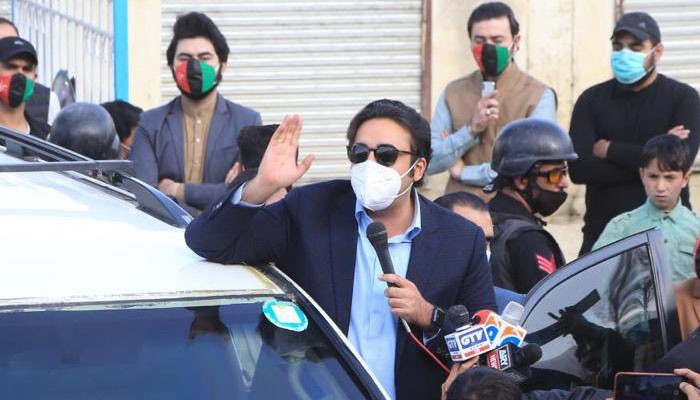
چیئرمین پاکستان پیپلزپارٹی بلاول بھٹو زرداری ضلع گانچھے پہنچ گئے ہیں۔ انہوں نے اسکردو ایئرپورٹ پر اپنے مختصر خطاب میں کہا کہ وہ گلگت بلتستان کے عوام سے منشور میں کئے گئے وعدے پورے کرنے کے لئے گلگت آئے ہیں۔ پیپلزپارٹی کے جیالوں کا سمندر ان کے استقبال کے لئے سکردو ایئرپورٹ پر موجود تھا۔ چیئرمین پی پی پی نے کہا کہ گلگت بلتستان کے عوام جس تاریخی معاشی بحران، بیروزگاری اور مہنگائی کا سامنا کر رہی ہے اس بحران سے صرف پاکستان پیپلزپارٹی ہی نجات دلائے گی۔
انہوں نے کہا کہ گلگت بلتستان کے آئینی حقوق اور عوامی مفادات کا تحفظ کروں گا اور شہید ذوالفقار علی بھٹو کے مشن کی تکمیل کروں گا۔ چیرمین پی پی پی کے استقبال کے لیے جگہ جگہ استقبالیہ کیمپس لگائے گیے تھے اور سکردو: بلتستان ڈویڑن کی اہم سڑکوں کو استقبالیہ بینرز اور جھنڈوں سے سجایا گیا تھا ۔ اس کے بعد گھانچے میں چیئرمین بلاول بھٹو کاسابق سینئر وزیر محمد جعفر اور دیگر رہنماﺅں نے پرجوش استقبال کیا گیا۔ بلاول بھٹو زرداری نے جنرل سیکرٹری پیپلزپارٹی انجنیئراسماعیل کے بھائی کے انتقال پر ان کے گھر جا کر فاتحہ خوانی کی۔
انہوں نے گھانچے میں ایک جلسہ سے خطاب کرنا تھا جو انجینئر اسماعیل کے بھائی کے انتقال کی وجہ سے ملتوی کر دیا اور گانچھے میں تین روزہ سوگ کا اعلان کیا۔
https://www.ppp.org.pk/pr/23966/