Friday, November 29, 2013
Troubled history hangs over Pakistan’s new Army chief
Drone strike kills 3 in North Waziristan
The Express Tribune
 A drone strike in North Waziristan early Friday killed three, Express News reported.
The unmanned aircraft fired two missiles in Miranshah town at a time when many in the country are protesting against the CIA drone campaign.
The timing is further controversial as the strike comes on the eve of Pakistan Army’s change of command ceremony where Chief of Army Staff General Ashfaq Parvez Kayani will hand the baton to his successor General Raheel Sharif.
Express News correspondent Nasrum Minallah reported that the drone remained in the area for a while after the attack, flying very low.
It could not be ascertained whether the drones targeted a vehicle or a compound.
The Pakistan Tehreek-e-Insaf-led (PTI) government in Khyber-Pakhtunkhwa has held an increasingly anti-drone stance with regular sit-ins being arranged to protest against the strikes.
The November 21 drone strike, which killed six people and injured eight others in the populated area of Hangu, had angered the people in the province further with many political parties, including PTI and Jamaat-e-Islami blocking the Nato supply routes.
Drone damage
The Pakistani government officially condemns drone strikes as a violation of its sovereignty and this has been a contentious issue between the two countries. Prime Minister Nawaz Sharif during his visit to the US urged President Barack Obama to halt the programme.
Despite their deep unpopularity in Pakistan, the US sees them as a vital tool in the fight against militants in the tribal areas.
The number and identity of casualties is often hard to determine because the tribal areas are off-limits to foreign journalists and aid organisations, but the London-based Bureau of Investigative Journalism estimates deaths at between 2,500 and 3,700.
Hundreds of civilians have died in the attacks, according to various estimates, prompting outrage in Pakistan and abroad.
A major report last month from rights campaigners Amnesty International said the US may be guilty of war crimes.
Thursday, November 28, 2013
U.S. troops mark Thanksgiving in Afghanistan
U.S. forces enjoyed turkey, sweet potatoes and pumpkin pie as military bases throughout Afghanistan marked the Thanksgiving holiday.
America isn't leaving the Middle East, unfortunately

Seumas Milne
Remember how we got here. Three months ago, the US, Britain and France were poised to launch yet another attack on an Arab and Muslim country, this time war-wracked Syria. An unexpected, and unprecedented, vote by British MPs halted the bid to escalate the war. That stiffened resistance in the US Congress. As Obama struggled to win support, Russia seized the chance to press for the UN-supervised destruction of Syria's chemical weapons. A deal was reached and the threat of attack abandoned. A couple of months on and Iran, Syria's closest ally, has now signed an agreement with the big powers to limit its nuclear programme in exchange for sanctions relief – and Syrian peace talks are back on the agenda for the new year. The west's August attempt to confront the Iranian-Syrian "axis of resistance" has been turned on its head. Russia has been bolstered without lifting a finger. The closest US allies in the Middle East, Israel and Saudi Arabia, are crying betrayal and demanding their supporters sabotage the deal in Congress. In fact, both agreements simply reflect a recognition of reality after 12 years of failed wars of intervention across the Middle East. In the case of Syria, despite covert intervention by western and Gulf states, the Assad regime has been gaining ground as the rebel camp slips further into the grip of al-Qaida-linked sectarian jihadists. When it comes to Iran, the Shia Islamic republic has been hugely strengthened by the west's war on terror and the US-British invasion of Iraq in particular. Sure, Iran has been hurt by sanctions imposed by nuclear-armed states and the campaign of assassinations and sabotage waged by the US and Israel. But the restrictions on its uranium enrichment programme agreed in Geneva on Sunday are significantly less onerous than those Iran offered in 2005, when its proposal of a centrifuge cap of 5,000 was rejected by the US out of hand. It now has upwards of 16,000. What has changed is that the costs of confrontation with Iran have escalated for the US; the credibility of an all-out attack on Tehran is now vanishingly small; the west's Arab allies are in turmoil or immersed in an unwinnable regional sectarian war – and Iran holds a key to conflicts the US wants defused or settled, from Palestine to Afghanistan. Whether the nuclear agreement lasts or goes further, Geneva is a measure of realism in a region turned upside down by increasingly bizarre alliances. Take Israel, the secular Jewish state, and Saudi Arabia, the Sunni sectarian autocracy. They are now not only working hand in glove against Iran, but both strongly backed the abortive attack on Syria and championed July's military coup against the elected Islamist president in Egypt. The US-backed theocratic Saudi dictatorship, along with the UAE, Jordan and Israel, are now in close alliance with the secular military regime in Cairo – which is busy buying weapons from Syria's ally Russia – while Saudi Arabia and other Gulf states are the main backers of Islamist and jihadist rebel forces in Syria. In fact, the Saudi authorities have been offering to release their own jihadist prisoners if they agree to go and fight in Syria and Lebanon with al-Qaida-linked groups such as the Islamic State in Iraq and Syria. Meanwhile, Islamist Turkey, which also backs the Syrian rebels, is trying to move closer to Iran. The chaos and cross-currents are a product of the war on terror and the Arab uprisings that flowed out of it nearly three years ago. The campaign that began in Afghanistan, and passed through the destruction of Iraq via drone wars against the terror groups it fuelled, reached its last phase in the attempts to hijack or crush the popular revolts across the Arab world. At every point, the war has failed in its stated aim of fighting terror and left a trail of destruction, death and sectarian conflict in its wake, from Pakistan to Libya. It has also revealed the limits, rather than the extent of US and western power to impose its will by military force. And it's that strategic defeat and overreach – paid for at such great human cost – that has been reflected in the deals made with Iran and Syria this autumn. The US administration has now signalled it wants a more modest engagement in the Middle East, focused on Iran, Syria and the Israel-Palestine conflict, as it "pivots" towards Asia and the rising power of China. "We've got interests and opportunities in that whole world," as Obama's national security adviser, Susan Rice, puts it. That's been interpreted by some as the prelude to a US withdrawal from the most directly western-dominated region in the world, encouraged by declining US dependence on Middle East oil. That would be too much to hope for. The US has been boosting its military presence and archipelago of bases in the Gulf, and the Middle East will continue to be crucial to the global energy market. But the failure of the war on terror and US decline means it is likely to try to use a reduction of tension with Iran to streamline and scale back its military involvement. Which would, of course, be welcome for the people of a region trying to carve out their own future. The west's baleful terror war will carry on across the Arab and Muslim world in the form of drone attacks and special forces operations. But the appetite for full-scale air and land campaigns seems to have exhausted itself. That can only be good for all of us.The Iran nuclear deal is a product of the failure of the war on terror. It should at least hand more control to the region's people
China: B-52’s defiance no reason for nervousness
 The Pentagon revealed Wednesday that the US had flown two unarmed B-52 bombers over China's newly established East China Sea Air Defense Identification Zone (ADIZ) on Tuesday morning. The Pentagon claimed the flight was part of a long-planned training exercise in the area on the one hand and demonstrated its defiance against Beijing's new air defense rules on the other.
China's Ministry of National Defense responded to the so-called mission carried out by Washington by saying that it had monitored the entire process of the US bombers through the zone. The US deliberately ignored the existence of the new ADIZ of China which, however, made a powerful reply that the zone is in operation.
 According to some reports from international media and reactions from Chinese Web users, the US seems to have gained the upper hand with its action that plunged China into a relatively passive situation. Nonetheless, it should be noted that the ADIZ has indeed given full play to its role of national defense.
Tokyo and Washington are unlikely to accept China's ADIZ through which Beijing will master all the US and Japanese military activities over the East China Sea. In actuality China will not inform them of its aircraft passing through their Air Defense Identification Zones. Not identical to airspace, the ADIZ is supposed to devote its role of identification to safeguard national security.
The air defense zone, however, has become a trigger of a political row over the East China Sea because it overlaps with the Japanese ADIZ over the Diaoyu Islands. Objectively speaking, China's establishment of the zone is conducive to identifying aircraft and thus avoiding unexpected frictions, but takes on another implication in public opinion.
Beijing has made a rather normal response to the flight of the two B-52 bombers by following and supervising them. What's unusual is that the US took a deviant move when disclosing that they had "conducted operations" in the area of the Diaoyu Islands and publicly posed a challenge to China's defense rules. This has nothing to do with military frictions but can only be viewed as a war of public opinion directed against Beijing.
China's ADIZ withstood the test but we failed in offering a timely and ideal response as we have been inundated with an inconceivably large amount of information that is adverse to the new zone and will probably even undermine the image of our military forces in this transient Internet age.
Therefore Chinese authorities must make speedy reactions to various emergencies and challenges and delegate such power to relevant departments and officials, who should meanwhile assume more responsibility to cope with sensitive issues.
Beijing needs to reform its information release mechanism to win the psychological battles waged by Washington and Tokyo. Increasing morale and cohesion of the Chinese people constitutes the fundamental cornerstone to properly handle diplomatic relations.
China dismisses Japanese claim of altering status quo
 China's Air Defense Identification Zone (ADIZ) over the East China Sea is completely justified and legitimate, Defense Ministry spokesman Yang Yujun said on Thursday.
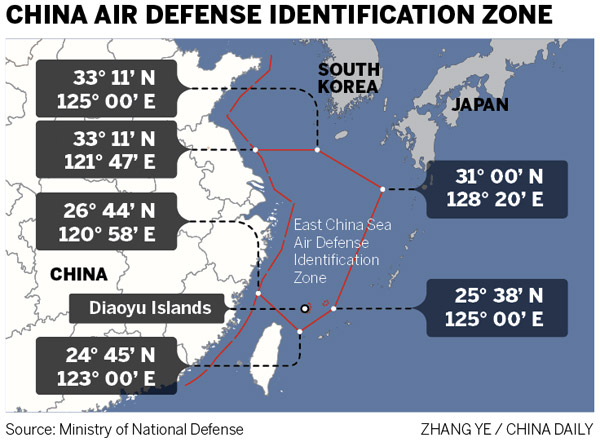 Yang's comments were in response to a question about Japanese media reports that China had altered the status quo unilaterally by announcing the ADIZ on Saturday.
"Japan has always accused or tarnished other countries without reflecting on their own deeds," Yang said at a regular news briefing.
Japan announced in September 2012 that it would "purchase" the Diaoyu Islands despite strong opposition from China. It has frequently sent vessels and planes to detect Chinese ships and planes in regular navigation or training, which has severely hampered the freedom of navigation and overflight, Yang said.
Japanese Coastguard warships intruded into the drill area of the Chinese navy on the high seas and interfered in their normal military exercise, Yang said.
Japan also boosted its military capacity under various disguises, attempting to change the post World War II international order. Japanese authorities play up the so-called China threat through the media and openly create confrontations, Yang said.
"Who is changing the status quo, accelerating regional tension, confrontation and jeopardizing regional security? I think the international community will make a fair judgement," the spokesman said.
Japan established its own ADIZ in 1969, therefore it has no right at all to make irresponsible remarks on China's ADIZ over the East China Sea, said Yang.
Japanese Prime Minister Shinzo Abe said on Monday that Japan was seriously concerned over the "unilateral" setup of the ADIZ and urged China to "retract the decision."
"Should the decision be retracted, we ask the Japanese side to revoke its ADIZ first, we will then consider their demand 44 years later," Yang said.
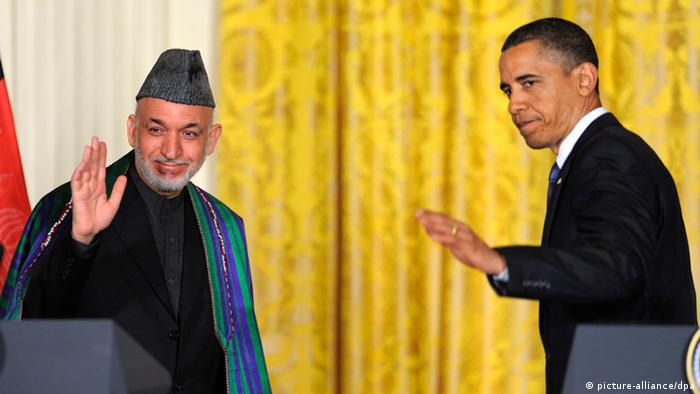
Karzai, Obama play poker with Afghanistan
The strained relationship between the US and Afghan governments has descended into sheer brinksmanship over the bilateral security agreement. And it would be in no one's interest if the deal collapsed.
Pakistan Army's Senior most-officer after General Kayani, resigns ( Silent Protest )

Lt General Haroon Aslam has taken early retirement and tendered his resignation on Thursday. His resignation letter has been sent to the Defence Ministry from GHQ. Haroon Aslam had been serving as the Chief of Logistics Staff at the Army GHQ and was the senior most-officer after General Kayani. His resignation came a day after General Raheel Sharif was appointed Army Chief and General Rashad Mahmood CJCSC. Lt Gen Haroon Aslam registered his silent protest by not attending the prime minister’s dinner on Wednesday night. Sources claim that the corridors of power were already abuzz with the information that General Haroon had played a key role as Director of Military Operations on October 12, 1999 along with the-then DGMO Major General Shahid Aziz to oust Nawaz Sharif from power. Then, Brigadier Haroon led the team to arrest all the cabinet members, including the then Prime Minister Nawaz Sharif. “Yes, Haroon was one of the two directors at the MO Directorate, under my command, who did whatever I ordered him to do on October 12, 1999,” Lt Gen (retd) Shahid Aziz told on July 7, 2013. Aziz was then a major general and DGMO who has openly confessed to his role in the last military coup in his recently-published autobiography ‘Yah Khamoshi Kahan Tak’. However, Shahid had added in the same breath that all the senior generals, including Haroon Aslam, were fit for the slot of the chief of army staff. On the other hand, Lt Gen Haroon had his side of the story that he used to tell his confidants. “What he did was not on his own. He was following the orders of his chain of command.” Another possible reason Lt Gen Haroon Aslam could not win any slot, according to the sources, is that he was a Special Services Group commando and Nawaz Sharif does not like commandos, particularly after his experience with Gen Pervez Musharraf. The sources in Islamabad also claim that somebody had already whispered to Nawaz Sharif regarding the background of Lt Gen Haroon Aslam. Yet another reason of Gen Aslam losing the top slot is the opinion of outgoing army chief Gen Kayani who was against the appointment of Haroon on any slot. The sources also claim that the newly-appointed Chairman Joint Chiefs of Staff Committee General Rashad Mahmood was a full colonel working with the Chief of Staff to the Corps HQ on Oct 12, 1999 in Rawalpindi. However, he did not land in any controversy. Gen Aslam, as a token of silent protest, did not appear in the dinner hosted in the Prime Minister’s House on late Wednesday night. The sources had already predicted that he would tender his formal resignation today to the Defence Ministry and move to Lahore for finalising his future plans, thus, did not attend the change of command ceremony as well.
Afghanistan's Karzai stands alone in high-stakes game with U.S.
New Film, Protests Highlight Disappearances In Pakistan
 The movie is based on the "true" story of a young Baloch activist, Nasir Baloch. Activists in the region claim Baloch was abducted twice in 2011. He reportedly survived the first abduction after he was shot and left for dead. He was later killed after being kidnapped for a second time while on his way to the doctor to treat his wounds.
The thriller was produced by Baloch political activist Noordin Mengal, his brother Bhawal Mengal, and British filmmaker David Whitney. Mengal says his aim was to spread awareness about the problems in the province.
The issue is also kept alive by family members of some of the victims of the disappearances in Balochistan. They are now holding a 700-kilometer-long march from Balochistan's provincial capital, Quetta, to Pakistan's largest city, Karachi.
The protest, which began in late October, is being led by Mama Qadeer Baloch, whose son, Jalil Reiki, was abducted in 2009. His bullet-riddled body was found dumped in a remote corner of Balochistan in 2011.
Global human-rights watchdogs have criticized Islamabad for its "kill and dump" operations in Balochistan. A February 2012 briefing by Amnesty International noted that at least 249 Baloch activists, teachers, journalists, and lawyers disappeared or were abducted from October 2010 to September 2011. The briefing called on Islamabad to "immediately put an end to the practice of enforced disappearance, arbitrary detention, torture, and extra-judicial and other unlawful killings carried out with total impunity by state forces in Balochistan."
In a July 2011 report titled "We Can Torture, Kill, or Keep You for Years," Human Rights Watch (HRW) documented the "detailed descriptions of 45 cases of alleged enforced disappearances reported in Balochistan in 2009 and 2010." It called on Islamabad to "investigate all allegations of enforced disappearances until the fate of each victim is clearly and publicly established."
For years, the Pakistani Supreme Court has heard cases about the abductions but failed to push the authorities to either release the victims or hold transparent investigations into the issue. Elected civilian leaders in Balochistan have publicly admitted their failure in resolving the problem. Military officials, however, have largely been ambiguous about the practice.
Authorities in Balochistan now confirm some 2,500 people in the province remain "missing" since their arrest. Balochistan authorities say more than 590 mutilated bodies have been found in the province since 2010.
Baloch activists allege that more than 10,000 people, most of them sympathetic to separatists, have disappeared under unclear circumstances.
RawalPindi Police Chief: “No student of Taleem ul Quran killed in Rawalpindi on Ashura”
www.shiitenews.com
False propaganda and lies being spread by the Deobandi fanatics and outlawed terrorist outfits about Pindi incident exposed on Wednesday when Rawalpindi Police Chief said that not a single student of Madressa Taleem ul Quran was killed on the day of Ashura. Talking to reporters, DIG Akhtar Umer Hayat Laleka, CPO Rawalpindi, said that in all 11 people were killed but they included no student of the said religious seminary. It is relevant to add here that pro-terrorists and pro-rioters Deobandis had been claiming that 90 persons including women and children were killed that proved bundle of lies because no women or child were among the deceased.
Pakistan: Whither PTI?
Nothing good has ever come from a marauding militia roaming the streets menacingly demanding of anyone who crosses their path, “Papers, please?” The sinister belief that patriotism can be judged by papers has now slunk into Peshawar, courtesy the PTI and its allies. Those to be tarred, blacklisted, excluded from right-thinking society are those truck drivers who have the temerity to deliver goods meant for Nato forces in Afghanistan. Legality and morality are two entirely different beasts so let us distinguish ourselves from Imran Khan’s vigilantes and not judge whether the truck drivers are right in aiding the US war effort. What we cannot deny is that they are entirely within their rights to earn a living this way. The Pakistan government has an agreement with the US and Isaf forces to allow our territory to be used as a transit point. We can suspend or revoke that permission at any time – as we did after the Salala incident – but the proper authority for doing so is the duly elected government. This may sound like Civics 101 but there are many who seem to believe that there is an Imran Khan veto carved out in the constitution. If the PTI leader doesn’t like anything it stands invalidated. The truck drivers may be making an honest living doing lawful work but the PTI as a party has explicitly endorsed mass lawbreaking across Khyber Pakhtunkhwa. Private citizens, even if their patrons happen to lead the provincial government, do not have the right to brandish weapons, demand identification and then take whatever action they see it. That is how mafias, normally a suffix we append to those organised elements illegally profiting from land, timber, construction etc, operate. Until the PTI keeps up this shakedown they should be considered a mafia, not a political party. In this regard, the PTI is a lot like the MQM which shuts down the city every time its sensitive feelings are offended. For a columnist to point out the hypocrisies of politicians is like Dale Steyn bowling to Mohammed Hafeez: there is just no way to miss the target. The job description of politicians forces them to pay tribute to virtues that no human could consistently maintain. Even accepting that a certain amount of vice is to be expected, maybe even tolerated, among the political class, the PTI has demonstrated staggering hypocrisy. Here they are forcibly and illegally trying to deny truck drivers their income because they believe that US government money has been tainted by their illegal drone war. At the same time, the Khyber Pakhtunkhwa government continues to gobble up money from the same US government. More than 10 percent, or Rs 35 billion, of the province’s revenues come from foreign aid. The US is one of the largest contributors of foreign aid. A single stroke of the pen and the PTI can rid itself of this tainted money. Instead it sends vigilantes to deny a living to those who need the money most.Nadir Hassan
Even when the PTI is right about something, it manages to end up being wrong. The drone strike in Hangu was an outrage, as were all the other attacks before that. The legality of the strikes is questionable at best. But even an entity like a political party that has little to gain from nuance should be able to hold more than one thought at a time. Yes, drone strikes should be condemned but the condemnation should be proportional to that dished out to other actors who are massacring us. The party may also warn about causality. To claim that an end to drone strikes will cause an end to terrorism is ludicrous. A far more credible argument would have been that the fear and loss of life caused by drones adds to terrorism by minting fresh militants who may not have otherwise signed up for the cause. But ‘drones are pretty bad but everyone else is even worse’ is not the sort of rhetoric that brings out the repressed inner cop in thousands of overexcited supporters. The tempting analysis is that the PTI has failed to mature from a party that existed only to generate fervour among the apolitical and condemn everything the PPP and PML-N stood for. That they haven’t yet learned that governing requires patience and compromise and lots of hard work. Such an interpretation wouldn’t be quite true. The party’s chief minister is a practiced politician – imbued with all the good and bad that entails – and the first budget it presented in the provincial assembly was impressive in its attention to detail. The Right to Information Law the party has championed is much better than the one that exists at the federal level. Still, the PTI continues to succumb to its desire to suck up all the media oxygen on issues that could do with a lot less sensationalism. This is why Imran Khan asks for drones to be shot down, even though he must know that it will trigger an unwinnable war with the US. This is why he doesn’t stop his activists from taking over the streets. This is why his first inclination is to indulge in theatrics every time he disagrees with the ruling party. There is a danger that the PTI will end up becoming like its ally, the Jamaat-e-Islami – a party for which street power is more crucial to maintaining its influence than representation in parliament. Instead of becoming a truly national party that can break the PPP-PML-N rut, the PTI may just end up becoming an irritant, there only to agitate against the ruling parties rather than govern itself. Our democratic project would be the biggest loser should this happen.
Pakistan: 'PTI-JI's Politics of sit-ins'

Editorial:Politics of sit-insPrima-facie, the PTI-sponsored sit-ins to block the Nato supply route through KPK over the last couple of days have not achieved what these were supposed to. It is not that sit-ins were defied and the Nato container-trucks crashed through them; a few truckers did turn up but were forced to return by angry protestors. The fact, however, remains that neither the Nato countries nor the government of Pakistan made any noticeable move as a response to sit-ins. Will they do it in near future? That is anybody's guess. But what the sit-ins did bring into play was gross disarray and disorder that prevailed as the protestors tried to interdict by force the traffic along the route which is also used by the local and Afghan transit trade transporters. There were quite a few scuffles when drivers refused to produce relevant documents to protestors, insisting that they were not bound to be checked or examined by anyone other than authorised officials. How come a party in power in a province creates a situation which results in flagrant violation of laws it is supposed to implement. This is certainly a display of street power; an art successfully honed by the Jamaat-i-Islami, PTI's coalition partner, and should have been discouraged by the country's second most popular political party. That the local police have now registered cases against those who took law into their own hands is as melodramatic as the sit-ins. How can you be both a custodian and a breaker of the law of the land? Blocking the Nato supply route by force is not the issue; the issue is: Should this route be blocked? Should the government decide to do so, it would be possible even without a one-man sit-in. In late 2011, the government blocked the supply route in protest against the killing of 25 soldiers in a cross-border incident and kept it in force for more than a year - till the offenders apologised. There is just no parallelism between the two blockades as some PTI leaders would like us to treat. At that time, it was the government's well thought-out move. Blocking Nato supply route should be acknowledged as a government prerogative; the PTI and its allies in power are expected to expend their energies towards the betterment of the people of the province under their control. Have they done it? Of course, the Nato can sleep over this 'irritation' and wait the sit-ins out, but not the others who too are being scared away from using the said route. Not only has the Afghan government protested the disruption of its transit traffic through the Khyber Pakhtunkhwa, hundreds of local truckers also have gone off the route fearing violence by protestors. The leaders of the PTI and its coalition partners were offered tea by the US consulate official when they turned up to hand their protest memorandum - indeed a measure of the opacity Pakistan is confronted with on the issue of drone strikes. That the Hangu police can investigate the CIA or the US ambassador in Pakistan in connection with the drone strike that killed seven persons is a misperception that requires the PTI leader, who filed the FIR, to rethink his take. Is it that the PTI leadership honestly believes that the drones will stop coming because of these sit-ins or the FIR filed by it with the Hangu police station. Who is this party trying to befool? The crisis Pakistan is presently confronted with is too grave and lethal to be tackled on the streets. Yes we are a sovereign state, like 190-plus others, but in this interdependent world absolute sovereignty is a myth. The bitter truth is that Pakistan not only invited drone strikes, but even joined them for reasons thought cogent and in national interest as defined by the government of the day. And, this is also a hard fact that the government of today is not prepared to take the risk by shooting down drones or blocking the Nato supply route. The PTI leadership would do well by putting across its position on drones to the federal government with strong enough argument with a view to winning over its acquiescence. And even before that it should seek to win over the confidence and support of its political opposition in the province. Sit-ins do work, but when at stake is the question that is as fundamental as Pakistan's multifaceted bilateralism with the Unit ed States and the Nato countries then that cannot be decided on the highway.
Peshawar: Day and… : ANP says supplies move freely at night
The Express Tribune
The Pakistan Tehreek-e-Insaf’s (PTI) campaign to block Nato supplies is nothing but an act to deceive the public as the supplies are openly transported at night instead, said Awami National Party’s (ANP) Mian Iftikhar Hussain in Chota Lahor, Swabi during a ceremony on Tuesday. Chief Minister Pervez Khattak can just block the routes used to transport Nato supplies through the province by issuing an executive order, argued Mian Iftikhar. He claimed a few PTI workers standing at different parts of the route cannot stop the supply till the chief minister issues said order. While talking about the party’s membership drive and elections, he said anyone who wanted to have a designation in the party should submit an application and contest in party elections. Hussain was speaking at the event with the ANP’s Basheer Matta, Sardar Hussain Babak, Shagufta Malik and Arbab Tahir.
Pakistan: The Hangu strike and the Haqqani network
While the PTI’s stance on the drones and terrorism is naïve at best and dishonest at worst, the PML-N has also been mum about the HQN’s top moneyman Nasiruddin Haqqani’s assassination Another US drone strike last week near Hangu wiped out six associates of the Jalaluddin Haqqani terrorist Network (HQN), namely Kaleemullah, Abdul Rahman, Mufti Hamidullah Haqqani, Maulvi Ahmed Jan, Abdullah and Gul Marjan. Maulvi Ahmad Jan was a confidant of the HQN’s de facto boss Sirajuddin Haqqani and a financier and operational point man. The federal government, except its volatile interior minister Chaudhry Nisar Ali Khan, played down the incident and was content with a run-of-the-mill protest with the US ambassador. The ruling party in Khyber Pakhtunkhwa, the Tehreek-e-Insaf (PTI), and its coalition partner Jamaat-e-Islami (JI), however, went to town over the incident. After holding a protest rally this past weekend, the PTI has been blocking the NATO supply route through Peshawar on a daily basis and has asked the provincial police chief to name the US and CIA in an FIR it has filed about the drone attack. While the PTI’s formula — stopping drone attacks and disrupting NATO supply lines — ostensibly to bring peace to the region, is essentially the same as that of the Tehreek-e-Taliban Pakistan (TTP), it does have the right as the provincial government to find out about the drone strike in its territory. The PTI also has the responsibility to explain what exactly the HQN men were doing in the settled areas of Pakistan. The PTI chief, Mr Imran Khan, has claimed that many children were killed in the Hangu attack. He may wish to back up his claim with some evidence now. Mr Khan should also tell whether his provincial administration had secured the crime scene and if it indeed did, how were the bodies moved to North Waziristan (NW) Agency instantly? While the PTI’s stance on the drones and terrorism is naïve at best and dishonest at worst, the PML-N has also been mum about the HQN’s top moneyman Nasiruddin Haqqani’s assassination. Interestingly, the Islamabad crime scene was hosed and Nasiruddin’s corpse shipped to and buried in NW within hours. It is well known that Jalaluddin Haqqani’s brothers, Ibrahim and Khalil, have been in and out of the Islamabad/Bhara Kahu area for several years now. The HQN men have reportedly travelled from Pakistan to the Gulf Arab countries for fundraising. The practice originally started with Jalaluddin Haqqani himself who used to set up shop in Saudi Arabia at pilgrimage time to raise money and was perfected by his sons and associates. In tandem with the mystery around Nasiruddin Haqqani’s assassination has been the theory that the Pakistani security establishment has decided to abandon the HQN. A change in the Pakistan army’s, especially the ISI’s, mindset about its longest uninterrupted alliance with a jihadist group would certainly be welcome but it just sounds too good to be true. During the war against the Soviets and the Afghan communists, the ISI crossed over into Khost to help Jalaluddin Haqqani’s men recapture their infamous Zawara base, which had fallen to the Afghan army. Several writers, including the ISI’s mujahideen handler Brigadier Mohammad Yousaf, have chronicled the battle in detail. If, and that is a huge if, the Pakistani establishment drops the HQN as a partner, that would imply a paradigm shift in not just its Afghanistan policy but will have ramifications for how other jihadist groups are handled. The Pakistani security establishment has abandoned its partners before, replacing the Afghan mujahideen with the Taliban, the JI with the Lashkar-e-Taiba (LeT), and has discarded many Kashmiri militant factions too. In each of those instances, the replacement was more radical and ostensibly more manageable. The incentive or inducement for the establishment to cut the HQN loose now and the alternatives it might be looking at, may explain the professed change of heart. While the HQN was never the only show in town, the security establishment favoured it perhaps more than even Mullah Omar’s Taliban. While the HQN has had a symbiotic, not just patron-client relationship with Pakistan, it has grown too big for its size. The extortions, drug running, killings on Pakistani soil and, above all, the perpetual protection the HQN has given to the TTP have become increasingly hard to defend. One proposition could be that (facilitating) the decapitating attacks on the HQN will make it more pliable. A more manageable HQN could pull the rug from under the TTP as well as the Afghan Taliban’s feet. The TTP is unlikely to negotiate and will have to be tackled militarily. The Afghan Taliban are more amenable to dialogue and perhaps more so if they lose the HQN pivot. Could Pakistan be betting only on the Afghan Taliban in the last lap then? It is unlikely that the Taliban can or will score a decisive victory post-2014, especially if the bilateral security agreement (BSA) between the US and Afghanistan goes through. President Hamid Karzai’s tantrums notwithstanding, the BSA will eventually be signed as the US does not appear ready to leave the field open to al Qaeda and its allies like the HQN. If this scenario pans out, the Taliban might get seated in Kabul but not at the head of the table. The US has moved from trying to pry away the HQN from the Taliban, to designating it as a terrorist organisation, to decimating its top echelons now. The HQN has been known to be resilient but its time may just be up after all. The Pakistani security establishment may or may not have had a change of heart in the absence of any viable alternatives to its most favoured proxy. But, with the ringleaders of a designated terrorist group being found and killed on Pakistani soil, making unnecessary noise could have serious consequences. Chances are that the Haqqani terrorist network’s fate was presented to Pakistan as a fait accompli.Dr Mohammad Taqi
Pakistan: Lawyers attack Supreme Court
 THE commotion in the Supreme Court on Tuesday proves that despite the passage of 16 years, little has changed in Pakistan. The only difference is that in 1997, it was PML-N supporters that had stormed the Sajjad Ali Shah-led court, while in the latest incident it was protesting lawyers from different parts of Punjab who attacked the nation’s highest seat of justice. The irony is quite evident: earlier it was political hotheads who had led the charge, angered by contempt charges against Nawaz Sharif, who was prime minister at the time. On Tuesday, it was members of the legal profession, who not too long ago had struggled for the ‘supremacy’ of the law and restoration of sacked Supreme Court judges, that were rampaging through the apex court. The incident is one of many in recent memory that clearly indicates the transformation of lawyers as a group from activists to vigilantes. The lawyers in Islamabad were ostensibly protesting against the non-establishment of high court benches in various Punjab cities. However, as past incidents have also proved, the black coats often resort to violence if things do not go their way. Lawyers accuse the police of resorting to brutality to break up the protest. While the unnecessary use of force by police cannot be condoned, the lawyers did not help the situation by delivering fiery speeches outside the court.
The lofty reputation the lawyers had earned through their movement for the restoration of the chief justice has all but disappeared, thanks to the thuggish behaviour of some amongst them. Members of the legal fraternity have clashed with the police, journalists as well as other lawyers while judges have been intimidated in the days since 2007. But what is most troubling is the relative silence of bar associations and senior lawyers regarding the violent tactics of their fraternity. Either bar councils have kept quiet or slapped violent elements on the wrist for aggressive behaviour. Unless this attitude changes, it is unlikely such ugly incidents will end.
Pakistan: Mother of new Army Chief wants elimination of terrorism
The mother of Chief of Army Staff-designate, Lieutenant General Raheel Sharif Wednesday said she wanted terrorism to be eliminated from the country, Geo News reported.
In an exclusive interview to Geo News sometime back, the new COAS’s mother said that those who look after their parents and work hard do achieve success in their lives.
She was of the opinion that the civil government should always consult their soldier brothers for ‘purging our beloved country of the scourge of terrorism’.
“The youth should put in sincere and dedicated efforts to deal with the challenges faced by Pakistan,” said the daughter of a soldier, widow of a martyred husband and mother of a martyred son.
About her five children she said, all of them love one another.
Bilawal Bhutto congratulates new CJP
http://mediacellppp.wordpress.com/
 Patron-in-Chief of Pakistan Peoples Party Bilawal Bhutto Zardari has felicitated Justice Tasadduq Hussain Jillani for being appointed as the new Chief Justice of Pakistan (CJP) today.
He said nation hopes that rule of law will be restored and Pakistan will finally see a truly independent, unbiased and progressive judiciary with CJP Jillani in office.
Bilawal Bhutto felicitates new COAS, CJCSC
http://mediacellppp.wordpress.com/
 Patron-in-Chief of Pakistan Peoples Party Bilawal Bhutto Zardari has felicitated Lieutenant General Raheel Sharif and Lieutenant General Rashid Mehmood on their promotions and being appointed as the new Chief of Army Staff (COAS) and Chairman Joint Chief of Staff Committee (CJCSC) today.
In a press statement, he hoped that with the new military leadership in command Pakistan will be able to defeat its most dangerous enemy TTP and other terrorist organizations bent upon destroying our nation. He also said that nation bids farewell to General Ashfaq Parvez Kiyani who served his country with honour and dignity, and obeyed the constitution besides commanding a successful operation against terrorists in Swat, Malakand and other tribal areas.
Wednesday, November 27, 2013
INDIA: Laskhar-e-Taiba, 26/11 villain and India's enemy at the gates
 The spectacular terror attack in Mumbai five years ago that held the bustling city under siege for more than three days was planned and plotted to lift the spirits of the Lashkar-e-Taiba cadre. Ten suicide bombers were trained to undertake the long sea journey, hold hostages and inflict maximum damage on India’s financial nerve centre.
Apart from the havoc they wreaked at multiple locations in the city of dreams, the attacks were central to the Lashkar’s own survival as the ‘Army of the Pure’, the literal meaning of the outfit. Key conspirator David Coleman Headley alias Daood Geelani would reveal to officials from the National Investigation Agency (NIA), three years later, that the senior leadership of the LeT was having problems holding on to their cadre.
Headley, who made several trips to Mumbai to videograph the key locations which were finally targeted on 26/11, was at one point, also willing to shift to al Qaeda.
An NIA document that contains extracts from his confession reveals that a year before the Mumbai terror attacks, Headley had dinner with LeT’s military chief Zaki-ur-Rehaman Lakhvi in Muzaffarabad.
That was the time, Headley says, "My country, Pakistan, was undergoing an identity crisis in the wake of the happenings in Afghanistan and FATA areas of Pakistan. A debate had begun among the outfits whether to fight in Kashmir or in Afghanistan. The 'clash of ideology' led to splits in many of the outfits. The decision of Abdur Rehman… to split from LeT and fight in Afghanistan was part of this trend. Zaki had a serious problem in holding the LeT and convincing them to fight for Kashmir and against India."
The most chilling line in Headley’s confession, reads, "I understand this compelled the LeT to consider a spectacular terrorist strike in India… this accelerated the Mumbai attack project. Earlier, it was a limited plan to attack only Taj Hotel in Mumbai with a couple of attackers like it used to happen earlier. But now it seemed to be a grand plan of LeT to strike Mumbai at multiple locations with multiple attackers.”
Five years after the terrorist strike, the Lashkar has not lost sight of its enemy. India remains that enemy.
Two weeks after the Mumbai attack, I had the occasion to visit the Lashkar’s headquarter in Muridke, a small town on the outskirts of Lahore. Ajmal Kasab – the lone LeT terrorist caught alive and later hanged – had told his interrogators that he had initially been trained in Muridke. While there, when I asked my handlers – one of whom was the son-in-law of Lashkar chief Hafiz Saeed – they made no effort to distance themselves from Kasab. When asked if they considered India their enemy, the response was a swift and straight forward, "Without doubt."
Five years later, India’s security apparatus continues to prepare for the threat from Lashkar. At the conference of director generals of police, three days short of the fifth anniversary of the Mumbai attack, the only group Prime Minister Manmohan Singh mentioned in his speech was the LeT.
"Resurgence of terrorist groups, particularly Lashkar-e-Taiba and increased infiltration attempts call for heightened vigil and coordination by our security forces," he said in a reiteration of the threat from the LeT. The Lashkar hit hard when it was down and on the verge of a split. Today, it can hit even harder.
Former president Zardari welcomes Iran accord with West

China 'monitored' US bombers in new air zone
 China monitored the flight of two US bombers that flew across its newly-declared "air defence identification zone", its defence ministry said.
 'Manage and control'
The unarmed US aircraft took off from Guam on a flight that was part of a regular exercise in the area, US officials said.
A Pentagon official said the US had followed "normal procedures" during the bombers' flight and had not filed flight plans with China.
China says aircraft passing through the zone must obey its rules, including identifying themselves, or face "emergency defensive measures".
However, Wednesday's defence ministry statement after the US flight made no reference to any emergency measures.
"China's air force monitored the entire course [of the US bombers], identified them in a timely way, and ascertained the type of US aircraft," the statement said.
"China will identify all aircraft activity in East China Sea Air Defence Identification Zone", it added. "China has the ability to effectively manage and control the relevant air zone."
The US flight is being seen as a clear signal that the US will not recognise Chinese control over its newly-declared zone, correspondents say.
The flight will also reassure America's allies in the region - Japan in particular - that Washington will stand by its security commitments, reports the BBC's Martin Patience from Beijing.
But, says our correspondent, the big fear is that a misstep on the part of one of the parties could trigger a crisis.
New US Ambassador to Japan Caroline Kennedy, in her first speech since assuming her post, criticised China's move.
"Unilateral actions like those taken by China... undermine security and constitute an attempt to change the status quo in the East China Sea," she said in Tokyo.
'Provocation'

Afghanistan: U.S. Would Like to See BSA Signed 'As Quickly As Possible'
Khursheed Shah welcomes appointments of new military leadership
 Opposition Leader Khursheed Shah has welcomed the appointments of new Chief of Army Staff Lt Gen. Raheel Sharif and Chairman Joint Chiefs of Staff Committee Lt Gen Rashad Mahmood.
In a statement‚ he also congratulated both the generals for their appointment and expressed the confidence that they will work with zeal for protection of geographical borders of the country as well as tackling other challenges.
Profile: Lt General Raheel Sharif
Born in Quetta on June 16, 1956 to Major and Mrs Muhammad Sharif, newly-appointed army chief Raheel Sharif grew up steeped in the military tradition.
Sharif’s older brother, Shabbir Sharif, was a course-mate of General (rtd) Pervez Musharraf, and was killed during the 1971 war with India.
 He attained his formal education at Government College Lahore and later went on to attend the Pakistan Military Academy.
After graduation, he was commissioned in 1976 in the battle hardened and renowned 6th battalion The Frontier Force Regiment in which his elder brother was also commissioned.
As a young officer, he performed his duties in Gilgit in an infantry brigade and also served as adjutant of Pakistan Military Academy.
Over the years, Sharif climbed up the military ladder mentored by Musharraf who handed him command of the 11th Infantry Division in Lahore.
Despite the common surname, Raheel Sharif is not related to Prime Minister Nawaz Sharif, but is known to be close to tribal affairs minister Lieutenant-General Abdul Qadir Baloch, a key confidante of the Sharif family.
As a brigadier, he has commanded two infantry brigades including an independent infantry brigade group.
He has been the General Officer Commanding of an infantry division and the Commandant of the prestigious Pakistan Military Academy.
As a Lieutenant General, Sharif served as Corps Commander for two years before taking over as Inspector General Training and Evaluation in which capacity he oversaw the training of Pakistan Army.
On Nov 27, the government approved Sharif’s appointment for the slot of Chief of Army Staff, a position that he will be taking over from Ashfaq Parvez Kayani who will be stepping down on Nov 29 after serving as military chief for six years.
The general is married with two sons and a daughter.
Pakistan chooses moderate to take over as army chief
Interview: Karzai Says He'll Agree To Deal Once The U.S. Meets His Demands
 Hamid Karzai: The Afghans now want to conclude an agreement with the United States, and the Loya Jirga has done well in backing it. We consider this agreement to be in the interests of Afghans. But our condition is to ensure the protection of Afghan homes. The Americans should stop attacks against Afghan homes. Another condition is peace in Afghanistan. If we don’t have peace, this agreement will turn into a disaster for Afghanistan instead of a blessing.
RFE/RL: Mr. President, the Loya Jirga has recommended adding 36 new clauses to the draft security agreement. One of the clauses recommends that you sign the agreement before the end of this year. The head of the Loya Jirga [former president Sibghatullah Mojadiddi] also demanded the same from you. So are you going to add these new clauses and sign the agreement before the end of 2013?
Karzai: I have demanded an end to all American attacks against Afghan homes and the beginning of a realistic peace process. Whenever the Americans meet these two demands of mine, I am ready to sign the agreement. And when these two demands are implemented, this agreement is in Afghanistan's interests. On the issue of elections, last night the U.S. national security adviser [Susan Rice] assured me that America is not going to interfere in the elections and that it wants the elections to be conducted on time. In addition, if possible, it wants to see the elections concluded in the first round and even if it goes into a second round [they are committed to back the process.] They have assured me about this. But I will see what happens.
RFE/RL: Are you saying that Susan Rice, the U.S. national security adviser, has assured you the United States will help in holding free and fair elections?
Karzai: I talked to the U.S. national security adviser about this and I explained to her the situation during the previous presidential election. I briefed her about how America and other Western nations interfered in the previous presidential election, how they delayed the election, how they maligned the first round ballot. Keeping in view that experience, and as the president of Afghanistan today, it is my duty not to allow foreigners to either malign Afghanistan's next presidential election or stretch the process so that they can manipulate it. She assured me that this time there will be no interference in our election. So for now, I have her assurance. But I am watching them to see whether they interfere in the election or not. And I will talk about it then.
RFE/RL: In your speech during the Loya Jirga, you demanded an end to operations or attacks against Afghan homes, help with conducting free and fair presidential elections, and support for a meaningful peace process. But it has been reported that in your talks with the U.S. national security adviser, you demanded the freeing of 17 prisoners from Guantanamo Bay. Is that true? What did you demand?
Karzai: This was a demand made by the jirga. If you look at the 29th clause of their recommendations, it says that America should release all Afghan prisoners at Guantanamo Bay immediately and hand them over to Afghanistan. So if the Americans want to implement the recommendations of the Loya Jirga, and one of the clauses that the Loya Jirga has recommended is an immediate signing of the security agreement, then they cannot ignore this other clause that demands the freeing of Afghan prisoners. Such things are not acceptable.
RFE/RL: In your view, why are the Americans insisting on signing this agreement soon?
Karzai: The Americans have their own agenda and their own plans. Whatever is behind their programs or their plans is up to them. But we Afghans need to have our own plans. We showed the Americans that Afghanistan wants friendship and an alliance with them. We are not against them. But in this friendship and alliance with the United States, the Afghans want to protect Afghanistan's interests. We don't want to stand against American interests. But we want to protect our homeland. And what are our homeland's interests? Our interest is to protect the homes of the Afghans from American attacks, night raids, and the unnecessary suffering of our people so that Afghan women and children are not forced to abandon their homes at night because of fears of American bombs and helicopters. You know well that in Afghanistan during the past few years people have taken their women and children to the mountains just to protect them from American attacks at night. It is impossible to have a security agreement with America while our people are still forced to leave their homes because of the fear of American forces. So if America wants to conclude a security agreement with us, America needs to respect the security of Afghan homes and let the Afghan children, men, and women live in their homes in security.
RFE/RL: Mr. President, after meeting you on November 25, Susan Rice said in an interview the United States is worried that after failing to convince you to sign the agreement, Washington may be prompted to plan the withdrawal of all of its forces from Afghanistan by the end of 2014. You also know that America is committed to spending billions of dollars on strengthening Afghan security forces and on security in Afghanistan. Are you ready to endanger this $8 billion or $9 billion in American aid?
Karzai: It is up to the Americans whether they want to stay or go. Even if we sign a thousand agreements with them, if it doesn't suit their interests they will leave -- just as they left Afghanistan alone in 1990s during the years after jihad. I was a deputy foreign minister then and I saw how the West abandoned Afghanistan after the Soviet withdrawal. I used to go to them and ask them to leave one junior official behind in their embassy. But they closed their embassy and left. So if it is not in their interest, they will never come here. If America wants to be in Afghanistan today, it is because of their own interests --- whether it is security interests or their major economic interests. As an independent nation, we have the right to protect and promote our interests.
RFE/RL: In your last speech to the Loya Jirga, you elaborated on one issue very clearly. You said that peace in Afghanistan is in the hands of the United States and Pakistan. Can you elaborate on that?
Karzai: Based on many reasons and I can prove this, the ongoing war in Afghanistan is being imposed on us and Afghans are being sacrificed in it for someone else's interests. We are not blocking the interests of the United States or other major powers. But we are demanding that if you consider Afghanistan the place from which to advance your interests, then you should also pay attention to Afghanistan’s interests. We are not demanding anything else.
RFE/RL: Mr. President, are you saying that Pakistan and the United States are responsible for the current instability in Afghanistan? And can they do anything to stabilize the situation here?
Karzai: To a very large extent, they are responsible. The Afghan government also shares this responsibility. Our weaknesses and our mistakes are part of this failure. But, as you know well, all of the major terrorist havens are in Pakistan, and the United States has said that the terrorist sanctuaries are in Pakistan. The American newspapers have repeatedly reported that U.S. contracts strengthen some of the armed factions. So why are they giving these contracts out? Six or seven years ago, I had a strong disagreement with the United States over these private companies. Who were these private security firms and why was I against them? These security companies were all of those people who were supported by the Americans and trained by them and who were being given up to $2 billion a year. And they were employed to protect American supply convoys. But in reality, they were a major cause for insecurity.
RFE/RL: Do you think that the Afghan security forces are able to deal with the Taliban on their own?
Karzai: This is our responsibility. We are all Afghans and we know each other well. Whether we would fight the Taliban or make peace with them -- that is our problem. Last year, during my visit to Washington, in a very important briefing a day before I met U.S. President [Barack Obama], his national security adviser Tom Donilon, and senior White House officials, generals, and intelligence officials, the national security adviser met with me. He told me: "The Taliban are not our enemies and we don't want to fight them." I told him "This is a very good thing and this is what we want. We have been urging you for years to stop bombing people and fighting people inside of Afghanistan. So if you don't consider the Taliban your enemies and don't want to fight them, then why are you raiding Afghan homes every night? If you don’t consider the Taliban your enemies, which are something I want you to do and am happy you have recognized, then why are you going into Afghan homes in the name of looking for the Taliban every night?" My question is whether this will go on after the security agreement. This is why I can never allow it to happen. The security agreement should end American operations.
Obama team ponders no troops in Afghanistan after '14
Tuesday, November 26, 2013
Sentenced in Saudi Arabia for peaceful activism
 By Waleed Abulkhair
Waleed Abulkhair is a human rights activist in Jeddah, Saudi Arabia.
Last month, a judge in Saudi Arabia sentenced me to three months in prison simply because I stood with victims of my country’s flawed and discriminatory criminal justice system.
Subscribe to:
Posts (Atom)