M WAQAR.....
"A man's ethical behavior should be based effectually on sympathy, education, and social ties; no religious basis is necessary.Man would indeed be in a poor way if he had to be restrained by fear of punishment and hope of reward after death."
--Albert Einstein !!!
NEWS,ARTICLES,EDITORIALS,MUSIC... Ze chi pe mayeen yum da agha pukhtunistan de.....(Liberal,Progressive,Secular World.)''Secularism is not against religion; it is the message of humanity.''
تل ده وی پثتونستآن
دوی دا تور هم ولګاوو چې له اوو مياشتو راهيسې ورته حکومتي مرستې بندې دي. دوی وايي چې ګڼ شمېر وزيرستاني کډوال دا وخت په افغانستان کې هم دي او حکومت يې د واپسۍ څه بندوبست نه کوي.
د کډوالو کمېټې مشر غلام خان د اګست په ۳۱ مه مشال راډيو ته وويل چې له حکومته يې غوښتنه ده چې د دوی مطالبې ومني کنه په پېښور کې به دهرنه پېل کړي:
(( موږ ته چې د حکومت لخوا د کورنۍ پر سر د مياشتې دولس زره روپۍ راکړل کېدې هغه بندې شوي دي .بل په افغانستان کې چې زموږ خلک دي او له هغو سره مېرمنې،ماشومان،څاروي او ګاډي دي نو هغه دې په عزت سره پاکستان ته راوستل شي.
او دا خبره هم ضروري ده چې حکومت دې ړومبې زموږ په سيمو کې امنيت راولي چې دارنګ هلته زموږ ژوند خوندي وي))
د پاکستان په قامي اسمبلۍ کې د شمالي وزيرستان منتخب استازی محسن داوړ د اګست پر ۳۱ مه مشال راډيو ته وويل چې دوی د کډوالو يادې ستونزې حکومت ته رسولي او تر هغو به په قلاره نه کېني چې دغه حل شوې نه وي.
A few years ago, my parents decided to perform Umrah (a lesser pilgrimage) to the holy city of Makkah in Saudi Arabia. Carrying Pakistani passports and belonging to the Ahmadiyya Muslim Community, a reformist community labeled and marginalized by a majority of Muslims as heretics and enemies of Islam, it was no surprise that they were concerned about their status quo and whether Saudi authorities would even allow them to undertake this journey. Nevertheless, driven by their love of Islam and their spiritual master, Prophet Muhammad PBUH, they mustered the courage to complete the Umrah.
In anticipation of their travel, my mother had to make a quick visit to a local ministry in Abu Dhabi (place of residence) where an officer asked my mother, what is your sect in Islam? Are you a Sunni or a Shia? My mother, with a cracking voice responded by saying she was an Ahmadi Muslim. The officer was rather surprised by her response and asked her again, is that Sunni or Shia? Lost for words she remained quiet to which the officer quoted the words of the declaration of faith, do you believe there is No God but Allah, and Prophet Muhammad PBUH is his Messenger? My mother responded in the affirmative, to which the officer agreed and stamped her passport for travel. I cant imagine the excitement and happiness my mother experienced in that moment, the relentless anxiety and worry, all but evaporated in this moment. My mother, a devout follower and a patient woman, felt all her prayers throughout the years were finally heard by the Almighty God.
The miracles of their journey didnt end with this incident but it has a deep link to the infamous blasphemy laws of Pakistan that have disrupted and destroyed nations before. Ahmadiyya Muslim Community is not recognized as an Islamic sect and given the current political climate in Pakistan, the community members are worried about their status after Tehrike Insaaf (a political party) leader Imran Khan has become a likely candidate for Prime Minister of Pakistan. In his recent remarks, Imran Khan has promised to defend the blasphemy laws. Whether this was a political statement to appease his right-wing supporters, or a genuine feeling, only time will tell. However, one cannot consider such a statement as benign because all tumors, no matter how small, eventually grow into full-blown aggressive cancers.
To fully comprehend this problem, I will narrate a historical perspective on this issue. Saudi Arabia is on a positive trajectory for world recognition having lifted the driving ban on women, opening cinemas and as an emerging leader in the stock market.
Not very long ago, all was not well in the Saudi Kingdom with its strict Shariah Law and an aristrocratic establishment that believed in a totalatarian style leadership. In the 1970’s, Saudi Arabia was responsible for its political campaign against Muslim minorities such as Shia, Ahmadi Muslims, Hindus and Christians which led many other Muslim countries to hold similar beliefs or worse. Pakistan, being a young nation in the 70’s, passed the infamous blasphemy laws in 1974 which barred Ahmadi Muslims and other minorities from declaring or practising their faith openly. Those who did were charged with blasphemy under the penal code and some were even sentenced to death.
Putting all of this into perspective, my mother journeying to Saudi Arabia and to openly declare to authorities that she is an Ahmadi Muslim was a brave act, but some may paint it as borderline eccentric. What good is faith if you cant openly declare it? Belief in something or someone is a fundamental right of every human being whether Muslim or otherwise. The Quran states “There is no compulsion in matters of faith” (Chapter 2 verse?). The Quran offers a simple yet comprehensive solution to all religious conflicts and matters of jurisprudience. We cannot assert our authority or incite violence or hate against any minority just because we disagree with their faith or vice-versa.
Muhammad Ali Jinnah, the founding father of Pakistan stated in his 14 points of constitution that “Full religious liberty i.e. liberty of belief, worship and observance, propaganda, association and education shall be guaranteed to all communities”. This clause says it all. Putting his faith into practice, his cabinet members comprised a devout Ahmadi Muslim, Sir Muhammad Zafrullah Khan and a Hindu, Jogendra Nath Mandal, as minister of law and labor.
All considered, Imran Khan may as well stand as a beacon of peace and reconciliation for our society, but I caution him and leaders alike. It is important to be versatile in approach and to prevent such laws from becoming the reason of a nation’s downfall. Let’s not forget that Achilles was only as strong as his heels.
Read more at http://www.beliefnet.com/columnists/muslimyouthusa/2018/08/new-chapter-pakistan-story-ahmadis.html#Yb4Q1w3GiqaYtsrL.99
When cricket star Imran Khan rose to power last month after securing the popular vote in Pakistan's elections, minorities responded with caution rather than jubilation, uncertain as to how he would approach the country's sensitive minorities question.
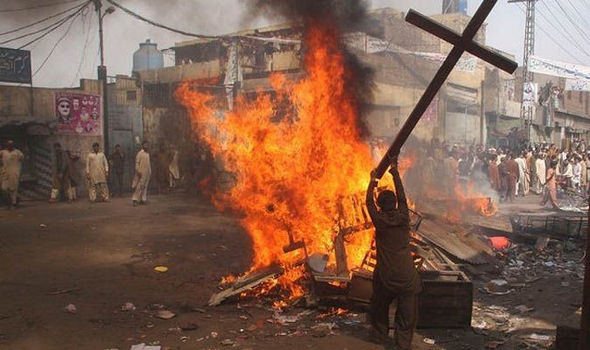
For Christians, Pakistan is a harsh and even deadly place to live and the source of a lot of their misery is the loathed blasphemy laws. Weeks after Khan took office, concerns remain that his government will not stem the violence of the last decade.
This week, Human Rights Watch sent a letter to Khan urging him to take steps to address Pakistan's human rights situation, including upholding freedom of religion and amending the blasphemy law.
'In the past two years, Pakistan has witnessed an increase in blasphemy-related violence while the government continued to encourage discriminatory prosecutions and other forms of discrimination against vulnerable groups by failing to repeal discriminatory laws and using religious rhetoric, inciting hatred against minorities,' it said.
'Human Rights Watch urges the Pakistani government to amend the blasphemy law, as a first step towards its repeal.'
Khan's promises this week to push for blasphemy laws at international levels will have done nothing to allay the fears of minorities.
This week, he said his government would raise the blasphemy issue at next month's United Nations General Assembly and he is courting the support of other Muslim countries.
'Our government will raise the matter in the Organisation of Islamic Cooperation (OIC) and ask the Muslim countries to come up with a collective policy that could then be brought up at international forums,' Khan said.
He then drew parallels with European countries that threaten prison sentences for Holocaust denial, according to Dawn news.
His comments came amid protests in Pakistan over Dutch nationalist politician Geert Wilders' plans to hold a caricature competition of the Prophet Mohammed. Wilders has since cancelled the competition, saying he did not want to put others at risk of violence.
Nasir Saeed, director of CLAAS-UK, an organization that supports Pakistani Christians accused of blasphemy, said it was right to cancel the cartoon competition and that no country should allow any competition which hurts the religious feelings of people. However, he added that Muslims in Pakistan should stop hurting the religious feelings of people who belong to different religions.
'The misuse of the blasphemy law should also be stopped in Pakistan and the government must take concrete steps in this regard,' he said.
'Those who misuse the blasphemy to settle their personal scores and grudges should be brought to the justice.'
Last month, there were two separate attacks on Christians, one of which was fatal. Christian husband and father Vicky Masih had been preparing to celebrate his ninth wedding anniversary when he was shot dead. According to the British Pakistani Christian Association, police have been uncooperative.
In a separate incident, Alvin John and his family were forced to flee their home after a mob attacked when he refused to allow his daughter to be forcibly married to a Muslim man.
Kashif Anthony, a coordinator for the National Commission for Justice and Peace in Karachi, said the latest violence was 'a sign of prevailing intolerance against Christians' in Pakistan.
'It is a result of the hate-based curriculum taught in the educational institutions, hate speeches, and other unmonitored publications against Christians,' he said.
The U.S. military said it has made a final decision to cancel $300 million in aid to Pakistan that had
been suspended over Islamabad’s perceived failure to take decisive action against militants, in a new blow to deteriorating ties.
The so-called Coalition Support Funds were part of a broader suspension in aid to Pakistan announced by President Donald Trump at the start of the year, when he accused Pakistan of rewarding past assistance with “nothing but lies & deceit.”
The Trump administration says Islamabad is granting safe haven to insurgents who are waging a 17-year-old war in neighboring Afghanistan, a charge Pakistan denies.
But U.S. officials had held out the possibility that Pakistan could win back that support if it changed its behavior.
U.S. Defense Secretary Jim Mattis, in particular, had an opportunity to authorize $300 million in CSF funds through this summer - if he saw concrete Pakistani actions to go after insurgents. Mattis chose not to, a U.S. official told Reuters.
“Due to a lack of Pakistani decisive actions in support of the South Asia Strategy the remaining $300 (million) was reprogrammed,” Pentagon spokesman Lieutenant Colonel Kone Faulkner said.
Faulkner said the Pentagon aimed to spend the $300 million on “other urgent priorities” if approved by Congress. He said another $500 million in CSF was stripped by Congress from Pakistan earlier this year, to bring the total withheld to $800 million.
The disclosure came ahead of an expected visit by U.S. Secretary of State Mike Pompeo and the top U.S. military officer, General Joseph Dunford, to Islamabad. Mattis told reporters on Tuesday that combating militants would be a “primary part of the discussion.”
Experts on the Afghan conflict, America’s longest war, argue that militant safe havens in Pakistan have allowed Taliban-linked insurgents in Afghanistan a place to plot deadly strikes and regroup after ground offensives.
INCREASING PRESSURE
The Pentagon’s decision showed that the United States, which has sought to change Pakistani behavior, is still increasing pressure on Pakistan’s security apparatus.
It also underscored that Islamabad has yet to deliver the kind of change sought by Washington.
“It is a calibrated, incremental ratcheting up of pressure on Pakistan,” said Sameer Lalwani, co-director of the South Asia program at the Stimson Center think tank in Washington.
Reuters reported in August that the Trump administration has quietly started cutting scores of Pakistani officers from coveted training and educational programs that have been a hallmark of bilateral military relations for more than a decade.
The Pentagon made similar determinations on CSF in the past but this year’s move could get more attention from Islamabad, and its new prime minister, Imran Khan, at a time when its economy is struggling.
Pakistan’s foreign exchange reserves have plummeted over the past year and it will soon decide on whether to seek a bailout from the International Monetary Fund (IMF) or friendly nations such as China.
“They are squeezing them when they know that they’re vulnerable and it is probably a signal about what to expect should Pakistan come to the IMF for a loan,” Lalwani said. The United States has the largest share of votes at the IMF.
Khan, who once suggested he might order the shooting down of U.S. drones if they entered Pakistani airspace, has opposed the United States’ open-ended presence in Afghanistan. In his victory speech, he said he wanted “mutually beneficial” relations with Washington.
A Pakistani official, speaking on the condition of anonymity, said he was unaware of a formal notification of the U.S. decision on assistance but said one was expected by the end of September.
Pakistan has received more than $33 billion in U.S. assistance since 2002, including more than $14 billion in CSF, a U.S. Defense Department program to reimburse allies that have incurred costs in supporting counter-insurgency operations.
Pakistan could again be eligible next year for CSF.
Ghana risks losing a parcel of land worth $80 million located in the capital of Pakistan, Islamabad. The land which was allocated to the country for construction of its embassy has currently been encroached upon by Malaysia.
According to the 2016 auditor general report, both France and Canada have expressed interest in the land prompting the Pakistani authorities to urge Ghana to develop the land or lose it.
Appearing before the Public Accounts Committee, the Minister for Foreign Affairs and Regional Integration Shirley Ayorkor Botchwey said her Ministry has no money for construction of a fence wall to secure the land at a cost of $180,000.
“What will be the ideal thing is to wall it and secure the piece of land. Unfortunately, it will cost us about €160,000 which we do not have at the moment. So it is the issue of lack of resources. The limited resources that we have, we are having to apply it to the countries where we have missions,” she told the Committee.
Asked if Ghana was that poor it could not get €160,000 to secure the land which is valued $40 million, the Foreign Affairs minister assured that she would look for the money “someway, somehow” to secure the land.
In typical fashion, Saudi Arabia’s response to this week’s UN report claiming it may be responsible for war crimes in Yemen is full of bluster.
How dare the human rights experts make ‘false allegations’ that the Riyadh-led coalition has targeted civilians, restricted humanitarian aid and carried out arbitrary detentions, it says.
This despite all evidence to the contrary.
Whether it’s air strikes on school buses killing dozens of children or the bombing of ships carrying humanitarian aid as they wait at a harbour entrance, the truth is plain to see.
This is not to say that Iran-backed Houthi rebels which the coalition is fighting are not guilty of heinous crimes as well. That they are also responsible for atrocities is made clear by the report, which says that both sides are guilty of arbitrary detentions, torture, enforced disappearances and recruiting children.
With 6660 civilians killed, 10,563 injured, 1.1 million hit by cholera and 22 million in need of aid, the war in Yemen is the world’s biggest humanitarian crisis.
But when you consider these stark facts it is hard not get riled by one thing which stands out from the Saudi rebuttal just for its sheer audacity.
The statement expresses "surprise for the report’s disregard of the great humanitarian role played by the coalition states in Yemen, and the huge humanitarian assistance it has provided in order to alleviate the suffering of the Yemeni people."
Hang on, if you hadn’t spent the past three years bombing the country back to the Dark Ages, there would be no need for any of the humanitarian aid which you are so proud of.
It’s a bit like a reckless motorist who wilfully causes carnage on a motorway expecting a pat on the back for picking up the medical bill afterwards.
The UN report found that coalition air strikes—armed with British and American firepower—have hit residential areas, markets, funerals, weddings, detention facilities, civilian boats and medical facilities.
Not only this but the UN’s Group of Experts "have reasonable grounds to believe that individuals in the government of Yemen and the coalition may have conducted attacks in violation of the principles of distinction, proportionality and precaution that may amount to war crimes."
A Yemeni child stands next to the destroyed bus at the site of a Saudi-led coalition air strike, that targeted the Dahyan market the previous day in the Huthi rebels' stronghold province of Saada on August 10, 2018.STRINGER/AFP/GETTY IMAGES
Time after time the Saudi authorities—who profess to uphold international law and human rights—throw their toys out of the pram when they are accused of flouting it.
You can see it in their brass neck claims not to be pirating transmissions of the World Cup, Champions League, Premier League, Formula One or any other passing sporting event whose broadcast rights are owned by rival Qatar—despite all evidence to the contrary.
But this month’s prize for sheer hypocrisy must surely go to both Saudi Arabia and the United Arab Emirates, who for a year have been blockading Qatar, accusing the tiny Gulf state of supporting terrorism, which Doha denies.
For there is new evidence from an Associated Press investigation that the Saudi-led coalition in Yemen has actually been negotiating, paying and helping Al-Qaeda, the terror group behind the 9/11 attacks.
So, a months-long offensive, Operation Swift Sword, was portrayed as a victory in the mountainous province of Shabwa for Emirati and Yemeni fighters over Al-Qaeda forces which had dominated the region for three years.
The UAE ambassador to Washington, Yousef al-Otaiba, said the triumph would "disrupt the terrorist organisation’s network and degrade its ability to conduct future attacks."
What wasn’t revealed was how weeks earlier the two sides had reportedly negotiated for trucks full of masked Al-Qaeda militants to quietly leave the area. About 200 Al-Qaeda fighters received payment, with one getting £20,000 ($26,000). Some have even joined the coalition side.
This is the same Yousef al-Otaiba who repeatedly accuses Qatar of funding terrorism.
A photo taken on March 18, 2018, shows a Yemeni child looking out at buildings that were damaged in an air strike in the southern Yemeni city of Taez.AHMAD AL-BASHA/AFP/GETTY IMAGES
It led to Doha’s ambassador to the U.S., Sheikh Meshal bin Hamad Al-Thani, saying: "For now, we must pose urgent questions to the UAE and Saudi Arabia: How can they in good faith give arms, safe passage and financing to terrorists? What are the terrorist groups doing with all of these funds and weapons?"
For now, a list of people who may be responsible for war crimes in Yemen has been passed to the UN high commissioner for human rights.
The UN report also urged the international community to "refrain from providing arms that could be used in a conflict"—a reference to America and Britain, who have been arming the Saudi-led coalition, and to Iran, who are supplying the Houthi rebels.
The plane that flew for an hour over the market in Dahyan, northern Saada, before launching its deadly payload killing 40 children on the school bus was armed with a U.S.–made 500lb laser-guided MK82 bomb.
For the perpetrators to say the Saada attack was a "legitimate military operation carried out in accordance with international humanitarian law" is despicable, and the UN is right to call out those responsible.
And as long as the U.S. continues arming the coalition with the types of Lockheed Martin weapons used on that school bus, and the U.K. rolls out the red carpet at every opportunity for Saudi Arabia, we too will be complicit in the carnage they cause.
If the US were to follow the rules of warfare written into US military law and treaties to which the US is a party, the US must immediately end its support for the Saudi Arabia-led war in Yemen. We should also marshal all of its diplomatic tools to end the conflict. Since 2015, Saudi Arabia, and allies such as the United Arab Emirates, have been waging a devastating war in support of the former government of Yemen against the current Houthi regime. Amnesty International has called the conflict a "forgotten war" because its deadly consequences have failed to rise to the level of international crisis in media or government agendas. However, under former President Barack Obama and now Donald Trump, the US has been complicit in war crimes and the creation of a completely preventable humanitarian nightmare for the people of Yemen.
On August 28, 2018, the United Nations High Commissioner for Human Rights released a report detailing the brutal conduct of the war. As of June 2018, at least 6,475 civilians had been killed and more than 10,000 injured in the conflict. The report notes the "real figure is likely to be significantly higher." While evidence "strongly suggests" that all parties to the conflict have violated international law, the report is clear that Saudi-led coalition airstrikes are responsible for the largest numbers of civilian deaths and injuries. Moreover, there is significant evidence that the Saudi-led coalition has repeatedly bombed civilian neighborhoods, medical facilities, markets, weddings, funerals, and even a school bus full of children. Intentionally attacking civilians is a war crime.
The United States has provided targeting support, intelligence, and midair refueling to Saudi fighter jets, enabling its continued bombardment. The US has also sold billions of dollars of sophisticated weaponry to Saudi Arabia, including cluster bombs, a weapon banned by UN treaty and outlawed by the majority of countries in the world. America’s actions have been lethal for Yemeni civilians. In the most recent example, news outlets reported in August 2018 that US-manufactured bombs killed 40 children, and others, in a single Saudi strike on a school bus. No matter how it is portrayed in media or by government representatives, aerial warfare is not clean and it is not precise.
On the ground, the situation is dire. The UN reports that arbitrary detention and torture in prisons controlled by UAE-affiliated forces is widespread, and government security forces have made a "common practice" of abduction and rape of women in order to extort money from victims’ families. In the careful language of human rights reporting, the UN states that there are "reasonable grounds" to believe that Saudi Arabia, UAE, and the government of Yemen have committed war crimes including rape and torture. Saudi Arabia and its allies have also blockaded Yemen by air and sea, preventing food and lifesaving medical supplies from entering the country. As a result, 8.4 million Yemenis were on the brink of famine as of April 2018. The collapse of healthcare infrastructure caused by the blockade has led to the largest series of cholera epidemics in modern history, as many as a million people.
The conditions in Yemen are unbearable and entirely man-made. Saudi Arabia and its allies, including the United States, are causing massive suffering for millions of civilians. In March, US Senators Bernie Sanders (I-Vt.), Mike Lee (R-Utah) and Chris Murphy (D-Conn.) introduced a bill that would have ended US support for the war. The bill was defeated 55-44 with 10 Democrats joining the Republican majority. Before the vote, Republican Senate Majority Leader Mitch McConnell stated that withdrawing US support would increase the risk to civilians. This argument strains credulity given that it is Saudi Arabia and its allies that are causing the majority of casualties. Furthermore, if McConnell were concerned about civilian safety, he would push congress and the Trump Administration to bring conflicting parties to a negotiating table.
Pursuing peaceful negotiations to end the conflict is an important diplomatic effort the United States should take immediately. It must also end its support for states and groups committing war crimes. The preponderance of evidence suggests Saudi Arabia is regularly violating the laws of war, and the US is complicit as long as it continues to enable Saudi actions. It must stop refueling Saudi jets and providing targeting intelligence. Crucially, the United States should initiate, and pressure other governments to support, an arms embargo on warring parties. At minimum, it must immediately suspend all weapons sales to Saudi Arabia. Finally, if US leaders claim to care about civilians in Yemen, they should drastically increase humanitarian aid for Yemenis whose suffering they have caused and the United States must reopen its refugee resettlement program to displaced Yemenis.
From 2015 to late 2016, the Obama Administration did not push for this moderate set of diplomatic initiatives and Trump is even less likely to take these actions. It is therefore incumbent upon Americans to call and write to their elected representatives to pressure them to end our support for the decimation of Yemen. If Americans care about human rights and international law, the bare minimum we can do is stop abetting war crimes against the people of Yemen.
The military coalition led by Saudi Arabia and the United Arab Emirates in Yemen has killed thousands of civilians in airstrikes, tortured detainees, raped civilians and used child soldiers as young as 8 — actions that may amount to war crimes, United Nations investigators said in a report issued Tuesday.
The report singled out Saudi and Emirati airstrikes for causing the most civilian casualties, saying they had hit residential areas, markets, funerals, weddings, jails, boats and medical facilities.
“There is little evidence of any attempt by parties to the conflict to minimize civilian casualties,” said Kamel Jendoubi, the chairman of the panel of experts that produced the report.
The report also said the Houthi rebels, who control northern Yemen and are fighting the Saudi-Emirati coalition, may have committed war crimes. They were accused of shelling civilians, torturing detainees, recruiting young children to fight and blocking access to humanitarian agencies.
“None have clean hands,” one of the experts, Charles Garraway, a retired military officer who served for 30 years as a legal officer in the British Army, told reporters in Geneva. “Despite the severity of the situation, we continue to witness a total disregard of the suffering of the people of Yemen.”
A spokesman for the Saudi-led coalition said it would respond after its legal team had reviewed the report.
The Emirati minister of state for foreign affairs, Anwar Gargash, said on Twitter that his government would need to study the report before responding, but he said the culpability of the Houthis for civilian suffering needed to be recognized.
Secretary of Defense Jim Mattis told reporters in Washington that the Trump administration had reviewed its support for the Saudi-Emirati coalition.
“We determined it was the right thing to do in defense of their own countries, but also to restore the rightful government there,’’ he told reporters. “Our conduct there is to try to keep the human cost of innocents being killed accidentally to an absolute minimum.’’
The American goal, Mr. Mattis said, is to encourage the combatants to negotiate a settlement to the conflict.
Tawakkol Karman, a Yemeni human rights activist who was awarded the Nobel Peace Prize in 2011, responded to Mr. Gargash, the Emirati foreign affairs minister on Twitter. She said the United Nations report would not be credible unless it cited the leaders of the United Arab Emirates and Saudi Arabia, as well as the head of the Houthi movement, as responsible for the civilian massacres.
Political factions and militias have been fighting for control of Yemen, the Arab world’s poorest country, since power-sharing talks collapsed in 2014 and the Houthis ousted the internationally backed government of President Abdu Rabbu Mansour Hadi.
Since then, fighting has devolved into proxy warfare, with Saudi Arabia and the United Arab Emirates arming and fighting alongside a disparate group of Islamist, tribal and regional militias against the Houthis, who control Sana, the capital, as well as the major port of Al Hudaydah and their ancestral territories along the Saudi border.
The Saudis and their allies have accused Iran of aiding the Houthis. Iran has denied involvement, despite evidence that the rebels are using Iranian weaponry, including missiles.
The report accused the Saudi-led coalition of routinely having failed to consult its own “no-strike list” of more than 30,000 sites in Yemen, including refugee camps and hospitals. It also said the Saudi Air Force had not cooperated with investigators about its targeting procedures.
The conflict has resulted in at least 16,700 casualties, including 6,475 civilians killed, but the real figure is almost certainly significantly higher, according to the United Nations.
The main cause of civilian casualties in the war, the report says, has been airstrikes by the Saudi-led coalition. It estimates that there have been 18,000 such strikes in little more than three years, inflicting a level of damage on civilians that “certainly contributed to Yemen’s dire economic and humanitarian situation.”
The report, to be delivered to the United Nations Human Rights Council next month, comes not long after a Saudi-coalition strike this month killed 40 children on a school bus.
The experts who wrote the report said that the names of individuals suspected of abuses would be sent to the Office of the United Nations High Commissioner for Human Rights. They declined to provide details, but the report said offenses had been committed by individuals at all levels in the Saudi-led coalition’s member states and their governments, including civilian officials.
Sixty coalition attacks on residential areas reviewed by the experts killed more than 500 civilians, including 233 children, they said. An attack on a funeral hall in Sana in October 2016 killed at least 137 civilians, according to the report.
The experts said that the coalition had kept up the intensity of the airstrikes even after it had become clear that civilians were suffering dire consequences.
Civilians were further harmed, they said, by the coalition’s arbitrary restrictions on shipping and air travel. The screening of ships coming into Al Hudaydah — ostensibly to prevent arms from entering the country — has had “a chilling effect on commercial shipping supplies of fuel and food needed to fend off starvation, even though United Nations searches of shipping had found no weapons,” the experts said.
“No possible military advantage could justify such sustained and extreme suffering of millions of people,” they said.
The report detailed allegations of rape and abuse by a proxy unit called the Security Belt Forces, which is under the control of the United Arab Emirates, that targeted not just detainees but also refugee and migrant women and children.
The experts faulted in particular the coalition’s Joint Incidents Assessment Team, which is supposed to investigate claims of military abuse but which human rights groups say was set up to deflect pressure for an international inquiry into the war.
The assessment team’s work lacked transparency, its investigations lacked legal analysis and its findings regularly ignored civilian casualties and were often substantially altered by the Saudi Arabian Ministry of Foreign Affairs, the experts said.
A report released by Human Rights Watch last week warned Britain, France and the United States that they risked complicity in unlawful attacks in Yemen by continuing to supply arms to Saudi Arabia.
"Michelle and I extend our heartfelt sympathies to all those who have gathered in Detroit, and we join you in remembering and celebrating the life of the Queen of Soul.
"From a young age, Aretha Franklin rocked the world of anyone who had the pleasure of hearing her voice. Whether bringing people together through a thrilling intersection of genres or advancing important causes through the power of song, Aretha’s work reflected the very best of our American story – in all of its hope and heart, its boldness and its unmistakable beauty.
"In the example she set, both as an artist and a citizen, Aretha embodied those most revered virtues of forgiveness and reconciliation, while the music she made captured some of our deepest human desires: namely affection and respect. And through her own voice, Aretha lifted those of millions, empowering and inspiring the vulnerable, the downtrodden, and everyone who may have just needed a little love.
"Aretha truly was one of a kind. And as you pay tribute, know we’ll be saying a little prayer for you. And we’ll be thinking of all of Aretha’s loved ones in the days and weeks to come.
Bill Clinton represented former presidents at the funeral of Aretha Franklin in Detroit, while Barack Obama and George W. Bush each sent letters in memory of Aretha Franklin that were read aloud by Rev. Al Sharpton and Barbara Sampson, respectively.
Obama and Bush remained in Washington for Saturday's memorial service for Sen. John McCain (R-Ariz.), who requested that each of them to speak.
Bill Clinton's Aretha Franklin tribute
Clinton's presence at the funeral is no surprise: His relationship with Franklin stretches back to at least 1993 when she performed at his first inauguration. In May 1999, Franklin performed for Clinton at the White House Correspondents Association's annual dinner, and later that year, the president awarded her with the National Medal of Arts and Humanities during a White House ceremony.
“She lived with courage," said the 42nd president. "Not without fear, but overcoming her fears. She lived with faith. Not without failure, but overcoming her failures. She lived with power. Not without weakness, but overcoming her weaknesses. I just loved her.”
Clinton recalls seeing Aretha last year at Elton John AIDS fund-raiser, where she performed for 45 minutes, despite looking gaunt from pancreatic cancer: “She stood right up and said, ‘How you doing, baby?’ I said, ‘I’m doing better now.’ She said: ‘Look at me. I got thin again.’ “
The former president also asked the audience to forgive him, saying he was happy that Franklin’s casket was still open when he arrived because he just had to see what she was wearing.
Clinton said, “I wonder what my friend has got on today. I wanted to see what the girl was carrying out,” to a wave of laughs and claps from the crowd. Franklin was wearing a gold gown, her fourth outfit of the week.
He ended his time by playing Franklin’s “Think” on his iPhone into the mic. “It’s the key to freedom!” Clinton said.
As the Federally Administered Tribal Areas transition into Khyber Pakhtunkhwa — a series of violent occurrences have marred the democratic process. A remote controlled bomb blast killed one, and injured three soldiers during a routine search in the Datta Khel Tehsil in North Waziristan. Subsequently, armed forces came to the Hamzoni village to arrest suspects. This arrest was resisted by the villagers — which led to clashes.
This tragedy shed light on two grave hindrances in the judicial and policing systems that aim to protect and safeguard the lives and rights of its citizens. First is the law of Collective Punishment under the Frontier Crimes Regulations (FCR) which was introduced by our colonial overlords in 1872 to control the tribes in FATA. The FCR inspired from the local tribal jirga system, appoints a ‘political agent’ who passes any and all judgements; even the right of holding an entire village or agency responsible for the crimes committed by a few. Instead being an effective tool of conflict resolution, this and other laws like it deprive the citizens of FATA of the constitutional rights granted to every other Pakistani.
Furthermore, it highlighted the need to give on-ground personnel across security outfits sensitivity training to deal with civilian populations. This way protests can be viewed as the democratic right of every citizen, an indicator of the prevalent freedom of speech and expression rather than a national security threat. Moreover, when the question of civilian lives is at stake — then mistakes or pre-emptive behaviour cannot hold priority. This is also evident in the accidental killing of Bilal Khan, a seventeen-year-old who was caught in crossfire during a police raid in Karachi on Saturday.
The most disheartening element however, was the media black-out of the sit-in protest that took place in Miran Shah in the aftermath of the shooting. While social media was rampant with indignation over the atrocities; major news channels and newspapers remained silent on the matter. The fourth estate must be allowed to provide fair and unhindered information regarding the happenings in the country, no matter which deprived, isolated corner of the state the news comes from.
On a positive note however, we see the newly elected MNA Mohsin Dawar playing an active role in the mobilisation and representation of his people, not only in person or on social media — but in the National Assembly. Similarly we must commend the Pakistan Army for assuming responsibility and initiating an investigation into the incident. Moreover, General Mumtaz Hussain visited the injured at Miran Shah Hospital and announced financial compensation for the injured as well as the deceased. While this tragedy left many disgruntled, the subsequent efforts by the politico-military outfits provide a glimmer of hope.
If Imran Khan’s government implements the Bill on mandatory Quran recitation in schools, it will create new social anxieties.
The news about Karachi don Chhota Shakeel’s son becoming a hafiz who can memorise and recite the Quran comes about a year after Dawood Ibrahim’s son Moin became an Islamic cleric.
From Zia-ul-Haq’s Pakistan to Imran Khan’s Naya Pakistan, the religio-military nexus has produced a well-oiled skills training programme for the youth. Even the dons’ family members now appear to be opting out of the empire’s spoils and are dropping the gun to pick up the rosary.
The news aboutShakeel’s family coincided last week with the news that Imran Khan’s new government may implement the Compulsory Teaching of the Holy Quran Bill 2017. If that happens, memorising the Quran and becoming a hafiz may just become the new social currency in Pakistan.
The Bill is yet to become a law, but social media in Pakistan was abuzz this weekend over the anticipated move.
Many outside Pakistan perhaps assume that the country already has such a law in place since Zia’s rule in the 1980s. But the truth is that if the new Bill is enforced, what was put in place three decades ago will intensify and create new social anxieties.
The 2017 Bill stipulated that it should be mandatory for (Muslim) students from ‘grade one to five to recite the scripture in Arabic, while children in grade six and above will be required to recite the Holy Quran along with the translation’.
Under Zia, memorising the entire Quran was incentivised with 20 extra points in school. But even those students who did not want to benefit from the extra points had to undertake mandatory memorisation of select verses of Quran, study Islamic history and translation. So, with or without the extra points, every student still had to study the Quran in school.
Now, under the new proposed law, there will be mandatory recitation of the entire Quran and its translation.
Learning to read the Quran is a private, family endeavour or an activity wherein you include a neighbourhood maulvi or maulani ji. Or, you take the help of the specialised ventures that make reading the Quran interesting for children with audio-visual aids. But now, the agency of the families can be taken away if reciting Quran becomes a formal school project.
If you succeeded in getting the 20-point incentive introduced under the Zia rule, you would use them at the time of your entrance into professional colleges and bureaucracy in Pakistan. Under Zia, it was also decided that a degree from a madrasa/seminary would be recognised by Pakistan’s Board of Secondary and Intermediate Education.
To help students get those 20 points, evening classes in the mosque sprung up with guaranteed Quran memorisation modules, seminaries opened their doors to speedy learning.
Non-Muslim students appeared for an ethics/social studies exam in lieu of Islamic studies in school and board exams all these years. However, the text and biased marking encouraged many non-Muslim students to mug up on Islamiyat and appear as ‘Muslim’ candidates.
If Pakistan’s rulers really read and understood the Quran, they would not have missed an essential injunction that specifies that ‘there is no compulsion in religion’. But instead, what we have in Pakistan are laws that deduct charity at source (in addition to taxes), and legislation that makes non-fasting a crime (when Islam itself provides for concessions).
Zia constituted committees that could knock on your door to monitor whether you were praying.
If the new PTI government implements this legislation, it can open a Pandora’s Box. The blasphemy law can crash into students mandatorily studying the Quran: what happens when a classroom tiff among young children snowballs into blasphemy or someone drops a copy of the Quran and is accused of disrespecting it?
One has to be in the state of ablution while reciting the Quran. Can the government ensure cleanliness, water, toilets in every school? Also, it would be far harder for families to challenge the all-powerful maulvi-instructors at schools if they dish out corporal punishment to students for mispronouncing certain words in the Quran.
It can also fuel a bigger debate about certification of tutors in schools – where sectarian and political loyalties can come into play in employment. It will be a massive project to find just the right kind of tutors for all the federal government-run educational institutions and private educational institutions regulated by the federal government.
Perhaps, the wily D-Company scions have sensed the new opportunities that may unfold in Naya Pakistan. Dawood may be ruing his fate over his empire’s legacy. But Dawood and Shakeel scions are not interested in the Karachi turf wars over prime plots and water tankers. Instead, they appear to be equipped for a more promising career in Naya Pakistan.