Monday, June 4, 2018

#JusticeForKhadija - #Pakistan where Taliban & killers Can Get Away With Murder ......Khadija Siddiqui’s attacker acquitted by Lahore High Court

So in Pakistan, killers, terrorists, Rapist can really get away with murder. Corrupt Pakistani elite is sending a very wrong message to its younger generation and to the world community. It's just shameful and disgusting.

The Lahore High Court (LHC) on Monday acquitted Shah Hussain, who had been sentenced for attacking Khadija Siddiqui.
The decision was announced by LHC judge, Justice Ahmed Naeem after hearing arguments from both parties.
In July 2017, Shah Hussain was found guilty of stabbing Khadija at least 23 times on Lahore’s Davis Road. 
The single bench of the LHC acquitted the convict today, giving him the benefit of doubt, after he appealed against his five-year sentence.
During the proceedings, the convict’s lawyer stated that his client has been facing punishment over baseless allegations.
He said that Shah Hussain was not present at the time of the attack and the evidence against him is insufficient. Following the arguments, the LHC acquitted the convict. 
After the verdict came in favour of Hussain, #JusticeForKhadija became a top trend on social media.


Last year, a local court sentenced Shah to seven years in prison, which was later reduced to five by a district and sessions court on March 30, this year.
After committing the attack, the suspect had managed to flee from the scene of the crime but was captured on a mobile camera by an eyewitness. Siddiqui was saved by her driver, who had tried to overpower the attacker, forcing him to flee from the scene on May 3, 2016.
The attack was witnessed by hundreds of people in front of a hotel on Davis Road.
A few days later of the assault, Khadija had identified her attacker and got him booked on charges of attempted murder. 
After the registration of a case, the accused, Shah Hussain, requested a sessions court for bail before arrest, which was turned down. Hussain, whose father happens to be a renowned lawyer, was aided by a number of other lawyers to flee from court premises after his request was turned down.
https://www.geo.tv/latest/197990-khadija-siddiquis-attacker-acquitted-by-lahore-high-court

Sunday, June 3, 2018

Pashto Music Video - RAZA RAZA - NAZIA IQBAL

Music Video - Farzana Naaz - Pashto Shamal Afghan Music

Video Report - Exclusive: PTV journalist fired for her support to Pashtun Tahaffuz Movement

Video Report - What's going on with the Pashtun Shopkeepers in Lahore? لاہور میں پختونوں کے ساتھ کیا ہورہا ہے

#Pakistan - The Pashtun Tahafuz Movement (PTM) announces support for sit-in against target killings in N Waziristan

Manzoor Pashteen warns of similar protest in Wana, Barwand of South Waziristan.

The Pashtun Tahafuz Movement (PTM), while announcing its support to sit in protest against frequent target killing in Miranshah and Mirali of North Waziristan, warned of arranging a similar sit-in Wana and Barwand of South Waziristan from Monday.
Manzoor Pashteen, chief of PTM, on Saturday night announced support for sit-in started by tribesmen from different parts of North Waziristan against frequent acts of target killing in the area. In the latest violent act, political administration official Hamid Ullah Kabalkhel was killed and three personnel of Khasadar forces were injured when unknown militants attacked a vehicle in Kaam Saroobi area on Razmak Road.
Soon after the funeral of Hamid Ullah Kabal Khel on Saturday, tribesmen from all over Miranshah and Mirali decided to resume the six-day sit-in which was last called off on May 18. Within hours hundreds of tribesmen came out of homes and rushed to main Chawk in Mirali and Miranshah whereas they went on a sit. The PTM chief Manzoor Pashteen has directed supporters and workers to participate in the protest.
PTM leader Ali Khan Wazir has said they deputed a team of workers to go and extend every sort of support to protesters in North Waziristan. He said, “Beside frequent target killing, through one or other ways, the PTM workers are also teased and harassed in South Waziristan.”
Wazir informed this scribe, “Yesterday, the government-loyal Taliban snatched caps from PTM workers in Wana, headquarter of South Waziristan, and terrorised them also. Target killing incidents are also taking place in Sarwaiki sub-divisions.” On such grounds, he said they decided of going on a sit-in in both Wana and Barwand, headquarter of Sarwaiki sub-division from Monday.
He said that arrangements regarding sit-in protest in two different places of South Waziristan are in progress. He said that the purpose of the sit-in is to convince the government for realising its responsibilities of protecting lives and properties of people.
The protesting tribesmen in Miranshah and Mirali have demanded an end to target killing, calling for the permission for tribesmen to keep arms for their self-defence.
Meanwhile, personnel of traditional Khasadar forces from North Waziristan also decided to go on protest just to ensure their safety in the new system after the merger of Federally Administrative Tribal Areas (FATA) in Khyber Pakhtunkhwa.
The Khasadar system was introduced along with the establishment of FATA and enforcement of Frontier Crimes Regulations (FCR) by previous colonial rulers in 1901. High ups in government departments both in centre and province already announced of adjusting personnel of Khasadar forces, who qualify in the police department.

واڼه: وسله والو يو شمېر ولسي وګړو ته مرګ ژوبله اړولې Wana#

 د جنوبي وزيرستان په مرکز واڼه کې د وسله والو طالبانو په ډزو کې دوه ولسي وګړي وژل شوي او تر ۲۰ زيات ژوبل شوي دي.

په سيمه کې د استخباراتي ادارو چارواکو د مشال راډيو خبریال ته د ډزو په نتيجه کې د دوه مړو پخلی کړی دی. بلخوا پوليټیکل چارواکو د نوم نه څرګندولو په شرط مشال راډیو ته ويلي چې په پېښه کې يو تن مړ او ۱۲ زخميان شوي دي.


په زخميانو کې نورولي نومي يو ځايي خبريال هم شامل دی چې دا وخت د نورو زخميانو ترڅنګ د ډېره اسماعيل خان په مرکزي هسپتال کې تر درملنې لاندې دی.


د ځايي اوسېدونکیو په وینا پیښه هغه وخت وشوه چې وسله والو د پښتون تحفظ تحریک پر يو مشر علي وزير ډزې وکړې. علي وزير هغه وخت په واڼه بازار کې خپل د تېلو پمپ ته ورغلی وو.


تر ډزو سمدستي پس ځايي خلک د علي وزير پمپ کې ورغونډ شول او په وسله والو يی کاڼي وورول. د کاڼو ورولو په ردعمل کې وسله والو مستقیماً پر ځايي خلکو ډزې وکړې چې په نتيجه کې يی مرګ ژوبله وشوه.


د ځايي خلکو په وینا، تر پېښې وروسته په واڼه بازار او شاوخوا سيمو کې کرفیو لګول شوې ده او پوځ او نيم پوځي ځواکونو سيمه په ولکه کې اخیستې ده.


بلخوا په پیښه کې ژوبل شوي کسان د ډېره اسماعيل خان هسپتال ته رسول شوي دي او علاج يی روان دی.


د واڼه د پیښې په غبرګون کې د پښتون تحفظ مومنټ مشرانو په پیښور، اسلام اباد او کوټه کې احتجاج پیل کړی.


د پښتون تحفظ موومنټ یو مشر د اتوار پر شپه ناوخته په اسلام اباد کې احتجاجی غونډې ته د وینا پر مهال په واڼه کې د وسله والو برید وغنده. نوموړي زیاته کړه چې د دوی تحریک په داسې بریدونو نشي درېدای او دوی به د خپلو حقونو د غوښتلو هڅې جاري ساتي.

Once Ruled By Taliban, Residents Of Pakistan's Swat Valley Say Army Should Leave


Diaa Hadid
Once Ruled By Taliban, Residents Of Pakistan's Swat Valley Say Army Should Leave
In the foothills of the Hindu Kush mountains, on the bank of the river that courses through the Swat Valley, boys play soccer in a dusty field. When the Pakistani Taliban occupied this valley a decade ago, loyalists trudged to the same riverbank with their own television sets, setting them ablaze in a fiery rejection of Western culture.
But the Taliban embraced other broadcast technology, when it was useful. Yards away, tucked into the low-slung village of Imam Dherai, lies the rubble of a pirate radio station where a preacher, Fazal Hayat, known as Maulana Fazlullah, broadcast his vision of an Islamic utopia in the Swat Valley. Residents nicknamed the charismatic preacher "Mullah Radio." And that is how militants began inching across the Swat Valley in 2004: over the airwaves.
Women donated jewelry to Mullah Radio, who used the donations to help fund a network of religious hardliners. Men offered labor and money to build a seminary and a mosque.
Fazlullah promised Islamic law in Swat; residents — chafing under what they said was a sluggish, corrupt and inept state system — said they were enamored by his promises of swift justice. Young men joined him.
Fearing his messianic influence on their elderly mother, one family sabotaged their radio. "Mother kept asking me to repair it," Iqbal Isakhel, a lawyer who opposed the militants, said with a laugh. "I didn't."
In 2007, Fazlullah led militants in an uprising to avenge a high-profile military operation against a radical mosque in Islamabad. The militants captured key towns in Swat and killed local leaders. Government officials went into hiding.
The militants used the radio station to announce who would be arrested or killed for infractions like adultery and homosexuality that violated their harsh rule. Men and women were whipped in the main square of the valley's largest town, and sometimes the Taliban left bodies hanging off a street light, pinned with notes detailing the peoples' alleged crimes. Girls' schools were targeted in attacks.
The Taliban, based in Imam Dherai, took control of the entire Swat Valley and held power until the Pakistani military retook the area in 2009. But nearly a decade later, the soldiers remain. Military checkpoints dot the roads. Residents say soldiers occupy government buildings in their towns and villages. And they say the military has overstayed its welcome.
"A black chapter"
When a Pakistani airstrike crushed the radio station in 2009, many residents said they cheered. Fazlullah escaped, and now leads the Pakistani Taliban, who remain violently opposed to the Pakistani state.
"It's a black chapter of our history," Waris, a 22-year-old Swat Valley resident, said with a sigh. "We prefer to forget it." He requested NPR only use his first name because he still fears the Taliban.
Still, he pointed out, "There is also our Malala Yousafzai."
Pakistan's Nobel Peace laureate, who recently returned to Swat for the first time since she was shot in the head by a Taliban gunman in 2012, was born and raised here. As a child, she defied the Taliban by calling for girls' education.
Fawad, a 28-year-old activist, said the army routinely points to Swat as a success story. He preferred not to use his full name, to avoid possible repercussions from the military.
"As they are saying, we have established peace in Swat," Fawad said. "We want them to give full authority to civilian government — to police and local government." But security problems remain. On Feb. 3, a suicide bomber with the Pakistani Taliban — the same branch that once ruled Swat — attacked soldiers, killing 11.
And so, says Shahid Latif, a retired air vice marshal, the military must remain as well. He said it is unlikely that the army will ever leave Swat, because police aren't trained properly to deal with the region's security complexities.
"Perhaps some kind of presence of the army, in my opinion, is going to stay there permanently," he said.
Pakistan's army spokesperson declined NPR's repeated requests for interviews.
The "paradise of Pakistan"
Across the river from Imam Dherai is the blaring, blinking Swat Wonderland Amusement Park. It opened two summers ago. It is best reached by crossing the Swat River in a dinky, two-seat chairlift. It is manned by soldiers: they took it over because it was symbolically tied to the Taliban's rule of Swat. Before he was Mullah Radio, Fazlullah was the chairlift operator.
At the park, young women shrieked as they swung wildly on a carousel. They pressed their veils to their faces, worried they'd fly away. Iqbal Asad, 26, a dental assistant, brought his two-year-old nephew Sahil Khan for a fun day. This, he said, gesturing to rides, showed "life is going well here."
"Swat — it's called the paradise of Pakistan," he said. "It's the Switzerland of Pakistan."
Foreign tourism was once a mainstay of the local economy and residents hope to revive it, but they've hit some obstacles.
In 2016, a company opened a ski resort. Workers are widening the perilous mountain route where cars inch along crumbly tracks over steep gorges.
Traffic was also slowed by soldiers checking IDs. For foreigners, they wanted to see the military permission slips that must be obtained to enter Swat. Kalimullah, a tour guide who only uses one name, said the army's permission was often a stumbling block for foreign tour groups who wanted to visit, though domestic tourists are arriving. At the ski resort, Pakistani tourists tumbled out of small vans, gleefully posing for selfies. Children hurled themselves in melting spring snow, flinging icy balls around a stout snowman.
There was more checking to cross a military zone that lies along the route to another tourist attraction: a 7th century rock-face carving of a Buddha above the village of Jahanabad. It was restored by a team of Italian archaeologists in 2016, nine years after the Taliban badly damaged the face with explosives.
A soldier took down all the visitors' details, and then provided a mandatory escort of two soldiers. Kalimullah said the presence of soldiers tended to frighten foreign tourists. He said he was grateful that the army had bought peace to Swat, but escorting tourists — "it is work of police." "I think [the] army should go back," he said. "This is not work of army."
Down in the valley, Fawad said some residents did not feel safe around the army. "We don't see ourselves as secure," he said.
In his hometown, he said soldiers occupied government buildings, including the girls' school, the agricultural office, several hostels – and a relative's house.
Referring to the army, he said, "They are not leaving."

'Everybody Is Scared': Pakistani Media Fighting -- And Losing -- Battle With 'Extreme' Censorship


Military rule, religious extremism, and war have long made Pakistan one of the world's toughest beats for journalists.
But Pakistani reporters say free media is now being shackled like never before, as veteran reporters have been leaving after experiencing threats, the nation's most popular TV station was forced off the air, and nationwide distribution of Pakistan's oldest newspaper has been halted.
The developments are threatening the independence of the already depleted ranks of free-press torchbearers, who have come under pressure from the all-powerful army, hard-line religious groups, and militant groups.

Threats, Kidnapping

Prominent Pakistani journalist Taha Siddiqui left Pakistan in January, shortly after armed men beat, threatened, and attempted to kidnap him in broad daylight as he took a taxi to the airport in the capital, Islamabad.
"The army and intelligence agencies were threatening me and I suspect the people who tried to kidnap me were from the army," says Siddiqui, speaking to RFE/RL from Paris, where he has relocated. "They do not like investigative reporting that uncovers the wrongdoings of those institutions."
A well-known reporter, the 33-year-old's work has appeared in The New York Times, The Guardian, and other Western media outlets. In 2014, he was awarded the Albert Londres Prize, the French equivalent of the Pulitzer Prize, for his coverage of Pakistan.
Siddiqui is known in his homeland for his critical reporting on the military, which has an oversized role in domestic and foreign affairs in the South Asian country.
The Islamabad bureau chief for India's World Is One News channel, Siddiqui says he was questioned and warned by the army after a 2015 article he wrote for The New York Times about torture and abuse at army-run detention centers. He followed that up with another critical story about the army confiscating land from farmers for a military-owned housing scheme.
He says he was warned by intelligence officers that he was "writing against the country's interests and we will make a fake drugs case against you."
The Pakistani military and its notorious intelligence services have long been accused of stifling independent media and silencing opposition through intimidation, censorship, and even assassination.

'Muzzling Of Debate'

Pakistani media have come under unprecedented pressure in recent months.
Since May 15, the distribution of the country's oldest newspaper, Dawn, has been disrupted across most of the country. The disruption came days after Dawn published an interview with ousted Prime Minister Nawaz Sharif, in which the former premier criticized the army and alleged it was backing militants who carried out the deadly attacks in the Indian city of Mumbai in 2008.
On April 1, Geo TV, part of Pakistan's largest commercial media group, Jang, was taken off the air in many parts of the country. The ban only ended a month later after talks between the military and the network's chiefs, who reportedly pledged to make sure the network’s coverage does not cross the military’s line.
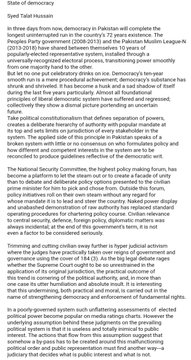
Meanwhile, prominent Pakistani columnists have had articles rejected by news outlets. Pakistani journalist Syed Talat Hussain wrote on Twitter on May 28 that his regular column was rejected for its content.
Pakistani writers have also seen the quashing of articles that cover antigovernment protests by the Pashtun ethnic minority, toward which the army has been accused of forced disappearances, extrajudicial killings, and discrimination. Journalist Mosharraf Zaidi said on April 17 that his story about the Pashtun Protection Movement was rejected.

'Extreme Level Of Censorship'

Some journalists have resorted to self-censorship to keep their jobs and remain safe.
"Everyone is exercising self-censorship and even I was doing the same," says Siddiqui. "Only those media and journalists who toe the line or observe self-censorship can survive and continue their professional work without threat."

Pakistan ranks 139th out of 180 countries listed on the World Press Freedom Index 2017, compiled by Reporters Without Borders, and threats to journalists are growing.
Raza Rumi, a TV anchor and respected reporter, narrowly escaped death when gunmen opened fire on his car in an attack that killed his driver in March 2014.
He is an outspoken critic of militant groups in Pakistan and the army's alleged support for militant groups in neighboring India and Afghanistan.
Shortly after the assassination attempt, Rumi moved to the United States, where he has continued his career as an editor for Pakistan's Daily Times.
"There is an extreme level of censorship being applied to media," says Rumi, who is based in New York. "There are no formal directives, but everybody has seen the fate of two major media outlets, Geo and Dawn, and everybody is scared of crossing the line."
Rumi is planning to visit Pakistan again for the first time since the attack on his life. But he insists he cannot work as a reporter in Pakistan in the current climate.
"I'm scared and do not feel very comfortable," he says. "The killers of my driver have been detained but not punished yet."
Fear of retribution even haunts journalists who have fled Pakistan.
Cyril Almeida, a leading columnist and assistant editor at Dawn, was barred from leaving the country in 2016 shortly after he wrote an article about a rift between the government and the military. He left for New York when the government order was lifted weeks later.