Sunday, March 25, 2018

#Pakistan - #PashtunTahafuzMovement - Manzoor Pashteen - First among equals


Manzoor Pashteen, the leader of the PTM, is charismatic and brave, but is that enough for the state to grant Pashtuns the right to life?
When Manzoor Pashteen gets nervous, his right eyebrow twitches. It’s almost unnoticeable; he himself claims to be unaware of it. He is also fidgety when he becomes nervous, especially with his hands. When television anchors expect him to prove his Pakistaniat, his patriotism — a hoop all marginalised communities are made to jump through before they are heard — you can hear the sustained tick tick, tick tick of the ball point pen in his hand.
Off camera, during his talks, when he is interrupted  he uses his hands to wave down the chanters, the sloganeers. This is because he’s not a speaker who riles up the crowd using anger. His style is more bayaaniya — he will tell you stories that shrink and expand your heart, and make you understand how human the Pashtun pain is, how universal their demands are.
Pashteen, the leader of the Pashtun Tahafuz Movement (PTM), has not taken centre-stage to ask for separation; on the contrary, his demand is inclusion. He’s not here to ask for a change in the Constitution; he simply demands that the Constitution be upheld in FATA. His demands are basic: justice for the murder of Naqeebullah Mehsud; the formation of a judicial commission to investigate police encounters; the demining of FATA; a reduction of military curfews and check-posts in the tribal areas; and the return of the thousands of missing Pashtuns that are allegedly held by the army and its intelligence services. The formal list of missing people that the PTM has compiled has 1,200 names.
“We are not out here to ask for money, or schools, or even roads, our basic demand is the right to life,” he tells me during a series of phone conversations between us. According to the 24-year-old who is the eldest among his seven siblings, currently there is no certainty to life in his hometown in the Sarwakai district of South Waziristan Agency or other tribal agencies. “This is why we are protesting, we want the right to live without being disappeared, without losing limbs to landmines, without being shot in murky police encounters, without being abused and humiliated at every check-post,” he says to me. “Are my demands unconstitutional? Don’t you already have all these rights?”
When Pashteen speaks, you listen. At first I thought it was just me who was spellbound by his stories, hanging on to every word. But looking around, at a student rally in Garden Town Lahore, and then at a discussion at the Lahore University of Management Sciences (LUMS) earlier this month, I realised that Pashteen’s storytelling abilities are at par with those of Scheherazade. After all both storytellers tell tales for the same reason: to stay alive.
Manzoor Pashteen tells heartbreaking tales, in the simplest possible language. He talks of mothers who have missing sons. Of how it feels to see a mountain of burnt books, Babylon style.
Pashteen tells heartbreaking tales, in the simplest possible language. He talks of mothers who have missing sons. Of a 7-year-old girl who saw her mother being shot to death. Of how it feels to see a mountain of burnt books, Babylon style. Of families whose bodies were attacked and obliterated by drones, to such an extent that when the father wanted to piece his children together he had to sit down and think about which finger matches which palm. He tells stories about families that lost homes to bombardments and had no option but to set up camp under the shade of keekar trees, only to lose their daughter’s life to a snake that shared their camp.
But along with the logos — the cold hard facts — he also brings pathos, in the form of humour, to the table. Once your heart is heavy and devoid of hope, Pashteen will reveal his naughtier side and take a dig at someone. One of the devices that Pashteen uses is that of apophasis. This is when the speaker brings up a subject by denying that it should be brought up. Ideal for rhetoric in Pakistan. At a speech in Lahore, he says, “I won’t speak about how when we came back to our villages we saw our houses destroyed and the bricks of our houses used to build the Army Hospital. It might be dangerous to speak about this, so I won’t.”
He does it again on TV when a journalist grills him about his demand of relaxing the number of check-posts in FATA. “I won’t talk about the hanky-panky and double dealing that goes on at these check points. It might be dangerous,” says Pashteen. Even the grizzly journalist succumbs, and smiles.
Pashteen’s stories are not unheard. Unless you consciously chose to have your head in the sand, you would know about the brutality of the Frontier Crimes Regulations, the collective punishments, the landmines and so on. But then what is it that makes Pashteen’s retelling so moving?
One of his listeners, Rabia Saeed, a Lahore-based student whose family hails from the Orakzai Agency, has a few ideas about why Pashteen’s bayaan deepened her sorrow but lessened her pain.
“Pashteen made my hurt, our hurt as a community, real. I’ve heard these stories before, but I didn’t know that I was allowed to discuss them in public, nor did I know that I was allowed to feel pain about these stories,” she says. “The death and brutality were just facts of our lives. Pashteen turned them into tales that can be retold and spread.”
Pashteen says that for the last 16 years, talking about their trauma was a taboo, which he has finally broken.
In school Pashteen had the reputation of being an all-out nerd. Once accepted to Gomal Univeristy in Bannu for an MA in veterinary sciences, when Pashteen decided to run for president of the Tribal Students Organization in 2014, the buzz was that he’s not popular enough to be president. “He sacrifices his sleep to study, he’s too much,” they said. In his defense, he says his father, a schoolteacher, would teach him at night after completing his day’s work, and that is how his night-time studying habit formed, he says at a lecture at LUMS.
But why veterinary studies, I ask him. Does he have a particular interest in animals? In response, the leader of a movement — that is “an affirmation of life in the midst of death,” according to academic-activist Ammar Ali Jan — placidly says: “Walid sahib ney kaha tha, toh hum nay karliya,” [My father said I should do veterinary studies, so I did].
Pashteen’s father dissuaded him when he began campaigning and creating awareness for Pashtun rights, in 2014. But he thinks that secretly his father was happy and proud. Apart from the pressure Pashteen felt from his family and villagers, there was pressure to stop demanding the right to Pashtun life from colleagues as well.
It was after securing presidency of the Tribal Leaders Organization that Pashteen really began his career as a human rights activist. He organised the only way he knew: door-to-door. He knocked on tribal students’ doors to ask for support in raising a united voice for Pashtuns. They told him he was paagal [mad]. “You should go see a psychologist, they said” says Pashteen at LUMS. “Whenever Pashtuns have demanded their rights, they’ve been shot dead. You are nothing but the son of a common school teacher, you have no power behind you.”
They began helping people get over their fear of speaking truth to power by holding study circles. Then they expanded to small jalsas, protests at Haq Nawaz Park in D I Khan, demonstrations in Bannu; at that time, they were still only known as the Mehsud Tahaffuz Movement (MTM).
And then after four years of slow but steady activism, a few arrests and threats, arrived a catalyst — in the form of Naqeebullah Mehsud’s untimely and unfair murder. Everyone connects Pashteen’s popularity to Naqeebullah’s murder, but very few know that Pashteen had already chalked out the Islamabad Long March in the December of 2017, a month before Naqeebullah was killed.
There was something about Naqeebullah, his social media persona or maybe his aspirations to be a model that gripped not just Pashtun heartstrings, but those of the nation at large. So when Pashteen announced a jalsa and connected it to Naqeebullah, this time not in the tribal agencies or its surrounding areas, but in Islamabad, people came out in droves.
At the start of the ten-day sit in, journalists ignored it. Politicians looked the other way. But eventually the 6,000 non-violent protestors outside the National Press Club, in February 2018, could not be ignored. The jalsa no longer represented only the Mehsuds, so from MTM, the movement became Pakhtun Tahafuz Movement (PTM). Political parties came to give their haazri and eventually the government came too. They agreed to fulfill PTM’s demands and the jalsa dispersed.
The jalsa dispersed from Islamabad on Feb 10 but in the hearts of Pashtuns, the awakening had just begun. So the PTM and Pashteen have been holding jalsas and events in Lahore, D I Khan, Quetta, Killa Saifullah, Peshawar and all over social media. After 16 years of war and oppression, they have found a leader who looks like them, dresses like them and most importantly, dares to speak their truth.
Pashteen is not the only Pashtun leader who has risen in the last decade or so. To say that would be to erase the history of so many brave Pashtuns. Take Ali Wazir for example. He is vocal about the oppression of FATA, and has paid the price of losing 17 family members. But while Ali’s hurt is fiery and angry, Pashteen’s is calm and controlled. Pashteen doesn’t make his pain about himself, the PTM is about humanity at large; they have invited all the historically oppressed to his movement: Baloch, Hazara, women, and all Pashtun regardless of their tribe.
And they have all come running. When Pashteen arrived at Killa Saifullah earlier this month, he was greeted like a rockstar. While walking up to the stage, the crowd love-surged towards Pashteen so ferociously that his posse had to hold hands and make a human chain around him for protection.
Pashteen is articulate, educated, and fearless, but that’s not all. His appeal is also cultivated through details. For instance, the clothing he chooses. The red-and-black hat that he won’t be seen without has developed its own legend: it’s said that Pashteen received it from a labourer in his hometown. Now, his followers, including PkMAP’s Hashim Khan, don the Pashteen-hat with pride.
A close friend of Pashteen’s, Raza Wazir, says that his appeal comes from the work he has done at the grassroots level. When no one was working for the Pashtuns, it was Pashteen who was recording the names of the those who had been forcibly disappeared, or those dead by landmines. “He was providing food and ration to families that had lost everything,” says Raza. But Pashteen’s true appeal, in Raza’s opinion, lies in his vast vision. “Most leaders work for their village, their tehsil, their tribe. Pashteen invited all Pashtuns,” he says. “And made them feel welcomed, important and heard.”
Pashteen can’t say why he is receiving this attention. He does say that he derives his energy from the mothers whose sons are missing and fights for their right to life. “Laapata is such a small worthless word. It doesn’t carry the pain of a missing family member,” he says. “When your son is laapata, your trauma has no wound so it can never heal.”
Pashteen claims to not have any mentors. When I ask him who he looks up to, he laughs awkwardly. “You are right, most leaders do have someone to look up to, but everyone we looked up to has been killed,” he says. He’s speaking of FATA’s local masharaan [leaders]. In his stories, Pashteen pays homage to how they continued to dare to speak truth to power — despite knowing the costs — until there were no masharaan left. He says instead of learning from books of philosophy or literature, he has learnt from his own experiences of living in a warzone.
In a recent opinion piece, he says that people tell him to read the history of Pashtun people, to prevent repeating the same mistakes. A friend recently gifted him Dr King’s A letter from Birmingham Jail. But he hasn’t yet found time to crack it open. He says, instead, perhaps it’s time for the Pashtun to make history of their own. Since the pain is their own, only they know the prescription.
He doesn’t think that no one can replace him, nor does he care about who leads the PTM to success, as long as Pashtuns are awarded the right to live. In this sense, he can be regarded less as a leader, and more as the first among equals.
According to journalist Rahimullah Yusufzai, the army is watching the PTM and Pashteen closely. “They aren’t acting yet because perhaps they are waiting for Pashteen and his excitable colleagues to make a mistake themselves.”
Activists are not politicians; they aren’t trained about what they shouldn’t say to the media. Already, the PTM has made some mistakes. In Killa Saifullah, earlier this month, Pashteen and others were booked for raising anti-army slogans.
A second fear for PTM is pressure from Pashtun ethno-nationalist parties. At first, they supported him and the Pashtun Long March, but now, Yusufzai says, they may be feeling threatened by the PTM. “Just last week a member of the PTM, Mohsin Dawar, who is also a member of the ANP, was removed from ANP’s youth committee. He was told that since he is part of another [PTM] group he can’t hold a position in the ANP,” says Yusufzai.
On his part, Pashteen negates the idea of him entering parliamentary politics. But who is to say that in the upcoming election, the PTM won’t garner support for certain parties over others? Already, under coercive pressure from television talk show hosts, Pashteen has admitted that on a personal level he wishes FATA to be merged with KP.
Yusufzai also predicts “in the future, there may be infighting in the PTM, especially at the tribal level”.
But even with these fears looming large, PTM’s demands are steadily being met. The demining of South Waziristan has begun. Rao Anwar was arrested last week. Although the naysayers say the arrest has nothing to do with PTM, many such as Yusufzai and activist Jibran Nasir believe that PTM’s pressure had a lot to do with Anwar’s arrest. Even disappeared Pashtuns are being sent home, others are being presented in court. The numbers are small, mere hundreds in light of the missing thousands. But it’s a start.
In another life Pashteen would’ve opted to be an Air Force Pilot, but when he saw the Air Force dropping bombs on him, he gave up that dream. Then he thought, maybe the system could be changed from the inside? He thought about joining the Public Service Commission and even took the exam, he scored a 150 — you only need 124 to be called in for an interview.
Unfortunately, the date of the interview clashed with a national event he had arranged — the Long March — and he chose consciously.
“I wish I had a chance to live a normal life, who doesn’t?” he says. “Your capability is one thing, but the halaat around you also define your life choices.” Recently he’s made another choice he wishes he didn’t have to. His baby girl is one month old, but he hasn’t been able to carve out time to sit with his family and choose a name for her.

#Pakistan - (WAHABI FANATIC ) KHADIM HUSSAIN RIZVI’S REFUSAL TO APPEAR IN COURT REFLECTS THE LOSS OF THE STATE’S WRIT IN MOST OF PAKISTAN


Arrest warrants have been issued for Tehreek-e-Labbaik leader Khadim Hussain Rizvi, and other absconding suspects in the Faizabad sit-in case, by an Islamabad Anti-Terrorism Court. The Supreme Court is also hearing a case against him relating to the November 2017 violent “dharna” that disrupted life in Islamabad and Rawalpindi for 20 days. The top court, especially, has expressed great interest in learning how Rizvi managed to cause so much suffering to the general public while also establishing a nascent political party that is already winning more votes in by-elections than the established Pakistan Peoples Party.
Shockingly, no one appears to know much about Rizvi, least of all the intelligence agencies that should have started keeping tabs on him after his Labbaik brought Lahore to a standstill in 2016 after the hanging of Salmaan Taseer’s murderer, Mumtaz Qadri. Despite being an absconder, he continues to stage rallies, even threatening to bring the government to a standstill once more if it does not fully implement the Faizabad agreement by April 1. Even the Inter-Services Intelligence Directorate claims ignorance, perhaps finding it routine that absconders in Pakistan rarely bother to appear in court. After all, Pakistan Tehreek-e-Insaf leader Imran Khan, as well as most of the leaders of the Muttahida Qaumi Movement, have pending cases that they refuse to face, continuously rebuffing court summons and defying arrest-warrants.
All this is perhaps “normal” because it relates to the nature of a sick state whose writ is thin in most of its territory. Former president Pervez Musharraf managed to duck out of treason case and was able to leave the county while having his name on the Exit Control List. Somebody just let him go. When he had to return to renew his expired passport, someone at the Pakistani embassy in Dubai renewed it. Former ambassador to the United States Hussain Haqqani, also facing a treason case, was also able to leave Pakistan despite having his name on the same ECL.
Rather than facing the ongoing collapse of its writ, the state seems far more convulsed about the alleged blasphemy committed by the changing of a single word in the text of the oath administered to all members of parliament. It should, perhaps, focus more on how its governance—or lack thereof—increasingly resembles that of “failed states” Somalia and Afghanistan.

http://newsweekpakistan.com/sickness-of-the-state/

#Pakistan - OP-ED Old sherbet in new bottles


By Raza Rumi
The fact that the military is in charge of national security matters and foreign pollicy has always been well known. However, the Bajwa Doctrine takes a broader view of domestic political affairs.
The political turmoil in recent months has seen Pakistan’s military return centre stage. Since the exit of Gen Musharraf, the latter had taken a back seat and exercised its traditional power from behind-the-scenes. But all that has been changing over recent years with the high-profile populist positions taken by Army Chiefs. The previous one and his effective public relations team convinced Pakistanis that Gen Raheel Sharif was indeed the new saviour who was also supportive of democratic order. Now it is the ‘Bajwa Doctrine’ – the worldview of the incumbent Chief of the Army Staff (COAS).
The details of the Bajwa Doctrine, thanks to a recent press briefing and subsequent media reports, are public. The fact that the military is in charge of national security matters and foreign policy has always been well known. However, the Bajwa Doctrine takes a broader view of domestic political affairs. A few details include the following. First, the Army supports continuation of the democratic process but wants a clean-up. Second, it supports the judicial accountability of ‘corrupt’ politicians. Third, the Army will not allow the judiciary to be undermined. Fourth, the eighteenth amendment to the Constitution needs to be revisited. Fifth, the economy is not on track (this was also announced earlier). Sixth, the Benazir Income Support Programme (BISP) — one of the largest cash transfer programmes in the world — needs to be adjusted.
Leaving aside the legal issues with the enunciation of such a ‘doctrine’, it is clear that the military will play a central role in the transfer of power scheduled later this year when a new election will be held. Five years ago, the military was still as powerful but the political class had gained enough space to manage the transition. It is a reflection of the failures of the political parties that they have once again ceded space to the deep state as the chief broker. The recently completed Senate elections are a case in point. More significantly, the PPP and PTI seem poised to play the ‘game’ as long as they can benefit from an engineered political arena and chip away at the strength of the largest party which has recently undergone judicial surgery for its leader who has been legally barred from holding forth at the helm.
Perhaps those who advise Gen Bajwa need to remind him that trade with Afghanistan has shrunk due to our strategic failures; and that we hardly trade with India or Iran.
Unfortunate as it may be, this is the new reality that the political actors will have to contend with. The Bajwa Doctrine therefore is a continuation of the past and in that sense is neither new nor unexpected. Its prognosis is almost similar to what the generals have said in the past. Commitment to a clean and ‘real’ democracy is not new. And the quest for an economically strong and centralised state is also a perennial theme in the military worldview.
What is different now is that the structural transformation initiated under the eighteenth amendment is far more complex than what executive decrees can undo. The backbone of greater provincial autonomy is the revised revenue sharing formula that gives the majority share to the provinces. Furthermore, even if the judiciary starts to undo the tenets of this constitutional arrangement, it is going to be a long drawn out and messy process. This is why the Bajwa Doctrine could be viewed as a response to the changed power-sharing structures which are difficult to undo.
In his press interaction, Gen Bajwa mentioned Sheikh Mujeeb’s six points and the role he played in the dismemberment of Pakistan in 1971. Reportedly, he said that Pakistan has turned into a confederation after the eighteenth amendment. Those who advise the top-generals — in military and non-military circles — cannot be oblivious to history. If provincial autonomy had been agreed upon, Pakistan would not have split into two states. Even after 1971, the centre-province relations have been strained. The military is fighting an insurgency in Balochistan and earlier the state had to deal with separatist sentiments in Khyber Pakhtunkhwa and Sindh. In fact, a good number of Sindhi youth are disenchanted with the way things work.
The eighteenth amendment does not make Pakistan weaker. In fact, it has only strengthened the workability of the federation. The federal government needs to shut down more ministries that are a burden on the exchequer and where the capacity gaps exist, the provinces need to be helped out.
Economic prospects are not going to improve unless there is political stability. Stable political systems are more likely to generate economic growth but given how Pakistan (dys)functions, it is unlikely. Perhaps those who advise Gen Bajwa need to remind him that trade with Afghanistan has shrunk due to our strategic failures; and that we hardly trade with India or Iran. There is a great reliance on Chinese investment and the latter’s vision is cited ad nauseum but there is hardly any mention of how China trades with its ‘enemies’ such as India and United States; and ‘renegade’ states such as Taiwan. The nature of security is changing rapidly and it no longer entails traditional warfare and even nukes. In short, the key to economic progress is as much in the hands of the military as in the ‘incompetent’ civilians.
Perhaps the more worrying news is that our military commanders are not too fond of BISP. For starters, BISP is a shift in the state’s approach to addressing its poorest citizens. The Principles of Policy in the Constitution expressly make a commitment that the state would improve the social and economic well-being of its citizens. It caters to millions of households and unlike other subsidies it is targeted. Studies have shown that it contributes to women’s empowerment; and a large number of donor assistance programmes are tied with the country’s commitment to BISP. It can be improved through better surveys, targeting and monitoring but it is the least that our state can do for the poor.
It is time that the military interacts with a larger pool of experts, academics and civil society rather than the select few with ‘patriotic’ credentials. A more engaged dialogue is the need of the hour.

Saturday, March 24, 2018

Video - #EnoughIsEnough - #VoteThemOut - March for Our Lives protesters rally for gun control reforms

Video - #March4OurLives - David Hogg: "Winter is over, change is here"

Video - #Marchforourlives: Emma Gonzalez stands in silence for 6 minutes 20 seconds

Video - #March4OurLives - MLK Jr's granddaughter: I have a dream .. enough is enough

#March4OurLives - ‘WE WILL VOTE YOU OUT’ - The March For Our Lives Is Proof That Generation Z Can’t Be Stopped


By Sebastian Murdock and Sara Boboltz


These kids won’t settle for anything less than change.

Enough.
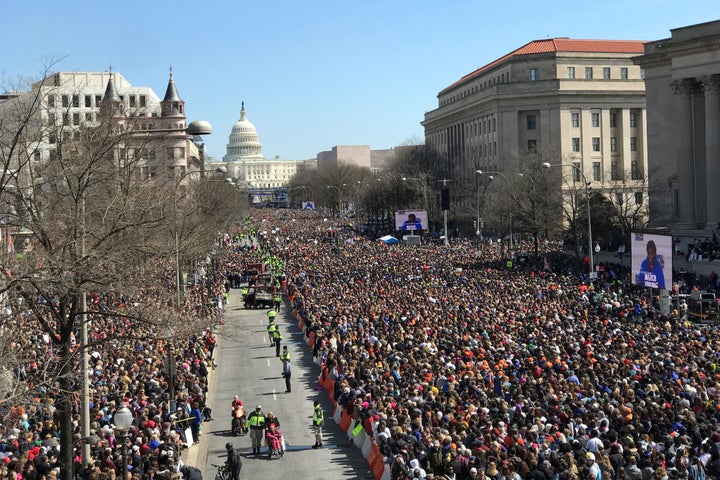
That was the message that hundreds of thousands of protesters around the world had Saturday for lawmakers who have ignored the toll of gun violence and refused to pass meaningful gun reform legislation.
At the March For Our Lives event in Washington, D.C., students from Marjory Stoneman Douglas High School in Parkland, Florida ― where 17 people were killed last month ― gave passionate, articulate speeches encouraging young adults to vote. 
Survivor David Hogg made it clear that politicians in the pocket of the National Rifle Association wouldn’t be around much longer.
“To those politicians supported by the NRA and who allow the continued slaughter of our children and our future, I say: Get your resumes ready,” Hogg said.
Fellow survivor and activist Delaney Tarr echoed the sentiment.
“If we move on, the NRA and those against us will win. They want us to forget. They want our voices to be silenced. And they want to retreat into the shadows where they can remain unnoticed,” Tarr said. “They want to be back on top, unquestioned in their corruption, but we cannot and we will not let that happen.”
Everytown for Gun Safety, a nonprofit established after the Sandy Hook Elementary school massacre, provided support to the young organizers. Organizers said more than 800 marches were planned around the U.S. and abroad, with some protesters traveling from neighboring states to attend the largest gatherings. 
Many of their signs skewered politicians and the National Rifle Association. The more popular chants that broke out among the crowds included “Not one more,” “Vote them out” and “The NRA has got to go!”
ANDREW CABALLERO-REYNOLDS VIA GETTY IMAGES

Thousands of people gather on Pennsylvania Avenue at the March For Our Lives rally in Washington. 
Stephen, 17, from Syracuse, New York, told HuffPost that people his age aren’t looking for “band-aid solutions.” Brianna, 17, also from Syracuse, said she’s “sick of crying.”
“Let’s fucking do something,” she said. “Go out and do something. Vote.”
Even the youngest speakers pushed for people to take action at the polls. Naomi Wadler, an 11-year-old activist, acknowledged “the African-American girls whose stories don’t make the front page of every national newspaper, whose stories don’t lead on the evening news.”
“We know we have seven short years until we too have the right to vote,” she said of her peers. “So I am here today to honor the words of Toni Morrison: ‘If there is a book that you want to read but it hasn’t been written yet you must be the one to write it.’” 
Eleven-year-old activist Christopher Lane, a sixth grader who helped organize the New York march, shared a similar message, reciting statistics about how gun violence disproportionally affects black people. 
Colette Paterson, 14, told HuffPost that she and her mother decided to attend the New York march after Colette and 200 others at her Perkasie, Pennsylvania, high school received detentions for walking out in protest of gun violence.
“She’ll be voting in four years. That’s not a long time,” said Colette’s mother, Stephanie, who has a concealed carry permit.
Speaking to a crowd of thousands in New York City, Marjory Stoneman Douglas High School student Meghan Bonner paid tribute to her friend, Alaina Petty, who was killed on Feb. 14.
Bonner, one of many teens from Parkland who leapt into action after the shooting, sent a message of action to people her age: “The adults failed us, and now 17 people are dead.”

#BannuBhuttoKa - AYA AYA BILAWAL...

نواز شریف اور خان صاحب کو الیکشن میں آئینہ دکھانے کا وقت آگیا، بلاول

پاکستان پیپلز پارٹی کے چیئرمین بلاول بھٹو زرداری نے کہا ہے کہ نواز شریف اور خان صاحب کی اصلیت جان چکے ہیں اب وقت آگیا ہے ان دونوں کو الیکشن میں آئینہ دکھاناہوگا،جھوٹ کا عالمی میلہ لگے تو سب سے بڑا تاج عمران خان کو ملے گا،جنھوں دی تو صرف” گالی“ اور لیا تو صرف ”یوٹرن“، نواز شریف دوسروں کو کھلونا کہتے ہیں اور خود چابی ڈھونڈ رہے ہیں ، ہمیں ایسی عدالت کی ضرورت ہے جو انصاف کرسکے اور ایسے اداروں کی ضرورت ہے جو قانون کی حکمرانی کو یقینی بنائیں،مشرف ہوں یا دہشتگرد ہر کسی کو قانون کے مطابق سزا ملنی چاہیے ، پیپلز پارٹی نے فاٹا کے لوگوں کو ووٹ کا حق دیا فاٹا کو کے پی میں ضم بھی ہم کریں گے،مولانا صاحب کو فاٹا کے عوام سے کیا دشمنی ہے لوگوں کے انسانی حقوق کیوں پامال کر رہے ہیں ،دہشتگردی کو طاقت سے ختم نہیں کیا جا سکتا،یہ نقیب اللہ یا ٹارگٹ کلر کا نہیں پورے ملک کا مسئلہ ہے۔بنوں میں جلسہ عام سے خطاب کرتے ہوئے بلاول بھٹو زرداری نے کہا کہ پیپلز پارٹی کا خیبرپختونخوا سے رشتہ نیا نہیں ہے، 1972 میں ذوالفقار علی بھٹو نے مینگورہ میں خطاب کرتے ہوئے مالاکنڈ ڈویژن سے ایف سی آر جیسے کالے قانون کو ختم کرنے کا اعلان کیا تھا۔وہی پہلے وزیرِ اعظم تھے جنہوں نے جنوبی وزیرستان کا دورہ کیا تھا اور فاٹا کا ترقیاتی بڑھایا۔چیئرمین پیپلز پارٹی کا کہنا تھا کہ پی پی پی نے فاٹا کے عوام کو ووٹ کا حق دیا اور یہاں سیاسی جماعتوں کو کام کرنے کا حق دیا، اور پی پی پی ہی فاٹا کو خیبر پختونخوا میں ضم کرے گی۔انہوں نے کہا کہ مولانا فضل الرحمان فاٹا کو خیبرپختونخوا میں ضم کرنے کی مخالفت کررہے ہیں، مولانا صاحب آپ کو فاٹا کے عوام سے کیا دشمنی ہے، آپ فاٹا کے لوگوں کے بنیادی انسانی حقوق کیوں پامال کررہے ہیں؟چیئرمین پیپلز پارٹی نے کہا کہ خیبرپختونخوا کے عوام 40 سال سے آگ اور خون کا مقابلہ کررہے ہیں اور یہ خوشبو کی وادی جنگ کی خوشبو میں تبدیل کردی گئی ہے۔بلاول بھٹو نے خیبرپختونخوا کی حکمران جماعت پاکستان تحریک انصاف کو بھی شدید تنقید کا نشانہ بنایا اور چیئرمین عمران خان کے حوالے سے کہا کہ 'اگر جھوٹ کا عالمی میلہ لگا تو سب سے بڑا تاج عمران خان کو ہی پہنایا جائے گا'۔انہوں نے چیئرمین پی ٹی آئی کو مخاطب کرکے مزید کہا کہ 'عمران خان آپ نے اگر کسی کو کوئی چیز دی ہے تو وہ صرف گالی دی اور لیا ہے تو صرف یوٹرن لیا' سپریم کورٹ نے عمران خان کی اے ٹی ایم نااہل کردی ہے۔چیئرمین پیپلزپارٹی کا کہنا تھا کہ ہم اپنی آنے والی نسلوں کو ان دہشتگردوں کے رحم و کرم پر نہیں چھوڑیں گے، ہم دہشت گردوں سے لڑیں گے، یہ ہمارے بچوں اور عورتوں پر تشددد کرتے ہیں، بزرگوں کو قتل کرتے ہیں۔انہوں نے کہا کہ ہم چاہتے ہیں دہشت گرد ہویا مشرف، گرفتار ہوں مقدمہ چلے اور قانون کے مطابق سزا ملے۔ہمیں ایسی عدالت کی ضرورت ہے جو انصاف کرسکے، ایسے اداروں کی ضرورت ہے جو قانون کی حکمرانی کو یقینی بنائیں۔بلاول بھٹو زرداری کا کہنا تھا کہ میاں صاحب اور خان صاحب کی اصلیت جان چکے ہیں، وقت آگیا ہے ان دونوں کو الیکشن میں آئینہ دکھاناہوگا، یہ دونوں ایک ہیں، ان کی سیاست اور بنیاد ایک ہیں۔انھوں نے کہا کہ دہشتگردی کو طاقت سے ختم نہیں کیا جا سکتا، ملک میں قانون کی حکمرانی سے دہشت گردی کو شکست دی جاسکتی ہے۔ دہشتگردی کے خاتمے کےلئے نصاب بدلنا ہوگا۔جب تک طالبان کو بچھڑا ہوا بھائی کہا جائے گا دہشتگردی ختم نہیں ہوگی۔انہوں نے کہا کہ ہمیں ایسی پولیس کی ضرورت ہے جس پر لوگ اعتماد کریں، کیونکہ پولیس ہی دہشت گردی کے خلاف جنگ میں فرنٹ لائن کا کردار ادا کرتے ہیں۔چیئرمین پی پی پی کا کہنا تھا کہ جب ہم نے بینظیر بھٹو کے انتقال کے بعد جب حکومت سنبھالی تو اس وقت دہشت گردوں نے خیبرپختونخوا اور فاٹا کے علاقوں میں قبضہ جمایا ہوا تھا۔انہوں نے کہا کہ اس دوران ان کی حکومت نے سیاسی مفاہمت کرکے ان علاقوں میں فوجی آپریشنز کا آغاز کیا اور اس دوران داخلی طور پر نقل مکانی کرنے والے آئی ڈی پیز کا خیال کیا۔خیبرپختونخوا میں پاکستان تحریک انصاف کی صوبے میں حکومت کو نشانہ بناتے ہوئے کہا کہ پی ٹی آئی حکومت نے اپنے دورِ اقتدار کے دوران صوبے میں ایک بھی یونیورسٹی نہیں بنائی۔ان کا کہنا تھا کہ تحریک انصاف کی حکومت نے خیبرپختونخوا یونیورسٹی بنانے کے بجائے کروڑوں روپے ایک مخصوص مدرسے کو دے دیے۔بینظیر انکم سپورٹ پروگرام کے لوگو سے سابق وزیراعظم بینظیر بھٹو کی تصویر ہٹانے کے حوالے سے بات کرتے ہوئے بلاول بھٹو زرداری کا کہنا تھا کہ یہاں سے ان کی تصویر ہٹائی جاسکتی ہے لیکن ملک کی غریب خواتین کے دلوں سے بینظیر بھٹو کو نہیں نکالا جاسکتا۔بلاول بھٹو زرداری کا کہنا تھا کہ جو شخص دوسروں کو چابی والا کھلونا کہہ رہا تھا آج وہ خود اپنے کھلونے کی چابی ڈھونڈ رہا ہے۔انہوں نے کہا کہ نواز شریف شمال مشرقی سرحدی صوبے کا نام خیبرپختونخوا رکھنے کی مخالف تھی تاہم اس معاملے میں پیپلز پارٹی کی سیاسی جیت ہوئی سابق وزیر اعظم نے اپنے گھٹنے ٹیک دیے اور صوبہ سرحد کا نام خیبرپختونخوا کا رکھ دیا گیا۔پاک چین اقتصادی راہدای کے حوالے سے بات کرتے ہوئے بلاول بھٹو زرداری کا کہنا تھا کہ اس منصوبے کی بنیاد پاکستان پیپلز پارٹی نے رکھی جس کا مقصد بلوچستان اور خیبرپختونخوا میں ترقی لانا تھا۔انہوں نے کہا کہ اس وقت سی پیک لاہور میں تو نظر آرہا ہے لیکن خیبرپختونخوا اور بلوچستان میں سی پیک منصوبہ نظر نہیں آرہا۔

https://www.nawaiwaqt.com.pk/24-Mar-2018/792392

Peoples Party has a long-standing relation with Khyber Pakhtunkhwa: Bilawal Bhutto


Pakistan Peoples Party has a long-standing relation with Khyber Pakhtunkhwa, said PPP Chairperson Bilawal Bhutto-Zardari.
While addressing a rally in Bannu, Bilawal said it was PPP founder Zulfikar Ali Bhutto who had announced to demolish the Frontier Crimes Regulation from Malakand Division during his speech there.
He added the brave people of KP have been fighting since a long time as the valley of fragrance has been turned into one of blood.
To solve the issues of KP a court is needed that could impart justice, the PPP chairperson said.
“We need a police force that people could trust and institutes that ensure rule of law,” he added. “I trust our police be it of KP, Punjab, Balochistan or Sindh as they all have made sacrifices and fought terrorists with valour.”
Bilawal said police was the country’s frontline, which ought to be strengthened on the whole as every street cannot have a soldier deployed.
Speaking about war against terrorism, Bilawal said it was his party that brought together the entire Parliament and united people for the sake of sustainable peace in Swat that was taken over by terrorists soon after Benazir Bhutto’s martyrdom.
The PPP chairperson also claimed of repatriating the nearly 2.5 million internally displaced persons to their native areas within three months.
Bilawal is flanked by other party leaders such as Anwar Saifullah Khan, Sher Azam Wazir, Humayun Khan, Senator Rubina Khalid and Faisal Kundi.
Party supporters from different areas have come to Bannu to attend the rally and show their support for their leader.

#BannuBhuttoKa - Bilawal lambastes #PTI, #PMLN, #JUIF in #Bannu rally

Pakistan People’s Party (PPP) chairman Bilawal Bhutto Zardari on Saturday said the nation’s basic concerns are not the questions behind a leader’s ouster but availability of food, cloth and shelter.
Speaking to party supporters gathered at the rally in Bannu, the PPP chief demeaned Nawaz Shareef and Imran Khan saying that the two, despite different claims, are of same sect and possess mutual conspiracies in politics.
He vowed that both parties’ ‘Quaids’ will be shown their realities during the forthcoming elections. He also criticised Jamiat-ul-Islam-Fazl chief Maulana Fazlur Rehman for opposing the merger of KP and FATA.
He outlined that the outcomes of China-Pakistan Economic Corridor (CPEC) are only visible in Lahore, whilst KP and Baluchistan remain unaffected.
The PPP chief maintained that the party has remained in sustained ties with KP for fifty years and stressed the need to arrest the accused terrorists involved in blood shedding the fragrant province and demanded legal proceedings, adding that "Terrorism is neither an issue only linked to Naqeebullah Mehsud's murder nor a case of a target killer, it is the problem of the entire country."
He claimed of repatriating the nearly 2.5 million internally displaced persons to their native areas within three months.
He further said that it was PPP founder Zulfikar Ali Bhutto who had announced to demolish the Frontier Crimes Regulation (FCR) from Malakand Division.
Pulling the tirade at the Pakistan Tehreek-e-Insaf chief, he alleged that Imran Khan makes false claims of ending corruption in KP, whereas the leader has miserably failed to even eradicate poverty, unemployment or to build a single hospital in the province.
He lauded Bannu for displaying the most authentic response by disagreeing to Imran Khan’s question if the city has been relieved of corruption.
He stressed that KP needs to be relieved of Banni Gala’s grip as Imran Khan only seems concerned to promote westernization in the province irrespective of crucial needs, adding that how can a newer Pakistan expected from the leader who couldn’t build a newer KP during his tenure.
He also added that if an annual festival of liars were to be held, Imran would be seated at the king’s throne as he has only taken U-turns in his political tenure.

Video - #Pakistan - #BannuBhuttoKa - #Pakistan - #PPP - Chairman PPP Bilawal Bhutto Speech At Bannu Jalsa 24th March 2018

Friday, March 23, 2018

Music Video - Sinéad O'Connor - Nothing Compares 2U

Video Report - Elizabeth Warren Scolds Ben Carson For Not Doing His Job

Video Report - People impacted by gun violence share their stories

Video Report - Parkland students: This is a matter of life and death

Video Report - Parkland Students Discuss Gun Reform, March For Our Lives | The Daily Show

Music Video - Bruno Mars - Finesse

Losing their religion - The number of ex-Muslims in America is rising


Yet even in the land of the free, apostasy isn’t easy.
AS SOON as he stepped off the plane on a family holiday to Kenya, Mahad Olad knew something was wrong. His mother, a “very devout, very conservative, very Wahhabi” woman, was acting strangely—furtively taking phone calls when she thought he was out of earshot. His suspicions would soon be proved correct. Mr Olad’s family, Somali immigrants to America and devout Muslims, had discovered that he had not only renounced Islam but was also gay. The holiday was a ruse, an intervention to save his soul.
Mr Olad was told he would leave college and be turned over the next day to the care of Muslim clerics who would restore his faith. “I was aware of the horrors of these camps,” Mr Olad says. “They operate them in the middle of nowhere, where you cannot escape. They subject you to beatings, starvation and trampling.” He tried to contact the American embassy, but it could not send help because of recent terrorist attacks nearby. Luckily, he also managed to reach a Kenyan atheist group. In the dead of night he sneaked into his mother’s room, stole his passport and was whisked away by taxi to the embassy, which eventually returned him safely to America. He has not spoken to his family since.
Though few have such harrowing stories, hundreds of thousands of American Muslims might recognise something like their own experience in Mr Olad’s tale. As the number of American Muslims has increased by almost 50% in the past decade, so too has the number of ex-Muslims. According to the Pew Research Centre, 23% of Americans raised as Muslims no longer identify with the faith. Most of them are young second-generation immigrants who have come to reject the religion of their parents. Some, however, are older when their crisis of faith arrives, already married to devout Muslim spouses and driving children to the mosque to study the Koran at weekends.
The vast majority, whether young or old, are silent about their faithlessness. One Muslim college student, who came home drunk one evening, was confronted by his father. Not thinking clearly, the son confessed to his father that he was an atheist, whereupon the father revealed that he too had lost his faith many years ago. Yet he still admonished his son for not hiding his secret well enough.
Publicly leaving Islam is difficult because many Muslims live in tight-knit communities. Many apostates are left closeted, afraid to put at risk their relationships with their parents, on whom they may still depend, or with their siblings and their friends. Non-believing Mormons, Hasidic Jews and evangelical Christians find themselves in a similar predicament. Within Somali enclaves in Minneapolis and Pakistani ones in Dallas, renunciation of Islam is tantamount to renunciation of an entire social circle. “The most frustrating part is living knowing that my life has to be guided by the rules I don’t agree with,” says one still deep in the closet.
Apostasy is different from apathy, but that is also growing among Muslims. Among believers aged 55 or older, 53% say they perform all five of the mandatory daily prayers—no easy feat, considering that the first must be done before dawn. Among Muslim millennials, that proportion falls to 33%. Few would be ostracised for missing a prayer, or not fasting during the month of Ramadan—so long as those misdeeds were not made public.
In broad terms, there are two types of ex-Muslims. Those who are from less religious families simply drift away and face fewer repercussions. “It was a progression,” says one such ex-Muslim, who stopped praying at the age of eight after noticing that nothing cataclysmic happened when she missed a prayer one day. Then she starting sneaking meals during Ramadan, before moving on to alcohol and premarital sex. At 18, she was an atheist.
Then there are those in more religious households. They tend to have cleaner breaks, sudden realisations while studying the Koran or the Hadith, the sayings of the Prophet Muhammad. Often the verses that trigger this are controversial ones about slavery or gender that family members and imams cannot explain satisfactorily. Coming across the writings of Ayaan Hirsi Ali, Richard Dawkins or Christopher Hitchens sometimes has the same effect. Some chafe at sexism or homophobia. “I remember one Halloween, I wasn’t allowed to go trick-or-treating because I had to clean up after dinner, but all my male cousins and brothers got to go,” says one female ex-Muslim who is not out to her family (nor will ever be, she fears). To cope, some look online, seeking solace in anonymous forums. One, hosted on Reddit, has nearly 30,000 followers. Here ex-Muslims trade stories of families kicking their children out after they confess their disbelief. But they also traffic in lighter-hearted fare, like taking pictures of booze-and-pork meals during Ramadan—enjoyed in the daylight, of course.
Out and proud
Despite all the pressure of family and community, more ex-Muslims seem to be going public. Ex-Muslims of North America (EXMNA), an advocacy organisation, has pushed for those who safely can to publicly declare their renunciations. “The goal is to change things enough so that we no longer need to exist,” says Sarah Haider, EXMNA’s director. The group launched a university tour, entitled “Normalising Dissent”, which has attracted angry critics and required extensive security preparations. Though she must contend with death threats, and has to be quite vigilant about infiltrators to her organisation, Ms Haider persists. “Condemnation is still acknowledgment,” she notes.
While the penalties for apostasy can be high in the West, they are much more severe in the Muslim world. In Pakistan, blasphemy carries a death sentence. In Bangladesh, atheist writers have been hacked to death by machete-wielding vigilantes. An atheist who recently appeared on Egyptian television to debate a former deputy sheikh from Al-Azhar University was dismissed by the host and told that he needed to see a psychiatrist. Mr Olad, who was born in a refugee camp in Kenya, has seen both worlds—he knows ex-Muslims in Kenya and Somalia who were severely beaten when their secrets were discovered. “I feel very grateful to live in a country where I have at least some level of protection,” he says.

Barack Obama gets a traditional nose-rubbing welcome in New Zealand


By Nicole Chavez


During a three-day visit to New Zealand, Obama was given a traditional Maori tribal welcome Friday. He was gifted with a whale tooth pendant and was honored with a hongi -- a greeting in which two people press their noses and foreheads together.
Obama met with New Zealand Prime Minister Jacinda Ardern to discuss leadership, climate change and how social media impacts politics, Arden told reporters.
He also held a public speaking event for an audience of about 800 and spent time playing golf with former New Zealand Prime Minister Sir John Key, The New Zealand Herald reported.
    He isn't the first high-profile visitor to take part in the tradition. Former Secretary of State Hillary Clinton, as well as Prince William and his wife Catherine, Duchess of Cambridge, have done it in the past.

    Barack Obama voices support of female leaders at exclusive NSW Art Gallery dinner


    Former US President Barack Obama has shared his thoughts on leadership and voiced his support for female executives at an exclusive event in Sydney overnight.
    Mr Obama attended a dinner last night at the Art Gallery of NSW, hosted by the New Zealand United States Council, where he spoke to an audience of around 200 people on topics ranging from leadership to young people and the spread of information.
    Mr Obama has been in Sydney on a whirlwind trip that began around 1pm yesterday when he flew into the city on a private jet flanked by a motorcade of vans, SUVs and around a dozen police motorbikes.
    Former US President Barack Obama has spoken at an exclusive dinner in Sydney overnight, attended by around 200 people. Picture: Twitter.
    Former US President Barack Obama has spoken at an exclusive dinner in Sydney overnight, attended by around 200 people. Picture: Twitter.
    Mr Obama threw his support behind female leaders and the influence of young people at an event at the Art Gallery of NSW. Picture: Twitter.
    Mr Obama threw his support behind female leaders and the influence of young people at an event at the Art Gallery of NSW. Picture: Twitter.
    While the dinner was an invitation-only event free of the media, social media posts from inside the gallery show the former President looking relaxed in an arm chair in front of the audience.
    “When I say that companies need women on boards it’s not for charity - those companies run better: President Barack Obama,” a tweet from Sydney councillor Christine Forster said from the dinner.
    “Young people drive change because they’re not vested in the way things have been, they can imagine how things should be. The problem is they don’t have any faith in existing institutions: President Obama,” another post said.
    The former leader has been in Sydney on a whirlwind 2-day trip down under that saw him meet Prime Minister Malcolm Turnbull. Picture: 9NEWS.
    The former leader has been in Sydney on a whirlwind 2-day trip down under that saw him meet Prime Minister Malcolm Turnbull. Picture: 9NEWS.
    Mr Obama was also seen yesterday visiting the Sydney Opera House yesterday during the two-day whirlwind trip and also met with Prime Minister Malcolm Turnbull.
    Heightened security measures have been put in place again today in preparation for the former President’s departure, with police officers surrounding the InterContinental Hotel in the CBD.
    Earlier this week, Mr Obama also spent time in New Zealand, playing a game of golf with former leader John Key and being hosted for a dinner by actor Sam Neill.
    He is expected to leave Sydney today to continue his trip, which will see him headed for Tokyo.
    https://www.9news.com.au/national/2018/03/24/08/36/barack-obama-art-gallery-nsw-sydney-event