Saturday, January 6, 2018

Cutting Off Pakistan, U.S. Takes Gamble in Complex Afghan War


Afghan officials have pleaded with three American presidents to reconsider their support for Pakistan, which was both receiving billions of dollars in American aid and harboring the leaders of a Taliban insurgency that the United States has struggled to defeat.
But when President Trump suspended nearly all American security aid to Pakistan on Thursday for what he called the country’s “lies and deceit,” any jubilation in the halls of power in Afghanistan — and there was some — was leavened with worry over how the move might affect a complex war that has pushed the Afghan government to the brink.
If there is one consensus among Afghan leaders and their American counterparts, it is that dealing with Pakistan is both vital and difficult.
American and Afghan officials accuse Pakistan’s powerful military intelligence service of maintaining influence with the Taliban and the group’s most ascendant faction, the Haqqani network, which is behind many of the large-scale attacks on Afghan cities. Through those links, Pakistan has the ability to control at least some of the tempo of the fighting in Afghanistan — and it has done little to constrain it over the past two years, the officials say.
At the same time, Pakistan enjoys leverage over the American military response to that militant violence: The United States mission has always relied on Pakistani air and ground routes for supplies to the troops in Afghanistan. The question on the table after the cutoff of military aid to Pakistan is who will come under the most pressure: the Pakistanis, or the coalition fighting the Taliban.
Muhammed Umer Daudzai, a former Afghan interior minister and ambassador to Pakistan, said the pressure on Pakistan had come too late, with the country having developed regional allies who would help it weather the financial toll.
“The financial sanctions may not bite Pakistan because they have developed alternatives,” Mr. Daudzai said. “The only area the impact could be huge, but it’s a bit too early to judge, is the field of air force. The Pakistani system is still hugely dependent on the U.S. It can take a long time to switch from that.”
Pakistani officials expressed both anger and caution over the American move. Several indicated that cutting off ground supply routes to Afghanistan was actively being considered, but that a formal decision was not likely to be announced on Friday.
The commander of the Pakistani Air Force also seemed to suggest that Pakistan’s airspace might be blocked to the Americans. In Islamabad on Thursday, Air Chief Marshal Sohail Aman said his force was “fully prepared to defend all the aerial frontiers of the country.”
On Friday, the Foreign Ministry released a statement saying, “We are engaged with the U.S. administration on the issue of security cooperation and await further details.”
“We believe that Pakistan-U.S. cooperation in fighting terrorism has directly served U.S. national security interests as well as the larger interests of international community,” the statement said. And in a measured criticism of Mr. Trump’s move, it said that working for peace requires “mutual respect and trust,” adding that “arbitrary deadlines, unilateral pronouncements and shifting goal posts are counterproductive in addressing common threats.”
Across the Pakistani political spectrum, officials accused the United States of making Pakistan a scapegoat for the failures in Afghanistan.
Imran Khan, a prominent opposition politician whose positions on foreign and defense policy are often closely aligned with Pakistan’s security establishment, called for steps to disengage diplomatically from the United States. “We must immediately remove excessive U.S. diplomatic, nondiplomatic and intelligence personnel from Pakistan so that diplomatic parity is established according to international legal norms governing diplomatic relations between states,” he said in a statement, adding that the ground and air routes for American military supplies should also be shut down. In past cases when relations frayed and Pakistan blocked American access to its supply routes, the United States military relied on a more expensive alternative that connects Baltic and Caspian ports through Russia and Central Asian countries. But that route is vulnerable to Washington’s chilly relations with Russia, which has used its influence over Central Asian states to limit access.
At its peak, when the United States had about 100,000 troops in Afghanistan, the alternative route helped with the transportation of about one third of nonlethal material with Russia’s consent. The American-led coalition also used Manas, a major air base in Kyrgyzstan, as the transit point for almost all of the coalition troops and a refueling center for tens of thousand aircraft.
Kyrgyzstan, apparently in response to Russian pressure and incentives, first increased the annual rent to $60 million from $17 million, and then the United States left the base in 2014.
From the American and Afghan standpoints, trying to change Pakistan’s outlook has only grown more difficult in recent years as the relative consensus has broken down among major players in the region — like Russia and Iran — over the American mission to eradicate international terrorist groups in Afghanistan.
In private, senior Afghan officials said they were watching just how focused the United States would be in maintaining the pressure on Pakistan, a nuclear state that has long managed to shrug off previous American and international pressure.
More publicly, however, President Ashraf Ghani and his government were measured in their reaction, staying away from directly addressing Mr. Trump’s move to freeze what could amount to more than a billion dollars in American aid.
“We welcome any decision that contributes to bringing stability in the region and Afghanistan,” said Haroon Chakhansuri, a deputy chief of staff to Mr. Ghani. “We want honest partnership in the region to fight against a common enemy, terrorism.”
Some Afghan officials and analysts feared that Mr. Trump’s pressure on Pakistan might escalate the violence across Afghanistan before it brings any change in Pakistani cooperation. Already, officials are bracing for more urban bombing attacks in the winter months, when the regular fighting slows down a bit.
Also vulnerable are about two million Afghan refugees in Pakistan, who feel an increase in harassment in such periods of high political tension.
An important factor in whether the American pressure could result in a change of Pakistani attitude is whether American diplomacy can appeal to China and Russia’s shared concerns of militant extremism in the region, and persuade them not to give Pakistan a release valve. Russia is concerned about the rise of an Islamic State affiliate in Afghanistan, most of whose fighters are from the tribal areas of Pakistan, while China fears that an unstable Afghanistan provides sanctuary to its Uighur insurgency.
“You have an anti-American sentiment in the region on the one hand, but on the other hand you have the fear of terrorism and extremism in the region,” said Davood Moradian, the director of the Afghan Institute for Strategic Studies in Kabul. “If the U.S. uses active diplomacy, it can convince the regional players to align with efforts to stabilize Afghanistan, because they will not compromise on their own national security for the sake of Pakistan.”
Mr. Moradian said factors that make Pakistan a military power, such as hardware and training, are oriented toward the United States, with China less able to easily fulfill them. And he described the Pakistani elite as more integrated in the West — with houses, business, and bank accounts there — and thus more likely to feel the pressure of targeted sanctions.
“I don’t think Pakistan will be able to absorb sustained U.S. pressures,” Mr. Moradian said. “In the Pakistan-American dynamics, Pakistan is far more vulnerable.”
He continued: “Pakistan’s success has been in absorbing pain for a short period, and then getting away. Washington has not been able to bear pain for a limited period of time in the hopes of longer success.”
Before the Trump announcement on freezing aid to Pakistan, senior Pakistani officials had shrugged off the threats. One official said every threat from Washington was pushing Pakistan closer to China. The two countries have a partnership to develop up to $60 billion in infrastructure in Pakistan under the “One Belt, One Road” program, and have tightened their military ties.
Khawaja Muhammad Asif, Pakistan’s foreign minister, recently urged a revisiting of ties with the United States, which he called neither a friend nor an ally.
“The world is vast enough,” he said, “and the U.S. is not feeding us.”

U.S. places Pakistan on watch list for religious freedom violations


The U.S. State Department has placed Pakistan on a special watch list for “severe violations of religious freedom,” it said on Thursday, days after the White House said Islamabad would have to do more to combat terrorism to receive U.S. aid.
The State Department also said it had re-designated 10 other nations as “countries of particular concern” under the International Religious Freedom Act for having engaged in or tolerated egregious violations of religious freedom.
The re-designated countries were China, Eritrea, Iran, Myanmar, North Korea, Sudan, Saudi Arabia, Tajikistan, Turkmenistan and Uzbekistan. They were re-designated on Dec. 22.
“The protection of religious freedom is vital to peace, stability, and prosperity,” the department said in a statement. “These designations are aimed at improving the respect for religious freedom in these countries.”
U.S. President Donald Trump has criticized Pakistan for not doing more to combat terrorism, and his administration has informed members of Congress that it will announce plans to end “security assistance” payments to the country.
Pakistan has said it is already doing a lot to fight militants, and summoned the U.S. ambassador to explain a tweet by Trump that said the United States had been foolish in dispensing aid to Islamabad.

The long history of incredibly fraught relations between the U.S. and Pakistan


By Amanda Erickson


It started as a tweet.

The United States has foolishly given Pakistan more than 33 billion dollars in aid over the last 15 years, and they have given us nothing but lies & deceit, thinking of our leaders as fools. They give safe haven to the terrorists we hunt in Afghanistan, with little help. No more!
Early Monday morning, President Trump lashed out at Pakistan, accusing the country of “lies & deceit” and of giving safe haven to terrorists. “No more!” he wrote.
By Thursday, the State Department had announced that it would withhold up to $2 billion in U.S. aid until the country takes “decisive action” against the Taliban and an aggressive offshoot of the group, the Haqqani network. As The Washington Post reported, that number includes $900 million in Coalition Support Funds designated to reimburse Pakistan for fighting militants.
“No partnership can survive a country's harboring of militants and terrorists who target U.S. service members and officials,” State Department spokeswoman Heather Nauert told reporters.
Pakistan responded with frustration and threats of its own, prompting fears that the two countries might become embroiled in an increasingly tense tit-for-tat. That could be a big problem for the United States, which relies on Pakistan as a key ally in its war in Afghanistan. Here's a look at what this latest fight between the two countries might mean.
How much military aid does the United States give to Pakistan? What is it used for?
The United States has given Pakistan at least $20 billion in security assistance since 2002. Much of that money has been dedicated to funding Pakistan's counterterrorism activities and paying for U.S.-made hardware. However, the flow of money to the region from the United States has shrunk in recent years, and Pakistan is not nearly as reliant on U.S. assistance as it's been in the past. Pakistan has developed a close relationship with China, for example, which is investing $62 billion in infrastructure projects in the country. The suspension of aid may have the biggest impact on Pakistan's air force, which is still very dependent on U.S. aid and supplies. The Trump administration is considering a range of other punishments, too, including sanctions, increased drone strikes and a withdrawal of support for Pakistan at global financial institutions such as the World Bank, my colleagues reported.
Have U.S.-Pakistan relations always been this fraught?
No. In fact, the United States was one of the first countries in the world to establish diplomatic ties with Pakistan after it achieved independence in 1947. In part, that was an effort to keep Pakistan from allying with the Soviet Union during the Cold War.
But Pakistan quickly became an important military asset. The United States was granted permission to lease Peshawar Air Station in the 1950s to keep an eye on Moscow. Lahore also allowed the United States to launch spy missions from its territory. And Pakistan helped President Richard M. Nixon make his first visit to China. In exchange, Washington offered millions of dollars in aid and military support.
Relations cooled in the late 1980s, after Congress adopted the Pressler Amendment, which banned military and economic aid to Pakistan unless the nation was able to prove that the money was not being used to develop a nuclear weapon. (The United States felt empowered to make this decision in large part because Pakistan had lost the strategic importance it enjoyed during the Cold War.) By 1992, the U.S. ambassador to Pakistan, Nicholas Platt, was suggesting that Washington include Pakistan on its list of state sponsors of terrorism because of the aid it was allegedly funneling to militants in India.
The Sept. 11, 2001, terrorist attacks shifted relations again. Just as during the Cold War, the United States needed Pakistan for its military missions. Pakistan became one of the United States' most important strategic allies in the war on terrorism, even negotiating discussions with the Taliban and al-Qaeda to see whether they would hand over Osama bin Laden. (Pakistani leaders felt they had no choice, they said, because the United States threatened to bomb them “back into the stone age” unless they complied.) In exchange, Washington dropped all sanctions and forgave a $1 billion loan. By 2004, Pakistan was considered a neo-NATO ally and allowed to buy weapons.
However, the U.S. war with Afghanistan created some complicated politics for Pakistan. U.S. drone strikes aimed at terrorists hiding in Pakistan killed and maimed civilians. American military incursions resulted in the deaths of Pakistani soldiers. And U.S. officials publicly questioned whether Pakistan was spending U.S. military aid on fighting terrorism.
The Bush and Obama administrations expressed frustration with Pakistan, suggesting that the country had not done enough to help eradicate terrorism. In 2011, the United States suspended $800 million in military aid.
So far, Trump and his advisers have seemed inclined to take a hard-line approach toward the country. In an August speech on Afghanistan, Trump remarked: “We have been paying Pakistan billions and billions of dollars at the same time they are housing the very terrorists that we are fighting. But that will have to change, and that will change immediately.” Pakistani officials reacted angrily, postponing a visit from a top State Department official and canceling a big bilateral visit.
Is the Trump administration right? Is Pakistan doing enough to get rid of terrorists and safe havens?
It's true that members of the Taliban and the Haqqani network have used Pakistan as a sort of safe haven. Afghan officials have long accused Pakistan's powerful military and intelligence service of maintaining influence with the Taliban and the Haqqani network, responsible for many attacks on Afghan cities.
“Through those links, Pakistan has the ability to control at least some of the tempo of the fighting in Afghanistan — and it has done little to constrain it over the past two years, the officials say,” the New York Times reports.
But Pakistani officials argue that they're doing all they can to stamp out the terrorists who shelter in their borders. They note, too, that they've been victims of terrorist attacks.
How is Pakistan responding?
Pakistani officials reacted to the news with measured frustration. In an interview with Geo News, Foreign Minister Khawaja Muhammad Asif called the United States “a friend who always betrays.” Opposition politician Imran Khan went one step further, calling on Pakistan to “immediately remove” U.S. diplomatic and intelligence personnel. In a statement, he also advocated for Pakistan to shut down U.S. access to air and ground routes.

#Pakistan - #AitzazHasan — Aitzaz Hasan Shaheed: a symbol of courage and bravery


January 6, 2018, marks the 4-year anniversary of the martyrdom of Aitzaz Hasan Bangash, a 15-year-old who gave his life to in order to protect the lives of others around him and from the moment of his Shahadat has been a symbol of courage and bravery for the entire country.
Aitzaz Hasan was with friends outside school when they spotted a man wearing a suicide vest. Despite the pleas of his fellow students, Aitzaz decided to confront and capture the bomber who then detonated his vest, killing himself and immortalising the young boy for his act of supreme bravery.
The incident of Aitzaz’s martyrdom took place in Ibrahimzai region of Hangu. There were almost 2,000 students in attendance at the time of the attack.
Aitzaz’s action to save his classmates captured the hearts of his countrymen and people all over the world and he was hailed as a national hero. Aitzaz was awarded the civil award of Sitara-e-Shujaat (Star of Bravery) by the government of Pakistan and was also named as the Herald’s Person of the Year for 2014.
“My cousin sacrificed his life to save his school and hundreds of students and school fellows,” Aitzaz’s cousin Mudassar Hassan Bangish stated after his martyrdom.
“The suicide bomber wanted to destroy the school and school students. It was my cousin who stopped him from this destruction,” his cousin continued.
His family insist that rather than focus on the sorrow brought about by his death, they want to focus on their pride in his actions.
“My son made his mother cry, but saved hundreds of mothers from crying for their children,” Mujahid Ali, Aitzaz’s father is quoted as saying.

#Pakistan - The elusive stability


By - Afrasiab Khattak
“Don’t be fooled, the abatement of
the darkness is not here yet
The deliverance of the eye and the heart
is not here yet
Keep moving, for the awaited destination
is not here yet “.
–Faiz Ahmad Faiz.
Challenges faced by democratic project in Pakistan aren’t new but the situation has worsened recently as the deep state, after seriously destabilising the elected government, is creating roadblocks on the path of general elections that are to be held in few months. By now it is an open secret that the aggressive and partially violent sit ins by maverick politicians and religious extremists during the last four years were scripted by the deep state. Sitting ministers had named names of some higher ups in the sensitive state institutions for being the moving spirit behind the prolonged sit in of 2014 and senior judges of higher judiciary have given revealing remarks in open courts about the recent violent sit in at Faizabad by religious fanatics. In both cases no formal denial came from the security establishment. But more curious is the agenda for dissolving the elected assemblies before their constitutional term and delaying the general elections on “technical grounds”. This is an agenda with twin objectives. One, such a development will subvert the schedule of the forthcoming Senate elections in which PML (n) is expected to become a majority party in the upper house. Two, it will create space for installing a care taker government (preferably of technocrats) for a prolonged period. The absence of political government would mean total monopoly of the security establishment over state power. So hectic behind the scene efforts were made to kill 24th Constitutional Amendment in the Senate where opposition parties enjoy majority. The bill was already passed by the National Assembly where Nawaz Sharif’s Party is in majority. Blocking it the upper house would have made the task of delimitation of constituencies on the basis of latest census in time impossible. In that case the delay in elections would have been inevitable and the responsibility for the delay would have been assumed by the Parliament. Playing to the tunes of the deep state some political opportunists among the opposition parties did try to obstruct passage of the bill in the Senate but saner elements in the same parties made sure that the bill is passed.
Yet the game is far from over. The agenda for forcing the dissolution of assemblies before their constitutional term is still being actively pursued. The machinations in Balochistan for putting pressure on Chief Minister Balochistan is the clearest indication. According to reports emanating from Quetta, apart from tabling a no confidence motion against CM Balochistan, he is also receiving threats of corruption cases if he doesn’t cooperate in the dissolution campaign. Political pundits predict that in case efforts for dissolution of Balochistan assembly bear fruit, next in line will be Pakhtunkhwa assembly followed by Sindh assembly. This will isolate Punjab assembly, the political bastion of Sharifs. Some of the opposition parties can further intensify the pressure by resigning from the National Assembly. But another set of political observers believe that the premature dissolution campaign may not succeed for two reasons. One, political parties wouldn’t wholeheartedly go for it in exchange for vague and uncertain promises of the establishment. Two, the indefinite delay in general elections can hurt the opposition political parties as much as it hurts the ruling party.
Be that as it may, former Prime Minister Nawaz Sharif has stayed the course and refused to bow out despite all sorts of pressures. Consequently he has emerged as a formidable political leader. His vote bank seems to be intact and his international stature appears to be growing. The former is proved by persistence of unity in his parliamentary party and the later is testified by his latest Middle East visit. Nawaz Sharif said important things in his press conference in Islamabad on Thursday. Reading out from a written statement, on the one hand he asked the US government to not forget the value and significance of Pak-US cooperation in war on terror, but on the other hand he distanced himself from the soft policy towards terrorism pursued at home. He clearly pointed out civil-military divide on the issue when he referred to the so called Dawn Leaks in which his government was accused by the Army for making deliberate leakage about a high level security meeting in October 2016. He categorically emphasised the need for “ putting our own house in order” when it comes to campaign against terrorism. Some ministers of the current government may be parroting the establishment’s narrative on terrorism by clinging to the policy of denial but the statement of Nawaz Sharif clearly indicates that the actual political leadership is in favour of ending soft corner for extremism and terrorism and avoiding interference in the internal affairs of other countries. It believes that such a policy change will provide a high moral ground to the country which is a pre requisite for taking a strong position. But most importantly Pakistan will be able to avoid the isolation that is being faced by it due to flawed policies on terrorism and extremism.
The pro establishment political parties claim that Nawaz Sharif-led PML has lost support among masses. But if that’s the case then why are they creating hurdles on the path of election which is around the corner? Fact of the matter is after ZAB it is for the first time that a political leader with large scale political support has stood up to the coercion and political engineering of the security establishment. As a political leader he like ZAB has his own limitations. But again like him he has mustered the courage to take a stand against the unconstitutional machinations and is sticking to it. He has certain advantages over ZAB. Establishment’s control has limits due to the not so easily controllable media in the 21st century, the social media in particular. Nawaz Sharif still enjoys a strong political base in the Punjab, which is the key to power. Despite short term bleak prospects the current political struggle can auger well for the federation if a political leader or his party from Punjab can bring the Punjabi dominated security establishment under control. That can become the real basis for durable political stability .

#Pakistan - Salmaan Taseer – on the right side of history


Today marks the seventh anniversary of the senseless, cold-blooded murder of Salmaan Taseer. His martyrdom was a price paid for defending a poor Christian woman and speaking up against injustice and violence perpetrated through the misuse of blasphemy laws. Even though the murderer has been punished by the courts of this country, ‘justice’ in a broader sense remains as remote as it was on January 4, 2011. Salmaan Taseer wanted the parliament to review these draconian laws. His quest for reform was misconstrued by the right wing fanatics, opportunists in the media and political opponents as ‘blasphemy’ itself. In all these years, not much headway has been made to reconsider the controversial and, if one may add, man-made laws that continue to haunt the body politic, and adversely affect the status of minorities in the country. Since his brutal murder, more people have been booked under the law, incidents of lynching have continued and hundreds languish in jails. The parliamentarians are scared, unmoved or worse remain indifferent.
Taseer’s killing should have moved the state towards action. After all he was a representative of the federation in his capacity as the governor of Pakistan’s largest province. But the state of Pakistan is addicted to misuse of religion for political gains. The Pakistan People’s Party government blocked YouTube after protests against a C-grade movie on the Internet. Nothing was learnt from the Taseer episode. A long legal battle led to restoration of YouTube but the damage was done. You could pick up any issue, incite public passions, mobilise a few hundred fanatics and then pressurise the state to surrender. In 2014, GEO TV that had fallen out of the favour of the powers-that-be, was booked under the blasphemy law. This followed the attack on journalist Hamid Mir whose family accused the deep state of harming him. GEO/Jang Group aired these accusations. Once again, blasphemy came in handy as a means to teach a lesson to the errant channel and its management. That this occurred at the behest of security establishment, says it all.
After the taming of traditional media, especially the television industry, the digital spaces emerged as arenas of dissent. A crackdown on digital media has been ongoing since the start of 2017. In January 2017, five social media activists were abducted by state agencies on the pretext of having committed ‘blasphemy’. The chorus was joined in by some TV channels and an effective campaign against illegally detained bloggers was launched that convinced even reasonable people of their alleged blasphemous activities. The Federal Investigation Agency (FIA) under the overzealous (former) interior minister published advertisements that online blasphemy should be reported. This was an open invitation for a witch-hunt. One victim of this odious state policy was Mashal Khan, a student at the Abdul Wali Khan University who was killed on campus by a mob that consisted of students, staff and outsiders on fake allegations of posting blasphemous content on his Facebook page. For weeks, everyone was busy proving that he was not a blasphemer, as if that would have justified the barbaric behaviour.
But this was a prelude to what was coming. After Nawaz Sharif’s engineered ouster through a questionable court verdict, his party’s government was brought to a standstill by clerics on the blasphemy issue. Ministers released video confessions that they were devout Muslims, and in the streets of Islamabad hundreds lionised Mumtaz Qadri, the killer of Shaheed Taseer. Abusive language, including expletives, was employed by these clerics to defend the ‘honour’ of Prophet Muhammad (PBUH). The son-in-law of former PM Sharif, Imran Khan and many others openly supported this cause. Such is the reckless support to extremism to earn a few political brownies.
This marginal Barelvi extremism has always been a reality. Mumtaz Qadri was a face of it but with the backing of the establishment to undercut Nawaz Sharif and pliant sections of the media, it is likely to turn into a menace. For more than 30 years, we have dealt with the Debonadi variant, generously funded by the Gulf countries, and now the Barelvi brigade might be used to control politics, as the Sharif dynasty refuses to disappear despite massive propaganda and court cases. In 2017, the military refused to become part of the crackdown on the Barelvi fanatics. Instead, they were given a warm send-off, called ‘our own people’ and awarded return fares. All of this unfolded like ignoble chapters of a tragedy. It is clear that the blasphemy laws are not going anywhere and religious passions will remain a convenient tool to be used at any given moment for a particular political agenda. Mumtaz Qadri was hanged. An immediate cause of justice was served but the mindset that aids and abets violence in the name of religion is ever-present and has the clear-cut backing of state institutions. Asia Bibi, the Christian woman defended by Shaheed Taseer, remains in prison. Another young scholar Junaid Hafeez continues to suffer solitary confinement and countless others are at risk. But Salmaan Taseer has left us with the idealism and courage of resisting this injustice. This is why many in Pakistan’s civil and political societies are challenging the forces of extremism. This is why we need to celebrate Taseer’s life; and bewail his death. He was on the right side of history.

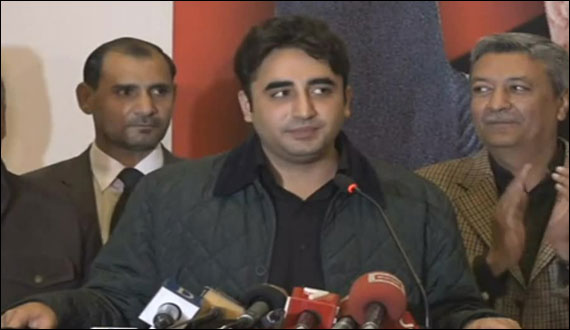
Video Report - Bilawal Bhutto Media Talk | 06 January 2018

#Pakistan - Bilawal Bhutto warns Balochistan crisis can spread to federal government


Pakistan Peoples Party chairman Bilawal Bhutto Zardari on Saturday questioned how the PPP could be behind any conspiracy against the Balochistan government when it does not even have a single seat in the provincial parliament.
“We don’t have even a single member in the (Balochistan) assembly. How can we be behind any conspiracy,” he said while addressing media, adding that the PPP will come up with their stance in the few days.
He hoped that the parliament will complete it tenure, but warned that the conspiracy can also spread to the federal government.
“When the assemblies don’t complete their tenure, then it would be a huge failure of the PML-N govt.”
The Balochistan government is facing a severe political crises as a no-confidence is being moved against chief minister Sanaullah Zehri, while several provincial ministers and advisors have tendered their resignations.
Regarding the Model Town incident, Bilawal said they will accept the decision made by the steering committee set up after the Pakistan Awami Tehreek (PAT) led all-parties conference of which the PPP is also a part.
Bilawal said they have faced dictators in the past and are afraid of falsified and fabricated cases. “We have faced PML-N, Zia, Musharraf in the past. We are not afraid of facing any false cases,” he said.
He said that Sindh was the only province which has a poverty alleviation programme, and that the development should not be gauged by metro buses and their projects should also be acknowledged.

Will be PML-N's failure if govt does not complete tenure: Bilawal Bhutto


Pakistan People’s Party Chairman Bilawal Bhutto said on Saturday that if the government did not complete its tenure then the onus of the failure will be on the ruling Pakistan Muslim League-Nawaz (PML-N).
The PPP scion was addressing media in Lahore, where he said that the party has carried out numerous development projects in Sindh and the media should highlight the same. 
Referring to the political situation in Balochistan, the PPP chairman said that the political situation in the province was worsening.
Responding to allegations that the PPP is involved in disrupting the political process in the province, Bilawal said there is not a single MPA of the party in the province's legislature. “How can I play any negative part then?” he said.
On the subject of PTI Chairman Imran Khan’s alleged third marriage, Bilawal said that it is the Imran’s personal matter.
“If Imran Khan has married then congratulations to him,” said the PPP chairman.
According to The News, the PTI chairman inaugurated 2018 by tying the knot on the night of January 1 in Lahore and reached from there the next day to appear before the anti-terrorism court in Islamabad which granted him bail.
On Jan 5, addressing an event on the birthday of PPP founder, Bilawal said that though democracy is present in Pakistan, it needs to be strengthened.
About the next general elections, Bilawal said the time was approaching and added the PPP would contest the 2018 elections with its might.  

Bilawal Bhutto condemns Punjab Police highhandedness against PPP Lahore Division President Shahjahan Ahmed Bhatti

Chairman Pakistan Peoples Party Bilawal Bhutto Zardari has strongly condemned the highhandedness of Punjab Police against PPP Lahore Division President and ex-MPA Shahjahan Ahmed Bhatti whose house was intruded in Nankana Sahib violating sanctity of Chadar and Chardiwari besides terrorizing his family.
In a statement issued here, the PPP Chairman said that Punjab government was turned the province into police state and its illegal raids and intrusions into the PPP leaders’ homes shows its highest level of political frustration.
Bilawal Bhutto Zardari said that raiding the house of Shahjahan Ahmed Bhatti without any warrants was tantamount to a threat to the PPP leaders and workers in Punjab and warned Sharif brothers to desist from such tactics as their days are numbered now.
He demanded immediate action against the officials involved in the illegal raid before the PPP workers take to streets to demolish the House of Cards of Sharif brothers.
https://mediacellppp.wordpress.com/2018/01/05/bilawal-bhutto-condemns-punjab-police-highhandedness-against-ppp-lahore-division-president-shahjahan-ahmed-bhatti/

Friday, January 5, 2018

Video - #HappyBirthdaySZAB - Zulfiqar Ali Bhutto's nuclrear policy statement

Video - #HappyBirthdaySZAB - Zulfiqar Ali Bhutto Speech - "#PPP"

Video - #HappyBirthdaySZAB - Mai Baghi Hoon (Jeyay Bhutto)

Video - #HappyBirthdaySZAB - Historic Speech of Shaheed Zulfiqar Ali Bhutto at UN security Council 15 December 1971

#HappyBirthdaySZAB - Kal Bhi Bhutto Zinda Tha,Ajj Bhi Bhutto Zinda Hai

ملک میں جمہوریت ہے لیکن مضبوط نہیں ، بلاول بھٹو - #HappyBirthdaySZAB

پیپلزپارٹی کے چیئرمین بلاول بھٹو زرداری نے کہا ہے کہ ملک میں جمہوریت موجود ہے لیکن مضبوط نہیں ،ہم الیکشن کی طرف جارہے ہیں ، جیالا جہاں بھی ہے تیار ہوجائے ۔
بلاول ہائوس لاہور میں پیپلز پارٹی کے بانی اور سابق وزیراعظم ذوالفقار علی بھٹو کی سالگرہ کا کیک کاٹنے کے موقع پر کارکنوں سے خطاب اور میڈیا سے گفتگو میں پی پی چیئرمین نےکہا کہ جتنا کام شہید بھٹو نے کیا اتنا کسی نے نہیں کیا ، انہوں نے ملک کو آئین دیا ، ایٹمی طاقت بنایا ۔
اس موقع پر بلاول بھٹو نےن لیگ اور پی ٹی آئی کی قیادت کو ہدف تنقید بنایا اور کہا کہ اگر ن لیگ کی حکومت آگئی تو پاناما کے بعد دنیا بھر میں کون ان سے بات کرے گا ؟یہ امریکا کی آنکھوں میں آنکھیں ڈال کر کیسے بات کریں گے؟
بلاول بھٹو نے یہ بھی کہا کہ اگر خدانخواستہ تحریک انصاف کی حکومت آگئی تو ہم دنیا کو کیا منہ دکھائیں گے ،وہ آدمی جو طالبان کو ہمارے بچھڑے ہوئے بھائی کہتا تھا ، ہمارا وزیر اعظم بنے گا تو پاکستان کہاں کھڑا ہوگا ؟
ان کا کہنا تھا کہ ابھی جمہوریت نئی اور کمزور ہے، اگر اگلی حکومت پیپلز پارٹی کی نہ ہوئی تو ملک کا کیا ہو گا؟عوام طاقت کا سرچشمہ ہیں ،چاہتے ہیں عوام ہی ہر فیصلہ کریں ۔
پی پی چیئرمین نے یہ بھی کہا کہ موجودہ حالات کے تناظر میں نواز شریف کے بیانات غیردانشمندانہ اور غیرذمہ دارانہ ہیں، ٹرمپ کے بیانات کا جواب حکومت وقت نے اچھا دیا ہے، یہ وقت یک زبان ہونے کا ہے۔
بلاول بھٹو نے کہا کہ اگلے انتخابات میں نوجوان قیادت صرف وہ خود ہیں کیونکہ مریم نواز ان کی عمر سے دگنی بڑی ہیں۔
سندھ میں کسانوں اور اساتذہ پر تشدد کے واقعات پر چیئرمین پیپلز پارٹی کا کہنا تھا کہ پولیس کا کام عوام کی خدمت کرنا ہے نا کہ اختیارات سے تجاوز کرنا۔

https://jang.com.pk/latest/429283-there-is-democracy-in-the-country-but-not-strong-bilawal-bhutto

Video - #HappyBirthdaySZAB - Chairman PPP Bilawal Bhutto addressing 90th birthday ceremony of PPP Founder leader SZAB

#HappyBirthdaySZAB - President PPPP Asif Ali Zardari addresses public gathering in Mirpurkhas

#HappyBirthdaySZAB - Zulfikar Ali Bhutto!!!! - (January 5, 1928-April 4, 1979)


By M Waqar 


January 5, we celebrate birthday of Z A Bhutto, a leader, politician, revolutionary, who after his execution in Pakistan on April 4, 1979, still lives on in the hearts and minds of millions of Pakistanis, and the party that he founded still possesses the largest permanent voting bank in Pakistan. 

The possibility of the secular, democratic Pakistan that he had in mind, like Pakistan 's founder, Jinnah has earned ZAB the title of Quaid-i-Awam . Z. A. Bhutto has still more charisma than any politician in Pakistan. Mr Bhutto was inducted into office as the President of Pakistan in 1971 and was removed in 1977, both events took place around midnight; one in the wake of a war and the other in the shadow of a civil war. In between he gave the country what even his sympathizers and admirers would concede was a 'strong' government, he mobilized his country's first mass-based political party around a socialist ideology and highly independent foreign policy. Pakistan's modernizer Zulfikar Ali Bhutto left deep footprints in the sands of history.
To his lasting credit remains the 1973 Constitution of the country, the Shimla Accord of 1972 which brought the longest peace between India and Pakistan, the social reforms to build an egalitarian society, the non-aligned foreign policy, the nuclear programme and the building of the social, economic and military infrastructure of the country. He was a thinker, author and orator. He was deliberate, discreet, and competent; honest, upright and keeper of his covenants. He was a friend of the poor, downtrodden and oppressed. Fearless in his beliefs he refused to bow before any man or power other than the Almighty. His courage was such that he preferred to face death for his beliefs and embraced martyrdom. He had profound faith in freedom and the liberation of humanity. Under his government, Pakistan gave overt and covert support to the African nations than under apartheid and minority rule. He rejected fanaticism. He gave pride to the poor.
He gave voice to the voiceless and power to the powerless of the country. He helped them shape their own destiny and the destiny of their country. He was a man of honour who gave honour and raised the honour of his country and his people. He was able to do this because the people of the country from Khyber to the shores of the Arabian sea in Karachi loved him and supported him. Bhutto brought back 90,000 prisoners of war, prevented their war crime trials and also restored the territory lost on the battlefield. As leader of the Third World he spoke boldly against racism, colonialism and imperialism. He fearlessly defended the right of nations to independence. When the 1973 Ramazan war broke out, he sent Pakistan's military to defend the borders of the Muslim countries, including the Golan Heights of Syria. ZAB's short life of 50 years was spent in the service of many international, regional and national causes. The most important and the most enduring legacy of the Quaid-i-Awam was raising the consciousness of the people for democracy. He awakened the masses, making them realise they were the legitimate fountainhead of political power. He enlightened the farmer, the industrial worker, the student, the woman and the rest of the common people of their importance and of their right of franchise, which is the definite means of bringing changes for the betterment of the lives of the common people. Z. A. Bhutto's rule brought a transformation of Pakistan's rules of the game, a new populist style of governance, a new governmentality, he favoured a much more active role of the state in relation to society, he reshaped the economic and political landscape of Pakistan. He reached out to masses, aroused their feelings and disciplined their minds. The role of Bhutto family in the uplifting of the poor is unforgettable.
Z A Bhutto is the first person in Pakistan who has given voice to the common people. Z. A. Bhutto remains alive in hearts of millions of Pakistanis. It was a miracle that in less than half a decade a defeated nation had become a significant entity in the comity of nations. Pakistan had friends all around the globe from Africa to the far corner of Asia and from Europe to South America. We were regarded as a nation which had proved itself. Pakistani manpower was exported in the Middle East and the statesmanship of Shaheed Zulfikar Ali Bhutto had started bearing fruit. Under Z A Bhutto's rule, a new vision of Pakistan was born. Within a few years of the defeat in 1971, Pakistan began to see itself not as some beleaguered non-entity in South Asia, as the Indian establishment was prone to see it, but as a strategically located middle-sized power straddling the two worlds of South and West Asia, uniquely poised to take advantage of a host of geopolitical possibilities and enjoying widespread support among the Islamic states. He is one of the few Pakistani leaders that energized the nation and gave it a sense of optimism. Z A Bhutto, saw the future of Pakistan.
Like Jinnah he outwitted Indira Gandhi at Shimla and formed alliances with various world leaders, from Sadaat, to Boumediene to Qaddafi to Faisal. Pakistan survives today because of those alliances that enabled him to build the Nuclear bomb. Zulfikar Ali Bhutto understood the geo-political realities of the region. Zulfikar Ali Bhutto has earned a place in the pantheon of leaders from the Third World who earned everlasting fame in the struggle against colonialism and imperialism. He had the privilege of interacting with many of those leaders who played a great role in the epic struggle for national independence in the 20th century, including Mao Tse Tung, Ahmed Soekarno, Chou-en Lai, Gamal Abdel Nasser and Salvador Allende. During the period between the end of the Second World War and the end of the Cold War, the world was divided into two blocs: The Capitalist West and the Socialist East. All these leaders aspired to aspects of a socialist pattern of economy. Bhutto shared their faith in a leading role for the public sector as an instrument of self-reliance. Bhutto's foundation of the PPP was a setback for the reactionary forces in a country long dominated by the Right. The slogan of "Food, Shelter and Clothing" shifted the focus of Pakistan politics from theological to economic issues. Zulfikar Ali Bhutto had the courage of his conviction to decide to lay down his life rather than compromise or seek appeasement.
The last chapter of his life is a glorious example of martyrdom for the cause of resurrection of democracy. At the time of his overthrow, Bhutto was emerging as a spokesman of the World of Islam and the leader of the Third World. The age of Bhutto was an Age of Revolution, he was the architect of the China Policy, Pakistan Steel Mill, Agriculture Reforms. Although his life and career were cruelly terminated, Zulfikar Ali Bhutto will forever shine in history as one of the Great leaders who took part in the liberation of the Third World from the yoke of Imperialism and Neo Colonialism during the Twentieth Century. He could have easily entered into a deal, as others did, at the cost of principles, to save his life and move out. How cruel it strikes to bring down such a sincere leader like Bhutto with rare caliber, competence and integrity, Bhutto never colluded with generals, he confronted them. Mr. Bhutto remains a memorable figure . He commanded the allegiance of millions of people inside Pakistan, across the Muslim world and in the Third World as a hero of the people. His leadership gave pride to his followers, to his Nation and to oppressed people everywhere. He conquered the hearts of a Nation through supreme qualities of leadership, vision, intellectual breadth, charisma, dauntlessness, bravery, boldness and a programme for political redemption of an exploited people, he built the foundations of education and industrialization in the country. He liberated the small farmers and peasants from the repression and cruelty of big landlords and banished the jagirdari and sardari system declaring that all citizens are born equal and must live with equal rights. The Taliban, the terrorist groups and the new war against terror are the direct result of the overthrow of the modernizing government of Z. A. Bhutto and its replacement by a clique of military officers that cynically used the name of religion to promote their own illegal stay in power. Quaid e Awam was murdered but his memory lives on in the monuments he built. It lives on in his ideas. And it lives on in the hearts of all men and women who believe that humanity can only progress when there is tolerance, freedom, dignity and equal opportunity for all. Pakistan survived due to the leadership of a bold and courageous leader, a people's leader, who had the vision to break the shackles of poverty to emancipate his people and lead them into a new decade of glory, strength and achievement. Quaid e Awam built the most modern schools, colleges, universities, professional colleges, vocational training institutes, including Quaid-e-Azam University, Allama Iqbal Open University, Chandka Medical College and many others. He built hospitals to take care of the sick and poor. He opened the way for the middle classes to develop and prosper in the fields of medicine, engineering , law and other specialist studies. He introduced peaceful nuclear energy to help treat cancer setting up the first cancer treating institutes in the four provinces of Pakistan. He built roads in the tribal areas and the Northern areas knowing how poor and oppressed people in the distant areas of Pakistan were. Internationally, using his experience as Foreign Minister, he hosted the Islamic Summit Conference in Lahore. It was at this conference that the Palestinian Liberation Organization was recognized as the authentic voice of the Muslims. He advocated closer relations with the Muslim countries arguing for a common economic bloc with banking and other financial institutions long before regional blocs became identified as the economic way forward. Bhutto pushed politics out of the posh drawing rooms into real Pakistan - into the muddy lanes and villages of the poor. Bhutto's inspiring leadership filled Pakistanis with hope, energy and strength.
There was a sense of purpose and direction in the country in pursuit of peace and prosperity. The economic growth rate increased and money poured in from expatriates who got the universal right to passport. The Muslim countries donated roughly $500 million annually to Pakistan, freeing it of international financial institutions. The people got jobs and opportunities. Women of the country were emancipated entering the police force, Foreign, Civil Service and subordinate judiciary for the first time in the country's history. There is a story that the American President John F. Kennedy was much impressed with the then Foreign Minister Zulfikar Ali Bhutto. When they met, Kennedy walked with him in the Rose Garden and said, "Bhutto, if you were an American, you would be in my Cabinet". To which Zulfikar Ali Bhutto smilingly replied, "No, Mr. President. If I were an American, you would be in my cabinet". Z A Bhutto, was highly skilled negotiator and an international statesman, he secured the agreement between USSR and Pakistan, he signed an agreement with China on demarcation of the Sino-Pak boundary. When he became President, Pakistan had innumerable problems, but he was not a man to be cowed down by knotty problems, he was in fact, a dynamo of inexhaustible and boundless creative energy, he was born to solve problems , he had to tackle the problems of shattered country by a methodical system of fixing priorities. Bhutto the adroit politician and statesman tackled the difficult problems of his country one by one with devotion, determination and patriotic zeal and solved them successfully. Since his assumption of power this great man of vision and destiny, equipped with resolute will, extraordinary intelligence and seething patriotic zeal fought successfully against the landlords, capitalists, industrialists, religious fanatics, corrupt bureaucrats, saboteurs, foreign intriguers and spies, he stood like a rock against all odds and achieved national unity, he worked hard for the emancipation of the exploited working class and illiterate masses. His cruel and barbaric murder by military despots caused revulsion across the globe, Z A Bhutto dedicated his life to remove the sorrows from the hearts of the poor and the oppressed, to remove the tears from the children of his poor nation. He lived consciously to make history and to leave a legacy in the form of the development of his nation, his fight was a fight against the policies of IMF, which serve to perpetuate the backwardness of the developing nations.

Bhutto is rightfully credited with saving Pakistan at this dark moment in its history, as French President Giscard d'Estaing said, "he was the man who incarnated Pakistan at a dramatic hour of its history. Tolstoy in the last volume of his War and Peace expressed that history is a movement of ideas in which political leaders play a minor role. Sometimes the movement of ideas is indeed rapid. Yet, at times, the movement of ideas is slower than the melting of the glaciers. The movement of ideas is facilitated in a vibrant political and democratic culture, which gives room for dissent and disagreement. In dictatorial societies, history remains static in a cold freeze. And so it was in Pakistan before Quaid-i-Awam. He was the one who converted that static and decayed dictatorial polity into a vibrant and dynamic democratic society; the cost of which he paid with his own life. He who gave his blood, and the blood of his sons and daughter,
Shaheed Mohtarma Benazir Bhutto, knew that there can be no sacrifice greater than the sacrifice for the people whose respect, honour and dignity is the respect and dignity of the Nation. Quaid e Awam made the people proud of themselves and of their Nation. The 20th century has seen many great leaders, Zulfikar Ali Bhutto is one of them. Due to his glorious achievements, Mr. Bhutto rules the hearts of the Pakistani people from his grave. He was not only the leader of Pakistan, he was the leader of an Islamic world, the leader of Third World. He will forever be remembered by his countrymen as Quaid-e-Awam. As his followers say, "Zinda Hai Bhutto, Zinda Hai"--Bhutto lives, he lives. Indeed he does, in the hearts of all those who dream of a better tomorrow.

Long Live Bhuttoism….

Pakistanis deeply missing Zulfikar Ali Bhutto: Bilawal Bhutto


Pakistan People’s Party Chairman Bilawal Bhutto Zardari said on Thursday that Pakistanis were deeply missing their beloved leader Shaheed Zulfikar Ali Bhutto as the current internal and external situation required a political sagacity and statesmanship of his level to handle the state of affairs today.

“Those who snatched Shaheed Zulfikar Ali Bhutto from us actually tried to eliminate the very dream of our founding fathers about Pakistan. But wisdom, tolerance, patience and bravery of Shaheed Mohtarma Benazir Bhutto and later of President Asif Ali Zardari after her martyrdom, foiled the evil designs of the perpetrators of both murders,” the PPP chairman said in statement, issued on the eve of 90th birthday of Shaheed Zulfikar Ali Bhutto.
Bilawal Bhutto Zardari said that Shaheed Zulfikar Ali Bhutto picked up the broken pieces and rebuilt the country after freeing 93,000 Prisoners of War (PoWs) and 5,000 square miles of our land from enemy captivity and occupation through his excellent diplomatic skills.
In a country shattered by war, Shaheed Zulfikar Ali Bhutto gifted the first-ever unanimous constitution and laid groundbreaking defence, economic and industrial foundations. “One man – One Vote, passport for every citizen, equality, end to discrimination, and empowerment of women and other vulnerable segments of society were the hallmark decisions of Shaheed Zulfikar Ali Bhutto,” he added.
Bilawal Bhutto Zardari said that Shaheed Zulfikar Ali Bhutto fought valiantly against dictatorships and for democratic rights of the people of Pakistan, eventually laying down his life but didn’t compromise over his ideals and mission.
The PPP chairman said that people of Pakistan would always remember him in golden words as their hero while his opponents were also accepting his courage, statesmanship, foresightedness and love for his country and nation. “Tormenters of Shaheed Zulfikar Ali Bhutto vanished into midair in a natural justice system but he remains in the hearts and minds of millions of people even today,” he added.
Bilawal Bhutto Zardari pledged that his party would continue to pursue the mission and vision of Shaheed Zulfikar Ali Bhutto to make Pakistan an egalitarian, peaceful, progressive and a democratic role-model Muslim country in the world.
Former president Asif Ali Zardari said that the PPP would fight the religious extremists and not permit them to usurp political power in the name of religion. He stated this on Thursday in a message on the eve of 90th birth anniversary of founding chairman of PPP Shaheed Zulfikar Ali Bhutto to be marked on Friday.