Saturday, February 18, 2017

Pakistan - The aftermath of tragedy


Afrasiab Khattak


Pakistan has faced numerous terrorist attacks in the past but the current wave of terrorism has turned this week to be the bloodiest in the country’s history so far. The last five days have seen ten attacks targeting all the four provinces.
Bloodbath at Sehwan, Sindh, on Thursday peaked the series of attacks when a suicide bomber hit the Sufi shrine of Laal Shahbaz Qalandar during rituals performed by the devotees. The terrorist wave started with an attack on a DSNG van of Samma TV in Karachi on Sunday killing a media worker. It was followed by a suicide attack in Lahore the next day that left 13 people dead. On the same day a Bomb Disposal Squad commander and a policeman were killed in Quetta while they were defusing a bomb planted by terrorists. Two security personnel were killed as their vehicle hit a land mine in South Waziristan. On Wednesday four suicide bombers blew themselves up in Peshawar, Momand Agency and Charssada. Their target was security forces and judicial officers. Three soldiers were killed in Awaran district of Balochistan on Thursday followed by an attack on police in Dera Ismail Khan. TTP claimed responsibility for some of the aforementioned attacks. The so-called Islamic State (IS) accepted its role in planning and carrying out suicide attack in Sehwan. Choice of time and places for terrorist attacks during the current wave reveals a sophisticated and coordinated plan behind the terror campaign.
In a knee jerk reaction Pakistan closed its border with Afghanistan late Thursday evening giving little thought to the fact that such an arbitrary closing of borders violates the Afghan-Pakistan Transit Trade Agreement. It is also important to note that closing six or eight crossing points at a border with hundreds of other unfrequented routes wouldn’t have any practical impact on the cross border movement of terrorists. Apart from this senior Afghan diplomat was summoned to GHQ for receiving a list of 76 terrorists hiding in Afghanistan who are involved in subversive activities in Pakistan. By initiating these significant foreign policy moves without even the fig leaf of some high level meeting, the GHQ has left no doubt about the fact that it is in the driving seat. But what is new about closing the borders or handing over the list of fugitives to the Afghan government? This has happened in the past without any result. Afghans have also been handing over longer lists of Taliban based in Pakistan. In fact the issue became a source of real embarrassment when sometime back Mr. Sartaj Aziz formally confirmed the presence of Afghan Taliban leadership in Pakistan for many years. Even a press report on Thursday quoted the Foreign Secretary Mr. Aizaz Chaudhry saying that Taliban entered Pakistan as immigrants on condition they would disavow militancy. Who entered in the aforementioned agreement with Taliban? I am sure Pakistani Parliament doesn’t know anything about it.
Anyhow, the statement of the Foreign Secretary brings us to the heart of the problem, to the Taliban project. The official narrative in Pakistan goes into great details to underline differences between the Pakistani and Afghan Taliban. But basically both of them belong the same movement and ideology. They take oath of allegiance to the same leader (to the Amir of the Afghan Taliban). Both have been systematically coordinating with Al Qaeda and other international terror networks. That’s why they have been reinforcing one another by division of work. For example, the TTP hold areas in FATA that were to be used by the Afghan Taliban for their activities across the Durand Line. A good number of TTP cadres have been fighting along side Afghan Taliban in Afghanistan. It is true that some elements in TTP have been regularly used by hostile foreign intelligence agencies against Pakistan from their bases inside Afghanistan, but the Afghan Taliban have always refrained from acting against TTP as an entity. One wonders why Pakistani authorities aren’t giving the lists of TTP fugitives to Afghan Taliban who have significant presence in the areas where these miscreants are based. Pakistani media gives wide coverage to Taliban “victories” in Afghanistan but never raises questions about nexus of Taliban on both sides of the Durand Line.
A number of Pakistani political leaders and analysts have been criticising the official policy of “good and bad” Taliban and the non-implementation of the National Action Plan (NAP) but there is no visible change in government policy. The Supreme Court’s Quetta Inquiry Commission Report issued in December last year was full of scathing criticism of government’s failure in tackling terrorism. Instead of taking corrective measures the government deemed it fit to totally brush aside the report. Proscribed organisations are publicly carrying out their activities under new names. Holy war or Jihad in Islam is a state institution but private Jihad hasn’t been criminalised so far. Under these circumstances the atmosphere remains conducive for spreading extremist militancy, with or without foreign support.
There are two critical aspects of the current wave of terrorism in Pakistan that find no mention in our media or official analysis. First is the expansion of the so called IS in the region at a time when it’s losing ground in the Middle East. Media reports appear from time to time about the presence of the so called IS in eastern Afghanistan. The fighting of Taliban is creating swaths of territory uncontrolled by the Afghan state. But what is not mentioned in these media reports is the fact that most of the fighters under its black flag are Pakistani citizens. So the ideology, cadres and resources flow from Pakistan to the stateless territory in Afghanistan. This process of expansion of the so-called IS is not dissimilar to the growth of Al Qaeda in the 1990s. It will definitely attract international intervention if it is not checked by local players soon. The second significant aspect of the current wave of terrorism is its negative fallout on Pak-Afghan relations. Efforts have been underway for restarting the political engagement between Pakistan and Afghanistan for arresting tensions in their relations before the so called summer offensive of the Taliban. Terrorists aim at derailing any possible political engagement between the two countries.
PM Nawaz Sharif must move swiftly to muster collective wisdom and energy for effectively meeting the current national security challenge.

A Wave of Grief and Anger After a Pakistani Shrine Is Bombed


By SALMAN MASOOD
Hundreds of protesters — enraged, inconsolable and demanding justice — converged outside a revered shrine in southern Pakistan on Friday, one day after an Islamic State suicide bomber killed more than 80 people in the country’s deadliest attack in years.
As families held the first funerals for the victims, many of them women and children, protesters clashed with the police and set fire to a car before the authorities dispersed the crowds using tear gas and batons.
The din of clashes and lamentations on Friday was in stark contrast to a day earlier, when hundreds of pilgrims thronged the gold-domed shrine of Lal Shahbaz Qalandar, in the southern province of Sindh, for a celebration of traditional music and the spiritual dance known as dhamal.
“After the blast, everyone present at the shrine was running, shouting and searching for their families,” said Faraz Hussain, 30, who had traveled to the shrine from his home in Karachi. “It was like doomsday.”
More than 250 people were wounded in the explosion, and local hospitals were quickly overwhelmed. Military aircraft were employed to take the wounded to hospitals as far away as Karachi, Pakistan’s largest city, about 180 miles from the shrine. On Friday, Prime Minister Nawaz Sharif and Gen. Qamar Javed Bajwa, chief of army staff, visited Sehwan and Nawabshah, where many of the wounded were taken for treatment.
One senior police official, Raja Umar Khitab, who is leading the forensic investigation, said the bomber’s suicide vest was filled with shrapnel, including ball bearings, bolts and screws, intended to inflict mass casualties.
“It is the reason for the high death toll,” he said.
The bombing, one of several deadly attacks this week, has shaken Pakistan’s leadership.
“It is a very ugly development,” said Afrasiab Khattak, an opposition politician and newspaper columnist. “The timing and the scale of the targets suggests it is a big plan to destabilize Pakistan.”
On Thursday, the Islamic State, the extreme Sunni militant organization based in Syria and Iraq, announced that its branch in the region had carried out the attack.
But the Pakistani military played down the role of the terrorist group, seeing instead old foes’ fingerprints on the attack. Military officials blamed Afghanistan for harboring Pakistani Taliban militants in its territory.
Afghan officials were summoned on Friday to the General Headquarters in Rawalpindi and handed a list of 76 terrorists whom the Pakistani military wants targeted, said Maj. Gen. Asif Ghafoor, the chief military spokesman.
The military also claimed that at least 100 terrorists had been killed in operations that began Thursday night, though there were few details.
Senior security officials also implicated Pakistan’s archrival, India, suggesting that an Indian intelligence agency might have been behind the attack to scuttle cooperation between Pakistan and China.
Some officials, however, said the threat posed by the Islamic State could not be ignored.
“At a time when space is shrinking for the Islamic State in the Middle East, it is trying to establish itself in this region,” Mr. Khattak, the opposition politician, said. “There are many groups here that are aligned with its ideology.”

The fight Pakistan must wage within


By Husain Haqqani


Attacks like the one in Sehwan show how its tolerance for terror groups undermines the country.
The suicide bombing at the Sufi shrine of Lal Shahbaz Qalandar at Sehwan is not the first terrorist attack on a place of worship in Pakistan, and is unlikely to be the last. Imbued with their extremist ideology, jihadis have targeted several Sufi shrines all over Pakistan for several years. As the shrine is a major attraction for devotees, the Sehwan attack resulted in a very high number of fatalities, just like the attacks on the popular shrine of Data Ganj Bakhsh in Lahore in 2010 and that of Hazrat Shah Noorani in Balochistan last November. Unfortunately, Pakistan’s ruling elite still sees terrorism through a geo-strategic lens, not as the consequence of its appeasement and sponsorship of Islamist extremism.
Jihadi justification
The jihadis justify their violence against Sufi shrines as attacks against ‘impure’ manifestations of the Islamic faith. Killing ‘unbelievers,’ ‘heretics’ and ‘deviants’ is an integral part of their plan to create a purer Islamic state. The same justification has been used in the past to attack Shias and Ahmadis as well as Pakistan’s Christians and Hindus. Although jihadi groups were originally nurtured by Pakistan for proxy wars in Afghanistan and against India, at least some jihadi groups consider Pakistanis as legitimate targets. To them Pakistan is as much their religious battlefield as Afghanistan or India. Pakistan would have to delegitimate the jihadi ideology in its entirety to ensure that more extreme offshoots of its protégés do not kill its people.
Despite periodic noises about making no distinctions among good and bad jihadis, Pakistan’s leaders have shown no interest in defining all jihadis as a threat to Pakistan. The country’s military still sees terrorism in the context of its geo-strategic vision. The jihadis responsible for attacks within Pakistan are deemed ‘agents’ of Indian intelligence or the Afghanistan National Directorate of Security (NDS). For Pakistan’s military, Pakistan has only one enemy and all acts of violence against Pakistanis must be attributed only to that enemy. At a recent event in Washington DC, I was confronted by a fellow Pakistani who argued that terrorism in South Asia would end if the Kashmir issue was resolved in accordance with Pakistan’s wishes. He had no answer to my question how resolution of any international dispute would diminish the fanaticism of those who kill Shias and Sufis as part of an effort to purify Muslim society.
In all four provinces
Over the last week, jihadi offshoots claiming links to the Islamic State (IS) have demonstrated their capacity to strike in each one of Pakistan’s four provinces. Jamaat-ul-Ahrar, a faction of the Taliban, publicly claimed responsibility for some of the attacks and threatened to attack further Shia, Ahmadi and Pakistan military targets as part of its ‘Operation Ghazi’. Simple research on Jamaat-ul-Ahrar and other similar groups reveals that their members are homegrown Punjabi jihadis ideologically convinced of their narrow sectarian worldview. But Pakistan’s reaction to the Sehwan attack was to blame groups ‘based in Afghanistan’. Some were silly enough to suggest that the latest wave of attacks was aimed at preventing the Pakistan Super League (which plays its cricket in Dubai due to poor security in Pakistan) from having its final in Pakistan. There was no attempt to answer the question how Afghanistan-based terrorists could travel vast distances within Pakistan without being intercepted by Pakistan’s security services. After all, the Inter-Services Intelligence (ISI), which prides itself at being the ‘world’s best intelligence’ service, shows a high degree of efficiency in dealing with secular critics, ranging from little known bloggers to political activists, but is remarkably incompetent at interdicting suicide bombers.
The only reasonable explanation for why Pakistan is unable to intercept jihadi terrorists targeting its own people is that the state apparatus does not consider jihadis as the enemy in the same manner as they pursue secular Baloch and Muhajir political activists or other critics of Pakistan’s policies. For decades Pakistan has seen jihadi groups as levers of its foreign and security policy and periodic assertions that the policy has changed have proved wrong. Every step against jihadis is followed by one in the opposite direction. Thus, the much publicised ‘Operation Zarb-e-Azb’ targeted out-of-control Pakistani Taliban in Waziristan but spared groups based in Punjab and Karachi. Hafiz Saeed’s recent detention was accompanied by blocking action against him and Masood Azhar at the U.N. with Chinese support. It is almost as if the Pakistani state is continuously telling jihadis, “Those of you who do not attack inside Pakistan will not get hurt.”
More about image
For Pakistan’s civil and military elite, the priority is Pakistan’s international image and its external relations, not the elimination of terrorism or confronting extremist ideology. Pakistan’s publicly stated view of its terrorist problem is that it is the victim of blowback from its involvement in the anti-Soviet Afghan Jihad during the 1980s. Former military ruler, General Pervez Musharraf, described Hafiz Saeed as Pakistan’s hero in a well-known interview on Pakistan’s Dunya TV in October 2015 and argued that Pakistan had “brought Mujahideen from around the world” and “trained the Taliban” at a time when Afghan warlord Jalaluddin Haqqani and Osama bin Laden were heroes for both the CIA and the Pakistanis.
In this version of history, there is little acknowledgement of Pakistan’s role in allowing the ideology of jihad to flourish and grow for two decades after the Soviets withdrew from Afghanistan and the Americans started telling Pakistan to shut down the jihadi enterprise. Pakistanis spend more energy defending themselves against U.S. and Indian criticism over safe havens for the Afghan Taliban than they do on figuring out how to rid Pakistan of the cancer of jihadi terrorism. Twenty-five years have elapsed since then Secretary of State James Baker threatened Pakistan in 1992 that its support of jihadi groups could result in the U.S. declaring Pakistan a State Sponsor of Terrorism. Over a quarter century, Pakistan has offered excuses and explanations as well as made promises that have not been kept. It has itself faced terrorism, lost lives and fought certain terrorist groups. But its essential policy of using jihadi groups for strategic advantage in the region— in Afghanistan, Jammu and Kashmir and against India — has not drastically changed.
For ‘strategic advantage’
In the process of securing strategic advantage, Pakistan has unleashed ideologically motivated groups on its soil that have morphed and mutated over time. While groups such as Hafiz Saeed’s Jamaat-ud-Dawa speak of Pakistan’s national interest, other groups such as Jamaat-ul-Ahrar have an ideological perspective that is not limited by the concept of modern nation states. For them, Pakistan is as dispensable as other states for the restoration of an Islamic caliphate and they have a God-given right to kill those they consider un-Islamic. In a recent report co-authored by Lisa Curtis of the Heritage Foundation and myself, we pointed out that Pakistan must focus on reversing the extremist trends in Pakistani society. Pakistani authorities — specifically the country’s military leaders, who control its foreign and security policies — need to take a comprehensive approach to shutting down all Islamist militant groups that operate from Pakistani territory, not just those that attack the Pakistani state.
As attacks like the recent one in Sehwan demonstrate, Pakistan’s tolerance for terror groups undermines the country. It corrodes stability and civilian governance, damages the investment climate, and inflicts death and injury on thousands of innocent Pakistani citizens.

Friday, February 17, 2017

Canada: Man accused of role in deadly Pakistan Ahmadiyya mosque attack tells of his return to Canada

Rashid Ahmed answered the phone at his suburban home in Mississauga this week, which would not be unusual except for the fact that he is being investigated by Pakistani police over a deadly sectarian clash two months ago. 

“Luckily I escaped,” he said in an interview during which he acknowledged that Pakistani police had named him “as a terrorist” over the Dec. 12 incident at a mosque in Pakistan’s Chakwal district. 

Ahmed said he had returned to Canada before he could be arrested. “That’s how I am safe here, thank God. It’s all work of God, I believe, because had I been caught it would have been not good for my health at all.”

After a mob estimated at between 1,000 and 3,000 stormed the mosque belonging to the minority Ahmadiyya sect in Dulmial, leaving two dead and a half-dozen wounded, Pakistani news agencies identified Ahmed as the key figure behind the attack. 

He denied that, and told the National Post a different version of events, saying a peaceful procession had entered the mosque after being taunted, pelted with stones and shot at. “They have claimed that we attacked. It was not an attack. It was an agitation. They attacked us,” he said. “The rest of what happened was a natural reaction.” 

But leaders of Canada’s Ahmadiyya Muslim community said they were unsettled by Ahmed’s return to Ontario and the apparent lack of a Canadian investigation. Safwan Choudhry, a spokesman for the Ahmadiyya Muslim Jama’at, said someone who had taken part in religious persecution in another country “should not have safe haven in Canada.” 

In a Twitter post following the incident, the Canadian High Commission in Islamabad commended the government of Punjab “for undertaking to hold mob leaders in Chakwal to account.” But it is unclear what, if anything, Canadian authorities are doing themselves. 

A mob estimated at between 1,000 and 3,000 stormed the mosque belonging to the minority Ahmadiyya sect in Dulmial, leaving two dead and a half-dozen wounded.

Upon his return to Toronto’s Pearson airport, Ahmed was questioned “and they were satisfied and said that I can go,” he told the Post. “And then CSIS (the Canadian Security Intelligence Service) came and asked me questions and they said, ‘Okay, no problem.’” 

Global Affairs Canada referred questions to the RCMP, which declined to comment, as did Peel Regional Police. The High Commission of Pakistan in Ottawa said it was “premature to fix the responsibility” until the police investigation was complete. 

“Rest assured, we have rule of law in Pakistan and all those individuals who are responsible for the incident will be taken to task with the due process of law,” said Nadeem Kiani, the press secretary. 

The incident is rooted in the persecution of Ahmadiyya Muslims, who are prohibited by Pakistani law from identifying as Muslims and, like Shiias and Christians, are subjected to attacks. 

According to Ahmed, the mosque in Dulmial village, about 150 kilometres south of Islamabad, was built in the 1800s and “occupied” by Ahmadiyyas in 1996. A court dispute over ownership of the mosque remains unresolved, he said. 

Last December, Ahmed said he was in the village as it was preparing for a procession marking the birthday of the Muslim prophet Muhammad. “I was not the organizer of this procession,” he said. 

He said the procession route was to pass by the Ahmadiyya mosque and there was talk of a protest. As “a high-profile person in good books” because of his community work, the locals consulted him and he suggested they write to the authorities. 

The resulting petition, signed by 580 villagers, spoke of “extreme measures” unless police took action to remove the Ahmadiyyas from the mosque. Ahmed’s signature was among the first on the petition. 

The Ahmadiyya community, meanwhile, wrote to the district authorities on Dec. 5 to ask for additional security, warning that locals had “incited to violence” and talked about taking “forcible possession” of the mosque. 

Prior to the procession, Ahmed said, an announcement on the village loudspeaker system told people not to bring weapons. Once the group had reached the mosque, they asked police to seal the building and remove the Ahmadiyyas. 

But police would not do so. “There was some frustration at the time and also quite a few people from close-by communities started coming because they learned about the incident,” Ahmed said. 

Ahmed claimed the Ahmadiyyas taunted the protestors, who began to scale the walls. He said three were injured by gunfire from inside the mosque and one protester was pulled in while he was climbing and later died of a gunshot wound. 

“I mean what do you expect from a large crowd? They will sit tight and get shot at and stones throwed at them and wrong type of words used against them? There are elements, they will do something and they did it. Some of them who are youngsters tried to climb the wall. But none of the Ahmadis got hurt at all, not even a scratch.” 

However, one of the dead was reportedly an Ahmadiyya who suffered a heart attack inside the mosque. The Canadian Ahmadiyya group said the man had family in the Toronto area. The dead protester was identified by the Nation newspaper as Nahmeed Shafique, 28. 

The protesters eventually forced their way into the mosque, where they prayed, said Ahmed, who said he had negotiated with the authorities to bring it to an end. He claimed the fires seen on videos of the incident were set by Ahmadiyyas, who torched their documents and furniture before fleeing. 

“That’s nonsense,” said Choudhry, adding video footage showed otherwise. In the videos, protesters can be seen looting the mosque and throwing the contents into piles, which are later seen in flames. 

Fearing he would be arrested, Ahmed said he had phoned the Canadian high commission to say “that this incident has happened and … I need your help.” But it was a Friday and the mission was closed, and he stopped using his phone. 

Because of a heart condition, he said he had been told he needed an angiogram. “So I thought before I do that there, they will arrest me from the hospital and I may not get my treatment done which could cause death so I should leave. This is what I was suggested, so immediately I was able to buy a ticket and come out. I was lucky.” Upon returning to Canada he had bypass surgery, he said. 

A Joint Investigation Team submitted a charge sheet against 61 suspects, according to a report in the Dawn newspaper, which named Ahmed as the “main suspect” and said he had fled before authorities could put his name on an exit control list. 

Ahmed said he was among those Pakistani police had “unfairly” named. He said that in addition to “terrorism,” police had accused him of 10 to 12 more minor crimes but he believed the judge appointed to the case would drop charges against everyone, except against those suspected of killings and property damage. 

“This is an incident where the government is trying to protect the minorities and working against the majority. That’s why we all are punished,” said Ahmed, who said he had lived in Canada for over 40 years. 

Dawn reported the Senate Committee on Human Rights had recommended the government take up Ahmed’s case with Canadian officials and seek his extradition. But Canada does not have an extradition treaty with Pakistan. 

Asked why the Ahmadiyyas could not have been left to worship at their mosque, Ahmed said that under Pakistani law Ahmadiyyas were not allowed to have mosques. “They should not have anything to do with mosques and they cannot be called Muslims,” he said. 

He said Ahmadiyyas were free to worship but not in a mosque. “They could have used a home or build one place, no problem. But why are they occupying a mosque which is built for Muslims by Muslims? This is aggression.” 

Choudhry said Canadian Ahmadiyyas were concerned that the persecution they fled was following them to Canada. The website of an organization affiliated with a Mississauga mosque Ahmed has attended calls the Ahmadiyya faith “evil” and an attempt “by anti-Islam forces to disunite Muslims.” 

Choudhry said he hoped for a “measured response” from Canadian authorities, which could include taking action against those who “bring values that are both un-Canadian and dangerous to those living in Canada.” 


http://timesofahmad.blogspot.com/2017/02/canada-man-accused-of-role-in-deadly.html

Pakistani - DEOBANDI PERPETRATORS BEHIND #LAHOREATTACK IDENTIFIED

Deobandi terrorists behind the deadly Charing Cross suicide bombing have been determined and a detailed report on the investigation has been submitted to the Prime Minister and Interior Minister, sources inside the interior ministry informed on Friday.

The latest development follows the arrest of two facilitators involved in the attack earlier this week.
According to police sources, the facilitators were apprehended from Dera Ismail Khan and Lahore. The terror group had entered Lahore from South Punjab. The arrested suspects were moved to an undisclosed location for interrogation, the sources added.
On Thursday, a picture showing one of the alleged facilitators of the suicide bombing was released. A reward of Rs 1 million has been announced for information pertaining to the facilitator.
At least 14 people were martyred including two senior police officials in a suicide attack in Lahore on February 13. The suicide bomber hit close to the Punjab Assembly when hundreds of demonstrators had gathered for a protest.

http://www.shiitenews.org/index.php/pakistan/item/27242-deobandi-perpetrators-behind-lahore-attack-identified

BEREAVED FAMILIES PROTEST AGAINST SHRINE BOMBING IN SEHWAN SHARIF

Locals and bereaved family members of Sehwan Sharif tragedy protested against the police today expressing dissatisfcation over the security arranegments at the shrine of Hazrat Lal Shahbaz Qalandar. They blamed police negligence behind the attack.

An angry mob went around the area around the shrine, wielding batons, shouting slogans against the police. Some of them set a police vehicle ablaze. They also protested outside a hospital in the vicinity.
While shouting and crying in grief over the carnage, the protesters demanded they be let inside premises of the shrine, that was closed for public after the attack. But when they were not heard, the inconsolable locals climbed their way in.
Despite rising terrorism attacks across the country, sufficient security had not been provided at the shrine, said people who were protesting outside the shrine Friday morning.
The shrine's Sajjada Nasheen, spiritual heir, told a news channel he was not satisfied with the security arrangement that was in place before the attack.
Holy places put on red alert
The government has placed security on high alert outside mosques across the city where Friday prayers are underway. Shrines across the country have been closed for public.
Administrator of the auqaf department Muhammad Nusrat, said the shrines would be reopened after a meeting with the police. The closed shrines include those of Bibi Pak Daman and Data Ganj Bakhsh in Lahore and Abdullah Shah Ghazi in Karachi. Rangers personnel guard the Abdullah Shah Ghazi shrine in Sehwan.
According to the auqaf department's website of both the provinces, there are 78 shrines in Sindh and 37 in Punjab.
Besides holy places being put on red alert, motorcycles and cars were being intercepted at all the checkpoints.

http://www.shiitenews.org/index.php/pakistan/item/27245-bereaved-families-protest-against-shrine-bombing-in-sehwan-sharif

Lal Shahbaaz Qalandar Mauseleum latest victim of #DeobandiTerrorism that has engulfed Pakistan


Pakistan’s popular Sufi Mauseleum of Lal Shahbaaz Qalander has been attacked by Deobandi terrorists. This is the 5th suicide attack in Pakistan within the last three days alone. Over 150 people are feared to have been killed and critically injured.
I am asked in private and in public why I am so repetitively critical of Deobandi terrorists and their government, judiciary, army, media and fake liberal apologists who continue to misrepresent this catastrophe. If the answer is not obvious, then one is being willfully obtuse.
There will be numerous excuses provided as well as False Equations drawn. For instance, many liberal champions of Pakistan will echo Jamaat e. Islami and blame the Sunni Barelvis, Shias and Hindus who comprise the victims in this blast. There will be the typically pathetic attempts (like Ken Roth of #HRW) to blame Syria and Iran even though neither has anything to do with this.
Missing from the vague and defective analysis will be the Deobandi cult identity of the terrorists. Also missing will be any real criticism of the ruling PML N government and any mention of the current Army chief. Any mention of KSA and other Gulf countries that provide hundreds of millions to the Deobandi madrasah nexus will also be studiously avoided unless Iran is lumped with them. Apologists and courtiers like Hamid Mir, Najam Sethi, Ansar Abbasi, Cyril Almeida- and Orya Maqbool Jan will be allowed to peddle their lies as they provide cover to the parent Deobandi groups like JUI and ASWJ-LeJ who in turn provide the infrastructure of terrorism in Pakistan, India and Afghanistan. PML N and its Interior Minister who are the chief patrons of the Deobandi terrorist leadership in Pakistan will continue to be absolved.
Many (not all ) of same liberals who were jumping up and down in (justifiably) condemning jokers like Aamir Liaquat Hussain will never muster the proportionate criticism against Deobandi hate mongers and terrorists for far worst acts like the carnage today. One is tired of qualifying Pakistani “liberals” with mild tags like “Sufyani” “fake” “commercial” for their serial dishonesty, hypocrisy and misrepresentations. It is time to accept the fact that liberalism itself has been co opted and NGO-ised to provide indirect support and deflection for terrorists and their patrons.
Sufi shrines like the Mausoleum of Lal Shahbaaz Qalandar have been traditional sanctuaries for the marginalized, oppressed and dispossessed sections of society. In Pakistan, Sufi Shrines like that o Lal Shahbaaz Qalandar welcome LGBT communities even as they are denied their rights in societies. During the 1980s and in the darkest days of the Martial Law Regime of General Zia ul Haq, Sufi shrines afforded protection to pro democracy activists. Along with Imambargahs, they also welcome people from other sects and faiths and it is not uncommon to find Sunnis, Shias and Hindus side by side in these shrines. This attack by Deobandi terrorists affiliated with ISIS is an attack on the very soul of South Asian civilisation.

Pakistan - TV report exposes ‘forgery’ of the Sharif family


The Sharif family submitted bogus documents in the Supreme Court to save their skin in the Panama leak case.
This was exposed in the report of a TV website. The eye-opening report revealed that the Sharif family has tampered the documents that they got from the British court to save themselves from the expected punishment; however they were caught red handed in tampering the record, as photocopies of the original documents have surfaced.
The Supreme Court is hearing the case of Panama leaks against the alleged billion-rupee corruption of Prime Minister (PM) Nawaz Sharif’s family. During the hearing, accused Sharif family changed its stance several times. Prime minister’s children had submitted documents (7531/CMA/2016) on November 15, 2016 in the Supreme Court through their counsel. But they changed one paper out of three about the trust deed by forging it. As a matter of fact they not only altered the text of documents, but also affixed bogus stamp and counterfeit signature of a British solicitor.
It is a very interesting fact that on November 15th last year, Maryam Nawaz had shared three pages regarding trust deed on her official Facebook page and also on her official Tweeter account. The first page is the same, which was verified by a British solicitor in which the declaration about Nielson and Nescoll companies was mentioned quite clearly.
However, they put up documents about the deed in Supreme Court on the same day and its first page had changed, in which there was nothing about the Nielson and Nescoll firms.
The original document is as follows:
Whereas; the beneficiary is the beneficial owner and holder of bearer shares, for all intents and purposes, of the following two companies:-
1-Nescoll Ltd, Pasea Estate, Road Town, Tortola, BVI
2-Nielsen Enterprises Ltd, Pasea Estate, Road Town, Tortola, BVI
These are special purpose vehicles to own the “properties” which details in the schedule hereto.
Page number one of the fake documents submitted in Supreme Court reads as under:-
Whereas; the beneficiary is the beneficial owner and holder of 49 share(s), for all intents and purpose, of Coomber Group Inc hereinafter referred to as the “company”.
Likewise, the points mentioned at 1 2 and 4 of the page number 1 of the deed were also distorted and altered page with other two pages were submitted in the Supreme Court.

Pakistan reeling after IS bombing at Sufi shrine killed 88


Pakistani forces killed and arrested dozens of suspects in sweeping raids as the death toll from a massive suicide bombing by the Islamic State group that targeted a famed Sufi shrine the day before rose to 88 on Friday.
The terror attack — Pakistan's deadliest in years — stunned the nation and raised questions about the authorities' ability to rein in militant groups despite several military offensives targeting militant hideouts.
It also threatened to drive a deeper wedge between Pakistan and Afghanistan. Islamabad quickly lashed out at Kabul, saying the bombing was masterminded in militant sanctuaries across the border in Afghanistan.


Underscoring tensions, Pakistan fired a blistering round of artillery shells into Afghan territory on Friday and shut down the Torkham border crossing, a key commercial artery between the two neighbors.
Afghan police chief Gul Agha Roohani in eastern Nangarhar province told The Associated Press the artillery assault began on Friday morning, although there was no immediate confirmation from Pakistan.
Afghan President Ashraf Ghani condemned the shrine attack. "Sufis always preach peace and brotherhood among people," he said in a statement, adding added that "terrorists once again proved that they have no respect for Islamic values."
Meanwhile, raids overnight across Pakistan targeted militant hideouts and led to shootouts with insurgents that left at least 39 suspects dead, according to three Pakistani security officials who spoke on condition of anonymity under regulations.
Most of the operations were carried out by the paramilitary Rangers. In one raid, troops killed 11 suspects at a militant hideout in the port city of Karachi. In another, the Rangers came under fire as they were returning from Sehwan, the town in southern Sindh province where the shrine bombing took place, and killed seven of the attackers.
Other raids took place in northwestern Pakistan and also in the eastern province of Punjab. The officials said a total of 47 suspects were arrested.
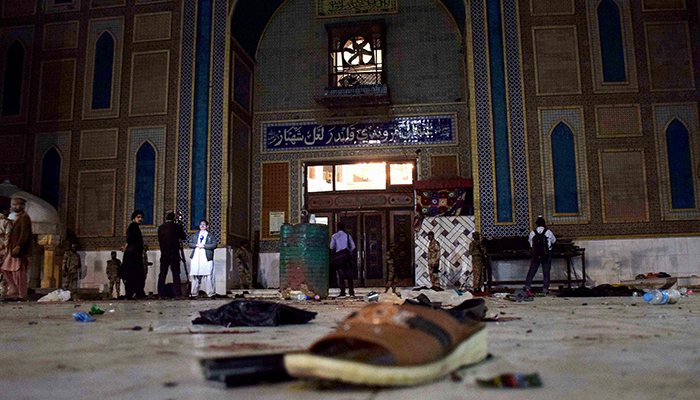
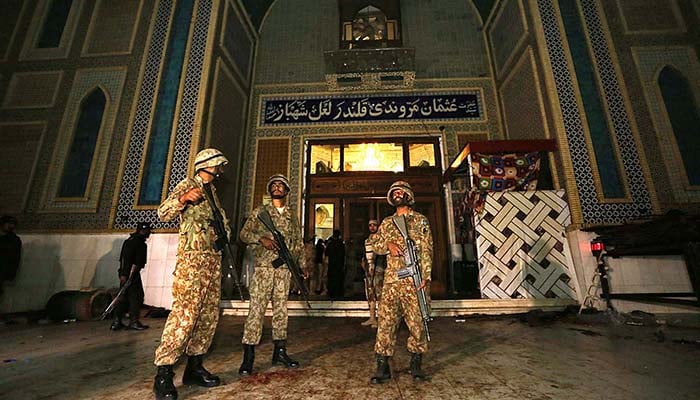
In Thursday's attack, the suicide bomber walked into the main hall at the Lal Shahbaz Qalandar shrine in Sehwan, and detonated his explosives among a crowd of worshippers, initially killing 75. At least 20 women and nine children were among the dead.
On Friday, authorities raised the death toll to 88 after some of the critically wounded died. The Sindh provincial health department said a total of 343 people were wounded in the attack but that most were discharged after treatment while 76 still remain in hospitals.
The Islamic State group, claiming responsibility for the attack in a statement circulated by its Aamaq news agency, said it targeted a "Shiite gathering." The Sunni extremist group views Shiites as apostates and has targeted Pakistan's Shiite minority in the past. It also views Sufi shrines as a form of idolatry.
The Sehwan shrine, which reveres a Muslim Sufi mystic, is frequented by the faithful of many sects of Islam but the majority of the worshippers are usually Shiite Muslims.
Raja Somro, who witnessed the attack, told a local TV network that hundreds of people were performing a spiritual dance known as the "dhamal" when the bomber struck.
Local TV showed graphic footage of the aftermath of the blast, with wounded worshippers crying out for help and the floors covered with shoes, blood and body parts. Women cried and beat their chests in grief.
Prime Minister Nawaz Sharif vowed that security forces would track down the perpetrators, according to Pakistani state TV.
"Each drop of the nation's blood shall be avenged, and avenged immediately," Pakistan's army chief, Gen. Qamar Javed Bajwa, said in a statement.
The U.S. State Department condemned the attack and offered its support to Pakistan in bringing the perpetrators to justice.
The attack was the deadliest in Pakistan after the Dec. 16, 2014 assault on an army-run school in Peshawar that killed 154 people, mostly schoolchildren. A Taliban-linked group, Jamaat-ul-Ahrar, claimed responsibility for that attack.
Pakistan has been at war with the Taliban and other extremist groups for more than a decade. In recent years it has launched major offensives against militant strongholds in the tribal regions along the border with Afghanistan, but insurgents have continued to carry out attacks elsewhere in the country.
The Islamic State group has been expanding its presence in Pakistan in recent years and has claimed a number of deadly attacks, including a suicide bombing at another Sufi shrine in November 2016 that killed more than 50 people.
The government has downplayed the IS affiliate, insisting that only a small number of militants have pledged allegiance to the group.
Afghanistan and Pakistan have long accused each other of failing to crack down on militants who operate along the porous border.
Also Friday, the Pakistani military handed over to Kabul a list of 76 suspected "terrorists" allegedly hiding in Afghanistan, demanding they be captured and extradited to Islamabad. A statement from the military says the list was given to Afghan officials at the Pakistani army's sprawling headquarters in the garrison city of Rawalpindi.
The military did not specify who was on the list, but it has long claimed that the head of Pakistani Taliban, Mullah Fazlullah, and other militants are hiding on Afghan soil with the purpose of fomenting violence inside Pakistan.
In Sehwan, police fired tear gas on Friday and swung batons to disperse a rally of several hundred protesters who demanded justice for the victims and better security measures from the government. The crowd set fire to a car before the police broke up the rally.
At one of the funerals that got underway Friday, relatives consoled the wailing mother of Zeeshan Ali, a 13-year-old who died in the shrine blast. Ali's uncle, Shoukat Ali, said he was devoted to his nephew and raised him since he had no children of his own.
"I raised him like my own child ... and they took him from me," he said.

Read more here: http://www.sacbee.com/latest-news/article133297919.html#storylink=cpy

Read more here: http://www.sacbee.com/latest-news/article133297919.html#storylink=cpy

Pakistan's Worst Attack in Two Years Dents Improved Security Image


Pakistan’s military blamed “hostile forces” in Afghanistan for its worst attack in two years, closing the porous border with its neighbor after a spate of bombings this week dented confidence over recent security gains in the South Asian nation.
At least 88 people were killed and 343 injured after a suicide bomber detonated explosives at a shrine near the southern city of Hyderabad on Thursday, said Sohail Jokhio, a police spokesman for Sindh province. Islamic State claimed responsibility and said at least 100 people were killed, according to SITE Intelligence Group, which monitors extremist media. The assault follows attacks in the cities of Lahore and Peshawar this week.
“These attacks show there are more than a few terrorists cells operating,” said Taimur Rehman, a political science professor at the Lahore University of Management Sciences. “Claims that their backbone has been broken needs to be assessed.”
Thursday’s bombing was the worst single attack since the Pakistani Taliban massacred about 150 students at an army school in the northern city of Peshawar in December 2014, prompting a military campaign against some domestic insurgent groups. Since then, Pakistan has seen renewed foreign investment as fears over safety have eased.
‘No More Restraint’
Since 2014, fatalities in Pakistan from violence have dropped 66 percent to 2,610 last year, according to the Islamabad-based Center For Research and Security Studies. Foreign direct investment is also up 10 percent to $1.1 billion in the six months through December, according to the central bank.
Recent terrorist acts were executed “from sanctuaries in Afghanistan,” Asif Ghafoor, the main spokesman for Pakistan’s armed forces, posted on Twitter, while Pakistan’s Army Chief General Qamar Javed Bajwa said “each drop of nation’s blood shall be revenged, and revenged immediately. No more restraint for anyone.”
Pakistan’s army said it wanted action against insurgents in Afghanistan and gave the country’s embassy officials a list of 76 terrorists hiding in the neighboring nation. Afghanistan’s President Ashraf Ghani condemned the bombing and his office in a Twitter post said Islamic State is a common enemy.
U.S. General John W. Nicholson, who heads NATO forces in Afghanistan, told a Senate committee last week that Islamic State insurgents in Afghanistan were mostly made up of Pakistani Taliban members who had been pushed out of the country by Pakistan’s military assault in the border regions.
Despite rising foreign investment, spearheaded by China which is providing more than $55 billion in funds and loans for infrastructure projects in Pakistan, many investors are still skittish over security concerns.
Security Conditions
However some, including Dutch dairy company Royal FrieslandCampina NV, are looking past Pakistan’s history of terror attacks. The firm bought a majority stake in Karachi-based Engro Foods Ltd. two months ago and Chief Executive Officer Hans Laarakker said in an interview this week that safety had improved after the military push against insurgents in cities such as the commercial capital Karachi.
“We believe there are some good signs that Pakistan will grow out of it,” said Laarakker. “Traveling here for two years, in a short period you can see the security condition changing, people are bit more outgoing, restaurants are coming up.”
S&P Global Ratings Ltd. raised Pakistan’s credit rating in October in part because of improved domestic security and Pakistan’s benchmark stock index has advanced 55 percent in dollar terms since 2014, making it Asia’s best performing measure in that period. The government expects an economic growth rate of 5.7 percent in the year ending June, the fastest pace in a decade.
“Given the historical situation in Pakistan it’s not surprising these attacks happen,” Ruchir Desai, senior investment analyst at Asia Frontier Capital Ltd., said by phone from Hong Kong. “That does not prevent investors from looking at the longer term story of Pakistan.”

Pakistan - At least 74 martyred in bombing at Lal Shahbaz Qalandar shrine

At least 74 people were martyred Thursday when a suicide bomber attacked the crowded Sufi shrine of Lal Shahbaz Qalandar in Sehwan, injuring up to 300 others, hospital and senior police officials said.
The powerful blast took place inside the premises of the shrine as a dhamaal was taking place, with a large number of women and children said to be among the casualties.
Taluka Hospital Sehwan confirmed the death toll of 60 men, four women and six children; further adding that 55 bodies have been handed over to their heirs, while 15 were unidentifiable. The medical facility further informed that among the injured; 190 men, 11 women and nine children were under treatment, while 41 wounded patients were shifted to other hospitals. 
MS Peoples Medical Centre Nawabshah stated that 37 injured were at its health facility, while ten were sent to a hospital in Karachi, he further informed that four bodies including of a child and woman were unidentified.
In the late night development, seven critically injured patients braving head wounds arrived from C-130 jet to Karachi. According to rescue sources, the injured were immediately shifted to a private hospital. Earlier, six other patients arrived in the metropolis on self-help basis. 
Suicide bomber was not a female: CTD official Raja Umar Khattab
Senior Counter-terrorism department (CTD) official Raja Umar Khattab dispelled initial reports that the suicide bomber was a female. He said that evidence suggested that the suicide bomber was a male. The long hair found at the blast site, he added, most likely belonged to one of the dervish at the shrine.
He added that not much explosives were used in the suicide jacket, and the deaths and injuries were caused due to the ball bearings present in the jacket.
Earlier, Deputy Inspector-General (DIG) Hyderabad Khadim Hussain Rind said more than 300 people were injured in the explosion, the latest in a series of terrorist attacks in the country, he further informed that the suicide blast occurred at the main gate of the shrine by a bomber who covered himself with a Burka.
Officials confirmed the suicide bombing took place inside the complex of the shrine, with eyewitnesses saying the explosion caused people to panic and triggered a stampede inside the crowded shrine.
An initial investigation report by bomb disposal squad confirmed that the incident was due to suicide bombing with the explosives of at least eight kilograms. Nut-bolts were used in the bomb along with the dynamite.
A large number of people from different parts of the province were gathered at the shrine when the blast took place.
Devotees throng to the shrine of the revered Sufi saint every Thursday to participate in a dhamaal and prayers. According to reports, the explosion occured after devotees had gathered inside the premises of the shrine. A high number of casualties were feared because of the crowd gathered at the shrine.
Terrorist organisation Daesh has claimed responsibility of the attack.
Meanwhile, IG Sindh AD Khuwaja said that though the terror group has claimed responsibility on social media, however, police is still investigating to confirm the responsible indivisuals or group for this terror attack.
"We have to take this news with precaution, we are looking into the case," he said.
A forensic van arrived on early Friday morning from Karachi to gather pieces of evidence from the site.
Hours after the bombing, the ISPR announced the closure of the Pakistan-Afghanistan border with immediate effect due to security reasons.

Bilawal Bhutto strongly condemns terrorist attack on the shrine of Hazrat Lal Shah Shahbaz Qalandar in Sehwan

Chairman Pakistan Peoples Party Bilawal Bhutto Zardari has said that terrorist attack on the shrine of Hazrat Lal Shah Shahbaz Qalandar in Sehwan was a worst form of terrorism aimed at to rip apart Sufi fabric of unity and peace.
Condemning the bomb attack on the Sufi shrine, the PPP Chairman said that extremism in the country has gone through roof and such shocking terror strikes should push an intensely alert wave across the Pakistani society to step up efforts against terrorism.
Terrorists on the ground are mere tools and their handlers are slaves of their masters who are holding the remote-control of terrorists, he said adding that only synchronized action against all those involved in execution of such gory terrorist acts would succeed.
Bilawal Bhutto Zardari said that this was an attack on our culture, history and civilization and every single individual of this land will fight against the terrorists and uproot this menace with fullest unity. “Terrorists who carried out the attack won’t go scot-free under any circumstances, he added.
He said that current wave of terrorism in the four provinces and Azad Jammu & Kashmir have exposed gravity of very serious situation and everybody should be on one page and era of ifs and buts on the monster of terrorism should now be over.
PPP Chairman expressed deep sympathies with the families of martyrs and those injured and urged all the concerned authorities for emergency rescue and medical relief.

https://mediacellppp.wordpress.com/2017/02/16/bilawal-bhutto-strongly-condemns-terrorist-attack-on-the-shrine-of-hazrat-lal-shah-shahbaz-qalandar-in-sehwan/

Pakistan - FORMER PRESIDENT ZARDARI CONDEMNS BLAST IN SEHWAN


Former President of Pakistan and President Pakistan Peoples Party Parliamentarians has strongly condemned terror attack on the shrine of Sehwan Sharif and said that the patrons, facilitators and planners of this attack will be apprehended at all cost.

Former President has directed Sindh Government to hold an inquiry into the incident and why security situation was not addressed. He also instructed the elected representatives, party office bearers and workers of PPP to reach hospitals and donate blood for the injured.
Asif Ali Zardari said that attackers on innocent citizens will not be spared and will be brought to book. He expressed his grief over this tragedy and said that Bhutto family and the PPP are with the bereaved families in this hour of grief. He also prayed for the martyrs and early recovery of injured.

https://ppppunjab.wordpress.com/2017/02/16/former-president-zardari-condemns-blast-in-sehwan/

Thursday, February 16, 2017

Islamic State claimed - Death toll in Pakistan shrine bombing rises to 72: official

More than 70 people were killed when a suicide bomber detonated explosives at a crowded Sufi shrine in southern Pakistan on Thursday, a police official said.
Senior police officer Shabbir Sethar told Reuters from a local hospital that the death toll was likely to rise.
"At least 72 are dead and over 150 have been injured," Sethar said by telephone.
The attack on Lal Shahbaz Qalandar shrine in the town of Sehwan Sharif is the largest of a wave of bombings to hit Pakistan this week as the Pakistani Taliban and other radical Islamist militants carry out threats of a new offensive.

Islamic State claimed responsibility for Thursday's attack.

http://www.reuters.com/article/us-pakistan-blast-idUSKBN15V233

Pakistan: Award named after Dr Abdus Salam -- The Salam Award for Imaginative Fiction


It's only fair that Pakistan's only Nobel Prize [in Physics] winner gets an award dedicated to him. The award has been launched in an effort to promote science fiction writing in Pakistan.

Spearheaded by Usman Malik and Tehseen Baweja, The Salam Award launches today; it's a tribute to Dr. Abdus Salam and an effort to promote science fiction writing in Pakistan.

The Salam award seeks to recognise the man's genius and his status as a marginalised person within his country via the honorific and to encourage the pursuit of science fiction and imaginative writing in Pakistan. It's an admirable small effort by a few concerned individuals to change that and encourage our populace to be more imaginative.

Prominent Pakistani intellectual and scientist Dr Pervez Hoodbhoy, a student and colleague of Dr Salam's, will be serving as the advisor and member of the award admin.

The award will be given to aspiring short fiction writers of Pakistani origin, regardless of sexual orientation, creed, or caste. Story submissions will be in English, blinded, and judged by a rotating jury of science fiction professionals each year. The three finalists will each receive an agent and editorial review of their manuscripts. The winner will receive 500 US dollars as well as the aforementioned perks.

Judges for 2017 are Jeff Vandermeer, Mahvesh Murad, and Usman Malik. The 2017 editor reviewer is Ann Vandermeer of Tor.com. The 2017 Agent reviewer is Seth Fishman of The Gernert Company.


http://timesofahmad.blogspot.com/2017/02/pakistan-award-named-after-dr-abdus.html

Pakistan - Christian educationist invokes Premier over reservations regarding upcoming census


By Madeeha Bakhsh
Pakistani Christian educationist Professor Anjum James Paul has urged the Prime Minister to look into the concerns of religious minorities regarding the upcoming census in March 2017. In this connection, he wrote a letter to the Prime Minister Nawaz Sharif maintaining that minorities are apprehensive regarding their status as equal citizenship and religious identity on the forms of census.
Anticipating a much awaited census in March, Professor Anjum James Paul, Chairman of Pakistan Minorities Teacher’s Association wrote a letter to the Premier on February 15. The text of the letter is as below:
To
Mr. Muhammad Nawaz Sharif Prime Minister of Pakistan Prime Minister’s Secretariat Islamabad
Subject: Census 2017 and reservations of religious minorities
Honorable Sir,
Greetings and peace from Pakistan Minorities Teachers; Association (PMTA). PMTA would like to draw your kind attention on the subject cited above.
Sir, religious minorities in Pakistan have reservations on the violation of their right to equal citizenship and religious identity on column 6 of census form 2.
Following recommendations are presented below which need your prompt kind attention to address the fundamental and constitutional rights as guaranteed in Article 25(1) of the Constitution of Pakistan 1973 that guarantees “All citizens are equal before law and are entitled to equal protection of law.”
1.Sikh religion, Bahai religion and Parsi religion mist be included in column 6.
2.Instead of “Isaai” word “Masihi” meaning “Christian” must be replaced in column 6.
3.“Scheduled Castes” must be included as “Hindu” in column 6.
Sir, it is requested to you to kindly address the genuine reservations on column 6 of census form 2 before the commencement of the census 2017.
With best regards
Prof. Anjum James Paul