Wednesday, April 29, 2015

Ghani seeks to renew India's commitment in Afghanistan


Afghan leader Ashraf Ghani is on a trip to India in a bid to boost trade and reassure New Delhi of his country's commitment despite warming ties with Pakistan. But will it be enough? DW talks to analyst Smruti Pattanaik.
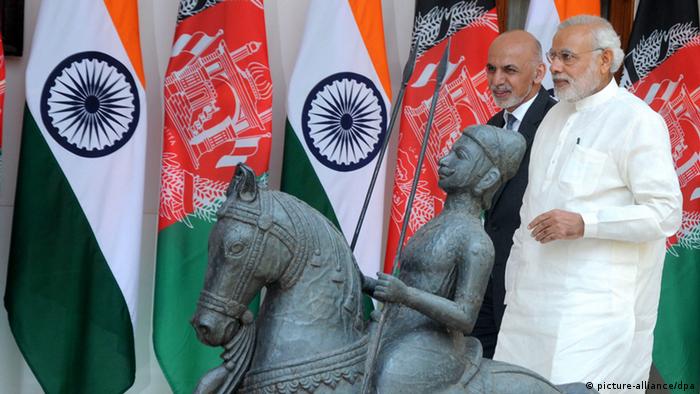
 Indian Prime Minister, Narendra Modi (R), walks with the Afghan President, Mohammad Ashraf Ghani during their meeting in New Delhi, India, 28 April 2015
(Photo: EPA/STR)
"India and Afghanistan have (a) million ties," Ghani told reporters at a joint media briefing in the Indian capital following talks with Indian Prime Minister Narendra Modi on April 28. The Afghan president is on a three-day visit to India aimed at renewing New Delhi's commitment to Afghan development and the fight against the Taliban as well as at shoring up Indian investment in the conflict-ridden country.
New Delhi has had close ties to Kabul since the fall of the Taliban regime in 2001, especially during the term of former Afghan President Hamid Karzai. India has granted Afghanistan $2.2 billion in aid over the past decade - the biggest it has ever given to any country. However, concerns were raised in New Delhi when, shortly after his election, President Ghani decided to reach out to India's rivals Pakistan and China before visiting India.
In a DW interview, Smruti Pattanaik, a research fellow at the New Delhi-based Institute for Defense Studies and Analyses, talks about India's view of Afghanistan's warming relations with Islamabad, and explains how India can contribute to Afghanistan's economic development.
 Afghanistan's President Ashraf Ghani attends a business meeting in New Delhi, India, April 29, 2015
(Photo: REUTERS/Stringer)
India's contribution to Afghanistan's economic growth is immense, says Pattanaik
DW: What are the key aims of Ghani's visit to India?
Smruti Pattanaik: Several elements of this visit are significant. First, Ghani wants to assure India that it remains an important strategic partner. Second, he wants to assure that its investment in Afghanistan is secured and would be protected from attacks by the insurgent groups. Third, Ghani is seeking more investment to accelerate the process of building the Chahbahar port in Iran.
Why has Ghani taken so long to visit India?
After the controversial electoral process that got Ghani elected as Afghan president, the main issues that have confronted his political leadership have been post-transition security challenges and talks with the Taliban aimed at concluding a negotiated political settlement that would bring lasting peace to the war torn country.
Keeping these two objectives in mind, President Ghani has sought the help of the US, Pakistan, China and Saudi Arabia. New Delhi cannot deliver on these immediate needs. However, India remains an important partner and a popular country to the people of Afghanistan. Ghani understands this and knows that India would remain a strategic challenge to Pakistan's intention to dominate Afghanistan through its proxies.
How important is Afghanistan to India?
Afghanistan forms the lynchpin of India's central Asia strategy, as it provides connectivity to these landlocked countries. Second, a peaceful Afghanistan would contribute significantly to regional peace. India does not want to see Afghanistan as a surrogate state of Pakistan. Therefore, it has laid emphasis on an Afghan-led and Afghan-owned peace process.
Third, India doesn't want Afghanistan to emerge as a fertile ground from where Pakistan can sponsor terrorism against India, as has been the case in the past. Fourth, India would not like to see emergence of Taliban or radical Islamists as a major force in Afghanistan politics which is likely to patronize radical groups elsewhere. Fifth, India has mining interests in Hajigok, and without peace in Afghanistan it would be difficult to extract the minerals.
How does the Indian government view Ghani's warming relationship with Islamabad?
India is carefully watching the unfolding Afghan-Pakistani relations. Islamabad is important for the establishment of peace in Afghanistan as it continues to host the Taliban leadership. India does not have any objection, rather it would be happy, if Pakistan was able to bring the Taliban leadership to hold a dialogue with the Afghanistan government.
There are, however, a lot of doubts as to whether Pakistan is willing to give up its leverage without a price. So there is much concern in India about how the Pakistan-brokered talks will pan out. Nonetheless, India does not see Afghanistan's relations with Pakistan and its relations with Afghanistan as zero sum game.
How can India help develop Afghanistan economically?
In spite of geographical constraints, India's contribution to accelerate economic growth is immense. For economic development in any country to succeed it requires three things: first, it needs good roads and communication network; then it needs electricity and human resources. In this context, India is prioritizing the construction of Chahbahar port to provide Afghanistan access to sea which will provide Kabul with crucial access to port facility and reduce its complete dependence on Pakistan.
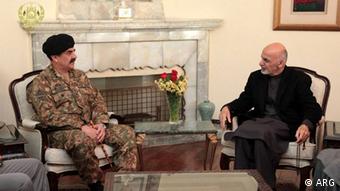
Gen Raheel Sharif Pakistan Army chief in a meeting with Afghan president Ashraf Ghani in Kabul, Afghanistan
Pattanaik: 'India is carefully watching the unfolding Afghan-Pakistani relations'
India has also built 220kV DC transmission line from Pul-e-Khumri to Kabul. It is in the process of completing the Salma dam project, which - although delayed for security reasons – is set to change the irrigation map of Afghanistan, as it will increase cultivatable land from 35,000 hectares to 80,000 hectares and would produce 42MW of electricity once completed. Moreover, Afghan bureaucrats receive training in India and it also provides 1000 scholarships to Afghan students.
How do you see bilateral ties unfolding in the coming months?
India and Afghanistan have historically shared very good relations except the few years of Taliban rule. A significant landmark has been the construction of Parliament house which symbolizes Afghanistan's transformational politics – from Taliban to democracy - and reflects India's commitment to help in Afghanistan transition. In the coming months the priority will be to complete the Chahbahar port, expand the infrastructure network and concentrate on capacity building. All these would contribute to make Afghanistan a stable and viable state.
Major challenges to India's effort would be the ongoing security threat posed by the resurgent Taliban who continue to receive support and sustenance from Pakistan.

Pakistan - Arab Bedouin & Politics Of Hunting Permits


By Haroon Janjua 

Will they (Arab Royals) continue hunting and dinning in the Pakistani deserts till the endangered species meet their extinction?

 “Every time we lose a species we break a life chain which has evolved over 3.5 billion years.” – Jeffrey McNeely
issue6When you consider the actual scene of hunting, and picture the hunter with possibly the most modern weapon, firing lethal ammunition, it’s a pitiful and inequitable mind that would not for a moment imagine in abhorrence and revulsion the contest between armed death and a rather defenseless life, that of the hunted.
There is a gross disparity in our appreciation of the human life, in comparison to most other life forms, which we have traditionally and often views as worthy of ‘game’, of hunting and taking down with the lethal weapons at our disposal.
The mindset needs to be called into question. The world has been progressing towards universalization of certain ideals and principles, which seek to ensure a certain quality of life and rights to not only the humans but also to the living creatures that inhabit this wider earth (and) including the ones who dwell in the wild.
issue2It must concern everyone that certain Arab royals are able to get the permits and even state patronage to a great extent, for the annual spectacle of killing an enormous number of houbara bustard in Pakistan, a bloody sport that has been gaining popularity and patronage for several decades now.
Houbara bustard is a klutzy, Turkey-sized bird, with lankly legs and a long neck, and is often associated with absurd and obscure mating ritual. There is not much remarkable about this species with the exception of one thing: it is the object of obsession for Arab falconers, who have chased this feathered creature for many years and in such large numbers that it is almost on the verge of extinction in the Persian Gulf.
As the houbara migrated from its breeding grounds in Siberia, newly enriched Persian Gulf royalty flocked to the deserts and fields of Pakistan, where they were welcomed with open arms by the country’s leaders. For the Pakistanis, the hunt has become an opportunity to earn money and engage in a form of soft diplomacy.
issue3What’s more glaring and shocking is that in the course of recent years, it has turned into a repetitive annual fare, in a bizarre geopolitical show, emphasizing affluent Arab sheikhs, the CIA, and Osama bin Laden.
J. Dana Stuster, highlighted the close association of Arabs hunting around the porous Pak-Afghan Durand-Line, when a singular Arab contingent managed to kill off 2100 houbaras in a matter of just three weeks, 20 times the quota granted to it by the gracious state of Pakistan that hosts them. In his article ‘Meet the Houbara Bustard: the Rare, Oversized, War-on-Terror Chicken’ in Foreign Policy, it was for the first time, that there was a close association of this blood sport established with the ongoing war on terror.
For the Arabs, this serves multiple objectives bizarrely enough. The Arabs consider the bitter and false-smelling meat of the houbara bustard to be full of aphrodisiacs, secondly to maintain the Sunni hegemony here, and in addition to that the Sheikhs find time for supporting their Jihadist chicken in the very region, Blissful indeed!
Steve Coll narrates in his book Ghost Wars, that in February 1999, CIA was able to zero in on the location of Osama bin Laden to a houbara hunting camp in southern Afghanistan. There was an Emirati royal who had set up his houbara hunting camp in the area. The agency intended to launch cruise missiles at the camp to kill the terror leader, however, according to Coll, the presence of this important Arab royal prevented them from taking out Bin Laden, given the probability of the valued royal likely dying in the attack as well.
issue4The fact that Bin Laden`s escape in 1999 from houbara hunting camp was made possible due to U.S. concern for the Arab Royal accompanying Laden only means that U.S.’s counter terrorism policy has necessarily been ambivalent and flirtatious on either side of the terrain.
It’s not only the houbara-falcon alone that Saudi’s have been keen on but they have often appeared to be on the good sides of the likes of Pak-Afghan Taliban and Al-Qaida. In relevance of USA’s preference for the Saudis this does imply that U.S. counter terrorism policy is essentially selective and limited to a great extent by who they are friends with.
And the Americans have also indirectly benefitted from the Saudi generosity. In the 90’s, Saudis developed airstrips in southern Afghanistan, to facilitate shipment of houbara hunting infrastructure, SUV’s, Tents, Hunting Equipment etc, sometimes actually using the massive C130 transport carrier for the job. After 2001, when the Americans invaded Afghanistan, they used the same airstrips to build the Shamsi airbase around them.
Nearly every bird species in the deserts of Gulf has been eliminated by excessive hunting by Arab royals. And now, the petro-dollar rich Arab royals have arrived in Pakistan, with the host state’s patronage, for hunting the endangered species of houbara bustard.
These birds transitionally migrate to Afghanistan and Pakistan in winter season. The Arab Sheikhs spend huge fortunes, by local standards, for hunting and killing these birds for fun.  They visit these areas every year and live in makeshift camp. This massive hunting has severely reduced the population of the houbara. The International Union for the Conservation of Wildlife must take action to help the hapless and defenseless bird from going extinct. If this bird is officially declared a preserved species, then it outlaws their hunting. This will deter the government of Pakistan from issuing licenses to the Arabs.
issue7The unhinged U.S. support and protection of the Saudi Monarchs has left them uncontrollable and they do whatever they like in the Gulf and in Pakistan as well. The Gulf Sheikdoms, Princes and Sheikhs of Saudi Arabia have been visiting the South Pakistan territories for not only hunting of birds but also to ‘quench their lust of sexual desires’, which has another grave set of repercussions on this country’s social & spiritual health and calls into question the morality of the religious righteous in the country, who also happen to be the strongest and the staunchest votaries of Pakistan’s subservience to the Saudi petro-dollars.
“This is a clear admission of servility to the rich Arabs. They come here, hunt with impunity, and are given police protection in spite of the fact that they are violating local laws.” says Pervez Hooddbhoy, a physics professor and long time critic of what he calls “Saudization” in Pakistan, on some Saudis continuing to be allowed to hunt a  houbara bustard, in Baluchistan despite a ban on hunting permits.
issue7The Baluchistan High Court cancelled all foreign hunting permits in response to complaints from conservationists. The International Union for the Conservation of Nature has termed the houbara a vulnerable species, and India has banned the hunt. The Baluchistan court order in November cited Pakistan’s obligation to international conservation treaties. However, in a bid to overcome the court ban, the Baluchistan government has lodged an appeal in Pakistan’s Supreme Court that is likely to be heard soon.
Saudi Arabia has recently injected $1.5 billion into Mr. Sharif’s government to help prop up the ailing economy. Last year in Islamabad, Mr. Sharif laid out a lavish welcome for the other Saudi hunting permit holder: Salman bin Abdul-Aziz Al Saud, now the King.
It remains to be seen whether the apex court will uphold the Baluchistan Court’s order or will succumb to pressure to let the Saudis have their way. Houbara bustard indeed is in danger of extinction.  It is the duty of every nature lover and conservationist to rise to its defence and ensure its survival.

Pakistan - WAHHABI TERRORISTS SHOT DEAD ANOTHER SUNNI-BARELVI TEACHER OF KARACHI UNIVERSITY

Wahhabi terrorists on Wednesday shot dead a Sunni-Barelvi teacher of University of Karachi (KU) in Federal B area.
Dr Syed Wahidur Rahman, alias Yasir Rizvi, was killed when four unidentified attackers riding two motorcycles opened fire on his car.
After the murder of Karachi University dean of Islamic Studies Prof Dr Shakeel Auj, this was the second murder of a Sunni-Barelvi teacher. The slain teachers was famous for denouncing the heinous crimes of Wahhabist Jihadists in his lectures. Some close associates of Dr Rahman told Shiite News that the slain teacher had mentioned many times that he could be murdered because of his name, Yasir Rizvi, which showed that he was Shia. It is learned that after the murder of Prof Dr Shakeel Auj, Dr Rahman was supporting the grieved family of the slain professor in term of seeking justice in the murder case.
Police surgeon Dr Jalil Qadir said Dr Rahman received five bullets wounds on his face, neck, chest, abdomen and arm while police reportedly recovered eight bullet cases from the site. The assailants managed to flee the scene soon after the attack.
Dr Rahman's body was taken to the Abbasi Shaheed Hospital in Karachi. In the wake of Dr Rehman's death, university activities have been suspended for two days.
It is also worth mentioning that Police in Jan 2015 had claimed the arrest of a suspect who had allegedly confessed to his involvement in the murders of Karachi University dean of Islamic Studies Prof Dr Shakeel Auj and Prof Syed Sibte Jafar.
Earlier this month, the vice-principal of the Jinnah Medical and Dental College's student affairs wing Debra Lobo was shot and seriously injured on Shaheed-e-Millat Road in Karachi.
http://www.shiitenews.org/index.php/shiitenews/pakistan/wahhabi-terrorists-shot-dead-another-sunni-barelvi-teacher-of-karachi-university

Pakistan - Hazara Under Attack

The Hazara community continues to face violent persecution owing to its religious identity. On Monday, two more Hazara men were killed and another injured in a gun attack on the booking office of a coach service in Satellite Town. They were purchasing tickets to travel to Taftan at the time of the attack. Had they successfully bought the tickets and left, they might still have been targeted during the journey perhaps by a different set of people but for the very same reasons. That is the reality of their lives; one that is intolerable for them but easily palatable for the state. A series of horrifying attacks has firmly established that the Hazara are under attack. It is also common knowledge who their attackers are; they proudly claim responsibility each time. The victims are known, the attackers are known and yet, the state is consistently failing to protect the former from the latter. When violent sectarian groups hold public rallies in Quetta and chant, “Shiites are infidels!” – in the same Quetta valley where the Hazara reside – and the state does absolutely nothing, it means that it is either impotent or complicit or even both. There is evidence for both. 
Other than instances where high-profile sectarian terrorists managed to escape from military prisons, images of sectarian leaders with security personnel provided by the state, immunity from action and free mobility – it is also worth remembering that Baloch tribes are not sectarian. This much, even former dictator Pervez Musharraf conceded during an interview. Is the state countering insurgencies by promoting religious extremists? By establishing religious seminaries and giving sole access to Jamat-ud-Dawa for relief work in earthquake-hit areas while refusing others, the leadership is making familiar mistakes that have already cost this country and its people far too much. The Hazara may not be very important to strategists forever engaged in one great game or the other, but they are citizens of Pakistan who must be protected. The state can begin by acknowledging its failure. Those who swore to serve and protect have done neither in Balochistan; at least the Hazara do not think so. Until or unless, there is visible action against sectarian elements in Balochistan and elsewhere, the state cannot expect citizens to believe that it has mended its ways.

Pakistan - Peshawar pummelled


In an event unprecedented for this time of the year, Peshawar had to brace itself on Sunday night when a massive storm came swooping in leaving death and destruction in its wake. Experts have called this freak occurrence a “mini-cyclone” and considering the toll it has taken on the provincial capital of Khyber Pakhtunkhwa, that would be a fair description. As many as 35 people are reported to have died and 150 injured in winds that are said to have reached 110 kilometres an hour. The death count is slated to rise and the questions are also mounting why this was allowed to occur without any preparedness.

We are living in strange times. Weather patterns are changing. We should have been languishing in the initial flutterings of a hot summer but now we are witnessing high speed winds, unexpected storms, surprising rain showers and the like. It is becoming evident that we can no longer depend upon the seasons to help us prepare and handle climate trajectories. We now need year round preparedness and measures taken to effectively reduce the human toll changing weather patterns can exact. However, our disaster management authorities leave much to be desired. The provincial disaster management authorities issued warnings to the hapless citizens after the storm had caused most of the damage, what to say of evacuating the people. Trees came crashing down, billboards were swept away and power transmission lines were massively damaged, plunging many parts of the province into darkness for a number of hours. To add to this chaos, hospitals started to overflow with people who had been caught in the storm and, for some time on Sunday night, it felt as though the citizens of Peshawar had been left stranded.

Relief and rehabilitation efforts, spluttering to a start after the ordeal, are all well and good but something should have been done to issue a warning to the people who could have saved themselves; maybe we would have seen a lower death count. There are some basics that should have been looked at and ensured even if we were caught by surprise. Public drainage systems must be kept functional so that low lying areas do not have to confront the menace of being drowned in rain water, which subsequently attracts the dengue mosquito. Even now aftershocks and tremors from the earthquake that struck Nepal on Saturday are being felt in Peshawar and elsewhere in Pakistan. All this goes to show that nature’s capriciousness is increasing and all we can do is prepare for the worst. In Pakistan, we cannot seem to do even that.

Tuesday, April 28, 2015

Video - Abe: WWII sex slaves were victims of human trafficking

China hits out as Abe visits the US


Tokyo alliance 'mustn't undermine Beijing's interests or disturbAsia-Pacific region'
Beijing warned on Tuesday that the alliance between the United States and Japan shouldnot undermine China's interests or disturb the Asia-Pacific region.
The warning came as the two allies highlighted territorial issues and Japan's increasedsecurity role during Japanese Prime Minister Shinzo Abe's ongoing trip to the US.
US President Barack Obama welcomed Abe to the White House on Tuesday. Hailing thealliance as the "cornerstone" of security in the Asia-Pacific, the two countries vowed tocounter threats to "international order" by forging a trade deal and through an expandedsecurity role for long-pacifistic Japan.
Observers said the Obama administration's latest policy agenda shows that the US viewsChina's rising strategic influence in the region as an imminent challenge and that Tokyohas secured more tangible support from Washington during Abe's visit.
US Secretary of State John Kerry said on Monday at a joint news conference thatWashington's "commitment to Japan's security remains ironclad and covers all territoriesunder Japan's administration".
Agence France-Presse reported that Kerry clearly included China's Diaoyu Islands withinthe scope of Japan's administration.
Following a meeting of foreign policy and defense chiefs from both countries, the US andJapan announced new guidelines on Monday for bilateral defense cooperation.
Under these guidelines, revised for the first time since 1997, Japan will have the right toexercise collective self-defense — being allowed to defend not just its own territory, butalso the United States and other countries if needed.
Chinese Foreign Ministry spokesman Hong Lei said on Tuesday, "Both the US and Japanhave a duty to ensure that their alliance does not infringe the interests of third parties,including China, or the peace and stability of the Asia-Pacific region."
China's territorial sovereignty over the Diaoyu Islands and affiliated islets "remains intactno matter who makes remarks or (takes) action against them", he said. He also said theway in which the US-Japan treaty alliance, formed during the Cold War, develops"deserves attention from all parties".
Abe, the first Japanese leader to visit the US since 2006, was scheduled to address a jointsession of Congress on Tuesday.
Yang Bojiang, deputy director of the Institute of Japanese Studies under the ChineseAcademy of Social Sciences, said Washington is trying to champion its leadership over theregion through the evolving US-Japan agenda, and Japan's influence appears to haveincreased within the alliance.
"The US is trying to tie Japan tightly to its future strategies. ... Also, China's latest strategicproposals with regional influence — including the Asian Infrastructure Investment Bank—have impressed Washington," Yang said.
Ruan Zongze, vice-president of the China Institute of International Studies, said the US isadding weight to Japan's role in its global security strategy. Ruan said, "Washington'ssecurity policy support has sent a misleading signal to Abe — that he can gloss overJapan's historical issues."
Washington has said it takes no position over the sovereignty of the Diaoyu Islands. ButObama for the first time officially included the islands within the area of Japan'sadministration during a visit to Tokyo in April last year, which triggered protests fromChina.
During a meeting on Tuesday with students at Harvard's Kennedy School in Cambridge,Massachusetts, Abe drew criticism as he again defined "comfort women" — a euphemismfor Asian women forced by the Japanese Imperial Army into sexual slavery—as victims of"human trafficking".
In response to a student's question, Abe said, "It's heart-wrenching to think about womenwho fell victim to human trafficking and suffered unspeakable pain."

Baltimore Riots Shed Light on City’s Troubled Past

By Chris Simkins


National Guard troops took up positions Tuesday in Baltimore, Maryland, as authorities tried to restore order after rioting and looting broke out a day earlier.
Violence swept across parts of the U.S. eastern city following Monday’s funeral for Freddie Gray, a 25-year-old black man whose suspicious death while in police custody outraged many in the city’s African-American communities and beyond.
Gray, arrested April 12, sustained a spinal cord injury while in police custody and died a week later.
Tuesday also brought peaceful street gatherings in West Baltimore, with racially mixed crowds rallying to prevent further violence and demonstrate a softer side of the city. Some stood, arms linked, to separate potential troublemakers from a line of law enforcement troops holding up shields. Others danced and distributed water bottles in a show of harmony on the sunny day.    
Local leaders condemned the violence, but some were not surprised given the long-standing frustration among blacks in the city.
U.S. Representative Elijah Cummings cited “the pain and frustration of young people.”
The Maryland Democrat said he knows many youths “who are crying out, saying, 'Look we want to be better educated.' They say, 'We want jobs.’ They want recreation centers.  But they are saying, 'What about us?'"
Gray’s is the latest in a recent string of fatal run-ins between black men and police officers in several cities scattered across America. Among them, the August shooting death of unarmed black teenager Michael Brown by white officer Darren Smith in Ferguson, Missouri, touched off fiery protests for which the governor called in the National Guard. Public anger was rekindled with the news that Eric Garner, 43, died in July after being put in a police chokehold in Staten Island, New York.   
Dividing lines
Baltimore is a tale of two cites. There is economic development downtown, but not far away poverty and crime plague many black neighborhoods. 
The predominantly black city of almost 625,000 is home to the NAACP, formerly known as the National Association for the Advancement of Colored People, the largest civil rights organization in the country.  
Its president, Cornell William Brooks, said: "The anger that we feel in Baltimore is very much related to the anger that has been felt in Ferguson, the anger that has been felt in Staten Island, New York. The anger that has been felt across the length and breadth of this country. But we have to go beyond anger to action." 
Many African-Americans in Baltimore have long complained about aggressive policing tactics and are demanding more accountability from police. The city has paid millions of dollars to settle lawsuits against police for inappropriate behavior. 
One teenage gang member is among those calling for solutions.
"If we can stick together doing something negative, then we can stick together doing something positive,” said the young man identified only as Steve. “If we start giving ear and listening to the youth more than just neglecting them, then it would probably be a change."
Now community leaders are focused on keeping the peace as tensions between young blacks and police remain high.  
Mayor Stephanie Rawlings-Blake ordered a mandatory curfew to take effect Tuesday from 10 p.m. to 5 a.m. and continue nightly into Monday. 

Video - Obama's passionate reaction to Baltimore unrest

Video - Protesters Call for Apology From Japan's Abe

Pakistan - Roadside bomb kills one in Peshawar

At least one person was killed Tuesday when a bomb planted on the side of a road exploded in Peshawar’s upscale Hayatabad area.
According to police, the blast also damaged a vehicle near Hayatabad's Bagh Naran Chowk.
A man who was seriously injured in the blast was taken to a nearby hospital for emergency treatment, but later succumbed to his injuries.
Superintendent of Police Rana Umer said the explosive material had been planted by the side of the road which caused a loud explosion.
Umer said that police had started a search operation in adjoining areas.

Police also said that a convoy of security forces' personnel had passed by the area shortly before the explosion, but they remained unhurt.

Sabeen Mahmud's Brutal Killing Is Another Stain on Pakistan's Human Rights


The brutal killing of Pakistan's human rights activist, Sabeen Mahmud, has not only stunned Pakistanis, but has also sent shock waves, which are rippling through the global social media.
She is also the latest victim, among the recent range of murders of human rights activists and journalists in Pakistan including, Rashid Rehman, Perween Rahman, Murtaza Rizvi, and Masood Hamid.
Rashid Rehman was the regional director of Pakistan Human Rights Commission; Perween Rahman was managing the Orangi Pilot Project serving one of the disadvantaged communities of Sindh province. Murtaza Rizvi, and Masood Hamid were the distinguished journalists associated with Pakistan's major news organization, the Dawn group.
These murderous attacks are a continuum that has seen senior journalists like Hamid Mir, and Raza Rumi also being attacked with bullets, though both survived. Hamid Mir continues his work in Pakistan and Raza Rumi has been forced into exile like Pakistan's former ambassador to the United States, Hussain Haqqani and others.
The fact that journalists in Pakistan live under siege and are attacked with impunity has been recorded many times. A report by Amnesty International, reviews this phenomenon and also shows that perpetrators of the crimes are neither found, nor ever prosecuted.
Various reports by Human Rights Watch have included the plight of human rights abuses in Pakistan, and have also highlighted the issue of missing persons in Pakistan's Balochistan Province. It is an issue that has not captured wide attention among the rights activists globally. The 2015 HRW report includes:
"Enforced disappearances linked to the security forces continued with impunity. On March 18, plainclothes gunmen later identified as belonging to Pakistan's Frontier Corps allegedly abducted Zahid Baloch, chairperson of the Baloch Students Organization -- Azad, in the provincial capital Quetta. Baloch's safety and whereabouts remained unknown at the time of writing. Despite ruling from Pakistan's Supreme Court in 2013, demanding justice for victims of enforced disappearances, as well as recommendations from the UN Working Group on Enforced, or Involuntary Disappearances in 2012, Pakistan's government has failed to meet its obligations, under the constitution, and international law prohibiting enforced disappearances."
While Sabeen Mahmud's philanthropy and human rights activism, as the founder of T2F and Peace Niche, had many shining facets, it could be her last act -- of highlighting the plight of Balochistan's missing persons -- that may have taken her life.
T2F, has been a unique Arts, Culture, Literature, and Events space, that many put on their itinerary when visiting the plight ridden metropolis of Karachi to find some peace and solace. T2F website reads:
"since our inception in May 2007, T2F has hosted hundreds of events, ranging from poetry readings and film screenings, to vibrant debates on critical issues. With the support and participation of musicians, artists, writers, film makers, scientists, comedians, thought leaders, and engaged audiences, T2F has contributed to revitalizing Karachi's cultural landscape and has provided an alternative, independent, safe space for discourse."
The last event at T2F, just before Sabeen Mahmud's murder was a talk, on Balochistan. "Unsilencing Balochistan (Take 2): In Conversation with Mama Qadeer, Farzana Baloch & Mir Mohammad Ali Talpur." It also included journalist Wusat Ullah Khan, who is known for his incisive commentaries on Pakistani society and politics.
The event hosted Mama Qadeer, a Baloch activist who has been leading a thousands-of-kilometres-long march by foot from Balochistan to other areas of Pakistan with a very small group of supporter to demand justice for Balochistan's missing persons.
His efforts have generally been ignored by Pakistan's media and authorities in general and he has been barred from traveling out of Pakistan.
A similar earlier event to be organized at Pakistan's reputed liberal university LUMS was cancelled, and the organizers blamed it on pressures by authorities.
This is what the university issued as a calrificaton:
2015-04-27-1430158389-7072430-LUMS.jpg
Sabeen Mahmud carried out the event at T2F, despite allegedly receiving threats, and even when her moderator and another journalist backed out of the event at the last minute. She was killed in a hail of bullets soon after the event, on her way home. Her mother was also seriously injured but survived.

According to report published at Wall Street Journal, "Many blamed the military and its intelligence agencies for the assassination of Ms. Mahmud, a charge the military refutes." In a rare move, Pakistan Army' s media wing ISPR announced that it will probe and assign resources to Sabeen Mahmaud's murder.
Her murder is creating a temporary chill and fear among Pakistan's liberal and progressive communities. This was perhaps what the killers wanted to achieve, and are apparently successful.
However, Pakistan has a long history of dissidence and struggle for human rights, where leading writers, poets, artists, students, labour leaders, and journalists, including men and women have sacrificed and given their lives. Mahmud was the latest flickering candle that has been so brutally snuffed. But her light continues to guide hundreds of young activists whom she nurtured over many years, and they will carry the torch forward. They are also determined that they will lend their voices to voiceless missing people of Balochistan, and to other abuses of rights.

Why Is Pakistan More Legitimate than Israel?

By DENNIS PRAGER

Consider these facts about the creation of Israel and Pakistan. 
Whenever I have received a call from a listener to my radio show challenging Israel’s legitimacy, I have asked these people if they ever called a radio show to challenge any other country’s legitimacy. In particular, I ask, have they ever questioned the legitimacy of Pakistan? The answer, of course, is always “no.” In fact, no caller ever understood why I even mentioned Pakistan.

There are two reasons for this. First, of all the 200-plus countries in the world, only Israel’s legitimacy is challenged. So mentioning any other country seems strange to a caller. Second, almost no one outside of India and Pakistan knows anything about the founding of Pakistan. Only months before the U.N. adopted a proposal to partition Palestine into a Jewish and Arab state in 1947, India was partitioned into a Muslim and Hindu state. The Hindu state was, of course, India. And the Muslim state became known as Pakistan. It comprises 310,000 square miles, about 40,000 square miles larger than Texas. In both cases, the declaration of an independent state resulted in violence. As soon as the newly established state of Israel was declared in May 1948, it was invaded by six Arab armies. And the partition of India led to terrible violence between Muslims and Hindus.

According to the final report of the United Nations Conciliation Commission, December 28, 1949, the 1948 war for Israel’s independence created 726,000 Arab refugees. Many sources put the figure at about 200,000 fewer. A roughly equal number of Jewish refugees — approximately 700,000 — were created when they were forcibly expelled from the Arab countries where they had lived for countless generations. In addition, approximately 10,000 Arabs were killed in the fighting that ensued after the Arab invasion of Israel.


Now let’s turn to the creation of Pakistan. According to the United Nations High Commissioner on Refugees, the creation of Pakistan resulted in 14 million refugees — Hindus fleeing Pakistan and Muslims fleeing India. Assuming a 50-50 split, the creation of Pakistan produced about 7 million Hindu refugees — at least ten times the number of Arab refugees that resulted from the war surrounding Israel’s creation. And the Mideast war, it should be recalled, was started by the Arab nations surrounding Israel. Were it not for the Arab rejection of Israel’s creation (and existence within any borders) and the subsequent Arab invasion, there would have been no Arab refugees. As regards deaths, the highest estimate of Arab deaths during the 1948 war following the partition of Palestine is 10,000. The number of deaths that resulted from the creation of Pakistan is around 1 million. In addition, according to the Indian government, at least 86,000 women were raped. Most historians believe the number to be far higher. The number of women raped when Israel was established is close to zero. From all evidence I could find, the highest estimate was 12. Given the spectacularly larger number of refugees and deaths caused by the partition of India and the creation of Pakistan, why does no one ever question the legitimacy Pakistan’s existence? This question is particularly valid given another fact: Never before in history was there a Pakistan. It was a completely new nation. Moreover, its creation was made possible solely because of Muslim invasion. It was Muslims who invaded India and killed about 60 million Hindus during the thousand-year Muslim rule of India. The area now known as Pakistan was Hindu until it was invaded by the Muslims in A.D. 711. On the other hand, modern Israel is the third Jewish state in the geographic area known as Palestine. The first was destroyed in 586 B.C., the second in A.D. 70. And there was never a non-Jewish sovereign state in Palestine. So, given all these facts, why is Israel’s legitimacy challenged, while the legitimacy of Pakistan, a state that had never before existed and whose creation resulted in the largest mass migration in recorded history, is never challenged? The answer is so obvious that only those who graduated from college and especially from graduate school need to be told: Israel is the one Jewish state in the world. So, while there are 49 Muslim-majority countries, and 22 Arab states, much of the world questions or outright rejects the right of only the one Jewish state, the size of New Jersey, to exist. If you are a member of the Presbyterian Church, send these facts to the leaders of the Presbyterian Church USA who voted to boycott Israel. If you are a student in Middle Eastern studies — or for that matter, almost any other humanities department — and your professor is anti-Israel, ask your professor why Pakistan is legitimate and Israel isn’t. They won’t have a good answer. Because their opposition to Israel isn’t based on moral considerations.

Read more at: http://www.nationalreview.com/article/417575/why-pakistan-more-legitimate-israel-dennis-prager
Read more at http://www.nationalreview.com/article/417575/why-pakistan-more-legitimate-israel-dennis-prager#3UhzxvdGdBWmfitP.99

Pakistan's Neutrality in the Yemen Crisis: Brought to You by China


Last week, Chinese President Xi Jinping visited Pakistan to a warm welcome. He left having signed scores of agreements that commit, over several years, billions in Chinese financing and support for various Pakistani infrastructure projects. Beset with a range of problems, Pakistan lacks the indigenous capacity to invest adequately in its own power and infrastructure needs, despite facing major shortfalls in these areas. China and Pakistan enjoy a special relationship by their own admission: they refer to their partnership as an “all weather” one and Xi, prior to arriving in Islamabad, remarked that he felt as if he was “going to visit the home of [his] own brother.”
Still, despite the warm rhetoric toward China and years of positive ties between the two countries, when it came to backing Pakistan, both financially and politically, Islamabad had always found support flowing in from the Arabian peninsula to its west. Arab states, most notably Saudi Arabia, have long supported Pakistan at times when it found itself isolated by the international community. Pakistan, in turn, maintains close ties with the Arab world. With Saudi Arabia in particular, Pakistan enjoys a close security relationship. From the early Cold War years through the 1990s, Pakistani military assistance was somewhat taken for granted by Saudi Arabia. Last year, Riyadh gave Pakistan $1.5 billion in an “unconditional grant” to shore up its foreign exchange reserve to service its debts. Additionally, after Prime Minister Nawaz Sharif was ousted in a coup in 1999, Riyadh hosted him during his years of exile.
It was Sharif who oversaw Xi’s visit to Pakistan last week, and it was Sharif who complied with the Pakistani parliament’s decision to stay out of Saudi Arabia’s “Operation Decisive Storm” — an air campaign launched in late March against the Houthi rebels in Yemen, led by Saudi Arabia with a coalition of Arab states and the United States backing it. Pakistan’s decision to stay out of the conflict stunned observers on the Arabian peninsula. Anwar Gargash, the United Arab Emirates’ minister of state for foreign affairs, condemned what he saw as Pakistan’s “contradictory and dangerous” move.
Of course, Pakistani policymakers had to have been aware of potential blowback. Maintaining neutrality on the Yemen issue is a major move for Islamabad and one that will surely cause the Saudis and other Arab states flush with cash to reconsider their financial commitments to Islamabad in the future. Fortunately, with the commitments Beijing set out last week, this might now be less of an issue for Pakistan.
A report published Monday in Pakistan’s Express Tribune makes the case that the impending Chinese financing buoyed Islamabad’s conviction in standing neutral while the Saudi-led coalition bombed Yemen. The billions in investment announced during Xi’s visit overshot what any of Pakistan’s Arab allies could offer. Certainly, it is preferable for China if its ally and beneficiary stays away from foreign entanglements when it faces a major security threat at home from extremist groups. Shortly after Xi’s departure, Pakistan announced that it would create a security force comprising nine army battalions and six wings into civilian security forces to protect Chinese workers in the country. Islamabad appeared to be doubling down its commitment to China over its Arab benefactors.
As The Diplomat recently reported, the reason Xi’s trip to Pakistan was announced at the eleventh hour after being delayed beyond its original late-March time line was due to Saudi Arabia’s decision to launch Operation Decisive Storm. Xi was originally slated to also visit the Middle East, reportedly including stops in Cairo and Riyadh, in a single trip. Had Islamabad chosen to participate in Saudi Arabia’s campaign, Xi’s visit could have been delayed further. Additionally, as Mu Chunshan wrote last week, Chinese financing for the Iran-Pakistan pipeline entailed that Pakistan couldn’t stand shoulder-to-shoulder with Saudi Arabia in what was widely seen as a proxy conflict between Shia Iran and Sunni Saudi Arabia (Pakistan itself is a Sunni majority state).
Pakistan acquiesced to these Chinese concerns. In return, Xi reportedly told Sharif, in the words of the Express Tribune, that China “would stand behind Islamabad in the event of unraveling of its ties with the Arab world.” The report adds:
The Chinese leader even suggested Pakistan realized its true potential and pointed out that if Islamabad maintained unity in their ranks and implemented the China-Pakistan Economic Corridor project, then it would not have to look up to outside help either from the West or Arab countries.
To be sure, Pakistan hasn’t left Arab states behind altogether — at least not yet. It remains to be seen if the fallout from Pakistan’s neutrality over Yemen will affect the broader relationship between Islamabad and Riyadh. Additionally, there is reason to view last week’s agreements between China and Pakistan with some skepticism. Despite optimistic headlines touting amounts in the billions, there is a considerable gap between what China has promised Pakistan in the past and what it has actually delivered. One study found that just six percent of what China promised Pakistan in terms of aid, assistance, and investment between 2001 and 2011 was delivered ($66 billion was pledged in total). Things may be different this time, given Xi Jinping’s personal interest in developing Pakistan as the linchpin of his One Belt, One Road initiative, but China’s track record in Pakistan leaves much to be desired.
Pakistan’s decisions over the past month could spark a longer-term recalibration in Riyadh and other Arab capitals. Despite what Saudi Arabia may have told Islamabad, its financial backing over the years was far from “unconditional” for Pakistan. It was a down payment for Pakistani support for Saudi policies in the region — the money came with a heap of strings attached. After saying no to Saudi Arabia, Pakistan will have to look to China to keep it afloat. Time will tell if Beijing can hold up its end of the “all-weather” partnership and deliver on what it has promised.

Nepal Earthquake: Pakistan Air Force Crew Caught in Aftershock


Landing a plane laden with aid in earthquake-struck Nepal proved particularly hair-raising for a Pakistan Air Force crew on Tuesday who touched down right as an aftershock hit.
Ahmad Bilal, Pakistan Air Force Squadron Leader, said that "right in the middle" of an exchange with air traffic control while the plane taxied, the controller stopped talking.
"I thought my [comms were] out," Bilal told NBC News minutes after landing his American-made Hercules aircraft at Kathmandu airport. "We were just rolling around. And then [the controller] comes back, 15 minutes later. He had run off because of the aftershocks."
Bilal successfully landed 40 tons of aid, 18 Pakistani engineers and two search-and-rescue dogs to find those caught up in Saturday's devastating 7.8-magnitude quake. The crew then unloaded the aid as a tremor violently shook the flight.
"When we stopped and were unloading all the supplies, and I was warming things down in the instruments, I read around a 30 degree lurch to the left and then a 30 degree right. On a stationary aircraft that weighs 150,000 pounds," technician Sanaullah Khan said. "Then the whole plane was lurched four feet forward. That's when, in the distance, a building collapsed and the dust raced towards us. It was like a sandstorm it came so fast."
Seeing the devastation on the ground prompted the seven-man crew to give away the food and water they had brought with them to the earthquake victims.