Tuesday, February 26, 2013

PAKISTAN: ''Chuck Hagel’s Indian Problem''

BY: Adam Kredo
Secretary of defense nominee Chuck Hagel suggested in a previously unreleased 2011 speech that India has “for many years” sponsored terrorist activities against Pakistan in Afghanistan. “India has over the years financed problems for Pakistan” in Afghanistan, Hagel said during a 2011 address regarding Afghanistan at Oklahoma’s Cameron University, according to video of the speech obtained by the Free Beacon. The controversial comments mark a departure from established United States policy in the region and could increase tensions between the Obama administration and India should the Senate confirm Hagel on Tuesday, according to experts.“It’s both over-the-top and a sharp departure from a U.S. position that has seen democratic India as a stabilizing influence in Afghanistan and Asia more broadly,” said Sadanand Dhume, former India bureau chief at the Far Eastern Economic Review and current resident fellow at the American Enterprise Institute. “It’s also exactly the sort of statement that would have frayed ties with New Delhi, which has been watching the U.S. withdrawal from Afghanistan with concern,” Dhume said, referring to the administration’s plan to remove most military forces from the war-torn country in the coming months. Hagel’s nomination has been stalled for more than a week after Senate Democrats failed to secure the 60 votes needed to end a Republican filibuster of the nomination. GOP lawmakers have continued to express concern over Hagel’s controversial stance on Israel, the Jewish community, and Iran, positions they say leave him unfit to serve in such a sensitive post. The U.S. has long viewed India as a key ally in its fight against terrorism in the porous border regions between Pakistan and Afghanistan. Tensions have arisen between India and Pakistan over the latter’s failure to stymie terrorist activities. Hagel appears to accuse India of fueling tensions with Pakistan, claiming it is using Afghanistan “as a second front” against Pakistan. “India for some time has always used Afghanistan as a second front, and India has over the years financed problems for Pakistan on that side of the border,” Hagel says in the speech. “And you can carry that into many dimensions, the point being [that] the tense, fragmented relationship between Pakistan and Afghanistan has been there for many, many years.” Hagel’s comments reflect a “paranoid” worldview, India expert Dhume said. “This statement reflects the views of the more paranoid elements of the Pakistan establishment more than mainstream U.S. opinion,” he said. “It’s a dated way of looking at a part of the world important to U.S. interests in Asia.” Hagel’s 2011 remarks at Cameron University were released to the Free Beacon under the Oklahoma Open Records Act. The university had initially stated that Hagel would have to personally authorize the speech’s release, though no authorization was ultimately granted. Hagel also criticized NATO during his remarks, questioning whether the international treaty organization can continue to exist. Divisions among NATO members over operations in Afghanistan and Libya have raised questions about the organization’s usefulness, Hagel said. “We are seeing a shift everywhere, we’re seeing a shift in NATO—seven, eight, nine members of NATO out of 28 were the only members of NATO that participated in the Libya exercise,” Hagel said. “Some of the most significant members, Germany being one of them, said NATO has no business in Libya, absolutely none.” “Many of the people in the countries [that are] represented with boots on the ground … don’t want to be there, never wanted to be there,” Hagel said of NATO allies. “So can NATO continue to exist, should it exist” given these disputes, Hagel asked. “What then is the usefulness of NATO?” Hagel again questioned NATO’s usefulness later in the speech.“All these [international] institutions that were built after World War II throughout leadership … now 65 years later of course they cannot be the same institutions,” Hagel said. “I just mentioned a couple minutes ago NATO as a good example. There is no Soviet threat and you all remember in 1989 when the Berlin Wall came down and ‘89, ‘90, ‘91 the Soviet Union imploded, the great question in the Congress, in Europe, was, ‘Why do we need NATO? What was the point on NATO?’ ” Hagel said. “And we essentially parked that question. We never answered it, and instead we said, ‘Well lets enlarge NATO,’ so we enlarged it.” Hagel also explained that the U.S. is increasingly relying on unmanned drones, comments that could renew Democratic criticism of the former Republican Nebraska senator’s stance on the use of such weapons.“What’s evolving with the drones. That is shifting that’s changing, that’s going to change our military from what it is now in many, many ways,” Hagel said. “We probably here soon will see one of the last copies of a human pilot aircraft finally for the obvious reasons. All of these dimensions are shifting the world in ways no one is wise enough, smart enough to calculate or calibrate.” Sen. Jim Inhofe (R., Okla.), the Senate Armed Services Committee’s ranking member, warned Republican lawmakers last week against voting to confirm Hagel. “Make no mistake; a vote for cloture is a vote to confirm Sen. Hagel as secretary of defense,” Inhofe wrote in a strongly worded letter to his Republican colleagues, several of whom have indicated that they would vote to end debate on Hagel’s nomination, paving the way for his confirmation. Hagel is widely expected to be confirmed Tuesday by the Senate, more than a month after he was first nominated by Obama. The anti-Semitic Nation of Islam leader, Louis Farrakhan, threw his support behind Hagel on Monday.

Monday, February 25, 2013

How will India respond to civil war in Pakistan?

In 1971, India intervened militarily on behalf of Bengalis in the civil war in East Pakistan, dividing the country in two and helping to create Bangladesh.In 2013, prospects of another civil war in Pakistan — this time one that pits radical Islamists against the secular but authoritarian military — have led once again to questions about what India would do. What would trigger Indian intervention, and who would India support? In the context of a civil war between Islamists and the army in Pakistan, it is hard to imagine Pakistani refugees streaming into India and triggering intervention as the Bengalis did in 1971. Muslim Pakistanis do not see India as a refuge, and Taliban fighters are likely to seek refuge in Afghanistan, especially if the United States leaves the region. A more selective spillover, such as the increased threat of terrorism, is possible. But a civil war inside Pakistan is more likely to train radical attention on Pakistan itself than on India. In fact, the real problem for India would be in Afghanistan. India has already staked a claim in the Afghan endgame, so if Islamists seek an alliance with an Afghan government favoured by India, New Delhi’s best option might be to side covertly with the Islamists against the Pakistani army. But this is unlikely, because for India to actually side with Islamists, US policy in Pakistan and Afghanistan would have to change dramatically. Conversely, for India to back the Pakistani army over the Islamists, Indian leaders would need to see a full and verifiable settlement of all bilateral disputes with India, including Kashmir, and/or the imminent fall of Pakistani nuclear weapons into the hands of Islamists. In the first case, a Kashmir resolution is not only unrealistic, but also likely to weaken the legitimacy of the Pakistani army itself, jeopardising the army’s prospects in the civil war. In the second case, Indian leaders would need to have independent (non-US/UK) intelligence, or alternatively see US action (such as a military raid on Pakistani nuclear facilities) that convinces them that nuclear weapons are about to pass into terrorist hands. Neither of those triggers is likely to exist in the near future. As it is, India and Pakistan have gone down to the nuclear edge four times — in 1986, 1990, 1999 and 2001–02. In each case, India responded in a manner that did not escalate the conflict. Any incursion into Pakistan was extremely limited. An Indian intervention in a civil war in Pakistan would be subject to the same limitations — at least so long as the Pakistani army maintains its integrity. Given the new US–India ties, the most important factor in determining the possibility and nature of Indian intervention in a possible Pakistani civil war is Washington. If the United States is able to get Kabul and Islamabad to work together against the Taliban, as it is trying to do now, then India is likely to continue its current policy or try to preserve some influence in Afghanistan, especially working with elements of the Northern Alliance. India and Afghanistan already have a strategic partnership agreement in place that creates the framework for their bilateral relationship to grow, but the degree of actual cooperation will depend on how Pakistan and the Taliban react. If Indian interests in Afghanistan come under attack, New Delhi might have to pull back. The Indian government has been quite clear about not sending troops to Afghanistan. If the United States shifts its policy to where it has to choose Kabul over Islamabad, in effect reviving the demand for an independent Pashtunistan, India is likely to be much more supportive of US and Afghan goals. The policy shift, however, carries the risk of a full-fledged proxy war with Pakistan in Afghanistan, but should not involve the prospect of a direct Indian intervention in Pakistan itself. India is not likely to initiate an intervention that causes the Pakistani state to fail. Bill Keller of the New York Times has described Pakistani president Asif Ail Zardari as overseeing ‘a ruinous kleptocracy that is spiraling deeper into economic crisis’. But in contrast to predictions of an unravelling nation, British journalist-scholar Anatol Lieven argues that the Pakistani state is likely to continue muddling through its many problems, unable to resolve them but equally predisposed against civil war and consequent state collapse. Lieven finds that the strong bonds of family, clan, tribe and the nature of South Asian Islam prevent modernist movements — propounded by the government or by the radicals — from taking control of the entire country. Lieven’s analysis is more persuasive than the widespread view that Pakistan is about to fail as a state. The formal institutions of the Pakistani state are surprisingly robust given the structural conditions in which they operate. Indian political leaders recognise Pakistan’s resilience. Given the bad choices in Pakistan, they would rather not have anything to do with it. If there is going to be a civil war, why not wait for the two sides to exhaust themselves before thinking about intervening? The 1971 war demonstrated India’s willingness to exploit conditions inside Pakistan, but to break from tradition requires strong, countervailing logic, and those elements do not yet exist. Given the current conditions and those in the foreseeable future, India is likely to sit out a Pakistani civil war while covertly coordinating policy with the United States.

Hunger in Punjab: ‘Vitamin deficiencies here among world’s highest’

The Express Tribune
Punjab suffers from high rates of malnutrition as 39% of children are too short for their age, 30% are underweight and 14% suffer from acute malnutrition. Women and children also suffer from some of the world’s highest levels of vitamin and mineral deficiencies, said Planning and Development Department Secretary Arif Anwar Baloch on Monday. Speaking at the launch of Punjab’s Nutrition Policy Guidance Notes, Baloch said that the alarming malnutrition rates shown by the National Nutrition Survey in 2011 required corrective measures through serious, urgent and collective efforts. Baloch applauded the Steering Committee on Nutrition, the Technical Working Group and international development partners for helping develop the policy guidance notes. Farasat Iqbal, the project director of the Punjab Health Sector Reforms Programme, said the nutrition policy notes were developed in consultation with major stakeholders in the public and the private sectors as well as international development partners. He said that there was a global consensus that health sector interventions alone were not enough to address malnutrition, and that a multisector approach including agriculture, education, food, social protection and water and sanitation was required. Dr Tausif Akhtar Janjua, country director for the Micronutrient Initiative Pakistan, said the main objectives of the dissemination workshop were to seek the feedback of participants and develop consensus on the way forward for the preparation of a nutrition strategy, as well as to strengthen coordination among government departments and development partners to eliminate malnutrition among children and women. Representatives from the health, food, agriculture, education, social protection and water and sanitation sectors shared their sector-specific policy and proposed action plans to address malnutrition in the Punjab. Muhammad Javed Malik, a member of the Planning Commission, stressed that the development of the guidance notes on nutrition was the first step towards the goal of eliminating malnutrition. “There is a long way to go to transform these notes into workable strategies and then develop operational plans for implementing them,” he said. He hoped that Punjab would also take the lead in incorporating the recommendations into work plans for other provinces to follow. Luc Leviolette, senior nutrition specialist from the World Bank, appreciated the speed with which the guidance notes were developed. He said that now it was time to make strategies and action plans, an accountability framework and build capacity for effective coordination among groups. He pledged the support of the Pakistan Nutrition Development Partner, a group of 20 donor organisation. Health Secretary Capt (retired) Arif Nadeem appreciated the input of the participants and urged them to continue their work to address malnutrition. More than 70 participants from government departments attended the ceremony.

New Afghan Song 2013

Suspected Islamists deface Egyptian cultural icons

Vandals place Islamic veil on statue of famous Egyptian singer Umm Kulthum, decapitate statue of writer Taha Husayn.
Monuments to two of Egypt’s most important cultural icons – singer Umm Kulthum and Taha Husayn, one of the most important intellectuals of the 20th century, have been vandalized, apparently by Islamists. In Mansoura, the Nile Delta hometown of Umm Kulthum, vandals placed an Islamic veil on a statue of her, according to a report in the the current issue of Al-Ahram Weekly, which was released last week.“What did those ignoramuses who attacked the statues do to Islam? They insulted it, and Islam is innocent of their behavior,” the paper quotes an article by Mohamed Salmawy published in the liberal daily Al-Masry Al-Youm as stating. Umm Kulthum, who died in 1975 and was also known as The Star of the East, was perhaps the Arab world’s most popular singer. She grew up in a rural village and moved to Cairo with her family like many others who sought a better life in the city. She sang in various genres, from religious to nationalistic songs, and broadcast legendary concerts monthly from Cairo from the 1930s to the 1970s. The growing strength of conservative Muslims in Egypt since the victory of Islamists in national elections has given them confidence in challenging the parts of the country’s cultural heritage that do not meet their religious standards. In Minya, 245 km. south of Cairo, vandals cut off the head of a 10-year-old marble memorial bust of Taha Husayn in a square named after him, according to the Al-Ahram Weekly. Husayn (1889-1973), known as The Dean of Arabic Literature, wrote novels and political opinion pieces. He went blind at the age of two and in 1902 went to study Islam at Al-Azhar, the most important Sunni center of learning. He clashed with the conservative views there and later moved to study in secular institutions, including the Sorbonne in Paris. He was named the minister of education in 1950 and some of his writings angered religious authorities and Islamists, which helps explain why his monument was targeted. Late last year, reports emerged that Islamists want to destroy the Giza Pyramids and the Sphinx. Sheikh Murgan Salem al-Gohary, who is linked with jihadists, called for the destruction of the landmarks in an Egyptian TV interview at the end of last year and said, “All Muslims are charged with applying the teachings of Islam to remove such idols, as we did in Afghanistan when we destroyed the Buddha statues,” according to Al-Arabiya. Because these monuments come from the pre- Islamic period (known as Jahiliyya), the “Era of Ignorance” before the revelation of the Koran to Muhammad, these monuments are deemed to be a form of idolatry.

President Zardari will leave for Iran

President Asif Ali Zardari will leave for Iran on Tuesday (today) to sign Pak-Iran Gas Pipeline Project (PIGPP) agreement. As per media reports, President Zardari will proceed to Tehran to sign the accord related to PIGPP despite mounting pressure from US against entering into such agreement with Iran. In line with the agreement, Iran will extend loan amounting to 500 million dollars to Pakistan for laying pipeline within its boundaries. Availability of investors has also emerged a major issue with regard to this project for fear of imposition of economic restrictions by US. The Foreign Office (FO) spokesman during his weekly press briefings on Thursday had brushed aside US pressure saying that PIGPP was very critical to Pakistan. Country was facing energy crisis at present and taking forward PIGPP was in the national interest, he added. President Asif Ali Zardari will not only sign agreement but Iran will also build an oil refinery in Gwadar. Refinery will refine 400000 barrel oil daily. Both the countries will ink the formal agreement in regard to this project during this proposed visit of President Zardari to Iran. US is likely to mount its pressure further on Pakistan in the face of growing ties between US and Iran. US state department said on Saturday Pakistan was having better option than PIGPP to meet its energy needs. However Pakistan has put up resistance to US pressure so far. During last week Iranian oil minister had visited Islamabad and announced his country would start supplying gas to Pakistan from December, 2014. Sources said President Zardari prospective visit to Iran would play a crucial role in determining Iran role in meeting energy requirement of Pakistan. As per minister for petroleum Dr Asim Hussain, President Zardari will ink gas pipeline project on February, 27. Besides it Pakistan will import Liquidated Petroleum Gas (LPG) and hold talks with Iran for building oil refinery in Gwadar. Iran has hinted at providing 10000 ton LPG daily initially to Pakistan and the quantum of supply would increase in the days to come. This development is taking place at such junction of time when US is reiterating its reservations and possible stern reaction on PIGPP. India has already pulled out of this project under US pressure. It seems as if assistance from Iran can offer partly solution to the energy problem facing Pakistan. The existing energy landscape is not only a perpetual source of embarrassment for Pakistanis but also the US recipes designed for addressing energy crisis for Pakistan are time consuming and expensive. US insist Pakistan to import gas from Turkmenistan and Qatar instead of Iran. US is extending cooperation to Pakistan in hydropower projects but it would take several years to generate power from these projects. Economic advisor to previous government Dr Ashfaq Hassan says energy crisis is leaving negative impact on GDP growth rate of the country which remains on the lower side by 3 to 4 percent. Analysts said lack of growth in GDP rate has led to proliferate unemployment rate and poverty incidence. Investment has come to stand still and the industries have either been closed down or they are operating below their capacity. Riots and demonstrations have become a common phenomenon due to prevailing energy crisis in the country. Gas shortfall has touched the mark of 2 billion cubic feet daily at present and the country will be able to secure 750 to one billion cubic feet gas daily from Iran under this project. . The gas will be utilized for generation of electricity ranging between 4000 to 5000 megawatt daily. As soon as this project completes the supply-demand gap might have been widened. Dr Ashfaq says the energy crisis is so deep that Pakistan should meet its requirements no matter it gets energy from anywhere. The PIGPP is viable and workable project at present. When asked if Pakistan would be able to bear US pressure, he said Pakistan would have to fight its case effectively. As per international media reports, US said if Pakistan makes headway in importing gas from Iran it could face economic embargoes. Prominent Analyst Dr Jaffer Ahmad says this is a complex issue and Pakistan track record is not ideal one in taking courageous, timely and correct decisions in national interest. But this is an opportunity that Pakistan tailors its policy about the region to serve its interests and later pursues it. He was of the view that Pakistan had not played its cards well so far and the others capitalized on this situation. But this is opportune time that Pakistan can take decision in its national interest and can come out of US pressure. But a prudent and visionary leadership is needed to take such decisions and we cannot estimate if such leadership is available in the country or otherwise. The analysts opined that prevailing situation of the region; US interests, other major players and China would not allow US to take any extreme step. If US demonstrate lack of prudence then it will have to pay heavy price for it.

PML-N is anti-farmer

Deputy Prime Minister Chaudhry Pervaiz Elahi has said that PML-N has created sense of deprivation among the people of South Punjab. Addressing a public gathering in Bahawalpur on Monday ‚ he said in 1990 PML-N had decreased the share of water for South Punjab under water accord resulting in acute water shortage. Ch Pervaiz Elahi appreciated the policies of reconciliation of President Zardari, adding due his policy of reconciliation the government is going to complete its constitutional term. Deputy Prime Minister lashed out at the Punjab government for the increasing sense of deprivation among the people of South Punjab belt. He was of the view that the sense of deprivation was increasing in southern parts of the province due to lack of development projects. Terming the PML-N government as anti-farmer, he said doctors are on strike in the province. There are neither doctors nor medicines in the hospitals now, he added. The deputy PM said schemes launched by the Punjab government have flopped. “Shahbaz Sharif is giving laptops to only those who have votes,” he said.

Mukhtar Mai: Gang rape victim fights back for girls' education

After Mukhtar Mai was gang raped on the orders of a tribal court in Pakistan in 2002, local tradition dictated she was expected to commit suicide. She defied her attackers and fought for justice. More than a decade on, she is still fighting for women's rights in Pakistan and inspiring many around the world. Mai's "honor revenge" was carried out on the orders of a jirga -- a tribal assembly -- because her 12-year-old brother was wrongly accused, according to a subsequent investigation ordered by the Punjab governor, of improper relations with a woman from another tribe. "They decided I should be punished against my brother's crime," Mai, now 39, told CNN through an interpreter. "They immediately acted upon that decision and dragged me out. That was the hardest moment of my life." Read: The wisdom of women -- whose words inspire you? While the majority of rapes go unreported in Pakistan, according to Pakistani national newspaper The Express Tribune, Mai was determined not to stay silent. "I was of the view that I must fight back to get my rights," said Mai. "First of all, there was the rape, and afterwards when I tried to call the police, I received death threats that I would be killed if I went to a police station."I sat inside the four walls of my home, but I was encouraged by well-wishers. My local community gave me the courage to fight back and go to the court." "I decided that what happened to me should never happen to anyone else." Initially, six men were sentenced to death for the rape or abetting the rape. However, in 2011, Pakistan's Supreme Court overturned all but one of the convictions and the men were freed. Mai grew up in a small village in the Punjab region of Pakistan, where she never went to school and was forced into marriage at the age 13. After only a few years, she was divorced and living back home with her parents. "I came back to my parents' home and I started to make myself independent. I started working at home doing sewing and household work, low income work. "I did that for 10 or 12 years and generated enough money to buy my own cattle." At the age of 28, her life changed forever when she was gang raped as a result of her younger brother's alleged crime. Also on Leading Women: The woman powering Japan's nuclear hopes post-Fukushima Far from destroying her, as her attackers would have expected, the incident made Mai determined to fight for women's rights and she set up the Mukhtar Mai Women's Organization. Convinced that lack of education contributed to the poor treatment of women, Mai established a girls' school, initially in a single room of her family home with a just one teacher and three students, including herself. "The first school I attended was my own school," said Mai. For the first three years, she ran the school without any outside funding. "Whatever I earned I used to pay the salary of the teacher. Sometimes I had to sell my own things," she said.Mai's school gained worldwide attention following a spate of articles in the international press in 2005 and donations began to pour in -- as well as some government money. Today the Mukhtar Mai Girl's Model School offers free education, books and uniforms to 550 girls from nursery to the beginning of high school. However Mai said the school has received no government funding for the last three years and is struggling for income. In addition, she has set up a women's shelter and resource center for victims of violence, while her memoir, "In the Name of Honor", was published in 2006 and has been translated into 23 languages. In 2009, Mai married a police officer who acted as her bodyguard and they now have a one-year-old son. Late last year, the shooting of the young Pakistani activist Malala Yousafzai brought women's rights back to worldwide attention. Malala, now 15, was shot by the Taliban for campaigning for girls' education in Swat Valley in October and is now recovering in hospital in the United Kingdom. "I am praying for Malala's health and recovery," said Mai. "She is a very little girl and the work she was doing and intends to do is great. "More girls are now getting an education in her region due to Malala." In the decade since her attack, Mai believes she has made a difference to women's rights in Pakistan, but still has a long way to go. "Things have improved, but not as much as they should have done. There are laws, but the laws are not always implemented. "It's an evolutionary process and it will take time. I hope I have given the courage to girls and women to speak about women's rights and to open new horizons." Mai is the headline speaker at the Geneva Summit for Human Rights and Democracy on February 19.

‘Prostitutes’: Saudi cleric insults recently-appointed female Shura members

By AL ARABIYA
A controversial Saudi cleric used Twitter to publicly insult the recently-appointed female members of the Shura Council. Derogatory terms such as "prostitutes" and "the filth of society" were used to describe the highly-achieved female academics and technocrats who were only sworn into the Council a few days after a highly-acclaimed Royal Decree was issued by King Abdullah bin Abdulaziz. The tweets quickly became widely-spread through the social media network and rapidly developed their own hash-tags; however, many Saudi tweeps condemned the attack on the female Shura members, especially since they came from figures who are supposed to preach tolerance, compassion and respect. Among the clerics who resorted to insults was member of the Islamic Ministry for Da’wah, Guidance and Endowments, Ahmed Al-abedulqader expressed his discontent of women partaking a role in the Shura Council over his Twitter account, “They thought they can mock the mufti by giving these 'prostitutes' legitimacy to be in power. I am not an imposter, and imposters do not fool me. For how long will the forts of virtues be torn down?” Following angry reactions by Twitter users, Qader said: “We have heard and read many insults against (God) as well as mockery against the prophet, prayer be upon him, and none of those defending (these female) members was angered.” For his part, Dr. Saleh al-Sugair, a former teaching assistant at King Saud University slammed the assignment of female members at the council and tweeted: “The insolent (women) wearing make-up at the Shura Council represent the society? God, no. They are the filth of society.” This wasn't the first controversial statement by al-Sugair, who is not a cleric but a medical doctor known for extreme religious views. Last year, he called for a complete separation in medical colleges between male students and female students. He spoke on what appeared to be a religious program saying “why do you need to employ females when we have unemployed males who are providing for their families” and he added “what is the point of having a male doctor with a female secretary?” He insisted that there is no need to have female receptionists in hospitals and especially in male sections.Sugair has over 40 thousand followers on twitter and is known for advocating against women employment, women driving, and women treating male patients. A few days ago, another controversial Saudi cleric also attacked the decision to appoint female members to the Shura Council, following an interview published in local Saudi daily where two of the newly appointed female members revealed that they intended to discuss the ban on women driving in the Kingdom. “Corrupt beginnings lead to corrupt results”, tweeted Sheikh Nasser al-Omar warning of more of what he described as “Westernization.” However, the backlash to the recent statements regarding the Shura Council appointees was severe. Author Maha al-Shahri tweeted: “(These statements) are a moral crime. The government has to set laws to (teach) them and their likes (morals).” Another Twitter user, Abdelrahman al-Sobeyhi, tweeted: “Every disease has a medicine to heal it except stupidity.” Another user, Ali Abdelrahman, wrote: “This is ignorance that does not belong to Islam.” “The problem is that they think they have immunity from God!” another twitter user said. A royal decree last month amended two articles in the council’s statute introducing a 20 percent quota for women in the country’s Shura Council, and the king appointed 30 women to join the consultative assembly. The council was sworn in last week. The assembly, whose members are appointed by the king - and until recently were exclusively male - works as the formal advisory body of Saudi Arabia. It can propose draft laws which would be presented to the king, who, in turn, would either pass or reject them. Previously, the European Union has welcomed Saudi King Abdullah’s recent decree allowing women to be members of in the kingdom’s Shura Council for the first time as a major development in the direction of women empowerment. “We welcome the announcement made by King Abdullah of Saudi Arabia on Friday Jan. 11 to appoint 30 women to the country's previously all-male Shura Council,” according to statement by Nabila Massrali, a spokesperson for the European Commission.

Saudi Arabia Continues Crackdown on Private Christian Worship

http://www.thenewamerican.com
Officials in Saudi Arabia are notorious for their intolerance of outsiders observing the Christian faith within Saudi borders, and on February 8 the country's religious police re-enforced that reputation when they arrested 53 Ethiopian Christians involved in a private prayer service in the Saudi city of Dammam, shutting down the service and hauling the believers off to jail. According to the World Evangelism Alliance, a total of 46 women and six men were arrested in the raid, and three of the Christians, identified as leaders of the private house church, were charged with trying to convert Muslims to the Christian faith. In December 2011, the Saudi religious police, known as the mutaween, arrested 35 Ethiopian Christians, 29 of them women, on charges of “illicit mingling” after the authorities raided a private prayer meeting in Jeddah. According to Human Rights Watch, some of the Christians were tortured, and the women were subjected to arbitrary body cavity searches. In September 2012, a Saudi Arabian girl who converted to Christianity fled to Dammam, a Saudi center for petroleum and natural gas production and a major seaport. The girl was eventually granted asylum in Sweden last month, according to Dammam's Al-Yaum newspaper. In its 2012 annual report, the U.S. Commission on International Religious Freedom (USCIRF) noted that Saudi Arabia continues to oppress non-Muslim religious observers, with Christians taking a big share of the abuse. “The Saudi government persists in banning all forms of public religious expression other than that of the government's own interpretation of one school of Sunni Islam,” said the report. It also “prohibits churches, synagogues, temples, and other non-Muslim places of worship; uses in its schools and posts online state textbooks that continue to espouse intolerance and incite violence; and periodically interferes with private religious practice.” The strict form of Sunni Islam practiced in Saudi Arabia is Wahhabism, which has been tied to many of the most notorious acts of terrorism across the Earth. Nineteen of the terrorists tied to the deadly 9/11 attacks in the United States were Wahhabi Muslims from Saudi Arabia. Said the USCIRF report: “More than 10 years since the September 11, 2001 attacks on the United States, the Saudi government has failed to implement a number of promised reforms related to promoting freedom of thought, conscience, and religion or belief.” The report called Saudi Arabia a “country of particular concern” for its crackdown on religious freedom, linking it with such oppressive regimes as Iran, North Korea, China, and Sudan. Dwight Bashir, the USCIRF's deputy director for policy, said that the crackdowns by the mutaween are coming even as the Saudi government does lip service to religious freedom. “During an official USCIRF visit to the Kingdom earlier this month,” recalled Bashir, “Saudi officials reiterated the government's long-standing policy that members of the Commission to Promote Virtue and Prevent Vice, also known as the religious police, should not interfere in private worship.” Nonetheless, Bashir reported, “the past year has seen an uptick of reports that private religious gatherings have been raided, resulting in arrests, harassment, and deportations of foreign expatriate workers.” Bashir recommended that “the U.S. government and international community should demand that any expatriate worker detained and held without charge for private religious activity in the Kingdom be released immediately.” Nina Shea, director of the Hudson Institute’s Center for Religious Freedom, told FoxNews.com that the latest arrests are part of Saudi Arabia's overall policy “to ban non-Muslim houses of worship and actually hunt down Christians in private homes.” Shea said that the nearly total silence on the part of the U.S. government over Saudi religious oppression has much to do with the strategic partnership between the two nations, charging that pressuring the Islamic government to change its behavior “has taken a backseat to oil and the war on terror. The Saudis are playing a double game — cooperating with the war on terror and working against the war on terror campaign.” At least one U.S. lawmaker has sounded off on the behavior of the American ally. “Nations that wish to be a part of the responsible nations of the world must see the protection of religious freedom and the principles of reason as an essential part of the duty of the state,” said Representative Jeff Fortenberry (R-Neb.), who is a member of the the Caucus on Religious Minorities in the Middle East. World Evangelism Alliance director Godfrey Yogarajah said his group is monitoring the situation in the Middle Eastern country closely, and called on Saudi officials to treat the latest detained Christians “with dignity and release them immediately as there is apparently no evidence for any offense against them. Arrest of believers for peacefully gathering for worship goes against the spirit of Saudi Arabia's promotion of inter-religious dialogue in international fora.”

NGO concerned over human rights in Egypt

The Shura Council discussed the proposed NGO law on Monday, amid fears over deteriorating human rights conditions. During the discussion, Mohamed Al-Demerdash, an advisor to the Ministry of Insurance and Social Affairs, said the ministry does not object to the formation of NGOs by notification and called for this practice to be incorporated in the law, state run EGYNews reported. Al-Demerdash also commended the Shura Council’s efforts to limit the role of security in civil society. However, the Egyptian Organisation for Human Rights (EOHR) expressed “intensive worry for the deteriorating situation of all the international and local civil society organisations in Egypt and the fund-drying measures that are badly affecting the defence of human rights,” in a statement published on its website. The EOHR received a letter from the Ministry of Insurance and Social Solidarity several days ago informing the organisation that no local entity is allowed to engage with international entities without permission from security bodies. In response, the human rights organisation said it always takes official measures even if that means that its projects are rejected without “any objective reasons”. Amnesty International reported that the government refused to grant the human rights group permission to work on a project on the freedom to form associations last year. Hafez Abu Se’da, Chairman of the EOHR, also expressed concerns over continued attempts to exclude human rights organisations, the group said on its website. The group added that human rights groups hoped the 2011 revolution would remove restrictions and obstacles in the way of civil society’s progress. Amnesty said the draft law tightens restrictions on NGOs and in some cases restricts their ability to conduct fact-finding missions and obtain funding. In December 2011, several NGOs were raided and over 40 people, including foreigners, were arrested and put on trial for receiving illegal funding. EOHR called for amending the current law to give NGOs more space to carry out public service activities.

Michelle Obama Makes a Star Turn at the Oscars

She may not have walked the red carpet, but Michelle Obama — all bangs and biceps and bling — had her own star turn during Sunday night’s Academy Awards ceremony, when she announced the winner for best picture via satellite from the White House. Barely moments after Mrs. Obama’s late night revelation of the fate of the nominated best films, the question of whether it was proper or dignified or awesome for the first lady of the United States to dirty her hands with a motion picture envelope disintegrated into a predictably-partisan rhubarb. But this seemed to matter little to the White House, where both President Obama and the first lady seem untethered from the safety net of a political campaign, and free to pursue their respective agendas. “The Academy Awards approached the first lady about being a part of the ceremony,” said Kristina Schake, a spokeswoman for Mrs. Obama. “As a movie lover, she was honored to present the award and celebrate the artists who inspire us all, especially our young people, with their passion, skill and imagination.” The idea to have Mrs. Obama participate in the ceremony was hatched by the producers of the show, with a big hand from the film executive Harvey Weinstein. Mrs. Obama agreed right away, but secret negotiations, including a final one involving a stealth flight from Los Angeles to Washington a few weeks ago to finalize details, ensued. “Literally from the first day we were hired we thought, ‘How can we make this special?’” said Neil Meron, who was hired last fall to produce the Oscar event with Craig Zadan. “We were hoping Obama would win so we could have our plan executed.” After the election, they decided the plan would need a fast track, lest it get stuck in the bureaucratic maw maw of the East Wing, so the two approached Mr. Weinstein. “We were very aware that Harvey was close to the Obama family,” Mr. Zadan said, “and if we went through normal channels the odds were small it would happen.” Mr. Weinstein reached out to the White House, originally with the idea of having Mrs. Obama be a guest at the awards show. The plan was for her to sneak backstage to morph into a secret Oscar presenter. But because the first lady had a conflict that night – the governors would be in town for a White House gala – the idea of a remote play was born. (Others involved with the process insist that the idea was actually that of Mr. Weinstein’s daughter, Lily, but like most Hollywood stories, one picks their own ending.) Only two top executives at ABC knew of the plan, along with the actor Jack Nicholson, who was charged with presenting Mrs. Obama from the stage in Hollywood. Mr. Meron and Mr. Zadan were given a private jet for the flight to Washington, although they told people they were going to New York to avoid suspicion. Mrs. Obama, wearing a shimmering gown designed by Naeem Khan, was hand-delivered the shiny classified envelope opening containing the winner, “Argo,” the Ben Affleck-directed film about a C.I.A. plan to rescue Americans from Iran during the hostage crisis, by Bob Moritz, the chief executive for PricewaterhouseCoopers from New York, which certifies the awards. White-gloved White House military social aides stood in the background. But Washington was as absorbed about the propriety of a first lady having such a central role in the Oscars, suggesting it was less proper than, say, a president throwing out a baseball pitch or flipping pancakes in Iowa in the courting of voters. “Now the first lady feels entitled,” said Jennifer Rubin, a conservative blogger for the Washington Post, “with military personnel as props, to intrude on other forms of entertaining, this time for the benefit of the Hollywood glitterati who so lavishly paid for her husband’s election.” Others were more charitable. The Web site Slate pointed out that Laura Bush taped a “What Do the Movies Mean to You?” segment for the Academy Awards while she was first lady in 2002 and that President Franklin D. Roosevelt opened the 13th Academy Awards ceremony by addressing the nation and the crowd at the Biltmore Hotel. The first lady’s Oscar turn followed her appearance last week on NBC’s “Late Night with Jimmy Fallon,” where, to kick off the third year of her “Let’s Move” exercise campaign, she presented a comedy sketch, the “Evolution of Mom Dancing.” The sketch was an instant hit. Though only posted last Friday, it had racked up almost five million views on YouTube as of Monday.

NATO says no evidence for Afghan misconduct claim

Associated Press
The U.S.-led coalition in Afghanistan said Monday it has found no evidence to support allegations that American special forces were involved in the abuse of Afghan civilians in a restive eastern province that serves as a gateway to Kabul. The statement came as the Afghan government moved ahead with an order to expel the special forces from Wardak province within two weeks, undeterred by fears the decision could leave the area and the neighboring capital more vulnerable to al-Qaida and other insurgents. Provincial officials and analysts expressed concern the already dangerous province could become more unstable without the American firepower, although they agreed with President Hamid Karzai's decision to investigate the allegations. Karzai issued the order on Sunday after a meeting of the National Security Council at which Wardak provincial governor Abdul Majid Khogyani and other local officials blamed Afghans working with U.S. special forces for the disappearance of at least nine men and the murder of an Afghan university student. The U.S. forces are being expelled because of their association with the Afghan groups. Khogyani and the other officials also alleged that the Afghans working for the American special forces were involved in abusive behavior including torture, killings and illegal detentions. The armed Afghans are not part of the Afghan security forces, the government has said, implying that they are members of secret militias working with the Americans. Coalition spokesman German Gen. Gunter Katz said the International Security Assistance Force found no evidence showing foreign forces were involved in abuses, but he did not comment on the Afghans allegedly linked to the Americans. "We take all allegations of misconduct seriously and go to great lengths to determine the facts surrounding them," Katz told reporters. "Over the past few weeks there have been various allegations of special forces conducting themselves in an unprofessional manner" in Wardak. He added that "so far, we could not find evidence that would support these allegations." Katz said he would not comment on the allegations until the coalition talks to the Afghan government "in the near future." An ISAF spokesman, Jamie Graybeal, said that "in recent months, a thorough review has confirmed that no Coalition forces have been involved in the alleged misconduct in Wardak province." He said that the two sides had agreed to a joint commission to look "into the current concerns of citizens" in Wardak. Presidential spokesman Aimal Faizi, however, said the government had asked NATO about the groups in the past and had not received a satisfactory answer. Wardak is a lynchpin province that connects the capital to southern Afghanistan, and the country's main north-south highway and trade route runs through its hills and desert plains. It is considered a transit point for insurgents coming from the south — the Taliban heartland — and from the east along the Pakistani frontier where insurgents retain safe havens. The area outside the provincial capital of Maidan Shahr — an hour's drive from the capital — is so dangerous that local officials reported they often can't go to their offices by road. It has been the focus of counterinsurgency efforts in recent years and the site of many attacks against coalition and U.S. bases, including one in November that killed three Afghan civilians and wounded 90. In August 2011, insurgents shot down a Chinook helicopter, killing 30 American troops, mostly elite Navy SEALs, in Wardak. The crash was the single deadliest loss for U.S. forces in the war. At least 100 insurgent groups operate in Wardak, including al-Qaida, the Taliban and fighters loyal to the Pakistan-based Haqqani militant network, according to Jawed Kohistani, a political and military analyst. He said recent suicide attacks in the capital were an indication that the situation could deteriorate if special forces withdrew from Wardak. "They can attack convoys, destabilize the security situation in Kabul," he said. "It is giving them opportunity to get stronger in Wardak, and that will be a real threat to the security of Kabul city." The Afghan government has said it is confident its own security forces, which took the lead for security in Wardak last December, can deal with the insurgents and stabilize the province. It is unclear how many of the extremely secretive U.S. special forces are operating in Wardak. "We never talk about special operating forces. We don't about their numbers either," said Katz. Afghan forces have been in control of Kabul for years and Katz said then government had assured them that "they are capable enough to provide security" for the capital. Sher Shah Bazon, a member of the Wardak provincial council, said there were many complaints about Afghan groups working with U.S. special forces, but "we must find a solution for this sort of issue here by talking with the U.S. special forces, which did not happen. Instead a decision was made which I believe most people are not happy with it." He said that Wardak was so insecure that local officials had problems getting around. "A district governor or a district police chief in many districts can't go to their offices by road, and if they go they must have a big convoy of security forces with them. So with a security situation like this, the withdrawal of the foreign forces is not a good idea," he said. Most of the complaints are aimed at the Afghans working with the U.S. special forces, provincial officials said. "I can say a lack of coordination between the Afghan and foreign forces caused all these problems in Wardak. The withdrawal of the U.S. special forces from Wardak would not be to the benefit of people, government and security of Wardak province. I am sure that would have a negative impact on the security of Kabul city as well," said Mohammad Hazrat Janan, deputy head of provincial council.

New Turkish Airlines uniforms raise eyebrows

The new uniforms of Turkish Airlines (THY) hosts and hostesses have raised eyebrows in Turkey after the photos of the new designs have leaked to Twitter. The public has found the new clothing very conservative, stirring controversy on social media channels such as Facebook and Twitter. The new outfits, which were created by famous Turkish designer Dilek Hanif, have been first published on Twitter and later on spread by Facebook. Hanif told the daily Hürriyet that the uniforms have not been fully completed and the design process is still ongoing. Lots of people have shared the photos and criticized the designs, saying that they are far too conservative. The most-criticized parts of the uniforms are the hats. Some have claimed the hats – along with the whole outfit – are reminiscent of costumes in the Ottoman-era TV serial “The Magnificent Century” (Muhteşem Yüzyıl). Hanif said the photos are only sample models and not the real designs. Turkish airlines general manager Temel Kotil has said he has not seen the uniforms and cannot criticize them, but added that whatever THY does, it does with beauty. THY representatives have responded to the Twitter reactions, saying the uniform designs have not been finalized yet. Daily Habertürk published comments from other Turkish designers, such as the famous Yıldırım Mayruk, who said Dilek Hanif’s designs are nothing but a “joke.” Designer Vural Gökçaylı said the clothes do not reflect Turkey. “The clothes look like they belong to Kuwait or Saudi Arabian Airlines. However, they should reflect Turkey and Turkey is not this.

Afghan refugees stay extended to June 2013

THE EXPRESS TRIBUNE
Minister for State and Frontier and Frontier Regions Abbas Khan Afridi informed the National Assembly on Monday that the registration of Afghan refugees and period for voluntary repatriation of the refugees has been extended till June 30. Replying to a various supplementary questions during the Question Hour, he said the repatriation package for the refugees has also been enhanced from $100 to $150 per returnee in order to encourage and motivate the Afghan refugees. Previously this amount was paid to them in Pakistan, now, Afridi said, it was being paid to them in Afghanistan to discourage re-entrance. The minister said that over 55,000 Afghan refugee families comprising 296,192 individuals (registered refugees) had been repatriated over the last four years, bringing the total repatriation to over 3.8 million since 2002. Afridi further told the NA that as many as 1.6 million Afghan refugees are registered to be in Pakistan and the Prime Minister has recently constituted a Cabinet Committee to deal with the repatriation of remaining refugees.

Afghanistan: Reporters beaten up by security personnel

THE FRONTIER POST
Some reporters were allegedly beaten up by the security forces in Jalalabad on Sunday. The incident happened when local reporters rushed to the area soon after a blast hit a facility of the National Directorate of Security (NDS) in Jalalabad. Reporters told media that they were beaten up by the security forces. They said the security forces also snatched their journalistic equipment. Those beaten up included as Ziyar Khan Yaad of Zhwandon television, Noorullah of AFP, Mehmood of Aryana televhsion, Zargai of Pajhwok and some others. An organisation of writers and journalists in eastern Afghanistan demanded arrest of those involved in the incident within 24 hours. A statement of the organisation of writers and journalists in eastern Afghanistan, available with the Afghan Islamic Press (AIP), said: “We are determined on our stance of protection of rights of journalists.” The statement demanded arrest and trial of those involved in the incident within 24 hours and measures to avoid recurrence of such incidents. The statement said reporters would not highlight any positive report of Nangarhar Governor’s House if the elements involved were not arrested and measures were not adopted to stop recurrence of such incidents. Meanwhile, the Taliban condemned the alleged mistreatment with reporters and their spokesman Zabihullah Mujahid told the AIP it was an efforts to hide facts from the people. It’s pertinent to mention here that two intelligence personnel were killed and three more injured in a suicide attack targeting an NDS office in Nangarhar’s capital Jalalabad today.

VIDEO: Watch Seth MacFarlane's We Saw Your Boobs here

Minorities fear for their lives in Pakistan

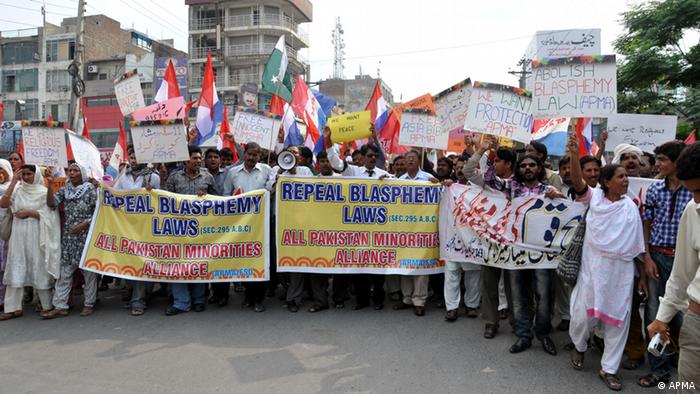
Rights organizations say that religious minorities face increasing legal and cultural discrimination in Pakistan. Forced conversions and murders of Christians, Hindus and other minority groups are on the rise. The independent Human Rights Commission of Pakistan (HRCP) recently reported that 2012 was one of the worst years for religious minorities in the country: Several people were charged with blasphemy, many places of worship were burnt down and houses were looted all over the country. Controversial blasphemy laws in the Islamic Republic of Pakistan, where 97 percent of the population is Muslim, were introduced by the military dictator General Zia-ul-Haq in the 1980s. Activists say they are often implemented in cases which have little to do with blasphemy however. They are used to settle petty disputes and personal vendettas. Christians, Hindus and Ahmadis are often victimized as a result.
Accused of blasphemy
On August 16 last year, Rimsha Masih - a Christian girl - was accused of committing a blasphemous act by a religious cleric in her town. The cleric said she had burnt pages on which were inscribed verses from the Quran. Masih, who is estimated to be between 10 and 14 years old and who some officials say suffers from Down's Syndrome, was taken into police custody.After numerous protests by rights organizations and the international community, a Pakistani court ordered her release and the blasphemy charges against her were dropped in November 2012. However, Asia Bibi has not had such luck. In 2010, the impoverished farmer was sentenced to death after her neighbors accused her of insulting Prophet Muhammad. She is still languishing in prison. A few months after Bibi's conviction, Salman Taseer, a former governor of Punjab province, was murdered by his bodyguard, Mumtaz Qadri. Qadri said he had killed Taseer for speaking out against the blasphemy laws and in support of Bibi. In March 2011, Shahbaz Bhatti, Pakistan's former minister for minority affairs, was assassinated by a religious fanatic for the same reason.
Legal reform needed
Farzana Bari, director of Center for Women's Studies at Islamabad's Quaid-i-Azam University, believes discrimination will persist unless there is radical change. "It is high time that the government reform these anti-blasphemy laws," she said to DW. "These laws are against the spirit of Islam and are a cause of notoriety for the country." Karachi-based journalist Mohsin Sayeed does not only blame the government. He told DW that what used to be comprised of a small section of society had now become mainstream. "The days are gone when we said it was a small group of religious extremists, xenophobes, hate-mongers and bigots who commit such crimes," he said. "Now the venom has spread to the whole of Pakistani society." He added that those who condemned such "barbaric crimes" had become a minority. He also criticized the Pakistani judiciary for its alleged sympathetic behavior toward the right-wing. "Asia Bibi is still in jail, while Qadri is still alive," he said.
Forced to convert
In 2012, the forced conversion of Rinkle Kumari and two other Hindu girls from the southern Sindh province also angered Pakistani activists. Amarnath Motumal, the vice chairperson of Pakistan's Human Rights Commission's Sindh Chapter, and also a member of the minority Hindu community, told DW he thought religious extremism was the main reason behind a series of forced conversions. He added that Pakistani Hindus, who make up 2.5 percent of the Pakistani population, were "very scared and not getting any help from anywhere." In July last year, to the shock of Pakistani rights activists, a 20-year-old Hindu man, who goes by the name of Sunil, was shown being officially converted to Islam on a live TV show aired by the ARY Digital, a private TV channel. It was a special transmission that marked the Muslim holy month of Ramadan. Though the conversion of Hindus and Christians is not a new phenomenon in Pakistan it was the first time one was presented on live television. Though Sunil said he was not forced to convert, the issue sparked a renewed debate in Pakistan about conversions, religious privacy, media ethics and the role of religion generally. According to Pakistan Hindu Seva, a community welfare organization, an average of around 10 families per month left Sindh, where most Pakistani Hindus live, for India between 2008 and 2011. Over the past 10 year, the number has increased to 400 families per month.
Attacked for being different
Experts say that places of worship are also being targeted more - not only by Islamic extremists, but also by ordinary Pakistanis. Abdul Hai, a senior official of the HRCP in Karachi told DW while there were also commercial reasons behind attacks on minorities' places of worship, most of the time, the temples and churches were attacked for religious reasons. "Religious fanaticism is growing in Pakistan and religious extremist groups are getting stronger by the day. Unfortunately, the government is not doing anything to protect minorities and their places of worship," he said. One of the most violent attacks on Christians and their places of worship in Pakistan was carried out in 2009 in the central Gojra town of the Punjab when Muslims burnt more than 70 Christian houses and many churches, killing seven people, after a rumor that the Quran had been desecrated.

U.N. told atheists face discrimination around globe

Atheists, humanists and freethinkers face widespread discrimination around the world with expression of their views criminalized and subject in some countries to capital punishment, the United Nations was told on Monday. In a document for consideration by the world body's Human Rights Council, a global organization linking people who reject religion said atheism was banned by law in a number of states where people were forced to officially adopt a faith. "Extensive discrimination by governments against atheists, humanists and the non-religious occurs worldwide," declared the grouping, the International Humanist and Ethical Union (IHEU) which has some 120 member bodies in 45 countries. In Afghanistan, Iran, Maldives, Mauritania, Pakistan, Saudi Arabia and Sudan "atheists can face the death penalty on the grounds of their belief" although this was in violation of U.N. human rights accords, the IHEU said. Further, in several others legal measures "effectively criminalize atheism (and) the expression and manifestation of atheist beliefs" or lead to systematic discrimination against freethinkers, the document declared. It was submitted to the rights council as it opened its annual Spring session against a background of new efforts in the U.N. by Muslim countries to obtain a world ban on denigration of religion, especially what they call "Islamophobia". Three of the states with legislation providing for death for blasphemy against Islam, a charge which can be applied to atheists who publicly reveal their ideas, are on the council - Pakistan, Mauritania and Maldives. Turkey's Foreign Minister Ahmet Davutoglu told the council on Monday there was a "rising trend" of Islamophobia, adding: "We condemn all sorts of incitement to hatred and religious discrimination against Muslims and people of other faiths." OIC WANTS ACTION And earlier this month a top official of the 57-nation Organisation of Islamic Cooperation (OIC) said the body would be focusing on getting agreement on criminalizing denigration of religion in coming talks with Western countries. In November last year, the head of the 21-country Arab League told the U.N. Security Council in New York his organisation wanted a binding international framework to ensure "that religious faith and its symbols are respected". The IHEU, and other non-governmental rights groupings, argue that many Muslim governments use this terminology and the concept of "religious blasphemy" within their own countries to cow both atheists and followers of other religions. A number of these governments "prosecute people who express their religious doubt or dissent, regardless of whether those dissenters identify as atheist", the IHEU document submitted to the rights council said. Islamic countries - including Bangladesh, Bahrain, Egypt, Indonesia, Kuwait, Saudi Arabia, Tunisia and Turkey - had also stepped up prosecution of "blasphemous" expression of criticism of religion in social media like Facebook and Twitter. OIC countries have 15 seats on the council, all from Asia, Africa and the Middle East, and make up just less than one third of the rights body.

Complaints on U.S.-led Afghan troops to be checked

Reuters
Secretary of State John Kerry said on Monday complaints against Afghans working for U.S. special forces in Afghanistan would be investigated, a day after Afghan President Hamid Karzai ordered U.S. troops to leave a critical battleground province. Karzai's spokesman on Sunday said Karzai had decided that all U.S. special forces must leave Wardak Province within two weeks, after accusations that Afghans working for them had tortured and killed innocent people. The move could further complicate talks between the United States and Afghanistan over the presence of American troops in the country once most NATO forces leave by the end of 2014. "With respect to Afghanistan and Wardak province, I understand the concerns that they have expressed. And appropriately, any complaints that they may have ought to be appropriately evaluated, and they will be, I can assure you," Kerry told reporters during a visit to London. Kerry said it was up to the NATO-led International Security Assistance Force (ISAF), to investigate. On Sunday ISAF said it was aware of the allegations of misconduct, but would not comment further until it had spoken to Afghan officials. Relations between Karzai and his international backers have at times been fraught, with the Afghan president warning that civilian deaths could sap support for foreign troops and fuel the insurgency. Earlier this month, Karzai said Afghan security forces would be banned from calling for NATO air strikes in residential areas after 10 civilians died in one such strike. Karzai's anger over the conduct of Afghan troops working with ISAF raises the pressure on Afghan forces as they increasingly assume control of security. NATO and its partners are racing against the clock to train Afghanistan's 350,000-strong security forces, though questions remain over how well the Afghans will be able tackle the insurgency in the face of intensifying violence. Kerry said Karzai had "many legitimate evaluations" of where things have wrong or could be improved, but indicated that negotiations on transition and an agreement on the presence of some U.S. troops in Afghanistan after 2014 were going well. "We're working on a bilateral security arrangement; we're working on this transition process. We've had a very good conversation with the President (Karzai) in the last days," Kerry said.

Obama urges Congress to 'compromise' on cuts

Associated Press
Facing an end of the week deadline, President Barack Obama said Monday that Congress can avert sweeping across-the-board cuts with "just a little bit of compromise," as he sought to stick lawmakers with the blame if the budget ax falls. Speaking to the nation's governors, Obama acknowledged that the impact of the $85 billion in cuts may not be felt immediately. But he also said the uncertainty already is impacting the economy, as the Pentagon and other agencies get ready to furlough employees. "At some point we've got to do some governing," Obama said. "And certainly what we can't do is keep careening from manufactured crisis to manufactured crisis." Despite Obama's urgent rhetoric, there is little indication that the White House and Congress will reach a deal by Friday's deadline. Obama wants to offset the so-called sequester through a combination of targeted spending cuts and revenue increases, but Republicans oppose any plan that would include tax hikes. The $85 billion budget-cutting mechanism could affect everything from commercial flights to classrooms to meat inspections. Domestic and defense spending alike would be trimmed, leading to furloughs for hundreds of thousands of government workers and contractors. Defense Secretary Leon Panetta has said the cuts would harm the readiness of U.S. fighting forces. Transportation Secretary Ray LaHood said travelers could see delayed flights. Education Secretary Arne Duncan said 70,000 fewer children from low-income families would have access to Head Start programs. And furloughed meat inspectors could leave plants idled. Despite the Friday deadline, there are no serious negotiations happening between the White House and Congress. Obama is focused instead are trying to rally public support for his stance in the debate by warning Americans of the dire consequences of the across-the-board cuts. The president told the governors that cuts would ""slow our economy, eliminate good jobs, and leave a lot of folks who are already pretty thinly stretched scrambling to figure out what to do." The spending cuts have frustrated governors attending the National Governors Association meeting in Washington. They contend it has created widespread uncertainty in the economy and hampered economic recovery in their states. "The No. 1 risk, in my view, to the continuing economic comeback of Michigan is the federal government," Michigan Gov. Rick Snyder, a Republican and former business executive, said in an interview. Snyder said many companies remain in limbo on whether to invest in their business because of the financial uncertainty. "What's the likely outcome? Are they going to put in a solution that's set for two or three years or are they simply going to say now it's going to move to the fall? It's not good," he said. The White House, seeking to ratchet up pressure on congressional lawmakers, gave the governors state-by-state reports on the impact of the cuts on their constituencies. White House officials pointed to Ohio — home of House Speaker John Boehner — as one state that would be hit hard: $25.1 million in education spending and another $22 million for students with disabilities. Some 2,500 children from low-income families would also be removed from Head Start programs. Officials said their analysis showed Kentucky would lose $93,000 in federal funding for a domestic abuse program, meaning 400 fewer victims being served in Senate Minority Leader Mitch McConnell's home state. Georgia, meanwhile, would face a $286,000 budget cut to its children's health programs, meaning almost 4,200 fewer children would receive vaccinations against measles and whooping cough. The White House compiled its state-by-state reports from federal agencies and its own budget office. The numbers reflect the impact of the cuts this year. Unless Congress acts by Friday, $85 billion in cuts are set to take effect from March to September. As to whether states could move money around to cover shortfalls, the White House said that depends on state budget structures and the specific programs. The White House did not have a list of which states or programs might have flexibility. Republican leaders were not impressed by the state-by-state reports. "The White House needs to spend less time explaining to the press how bad the sequester will be and more time actually working to stop it," said Michael Steel, a spokesman for Boehner.

Sunday, February 24, 2013

Cuban leader Raul Castro says he will retire in 2018

http://www.reuters.com
Cuban President Raul Castro announced on Sunday he will step down from power after his second term ends in 2018, and the new parliament named a 52-year-old rising star to become his first vice president and most visible successor. "This will be my last term," Castro, 81, said shortly after the National Assembly elected him to a second five-year term. In a surprise move, the new parliament also named Miguel Diaz-Canel as first vice president, meaning he would take over if Castro cannot serve his full term. Diaz-Canel is a member of the political bureau who rose through the Communist Party ranks in the provinces to become the most visible possible successor to Castro. Raul Castro starts his second term immediately, leaving him free to retire in 2018, aged 86. Former President Fidel Castro joined the National Assembly meeting on Sunday, in a rare public appearance. Since falling ill in 2006 and ceding the presidency to his brother, the elder Castro, 86, has given up official positions except as a deputy in the National Assembly. The new government will almost certainly be the last headed up by the Castro brothers and their generation of leaders who have ruled Cuba since they swept down from the mountains in the 1959 revolution. Cubans and foreign governments were keenly watching whether any new, younger faces appeared among the Council of State members, in particular its first vice president and five vice presidents. Their hopes were partially fulfilled with Diaz-Canel's ascension. He replaces former first vice president, Jose Machado Ventura, 82, who will continue as one of five vice presidents. Commander of the Revolution Ramiro Valdes, 80, and Gladys Bejerano, 66, the comptroller general, were also re-elected as vice presidents. Two other newcomers, Mercedes Lopez Acea, 48, first secretary of the Havana communist party, and Salvador Valdes Mesa, 64, head of the official labor federation, also earned vice presidential slots. Esteban Lazo, a 68-year-old former vice president and member of the political bureau of the Communist Party, left his post upon being named president of the National Assembly on Sunday. He replaced Ricardo Alarcon, who served in the job for 20 years. Six of the Council's top seven members sit on the party's political bureau which is also lead by Castro. The National Assembly meets for just a few weeks each year and delegates its legislative powers between sessions to the 31-member Council of State, which also functions as the executive through the Council of Ministers it appoints. Eighty percent of the 612 deputies, who were elected in an uncontested vote February 3, were born after the revolution. EFFORT TO PROMOTE YOUNGER GENERATION Raul Castro, who officially replaced his ailing brother as president in 2008, has repeatedly said senior leaders should hold office for no more than two five-year terms. "Although we kept on trying to promote young people to senior positions, life proved that we did not always make the best choice," Castro said at a Communist Party Congress in 2011. "Today, we are faced with the consequences of not having a reserve of well-trained replacements ... It's really embarrassing that we have not solved this problem in more than half a century." Speaking on Sunday, Castro hailed the composition of the new Council of State as an example of what he had said needed to be accomplished. "Of the 31 members, 41.9 percent are women and 38.6 percent are black or of mixed race. The average age is 57 years and 61.3 percent were born after the triumph of the revolution," he said. The 2011 party summit adopted a more than 300-point plan aimed at updating Cuba's Soviet-style economic system, designed to transform it from one based on collective production and consumption to one where individual effort and reward play a far more important role. Across-the-board subsidies are being replaced by a comprehensive tax code and targeted welfare. Raul Castro has encouraged small businesses and cooperatives in retail services, farming, minor manufacturing and retail, and given more autonomy to state companies which still dominate the economy. The party plan also includes an opening to more foreign investment. At the same time, Cuba continues to face a U.S. administration bent on restoring democracy and capitalism to the island and questions about the future largess of oil rich Venezuela with strategic ally Hugo Chavez battling cancer.

Pakistan PM says Islamabad resolved to go ahead with Iran gas plan

Pakistan’s Prime Minister Raja Pervez Ashraf said on Sunday that Islamabad is keen to go ahead with the proposed gas pipeline project with Iran in order to overcome its energy crisis. Talking to journalists at the Government College, Hyderabad, during a visit to his alma mater, he said, “Pakistan is facing a serious energy crisis and we want to end it as soon as possible.” He, however, avoided commenting specifically on a statement by a U.S. State Department spokeswoman warning Pakistan of sanctions if it went ahead with the Iran gas pipeline project. “We believe there are better, more secure and more efficient ways for Pakistan to get its power. We’ve made clear to countries around the world, including Pakistan, that we believe it’s in their interest to avoid activities that could be prohibited by UN sanctions or that could be ‘sanctionable’ under U.S. law,” the spokeswoman had warned Islamabad on Friday. The prime minister said the energy crisis had become a big burden on the national economy. He said everyone knew that India had been part of the project in the past.

Zardari to finalise gas pipeline deal in Tehran

The Express Tribune
Despite mounting US pressure, President Asif Ali Zardari has decided to travel to Tehran this week to finalise a multibillion dollar gas pipeline deal, officials revealed on Sunday. Under the agreement, Iran would offer a loan of $500 million to Pakistan for the construction of a gas pipeline on its side of the border. However, the project has run into trouble due to an absence of investors fearing economic sanctions by the United States. A foreign ministry official confirmed to The Express Tribune that President Zardari will begin a two-day visit to Iran on Tuesday to finalise the much-anticipated deal.The official, requesting anonymity, disclosed that Washington was pushing hard to convince Islamabad to abandon the project. “But we feel that the project is important for our future energy needs and we will pursue it at all costs,” he added. Meanwhile, at his weekly briefing on Thursday, the foreign ministry spokesperson rejected reports of US pressure insisting that the Iran-Pakistan (I-P) gas pipeline project was “enormously important” for Pakistan. “We are an energy deficient country. It is in our national interest to have this project,” Moazzam Ali Khan asserted. Not only would President Zardari sign a deal on the I-P project, Iran will also set up an oil refinery in Gwadar, Balochistan, it was revealed. And both the formal agreements would be inked between leaders of the two countries during the president’s upcoming visit to Tehran. The $4 billion refinery is slated to be constructed in the port city of Gwadar with an estimated capacity of about 400,000 barrels per day. The proposed cooperation between Islamabad and Tehran is likely to invite more pressure from Washington, sources say. The US State Department said on Saturday that there were better options available for Pakistan than the I-P project to meet the country’s growing energy demands. But, Pakistan so far resisted the pressure and has decided to go ahead with the project. Last week, the Iranian oil minister visited Islamabad and said Tehran would start supplying natural gas to Pakistan by December 2014.

Babra Sharif IN Pakistani Movies

Remembering Mehnaz Begum

Mehnaz Begum (1958 - 2013) was born in karachi to the celebrated subcontinental singer Kajjan Begum. She was trained under her mother in music and sang a variety of genres, including ghazal, thumri, dadra and geet. She also sang for films in the 70s and 80s. She died at Bahrain Airport January 19, 2013 while traveling from Karachi to Miami, where she was going for medical treatment.She was 55. She sung over 2,500 songs for the radio‚ television and films which is the second largest after that of Malika-e-Taranum Madam Noor Jehan’s. Her widely acclaimed ghazals included “Ab Kay Tajdeed-e-Wafa Ka Nahi Imkaan” and “Mujhe Dil Se Na Bhulana”. She was so versatile that she even made her mark on khayal, dadra and drupad singing. Mehnaz also recited salam, noha and marsiya. Introduced by Salim Gilani, Mehnaz made her debut on Radio Pakistan in 1973. The same year, Ameer Imam, a Karachi television producer, signed her for a musical programme ‘Naghmazaar’ bringing her to television audience. Her most popular songs are from ‘Aina’ and ‘Bandish’. In 1981, Mehnaz toured the US and Canada, where she sang for large audiences in Chicago, New York, San Francisco, Los Angeles and Toronto. Three years later, she visited the United Kingdom and captivated a large audience with her magical voice.In his condolence message, the president Zardari lauded the invaluable contributions of Mehnaz Begum in the field of music and said that in her demise, the music industry has lost a great asset. He said that her melodious voice would be remembered for long. Expressing sympathies with the bereaved family and her millions of fans, he prayed to the Almighty to grant eternal peace to the departed soul and to give courage to the bereaved family to bear this loss with fortitude.

Afghan forces 'are just like criminals'

Murder, sexual abuse, drugs and extortion revealed in Panorama investigation
Shocking revelations of murder, sexual abuse of young boys, unarmed civilians being shot at, police officers high on drugs, and routine kidnaps and extortion are exposing the true state of Afghanistan's security forces in Helmand province. An investigation has revealed how Afghan forces running bases that British soldiers fought to secure are barely able to function – let alone pose a challenge to the Taliban. More than 100 British soldiers lost their lives in Sangin before handing over to the Americans in 2010. Foreign troops are due to leave their combat role in Afghanistan at the end of 2014 – passing security to the Afghan government. But the despair of the US marines advising Afghan forces is laid bare in scenes being broadcast on BBC1's Panorama tomorrow evening. It reveals how three boys were shot dead escaping from police commanders who were sexually abusing them. Major Bill Steuber meets the deputy police chief, who claims the children want to stay at the bases and "give their bodies at night". Eventually he agrees to take action, but the operation to rescue the other "chai boys" used as sex slaves does not happen. Major Steuber angrily gestures to a nearby Afghan patrol base commander :"who we know is kidnapping boys and sexually molesting them, robbing the people. He treats the people of Sangin like a piggy bank that he can just shake and rob and, you know, that's really difficult, you know. How do you work with a guy like that?" Ben Anderson, the reporter embedded with the US marines, has been visiting Afghanistan since 2007 and said: "The police are behaving like the worst criminals imaginable." He added: "Even going out there with very low expectations I was still shocked at how widespread the abuse is and how it's not really being tackled." Reacting to the investigation, Colonel Richard Kemp, a former commander of British forces in Afghanistan, cautioned that Afghan forces "will not be ready to take on the insurgency alone when coalition forces leave. Instead many areas of the country will suffer brutality, abuse and corruption as well as surreptitious collusion with insurgents." Afghan forces are seen under the influence of drugs, indiscriminately firing into the air without regard for civilians, and US soldiers discover four men kidnapped by police and used to barter with the Taliban. The scenes are in stark contrast to the Defence Secretary Philip Hammond's assurances during a visit to Helmand earlier this month that transition is "on track" and that the Afghans "will be able to maintain security as the Isaf draw down." A Ministry of Defence spokesperson said in a statement: "We are unable to comment on the specific incidents raised by Panorama" and insisted the Afghan security forces are a "professional and capable force" in the "vast majority of cases" but admitted "real challenges remain across Afghanistan, including proper adherence to the rule of law and respecting human rights".

Violence continues to shake Pakistan's Lyari town

Afghanistan's first female mayor proves critics wrong

Azra Jafari has won respect in her community as she fights to improve lives and change attitudes towards women
When Azra Jafari became mayor of Nili, she knew that the impoverished and remote Afghan town desperately needed roads and investment. She was aware that she would be living in very basic conditions, on a meagre salary of $76 (£50) a month, and that taking care of a four-year-old daughter at the same time would be challenging. What she was less prepared for was the appearance of a powerful mullah in her unheated, makeshift office, wagging his finger at her, warning that Nili was not about to accept a female mayor who thought she could "exploit her femininity in order to complete a few projects and influence our women". "After three months, the same man came up to me and thanked me," Jafari recalled, four years later. "He said, 'If a man could do just half of what you've done here, our province will surely flourish'. He now supports me and we work very well together – I have a great deal of respect for him." She is now referred to as "Mr Mayor" by her community, a title that conveys respect in a country not known for women's rights. Until 2009, Nili – a small town of about 40,000 people at the centre of Daykundi province – had never seen a female official, said Jafari. She had to prove to the community that she was serious about improving their lives. Jafari was shocked by the complete lack of infrastructure in the town. "Anything that needed to be built in Nili, had to be built from scratch," she said. "And I had no budget" – something she had to address by making regular trips to Kabul to implore ministry officials to release funds. "When I arrived, my office had been damaged by snowfall. It was a small room, with a few pillows. There was no table, no chairs. Just a couple of people there to help me," Jafari said. "Wherever it was necessary I picked up a shovel, kicked dirt, and gathered coal with my hands. Nili is not the sort of town where you can easily drive a car. I often had to walk from place to place through deep snow, getting my feet soaking wet." The 34-year-old cannot be further from the image of the downtrodden victim that has become a misleading shorthand for Afghan womanhood. Nor is she connected to a powerful or wealthy family, and she fiercely rejects the suggestion that her promotion was an exercise in tokenism by a government under pressure from its western financiers to show it is bettering women's rights. "If our friends in the international community really made me mayor because I am a woman then they would have paid for the roads I built. Unfortunately they have contributed very little to the changes in Daykundi," she said. Jafari also does not hold back on the subject of how severely women in office in Afghanistan are judged, likening it to having one's decisions and behaviour placed under a magnifying glass. "There are plenty of men here with no ambition to work, who are bad at their jobs and over whom a lot of money has been wasted. Because they are men, no one really questions them and asks 'as a man, how successful have you managed to be?' But as the only female mayor among 180 others, the first question I'm always asked, wherever I am, is 'show us what you've done for your people'." Jafari, who is married to an Afghan film-maker, is currently the subject of a documentary series called Kabul: A City at Work, a sequel to Kabul at Work, which seeks to show ordinary, working Afghans doing extraordinary things at a time of war. "Mr Mayor" grew up in Ghor province, which borders Daykundi to the west. Like Daykundi, Ghor's population is poor and mainly Shia Hazara. Jafari says that her familiarity with the people and their needs is what partly drew her to the job in Nili. Daykundi has virtually no western troops. It was carved out of inhospitable, mountainous terrain in the centre of Afghanistan in 2004, hugged by the much more restive provinces of Ghazni, Uruzgan and Helmand. It takes Jafari and her daughter, Indira, two days to drive to Nili from Kabul. It is a perilous journey on poorly paved roads. It becomes a death trap during winter's heavy snowfall. Two days after this interview, Jafari telephoned from Nili to explain that say the small coach she had been travelling in, along with her daughter and 13 other passengers, had overturned and almost careered 1,600ft towards a riverbed below. "The windows were shattered. Thank God we were OK," she said, adding that she had suffered a sprained neck and her daughter had cut her finger on some glass. "But she couldn't stop shaking for half an hour afterwards." Bad weather and heart-stopping bus journeys are one risk. The other is the war being waged between Afghan and foreign forces and insurgents. Jafari's commute often takes her through the insurgent-filled province of Maidan Wardak. "Last year we were caught in a gunfight between Afghan forces and insurgents for three hours. We couldn't move." And violence is slowly encroaching on Nili itself. Daykundi has long been known as one of the least dangerous and most isolated provinces in Afghanistan. But the Taliban are making increasingly bold moves on Nili, advancing from a district called Gizab, on the border with Uruzgan and technically under that province's jurisdiction. For many years, it was the very lack of an insurgency that starved Daykundi of adequate attention from foreign donors. Now, Jafari says, that argument is running on borrowed time. Between 2001 and 2011 the US government's development agency, USAid, spent $37m (£24.4m) on projects in Daykundi province, which has a population of just over 400,000 but no Nato-backed provincial reconstruction team (PRT). By contrast, the more dangerous Uruzgan province, which borders Daykundi to its south and is home to 100,000 fewer civilians, received almost twice as much aid over the same period and hosts a PRT. Like thousands of Afghans, Jafari fled the civil war in the early 1990s, taking refuge in Iran, where she ran a school for Afghan refugee children. She moved back to Afghanistan in September 2001 to take part in a peace jirga (a tribal assembly of elders) as the fall of the Taliban became imminent. She has also published two books, one entitled I am a Working Woman, which she wrote specifically for women with low levels of literacy. When we met, Jafari was dressed in a fitted, beige, knee-length tunic, buttoned down the front, and worn over trousers. Her hair was neatly covered with a black shawl splashed with bright colours and loosely wrapped around her neck. It is a typical Kabul look, but perhaps seen as less acceptable in a much more conservative and rural place such as Nili. "I like to dress formally," she explained. "This means clothes tend to be more fitted and a bit tighter, but this is the way formal, professional people dress. Not traditional loose, wide clothing, and people need to accept this." She has never changed what she wears, even in the face of criticism and gossip, as she sees it as part of her job to change mindsets and to encourage people to understand that the way someone dresses has no bearing on who they are or their ability to get a job done properly. "What I've really learned is that it makes no difference whether you are a man or a woman, what matters is that you do your work properly and you work hard and how seriously you take your responsibilities," she said. As Afghanistan's first and only female mayor Jafari is determined to make her mark not just on infrastructure, but on people's attitudes towards women. She feels strongly that since being in Nili, she has influenced the way younger women think for the better. She says one day she may angle for the top job in Afghan government, but she would like to become a member of parliament first, before reaching for the presidential palace. "I'm like a template for women," she said. The morning after the interview, Jafari set off, with Indira in tow, on their long and dangerous journey to Nili.