http://www.usatoday.com/news/President Obama is back on the campaign trail for the first time since Hurricane Sandy struck the east coast on Monday; Obama has campaign appearances Thursday in Wisconsin, Nevada, and Colorado. President Obama began his post-Sandy re-election campaign Thursday by striking a bipartisan tone before resuming attacks on Republican challenger Mitt Romney. During an airport rally in Green Bay, Obama first said that the response to Hurricane Sandy showed how Americans can come together: "There are no Democrats and no Republicans in a storm." Obama then said that the U.S. economy is turning around under his leadership, but Romney is advocating the type of "top down" economics that produced a near-depression in 2008. "We know what change looks like," Obama said. "What the governor's offering sure ain't change." Instead, the president touted his own record of change, citing the health care law, new financial regulations, education and research programs, and efforts to reduce the federal debt by raising taxes on the wealthy as well as budget cuts. Wearing a leather jacket in the chilly Wisconsin air, Obama said: "We need a middle class agenda that rewards hard work and responsibility." Romney aides said the middle class are the ones who have suffered the most under Obama's handling of the economy. "We need a new president who actually understands businesses and won't punish them with higher taxes, more regulations, and job-destroying energy policies," said Romney spokesman Ryan Williams. "Mitt Romney spent his career in the private sector as a successful businessman, and as president he will promote pro-growth policies that will create jobs, help small businesses, and strengthen the middle class." Making what aides described as a "closing argument" for a second term, with Election Day less than a week away, Obama told backers they "know what I believe" and "where I stand." The president also cited the support of Democratic predecessor Bill Clinton, who has a full schedule of events leading into Tuesday's election. The Green Bay rally kicked off five days of campaigning for the president heading into Tuesday's election. Thursday features a western swing that will take Obama to Las Vegas and Denver. Obama had suspended his campaigning on Monday as Hurricane Sandy approached the East Coast, and earned good reviews for his reaction to the damage in New Jersey, New York, and other states. Aides said that, throughout Thursday, Obama will continue to be in communication with emergency management aides and local officials hurt by the storm. Commenting on the storm during his speech in Green Bay, Obama said: "We're awed and humbled by nature's destructive power."
M WAQAR..... "A man's ethical behavior should be based effectually on sympathy, education, and social ties; no religious basis is necessary.Man would indeed be in a poor way if he had to be restrained by fear of punishment and hope of reward after death." --Albert Einstein !!! NEWS,ARTICLES,EDITORIALS,MUSIC... Ze chi pe mayeen yum da agha pukhtunistan de.....(Liberal,Progressive,Secular World.)''Secularism is not against religion; it is the message of humanity.'' تل ده وی پثتونستآن
Thursday, November 1, 2012
Obama lauds bipartisanship, attacks Romney
Federal Storm Aid Available for NYC, NJ, L.I. Residents
Assistance includes grants for temporary housing and home repairs, low-cost loans to cover uninsured property losses and other programsThe Federal Emergency Management Agency says federal funding is being made available to storm-affected residents and business owners in New York City, parts of New Jersey and on Long Island. Assistance includes grants for temporary housing and home repairs, low-cost loans to cover uninsured property losses and other programs. Federal aid is also available to state and eligible local governments and certain non-profit organizations on a cost-sharing basis for debris removal and emergency protective measures. The money was made available as part of a disaster declaration signed Tuesday by President Barack Obama. The counties eligible for aid in New Jersey include Atlantic, Cape May, Essex, Hudson, Middlesex, Monmouth, Ocean and Union, which bore the brunt of the storm in the Garden State. All of New York City and Long Island is eligible. Residents and business owners who sustained losses within the declaration zone can apply for assistance online at www.disasterassistance.gov or by calling 1-800-621-FEMA(3362) or 1-800-462-7585 (TTY) for the hearing and speech impaired.
One Result of Hurricane: Bipartisanship Flows
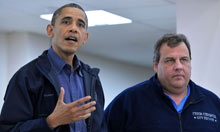
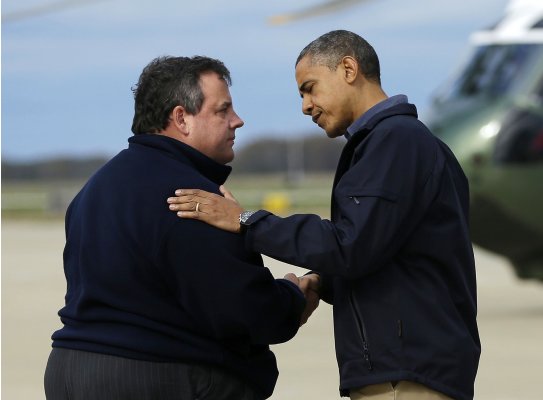
The power of the image could not have been lost on a politician as savvy as Gov. Chris Christie of New Jersey: With days to go before a cliffhanger election, a Democratic president was giving the handshake-back pat to his Republican opponent’s most aggressive campaigner as they prepared to embark on a tour of damage from a catastrophic storm.
Mr. Christie had been scheduled to campaign for Mitt Romney, but he embraced the moment. When President Obama praised the governor after they finished their tour — “I want to let you know your governor is working overtime” — the two were soon swapping compliments.
“It’s been a great working relationship,” Mr. Christie said.
“I cannot thank the president enough for his personal concern and compassion for our state,” he added during a brief news conference. He said it was “my honor” to turn the podium over to the president and then stood just behind him, occasionally nodding and smiling at his jokes.
For all the disruptions caused by Hurricane Sandy, the most unexpected may have been its unsettling effect on a presidential campaign winding into its final days. Perhaps nothing demonstrated the sudden upending of a political landscape years in the making so much as Mr. Christie’s unexpected and effusive praise of Mr. Obama. Only last week he dismissed the president as “clutching for the light switch of leadership.”
The scene played out on televisions around the country like a stirring campaign ad that hit themes of bipartisanship and crisis management — only it was run free of charge. And for those who missed it, Mr. Christie repeated his praise again and again in television interviews, saying the president had been “outstanding,” “incredibly supportive” and “deserves great credit.”
As pundits mused about the political implications for the presidential race, few of those watching, including campaign aides to the president and Mr. Romney, could do more than guess about the latest wild-card move from a wild-card governor.
Was he just a selfless leader making sure that he and his state had the ear of the man holding the federal purse strings? Or a selfish climber who figured he could run for president in 2016 if Mr. Romney were to lose this year? Or maybe he saw it in purely local terms, as a way to scare away a potentially strong Democratic challenger, like the popular Newark mayor, Cory A. Booker, at a time when the state’s unemployment rate hovers well above the national average.
As Mr. Obama stood beside Mr. Christie and gushed about “his extraordinary leadership,” Romney aides were eager to make nothing of the partnership.
“He’s a governor focused on his job,” said Kevin Madden, a Romney adviser. “He has said he’s not looking at this through the lens of politics. He’s right, and I expect most folks are looking at it just like the governor is.”
Jay Carney, the White House press secretary, said the visit should not be seen as a political event. “This is a time to focus on what was a devastating storm and the terrible aftermath of that storm,” he said.
But Mr. Christie did not completely set aside politics: he has blasted Democrats in the State Legislature for not allowing him to raise fines on utilities that do not respond quickly enough to power failures, and he has picked a fight with the Democratic mayor of Atlantic City.
Part of it may be that Mr. Christie still feels like a youngster in a candy shop about being governor — he tells audiences at home that when he sees his name and title etched in gold on his office door, he asks himself, “How the hell did this happen?” When the president calls, it’s still a pinch-me moment. Even when he wakes you up.
“It’s O.K., he’s allowed to,” he told reporters.
Before the visit Wednesday, Mr. Christie mentioned several times that he and the president had talked “just the two of us,” and that the president had insisted that if he had any problems, he was to call him directly.
Mike DuHaime, an adviser to Mr. Christie, said the governor was acting true to form. “He calls ’em as he sees ’em,” he said. “If they’re working well together, he’s going to say it.”
Mr. Christie has not announced whether he will run for a second term, but if he does, Election Day is a mere year and five days away. His approval ratings are high in New Jersey, but Mr. Obama’s are higher.
It would not be the first time that Republicans have accused him of putting his own interests first: many criticized him after he delivered the keynote speech at the Republican National Convention, when it took him 15 minutes to mention Mr. Romney’s name.
But one Republican close to Mr. Romney said that Mr. Christie would have been accused of playing politics if he had said no to the president’s post-storm visit, as Mayor Michael R. Bloomberg of New York had.
Still he seemed at times almost dismissive of Mr. Romney. When a host of Fox and Friends asked whether Mr. Romney would come visit New Jersey, the governor replied sternly: “I have no idea,” he said. “Nor am I the least bit concerned or interested.”
As the president and the governor flew over the devastated Jersey Shore, at least one resident seemed to be staying on message. At the north end of Point Pleasant Beach, someone had etched in the sand: “ROMNEY.”
US Concerned Over Bahrain Banning All Protest Gatherings
http://www.rttnews.comThe United States has expressed concerns over the recent ban on all protest gatherings in Bahrain, and urged the government in the Gulf Kingdom to allow freedom of peaceful assembly in line with its international commitments. "The United States is deeply concerned by the Bahraini Government's decision to ban all public gatherings," State Department spokesman Mark Toner said at a press briefing in Washington on Wednesday, noting that "freedoms of assembly, association, and expression are universal human rights." Toner also urged the Bahraini government to uphold its international commitments and ensure that its citizens are able to exercise - are able to assemble peacefully and to express their views without fear of arrest or detention. "We urge the Government of Bahrain to work with responsible protest leaders to find a way for peaceful and orderly demonstrations to take place. The decision to curb these rights is contrary to Bahrain's professed commitment to reform, and it will not help advance the national reconciliation nor build trust among all parties," he said. The spokesman also urged the Bahraini Opposition to refrain from provocations and violence, stressing that violence undermines efforts to reduce tensions, rebuild trust, and pursue meaningful reconciliation in the Middle East nation. "Recent violent attacks, including fatal attacks, on security force personnel are a deeply troubling development. So we urge the Government of Bahrain to take steps to build confidence across Bahraini society and to begin a meaningful national dialogue with the political Opposition," he added. Toner's response came a day after Bahrain banned all protest gatherings and threatened legal action against groups encouraging demonstrations and clashes. The move is believed to be aimed at crushing the oil-rich Kingdom's anti-government uprising spearheaded by the majority Shia population, who have been complaining about discrimination by the ruling Sunni royal family. While announcing the ban apparently targeting Al-Wefaq, the country's largest Shia political bloc, the Interior Ministry warned that any "illegal rally or gathering would be tackled through legal actions against those calling for and participating in it." Notably, the Al-Wefaq had previously organized several Opposition marches that ended in clashes with security forces. Separately, Interior Minister Sheikh Rashid al-Khalifa said on Wednesday that "repeated abuse" of the rights to freedom of speech and expression could no longer be tolerated. He added that protests of any kind would be permitted only after sufficient levels of security and stability required to maintain national unity were achieved. It is estimated that at least 60 people have been killed since pro-democracy protests broke out in Bahrain in February 2011 as a fallout of the 'Arab Spring' that saw the toppling of entrenched rulers in North Africa and the Middle East. The Bahraini government had suppressed last year's unrest with the help of troops from other GCC (Gulf Cooperation Council) States. Nevertheless, the country continues to witness frequent protests staged by the Opposition and Bahrain's Shia majority, who have long been complaining about discrimination in housing and government jobs. They have been demanding greater political rights and want the Sunni monarchy to hand over most of its powers to the elected Parliament. Political turmoil in Bahrain has been of particular concern to the United States since the strategically located island in the Persian Gulf is home to the U.S. Navy's Fifth Fleet. The U.S. also fears that the Gulf Kingdom with its Shia-majority population could come under Iranian influence.
Calls for Saudi Arabia to free ‘blasphemor’
http://gulfnews.comA Human rights organisation on Wednesday called for the immediate release of a man holding dual US and Saudi citizenship and detained by Saudi authorities for writing comments on twitter about the Quran. Human Rights Watch said Mohammad Salama has been held since April without charge after he was arrested for posting tweets criticising interpretations of the sayings of the Muslim Prophet Mohammad (PBUH), also known as the hadiths, on his twitter account. It said that in March Salama wrote that the “the Prophet [PBUH] himself questioned the Quran” and that “thoughts of suicide are normal, because the Prophet himself contemplated it.” He also posted a video on YouTube criticising a cleric for his political views after which unidentified online commentators called for his arrest and execution.HRW said that neither Salama or his family have been informed of accusations against him. “Salama’s case is a sad example of the way that Saudi authorities hold detainees for extended periods of time without charge and in violation of major human rights standards,” Joe Stork, HRW’s deputy Middle East director, said in a statement. “Authorities have shown no evidence that he did anything more than express his opinion peacefully. He should be released immediately.” HRW said another Saudi, Hamza Kashgari, has also been in custody since February 12 for his tweets discussing religion. Saudi authorities arrested and detained Kashgari immediately after Malaysia extradited him, despite pleas by human rights organisations not to send him back to Saudi Arabia. Kashgari had posted messages on his twitter account that top Saudi clerics said committed apostasy, HRW said.
West call for Assad departure daydreaming: Russia
Russia has warned the Western powers that their call for the ouster of Syrian President Bashar al-Assad is like daydreaming and will only lead to more bloodshed in the Arab state.
"If the position of our partners remains the departure of this leader who they do not like, the bloodbath will continue," Russian Foreign Minister Sergei Lavrov said in Paris on Wednesday after holding talks with his French counterpart Laurent Fabius.
“It is like daydreaming to speculate on the subject, to the effect that if the [Syrian] government is overthrown everything will fall into place,” Lavrov added.
“If this is a priority for somebody, bloodshed will continue,” he stated.
Lavrov went on to say that “Assad’s fate should be decided by the Syrian people.”
The Russian foreign minister called for efforts to find a political solution to the Syrian conflict, reiterating that there is no military solution to the problem.
He urged the Western states and Turkey to negotiate with the Syrian president.
Damascus accuses Ankara of being a key member of an international coalition attempting to destabilize Syria.
Lavrov said Paris and Moscow want an end to the conflict and support efforts to avert an international contagion.
Meanwhile, the French foreign minister said Paris still disagrees with Russia over Assad's role in any future transition government.
Kuwaiti Court Frees Top Opponent after Violent Clashes
A Kuwaiti court on Thursday ordered the release on bail of opposition leader Mussallam al-Barrak following a night of violent protests that left dozens hurt, his lawyer said.
News of the court order came as opposition groups convened in an emergency meeting in the wake of the night-long clashes, which also saw more than 20 demonstrators arrested, according to activists.
"A judge ordered the release of Barrak on bail of 10,000 dinars ($35,600) pending trial," lawyer Abdulrahman al-Barrak told Agence France Presse, adding that his client was expected to be freed from the central jail later in the day.
Thousands of protesters staged a demonstration on Wednesday, marching on the central jail to demand freedom for the former lawmaker before police confronted them with tear gas and stun grenades.
Clashes continued into the early hours of Thursday and spread to several areas of the Gulf state.
The disturbances in the OPEC member saw the Kuwait Stock Exchange index dive about 2.0 percent to 5,645.31 points on Thursday.
Barrak was arrested on Monday and two days later his detention was renewed for 10 days, triggering the angry demonstrations.
He has been charged with undermining the status of Kuwait's emir at a public rally on October 15 for which he could face a jail sentence of up to five years, his lawyer said.
Kuwaiti opposition groups meanwhile went into an emergency meeting on Thursday to discuss the situation following the clashes and what they claim was the use by police of excessive force, an activist said.
The interior ministry said in a statement five policemen were wounded during the overnight clashes when two vehicles hit them and sped away. It said one of the vehicles bore a "foreign number plate."
The ministry said police arrested several protesters without giving a number but witnesses told AFP that at least 23 people were detained.
Activists said that dozens of people, especially children, were rushed to hospital after inhaling gas when riot police made extensive use of stun grenades and tear gas canisters in their attempt to disperse the protesters.
The activists said police chased demonstrators in the Sabah al-Nasser area, a predominantly tribal district near the central jail, into homes and beat them up.
The violence continued there until riot police withdrew at around 3:00 am (12:00 GMT) after about seven hours of unrest.
Protests spread to other mostly tribal areas as police clashed with demonstrators in residential areas near the oil hub of al-Ahmadi, around 40 kilometers south of Kuwait City and also in northern Kuwait.
The violent protests were the second major confrontation between police and the opposition in the past 10 days. On October 21, more than 100 people and 11 policemen were hurt during a massive protest.
The opposition plans to stage another demonstration on Sunday amid a stern warning by authorities that any illegal protest will be stopped by force.
Senior Kuwaiti cleric Nabeel al-Awadhi said on Thursday that he and a number of other clerics had begun an initiative aimed at ending the political stalemate in the country. He did not elaborate.
Tensions have been simmering since the emir, Sheikh Sabah al-Ahmad al-Sabah, on October 19 said he had ordered the government to amend the controversial electoral law.
The opposition claims the change is aimed at electing a rubber stamp parliament.
Kuwait is scheduled to hold snap polls on December 1 which almost all opposition groups have announced they will boycott.
The Gulf state has been rocked by a series of ongoing political disputes since 2006 during which the cabinet was forced to resign nine times and parliament was dissolved on six occasions.
Hina Rabbani Khar looks forward to working with Salman Khurshid
Congratulating external affairs minister Salman Khurshid on his assumption of office, Pakistan foreign minister Hina Rabbani Khar said she looks forward to working closely to promote friendly and cooperative bilateral ties.
"I wish you every success and look forward to working with you closely to promote good neighbourly, friendly and cooperative relations between our two countries.
"We attach considerable importance to taking forward the ongoing dialogue process," Khar said in a letter to Khurshid.
Besides Pakistan, Russia, Turkey, Bangladesh, Nepal, the UK and Oman have sent Khurshid a letter of felicitation.
Malala Yousufzai status updates (01 November 2012)
Thursday 1 November 2012 Malala Yousufzai remains in a stable condition in the Queen Elizabeth Hospital Birmingham, under the care of Queen Elizabeth and Birmingham Children’s hospitals' medical staff.
AFGHANISTAN: Disease outbreaks prompt action
Afghanistan is taking steps to improve its routine immunization coverage, after a drop in coverage led to a sharp increase in measles outbreaks last year, killing more than 300 children.
Since the start of the last Afghan winter, in November 2011, 9,000 measles cases were reported across almost every province in the country, as compared to 3,000 cases over the same period the year before. Aid workers described the increase as an emergency situation that should serve as a “ringing alarm bell”.
It was the culmination of several years of decreasing vaccination coverage due to rising insecurity, decreased access, difficult terrain and harsh winters that cut off thousands of villages. Last year’s severe drought also contributed.
Routine immunization is supposed to cover measles, polio, Hepatitis B, Haemophilus influenza type B, diphtheria, pertussis, tetanus and tuberculosis.
“The main issue is access,” said Maria Luisa Galer, the coordinator of the international aid community’s health cluster in Afghanistan. “We probably have to revise and adapt the strategy to this context,” she told IRIN.
In its 2011-2015 plan for the National Immunization Programme, the Ministry of Public Health writes: “Considering the current constraints and challenges in Afghanistan, reaching 95 percent [measles vaccine] coverage nationally and at least 80 percent in each district through routine immunization services is not easily achievable.”
According to the UN Office for Coordination of Humanitarian Affairs, the number of suspended or non-functional health facilities in Afghanistan increased by 40 percent between 2011 and 2012, reaching 540.
The Basic Package of Health Services (BPHS), the government programme responsible for healthcare delivery at the primary level, does not cover the whole country. “On paper it covers 80 percent, but practically it is close to 60 percent,” said Islam Saeed, director of the government’s Disease Early Warning System (DEWS). The rest is left to humanitarian NGOs and the private sector, but they, too, face challenges.
“Day by day, the [security] situation becomes worse and our access to the people for providing health services becomes more limited,” said Sayed Zubair Sadat, responsible for the Afghan Red Crescent Society’s 45 health clinics nationwide. “We had problems conducting the [Expanded Programme on Immunization] in the border areas and conflict provinces,” he told IRIN.
“Not covered by anyone”
Experts say nearly 30 percent of the population has no or very poor access to primary health care, including immunization, and the percentage is estimated to be as high as 70 percent in areas of conflict in the south. In some communities, the closest health facility is 70km away. Last year, there were some districts where the government was not present at all.
“We have lots of big areas… that are not covered by anyone - no health facilities, no private sector, no NGOs in the whole area,” Saeed told IRIN.
Where vaccinations do take place, quality can also be an issue, and government officials readily admit the lack of capacity of their staff to properly manage cold chains, for example.
“There has been a decline not only in the coverage, but also in the quality of routine immunization,” said Elena Vuolo, external relations officer with the World Health Organizations (WHO) in Afghanistan. BPHS, which is responsible for immunizations, “is overburdened with several activities they have to carry out with limited resources, and difficult access,” she told IRIN.
In the National Priority Programmes, which outline government priorities until 2015, the government admits many vaccinators lack initial training, and that budget shortages in past years prevented supervisory and monitoring visits by provincial level management teams. It found this to be “a major cause” in decreasing immunization coverage.
Quality of vaccinations
The last national measles vaccination campaign was in 2009, but according to Shakoor Waciqi, who used to manage the government’s immunization programme in the 1990s but now works with WHO, the target age group was limited and “the quality of the campaign was sub-optimal”.
Given the number of outbreaks last year, health workers say the immunization clearly did not reach 90 percent of children in every district - the minimum required to prevent outbreaks. According to DEWS, there have been 285 disease outbreaks, including 179 measles outbreaks, in 2012 so far. (An outbreak is defined as more than five cases within a defined geographical area within the incubation period of the disease).
“In some areas, the coverage is less than 20 percent. In some areas, it is zero percent,” Saeed, of DEWS, said.
Another problem is the lack of a baseline to accurately gauge how many children to target. Afghanistan has not conducted a census since the 1970s. Aid workers worry that the figures used to create targets are outdated, and thus many children are missing in the national statistics.
Preventing a repeat
As a new winter approaches, WHO is trying to prevent a repeat of last year.
In July, it began an emergency nationwide measles vaccination campaign, vaccinating more than six million children between nine months and 10 years old in 16 provinces. It is planning to continue with the remaining 18 provinces in November.
While measles cases are still appearing, the numbers have decreased sharply after the first phase of the measles campaign, WHO says. In November, the government and WHO will be training immunization officials in advance of the second phase of the measles vaccination campaign.
Health officials are also taking other steps to improve immunization.
This year, WHO, the UN Children’s Fund (UNICEF) and the Ministry of Public Health combined the measles and polio vaccination campaigns, Vuolo said, suggesting the “piggy-back” model could make better use of resources in the future.
As part of a winter contingency plan, health workers also started pre-positioning medicines in areas that will be cut off during the winter; and establishing temporary sub-health centres to serve villagers in remote areas through the winter.
Mobile health teams
The government is increasingly recognizing the important role of mobile health teams, in some cases airlifting teams by helicopter into remote areas. This is part of an approach to tailor immunization strategies to the specific context of an area, instead of applying “one blanket method for every province”, Galer said. The government is also planning to use more female vaccinators to increase access to women; and to improve the reporting forms to improve monitoring.
A new task force is aimed at coordinating activities linked to the surveillance of and response to diseases, bringing together people from different government departments as well as WHO, Saeed and Waciqi said.
There are also initiatives aimed at integrating the various disease surveillance systems into one mechanism and consolidating all health information under one department responsible for analysis.
Quetta: Striking doctors ponder plan to quit en masse
Strike at Balochistan hospitals entered 16th day to protest against kidnapping of doctor. Doctors in Balochistan are on the verge of resigning en-masse as they continued strike on the sixteenth day (Thursday) demanding recovery of their abducted colleague, Dunya News reported. The provincial government has failed in making any headway in recovering Dr Saeed Ahmed Khan, an eye specialist and head of LRBT Hospital, who was kidnapped on October 16 from Saryab Road in the provincial capital. Due to strike, the outdoor patient departments (OPDs) and operation theatres remained closed, causing immense difficulties to the patients.
Doctors Without Order In Balochistan
Ghulam Rasool bears psychological scars from trying to practice psychiatry in Pakistan's Balochistan Province.
For his efforts, the 52-year-old doctor found himself bound and blindfolded for more than two weeks in his kidnapper's remote hideout. He had been kidnapped in broad daylight in a busy market in Quetta, the capital of the restive southwestern province, and held for ransom.
"I feel lucky that I was not physically tortured during the 17 days I was in captivity," Rasool says. "As a psychiatrist, I can tell you if I were to confine someone even in heaven they would not be at peace for a minute. Socially, it caused great stress to my family and my community.
Rasool was targeted because of his profession, and he is no exception. Dozens of doctors working in Balochistan have been killed or kidnapped in recent years amid the lawlessness of secessionist violence. Doctors make easy targets because of their perceived wealth, the openness of their profession, and the lack of alliances to prominent tribal leaders who could provide protection.
For the past two weeks, doctors like Rasool have joined ranks by going on strike throughout the province, and calling on the authorities to do more to protect them. If their demands are not the consequences could be fatal for health care in the province. Hundreds of doctors have already prepared their resignations, and threaten to add to the many doctors who have already fled the region to take jobs in Europe and the Middle East.
Rasool, who would not reveal how his release was secured, says doctors are easy prey. "It is very easy to kidnap doctors because their schedule and their pattern of movement can be easily traced by everyone," he notes. "They [kidnappers] are also aware of doctors' wealth because they can monitor their business. This makes them potentially a good target for kidnapping."
Doctors Demand Protection
The current strike was precipitated by the shooting deaths of two doctors in remote regions of the province and the abduction of a prominent ophthalmologist. Saeed Ahmed Khan was kidnapped as he returned home from a Quetta hospital on October 16, and has not been heard from since.The doctors vow to continue the strike -- which affects all medical care with the exception of emergency services -- until they see action.
Aftab Kakar, a senior leader of the provincial doctors association, says 27 doctors have been killed and 12 more kidnapped in the past five years. "Doctors are being threatened across the province. They constantly receive threatening [phone calls] and messages," he says. "Our doctors are facing a very difficult situation here."
The flight of doctors has had a visible impact on health care in the province, Kakar says, which is considered the most impoverished of Pakistan's four provinces and was already struggling to provide adequate medical services. "If these problems continue you should realize it will be difficult to find good doctors even in Quetta," he says.
Local Action Needed
Much of the criticism has been leveled against provincial authorities, who have been ordered by the Pakistani Supreme Court to do more to protect doctors.
Kakar says that senior officials have privately told him that the authorities know about some kidnapping gangs but are reluctant to move against them for unexplained reasons.
Officials say they are actively trying to combat the problem. Asmatullah Kakar, the most senior bureaucrat in Balochistan's Health Ministry, notes that authorities recently met with doctors to work out a plan to improve security. He says the government is ready to deploy police officers and paramilitary units. "God willing, we will do whatever we can to protect doctors," he says.
However, no concrete steps have yet been taken, and Rasool claims the provincial government has failed doctors. "So far, the government has not arrested a single culprit. The government has so far failed to assert its authority or show its resistance to such incidents," he says. "Why is this happening? This is a big question here for people from all walks of life."
Comprising nearly half of the country's territory, Balochistan is Pakistan's largest but poorest province. Thousands of civilians, soldiers, and rebels have died in a worsening separatist conflict perpetuated by ethnic Baluch nationalists. Sectarian clashes, targeted assassinations, and unchecked criminality have added to the woes of the province's 8 million people.
Pakistan's rights record slammed by UN
As Pakistan seeks to become a member of the United Nations' Human Rights Council, the West has once again expressed 'serious concern' over human rights violations in the Islamic country.
Pakistan's bid to become a member of United Nations' Human Rights Council (HRC) suffered a setback on Tuesday when the HRC members slammed the human rights situation in Pakistan at the council's Universal Periodic Review meeting in Geneva.
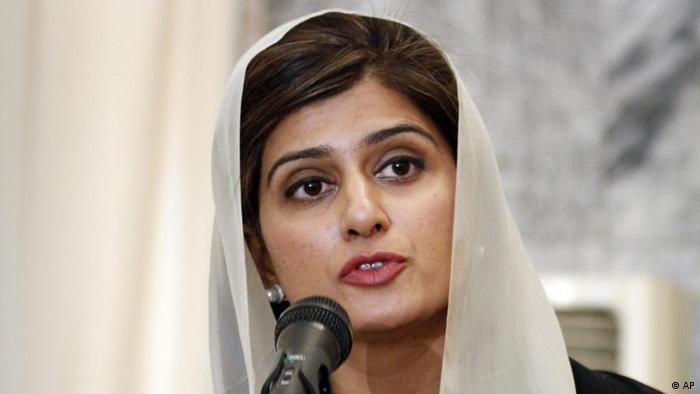
New HRC members will be elected on November 12 and Pakistan hopes it will get a seat at the council. Pakistan's Foreign Minister Hina Rabbani Khar
led the delegation to Geneva to defend Islamabad's human rights record and convince the member states to vote for her country.
"Today Pakistan is a functional democracy with an elected and sovereign parliament, an independent judiciary, a free media and a vibrant and robust civil society," Khar told the HRC.
She said that her government was working hard to improve human rights in Pakistan and defeat extremism.
Sharp criticism
Most HRC member countries, however, seemed unimpressed by Khar's defense.We have
serious concerns about the human rights situation in Pakistan," US ambassador to the HRC, Eileen Donahoe, told the council. She, in particular, mentioned the army operations "aimed at silencing dissent" in the Pakistani province of Baluchistan, which is facing a protracted separatist movement.
Donahoe said that Pakistan should "ensure that those guilty of torture, enforced disappearances and extrajudicial killings must be prosecuted" and that laws discriminating against religious minorities should be reformed.
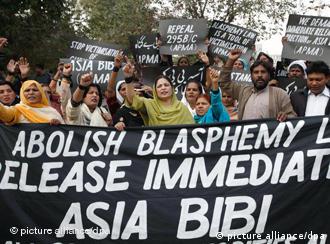
Pakistan's controversial blasphemy laws also came under criticism. The British delegate condemned the recent case of a young Christian girl, who had been accused by an Islamic cleric of burning pages of the Koran. The girl - who was released by a Pakistani court on bail - had spent several weeks in jail on blasphemy charges.
The US and British condemnation was echoed by Sweden, Switzerland and some other European countries, including Belarus. The Belarus delegate urged Islamabad to fight the trafficking of women and children, stop sexual exploitation and the cruel treatment of children.
'A weak defense'
Pakistani human rights activist Saleha Athar told DW that it was not easy to defend the dismal human rights situation in Pakistan. She said that Khar's defense of Pakistan's human rights situation was "weak."
"The human rights situation in Pakistan is very bad," Athar said. "Khar was trying to defend her government and not the human rights situation in Pakistan."Athar appreciated the fact that Pakistan had a democratic government but said that democracy was still controlled by the Pakistani army.
"True democracy guarantees better human rights but unfortunately, Pakistan is far away from it," Athar commented, adding that in recent years, the Pakistani parliament had passed a number of bills and laws to empower women and minorities but that they would remain meaningless until the government made sure they were properly implemented.
She said that the issue of "forced disappearances, extremism, and religious rights of minorities" needed government's immediate attention.
Karachi-based rights campaigner Zahid Farooq told DW that one should not expect human rights to improve in a country whose legislations were based on religion.
"Religious minorities are being targeted in Pakistan. The blasphemy laws are used to grab their lands, to steal their wealth and to kidnap their women," said Farooq, adding that Pakistan's founder Muhammad Ali Jinnah had a liberal vision for Pakistan but that the successive regimes turned the country into a theocratic state.
International obligations
Both Athar and Farooq, however, believed that Pakistan should be given the HRC membership.
"Pakistan's human rights record is not good but we hope that the HRC membership will make things better," Farooq said. The international obligations would obligate Islamabad to do more work to improve the rights situation, he added.
Athar was of the opinion that the HRC membership would allow the international community to monitor the human rights situation in Pakistan in a better way.
Pakistan security chief calls for formulating new counter-terrorism law
The chairman of the Parliamentary Committee on National Security (PCNS), Mian Raza Rabbani, has said that Pakistan requires a new counter-terrorism law in order overcome the threat of terrorism in the country.
Rabbani, during a PCNS meeting, said that a law to counter terrorism was being formulated in the country. He said the proposed law should also cover the fundamental rights of the people, reports The Dawn.
A British lawyer and an expert on anti-terrorism laws, Lord Alexander Charles Carlyle, also attended the meeting. During the meeting, Lord Carlyle briefed the committee on Britain's counter-terrorism laws.
"We will take into consideration the counter-terrorism laws enforced in different countries," Rabbani added.
New US envoy present credentials to Zardari
Ambassador designate of the United States of America, Richard Olson, called on President Asif Ali Zardari on Wednesday at the Governor House and presented his credential as ambassador to Pakistan.
Other Ambassadors (designate) of Hungary, Jordan, Belgium, Uzbekistan, Oman and the High Commissioner (designate) of Canada also called on President Zardari and presented their credential at a special ceremony held at the Governor House, Karachi.
According to officials, they called on separately on the president and discussed bilateral relations and matters of mutual interest.The president, while felicitating the newly-appointed ambassadors, expressed the hope that they will work for furthercementing the existing ties of their respective countries with Pakistan.
Those who called the President were Mr. Istvan SZABO, Ambassador designate of Hungry, Maj Gen (Retd) Nawaf Khalifeh Ibrahim Saraireh, Ambassador designate of Jordan, Mr. Peter L.J.F. CLAES, Ambassador designate of Belgium, Mr. Parvez Aliev, Ambassador designate of Uzbekistan, Mr. Greg Giokas, High Commissioner designate of Canada and Mr. Riyadh Ahmad Yousif Al-Raisi, Ambassador designate of Oman.
All the designated ambassadors and high commissioner were come with full protocol and at the Governor House. National anthems of Pakistan and their respective countries were played and the envoys were presented Guard of Honour by a smartly turned out contingent of Pakistan Army.
Sources said all the diplomats were arrived in city on Tuesday night in a special plane and it was the first big ceremony held at Governor House where the ambassadors and high commissioner were present their credential to the President of Pakistan.
The United States Ambassador were arrived in Pakistan on Saturday and he was waited the President Zardari in Islamabad to present his credential. The program was shifted to Karachi from Islamabad as the President Zardari arrived in city on Eid day and he is busy in official engagements in Sindh.
Meanwhile, the President Asif Ali Zardari expressed concern over the destruction caused by Hurricane Sandy. Expressing grief over the loss of lives and huge destruction caused to the property, the President expressed his sympathies with the affected people and has wished early rehabilitation of the affectees.
The President was expressed his concern in a meeting with Sherry Rehman, Pakistan’s Ambassador to United States, who called on him at Bilawal House.The President especially inquired about the well being of the Pakistani community present in the affected areas and advised the ambassador to provide all possible help to the affected people.
Balochistan: Aslam Raisani's PPP membership suspended
Pakistan TodayPakistan Peoples Party (PPP) has decided to suspend the primary membership of the Balochistan Chief Minister Aslam Khan Raisani for the next three months. Talking to Private Channel, PPP Kalat Division President Rafique Sajjad said that Raisani’s membership of the party has been suspended for deviating from party’s policies. “He (Raisani) is also damaging party’s reputation,” he said, adding earlier a notice was issued to the Balochistan chief minister but he did not mend his ways. Sajjad said that neither were the issues of the PPP workers were being addressed, nor was Raisani spending sufficient time in Quetta. He said that Raisani had been voted into power by PPP workers but the chief minister was not taking steps to solve their problems. Sajjad added that the PPP had weakened in Balochistan due to the actions and policies of Chief Minister Raisani. Sajjad said that Raisani’s membership has been suspended after taking into confidence PPP provincial chief Mir Sadiq Umrani.
Cultural show breaks silence of fear in Swat
The singers and artists enthralled the residents of militancy-hit Malakand division at a three-day cultural and music show, held here at Wadoodia Hall in Saidu Sharif.
The participants of the show said that after attempt on the life of Malala Yousufzai, organising such a successful cultural event was a great victory for those forces, who wanted to promote sanity and restore peace in the region.
The culture and music show was organised by Swasto Art and Culture Association with the cooperation of provincial cultural department. The show was aimed at breaking the silence of fear and fright in Swat and reposing people’s confidence in the government and security forces.
The show, started on Oct 28, continued till Oct 30. A large number of people from Swat, Shangla, Buner, Dir Upper and Lower and Malakand protected area participated in the show.
According to administration of Wadoodia Hall, around 1,000 people attended the show on the first day, over 15,000 on the second and 20,000 on the final day.
Bakhtiar Khattak was the host of the show while renowned Pashto singers Humayun Khan, Sitara Younas, Kiran Khan, Ayaz Khan, Ziauddin, Anwar Khial, Azra Iqbal, Nabeela, Omera and Fareeha performed at the show.
Comedians Rahmat Ali Ajiz, Mohammad Akbar Meno, Jehanzeb, Alamgir Swati and Yousuf Khan also amused the audience.
The participants of the music show appreciated the government’s efforts to create confidence in the people of Swat.
Osman Ali, a resident of Barikot, told Dawn that he enjoyed such an attractive show after three years. He applauded the singers, who enthralled the participants with their melodious voices.
The opening and final days of the show were attended by Swat DCO Kamran Khan, DOR Niaz Ahmed and MPA Sher Shah Khan, who is also district president of the ruling Awami National Party.
They said that the show would convey a message of peace to the world. It would prompt people to visit the picturesque area and enjoy its scenic valleys, they added.
They said that such events would be arranged in future to show the world that Pakhtun culture always promoted peace and not vulgarity. They regretted that some religious and militant groups considered culture as a vulgar and un-Islamic act.
Swasto Art and Culture Association head Usman Olasyar told Dawn that they proved that there was no space for vulgarity in Pakthun culture and music.
He said that the show was aimed at providing recreational opportunity to the people of Swat and highlighting the positive aspects of Pakhtun culture. He said that it was responsibility of every Pakhtun to work for promotion of culture.
Extraordinary security arrangements were made on the occasion. Swat DPO Gul Afzal Khan Afridi told Dawn that apart from security forces 6,000 policemen were deployed at different spots of Swat after the government declared Swat and Shangala as sensitive areas during Eidul Azha. He said that leaves of all police personnel were cancelled during Eid to make elaborate security arrangements.
He said that all entry and exit points of Swat were sealed and mobile teams were set up to keep vigil on the movement of suspected persons. He said that no untoward incident occurred during Eid owing to better security arrangements.
Apart from the music and culture show, a large number of visitors thronged the scenic spots of Swat valley including Kalam, Bahrain, Madyan, Malam Jabba, Marghuzar and Fizagut. The tourists enjoyed the relatively chilly weather of Swat and snow-covered Kalam valley.
DNA test lab goes functional in Peshawar
A DNA test laboratory has been set up in Khyber Teaching Hospital of Peshawar while other facilities have also been increased in the medical facility, Geo News reported on Wednesday.
Dr Umar Ayub, Chief Executive Doctor at the Khyber Teaching Hospital told Geo News that there had been a record improvement in the medical facilities for the patients.
He said although the provincial government had provided machinery worth millions of rupees, big hospitals were needed in the wake of increasing number of patients.
Islamabad : Girls college falls prey to ‘political point scoring’
The Islamabad Model College for Girls I-8/3 has been functioning without budget allocations, teaching and non-teaching staff and infrastructure since its inception. Insufficient and borrowed teaching and non-teaching staff has been running the college affairs.
The then Federal Minister for Education Mir Hazar Khan Bijarani had inaugurated the college in August 2009 and, according to officials, it was indeed political point scoring and individual boost up and material self-benefits on the part of certain individuals who arranged inauguration of a girls degree college in hurry in the federal capital without even considering the provision of basic amenities.
In spite of even mounting pressure from parents, the principal was compelled to drop the science subjects and launch intermediate and degree classes in humanities group only. “This is indeed mockery of education that only those subjects which have least fascination and little use in the job market are being taught,” remarked an official.
A teacher who has been teaching in the college temporarily, while recalling the days when the classes were started, said, “the principal, Metlo Hamida Qais, used to run among different offices of the then Ministry of Education and the Federal Directorate of Education (FDE) and even had been begging to meet the basic needs of the students. It makes big question mark on the face of performance of these bureaucratic offices and those political high ups.”
Another teacher of the college telling about their problems said that until now, there is not even a single regular teacher in the college. The principal borrows teaching and non-teaching staff from other sister institutions under the FDE on request that is insufficient to meet the requirements of such a degree college.
“Due to having no regular teachers to teach different classes, the academic work is suffering badly. It is also resulting mounting anxiety among both the parents as well as students and the principal does not find any way out to address the situation effectively,” he maintained.
This is no less than a joke that a degree college has no head of accounts and no budget allocations from the government to meet miscellaneous expenditure. The utility bills of the college are paid from the little amount collected from the students’ fee.
The Pak-Korea Trust had donated 20 computers to the college when the Principal approached the Trust in 2010 but the computers can be seen lying as a dead heap for lack of computer tables and chairs for the students to use them in a proper computer laboratory. Besides the absence of any infrastructure, the college does not have any auditorium to arrange any extra-curricular activities so the students have also been deprived of such activities, which play very important role in personality building of the young learners.
Reportedly, the college was allotted an area of 6 acres and payment was made to the Capital Development Authority (CDA). However, it was fine jugglery of CDA that only 4 acres land was handed over to the college for construction of the campus. Rest of the two acres has been reportedly allotted to three CDA members. When the CDA was contacted by the college principal in this regard, it responded with the measurement of area, acknowledged the fact regarding handing over only four acres to the college.
CDA authorities clearly stated verbally, if FDE takes up the issue officially with the Authority, they would compensate by adding almost 1.5 acres land adjacent to the college campus and will return the paid amount for the acres less than 0.5 acre. This is indeed indifference on the part of the FDE (Planning & Development section) that up till now, no proceeding has been witnessed in this regard.
Spokesman for the Federal Government College Teachers Association, Prof. Tahir Mahmood said, “the present picture of the college, after three years, has raised a big question mark on the will power, intention and interest of the political leadership and bureaucratic machinery. It has proved that the inaugurators were interested only in political scoring and personal projection for material gains. The political and bureaucratic point scorers have escaped and the college administration is left to face the criticism of the parents and students’.
FDE Spokesperson Waqar Ashraf could not be contacted despite repeated attempts made by this scribe to have his point of view on the subject.
Pakistan: Elections to be held by May 10
Information Minister Qamar Zaman Kaira on Wednesday said the interim governmental set up would take over around March 18, 2013 following the completion of the five-year term of the government, while general elections would be held 40 days after the caretaker set up took over.
Talking to reporters after a meeting of the federal cabinet, Kaira said there was a baseless propaganda making rounds about delay in election.
“There is a free media and independent judiciary which will never allow this (delay). Moreover, the government and parliament duly get the credit for completion of terms of the assemblies and a democratic transition of power will take place and by delaying the elections, all credit will become a discredit,” he said.
The minister said the government would investigate the role of people like Hameed Gul in line with the Supreme Court’s order in the Asghar Khan case.
“This order has proved that the government installed after the 1990 election was illegitimate and its decisions need validation. A serious debate is on over the legitimacy of the then government and the issue should be resolved.”
The information minister claimed that history had revealed that mandates of the Pakistan People’s Party (PPP) had been stolen. “At times direct martial laws were imposed and indirect martial laws were imposed at other times through alliances like Islami Jamhoori Ittehad (IJI).”
He said that several past presidents, like Rafique Tarar, worked against the PPP. “Tarrar should be asked about the service for which he was awarded the office of the president. What was the reason behind issuance of licence to launch a new bank to Younus Habib in 1992,” he argued.
Referring to the release of tapes involving Justice Quyyum and Nawaz Sharif’s crony Saifur Rehman, Kaira said it was strange that the judge had to resign but the then chief minister, who happened to be the present chief minister of Punjab, did not face any punishment.
He said the PML-N government was illegal in the past and even the Punjab government had no majority in the provincial assembly and was being saved by crutches of turncoats from the PML-Q.
Kaira said that after the 1990 elections, Benazir Bhutto had issued a white paper about an alleged election fraud and rigging in 100 constituencies which was part of history.
To a question, Kaira said when the PPP-led government came to power in 2008, the economy was in tatters and there was recession in international markets, Pakistan had over 250,000 IDPs from Swat and Malakand.
“Moreover, the country was hit by devastating floods in 2010 and 2011 and in such a situation bringing the inflation down was no meagre achievement,” he said.
Kaira said the Presidency was a political office and was part of parliament. He said the president should be impartial, but there was no bar on his meetings with political leaders.
To a query on the much demanded army operation in North Waziristan, he said the government had already clarified that no such operation would be conducted. He said that if any decision was made by the political and military leadership, it would be shared with the media and the nation.
To a question about increase in public sector debt, he said in presence of Fiscal Responsibility Act, the government could not exceed the limit.
Commenting on the CNG sector, he said filling station owners had their own viewpoint which would be presented to the Supreme Court.
Cabinet decisions:
Giving details of the cabinet meeting chaired by Prime Minister Raja Pervez Ashraf, Kaira said the finance secretary informed the cabinet that the overall price situation had stabilised and the inflation in prices had been capped to single digit at 8.8 percent, compared to 25 percent in October 2008.
Following the policy of self dependence, the government had collected Rs 350 billion in taxes in the current year. The overall revenue collection had doubled from Rs 1 trillion to Rs 2 trillion in the last four-and-a-half years.
The government had raised salaries by 115 percent during its tenure, while the overall expenditure of the federal government had increased by only six percent, adding that the country did not default on payment of loans, both internal and external.
Kaira said the tax to GDP ratio had increased by 0.5 percent.
The cabinet was told that the subsidy on power sector was affecting the financial prudence of the federal government.
While the overall expenditure of the federal government was Rs 220 billion per annum, subsidy on power sector alone had reached the Rs 30 billion per month.
Kaira said the cabinet reviewed status of implementation of decisions pertaining to the Finance Division. The cabinet was informed that 93 percent of the decisions made by the cabinet from 2008-2012 had been implemented, while the rest were at various stages of implementation.
The cabinet was also informed that as a result of NFC Award, the provinces had been given 70 percent funds of the divisible pool, thus restraining the federal government to meet subsidies. “The country is generating power at the cost of Rs 12 per unit but providing the same to consumers at Rs 9 per unit. If the country imports gas from outside it will cost $18 per thousand cubic feet, while the same amount is being provided in the country for $6 only.”
The information minister said the prime minister apprised members of the cabinet about his recent visit to Saudi Arabia to perform Haj on the invitation of Khadum al Harman Sharifan.
The PM said that during his stay in Saudi Arabia, he met Saudi King Abdullah bin Abdul Aziz and Crown Prince Salman bin Abdul Aziz.
During his meeting with the Saudi crown prince, the PM extended an invitation to him to visit Pakistan, which he graciously accepted.
“The son of the crown prince will soon visit Pakistan.
Kaira said the cabinet expressed solidarity with the Sandy storm-hit Americans, adding that several Pakistanis had also been affected by Sandy. The federal cabinet also ratified the visa agreement with India and approval was been given for three business and one cultural visa agreements.
An approval was also given for an MoU with the United States concerning financial intelligence cooperation.
North Waziristan: Seven days on, power supply cut to three sub-divisions
There has been a blackout in three sub-divisions of North Waziristan Agency, Razmak, Mir Ali and Miranshah, for the past seven days. Due to the power cuts, the areas are now suffering from a severe water shortage.
The electricity cuts persist due to tribal disputes between the Mamad Khel, Sari Khel and Pathack Khel tribes.
The Mamad Khel tribe from Frontier Region (FR) Bannu started taking electricity illegally from electricity transmission lines in North Waziristan, disrupting power supply in order to pressurise the government. A jirga was conducted in June by Mamad Khel and Sari Khel, where the Mamad Khel tribe said that Baka Khel and Pathack Khel have been illegally using their electricity for 14 months and now they are without power.
Two weeks prior to that, Mamad Khel and Sari Khel had set up illegal connections on the main supply line of North Waziristan, cutting off the other tribes’ electricity for three days. Twelve tribesmen were arrested for the power cuts, but were released soon after.
Participants from the Mamad tribe claimed that their men have nothing to do with the power cuts and were wrongfully accused, once again alleging that Baka and Pathack were involved. They also threatened to ban the entry of polio teams in their area if their men were not released and the illegal power supply is not disconnected from their feeder.
The Mamad Khel tribe once again cut off electric supply to three sub-divisions of North Waziristan Agency, Razmak, Mir Ali and Miranshah a day before Eidul Azha and since then they have been without electricity.
“We sit in dark rooms at night and people are facing a dire shortage of water at their homes, hospitals, schools and mosques,” a resident of North Waziristan, Malik Gul Sajan told The Express Tribune, adding that soon their water supply will finish if the government does not take action.
A resident of Mir Ali, Liaqat Khan, said that they have to bring water from other areas. One barrel of water costs Rs500, which carries approximately 10 gallons of water, he said. “We do not have water at our homes as there is no electricity to run the motor to draw water from wells,” he added.
When an elder of Mamad Khel, Malik Badshah Noor, was asked why they cut the power supply, he said: “If Pathack Khel does not take out their illegal connection and let our share of electricity pass, we will not allow electricity for other areas to pass from our soil.”
When the political administration of North Waziristan and FR Bannu were contacted regarding the issue, they said that a jirga is already working to resolve the matter.
Peshawar: Repair of Kaka Sahib shrine
Frontir PostKhyber Pakhtunkhwa Minister for Information & Public Relations, Mian Iftikhar Hussain has directed the DCO Nowshera to prepare the estimate for repair and renovation of mausoleum of Kaka Sahib (RA) so as to start practical work on it at the earliest. He issued these directives while inspecting the site of bomb blast at the mazar of Kaka Sahib Nowshera on Wednesday. DCO and DPO Nowshera were also present on this occasion. Strongly condemning the terrorist act in the mazar, the minister said that those targeting misques, spiritual places, funerals and bazaars were not deserved to be called Muslims, even a human being rather they were the beast. He added that the terrorists have not for the first time targeted the mausoleum of Kaka Sahib but they also targeted the tombs of spiritual personalities like Abdur Rahman Baba (RA), Pir Baba (RA), Akhoon Panjo Baba (RA), Hamza Baba (RA), Mian Umar Baba (RA) and Ajmal Khattak Baba. Mian Iftikhar Hussain continued that real faces of the terrorists were unveiled by such brutal acts that were and why the whole nation has been stood up against the terrorists. He added, the terrorists are terrorists and they have nothing to do with religion, belief, caste or language but they were the anti-state elements who want to destabilize the country. Such brutal acts in the spiritual and religious places and bazaars have deeply shocked the feelings of the whole nation, and today the terrorists were isolated in the society and every one hate them, he concluded.
SC to take notice of Hamid Gul's Role in IJI
Radio Pakistan
Minister for Information and Broadcasting Qamar Zaman Kaira has said the Supreme Court should take notice of the statement made by General Hamid Gul about his role in the establishment of Islami Jamhoori Ittehad. Talking to the media persons in Islamabad today‚ he said the IJI was formed to stop Pakistan People's Party from coming into power. He said massive rigging was done in the 1990 elections to block the way of PPP.
Wednesday, October 31, 2012
Video: Obama in New Jersey: "We Are Here for You"
Speaking in Brigantine, New Jersey Wednesday President Barack Obama told those recovering from superstorm Sandy: "We are here for you, and we will not forget."
Obama tours shattered New Jersey and promises help for Sandy victims
President flies over Jersey shore with governor Chris Christie as Mitt Romney attempts difficult political balancing act in FloridaIt is the image that could end up being seen as the defining moment of the the 2012 White House race. Television cameras showed Barack Obama, aboard the presidential helicopter Marine One, flying over the Jersey shore, seeing at first hand the devastation left by superstorm Sandy. Over a thousand miles away, his Republican challenger, Mitt Romney, was back on the campaign trail in Florida, trying to balance his desire to make up for time lost while trying to avoid accusations of a premature return. The television networks picked up on the contrast, splitting their screens to show one in presidential mode, seemingly above politics, and the other back on the stump, making partisan points in a time of crisis. The news channels stayed with Obama almost throughout the day as he witnessed the destruction and talked with officials and victims, offering sympathy and promising help. On his flight over New Jersey, Obama saw a string of towns along the coast, the worst hit of which is Seaside Heights. From the air, he could see houses flattened, roads covered in sand or water, a carnival and large pier that looked as if large bites had been taken out of them, and the boardwalk gone except for lonely posts here and there, according to a White House pooled report.It is not just the emotion that is helping Obama. He is being given a boost by an unexpected source, the popular governor of New Jersey, Chris Christie, who joined him in Atlantic City for the helicopter tour. Christie is not only a Republican but one of Romney's highest-profile backers. Republicans are still trying to work out how to respond to Christie lavishly praising Obama, less than a week before the election. Christie, resisting calls from some Republicans to get in a dig at Obama during the visit, went out his way instead to thank him again. "It's really important to have the president of the United States here," Christie said when the two stopped at the Brigantine Beach community centre, where 50 people are sheltering. Obama returned the compliment, telling the people in the shelter: "I want to let you know that your governor is working overtime" to repair damages in the state. Although Obama tried to avoid saying anything political, he seemed to be making the case for federal intervention, in particular the federal emergency management agency, which has been overseeing the rescue and recovery operation. Romney last year proposed cutting back Fema. "The country comes to help because you never know when someone is going to get hit by a disaster," Obama said. With the storm still raw, few politicians or commentators are prepared yet to discuss publicly the impact of Sandy on the White House race. But in private, some, even Republicans, will admit that Obama is the fortunate beneficiary of this act of nature. Roger Simon, a columnist on Politico, is one of the few to go public, writing that: "Hurricane Sandy has given Barack Obama a lift beneath his wings." He said that the disaster and his "shrewd calculation" to stop campaigning in order to supervise the relief effort has provide him with the one thing he had needed for weeks: the opportunity to look presidential. This week had supposed to be Romney's big push, building on the momentum that started with his surprise debate victory over Obama in Denver on October 3. Instead, he has been largely sidelined by Sandy. Having seen his campaign schedule wrecked on Sunday and Monday, and having been forced to suspend it on Tuesday, even Romney return failed to excite the media. He was only a few sentences into a speech in Florida when one of the television networks subjected him to the indignity of cutting him off mid-sentence. Obama's team knows that Obama is benefiting from the attention but are careful to avoid acknowledging it. The White House spokesman, Jay Carney, was asked by a reporter on a flight to New Jersey if Obama was sending a political message by visiting the state. Carney vigorously denied it. "This is a time to focus on what was a devastating storm and the terrible aftermath of that storm.," Carney said. "New Jersey was by many measures the hardest-hit state. I believe that's correct. It is entirely appropriate for the president to visit New Jersey and receive updates on the efforts there to recover and to view first-hand the damage inflicted by Sandy. This is not a time for politics." The mayor of New York, Michael Bloomberg, had not invited Obama to the city, but Carney insisted that was because the two had agreed that a visit to lower Manhattan would have tied up resources needed for helping to restore transport links and power. Before leaving for New Jersey, Obama phoned doctors and nurses in New York to thank them for their bravery during the storm and helping to evacuate 200 patients. Against that backdrop, it was an awkward balancing act for Romney on his return to the campaign trail. He had to avoid being too aggressively partisan in time of crisis. But he could not completely hold back, saying that unlike Obama, he does not "just talk about change — I actually have a plan to execute change and make it happen." Screens on either side of Romney urged donations to the Red Cross. He also asked people if they had a spare dollar, to send it in. "We love all of our fellow citizens, we come together in times like this and we want to make sure they have a speedy recovery," Romney said. But he could not resist making a political point too. "People coming together is also what I believe will happen on November 7," he said, suggesting that the public would rally round behind him after he wins the November 6 election. One fact that the Romney campaign can hang on to is that the storm has so far not had a major impact on the swing states. Both New York and New Jersey are solidly Democratic, at least in White House races, and while there is sympathy for the victims, New York in particular is viewed in the midwest as Gomorrah. It is the second time in months that weather has disrupted Romney's campaign. A hurricane forced him to abandon the opening day of the Republican convention in Tampa, meant to introduce him to the American people and showcase his policies. The convention never quite recovered from the disruption. In spite of the lost days, his campaign team expressed confidence that Romney will win on Tuesday, pointing to polls showing him with leads in key states. Obama's chief campaign adviser, David Axelrod, in a phone-conference with reporters, described the Republicans as delusional and suggested the polls they were quoting were unreliable. He said he was hesitant to talk about the election in terms of the impact of the storm given that 50 people had died and millions of dollars worth of damage. Having said that, he admitted: "The only impact I would suggest is that it tended to freeze the race because people are focused on the storm." Obama will return to the campaign trail Thursday, making up for lost time with a race across three states: Wisconsin, Nevada and Colorado. Polls show the race remains tight. The Obama campaign claims it is tied or ahead in all eight swing states and is building a strong firewall, having a large advantage among those voting early. The Republicans say that their supporters traditionally turn out in larger numbers on election day and this will eliminate the Democratic early voting advantage.
Obama gets first-hand look at storm devastation
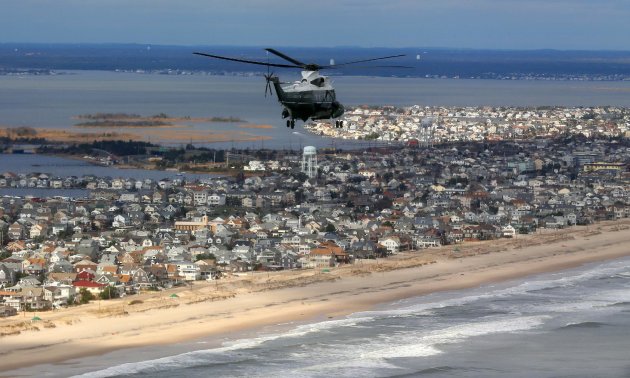
President Barack Obama inspected the devastation from Sandy on Wednesday, flying high over flooded neighborhoods, sand-strewn streets and a burning fire that charred homes along the New Jersey coastline.
With Election Day less than a week away, Obama's visit to view the aftermath of the rare autumn storm was layered with political implications. The president's tour guide was New Jersey Gov. Chris Christie, a Republican and top supporter of GOP presidential nominee Mitt Romney who joined Obama on a Marine One helicopter ride over the region.
To the chagrin of some Republicans, Christie has lavished praise on Obama for his efforts in helping states deal with the storm.
Even though politics infuse every moment in the final week before Election Day, the White House sought to focus attention on the storm, an event that has given Obama an opportunity to project presidential leadership in the final days of the tightly contested White House race.
White House spokesman Jay Carney said there were no political motivations behind Obama's decision to join his supporter's rival Wednesday.
"This is not a time for politics," Carney said. "The president appreciates the efforts of governors, state and local officials across the various states that were affected by the storm, regardless of political party."
During the helicopter tour, Obama and Christie saw a carnival and a large pier that had been damaged, along with flattened houses and fragments of wood scattered throughout neighborhoods. Parts of the New Jersey shore's famed boardwalk was missing in sections and in one area, a fire was still burning and appeared to have taken out about eight homes.
Obama, Christie tour storm damage
http://www.usatoday.comPresident Obama and New Jersey Gov. Chris Christie -- the newest political odd couple -- began a tour Wednesday of the devastation wrought by Hurricane Sandy along the Jersey shore. The Democratic president and Republican governor -- a major supporter of White House challenger Mitt Romney -- took an aerial tour that included sights of charred houses, sand-packed and water-logged streets, and busted bridges and boardwalks. At least one Jersey resident showed some puckish political humor; on the sand at Point Pleasant Beach, someone wrote a name in large letters: ROMNEY. While an outspoken critic of Obama's policies in general, Christie has praised the president's leadership in the aftermath of the hurricane that swept through the northeast United States on Monday and Tuesday. Christie, wearing a blue polar fleece, slacks, and white sneakers, greeted Obama at airport in Atlantic City. The president is wearing khaki pants, a blue windbreaker, and brown hiking boots. The two men and Craig Fugate, administrator for the Federal Emergency Management Agency, boarded a Marine One helicopter for their tour. Obama and Chris Christie also planned to speak with local officials about rescue and recovery efforts. While the Atlantic City boardwalk appears to be intact, observers saw mountains of sand covering city streets up and down the Jersey coast. Pools and pools of standing water also dotted the landscape. In Beach Haven, on Long Beach Island, entire streets are underwater, and buildings are pock-marked by boarded-up or broken windows. Some of the worst damage occurred at Seaside Heights, where roads are covered by either water or sand. Both the boardwalk and a nearby carnival got smashed by Hurricane Sandy, leaving wood fragments everywhere. A fire that burned down at least eight house still smolders. Other homes lost their decks to the storm's fury. Abandoned cars remain on a bridge knocked down at one end. Earlier in the day, Obama visited FEMA headquarters in Washington, D.C., for another briefing on recovery plans. The president also called the New York University-Langone Medical Center to thank doctors and nurses for evacuating more than 200 patients as the storm approached, said White House spokesman Jay Carney. One topic Carney would not address: What impact, if any, will the storm have on Obama's fortunes on Election Day next Tuesday. Carney said the president is dealing with governors, mayors, and other local officials "regardless" of political party. "This is a time to focus on what was a devastating storm and the terrible aftermath of that storm," Carney said. "This is not a time for politics." The next town to the north, Point Pleasant Beach, again has sand and water everywhere. It is about four blocks inland before you can see concrete on the roads. Someone has written "ROMNEY" in large letters in the sand at the north end of Point Pleasant Beach. We pass over a harbor. The boats seem to be in okay shape. Flying back south on the bay side of Long Beach Island. The water level is high, lapping at the bottom of homes. On the mainland bay shore again there are homes and parts of homes turned into wood piles. The island's bay shore seems to be in better shape. There's a two-span bridge to Long Beach Island that looks to be in tact, though on the island side there looked to be mud on the road. Heading south, more water on mainland roadways near the bay. Entire sections of several hundred yards each of the north-south road closest to the bay are underwater but there are vehicles traversing it. Perhaps it was tough to catch from the helo, but pool did not see very many trees down. Not many leaves left on the trees either. The last 10 minutes of the ride were relatively uneventful. Pool passed over mainland towns, a trailer park which seemed to have survived unscathed and a golf course with the appropriate amount of sand on it. There are entire subdivisions that look like no storm hit. Nighthawk Two landed back at the Atlantic City airport at 2:24 p.m. Marine One followed seconds later.
Christie, Obama form pre-election bond in Sandy’s wake
New Jersey Governor Chris Christie, a staunch Romney supporter, heaped praise on President Barack Obama’s quick response to Sandy in the aftermath of the massive storm that devastated the state’s shoreline. Reuters correspondent John Whitesides says Christie’s comments, while sincere, may also enhance his own standing as a leader in crisis. GOP challenger Mitt Romney held a Sandy relief event at an Ohio arena as he prepared to resume campaigning in key swing states on Wednesday.
Obama goes to FEMA before visit to storm-racked NJ
http://www.fox11online.comPresident Obama is paying a visit to Federal Emergency Management Agency headquarters ahead of his trip to New Jersey to see the damage done by superstorm Sandy. Obama took a motorcade to FEMA's offices to meet with agency chiefs before a planned flight to Atlantic City, N.J., to meet with Sandy's victims and relief workers. Days before the election, the president has kept up a steady public presence overseeing the storm response, while canceling a series of public campaign rallies. It was Obama's second visit in four days. On Sunday, he met with FEMA officials, then told reporters the government will "respond big and respond fast" after the massive storm made landfall.
President Zardari expresses concern over Hurricane Sandy' destruction in US
President Asif Ali Zardari has expressed concern over the destruction caused by Hurricane Sandy. He was talking to Pakistan's Ambassador to United States‚ Sherry Rehman in Karachi on Wednesday. Expressing grief over the loss of lives and huge destruction caused to the property‚ the president expressed his sympathies with the affected people and has wished early rehabilitation of the affectees. The President especially inquired about the well being of the Pakistani community present in the affected areas and advised the ambassador to provide all possible help to the affected people.
Malala status updates-Wednesday 31 October 2012
The medical team caring for Malala Yousufzai at the Queen Elizabeth Hospital Birmingham reported today that she is still stable and making good progress with her treatment. Only the medical team from the Queen Elizabeth and Birmingham Children’s hospitals and Malala’s immediate family have been given access to her bedside.
Obama to tour storm-hit New Jersey on Wednesday
http://news.yahoo.comBarely one month ago, outspoken New Jersey Gov. Chris Christie was telling President Barack Obama to "get on a plane and go back to Chicago where you belong." But the Republican will play host to his target on Wednesday, as Obama tours areas of the Garden State pummeled by superstorm Sandy. "Tomorrow afternoon, the President will travel to New Jersey where he will join Governor Christie in viewing the storm damage, talking with citizens who are recovering from the storm and thanking first responders who put their lives at risk to protect their communities," the White House announced. Obama has scrapped three days of campaign travel in favor of staying in Washington to oversee the federal government's response to the deadly storm. He's been seen in the Situation Room talking to top advisers, at the Red Cross urging donations and in the White House briefing room delivering a televised warning to Americans to listen to official evacuation orders. Aides don't mind the campaign break too much: Images of the president doing his job aren't exactly bad for his re-election prospects. (Look for the president to resume campaigning on Thursday.) And Christie? "The president has been all over this, and he deserves great credit," Christie told MSNBC on Tuesday. "He gave me his number at the White House and told me to call him if I needed anything, and he absolutely means it." "It's been very good working with the president and his administration. It's been wonderful," he added, saying he had three conversations with Obama on Monday. "He asked me what I needed. I said if he could expedite the Major Disaster Declaration without all the normal FEMA mumbo-jumbo. He got right on it," Christie continued. On Fox News, Christie said Obama had helped "tremendously" by declaring the state a major disaster area, freeing up federal aid. "He's been very attentive, and anything that I've asked for, he's gotten to me. So I thank the president publicly for that. He's done—as far as I'm concerned—a great job for New Jersey." What about Mitt Romney? Will the Republican presidential nominee be touring disaster-hit areas, Fox asked. "I have no idea, nor am I the least bit concerned or interested," Christie replied, immediately shutting down the idea. "I've got a job to do here in New Jersey that's much bigger than presidential politics and I could care less about any of that stuff." "I have a job to do," he stressed. "I've got 2.4 million people out of power, I've got devastation on the shore, I've got floods in the northern part of my state. If you think right now I give a damn about presidential politics then you don't know me."
Obama visits storm victims while Romney campaigns
Associated PressPresident Barack Obama, locked in a fierce re-election bid, is emphasizing his incumbent's role for a third straight day, skipping battleground states to visit victims of Hurricane Sandy in New Jersey, a state he's confident of winning. The president's actions have forced his Republican challenger, Mitt Romney, to walk a careful line and make tough choices. The former Massachusetts governor must show respect for the superstorm's casualties all along the Eastern Seaboard. But Romney can ill afford to waste a minute of campaign time, with the contest virtually deadlocked in several key states and the election six days away. After tamping down his partisan tone Tuesday at an Ohio event that chiefly emphasized victims' relief, Romney planned three full-blown campaign events Wednesday in Florida, the largest competitive state. Sandy largely spared Florida, so Romney calculates he can campaign there without appearing callous. Obama's revised schedule is a political gamble, too. Rather than use the campaign's final Wednesday to woo voters in tossup states, he will go before cameras with New Jersey's Republican governor, Chris Christie. Christie is one of Romney's most prominent supporters, and a frequent Obama critic. But Christie praised Obama's handling of superstorm Sandy, a political twist the president's visit is sure to underscore. Obama also took full advantage of incumbency Tuesday. He visited the Red Cross national headquarters — a short walk from the White House — to commiserate with victims and encourage aid workers. "This is a tough time for millions of people," the president said. "But America is tougher." While Obama and Romney moved cautiously Tuesday, their campaigns exchanged sharp words in Ohio and expanded their operations into three Democratic-leaning states, a move that will reshape the contest's final six days. Romney's campaign is running ads in Minnesota and Pennsylvania, and a pro-Romney group is doing the same in Michigan. The three states were considered fairly safe for Obama, but his campaign is taking the threat seriously. It sent former President Bill Clinton to Minnesota on Tuesday and it is buying airtime in all three states. Republican strategists differ on the Romney campaign's thinking. Some think Romney's aides fear losing all-important Ohio, and they hope for a stunning last-minute breakthrough elsewhere to compensate. Others say the GOP camp has so much money — and so few chances to buy useful airtime in saturated states — that it can spend millions of dollars on a long shot without scrimping in a battleground. "If they didn't have so much money, they wouldn't be able to do something with so little chance of success," said Democratic strategist Tad Devine. Some Republicans played down the significance of the expand-the-map strategy. "This always happens this time of year" in a big campaign, said Republican consultant Mike McKenna of Richmond, Va. "They see a poll or two" that suggests a sudden tightening of the race in a place like Minnesota "and they get all excited." "They tend to chase shiny objects," McKenna said. Ohio, he said, remains by far the most important state for Romney to win. Another sign that Ohio looms large for the Romney campaign: a guest-filled rally in suburban Cincinnati on Friday to kick off the campaign's final four days. Set to join the GOP ticket are golf legend Jack Nicklaus, former Secretary of State Condoleezza Rice, Texas Gov. Rick Perry and former New York City Mayor Rudy Giuliani. Meanwhile, Democratic groups bitterly complained about a TV ad the Romney camp is running in the Toledo and Youngstown areas of Ohio. The ad suggests that Jeep will move its Toledo car-making facility to China, a claim Jeep executives deny. Democrats called the ad a brazen lie and a sign of desperation. Even some Republicans worried that Romney has gone too far in a state where voters follow the auto industry closely. "It's the kind of thing that happens late in the campaign, when everybody's tired and you're not quite yourself," McKenna said. "It didn't help. But I don't think it's a big thing. At this point, everybody has made up their mind." Vice President Joe Biden planned to campaign Wednesday in Florida. Romney's running mate, Rep. Paul Ryan, was scheduled to campaign in his home state, Wisconsin.
Subscribe to:
Posts (Atom)