Thursday, October 3, 2019
Waheed Murad honoured by Google’s Doodle on his birthday
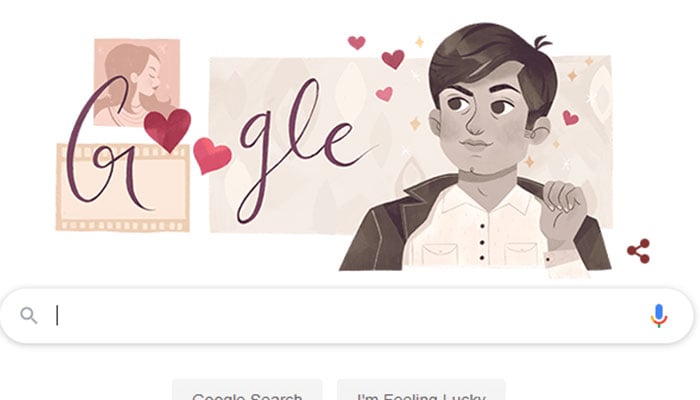
Google's Doodle honoured Pakistan’s chocolate hero Waheed Murad on his 81’st birthday. Murad was the finest romantic hero who brought grace and style to Pakistani cinema.
If you hover the cursor on the Doodle, you will see ‘Waheed Murad’s 81st birthday’ written in the popup text.
Pakistani cinema is indebted to the great film actor, producer and script writer who charmed the cinema-goers with his expressions, attractive personality, tender voice and unusual acting talent.
Much before Rajesh Khanna ruled Bollywood as romantic hero, Murad had kept the film-viewers mesmerized with his magical aura. As such, he is considered one of the most famous and influential actors of South Asia. The world gave him loving title of ‘Chocolate Hero’.
Born in Karachi, Sindh, he started his filmy career when he was 21 years old. He landed in his first role as cameo in 1959 in the film Saathi.
He started working as a producer at his father's established 'Film Art' in 1961. As producer, his first film was Insaan badalta hai in 1961. His naughty facial expressions and gestures, bold romanticism and alluring performance style during picturization of songs made him immensely popular.
One of his films is Armaan, which was produced by him, made a pivotal impact on the sub-continental film industry such that the Pakistani film industry was considered as the rising star and the film made him a superstar overnight.
He won many awards for recognition of his services to the film industry while in November 2010, after a long period of 27 years after his death, the Pakistani government awarded him with Sitara-e-Imtiaz, the third highest honor and civilian award by the State of Pakistan, given in the fields of literature, arts, sports, medicine, or science.
Murad produced eleven films under his father’s established ‘Film Art’. He was the youngest film producer in the industry at that time. Most of his produced films were either Golden Jubilee or Silver Jubilee.
During the 1960s and early 1970s, he produced films like Insaan badalta hai (1961) (his first film as producer), Armaan (1966), Ehsaan (1967), Naseeb apna apna (1970) and Mastana mahi (Punjabi film of 1971). However, after Mastana Mahi he produced no film except Hero which was produced in the 1980s and was released after his death.
Murad’s acting style has the legacy of being taught in Indian and Pakistani film institutions. He is considered as one of the pioneering Rock n’ Roll stars of Pakistan. His fans term him as the cultural icon of the Pakistani Film Industry.
https://www.thenews.com.pk/latest/534872-waheed-murad-honoured-by-googles-doodle-on-his-birthday
7 ways Imran Khan’s fans tried to show Pakistanis his US visit was a success

NAILA INAYAT
From Indian Muslims to Rani Mukerji to a US senator, PTI supporters declared everyone was in awe of their leader Imran Khan.
Everything has changed for Pakistan’s ‘Selected’ Prime Minister Imran Khan after the recent visit to the United States.
Since Imran Khan was sworn in to power in August 2018, he has been mocked as a ‘Selected’ prime minister and not an elected one. The word selected has irked Khan and his ministers so much that the deputy chairman even banned its usage in the national assembly.
But during his recent visit to the US, ‘Senator Tony Booker’ came out in support of Khan, saying, “If he is selected then it might be the best selection ever, and if he is elected then Pakistanis are the most wise nation in the world.”
Khan wins Booker
If India’s Prime Minister Narendra Modi was taking a lap with US President Donald Trump in Houston, Pakistan had Tony Booker, who just settled the year-long debate on “selected” once and for all.
#manofpeace #manofjustice #manofwisdom . @ImranKhanPTI . I say sir You are selected by the ALMIGHTY to lead Pakistan in the future .May the blessings of ALMIGHTY shine upon this nation . And may ALLAH guide us all .Pakistan hamesha Zindabad.


3,047 people are talking about this
But, wait. There’s just a small glitch. Tony Booker, the US Senator, doesn’t really exist. He exists in the tweets of Pakistan Tehrik-e-Insaf (PTI) fans, not in the real world. There is one Cory Booker, US senator from New Jersey, but he hasn’t had the opportunity to weigh in on Pakistan prime minister’s status of being selected yet. Very cleverly, when people pointed out that Tony Booker wasn’t real, some of the PTI trolls started spinning the statement in Cory Booker’s name.
When Khan advises the entire world to “just Google”, it might be a good start if he could teach that to his supporters at home first. For now, Tony Booker, a fictitious senator, lives only in memes.
But the marketing of Imran Khan’s US visit is endless. When he returned, hundreds of supporters and his top cabinet colleagues landed at the Islamabad International Airport with flags and flowers, in the backdrop of welcome chants. On Twitter, hashtag #WelomeHomePMIK trended the whole day. It was a welcome fit for a king who has returned after victory on the battlefield – or in his case, after winning another World Cup. But scratch the surface, and the welcome party is also another product of the fake news factory that is today’s PTI.
Of course, when former Prime Minister Nawaz Sharif’s supporters used to welcome him at the airport, Imran Khan used to lampoon them as “darbaaris”.
Trump, Erdogan listen to world leader Khan
Imran Khan is a world leader and if you don’t know that, then you have been living under a rock. Indians can use Burnol, for President Trump and President Erdogan were “seeking advice” from our captain on the sidelines of UN General Assembly’s 74th session last week. Look at him sitting so calmly, displaying such poise. They claim that this shows how the world values the leader of Pakistan. Unprecedented, his followers say.
There is a photograph that really exists. Trump and Erdogan are leaning over and talking to each other. Except that in the real picture, there was an empty seat between Trump and Erdogan. And PTI trolls have superimposed Imran Khan’s picture in the middle.
12 Indian Muslims
The world has gone gaga over Khan’s speech, his party claims: his act, speed, timing, delivery and whatnot. He is not only the best ambassador of Kashmirs, but he is also now the voice of every Muslim in India. After all, he worries about them day and night. Indian Muslims, from wherever, are glued to their TVs, watching Khan’s UNGA speech.
We have heard Imran Khan's speech with our entire family in India. It is heartening to hear the words of Islam.@FarhanKVirk@ZaidZamanHamid@CallSignMujahid#ImranKhanVoiceOfKashmir


1,369 people are talking about this
They showcase a tweet with an image of an Indian Muslim family saying: “We have heard Imran Khan’s speech with our entire family in India. It is heartening to hear the words of Islam.” But no, this Muslim family from Kolkata was watching then-US President Barack Obama’s famous Cairo speech 10 years ago.
Nevertheless, if you have to show that the speech was a hit with 12 Indian Muslims, then this is the way to do it.
Time magazine cover
Imran Khan had just ended his UNGA speech, and it was just a matter of seconds before he made it to the cover of Time magazine. A cover showing Khan hit the social media stands, titled, “He Came, He Fought, He Conquered. How Khan won the world!” From what it looks like, the Time hasn’t done just a cover on Khan but an entire Issue, with no other stories but “How Prime Minister Imran Khan changed the Muslim world”. And by just superimposing Khan on the cover of a 2018 magazine.
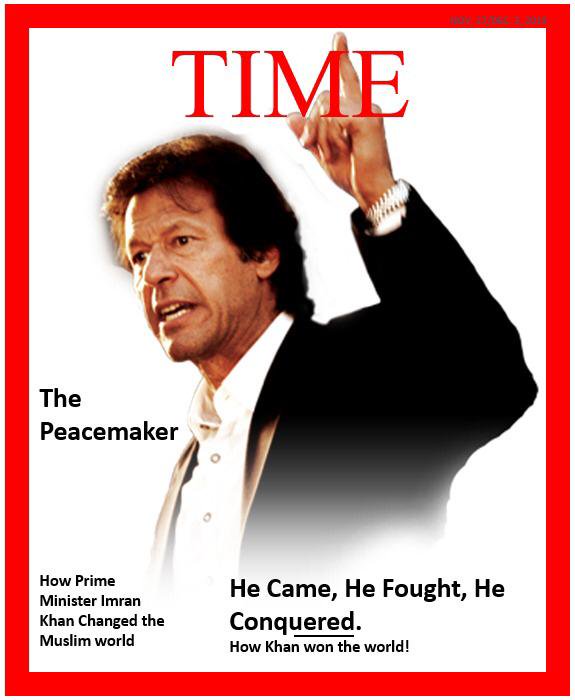
Now, don’t ask about the contents of this issue because the deadline was short and the editors of Time didn’t have the time. So, you will have to live with only the cover for now. Thanks to Insafians, it is the second time in 2019 that Khan made it to Time magazine’s cover: in April, he was adjudged as one among the ‘100 most influential’ people in the world.
Rani Mukerji, a voice of reason
Ever since the advent of Twitter in Pakistan, ‘Rani Mukerji’ has been a voice of reason for PTI users. Whatever the political situation between Pakistan and India be, Rani Mukerji will give her opinion anyhow. If there is a day when you don’t understand the difference between real or fake, wait for Rani to endorse it to know it is fake for real.
What a brilliant & tremendous speech by the Pakistani PM @ImranKhanPTI at the #UNGA. He spoke his heart out for the Oppressed Kashmiris & rightly exposed the RSS controlled regime. Wish we Indians had leadership like him.

2,021 people are talking about this
“What a brilliant & tremendous speech by the Pakistani PM @ImranKhanPTI at the #UNGA. He spoke his heart out for the Oppressed Kashmiris & rightly exposed the RSS controlled regime. Wish we Indians had leadership like him,” the tweet by @RANIMUKERJI read. It doesn’t matter if her bio says ‘Parody account’ – what she posts is gospel truth for Khan supporters. The only tweet posted by the account has more than 4,000 likes and close to 2,000 retweets.
Putin-Khan dostana in US
Russian president Vladimir Putin had a rather good dinner interaction with PM Khan, as they sat together in New York, or so we are told. What all they would have talked about, we wondered. It meant good news diplomatically, right? But just as we were about to begin our celebration over this, we found that Putin wasn’t even in New York. He was in Russia with the Venezuelan President Nicolás Maduro.
Paid ad in NYT
Get a paid advertisement published, put the ad sheet on top of the front page of The New York Times, and tweet from the official party handle: “The world has started paying attention to the #KashmirIssue and that itself is a diplomatic win for Pakistan. Our only aim is to make the Kashmiri voices heard despite Modi’s attempts to silence them through media blackout in Kashmir. Today in @nytimes! #ImranKhanVoiceOfKashmir”. Once the lie is called out, simply delete the tweet. A sponsored ad, not on the front page of The New York Times.
Dengue count soars to 2,823 in Balochistan
The number of dengue cases reported in Balochistan during the current year has soared to 2,823 as three of the provincial districts remain affected.
According to Balochistan Health Department’s statistics and figures, dengue virus has affected 1,898 people in the province whereas another 925 people are suspected of being affected by the epidemic as well. So far, three people have reportedly died from the mosquito-borne disease.
The Health Department stated that the dengue cases have surfaced in district Kech, Gwadar and Lasbela of which district Kech is the most affected where 1,747 cases were reported. In Gwadar, at least 872 cases were reported and approximately 204 people were affected in Lasbela district. No case has been reported from Quetta so far, according to officials.
Secretary Health Balochistan Hafiz Abdul Majid has said that concrete steps are being taken to address the issue and apart from providing treatment in the affected districts, a campaign is also launched to create awareness among the people about preventive measures.
Five more dengue patients admitted to Bahawal Victoria Hospital
Apart from the anti-dengue spray, a special team from the health DG’s office has also been sent to the affected areas, officials said. They claimed the spray had been completed in all the affected districts which will help overcome the situation in the coming days.
“On the directives of Balochistan Chief Minister Jam Kamal, an effective and practical strategy has been devised and steps taken to curtail dengue are being monitored,” he said.
“Coordination with the health experts concerned is underway for the necessary technical and health assistance and all measures will be taken to deal with the situation,” the secretary health assured.
Informing about the affected districts, Hafiz Abdul said that government hospitals have been equipped with facilities and steps taken to deal with the dengue epidemic.
“There is a dire need to educate the public about dengue and the government is fulfilling its responsibilities in this regard,” he continued.
Dengue death toll hits 28 with three more fatalities
Health Secretary assured that the situation is under control and the virus will be eradicated soon. He urged the public to not be overcome by any fear and rather adopt the recommendations proposed for protection from the virus.
He said that with the cooperation of the public the dengue virus will soon be eliminated from the affected districts.
Earlier, Balochistan Health Minister Meer Naseebullah Marri also said that health department has been utilising earnest efforts to deal with the recent outbreak of dengue virus.
“Health teams have been sent to dengue-hit areas where patients are being provided quality care and medicines,” Marri said in a statement, adding that the government has been reviewing daily reports that are emerging from the affected areas.
He said the provincial government has taken immediate notice after dengue cases surfaced in Lasbela and other districts, while Incentive Care Units (ICUs) have also been established for patients affected by dengue.
https://tribune.com.pk/story/2070811/1-dengue-count-soars-2823-balochistan/
Wednesday, October 2, 2019
What civilians in Pakistan’s Kashmir face: Poor infrastructure, lack of jobs, press control
SOHAIL AKHTAR
Both Imran Khan government and the global community have a part to play in setting Pakistan’s Kashmir on the path towards development.
On August 5, Indian Prime Minister Narendra Modi announced the withdrawal of Article 370 of the Indian constitution from Jammu and Kashmir, which revoked the state’s semi-autonomous status. Modi’s decision made international news headlines and newly enflamed tensions between India and Pakistan.
Kashmir has long been a flashpoint between the two nuclear powers. Media outlets have particularly emphasized the chaos and turmoil that has befallen the Indian state since August 5. Uncertainty in light of the decision has led to overflowing hospitals, food scarcity, lack of access to internet, and thousands of security forces patrolling checkpoints.
Less likely to appear in news coverage, however, is reporting on the political and humanitarian situation in the smaller Pakistan-controlled Kashmir (PK) on the other side of the Line of Control (LoC). Individuals living in PK are major stakeholders in the broader dispute yet have heretofore lacked a legitimate mouthpiece for voicing their political and socio-economic grievances. They have not had adequate means of expressing dissatisfaction with the Pakistani government’s regional policies, and generally suffer as a result of underdevelopment and disenfranchisement.
Most recently, on September 9, local police arrested at least 22 people demonstrating in favour of Kashmiri independence, after clashes between the police and activists became violent. Development and political enfranchisement go hand-in-hand in promoting security and stability. Within the context of the Kashmir dispute and broader conflict between India and Pakistan, it is thus especially important to highlight the sub-par living conditions in PK and to gear stakeholders towards taking more concerted action.
The Pakistani federal government has historically neglected basic development needs in PK, which suffers from poor infrastructure and a lack of available resources and technology. The Pakistani government has not taken sufficient measures to encourage development-oriented investment in the region, and some activists on-the-ground have even charged the Pakistani military with keeping the region’s people unprivileged.
PK is entirely dependent on the federal government for its financial resources and only about 25 per cent of the budget allocated to the region goes towards initiatives for development. Government estimates suggest that PK had a 10.3 per cent unemployment rate during the 2017-2018 fiscal year. The local government and local businesses have largely not taken advantage of natural resources and human capital present in the region. Combined with subpar literacy rates (an official 78 percent literacy rate accounts for individuals with only very basic proficiency) and a dearth of available jobs, young Kashmiris in particular migrate to Pakistan’s large cities in search of low-paying jobs at hotels, restaurants, and clothing stores. Though recent economic activities in PK, particularly billions in Chinese investment, have generated hope that the region’s economic future would improve, the movement towards achieving this has been slow. For instance, the mainstay of the China-Pakistan Economic Corridor in PK, the Mirpur-Muzzafarabad-Mansehra highway, is still to be constructed despite being proposed in 2016, and the Kohala hydropower project is facing local opposition due to environmental concerns.
Civilians living in PK also suffer from poor governance, an absence of political legitimacy, and disenfranchisement. Government action in PK has principally surrounded its ambiguous legal status: the federal government has disproportionately focused on securing its political hold over the region, neglecting actual governance in the process. The federal government grants the local PK government only limited resources and governing authority. PK lacks representation in the National Assembly of Pakistan as a result of its lack of international recognition, which means political control falls into the hands of federal officials who are unaware of local grievances.
A June 2018 report from the Office of the United Nations High Commissioner for Human Rights (OHCHR) notes with concern the restrictions on right to freedom of expression and association in PK, particularly in relation to the cause of Kashmiri independence or the populace’s right to self-determination, a tight control over the press, and an outsized role of the military and intelligence agencies in local governance. In its follow up report in July this year, the OHCHR assesses that many of these concerns remain.
Political disenfranchisement, underdevelopment, and a disregard for human rights in Pakistan-controlled Kashmir bode poorly for long-term regional stability and security. As the international community assesses growing fissures between India and Pakistan, it must also encourage action to lessen Pakistan-controlled Kashmir’s isolation and encourage development and political participation.
Lack of access to basic resources and low government capacity may lead some individuals to seek group-belonging and stability in insurgency groups and recognised terrorist organisations. The region boasts proximity to large water sources, is resource rich, and its literacy rate is actually higher than Pakistan’s overall rate. Both the Pakistani federal government and the international community have a part to play in setting Pakistan-controlled Kashmir on the path towards development, and have a moral obligation to improve the lives of civilians on the ground.
Video Report - - Bilawal Bhutto Press Conference On Earthquake In Mirpur Azad Kashmir | 2 Oct 2019

Pakistan Peoples Party (PPP) Chairman Bilawal Bhutto on Wednesday has arrived in earthquake-hit Azad Kashmir.As a gesture of solidarity with the quake sufferers, the PPP leader visited Mirpur District Hospital where he inquired about the health of the victims.
A NUCLEAR WAR BETWEEN INDIA AND PAKISTAN COULD KILL TWICE AS MANY PEOPLE AS WWII, STUDY FINDS

BY ROSIE MCCALL

The study, co-authored by researchers at Rutgers University, quantifies just how catastrophic a nuclear conflict between the two nations would be. In addition to the 100 million-plus death toll in the immediate aftermath, the study authors warn we could expect global vegetation growth to decline 20 to 35 percent as ocean productivity fell 5 to 15 percent—a result that would cause mass starvation, ecosystem disruption and more deaths. It could take over a decade to fully recover from the impacts, they say.
"Nine countries have nuclear weapons, but Pakistan and India are the only ones rapidly increasing their arsenals," said Alan Robock, a Distinguished Professor in the Department of Environmental Sciences at Rutgers University—New Brunswick.
"Because of the continuing unrest between these two nuclear-armed countries, particularly over Kashmir, it is important to understand the consequences of a nuclear war."
Indeed, only last week in an address to the United Nations General Assembly in New York, Pakistani Prime Minister Imran Khan appealed for international support against India's decision to remove semi-autonomous status from its share of Kashmir last month and impose a lockdown on the majority Muslim population—stressing the threat of nuclear war.
"If a conventional war starts between the two countries, anything could happen," said Khan. "But supposing a country seven times smaller than its neighbor is faced with the choice: either you surrender, or you fight for your freedom till death, what will we do?"
"I ask myself this question and my belief is la ilaha illallah, there is no god but one, and we will fight. And when a nuclear-armed country fights to the end, it will consequence far beyond the borders."
Robock et al.'s calculations are based on a potential war scenario for 2025, when it is estimated the two countries could have 400 to 500 nuclear weapons between them. Each nuke could have an explosive power between 15 kilotons—equivalent to 15,000 tons of TNT, i.e. the same size as the "Little Boy" that fell on Hiroshima in 1945—and a few hundred kilotons, the researchers say. The largest known nuclear weapon in existence today, the Tsar Bomba, far exceeds those considered in the study with an explosive power of 50 megatons.
The researchers conclude that were India to release 100 strategic weapons in a nuclear conflict and Pakistan 150, the number of fatalities caused by the initial effects could total 50 million to 125 million people—the exact size depends on the size of the weapons used. For context, an estimated 50 million people were killed in the Second World War, although that number excludes those who died from disease and starvation. Many more would die from the mass starvation that would almost certainly follow, they add.
Starvation is likely because the explosions would cause fires that could, between them, release 16 million to 35 million tons of soot into the atmosphere. This soot would absorb solar radiation and heat the air, which would then cause the smoke to rise further, blocking our sun's light so that 20 to 35 percent less would fall on the Earth. This would trigger a period of global cooling—resulting in a nuclear winter—that would see surface temperatures drop 3.6 F to 9 F to levels not seen on Earth since the last ice age. We could also see global precipitation levels plummet 15 to 30 percent, affecting some regions more than others, the study's authors conclude.
As a result, they predict 15 to 30 percent less vegetation growth and a 5 to 15 percent decline in ocean productivity worldwide.
"Such a war would threaten not only the locations where bombs might be targeted but the entire world," said Robock. "I think we have been lucky in the 74 years since that last nuclear war that we have not had another due to mistakes, panic, misunderstanding, technical failures or hacking," Robock told Newsweek. "If the weapons exist, they can be used. And the ongoing conflict in Kashmir has the potential to escalate." Neither party is likely to initiate a nuclear conflict without major provocation, the study's authors wrote. However, they did warn of a new Cold War.
"India and Pakistan may be repeating the unfortunate example set by the United States and Russia during the 'Cold War' era: that is, building destructive nuclear forces far out of proportion to their role in deterrence," they write.
https://www.newsweek.com/nuclear-war-india-pakistan-death-toll-ww2-1462550
FATAH: Pakistan threatens the world with nuclear war
Tarek Fatah
Not since 1956 when Soviet Premier Nikita Khrushchev threatened the West with the infamous words, “We will bury you” have world leaders heard the head of a nuclear state brandish its atomic weapons to intimidate the world. Almost 60 years after Khrushchev said these words at a reception in Moscow while addressing Western ambassadors, the Islamic State of Pakistan was back at the centre of the world’s attention as its prime minister raised the spectre of a nuclear war engulfing the globe. Last Friday, Imran Khan rose to address a poorly attended hall of the UN General Assembly and in a not-so-disguised threat said, if the world did not pay attention to his penchant for a jihad against neighbouring India over the Indian state of Kashmir, a nuclear war would ensue and engulf the rest of the world: “If a conventional war starts between the two countries … anything could happen. But supposing a country [Pakistan] seven times smaller than its neighbour [India] is faced with the choice either you surrender, or you fight for your freedom till death? “What will we do? I ask myself this question … and we will fight. … and when a nuclear-armed country fights to the end, it will have consequences far beyond the borders.” Khan warned of a “blood bath” in Kashmir, where New Delhi has taken steps to fully integrate the territory with the rest of the country by amending the country’s constitution that hitherto had granted greater autonomy to the region than that given to the other 29 Indian states. The Pakistani prime minister positioned himself as leader of the Islamic world and thus having authority to speak on behalf of India’s Kashmiri Muslims. In a provocative remark, Khan posed a rhetorical question: “Would I want to live like that?” Then answering his own question, he declared, “I would pick up a gun.” And then to claim plausible deniability, he backtracked to say: “I am not threatening here about a nuclear war; it is a worry. It is a test for the United Nations. You are the one who said Kashmir has the right to self-determination. This is not the time for appeasement like that in 1939 in Munich.” Was Imran Khan equating the world’s largest democracy India with Nazi Germany? Was he making a parallel between Prime Minister Narendra Modi and Adolf Hitler? Outrageous as it may sound, but, yes the man known as ‘Taliban Khan’ did accuse the Indian leader of being a fascist just as Pakistani-Americans on the streets of New York roamed around with posters showing Mr. Modi as Hitler, chanting “Allah O Akbar” as they attacked and browbeat anti-Jihadi exiles from Balochistan and Sindh who were protesting human rights violations inside the Islamic State of Pakistan. The threats of nuclear war by Imran Khan were met with a calm response from Indian diplomat Vidisha Maitra. Addressing the General Assembly in her right of reply to Khan, she said: “Prime Minister Imran Khan’s threat of unleashing nuclear devastation, qualifies as brinksmanship, not statesmanship. Even coming from the leader of a country that has monopolized the entire value chain of the industry of terrorism, Prime Minister Khan’s justification of terrorism was brazen and incendiary.” And in response to the Pakistan Prime Minister’s declaration that “There is no God, but Allah,” the Indian diplomat said: “Unfortunately, what we heard today from Prime Minister Imran Khan of Pakistan was a callous portrayal of the world in binary terms. Us vs Them; … Muslims vs Others. A script that fosters divisiveness at the United Nations. Attempts to sharpen differences and stir up hatred, are simply put – hate speech.” https://torontosun.com/opinion/columnists/fatah-pakistan-threatens-the-world-with-nuclear-war
Not since 1956 when Soviet Premier Nikita Khrushchev threatened the West with the infamous words, “We will bury you” have world leaders heard the head of a nuclear state brandish its atomic weapons to intimidate the world. Almost 60 years after Khrushchev said these words at a reception in Moscow while addressing Western ambassadors, the Islamic State of Pakistan was back at the centre of the world’s attention as its prime minister raised the spectre of a nuclear war engulfing the globe. Last Friday, Imran Khan rose to address a poorly attended hall of the UN General Assembly and in a not-so-disguised threat said, if the world did not pay attention to his penchant for a jihad against neighbouring India over the Indian state of Kashmir, a nuclear war would ensue and engulf the rest of the world: “If a conventional war starts between the two countries … anything could happen. But supposing a country [Pakistan] seven times smaller than its neighbour [India] is faced with the choice either you surrender, or you fight for your freedom till death? “What will we do? I ask myself this question … and we will fight. … and when a nuclear-armed country fights to the end, it will have consequences far beyond the borders.” Khan warned of a “blood bath” in Kashmir, where New Delhi has taken steps to fully integrate the territory with the rest of the country by amending the country’s constitution that hitherto had granted greater autonomy to the region than that given to the other 29 Indian states. The Pakistani prime minister positioned himself as leader of the Islamic world and thus having authority to speak on behalf of India’s Kashmiri Muslims. In a provocative remark, Khan posed a rhetorical question: “Would I want to live like that?” Then answering his own question, he declared, “I would pick up a gun.” And then to claim plausible deniability, he backtracked to say: “I am not threatening here about a nuclear war; it is a worry. It is a test for the United Nations. You are the one who said Kashmir has the right to self-determination. This is not the time for appeasement like that in 1939 in Munich.” Was Imran Khan equating the world’s largest democracy India with Nazi Germany? Was he making a parallel between Prime Minister Narendra Modi and Adolf Hitler? Outrageous as it may sound, but, yes the man known as ‘Taliban Khan’ did accuse the Indian leader of being a fascist just as Pakistani-Americans on the streets of New York roamed around with posters showing Mr. Modi as Hitler, chanting “Allah O Akbar” as they attacked and browbeat anti-Jihadi exiles from Balochistan and Sindh who were protesting human rights violations inside the Islamic State of Pakistan. The threats of nuclear war by Imran Khan were met with a calm response from Indian diplomat Vidisha Maitra. Addressing the General Assembly in her right of reply to Khan, she said: “Prime Minister Imran Khan’s threat of unleashing nuclear devastation, qualifies as brinksmanship, not statesmanship. Even coming from the leader of a country that has monopolized the entire value chain of the industry of terrorism, Prime Minister Khan’s justification of terrorism was brazen and incendiary.” And in response to the Pakistan Prime Minister’s declaration that “There is no God, but Allah,” the Indian diplomat said: “Unfortunately, what we heard today from Prime Minister Imran Khan of Pakistan was a callous portrayal of the world in binary terms. Us vs Them; … Muslims vs Others. A script that fosters divisiveness at the United Nations. Attempts to sharpen differences and stir up hatred, are simply put – hate speech.” https://torontosun.com/opinion/columnists/fatah-pakistan-threatens-the-world-with-nuclear-war
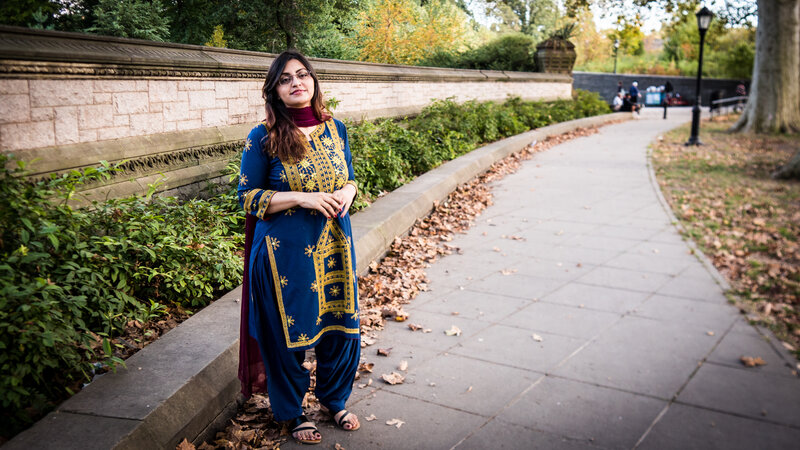
Afraid For Her Life, A Pakistani Activist Vanishes ... And Escapes To New York

By TIM MCDONNELL
In May, one of Pakistan's most controversial women's-rights activists vanished.
Gulalai Ismail, 32, had spent much of her life organizing young women and girls to push back against child marriage and assert their rights in a male-dominated society. She founded an organization, Aware Girls, that provided leadership training and produced one alumna who went on to become the world's best-known girls' education advocate and youngest-ever Nobel laureate: Malala Yousafzai.
Ismail was used to making enemies, ranging from anonymous Facebook trolls to Taliban militants. But early last year, when she began to draw attention to the stories of women who claimed to have been raped or sexually assaulted by Pakistani security forces, she attracted the ire of her most formidable opponent yet: The country's all-powerful military and intelligence agencies.
Over the next year, she says she faced an escalating series of reprisals from the police and security officials, including intimidation, treason and terrorism charges, arrests and death threats. By the spring, after what she says was an especially harrowing 40-hour detention Pakistani intelligence officers without food, water or communication with her lawyer or family, Ismail began to fear for her life. She had good reason: Activists in Pakistan who anger the government have long been known to mysteriously disappear and never be seen alive again. So in May, when a friend tipped her off that a police team was on its way to her house, she said goodbye to her parents and slipped out the door. She wasn't seen publicly again for four months.
Then, on September 19, Ismail resurfaced in New York City, having slipped out of Pakistan and leveraged her activism network to secure the support of Senate Majority Leader Charles Schumer for an asylum claim.
"It is clear that her life would be in danger if she were to return to Pakistan," Schumer told The New York Times.
Ismail met with NPR in Brooklyn, near the home where she's staying with two brothers and two sisters who have lived in the U.S. for several years. She chose to keep many details of her journey secret, to protect people who helped her along the way. But she discussed her high-stakes escape and her plans to redouble her fight against gender-based violence.
This interview has been edited for length and clarity.
How does it feel to be in New York?
I had remained without any communication for four months, so it's been a bit overwhelming.
And when you live for so long in a state of insecurity it's not a magic bullet where all of a sudden you start feeling safe. Even today, if I go outside and someone is holding a camera I get a bit paranoid.
Let's back up — when did your situation with the Pakistani authorities escalate enough that you felt you had to leave the country?
In January 2018, I got involved with this group, Pashtun Tahafuz Movement. Young people from all over Pakistan had come to Islamabad protesting against extrajudicial killings and enforced disappearances.
But only a few were women, and so with some of my friends we decided that we are going to reach out to women. It became a movement about everyone who was persecuted by despotism and the military establishment. But the moment my support for the movement started, the state of Pakistan started persecuting me.
In November, I was taken to ISI headquarters [Pakistan's equivalent to the CIA]. They told my father that if you do not make sure that your daughter is silenced, we are going to kill her. I was glad I am seen as a threat to all these institutions of oppression. Why not? The system should feel threatened by a woman. But when I started raising the issue of sexual violence by the security forces, the situation became much more difficult for me. Many women had shared their stories of sexual violence by Pakistan's security forces. And the military did its best to silence the issue.
By that time my friends told me, 'Initially they were just intimidating you, and now it seems that they really want to harm you. And then one day they will not leave you alive.'
One morning, very early, I received a call from a friend, and she said the local media is reporting that police raid teams are prepared to come and arrest you. I went and woke my mother and father, and I told them, and I just left. I didn't know that this is my farewell to home. That was the last time I saw my parents, my sister. Our home was raided. Dozens of police and counter-terrorism people came to arrest me. My relatives' homes were raided, my friends' homes were raided.
So where were you?
We made a list of people who could provide me protection, who were not very close to me because we knew that my family and close friends would be under surveillance.I would usually live with them for around ten days, and then I would go to another location, so I lived in different cities of Pakistan. I did not have any mobile phone or social media.While I was in hiding, the Pakistan state was using all its machinery to find me. Once my driver was abducted and he was tortured for eight hours to get information about me, but he didn't know anything. Then a friend was picked up. He was beaten brutally, just because he is a friend.So in that situation, now this is not a legal battle. Now it is a battle for life. So I and my friends decided that now it's time to leave the country. But my name was on an exit control list. My pictures were pasted on all borders of Pakistan. During all this time I crossed hundreds of checkpoints, and I was just making sure they would not recognize me. I was given identity documents of a dead woman, so I would have like a fake identity.
What can you tell me about how you managed to get to America?
I was in hiding for four months. I cannot speak about exactly when I came here. Going outside of Pakistan was a life-risking journey. There were huge chances of not just me being arrested, but also people who had been supporting me.
Once the journey started, I was among people who I had never met before, and I was the only woman. I was given a lot of respect, but I was always extremely worried about my safety. Every few days I would be among new people, and I had no other choice but to trust them.
I had a U.S. visa, it was the only visa I had. Once I moved to a country where I was safe, I took a flight to the U.S. and I landed in New York.
What did it feel like when you finally managed to leave Pakistan?
I was in a state of uncertainty and disbelief. Those strangers sat in a circle and said a prayer. They said that the world may see this journey as illegal, but for us this is not illegal, it's a battle of survival. So we just pray that we are forgiven. They kept their hands on my head, and said may God protect you. And I bent, and I touched my soil, and you know it was so painful to leave soil where you have roots.
What happened with your family after you left?
My whole family had become at risk. One day a guy came out from the car and told my sister, 'You know, you're a look-alike of Gulalai and I'm afraid that one day we will shoot you instead of her mistakenly.' I'm afraid that my parents will be tortured or harassed or arrested.
When was when was the next time you were able to speak to them?
I couldn't speak to them even when I landed in the U.S. because I was just not sure if their communication is tapped. But when I was able to do it, it was a very brief video call and my mother and father were crying when they looked at me. I had never seen my father crying — in our culture men are not supposed to cry. They were just so glad to see me alive, because I think that they had stopped believing that I will ever manage to stay alive.
Now that you're out, what happens next?
I have paid a huge price for speaking out and for not silencing myself. In speaking about sexual violence in armed conflict, there's so much that the state is afraid of. And they would even kill people so that this crime is not exposed to the world. I am going to speak out about it as much as I can. I will continue empowering young women, because I know that when women human rights defenders are at risk there is very little support for them. I will continue raising my voice about the human rights abuses committed by state actors in conflict zones. When I was working in Pakistan I was able to work directly with young women, and it would give me a lot of inspiration. But the advantage that I have here is that I'm in a position where I can act as a bridge between the women of Pakistan and international policymakers.
As we're speaking, many of Pakistan's leaders are here in New York for the U.N. General Assembly. In his speech on Friday, Prime Minister Imran Khan accused India of committing human rights abuses in Kashmir, a subject he has raised before. How does that jibe with your story?
It's such hypocrisy. Pakistan has no moral authority, no credibility to point towards any country about their human rights abuses, when they themselves are being more authoritative and more oppressive against their own citizens. I was one lucky person who could leave the country. But dozens of activists of the same movement are still in jail. I condemn every human rights abuse committed in Kashmir. But what will happen in Kashmir should be decided by the people of Kashmir. If the Pakistani prime minister tries to lead the campaign for Kashmir, it harms the movement more than benefiting it.
One of the young women you worked with, Malala, became an international superstar. But her reputation within Pakistan is mixed. Some people were very opposed to her, for promoting what they see as Western, anti-Islamic values. Do you think attitudes in Pakistan toward women activists are changing?
Malala is a good friend, and I really admire what she's doing. Women activists have many more challenges than men activists. When a woman speaks up, she's not just speaking against one system of oppression. She is fighting the cultural norms, religion, the patriarchy. Many women have to fight the institution of family as well. Because she is challenging so many systems, by just existing she is seen as a threat. Take the example of sexual violence in armed conflict. Some other men also had mentioned these incidents, but no one charged them in cases of terrorism, sedition and treason. I said the same things and I was charged. So the system feels more challenged by a woman. However, the support that I have received back from my home is also immense. On the internet we see a lot of hate, but there is a lot of love out there as well. And I would not be alive today if people were not supporting me. So I think the attitudes are changing and people are gradually acknowledging the role of women activists.
Every time you've been arrested or intimidated, you keep coming back to protests, you keep organizing. What keeps you going?
When the most cruel forces unite to silence you, then living is resistance. Stay alive, because if you don't stay alive, you will not be able to resist. That is what I learned. If I was arrested, if I was killed, then it would block the path for many other young women. It would have sent a message of fear, and no parents would have ever dared to raise an independent daughter, because they might face torture and death.
Subscribe to:
Posts (Atom)