Wednesday, August 14, 2019
Article 370 and Pakistan’s false outrage
KRITI M. SHAH
The intention behind removing Article 370 has been to encourage further investment and improve the security in Kashmir.The relationship of the state of Jammu and Kashmir with the Union of India was forever changed this week, as the government in New Delhi removed Article 370. This alters the fundamental nature of Kashmir’s constitutional standing within the Indian Union. Across the border, Pakistan has taken great offense at this supposed ‘mass injustice’ of the Government of India towards Kashmiris. The Pakistan Army has threatened to “exercise all possible options to counter the illegal steps taken by India.” Regardless of which side of the political aisle you stand on, the Pakistan hypocrisy and faux outrage over the future of Kashmiris is breathtaking in its chutzpah, given that over the last seven decades they have steadily destroyed, dismembered and dismantled the part of Kashmir that is under their illegal occupation.
Gilgit-Baltistan, the northern most tip of the subcontinent, was forcibly captured by Pakistan weeks before Partition, as a result of treachery of British military officers of the Gilgit Scouts, who revolted with the help of the Pakistan army. While legally, the region would have ascended in its entirety to the Maharaja of J&K and thereby to India, Pakistan was quick to install a political agent in November 1947 as a puppet of the central government and has exercised administrative control over the region ever since.
One of the main arguments propagated by Pakistan is that the removal of Article 370 would lead to changes in Kashmir’s demography. However, in Gilgit-Baltistan this has been steadily happening for decades.
One of the main arguments propagated by Pakistan is that the removal of Article 370 would lead to changes in Kashmir’s demography. However, in Gilgit-Baltistan this has been steadily happening for decades.
Referred to as the Northern Areas up till ten years ago, the region finds no mention in any of Pakistan’s constitutions. Its political status is neither that of a province, nor an independent region. Until 1994, there were no party-based elections. Its legislative council was upgraded to a legislative assembly only in 2007 and in 2009 anyone who domiciled in the region became a citizen of Gilgit-Baltistan, not Pakistan. Therefore, the sudden anger of Pakistan citizens for Kashmiri Indians, is not only misplaced and misdirected, it is highly hypocritical.
One of the main arguments propagated by Pakistan is that the removal of Article 370 would lead to changes in Kashmir’s demography. However, in Gilgit-Baltistan this has been steadily happening for decades. The state subject rule, which enacted by Dogra rulers barred outsiders from seeking permanent residence in the Princely states, was removed by Zulfikar Ali Bhutto in the 1970s, with the deliberate intention of changing the demographic profile of the region. Over the years, the Pakistani state has encouraged the migration and settlement of different groups, especially Pashtuns and Taliban cadre to colonise the Shia and Ismaili dominated region, leading to a rise in sectarianism and religious extremism. The Pakistani establishment has also forced population displacement, masking it as a consequence of development by constructing dams such as the Diamer-Basha and Skardo-Karzura, forcing thousands of local residents to relocate, effectively killing local culture and identity. If Pakistan feels so compelled to speak up for Muslims in Kashmir, it should perhaps first question why its country has been silent towards cultural and religious repression of Muslims in China’s Xinjiangprovince.
Sectarian conflict between Shia and Sunnis are a creation of the Pakistani state. Zia-ul-Haq made numerous attempts to introduce Sunni-Deobandi Islam in the region encouraging radical militant groups such as Sipah-e-Sahaba to suppress the Shias and Ismaili populations. Through the years, clashes between the groups have become an unfortunate regular occurrence, involving the destructionof homes, businesses, lynchings, targeting of Shia clerics, policeman and local representatives.
Sectarian conflict between Shia and Sunnis are a creation of the Pakistani state.
Sectarian conflict between Shia and Sunnis are a creation of the Pakistani state.
Pakistanis were up in arms lecturing India on democratic principles, after the temporary house arrest of certain Kashmiri politicians. This was while Pakistan has imprisoned Ali Wazir and Mohsin Dawar, two sitting members of parliament for their involvement in the Pashtun Tahafuz Movement (PTM), a non-violent civil rights movement for Pashtuns. The establishment has spun a story, trying to link Wazir and Dawar to an attack on an army check post in Waziristan in a brazen attempt to discredit the Pashtun movement and paint the two lawmakers as aggressors. The government known for its stifling of dissent, arrested opposition leader Maryam Nawaz on charges of money laundering, a day after she spoke up against the Imran Khan government and their handling of the Kashmir issue.
The ‘freedom’ given to the Pakistani media resembles an Orwellian dystopian novel. Within the last year there has been repeated muzzling of the national media. Pakistan’s electronic media regulatory body issued a notice in December 2018 ‘advising’ media houses to avoid excessive coverage of crime reporting, violence, sexual abuse and terrorism so as to not build a negative image of Pakistan around the world. Television anchors who questioned the arrest of Nawaz Sharif and his family or the transparency of the general elections have been asked to leave their jobs. In the last month, Pakistan Broadcasters Association has taken three channels off the air without reason. It has issued notices to 21 TV channels that aired opposition leader Maryam Nawaz’s press conference. Former president Asif Ali Zardari’s interview with a private news channel was pulled off the air minutes after it had begun. Those journalists that have covered the PTM rallies and protests have had cases filed against them.
The ‘freedom’ given to the Pakistani media resembles an Orwellian dystopian novel. Within the last year there has been repeated muzzling of the national media.
The ‘freedom’ given to the Pakistani media resembles an Orwellian dystopian novel. Within the last year there has been repeated muzzling of the national media.
This is not to say that the Indian media is absolutely faultless and unbiased, but that they operate in an environment that allows them the opportunity of openly criticise the government. This can be best highlighted by acknowledging the many different voices and opinions that have emerged in the last week over the changes in Kashmir. There have been those that have hailed the government for its actions just as there have been news organisations and journalists who have been equally critical of the move.
The consequences of the removal of Article 370 will only surface in the months and years to come. Whether this will truly be a positive transformation in the lives of Kashmiri Muslims and Hindus, only time will tell. However, the intention behind removing Article 370 has been to encourage further investment and improve the security in Kashmir. In Pakistan unfortunately, the administrative and political reforms in Gilgit-Baltistan over the years have been to ensure the region is adequately prepped for the Chinese to consolidate their foothold. Therefore, before the common Pakistani citizen declares their great disappointment with the Indian government, they should consider that an alternate way of showing solidarity would be to look towards Islamabad and Rawalpindi to correct their own historical wrongs.
How far will China go to support Pakistan's position on Kashmir?
Both India and Pakistan are vying for China's support in the dispute over Kashmir. Experts say that although China is critical of India's move to control the region, it's unlikely to affect economic ties with India.
On Friday, Pakistani Foreign Minister Shah Mahmood Qureshi visited Beijing as part of Islamabad's efforts to draw global support against the Indian government's decision to scrap Kashmir's special status.
Beijing is opposed to New Delhi's Kashmir move, especially its decision to carve the Ladakh region out of Jammu and Kashmir state and administer it federally. The Chinese government spokesperson called the move "unacceptable" and said that it would help Pakistan in defending "its legitimate rights and interests" in the Kashmir region.
Qureshi claimed that China "offered complete" support to Pakistan, should Islamabad take the matter to the UN Security Council.
On Sunday, India's Foreign Minister S Jaishankar arrived in Beijing on a pre-scheduled three-day visit. China, on Monday, insisted that India needs to play a "constructive role" for regional peace and stability.
China has historically sided with Pakistan on regional matters, but Beijing's backing is important for both Islamabad and New Delhi.
Kashmir is claimed in its entirety by both India and Pakistan, although both countries only control parts of it. The territory has been an ongoing dispute since both became independent countries in 1947.
Today, India has de facto control over about 45% of the region and the majority of its population, while Pakistan controls around 35%. But the remaining 20% is actually under the control of China.
China claims about 90,000 square kilometers (35,000 square miles) in the Indian state of Arunachal Pradesh, referred to informally by some Chinese as "Southern Tibet." India, on the other hand, claims sovereignty over 38,000 square kilometers (15,000 square miles) of the Aksai Chin plateau.
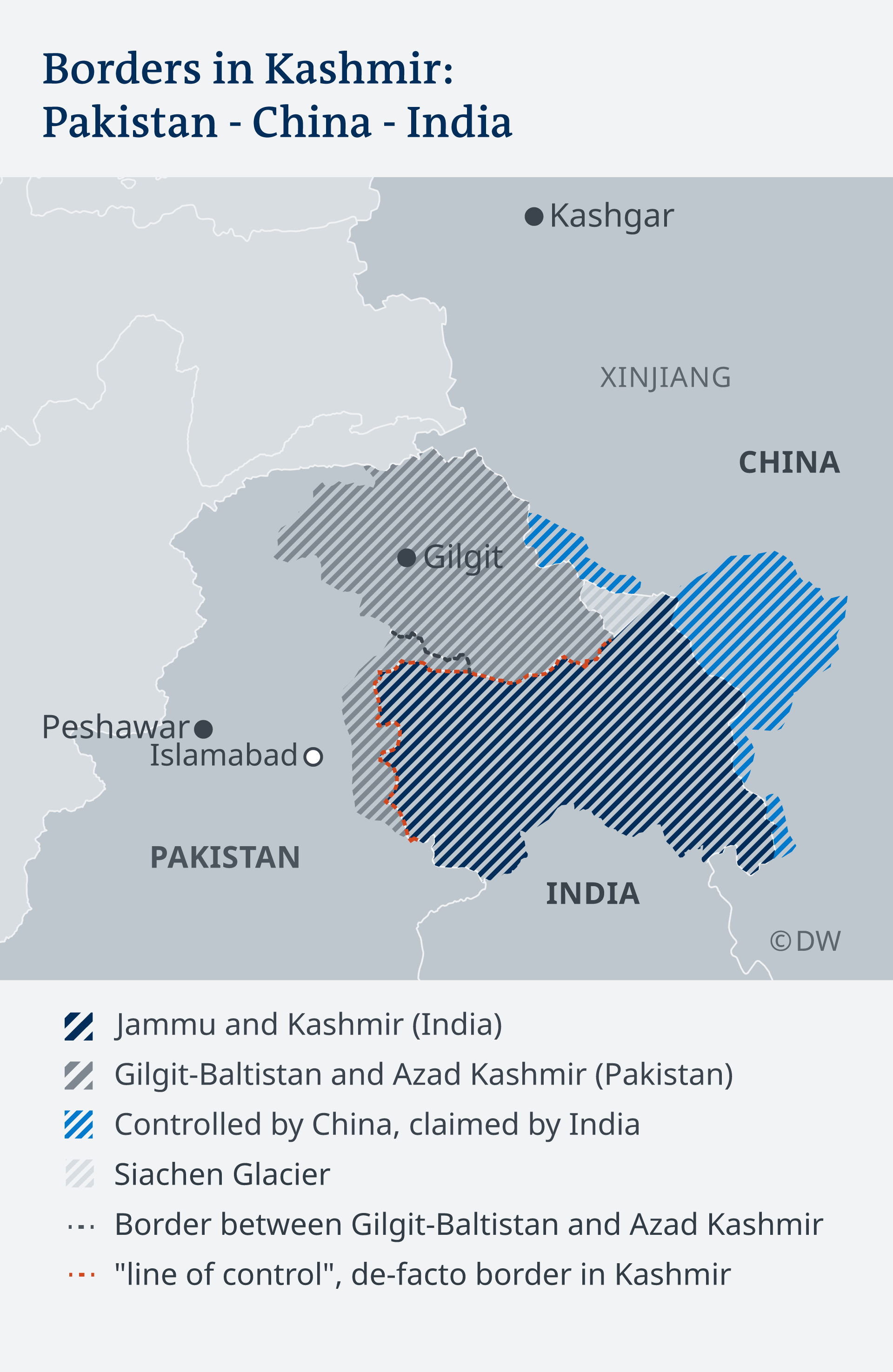
As the two most populous nations in the world, India and China have competing and unresolved territorial claims. The disputes have occasionally flared up, leading to minor border skirmishes.
"China is always opposed to India's inclusion of the Chinese territory in the western sector of the China-India boundary into its administrative jurisdiction," said the Chinese foreign ministry spokeswoman, Hua Chunying, following India's Kashmir move.
"Recently India has continued to undermine China's territorial sovereignty by unilaterally changing its domestic law," Hua added. "India's action is unacceptable and would not have any legal effect."
Territorial dispute
China, which has a long border with Jammu and Kashmir, has been involved in Kashmir tensions in the past. In 1962, China occupied a part of India that borders Kashmir — and entered into an alliance with Pakistan.
Today, China and Pakistan trade via the newly constructed Karakoram Highway, which connects the countries via the western Kashmir region. As part of the multibillion-dollar China-Pakistan Economic Corridor (CPEC) project, this former gravel road is currently being developed into a multi-lane asphalt highway that can be used all year long.
China is investing $57 billion (€51 billion) in Pakistani infrastructure and energy projects, more than in any other South Asian country. The economic alliance with its powerful neighbor has helped solidify Pakistan's claims to the Himalayan foothills.
Some analysts say that New Delhi's decision to directly govern Ladakh is a geopolitical move. Sameer Patil, a researcher at the International Security Studies at Gateway House, an Indian foreign policy think tank, told DW that Chinese influence in Ladakh has been increasing over time, largely due to its economic incentives in the area. At the same time, according to Patil, the region has suffered due to a lack of interest from the Indian government.
"Indian Prime Minister Narendra Modi's decision has been guided by both administrative and geopolitical factors. New Delhi was concerned that Ladakh wasn't receiving attention, which allowed China to increase its clout there," Patil said.
Modi has thus designated the Ladakh region as a "Union Territory," which will allow New Delhi to rule the region by implementing the central government's directives. But publicly, India has tried to downplay this factor. Prime Minister Modi's government has said that the new designation is aimed at addressing Ladakh's development needs.
"China expected India to resolve the territorial dispute by implementing new border mechanisms between the two countries and not within India's domestic framework alone," Patil said, adding that Modi's Kashmir move will naturally irk Beijing.
China too occupied with other problems
But Narayani Basu, a New Delhi-based author and foreign policy expert, believes that the Kashmir crisis won't have a huge impact on Sino-India relations. "China, at the moment, is dealing with a number of domestic and global issues, so it cannot solely focus on Kashmir," Basu told DW, referring to Beijing's woes in Hong Kong and Taiwan, as well as its ongoing trade conflict with the United States.
"There will be diplomatic posturing from both sides, but any major fallout is unlikely," Basu added.
This situation only makes things more difficult for Pakistan, which has so far not received the kind of international backing over Kashmir that it has been looking for.
Following Modi's decision to scrap Kashmir's special status, Washington said its policy toward the region has not changed. Russia and the United Arab Emirates backed New Delhi's move. Saudi Arabia, another Pakistan ally, has also not supported Islamabad over Kashmir.
"China, although sharply critical of India, has said that the responsibility for maintaining peace in the region lies with both India and Pakistan. Diplomatically, it has put the onus on both Islamabad and New Delhi," Basu said.
Will economic relations take precedence?
Indian Foreign Minister Jaishankar has emphasized in Beijing that both China and India need to play a stabilizing role in the time of global uncertainty.
Analyst Basu believes that the China-India ties are unlikely to be derailed in the aftermath of Modi's Kashmir move. "Both Indian PM Modi and Chinese President Xi Jinping have shown the maturity to compartmentalize their relationship in a way that disputes do not overshadow areas of cooperation. Hence, while there will be diplomatic posturing, nobody should expect more than that," he underlined.
But analyst Patil thinks that China could use the Kashmir issue to pressure India on economic and trade issues.
Foreign Minister Jaishankar's China visit is followed by Modi's possible visit to Paris for the G7 Summit by the end of this month. In October, Chinese President Xi is slated to visit India for an informal summit with Modi.https://www.dw.com/en/how-far-will-china-go-to-support-pakistans-position-on-kashmir/a-49993550
Bilawal raises doubts over govt’s sincerity with Kashmir cause
Raising doubts over government’s sincerity with the Kashmir cause, Pakistan Peoples Party (PPP) chairman Bilawal Bhutto-Zardari has said the government is “not supporting the Kashmiris in an effective way”.
Speaking at a press conference on Tuesday, he said the government’s decision “not to move the United Nations Security Council” on the Kashmir issue and sending Foreign Minister Shah Mehmood Qureshi to Azad Jammu and Kashmir (on Eid day) in place of PM Imran Khan had exposed its “insincerity” with the Kashmir cause.
The PPP chief said Indian PM Narendra Modi and PM Khan were on the same page as both were bent upon tyrannising people. “Modi is committing oppression and tyranny in Kashmir while Imran Khan is doing so against the opposition in Pakistan.”Pakistan would have to send a clear message to the Kashmiris that every Pakistani was with them at this difficult time and the nation was ready to go to war if needed for the Kashmir cause, he said.He expressed concern over the foreign minister’s recent remarks that many countries would not support Pakistan over the Kashmir issue in the UN Security Council. “We should not stop ourselves from filing an application in the UN Security Council by assuming that there will be some opposition in the world body.”
Mr Bhutto-Zardari said the PTI government wanted to divide the people of Pakistan by antagonising the opposition. “The government has started arresting even women leaders belonging to the opposition,” he deplored.
“Faryal Talpur was sent to Adiala jail at midnight from the hospital where she was being treated and the doctors had advised her treatment in a cardiology hospital. The law says that no one can be sent to prison from hospital after 5pm, but Faryal Talpur was forced to go to prison at midnight.”
The government, the PPP leader said, had sent Ms Talpur to prison from hospital when he was in Azad Kashmir to offer Eid prayers with Kashmiris and his father was in jail. Besides, he added, the government was also aware that the next morning was Eid day when there would be no newspapers. “This proves that the tyrannical PTI government does not want one voice for Kashmiri brethren.”
The PPP chairman said that whenever he met Kashmiri activists and journalists, they asked him whether the prime minister was also “involved in conspiracy” against the Kashmiris.He said the recently held joint session of parliament had been convened on PPP’s demand and when the opposition went to AJK to show solidarity with the Kashmiris, the government also sent its representative (foreign minister) there.
Replying to a question, he said his family would file a petition against sending Faryal Talpur to prison.
He said the government was taking action against Amnesty, NYT and the BBC which were raising voice for the Kashmiris. About urban flooding in Karachi, he said a propaganda campaign had been launched against the Sindh government, but it was also a fact that the city had received record rains this year.
https://www.dawn.com/news/1499304/qureshi-bilawal-spend-eidul-azha-in-ajk-to-show-solidarity-with-kashmiri-people
ستر سال کا پاکستان اور جشن کس بات کا؟
25 جولائی ، 2017

چند روز بعد پاکستان ستر برس کا ہوجائے گا۔ ’’حکومت اس پر70سالہ جشن بڑے زور و شور سے منارہی ہے ،خوب پیسہ لگایا جائے گا، آتش بازی اور رنگا رنگ تقاریب ہوں گی۔جس طالبہ نے اس ستر برس پر ایک لوگو بنایا ہے حکومت نے اسے انعام و اکرام سے بھی نوازا ہے۔ پنجاب کے وزیر تعلیم برائے ا سکولز ایجوکیشن نے اعلان کردیا ہے کہ تمام ا سکولز 15اگست کی بجائے 7 اگست کو کھلیں گے اور اس سلسلے میں نوٹیفکیشن بھی جاری کردیا گیا ہے اور یہ بھی شنیدہے کہ ہر اسکول کا سربراہ اپنے اسکول کی حاضری کو سوفیصد یقینی بنائے گا اور اگر حاضری پوری نہ ہوئی تو کارروائی بھی ہوسکتی ہے۔
اربوں، کروڑوں روپے کا بجٹ رکھا جارہا ہے، مگر کیوں؟یہ سارا کچھ کسی روز سامنے آہی جائے گا۔ بحیثیت قوم اس بےبس عوام نے کیا کمایا؟ مجموعی طور پر قوم کے کردار نے کیا صورت اختیار کی؟ سڑکیں، عمارتیں،پل، انڈر پاسز ،اوورہیڈ برج اور باغ بنانے سے ملک کی ترقی نہیں ہوتی۔ یہ تمام چیزیں ضرورت کے تحت بنائی جاتی ہیں اس میں کسی حکومت کا عوام پر کوئی احسان نہیں کیونکہ ان چیزوں کی حکمرانوں کو بھی ضرورت ہوتی ہے۔آخر ہم کس بات کا جشن آزادی منانا چاہتے ہیں کیا ہمارا ملک ڈنمارک، سویڈن، ناروے، چین، کوریا جرمن اور عرب ممالک جیسا ہوگیا ہے۔ ہم نے ان ممالک کی مثالیں اس لئے دی ہیں کہ ستر
اربوں، کروڑوں روپے کا بجٹ رکھا جارہا ہے، مگر کیوں؟یہ سارا کچھ کسی روز سامنے آہی جائے گا۔ بحیثیت قوم اس بےبس عوام نے کیا کمایا؟ مجموعی طور پر قوم کے کردار نے کیا صورت اختیار کی؟ سڑکیں، عمارتیں،پل، انڈر پاسز ،اوورہیڈ برج اور باغ بنانے سے ملک کی ترقی نہیں ہوتی۔ یہ تمام چیزیں ضرورت کے تحت بنائی جاتی ہیں اس میں کسی حکومت کا عوام پر کوئی احسان نہیں کیونکہ ان چیزوں کی حکمرانوں کو بھی ضرورت ہوتی ہے۔آخر ہم کس بات کا جشن آزادی منانا چاہتے ہیں کیا ہمارا ملک ڈنمارک، سویڈن، ناروے، چین، کوریا جرمن اور عرب ممالک جیسا ہوگیا ہے۔ ہم نے ان ممالک کی مثالیں اس لئے دی ہیں کہ ستر
برس قبل ان ممالک کے حالات بھی بہت خراب تھے۔ آج ان ممالک کی ترقی دیکھتے ہوئے ایسا لگتا ہے کہ پاکستان ان سے برسوں پیچھے ہے اوردور دور تک ان کا مقابلہ نہیں کرسکتا۔ جن ممالک کے ہم مقروض ہیں وہ ملک اور قومیں کیا ہم پر ہنسیں گی نہیں کہ پاکستان کے امیر ترین حکمران خود کشکول لے کر آجاتے ہیں اور پھر جشن آزادی مناتے ہیں۔ ان کو ذرہ برابر شرم نہیں ا ٓتی کہ آخر ہم کس منہ سے70سالہ جشن آزادی منارہے ہیں؟ اپنا احتساب کرو،بلائو ان لوگوں کو جن کی عمریں اب نوے سال اور اس سے اوپر ہیں سنو ان کے دل کی باتیں ،جنہیں سن کر رونا آجائےگا ۔ آج بھی ا س ملک میں وہ چند لوگ زندہ ہوں گے جنہوں نے اپنے ہوش و حواس میں بھارت سے ہجرت کی،سنو! ان سے ہجرت کے وہ واقعات۔
آج جشن آزادی نہیں بلکہ اپنے احتساب کا دن منائو اور سوچو کہ ہم نے اس ملک کو کیا دیا اور ہجرت کرکے آنے والوں کو کیا دیا؟ جنہوں نے اپنی جانیں قربان کرکے یہ آزادی حاصل کی۔ صرف چند پٹواریوں اور کچھ جہاندیدہ لوگوں نے1947سے ہی لوٹنا شروع کردیا تھا۔ آج ان پٹواریوں کے خاندان عزت دار اور بڑے لوگ کہلاتے ہیں۔ یہ بالکل حقیقت ہے کہ ایک طرف لٹے ہوئے قافلے آرہے تھے تو دوسری طرف مختلف شہروں اور دیہات کے پٹواری جعلی کاغذات بناکر(PTO)بنا کر لوٹ مار کرنے میں لگے ہوئے تھے۔ اس وقت ان کی طرف کسی کی توجہ نہ گئی صرف لاہور کو چار پٹواریوں نے مل کر لوٹا ، یہی وہ لوگ ہیں جو اب بھی پشت در پشت چلے آرہے ہیں اور بڑے لوگ بنے بیٹھے ہیں۔
عزیز قارئین! آپ کو یہ سن کر حیرت ہوگی کہ محکمہ ا سکول ایجوکیشن پرائمری کلاس میں داخل ہونے و الے طلبا کو ڈھائی لاکھ بیگ مع کتابوں کے دے رہے ہیں جس پر گیارہ کروڑ 25لاکھ روپے لاگت آرہی ہے۔ ان اسکول بیگ پر وزیر اعلیٰ پنجاب کی تصویر، پڑھو پنجاب، بڑھو پنجاب کا سلوگن لکھا ہوگا اور یہ36اضلاع میں دئیے جائیں گے۔
ارے اللہ کے نیک بندو ان گیارہ کروڑ 25لاکھ روپےسے کتنے اسکولوں میں سہولتیں مہیا کی جاسکتی ہیں۔ ذرا سوچو اور اس پر غور کرو۔ یہ بیگ کیوں اور کون بنارہا ہے اور اس میں دلچسپی کیوں ہے یہ بھی کہانی کبھی سامنے آجائے گی۔ چوہدری پرویز الٰہی جب پنجاب کے وزیر اعلیٰ تھے تو انہوں نے اسکولوں کی کتابوں کے بیک ٹائٹل پر اپنی تصویر لگوادی تھی پھر جب ن لیگ کی حکومت آئی تو وہ لاکھوں کتابیں تقسیم کرنے سے روک دی گئیں۔ کیا ہمارے حکمراںکتابوں اور بیگوں پر تصاویر لگوا کر زندہ رہیں گے؟ کیا لیپ ٹاپ تقسیم کرکے زندہ رہیں گے؟ ہرگز نہیں اگر کوئی زندہ رہے گا تو صرف اپنے کاموں اور نیکیوں کے ذریعے۔ برصغیر کے ہزاروں اولیاء کرام کے مزارات آج بھی بارونق ہیں اور رشد و ہدایت کا ذریعہ ہیں۔ انہوں نے کسی کو پیسے نہیں دئیے تھے بلکہ نیکی کا پرچار کیا تھا، انسانیت کی بھلائی، دین کی سرفرازی کے لئے کام کیا تھا۔کس بات کا جشن آزادی منارہے ہیں۔ کیا پاکستان کرپشن سے پاک ہوگیا ہے؟ کیا اسپتالوں میں غریب کو دوائی مفت مل رہی ہے؟ کیا پاکستان ہیپاٹائٹس اور پولیو فری ہوگیا ہے۔پنجاب کے کئی اضلاع پورے پورے ہیپاٹائٹس بی اور سی میں مبتلا ہوچکے ہیں۔ یہ آفیشل اعداد و شمار ہیں۔کیا اس بات کا جشن منارہے ہو کہ پاکستان میں گوڈے گوڈے کرپشن ہے؟ کیا عوام اور پولیس میں فاصلے ختم ہوچکے ہیں؟ کیا تھانہ کلچر تبدیل ہوچکا ہے؟ کیا ڈاکٹرز اپنی ڈیوٹی پوری طرح کرتے ہیں؟ کیا پرائیویٹ اسپتالوں میں لوٹ مار کا بازار ختم ہوچکا ہے؟ کیا جعلی ادویات اور ناقص غذا ملنا بند ہوگئی ہے؟
ارے بلائو ان خاندانوں کو جن کے عزیز و اقارب دوران ہجرت شہید کردئیے گئے سکھوں نے ہزاروں لوگوں کو مار دیا ۔ ہزاروں خواتین سکھ اٹھا کر لے گئے ۔ ارے بلائو ان خاندانوں کو ہاکی ا سٹیڈیم میں اور سنو ان کی داستانیں اور شہداء کے لئے قرآن خوانی کرائو پورے ملک میں۔ کس بات کا جشن، آج نوجوان نسل بگڑ چکی ہے، اساتذہ کا احترام ختم ہوچکا ہے۔ اس بات کا سترسالہ جشن منارہے ہیں؟جس ملک میں ستر برس کے بعد بھی سیٹل منٹ کا آفس کام کررہا ہوکبھی سوچا وہ محکمہ آج بھی کیوں قائم ہے؟ اور وہاں پر آج بھی گھپلے کیوں ہورہے ہیں ؟جس قوم کا کردار یہ ہو کہ ایک لیٹر پٹرول کو لوٹنے کے لئے ٹوٹ پڑے اور پھر دیکھتے ہی دیکھتے لقمہ اجل بن گئے، احمد پور شرقیہ کے اتنے بڑے سانحے کے بعد بھی لوگوں کو عقل نہ آئی اور وہاڑی میں ایک اور ٹرک پر لٹیرے حملہ آور ہوگئے وہ تو پولیس نے ان کی جانیں بچالی لیں۔ آج کون سا محکمہ ہے جہاں پر رشوت کا بازار گرم نہیں۔ آج لوگ اربوں روپے کی کرپشن کرتے ہیں جب جیل جاتے ہیں تو گردوں اور دل کے عارضے کے جعلی سرٹیفکیٹ پیش کرکے بچ جاتے ہیں۔ جب لوٹ مار کررہے ہوتے ہیں تو تب کیا دل ،گردوں اور شوگر کے مریض نہیں ہوتے؟ تب تو بڑے تھری پیس سوٹ اور ٹائی پہن کر انگریزی میں بھاشن دے رہے ہوتے ہیں۔
ذرا سوچو! ان ستر برسوں میں کتنے لوگ اپنے دیس میں آکر اجڑ گئے ، کتنے خاندان دہشت گردی کی نذر ہوگئے اور کتنے خاندان آج معذوری کی زندگی بسر کررہے ہیں۔ کسی نے مولانا حسرت موہانی سے پوچھا کہ آپ بھارت میں خوش نہیں حالانکہ آپ نے آزادی کی خاطر جیل کاٹی۔ پاکستان کیوں نہیں چلے جاتے۔اس پر مولانا حسرت موہانی نے کہا کہ بھارت میں مجھے کوئی ہندو، مسلمان کہہ کر ماردے گا جبکہ پاکستان میں مجھے کافر کہہ کر مار دے گا۔ اس سے بہتر ہے کہ میں مسلمان کہلوا کر ہی مارا جائوں۔ سوچیں حسرت موہانی نے یہ بات کتنے برس قبل کہہ ڈالی اور آج ہم کسی پر بھی کوئی مذہبی الزام لگا کر جب چاہیں مار سکتے ہیں۔ دکھ اور افسوس کی بات یہ ہے کہ جس ملک کو ہم نے اس لئے حاصل کیا تھا کہ وہاں ان کی عزتیں محفوظ ہوں گی، اسی ملک میں آج عورتوں کی عزتیں غیر محفوظ ہیں، بوڑھے لوگ دھکے کھارہے ہیں، پنشن نہیں ملتی، رشوت کا بازار گرم ہے، پھر بھی ہم ستر سال کا جشن منارہے ہیں۔ ستر سال میں انسان میں بردباری اور سنجیدگی آجاتی ہے مگر ہم ستر سال کے بعد بھی سات سال کے بچے ہیں؎
کبھی سوچا ہے کہ لوگ تمہیں اچھا کیوں نہیں کہتے
اس ملک نے صرف ان کو بہت کچھ دیا جو سیاست میں ہیں، بیوروکریسی میں اور مقتدر اداروں میں ہیں،دو مرلہ کے مکانوں میں رہنے والے آج کئی کئی ہائوسنگ اسکیموں کے مالک ہیں۔ اس وقت بیوروکریسی، پولیس اور بعض سیاستداں صرف اور صرف زمینوں کے کاروبار میں مبتلا ہیں اس پر پھر بات کریں گے۔
Tuesday, August 13, 2019
Chairman Bilawal’s Press Conference on Tuesday
Pakistan will have to send a clear message to Kashmiri people that every Pakistani is with them at this difficult time and Pakistan will have to send a message that we are ready to go to war if needed for the Kashmir cause.
Addressing a press conference with Senator Farhatullah Babar and Senator Mustafa Nawaz Khokhar at Zardari House Islamabad, Bilawal Bhutto Zardari said that the PTI government wants to divide the people of Pakistan by antagonizing the opposition. The government has started arresting the women of opposition.
Faryal Talpur was sent to Adiala Jail at midnight from the hospital bed where she was being treated and the doctors had advised to treat her in the Cardiology Hospital. The law is that no one can be sent to prison from hospital after 5pm but Faryal Talpur was forced to go to the prison at midnight. The government knew that I was in Kashmir to offer Eid prayers with Kashmiri brethren and my father President Zardari was in jail, Chairman Bilawal said. The government was also aware that the next morning was Eid and there would be no newspapers the next day. All this proves that the tyrannical PTI government does not want one voice for Kashmiri brethren.
Chairman PPP said that whenever he meets Kashmiri activists and journalists, they ask whether the Pakistani Prime Minister is also involved in conspiracy against Kashmiris. The joint session was summoned on the demand of the PPP and when we went to show solidarity with Kashmiri people, the government also sent its representative. It is unfortunate that Prime Minister Imran Khan did not go to Muzaffarabad despite the fact that AJK government had invited him to address the AJK Assembly.
Bilawal Bhutto Zardari said that the government has totally ruined the economy and price hike has made the lives of the people hell. However, on the Kashmir cause the people of Pakistan have the right to ask the government about its efforts for the cause and why is everything going in accordance with what Imran Khan said in an interview. Pakistan should expose Modi and his tyranny instead of targeting the opposition. The foreign journalists ask us about the difference between PTI and Modi governments because both are on the same page with regard to suppressing people. He said that Kashmiris still remember Shaheed Zulfikar Ali Bhutto and Shaheed Mohtarma Benazir Bhutto who had fought for the Kashmiri cause and even today, PPP will continue to do so.
Bilawal Bhutto Zardari said that he will visit Skardu and will talk about human rights violation in Pakistan as well as the attack on the media by PTI government. He said that PPP will not let incapable Prime Minister Imran Khan to harm Kashmir cause. He demanded of the government to take seriously the happenings in Kashmir and play its role for national harmony. Pakistanis will never forgive the PTI leadership and government if they do not support the Kashmiris who have the right to decide their own future. He said that the statement of foreign minister yesterday was unfortunate and Pakistanis and Kashmiris both are disappointed with his statement.
Answering a question, Bilawal Bhutto Zardari said that his family will file a petition against sending Faryal Talpur to prison. He said that President Zardari was not even allowed to offer Eid prayers despite requesting the officials.
Bilawal Bhutto Zardari said that this government is taking action against all institutions which are raising their voice for Kashmiris like Amnesty International, New York Times and the BBC. On the floods in Karachi, he said that a propaganda campaign has been waged against Sindh government but it is also a fact that the rain this year was record-breaking and Karachi is below sea level unlike the sloped cities of Islamabad and Lahore. He appreciated efforts of Sindh government as well as the bureaucrats who sacrificed their Eid to clear the city of rain water.
Don’t live in fool’s paradise, hard to get support against India: Qureshi tells Pakistan


Pakistan's foreign minister Shah Mahmood Qureshi said it wouldn't be easy for Islamabad to get support from UNSC as well as the Muslim world against India's decision Kashmir decision.
Pakistan’s Foreign Minister Shah Mahmood Qureshi has asked his countrymen not to live in a “fool’s paradise” as he highlighted that it will not be easy for Islamabad to get the support of the UN Security Council as well as from the Muslim world against India’s decision to withdraw Jammu and Kashmir’s special status.
Addressing the media in Muzaffarabad in Pakistan-occupied Kashmir on Monday, Qureshi asked Pakistanis to “wage a new struggle” to get the support of the UNSC members.
“You (people) should not in live fool’s paradise. Nobody will be standing there (in the UNSC) with garlands in hands…Nobody will be there waiting for you,” he said.
India has categorically told the international community that its move to scrap Article 370 of the Constitution removing the special status to Jammu and Kashmir is an internal matter and has also advised Pakistan to “accept the reality”.
Without naming any Muslim country, Qureshi also said the “guardians of Ummah (Islamic community)” might also not back Pakistan on the Kashmir issue due to their economic interest.
“Different people in the world have their own interests. India is a market of (over) billion people…A lot of people have invested there (India). We often talks about Ummah and Islam but the guardians of Ummah have also made investments there (India) and they have their own interests,” he said.
Qureshi’s statement came two days after Russia becomes the first UNSC member to back India’s move on Jammu and Kashmir, saying that the changes in the status are within the framework of the Indian Constitution.
“We proceed from fact that the changes associated with the change in the status of the state of Jammu and Kashmir and its division into two union territories are carried out within the framework of the Constitution of the Republic of India,” the Ministry of Foreign Affairs of Russia said in a response to questions on Friday last.
The US has also maintained a neutral stand on the issue, saying that there is no change in its policy on Kashmir as it called on India and Pakistan to maintain restraint and hold direct dialogue to resolve their differences.
China, the all-weather ally of Pakistan, has objected to the formation of Ladakh as Union Territory by India. However, at the same time, Beijing has told Qureshi that it regarded both India and Pakistan as “friendly neighbours” and wants them to resolve the Kashmir issue through UN resolutions and the Simla agreement.
Qureshi had air-dashed to Beijing on Friday last week to seek Islamabad’s support on Kashmir.
#Kashmir: India wins freedom 2.0
Tarek Fatah
A major shift took place in the Indian subcontinent on Monday when the government of India revoked the special status it had conferred on its only Muslim-majority state – the State of Jammu and Kashmir (J&K).
In doing so, India demonstrated a spinal cord of steel, this coming after 1,000 years of Arab, Turkic, Persian and Afghan Islamic invasions, followed by Portuguese, French and British colonization, had reduced it to mere spaghetti.
India today stands as tall as the Himalayas and walks as gracefully as the Bengal tiger.
As expected, Pakistan invoked its self-styled role as the godfather of India’s Islamists. The country’s military-backed Prime Minister Imran Khan made a barely concealed threat of a nuclear attack unless India revoked its actions taken on its own sovereign territory.
Khan told a joint session of the Pakistan parliament, “if we fight a war till we shed the last drop of our blood, who will win that war? No one will win it and it will have grievous consequences for the entire world,” he thundered. Then, as if to mollify his threat of a worldwide nuclear catastrophe, Khan fooled no one by insisting: “This is not nuclear blackmail.”
Khan then played the race card: “What they (Indian government) did in Kashmir is in accordance with their ideology. They have a racist ideology … ingrained in their ideology that puts Hindus above all other religions and seeks to establish a state that represses all other religious groups.”
India’s actions were taken through a change in two articles of its constitution that won approval in both houses of the country’s parliament. The fact this led Pakistan to threaten nuclear war tells us why so many of us consider the country not just a state sponsor of terrorism, but a threat to world peace under a military that is carrying out a genocide on its own people in the occupied once independent country of Balochistan.
India has a peculiarity to its history. Unlike the Persian and Egyptian civilizations that crumbled in the face of Islamic expansionism of the 7th and 8th centuries, India’s Hindu society was able to survive despite the total erasure of Hinduism from the 5,000-year-old Indus Valley Civilization by the Arab marauder Muhammad Bin Qasim and later murderous plunderers such as Tamerlane and the Moguls ending with the looting of its riches and resources by the British.
When they finally left in 1947, Britain amputated India’s limbs to partition the ancient land into three, with the Islamic State of Pakistan flanking India on both its eastern and western borders.
On paper India had won its freedom in August 15, 1947, but on the ground the ancient plundered land was not free until Monday.
Acting in good faith and making India secular to accommodate its Muslim minority, for decades its Hindu leaders distanced themselves from their heritage. India’s first education minister came from a family in Mecca that claimed to be a direct descendent of Prophet Muhammad.
In fact, India is the only major civilizational country where you are systematically taught to hate your heritage and glorify the invaders who came to destroy it. And this absurdity is called “secularism.”
Anyone standing up for the rights of India’s Hindu heritage of its indigenous and aboriginal population, who took pride in their ancient Vedic texts was labelled by the slur of being an “ultra-right Hindu nationalist,” while those who propagated the total Islamization of India under the Arab doctrine of “Ghazwa-e-Hind” and the eradication of every Hindu Temple were free to claim such hate as being their “right” to practice their faith.
But in the words of Bob Dylan, “the times, they are a changing.” India has finally won its freedom from the clutches of those who mock its heritage and wish it harm.
Under this new freedom, India’s Hindus, Muslims, Sikhs and Christians will be equals before the law and not hide behind “special status.”
https://torontosun.com/opinion/columnists/fatah-india-wins-freedom-2-0
Monday, August 12, 2019
Central government spokesperson strongly condemns HK rioters' petrol bomb attacks on police

A spokesperson for the Hong Kong and Macao Affairs Office of the State Council on Monday strongly condemned the acts of a very small number of rioters in Hong Kong who on Sunday hurled petrol bombs at the police, causing injuries.
"We express extreme anger and strong condemnation against such atrocious and reckless acts of severe crime," said spokesperson Yang Guang.
The spokesperson also expressed solicitude for the police injured.
Identifying the police as the backbone of the force safeguarding public security and rule of law in Hong Kong, Yang said for more than two months, Hong Kong police officers have performed their duties with dedication and in accordance with the law, and have shown professionalism and restraint, and made important contributions at the frontline to end violence and chaos.
They have won praise and high esteem from all peace-loving people, including the majority of people in Hong Kong, said Yang.
The radicals, who repeatedly attacked police officers with extremely dangerous tools, showed a tendency of resorting to terrorism, he said, calling it a gross trampling on rule of law and order in Hong Kong, a serious threat to residents' life and safety, and a serious challenge to Hong Kong's prosperity and stability.
Such violent crimes should be cracked down upon in accordance with the law and without mercy, he said, stressing that the central government supports Hong Kong law enforcement and judicial agencies to enforce the law and bring offenders to justice as quickly as possible.
"Hong Kong has stood at a critical point. Here I call on all people who care about the future of Hong Kong to step out and say no to all criminal acts and to all violent attackers," Yang said.
The overriding and most pressing task of Hong Kong at present is to stop violence, end the chaos and restore order, he added.
Hong Kong riots have 'signs of terrorism': official
By Chen Qingqing and Wang Wenwen
Hong Kong police vowed on Monday to push efforts to fight illegal protesters who use more dangerous weapons and endanger the public, with the mobs' violent actions have shown "signs of terrorism."
Following days of guerrilla-style and flash mob protests in the city, central government officials and Hong Kong police have strongly condemned escalating violence across the city, disrupting public order and putting ordinary Hongkongers in danger.
The Hong Kong and Macao Affairs Office of the State Council also said that attacking police officers with dangerous weapons is a crime, which showed signs of terrorism, and such crimes must be dealt with resolutely and in accordance with the law, according to a press briefing on Monday.
This past weekend, illegal protesters besieged several police stations in various districts, including Kwai Chung, Tsim Sha Tsui, Sham Shui Po, using bricks, stones, steel balls, daggers, hammers and other lethal weapons to attack police offers. They also threw gasoline bombs in Sham Shui Po and Tsim Sha Tsui, injuring police officers.
"No matter how hard protesters disguise violence, they can't get away with the nature of the violence," Tang Ping-keung, deputy commissioner of police (operations), said at a press conference in the police headquarters on Monday.
Compared to previous dispersal work, the Hong Kong police acted in a more efficient way, as law enforcement was much faster than before, and police officers, particularly the Special Tactical Squad - an elite paramilitary task force of the Hong Kong Police Force - accurately grasped the information about the movements of black-clad protesters assisted by undercover police tactics.
"Because they were illegal assemblies, the protesters violated the law. It's right for the police to use undercover tactics. It's like undercover police cracking down on gangsters," Joe Chan Cho-kwong, former chairman of the Junior Police Officers' Association, told the Global Times on Monday.
The police conducted dispersal work with minimum force, which was also strictly in line with the law, officials said.
The police have used undercover officers in accordance with the intelligence acquired, a senior police officer said.
"Undercover officers will not trigger any unrest or engage in any unlawful actions," Tang said.

Signs of terrorism
Speaking at a press conference on Monday, Hong Kong Secretary for Security John Lee said the police are trying to carry out actions that cause the minimum degree of injuries, and that only non-lethal weapons have been used.
"That is why they have to use tear gas and that is to maintain a safe distance so that there is no large-scale confrontation, and the amount of force they use are non-lethal weapons," said Lee.
Lee said there is a particular group of people carrying out serious violent acts, such as throwing petrol bombs.
"This is sowing the seed of terror, which I think the Police must deal with."
The police also said 149 rioters armed with offensive weapons such as petrol bombs were arrested from Friday to Sunday. And thanks to accurate information, it also arrested some of the core members of recent illegal assemblies.
Illegal protesters are now using lethal weapons, including explosives, bows and arrows, grenade launchers to shoot projectiles at the police. They even hurled petrol bombs at police officers, causing one police officer's legs seriously burned.
A former police officer, who preferred not to be named, told the Global Times that some protesters were carrying folding military knives.
Yang Guang, spokesperson of the office, slammed rioters for undermining the city's "rule of law and social order."
A Beijing-based law expert told the Global Times on condition of anonymity that "Violent protests matter to public security from the angle of law, while terrorism touches on national security.
"If the situation spirals to the level of terrorism, the central government has the responsibility to urge the Hong Kong government to secure both public security and national security," the expert said.
The Liaison Office of the Central People's Government in Hong Kong also condemned the violence.
"Such heinous terrorist actions will never be tolerated in any part of the world. If such actions are allowed to spread, Hong Kong will slide into a bottomless pit," the office said in an official statement issued on Monday.
At recent illegal assemblies, protesters ignored police warnings and constantly provoked the police through insults, dog barks, and flashing laser pens at police officers. But the police force responded to such illegal activities in a very restrained and professional way.
Western media and some local press blamed Hong Kong police for using tear gas on Sunday night inside the Kwai Fong station, where another clash between violent protesters and the police occurred.
The police on Monday defended their actions and confirmed that they only fired one tear gas canister.
Kong Wing-cheung, senior superintendent at the Police Public Relations Branch, said at the press conference that it was for the sake of public security as the violent protesters used bullet forks and steel balls against the police, which may hurt people inside the subway station as well.
"We will use tear gas when violence needs to be stopped, and we do so after considering the environment and the people involved," said Mak Chin-ho, assistant commissioner of police (operations).
http://www.globaltimes.cn/content/1161241.shtml
Hong Kong police vowed on Monday to push efforts to fight illegal protesters who use more dangerous weapons and endanger the public, with the mobs' violent actions have shown "signs of terrorism."
Following days of guerrilla-style and flash mob protests in the city, central government officials and Hong Kong police have strongly condemned escalating violence across the city, disrupting public order and putting ordinary Hongkongers in danger.
The Hong Kong and Macao Affairs Office of the State Council also said that attacking police officers with dangerous weapons is a crime, which showed signs of terrorism, and such crimes must be dealt with resolutely and in accordance with the law, according to a press briefing on Monday.
This past weekend, illegal protesters besieged several police stations in various districts, including Kwai Chung, Tsim Sha Tsui, Sham Shui Po, using bricks, stones, steel balls, daggers, hammers and other lethal weapons to attack police offers. They also threw gasoline bombs in Sham Shui Po and Tsim Sha Tsui, injuring police officers.
"No matter how hard protesters disguise violence, they can't get away with the nature of the violence," Tang Ping-keung, deputy commissioner of police (operations), said at a press conference in the police headquarters on Monday.
Compared to previous dispersal work, the Hong Kong police acted in a more efficient way, as law enforcement was much faster than before, and police officers, particularly the Special Tactical Squad - an elite paramilitary task force of the Hong Kong Police Force - accurately grasped the information about the movements of black-clad protesters assisted by undercover police tactics.
"Because they were illegal assemblies, the protesters violated the law. It's right for the police to use undercover tactics. It's like undercover police cracking down on gangsters," Joe Chan Cho-kwong, former chairman of the Junior Police Officers' Association, told the Global Times on Monday.
The police conducted dispersal work with minimum force, which was also strictly in line with the law, officials said.
The police have used undercover officers in accordance with the intelligence acquired, a senior police officer said.
"Undercover officers will not trigger any unrest or engage in any unlawful actions," Tang said.
Weapons seized by police from illegal protesters on Sunday, including a dagger and hammer, are shown at the headquarters of the Hong Kong police on Monday. Photo: Chen Qingqing/GT
Signs of terrorism
Speaking at a press conference on Monday, Hong Kong Secretary for Security John Lee said the police are trying to carry out actions that cause the minimum degree of injuries, and that only non-lethal weapons have been used.
"That is why they have to use tear gas and that is to maintain a safe distance so that there is no large-scale confrontation, and the amount of force they use are non-lethal weapons," said Lee.
Lee said there is a particular group of people carrying out serious violent acts, such as throwing petrol bombs.
"This is sowing the seed of terror, which I think the Police must deal with."
The police also said 149 rioters armed with offensive weapons such as petrol bombs were arrested from Friday to Sunday. And thanks to accurate information, it also arrested some of the core members of recent illegal assemblies.
Illegal protesters are now using lethal weapons, including explosives, bows and arrows, grenade launchers to shoot projectiles at the police. They even hurled petrol bombs at police officers, causing one police officer's legs seriously burned.
A former police officer, who preferred not to be named, told the Global Times that some protesters were carrying folding military knives.
Yang Guang, spokesperson of the office, slammed rioters for undermining the city's "rule of law and social order."
A Beijing-based law expert told the Global Times on condition of anonymity that "Violent protests matter to public security from the angle of law, while terrorism touches on national security.
"If the situation spirals to the level of terrorism, the central government has the responsibility to urge the Hong Kong government to secure both public security and national security," the expert said.
The Liaison Office of the Central People's Government in Hong Kong also condemned the violence.
"Such heinous terrorist actions will never be tolerated in any part of the world. If such actions are allowed to spread, Hong Kong will slide into a bottomless pit," the office said in an official statement issued on Monday.
At recent illegal assemblies, protesters ignored police warnings and constantly provoked the police through insults, dog barks, and flashing laser pens at police officers. But the police force responded to such illegal activities in a very restrained and professional way.
Western media and some local press blamed Hong Kong police for using tear gas on Sunday night inside the Kwai Fong station, where another clash between violent protesters and the police occurred.
The police on Monday defended their actions and confirmed that they only fired one tear gas canister.
Kong Wing-cheung, senior superintendent at the Police Public Relations Branch, said at the press conference that it was for the sake of public security as the violent protesters used bullet forks and steel balls against the police, which may hurt people inside the subway station as well.
"We will use tear gas when violence needs to be stopped, and we do so after considering the environment and the people involved," said Mak Chin-ho, assistant commissioner of police (operations).
http://www.globaltimes.cn/content/1161241.shtml
Op-Ed: Hong Kong is not and shall not be the frontline of US and China
By Curtis Stone
Hong Kong has been rocked by chaos and violence for weeks and the violence is getting more and more intense. What is going on in Hong Kong? There is already evidence of interference by foreign forces. As Chinese officials have pointed out, the situation in Hong Kong bears the features of a "color revolution."
US politicians have openly supported the unrest and anti-China forces are working behind the scenes. In fact, the US government often uses democracy promotion to attack other countries, and China has always been a major target.
In recent years, there have been warnings that color revolutions are emerging as a new form of warfare employed by the West to destabilize certain countries. According to a Defense News article that was published in 2014, officials at a conference in Moscow accused the US and its allies of engineering revolutions and uprisings in key areas around the world to destabilize governments and replace existing regimes to gain power and resources.
Promoting Western-style democracy has long been a US foreign policy aim. For those who subscribe to this thinking, the best way to guarantee long-term security and prosperity in the Western world is to make the world look and act more like the West. For this reason, there is always funding for democracy promotion in US foreign policy.
US institutions like the National Endowment for Democracy play a key role in this strategy. They fund, train, and equip leaders and groups who serve the American interest. In fact, the congressionally funded NED exists solely to promote Western-style democracy abroad. Last year, for example, NED provided the Washington-based National Democratic Institute for International Affairs with $200,000 “to facilitate engagement on Hong Kong’s growing threats to guaranteed rights.”
When it comes to color revolutions, failure is the most likely result. To understand the failure of Western-backed efforts to turn people against their governments, look no further than the Arab world. In 2011, the “Arab Spring” opened a door for the US government to spread the long tentacles of Western-style democracy. Seeing an opportunity to expand Western power and influence under the guise of mass protests, the US government expanded efforts to undermine certain Arab governments in the name of democracy.
The unrest that swept the Arab world resulted in increased violence and instability rather than peace and prosperity for the people. In Libya, where the United States led an intervention that resulted in the violent and gruesome overthrow of Muammar Gaddafi, a civil war is raging, and the people of Libya are suffering. The truth is, the turmoil caused by color revolutions is long lasting and America’s obsession with fanning the flames of color revolutions simply makes it look nasty in the eyes of the world.
There is plenty of evidence to show that not only are color revolutions ineffective, but there are unintended consequences, as the mess in the Arab world highlights. It would be a disaster to expand this strategy of warfare to the world’s second largest economy with a population of 1.4 billion people.
Some US politicians dream of making China look and act more like the United States. One reason we are seeing increased pressure on China is because those who have tried to change China over the years via other methods have failed and there is growing fear that China is getting too powerful, so the Uncle Sam will never miss any opportunity to undermine China.
However, Hong Kong is Chinese territory. This means that the city is not and shall not be a playground for anti-China forces. China is no longer a poor and weak country that cannot stand up to foreign interference. The country has enough methods and strength to quickly quell the unrest and smash foreign plots when such actions are deemed necessary to protect national sovereignty and the prosperity and stability of Hong Kong.
Subscribe to:
Posts (Atom)