Sunday, April 21, 2019
207 killed, 450 injured in Sri Lanka Easter day bomb attacks
At least 207 people have been killed and over 450 are injured in a series of coordinated
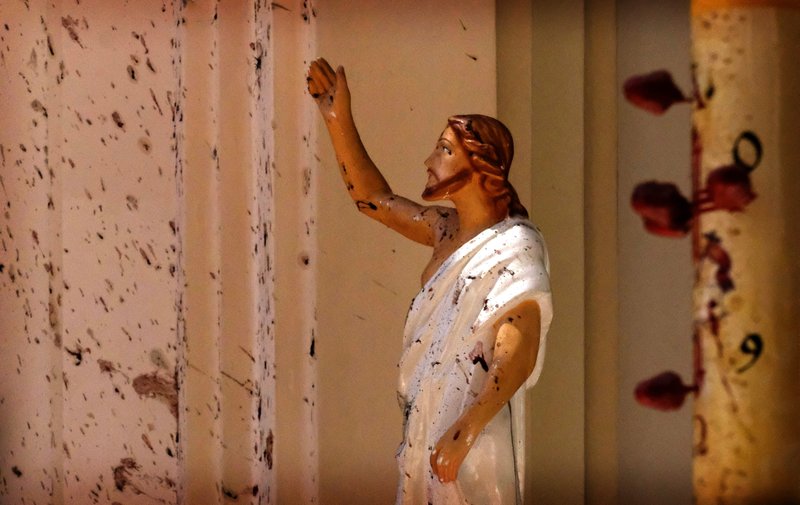
A series of bomb blasts ripped through three churches in Colombo, Negombo and Batticaloa and three luxury hotels in Colombo early Sunday morning.
Bombs exploded at the St. Anthony's Church in Kochchikade, St. Sebastian's Church in Katuwapitiya, Katana, and Zion Church in Batticaloa while hotels Kingsbury, Shangri-La and Cinnamon Grands came under attack.
According to police sources, 27 foreign nationals are among the dead. According to Hospital sources British, Dutch and American citizens had been killed, while British and Japanese nationals are among the injured.
A seventh bomb explosion has been reported at a hotel near the National zoo in Dehiwala this afternoon with police reporting two deaths.
An eighth explosion was reported in a house in Dematagoda. Reports say it was suicide bomber and thatthree people, believed to be security personnel, were killed during a police raid.
The government has imposed a 12-hour curfew from 6 pm Sunday. Schools and universities have been closed and security has been tightened with deployment of Army and Navy troops.
No group has yet claimed responsibility for the attacks.
Pakistan blames Iran-based separatists for deadly Baluchistan attack

By Shamil Shams
Earlier this week, gunmen ambushed a passenger bus in Pakistan's restive Baluchistan province, killing 14 people. It's not the first time Pakistan has blamed Iran-based militants for launching attacks on its soil.
Pakistan's Foreign Minister Shah Mahmood Qureshi told reporters on Saturday that "terrorist outfits" that carried out a deadly attack against armed forces on Thursday had crossed the border from neighboring Iran.
The gunmen reportedly entered the bus, demanded to see everyone's IDs, and then commenced their attack on specific passengers. Those killed included 10 serving the navy, three working with the air force and one with the coastguard. The killings took place when they were traveling in buses on the Makran coastal highway between the southern city of Karachi and Gwadar in the southwest, a key port in China's multi-billion dollar China-Pakistan Economic Corridor (CPEC) project.
"We have shared this actionable evidence with Iran after due authentication, and have identified [the] location of the camps," Qureshi said, adding that the attackers' training and logistic camps were based "inside Iranian areas bordering Pakistan."
Pakistan's foreign ministry urged Tehran to act against the attackers from "a newly founded Raji Aajoi Sangar" separatist group.
The ministry said the "killing of 14 innocent Pakistanis by terrorist groups based in Iran is a very serious incident that Pakistan protests strongly."
The announcement comes a day before Prime Minister Imran Khan starts his two-day visit to Tehran. Foreign Minister Qureshi said that PM Khan would take up the matter with Iranian authorities.
The Baluchistan conflict
Pakistan's Baluch separatists claimed responsibility for the Thursday attack. The insurgents seek Baluchistan's "independence" from Islamabad and are known to target the security services and people from Punjab province, as they tend to make up the bulk of soldiers stationed in their province.
Baluchistan remains Pakistan's poorest and least populous province despite a number of development projects Islamabad initiated there in the past. Rebel groups have waged a separatist insurgency in the province for decades, complaining that the central government in Islamabad and the richer Punjab province unfairly exploit their resources. Islamabad reacted to the insurgency by launching a military operation in the province in 2005.
Separatist groups active in Pakistan's and Iran's Baluchistan provinces, which share a long border, seek independence from both countries.
Baluchistan is also host to a number of projects under the China-Pakistan Economic Corridor project.
In an 2015 interview with DW, Brahamdagh Bugti, leader of the Baloch Republican Party living in exile in Switzerland, and grandson of slain nationalist leader Nawab Akbar Bugti, said that Chinese economic projects in Baluchistan were aimed at "colonizing" the province, and must be resisted.

Friction between Iran and Pakistan
Pakistan has generally tried to maintain close ties with both Saudi Arabia and Iran – bitter regional foes – but has drifted away from Tehran in the past few years.
Ties between the two neighbors have been tense for many years. The two countries have border conflicts, and Tehran is also not very pleased with Islamabad's alleged support to various Sunni militant groups, which have been involved in launching attacks in Iran's eastern areas, and massacring Shiite citizens inside Pakistan.
Pakistan is a key part of a Saudi Arabia-led military alliance, which is at war with Iran-backed Houthi rebels in Yemen.
Security analysts say that Pakistan's support to Saudi Arabia has increased the Sunni-Shiite rift in the South Asian country. They also say that Sunni militant groups feel further emboldened by the fact that Raheel Sharif, Pakistan's ex-army chief, now heads the Saudi-led alliance.
The sectarian strife in Pakistan has been ongoing for some time now, with militant Islamist groups unleashing terror on the minority Shiite groups in many parts of the country. Most of these outfits, including the Taliban, take inspiration from the hard-line Saudi-Wahabi Islamic ideology.
On April 12, militants killed at least 16 people in a powerful blast targeting the Shiite Hazara ethnic minority Baluchistan's capital city Quetta.
Experts say that ties between Iran and Pakistan are likely to deteriorate further with both countries blaming each other for not acting against militants that perpetrate attacks across the border.
Who wants an ‘Islamic President’ in Pakistan and where does Imran Khan fit in?

By Gul Bukhari
Imran Khan’s PTI colleagues are campaigning for a so-called Islamic Presidential System where the Supreme Leader will have absolute power.
Merely eight months into its term, a few members of Imran Khan’s party, PTI, and some ruling establishment-related social media accounts have suddenly started a campaign for “Islamic Presidential System” in Pakistan. This is a curious turn of events for the supporters of Prime Minister Imran Khan, who was feted with high praise as the embodiment of Naya Pakistan just a few months ago.
Now, they are even claiming that Imran Khan is not succeeding and the corrupt politicians remain at large. They say that the present system of parliamentary democracy is fundamentally flawed. They cite the examples of recent pre-arrest bails granted to former Punjab chief minister Shehbaz Sharif and his son Hamza Shehbaz by the Lahore High Court on 8 April, a day before the two were indicted by an accountability court in a corruption case.
As if courts of law do not exist under a presidential system. Or maybe in the utopian system they are putting forth, the President has the absolute power to imprison whomsoever he imagines guilty of corruption. They point towards the US, which gained strength under a presidential system while powers of the Great Britain, which shrunk from an empire to a small country, waned under the parliamentary form of government.
The presidential, or rather the so-called Islamic Presidential System (yet undefined), is being portrayed as one that would allow the Supreme Leader to be all in all, unencumbered by sold-out members of parliament and purchasable senators, who keep a Prime Minister blackmailed with changing loyalties (which is actually a factually incorrect assertion – Pakistani constitution now forbids floor crossing, and a member of the House has to give up his seat and contest election again to join another party).
Two of these are the PTI loyalist tweeps Hanzala Tayyab and Farhan Virk who are notorious for trending hashtags for the military/intelligence agencies.
And their hashtags even entered mainstream electronic media debates and the clueless governor of Khyber Pakhtunkhwa, Shah Farman, endorsed a public referendum on the subject, for which there is no room in the Constitution of Pakistan.
Information Minister Fawad Chaudhry was even forced to dismiss the debate.
A star genius, who goes by the title of ‘economist’, and whose solution to every economic problem of Pakistan was Imran Khan bringing back $200m black money stashed abroad, is even tweeting a slide of made-up numbers to demonstrate how Pakistan’s GDP growth was always far superior under Presidents Ayub Khan, Muhammad Zia-ul-Haq, and Pervez Musharraf. Farrukh Saleem is the one who used to keep attacking the previous government with corruption allegations and advices Imran Khan’s Pakistan Tehreek-e-Insaf (PTI) and the ruling establishment now.
As if for each one of Generals Zia and Ayub’s 11-year stints, the economy grew at exactly 7 per cent. Notwithstanding the fact that the growth rates shown in the chart are fictitious, the gent ‘economist’ ignores the fact that Ayub benefited from entering the SEATO-CENTO alliance and the aid it consequently brought, whereas the other two benefited from war economies with aid dollars flowing in from the US. Fascinatingly, his chart stops at 2012, and doesn’t bother to show the five years of Nawaz Sharif government’s period of growth under the same parliamentary system that he was putting down through incorrect figures.
These actors created widespread confusion in Pakistan with their posts because as they have represented both the PTI and the establishment in the past. But their new campaign for presidential government have not been endorsed either by Imran Khan or any other important member of his party or cabinet. They haven’t even used the current parliamentary system as an excuse for their failures. More significantly, if by some magic, such a presidential system is imposed on Pakistan, it will not be designed to make Imran Khan the Khalifa President with absolute powers. Instead Gen (retd) Raheel Sharif’s name is being bandied about. Hence it has rightly provoked a reaction from the government’s spokesperson Fawad Chaudhry.
Senior political analysts see this as institutional memory and the undying wish, of the establishment to rule Pakistan as one unit with an iron fist. However, not only has this dream met with stiff resistance from mainstream political parties and the country’s intelligentsia, it is unlikely to find favour with the PTI as well.
PMLN member of the National Assembly Shaista Pervaiz said, “After attempting to paint a donkey as a zebra by painting white lines on it, shenanigans of presidential system have been started”. Senior journalist Murtaza Solangi’s reaction was, “you might as well just impose martial law”.
I reminded Hamza Ali Abbasi of Pakistan’s history thus, “Dear genius, shall I tell you a secret? Bangladesh came into existence in the period of “President” Yahya’s Presidential System.”
Bilawal Bhutto Zardari, leader of the People’s party, has repeatedly rejected the notion outright, saying it’s a formula for further breakup of the country.
In final analysis, it appears that this particular adventure neither has any constitutional way forward, nor a majority in Parliament to support it. Nor has it found any supporters even in the establishment’s own puppet setup in power, except a few trolls who will create and trend any fake trend they are ordered to.
Genocide Of Hazara community in Pakistan - Hazara community

Adnan Aamir

Despite some internal political divisions, the sit-in by the Hazara community after the recent attack in Quetta forced many political actors in the country to sit up and take notice, proving the community’s resolve.
On Friday April 12, a convoy of vehicles left from Hazara town, Quetta for the Hazar Gunji vegetable market. It was early in the morning. Escorted by security forces, the convoy was transporting Hazara vegetable vendors to the Hazar Gunji Bazaar. Hazara shopkeepers regularly stock vegetables and fruit from the Hazar Gunji Bazaar to then sell in their own shops in Hazara Town. For the last few years, they have been escorted by police and FC to and from the Hazar Gunji due to incessant attacks on the Hazara community.
Moments after they reached the market, a loud bang was heard from a green grocer’s shop. Initially, the police claimed that it was an Improvised Explosive Device (IED) that was planted in a gunnysack filled with potatoes. Later on, however, Home Minister of Balochistan, Zia Langove, confirmed that it was a suicide attack.
This was yet another targeted attack on the Hazara community. The blast claimed the lives of 20 people and left at least 48 injured. Eight of the deceased belonged to the beleaguered Hazara community — vegetable vendors who were there just to earn a livelihood for their families — the remaining 12 were bystanders, shopkeepers and pedestrians. The responsibility of the attack was claimed by the Qari Husain faction of the Tehreek-e-Taliban Pakistan (TTP) as well as the militant Islamic State (IS) group.
According to a report released by the National Commission for Human Rights (NCHR), Understanding the Agonies of Ethnic Hazaraz, a total of 509 Hazara were killed in Quetta from January 2012 to December 2017. In April 2018 alone, Hazaras were targeted in four different attacks. On April 28, 2018, two Hazara shopkeepers were gunned down, after which the very first woman lawyer from the Hazara community, Advocate Jalila Haider, went on a hunger strike. Her protest gained considerable attention on social media, resulting in the then Army Chief travelling to Quetta to assure the Hazara community of an increase in security measures. Friday’s blast was the first attack since.
This attack was widely condemned by different sections of the society while exposing the environment of fear that still engulfs the daily lives of the Hazara community. Human Rights Commission of Pakistan (HRCP) stated in a press release that this attack reflects a deeper sectarian problem that will not be resolved until the state makes a concerted effort to eliminate militancy and religious extremism.
Hours after the latest attack and before bodies of the slain Hazara vegetable vendors were buried in the native Hazara town graveyard, the Hazara community began a sit-in on one end of the Western Bypass road of Quetta — the road that connects Hazara Town with Hazar Gunji. Led by Tahir Khan Hazara, the leader of Hazara Siyasi Karkunan (HSK), the sit-in was joined by many members of the Hazara community, including Jalila Haider.
On the very first day of protest, three cabinet members of the Balochistan government visited the camp and asked Tahir Khan Hazara to end the protest. In return, Tahir Hazara chastised the cabinet members for their failure and powerlessness and refused to end the protest. His response to the cabinet members, recorded on video, went viral on social media and increased interest in the sit-in, that continued for a further four days.
In the past Balochistan government has been in a state of denial about the existence of the IS in Balochistan even when this group claimed responsibility for the July 13, 2018 attack in Dreengarh, which killed over 200 people.
Leaders from many political parties of Balochistan visited the camp in a show of solidarity. At the same time, the speeches of Tahir Hazara and other activists were streamed live via social media. This resulted in putting immense pressure on the government. On April 15, Balochistan Chief Minister Jam Kamal and Interior Minister Shehryar Afridi visited the camp to assure Tahir Hazara of increased measures by the government to protect the Hazara community. The talks were successful and as a result, the sit-in was called off by the leader of HSK.
The next day, President of Pakistan Arif Alvi and Pakistan People’s Party (PPP) Chairman Bilawal Bhutto-Zardari also reached Quetta to condole with the families of slain Hazaras.
This protest was a significant one as it not only proved the resolve of the Hazara community but also highlighted the apparent internal divisions within the community. Led by Tahir Khan Hazara, the sit-in was disowned by two other major Hazara political parties: Hazara Democratic Party (HDP) and Majlis-e-Wahdat-e-Muslimeen (MWM). It was obvious why HDP distanced themselves from this protest as they are currently a part of CM Jam Kamal’s cabinet.
However, some people within the Hazara community questioned the protest and termed it a publicity stunt. Hassan Raza Changezai, an author and cultural critic, believes that it was “Tahir Khan’s right to stage a protest” but is critical of the way it was carried out. About the political ramifications of this protest, Changezai says, “HSK will not get any political mileage from this sit-in protest despite its success”.
Shahzada Zulfiqar, a senior journalist based in Quetta, shares similar views. He believes that as a result of this protest, Tahir Khan Hazara will gain prominence as a leader of the Hazara community but it will not automatically translate into political support. However, he agrees with the assertion that despite the internal divisions within the Hazara community the sit-in protest was successful in giving a loud message: the community will protest if it’s attacked.
The Hazar Gunji attack is a grim reminder about the deterioration of the security situation in Balochistan. In recent months terror attacks have increased in the Pashtun belt of Balochistan; with the recent attack on Hazaras and a few days later the attack on select passengers in a bus going down the Karachi-Gawadar route, is a continuation of that trend. As per analysts, what is more worrying is the fact that the responsibility for this attack was claimed by IS. In past the Balochistan government has been in a state of denial about the existence of IS in Balochistan even when this group claimed responsibility for the July 13, 2018 attack in Dreengarh, which killed over 200 people including the Balochistan Awami Party (BAP) leader Siraj Raisani. CM Balochistan termed the recent attack on Hazaras as a reaction to the fencing of the Afghan border. He claimed that steps taken by the government to protect the Afghan border from infiltration would control terrorism in the province.
Syed Fakhar KaKaKhel, a senior journalist who covers the conflict in Pakistan, says that the entire Muslim world is facing the menace of sectarian conflict in one form or the other. “Ethnic and sectarian fault lines in Balochistan make it easy for hostile spying agencies to exploit the situation in Balochistan”. He believes that attacks on the Hazara community are a continuation of regional hostilities. “In the Hazar Gunji attack people from all sects died but it was made a sectarian issue deliberately,” he claims.
Changezai believes that attacks on Hazaras will not end until the government does not change its policies. “Pakistan has to review its policy in terms of dealing with certain foreign countries in order to put an end to attacks on Hazaras in Quetta,” he claims. However, the Hazar Gunji attack and the subsequent protest proves that if violent attacks continue to be inflicted on Hazaras, they will be met with strong protests. Not only will the community protest but it will also get the support of all other communities dwelling in Quetta.
“This protest has put huge pressure on both federal and provincial governments to take action to protect Hazaras,” says Zulfiqar. He adds, “Now the government will be compelled to prevent attacks on the Hazara community to avoid dealing with protests by them in the future.”
The protest staged by Tahir Khan Hazara achieved a remarkable feat, among other things: it united the citizens of Quetta from all ethnic and sectarian denominations.
Chairman PPP Bilawal Bhutto Zardari felicitates Christian Community on the occasion of Easter
Pakistan People’s Party (PPP) Chairman Bilawal Bhutto Zardari has on the occasion of Easter felicitated the Christian Community.

In his message, the PPP Chairman said, “I felicitate the Christians on the occasion of their highly esteemed rituals of the Easter from the core of my heart.”
Pakistan is a country like Rainbow where different colours of religion, races and ethnic groups live peacefully together, said Bilawal Bhutto Zardari and adding, the role of the Christian community in Pakistan’s progress and development is thousand fold of their numbers.
He said that the founder of Pakistan Muhammad Ali Jinnah had declared that the religious minorities in Pakistan would have and enjoy equal rights with complete religious freedom.
Pakistan’s unanimously passed constitution under Shaheed Zulfikar Ali Bhutto’s fully guarantees the protection of rights of the minorities in Pakistan, the PPP Chairman said.
Bilawal Bhutto Zardari assured the Christian and other religious minorities that the PPP would never compromise on laws based on religious discriminations and would always defend the religious minorities.
Need of inter-religious and inter-faith harmony stands on top today more than ever, PPP Chairman added.
He said that the presence of weapons of mass destruction, intolerance and a tendency to enforce the military powers in the world are a direct and serious threat to human race.
He appealed to the Christian community to pray for Pakistan’s integrity, peace, progress and prosperity today.
https://mediacellppp.wordpress.com/2019/04/21/chairman-ppp-bilawal-bhutto-zardari-felicitates-christian-community-on-the-occasion-of-easter/

In his message, the PPP Chairman said, “I felicitate the Christians on the occasion of their highly esteemed rituals of the Easter from the core of my heart.”
Pakistan is a country like Rainbow where different colours of religion, races and ethnic groups live peacefully together, said Bilawal Bhutto Zardari and adding, the role of the Christian community in Pakistan’s progress and development is thousand fold of their numbers.
He said that the founder of Pakistan Muhammad Ali Jinnah had declared that the religious minorities in Pakistan would have and enjoy equal rights with complete religious freedom.
Pakistan’s unanimously passed constitution under Shaheed Zulfikar Ali Bhutto’s fully guarantees the protection of rights of the minorities in Pakistan, the PPP Chairman said.
Bilawal Bhutto Zardari assured the Christian and other religious minorities that the PPP would never compromise on laws based on religious discriminations and would always defend the religious minorities.
Need of inter-religious and inter-faith harmony stands on top today more than ever, PPP Chairman added.
He said that the presence of weapons of mass destruction, intolerance and a tendency to enforce the military powers in the world are a direct and serious threat to human race.
He appealed to the Christian community to pray for Pakistan’s integrity, peace, progress and prosperity today.
https://mediacellppp.wordpress.com/2019/04/21/chairman-ppp-bilawal-bhutto-zardari-felicitates-christian-community-on-the-occasion-of-easter/
Beg, borrow, repeat: Pakistan’s IMF addiction continues even as its finance minister leaves

HUSAIN HAQQANI
Pakistan’s military-driven economic decision-making is based on ‘Jazba’ and 'Chanda'.
As Pakistan’s finance minister, Asad Umar, stepped down within a couple of days of announcing that Pakistan will soon get its 13th IMF bailout in 30 years, it is safe to speculate that the discussions with the IMF are not going as well as Pakistanis would like. Umar’s departure from Imran Khan’s cabinet has come in a virtual coup that has brought military favourites from previous regimes into office.
The Pakistani military has a view on everything, including management of the economy, although military officers are not trained in economic matters. The generals who really rule Pakistan cannot accept that the country’s resources cannot sustain an over-sized military and the periodic wars it initiates. Nor do they see the connection between their preferred policies, such as support for Jihadi terrorism, and declining investment or foreign trade.
Under the generals’ influence, Pakistan prides itself as a warrior nation. Investors and traders are looked down upon although in prosperous countries they are seen as drivers of economic growth and prosperity. Politicians and civil servants are frequently sent to prison for signing projects with foreign investors, along with cancellation of those contracts.
Tax collection remains low because land-owning politicians, often beholden to the military, do not agree to paying taxes. Loss-making public sector corporations, which provide lucrative post-retirement jobs to military officers, are neither shut down nor sold off even though their privatisation has been part of the promised reforms offered each time Pakistan borrows from the International Monetary Fund (IMF).
Economies grow amid stability, rule of law, enforceability of contracts, and security for both capital and the capitalists. None of those are available in Pakistan. Instead, policies are often driven by myths, such as the notion that billions of dollars of ‘ill-gotten money’ belonging to Pakistanis is lying in foreign banks that can be confiscated and repatriated by an ‘honest’ (read pro-army) leadership. Or, the fantasy that multi-billion-dollar projects like huge dams can be built by raising donations from well-meaning Pakistanis.
Pakistan’s military-driven economic decision-making is based on ‘Jazba’ (passion, spirit, and strong feeling or emotion) and Chanda (donations). In economic matters, Prime Minister Imran Khan has been a civilian advocate of the Pakistan military’s simplistic paradigm. His assurances to Pakistanis that they should not worry – “Aap nay Ghabrana Nahin hai”— have become a joke or a legend, depending on which side of Pakistan’s political divide one stands.
But economists look at hard numbers and are seldom swayed by the belief that God makes special provision for nations led by honest patriots. That is why Khan had to beg for $10 billionfrom Saudi Arabia, China, and the UAE to stave off a balance of payments crunch soon after coming to office in the hope that this would preclude his government from having to go to the IMF. That money is now running out.
Turning to the IMF is the economic equivalent of a sick individual being in intensive care. Considering that Pakistan has spent 22 years in the last three decades in the IMF’s intensive care, the country’s economy obviously suffers from some serious ailment. This might be the time to reflect on the source of the disease rather than focusing on the symptoms of the latest bout of illness.
Pakistan has battled budget and trade deficits for years. Its exports and tax revenues have failed to increase sufficiently, and its foreign currency reserves have never risen beyond the value of a few months’ imports. Pakistan has often borrowed heavily to make up for insufficient revenues and exports, increasing sovereign debt. In recent years, that has led to onerous external debt payments and a weak rupee.
Pakistan’s repeated knocks on the IMF’s door come whenever the country faces a balance of payments crisis. Pakistan has borrowed from the IMF 18 times since 1972. Compare that with only 10 IMF loans for Bangladesh in the same period. Pakistan’s IMF borrowings ran to an estimated $19 billion, while Bangladesh’s dealings with the IMF were a modest $2.7 billion. With rising exports, Bangladesh has not sought help from the IMF since 2015.
The comparison with Bangladesh is important because Pakistan’s Punjabi elite looked down on what was their country’s Eastern wing from 1947 until the Bengalis successfully fought for independence in 1971. On the eve of its independence, Bangladesh was more populous, more illiterate, and much poorer than Pakistan. It now has a smaller and more literate population and its GDP, which stood at $6 billion in 1972, has grown to over $249 billion.
While Pakistan invested in its army and nuclear weapons, Bangladesh invested in its people. Its literacy rate rose from 17 per cent in 1971 to 72 per cent in 2016, putting Pakistan’s 58 per cent literacy rate in 2018 (up from 22 per cent in 1971) to shame. The more literate Bangladeshis create a better human capital pool, which in turn allows their country to produce value-added goods.
While Pakistan still sells cotton yarn to the world, Bangladesh exports garments that fetch higher prices. Literate Bangladeshi tailors produce garments that meet foreign buyers’ specifications; as a result, cotton textile exports of Bangladesh, which does not produce cotton, exceed in value against those from Pakistan, which is one of the world’s major cotton producers.
Instead of addressing these fundamental issues, Pakistan’s generals constantly search for a well-connected international banker, multi-national corporation executive, or a former World Bank official who would straighten Pakistan’s balance sheet with a few more loans or donations. That keeps the Jazba and Chanda cycle going but does not create a healthy economy.
Just before he was forced to quit, finance minister Umar had been quoted in the magazine Euromoney, promising to end Pakistan’s addiction to the IMF. Ironically, the same magazine had cited General Pervez Musharraf’s finance minister, Shaukat Aziz, making the same promise while anointing him as ‘Finance Minister of the Year’ in 2001.
Euromoney, which has sometimes been accused of “surviving on soft advertorial” and whose “various annual awards seemed weighted towards clients that had bought the most advertising” also saw “encouraging signs of a sustainable period of growth” in Pakistan’s economy in April 2017, just before General Qamar Bajwa pulled the rug from under former Prime Minister Nawaz Sharif’s feet.
If the army’s meddling did not allow previous IMF programmes to pave the way for sustainable economic growth in the past, it is unlikely that their latest efforts at engineering will result in anything better.
A new finance minister might be able to borrow money from the IMF on different terms than the outgoing one. But at the end of the day, Pakistan will have to address its huge military burden, poor social indicators, and unreliable investment climate or remain on life support.
Saturday, April 20, 2019
Runaway Saudi Sisters Plead for Help on Social Media

Using a newly created Twitter account called “GeorgiaSisters,” they identified themselves as Maha al-Subaie, 28, and Wafa al-Subaie, 25. Like other Saudi women who have fled and turned to social media, they posted copies of their passports to establish their identities.The sisters claim they are in danger and will be killed if they are forcibly returned to Saudi Arabia. They said their father and brothers have arrived in Georgia looking for them. Wafa said they fled “oppression from our family” without elaborating.
Saudis can enter Georgia visa-free, making the country a transit point for numerous other Saudi women who have fled in recent years.
Guardianship laws
Saudi women who run away are almost always fleeing abusive male relatives and claim there are few good choices for them to report the abuse in Saudi Arabia. Saudi women caught running away in the kingdom can be forced into restrictive shelters, pressured to reconcile with their abusers or detained on charges of disobedience.
Regardless of their age, women in Saudi Arabia must have the consent of a male relative to obtain a passport, travel or marry under so-called male guardianship laws.
The sisters’ first post to the Twitter account was Tuesday evening. It read: “We are two Saudi sisters who fled from Saudi Arabia seeking asylum. Yet, the family and the Saudi government have suspended our passports and now we are trapped in Georgia country. We need your help please.”
Remember us
In another post, the sisters appear with their faces showing and their hair uncovered — a taboo for conservative families in Saudi Arabia. The post says they are showing their faces in order for the world to “remember us” in case something happens to them.In a later video posted on Twitter, Maha said: “We want your protection. We want a country that welcomes us and protects our rights.”
Her sister posted another video calling for help from the U.N. refugee agency.
“We fled oppression from our family because the laws in Saudi Arabia (are) too weak to protect us. We are seeking the UNHCR protection in order to be taken to a safe country,” Wafa said.The sisters did not give further details on why they have fled. The Associated Press could not immediately reach the sisters in Georgia. A Saudi activist who goes by the name Ms Saffaa told the AP that she and other activists have had direct contact with the sisters in Georgia.
Other, similar cases
Their cases mirror that of 18-year-old Rahaf Mohammed al-Qunun, who in January drew worldwide attention when she barricaded herself in an airport hotel room in Bangkok after fleeing her Saudi family during a trip to Kuwait. Her social media pleas on Twitter prompted quick action by the UNHCR and she was granted asylum in Canada.
There had been speculation that al-Qunun’s successful getaway would inspire others to copy her, but powerful deterrents remain in place. If caught, runaways face possible death at the hands of relatives for purportedly shaming the family.
The issue of male guardianship is extremely sensitive in the kingdom, where conservative, tribal families view what they consider to be the protection of women as a man’s duty.
https://www.voanews.com/a/runaway-saudi-sisters-plead-for-help-on-social-media/4879358.html
Western hypocrisy on Khashoggi is shameful
By Tariq A. Al Maeena

Saudi Arabia has gone out of its way to bring to book those involved in the grisly murder.
One day last October a brutal murder took place within the premises of the Saudi Consulate in Istanbul, Turkey. It was a murder so grotesque that its aftermath reverberated with revulsion around the globe. Jamal Khashoggi, a Saudi journalist who had entered the consulate on some business pertaining to the impending marriage to his Turkish fiancee was never to leave the premises alive.
Rogue elements within the Saudi government had intercepted Khashoggi while inside, and though the details are still being investigated, the journalist was subjected to interrogation and treatment that led to his unlawful death. Within minutes of the event, the previously obscure Khashoggi became known to the entire world as details of his encounter began to filter out.
The wave of charges and criticism against Saudi Arabia also began in an unprecedented manner. Governments from the US, Canada and the capitals of Europe were howling for blood, Saudi blood!
And while the Saudi leadership stated at the time that all those involved in this unacceptable act would be brought to justice, it was met with scepticism and there were few takers from the western world.
The crescendo of voices had forced many international businesses to re-evaluate their relationship with the kingdom, with some of them downsizing their investments, while others pulling out altogether.
Saudi has been continually under a malicious attack that has shown no signs of abating. Calls for the murder to be investigated by the UN and the International Criminal Court (ICC) too appeared. The loudest shrills for swift justice were those being heard within the US government. One man, one murder, and the western world reacted.
Justice blocked
Now fast forward a few months past that sordid day. Last month US Secretary of State Mike Pompeo stated that the US would deny or revoke entry visas to any members of the International Criminal Court who may try to investigate any war crimes or prosecute the guilty for abuses committed by US personnel in Afghanistan and elsewhere.
His threats also included ICC members who may be doing the same for the criminal acts carried out by Israelis.
He justified his actions by stating, “We are determined to protect the American and allied military and civilian personnel from living in fear of unjust prosecution for actions taken to defend our great nation. These visa restrictions may also be used to deter ICC efforts to pursue allied personnel, including Israelis, without allies’ consent.”
He made good on his threat a few days later when the US revoked the visa of the International Criminal Court’s chief prosecutor because of her attempts to investigate allegations of war crimes in Afghanistan, including any that may have been committed by American forces.
And just last week, the US administration again included Israelis along with Americans as deserving immunity from International Criminal Court prosecution for war crimes.
Commenting on the ICC rejection of a request to investigate US personnel for actions in Afghanistan, the White House released a statement saying, “Since the creation of the ICC, the United States has consistently declined to join the court because of its broad, unaccountable prosecutorial powers; the threat it poses to American national sovereignty; and other deficiencies that render it illegitimate. Any attempt to target American, Israeli, or allied personnel for prosecution will be met with a swift and vigorous response.”
Wait a minute. Something does not add up. One the one hand you are baying for the blood of Saudi Arabia for the death of one man, and on the other, you are callously shielding countries like Israel whose daily count of war crimes against innocent civilians goes largely unnoticed or unreported!
And even it does and a criminal Israeli is caught, he is soon released as was the case of Elor Azaria, the Israel Forces medic who cold bloodedly shot a Palestinian in the head when he was wounded and immobilised on the ground, in the occupied West Bank city of Hebron. A medic no less, trained to save lives, but in Israel trained to kill Palestinians. Three months’ detention was all that he had to put up with while the victim’s family will live the rest of their lives mourning their loss.
Such events are an everyday fact in Israel, and with the US throwing a blanket cover, they are bound to increase.
Trump’s veto over Yemen is a scandalous abuse of presidential power

Simon TisdallThe US could have distanced itself from a murderous war. Instead, Trump’s unholy alliance with the Saudis continues.
Expected or not, Donald Trump’s veto of a bipartisan Congressional resolution to end US military involvement in Saudi Arabia’s murderous war in Yemen is an outrage. It will prolong the unspeakable suffering of millions of Yemeni civilians, the blameless victims of Riyadh’s vicious proxy war with Iran and its Houthi allies.
Yet Trump’s uncaring arrogance also threatens the US itself. It is further proof that the constitution’s famous checks and balances are just not working, and that, post-Mueller, this unworthy president is raging dangerously out of control.
Trump ’s stated reasons for the veto ranged from specious to risible. He claimed to be protecting American citizens – even as he denied directly assisting the Saudis and said there were no US regular troops in Yemen. So which is it? The Americans Trump referred to, mostly resident in Gulf states that back the Saudi-led coalition, were at risk from Houthi “explosive boats”, he said. They may also face danger when transiting Riyadh airport. In reality, no US citizen is obliged to brave such shocking perils, and very few have.
Yet Yemen’s civilians have no choice.They need not leave their houses to be killed or maimed by Saudi air force bombers, assisted by US advisers. “Yemen is at breaking point, with 10 million people on the brink of famine. There are as many as 100 civilian casualties per week, and Yemenis are more likely to be killed at home than in any other structure,” said David Miliband, head of the International Rescue Committee. Trump’s veto is a “green light”for further atrocities, he warned.
Far from protecting presidential rights and prerogatives, Trump is abusing them. He tried it on again earlier this year, when he declared a fatuous, anti-migrant “national emergency” at the Mexican border – and Congress could not stop him. This week, Trump had a chance to do the right thing, said Ro Khanna, the California Democrat who sponsored the original Yemen resolution. Instead, he had “failed to uphold the principles of the constitution”.
Why is the US Congress, which counts itself an exemplary global democratic paragon, apparently so impotent in the face of such abuses? There are echoes of Westminster here. What do these many hundreds of elected politicians, regardless of party affiliation, think they are doing to earn their pay? How did the US arrive at a situation in which an ignorant, irresponsible, arguably corrupt chief executive exercises such arbitrary power? Trump rides roughshod over the people’s tribunes. And they, with valiant exceptions, let him. King George was a pushover by comparison.Congress should now move heaven and earth, in the name of Yemen’s starving children and the majority of Americans who oppose the Saudis’ war, to override Trump’s veto. The firm expectation that it will fail to do so reflects a broader failure to properly police the corrosive Trump-Saudi relationship. The oleaginous friendship between Trump and the Saudi crown prince, Mohammed bin Salman, encompasses far more than an irrational desire for continued carnage in Yemen.It started in 2016-17, when Saudi and other Middle East nationals were first suspected of funnelling illegal donations to Trump’s campaign and inaugural committee. A Trump-owned hotel in Washington profited from Saudi business. The relationship flourished as greenhorn Trump bought into the Saudi-Israeli narrative that Iran, not Russia, was the number one international threat. Riyadh, not coincidentally, hosted Trump’s first trip abroad as president.
Trump and the Saudis have since found common cause not just over Iran, and by association Yemen and Syria, but also over Palestine. The long-delayed, much-hyped “peace plan” by Trump’s son-in-law, Jared Kushner, reportedly pivots on the injection of massive financial investments by the Saudis and other wealthy Arab states. The cash would be used to “buy” Palestinian acquiescence in the permanent loss of large parts of the West Bank and their dream of a viable, fully independent separate state.
Trump’s Saudi-Israeli axis also extends to apparently quid pro quo talks to furnish Riyadh with technological capabilities that could, in theory, enable it to produce nuclear weapons – supposedly to counter Iran. In February an interim report by Democrats on the House oversight committee revealed that Trump relatives, senior officials and business cronies had secretively pursued a potentially multibillion-dollar deal – without reference, at that point, to Congress or the International Atomic Energy Agency.
Trump’s self-serving obeisance to like-minded Saudi autocrats led him to become apologist-in-chief for the brutal murder of the Saudi journalist, Jamal Khashoggi. It has emboldened him to ignore other egregious human rights abuses, such as the torture of Saudi women’s rights campaigners currently held in jail.
All this is rendered ever more alarming by Trump’s now systemic, vandalistic contempt for international law. Last week his administration revoked the US visa of the chief prosecutor of the international criminal court, who had been inquiring into alleged US war crimes in Afghanistan. More significantly, his recognition of Israeli sovereignty over the Golan Heights – a blatant pre-election gift to his fellow “strongman” Benjamin Netanyahu – blew apart international legal norms embodied in UN resolutions.
It’s all of a piece – and Trump’s grubby Yemen veto is but the latest proof. Let’s face it. This worst-ever American president, led by the nose by the Saudis, bedevilled by greed and hubris, is a threat to the world and his own country. He has gone rogue. So when will Americans bring him to heel?
Subscribe to:
Posts (Atom)