Monday, January 7, 2019
#SaveRahaf - Rahaf al-Qunun: Saudi woman under UN protection as Australia urges asylum claim

Helen Davidson
An 18-year-old Saudi woman who barricaded herself in a Bangkok airport hotel room to prevent her forcible return to a family she claims will kill her, has been taken under the protection of the UN high commissioner for refugees in Thailand.Thai authorities say 18-year-old will not be forced to return with her father to the Middle East, where she claims her family will kill her
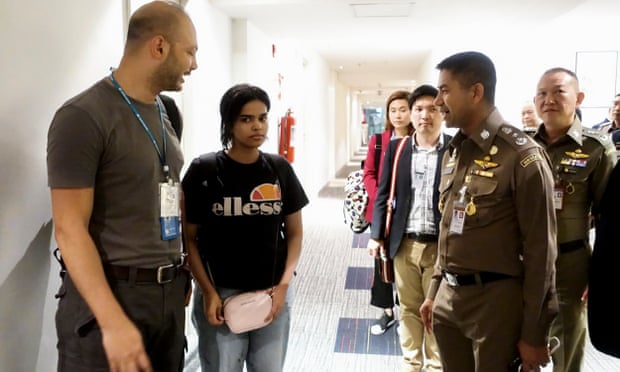
The Australian government said on Monday night Rahaf Mohammed al-Qunun’s situation was “deeply concerning” and it had lobbied the Thai government and the UNHCR to allow her to formally claim asylum.
She demanded access to the UNHCR and barricaded herself inside her hotel room in fear she would be forced on to a plane after Kuwait Airways officials had come to her door, but Monday’s 11.15am flight departed without her.
Qunun was detained on arrival at Bangkok and denied entry to Thailand while en route to Australia, where she said she intended to seek asylum. The Guardian confirmed on Monday Qunun had a valid three-month tourist visa for Australia, issued to her Saudi passport. Qunun said she was abducted after arriving in Bangkok and had her passport confiscated by Saudi Arabian diplomatic staff.
The head of Thailand’s immigration police, General Surachate Hakparn, had previously said Qunun would be sent back to Saudi Arabia because she was “unsafe” without a guardian in Thailand, and claimed she did not have the documentation to go on to Australia.
But late on Monday he promised she would not be deported and agreed to consult the UNCHR. He later said she had been taken to a safe house for her asylum claim to be processed.
“If she goes home it will be dangerous for her so Thailand is ready to help,” he told media. “We are working with the foreign affairs ministry and UNHCR and today we will allow her entry to Thailand. UNHCR is now taking care of her and working on her asylum claim.”
Surachate said Qunun’s father was due to arrive in Bangkok on Monday night and that officials would establish whether she wanted to return to the Middle East with him. “As of now, she does not wish to go back and we will not force her. She won’t be sent anywhere tonight,” he told reporters. “Thailand is a land of smiles. We will not send anyone to die.”
Qunun confirmed on Twitter she was under the protection of the UNHCR and her passport had been returned.
A spokeswoman for the UNHCR, Melissa Fleming, confirmed the organisation’s Bangkok protection team was meeting Qunun. “UNHCR has been following developments closely and immediately sought access from the Thai authorities to meet with Rahaf to assess her need for international protection,” she said. “UNHCR consistently advocates that refugees and asylum seekers – having been confirmed or claimed to be in need of international protection – cannot be returned to their country of origin according to the principle of non-refoulement.” She said the UNHCR could not comment on the outcome of the meeting, for confidentiality reasons.
The Australian Department of Foreign Affairs said it was monitoring the case closely.
“The claims made by Ms Al-Qunun that she may be harmed if returned to Saudi Arabia are deeply concerning,” a spokesman said on Monday night.
“The Australian embassy in Thailand has made representations to both the Thai government and the Bangkok office of the UNHCR to seek assurances that Ms Al-Qunun can access the UNHCR’s refugee status determination process in Thailand.”
Qunun said in a video posted on social media from inside the airport that she was trying to escape from her family because they subjected her to physical and psychological abuse. She has appealed for help from Europe, the US, Canada and Australia.
“I am Rahaf … I am in the hotel, I need a country to protect me as soon as possible. I am seeking asylum,” said Qunun, who fled Kuwait while her family was visiting the Gulf country. “My family is strict and locked me in a room for six months just for cutting my hair,” she said, adding that she was certain she would be imprisoned if sent back. “I’m sure, 100%, they will kill me as soon as I get out of the Saudi jail,” she said.
Her case has brought international attention to the obstacles women face in Saudi Arabia. The kingdom also faces intense scrutiny over the murder of journalist Jamal Khashoggi, which has renewed criticism of its human rights record.A 20-year-old friend of Qunun, whom the Guardian has chosen not to name and who recently moved from Saudi Arabia to Australia, said the threats to her were real. “She’s ex-Muslim and has a very strict family. They’re using violence with her and she faced sexual harassment,” she said. “She received a threat from her cousin – he said he wants to see her blood, he wants to kill her.
“If they didn’t kill her they couldn’t go [around in] public after this [Qunun renouncing the Muslim faith], so they have to do it,” the friend said. “It’s like: if you’re a man you should prove it. If they don’t kill her they can’t go outside and see other men.”
Qunun’s friend has lived in Australia for three months, and said she was seeking asylum there after being abused in Saudi Arabia. She said she had known Qunun for a year, after connecting with her online. “She’s an activist, she’s a feminist,” she said. Sarah Hanson-Young, a Greens senator from South Australia, called on Australia to act quickly to issue Qunun with emergency travel documents.
A Saudi teen fled her family to seek asylum abroad. Now the whole world is watching.

By

The 18-year-old escaped to Thailand and barricaded herself in hotel room, demanding to speak to United Nations officials.
An 18-year-old Saudi woman has drawn international attention after barricading herself inside a Thailand airport hotel room and demanding asylum, claiming that she feared for her life if she returned to her family.
“I’m not leaving my room until I see UNHCR,” Rahaf Mohammed Alqunun said in a video posted on Twitter late Sunday, referring to the United Nations High Commissioner for Refugees, the international organization in charge of refugees. “I want asylum.”
The Saudi teen says she fled from her family, who had been vacationing in Kuwait. She was able to board a flight to Thailand, intending to seek asylum in Australia.
But Thai authorities intercepted Alqunun when she arrived in Bangkok, where Alqunun says they took her passport. Thai officials, in apparent cooperation with Saudi Arabia, planned to put her on a flight and deport her back to her family in Kuwait.
Alqunun instead barricaded herself in her airport hotel room on Sunday, refusing to leave unless she could meet with the Office of the United Nations High Commissioner for Refugees (UNHCR) to make her case for asylum.
She launched a furious campaign on social media, amplified by activists and human-rights organizations.
Her calls were eventually answered: UNHCR officials met with Alqunun on Monday, and Thai authorities have, for now, halted deportation proceedings against her.
“The Thai authorities have granted UNHCR access to Saudi national, Rahaf Mohammed Al-qunun, at Bangkok airport to assess her need for international refugee protection,” UNHCR said in a statement. “UNHCR has been following developments closely and immediately sought access from the Thai authorities to meet with Ms. Mohammed Al-qunun, 18, to assess her need for international protection.”
Alqunun remains in Thailand as human-rights officials evaluate her claims, which could take up to 10 days, Thai officials told the New York Times. (UNHCR hasn’t given any details about the discussions, citing confidentiality reasons.)
“Today really was a good day for the cause of human rights around the world, with Rahaf’s tremendous courage and resilience being met with a global surge of sympathy for her,” Phil Robertson, the deputy Asia director for Human Rights Watch, told the New York Times. “It all came together to persuade Thailand to do the right thing.”
Rahaf Mohammad says her family will torture her if she returns to them
Alqunun is live-tweeting her saga as it unfolds, posting desperate pleas for protection and documenting her resistance.
Alqunun has said that she slipped away from her family in Kuwait because she faced oppression, and possibly torture at home. “I don’t have rights in Saudi Arabia, and my family treated me so bad,” Alqunun told the BBC.
She told the New York Times that her life in Saudi Arabia was like a “prison,” where she faced verbal and physical abuse at the hands of her family:
Alqunun said she’d been plotting her escape since she was 16, but couldn’t travel on her own because Saudi Arabia requires women to obtain the consent of a male guardian (typically a father or other immediate male relative) to obtain passports and travel outside the country.Kuwait doesn’t have those same rules, so she seized the opportunity to slip away and seek safety.
Now Alqunun is fearful that she will face torture or death if she’s returned to her family because she’s disgraced them and has denounced Islam — a crime in Saudi Arabia for which she could be prosecuted. She even posted a screen shot of a death threat, which she claims is from a cousin. (The Twitter account she references has since been deleted.)
The arrival of UNHCR officials secured Alqunun a temporary reprieve, but her fate is far from secure. In a recent update, she posted on Twitter that her father had just arrived in Thailand, but said “at least I feel save [sic] under UNHCR protection with the agreement of Thailand authorities. And I finally got my passport back.”
Thai officials had originally claimed that they stopped Alqunun because she didn’t have a hotel reservation or a return ticket.
Thailand, which is ruled by a military dictatorship, has come under pressure for its willingness to work with authoritarian governments. In particular, the government has faced international condemnation for detaining or deporting ethnic Uighurs — a Muslim minority group persecuted by the Chinese government — back to China under pressure from Beijing.
The Saudi embassy has claimed that Alqunun will be deported back to the State of Kuwait where her family live” because she violated Thai laws. (Alqunun denied that she lived in Kuwait, and posted a picture of her student ID from Ha’il, a city in Saudi Arabia.) Alqunun’s father or other members of her family doesn’t appear to have spoken to the international press, or publicly addressed the allegations.
The Thai government’s immigration chief has now said Alqunun won’t now be sent back, and that she’s under the care of UNHCR. “There are no conditions,” Maj. Gen. Surachate Hakparn, Thailand’s immigration chief, said. “There’s no detention or control over her.”
Alqunun’s story gained worldwide focus as Saudi Arabia faces continuing scrutiny for the assassination of dissident journalist Jamal Khashoggi. Khashoggi, a columnist for the Washington Post who was critical of the kingdom, was murdered in a Saudi consulate in Turkey — a hit that was likely ordered by the kingdom’s de facto leader, Crown Prince Mohammad bin Salman (MBS).
Khashoggi’s death helped destroy the image of MBS as some modernist reformer — he granted women permission to drive cars — and put focus on his consolidation of power and his crackdown on free speech. Dozens of journalists and activists are languishing in jails, and while the kingdom was never known as a bastion of free speech, the government has become even more repressive under MBS.
The UNHCR is still evaluating Alqunun’s claims, but her plight is again putting the spotlight on the troublesome human-rights situation in Saudia Arabia. And, once again, the whole world is watching.
#SaveRahaf - Fleeing Saudi Woman, Facing Deportation, Is Allowed to Remain in Thailand

By Richard C. PaddockAn 18-year-old Saudi woman who expressed fear that she would be killed if sent back to her family was allowed to remain in Thailand on Monday evening, ending a tense 48-hour drama at Bangkok’s main international airport.

The young woman, Rahaf Mohammed Alqunun, was on the verge of being deported earlier in the day at the request of the Saudi government. But after she and human rights advocates mounted a global social media campaign, Thai immigration officials agreed not to send her home.
“Thailand is a land of smiles. We will not send someone back to die,” said the country’s immigration chief, Maj. Gen. Surachate Hakparn. “We will take care of her as best as we can.”
After meeting with Ms. Alqunun and officials from the United Nations refugee agency Monday afternoon, General Surachate said that Ms. Alqunun had been allowed to leave the airport with agency representatives. They will take up to 10 days to process her request for refugee status and find a country that will accept her.
Earlier in the day, she posted a short video from an airport hotel room in which she had barricaded herself, saying she would not leave without seeing United Nations officials. “I want asylum,” Ms. Alqunun said in a clear, calm voice.
Every woman in Saudi Arabia has a male “guardian,” typically a father, husband, brother or uncle. A woman must have permission from her guardian to do an array of things, including to travel, obtain a passport, marry or divorce.
King Salman relaxed some of the rules in 2017, allowing a woman, under some circumstances, to go to school, get a job, or rent an apartment without her guardian’s permission, but those changes are not always observed in practice. Women’s rights advocates say that the police often require a guardian’s permission for a woman to report a crime, making it all but impossible for her to report domestic abuse committed by her guardian.
Human Rights Watch has called the guardianship system “the most significant impediment to realizing women’s rights in the country, effectively rendering adult women legal minors.”
In a telephone interview with The New York Times, Ms. Alqunun said she had slipped away from her family on Saturday during a trip to Kuwait, where women are allowed to travel without a male guardian, and had flown on her own to Bangkok.
She said that she had planned to spend a few days in Thailand and continue to Australia, for which she had a visa, and that she planned to request asylum. But on arrival at Suvarnabhumi Airport in Bangkok, she was intercepted by a man she identified as Saudi who said he would help her. Instead, he took her passport and brought over Thai immigration officials, who said they would send her back to Kuwait at her family’s request.
The deputy Asia director for Human Rights Watch, Phil Robertson, who played a crucial role in mobilizing support for Ms. Alqunun, said he was pleased with the results of the fast-paced campaign.Thousands of people called the United Nations refugee agency to express support for Ms. Alqunun, and ambassadors worked the phones to help find a solution, he said.
“Today really was a good day for the cause of human rights around the world, with Rahaf’s tremendous courage and resilience being met with a global surge of sympathy for her,” he said. “It all came together to persuade Thailand to do the right thing.” Thailand, which has been run by a military regime since 2014, is not a signatory to international agreements allowing travelers to seek asylum and was not bound to honor her asylum request.
Ms. Alqunun’s plight has attracted attention around the world. She opened a Twitter account over the weekend and already has tens of thousands of followers.
Ms. Alqunun told The Times that she had been planning her escape since she was 16. She said her brother and other family members often had beat her, and that she was once locked in a room for six months because she had cut her hair in a way disapproved by her family. “They will kill me because I fled and because I announced my atheism,” she said. “They wanted me to pray and to wear a veil, and I didn’t want to.”
General Surachate said that Ms. Alqunun was free to go wherever she wanted in Thailand and that there were no government restrictions on her now that she had entered the country.
She will be under the care of the United Nations refugee agency until her departure, he said.
“There are no conditions,” he said. “There’s no detention or control over her.”
He said officials initially had planned to deport Ms. Alqunun because of her lack of money and concrete travel plans.
“Once we heard the update on the situation, that she was in trouble, that it was life-threatening if she went back,” he said, “Thailand welcomed her.”
#Pakistan - #PPP - Bakhtawar Bhutto says entire JIT report is ‘farce and waste of public money’
Bakhtwar took to Twitter saying, “The entire JIT report has been a farce & a waste of public money & time in a deliberate attempt to distract and distort from the non performance of the selected PTI government.”Hours after Chief Justice Mian Saqib Nisar ordered the government to remove the names of PPP Chairman Bilawal Bhutto and Chief Minister Sind Murad Ali Shah from the Exit Control List (ECL), Bakhtawar Bhutto Zardari has said that the entire JIT report has been a farce & a waste of public money.

While hearing the Fake accounts case, a three-member bench headed by CJP Nisar directed the officials to delete paras regarding the PPP chairman and Sindh CM from the report prepared by the Joint Investigation Team.https://www.thenews.com.pk/latest/415866-bakhtawar-bhutto-says-entire-jit-report-is-farce-and-waste-of-public-money
#Pakistan - #PPP - Bilawal Bhutto is innocent: CJP

Chief Justice of Pakistan (CJP) Mian Saqib Nisar on Monday has directed to remove Pakistan Peoples Party (PPP) Chairman Bilawal Bhutto Zardari’s name from Exit Control List (ECL).
During the hearing of money laundering through fake bank accounts, the top judge has also ordered to omit Bilalwal’s name from Joint Investigation Team (JIT) report.
He has also directed to exclude Sindh Chief Minister (CM) Murad Ali Shah’s name from the list.
Murad Ali Shah should have been given the right to state his opinion while the PPP Chairman, who was out of the country pursuing his studies, is innocent and had nothing to do with the businesses of his father, he observed.
Meanwhile, Attorney-General Anwar Mansoor Khan told the court that the matter of placing names of one hundred and seventy-two suspects on ECL was referred to Interior Ministry and progress on the issue is expected till Thursday.
He has also directed to exclude Sindh Chief Minister (CM) Murad Ali Shah’s name from the list.
Murad Ali Shah should have been given the right to state his opinion while the PPP Chairman, who was out of the country pursuing his studies, is innocent and had nothing to do with the businesses of his father, he observed.
Meanwhile, Attorney-General Anwar Mansoor Khan told the court that the matter of placing names of one hundred and seventy-two suspects on ECL was referred to Interior Ministry and progress on the issue is expected till Thursday.
SC sends fake bank accounts issue to NAB
The court has also sent fake bank accounts issue to National Accountability Bureau (NAB) and directed to complete the investigation in two months.
The suspects have chance to clear their stance by appearing before the investigation officers, he continued.
The suspects have chance to clear their stance by appearing before the investigation officers, he continued.
Earlier, Pakistan Tehreek-e-Insaf-led government had decided to place 172 people including former president Asif Ali Zardari on the ECL.
Briefing media about the decisions taken by the cabinet meeting, Fawad Chaudhry said that the cabinet took this important initiative as some personalities involved in the fake accounts and money laundering case including Asif Ali Zardari were found saying that they are not taking JIT report seriously.
He said that the JIT, investigating the alleged money laundering cases under the instructions of the Supreme Court of Pakistan, had revealed that government resources were used to launder money abroad.
“We hope that Mr Zardari will consider this JIT seriously,” he said.
https://dunyanews.tv/en/Pakistan/473206-CJP-remove-Bilawal-Bhutto-name-ECL-JIT-report
#Pakistan - #PPP - CJP orders removal of Bilawal and CM Shah's names from ECL

Chief Justice of Pakistan Justice Mian Saqib Nisar on Monday, while hearing the mega money laundering and fake bank accounts case, ordered that Pakistan Peoples Party (PPP) Chairman Bilawal Bhutto Zardari and Sindh Chief Minister Murad Ali Shah's names be removed from the Exit Control List (ECL) and ordered the National Accountability Bureau (NAB) to initiate an inquiry into the case.
A three-judge bench headed by the chief justice and comprising Justice Ijazul Ahsan and Justice Faisal Arab forwarded the case to the National Accountability Bureau (NAB) and ordered it to initiate a fresh inquiry into the case in light of the joint investigation team (JIT) report.
Ordering NAB to complete the investigation within two months, the chief justice remarked, "The accountability watchdog can probe Bilawal and CM Shah independently. If after the investigations a reference can be formed, then it should be filed."
Why was Bilawal's name included, asks CJP
Earlier during the hearing, the top judge asked the JIT counsel why Bilawal's name was included in the report.
“In this moment, Bilawal is clean and innocent. He is only taking forward his mother’s legacy, why was his name placed on the ECL,” the top judge asked.
“Did the JIT include him in the matter to bring him disrepute or because someone asked to do so?” the chief justice asked.
Justice Nisar further said, “Bilawal’s career is spotless till now. His [Bilawal's] father and paternal aunt were running the businesses and may have a role in this matter, but what is his role? The JIT should satisfy the court regarding Bilawal’s inclusoion.”
At this, JIT counsel Faisal Siddiqui said, “JIT report page 57 mentions Park Lane property which was brought through fake accounts. Bilawal has 25% share in the property.”
However, the top judge remarked, “How does being a shareholder prove that Bilawal is part of the scandal. We can freeze the property but his name cannot be placed on the ECL on this basis.”
The JIT counsel then said, "We can delete Bilawal's name from the report." The chief justice then ordered that "all parts of the JIT report which mention Bilawal's name be deleted".
Further during the hearing, advocate general Sindh said, “Sindh CM Murad Ali Shah’s name was placed on the ECL without any investigation.”
At this, the chief justice remarked, “Murad Ali Shah’s self-respect is being damaged. Should have seen that he is a provincial chief minister. Does this happen in any country that the name of a chief minister of the second biggest province is placed on the ECL?”
The chief justice then ordered that Bilawal and CM Shah’s names be removed from the ECL. "Bilawal Bhutto and the Sindh chief minister were only included for political scoring," Justice Nisar remarked.
The court also ordered that names of Anwar Mansoor Khan's brother and Farooq H Naek and his family be removed from the ECL.
A lot of matter against Omni Group: CJP
Earlier as the hearing went under way, the attorney general submitted a clarification regarding placing names of 172 suspects on the Exit Control List (ECL) in light of the JIT's report.
The attorney general informed the court, “The federal government has forwarded the matter of placing names on ECL to the review committee. Further progress on this matter is expected by January 10.”
At this, the Omni Group counsel stated, “The matter has been further complicated by forwarding it to the committee. We don’t know when the committee will take measures.”
Expressing anger over the Omni Group counsel’s remarks, the chief justice said, “If you have an issue then forget the cabinet, I will place names on ECL.”
“You are not discussing the real case,” Justice Nisar further told the Omni Group counsel.
“So much matter has come against Omni Group that no one can shut their eyes to it. Bags of sugar have also been picked up, tell us which court should we forward this matter to?” Justice Nisar added.
The case
The Federal Investigation Agency is investigating 32 people in relation to money laundering from fictitious accounts, including Zardari and Talpur. Zardari’s close aide Hussain Lawai was arrested in July in connection with the probe.
The former president’s other close aide and Omni Group chairman Anwar Majeed a close aide and Omni Group chairman and his son, Abdul Ghani, were arrested by FIA in August.
Over 20 ‘benami’ accounts at some private banks were opened in 2013, 2014 and 2015 from where transactions worth billions of rupees were made, according to sources.
The amount, according to FIA sources, is said to be black money gathered from various kickbacks, commissions and bribes.
https://www.geo.tv/latest/224337-cjp-orders-removal-of-bilawal-and-cm-shahs-names-from-ecl
Sunday, January 6, 2019
Saudi Arabia Fears Critics Like Hasan Minhaj. But They’ll Only Get Louder.

By Akbar Shahid Ahmed
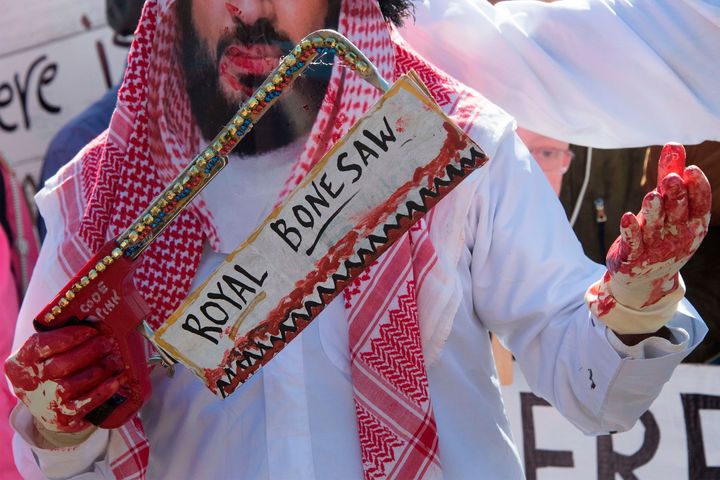
After the worst year for Saudi Arabia’s image since the 9/11 attacks involved several of its citizens, the kingdom began 2019 with a fresh controversy by asking Netflix to block Saudi users from viewing an episode of “Patriot Act with Hasan Minhaj.”
On Jan. 1, The Financial Times confirmed that Netflix had complied ― setting off international condemnation and a wave of renewed attention to a sketch Minhaj released months ago. (He appreciated the publicity.)
But beyond the absurdity and outrage is a reminder of a powerful trend that matters not just for the Saudis’ ongoing struggle to sustain their place in the world but for 1.6 billion people associated with the religion that was founded in the country, Islam.
The offending episode featured Minhaj saying this of Saudi Arabia’s de facto ruler, Muhammed bin Salman, and his connection with last year’s murder of Jamal Khashoggi: “It blows my mind that it took the killing of a Washington Post journalist for everyone to go, ‘Oh, I guess he’s not a reformer.’ Meanwhile, every Muslim person you know was like, ‘Yeah, no shit, he’s the crown prince of Saudi Arabia.’”
As Muslims like Minhaj in the U.S. and those elsewhere in the Muslim-majority world win bigger audiences, such observations will become a larger part of the global conversation. People will become more aware of critiques and nuances shared among Muslims for years but rarely included in the Western-driven coverage of issues like the Saudi regime’s behavior.
For Riyadh, that’s dreadful news. It becomes a lot harder to say the kingdom should get a free pass for denying adult women the right to travel without a man’s permission and giving its citizens almost no say over how the country is run if the regime can’t hide behind claims that that’s simply Islamic culture or the way Muslims want to live.
It’s inconvenient, particularly after the Saudis invested such immense amounts of time and money in trying to win influence by appealing to Muslims’ sense of solidarity, to have different kinds of voices and examples from within the community showing different ways to live and thrive. And it’s especially worrying that many of these newly visible Muslims seek to own their identities ― not to cede them, out of frustration or fear, to traditional stewards like Saudi clerics, or to simply assimilate for mainstream consumption.
Faced with this threat to their M.O. and the foreign security alliances critical to their power, Saudi leaders are, in classic style, so far only making things worse.
To understand why the situation escalated this way, consider that the modern state of Saudi Arabia is less than 100 years old. To become the kind of world player it is today, the kingdom has relied on its connection to Islam. The Saudi King uses the title “Custodian of the Two Holy Mosques” ― a reference to the Saudi cities of Mecca, where every practicing Muslim must travel once in their lifetime, and Medina ― in every official document.
The monarchy’s most important friends, notably the U.S., justify the relationship by referencing its authority in the Muslim-majority world. Around the region, the idea of natural Saudi leadership of the “Ummah” ― the global Islamic community ― carries weight among thousands of politicians and generals, oligarchs and day laborers. It doesn’t hurt that the Saudis’ oil wealth helps them buy support, but money is something many ambitious nations, from America to neighbors like the United Arab Emirates or Turkey, can offer. A connection to the divine isn’t.
The link in the international imagination between the modern kingdom and the preachings that began there 1,400 years ago is so strong that even Islam’s loudest critics take note ― and advantage. When Donald Trump lies about Saudi treatment of gay men in an attack on Hillary Clinton or when Islamophobe activist Pamela Geller publicizes Saudi excesses (inevitably inaccurately) to suggest that the way the kingdom operates is how Muslims want the world to run, they know they’re using one hardline regime to fear-monger about all of contemporary Islam and they know the tactic works.
But Saudi Arabia’s mantle is under threat. With more Muslims sharing particular experiences of their faith, their goals and their identities, the kingdom’s generalizations and claims to broad authority are becoming weaker. The internet’s made that easier in even the most hidebound Islamic societies. And in the West, years of activism have successfully pushed institutions to better represent younger Muslim communities, like immigrants or second and third-generation Americans. That’s something Netflix considered in offering a major platform to Minhaj ― “a person who relishes and catalogs the cultural specificity of his life,” as a recent vivid profile of him put it ― in the first place. A California-born child of Indian Muslims, Minhaj melded general American concerns about Saudi Arabia ― what it means for it be a close U.S. partner, what it’s doing to civilians in Yemen and independent voices at home ― with a particular discomfort for his own community.
“As Muslims, we have to pray toward Mecca,” he said in the Netflix episode. “We access God through Saudi Arabia, a country which I feel does not represent our values.”
It’s a sentence many Muslims wary of the austere Saudi state-sponsored interpretation of Islam ― and its influence in other Muslim-majority societies, from Southeast Asia to North Africa ― would nod their heads to, even if official politics, clerical circles and Muslims’ desire to visit the holy sites in the kingdom (something Minhaj has done) sustain a public posture of respect.
Sensing what’s coming and how it could challenge their regime’s critical coziness with Western patrons, top Saudis are already trying to maintain their comfortable status quo. That’s the driver behind efforts like Saudi media’s smearing in recent months of Reps. Ilhan Omar (D-Minn.) and Rashida Tlaib (D-Mich.), the first Muslim women elected to the U.S. Congress.
“These regimes have always benefited from the false choice they present to policymakers in the West — in Muslim countries, they say, extremists are the only alternative to dictators,” journalist Ola Salem wrote. “That argument is eloquently undermined by American politicians who share those regimes’ religion, but not their cynicism about democracy.”
Such figures have independent knowledge and thoughts on the Muslim-majority world, she noted ― they’re less likely to buy whatever the Saudi lobby in Washington is selling, such as panic about the kingdom’s regional rival, Iran.
While the episode ban remains in place, Minhaj’s quick viral response to the kingdom shows that the Muslims who’ve fought stereotypes, racism and skepticism on top of all the other challenges to entering public life increasingly are unlikely to be cowed by Riyadh.
“I can’t speak for all American Muslims but what I can tell you is... it is a stain on the perception of Islam and Muslims,” Abdul El Sayed, a young Democrat who most recently sought the party’s gubernatorial nomination in Michigan, said of the kingdom. One of a growing group of Muslim Americans who are making waves in left-wing politics, he said a tougher U.S. stance toward the Saudis would serve a range of progressive ideals: rejecting the regime’s human rights violations and regressive interpretation of Islam, and challenging a key player in the global oil market.
Saudi leaders now have to figure out how to handle and respond to these louder and louder voices. They might seek advice from an increasingly close friend in a parallel situation: Israeli Prime Minister Benjamin Netanyahu, who despite Israel’s status in Jewish theology and history has aligned himself with right-wing leaders in Europe and the U.S. whose political bases include known anti-Semites. Netanyahu’s approach, described by his supporters as a way to better protect his nation, helps these right-wing movements fight claims of prejudice ― much as the Saudi reluctance to criticize Trump’s Muslim-focused travel ban did for the U.S. administration. Meanwhile, the fighting within the larger Jewish community over Israel’s direction only becomes more heated.
Whatever the Saudis choose, they can’t ignore the growing conversation.
“I think it’s incumbent on all Americans to stand up and say enough is enough: We are not going to be part of empowering a despot who murdered his own citizen,” El Sayed said. “I can think of nothing more American than that.”
Saudi woman who 'fled abusive family' fears she will be killed if she returns as she is held at Bangkok airport
A Saudi woman held at Bangkok airport said she would be killed if she was repatriated by Thai immigration officials, who confirmed the 18-year-old was denied entry to the country on Sunday.

The incident comes against the backdrop of intense scrutiny on Saudi Arabia over its investigation and handling of the shocking murder of journalist Jamal Khashoggi last year, which has renewed criticism of the kingdom's rights record.
Rahaf Mohammed M Alqunun told AFP she was stopped by Saudi and Kuwaiti officials when she arrived in Suvarnabhumi airport and her travel document was forcibly taken from her, a claim backed by Human Rights Watch.
"They took my passport," she told AFP, adding that her male guardian had reported her for traveling "without his permission".
Rahaf said she was trying to flee her family, who subjected her to physical and psychological abuse.
"My family is strict and locked me in a room for six months just for cutting my hair," she said, adding that she is certain she will be imprisoned if she is sent back.
"I'm sure 100 percent they will kill me as soon as I get out of the Saudi jail," she said, adding that she was "scared" and "losing hope".
Rahaf was stopped from entering Thailand when she flew in from Kuwait on Sunday, Thailand's immigration chief Surachate Hakparn told AFP.

"She had no further documents such as return ticket or money," he said, adding that Rahaf was currently in an airport hotel.
"She ran away from her family to avoid marriage and she is concerned she may be in trouble returning to Saudi Arabia. We sent officials to take care of her now," he said.
He added that Thai authorities had contacted the "Saudi Arabia embassy to coordinate".
But Rahaf disputed his account, saying that she was only in transit to seek asylum in Australia, where she claimed to have a visa, and was accosted by Saudi and Kuwaiti embassy representatives when she deplaned in Suvarnabhumi airport.
She took to Twitter to plead her case, livestreaming a video where she spoke about how her father had told Saudi embassy officials she was a "psychiatric patient" who had to be returned.
Human Rights Watch Asia deputy director Phil Robertson slammed the Thai authorities and urged the UN refugee agency to help the teenager.
"What country allows diplomats to wander around the closed section of the airport and seize the passports of the passengers?" he said, adding that there is "impunity" within the family unit in Saudi Arabia to abuse women.
Immigration head Surachate said Rahaf would be sent back to Saudi Arabia by Monday morning.
"It's a family problem," he said of the case.
The ultra-conservative kingdom has long been criticised for imposing some of the world's toughest restrictions on women.
That includes a guardianship system that allows men to exercise arbitrary authority to make decisions on behalf of their female relatives.
If punished for "moral" crimes, they could become victims of further violence in "honour killings" at the hands of their families, activists say.
https://www.telegraph.co.uk/news/2019/01/06/saudi-woman-says-fled-abusive-family-fears-will-killed-returns/
Saudi Woman Who Tried to Flee Family Says, ‘They Will Kill Me’

A young Saudi woman who wanted to assert her independence slipped away from her family during a holiday in Kuwait last week and boarded a plane for Thailand.
Rahaf Mohammed Alqunun, 18, said that her family was abusive and that she hoped to seek asylum in Australia.
 But when she got off the plane in Bangkok, she said, a man was waiting, her name written on a placard. He said he would help her get a Thai visa, and disappeared with her passport.
Instead, Ms. Alqunun said, the man came back with other men she believes were Thai security officers and a representative of Kuwait Airlines. They said that her family had filed a missing persons report about her — and that she had to return to Kuwait on a flight late Monday morning.
Ms. Alqunun said she feared for her life if she is forced to go back to her family.Human rights advocates urged the Thai government to allow Ms. Alqunun to continue on her journey to Australia or to seek asylum in Thailand. They called on the United Nations Refugee Agency to help her.
“They will kill me,” she said by telephone Sunday evening from a hotel at Bangkok’s Suvarnabhumi Airport, where she was being kept overnight. “I am detained,” Ms. Alqunun said. “I can’t even go out of the hotel.”
“Saudi women fleeing their families can face severe violence from relatives, deprivation of liberty, and other serious harm if returned against their will,” said Michael Page, the deputy Middle East director at Human Rights Watch. “Thai authorities should immediately halt any deportation.”
Thailand has a history of sending refugees back to autocratic countries, including China, Pakistan and Turkey, said the deputy Asia director for Human Rights Watch, Phil Robertson.
In November, the Thai authorities arrested a former Bahrain soccer player, Hakeem al-Araibi, who had been granted refugee status in Australia after speaking out against a powerful Bahraini soccer official.
Mr. Araibi had come to Thailand for his honeymoon but was stopped at the same Bangkok airport as Ms. Alqunun after Bahrain sought his arrest through Interpol. He remains in custody, awaiting a decision on Bahrain’s extradition request. “Basically, Thailand is open for business sending refugees and asylum seekers back to their authoritarian governments,” Mr. Robertson said. In the interview, Ms. Alqunun described a life of unrelenting abuse at the hands of her family, who live in the city of Hail, in northern Saudi Arabia. She said she was once locked in a room for six months because she had cut her hair in a way that her family did not approve of. And she said her family used to beat her, mostly her brother. Saudi Arabia, Ms. Alqunun said, is “like a prison.”
“I can’t make my own decisions,” she said. “Even about my own hair I can’t make decisions.”
Ms. Alqunun said that when she was 16, she tried to kill herself. When her family did not seek help for her, she said, she started planning her escape.
Even at age 18, though, Ms. Alqunun could not simply leave Saudi Arabia on her own. Women in the kingdom need the approval of a “male guardian” to travel, usually a father, husband or even a son.
Her chance for freedom came on Wednesday, when her family took a trip to Kuwait, which does not have the same restrictions on women. On Saturday, she caught the plane to Thailand, where she had reserved a hotel and an outbound flight.
Her plan was to stay there until she could leave for Australia, where she was supposed to meet a woman she described as “a Saudi refugee” who would help her.
Maj. Gen. Surachate Hakparn, the head of Thailand’s immigration agency, said Ms. Alqunun had been denied a visa to enter Thailand because she did not have sufficient money. She also lacked the necessary documents to gain entry to the country or continue on to Australia, he said.
“She left her original country due to a family issue and came to Thailand,” General Hakparn said in an interview. “She’s safe. Her passport wasn’t confiscated.”
He said Ms. Alqunun would be put on the flight back to Kuwait accompanied by Thai immigration officers.
Saudi Arabia’s ambassador to Bangkok, Abdul-Ilah al-Shuaibi, issued a statement asserting that Ms. Alqunun had been arrested at the airport for violating Thai laws, which was not the case. He said the embassy did not have the authority to stop her at the airport. In a similar case in 2017, a Saudi woman, Dina Ali Lasloom, was forced to return to her family in Saudi Arabia while in transit in the Philippines on her way to Australia.
Ms. Alqunun said it appeared that the Saudis and Thai officials were working together. At one point, she said, she was required to sign documents written in Thai that she did not understand. She said her passport had been returned to her but was later taken again and handed over to Kuwait Airways to help ensure that she boarded her return flight.
If she is returned to Saudi Arabia, Ms. Alqunun could face criminal charges of parental disobedience or harming the reputation of the kingdom, Human Rights Watch said.
Saudi Arabian men consider themselves guardians of their families’ honor and often punish family members, especially girls and women, who are said to have brought dishonor on the family. In extreme cases, the family members are killed. Ms. Alqunun said she was particularly concerned about what her family might do to her because in describing her plight on Twitter, she renounced religion. “They will kill me because I fled and because I announced my atheism,” she said. “They wanted me to pray and to wear a veil, and I didn’t want to.”
Ms. Alqunun posted reports and videos on Twitter in a bid to build support. “I’m the girl who run away from Kuwait to Thailand,” she wrote in one post in English. “I’m in real danger because the Saudi embassy trying to forcing me to go back to Saudi Arabia, while I’m at the airport waiting for my second flight.” On Sunday, she was still hoping to make it to Australia.
“I want to be protected in a country that will give me my rights,” she said, “and allow me to live a normal life.”
Subscribe to:
Posts (Atom)