Sunday, October 7, 2018

#Pakistan - Asia Bibi’s Final Hearing is Tomorrow. Don’t Let Her Be Executed

 By  

Tomorrow, Asia Bibi has one final chance to prove her innocence, or be sentenced to death. The world must scream in her defense.

Asia Bibi, a Pakistani Christian woman accused of blasphemy in 2009, is scheduled for her final appeal against execution on Monday.
Bibi was accused of insulting the Prophet Mohammad after a dispute with a Muslim woman who said that a non-Muslim woman should not touch the same bowl of water as Muslims.
The supremacy and entitlement that one must feel to not want a member of a different religion to touch the same bowl of water may sound shocking to some. Unfortunately, however, this sentiment permeates Pakistan, often resulting in horrific violence against Christians and other religious minorities.
Last year, a Pakistani Christian boy was beaten to death by his classmates, while his teacher was in the room.
This past week, a Christian family in Gujar Khan went into hiding after six Muslim brothers set their house and car on fire. This happened a day after the brothers demanded that the Christian husband and wife go inside because their “ritual impurity” was contaminating the air.
In April, a Muslim man burned a 17-year old Christian girl to death when she refused to marry him.
The roots of this hatred are systematic. The British Pakistani Christian association has called for a reform of Pakistan’s education system, which it says “openly demonizes and characterizes minorities.”
The World at Large
Across the world, religious minorities are persecuted. From the Yazidis of Iraq, to the Baha’is of Iran and Yemen, to the Copts of Egypt, to the Rohyngas of Myanmar.
This persecution involves rape, torture, threats of execution, imprisonment, and murder.
If Asia Bibi is saved, minorities around the world will know that there is a glimmer of hope amidst a black sky of injustice.
If Asia Bibi is executed, minorities will see the world fail them once more.
The world must scream out in Asia Bibi’s defence. We must let Pakistan know that we are watching.
https://conatusnews.com/asia-bibi-hearing-blasphemy/

Pakistan's Ahmadi Muslims - What should we do with them?


A number of politicians, ulema of various kind and tajzia nigars have concluded that Qadianis are not a minority. What can be worse than being a minority? What happens when a minority is declared a non-minority?
We are fast running out of things that we can do to Qadianis. Most readers of this newspaper are educated enough to know that Qadianis don’t like to be called Qadianis, they refer to themselves as Ahmadis. But events of the last few weeks have proved that we are finally past that point where we had to pretend to care what they think or feel.
Forty five years ago we asked our elected parliament the same question: what should we do about the Qadianis? Our first elected parliament decided “let’s declare them kafirs!” because, for more than a century, a certain brand of ulema had been demanding that they should be declared kafir. Since then we have asked the ulema over and over, not that they wait to be asked, and they have told us that not only are Qadianis kafir but they are the worst kind of kafir — worse than Hindus, definitely much worse than Christians and even more sinister than Yahoodis. Almost all the anti-Qadiani literature, banners and slogans declare them the bud-tareen kafirs in the world.
Pakistani liberals keep saying, in weak, apologetic voices that Ahmadis are actually a minority. But the debate that emerged around Atif Mian’s appointment proved that Qadianis can’t be treated as a minority. A number of ruling and opposition party politicians, ulema of various kind and tajzia nigars have concluded that Qadianis are not a minority. May be the constitution declared them a minority, and later set out rules about how they should behave as a minority, but no sorry they are not. What can be worse than being a minority? What happens when a minority is declared a non-minority?
Rioting in Jhelum 2015. Photo by Rahat Dar
When Imran Khan’s government announced Atif Mian’s name as a member of the Economic Advisory Council (EAC), they probably thought it’s only a consultative role; they probably can get away with it. When Imran Khan had announced his name as his pick for finance minister at a public rally, he had to lean back to confirm his name. There was more noise in PTI’s own ranks than outside. If the nominee had been a Christian or Parsi or Hindu, there would still be opposition but probably there wouldn’t be the kind of menace that emerged around Atif Mian’s name. Even those most loyal to Khan were shaking their heads and shouting: what were you thinking?The discourse around Qadianis, their faith and how they practice has always been fierce when not outright murderous but Khan’s backtracking has raised it to a bizarre new level. You can’t even consult an Ahmadi on some technical issues, surely you can’t go to an Ahmadi surgeon, and God forbid if there is an Ahmadi school teacher out there. I am sure Atif Mian wouldn’t have said, first of all you all need to abandon your religion, and follow my khalifa, only then I’ll tell you how to fix your budget deficit.
Let’s not blame Imran Khan though; let’s look at ourselves.
Just before the appointment of the current army chief, a senator and a religious scholar accused him of being an Ahmadi. The army chief wasn’t Ahmadi but there is no public record of any action having been taken against the senator. It was a vile attempt to sow doubts within the highest ranks of Pakistan’s most disciplined institution and it’s punishable under any number of laws. The chief, after taking over his command, responded by releasing pictures of a mehfil-e milad held at his house. That is what the country’s most powerful man had to do to counter an accusation of being an Ahmadi. Imran Khan’s blundering retreat may not be forgivable but it’s completely understandable.
Pakistani liberals keep saying, in weak, apologetic voices that Ahmadis are actually a minority. But the debate that emerged around Atif Mian’s appointment proved that they can’t be treated as one.
Orya Maqbool Jan, tv anchor and former bureaucrat, spoke loud and clear in one of his TV programmes: I realise that they are a minority according to the constitution, but in this country there are ahl-e constitution and then there are ahl-e iman; the ahl-e iman know the Qadianis are not a minority because they don’t consider themselves a minority. They have set up a parallel shop and this can’t be tolerated, he said. Ahl-e constitution don’t stand a fighting chance when they are up against ahl-e iman.
So what should the practising Ahmadis do? In the past, citizens have been declared traitors, enemy combatants, foreign agents but never in Pakistan’s history has a declared minority been recast as something worse than a minority.
Every breath they take is a blasphemy, every time they pray silently, every sajda, every rukoo, every time they hide and read the Quran, every time they fast and break it with Rooh Afza, every time they sing a lullaby to their children that evokes Hasan and Hussain, every time they say Alhamds to your good news, every time they send you a Happy Eid Mubarak emoji, every time they grow a beard, or their daughter goes full hijabi, every time they give azan in their new born’s ear, they are committing a crime. Their very existence is perpetual blasphemy. And we all know the entire list of punishments for blasphemers, some imposed by ahl-e constitution, others by ahl-e iman.
It seems like an act of supreme mercy that we haven’t chucked them in the Arabian Sea yet or made them wear yellow stars. Although a certain Justice of the Islamabad High Court has tried.
In Atif Mian’s case there was also a blood-curdling, between-the-lines accusation: you are not even a non-minority, you are a murtad (apostate). You are given three days to think it over and then everybody knows the murtad’s punishment. And Ahl-e constitution will not decide, ahl-e iman will.
So in our own lifetime Qadianis have become from a Muslim sect to non-Muslim minority to a non-minoritity to murtads who at best can be given three days to live.
And what happens if Ahmadi soldiers die in a battle fighting for Pakistan? Can we call them martyrs? Are we allowed to praise their sacrifice? Last month, on Defence Day, the Ahmadi community took out an advertisement to commemorate these sacrifices. The newspaper pulled out the advertisement and was forced to publish an apology. We can’t show the picture of an Ahmadi soldier who died on our borders or admit his services. Not even the most powerful institution in the country can pull this off.
Forget soldiers, when was the last time you heard an Ahmadi singer or artist or poet (Obaidullah Aleem is dead so he doesn’t count). Was there any famous or at least potentially useful Ahmadi between Dr Abdus Salam and Dr Atif Mian? The lesson that Ahmadi kids are taught before they are sent off to school is: “don’t tell anyone that you are an Ahmadi”.
So now that we know what Ahmadis are not allowed to do, what is it that they are allowed to do? And what are we allowed to do with them? Can we rent a house from them? Are our children allowed to play with their children? Can we cast them in tv plays as non-Ahmadi characters? If we are lost in a new city, can we ask them for directions? Can one of them play PSL? Are they allowed on Coke Studio?
The best-selling and seminal Urdu novel of our generation is Peer-e Kamil, most of it is about the spiritual journey of an Ahmadi girl. No point guessing where this journey ends. But if it becomes a tv serial, can an Ahmadi girl play that role of the misguided Ahmadi girl?
Many Ahmadis would tell you: “Thank God we are kafirs and not Shias”. They acknowledge that Shias in Pakistan have probably suffered a lot more than they have. The fate of Ahmadis and Shias are mentioned in a speech given by one of Pakistan’s most influential thinkers, Maulana Haq Nawaz Jhangvi. Liberals who moan that they don’t live in Jinnah’s Pakistan but General Zia’s Pakistan are being characteristically optimistic. All the evidence suggests that we live in Maulana Jhangvi’s Pakistan.
When Maulana Haq Nawaz Jhangvi launched his Anjuman Sipah-e Sahaba in the mid-1980s, it initially didn’t get much traction with his old comrades. His JUI colleagues thought that by asking the state to declare Shias kafir, Maulana had gone a bit too far. In one of his early speeches Maulana said that his friends think he has gone a bit bonkers, that he wants the state to declare Shias kafir.
Maulana Jhangvi’s response: “Remember in this country there was a man called Syed Ata Ullah Shah Bukhari who for more than half a century, went from town to town demanding that the state should declare Qadianis kafir. Did anyone think it was possible? People used to say that Shah Sahib had gone mad. But look at us now.”
Yes, look at us now.

http://tns.thenews.com.pk/what-should-we-do-with-them/#.W7owuGhKiUk

PPP will file petition to reopen Shaheed Bhutto reference: Bilawal

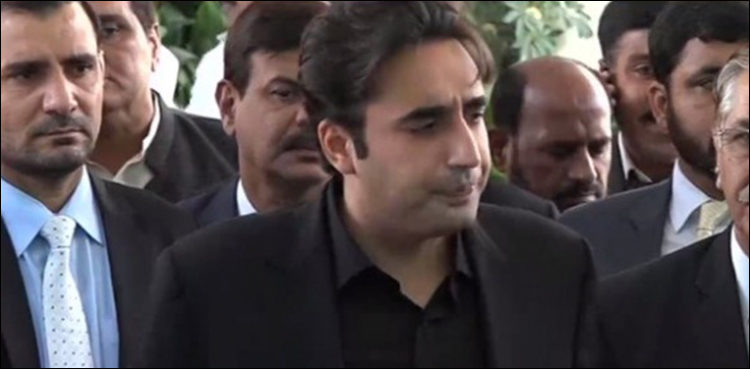
Chairman Pakistan Peoples Party (PPP) Bilawal Bhutto Zardari on Saturday said his party would file a petition in the Supreme Court next week to reopen ‘Shaheed Bhutto reference’, ARY News reported.
“I have signed the petition in this regard today,” he said during an informal conversation with journalists in Islamabad.
In his reaction to arrest of Opposition Leader in National Assembly Shehbaz Sharif, he said the way he was arrested was not appropriate.
“Legal procedures should have been fulfilled, if there were allegations against him,” he said.
The PPP chief said they had a consensus over requisition regarding Shehbaz Sharif in the NA and if needed, he would sign on it.
Bilawal said the government kept chairmanship of the PAC with itself for it wanted to evade accountability.
It is pertinent to mention that an accountability court has granted 10-day physical remand of the PML-N president in the Rs14 billion Ashiyana-i-Iqbal housing project scam.
While presenting his arguments, the NAB prosecutor requested the judge to remand the PML-N leader in their custody for interrogation for 15 days.
He said the former Punjab chief minister misused his powers, causing a huge loss to the national kitty.
The lawyer said Shehbaz had cancelled a contract awarded to M/s Ch A Latif & Sons for construction of Ashiana Iqbal Housing project and handed it to his favourite firm.
He sought the PML-N leader’s custody for further investigation into the scam.
The anti-graft body a day earlier arrested the the leader of the opposition in the National Assembly at its Lahore office where he was summoned to record his statement in connection with the Punjab Saaf Pani Company case.
https://arynews.tv/en/ppp-to-file-petition-to-reopen-shaheed-bhutto-reference-bilawal/

Benazir Bhutto's presence still firm at Oxford among five Pakistani PMs who studied there

Pakistan has seen the rule of five heads of state who have been educated at Oxford University with Benazir Bhutto being the only one with her presence branded around the premises.
The country's senior journalist Hamid Mir amidst his visit to Oxford University revealed that in spite of Pakistan witnessing the rule of five of the institution's graduates, Pakistan People's Party's departed leader Benazir Bhutto remains the only one with her presence acknowledged around the campus.
"5 former Prime Ministers of Pakistan were educated in Oxford University(Liaqat Ali Khan,Feroz Khan Noon,Zulfiqar Ali Bhutto,Benazir Bhutto and Imran Khan)I found pictures of only Benazir Bhutto in the university at least on 20 different places," read his tweet.
The current Prime Minister Imran Khan had graduated from Oxford University's Keble College in 1975 where he studied philosophy, politics and economics.
Benazir Bhutto who became the country's first female prime minister in 1993 had attained an undergraduate degree from Oxford's Lady Margaret Hall in the subjects of philosophy, economics and politics.
On the other hand, Benazir's father and ninth premier of the country, Zulfiqar Ali Bhutto also went to Oxford University where he received an LLB degree.
Seventh prime minister Feroz Khan Noon was also an Oxford graduate studying at its Wadham College where he studied history and Farsi.
The country's first prime minister Liaqat Ali Khan had attended Oxford University as well at its Exeter College in 1921, from where he graduated with a law degree.  
https://www.thenews.com.pk/latest/377433-benazir-bhuttos-presence-still

Treason Trial for Pakistani Journalist Signals New Pressure on Media

A prominent Pakistani journalist has been ordered to face a court hearing on accusations of treason next week, in a case the country’s press corps says is one of several recent attempts under the new government to intimidate the news media into silence.
The journalist, Cyril Almeida, a leading columnist for the newspaper Dawn, has been summoned to appear before the High Court in Lahore on Monday. The accusation stems from an article he wrote in May that featured an interview with former Prime Minister Nawaz Sharif, who was at loggerheads with Pakistan’s powerful military until he was ousted last year.
In the interview, Mr. Sharif appeared to reinforce India’s accusation that Pakistan’s military aided the militants who carried out the 2008 Mumbai attacks, which killed more than 160 locals and foreign tourists.
Mr. Almeida’s summons to stand trial on a potentially capital offense for simply conducting an interview was instantly alarming to veteran Pakistani journalists, who were already worried that the country’s new government will continue the intimidation tactics favored by the military in the lead-up to the parliamentary election in July. Pakistan’s opposition and European observers said the military created an unlevel playing field before the polls, censoring the news media and pressuring candidates to secure a victory for Imran Khan, who became prime minister in August.
On Tuesday, journalists, editors and other civil society groups will stage a demonstration against the court’s action against Mr. Almeida and what they say is pressure on media organizations to stifle criticism of the government and military.“This is the darkest period for journalism in the country’s history, no doubt about it,” said Afzal Butt, president of the Pakistan Federal Union of Journalists. In the months before the election, several journalists were beaten or abducted, with only one thread tying them together: their criticism of the military.
In June, the columnist and political commentator Gul Bukhari was abducted in an army-controlled area of Lahore by unknown attackers, including men in military uniform. And Dawn, which Mr. Almeida works for, was prevented from being distributed in military cantonments, which make up large residential areas of most Pakistani cities.Mr. Almeida and the editors at Dawn declined to comment for this article, citing the coming trial.
Before the election, while most parties decried the pressure on the news media, Mr. Khan was silent. In an interview with The New York Times weeks before the polls, he said that the pressure certain media outlets came under was deserved, as they supported Mr. Sharif, the ousted prime minister.
But in the same breath, Mr. Khan insisted that the news media was free.
“Pakistan’s media is one of the most vibrant medias in the world,” he said in the interview. “Watch the programs every evening. There are 10 current affairs programs going on; everyone expresses their views.”
Many journalists and editors say the current hostility is more dangerous than pressure seen under previous governments: They see it as coming from all pillars of the state, with Mr. Khan’s government considered closely in sync with the courts and the military. The military is accused of pressuring the courts to block any opposition — or even criticism — of Pakistan’s powerful army, and military pressure was seen as a factor in the court’s ruling last year removing Mr. Sharif from office on corruption charges.
Soon after the inauguration of Mr. Khan’s new government, Information Minister Fawad Chaudhry raised hopes among the international news media when he said in an interview in August that he would ease visa restrictions for foreign journalists. But since then, editors and reporters have been on edge. In mid-September, Mr. Khan created the Content Committee, a board to coordinate and oversee the distribution of state advertisements to local newspapers and electronic media. The government is the country’s largest media advertiser and has not paid its recent bills, several newspaper publishers said, leaving hundreds of journalists and other media employees without salaries for the past four months.
Editors and publishers fear that the Content Committee may favor media outlets deemed to be supportive of Mr. Khan’s government while indirectly punishing those that are critical by withholding needed advertising.
“We have to wait and see if this is a monitoring body to favor some groups and curtail advertisement for others that in the past or present were critical to government,” said Mazhar Abbas, the former secretary general of Pakistan’s journalist union.
“The tactics are now different, to financially cripple strong media houses, unlike before where they may ban a newspaper for some time. By crippling the media houses, newspapers are curbing their reporting, reducing their pages,” Mr. Abbas added. Mr. Almeida is not the first journalist to be charged with treason, and Mr. Khan is certainly not the first Pakistani leader to be accused of hostility toward the news media. During Mr. Sharif’s second term as prime minister in 1999, Najam Sethi, a prominent journalist and editor, was beaten and arrested on suspicion of treason after he gave an inflammatory speech while visiting India. He was detained for several weeks, but the Supreme Court ordered the charges against him dropped. But Mr. Abbas and others say Mr. Almeida’s case is unique because his treason charges stem directly from an interview he conducted. “If an interview is now a crime, how can we do our jobs?” Mr. Abbas asked.
This month, the Ministry of Information started a Twitter account called Fake News Buster, supposedly to debunk social media rumors. The move was a chilling reminder of the army’s warning to journalists before the election that their social media accounts were being monitored, hinting that they would be punished for any posts that were unfavorable to Pakistan.
“This seems to be a well-thought, sinister move on the part of both government and military to remodel and regulate the country’s print and electronic media industry to strengthen the military’s narrative about politics and the economy at the cost of constitutionally guaranteed freedoms,” said Matiullah Jan, a prominent talk show host.
The tendency of officials to “paint critics as anti-state and traitors is pressurizing and endangering the lives of journalists,” Mr. Jan added.
https://www.nytimes.com/2018/10/05/world/asia/pakistan-journalist-treason-military.html

Saturday, October 6, 2018

Pashto Music - Palwasha | Ghani Khan | Sardar Ali Takkar |پلوشه | غني خان | سردارعلي ټکر

Pakistani Christian woman - Life or death for Asia Bibi, decisive hearing scheduled for 8 October

The Supreme Court of Pakistan examines the appeal of the lawyers of the Christian woman sentenced to death for blasphemy. She prays in prison and asks for the Pope's closeness.
The decisive day for the life or death of Asia Bibi has come. On Monday, October 8, 2018, at 1:00 p.m. local time, the Supreme Court of Pakistan examines the appeal, which has reached the third and final level of judgment, filed by the lawyers of the Christian woman sentenced to death for blasphemy and in prison for almost a decade.  
  
 It will be a quick trial: according to Pakistan's criminal procedure, at this point everything will take place in a single hearing, where the judges will listen to the positions of the defense and the public prosecution and consider whether to confirm or overrule the death penalty sentence. The decision should be taken on the same day while for its publication we will have to wait two or three more days.  
  
"Within a week, then, Asia could be free. Let's hope and pray," notes Joseph Nadeem, guardian of the woman's family, and president of the Renaissance Education Foundation which from Lahore covers the legal costs of the trial and takes care of Asia’s family.  
  
As confirmed by the document issued by the Chancellery of the Supreme Court of Islamabad and reviewed by Vatican Insider, a special panel of judges, created for the occasion, are to listen to the arguments of the Muslim lawyer Saiful Malook, lawyer of Asia Bibi, and to decide on the fate of the woman.  
  
According to Nadeem, the hopes are well-founded. The college, composed of three senior magistrates - as anticipated by Vatican Insider last July - is chaired by the President of the Supreme Court of Pakistan, Mian Saqib Nisar who, as a guarantee of impartiality and transparency, has taken upon himself the case of Asia Bibi, to avoid any risk of political and religious exploitation.  
  
  The declared aim - in an approach that has always been shared by the lawyers of the Christian woman - is, in fact, to handle the trial as a normal case of a legal order, stripping it of any symbolic or religious value. This will allow us to examine with serenity and rigor the evidence and the arguments presented by the lawyers and to issue a verdict that is only the result of the conviction gained in the trial, generated by factual elements.  
  
Both in the first and in the second degree, in fact, the judicial case that brought the Christian peasant girl of Punjab into prison was heavily conditioned by external elements that completely distorted the case.  
  
The trial before the court of Nakhana Shahib, who in November 2010 decreed the first death sentence, was evidently spoiled by false accusations, artfully built to punish the woman who had dared to rebel against a discrimination of which she had been victim, perpetrated by her agricultural work companions in the fields. Some women had accused her of having contaminated, as a Christian, the source of water from which everyone was drinking.  

Faced with Asia’s offended reaction - an unforgivable affront -the women had gone looking for the local imam’s support, who plotted the plan to charge Bibi for blasphemy: an easy shortcut used to get rid of opponents in private quarrels. The imam filed a complaint and testified in court about an event in which he was in no way involved in person, claiming that Asia had offended the name of the prophet Mohammed.  
  
It would have been easy, at that point, for the judges to expose the conspiracy, since the imam had never heard the words of Asia and his testimony was clearly false. But the court chose the most convenient way and, in order not to upset the local Muslim groups, preferred to plead Asia guilty.  
  
Asia's life changed from that day and, as innocent woman was sentenced to death under Article 295, Paragraph C of the Penal Code of Pakistan, or for the crime of blasphemy against the prophet Muhammad. Her case went public and Christians in Pakistan began a campaign in her defense, which culminated with Benedict XVI’s public appeal for her release.  
  
Meanwhile, an appeal was filed before the High Court of Lahore, the capital of Punjab, against that unjust sentence, but the case of Asia Bibi was already "hot" and a few months later, in that fateful 2011, was forever linked to two murders of high-ranking people, who had publicly sided in her favor: to lose their lives to the terrorist hand were first the Muslim Salman Taseer, governor of Punjab, and then the Catholic Shahbaz Bhatti, federal minister for religious minorities.  
  
  At that point no magistrate wanted to take responsibility for judging Asia Bibi and a series of postponements, for various reasons, marked the trial in Lahore, while her detention time was significantly extended as the woman was transferred from Sheikhupura prison to the women's prison in Multan, to ensure greater security.  

We have to wait until October 2014 for a judge to agree to rule on the case of Asia but, while rumors of threats to the magistrates were spreading, the High Court confirmed the judgment of first instance, considering credible the testimonies presented against the woman. However, the sentence was suspended, pending the ruling of the third and final instance, the Supreme Court.  
  
"We are working hard and will bring convincing arguments. We trust in respect for the rule of law and in the impartiality of the judges. We are confident about the outcome of the trial," notes lawyer Saiful Malook who will attend – escorted - the hearing on October 8 in Islamabad.  
  
Meanwhile, just a few days ago, Joseph Nadeem and Asia's husband, Ashiq Masih, visited her in prison, finding her "strong in body and spirit", as they reported. "Asia is a woman of deep faith and lives this time immersed in prayer, with great spiritual serenity. She knows she is a beloved daughter of God and trusts in the Lord, who will be able to give her salvation," Nadeem observes. "At this decisive moment in her life, she asks for the prayer of all the Christians in the world and the special prayer of Pope Francis, who has already sent her a blessing and a Rosary, which Asia uses every day, animated by feelings of forgiveness towards her persecutors," she concludes.  
  
In the event the Supreme Court were to confirm her condemnation, Asia Bibi's last chance would be to ask for a measure of clemency from the President of Pakistan.  

http://www.lastampa.it/2018/10/06/vaticaninsider/life-or-death-for-asia-bibi-decisive-hearing-scheduled-for-october-jY8BQwvu5bdCrWyYvA6fAJ/pagina.html

Asia Bibi’s family: Pakistan Supreme Court to decide her fate this month

Simon Caldwell


The first Catholic woman to be condemned to death under Pakistan’s blasphemy laws will discover her fate later this month, her family told Catholic News Service.
Asia Bibi, who has been held in solitary confinement since November 2010, when she was sentenced to hang for insulting Muhammad, the founder of Islam, will learn the outcome of her appeal to the Pakistan Supreme Court later in October, her husband, Ashiq Masih, told CNS Oct. 5.
If Bibi is released, he said, she and her family will immediately seek sanctuary in one of several countries that have offered them exile, because it is too dangerous for them to remain in Pakistan.
Ashiq, a builder from Sheikhupura, Pakistan, was in England with his and Bibi’s youngest daughter, Eisham Ashiq, as guests of Aid to the Church in Need, a Catholic charity helping persecuted Christians.
They said when they visited Bibi in Multan Prison Oct. 1 that she was in good health, contrary to speculation that she was developing dementia.
During the interview at St Columba’s Church, Ashiq said Bibi was praying constantly and that she deeply believed she would win her freedom.
“She is psychologically, physically and spiritually strong,” said Ashiq. “Having a very strong faith, she is ready and willing to die for Christ. She will never convert to Islam.
“She also wanted to deliver a message to the international community that they must remember her in their prayers. These prayers will open the door of the prison, and she will be released very soon,” he said.
“She is spending her life praying with a very strong faith and is reading the Bible every day. She feels when she is praying, Jesus is encouraging and supporting her,” he continued, adding that she also received Communion in jail Oct. 1.
In June 2009 Bibi, who worked as a farmhand, was accused of blasphemy against Islam after Muslim women objected to her drinking from a common water supply because she is a Christian.
Eisham told CNS that, as a 9-year-old girl, she witnessed her mother being severely beaten by a Muslim mob in the aftermath of the accusation.
“I believe in God and I believe she will be released, but she can’t live in Pakistan once she has been released - simple as that,” she said.
Bibi was rescued by police, only to be sentenced to death for violating Section 295C of the Pakistan Penal Code, which makes insulting Muhammad a capital offense.
No one has been executed under the law so far, but Christians who are falsely accused often are lynched or spend many years in prison.
Bibi’s final appeal will be heard by a special three-judge bench. The hearing represents her last chance at avoiding a death sentence for blasphemy. If the court upholds the execution order, the only option open to her lawyers will be a direct appeal for clemency to President Imran Khan.
Her case has divided Pakistan, with millions of Islamic militants reportedly willing to kill her to obtain a reward of 500,000 rupees offered by a Muslim cleric for her murder; some moderate Muslims have called for her release.
Among those who called for her release was the governor of Punjab, Salmaan Taseer, who was assassinated in January 2011 after he said he would fight for her release.
Two months later, Minority Affairs Minister Shahbaz Bhatti, a Christian, was gunned down after he said he would seek the reform of the blasphemy laws to stop them being abused to persecute innocent Christians.
Now-retired Pope Benedict XVI is among those to have publicly called for Bibi’s release and, in February, Pope Francis received Ashiq and Eisham at the Vatican, while the Coliseum was bathed in red light to highlight the suffering of contemporary martyrs.
Ashiq said: “The pope encouraged us and said to us, ‘Don’t let your mind be disturbed’ and said ‘Pass on my encouragement to Asia Bibi and bless her as well.’ He said he is praying for her and that he believed she would be freed very soon.
“By meeting him, our faith was boosted,” he said. “We were already believing and have a strong faith, but listening to him really encouraged us.”
“Remember us in your prayers and support us as much as you can so that Asia Bibi can be released very soon,” Ashiq said. “When she is free, she will able to answer questions in person.”
https://cruxnow.com/church-in-asia-oceania/2018/10/05/asia-bibis-family-pakistan-supreme-court-to-decide-her-fate-this-month/