Tuesday, August 28, 2018
#Pakistan - Combating extremism through critical thinking


Lack of critical thinking is one of the many flaws of Pakistan’s education system. Concerns have been raised by experts time and again about the content of textbooks which in some cases promotes racial hatred and division on the basis of religion. While there have been efforts in the recent past to amend the educational curricula to add lessons of tolerance, the state as a whole appears to be hostile towards the idea of critical thinking. Students who engage in activism on campus are seen as a threat by the administrations.
In January, several student activists of Punjab University were arrested after a violent clash between two student groups. Most arrested students belonged to the ethnic minority groups and were later charged with terrorism. They are still in jail.
Progressive student groups of the university allege that Islami Jamiat Talaba (IJT), the student wing of Jamaat-e-Islami (JI), has been practicing hooliganism on campuses. The activists of IJT have been able to get away with violence supposedly because of their religious affiliation. The group has long been acting as the de facto moral police in the universities where it has presence. In recent instances, clashes have taken place due to IJT students’ act of forcibly stooping what they call “mixed gatherings” and cultural events. Pakhtun and Baloch students of the PU have mostly been on the receiving end during the violent clashes, but the administration as well as the law enforcers side with the IJT.
While there have been efforts in the recent past to amend the educational curricula to make it inclusive, the state as a whole appears to be hostile towards the idea of critical thinking
The impunity which such violent religious groups enjoy can be judged from the incident whereby a professor of Punjab University who wanted his students to think critically became target of a smear campaign by the said group. Ammar Ali Jan, a progressive professor, was fired by Punjab University in March after students of IJT ran a campaign against him for speaking to Pakhtun students of the university about peaceful resistance. As teacher, Ammar used to hold study circles where students were encouraged to think critically and take part in progressive activities, for which he was declared “anti-state” and “Indian agent”.
This nonacceptance for alternative views says a lot about why our educational institutes are not producing individuals who know how to reason with facts. Given the hostility towards critical thinking, students of prestigious universities getting involved in extremist activities (as has been witnessed in the past few years), should not come as a surprise.
Objective analysis and critical evaluation of course content is the need of the hour, because the growing intolerance and extremism in the society can be countered through an inclusive curricula free of religious, ethnic or racial bias. Much has been said on the need to introduce reforms in textbooks, but there has been little to no effort in this regard by successive governments. A number of NGOs like Alif Ailaan and Rabbt are working towards promotion of critical thinking, but governmental support is needed in this regard. However, in Khyber Pakhtunkhwa (KP), the provincial government of Awami National Party (ANP) did add secular content in the textbooks, but the changes were later reversed by the Pakistan Tehreek-e-Insaf (PTI)’s government. An inclusive curriculum with lessons of tolerance and interfaith harmony can serve as an effective counter-narrative to extremism. We as a state need to undo the results of decades of Islamisation to fight the menace of extremism. For this to happen, the culture of critical thinking in educational institutes should be promoted at the state level and experts should be consulted for introducing textbook reforms across the country.
Financial Task Force Monitor Pakistan's Progress on Anti-Terror Financing

A delegation from the global financial watchdog Financial Action Task Force (FATF) has held meetings with Pakistani authorities to review the country's measures against money laundering and terror financing.
A six-member team from the Asia Pacific Group (APG) was in Islamabad this past week to monitor Pakistan’s progress after the country was placed on FATF’s gray list in June, following months of negotiation by Pakistan to avoid being put in the list.
At the time, Pakistan submitted a comprehensive 26-point strategy to fight terror financing and ensured the international community that it will take adequate steps to bar militant groups from laundering money. But Pakistan’s efforts failed to convince the global watchdog, and Islamabad was placed on the watchdog’s list.
This week, the FATF representatives met with government officials in Pakistan and evaluated the country’s progress in its fight against terror financing. The APG delegation will submit its findings to the Paris-based FATF.
No formal announcement was made either by the APG or the Pakistani government regarding the meetings.
“The recent meetings between FATF and Pakistani officials should be taken in a positive way. Pakistan is a big country and has some international responsibilities to play its role towards terror financing and money laundering,” Dr. Salman Shah, an economist and former finance minister of Pakistan, told VOA.
“There are some loopholes in the system, but Pakistan is adamant to overcome these shortfalls and to combat terrorism in any form. I’m sure Pakistan will take FATF’s suggestions seriously and will manage to evade the gray list soon,” Shah added.
If Pakistan fails to take adequate measures in accordance with the guidance of FATF, the country could be placed on the group's black list, further undermining the country’s already fragile economy as international investors would be discouraged from investing in the country.
Findings
According to local media reports, the FATF delegation found that Pakistan would need to implement stricter laws, strengthen law enforcement agencies, and make terror financing and money laundering extraditable offenses.
While the APG applauded some measures taken by the Pakistani security and financial authorities, it noted that the government needs to adopt an "enhanced legal framework" to overcome inadequacies regarding nonprofit and charitable organizations, and to form counter-terror finance measures to point out suspicious transaction reports (STRs).
Some Pakistani analysts, including Ayub Tareen, think Pakistan has, in recent years, implemented strict measures in its banking sector that bars individuals and groups from laundering money and getting involved in terror financing -- activities they had previously been able to do without being noticed and scrutinized.
“Pakistan has enacted strict banking laws that make it virtually impossible to move money through banking channels. It is unfortunate that the Asia Pacific group did not take a closer look at Pakistan’s financial system,” Tareen, an economist from Pakistan, said.
Others believe the main issue that needs to be tackled is the informal financial channels that militants rely on to funnel and launder money.
“While Pakistan has made substantial banking reforms, the problems lie outside the banking system,” Khalid Farooqi, a security analyst based in Brussels, told VOA.
“It is mainly informally channeled money that is being moved inside and outside the country that leads to Pakistan’s reputation for terror financing,” Farooqi added.
Terror financing remains a threat within Pakistan, where terror groups allegedly continue to gather hefty amounts of money under the guise of religion and welfare for the poor.
Foreign funding, drug trafficking, extortion from businesses and kidnapping for ransom are other means of income for militants in Pakistan. Hawala system, an alternative or parallel banking system, is also frequently used by terrorists to launder money.
New regulations
In June, Securities and Exchange Commission of Pakistan (SECP), the national financial authority, introduced new regulations to choke terror financing and money laundering to comply with the FATF’s guidelines.
The framework, named “Anti-Money Laundering and Countering Financing of Terrorism Regulations, 2018,” is designed to help identify criminals and militant elements that hide behind the “complex ownership structure of companies or other similar forms."
Prior to that, SECP issued in January a notification that banned individuals and groups placed on terror watch lists by Pakistan and the U.N. Security Council from collecting funds.
The directive also banned those groups from arranging any political, social, welfare or religious events in the country.
The international community has repeatedly voiced concerns over Pakistan's noncompliance to established international guidelines to choke terror financing.
Pakistan denies the allegations and maintains that it has curbed the financial assets of militant elements without any discrimination.
Gray List
Earlier this year, the United States, France, Britain and Germany submitted a motion to the FATF alleging Pakistan had failed to adhere to the watchdog's guidelines on terror financing and anti-money laundering regulations.
In February, during a meeting of FATF-member countries in Paris, it was decided that Pakistan be put on the FATF's gray list. The purpose was to put pressure on Pakistan to beef up its efforts against terror financing.
Lisa Curtis, a U.S. National Security Council official, visited Islamabad after the FATF decision and raised U.S. concerns over the issue.
"There has been a long-standing concern about the ongoing deficiencies in Pakistan's implementation of its anti-money laundering/counterterrorism finance regime,” Curtis said at the time.
Pakistan has been placed on the FATF’s gray list previously. The country was on the list from 2012-2015.
Nafisa Hoodbhoy of VOA’s Urdu service contributed to this report from Washington.
Imran Khan Embarrassed: US Stands By Terrorism Warning To Pakistan; Calls Out Pak Army By Demarcating 'civilian Government'

By Ankit Prasad
- The US has rubbished Pakistan's allegation that there was no terrorism warning in US State Secretary Mike Pompeo's phone call with new Pak PM Imran Khan
- The US state department has also clearly called out any shadow governments in Pakistan by using the term 'civilian government' in its latest statement
- In just the first week, Pakistan's new government has faced at least two foreign affairs-related embarrassments
Not yet even a week old, Pakistan's new government had already had to backtrack regarding the contents of PM Modi's congratulatory message to Imran Khan, and now, it's had to do the same regarding the US' statement.
The US, which had via its Department of State called for Pakistan to do more about the terrorists on its soil, has also brushed aside India's neighbour's ensuing protests regarding the contents and veracity of said statement.
In her most recent press briefing, US Department of State spokesperson Heather Nauert was asked about Pakistan's Foreign Affairs spokesperson's statement that terrorism hadn't been discussed when US Secretary of State Mike Pompeo dialled Pak PM Imran Khan. She said:
"In the readout the Secretary notes that he spoke to the new Prime Minister (Imran Khan) and expressed willingness to work with the new government towards a productive bilateral relationship.""They had a good call. That may surprise some of you but they had a good call. Pakistan is an important partner to the US. We hope to forge a new productive working relationship with the new civilian government. My understanding is that the call was a good discussion towards working together."
She was then asked repeatedly about whether terrorism was indeed mentioned and even whether an apology would be forthcoming if it wasn't, to all of which her answer was:
"We stand by our readout."
The US statement regarding Pakistan reads as follows:
Secretary Pompeo's Call with Pakistani Prime Minister Imran Khan
Secretary Michael R Pompeo spoke today with Pakistani Prime Minister Imran Khan and wished him success. Secretary Pompeo expressed his willingness to work with the new government towards a productive bilateral relationship. Secretary Pompeo raised the importance of Pakistan taking decisive action against all terrorists operating in Pakistan and its vital role in promoting the Afghan peace process.
To this, Pakistan's Foreign Affairs Ministry spokesperson Mohammad Faisal had written on Twitter:

Interestingly, Heather Nauert's statement had contained one more subtle but clear indictment of Pakistan -- her use of the word 'Civilian' to describe the Pak government, as opposed to the doings of the influential Pakistani Army and deep-rooted ISI, which have been accused of being the real power in the country. Additionally, there's no escaping the fact that it wasn't the US President who called up Imran Khan, but the Secretary of State.
Earlier, Pakistan had also been forced to commit a U-turn over PM Modi's call to Imran Khan and ensuing communication between the two countries, which the new Pakistan Foreign Minister had claimed contained an offer to negotiate.
Our foreign secretary just told us that the Indian foreign minister has congratulated Imran Khan and expressed the will to commence dialogue. @SMQureshiPTI #FederalCabinet

Addressing media persons, new Pak Foreign Minister Shah Mehmood Qureshi had said:
"We received a letter from India's Prime Minister yesterday in which he congratulated Imran Khan and when I spoke, they gave a message of negotiations. That is a very positive sign".
However, India's statement about the phone call contained no mention of negotiation. As a result, Pakistan issued a clarification:
"In response to a query regarding the controversy being unnecessarily created by sections of the Indian media, the Spokesperson stressed that the Foreign Minister had not stated that “the Indian Prime Minister had made an offer of a dialogue”, but had said that the Indian Prime Minister in his letter to Prime Minister, Imran Ahmed Khan Niazi, had also mentioned something similar to what the Foreign Minister elucidated earlier i.e. that the way forward was only through constructive engagement. The Foreign Minister was also briefed about the same positivity and constructive environment prevailing during the meeting of the former Minister of Law & Information with the Indian External Affairs Minister during his visit to India on 18 August 2018 to attend the funeral of Mr. Atal Bihari Vajpayee.
Pakistan looks forward to a mutually beneficial, uninterrupted dialogue with India to resolve all issues. Any attempts to instigate controversy and vitiate the environment are counterproductive and against the spirit of responsible journalism."
The statement failed to offer a clarification on the Minister also raising Pakistan's nuclear prowess:
My second message is for the Government of India. I want to tell the Indian foreign minister that we are not just neighbours; we are atomic powers. We have a lot of common resources. @SMQureshiPTI #FederalCabinet
Chairman PPP Bilawal Bhutto rejects report on the failure of the RTS by PTI’s fact-finding committee

Chairman Pakistan People’s Party (PPP) Bilawal Bhutto-Zardari rejected the report on the failure of the Result Transmission System (RTS) by PTI’s fact-finding committee. “We cannot accept a report prepared by PTI’s own ‘fact-finding’ committee because PTI itself benefitted the most from RTS crash.” Chairman PPP reiterated his demand that a joint parliamentary committee be formed to conduct a thorough investigation into the discrepancies in the election process including RTS failure.”
Chairman Bilawal Bhutto once again asked the Prime Minister to order an immediate inquiry into the deaths of those martyred in terrorist attacks during the election campaign and on the day of the general elections. “We condemn terrorist attacks, pay tributes to martyrs but this is mere lip-service if there is no serious effort to catch their killers. What is the use of these tributes and condolence messages if the perpetrators of these heinous crimes roam around freely? “Time has come for the government to provide answers and justice to the families of the victims”.
https://mediacellppp.wordpress.com/2018/08/28/chairman-ppp-bilawal-bhutto-zardari-rejects-report-on-the-failure-of-the-rts-by-ptis-fact-finding-committee/
Monday, August 27, 2018
ISI spied on Pakistan polls, may meddle in India's 2019 elections too: Sources
Ankit Kumar
Even before Pakistan Tehreek-e-Insaf chairman Imran Khan declared victory, allegations of the Pakistanis all-powerful military and the Inter-Services Intelligence (ISI) backing him were doing the rounds. In fact, it was revealed that the same Pakistani-based actors involved in an online and offline surveillance of Indian military personnel and diplomats in 2016 targeted civil rights groups and rival political parties during the July general elections.
While the Pakistan elections were keenly followed by the worldwide intelligence community, Indian sleuths were looking for a particular pattern in techniques used by Pakistanis in surveillance of civil rights groups and rival political parties.
The Indian Intelligence community expected that the Pakistani military would not be as careful in covering its tracks while targeting its citizens. As expected, the ISI didn't disappoint.
As Pakistan prepared for general elections and a caretaker government took charge, the ISI went full throttle to protect its interests. Amnesty International and US-based mobile security firm Lookout exposed intelligence infrastructure used to target Pakistani political and civil rights groups.
The Indian Intel community was, however, more interested in gathering more evidence on compromised and functional entities which may have been active in India. Sources familiar with this operation in India have confirmed that at least, two high-value active ISI assets were identified in the process and where tracked successfully. Sources believe that the ISI might use the same infrastructure to interfere in the 2019 Lok Sabha elections and hence "information collected during this period is going to be very crucial for Indian interests".
In March 2016, Japanese cyber security and defence company Trend Micro published a report called Op C Major, which revealed that a Pakistan-based actor was targeting Indian military and diplomatic targets using a combination of Android and Windows-based malware to conduct a long-running and successful surveillance campaign against Indian diplomats and military personnel.
Around same time, US-based cybersecurity firm Proofpoint came out with a similar report named Operation Transparent Tribe, which uncovered evidence of an advanced persistent threat (APT) against Indian diplomatic and military resources. The threat, which initially appeared to be a relatively small email campaign sent to Indian embassies in Saudi Arabia and Kazakhstan, eventually turned out be connected to watering hole sites targeting Indian military personnel as well as other campaigns designed to drop a remote access Trojan". According to both the reports, the roots of these campaigns were traced to Pakistan.
Fast forward to Shakacon X IT Security Conference in Honolulu in July 2018, where speakers and attendees from around the globe gathered to exchange latest trends on global cybersecurity and cyberwarfare. In a presentation made by Andrew Blaich and Michael Flossman, who represented Lookout, it was claimed that the same Pakistani actors who were involved in the 2016 operations against foreign diplomats and military personnel were targeting Pakistani civil leaders. The report, which was published earlier on May 15, was named Stealth Mango and Tangelo: Nation state mobile surveillanceware stealing data from military & government officials.
On same day, Amnesty International also published a report revealing how attackers were using fake online identities and social media profiles to ensnare Pakistani human rights defenders online and mark them out for surveillance and cybercrime.
At Shakacon, Blaich and Flossman said, We have analysed over 15 gigabytes of data taken from compromised devices, the majority of which is information that would be relevant to a nation state actor (in Pakistan) performing espionage activities. The compromised data included letters and internal government communications, travel information, pictures of IDs and passports, GPS coordinates of pictures and devices etc.
The Lookout team also claimed that the group or individuals are believed to belong to the Pakistani military and there were enough indications that they were related to Op C Major and Transparent Tribe, which showed how they targeted Indian diplomats and military personnel.
https://www.indiatoday.in/world/story/isi-spied-on-pakistan-polls-may-meddle-in-india-s-2019-elections-too-sources-1324927-2018-08-27
Pakistan: New Prime Minister Should Promote Rights

Letter to Imran Khan Highlights 6 Key Areas

Pakistan’s newly elected Prime Minister Imran Khan should make human rights a key focus of his government, Human Rights Watch said in a letter made public today. Khan has an important opportunity to create a rights-respecting government that abides by the rule of law and restores the public’s faith in democratic institutions.
It is crucial for Pakistan’s development for the government to actively carry out a human rights agenda, Human Rights Watch said.
“Pakistan faces serious human rights challenges and addressing them should be one of new government’s top priorities,” said Brad Adams, Asia director at Human Rights Watch. “The government should begin by reversing abusive laws and policies and demonstrating genuine commitment to the rule of law and equal justice.”
Human Rights Watch urges the Pakistani government to take concrete steps to protect fundamental civil, political, economic, social, and cultural rights in six key areas. These are freedom of expression and attacks on civil society; freedom of religion and belief; violence against women and girls; access to education; restoring the moratorium on the death penalty; and terrorism and counterterrorism abuses.
Sunday, August 26, 2018
#JohnMcCain - ‘Patriot or warmonger?’ McCain’s track record comes under public scrutiny

Following the announcement of 81-year-old John McCain’s death, the public took to social media to express their condolences and share mixed feelings about the Republican’s life and deeds. Amid an endless outpouring of sympathies for the McCain family, some chose to challenge the massive praise McCain received posthumously.
In his 36 years of service in Congress, McCain had acquired a reputation as a maverick Republican who was not shy about throwing American troops in harm's way. Over the years, McCain advocated for military intervention in a number of countries including Bosnia, Kosovo, Georgia, North Korea, Iraq, Afghanistan, Iran, Syria, Kuwait, Libya, Nigeria, and Mali.


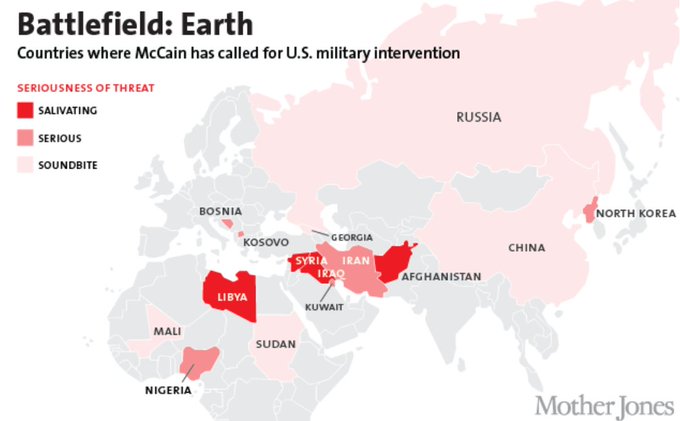
This is a map from 2013 of the many countries where unrepentant warmonger John McCain had called for US military intervention:
- Syria
- Iraq
- Afghanistan
- Libya
- Kosovo
- Nigeria
- Bosnia
- North Korea
- Iran
- Russia
- Sudan
- Mali
- China motherjones.com/politics/2013/…

McCain also adamantly lobbied against Russia and China – policies which some Twitter users found confrontational and potentially disastrous.
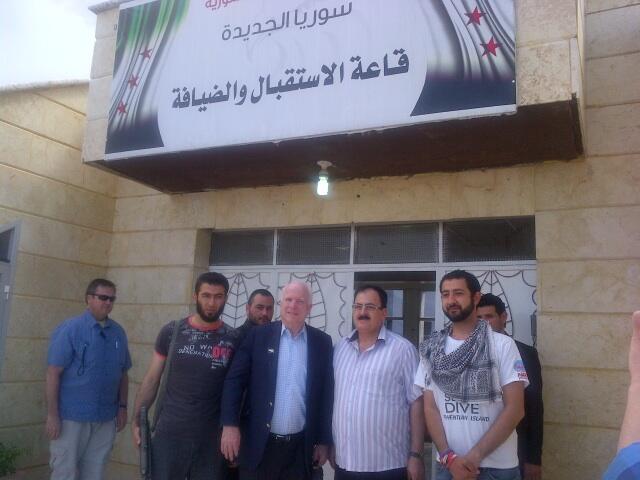
Important visit with brave fighters in #Syria who are risking their lives for freedom and need our help


John McCain Dead at 81. RINO. War Hero, but War Monger. Worked with Hillary and Obama to Create ISIS. Somewhere he lost his way and gave himself over to the Globalist. These were his real friends in the photo. #JohnMcCain #Globalist #WarMonger

Calling him a ‘warmonger,’ some users recalled McCain’s rendezvous with Syrian militants and even accused him of conspiring “with Hillary and Obama to create ISIS.” Others directly accused the deceased senator of pursuing his ideals at the cost of entire nations and wanting “to wipe Syria, Iran, Iraq, Palestine, and Vietnam off the map.”
If you are a non-interventionist, you should already know that McCain was a war monger, in the pocket of military industrial complex and is responsible for hundreds of thousands of dead. He meddled for war in the Middle East and Ukraine. He was an evil, entitled, heartless man.


“If you are a non-interventionist, you should already know that McCain was a war monger, in the pocket of military industrial complex and is responsible for hundreds of thousands of dead. He meddled for war in the Middle East and Ukraine. He was an evil, entitled, heartless man,” one user tweeted.
Amid the torrent of praise from acting and former politicians as well as public figures, some people claimed that, while McCain was a useful “tool” of the GOP, his public image and policies nonetheless tarnished the entire Republican party’s reputation.
John McCain was a Judas Iscariot, a traitor, to the GOP. I’m sorry his family is in pain, but mhaopy he is no longer in the US Senate @LouDobbs @seanhannity


Subscribe to:
Posts (Atom)