Monday, June 11, 2018
#Pakistan - New #Rupee devaluation shows economic risk before election


The rupee drop threatens to squeeze consumers, coming just days before Eidul Fitr and ahead of the July 25 general election.
The apparent devaluation shows signs of vulnerability in the country's nearly $300 billion economy, as dwindling foreign reserves and a widening current account deficit trigger speculation about going back to the International Monetary Fund for loans for the second time since 2013.
One leading economist, Ashfaque Ahmad Khan, said the interim government that now holds the reins during the election campaign might itself be forced to go to the IMF.
Khan said the interim government needs to take policy decisions to curb imports and increase exports, but so far the caretaker government has not taken enough steps.
“If we rely exclusively on the rupee devaluation to address our balance of payment crises, this will have disastrous consequences,” he said.
The outgoing PML-N government has touted its stewardship of the economy as a reason to bring the party back to power, but foreign reserves are now at a low of two months' worth of imports. The PML-N policy for years was to support keeping the rupee relatively stable in what was widely considered a managed float, but as the current account deficit widened and foreign reserves dropped to about half their peak, the policy shifted.
Since December, the rupee has fallen by about 14pc.
The rupee closed at 119.85 per US dollar on Monday after opening at 115.63. Earlier in the day, it traded close to 121 per dollar, traders said.
“On Monday the central bank didn't intervene (to support the rupee) and allowed the market to determine the rupee value,” Samiullah Tariq, director of research at Arif Habib Securities, told Reuters. “Pressure of a high current account deficit and dollar demand in the market also contributed to the rupee's fall.”
A spokesman for the State Bank of Pakistan didn't respond to Reuters' request for comment on the talk that the bank had withdrawn support for the rupee, triggering another devaluation.
Withdrawal of support would have the effect of devaluing the currency as the SBP is the most influential player in the thinly traded local foreign exchange market and controls what is widely considered a managed float system. In December and in March, the rupee was devalued, each time by about 5pc, by the central bank. Pakistan's economy is expected to expand by close to 6pc this year, the fastest pace in more than a decade, but a widening of the current account deficit has brought new worries. The current account deficit now stands at $14 billion, around 5.3pc of gross domestic product, an SBP official said. The economic outlook has been hurt by the fast depletion of foreign currency reserves, which now stand at just over $10bn.
Pakistan is currently in discussions with China for loans to ease pressure on its foreign currency reserves. Over the weekend, the shortage of foreign currency widened the spread at which the rupee is traded in the open market and the interbank market to 4 rupees.
"Whatever has happened again today is the reflection of growing pressure on the balance of payments side," Khan told Reuters.
“It also exposes the outgoing government's claims that they strengthened the economy [and] that they are leaving the economy in good shape. That unfortunately isn't the case.”
#Pakistan - No fair election without free media

Pakistanis will elect a new government on July 25. The caretaker administrations at the centre and provinces have taken charge and the Election Commission of Pakistan (ECP) will be performing its legal duties to ensure a fair election. However, a fair election requires free and independent media that can inform the public and help the electorate in making informed choices on the Election Day. But media freedoms have consistently been under attack in recent months. This is a serious cause for concern and needs to be addressed at the earliest.
The country’s largest TV network was browbeaten into adopting a pliant line. The method chosen was even more alarming. Instead of legal proceedings through the electronic media regulator underhand means were employed to restrict the transmission of the channel in various parts of the country. This continued for weeks and ultimately the channel reportedly made a deal with the powerful quarters within the state. Since then the programming of the channel has undergone a noticeable change. The latest victim of such highhanded methods has been DAWN newspaper, which is country’s oldest and much respected newspaper. The list is long and worrying.
Individual journalists, including citizen journalists such as Gul Bukhari, have been warned and intimidated and none other than the head of military’s public relations wing announced that the social media was under surveillance to check anti-state content. All states exercise some measure of scrutiny to ensure that national security imperatives are not compromised. Yet, journalistic freedoms need to be carefully handled as they relate to a vital citizen right of information and the sustenance of a culture that enables freedom of speech. These rights are under threat in Pakistan as the country enters into the election cycle.
At the centre of this tension between the media and the permanent institutions of the state i.e. the military and the judiciary is the aggressive posture of former prime minister Nawaz Sharif and his party that have been complaining of strong arm tactics by the establishment. Another fault line is the media coverage of the Pashtun Tahafuz Movement, its strong rhetoric against the deep state and public mobilisation against some of the instruments of Pakistan’s crackdown on terrorism, a subset of the global war on terror. The army has concluded that it’s foreign sponsored and a threat to the national security. Resultantly, there has been a blackout and public conversations have shifted to social media.
Sadly, Pakistan’s media remains disunited and unable to forge a common strategy to counter the growing curbs their freedoms. A recent example of the disarray is the statement issued by PFUJ against the press conference of the DG ISPR. PFUJ’s strongly worded statement was retracted a day later thereby showing how even the media bodies are much susceptible to pressure. As regards the electronic media, the media owners are so driven by profit that they have no qualms about forsaking freedoms lest their business is affected by the state controls.
Pakistanis deserve better. Access to information through independent media must be a non-negotiable right. Foreign press has been reporting on this issue and international watchdogs have issued statements asking for protection of journalists. In the globalised information age, it is impossible to implement censorship. Pakistan’s image suffers each time there is an attempt to muzzle the media. The political parties and the media houses have an important role to play to ensure that citizen rights are not denied. Never was media unity more needed and never was it as fragile as it is today.
All of this casts an ominous shadow over the electoral process and the future direction of democracy in the country.
#Pakistani #Christians Under Attack : Asylum family in plea to PM over fears of death in Pakistan

A Christian man who has spent six years seeking asylum has appealed to the prime minister to allow him and his family to stay in the UK.
Maqsood Bakhsh fled Pakistan in 2012 with his wife and two sons after Islamic extremists threatened to kill him because of his religious beliefs.
They now live in Glasgow and fear their lives would be in danger if they returned to Pakistan.
The Home Office said every asylum case was assessed on its individual merits.
It said officials would contact the Bakhsh family to discuss their circumstances after their case was highlighted by the Church of Scotland.
The catalyst for Mr Bakhsh leaving Pakistan with his wife Parveen, their sons Somer and Areebs - then aged nine and seven - was the murder of two Christians shot outside a court in Faisalabad in 2010.
Pastor Rashid Emmanuel, 32, and Sajid, 24, were accused of writing a pamphlet critical of the Prophet Muhammad that flouted Pakistan's controversial blasphemy law, which carries the death penalty.
Mr Bakhsh, 50, claims the people responsible for the deaths believed he was in league with the two men and would kill him and his family if they had the chance.
The Home Office has rejected the family's previous asylum applications and they have now been told they have exhausted the process and have no right to appeal.
However, they plan to launch a legal challenge.
'My sons feel safe here'
Mr Bakhsh said: "Prime Minister, please help us because I do not understand why the Home Office keep rejecting us.
"They keep telling us that some parts of Pakistan are safe for Christians.
"It is true that lots of Christians live in Pakistan but once you have been targeted by Islamic extremists who know your name and your face, it is impossible to live.
"Four of my friends have been killed by Islamic extremists and my sister-in-law's brother is serving life in jail because of the blasphemy law.
"My nephew was kidnapped last month and no one knows what has happened to him."
Mr Bakhsh, who was a commissioner at the Kirk's General Assembly in 2017, worked as a data analyst in Pakistan and holds two masters degrees, while his wife is a trained neo-natal midwife with 17 years experience.
Due to their immigration status both have been unable to work since arriving in Scotland and survive on benefits and charity.
Mr Bakhsh added: "We love this city, my sons feel Scottish and they are thriving here.
"They feel safe, which is my biggest concern, and want to stay with all their friends - the only people they know - and get a good education."
Rev Linda Pollock, minister at Possilpark Parish Church where Mr Bakhsh is an elder, said their situation was "unconscionable".
She added: "I hope that the Home Office will re-examine the family's case, stop treating them as numbers and acknowledge them as human beings because they have so much to give to Scotland."
The family's MP, Labour's Paul Sweeney, plans to raise the case in the House of Commons.
A Home Office spokeswoman said: "The UK has a proud history of granting asylum to those who need our protection and every case is assessed on its individual merits."
https://www.bbc.com/news/uk-scotland-glasgow-west-44432107
#Pakistan - #PPP - Shehla Raza to contest election against Imran in Karachi

Pakistan Peoples’ Party on Sunday nominated former Sindh Assembly deputy speaker Shehla Raza to contest against Pakistan Tehreek-e-Insaf Chairman Imran Khan in NA 243 (Karachi), as the party announced its candidates for 160 national and provincial seats of Sindh.
The party chairman Bilawal Bhutto Zardari will contest from Larkana (NA-200) and party’s stronghold Lyari (NA-246), former president Asif Ali Zardari will contest from NA- 213 (Nawabshah) and former Opposition Leader Khurshid Shah has been nominated for a seat in Sukkur (NA-206), said the declaration.
Former President Zardari’s sister Faryal Talpur will contest from provincial seats of Larkana (PS-10), Nawabshah (PS-37).
Zardari’s brother-in-law Munawar Talpur will be the party’s candidate from Mirpurkhas on NA seat.
Agha Siraj Durrani will contest from Shikarpur (PS-9), Imtiaz Sheikh from (PS-7), Sohail Anwar Siyal from Larkana (PS-12), Nisar Khuhro from Larkana (PS-11), former Sindh CM Murad Ali Shah from Jamshoro (PS-80).
KARACHI
The party has nominated Jam Abdul Karim Jokhio to contest from NA-236 (Malir 1), Abdul Hakim Baloch from NA-237 (Malir 2), Agha Rafiullah from NA-238 (Malir 3), Syed Imran Haider Abidi to contest from NA-239 (Korangi), Sheikh Muhammad Feroz from NA-240 (Korangi), Muazam Ali Qureshi from NA-241 (Korangi).
The party has nominated Jam Abdul Karim Jokhio to contest from NA-236 (Malir 1), Abdul Hakim Baloch from NA-237 (Malir 2), Agha Rafiullah from NA-238 (Malir 3), Syed Imran Haider Abidi to contest from NA-239 (Korangi), Sheikh Muhammad Feroz from NA-240 (Korangi), Muazam Ali Qureshi from NA-241 (Korangi).
Iqbal Sand from NA-242 (Karachi East), Asad Alam Niazi from NA-244 (East), Farrukh Niaz Tanoli to from NA-245 (East), Abdul Aziz Memon from NA-247 (South), Abdul Qadir Patel from NA-248, Ali Ahmed from NA-250 (West), Naz Baloch from PS-127 (Karachi West).
http://www.thesindhtimes.com/pak/06/shehla-raza-contest-election-imran-karachi/
Sunday, June 10, 2018
Perspective: #Pakistan - ‘Mirzai’ — the biggest enemy?

Hassaan Khan Niazi

Only in the past couple of years I found out that a few of my school friends belonged to the Ahmadi faith. They had chosen to hide that aspect of their lives because they were scared of rejection, or being ostracized.
As the world watches the drama unfold in Jerusalem, al-Aqsa mosque is once again the centre of our attention. Israel’s right-wing government plans to demolish the mosque in the next stage of takeover of the holy city. Even the thought of it is painful; how agonising it will be seeing the holy edifice being torn down? I wonder how the local Muslims living in Jerusalem will deal with the loss. My question to all the thaikaidars of Islam in Pakistan is, what will you do when ultra-right Jews replace al-Aqsa with a Synagogue.
Recently, I woke up to the news of an Ahmadi place of worship being demolished by religious fanatics in Sialkot.
How painfully helpless would one feel when one cannot even defend oneself? When one’s so-called “protectors” are complicit in the crime being committed, and especially when someone is not in a position to put up a defence because that someone belongs to a minority in Pakistan. Apparently, the police of Sialkot was watching it all happen and didn’t move a muscle.
The wound inflicted at Babari Masjid still feels awfully painful but in reality we are no different from Modi, whose BJP demolished our mosque. How can you attack a holy site? For me it is still hard to comprehend.
We derisively call them ‘Mirzai’, a term they find repugnant. It’s like referring to inanimate objects that do not breathe, or feel anything. Only in the past couple of years I found out that a few of my school friends belonged to the Ahmadi faith. They had chosen to hide that aspect of their lives because they were scared of rejection, or being ostracised. It made me wonder how I would feel if the proverbial shoe was on the other foot, and if I had, in some parallel universe, traded places with them. I can only relate this feeling with the Palestinians living in Jerusalem right now.
Another stray thought came rushing in: why is it that I have yet to come across a single Ahmadi who is not humble and who can actually pose a credible threat to the society? They are normally better educated and better behaved than their counterparts in other faiths. I have definitely found them better human beings than Aamir Liaquat, Khadim Rizvi and Maulana Fazlur Rehman.
One can understand the intolerance that is being exhibited by the Hindu majority in India on its minorities. Manusimriti is a part of their creed and their caste ridden system is built on intolerance and hatred for those they perceive to be lower than them. But Islam was different, it is different. It preaches tolerance. The Quran says that the murder of one man is the murder of all of humanity. When did we descend from such high ideals?
What creed or version of Islam makes us intolerant? How come invoking the name of the greatest human being that ever lived, and whom Allah refers to as Rehmatul–Alamein (may Allah’s blessings and peace shower on him endlessly), we commit the most barbaric of acts? How can a lover of Madina be so abusive and dangerous for the people who are weak?
Unfortunately, our current system promotes the radical elements who are out in the open, no longer lurking in the shadows. It was less than a week back that I interacted with an FIA official, and was left speechless. From disrespectful comments to derogatory slurs, his words were punctuated by incomprehensible hate. It will not surprise me at all if he was found amongst the hooligans that demolished the Ahmadi place of worship in Sialkot. This is supposedly an educated man, sworn to uphold the law and protect all Pakistanis regardless of their ethnicity and creed.
What can one expect from dregs of the society then, whom we have left behind in our mad rush for material gains, who are brainwashed by the so-called Mullahs, to riot at their behest, when and wherever it pleases them? They are the foot soldiers of the fanatics. The Dalit in India see a similar fate.
I came to see this official in Lahore, to discuss a human rights case regarding a widow and mother of two minor daughters, against whom the FIA had registered an unreasonable case.
I was trying to convince the official that the FIR under S-420 could be fatal for her and the two minor children, when suddenly, in a room full of nearly 10 men, instead of discussing the matter he was supposed to discuss, he threw a jibe at me by telling me not to be a hero and act like a professional lawyer. To which I responded that I do want to be a “hero” if it meant that I was defending the rights of my clients. His frustration increased and he said, “jao jaker mirzaiyon ko defend kero” (go defend “Ahmadis”). I felt that this was his way to shut me up. My rebellious nature took over and I instantly said. “I will.”
He laughed sarcastically followed by an awkward silence that left me flabbergasted at his obnoxious, unethical and very unprofessional behaviour. Is this how an officer of law should behave? What are we doing to ourselves? Shivers run through my body when I recall those 10 faces in the room. Anyone could have done anything in the name of Islam.
It took me a day to digest the whole incident and I thought I should just forget what happened there.
But then, seeing many people across the vast spectrum of social media condemn the attack on the Ahmadi place of worship, I got the courage to share my experience with the public at large. When should people like this official run the affairs of state in this manner, what will our future look like?
Most certainly, this is not Islam! I am more conservative than many Muslims around and definitely more than any of the hooligans who attacked the Ahmadi house of worship in Sialkot the other day. It is my belief that hellfire awaits anyone who thinks people they hate are not human and they are free to inflict pain as they please.
I love Mujahideen like Burhan Wani, but I have zero respect for the thugs who bully and terrorise the weak.
Lastly, if an Ahmadi place of worship hurts and bothers someone so much, then they must seek relief through a court of law with standing. No one has the right to take anyone’s life or obstruct their lawful activities, as equal citizens of this nation, including worship.
Human rights are for every human being in the world — not just Muslims!
We need to be different from the Zionist and hardcore extremist Hindus in India. If you want to participate in jihad then go raise a voice for the pitiful Palestinians and Kashmiris.
It is high time we start loving the minorities.
#Pakistan ranks 6th out of 167 countries on Slavery Index

Akhtar Amin
The Global Slavery Index has ranked Pakistan 6th out of 167 countries as 2,134,900 people are estimated living in modern slavery in the country.
 The details of the Global Slavery Index were discussed at a provincial consultation titled “Abolishing Bonded Labour” organised by the Democracy Reporting International at a hotel here.
Giving a broader overview on the issue of bonded labour in Pakistan, Muhammad Rafique of the Democracy Reporting International told the participants that as per the Global Slavery Index, 60 percent of labour force is vulnerable to modern slavery in Pakistan in different sectors including agriculture, brick-kiln, carpet weaving, mining and others.
He said that among the main resources behind prevalence of the bonded labour, economic factor is 2 percent, unemployment 5.9 percent, poverty 39 percent and agriculture is 40 percent.
However, he said that lack of human development in Pakistan is the main issue for bonded labour as in the Human Development Index, Pakistan has become the lowest country in South Asia and ranked 146th.
He said that the other factors are social factors and lack of education, health and other basic amenities to people.
“Unfortunately, there is no well documented research based study of the bonded labour in the country, through which the issue can be addressed,” Director National Commission on Human Rights (NCHR) Khyzar Hayat Khan told the participants. He also said that like in the past, now he did not see the enthusiasm among the rights activists to take up the issue.
He revealed the provinces also have no actual data of cases of the bonded labour, which also showed the lack of interest of the governments toward the issue.
Raza Asad, coordinator for the NCHR, said that the Pakistan’s laws for abolition of the bonded labour were also week as compared to other countries, including Nepal, where rehabilitation of the bonded labour is also the state responsibility.
Irfanullah Khan, director Labour Department Khyber Pakhtunkhwa, said the provincial government has recently launched the first Child Labour Policy 2018 of the province, through which the child labour in the province would be curbed. He said that through the policy, a Central Referral Mechanism would be established to discourage the issue of bonded labour. Besides, he said the department is going to take strict action against child labour. Irfanullah Khan said that the advance money system to labourers of brick-kiln by the owners and labour force in agriculture often leads the labours towards slavery. Liaqat Bacha of Muttahida Labour Federation said that the issue of bonded labour is increasing in the country and province due to the existing weak laws and its non-implementation.
He said the government had failed to implement the minimum wages in the province as even today labourers are getting from Rs5,000 to Rs8,000 salary in the industrial units and private schools instead of Rs15,000, the minimum wages declared by the provincial government.
Rukhshanda Naz, a known women’s rights activist and Executive Director of Legal Aid and Awareness Services (LAAS), said the lack of policy for home-based workers and domestic workers adds more to the miseries of child labour. Imran Takar, a child rights activist, said that child labour was very high in Khyber Pakhtunkhwa and Fata and unfortunately there was no specific focus on the subject.
“Children in the province are involved in different sectors, including agriculture, mining, manufacturing, bonded labour, domestic labour and home-based work. There are a number of laws at provincial level, which regulate child labour and working conditions of children across Khyber Pakhtunkhwa. The laws such as KP Prohibition of Employment of Children Act 2015 and KP Bonded Labour System (Abolition) Act 2015 are in place but their implementation and awareness is a far cry,” he added.
#Pakistan - #PPP - Bilawal, Aseefa reach Larkana to file nomination papers


They were received by PPP provincial chief Nisar Ahmed Khuhro and other party leaders at Mohenjo Daro airport.
Speaking to the media, Khuhro said that Bilawal will submit his nomination papers to the Returning Officer for National Assembly seat NA-200.
He said the PPP chief will be warmly welcomed by the party activists on his arrival in Larkana on Monday morning.
Khuhro claimed that Bilawal will win from Larkana with record votes and the upcoming general elections will be the first of Bilawal and “the last of his opponents.”
Earlier this week, Bilawal announced that he will be contest upcoming general elections from three National Assembly constituencies, which include NA-8 Malakand, NA-200 Larkana and NA-246 Lyari.
Moreover, Bilawal’s younger sister Aseefa Bhutto will contest elections from NA-202 Larkana.
Speaking to the media after filing his nomination papers for the NA-246 constituency, Bilawal said that the PPP will forward former PM Benazir Bhutto’s mission and vision and that it will be a great source of happiness for him to serve Pakistan.
“I am stepping into parliamentary politics. A Bhutto in mainstream politics will strengthen Pakistan’s defence,” he said.
#Pakistan - ‘Black gold’ finally unearthed in Tharparkar

A private mining company excavating coal in Tharparkar has announced to discover first layer of indigenous coal today (Sunday), SAMAA TV reported.
It said the coal was discovered at the depth of 140 meters after more than two years of exaction.
First electron will be generated from the power plant in December this year, announced Sindh Engro Coal Mining Company (SECMC), a joint venture between the Sindh government and Engro Powergen.
The company said the successful extraction not only proves that Thar’s indigenous coal is exploitable but can produce thousands of megawatts of cheap electricity for many decades.

Former chief minister Sindh, Syed Murad Ali Shah, also announced it on Twitter.
“By the Grace of the Almighty, today we have reached “Black Gold” in Thar, as envisioned by Shaheed Mohtarma Benazir Bhutto. This discovery of Coal is the result of the hard work and perseverance of #PPP govt, and the beginning of an energy sufficient Pakistan,” he tweeted.
Shamsuddin Shaikh, head of the SECMC, said the dream of discovering the coal from Tharparkar has come true after 25 years.
In Tharparkar, Sindh has one of the world’s largest coal reserves. The coal mine is set to become Pakistan’s biggest industrial site.
The estimated 175 billion tonnes of watery, low energy coal was first discovered in 1992 but because of its poor quality, most companies found it too costly to mine.
In 2012, SECMC, took up the challenge, convincing eight companies to join them, two of them Chinese.
They are also now building a 660 megawatt coal power plant nearby – which the company wants to increase to 3,300 MW by 2022 – and the government has improved roads and built an airport in the desert for the project.
Pakistan is not the only country using coal - one of the cheapest but also most polluting forms of energy - to help plug its growing energy needs.
Most new demand for coal-fired power stations is in Southeast Asia, although other countries including Bangladesh are also building new stations.
Saturday, June 9, 2018
#G7 summit fails to calm trade tensions as Trump refuses to endorse joint statement


Just hours after G7 leaders had seemingly found common ground on "rules based trade," US President Trump refused to endorse a joint communique. The leaders leave the summit with a threat of a trade war looming.
Leaders of the G7 appeared to have agreed on a final communique at the end of a contentious two-day summit in Canada on Saturday, before US President Donald Trump lashed out at Canada and created further uncertainty over trade.
The summit between the United States Germany, France, Japan, Canada, Britain and Italy was one of the most fractious ever and the agreement on a final communique couldn't paper over differences on trade, the environment and Iran nuclear deal.
Despite Trump's recent decision to slap aluminum and steel tariffs on America's allies, the statement at the conclusion of the summit called for the "free, fair, and mutually beneficial trade," fighting protectionism and "the crucial role of a rules-based international trading system."
Yet a deep rift was highlighted as host Canadian Prime Minister Justin Trudeau ended the summit by saying he would move forward with retaliatory tariffs against the United States starting on July 1. He called US tariffs on its ally under the pretext of national security "kind of insulting" and said Canada would not be "pushed around."
"What we did this weekend was come together, roll up our sleeves and figure out a consensus language that we could all agree to," Trudeau said at a press conference, recognizing that there were major differences with Trump. "If the expectation was that a weekend in beautiful Charlevoix surrounded by lovely people was going to transform the president's outlook on trade and the world, then we didn't quite perhaps meet that bar" ]
Only hours later Trump took to Twitter to assault the Canadian prime minister's "false statements" and instructed US representatives to renege on the US endorsement of the joint communique. He also said he would be looking to impose tariffs on car imports into the United States.
Trudeau's office responded later, saying they were focused on what was accomplished at the G7 summit and that the prime minister said nothing at the press conference that he hadn't mentioned "before - both in public, and in private conversations with the President."
US isolated among allies
Although Trump called his relationship with the six other countries "outstanding," the summit showed the United States was increasingly isolated. Trump repeatedly insisted America's allies would yield to his trade demands and that Washington would crush any opposition in a potential trade war.
Trump appeared to get one concession when the G7 committed "to modernize the WTO to make it more fair as soon as possible." Trump has repeatedly criticized the World Trade Organization as a disaster for the United States.
Before Trump pulled out of the final comminque, French President Emmanuel Macron said Europe had put up a united front against the United States.
"Trump did not want to be isolated," Macron said. "We managed to convince Trump that six plus one was feasible and he did not want that."
"This G7 does not put an end to all our disagreements, but in a context of tension it did allow us to preserve unity wherever that was possible," he said. "The fact that we weren't ready to downgrade our positions allowed us to have a better result than we might have hoped for."
While the final communique, apparently with just the G6 signing on, committed that Iran will "never seek, develop or acquire a nuclear weapon," there appeared to be little to close the gap between the US and its allies on contentious issues surrounding trade and investment with Iran.
The Trump administration withdrew from the Iran nuclear deal last month and is set to impose sanctions that have left European leaders scrambling to protect their businesses and save the accord.
On climate change, the G7 failed to find consensus after the United States withdrew from the Paris climate accord last year. The G7 minus the United States agreed to cooperated on climate change.
The United States was also the only outlier on the issue of environment protection. German Chancellor Angela Merkel said the United States was the only G7 member that refused to commit to eliminating plastic waste, which is devastating the world's oceans.
"The United States is in favor of protecting the oceans in principle, but they do not want to participate in quantifiable goals in that regard," Merkel said.
Trump the outsider gatecrashes own party: Top takeaways from an ill-mannered #G7


The US’s status as the biggest G7 economy has customarily allowed it to steer the agenda of the club’s summits from its place at the top, the other countries following its lead. But Donald Trump chose a different tactic.
Flouting protocol
There were too many flagrant deviations by the US delegation from established etiquette to consider it a simple sign of Trump’s erratic boorishness. Instead, it appeared that American president was in no mood to compromise, and had every intention to aggravate.
Arriving late to miss a face-to-face with Emmanuel Macron, snubbing Theresa May while leaking pointed comments about her “school mistress” tone, tardiness at the official breakfast on Saturday, and skipping a climate change discussion to leave early, only to give a casual press conference on the way out – all of these were extravagant diplomatic displays of disdain.
While some have reported that Trump simply never wanted to go to Quebec, others believe he is following the well-known conflict strategy in negotiation, in which he scares his supposedly saner counterparts into granting him his wishes just to avoid the greater risks he is prepared to take. The only man with a counter-strategy to the man-with-the-bomb act appeared to be Emmanuel Macron who simply decided to death grip Donald Trump’s hand until it turned an alarming shade of white, though it remains uncertain if the move was effective.
Russia’s G8 status a red rag
There is no better way to rile up the rest of the G7 than by suggesting that it welcome Russia back at the exact moment when relations between Moscow and the West are hitting a new nadir on a weekly basis.
Trump mentioned this proposal at every single press opportunity, straight-facedly talking about how reintegrating Moscow would be a boon to world peace, and even had the chutzpah to suggest that some (unspecified) countries actually agreed with the proposal.
Discussing Crimea as an Obama-era issue also implied that the current administration may not regard the fate of the peninsula as an immovable issue resulting in eternal sanctions, a contravention of the “not an inch” rhetoric from Europe.
The tariff war isn’t going away easily
Many political rivals and analysts considered Trump’s pet obsessions – such as building that wall – wrong-headed or impractical, believing them to be empty campaign promises or fantasies. They are probably still surprised that the US president did move the embassy to Jerusalem, and actually quit the Iran deal.
And Trump’s trade balance hobby horse is one of his sturdiest, and could single-handedly explain his entire performance in Quebec.
Painting the US as a victim of its haplessness - “the piggy bank that everybody is robbing” including a “brutal” EU – as a result of asymmetrical tariffs, Trump announced his aluminum and steel levies in advance of the G7, and didn’t let the topic go, only to turn around at the last moment and suddenly suggest dropping tariffs altogether.
In one of the mostly tonally odd moments of the entire summit, Trump at one point announced out of nowhere – in a mix between a deadpan joke and a power move – that Canada had agreed to drop all tariffs, with Justin Trudeau standing next to him bemused (“we have a ten out of ten relationship,” Trump told the media).
Still relevant?
With Russia out, none of the BRICS countries were represented at Charlevoix, and economic data shows that with each annual summit the share of the seven keeps falling in relative terms, as the rest of the world catches up.
But libertarian economist Jeffrey Tucker believes the problems run deeper than that.
“The world economy is increasingly decentralized and integrated in a way that eludes control by anybody - whether it's G7, G8, G20 or G200,” he told RT. “It’s hard to know if in the future these bodies will have much relevance to the way the world economy operates.”
So if it is not their economic heft, and their once-vaunted political unity that these seven countries are projecting what is it exactly that the G7 is offering, either to those posing the “family photo” or those in the wider world?
Trump Refuses to Sign G-7 Statement and Calls Trudeau ‘Weak’

By Michael D. Shear and Catherine Porter
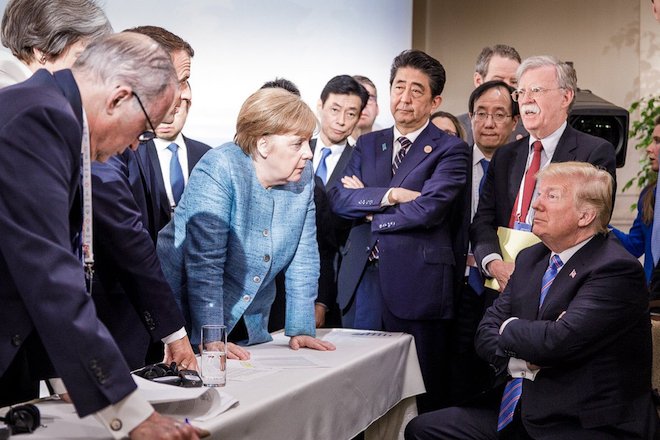
In a remarkable pair of acrimony-laced tweets from aboard Air Force One as he flew away from the Group of 7 summit toward a meeting with North Korea’s leader, Mr. Trump lashed out at Justin Trudeau. He accused the prime minister, who hosted the seven-nation gathering, of making false statements.
Literally moments after Mr. Trudeau’s government proudly released the joint statement, noting it had been agreed to by all seven countries, Mr. Trump blew apart the veneer of cordiality that had prevailed throughout the two days of meetings in a resort town on the banks of the St. Lawrence River.
“Based on Justin’s false statements at his news conference, and the fact that Canada is charging massive Tariffs to our U.S. farmers, workers and companies, I have instructed our U.S. Reps not to endorse the Communique as we look at Tariffs on automobiles flooding the U.S. Market!” Mr. Trump wrote.
A few hours earlier, Mr. Trudeau said the seven nations had reached broad agreements on a range of economic and foreign policy goals. But he acknowledged that deep disagreements remained between Mr. Trump and the leaders of the other nations, especially on trade. Mr. Trudeau had sought to play down personal clashes with Mr. Trump as he wrapped up the summit, calling the meeting “very successful” and saying he was “inspired by the discussion.” But he also pledged to retaliate against the United States tariffs on steel and aluminum products in defense of Canadian workers.
Mr. Trump, who apparently saw Mr. Trudeau’s news conference on television aboard Air Force One, was clearly enraged.
“PM Justin Trudeau of Canada acted so meek and mild during our @g7 meetings,” Mr. Trump said in a second tweet, “only to give a news conference after I left saying that, ‘US Tariffs were kind of insulting’ and he ‘will not be pushed around.’ Very dishonest & weak. Our Tariffs are in response to his of 270% on dairy!”
Not long after, John Bolton, the president’s national security adviser, tweeted out a dramatic photo of Mr. Trump, arms crossed and scowling, looking defiant as the leaders of the other nations stood in a circle around him. “Just another #G7 where other countries expect America will always be their bank,” Mr. Bolton wrote as the president’s plane stopped for refueling at Souda Bay on the Greek island of Crete. “The President made it clear today. No more.”
Mr. Trudeau’s office responded to the president’s Twitter barrage with a carefully worded statement.
“We are focused on everything we accomplished here at the summit,” said Cameron Ahmad, a spokesman for Mr. Trudeau. “The prime minister said nothing he hasn’t said before — both in public, and in private conversations with the President.”
The president’s outburst had been foreshadowed for days leading up to the Canada summit, with Mr. Trump and his counterparts trading sharp-edged barbs that included threats of punches and counterpunches on tariffs. President Emmanuel Macron of France accused Mr. Trump of being willing to remain isolated from the world.
That was followed by 48 hours of tense and often confrontational closed-door discussions between Mr. Trump and the leaders of America’s closest allies — France, Britain, Canada, Japan, Italy and Germany — in the hopes of resolving a brewing trade war among friends.
Instead, the gathering apparently served to further inflame Mr. Trump’s belief that the United States is being treated unfairly by countries with which prior presidents had long ago negotiated trade agreements for the flow of goods and services. The result was a slow-rolling collapse of the fragile alliances that officials at the summit — and even Mr. Tump’s own White House advisers — insisted throughout the day could be maintained in the face of fundamental disagreements.
Reporters on Air Force One had been told that the United States would sign the joint statement. And minutes after the president’s tweets, reporters were sent an email that had clearly been prepared earlier touting Mr. Trump’s participation in the summit, complete with photos.
Earlier in the day, before Mr. Trump left the summit, he brought up the dramatic prospect of completely eliminating tariffs on goods and services, even as he threatened to end all trade with them if they didn’t stop what he said were unfair trade practices. Mr. Trump, speaking to reporters at the end of the contentious meeting, said that eliminating all trading barriers would be “the ultimate thing.” He railed about what he called “ridiculous and unacceptable” tariffs on American goods and vowed to end them. “It’s going to stop,” he said, “or we’ll stop trading with them. And that’s a very profitable answer, if we have to do it.” He added, “We’re like the piggy bank that everybody’s robbing — and that ends.”
The other six leaders were defiant in the face of Mr. Trump’s threats.
“I have made it very clear to the president that it is not something we relish doing, but it is something that we absolutely will do,” Mr. Trudeau said. “As Canadians, we are polite, we’re reasonable, but also we will not be pushed around.”
Mr. Macron said the trade debates at the summit were “sometimes quite heated.” Asked who won the tug-of-war with Trump, Mr. Macron said: “There is no winner, there are only losers when you take that strategy.” Theresa May, the British prime minister, blasted Mr. Trump’s tariffs. She said she had registered “our deep disappointment at the unjustified decision” and that the loss of trade through tariffs would “ultimately make everyone poorer.”
The president’s public comments on trade Saturday echoed the complaints he made directly to the leaders from Canada, Japan and Europe in private sessions on Friday. Mr. Trump confronted several of the leaders individually, giving examples of how, in his view, each of their countries had mistreated the United States, whether it be through trade barriers or security commitments, according to a European official.
The president delivered a running monologue in one of the closed-door meetings, one person familiar with the discussion said. One minute, he slammed Germany for taking advantage of the United States by selling so many cars there. The next, he talked about how his grandfather was German and how much he loved Europe. Several of the leaders responded aggressively to Mr. Trump’s demands — as they have repeatedly done in public — listing their own complaints about American tariffs and other trade measures, the official said. Several countries have said that they will retaliate against the United States’ new steel and aluminum tariffs with increased tariffs of their own.
“If they retaliate, they’re making a mistake,” Mr. Trump said on Saturday.
Mr. Trump’s surprise proposal for a tariff-free G7 followed from a conversation the president had on Air Force One heading to Canada with Larry Kudlow, his national economic adviser. Mr. Kudlow, a self-described “lifelong free trader,” wrote an op-ed article in The Washington Post on Thursday saying that he did not prefer tariffs but that Mr. Trump’s actions were “a wake-up call to the dangers of a broken trading system that is increasingly unfree.” Mr. Trump and Mr. Kudlow discussed the article on the plane, but the president surprised even his own team by raising the idea with the other leaders. While some observers took it as more of a talking point, a senior administration official said the president was serious about it and wanted it given serious study. Other leaders, the official said, expressed interest.
The official spoke on the condition of anonymity to describe closed-door discussions.
Asked late Saturday what he told Mr. Trump about the surprise proposal for a tariff-free zone, Mr. Macron said, with a smile: “Be my guest, if that’s your wish.” Throughout his remarks on Saturday, Mr. Trump repeatedly returned to his broader complaints about trade practices around the world, insisting that it was the fault of past American leaders who had agreed to deals that benefited other countries more than the United States.
He complained that American dairy farmers were being treated unfairly by Canada.
“The United States pays tremendous tariffs on dairy, as an example, 270 percent,” he said. “Nobody knows that.”
“We don’t want to pay anything,” he said. “Why should we pay?” The president also said American farmers had been hurt for a long time by trade barriers that made it harder for them to sell their goods to other countries.
“You look at our farmers,” he said. “For 15 years, the graph has gone just like this: down.”
“I blame our leaders,” Mr. Trump said. “In fact, I congratulate the leaders of other countries for so crazily being able to make these trade deals that were so good for their country and so bad for the United States. But those days are over.” Mr. Trump said some of the other leaders he met with during the summit appeared to admit that their trade arrangements with the United States were unfair.
“A lot of these countries actually smile at me when I’m talking,” he said. “And the smile is, ‘We couldn’t believe we got away with it.’”
That assessment by Mr. Trump stands in contrast to the public statements by those leaders, who have repeatedly insisted that they will not accept the kinds of tariffs that Mr. Trump has imposed on their industries. In addition to trade, Mr. Trump also took questions about his call for Russia to be reinstated as a member of the Group of 7 nations, despite having been expelled four years ago in the wake of the Russian annexation of Crimea.
“I would rather see Russia in the G-8 as opposed to the G-7,” he said. “I would say that the G8 is a more meaningful group than the G-7. Absolutely.”
Subscribe to:
Posts (Atom)