Thursday, November 10, 2016
What would happen if Donald Trump was impeached?
Google searches for how to remove a president from office increased by nearly 5,000 per cent after Donald Trump won the top job on Wednesday.
Some people have been asking if Mr Trump could be impeached after taking office since before he was even chosen as the Republican nominee, and one law professor has said there is already enough evidence to remove him, before he officially takes office.
Mr Trump also faces a civial case over allegations of fraud related to Trump University that goes to court later this month.
But in reality the process of impeachment is still more complicated — and less mechanical — than some angry Democrats hope.
What is impeachment?
In the US, impeachment is the first step in a constitutionally sanctioned two stage process to remove a president from office for committing “treason, bribery, or other high crimes and misdemeanours”.
According to constitutional lawyers, high crimes and misdemeanours are: "real criminality", so breaking the law; "abuses of power"; or "violation of public trust”.
Beyond, these definitions, it is up to the House of Representatives to decide if an offence warrants impeachment.
In 1970, then-Representative Gerald Ford defined impeachable offences as: ”Whatever a majority of the House of Representatives considers it to be at a given moment in history.“
The House of Representatives decides if there are grounds to consider impeaching a president through an inquiry, a debate, and then a vote, which should include all members of the house. If a majority vote the president guilty on any charges, it will result in impeachment.
However, not a lot actually happens as the result of an initial impeachment. The offending Head of State retains office and can pretty much go about their business as usual until the second stage of the process, in which they will be either convicted or cleared in trial by the Senate.
In this trial, the president will be represented by his lawyers, a select group of House members will serve as ”prosecutors“, the Chief Justice of the Supreme Court will preside, and all 100 Senators will acting as the jury.
If in the Senate a two-thirds majority find the president guilty, he will be convicted and removed from office.
Could President Trump be impeached?
Yes, but it is pretty unlikely.
No president has ever actually been removed from office as a result of impeachment, although two — Andrew Johnson and Bill Clinton — were found guilty of wrongdoing by the House of Representatives, before being cleared by the Senate, and in 1974 President Richard Nixon resigned rather than facing an impeachment process for several charges related to the Watergate scandal.
A major obstacle to impeaching Mr Trump is that both the House of Representatives and the Senate are controlled by the Republicans. Lots of people have speculated that Mr Trump's own party are unlikely to impeach him, unless of course they are put under a huge amount of public pressure.
But, then again, it is not impossible: many Republicans actually do not like the president-elect at all.
Notably, the Republican Speaker Paul Ryan is an outspoken enemy of Mr Trump. The two men have been openly hostile to each other throughout the campaign period, with both initially refusing to endorse the other.
So the house could theoretically turn against him. But are there real grounds for impeachment?
Arguably, yes — a University of Utah law professor called Christopher Lewis Peterson has written a 23-page article analysing why it would be correct for Congress to impeach Mr Trump.
Mr Peterson believes Mr Trump has engaged in fraud and racketeering which meet the criteria of “high crimes and misdemeanours.”
According to Mr Peterson, the Constitution does not prohibit Congress from impeaching a president for alleged acts that happened prior to taking office.
The case against Mr Trump will become more compelling if he is actually convicted of offences, which could happen before he enters the White House. Mr Trump was set to face criminal proceedings for raping a 13-year-old girl, but the case was dropped. However the president-elect is still set to go to court later this month to defend himself against allegations of fraud brought by former students of the now closed Trump University. A number of students claim they were misled into paying up to $35,000 to learn worthless real estate investing “secrets”.
Once a president has taken office they are immune from lawsuits arising during their time as head of state, but the Supreme Court has said this does not extend to acts alleged to have taken place prior to taking office.
So the House of Representatives could turn against Mr Trump, and there could be sufficient legal grounds to impeach him. But to actually kickstart start the mechanism for removing him from office there would probably have to be a shift in public opinion.
While many Americans have taken to the streets in protest against Mr Trump being elected president, many others voted him in.
Bruce Fein, who worked in the Justice Department during Ronald Reagan's presidency, and was also involved in the Republican-led effort to impeach Bill Clinton, told Politico: “Ninety-nine percent of the game is how popular is the president.”
At the moment Mr Trump probably has too many supporters for an impeachment to take place. However, he has promised to do lots of things which could change this. If the economy flagged for example, or if he did institute the use of torture, or begin building a wall to keep Mexicans out, he could make enough enemies to start the process.
Hillary Clinton spotted hiking on day after conceding US election
Scott Bixby
Ex-Democratic presidential nominee went for a hike with her husband near their New York home, hugging a supporter and ‘exchanging some sweet pleasantries’.
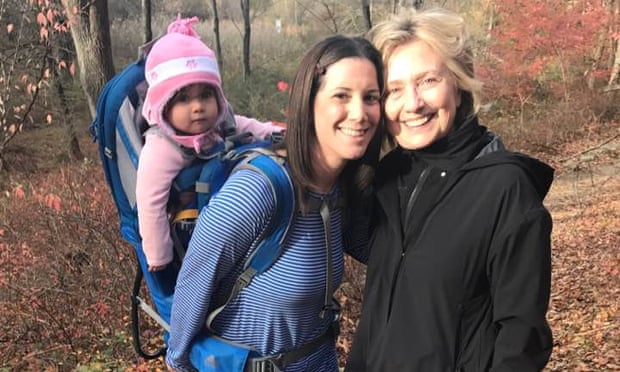 An upstate New York woman, hoping to take her mind off of the US election results with a hike through the woods of Westchester County, bumped into another woman on Thursday with a presumably similar notion: Hillary Clinton.
Margot Gerster of White Plains wrote on Facebook that after “feeling so heartbroken since yesterday’s election”, she hoped to relax by taking her young daughter and her dog hiking on Thursday.
“I decided to take them to one of favorite places in Chappaqua,” Gerster wrote, the Westchester hamlet that the Clintons call home. “We were the only ones there and it was so beautiful and relaxing.”
As Gerster was ending her hike, however, she ran into an unexpected couple on the trail: the former secretary of state and her husband, former president Bill Clinton.
“I heard a bit of rustling coming towards me and as I stepped into the clearing there she was, Hillary Clinton and Bill with their dogs doing exactly the same thing as I was,” Gerster wrote. “I got to hug her and talk to her and tell her that one of my most proudest moments as a mother was taking [my daughter] with me to vote for her.”
Clinton was grateful for Gerster’s words, offering pleasantries, a hug and even a photo taken by the former president.
“She hugged me and thanked me and we exchanged some sweet pleasantries and then I let them continue their walk,” Gerster wrote. “Now, I’m not one for signs but I think I’ll definitely take this one. So proud.”
The photo represents Clinton’s first appearance since her concession speech on Wednesday, during which she declared: “To all the little girls who are watching this: never doubt that you are valuable and powerful and deserving of every chance and opportunity in the world to pursue and achieve your own dreams.”
Gerster ended her post, which has been shared nearly 3,000 times, with a series of hashtags expressing support for the former presidential candidate: “#iamstillwithher #lovetrumpshate #keepfighting #lightfollowsdarkness.”
The photo has received thousands of comments, most expressing good wishes for the former candidate.
“I wish I could give her a hug and thank her personally,” wrote one supporter. “And apologize for the rest of our country.”hi.
https://www.theguardian.com/us-news/2016/nov/10/hillary-clinton-hike-new-york-after-election-donald-trump
An upstate New York woman, hoping to take her mind off of the US election results with a hike through the woods of Westchester County, bumped into another woman on Thursday with a presumably similar notion: Hillary Clinton.
Margot Gerster of White Plains wrote on Facebook that after “feeling so heartbroken since yesterday’s election”, she hoped to relax by taking her young daughter and her dog hiking on Thursday.
“I decided to take them to one of favorite places in Chappaqua,” Gerster wrote, the Westchester hamlet that the Clintons call home. “We were the only ones there and it was so beautiful and relaxing.”
As Gerster was ending her hike, however, she ran into an unexpected couple on the trail: the former secretary of state and her husband, former president Bill Clinton.
“I heard a bit of rustling coming towards me and as I stepped into the clearing there she was, Hillary Clinton and Bill with their dogs doing exactly the same thing as I was,” Gerster wrote. “I got to hug her and talk to her and tell her that one of my most proudest moments as a mother was taking [my daughter] with me to vote for her.”
Clinton was grateful for Gerster’s words, offering pleasantries, a hug and even a photo taken by the former president.
“She hugged me and thanked me and we exchanged some sweet pleasantries and then I let them continue their walk,” Gerster wrote. “Now, I’m not one for signs but I think I’ll definitely take this one. So proud.”
The photo represents Clinton’s first appearance since her concession speech on Wednesday, during which she declared: “To all the little girls who are watching this: never doubt that you are valuable and powerful and deserving of every chance and opportunity in the world to pursue and achieve your own dreams.”
Gerster ended her post, which has been shared nearly 3,000 times, with a series of hashtags expressing support for the former presidential candidate: “#iamstillwithher #lovetrumpshate #keepfighting #lightfollowsdarkness.”
The photo has received thousands of comments, most expressing good wishes for the former candidate.
“I wish I could give her a hug and thank her personally,” wrote one supporter. “And apologize for the rest of our country.”hi.
https://www.theguardian.com/us-news/2016/nov/10/hillary-clinton-hike-new-york-after-election-donald-trump
An upstate New York woman, hoping to take her mind off of the US election results with a hike through the woods of Westchester County, bumped into another woman on Thursday with a presumably similar notion: Hillary Clinton.
Margot Gerster of White Plains wrote on Facebook that after “feeling so heartbroken since yesterday’s election”, she hoped to relax by taking her young daughter and her dog hiking on Thursday.
“I decided to take them to one of favorite places in Chappaqua,” Gerster wrote, the Westchester hamlet that the Clintons call home. “We were the only ones there and it was so beautiful and relaxing.”
As Gerster was ending her hike, however, she ran into an unexpected couple on the trail: the former secretary of state and her husband, former president Bill Clinton.
“I heard a bit of rustling coming towards me and as I stepped into the clearing there she was, Hillary Clinton and Bill with their dogs doing exactly the same thing as I was,” Gerster wrote. “I got to hug her and talk to her and tell her that one of my most proudest moments as a mother was taking [my daughter] with me to vote for her.”
Clinton was grateful for Gerster’s words, offering pleasantries, a hug and even a photo taken by the former president.
“She hugged me and thanked me and we exchanged some sweet pleasantries and then I let them continue their walk,” Gerster wrote. “Now, I’m not one for signs but I think I’ll definitely take this one. So proud.”
The photo represents Clinton’s first appearance since her concession speech on Wednesday, during which she declared: “To all the little girls who are watching this: never doubt that you are valuable and powerful and deserving of every chance and opportunity in the world to pursue and achieve your own dreams.”
Gerster ended her post, which has been shared nearly 3,000 times, with a series of hashtags expressing support for the former presidential candidate: “#iamstillwithher #lovetrumpshate #keepfighting #lightfollowsdarkness.”
The photo has received thousands of comments, most expressing good wishes for the former candidate.
“I wish I could give her a hug and thank her personally,” wrote one supporter. “And apologize for the rest of our country.”hi.
https://www.theguardian.com/us-news/2016/nov/10/hillary-clinton-hike-new-york-after-election-donald-trump
#USELECTIONS - The Electoral College Is Hated by Many. So Why Does It Endure?


In November 2000, as the Florida recount gripped the nation, a newly elected Democratic senator from New York took a break from an upstate victory tour to address the possibility that Al Gore could wind up winning the popular vote but losing the presidential election.
She was unequivocal. “I believe strongly that in a democracy, we should respect the will of the people,” Hillary Clinton said, “and to me that means it’s time to do away with the Electoral College and move to the popular election of our president.”
Sixteen years later, the Electoral College is still standing, and Mrs. Clinton has followed Mr. Gore as the second Democratic presidential candidate in modern history to be defeated by a Republican who earned fewer votes, in his case by George W. Bush.
In her concession speech on Wednesday, Mrs. Clinton did not mention the popular vote, an omission that seemed to signal her desire to encourage a smooth and civil transition of power after such a divisive election. But her running mate, Senator Tim Kaine of Virginia, wasted little time highlighting her higher vote total than Donald J. Trump’s in introducing her.
And the disparity left a bitter taste in the mouths of many Democrats, whose party won the country’s national popular vote for the third consecutive election but no longer controls any branch of government.
“If we really subscribe to the notion that ‘majority rules,’ then why do we deny the majority their chosen candidate?” said Jennifer M. Granholm, a former governor of Michigan.

Mr. Trump himself has been critical of the Electoral College in the past. On the eve of the 2012 election, he called it “a disaster for a democracy” in a Twitter post. Now, after months of railing against what he called a “rigged” election, he has become the unlikely beneficiary of an electoral system that allows a candidate to win the race without winning over the most voters.
None of Mrs. Clinton’s supporters have gone so far as to suggest that the popular vote tally should delegitimize Mr. Trump’s victory, and the popular vote margin in Tuesday’s election was in fact narrower than the one that separated Mr. Bush and Mr. Gore in 2000.
But the results are already renewing calls for electoral reform. “I personally would like to see the Electoral College eliminated entirely,” said David Boies, who represented Mr. Gore in the Florida recount in 2000. “I think it’s a historical anomaly.”
Defenders of the system argue that it reduces the chances of daunting nationwide recounts in close races, a scenario that Gary L. Gregg II, an Electoral College expert at the University of Louisville, said would be a “national nightmare.”
A variety of factors informed the creation of the Electoral College, which apportions a fixed number of votes to different states based on the size of their populations. The founding fathers sought to ensure that residents in states with smaller populations were not ignored. And in an era that predated mass media and even political parties, they were concerned that average Americans would lack enough information about the candidates to make intelligent choices. So informed “electors” would stand in for them.
Above all, some historians point to the critical role that slavery played in the formation of the system. Southern delegates to the 1787 Constitutional Convention, most prominently James Madison of Virginia, were concerned that their constituents would be outnumbered by Northerners. The Three-Fifths Compromise, however, allowed states to count each slave as three-fifths of a person — enough, at the time, to ensure a Southern majority in presidential races.
On social media Wednesday, some drew connections between that history and what they perceived as an imbalance in the Electoral College that favors Republicans.
“Electoral college will forever tip balance to rural/conservative/“white”/older voters — a concession to slave-holders originally,” the author Joyce Carol Oates wrote on Twitter.
To its critics, the Electoral College is a relic that violates the democratic principle of one person, one vote, and distorts the presidential campaign by encouraging candidates to campaign only in the relatively small number of contested states.
“I think it is intolerable for democracy,” said George C. Edwards III, a political-science professor at Texas A&M University and the author of a book on the Electoral College. “I can’t think of any justification for it, and any justification that is offered doesn’t bear scrutiny.”
But calls to change the system, which would require a constitutional amendment, are likely to fall on deaf ears with Republicans in control of both houses of Congress.
And though there was some momentum for reform after Mr. Gore’s defeat, it dissipated after Mr. Bush and Barack Obama won both the popular and electoral votes in 2004, 2008 and 2012.
Some states have discussed a possibility that would not necessarily require amending the Constitution: jettisoning the winner-takes-all system, in which a single candidate is awarded all of a state’s electoral votes — regardless of the popular vote — and instead apportioning them to reflect the breakdown of each state’s popular vote. Two states, Maine and Nebraska, already do this. But even that approach could face challenges, said Laurence H. Tribe, a professor at Harvard Law School.
For reformers, the best hope may lie in the so-called National Popular Vote Interstate Compact, an agreement among states to award all of their respective electoral votes to the candidate who wins the popular vote in a given election. So far, 10 states and the District of Columbia have joined the agreement. But it will only go into effect when enough states have signed on to guarantee that the winner of the popular vote will win the election.
For now, it seems, any change still remains a far-off notion.
“I am very mad at James Madison,” said former Representative Barney Frank, a Massachusetts Democrat. “But I don’t think there’s anything I can do about it.”
Wednesday, November 9, 2016
Russian media: Clinton lost by demonizing Putin

Politicians and foreign policy pundits surveyed by the Russian press say that Trump won not because of his opinion about Russia but because of his anti-establishment credentials — which conversely make it harder to predict the future of U.S.-Russia relations.
The end of the U.S. elections have been big news in the Russian press. Experts quoted by Russia’s major newspapers and website have offered a variety of reasons for Trump’s unexpected victory, but are reluctant to say that the change will necessarily result in an improvement in U.S.-Russian relations.
Foreign policy was not a big factor in the election
In describing the outcome of the election, news website Gazeta.ru said (in Russian) that Donald Trump won the election because he positioned himself as an anti-establishment candidate and was able to attract voters disgruntled with “official Washington.”
“Issues such as maintaining a liberal international order, distributing democracy, restraining Russia’s power, and the view of Vladimir Putin as the focus of the world’s evil — these issues are what much of Clinton’s campaign were based on. As it turns out, this did not bother the average American voter, which is why it turned out like this,” Dmitri Suslov Deputy Director of the Center for European and International Studies at the Higher School of Economics in Moscow said in an interview with Gazeta.ru.
“These results show a deep divide between the establishment and the American population,” Suslov added. “The whole of the U.S. elite needs to make certain conclusions from this, and it seems that in this sense the U.S. political system is in need of reform. Trump’s victory is a colossal shock, which cannot be seen as a kind of accident. We should hope that in four years Trump will not be re-elected, and everything will go back to normal.”
Despite the fact that Trump was the official candidate of the Republican Party, many in the party leadership sought to distance themselves from him. Many experts think that Trump’s victory will result either in reform or a split within the GOP.
Trump will likely find it difficult to work with the establishment Republicans once on the ground in Washington. He lacks large transition team that will help him with his move into the White House. And, although Trump is in relatively good health, he is still the oldest person elected U.S. president.
Will relations with Russia improve?
Although many Russian politicians originally said Trump would be a better partner for Russia, Leonid Slutsky, head of the State Duma’s International Affairs Committee, told Russian business daily Kommersant that “the situation for Russo-American relations remains an issue of serious concern.”
“We are still awaiting a reaction, although we don’t really even have hope that the Senate and the House of Representatives of the United States would gather together with some representatives of the four committees for foreign affairs to discuss the situation,” Slutsky said.
Vyacheslav Novikov, first Deputy Chairman of the state Duma Committee for International Affairs, also said that it is unrealistic to expect swift changes after Trump’s victory. “Trump’s victory is a signal that problems in the U.S.A. have built up,” he said in an interview with Kommersant.
“Hillary Clinton represents the continuation of the current crisis, and this result therefore shows an attempt to change something. However, the second part of the problem lies in the fact that Trump will be president of his own country. He will have to work with the ruling elite, and it is still too early to hope for any grand changes in the White House. The rise of a new figure is a good opportunity for the U.S. to escape those bounds which appeared in the period before this, and to take advantage of this with good face. Trump may adjust policy on international lines; this does not look like a painful defeat but rather this might strengthen America’s position on the world stage.”
Sergei Mironov, head of the Just Russia party, expressed a similar opinion. “Candidates’ statements are one thing – and real life is another,” he said, referring to Trump’s campaign promises about improving relations with Russia. Nevertheless, Mironov suggested that Trump’s term as U.S. President “will turn a new page in relations between Russian and the United States.”
Politicians overreact on Twitter
A number of politicians expressed their frustration with the situation on Twitter, only to think better of it later. Gerard Araud, the ambassador of France to the U.S., wrote on Twitter: “After Brexit and these elections everything is possible. The world is crumbling before our eyes. My head is spinning.” This post has now been removed, however.
Former U.S. Ambassador to Russia Michael McFaul wrote on his Twitter page: “Putin has interfered in our elections and succeeded. Well done.” This tweet has also since been removed.
Russian Foreign Ministry Spokesperson Maria Zakharova had time to react, however. “Firstly, the Obama Administration appointed this McFaul to responsible positions and entrusted him to managing not only the affairs of his own country but those of many vassal states, and then, when this situation became unworkable he began to cry that Moscow is to blame,” she wrote on Facebook.
Child Marriage Rife in Northern Afghanistan
By Qayum Babak
An investigation by IWPR has revealed that child marriage remains rampant in the north of Afghanistan, with the local authorities warning that they are powerless to combat the practice.
Dozens of fathers and tribal elders interviewed in Balkh, Faryab, and Jowzjan provinces all said that most girls in their communities were married off between the ages of nine and 14.
The legal age for marriage in Afghanistan is 16, although it can be as low as 15 with parental consent.
Local officials and rights workers said that they had been unable to combat traditional practices that often led to young girls being married off to much older men for large sums of money.
The Afghanistan Human Rights Independent Commission (AIHRC) also confirmed that the practice was rampant.
Shah Mardanqal, a 70-year-old resident of Kata Qala village in the Pashton Kot district of Faryab province, said with satisfaction that he had married his 14-year old daughter to Sarwar Baik, 60, in return for 3,000 US dollars, a cow and 10 sheep.
“A girl should be married while she is still young,” he told IWPR. “Here, all parents earn money from their daughters’ marriages, I did too.”
Asked why he had forced his underage daughter to marry a 60-year-old man, he said, “A father who keeps his young daughter at home and doesn’t get her married commits a sin.”
Najmuddin, a 65-year-old resident of the village of Jin Mala in the Shibirghan district of Jowzjan province, also said he had no regrets about marrying off his three daughters when they were aged between 11 and 17 years old.
He added that he had received a total of 19,000 dollars in bride prices.
“I sold my daughters after the Islamic scholar in our village told me that the marriage of underage girls was not a sin in Islam,” Najmuddin continued.
He claimed that he would not have been forced to sell his daughters if government help would have been available to help lift his family out of poverty.
Najmuddin’s eldest daughter Runa was married at the age of 11 to a 40-year-old man called Adil, from the village of Pancharigh in Aqchah district.
“When I got married, I knew nothing. I didn’t even know what a husband was and what marriage involved,” she said. “I was very scared when I entered my husband’s house.”
Mohammad Bhai, another of Najmuddin’s three sons-in-law, said that he had paid 6,500 dollars for his younger daughter Firooza.
“Because Firooza was betrothed to marry me, I travelled to Iran and spent many years working to earn this much money,” he said.
Both parties’ consent to marriage is required in Islam for a wedding to be lawful. The ceremony must be carried out by a religious scholar in the presence of two witnesses.
Mawlawi Hanif, the scholar who conducted all three of Najmuddin’s daughters’ marriages, said that he had carried out dozens of such ceremonies involving underage girls in Shibirghan city.
He argued that Islam did not prohibit the marriage of girls.
“Whoever disputes this, I am ready to discuss it and challenge him,” he said.
BRUTAL CONSEQUENCES
Balkh director of women’s affairs Suhaila Hadid said she could not give exact figures for the number of child marriages in the region, but added, “I want to say that every day when I come to my office I face a new case of forced or underage marriage.”
Qazi Sayed Mohammad Sameh, head of the AIHRC regional office in Balkh, also said that child marriage was an ongoing crisis.
He said that figures from 2015 showed that 56 cases of forced marriages of underage girls had been registered in the northern provinces. He stressed, however, that this was just the tip of the iceberg.
“The cases of forced marriages of underage girls in remote areas and villages are much higher than we thought or expected,” he continued.
Sameh said that the cases that they registered related mostly to much older men who had paid large sums to marry young girls.
Such marriages, she continued, were due to poverty, illiteracy, and outdated traditions.
As a result, girls were deprived of their education and often felt they had no other option but to run away from home. Sometimes girls and older women went on to commit suicide. Complications from repeated and early pregnancies were also a serious issue.
The Law on the Elimination of Violence Against Women, enacted by presidential decree in 2009, prohibited a range of abuses including marriages that are coercive, involve minors or amount to a transaction between the two families. However, this law was rejected by parliament in May 2013, and has been shelved ever since.
Hasina Rastaqi, head of children’s rights support at the AIHRC, said that although they tried to educate the public on such issues it was nonetheless the government’s duty to take action against the practice.
“Preventing such forced and underage marriages is the government’s responsibility,” she continued, adding, “We have held workshops to try and increase awareness among some villagers.”
Manizha Mukhlas, who works for the Humanitarian Assistance for the Women and Children of Afghanistan (HAWCA) NGO, argued that the authorities needed to make an example of anyone involved in such cases.
“All the people involved in forced and underage marriages should be investigated by the government including the girl’s father, the religious scholar and the two witnesses.”
She continued, “Investigating those people who are involved in forced and underage marriages will frighten people and serve as a lesson for others, and that’s how to prevent such marriages.”
In a tiny minority of cases, women feel able to pay the penalty of ending their marriages in a country where it is seen as deeply shameful for a woman to apply for divorce.
Sharifa, 20, is a resident of Bazar Markaz in the Shor Tapa district of Balkh province. She was given as a third wife to carpet seller Tajuddin by her father, Tangi Berdi, who told IWPR, “I sold my daughter for 10,000 dollars because all fathers in Balkh take money from their son-in-laws in exchange for giving their daughters to them.”
“As soon I set foot in my husband’s house, he started torturing and harassing me,” Sharifa told IWPR, adding that the situation had been so unbearable that she was prepared to risk the social consequences of leaving her marriage.
“I went to the court and got divorced from my husband,” she said.
Asked why he had mistreated Sharifa, Tajuddin replied, “I have two more wives as well as Sharifa. Whenever I got angry with one of my wives, I beat all three, so as to treat all of them equally.”
http://reliefweb.int/report/afghanistan/child-marriage-rife-northern-afghanistan
Trump victory: ‘Pakistan, others will have to review foreign policy’

Opposition Leader in National Assembly (NA) Khurshid Shah has said that victory of Donald Trump in US presidential polls will bring about a new change in the world and the entire world including Pakistan will have to review their foreign policy.
“World will now witness a change with Trump success in presidential polls in US. However the entire world including Pakistan will have to review their foreign policy”, he said this while talking to media here on Wednesday in parliament house.
Lashing out at government over pursuing ill conceived foreign policy he said “our foreign policy is confused. A serving Indian military officer Kulbhushan Yadev was arrested as Indian spy agency RAW agent but we failed to expose India’s vindictive face to the world. Had this incident occurred in India the latter would have maligned us in the world?
He went on to say “our foreign policy is unclear. Our external front has gone paralysed due to lack of foreign minister, he added. Induction of permanent foreign minister is need of hour, he stressed. However it seems as if government has no competent person to be appointed as foreign minister. For this reason government is not realising sensitive matters.
Replying to a question about Imran Khan he said that the Pakistan Tehree-e-Insaf (PTI) chief has no political or parliamentary experience. Earlier he used insulting language against parliament and later he returned to parliament.
Commenting on non participation by the PTI in the committee for law and justice he said role of real opposition is not played by abusing and levelling allegations. Opposition is that which we are doing in parliament. “we don’t know the PTI is playing what game, he remarked.
http://dailytimes.com.pk/pakistan/09-Nov-16/trump-victory-pakistan-others-will-have-to-review-foreign-policy
Pakistani Christian: Life is Unbearable as an Asylum Seeker in Thailand

This interview was facilitated by the British Pakistani Christian Association, and was written by Donna Edmunds for the publication Breitbart. It has been reproduced with full with permission. The victim and her family are part supported by the BPCA however Kathriya is also earning a very small living as a model.
Kathriya Louis is gazing out of the window of the second floor condo she shares with her family in Thailand when a military vehicle pulls up. Pausing only to take a quick picture on her cell phone, she quickly withdraws inside, and the family sit in silence, hoping not to be the latest detainees shipped to Thailand’s immigration centers.
Kathriya, 20, is just one of thousands of Pakistani Christians who fled to the country following persecution in her home state. But like her compatriots, Kathriya lives her life in fear of being arrested and detained as an illegal immigrant.
“I am really worried,” she told Breitbart News. “We are all scared that the soldiers and police will come in larger numbers to take us all away. We all know how badly detainees are treated in the immigration detention centre, and none of us want to go there.”
Kathriya is lucky, for now – the officials move on. But she admits: “My family and I are planning what to do in an emergency, we are also thinking of spending time outdoors in tourist areas to prevent being caught at home again.”
And she begs: “Please ask people to pray for us.”
Thailand is not a signatory to the UN’s 1951 Refugee Convention, and does not recognize asylum seekers from anywhere, considering them to be illegal immigrants instead. Consequently, those who flee to Thailand must wait to be assessed by the UN’s Refugee Agency and, if granted refugee status, to be moved to a country willing to accept a quota of asylum seekers. The whole process takes around five years, during which time the migrants are unable to work and must rely on charity handouts.
But precarious as it is, life in Thailand is preferable to the old life they left behind in Pakistan, where Christians are frequently caught in indebted slavery, tortured, falsely accused of blasphemy, and sentenced to death. Thousands of girls have been abducted and forced to convert to Islam before being married off to their captors. Many, consequently, have fled the country.
Kathriya remembers well the difficulties that came with being the only Christian family in her native town. “Our Muslim neighbors did not like us because they knew we were Christians,” she said. “Whenever we prayed or played Christian music they would come to our house and shout at us. My brothers were always caught up in arguments and fights and were harassed and bullied daily.”
Three years ago, an argument between her nephew and a local girl escalated when the girl falsely accused him of blasphemy, a charge which carries a death penalty. Within hours a mob had surrounded the family’s homes, beating her relatives and threatening to lynch them. Kathriya and her family were able to slip away through a rear exit and hid in a nearby town for six weeks, where a local pastor suggested they flee to Thailand, even helping with the cost of flights.
“My family is still deeply traumatized by the attack,” she admits. “I cry when I remember the day of the attack; none of us will ever forget it.”
“We felt in fear of our lives and needed to flee quickly, so we came to Thailand because it is easy to get here, visa is cheap and easy to get and flights are inexpensive. Also, most other countries do not accept Pakistanis. And my pastor told us to go to Thailand because others had escaped there. We were told that the UN would help us.”
Last year, the family were once again pitched into turmoil following the bombing of the Erawan Shrine in Bangkok, in an attack which claimed the lives of 20 people and left more than 120 wounded. The Thai authorities used the attack as an excuse to crack down on immigrants. Kathriya and her family narrowly escaped detention.
“We were woken up at 7.am by the noise of lots of vehicles that had arrived at our condos,” she recounted. “I could see many were the royal army, Royal police and Immigration officers also and they came with large vans with bars on.
“I was with my mum, and from our balcony I saw them breaking doors on many of the flats and was terrified.” Although Kathriya and her mother hid in the bathroom, immigration officials broke down their door, demanding to see their passports, and rejecting the UNHCR papers which listed them as asylum seekers.
“The immigration officer demanded we go downstairs and led us to where other asylum seekers had been taken. The Police placed Somalians in the vans first then started to place Pakistani into the vans, but ran out of space. So the vans left and I was left with my Mother, my two sisters in law and their four children, and there were some other Pakistani woman around also.
My fourteen-year-old niece and I asked if we could go to the toilet, and whilst there some of our friends called us to come to them through a back door that the Police did not know of. We went through the door and quickly jumped onto a taxi motorcycle, escaping to my friend’s house.
A few hours later I received a call from my mother, who had also escaped with my nephew. She had been allowed to get some milk for my small baby nephew who was crying, but after the landlord allowed her through the gates of the condo he had and argued with the Police to let her stay. Thankfully, a Christian Police officer told them to leave her, and so they did.”
Now just two months away from their interview with the UHNCR, with a view to being granted ‘Refugee Status Determination’ following a nearly three-year wait, Kathriya and her family fear that a spate of recent bomb attacks will provoke further crackdowns which could see her detained or even deported.
If she is granted Refugee status she faces a further wait of two to three years before she is granted leave to travel to a country which will accept her.
“I’m hoping to move somewhere safe where I can continue my studies and create an opportunity for a better life,” she said. “I am not bothered where I am resettled, but want to get to a Christian country. I won’t feel safe in a Muslim, Hindu or Buddhist nation.”
“I have already suffered persecution and just want to live a normal life free of danger and persecution I have done nothing to deserve the violence and hatred that I have had to suffer for most of my life, and I just want to be able to use my abilities to better my life and that of my family.”
“Our lives in Thailand have become worthless and without purpose or value. The situation in here is becoming unbearable, and Pakistan is now an impossibility for us. The UNHCR must help refugees likes us gain acceptance and hope.”
British Pakistani Christian Association are assisting stranded Pak-Christian asylum seekers in Thailand. We provide advocacy, aid and assistance including medical care, housing and food, business workshops and a school for asylum children. - See more at: http://www.pakistanchristianpost.com/detail.php?interviewid=98#sthash.poa8jztW.dpuf
PPP STRESSES ON BILAWAL’S FOUR POINTS DEMAND
 Pakistan Peoples Party’s Senator Saeed Ghani in a statement issued by Media Office has said that Nawaz Sharif and Imran Khan are the two sides of the same coins. Both have the same vision and both have been taught by the same teacher. Imran Khan has always harmed the opposition and once again he is offering his shoulder to Nawaz government.
Senator Ghani said that because of Imran Khan PML(N) won more seats in Punjab than it deserved. Senator Ghani said that if opposition had been remained united then on the issue of Panama papers it could have give tough time to the government.
Imran Khan supported the government with solo flight. PPP is of the view that it will never change its stance on Panama paper and will keep asking the government to accept four points demand by PPP Chairman Bilawal Bhutto Zardari, Senator Saeed Ghani concluded.
https://ppppunjab.wordpress.com/2016/11/09/ppp-stresses-on-bilawals-four-points-demand/
Monday, November 7, 2016
Clinton campaign buoyed by high Latino turnout in election's final hours

Dan Roberts
The US presidential campaign ended on Monday where the fiercest nomination battles began – in the rustbelt – as Hillary Clinton and Donald Trump spent the last hours of a bitter election focused on the country’s deep economic divide.
Democrats gained a late confidence boost as a final series of national opinion polls confirmed a small but steady lead for Clinton. Early voting numbers point already to record turnout among Latino voters stirred into action by Trump’s anti-immigration rhetoric.
But the continued risk of an upset that would send shockwaves around the world was underlined by state-level polling suggesting several possible paths to victory also remain for Trump. He hopes to galvanise white working-class anger over jobs and trade in the traditionally Democratic manufacturing regions, though also needs an almost clean sweep of battleground states including Florida and North Carolina to win outright.
Sensing possible danger, the Clinton campaign poured last-minute resources into the industrial midwest, a region where she struggled against a similar anti-establishment surge for Bernie Sanders during the primary election season. Both Clinton and Barack Obama held afternoon rallies in Michigan before planning to finish the night on stage together in Philadelphia with Bruce Springsteen.
Trump was also headed to Michigan where he planned to end the night, before returning to New York, where he will vote. The Republican candidate took aim at Clinton’s use of celebrities to amplify her final pitch to voters, with a loaded jibe at Jay Z and Beyonce: “Were they talking or singing?”
“What’s happening is a disgrace,” he told his first rally in Florida after the FBI confirmed overnight it would not be changing its decision not to charge Clinton over her private email use. “With what’s happening with our justice, our country is a laughing stock all over the world. They’re laughing.”
“We are going to bring back the jobs and the wealth that have been stolen from you,” Trump told a later rally in Raleigh, North Carolina. “We are going to bring back the miners and the factory workers.”
Under the crisp blue skies forecast for much of the country on election day, his opponent began her last full day of campaigning with a more personal moment: one that highlights the historic opportunity ahead of her to become the first female president and role model for a generation of young women.
Pausing beneath the plane that has carried her through the closing months of a sometimes interminable-feeling campaign, she stopped to show the scene to her two-year-old granddaughter Charlotte via her phone’s FaceTime application.
“I wouldn’t have worked as hard as I have over 18 months … if I did not believe in my heart that we can do this,” she later told supporters in Pittsburgh. “We don’t have to accept a dark and divisive vision for America. Tomorrow you can vote for a big-hearted America.
“Our core values are being tested in this election,” Clinton added. “I know a lot of people feel frustrated and left behind. There is fear and anger in our country, but anger is not a plan. We have got to start talking to each other again.”
Amid continued Democratic rancour over the late role of the FBI and Trump’s threat to refuse to recognise an election result he claims may be “rigged”, it will a tough battle whoever wins.
The Department of Justice announced on Monday that its Civil Rights Division plans to deploy more than 500 personnel to 67 jurisdictions in 28 states to monitor voting. There is particular concern that changes to voting rules in states such as North Carolina may have deliberately depressed African American turnout.
Though stock markets rebounded on Monday in the wake of better national polls for Clinton, Democrats fear the unnecessary cloud cast by the FBI could cost them control of Congress and prolong Washington gridlock even if she wins the White House.
“I think I have some work to do to bring the country together as I’ve been saying in these speeches in the last few days,” Clinton acknowledged to reporters on her plane. “These splits, these divides that have been not only exposed but exacerbated by the campaign on the other side are ones that we really do have to bring this country together.”
Obama urged Americans to focus on the big picture as he began his last day of campaigning warning that Tuesday’s election could be close-fought.
“I want you tune out all the noise and I want you to focus because the choice you face when you step into the voting booth could not be clearer: Donald Trump is temperamentally unfit to be commander in chief,” he told a rally in Ann Arbor, Michigan. “Just think, over the weekend his campaign took away his Twitter account. Now, if your closest advisers don’t trust you to tweet, why should we trust you with the nuclear codes?”
Defending his economic record, and a Democratic sponsored bailout for the auto industry, the president reserved his harshest comments for the notion that a wealthy Manhattan property developer was portraying himself a blue-collar champion.
“Don’t be bamboozled. Don’t fall for the okey-doke,” blasted Obama. “I don’t think Trump knows any working people apart from the folks who work on his golf course and clean up in his hotel.”
Trump has spent his final days barnstorming throughout states that have long leaned Democratic such as Michigan and Minnesota in attempt to strike electoral lightning and pull off an upset as he kept up a frenetic schedule of rallies. The Republican nominee seemed aware the odds are were against him, telling a crowd in Virginia, a state that has long been considered to be safely in Clinton’s column that election day “will be Brexit times 50”.
His closing message remained little changed from the themes which had defined his campaign since launch on 16 June 2015, railing against targets like immigrants and the media.
In Minnesota, home to the US’s largest Somali-American community, Trump took aim at that minority group to deafening cheers in a Minneapolis airport hangar. “Here in Minnesota, you’ve seen first-hand the problems caused with faulty refugee vetting, with very large numbers of Somali refugees coming into your state without your knowledge, without your support or approval,” Trump told the crowd.
He added: “Everybody’s reading about the disaster taking place in Minnesota,” he added, before falsely claiming: “You don’t even have the right to talk about it.”
Trump has long made refugees from Syria targets of his scorn, using his pledge to prevent any from being admitted into the United States as a regular applause line at this rallies. However, adapting his message in a state which was last won by a Republican in a presidential election in 1972, he added Somalis to his target list.
The Republican nominee though seemed most energized by Jay Z and Beyoncé, who appeared in a concert on behalf of Hillary Clinton in Cleveland on Friday. He repeatedly bashed the two over weekend. Trump boasted that he didn’t need celebrities to draw a crowd. “I don’t need Beyonce and I don’t need Jay Z,” he told a cheering crowd in a late night rally in Denver on Saturday.
The Republican nominee, well known for a host of controversial and vulgar comments, including a leaked recording in October where he boasted of grabbing women “by the pussy” , also criticised the pop stars for the language in their songs. Trump told the crowd in Minneapolis: “Jay Z and Beyonce use the most filthy language you’ve ever heard,” while making clear, “I like Jay Z and I like Beyonce but the language is terrible.”
With the sound of far-harsher words from Trump ringing in their ears, Americans take the polls poised to banish his rhetoric from the political realm or usher in an angry four years.
Subscribe to:
Posts (Atom)