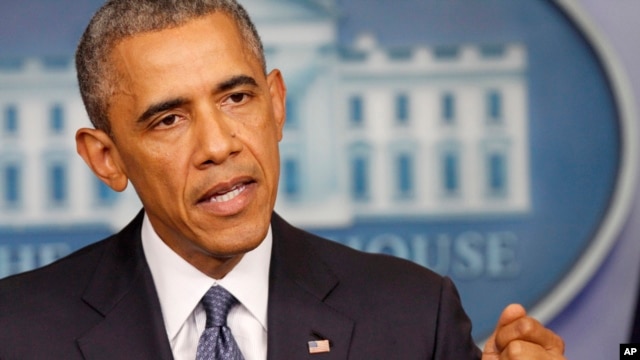
 As House Republicans leaders scrambled to toughen up their border bills to win the support of their most conservative members, Democratic President Barack Obama blasted Congress for failing to send him an emergency funding measure to sign before lawmakers leave for a five-week August recess.
House Republicans began Friday with a closed meeting in the basement of the U.S. Capitol, one day after a failed effort to pass a supplemental funding bill in response to an influx of children from Central America. Even the most conservative members emerged optimistic that the two border bills would now be changed to win the 218 votes needed to pass. Republican lawmaker Michele Bachmann said the bills now do what a core group of conservative Republicans wants:
“Stopping the invasion of illegal foreign nationals into our country,” she said.
No action in Senate
The Democratic-run Senate left town without passing a border bill. Senate Majority Leader Harry Reid blasted House Republicans for adding to the agenda a second border bill that would end an Obama administration policy of allowing hundreds of thousands of young undocumented immigrants who came to the U.S. as children years ago to stay.
“House Republicans will vote to deport children who have been living in the United States their entire lives, all in a pathetic attempt to appease the Tea Party,” he said.
President Obama criticized House members for crafting border legislation they know will never be taken up in the Senate and that he has said he would veto.
“House Republicans, as we speak, are trying to pass the most extreme and unworkable versions of a bill that they already know is going nowhere,” he said.
The president said Congress is leaving him no choice but to act on his own.
“I am going to have to act alone because we don’t have resources. We have already been very clear, we have run out of money,” he said.
Stopping the flow
Republican lawmakers blame the president for contributing to the influx of 57,000 children from El Salvador, Guatemala and Honduras this year, saying his rhetoric about immigration reform has caused confusion, which criminal trafficking gangs have exploited. Republican Congressman Tom Cole said the right thing to do is to send a clear signal to deter children from making the dangerous journey to America.
“So we need to stop this flow. We need to do in a humane and appropriate way,” he said.
House Democrats took to the floor in large numbers to oppose the border bills, calling them harsh and mean-spirited towards desperate children. Democratic Congressman Luis Gutierrez said Hispanic voters would remember the way Republicans treated the Central American children for many elections to come:
“Because the way you treat one of us today is the way you have treated all of us, and we will remember that,” he said.
Analysts say the president will likely have to shift funds to provide food and shelter for the children at the border, and that members of Congress will likely face the border issue again when they return in September.
As House Republicans leaders scrambled to toughen up their border bills to win the support of their most conservative members, Democratic President Barack Obama blasted Congress for failing to send him an emergency funding measure to sign before lawmakers leave for a five-week August recess.
House Republicans began Friday with a closed meeting in the basement of the U.S. Capitol, one day after a failed effort to pass a supplemental funding bill in response to an influx of children from Central America. Even the most conservative members emerged optimistic that the two border bills would now be changed to win the 218 votes needed to pass. Republican lawmaker Michele Bachmann said the bills now do what a core group of conservative Republicans wants:
“Stopping the invasion of illegal foreign nationals into our country,” she said.
No action in Senate
The Democratic-run Senate left town without passing a border bill. Senate Majority Leader Harry Reid blasted House Republicans for adding to the agenda a second border bill that would end an Obama administration policy of allowing hundreds of thousands of young undocumented immigrants who came to the U.S. as children years ago to stay.
“House Republicans will vote to deport children who have been living in the United States their entire lives, all in a pathetic attempt to appease the Tea Party,” he said.
President Obama criticized House members for crafting border legislation they know will never be taken up in the Senate and that he has said he would veto.
“House Republicans, as we speak, are trying to pass the most extreme and unworkable versions of a bill that they already know is going nowhere,” he said.
The president said Congress is leaving him no choice but to act on his own.
“I am going to have to act alone because we don’t have resources. We have already been very clear, we have run out of money,” he said.
Stopping the flow
Republican lawmakers blame the president for contributing to the influx of 57,000 children from El Salvador, Guatemala and Honduras this year, saying his rhetoric about immigration reform has caused confusion, which criminal trafficking gangs have exploited. Republican Congressman Tom Cole said the right thing to do is to send a clear signal to deter children from making the dangerous journey to America.
“So we need to stop this flow. We need to do in a humane and appropriate way,” he said.
House Democrats took to the floor in large numbers to oppose the border bills, calling them harsh and mean-spirited towards desperate children. Democratic Congressman Luis Gutierrez said Hispanic voters would remember the way Republicans treated the Central American children for many elections to come:
“Because the way you treat one of us today is the way you have treated all of us, and we will remember that,” he said.
Analysts say the president will likely have to shift funds to provide food and shelter for the children at the border, and that members of Congress will likely face the border issue again when they return in September.
Saturday, August 2, 2014
Obama Says He Will Act Alone on US Border Crisis, Slams Congress
As House Republicans leaders scrambled to toughen up their border bills to win the support of their most conservative members, Democratic President Barack Obama blasted Congress for failing to send him an emergency funding measure to sign before lawmakers leave for a five-week August recess.
House Republicans began Friday with a closed meeting in the basement of the U.S. Capitol, one day after a failed effort to pass a supplemental funding bill in response to an influx of children from Central America. Even the most conservative members emerged optimistic that the two border bills would now be changed to win the 218 votes needed to pass. Republican lawmaker Michele Bachmann said the bills now do what a core group of conservative Republicans wants:
“Stopping the invasion of illegal foreign nationals into our country,” she said.
No action in Senate
The Democratic-run Senate left town without passing a border bill. Senate Majority Leader Harry Reid blasted House Republicans for adding to the agenda a second border bill that would end an Obama administration policy of allowing hundreds of thousands of young undocumented immigrants who came to the U.S. as children years ago to stay.
“House Republicans will vote to deport children who have been living in the United States their entire lives, all in a pathetic attempt to appease the Tea Party,” he said.
President Obama criticized House members for crafting border legislation they know will never be taken up in the Senate and that he has said he would veto.
“House Republicans, as we speak, are trying to pass the most extreme and unworkable versions of a bill that they already know is going nowhere,” he said.
The president said Congress is leaving him no choice but to act on his own.
“I am going to have to act alone because we don’t have resources. We have already been very clear, we have run out of money,” he said.
Stopping the flow
Republican lawmakers blame the president for contributing to the influx of 57,000 children from El Salvador, Guatemala and Honduras this year, saying his rhetoric about immigration reform has caused confusion, which criminal trafficking gangs have exploited. Republican Congressman Tom Cole said the right thing to do is to send a clear signal to deter children from making the dangerous journey to America.
“So we need to stop this flow. We need to do in a humane and appropriate way,” he said.
House Democrats took to the floor in large numbers to oppose the border bills, calling them harsh and mean-spirited towards desperate children. Democratic Congressman Luis Gutierrez said Hispanic voters would remember the way Republicans treated the Central American children for many elections to come:
“Because the way you treat one of us today is the way you have treated all of us, and we will remember that,” he said.
Analysts say the president will likely have to shift funds to provide food and shelter for the children at the border, and that members of Congress will likely face the border issue again when they return in September.
"Premature to name Afghan leader for the Wales Summit"
Javed Hamem Kakar


Why the US Spent More on Afghanistan Than on the Marshall Plan
By Akhilesh Pillalamarri
There are several reasons the U.S. has spent as much as it has in Afghanistan, to so little avail.Recently, it has emerged in a report that the United States has spent more on reconstruction efforts in Afghanistan than it spent on the Marshal Plan, which resuscitated Europe after the Second World War. According to the U.S. Special Inspector General for Afghanistan Reconstruction (SIGAR), congressional appropriations for reconstruction in Afghanistan have reached $109 billion in today’s dollars. On the other hand, the Marshall Plan delivered $103 billion in today’s dollars to 16 European countries between 1948 and 1952. However, reports comparing reconstruction efforts in Afghanistan and the Marshall Plan do not generally take into account the fact that the Marshall Plan appropriations constituted a much greater proportion of the U.S. economy in the 1940s than Afghanistan reconstruction efforts do today. While the U.S. has spent $109 billion out of a $13-15 trillion economy on Afghanistan over 13 years, in 1948-1952, it spent $103 billion out of a $2 trillion dollar economy (adjusted) in only four years.
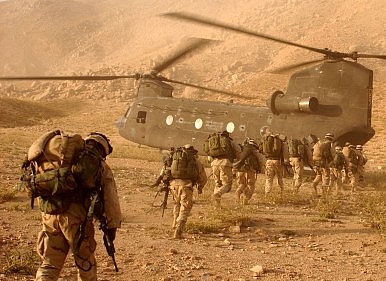
Afghanistan: Reports of Taliban surge are exaggerated, says incoming ISAF commander
 The incoming NATO-led International Security Assistance Force (ISAF) commander, Gen. John F. Campbell has called reports regarding the surge of Taliban militants as exaggerated.
Gen. Campbell is expected to succeed Gen. Joseph Dunford as ISAF commander and take over commander of the NATO combat mission in Afghanistan.
The General suggested that the reports suggesting that the Taliban militants are gaining ground as U.S. troop levels fall and Afghan soldiers take on more fighting duties, are more about PR than battlefield realities.
Speaking to reporters in Pentagon, Gen. Campbell said many of the claims were based on propaganda by the insurgents trying to intimidate the Afghan public into supporting them.
“A lot of what you’re getting on how bad it may have been down in the south, or this attack there, or some of the things in the east, is we have kind of lost the information war here,” Gen. Campbell quoted by Star and Stripes said.
He said, “The Taliban are trying to go do what they couldn’t do for the elections with these spectacular attacks.”
The remarks by Gen. Campbell comes as reports suggest that the Taliban militants surged out of strongholds in remote areas of the south and taken over strategic territory around Kabul as well as elsewhere in the country.
Campbell acknowledged the Taliban are making Afghanistan pay a heavy price. “It’s not much ado about nothing. There is very much some concern because of the numbers of civilians that have been attacked and killed is much higher,” he said.
However, he insisted that there’s a fundamental difference between the war now and when he last commanded troops in Afghanistan in 2011.
Campbell said the improved Afghan security forces are usually able to retake lost ground quickly as the Taliban could take and hold positions.
The incoming NATO-led International Security Assistance Force (ISAF) commander, Gen. John F. Campbell has called reports regarding the surge of Taliban militants as exaggerated.
Gen. Campbell is expected to succeed Gen. Joseph Dunford as ISAF commander and take over commander of the NATO combat mission in Afghanistan.
The General suggested that the reports suggesting that the Taliban militants are gaining ground as U.S. troop levels fall and Afghan soldiers take on more fighting duties, are more about PR than battlefield realities.
Speaking to reporters in Pentagon, Gen. Campbell said many of the claims were based on propaganda by the insurgents trying to intimidate the Afghan public into supporting them.
“A lot of what you’re getting on how bad it may have been down in the south, or this attack there, or some of the things in the east, is we have kind of lost the information war here,” Gen. Campbell quoted by Star and Stripes said.
He said, “The Taliban are trying to go do what they couldn’t do for the elections with these spectacular attacks.”
The remarks by Gen. Campbell comes as reports suggest that the Taliban militants surged out of strongholds in remote areas of the south and taken over strategic territory around Kabul as well as elsewhere in the country.
Campbell acknowledged the Taliban are making Afghanistan pay a heavy price. “It’s not much ado about nothing. There is very much some concern because of the numbers of civilians that have been attacked and killed is much higher,” he said.
However, he insisted that there’s a fundamental difference between the war now and when he last commanded troops in Afghanistan in 2011.
Campbell said the improved Afghan security forces are usually able to retake lost ground quickly as the Taliban could take and hold positions.
Humaima Mallick Proud Of Romantic Scenes In ‘Raja Natwarlal’
 Pakistani model-actress Humaima Malick says she may have shot steamy and passionate kissing scenes with her co-star Emraan Hashmi for her forthcoming Bollywood debut “Raja Natwaral” but there is no vulgarity in the movie.
“There is no vulgarity in the film at all. In fact, I am very proud that we have done many romantic scenes in the film and have shot beautifully,” Humaima said here Wednesday at the launch of a song from the film.
Directed by Kunal Deshmukh, “Raja Natwaral”, also featuring Paresh Rawal and Kay Kay Menon, will hit the theatres Aug 29.
“Everyone can watch the film with his/her kids and family,” she added.
Pakistani model-actress Humaima Malick says she may have shot steamy and passionate kissing scenes with her co-star Emraan Hashmi for her forthcoming Bollywood debut “Raja Natwaral” but there is no vulgarity in the movie.
“There is no vulgarity in the film at all. In fact, I am very proud that we have done many romantic scenes in the film and have shot beautifully,” Humaima said here Wednesday at the launch of a song from the film.
Directed by Kunal Deshmukh, “Raja Natwaral”, also featuring Paresh Rawal and Kay Kay Menon, will hit the theatres Aug 29.
“Everyone can watch the film with his/her kids and family,” she added.
Pakistan: Food for thought, Mian Sahib(Nawaz)
If one goes by the tongue-in-cheek observations of some TV talk show anchors, the PML-N’s days are numbered. It is implied that massive rallies and dharnas in Islamabad are bound to create a situation that will force incumbent governments to agree to mid-term elections. Imran Khan has upped the ante by asserting that because of rigging in the 2013 elections, the present government cannot be considered legitimate and polls under their auspices will mean a repetition of the farce of another (rigged) election. Hence this government has to go and a new electoral set-up forged for electing the real representatives of the people. Looking back, Imran had given the PML-N a month to provide answers to his four questions relating to the way the 2013 elections were held. Characteristically, Nawaz Sharif did not take this notice seriously. Imran’s challenge was thus practically ignored giving him the excuse and opportunity of declaring that time had run out and the goal-post shifted. As for Tahir-ul-Qadri’s threat of launching a revolution, the government, weakened as it was after the Model Town incident, resorted to subject Qadri to tax-default notices. According to him, he and his organization have been asked to pay more than 700 million rupees to the FBR. Undeterred, Qadri has stuck to his resolve to wipe the government out on account of corruption, and for its failing to abide by certain provisions of the Constitution. Instead of rising to the occasion to take Imran Khan seriously and somehow finding a way to engage him with a view to finding a solution to the problem, the government let the matter drift and the situation deteriorate from bad to worse. Valuable time was lost. It is puzzling how most of the TV channels are vying with each other to project the PTI and PAT. Mr. Qadri has often been seen waxing eloquence, quoting scriptures and Articles of the Constitution of Pakistan to convincingly establish his case for the Inqilab. He claims the people have the right to rise and do away with an “incompetent, corrupt and cruel” administration. There has hardly been a befitting response on the electronic media to the vilification campaign raging against the government. Sheikh Rasheed is often found firing broadsides from almost every channel. Thus the electronic media reinforces the noise raised by the opposition. (Geo, in spite of repeated assurances by the minister for information, has not yet been restored.) The government’s near-paralysis is inexplicable. Too much is at stake; the incumbent government and democracy itself. The regime’s deeply unfortunate behaviour in Model Town has been condemned even by the PPP, which has joined the rest of the opposition in denouncing the federal government for extended load-shedding inflicted on citizens. This, coupled by Zardari’s utterances about the PML-N leadership, and an indication of support for Imran Khan, has added to the government’s discomfiture. There is speculation that the PPP may make a common cause with Imran Khan, at some stage. There is little doubt that the Sharif brothers have been found wanting in facing the odds stacked against them confidently. Instead of resolving to unite, or to demonstrate strength, there have been fissures in the party high command itself. How could the Prime Minister, for instance, fly away to another land for ten days in the midst of complete political chaos and a war with over a million displaced people? Yet another surprise was sprung. Without consulting the leader of the opposition, the army was asked to take over security of Islamabad under Article 245 of the Constitution on the grounds that a terrorist blow-back was imminent. It is widely believed that the army has been called in to help the government deal with the PTI (and possibly the PAT) rallies and dharnas. It appears that the government has done so, in panic, and not out of prudence to ward off a Taliban strike. A word about the civil-military relations. The Musharraf trial is an issue of real contention. The fact remains that the government had a good case. The top brass was to be convinced that a bitter pill had to be swallowed to uphold the supreme law of the land. The Geo episode further added to the misunderstandings. Above all, the lethargic handling of talks with the Taliban resulted in the shifting of the initiative to the army which went ahead to start off the military operation in North Waziristan. In the Indian Express, C. Raja Mohan a veteran journalist, in a recent column, has reviewed two new books on the Pakistan Army. One is authored by Christine Fair, titled “Fighting to the End.” The second is titled “The Army and Democracy: Military Politics in Pakistan,” by Aqil Shah. Mohan says, “Few armies in the world attract the kind of policy and scholarly attention that the Pakistan army does. Rightly so, for its institutional primacy at home and strategic influence abroad have few parallels. Many armies have run their countries, but most of them had to eventually yield to democratic change and civilian control. The Pakistan army however, exercises extraordinary power, whether in the barracks or the chancelleries. It controls Pakistan’s nuclear arsenal, manipulates its domestic politics, shapes its internal security and runs the critical accounts of the country’s foreign policy with India, Afghanistan, China, the Gulf and the United States.” Speaking of Aqil Shah’s book, he further states, “Like Fair, he (Shah) too delves deep into the Pakistan army’s mindset and its self perception as the guardian of the nation… he poses two important questions: One, can the army really be pushed back to the barracks? And two, who will guard the guardians? Therein is much food for thought for Mian Sahib.BY INAYATULLAH
Pakistan:Two new polio cases in Peshawar, Bara, take total to 104
http://www.nation.com.pk/
The unvaccinated children in Khyber Pakhtunkhwa and tribal areas continued to thwart global efforts to eradicate polio as National Institute of Health, Islamabad confirmed two new polio cases today.
The new cases took the nationwide polio count to 104 this year alone for ahead of last year tally of 93.
Pakistan has recorded highest number of polio cases among the three endemic countries.
One newly-infected child is the residents of the violence-wracked Bara subdivision of Khyber Agency.
Polio virus detected in eight month old Hafsa resident of Bara. One year old Salma, resident of Peshawar was also found infected with virus.
File of case registered against PML-N MPA goes missing
http://tribune.com.pk/The file of a case registered against Pakistan Muslim League – Nawaz (PML-N) MPA Rana Shoaib Idrees in January 2013 for allegedly attacking a police station and torturing policemen has gone missing, Express News reported on Saturday. A case has been registered against ASI Umar Daraz and Inspector Ghazanfar for allegedly being responsible to cause the file to go missing. Idrees was caught on tape attacking a police station in Faisalabad on July 19. The PML-N MPA and his accomplices allegedly attacked Khurarianwala police station in order to free their companions. They also reportedly tortured and injured Sub Inspector Riyasat Ali and other police officials, and damaged official property of the station. The Khurarianwala police had registered a case under various sections of the Anti-Terrorism Act and Pakistan Penal Code against nine identified and 50 unidentified men for taking the law in their own hands, damaging the police station, rioting and injuring policemen. However, the Lahore High Court (LHC) had granted Idrees protective bail till August 11. At this point, Idrees had defended himself, saying the footage that the police presented as evidence against him was over a year old, of an incident that occurred before the May 11 general elections – the file of this case is now missing.
Pakistan's Load Shedding: Losing power

Despite a year of talk, the facts remain the same. Losses in the power sector are at the same level they were last year when the government made what it called a one-time retirement of the circular debt.That extraordinary measure was taken to create some breathing room in which to implement the necessary reforms and bring down the losses, a goal that has evaded the government so far. The latest round of figures compiled by the power bureaucracy in its monthly report of operational data show that the gap between the amount of electricity provided to the distribution companies and the amount of units billed is just under 19pc in the fiscal year ended June 2014, the same level they were at last year. And this figure tells only half the story. In financial terms this means that electricity worth Rs211bn was lost in the last fiscal year. When recovery losses — the gap between the units billed and the amount of money actually recovered against those bills — are added to this tally the figure doubles, bringing us close to the approximate total of Rs550bn of the circular debt. A closer look at the data compiled by the power bureaucracy shows that all distribution companies of the country are contributing their fair share to these overall losses. For a while, the minister of state for water and power tried to peddle the story that the chief reason for the circular debt was that Punjab pays its bills but that Sindh and Khyber Pakhtunkhwa do not. The data provided by the power bureaucracy belies this claim; it shows that more than half the losses occurred in distribution companies in Punjab with the remaining half shared by those from Sindh, KP and Balochistan. It seems that inefficiency and incompetence do not have an ethnicity, and all apparent attempts to paint one province as superior in the matter of billing recoveries or distributional efficiency are without foundation. Why is this data not made public? The power bureaucracy is required to produce monthly reports of its operational data which includes details of all the electricity generated and provided to all the distribution companies in the country. The result is a report with 150 or so pages of detailed data on where the electricity is coming from and where it is going. There is no reason to keep this information out of the public domain, and the water and power secretary should seriously consider making the document available online, along with all back issues. In addition, financial data should be similarly gathered and disseminated, including cash flow statements, so that claims about operational efficiencies can be verified. There should be accountability of the power bureaucracy, and allowing some daylight into the dark corners where discretionary decision-making power lurks is the best way to ensure this.
Pakistan: Army to be visible in Islamabad soon
Army troops would soon be guarding sensitive buildings in Islamabad, and patrolling the streets later, as the federal government’s decision to deploy them in aid of the civil administration came into effect on August 1.
Interior Minister Chaudhry Nisar Ali Khan had sent shockwaves across the country last week by revealing that the government had issued a notification on July 24 to requisition services of the armed forces under Article 245 of the Constitution.
A day after a military spokesman disclosed on July 26 that the decision to call army was taken in a meeting, on the launch of the military operation against militants in North Waziristan, held on June 15, the minister accused those criticising the decision were making army controversial in a war-like situation. He said 352 troops were being requisitioned to assist police and other civic agencies secure Islamabad.
“Army soldiers will be all over the city and will be able to reach a hotspot in case of an emergency within 10 minutes. The army will coordinate with police and Rangers directly and through the district administration,” he said.
Senior Superintendent of Police Mohammad Ali Nekokara told Dawn that deployment of the soldiers under Article 245 will be finalised after consultation with the district administration.
“I believe that collaboration between the Army, police and district administration became necessary for national security in the wake of Operation Zarb-i-Azb. Police have been collaborating with all agencies. That is why not a single untoward incident has been reported in the federal capital since the launch of Operation Zarb-i-Azb,” he said.As of now SSP Nekokara did not feel the need to put troops on patrol duties in the city, however.
“They can be called to that duty if and when required,” he said.
Pakistan:PPP asks govt to withdraw army
The Pakistan People’s Party has asked the government to immediately withdraw Article 245 because the entire political leadership of the country and civil society have opposed it. “The PML-N government is mishandling a political issue. It has complicated the matter of a political protest by calling in army in the federal capital,” former prime minister Yousuf Raza Gilani said here on Friday. Mr Gilani said during his tenure as a premier he had not called in the army to stop the lawyers march to restore the judiciary. He said the government should not have set this precedent. He said PTI’s long march should be peaceful. Punjab PPP President Manzoor Wattoo said the situation in Islamabad was not that bad to invoke the article. He said the government should withdraw the army because there was a possibility of a clash of the institution. He argued that it also implied that the government and its law-enforcement agencies had failed to secure the federal capital reflecting poorly on its ability to handle a political issue. Wattoo said the PML-N government was taking a solo flight. He said the ongoing military operation in North Wazirstan was launched without taking parliament into confidence. Lahore PPP President Samina Ghurki said the government should not use force to deal with political issues.http://mediacellppp.wordpress.com/
Friday, August 1, 2014
Obama Defends Handling of Gaza, Ukraine Conflicts
http://www.voanews.com/
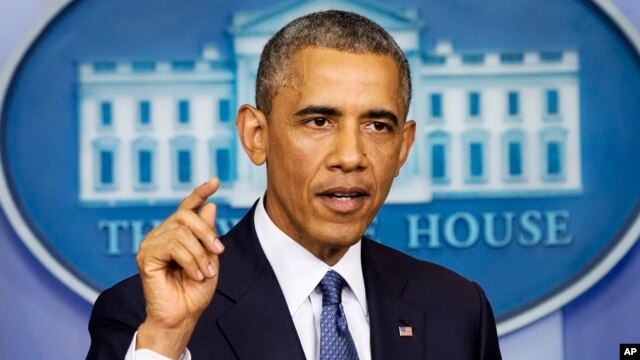 President Barack Obama is defending his handling of conflicts in Gaza and Ukraine as fighting in both places shows no signs of letting up, despite intense U.S. diplomatic efforts this week.
At a White House briefing Friday, the president hoped to focus on positive job growth numbers. Instead, he dealt with questions on the failure of U.S. diplomatic efforts to secure a cease-fire in Gaza and stop Russia's intervention in Ukraine, where fighting raged as Russian forces continued their buildup on the border.
In Gaza, a cease-fire brokered with U.S. help collapsed moments after it was announced, when two Israeli soldiers were killed and a third was captured.
Obama said stopping the fighting is going to be a challenge. “I think it's going to be very hard to put a cease-fire back together again if Israelis and the international community can't feel confident that Hamas can follow through on a cease-fire commitment.”
When a reporter asked the president if he had lost his influence in the world, Obama said U.S. diplomatic efforts will take time, and he pointed to what he said is progress in pressuring Russia to resolve the Ukraine crisis.
European nations joined Obama this week in imposing tougher new sanctions on key Russian sectors, something the U.S. administration had been threatening for months. Short of going to war, he said there are going to be constraints in terms of what the U.S. can do to stop Russian interference in Ukraine.
“What we've done is imposed sufficient costs on Russia that objectively speaking, they should -- President Putin should -- want to resolve this diplomatically, get these sanctions lifted, get their economy growing again, and have good relations with Ukraine; but, sometimes people don't act rationally,” he said.
Obama said he called Putin on Friday and reiterated his deep concerns about Russia's increasing support for separatists in Ukraine. Obama said he told the Russian leader he prefers a diplomatic solution, and the two agreed to keep channels of communication open.
President Barack Obama is defending his handling of conflicts in Gaza and Ukraine as fighting in both places shows no signs of letting up, despite intense U.S. diplomatic efforts this week.
At a White House briefing Friday, the president hoped to focus on positive job growth numbers. Instead, he dealt with questions on the failure of U.S. diplomatic efforts to secure a cease-fire in Gaza and stop Russia's intervention in Ukraine, where fighting raged as Russian forces continued their buildup on the border.
In Gaza, a cease-fire brokered with U.S. help collapsed moments after it was announced, when two Israeli soldiers were killed and a third was captured.
Obama said stopping the fighting is going to be a challenge. “I think it's going to be very hard to put a cease-fire back together again if Israelis and the international community can't feel confident that Hamas can follow through on a cease-fire commitment.”
When a reporter asked the president if he had lost his influence in the world, Obama said U.S. diplomatic efforts will take time, and he pointed to what he said is progress in pressuring Russia to resolve the Ukraine crisis.
European nations joined Obama this week in imposing tougher new sanctions on key Russian sectors, something the U.S. administration had been threatening for months. Short of going to war, he said there are going to be constraints in terms of what the U.S. can do to stop Russian interference in Ukraine.
“What we've done is imposed sufficient costs on Russia that objectively speaking, they should -- President Putin should -- want to resolve this diplomatically, get these sanctions lifted, get their economy growing again, and have good relations with Ukraine; but, sometimes people don't act rationally,” he said.
Obama said he called Putin on Friday and reiterated his deep concerns about Russia's increasing support for separatists in Ukraine. Obama said he told the Russian leader he prefers a diplomatic solution, and the two agreed to keep channels of communication open.
Iraq violence kills over 1,700 in July, UN says
The UN said on Friday that at least 1,737 people, mostly civilians, were killed in the crisis-hit country last month.The United Nations says more than 1,700 people have been killed in Iraq during violence in July as the country grapples with a crisis caused by ISIL Takfiri terrorists.
The death figure includes 551 members of Iraqi security forces and 1,186 civilians.
"I am concerned about the rising number of casualties in Iraq, particularly among the civilian population. Children and women are most vulnerable," said Nickolay Mladenov, the UN envoy to Iraq, on Friday.The July figure brings the total death toll of the year to at least 6,700. Earlier in the day, at least 17 Iraqi soldiers were killed in clashes with militants in a town south of the capital Baghdad. "Seventeen soldiers were killed and three wounded during clashes with insurgents in Jurf al-Sakhar that lasted two hours this morning," said an Iraqi army lieutenant. At least 2,400 deaths were recorded in June, when Takfiris launched a massive blitz capturing parts of the country. The ISIL Takfiri militants took control of Mosul, in a lightning advance on June 10, which was followed by the fall of Tikrit, located 140 kilometers (87 miles) northwest of Baghdad. More than a million people have been displaced in Iraq so far this year, according to the UN. The ISIL has vowed to continue its raid towards Baghdad. Iraqi Prime Minister Nouri al-Maliki has said that the country’s security forces would confront the terrorists, calling the seizure of Mosul a “conspiracy". Soldiers of the Iraqi army have been engaged in heavy fighting with the militants on different fronts and have so far been able to push back militants in several areas. Maliki has said Saudi Arabia and Qatar are responsible for the security crisis and growing terrorism in his country, denouncing the Al Saud regime as a major supporter of global terrorism.
Japan's naming of islands illegal, invalid: China
 China on Friday opposed Japan's naming of five islets belonging to the Diaoyu Islands, saying the move is illegal and invalid.
China: Xi vows strike on military corruption
Chinese President Xi Jinping has pledged a harsh strike against military corruption as the People's Liberation Army (PLA) prepares for the 87th anniversary of its establishment on Friday.
Xi, who heads the Central Military Commission (CMC), urged troops to strengthen their ties with the people and avoid undesirable work styles such as formalism, bureaucracy, hedonism and extravagance.
 The president made the remarks during a Wednesday visit to the headquarters of the military region of Fujian, where he worked for 17 years.
Xi stressed the need for military to be loyal to the Communist Party of China (CPC), saying "the Party's absolute leadership over the army should be unswervingly adhered to."
While addressing officers, he called for intensified drills to improve troops' fighting abilities and ensure they can win battles.
The president has showed his determination to root out pervasive military corruption in order to safeguard the integrity of the PLA.
The CPC last month announced that Xu Caihou who retired as vice chairman of the CMC last year, had been expelled from the Party for bribery and may face prosecution.
Investigation found that Xu took advantage of his post to assist the promotion of other people and accepted bribes personally and through his family members.
Before the downfall of Xu, Gu Junshan, a former senior military logistics officer, was charged with embezzlement, bribery, misuse of state funds and abuse of power. The case was filed to a military court in March.
The president made the remarks during a Wednesday visit to the headquarters of the military region of Fujian, where he worked for 17 years.
Xi stressed the need for military to be loyal to the Communist Party of China (CPC), saying "the Party's absolute leadership over the army should be unswervingly adhered to."
While addressing officers, he called for intensified drills to improve troops' fighting abilities and ensure they can win battles.
The president has showed his determination to root out pervasive military corruption in order to safeguard the integrity of the PLA.
The CPC last month announced that Xu Caihou who retired as vice chairman of the CMC last year, had been expelled from the Party for bribery and may face prosecution.
Investigation found that Xu took advantage of his post to assist the promotion of other people and accepted bribes personally and through his family members.
Before the downfall of Xu, Gu Junshan, a former senior military logistics officer, was charged with embezzlement, bribery, misuse of state funds and abuse of power. The case was filed to a military court in March.
The president made the remarks during a Wednesday visit to the headquarters of the military region of Fujian, where he worked for 17 years.
Xi stressed the need for military to be loyal to the Communist Party of China (CPC), saying "the Party's absolute leadership over the army should be unswervingly adhered to."
While addressing officers, he called for intensified drills to improve troops' fighting abilities and ensure they can win battles.
The president has showed his determination to root out pervasive military corruption in order to safeguard the integrity of the PLA.
The CPC last month announced that Xu Caihou who retired as vice chairman of the CMC last year, had been expelled from the Party for bribery and may face prosecution.
Investigation found that Xu took advantage of his post to assist the promotion of other people and accepted bribes personally and through his family members.
Before the downfall of Xu, Gu Junshan, a former senior military logistics officer, was charged with embezzlement, bribery, misuse of state funds and abuse of power. The case was filed to a military court in March.
What You Need to Know About the Ebola Outbreak
By Denise Grady, Josh Keller, Heather Murphy and Sergio Peçanha.
How many people have died?More than 1,300 people in Guinea, Liberia and Sierra Leone have contracted Ebola since March, according to the World Health Organization, making this the biggest outbreak on record. More than half of those infected have died. Nigeria also reported one probable case: a Liberian man who traveled there and died on July 25.
How does this compare to past outbreaks?
It is the deadliest, eclipsing an outbreak in 1976, the year the virus was discovered.
How contagious is the virus?
You are not likely to catch Ebola just by being in proximity with someone who has the virus; it is not airborne, like the flu or respiratory viruses such as SARS. Instead, Ebola spreads through direct contact with bodily fluids. If an infected person’s blood or vomit gets in another person’s eyes, nose or mouth, the infection may be transmitted. In the current outbreak, most new cases are occurring among people who have been taking care of sick relatives or who have prepared an infected body for burial. Health care workers are at high risk, especially if they have not been properly equipped with or trained to use and decontaminate protective gear correctly. The virus can survive on surfaces, so any object contaminated with bodily fluids, like a latex glove or a hypodermic needle, may spread the disease.
Why is Ebola so difficult to contain?
In some parts of West Africa, there is a belief that simply saying “Ebola” aloud makes the disease appear. Such beliefs create major obstacles for physicians from groups like Doctors Without Borders, which are trying to combat the outbreak. Some people even blame physicians for the spread of the virus, and turn to witch doctors for treatment. Their skepticism is not without a grain of truth: In past outbreaks, hospital staff who did not take thorough precautions became unwitting travel agents for the virus.
How does the disease progress?Symptoms usually appear about eight to 10 days after exposure, according to the Centers for Disease Control and Prevention. At first, it seems much like the flu: a headache, fever and aches and pains. Sometimes there is also a rash. Diarrhea and vomiting follow.
Then, in about half of the cases, Ebola takes a severe turn, causing victims to hemorrhage. They may vomit blood or pass it in urine, or bleed under the skin or from their eyes or mouths. But bleeding is not usually what kills the patient. Rather, blood vessels deep in the body begin leaking fluid, causing blood pressure to plummet so low that the heart, kidneys, liver and other organs begin to fail.
How is the disease treated?There is no vaccine or cure for Ebola, and in past outbreaks the virus has been fatal in 60 to 90 percent of cases. All physicians can do is try to nurse people through the illness, using fluids and medicines to maintain blood pressure, and treat other infections that often strike their weakened bodies. A small percentage of people appear to have an immunity to the Ebola virus.
Where does the disease come from?Ebola was first discovered in 1976, and it was once thought to originate in gorillas, because human outbreaks began after people ate gorilla meat. But scientists have since ruled out that theory, partly because apes that become infected are even more likely to die than humans. Scientists now believe that bats are the natural reservoir for the virus, and that apes and humans catch it from eating food that bats have drooled or defecated on, or by coming in contact with surfaces covered in infected bat droppings and then touching their eyes or mouths. The current outbreak seems to have started in a village near Guéckédou, Guinea, where bat hunting is common, according to Doctors Without Borders.
Putin to Obama: US Sanctions Against Russia Hurt Bilateral Relations
 Continuing sanctions pressure on Moscow is counterproductive and seriously harms Russia-US relations, President Vladimir Putin told his US counterpart, Barack Obama, in a phone call on Friday.
Pakistan: Govt made situation complicated unnecessarily
 Former prime minister Yousuf Raza Gilani has said that the government had made the situation complicated unnecessarily, Geo News reported.
Talking to media here Friday, Gilani said there is space for dialogues in the politics at anytime.
Former premier said Pakistan People’s Party (PPP) had not called in army during the lawyers’ long march. He said whether it is long march or something else, it should be peaceful.
He said they wanted protection of rights of the masses.
Gilani was of the view that the government could be ousted because of its own mistakes and not by any long march. He said there was no need to invoke article 245, adding the government could still handle the situation.
He said PML-N government had itself launched long march, therefore, it should allow others to hold peaceful march.
Former prime minister Yousuf Raza Gilani has said that the government had made the situation complicated unnecessarily, Geo News reported.
Talking to media here Friday, Gilani said there is space for dialogues in the politics at anytime.
Former premier said Pakistan People’s Party (PPP) had not called in army during the lawyers’ long march. He said whether it is long march or something else, it should be peaceful.
He said they wanted protection of rights of the masses.
Gilani was of the view that the government could be ousted because of its own mistakes and not by any long march. He said there was no need to invoke article 245, adding the government could still handle the situation.
He said PML-N government had itself launched long march, therefore, it should allow others to hold peaceful march.
Pakistan: PTI denies govt’s claims of contacts over Aug 14 march
Pakistan Tehreek-i-Insaf (PTI) vice chairman Shah Mehmood Qureshi on Friday strongly denied claims of the ruling Pakistan Muslim League - Nawaz (PML-N) that the government is in touch with certain PTI leaders to call off the 'million march' on Islamabad scheduled for August 14.
"Chief Minister Punjab Shahbaz Sharif wanted to have a word with Imran Khan but the PTI chief refused to talk to him and there is also no other contact between government and the party leaders,” he told Dawn.com over telephone from his native home town, Multan.Qureshi said time for talks with the government has gone past and the decision of going ahead with the long march is final.
"Some of government ministers are spreading rumours to confuse our workers,” he claimed.
"The government, by calling Pakistan Army in Islamabad, wants to scare PTI workers but we are determined to carry on with the Aug 14 march,” he said, adding that, “our workers won't clash with military or any other security force.” When his attention was drawn to the fact that an electoral reforms committee has been constituted, Qureshi said the PTI would extend full cooperation to the committee. However, he added that the government was not serious in reforming the country’s electoral processEarlier, Political Secretary to Prime Minister Nawaz Sharif Dr Asif Kirmani had told Dawn that the government has established contact with the PTI leadership in a bid to convince them to call off the long march. “Some of our party leaders are in touch with PTI leaders for holding a dialogue in order to call off their long march," said Kirmani. He said the government's door was open for talks with PTI and that party chief Imran Khan was requested to discuss issues on a dialogue table instead of launching the long march. Sources said that Interior Minister Chaudhry Nisar Ali Khan has been tasked to woo Imran to call off his party's million-man long march. They added that as a result of background contacts, both Nisar and Imran are expected to meet on Aug 4 to discuss the issues and demands of the PTI.
Pakistani women flee fighting but are denied aid
 Thousands of women displaced by fighting in Pakistan are struggling to get food and other aid because they lack identity cards and conservative Muslim elders have forbidden them from going to distribution centers.
The women are among nearly a million people who registered for aid after the army began an offensive against the Pakistani Taliban in North Waziristan, a mountainous region on the Afghan border.
The army ordered most civilians to leave before the offensive began in June. Many ended up in Bannu, a small city on the main road out of the semi-autonomous tribal region.
No census has been conducted in North Waziristan for years, so no one knows the true scale of the problem. Government figures, however, show almost three-quarters of those seeking aid are women and children.
There's plenty of food to go around, with the World Food Program handing out nearly 5,000 tonnes and many other aid groups active.
But women face two problems: the lack of identity cards and an edict from elders of their Pashtun tribes forbidding them from going out to get aid. Conservative tribal traditions demand women stay at home and men fetch the food.
The same traditions prevent many women from getting identity cards. Some families also find the idea of a woman being photographed or fingerprinted for cards highly intrusive, even though the national identity agency runs women-only centers. Others simply lived in areas too remote to get cards.
For now, women and children without male relatives are largely dependent on handouts from neighbors who are themselves dependent on aid. Even women who have husbands may face problems, since many men have multiple wives depending on them.
"I HAVE NO CHANCE"
One woman sobbed behind her veil as she waited outside the main sports stadium in Bannu last week, watching men with wheelbarrows carry out sacks of flour and containers of water.
"They are not letting me in," the woman said. "I have no chance to enter."
The woman, Basmira, had no identity and no male relative. She stood near a cluster of women in all-covering burqas beseeching stick-wielding police and army guards to let them into the stadium.
Another woman, Maimoona, said her husband was killed by a stray bullet three months ago.
"You see those sticks in their hands? They will beat us if we try to go in," said 30-year-old Maimoona, who like many in Pakistan uses only one name.
Two other women said they were also widows and one said her son was a drug addict.
A soldier at the gate said women were welcome to go to other distribution sites around the city, but Reuters found that women were also being denied entry at four other centers.
"This lack of ID cards is a major problem for widows, second wives, and many women whose husbands are not here," said Yasmin Akhtar, regional manager for Khwendo Kor, an aid group helping about 1,000 of the women.
Muhammad Abbas Khan, the commissioner for displaced families in Bannu, was exasperated.
"We tried to resist the elders but it was like talking to a brick wall," he said. "This conservative culture overrides religion, it overrides ethics and it overrides human rights."
The government says it will set up a women-only distribution point in the next few weeks but until then, women have to rely on handouts from other hungry families.
That generosity is keeping many people fed at Bannu's Government School Number 3, where hundreds of displaced live in concrete classrooms partitioned by cotton sheets.
Shashparizada, 45, and her co-wife are at the school with their 12 children and husband, a frail 70-year-old with a long white beard. He lay on a rope bed with a fan nearby, too weak to stand.
"He is so old, it is hard for him to wait in line," Shashparizada said. "We do not have ID cards and he cannot go, so there is nothing for us."
Thousands of women displaced by fighting in Pakistan are struggling to get food and other aid because they lack identity cards and conservative Muslim elders have forbidden them from going to distribution centers.
The women are among nearly a million people who registered for aid after the army began an offensive against the Pakistani Taliban in North Waziristan, a mountainous region on the Afghan border.
The army ordered most civilians to leave before the offensive began in June. Many ended up in Bannu, a small city on the main road out of the semi-autonomous tribal region.
No census has been conducted in North Waziristan for years, so no one knows the true scale of the problem. Government figures, however, show almost three-quarters of those seeking aid are women and children.
There's plenty of food to go around, with the World Food Program handing out nearly 5,000 tonnes and many other aid groups active.
But women face two problems: the lack of identity cards and an edict from elders of their Pashtun tribes forbidding them from going out to get aid. Conservative tribal traditions demand women stay at home and men fetch the food.
The same traditions prevent many women from getting identity cards. Some families also find the idea of a woman being photographed or fingerprinted for cards highly intrusive, even though the national identity agency runs women-only centers. Others simply lived in areas too remote to get cards.
For now, women and children without male relatives are largely dependent on handouts from neighbors who are themselves dependent on aid. Even women who have husbands may face problems, since many men have multiple wives depending on them.
"I HAVE NO CHANCE"
One woman sobbed behind her veil as she waited outside the main sports stadium in Bannu last week, watching men with wheelbarrows carry out sacks of flour and containers of water.
"They are not letting me in," the woman said. "I have no chance to enter."
The woman, Basmira, had no identity and no male relative. She stood near a cluster of women in all-covering burqas beseeching stick-wielding police and army guards to let them into the stadium.
Another woman, Maimoona, said her husband was killed by a stray bullet three months ago.
"You see those sticks in their hands? They will beat us if we try to go in," said 30-year-old Maimoona, who like many in Pakistan uses only one name.
Two other women said they were also widows and one said her son was a drug addict.
A soldier at the gate said women were welcome to go to other distribution sites around the city, but Reuters found that women were also being denied entry at four other centers.
"This lack of ID cards is a major problem for widows, second wives, and many women whose husbands are not here," said Yasmin Akhtar, regional manager for Khwendo Kor, an aid group helping about 1,000 of the women.
Muhammad Abbas Khan, the commissioner for displaced families in Bannu, was exasperated.
"We tried to resist the elders but it was like talking to a brick wall," he said. "This conservative culture overrides religion, it overrides ethics and it overrides human rights."
The government says it will set up a women-only distribution point in the next few weeks but until then, women have to rely on handouts from other hungry families.
That generosity is keeping many people fed at Bannu's Government School Number 3, where hundreds of displaced live in concrete classrooms partitioned by cotton sheets.
Shashparizada, 45, and her co-wife are at the school with their 12 children and husband, a frail 70-year-old with a long white beard. He lay on a rope bed with a fan nearby, too weak to stand.
"He is so old, it is hard for him to wait in line," Shashparizada said. "We do not have ID cards and he cannot go, so there is nothing for us."
Mismanagement of $104 Billion Aid in Afghanistan

Over the past 13 years Afghanistan has received the largest sum of international aid in its modern world history.In a recent report, the U.S. Special Inspector General for Afghanistan Reconstruction (SIGAR) claimed that Afghanistan has received $104 billion in financial assistance in the past 13 years. This is the most the U.S. has spent on a nation-building project since the Marshall Plan, 1948—implemented to rebuild Western Europe after World War 2—had only cost an inflation-adjusted, $103 billion. SIGAR stated that Afghanistan's economic condition remains fragile in spite of all the aid, raising questions about the aid system in the country. Experts have said mismanagement is the main reason behind the alleged misappropriation of the funds. "Afghanistan has lost major economic opportunities due to mismanagement," university professor Syed Jawad Hussaini said. "If the money was managed and used properly, Afghanistan would have already reached the same levels of stability and construction as the other countries in the region." Moreover, the government's inadequacies as well as lack of transparency and accountability in the system have been criticized as factors playing into the mismanagement. "The lack of harmony between the government and the international community, the lack of monitoring of the legislative body and the silence of the civil society and the public are the main factors that have led to embezzlement," commentator on economics Syed Massoud said. Meanwhile, the report indicates that the aid to Afghanistan was not allocated to the establishment of security forces only—just as the case was with the Marshall Plan in Europe. From the total amount of $104.1 billion in Afghanistan, 62 billion was allocated for structuring the army and the police forces and $7.6 billion was allocated to counter-narcotic initiatives. SIGAR asserted that despite the large sum of money distributed to combating narcotics, drug smuggling remains a big problem. The pressure is now on the next government as the inability to combat corruption could potentially lead the country toward an economic recession. The next government will have to make up for the misconduct of international aids as it deals with a fragile economy and decrease of international aids.
Disabled By Polio, Afghan Official Hopes For Better Opportunities For All
Sayed Hamid Daqiq was partially paralyzed by polio at an early age, but with a little assistance from family and friends, he has risen to a high-level post in Afghanistan's Finance Ministry. Daqiq hopes that recent legislation promising improved access and resources for disabled Afghans will allow many more people to meet their full potential. (Produced by Malali Bashir; camera by Wali Sabawoon and Farishta Mursal, RFE/RL's Radio Free Afghanistan)
Pakistan's Semi Martial Law: Army deployed in Islamabad from today
The federal government’s decision to deploy the army in Islamabad under Article 245 of the Constitution is in effect from today, with the military mandated to aid civilian law-enforcement agencies in securing the capital for the next three months. Five companies of the army have been deployed in various parts of Islamabad to secure main offices of the judiciary, Parliament House, Presidency and Prime Minister Houses, foreign missions, foreign office and other important installations, sources said.
One army company was deployed at Margalla Hills and on the road that connects the province of Khyber Pakhtunkhwa with Islamabad, they added.According to the security plan, the army would work in close coordination with the police, Rangers and administration for ensuring fool proof security for Islamabad.
However, the Pakistan Peoples’ Party (PPP) has decided to take up the matter in the National Assembly session starting from August 4.t is being largely deemed that the government is calling for military assistance as it is apparently panicking in the face of Pakistan Tehreek-i-Insaf’s (PTI) upcoming long march on Independence Day. An interior ministry spokesperson had elaborated that the capital was not being ‘handed over’ to the army and in fact a contingent from the military would assist the police and civil administration at sensitive installations and serve as a rapid response force. Earlier, Information Minister Pervaiz Rasheed had downplayed the impression that the decision had anything to do with the upcoming PTI long march. The PTI has rejected the government’s decision to invoke the article and a statement issued by the party's central information secretary had stated that resorting to Article 245 signals an admission of failure to govern.
Meanwhile, the PPP has been strongly opposing the decision to deploy the army in the capital, saying summoning the army under the said article has ‘grave implications for political stability and civil-military relations in the country.
John Kerry meets Narendra Modi in prelude to Washington summit
http://timesofindia.indiatimes.com/
 President Barack Obama is looking forward to a summit with Prime Minister Narendra Modi in September to set an "ambitious new agenda" to chart a new course in the bilateral ties, top US functionaries John Kerry and Penny Pritzker said on Friday.
Kerry, US secretary of state, and Pritzker, secretary of commerce, conveyed this during a meeting here with Modi who said the two countries should prepare for concrete outcomes during the summit to take the relationship to "an entirely new level on the basis of vision, strategy and action plan."
Modi is expected to travel to Washington in September-end for his first summit meeting with Obama.
During the hour-long meeting, the two visiting secretaries briefed the Prime Minister on the India-US strategic dialogue that took place here on Thursday.
Conveying that Obama attaches great priority to relations with India, both for bilateral cooperation and global partnership, they said he looks forward to a "productive and fruitful" summit in September to "set an ambitious new agenda to chart a new course in the relationship", a PMO statement said.
Modi said there was broad convergence of views and interests between the two countries.
President Barack Obama is looking forward to a summit with Prime Minister Narendra Modi in September to set an "ambitious new agenda" to chart a new course in the bilateral ties, top US functionaries John Kerry and Penny Pritzker said on Friday.
Kerry, US secretary of state, and Pritzker, secretary of commerce, conveyed this during a meeting here with Modi who said the two countries should prepare for concrete outcomes during the summit to take the relationship to "an entirely new level on the basis of vision, strategy and action plan."
Modi is expected to travel to Washington in September-end for his first summit meeting with Obama.
During the hour-long meeting, the two visiting secretaries briefed the Prime Minister on the India-US strategic dialogue that took place here on Thursday.
Conveying that Obama attaches great priority to relations with India, both for bilateral cooperation and global partnership, they said he looks forward to a "productive and fruitful" summit in September to "set an ambitious new agenda to chart a new course in the relationship", a PMO statement said.
Modi said there was broad convergence of views and interests between the two countries. He conveyed his appreciation for Obama's "thoughtful and detailed letter" and asked both sides to prepare for "concrete outcomes during the summit to take the relationship to an entirely new level, on the basis of vision, strategy and action plan", the statement said. Modi outlined his vision for India and for the partnership between the world's two largest democracies in addressing global challenges, promoting peace and stability in the world and supporting India's own economic transformation. The Prime Minister highlighted the opportunities for partnership in trade, investment, clean energy, innovation, education, skill development, agro-processing, youth empowerment, among others.
The Haqqani Threat to the US-Pakistan Détente
By Michael Kugelman
America and Pakistan have seen relations improve in recent months. Unfortunately, the Haqqani network could derail this.The Haqqani network — a family-run syndicate that happens to be one of South Asia’s most fearsome militant groups — has long been a source of tension for the volatile U.S.-Pakistan relationship. And it’s easy to understand why. U.S. military officials often describe the Haqqani network as one of its biggest threats in Afghanistan. John Allen, who commanded U.S. and NATO forces in Afghanistan from July 2011 to February 2013, says the group wounded or killed more than 500 of his troops. It’s been blamed for an attack on the U.S. embassy in Kabul. It held Bowe Bergdahl, the only U.S. POW in Afghanistan, in captivity. It has close associations with Al-Qaeda, and the State Department has formally designated it as a terrorist organization (this status does not apply to the Afghan Taliban, with which the Haqqani network is affiliated). The Haqqani network also has links to Pakistan’s security establishment, which views the group as a strategic asset that limits the influence of archrival India in Afghanistan (it frequently assaults Indian targets in Afghanistan). In 2011, Mike Mullen, then the Chairman of the Joint Chiefs of Staff, infamously described it as a “veritable arm” of Pakistan’s main intelligence agency. An angry Pakistan rejected the accusation and threatened to cut off ties with Washington. Last year, unknown gunmen assassinated Nasiruddin Haqqani, one of the group’s top leaders. Tellingly, he was not gunned down in an isolated, mountainous, tribal-area redoubt — but rather as he strolled into a bakery in the suburbs of Islamabad, Pakistan’s capital (Rawalpindi, the city that houses military headquarters, is nearby). For years, Haqqani fighters enjoyed a sanctuary in Pakistan’s North Waziristan tribal agency. Washington (to the irritation of Islamabad) pressured Pakistan relentlessly to target this safe haven, but to no avail. Then, in recent weeks, Pakistan changed course and launched a military offensive in North Waziristan. Islamabad insists that its offensive is targeting all militant groups, including the Haqqani network. Pakistani officials report that the offensive has driven the group into Afghanistan, and they are asking U.S. forces to go after it there. In effect, Pakistan wants the United States, and its Afghan allies, to serve as the anvil to Pakistan’s hammer. This should all be music to Washington’s ears. Unfortunately, it is not. That’s because the offensive is happening several years too late, and because there’s little reason to believe Pakistan’s claims about targeting the Haqqani network are actually true. As a result, U.S.-Pakistan relations face a new crisis rooted in an old problem. Had Pakistan’s North Waziristan operation been launched several years earlier, at the height of the U.S. military surge in Afghanistan, then U.S. forces would have been in a strong position to handle an influx of fighters from Pakistan. Yet today, U.S. forces are headed for the exits. Afghan troops aren’t in much of a position to help either. They have their hands full with a resurgent Taliban, which is staging stepped-up assaults. These have produced offensives in Helmand and Kandahar provinces and actual takeovers of territory in areas outside the cities of Kabul and Jalalabad. Some might argue that Pakistan’s North Waziristan offensive, by unloading Haqqani network fighters into Afghanistan, is contributing to this increased unrest in Afghanistan. The Afghan government, for its part, has blamed the Haqqani network for two recent major attacks — a mass-casualty market bombing and an assault on Kabul’s airport. In effect, at the very moment U.S. forces are seeking some semblance of a smooth withdrawal from Afghanistan, a Pakistani military offensive is flushing some of the most ruthless anti-Afghan militants into that nation amid an intensified insurgency. And it could get even worse. Many Pakistani Taliban (TTP) fighters are based in eastern Afghanistan. The TTP (which mainly attacks the Pakistani state) and Haqqani network may focus on different targets, but they each share the same hardline ideology and loyalty to Afghan Taliban leader Mullah Omar. This all suggests that Haqqani fighters could conceivably cooperate operationally with TTP (and Afghan Taliban) forces in Afghanistan. Incidentally, one of the TTP’s founding leaders, the late Baitullah Mehsud, was once a Haqqani network commander.
At the same time, there’s little reason to believe Pakistan’s security establishment truly wants to take on its long-time trusted asset. Why would it want to sever ties now, given the uncertainties of Afghanistan’s future amid the U.S. withdrawal, and given that reconciliation with India remains a distant dream? There’s also little reason to believe Pakistan wants the Haqqani network to stay out of Pakistan. The latter derives leverage over the Haqqani network by hosting it on its soil. By denying it a sanctuary, Pakistan would lose this leverage — and risk having the organization turn on the Pakistani state. Consider that some Afghan Taliban members have expressed deep unhappiness about Pakistan, and that when Baitullah Mehsud was a Haqqani commander, the group launched several attacks on the Pakistani military. Little wonder, then, that a range of sources — from U.S. officials to North Waziristan locals — believe the Haqqani network was tipped off about the offensive by the Pakistani military and fled in advance. Pakistan’s own ambassador to Washington admits that many Haqqani fighters left North Waziristan before the offensive (in his view, this is simply because the operation was pre-announced). So, despite all the spin about taking definitive action against militants of all stripes, Pakistan may have more nefarious objectives in North Waziristan: Smash the sanctuaries of anti-state militants such as the TTP, but shield the Haqqani network by sending it to Afghanistan (and to other Pakistan tribal areas), where the group can exploit rising political instability (stemming from an ongoing election crisis) and aid an increasingly emboldened Afghan Taliban. Then, when the offensive in North Waziristan has ceased, the organization can return to its Pakistani sanctuary and resume its cross-border strikes on Afghanistan. This all has troubling implications for U.S.-Pakistan relations. Washington can’t be happy that Pakistan is merely displacing, rather than destroying, the Haqqani network — and especially into Afghanistan at such a delicate time. If the Haqqani network returns to its North Waziristan sanctuary and resumes attacks on Afghanistan, threats will likely intensify on Capitol Hill to reduce military aid to Pakistan. After all, a recent U.S. defense spending bill calls for $300 million in military aid to be withheld from Pakistan if the country has not “significantly disrupted” the Haqqani network’s “safe haven and freedom of movement.” Such warnings won’t be received well in Islamabad, where officials often (and justifiably) note that Pakistan’s military has lost scores of soldiers fighting militant groups in the tribal belt, and complain that U.S. forces have failed to disrupt Pakistani Taliban safe havens in Afghanistan, which are used to mount attacks on Pakistan. Indeed, some of the TTP’s most vicious and hardline leaders — including supreme leader Mullah Fazlullah, who orchestrated the brief takeover of the Swat region in 2009, and TTP Mohmand tribal agency chief Omar Khalid Khorasani, who earlier this year ordered the execution of 23 Pakistani soldiers held in captivity — are reportedly based in Afghanistan. The upshot? The current period of preternaturally placid U.S.-Pakistan relations could soon be shattered, thanks to the militant organization that so often bedevils them.
Bilawal Bhutto shocked at Karachi beach tragedy
http://mediacellppp.wordpress.com/
Pakistan's Sectarian killings : Spectacular strategies
Sectarian killings continue to take their toll as four Ahmadis were murdered Sunday night in Gujaranwala while on Eid day a Shia named Ahsan Manzoor has been gunned down in Karachi. So let us protest and save Gaza! This country is at war in the tribal belt. So let us celebrate Eid in Medina and get some directives (maybe some cash) from the Saudi masters. Moreover our prayers inside the tomb of the prophet will lead to total defeat of the enemy! The Muslim Ummah should unite against Israel. So let us first celebrate three Eids in Pakistan before asking Ummah to unite on a single agenda! There are many poor and needy in our vicinity badly in need of financial assistance.So let us fund Jahadis like Lashkar-e-Taiba, Jaish-e-Mohammad, Sipah-e-Sahaba and the like; for sponsoring violent jehadis brings us greater respect and prestige in the comity of nations!At present the country is utterly in need of inter-faith harmony. So let us allow full freedom to ulema of various brands to issue “fatwas” (edicts) declaring others as heathens and non-believers! There is a high probability that terrorists would strike main cities during Eid holidays. So let us ban pillion riding and block mobile communication for a couple of days! Our economy is badly suffering due to load-shedding. So let us build some overhead bridges and run metro buses in big cities! Our industrial cartels and the business class are looting the common man. So let us give them some more incentives and tax concessions! Our literacy rate is not high and our education sector is in shambles. So let us build some more mosques, medressas and monuments! Facebook is carrying lot of undesirable material, damaging our “ideology” and “culture.”So let us ban it!by Shahram Ali
 The higher order functioning of the brains of both the brothers presently at the helm of affairs was deficient.Hence, as advised by an ayurvedic hakeem, both of them underwent hair-transplant!
- See more at: http://lubpak.com/archives/318911#sthash.AbrzQy0P.dpuf
The higher order functioning of the brains of both the brothers presently at the helm of affairs was deficient.Hence, as advised by an ayurvedic hakeem, both of them underwent hair-transplant!
- See more at: http://lubpak.com/archives/318911#sthash.AbrzQy0P.dpuf
Pakistan: No space for Ahmadis
TWO policemen stand guard over the charred remains of Boota’s house in a narrow alley of Arafat Colony off Racecourse Road in Gujranwala. They were deployed there on Monday to protect the ashes. For further security, the police have locked up the house, inside which may lie evidence against the ‘unidentified’ rioters who had set it ablaze on Sunday night. The attack was part of the anti-Ahmadi violence that broke out in the neighbourhood over an alleged blasphemous Facebook post by an 18-year-old Ahmadi boy. Jamaat-i-Ahmadiyya leaders in Gujranwala say that the police didn’t budge when a 3,000-strong mob vandalised and burnt homes belonging to their community. “The police were there. They didn’t do anything to stop the attackers. They let them have their way. Our homes were plundered and burnt, our people abused, beaten and killed,” said Munawar Ahmed Nasir, a Jamaat leader. He described the events as the worst anti-Ahmadi attacks in the city since 1974.
“Instead of controlling the mob, the police turned back the fire brigade and ambulances,” he added.
Boota lost much more than his house and belongings in that fire; his mother and two daughters died of suffocation while his sister miscarried. “It is very sad that the woman and her granddaughters lost their lives in the attack. It [the Facebook post] wasn’t their fault; they were punished for someone else’s sin,” said one of the two policemen.
Boota’s was one of the five Ahmadi houses burnt down by the attackers who had begun gathering when the word spread that the alleged blasphemous picture had been shared by the 18-year-old suspect. Several other Ahmadi houses and their shops in the area were vandalised and looted in the attacks that began soon after Iftar.“A police party headed by Peoples’ Colony police station in-charge Malik Asghar reached there by 9pm. Instead of controlling the attackers, who were quite small in number in the beginning, the SHO tried to placate them by offering to register a case against the suspect. His offer didn’t satisfy the bloodthirsty hounds and their number continued to swell as workers of a religious party also joined them,” alleged a young Jamaat-i-Ahmadiyya leader. In a street, a little away from Boota’s home, a police joint investigation team (JIT) was filming another burnt house, owned by Aslam, on the main road and collecting ‘evidence’. “We cannot say anything right away. Let us complete our work,” JIT head Naeem Kausar said curtly. “So far we don’t have any evidence or a statement against anyone named in the FIR [registered by Boota against the attackers].” All the 28 Ahmadi families living in the area have left their homes for safe places since the attack. They are not the only ones to have left their homes. Saddam Hussain, 18, who had accused his friend of having shared the blasphemous picture on Facebook, is said by his neighbours to have left for Sindh to “participate in a family wedding”. Mohammad Hakim, the Peshimam of a nearby mosque, who the Ahmadis allege incited the attacks on their homes, has returned to his village to “celebrate Eid” with his family. “It was a very unfortunate incident. The mob was uncontrollable. The police appeared unwilling to intervene,” recalled Asghar Farooqi, a homoeopath whose clinic is just opposite Aslam’s house. “They spared my clinic only when I told that I was a Muslim and owned that property.” In the colony’s market, a group of young men in their early 20s threatened to ‘react’ even more severely if any Muslim named by Boota in the FIR was arrested. The blasphemy suspect “abused Saddam and dared him to do whatever he could when the latter confronted him about his Facebook post. He also shot at Saddam and others from the rooftop of his cousin’s house, injuring Zakriya, the teenage son of Peshimam Hakim. What kind of treatment did they expect after that?” asked Malik Suhail. Another man, Lateef Minhas, however, claimed that “the rioters did not belong to our neighbourhood”. “They came from outside. I did not recognise anyone of them. We, the neighbours, even rescued women and children who had shut themselves inside after their houses were set on fire,” he said as he showed his ears that got burnt during the effort. Senior police officials are said to have reached the scene only when the situation spun out of control. “The police also brought Qari Zahid Saleem, chairman of the local peace committee. But instead of cooling down the situation, he endorsed the mob action against the Ahmadis and praised the attackers for punishing the community,” said an elderly Ahmadi leader Chaudhry Amin. “Khurram Dastgir Khan, the federal minister from the area, came at around three in the morning when our homes had been burnt, our children killed and the mob had dispersed. There’s not a single word of condemnation from Chief Minister Shahbaz Sharif or any political leader from the ruling party. Perhaps they are scared of standing by the most persecuted community in the country.”
Pakistan’s shrinking minority space
The desire of Islamist extremists to ‘purify’ Pakistan has resulted in a major catastrophe for the minorities. The country cannot emerge as a modern pluralist state until the reversal of this culture of intolerance. The murder in Gujranwala of an elderly woman, a seven-year-old girl and an infant in a mob attack on members of the Ahmadi community highlights the continuing deterioration of Pakistan’s treatment of its religious minorities. The mob was incited by an Ahmadi youth allegedly sharing blasphemous material on his Facebook page. But the cause of incitement is hardly relevant. Pakistan has been described by several human rights organisations as one of the nations with the least tolerance in religious matters. The latest incident should be viewed as part of a tragic pattern that has evolved over decades. Ironically, the intolerance that is now widely associated with Pakistan had little to do with its founder’s vision of a country where “in course of time Hindus would cease to be Hindus and Muslims would cease to be Muslims, not in the religious sense, because that is the personal faith of each individual, but in the political sense as citizens of the State.” The Ahmadis consider themselves Muslim but their beliefs are deemed by the orthodox as falling outside the tenets of Islam. The community recognises Mirza Ghulam Ahmed of Qadian as messiah and an emissary from god, a concept that runs contrary to the Orthodox Muslim notion of Khatm-e-Nabuwwat or Finality of the Prophethood. Anti-Ahmadi agitations have often been used by religious-political groups, particularly in the Punjab, as an instrument of polarisation. Violent attacks on Ahmadis in 1953 resulted in Pakistan’s first instance of limited martial law being imposed in the city of Lahore. Growing discrimination In 1974, another wave of violence led to Pakistan’s Parliament amending the Constitution to declare Ahmadis as non-Muslims for legal purposes. It was argued at the time that once the Ahmadis’ apostasy is legally recognised and they are classified legally as non-Muslims, their orthodox Muslim critics would be satisfied and anti-Ahmadi violence would decline. But that has not happened. Instead, attacks on Ahmadis have continued unabated and along with other minority religious communities, there is an effort to marginalise the community, convert them or push them out of Pakistan. Currently, the Ahmadis are barred by law from calling themselves Muslim or using Islamic terminology like “masjid” to describe their places of worship. Violation of that law entails criminal proceedings and imprisonment. But the community is not afforded any legal protection even as a non-Muslim minority. Over a one-and-a-half year period in 2012-2013, there were 54 recorded mob attacks against Ahmadis. The latest incident stands out because of the frivolousness of its ostensible cause and the innocence and helplessness of its victims. A grandmother and her seven-year-old granddaughter or an infant could hardly pose a threat to Islam in Gujranwala, a large city with millions of inhabitants and hundreds of mosques and madrasas. The desire of Islamist extremists to “purify” Pakistan has resulted in a major catastrophe for the country’s minorities. The violence of Partition denuded Pakistan of the majority of its Hindus and Sikhs, who would have otherwise constituted almost 20 per cent of the new country’s population based on the 1941 census. Now that a sizeable swathe of Pakistan’s Muslim population has been turned into zealots, communities such as the Ahmadis, who were considered Muslim at independence, have joined the ranks of endangered minorities. Even the Shia, almost 20 per cent of the populace, are being attacked by extremists who do not acknowledge them as being a part of Muslim society. The attempts to describe Shias as non-Muslims are particularly ironic in view of the fact that Pakistan’s founder, Quaid-e-Azam (the great leader) Muhammad Ali Jinnah was himself a Shia Muslim. Jihadist groups created and trained to fight “infidel” communists in Afghanistan and “Hindu” India have become a threat at home and no one in a position of power seems to have the will or the courage to shut them down. Such is the sway of extremist ideology that the murder in cold blood of Ahmadis, Shias, Christians, Hindus and now increasingly Barelvi or “soft Sunni” Muslims and other religious groups who do not belong to the majority Sunni Muslim interpretation of Islam no longer seems to have any shock value left. According to reports, crowds celebrated all night on July 27 after the bloodshed in Gujranwala. Erosion of diversity That this occurred in the month of Ramzan, a month meant to be spend praying and asking for forgiveness of one’s earthly sins, indicates the absence of any connection between violence against minorities and any notion of religious piety among the orthodox Sunnis who victimise them. More than three days have passed since the Gujranwala attack and most Pakistanis have seen the television images of the crowd who perpetrated this calumny, dancing in the streets all night in celebration. However, there was no condemnation heard from either the Prime Minister of Pakistan, Nawaz Sharif or his brother, the Chief Minister of Pakistani Punjab. The utter irrationality of the rejection of the Ahmadiyya community in Pakistan is encapsulated in the manner in which one of its most famous sons, Dr. Mohammad Abdus Salam was spurned by his country. The physicist was the first and the only Pakistani as well as the first Muslim to win a Nobel Prize in science. After his death in 1996, Salam’s remains were returned to Pakistan and buried in an Ahmadi cemetery, with his tombstone describing him as the “First Muslim Nobel Laureate.” A magistrate subsequently ruled that the word “Muslim” on an Ahmadi grave was blasphemous and ordered it to be sanded off. It seems that nobody in Pakistan remembers Jinnah’s comments when confronted with the demand to exclude Ahmadis from the fold of Islam. Jinnah had said, “If someone describes himself as a Muslim, how can I judge him otherwise. Let God decide that matter.” When Pakistan was born on August 14, 1947, the new country’s capital, Karachi, was home to a religiously diverse community. The city’s architecture, too, reflected the traditions of several religions. In addition to mosques of various Muslim denominations, there were Catholic and Protestant churches, a Jewish synagogue, Parsi (Zoroastrian) fire temples, as well as Jain and Hindu temples devoted to various deities. The Muslim call to prayer (Azan) was called on loudspeakers by Shias, Sunnis and Ahmadis five times a day. Various religious holidays were observed openly and often across communities. Sixty seven years later, Karachi is no longer Pakistan’s capital. The country’s federal government now conducts its business from a purpose built capital, Islamabad, whose very name suggests a close relationship between Pakistan and Islam. Karachi’s synagogue has shut down as have several of its churches. The few remaining churches have a dwindling number of worshippers. Many Pakistani Christians have emigrated to North America or Australia. Most Jain and Hindu temples have either been destroyed or taken over by squatters or land-grabbers and property developers. The Parsi populations have also declined though their temples exist. The Muslim call to prayer no longer sounds from Ahmadi places of worship. Incremental intolerance Pakistan’s incremental intolerance in matters of religion is exemplified by the brutal assassination of former Punjab Governor Salmaan Taseer and its aftermath. Taseer had attempted to help a poor unlettered Christian woman, Asia Bibi who was facing false blasphemy accusations. He was accused of being a blasphemer himself and killed by his own bodyguard. His murderer, Mumtaz Qadri, was garlanded and showered with rose petals by educated middle class lawyers outside a courthouse at his arraignment. According to the independent Human Rights Commission of Pakistan (HRCP), the country’s problem is the tolerance of “pervasive intolerance” in the country. The commission’s director, I.A. Rehman, asserts that “Pakistan continues to offer evidence of its lack of respect for the rights of religious minorities.” He attributes it to “the virus of intolerance” that he maintains “has infested the Pakistani people’s minds.” Human rights advocates like Mr. Rehman demand “visible action to end abuse of minorities’ rights” instead of “half-truths and subterfuge in defending the state,” which they feel have been consistently employed by Pakistan officials over the years. Pakistani laws, especially the one that deals with blasphemy, deny or interfere with the practice of minority faiths. Religious minorities are targets of legal as well as social discrimination. Most significantly, in recent years, Pakistan has witnessed some of the worst organised violence targeting religious minorities. Over an 18-month period covering 2012 and part of 2013, at least 200 incidents of sectarian violence were reported, that led to 1,800 casualties, including more than 700 deaths. Those of us who have been born in Pakistan have seen and experienced the effects of the hatred fed to us through our textbooks, television sets, newspapers, religious clergy and military dictators about the purity of only one religion and one version of Islam. Their need to destroy any threat to its purity, and therefore the purity of the state, has ensured that the well of tolerance has by now been well and truly poisoned. Pakistan cannot emerge as a modern pluralist state until the reversal of this culture of intolerance. http://www.thehindu.com/opinion/lead/pakistans-shrinking-minority-space/article6268754.eceBy FARAHNAZ ISPAHANI
Asfandyar Wali : Handing over Islamabad to army: Nawaz provides opportunity to army to interfere in politics
 Awami National Party chief Asfandyar Wali Khan has criticised the federal government for handing over the federal capital to the army for maintaining law and order, adding that Prime Minister Nawaz Sharif provided another opportunity to army to interfere in the democratic process. Talking to party workers at Wali Bagh, Charsadda, Asfandyar said that ANP in no way could support invoking of Article 245 to handover Islamabad to the army.
He said his party supported across the board operation in North Waziristan and it should be taken to its logical conclusion as soon as possible. "Constitution allows peaceful protest to every one including Imran Khan and no one can be denied of this constitutional right," he added. However, he said, the protest should be completely peaceful and orderly. He said the PTI chief could not see rigging during elections but after the passage of one year, he was raising rigging issue to derail democracy.
The ANP Chief came hard on the PTI government in Khyber Pakhtunkhwa, saying that due to its inefficiency, Rs 90 billion development budget went back to the central pool as the development projects could not be initiated. He claimed that the ANP government carried out record development work and gave the province its own identity.
Awami National Party chief Asfandyar Wali Khan has criticised the federal government for handing over the federal capital to the army for maintaining law and order, adding that Prime Minister Nawaz Sharif provided another opportunity to army to interfere in the democratic process. Talking to party workers at Wali Bagh, Charsadda, Asfandyar said that ANP in no way could support invoking of Article 245 to handover Islamabad to the army.
He said his party supported across the board operation in North Waziristan and it should be taken to its logical conclusion as soon as possible. "Constitution allows peaceful protest to every one including Imran Khan and no one can be denied of this constitutional right," he added. However, he said, the protest should be completely peaceful and orderly. He said the PTI chief could not see rigging during elections but after the passage of one year, he was raising rigging issue to derail democracy.
The ANP Chief came hard on the PTI government in Khyber Pakhtunkhwa, saying that due to its inefficiency, Rs 90 billion development budget went back to the central pool as the development projects could not be initiated. He claimed that the ANP government carried out record development work and gave the province its own identity.
Pakistan: Tales of horror, from Gaza to Gujranwala
It was supposed to be a month of peace and tolerance. It turned out to be anything but. A mob attacked homes belonging to Ahmadis in Gujranwala, causing the death of three innocent civilians. In the backdrop of religious chants and slogans, the youth ransacked private property and set alight homes belonging to Ahmadis. The police, as usual, stood idle.These scenes of extremism were no different from the ones in Ayodhya in 1992 when Hindu extremists destroyed the Babri Mosque, or from the recent scenes of wanton destruction of Palestinian homes in Gaza. The murder of Ahmadis in Gujranwala is a manifestation of hate that appears to be deeply ingrained in Pakistan, which was founded on the basis of religious distinction. Having religion being considered the sole raison d'etre for a nation state breeds extremism. It consumes diversity in all its manifestations, leaving hate in charge of the streets and society. The mob in Gujranwala that burnt and killed, and those who are now hiding and protecting the miscreants, are no better than others doing the same elsewhere. Remember, Muslim mobs rampaging through homes in Ramazan does not make their murderous acts halal. Imagine the predicament of parents who lost children either in Gaza or in Gujranwala days before Eid. What should they do on Eid with the surviving children? Should they dress them up, as they must have planned weeks earlier? Or should they mourn in silence and remain in hiding from shells in Gaza and murderous mobs in Gujranwala? The mob in Gujranwala caused the death of an elderly grandmother and her granddaughters, seven year old Hira and 10 months old Kainat. The victims were citizens of Pakistan and innocent of any crime. Still, it did not deter the mob from attacking them because the zealots found the three victims guilty by association. Somehow being a minority in Pakistan has become a crime. Ahmadis, Shias, Christians and others have been killed for being different. This discounted model of citizenship will continue to divide people and consume the society from within. Pakistan has evolved into one of the world’s least tolerant places. Dozens are murdered on suspicion and rumours. While the world is getting more connected with the Internet, Pakistan is moving in the opposite direction. Already, YouTube is banned in Pakistan for carrying material that some Muslims find offensive. After the Gujranwala incident that was allegedly provoked by a Facebook update, Facebook may be next to be banned in Pakistan by the government. The sustained failure of Pakistan’s criminal justice system has strengthened militant groups and mobs, who are encouraged by the knowledge that they will most likely escape justice. For instance, those behind the murder of 94 Ahmadis in Lahore in May 2010 have not been brought to justice. Countless other religious fanatics turned mass murderers have won their freedom from the courts. The lack of religious tolerance in Pakistan has brought the country to such lows that a recent report by the United States Commission on International Religious Freedom (USCIR) observed that Pakistan represented “the worst situation in the world for religious freedom for countries not currently designated by the US government as ‘countries of particular concern’.” The report further lamented that though the recent transfer of power from one civilian government to another was a step in the right direction, still both the old and the new government tolerated egregious violations of religious freedoms. The blasphemy laws continue to be abused in Pakistan. USCIR observed that blasphemy laws have put 17 individuals on death row and another 19 are serving life sentences. Ahmadis in Pakistan are treated even worse, where those accused of blasphemy have been killed while in police custody. Mr Nawaz Sharif, Pakistan’s prime minister, observed yesterday in Jeddah that only democracy could being a revolution in Pakistan. An odd statement to make in Saudi Arabia, a ruthless monarchy. Pakistan, however, needs law and order along with democracy. If there were law and order in Gujranwala, Hira, Kainat and their grandmother would have been alive today.
Subscribe to:
Posts (Atom)