Saturday, March 15, 2014
Can the UN save Afghanistan?

Assem Akram
After all military options have failed, it's high time for UN-sponsored roundtable talks in Afghanistan.
2014 is a high stakes year for Afghanistan. Presidential elections are due to be held in April and the US is withdrawing its troops by the end of the year. But looking closer, these actions are not entirely what they appear to be. The elections are being shunned by most armed opposition groups, particularly by the Taliban that controls areas just a few kilometres outside the capital Kabul, in places such as Wardak and Logar. During the last presidential elections in 2009, accusations of fraud and ballot-stuffing seriously discredited the outcome and it took the mediation of Senator John Kerry, then Chair of the US Senate's Foreign Relations Committee, to settle the case between President Hamid Karzai and the then front runner up Dr Abdullah Abdullah.Washington is in the process of withdrawing most of its troops by the end of this year, but it's very likely, per the Bilateral Security Agreement (BSA), that it will leave behind a significant contingent of around 10,000 troops, preserving the ability to engage in ground and air operations - in particular the capability to launch cross-border drone strikes. Pivotal year There is also a measure of theatrics displayed by Karzai, who initially pushed for the BSA agreement and gathered a Loya Jirga to get it approved, and now refuses to sign it - allegedly because the US is not setting up direct negotiations between his government and the Taliban leadership. But Karzai is on his way out and all the major candidates, jockeying to replace him, have declared they have no qualms signing the BSA - which they view as a type of life insurance policy for their administration, should they win. Whereas neither the US withdrawal nor the presidential elections are exactly what they appear to be, 2014 can still be viewed as a pivotal year for the war-afflicted Afghans. The US, which launched a full military intervention in that country in October of 2001 and, along with its allies, remained there for the past 13 years, is about to significantly downsize its military presence and consequently reduce - somewhat - its influence over the country's affairs. And a new president, as imperfect as his election may turn out to be, could be viewed as a better partner for talks by the armed opposition groups than his predecessor. This is why I believe 2014 presents a good opportunity for the United Nations - still perceived by most as a neutral entity and representing the good will of the international community - to initiate a crucial comeback and play once again a determining part in seeking a diplomatic/negotiated resolution to the conflict in Afghanistan. In the past, following the Soviet Intervention of December 1979 and over the years, the UN played a key role in efforts to reach a negotiated resolution to the conflicts in Afghanistan while making sure that the country's sovereignty and territorial integrity were respected. The UN struck a master coup with the successful negotiations that led to the Geneva Accords of 1988. In the following years, the UN remained involved every step of the way in a number of negotiation talks among Afghan, regional and other international concerned parties to bring peace and stability back to Afghanistan. At the same time, the UN worked to the best of its abilities to alleviate the pain and suffering of civilian population through the work of its many agencies. UN sponsorship However, since 2001, the UN has played a rather minor diplomatic role and has been subservient to a course designed in Washington that stressed on a military outcome. As we all know by now, that strategy simply did not work. Today we find ourselves almost where we started more than a decade ago; and we may very well go back to a situation in many ways similar to the one prevalent during the 1990s. The reality is that the international community is better off with a peaceful Afghanistan than one that is unstable, one that constitutes a major threat to regional and international stability. It is also true that, at the end of the day, Afghans on all sides of the divide are above all Afghans, and need to be included in the process. This is why I believe it is high time for the UN, in accordance with the fundaments of its mission, to make a strong comeback on the diplomatic/negotiations scene of the Afghan conflict. In order to speed up the process, it is essential that UN Secretary General Ban Ki-Moon moves in a way that shows his resolve and, through him, that of the international community, by inviting all Afghan parties/groups to participate in UN-sponsored discussions to reach a political resolution to the conflict, without preconditions. Secondly, he should appoint a high profile personality - such as a former president or a former head of government - as his Special Representative for Afghanistan. And finally, he should set a date and a location for the first round of discussions. I sincerely hope that Secretary General Ban Ki-Moon realises how 2014 can be an opportunity for the UN to revamp its policy and standing towards the Afghan conflict. This is the time to energetically push, in accordance with the UN's core mission, for conflict-resolution through diplomatic means. All military options have failed. Afghans aspire for peace and they need hope. It is high time for roundtable talks and negotiations to take centre stage.
Hamid Karzai insists he will not let US troops stay on in Afghanistan
 In his final address to Afghanistan’s parliament on Saturday, President Hamid Karzai told the United States its soldiers can leave at the end of the year because his military, which already protects 93% of the country, was ready to take over entirely.
He reiterated his stance that he would not sign a pact with the US that would provide for a residual force of troops to remain behind after the final withdrawal, unless peace could first be established.
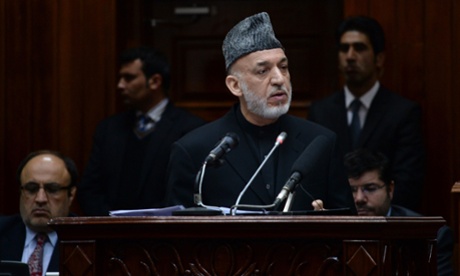 The Afghan president has come under heavy pressure to sign the Bilateral Security Agreement, with a council of notables that he himself convened recommending that he sign the pact. The force would train and mentor Afghan troops, and some US special forces would also be left behind to hunt down al-Qaida. All 10 candidates seeking the presidency in 5 April elections have said they would sign the security agreement. But Karzai himself does not appear to want his legacy to include a commitment to a longer foreign troop presence in his country.
Karzai was brought to power in the wake of the 2001 US-led invasion and subsequently won two presidential elections – in 2004 and again in 2009. But he has in recent years espoused a combative nationalism, with his hour-long speech on Saturday no exception.
“I want to say to all those foreign countries who maybe out of habit or because they want to interfere, that they should not interfere,” he said.
Karzai said the war in Afghanistan was “imposed” on his nation, presumably by the 2001 invasion, and told the United States it could bring peace to Afghanistan if it went after terrorist sanctuaries and countries that supported terrorism, a reference to Pakistan.
Pakistan has a complicated relationship with the Taliban. It backed the group before their 2001 overthrow, and although now it is at war with its own militants, Afghan insurgents sometimes find refuge on its territory.
Karzai told parliament, which was holding its opening session for this term, that security forces were strong enough to defend Afghanistan without the help of international troops.
Karzai steps down after next month’s presidential elections. Under Afghanistan’s constitution, he is banned from seeking a third term. Relations between Karzai and the US have been on a downward spiral since his re-election in 2009, in which the US and several other countries charged widespread fraud. Karzai in turn accused them of interference.
In his speech, Karzai again urged Taliban insurgents to join the peace process, while accusing Pakistan of protecting the Taliban leadership. He suggested that Pakistan was behind the killing earlier this year of a Taliban leader who supported the peace process. No one has taken responsibility for the attack.
Throughout his speech Karzai spoke of his accomplishments over the last 12 years, saying schools were functioning, rights were being given to women, energy projects were coming online and the Afghan currency had been stabilised. Karzai said that when he first took power his country was isolated and nothing was functioning.
“I know the future president will protect these gains and priorities and will do the best for peace in the country and I, as an Afghan citizen, will support peace and will cooperate.”
Afghanistan’s current parliament plans to tackle a number of key issues, including a controversial law on the elimination of violence against women. Meanwhile the Taliban released two Afghan army personnel, captured during last month’s deadly raids on two military check points, the Ministry of Defence said in a statement on Saturday. The men were freed after elders in the region interceded on their behalf and the military agreed to hand over to the Taliban the bodies of their comrades left behind on the battlefield.
The attacks on 23 February left 21 Afghan army personnel dead. Several insurgents were also killed.
Russia vetoes US-sponsored UN resolution declaring Crimea vote invalid

Russia has vetoed a UN Security Council’s resolution declaring the upcoming referendum on the future status of autonomous republic of Crimea invalid and urging all states not to recognize its results. China abstained as 13 council members supported the resolution and Russia voted against.

The draft resolution noted that the Ukrainian government in Kiev has not authorized the referendum and said that it cannot be valid. “This referendum can have no validity, and cannot form the basis for any alteration of the status of Crimea; and calls upon all States, international organizations and specialized agencies not to recognize any alteration of the status of Crimea on the basis of this referendum and to refrain from any action or dealing that might be interpreted as recognizing any such altered status,” the documents reads. Moscow has a veto right as one of five permanent members of the Security Council. It was “no secret that Russia would vote against the US draft resolution,” Russia’s envoy at the UN Vitaly Churkin said ahead of the voting. He added that Moscow would respect the choice of Crimeans. “We cannot accept its basic assumption: to declare illegal the planned March 16 referendum where there residents of the Republic of Crimea should decide on their future,” Churkin said, explaining Moscow’s decision to veto the proposed document. “The philosophy of the authors of the draft runs counter to one of the basic principles of the international law – the principle of equal rights and self-determination of peoples enshrined in the Article 1 of the UN Charter,” the Russian diplomat said.
Missing jet: Not a hijacking but 'deliberate' action, PM says
 The Malaysian Prime Minister stopped short of calling the disappearance of Flight 370 a hijacking, but he said Saturday that the jet veered off course, likely due to deliberate action taken by someone aboard.
With that revelation on Day 8, the search for the missing Malaysian Airlines plane refocused on the crew and passengers and widened to a larger swath of geography.
The passenger jetliner disappeared March 8, en route from the Malaysian capital Kuala Lumpur to Beijing, China.
"Evidence is consistent with someone acting deliberately from inside the plane," Prime Minister Najib Razak said, officially confirming the plane's disappearance was not caused by an accident.
"Despite media reports that the plane was hijacked, we are investigating all major possibilities on what caused MH370 to deviate," he said.
Military radar showed the jetliner flew in a westerly direction back over the peninsula before turning northwest toward the Bay of Bengal or southwest into the Indian Ocean, Najib said.
"Up until the point at which it left military primary radar coverage, these movements are consistent with deliberate action by someone on the plane," he said.
Investigators, he said, have confirmed by looking at the raw satellite data that the plane in question was the Malaysia Airlines jet.
The same conclusion was reached by the U.S. Federal Aviation Administration, the U.S. National Transportation Safety Board, the British Air Accidents Investigation Branch and the Malaysian authorities, all of whom were working separately with the same data, he said.
Pilot's home searched
Shortly after Najib spoke with reporters, a source close to the investigation told CNN that Malaysian police had searched the home of pilot Zaharie Ahmad Shah, 53. Shah lives in a gated community in Shah Alam, outside Kuala Lumpur.
Police made no comment about their activities at the home of co-pilot, Fariq Ab Hamid, 27. Two vans exited the home carrying small bags, similar to shopping bags, but it was unclear whether the bags were taken from the home.
Kazakhstan to Indian Ocean
As the focus of the investigation has shifted, so too has the focus of the search.
Information from international and Malaysian officials indicate that the jet may have flown for more than seven hours after the last contact with the pilots. The area of the search has broadened.
The plane's last communication with the satellite, Najib said, was in one of two possible corridors: a northern corridor stretching from the border of Kazakhstan and Turkmenistan to northern Thailand and a southern corridor stretching from Indonesia to the southern Indian Ocean.
"Based on new satellite information, we can say with a high degree of certainty that the Aircraft Communications Addressing and Reporting System, or ACARS, was disabled just before the aircraft reached the East Coast of peninsular Malaysia," the Prime Minister said.
"Shortly afterward, near the border between Malaysian and Vietnamese air traffic control, the aircraft's transponder was switched off. From this point onwards, the Royal Malaysian Air Force primary radar showed that an aircraft -- which was believed but not confirmed to be MH370 -- did turn back."
International effort
Given that the new search area involves a number of countries, the relevant foreign embassies have been given access to the new information. Malaysia's Foreign Ministry will brief the governments that had passengers aboard the plane and will brief the relatives of its 239 passengers and crew.
The search now involves 14 countries, 43 ships and 58 aircraft, Najib said.
Shortly after Najib delivered his remarks, China demanded that Malaysia provide more information on the investigation. China is sending technical experts to join the investigation.
Most of the passengers aboard were Chinese.
Plane was taking 'strange path'
Hours before Najib's announcement, U.S. officials told CNN the flight had made drastic changes in altitude and direction after disappearing from civilian radar.
The more U.S. officials learn about the flight, "the more difficult to write off" the idea that some type of human intervention was involved, an official familiar with the investigation said.
CNN has learned that a classified analysis of electronic and satellite data suggests the flight may have crashed in the Bay of Bengal or elsewhere in the Indian Ocean.
Taken together, the data point toward a possible scenario in which someone may have taken control of the plane for some unknown purpose.
The jetliner was flying "a strange path," a U.S. official said on condition of anonymity. The details of the radar readings were first reported by The New York Times on Friday.
Malaysian military radar showed the plane climbing to 45,000 feet -- which is above its approved altitude limit -- soon after disappearing from civilian radar screens and then dropping to 23,000 feet before climbing again, the official said.
Air traffic controllers outside Kuala Lumpur said they lost contact with the plane on March 8 at 1:30 a.m. local time, about 45 minutes after takeoff. The Prime Minister said its last communication with a satellite was at 8:11 a.m. the same day, but its precise location was unclear.
Najib noted that theories and conspiracy theories on what happened abound.
"There has been intense speculation," Najib said. "We understand the desperate need for information on behalf of the families and those watching around the world. But we have a responsibility to the investigation and the families to only release information that has been corroborated."
Pakistan & Saudi: A dangerous intimacy
 It would seem Ishaq Dar did the impossible. He promised to bring down the value of the dollar to double digits in 100 days, and he kept true to his word. Of course this would not have been possible if Pakistan was not blessed with the company of such good friends. In his statement he said “a friendly country” had injected $ 1.5 billion into the Pakistan Development Fund (PDF) which among other reasons, had led to the appreciation of the rupee. This anonymous country is allegedly Saudi Arabia and the terms of the loan still remain a mystery. But does that matter? We have the money. The economy is steadily improving. To Ishaq Dar, it does not. But to the rest of us, it absolutely should.
If this money had been loaned to Pakistan by the US, questions would have popped up about the ‘strings attached’ and how it would affect the government and the people as a whole. But so far, not many are concerned that this magnanimous gesture by the Saudis might not be as selfless as it is made out to be.
The dots are there. One need only glance at them to understand the way this has been running. Nawaz Sharif made it a priority to visit Saudi Arabia before other countries. General Raheel Sharif also made a trip, with his best sales pitch for JF-17s at hand. The Iran-Pakistan gas pipeline has been sidelined with no substantial reasons cited. And now, Pakistan’s policy on Syria is ambiguous, with rumors that we will not be neutral any longer with the more condemnable suspicion of selling weapons to the rebels in a conflict that does not need any more bloodshed.
Nawaz Sharif and the PML-N have always had close ties with the oil kingdom in the Middle East. If it were only a question of maintaining a good relationship with a friendly country then this loan would not have been a problem. But a close relationship with Saudi,is dangerous intimacy. There comes with it an inherent bias against minority sects like the Shias and the support of questionable wars such as the one in Syria. On the other hand, we share a border with Iran, a Shia majority country, and Saudi Arabia’s rival in a conflict that extends to proxy warfare alongside direct hostilities. Pakistan has a multi-cultural society with a significant Shia population and alienating various minorities is not only inexcusable, its just not on the cards for us. Now more than ever, Pakistan must be very wary of this friendship, especially when you add $1.5 billion into the mix.
http://www.nation.com.pk/editorials/15-Mar-2014/a-dangerous-intimacy
Pakistan's source Of $1.5 billion : Economic outlook
Peshawar & Quetta Blasts: Delaying the inevitable
 Yesterday, On Friday at noon, nine innocent people died and forty-five were reported injured in a blast in Peshawar; minutes later, a blast in Quetta ended the lives of eleven Pakistanis and wounded forty-two.
The timing might indicate that both the blasts were synchronized and the result of efforts either by one major terrorist organization or coordinated endeavors of two splinter groups.
Whatever, the views of leaders, for the people talks or no talks, violence is the result in any instance. People are now asking the question: Why go through the efforts of peace negotiations and spend time and energy on the process when bombs continue to kill Pakistanis, nevertheless.
The issue of how to deal with the TTP is becoming evermore complex, as each act of violence by militants and at the same time their overtures for peace are now being interpreted from different and opposing angles. If one is a supporter of talks, one can say that the TTP and many of its affiliated groups are in favour of peace talks. If one, however, is of a mind that the only way to end militancy is through a relentless military operation; then one may say the Taliban announcement of ceasefire is just a hoax and militants are carrying out acts of violence while raising the ruse of talks.
Amidst this confusing situation, the Taliban peace talks committee which went to North Waziristan and held parleys with the TTP Shura on its return on Friday has struck very hopeful notes in a general sort of way. But even the positive expectations of the committee did not clear the situation as it did not disclose the particulars of the TTP conditions for peace and as such it is hard for others to share the committee members' enthusiasm regarding the prospects of putting an end to militancy in the country.
The Taliban spokesman Shahid Ullah Shahid has, however, disclaimed and condemned the both acts of violence.
The Frontier Post in its editorials, when Nawaz Sharif initially showed willingness to talk with Taliban, had warned the Islamabad government of falling into the pitfall of confusion and putting the whole nation in a perplexing situation if it accepted the Taliban talks offer without TTP guaranteeing that there will be not acts of terror from its side or of its affiliate groups.
Now, each blast that takes place anywhere in Pakistan, it discredits the TTP claim of being an umbrella organization of all hues of Taliban. At the same time, it weakens both the PML-N and PTI leaders' stance that talks is the only solution to ending violence. The continued acts of terror are hardening the ordinary people's stance against Taliban. The pressure of popular opinion has become so great that even Imran Khan, the staunchest supporter of talks, has given a public statement that if negations fail, he will support an all out operation against the militants.
A division, apparently, has taken place among the various groups of Taliban between those who want to continue talks and those who want to carry on with violence.
Seemingly, the TTP has indicated by its insistence on keeping the ceasefire intact that it wants peace. Many, however, are perplexed at the Talibans main group's sudden offer of peace talks two months ago and now its persistence to keep the truce alive when previously it doubted the loyalty of the leaders and the ordinary people towards Islam. Some say the supply of funds and arms which kept the Taliban going as a fighting force is dwindling after US announcement to quit Afghanistan and Washington's interests in the area though are the same, its strategy has changed. Now it wants strong and stable Pakistan and Afghanistan to take care of its global interests, therefore, it does not want to weaken the governments of these two countries. The Strong and fighting fit Pakistani Taliban can only be destructive towards US global policy. The other theory being that the Taliban are waiting for warm weather before they can launch their offensive against Pak forces.
To dispel these negative notions, TTP has to show its sincerity for talks by helping in creating conditions conducive for the same. In spite of the fact that Nawaz Sharif government did not demand or get iron clad assurance of non-violence during the peace process, the TTP cannot escape its responsibility by just condemning or distancing itself from the violent acts of the so said small terrorist groups. The TTP, if it is not involved in a double game of blasts-and-talks policy, has to convince through reasoning its sister terrorist groups or come out swinging and subdue the bands that do not quit violence.
The Frontier Post strongly believes that, other than cementing the already anti-terrorist public opinion against Taliban, the talks-and-blasts situation is not going to serve any useful purpose.
Nobody wants war and bloodshed but where peaceful means are not appreciated, war is the only option left. The government, instead of waiting for more Pakistanis to die, should launch a full scale offensive; nothing will be achieved by delaying the inevitable.
Pakistan: Rape rooted in feudal system: Mukhtaran
 “It was one of the most saddening experiences when I saw her lying on the hospital bed, most of her body burnt,” says Mukhtaran Mai, in an interview with Dawn. Her voice thickens with tears but she swallows them back.
‘A’ was a student of first year and a resident of Meerwala as is Mukhtaran. After she had filed the FIR, she found out that one of her ‘rapists’ were set free on bail. Mukhtaran alleges the investigating officer was bought for Rs70,000.
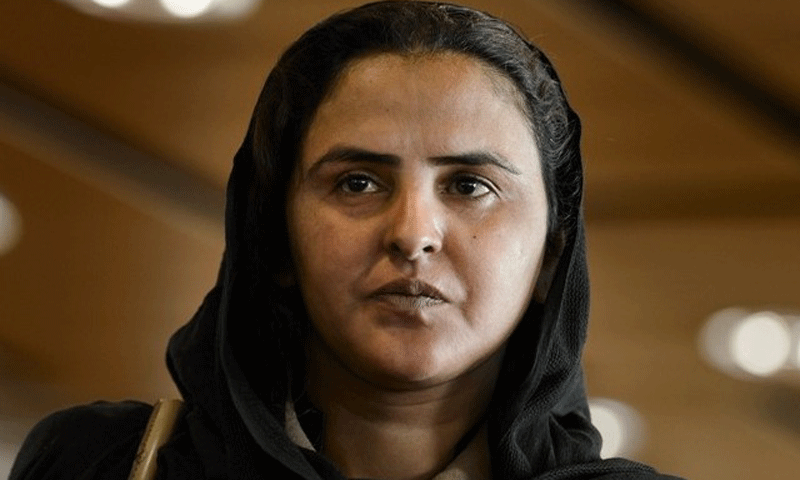 “She first came to me two days after the incident, asking for help. I offered her shelter at my home for survivors of sexual harassment but she refused the offer, saying she wanted to stay with her family.
My team and I were with her throughout but after learning what the police had done, she was shocked.”
Mukhtaran said her team’s psychologist kept explaining to her not to lose heart because these things took time and that the case was yet to go to court. But like many other young women who are left confused, depressed and angry, ‘A’ was impatient.
And when she went to the police station again, the officer involved hid himself in his room, not appearing and she doused herself with a bottle of petrol and set herself on fire.
The Nishtar Hospital in Multan where she was admitted announced her to be in a precarious condition with 80pc burns and she succumbed to the burns on Friday. But was it really burn injuries that killed her or it was the level of injustice that women in the country have to face everyday?
Even the Punjab government seems to have taken its time to respond.
On Friday, women’s rights activists protested in front of the Punjab Assembly to show their anger at the Muzaffargarh police and insisted that the Punjab government should itself take action and do some research as to why number of crimes against women was on the rise in the province. They demanded that the accused, including police officer involved, must be dealt with strictly.
In a press statement, Zohra Yousuf of the Human Rights Commission of Pakistan (HRCP) said it was common knowledge that only the courageous rape survivors in the country took the matter to police or court.
“It leads to only one conclusion: she had become convinced that she would not get justice. It is sad and ironic that only a week after celebrating the International Women’s Day with such fanfare the state and its justice system have let a woman down so brazenly.”
Meanwhile, Mukhtaran Mai, who herself is a rape survivor, says that problems are deep rooted and many.
“The problem starts with the government and police and ends with the judiciary but this is just the tip of the iceberg. The concept of sexual harassment does not seem to exist in Pakistani society. Men look at women as mere commodities.”
Referring to her own case, she says: “It takes a lot of consistent courage to face the men who have assaulted you.
Sometimes when I get out of the school, I see those men in front of it, sitting under a tree and when I go past them, they comment and whistle at me. But women cannot go on living in fear.”
Psychiatrist Dr Nazia says rape leaves a feeling of hopelessness and paranoia which is exacerbated with the lack of justice in the country’s judicial and police systems.
“The mentality of the rapist is not normal. He yearns to exert his power and male dominance sexually. This mentality cannot be changed in an individual but only through collective change.”
Incidents of rape in the country are far from falling. Statistics presented to the Senate in October 2013 showed that about 10,703 rape cases were registered in Pakistan since 2009.
These were only the ones which were reported. Most cases occurred in Punjab and experts believed that this might be only because of a higher population.
However, Mukhtaran Mai is of the opinion that huge supporters of the “rape-friendly” culture in Pakistan are the ‘Biradari’ and feudal systems.
Pakistan: At least 18 tribesmen abducted from Peshawar outskirts
At least 18 tribesmen were kidnapped by armed gunmen from Badhber area on the outskirts of Peshawar, the capital of restive Khyber Pakhtunkhwa province.
The incident took place on Saturday at 2 am.
Official sources said that about 60 to 70 armed gunmen raided Faqeer Kalley in Mashokhel area of Badbher, some one kilometres away from the main city and kidnapped 18 people from the village.
The local people and the police said the kidnapped people belonged to the Shinwari tribe of Afridis.
Badhber police have registered a case against three commanders of the banned religious outfit Lashkar-e-Islam for kidnapping of eleven tribesmen. Commanders Khalid, Sherkhel and Izzat have been nominated in the FIR.
One of the kidnapped persons has managed to escape from the kidnappers and has reached back home who phoned the police that the Khyber Agency-based Lashkar-e-Islam kidnapped the tribesmen.
Peshawar lies on the edge of Pakistan's tribal areas which have been labelled by Washington as the main sanctuary for Al Qaeda and Taliban militants in the country.
The city has seen frequent attacks by militants in the past few years, with targets ranging from civilians to policemen and other law enforcement personnel.
Separately, the political administration of Khyber Agency has also suspended the polio vaccination drive scheduled to begin on March 17 due to the law and order situation.
Court cuts jail term of Pakistan doctor who helped find bin Laden

A court in Pakistan on Saturday reduced by 10 years the jail term handed down to a Pakistani doctor who helped the United States track down al Qaeda leader Osama bin Laden, in a blow to his supporters who have been fighting for his release. Shakil Afridi, hailed as a hero by U.S. officials, was arrested after U.S. soldiers killed bin Laden in May 2011 in a raid in a northern Pakistani town that outraged Pakistan and plunged relations between the strategic partners to a new low.Pakistan arrested Afridi and sentenced him to 33 years in jail for being a member of a militant group, a charge he denies. On Saturday, a court in the city of Peshawar reduced his sentence to 23 years following repeated calls by the United States and his legal team for his release. "We will receive a complete court order on Monday and will then challenge it at the FATA Tribunal," said Afridi's lawyer, Qamar Nadeem, referring to a higher tribal court. Afridi has become a new irritant in the complex ties between Washington and Islamabad that have been deteriorating over past years despite Pakistan's pivotal role to U.S. interests in Afghanistan, counter-terrorism and nuclear security. The day after Afridi was sentenced, the U.S. Senate expressed its anger by voting to dock Islamabad $33 million in aid - $1 million for every year of the term. Pakistan has accused the doctor of running a fake vaccination campaign in which he collected DNA samples to help the U.S. Central Intelligence Agency track down bin Laden.
Pakistan: 18-year-old Rape Victim: ''Murdered''
 An 18-year-old girl is dead because those who had the power to help her just didn’t care. This girl from Muzaffargarh had been gang-raped by five men and, unlike most victims who are taught by society that being raped is somehow their fault and something they should be ashamed about, she had the courage to go to the police and identify the rapists. It didn’t make an iota of a difference. After a cursory investigation the police submitted a report to the local court that allowed them to be released on bail. This despite the fact that the police should have known that the girl did not come from a privileged background and would surely be in danger of being targeted by the accused. Their release was the last straw. The girl died after setting herself on fire outside the police station. Her mother says she was ‘tortured’ and treated with contempt. Just to rub even further salt into gaping wounds, an FIR for suicide has been lodged against her. This was no suicide. The girl was murdered, first by the men who so brutally raped her and then by the authorities that treated her case so casually. Justice for rape victims is hard to find and that is mostly the case because the men who hold the levers of power have no interest in dealing with crimes against women. The ‘suicide’ has illustrated the agony and frustration the victims suffer.
Consider the MNA from this girl’s area. In recent weeks Jamshed Dasti has been in the headlines for his moral crusade against alcohol consumption and partying in the parliamentary lodges. But his past shows how selective that morality is. Mukhtaran Mai, another victim of gang rape in Muzaffargarh, had revealed how Dasti threatened her and her family with dire consequences unless she withdrew her case in the Supreme Court against her rapists. Publically, Dasti castigated Mukhtaran Mai for distorting the image of Islam and being a puppet of NGOs. Keep in mind too that she was gang-raped on the orders of a tribal council. In both the Mukhtaran Mai and the teenage girl cases we see how the weak and powerless are preyed upon and treated not as autonomous human beings but the property of others who can be used and discarded at will. That rape can be committed with such impunity is down to the culture of our country, where you have the Council of Islamic Ideology only grudgingly accepting the use of DNA evidence in rape cases and still saying it is of less value than the testimony of four men. Little wonder then that survivors of rape either live in silence or fight fruitless battles for justice. Justice, and the ability to deliver it, is a basic pillar of a state’s legitimacy. In our country that pillar seems to have crumbled. Building it up again is the only way to avoid incidents as horrific as the one in Muzaffargarh. No citizen, no 18-year-old, should feel they have no choice but to take such drastic measures. Others have felt the same way, setting themselves alight outside governors’ houses, assemblies or press clubs. Is there anyone to hear them? We cannot continue to pretend any longer that we do not hear their cries for help and their screams of pain. Or can we?
Lahore: Barbarity cruelty Lahore police
Police baton-charged and thrashed protesting nurses, leaving around four of them severely injured on The Mall near the Punjab Assembly on Friday.
Around nine of the protesting ladies were also arrested.
There were rumours that one of the injured, who was pregnant, died which caused panic among other nurses. After the incident, nurses at Ganga Ram Hospital, Mayo Hospital and many other hospitals boycotted their duties. Many of them from nearby Sir Ganga Ram Hospital and Services Hospital and Mayo Hospital later also joined their protesting fellows. There were also rumours that the torture of the nurse led to miscarriage.
The Nurses moved from Cooper Road, where they had been protesting for the last couple of days, to The Mall on Friday afternoon and held a strong protest sit-in there. This caused great traffic mess on many adjacent roads. The police baton charged the protesting nurses to disperse them which resulted in the sad incident. Later, a large number of nurses from other hospitals joined the sit-in.
For the last five days, these nurses boycotting their duties have been protesting against the Punjab government, demanding regularization of their services.
Director General (DG) Health Punjab Dr Zahid Pervez said the injured nurse, Aasia of Lahore General Hospital (LGH), was admitted to Sir Ganga Ram Hospital along with some other nurses and her condition was stable. He said the news of the miscarriage were untrue and termed the reports about her death mere rumours.
It is pertinent to mention that the government has been claiming that the services of the nurses working on ad-hoc basis could only be regularized once they cleared the Punjab Public Service Commission (PPSC) examination.
Meanwhile, addressing an emergent press conference, Advisor to the CM Punjab on Health Khawaja Salman Rafiq said the chief minister had ordered a judicial inquiry into the incident, adding that, on recommendations of the inquiry, a strict action would be taken against those responsible. He said there were conflicting reports as to what actually led to start of the sad incident, claiming it had already been decided at higher level that no action would be taken against the protesting nurses. He said judicial inquiry would determine as to how it all started. Media footage would also be used in this regard, he added.
Khawaja Salman Rafiq claimed that almost 90 percent issues of the nurses had already been solved while the government was also extending contracts of the nurses working on ad-hoc basis. To a question, he said as per service rules, the services of the employees working on ad-hoc basis could not be regularized without PPSC. He said the Health Department had sent a requisition to the PPSC for the appointment of 1450 nurses, adding the protesting nurses could also apply for the same as they would be awarded extra marks of their experience.
Several associations of doctors and paramedic staff and political parties strongly condemned the police torture of the nurses and termed the same inefficiency of the Punjab government.
In a press release issued here, the Pakistan Medical Association (PMA) condemned the use of violence by Lahore police against protesting nurses, terming the same “unacceptable”. The PMA members expressed strong views on the police brutalities at an emergency meeting of PMA Lahore chaired by its President Dr Muhammad Tanveer Anwar. The nurses continued their protest on The Mall at Faisal Chowk till filing of this report.
Lahore: Nurses unmoved despite lathi-charge, arrests


Lahore nurses sit-in heading to a major medical staff movement
The nurses of the government hospitals in different cities of the province of Punjab on Saturday morning also stopped working in support of the ad-hoc sit-in nurses, who yesterday were subjected to police baton charge and wanton arrests, Geo News reported.Sources said that the Rawalpindi Allied Hospital and Holy Family Hospital emergency nurses observing protest strike stayed away from their duties causing immense problem for the patients. Nurses in Multan are on protest observing strike for the last five days, while the attendants of the patients in Children Complex irked by the protest strike of nurses staged demo. Faisalabad Civil, Allied Hospitals and Faisalabad Institute of Cardiology OPDs nurses are also observing strike and staged sit-in for a while outside the hospital affecting the traffic flow. Vehari, Bhakkar nurses staged protest, while the nurses of Bhawalnagar District Headquarter Hospital and Bhawalpur Victoria Hospital staged sit-in outside the hospitals. Besides, Rahimyar Khan Sheikh Zaid Hospital nurses are also observing strike.

Pakistan: Lahore nurses sit-in enters 5th day
The nurses yesterday had moved from Cooper Road, where they had been protesting for the last couple of days, to The Mall on Friday afternoon and held a strong protest sit-in there. This caused great traffic mess on many adjacent roads. The police baton charged the protesting nurses to disperse them, which resulted in the sad incident. Later, a large number of nurses from other hospitals joined the sit-in. Punjab Chief Minister, Shabaz Sharif, ordering for a judicial inquiry into the incident, has also constituted cabinet committee for the resolution of the problems of protesting nurses, who working for years on ad-hoc basis demanding confirmation. The committee headed by the Punjab Law Minister, Rana Sanaullah will hold talks with the aggrieved nurses. Meanwhile, Health Advisor to CM Punjab, Khawaja Salman Rafique accompanied by Lahore Division Commissioner, Rashid Mahmood Langrial and CCP, Shafique Gujar late at night reached the nurses sit-in site to hold talks, but the nurses disapproving any talks with them started voicing slogans ‘CM has to come’.
Bilawal Bhutto meets HRW team, assures action on human rights
http://mediacellppp.wordpress.com/

Friday, March 14, 2014
Malaysia Airlines plane : Analysis shows 2nd possible Indian Ocean path for airliner
A classified intelligence analysis of electronic and satellite data suggests Malaysia Airlines Flight 370 likely crashed either in the Bay of Bengal or elsewhere in the Indian Ocean, CNN learned Friday.
The analysis conducted by the United States and Malaysia governments may have narrowed the search area for the commercial jetliner that disappeared a week ago with 239 people on board.
If accurate, it would offer one of the first firm details about what happened to the airliner when it disappeared en route from Kuala Lumpur to Beijing, leaving little trace of where it went or why.
The intelligence analysis was proof enough for the United States to move the USS Kidd, a guided missile destroyer, into the Indian Ocean and Indian officials to expand its search effort into the Bay of Bengal.
The theory builds on earlier revelations by U.S. officials that an automated reporting system on the airliner was pinging satellites for hours after its last reported contact with air traffic controllers. Inmarsat, a satellite communications company, confirmed to CNN that automated signals were registered on its network.
An aviation industry source tells CNN that the flight's automated communications system appeared to be intact for up to five hours, because pings from the system were received after the transponder last emitted a signal.
Taken together, the data point toward speculation in a dark scenario in which someone took the plane for some unknown purpose, perhaps terrorism.
That theory is buoyed by a New York Times report that the Malaysia Airlines plane made several significant altitude changes after losing transponder contact.
Malaysian military radar showed the plane climb to 45,000 feet soon after disappearing from civilian radar screens, the newspaper reported, citing an unnamed person familiar with the data.
Then there's the theory that maybe Flight 370 landed in a remote Indian Ocean island chain.
The suggestion -- and it's only that at this point -- is based on analysis of radar data revealed Friday by Reuters suggesting that the plane wasn't just blindly flying northwest from Malaysia. Reuters, citing unidentified sources familiar with the investigation, reported that whoever was piloting the vanished jet was following navigational waypoints that would have taken the plane over the Andaman Islands.
The radar data don't show the plane over the Andaman Islands, but only on a known route that would take it there, Reuters cited its sources as saying.
The movie-plot theory seems more complicated and unlikely than one in which the plane -- its flight crew perhaps incapacitated -- simply flew on until it ran out of fuel or faced some other problem. But it's one that law enforcement has to check out, former FBI Assistant Director James Kallstrom said.
"You draw that arc, and you look at countries like Pakistan, you know, and you get into your 'Superman' novels, and you see the plane landing somewhere and (people) repurposing it for some dastardly deed down the road," he told CNN's Jake Tapper on Thursday.
Aviation experts say it's possible, if highly unlikely, that someone could have hijacked and landed the giant Boeing 777 undetected.
The international airport in Port Blair, the regional capital of the Andaman and Nicobar islands, has a runway that is long enough to accommodate a 777, according to publicly available data.
But the region is highly militarized because of its strategic importance to India, Indian officials with knowledge of the operation tell CNN, making it an unlikely target for pirates trying to sneak in an enormous airplane with a wingspan of more than 200 feet.
Denis Giles, editor of the Andaman Chronicle newspaper, says there's just nowhere to land such a big plane in his archipelago without attracting notice.
"There is no chance, no such chance, that any aircraft of this size can come towards Andaman and Nicobar Islands and land," he said.
The Malaysian government said Friday that it can't confirm the report.
And a senior U.S. official offered a conflicting account Thursday, telling CNN that "there is probably a significant likelihood" the plane is on the bottom of the Indian Ocean.
The jetliner, with 239 people on board, disappeared a week ago as it flew between Kuala Lumpur, Malaysia, and Beijing. The flight has turned into one of the biggest mysteries in aviation history, befuddling industry experts and government officials. Authorities still don't know where the plane is or what caused it to vanish.
Suggestions of what happened have ranged from a catastrophic explosion to hijacking to pilot suicide.
Among the things being considered is whether lithium batteries in the cargo hold, which have been blamed in previous crashes, played a role in the disappearance, according to U.S. officials briefed on the latest developments in the investigation. The officials spoke on condition of anonymity because they were not authorized to release details to the media.
If the batteries being carried on the plane caused a fire, it still doesn't fully explain other anomalies with Flight 370, the officials say.
Details of the search
Malaysian officials, who are coordinating the search, said Friday that the hunt for the plane was spreading deeper into both the Indian Ocean and the South China Sea.
India has deployed assets from its navy, coast guard and air force to the south Andaman Sea to take part the search, the country's Ministry of Defense said Friday.
Indian search teams are combing large areas of the archipelago. Two aircraft are searching land and coastal areas of the island chain from north to south, an Indian military spokesman said Friday, and two coast guard ships have been diverted to search along the islands' east coast. Indian officials are also including part of the Bay of Bengal in their search, officials said.
As of Friday, 57 ships and 48 aircraft from 13 countries were involved in the search, Hussein said.
China, which said it would be extending its search, said crews have searched more than 27,000 square miles (about 70,000 square kilometers) of the South China Sea without finding anything.
On Friday, the United States sent the destroyer USS Kidd to scout the Indian Ocean as the search expands into that body of water.
"I, like most of the world, really have never seen anything like this," Cmdr. William Marks of the U.S. 7th Fleet said of the scale of the search. "It's pretty incredible."
"It's a completely new game now," he said. "We went from a chess board to a football field."
Other developments
• "Seafloor event":
Chinese researchers say they recorded a "seafloor event" in waters around Malaysia and Vietnam about an hour and a half after the missing plane's last known contact. The event was recorded in a non-seismic region about 116 kilometers (72 miles) northeast of the plane's last confirmed location, the University of Science and Technology of China said.
"Judging from the time and location of the two events, the seafloor event may have been caused by MH370 crashing into the sea," said a statement posted on the university's website.
However, U.S. Geological Survey earthquake scientist Harley Benz said Friday that the event appeared to be consistent with a naturally occurring 2.7-magnitude earthquake.
• Malaysian response:
Authorities continued to defend their response to the crash. "A normal investigation becomes narrower with time, I understand, as new information focuses the search," Hishammuddin Hussein, the minister in charge of defense and transportation, said at a news briefing. "But this is not a normal investigation. In this case, the information we have forces us to look further and further afield."
However, Bob Francis, a former National Transportation Safety Board official, is one of several experts who have questioned how Malaysian authorities have handled the situation.
"The Malaysians are not doing a superb job of running this investigation," he said. "And they apparently give you some information, and then they withhold information. How much are they relying on and listening to the Europeans and the NTSB who are there with more expertise? I don't know, but I think you know we've got a mixture of a very strange situation that happens to be in an environment, a regulatory environment, that really isn't capable or isn't running an investigation the way it should be run."
No deal reached at U.S.-Russia talks on Ukraine crisis
 No major agreement was reached Friday at the U.S.-Russia talks on Ukraine in London, as both sides refused to back down from their previous stances towards the stalemate in Ukraine.
U.S. Secretary of State John Kerry and his Russian counterpart Sergei Lavrov held separate press conferences after their talks which lasted for about six hours in London.
Lavrov said Russia and the United States did not have a "common vision" on the crisis in Ukraine, while emphasizing that Russia will respect "the will of the people of Crimea" the results of the referendum in the region on Sunday.
While both sides described their talks as "constructive", major disagreements regarding Ukraine remain unresolved between the two countries.
At the press conference, Kerry said Russian President Vladimir Putin is "not prepared" to make any decision on Ukraine yet.
"After much discussion, Foreign Minister Lavrov made it clear that president Putin is not prepared to make any decision regarding Ukraine until after the referendum on Sunday," Kerry said.
Kerry said the United States and its allies "respect" Russia's legitimate interests in Ukraine, but insisted that there is "a better way" for Russia to pursue the interests.
"There are legitimate interests, historical, cultural...strategic. There are real interests. All of us, who are joined together in the EU and the extended contact group, understand that interests and we are prepared to respect them," he said.
Moreover, the U.S. official stressed that international and multilateral norms are needed to solve the Ukraine crisis.
Kerry reiterated that his country will not recognize the outcome of the referendum in Crimea, describing the upcoming vote as "illegitimate".
"The President (Obama) has made it clear that there will be consequences if Russia doesn't not find a way to change course," Kerry added.
Crimea, a Ukrainian autonomous republic, will hold a referendum Sunday over its future status.
British Foreign Secretary William Hague on Friday warned that the European Union (EU) will take "further measures" if the U.S.-Russia talks over Ukraine crisis in London make no progress.
Pakistan: Ahrar-ul Hind claims Peshawar, Quetta attacks

Pakistan: Zardari, Bilawal condemn attacks
From his Pakistan hideout, Fascist muslim Uighur leader vows revenge on China
 Entrenched in secret mountain bases on Pakistan's border with Afghanistan, Uighur fighters are gearing up for retribution against China to avenge the deaths of comrades in Beijing's crackdown on a separatist movement, their leader told Reuters.
China, Pakistan's only major ally in the region, has long urged Islamabad to weed out what it says are militants from its western region of Xinjiang, who are holed up in a lawless tribal belt, home to a lethal mix of militant groups, including the Taliban and al Qaeda.
A mass stabbing at a train station in the Chinese city of Kunming two weeks ago, in which at least 29 people were killed, has put a new spotlight on the largely Muslim Uighur ethnic minority from Xinjiang, where Beijing says armed groups seek to establish an independent state called East Turkestan.
Beijing has called the Kunming bloodshed a "terrorist attack" carried out by militants, and says separatists operate training camps across the rugged border which abuts Pakistan and Afghanistan.
In a rare but brief interview, Abdullah Mansour, leader of the rebel Turkestan Islamic Party, said it was his holy duty to fight the Chinese.
"The fight against China is our Islamic responsibility and we have to fulfill it," he said from an undisclosed location.
"China is not only our enemy, but it is the enemy of all Muslims ... We have plans for many attacks in China," he said, speaking in the Uighur language through an interpreter.
"We have a message to China that East Turkestan people and other Muslims have woken up. They cannot suppress us and Islam any more. Muslims will take revenge."
Mansour spoke on a crackly line using a mobile phone with an Afghan SIM card in a brief statement which gave Reuters no chance to ask about the Kunming attack.
The separatists hide mainly in the troubled North Waziristan region, where they are treated by their Pakistani Taliban hosts as guests of honor, militant and Pakistani intelligence sources say.
The Turkestan Islamic Party, which China equates with the East Turkestan Islamic Movement (ETIM), keeps a low profile in Pakistan. Unlike the Taliban, it almost never posts videos promoting its activities or ideology. Its exact size is unknown and some experts dispute its ability to orchestrate attacks in China, or that is exists at all as a cohesive group.
Getting hold of leaders such as Mansour is almost impossible and interviews are usually very brief and conducted from undisclosed locations through a Pashto-speaking translator.
Pakistani intelligence sources say they number about 400 fighters, and are clustered around the remote Mir Ali area, sharing bases with other foreign insurgents, particularly Uzbeks, who speak a similar language.
In Afghanistan, two security reports sent to expatriates working there this year warned of attacks on a Chinese hotel, Chinese companies and other targets in Kabul. There have been no attacks so far.
According to Afghan Taliban sources, there are about 250 Uighur militants in Afghanistan's Nuristan and Kunar provinces.
"They live here with us but are always concerned about their people and mission in China. They are nice people, good Muslims and the best fighters," a senior Taliban commander said.
He added that Uighur militants were not fond of guns, and resorted mostly to knives and daggers.
China has stepped up security in Xinjiang after a vehicle ploughed into tourists on the edge of Beijing's Tiananmen Square in October, killing the three people in the car and two bystanders. China labeled it a suicide attack by militants from the region.
Mansour released a Uighur-language video weeks after the Tiananmen incident, calling it a "jihadi operation" by its holy warriors.
CRUCIAL ALLY
For Pakistan, China is a valued friend in a region it views as potentially hostile. It is keen to demonstrate a commitment to weeding out what Beijing calls separatists, but its security forces are already stretched fighting Pakistani Taliban militants.
Rehman Malik, Pakistan's former interior minister, said that about 20 Uighur militants were captured and handed over to China on his watch in 2008-2013.
"Pakistan and China are great friends. There are no secrets between us. When I took over as interior minister, I took on this subject in close association with my partners in China," he said. "The present government is also aware of the whole thing."
Many Uighurs in the energy-rich Xinjiang region which borders ex-Soviet Central Asia, Afghanistan, Pakistan and India, accuse Han Chinese of stifling their culture and religion. More than 100 people there have been killed in unrest in the past year, according to Chinese state media reports.
But the Chinese government has provided little evidence that the Kunming killings or any other incidents that Beijing has labeled terrorist attacks have been linked to outside forces.
Some experts have suggested that the low-tech nature of the weapons the assailants used in Kunming and the location of the attack point to a lack of external backing and weakly organized revenge killings as opposed to coordinated international terrorism.
The Kunming attack has put China on edge and prompted concerns over rising discrimination against Uighurs across the country.
Exiled Uighur groups have repeatedly called for transparent investigations into such incidents and say they should not be used as excuses for further repressive policies on Uighur communities.
Hundreds of Uighurs migrated to the lawless areas of Pakistan about five years ago after they were squeezed out of their homeland by a Chinese crackdown, Pakistani security sources say. Their numbers are believed to be much smaller now.
"The Chinese militants in the tribal areas are mostly clerics and fighters. They have their families here and are mostly focused on Afghanistan," said one Pakistani Taliban commander.
Saifullah Mahsud, head of the Pakistani think tank FATA Research Center, which has extensive sources in Pakistan's tribal areas, agreed their power and capacity to carry out major attacks are exaggerated by China.
"It's survival, basically. They can't go back," he said. "This is the only place where they are welcome."
But attempts by Taliban insurgents to carve out new hideouts in northern areas of Pakistan near China's border have helped create a new corridor for Uighurs leading into their homeland.
"In the last couple of years, Taliban militants have got nearer and nearer to the Chinese border," said Mahsud. "There has been a lot of movement there. Perhaps that gives them the logistical support that they require to cross over into China."
Analysis : 21 PAKISTANI KILLED 100 INJURED IN BOMB BLASTS, DESPITE GOVT MAINTAIN CEASEFIRE WITH TALIBAN
Tehreek-e-Taliban Pakistan (TTP) spokesperson Shahidullah Shahid have disassociated themselves from the attacks and said his group will abide by the month-long ceasefire announced earlier. But the Question here arises that if we take their word , that they are not doing the Suicide Attacks and Planted attacks , then why is the PML – N Government in collaboration with the supporters of Taliban , Pakistan Tehreek e Insaaf ( PTI ) , Jamaat e Islami ( JI ) , Jamiat e Ulema e Islam – Sami Ul Haq ( JUI – S ) , Sipah e Sahaba Pakistan (SSP / ASWJ ) , have initiated a Dialogue with them , as if the Government is bound to give concessions to them in the name of Peace in the country , while the country is still under attacks , and the Innocent Pakistanis are still being Killed in By Suicide Attacks , and on the Other Hands the Armed forces are being ordered not to take any action against the perpetrators , as all the terrorist who have their Hide Outs in the North Waziristan .
But the Dangerous Scenario is that the PML – N Government which is sponsored by the Saudi Government , and at the same time Sponsors of Taliban Terrorist, and Now as the Defenders of Pakistan , have started to take some action against the terrorist of North Waziristan , and have done some surgical strikes to counter the threat. So as these terrorist thought they can even be Killed , so they have begged to their Saudi Sponsors that their Lives should be spared , as they are there only to Kill Innocent Pakistanis , while No action should be taken against them either by the LEAs or the Judiciary , which is also very evident from the Past Practices of the Government , and also by the No Action Plan by the Armed forces of Pakistan . As the Government is trying to prove that these terrorist are Mightier than the Armed forces of Pakistan , and if Amnesty is not declared to these Terrorist , in the Name of Peace then they Might Kill all the Armed forces of Pakistan and Might take Over Pakistan , which is a very Treasonous thought being imposed by the Present Rulers and the supporters of these Taliban Terrorist . So as now even it is learned that the Saudi Government and the UAE Govt , has tried to Buy back the Loyalty of the Loyal Pakistani Armed Forces by Giving a Loan of around USD1.5 Billion , to make sure NO Action is taken against the Enemies of Pakistan , and the Terrorist Loyal to Saudi and UAE Governments
And now there are again Reports that the Dialogue with the Taliban are being conducted on the grounds that they will be given concessions and the authority to implement their So called “ Sharia “ in the areas where they have stronghold , like FATA , which clearly Indicates that now the same scenario of the 1970 is being tried to be Replayed
Pakistan: Vicious violence: 21 killed in bomb and suicide attacks

Former President Zardari condemns attacks on security vehicles in Peshawar and Quetta
http://mediacellppp.wordpress.com/
Former President Asif Ali Zardari strongly condemned the attacks on Friday on security vehicles in Peshawar and Quetta, in which nine and eleven people were reportedly killed and dozens injured. In a statement the former President said that the continuous acts of terrorism in all parts of country will only strengthen the nations and security forces resolve to fight the militants. He called for forging unity so that this coward and brutal enemy are defeated once for all. He paid tributes to the brave security personnel who are offering extreme sacrifices so that our men, women and children can live in peace. He also prayed to Allah for grant of eternal peace to the departed souls and early recovery of injured. He also expressed sympathy to the bereaved families.
Pakistan: Adjournment Motion moved in Senate over 1.5 billion dollars aid
An adjournment motion was moved in the Senate today to discuss whether the 1.5 billion dollars bailout by an un-named Muslim country was related to the change in the country’s policy of neutrality over Syria. The adjournment motion was moved by PPPP Senator Farhatullah Babar. In a statement he said that the claim of national debts coming down by 800 billion rupees as a result of rupee rising in value against dollar following the 1.5 billion dollars bail out was most welcome but, ‘we need to be reassured there is no quid pro quo and trade off with a critical area of our foreign policy’. Finance Minister Ishaq Dar stated Wednesday that a Muslim country gave Pakistan 1.5 billion dollars towards ‘Pakistan Development Fund’ but the donor country did not wish to be identified. The secrecy raises questions. We need to know when was the Pakistan Development Fund set up and for what purpose and what happened to a similar fund set up sometime back by the Friends of Democratic Pakistan. We also need to know whether it is outright grant, or aid or loan and on what terms and conditions, he said. There is no such thing as free lunch and relations between countries were guided by their national interests and based on a quid pro quo. There are issues that cannot be shrugged off, he said. He said that Syria had the potential of becoming Afghanistan of the Middle East and warned against any misadventure by changing course disregarding the catastrophic experience in Afghanistan next door. It would be a mistake of monumental proportions if we allowed ourselves to be sucked into the web of regional power politics in the Middle East. He said that the alarm bells first rang by reports late last month that a Muslim country was in talks with Pakistan for supply of anti-aircraft and anti tank rockets to Syrian rebels. He said that doubts linger as the joint statement issued after the visit of a dignitary from Middle East last month called for regime change in Syria as the joint statement called for the “formation of a transitional governing body with full executive powers enabling it to take charge of the affairs of the country”. He also disputed the assertion of the Advisor Foreign Affairs Sartaj Aziz that this formulation in the joint statement was in accordance with the recent Geneva 1 Accord over Syria. He said that the Geneva 1 joint communiqué stressed ending violence and human rights abuses and “launch of a Syrian led political process leading to a transition that meets the legitimate aspirations of the Syrian people”. There is a sea of difference between a ‘political process leading to a transition’ as envisaged in Geneva 1 and ‘formation of transitional governing body with full executive powers’ as stated in the joint statement and there is an ominous ring to it, he said.
U.S. Commander Says More Focus On Haqqani Militants
http://www.rferl.org/The top U.S. commander in Afghanistan says allied and Afghan forces are focusing more on going after the Haqqani militant network, which has threatened to disrupt the Afghan presidential elections in April. Marine General Joseph Dunford said the United States was targeting the groups financing and freedom of movement. He said Haqqani militants have been more active in the past few months. The Haqqani network is blamed for some of the most high-profile attacks in Afghanistan. U.S. officials have repeatedly pressed Pakistani authorities to move more aggressively against the militants, who are based in North Waziristan and regularly cross the border to conduct attacks against U.S. and coalition troops. Dunford told members of the House Armed Services Committee on March 13 that he would need 102 days to withdraw U.S. troops and equipment from Afghanistan and turn over any remaining bases to the Afghans.
Afghanistan: US still open to signing BSA: White House
'Toxic stew' of militants lurk in Afghanistan as NATO heads home
Subscribe to:
Posts (Atom)