 The Organisation for the Prohibition of Chemical Weapons (OPCW) has approved the details of an international plan to take under control and ultimately destroy Syria’s chemical weapons arsenal.‘Immediate and unfettered’ inspections
In line with the decision by the chemical weapons watchdog, Syria has until November 1 to “complete… the destruction of chemical weapons production and mixing/filling equipment” and must finish “the elimination of all chemical weapons material and equipment in the first half of 2014.”
Syria will be required to “cooperate fully… including by providing the OPCW personnel with the immediate and unfettered right to inspect any and all sites in the Syrian Arab Republic.”
The OPCW in its turn would "initiate inspections" no later than October 1 and will have 30 days to inspect all chemical facilities listed by Syria as well as “any other site identified by a State Party [any Chemical Weapons Convention member state] as having been involved in the Syrian chemical weapons programme.”
The watchdog would gather again within 24 hours in case a “delay by the Syrian Arab Republic in meeting the requirements” is reported or “a lack of cooperation in the Syrian Arab Republic or another problem” arises in implementation of the plan.
The decision paved the way for the UN Security Council's vote on the resolution.
No ‘military measures’ in Syria
The five veto-wielding members had agreed upon the text on Thursday before presenting the draft to the full 15-member body during overnight discussions.
The draft resolution is fully in line with the Geneva framework on the destruction of chemical weapons in Syria, Sergey Lavrov told the press earlier on Thursday on the sidelines of the UN General Assembly's 68th session.
“There will be no enforcement in line with Chapter 7,” he emphasized.
The draft resolution backs the agreement reached in Geneva regarding Syria's commitment to place its chemical weapons stockpile under international control. If there is any violation by any party – as the resolution also calls on the opposition to assist in the disarmament process – the Security Council will convene again and will be ready to take enforcement measures in line with Chapter 7, Lavrov said.
Friday, September 27, 2013
Chemical weapons watchdog approves Syria action
The Organisation for the Prohibition of Chemical Weapons (OPCW) has approved the details of an international plan to take under control and ultimately destroy Syria’s chemical weapons arsenal.‘Immediate and unfettered’ inspections
In line with the decision by the chemical weapons watchdog, Syria has until November 1 to “complete… the destruction of chemical weapons production and mixing/filling equipment” and must finish “the elimination of all chemical weapons material and equipment in the first half of 2014.”
Syria will be required to “cooperate fully… including by providing the OPCW personnel with the immediate and unfettered right to inspect any and all sites in the Syrian Arab Republic.”
The OPCW in its turn would "initiate inspections" no later than October 1 and will have 30 days to inspect all chemical facilities listed by Syria as well as “any other site identified by a State Party [any Chemical Weapons Convention member state] as having been involved in the Syrian chemical weapons programme.”
The watchdog would gather again within 24 hours in case a “delay by the Syrian Arab Republic in meeting the requirements” is reported or “a lack of cooperation in the Syrian Arab Republic or another problem” arises in implementation of the plan.
The decision paved the way for the UN Security Council's vote on the resolution.
No ‘military measures’ in Syria
The five veto-wielding members had agreed upon the text on Thursday before presenting the draft to the full 15-member body during overnight discussions.
The draft resolution is fully in line with the Geneva framework on the destruction of chemical weapons in Syria, Sergey Lavrov told the press earlier on Thursday on the sidelines of the UN General Assembly's 68th session.
“There will be no enforcement in line with Chapter 7,” he emphasized.
The draft resolution backs the agreement reached in Geneva regarding Syria's commitment to place its chemical weapons stockpile under international control. If there is any violation by any party – as the resolution also calls on the opposition to assist in the disarmament process – the Security Council will convene again and will be ready to take enforcement measures in line with Chapter 7, Lavrov said.
Obama, Iran's Rouhani hold historic phone call
 President Barack Obama and new Iranian President Hassan Rouhani spoke by telephone on Friday, the highest-level contact between the two countries in three decades and a sign that they are serious about reaching a pact on Tehran's nuclear program.
U.S. Senate votes to keep government open, now up to House
 The U.S. government braced on Friday for the possibility of a partial shutdown of operations on October 1 as Congress struggled to pass an emergency spending bill that Republicans want to use to defund the new healthcare reform law.
UN checking 7 reported chemical incidents in Syria, incl 3 near Damascus
UN chemical weapons inspectors in Syria are investigating seven cases of alleged chemical weapons use, including three incidents around the capital Damascus. This comes following the chemical attack on August 21 in Ghouta.
The inspectors are due to finalize their work on Monday, the UN team in Damascus said in a statement on Friday, adding that a comprehensive report is expected to be ready by late October.
In August the Syrian government allowed the UN investigation to visit and take probes at three locations of alleged chemical attacks, including the Khan al-Assal attack in March.
However their work was disrupted by the August 21 attack in Damascus's eastern Ghouta suburbs, causing casualties that ranged from dozens to 1,300 according to various accounts.
In their report the inspectors confirmed that sarin gas was used “on a large scale” in the attack.
However the report did not specify who was behind the attack, while both sides of the ongoing Syrian civil war blame each other.
Nevertheless, the US and Britain believe that the forces loyal to President Bashar Assad used the chemicals, basing their conclusions on the UN experts’ assessment of the technical characteristics of warheads found at the attack site.
Damascus claims that the UN investigators had ignored evidence passed to them confidentially, while Russia and Syria urge the US and its allies not to jump into conclusions too quickly. yria has become a full member of the global anti-chemical weapons treaty, while Assad personally vowed to hand over the country’s chemical arms to be destroyed.
The Organization for the Prohibition of Chemical Weapons (OPCW) is to discuss a disarmament plan for Syria on Friday.
The preliminary plan suggests that its team will inspect “any other site identified by a State Party as having been involved in the Syrian chemical weapons program, unless deemed unwarranted by the Director-General,” according to a copy of the draft plan obtained by the Associated Press.
This is a departure from the OPCW’s usual practice, which is to suggest only the investigation of previously inspected sites declared by member states.
The OPCW has proposed starting the inspection “as soon as possible, and no later than 1 October 2013,” saying that all efforts to destroy Syria's chemical weapons stockpiles should be completed in the first half of 2014.
The UN Security Council may vote late Friday on the resolution, which has been drafted and submitted by Russia and the US after their talks in Geneva on the destruction of chemical weapons in Syria.
Russian Foreign Minister Sergey Lavrov said Thursday that if there was a violation of the resolution by any party to the conflict, including the Syrian opposition, the UN Security Council should take measures to enforce it in accordance with Chapter 7 of the UN Charter. He added that such action does not imply immediate military intervention.

Bahrain Opposition Stages Major Rally
 Thousands of marchers in Bahrain have joined the largest anti-government protest in months in the violence-gripped Gulf nation.
Sporadic clashes with security forces broke out Friday as more than 10,000 marchers clogged a main highway, but most of the event was peaceful.
The rally was approved by Bahrain's Sunni rulers as part of efforts at outreach with the Shiite-led opposition. But many marchers appeared emboldened by U.S. President Barack Obama's mention of sectarian tensions in Bahrain in his U.N. address earlier this week.
Bahrain has been hit by nonstop unrest since early 2011 when majority Shiites launched an Arab Spring-inspired uprising for greater political rights.
The island kingdom is home to the U.S. Navy's 5th Fleet.
UN '95% sure' humans cause warming
 A landmark report says scientists are 95% certain that humans are the "dominant cause" of global warming since the 1950s.
The report by the UN's climate panel details the physical evidence behind climate change.
On the ground, in the air, in the oceans, global warming is "unequivocal", it explained.
It adds that a pause in warming over the past 15 years is too short to reflect long-term trends.
The panel warns that continued emissions of greenhouse gases will cause further warming and changes in all aspects of the climate system.
To contain these changes will require "substantial and sustained reductions of greenhouse gas emissions".
After a week of intense negotiations in the Swedish capital, the summary for policymakers on the physical science of global warming has finally been released.
The first part of an IPCC trilogy, due over the next 12 months, this dense, 36-page document is considered the most comprehensive statement on our understanding of the mechanics of a warming planet.
It states baldly that, since the 1950s, many of the observed changes in the climate system are "unprecedented over decades to millennia".
Each of the last three decades has been successively warmer at the Earth's surface, and warmer than any period since 1850, and probably warmer than any time in the past 1,400 years.
"Our assessment of the science finds that the atmosphere and ocean have warmed, the amount of snow and ice has diminished, the global mean sea level has risen and that concentrations of greenhouse gases have increased," said Qin Dahe, co-chair of IPCC working group one, who produced the report.
Speaking at a news conference in the Swedish capital, Prof Thomas Stocker, another co-chair, said that climate change "challenges the two primary resources of humans and ecosystems, land and water. In short, it threatens our planet, our only home".
Since 1950, the report's authors say, humanity is clearly responsible for more than half of the observed increase in temperatures.
But a so-called pause in the increase in temperatures in the period since 1998 is downplayed in the report. The scientists point out that this period began with a very hot El Nino year.
"Trends based on short records are very sensitive to the beginning and end dates and do not in general reflect long-term climate trends," the report says.
Prof Stocker, added: "I'm afraid there is not a lot of public literature that allows us to delve deeper at the required depth of this emerging scientific question.
"For example, there are not sufficient observations of the uptake of heat, particularly into the deep ocean, that would be one of the possible mechanisms to explain this warming hiatus."
"Likewise we have insufficient data to adequately assess the forcing over the last 10-15 years to establish a relationship between the causes of the warming."
However, the report does alter a key figure from the 2007 study. The temperature range given for a doubling of CO2 in the atmosphere, called equilibrium climate sensitivity, was 2.0C to 4.5C in that report.
In the latest document, the range has been changed to 1.5C to 4.5C. The scientists say this reflects improved understanding, better temperature records and new estimates for the factors driving up temperatures.
In the summary for policymakers, the scientists say that sea level rise will proceed at a faster rate than we have experienced over the past 40 years. Waters are expected to rise, the document says, by between 26cm (at the low end) and 82cm (at the high end), depending on the greenhouse emissions path this century.
The scientists say ocean warming dominates the increase in energy stored in the climate system, accounting for 90% of energy accumulated between 1971 and 2010.
For the future, the report states that warming is projected to continue under all scenarios. Model simulations indicate that global surface temperature change by the end of the 21st Century is likely to exceed 1.5 degrees Celsius, relative to 1850.
Prof Sir Brian Hoskins, from Imperial College London, told BBC News: "We are performing a very dangerous experiment with our planet, and I don't want my grandchildren to suffer the consequences of that experiment."
ANP's Condolence Reference for Peshawar Church Bombing Victims
http://awaminationalparty.org/
 A condolence reference to show solidarity with Christian community was held at Baacha Khan Markaz, the party Head Quarters in Peshawar under the chairmanship of Mr. Bashir Ahmad Khan Matta. The objective was to show solidarity with the community on big human losses caused due to terrorist acts on Sept 22nd on Peshawar church.
Large number of party workers, lawyers , PSF workers and Christian community attended the event. Bashir Ahmad Khan Matta, Mian Iftikhar Hussain, Aimal Wali Khan , Saddruddin Marwat , Senator Amarjeet Malhotra , Ex-MPA Asif bhatti, Gulshan Yousuf and Bishop Shafee addressed the event, while Mr. Paster Pitras Salamat offered prayers and Dr. Hashmat delivered a message. At the end candles were lighted in the memory of those who lost their lives in the blast.
While addressing the gathering Mr. Bashir Ahmad Khan Matta said that terror acts on church is worth thinking for all of us. He said that A.N.P is shares this sorrow and extends condolence to the affected families. He said that it is the responsibility of the state to protect the rights & lives of Minorities. But PTI Chief Imran Khan is just blaming A.N.P to hide his in-efficiency & failure in time response on this occasion instead he should have praised the Bravery of A.N.P and its leaders & workers for their quick response to help the victims in this state of emergency. He said Imran Khan is lacking political wisdom as he has spent most of his life in sports as a player. Quick response by Mian Iftikhar Hussain to reach the blast site was good gesture & good and scared politics of ANP. If Imran Khan considers it as a sin, we will continue with this sin to live & die with the masses. He said the God help PTI to continue with the politics to leave the people on mercy of God. This is their way of Pakistan.
Mian Iftikhar Hussain while speaking on this occasion condemned the church blast in strong words. He said that on one side hundreds of dead bodies & wounded were lying un-attended in hospitals and the wounded people were crying for help, and their relatives crying. But on the other hand the response by the Govt: side was zero. No Minister or public representative was there. There were no Doctors , no beds , no medicine & other facilities in hospital. In this condition the people’s anger was natural. I reached Hospital as usual to show sympathy with people & tried to minimize their anger. If still Imran Khan sees it with doubts, then I can only pray for his wisdom, e said. Instead criticizing me, Imran Khan should have condemned the terrorists for their barbarism. He said that he is follower of Baacha Khan and am from public & will always will stand with people. People are the best judges of my performance and I leave it to the people.
Pashto Song For Peshawar: kala me perzo she pa bamoono pekhawara
" how can i see you facing bomb blast Peshawar "
Pakistan quake toll reaches 515, insurgents hamper aid efforts
Causes of Pakistan's New Island Revealed
http://news.discovery.com/The powerful earthquake that hit Pakistan on Tuesday (Sept. 24) and killed more than 320 people struck along one of the most hazardous yet poorly studied tectonic plate boundaries in the world.

Peshawar blast: 19 killed
 Around 19 people were killed and 44 others sustained injuries in an explosion inside a van on Charsadda Road, Peshawar, Express News reported on Friday.
The attack targeted a bus of Civil Secretariat employees that was carrying around 30-40 people.
The bomb was placed in the back of the bus.
Injured
Police and rescue officials have reached the area and injured were taken to Lady Reading Hospital (LRH) and Charsadda District Headquarters Hospital.
Emergency was declared in LRH after the blast.
Injured were shifted to the hospitals in private cars and ambulances.
Blast
According to the bomb disposal squad (BDS), the bomb contained around six to seven kilogrammes of explosive material and had a timed device attached to it.
The explosion was so intense that it threw the bus far away from the blast site.
Despite police presence in the area, bus parts and other evidences were not collected for investigation and many were taken away by the locals.
Background
Peshawar has been a target of militant attacks for the past decade.
On September 22, a pair of suicide bombers blew themselves up outside a 130-year-old Anglican church in Peshawar, killing at least 81 people in the deadliest attack on Christians in the country.
Last year in June, 19 people were killed and 20 injured in a bomb attack on a Civil Secretariat bus.
MALALA CHAMPIONS EDUCATION AT U.N.
http://newsweekpakistan.com/
With a maturity and poise that belied her tender years, Malala Yousafzai, the Pakistani teen shot by the Taliban for championing girls’ education stood by world leaders on Wednesday and called for books not guns. “Instead of sending weapons, instead of sending tanks to Afghanistan and all these countries which are suffering from terrorism, send books,” she pleaded. “Instead of sending tanks send pens,” she urged, her hair modestly covered by a scarf as she took part in the first anniversary of the Global Education First initiative at the United Nations in New York. In October last year, Malala was shot in the head by a Taliban gunman as she was on her way to school in her usual bus in an attack that drew worldwide condemnation. Gravely wounded and close to death, the Pakistani schoolgirl was flown to Britain for surgery. She returned to school in England last March, after recovering from her injuries. Now she has become a global advocate for the right of all children, and in particular girls, to have a proper education. “Instead of sending soldiers, send teachers,” Malala argued at an event attended by Nobel peace laureate Desmond Tutu, Bangladeshi Prime Minister Sheikh Hasina and Croatian premier Ivo Josipovic. According to the United Nations, some 57 million children around the world of elementary school age are denied an education—and 52 percent of them are girls. “This is my dream to see every child to be educated,” Malala told the gathering, building on themes of one of her heroes, Martin Luther King. “This is my dream to see equality for every human being. This is my dream to see peace everywhere in the world, in Nigeria, in Syria, in Pakistan, in Afghanistan.” It was not Malala’s first trip to the United Nations building in New York. Earlier this year in July, she received a standing ovation for an address to the general assembly at which she vowed she would never be silenced. “We want women to be independent … and to have equal rights as men have,” Malala said on Wednesday. “We believe in equality and to give equality to women is justice,” she added, receiving resounding applause. “We are here to find a solution for all these problems that we are facing.” U.N. chief Ban Ki-moon hailed the teenager for “your courage and triumph” which he said “have inspired millions of people across the world.” Malala’s courage has already won her numerous awards including the highest honor from Amnesty International, which announced she would be named an Ambassador of Conscience. Time magazine also listed her as one of the 100 most influential people in the world, and she has just been nominated for the prestigious European Parliament Sakharov Prize. Next month her book I am Malala is due to be published and she has also launched an organization called the Malala Fund.TEEN ACTIVIST URGES EDUCATION FOR ALL WHILE ADDRESSING GLOBAL EDUCATION FIRST INITIATIVE.
At least 17 killed in Peshawar explosion
 17 people were killed and 43 others injured when a bomb exploded on a bus carrying government employees on Peshawar’s Charsadda Road, DawnNews reported.
“The bomb was planted inside the bus. At the moment, the death of 17 people have been confirmed,” Zahirul Islam, deputy commissioner of Peshawar, told AFP.
Nasir Durrani, the police chief of Khyber Pakhtunkhwa, told reporters the remote-controlled bomb was planted at the back of the bus, which was taking government staff home to the town of Charsadda after work.
Durrani confirmed that 17 people have been killed and 43 wounded.
An eyewitness speaking on GEO news channel said the blast was so powerful it threw victims' bodies clear of the vehicle and onto the roadside.
Footage showed the back of the bus reduced to a tangle of twisted metal by the force of the explosion.
Nine dead bodies have been taken to Lady Reading Hospital in Peshawar while eight bodies have been taken to a government hospital in Charsadda.
The target was government employees, Sahibzada Mohammad Anis, the commissioner of Peshawar, told AFP.
Peshawar, the capital of Khyber Pakhtunkhwa, lies on the edge of Pakistan's tribal areas, labelled by Washington as the main sanctuary for Al Qaeda and Taliban militants in the country. The city has seen frequent attacks by militants in the past few years, with targets ranging from civilians to policemen and other law enforcement personnel.
16 killed, over a dozen injured in Peshawar Secretariat bus blast
SIXTEEN persons were killed and over a dozen injured when a blast hit the bus carrying Secretariat employees at Charsadda Road in Peshawar before Friday prayers, Local TV reported. According to the initial reports, a Civil Secretariat bus carrying around 100 employees was on its way when an explosion occurred near Gulbaila at Charsadda Road. More than 20 persons were injured while ten succumbed to their injuries initially that later rose to 13. Sources said that casualties are feared to rise. Rescue teams shifted the injured and bodies to Lady Reading Hospital and Charsadda District Headquarter Hospital. Police reached the blast site and cordoned off the area while further details about the blast are yet to be ascertained.
Pakistan: September 22 attack: ‘Deploy the army at churches, protect us or expel us’
Pakistan: Rape and the rot

Pakistan: Dengue outbreak kills 23 in Swat valley
Pakistan: Extreme myopia
China to close Sino-Pakistan border
Daily TimesThe Chinese government has decided to close the Sino-Pak border for 10 days as part of extra ordinary security measures ahead of its Independence Day celebrations. According to Hunza Nagar police, a notification from the Chinese government said the Khunjerab Pass would remain closed from September 28 to October 7. Trade and traffic between the two countries will remain closed during this period. Police said the Chinese government has been expressing concerns about threats of terrorist infiltration through the Khunjerab Pass. Such measures are routinely taken to guard the country against elements who may want to be involved in subversive activities in the Xinjiang autonomous region, where sections of the Uighur communities have been involved in a struggle against the government, police quoted the Chinese government as saying.
Imran’s proposals : Ill-advised suggestions
EDITORIAL: DAILY TIMESAddressing the media in Peshawar on Wednesday, Imran Khan mooted a proposal to the federal government that the Tehreek-e-Taliban (TTP) be allowed to open an office. He also stated that the government should announce a ceasefire in order to initiate meaningful talks with the TTP. If there was any doubt about Imran’s delusional attitude based on nothing but misplaced ideological inclinations in dealing with the TTP, it has been removed after this naïve statement. Ironically, Imran was visiting the Lady Reading Hospital to offer his condolences to the victims of the heinous suicide bombings carried out by militants in a church. Although the TTP, possibly after seeing the backlash of these attacks, has tried to distance itself by claiming that the attacks were carried out by Tehreek-e-Taliban Jundullah, an autonomous group having little to do with the TTP, one cannot be sure whether this is true or not. The TTP has a track record of denying involvement in attacks that caused widespread resentment amongst the masses. Imran’s proposals, if taken seriously by the federal government, would have negative consequences for the already frayed security situation. His proposal to set up an office in Pakistan similar to the one established by the Afghan Taliban in Qatar will give the TTP official recognition and elevate its position from a militant insurgency carrying out asymmetrical warfare to a stakeholder in how the country’s affairs are run. Secondly, this gesture will reinforce the TTP’s rigid and unreasonable attitude and will possibly spur the banned outfit to become more adventurous in the future. Such a proposal will only provide legitimacy to these misanthropists and will surely be perceived as a sign of the state’s weakness by the TTP. Imran’s second proposal seems even more preposterous than the first one. He proposes that the federal government should enforce a ceasefire. This is tantamount to a partial surrender; a complete surrender would be if the federal government acquiesces to the TTP’s demands for imposing sharia, turning the country into an Islamic emirate, presumably under the TTP, and obviously then packing up and going home. It is quite obvious that Imran is unwilling to budge from his rigid point of view and still has faith in a peaceful settlement with the TTP despite all the clear signals that the TTP is sending to the contrary. Moreover, if simple logic is not convincing enough, perhaps a closer look at the history of insurgencies and warfare would help. A ceasefire is always based on mutual consent and is applicable to both sides. A one-sided ceasefire is unheard of. Considering the consistency and frequency with which the TTP is conducting terrorist attacks, a ceasefire by the government will, in effect, be an open invitation for the terrorists to carry out their ‘jihad’ against innocent civilians with impunity. The Khyber Pakhtunkhwa government does not seem to have any clarity on how to tackle the TTP problem, which is growing with each passing day. Although the consensus reached by all political parties at the All Parties Conference is often touted as a great political success, nobody seems to have any clue about how to proceed. The resolve to hold talks with the TTP is not enough. There needs to be a set agenda for the proposed talks. A bare minimum set of conditions need to be put forward by the government before any talks can be held. For starters, the TTP needs to halt its hostilities against the state. The TTP’s behaviour so far gives no indication it is willing to do so. Moreover, for talks to bear fruit, it is imperative that the government has some sort of idea what it is trying to achieve through talks. The TTP shelters under its umbrella more than 60 groups and there is a possibility that even if an agreement is reached with Hakeemullah Mehsud, not all groups would comply with such an agreement. It is time for Imran to wake up and smell the coffee. The only way out of this mess is to use force against those who do not respect the writ of the state and at the same time keep room for negotiations for those who want to give up militancy and reintegrate in society. The solution does not lie in surrendering to the whims and wishes of the fanatics.
Jihadists torch statues, crosses in Syria churches: NGO

Death toll in Balochistan earthquake jumps to 531
The Frontier PostThe death toll in Tuesday s powerful earthquake in Balochistan has reached 531 today (Thursday). Rescue workers pulled victims, some screaming in pain, from the heavy rubble of mud houses collapsed on residents throughought the remote areas of Balochistan. Pakistan s army airlifted hundreds of soldiers to help with the aftermath of the worst earthquake. The earthquake of magnitude 7.7 struck Balochistan on Tuesday, a huge earthquake-prone province of deserts and rugged mountains, and was felt across South Asia. It destroyed houses and cut communications with the worst affected district of Awaran, and was so powerful it caused a small island to emerge from the Arabian Sea, just off the Pakistani coast. Rescue teams found it hard to reach the remote location quickly, and some officials said the death toll was likely to rise as emergency workers fanned further into the mountains to assess the damage.
Pakistani Quake Survivors Search Rubble For Food, Wait For Help
 Miral, a local government employee in Pakistan's southwestern Balochistan Province, was in his office when he felt his building riding the waves of a magnitude 7.7 earthquake as if it were a boat on a stormy sea.
Built from reinforced concrete for district administrators in Arawan, it is one of the stronger structures in the impoverished region and was able to withstand the September 24 quake.
Miral rushed outside after the temblor passed, looking anxiously across a flat stretch of desert toward his home in the nearby village of Balathi. Instead of the mud-brick houses that had been built there by his relatives and neighbors, he could see only rising clouds of dust and smoke.Running to his village, Miral found stunned survivors covered in dust and limping around in the rubble. Their village was one of many in the Awaran district that was almost completely leveled by the quake.
Miral spoke with RFE/RL's Radio Mashaal by satellite phone late September 25 as Balathi's homeless survivors were beginning their second night outside under the open sky.
"My nephew [and uncle were] killed and my house was completely destroyed," Miral said. "We can't even find a piece of plastic for our children to sit on. There is nothing left. We are sitting in the darkness with no food, water, or any other facilities."
Desperate For Food, Water
Balochistan is the largest and least populated province of Pakistan. Even in the best of times, the impoverished residents of remote districts like Awaran struggle to eke out a living.
Around Balathi, few water wells have been dug into the sandy soil. Instead, water is collected when it rains and stored for later use in cisterns and reservoirs.
There also are few medical facilities. The hospitals and clinics that do exist in the area often lack adequate stocks of medical supplies. There also is a shortage of qualified doctors and medical workers.
Muhammad Riaz, one of Miral's neighbors, said that about 15 people were crushed by collapsing buildings in Balathi. With another 50 people seriously injured in the village and other survivors becoming desperately hungry, Riaz worries that the death toll there will rise.
"There is no water and there is no food. There is little that can be done," Riaz said. "The shops have been destroyed. The houses have also been destroyed. People don't have money."By September 26, with daytime temperatures soaring, the situation for Balochistan's quake survivors was rapidly deteriorating. Having recovered many of the dead from beneath collapsed walls, some survivors were combing through the rubble where shops and homes once stood, hoping to find food or bottled water.
Shabbir Ahmad, a local journalist in the Awaran district, has traveled since the quake to other remote areas such as Gishkor, Malar, and Bazdad. Ahmad said the survivors he met were all in the same desperate situation -- and still waiting for relief aid to reach them.
Ahmad also said that local health clinics and hospitals have been reduced to "nothing." The main district hospital in Awaran had only two doctors on duty the night after the quake.
Ahmad Hussain, a professor at Awaran College, said local groups were rushing to provide aid to survivors, but that many residents remained without help.
"There is a lot of destruction in the different villages. The mud houses have caved in," Hussain said. "And both local and governmental organizations are busy with relief. But the people have yet to get suitable assistance. The people are struggling to get water and food."
Government Response
Meanwhile, about 100 protesters gathered around the district office in the town of Arawan to call attention to the plight of survivors in nearby villages.
Pakistan's National Disaster Management Authority says it is establishing a field hospital in Awaran and has sent out additional teams of doctors and paramedics to try to cope with the disaster.
The government disaster agency says it has sent 5,000 tents to Balochistan from its strategic reserves in Karachi. It says it also has "mobilized its resources" to provide 7,000 food aid packages, each weighing 53 kilograms, to survivors in the stricken districts of Awaran and Kech.
The government is also in the process of setting up forward operating bases in the towns of Khuzdar and Bela to help distribute aid and provide logistical support for relief operations.But government attempts to deliver relief aid to some far-flung villages are being complicated by the presence of Baloch separatist rebels who are active across Balochistan Province.
On September 26, separatist militants reportedly fired two rockets at one government relief helicopter that was trying to deliver food packages, narrowly missing it.
Pakistan's military, meanwhile, is consulting satellite imagery and photographs taken from aircraft to try to assess the extent of the damage across a swathe of land that could stretch hundreds of kilometers across.
By midday on September 26, the official death toll from the quake stood at 348, with hundreds more injured and up to 300,000 people left homeless or otherwise affected by the disaster.
Authorities say the death toll is likely to rise as reports from more remote villages are collected and as the humanitarian crisis for survivors continues.
Russia, US agree on draft resolution on Syria chemical weapons - Lavrov


Thursday, September 26, 2013
Obama sharply critical of Republican opponents of healthcare law
Saudi women's new campaign to end driving ban

Homemade sarin was used in attack near Damascus – Lavrov

Turkey: Nationalist Movement Party accuses PM Erdoğan of not being sorry for killing of slain Gezi victim

Revealed: Qatar's World Cup 'slaves'

Exclusive: Abuse and exploitation of migrant workers preparing emirate for 2022Dozens of Nepalese migrant labourers have died in Qatar in recent weeks and thousands more are enduring appalling labour abuses, a Guardian investigation has found, raising serious questions about Qatar's preparations to host the 2022 World Cup. This summer, Nepalese workers died at a rate of almost one a day in Qatar, many of them young men who had sudden heart attacks. The investigation found evidence to suggest that thousands of Nepalese, who make up the single largest group of labourers in Qatar, face exploitation and abuses that amount to modern-day slavery, as defined by the International Labour Organisation, during a building binge paving the way for 2022. According to documents obtained from the Nepalese embassy in Doha, at least 44 workers died between 4 June and 8 August. More than half died of heart attacks, heart failure or workplace accidents. The investigation also reveals: • Evidence of forced labour on a huge World Cup infrastructure project. • Some Nepalese men have alleged that they have not been paid for months and have had their salaries retained to stop them running away. • Some workers on other sites say employers routinely confiscate passports and refuse to issue ID cards, in effect reducing them to the status of illegal aliens. • Some labourers say they have been denied access to free drinking water in the desert heat. • About 30 Nepalese sought refuge at their embassy in Doha to escape the brutal conditions of their employment. The allegations suggest a chain of exploitation leading from poor Nepalese villages to Qatari leaders. The overall picture is of one of the richest nations exploiting one of the poorest to get ready for the world's most popular sporting tournament. "We'd like to leave, but the company won't let us," said one Nepalese migrant employed at Lusail City development, a $45bn (£28bn) city being built from scratch which will include the 90,000-seater stadium that will host the World Cup final. "I'm angry about how this company is treating us, but we're helpless. I regret coming here, but what to do? We were compelled to come just to make a living, but we've had no luck." The body tasked with organising the World Cup, the Qatar 2022 Supreme Committee, told the Guardian that work had yet to begin on projects directly related to the World Cup. However, it said it was "deeply concerned with the allegations that have been made against certain contractors/sub-contractors working on Lusail City's construction site and considers this issue to be of the utmost seriousness". It added: "We have been informed that the relevant government authorities are conducting an investigation into the allegations." The Guardian's investigation also found men throughout the wider Qatari construction industry sleeping 12 to a room in places and getting sick through repulsive conditions in filthy hostels. Some say they have been forced to work without pay and left begging for food. "We were working on an empty stomach for 24 hours; 12 hours' work and then no food all night," said Ram Kumar Mahara, 27. "When I complained, my manager assaulted me, kicked me out of the labour camp I lived in and refused to pay me anything. I had to beg for food from other workers." Almost all migrant workers have huge debts from Nepal, accrued in order to pay recruitment agents for their jobs. The obligation to repay these debts, combined with the non-payment of wages, confiscation of documents and inability of workers to leave their place of work, constitute forced labour, a form of modern-day slavery estimated to affect up to 21 million people across the globe. So entrenched is this exploitation that the Nepalese ambassador to Qatar, Maya Kumari Sharma, recently described the emirate as an "open jail".
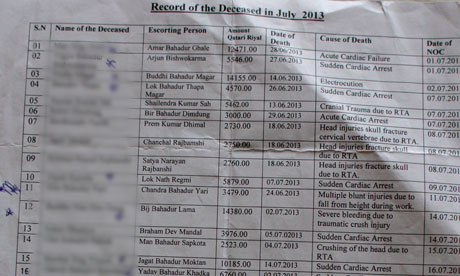
"The evidence uncovered by the Guardian is clear proof of the use of systematic forced labour in Qatar," said Aidan McQuade, director of Anti-Slavery International, which was founded in 1839. "In fact, these working conditions and the astonishing number of deaths of vulnerable workers go beyond forced labour to the slavery of old where human beings were treated as objects. There is no longer a risk that the World Cup might be built on forced labour. It is already happening." Qatar has the highest ratio of migrant workers to domestic population in the world: more than 90% of the workforce are immigrants and the country is expected to recruit up to 1.5 million more labourers to build the stadiums, roads, ports and hotels needed for the tournament. Nepalese account for about 40% of migrant labourers in Qatar. More than 100,000 Nepalese left for the emirate last year. The murky system of recruitment brokers in Asia and labour contractors in Qatar leaves them vulnerable to exploitation. The supreme committee has insisted that decent labour standards will be set for all World Cup contracts, but underneath it a complex web of project managers, construction firms and labour suppliers, employment contractors and recruitment agents operate. According to some estimates, Qatar will spend $100bn on infrastructure projects to support the World Cup. As well as nine state-of-the-art stadiums, the country has committed to $20bn worth of new roads, $4bn for a causeway connecting Qatar to Bahrain, $24bn for a high-speed rail network, and 55,000 hotel rooms to accommodate visiting fans and has almost completed a new airport. The World Cup is part of an even bigger programme of construction in Qatar designed to remake the tiny desert kingdom over the next two decades. Qatar has yet to start building stadiums for 2022, but has embarked on the big infrastructure projects likesuch as Lusail City that, according to the US project managers, Parsons, "will play a major role during the 2022 Fifa World Cup". The British engineering company Halcrow, part of the CH2M Hill group, is a lead consultant on the Lusail project responsible for "infrastructure design and construction supervision". CH2M Hill was recently appointed the official programme management consultant to the supreme committee. It says it has a "zero tolerance policy for the use of forced labour and other human trafficking practices". Halcrow said: "Our supervision role of specific construction packages ensures adherence to site contract regulation for health, safety and environment. The terms of employment of a contractor's labour force is not under our direct purview." Some Nepalese working at Lusail City tell desperate stories. They are saddled with huge debts they are paying back at interest rates of up to 36%, yet say they are forced to work without pay. "The company has kept two months' salary from each of us to stop us running away," said one man who gave his name as SBD and who works at the Lusail City marina. SBD said he was employed by a subcontractor that supplies labourers for the project. Some workers say their subcontrator has confiscated their passports and refused to issue the ID cards they are entitled to under Qatari law. "Our manager always promises he'll issue [our cards] 'next week'," added a scaffolder who said he had worked in Qatar for two years without being given an ID card. Without official documentation, migrant workers are in effect reduced to the status of illegal aliens, often unable to leave their place of work without fear of arrest and not entitled to any legal protection. Under the state-run kafala sponsorship system, workers are also unable to change jobs or leave the country without their sponsor company's permission. A third worker, who was equally reluctant to give his name for fear of reprisal, added: "We'd like to leave, but the company won't let us. If we run away, we become illegal and that makes it hard to find another job. The police could catch us at any time and send us back home. We can't get a resident permit if we leave." Other workers said they were forced to work long hours in temperatures of up to 50C (122F) without access to drinking water. The Qatari labour ministry said it had strict rules governing working in the heat, the provision of labour and the prompt payment of salaries. "The ministry enforces this law through periodic inspections to ensure that workers have in fact received their wages in time. If a company does not comply with the law, the ministry applies penalties and refers the case to the judicial authorities." Lusail Real Estate Company said: "Lusail City will not tolerate breaches of labour or health and safety law. We continually instruct our contractors and their subcontractors of our expectations and their contractual obligations to both us and individual employees. The Guardian have highlighted potentially illegal activities employed by one subcontractor. We take these allegations very seriously and have referred the allegations to the appropriate authorities for investigation. Based on this investigation, we will take appropriate action against any individual or company who has found to have broken the law or contract with us." The workers' plight makes a mockery of concerns for the 2022 footballers. "Everyone is talking about the effect of Qatar's extreme heat on a few hundred footballers," said Umesh Upadhyaya, general secretary of the General Federation of Nepalese Trade Unions. "But they are ignoring the hardships, blood and sweat of thousands of migrant workers, who will be building the World Cup stadiums in shifts that can last eight times the length of a football match."Record of deaths in July 2013, from all causes, held by the Nepalese embassy in Doha. Photograph: /guardian.co.uk
Qatar's World Cup 'slaves': FIFA deeply concerned
Recent reports allege that numerous Nepalese migrant labourers in Qatar are enduring atrocities and labour abuses, raising questions about Qatar's preparations to host the 2022 Football World Cup. It has also been stated that some workers died in modern-day 'slavery'. The Voice of Russia very own Tim Walklate contacted FIFA directly to inquire about the details of the highly controversial accusations.
In an official statement to the Voice of Russia, FIFA representative asserted that the organization is deeply disturbed by the news and will seek to discuss the issue during Executive Committee Meeting in October.
The statement reads:
"FIFA is very concerned about the reports presented by the media regarding labour rights’ abuses and the conditions for construction workers in projects at Lusail City, Qatar. FIFA will again get in contact with the Qatari Authorities and the matter will also be discussed at the Executive Committee Meeting under point FIFA World Cup Qatar 2022 on 3 and 4 October 2013 in Zurich." Read more: http://voiceofrussia.com/news/2013_09_26/Qatars-World-Cup-slaves-FIFA-deeply-concerned-1732/
Karzai: Afghanistan offers exciting opportunities for investment

 Afghan president Hamid Karzai attended the fifth Euro-Asia Economic Forum which kicked off today in Xi’an, the capital of China’s Shaanxi Province.
The 3-day event aims to promote economic exchanges between Asia and Europe, and will discuss a series of agreements on how to enhance mutual sharing of infrastructure constructions, trade promotions, collaboration in energy and finance.
President Hamid Karzai started his speech at the forum with Globalization and said, “Globalization is not only resulting in greater world economic integration and interdependence, but also in the rise of the new economic power houses of China and India, and the fast growing economies in Africa, Asia, and Latin America.”
President Karzai further added that the benefits of globalization in Eurasia can best be realized if we work together to translate the extraordinary potentials and strengths of our populations, resources and markets.
Karzai also insisted on the need for equitable and coherent strategies for multilateral economic cooperation, trade and connectivity, in order to achieve the aspirations for Eurasia as a driver of global economic growth in the 21st Century.
He said, “I would like to share with you the opportunities and potentials of Afghanistan contributing to the modern day revival of the Silk Road, and the formation of a new Euro-Asia inland economic architecture.”
President Karzai also pointed towards the importance of geographical location of Afghanistan and said Afghanistan is a natural land bridge for transit and commerce between east and west, and the rich markets of Central and South Asia. He said, Afghanistan is well-positioned to contribute to promoting trade and transport links between European and Asian economic centers.
During his speech at the forum, president Karzai vowed that Afghanistan stands ready to help accelerate economic collaboration and growth in Eurasia and South Asia by facilitating the transfer of energy, rail and road transportation, communication, and trade development.
He also endorsed President i Jinping’s proposal for the developmetn of a Silk road Economic Belt during his speech, and said that the renewal and promotion of the Silk Road, of which Afghanistan is a part, will not only unleash unprecedented opportunities for regional cooperation and integration, but will also contribute to global economic growth and security.
President Karzai also said that Afghanistan offers exciting opportunities for investment and business development. We have vast unexploited natural resources including minerals, hydrocarbons and other materials that our neighbors and regional partners need to build and sustain their industrial economies.
“I encourage business participants at this Forum to explore business opportunities in Afghanistan, and to follow the example of the Metallurgical Company of China and the China National Petroleum Corporation by investing in Afghanistan,” President Karzai said.
Subscribe to:
Posts (Atom)