 REACTING to the tragic van fire near Gujrat town on Saturday, a local official said lives could have been saved if the driver of the vehicle had shown some courage. That statement provides the starting point of a probe to identify all those responsible for the heartbreaking, horrible tragedy. The killing of at least 15 young school-bound children and a teacher in the fire was no accident. This was nothing short of murder or at least manslaughter.
The guilty include money-minded transporters who justify the low safety standards they maintain by boastfully stressing on the affordability factor. Never is their greed more obscenely manifested than in the hot summer months. The routine sight of children crammed in rundown vehicles in the suffocating heat is the worst advertisement for our education system. It is a horrifying throwback to those dark times that we would like to pretend we have left far behind. Sadly, the same era of ignorance and negligence continues, frequently throwing up tragedies of this sort. Those responsible also include school administrations and the officials who run the affairs of government. Finally, cruel though it may sound considering the grief of those whose children have perished, parents too must bear part of the blame for not demanding a better deal for their offspring, for being the meek of the earth who accept their fate unquestioningly.
In a saner country, the Gujrat fire would be the only news worth pondering over for days and weeks if not months. In Pakistan, it is likely to be quickly overtaken by other, ‘more pressing’ events, as has happened in the aftermath of similar incidents in the past. Such incidents have included the killing of children in gas cylinder blasts, deaths of school-bound students at a railway crossing at one place and a bus overturning during a school excursion at another. After a period of initial mourning, these tragedies are forgotten in the interest of the continuation of the system. A similar pattern appears to be emerging now and the design could succeed once again unless a genuine effort is made to devise and enforce safety measures in transport used by our schoolchildren — and urgently. The blaming of one individual — the driver of the van — and the convenient, standard identification of short-circuiting as the cause of the fire are dire signs of the guilty seeking to take the old escape route. They are no less than murderers. If they are allowed to flee now, they will return to kill again.
REACTING to the tragic van fire near Gujrat town on Saturday, a local official said lives could have been saved if the driver of the vehicle had shown some courage. That statement provides the starting point of a probe to identify all those responsible for the heartbreaking, horrible tragedy. The killing of at least 15 young school-bound children and a teacher in the fire was no accident. This was nothing short of murder or at least manslaughter.
The guilty include money-minded transporters who justify the low safety standards they maintain by boastfully stressing on the affordability factor. Never is their greed more obscenely manifested than in the hot summer months. The routine sight of children crammed in rundown vehicles in the suffocating heat is the worst advertisement for our education system. It is a horrifying throwback to those dark times that we would like to pretend we have left far behind. Sadly, the same era of ignorance and negligence continues, frequently throwing up tragedies of this sort. Those responsible also include school administrations and the officials who run the affairs of government. Finally, cruel though it may sound considering the grief of those whose children have perished, parents too must bear part of the blame for not demanding a better deal for their offspring, for being the meek of the earth who accept their fate unquestioningly.
In a saner country, the Gujrat fire would be the only news worth pondering over for days and weeks if not months. In Pakistan, it is likely to be quickly overtaken by other, ‘more pressing’ events, as has happened in the aftermath of similar incidents in the past. Such incidents have included the killing of children in gas cylinder blasts, deaths of school-bound students at a railway crossing at one place and a bus overturning during a school excursion at another. After a period of initial mourning, these tragedies are forgotten in the interest of the continuation of the system. A similar pattern appears to be emerging now and the design could succeed once again unless a genuine effort is made to devise and enforce safety measures in transport used by our schoolchildren — and urgently. The blaming of one individual — the driver of the van — and the convenient, standard identification of short-circuiting as the cause of the fire are dire signs of the guilty seeking to take the old escape route. They are no less than murderers. If they are allowed to flee now, they will return to kill again.
Monday, May 27, 2013
Van fire tragedy: ''All are responsible''
REACTING to the tragic van fire near Gujrat town on Saturday, a local official said lives could have been saved if the driver of the vehicle had shown some courage. That statement provides the starting point of a probe to identify all those responsible for the heartbreaking, horrible tragedy. The killing of at least 15 young school-bound children and a teacher in the fire was no accident. This was nothing short of murder or at least manslaughter.
The guilty include money-minded transporters who justify the low safety standards they maintain by boastfully stressing on the affordability factor. Never is their greed more obscenely manifested than in the hot summer months. The routine sight of children crammed in rundown vehicles in the suffocating heat is the worst advertisement for our education system. It is a horrifying throwback to those dark times that we would like to pretend we have left far behind. Sadly, the same era of ignorance and negligence continues, frequently throwing up tragedies of this sort. Those responsible also include school administrations and the officials who run the affairs of government. Finally, cruel though it may sound considering the grief of those whose children have perished, parents too must bear part of the blame for not demanding a better deal for their offspring, for being the meek of the earth who accept their fate unquestioningly.
In a saner country, the Gujrat fire would be the only news worth pondering over for days and weeks if not months. In Pakistan, it is likely to be quickly overtaken by other, ‘more pressing’ events, as has happened in the aftermath of similar incidents in the past. Such incidents have included the killing of children in gas cylinder blasts, deaths of school-bound students at a railway crossing at one place and a bus overturning during a school excursion at another. After a period of initial mourning, these tragedies are forgotten in the interest of the continuation of the system. A similar pattern appears to be emerging now and the design could succeed once again unless a genuine effort is made to devise and enforce safety measures in transport used by our schoolchildren — and urgently. The blaming of one individual — the driver of the van — and the convenient, standard identification of short-circuiting as the cause of the fire are dire signs of the guilty seeking to take the old escape route. They are no less than murderers. If they are allowed to flee now, they will return to kill again.
On Memorial Day, Obama pays tribute to fallen
http://www.reuters.com/President Barack Obama paid tribute on Monday to fallen men and women of the U.S. armed services during a Memorial Day ceremony in which he reminded Americans that the country was still at war. During a solemn visit to Arlington National Ceremony, the resting ground for many military casualties, Obama noted in remarks to visitors that next year would mark the last Memorial Day of the U.S. war in Afghanistan. "But even as we turn the page on a decade of conflict, even as we look forward, let us never forget, as we gather here today, that our nation is still at war," Obama said. Unlike World War Two or the Vietnam War, conflicts that touched nearly every American, today most U.S. citizens were not directly affected by the military conflicts overseas, the president noted. "As we gather here today, at this very moment, more than 60,000 of our fellow Americans still serve far from home in Afghanistan," Obama said. "They're still going out on patrol, still living in Spartan forward operating bases, still risking their lives to carry out their mission. And when they give their lives, they are still being laid to rest in cemeteries in the quiet corners across our country, including here in Arlington." Before his remarks, Obama laid a wreath at the Tomb of the Unknown Soldier, placing his hand over his heart while taps was played. Joined by his wife, first lady Michelle Obama, the presidential motorcade snaked through the cemetery on a street lined with uniformed military members while the boom of a ceremonial canon sounded off in the background.
Pakistan: Loadshedding has no solution?
 It was reported in a Business Recorder exclusive that the Ministry of Finance has decided to release 5 billion rupees instead of the 22.5 billion rupees that the caretaker Federal Minister for Water and Power Dr Musaddaq Malik claimed had been agreed with the Ministry of Finance. Dr Malik in a press conference further revealed that the decision to release 15 billion rupees to be utilised by Pakistan State Oil to procure fuel and the remaining 7.5 billion rupees to generate additional power was approved by the country's chief executive namely caretaker Prime Minister Khoso.
An amount of 42 billion rupees, Dr Mailk added, had also been sanctioned by Khoso for June, a period when the caretakers would no longer be in power. It is extremely disheartening that four days later, Dr Musaddaq Malik in another press conference stated that until and unless the Ministry of Finance releases 17.5 billion rupees immediately, as agreed, loadshedding will continue at the same level which, with temperatures soaring, has begun to claim lives throughout the country. And the caretaker minister acknowledged that his own ministry is understating the demand position and thereby understating the demand-supply gap.
It is by now evident that the caretaker cabinet is not on the same page on this critical issue that continues to compromise not only the country's ability to operate at optimum productivity levels but is also a source of considerable anger for the general public. In all fairness though the 5 billion rupee figure indicates the pressure on the Ministry of Finance to contain the budget deficit, a prerequisite to assuring bilateral and multilateral donors that the country is embarked on meaningful reforms that would create fiscal space necessary to positively impact on all the key macroeconomic indicators including inflation; while the 22.5 billion rupee amount indicates the Water and Power Ministry's focus on reducing loadshedding to a level whereby the productive sectors can be enabled to become the engines of growth of the economy and to stop the domestic sector's angry demonstrations against heavy loadshedding given the current high temperatures.
This is indeed a Catch-22 situation which unfortunately is further complicated by allegations of a 'mafia' operating within the Water and Power Ministry by the caretaker Federal Minister leading him to publicly maintain that the energy crisis is structured by the unscrupulous rather than structural which would require some major reforms by the several power sub-sectors. Dr Malik's revelation that a random check carried out by him in Sialkot and Gujranwala led him to become aware that the entire distribution system of these cities was shut down is truly mind-boggling. The problem of circular debt that the PPP-led coalition government could not resolve during its five-year rule is also one that cannot be overcome in a matter of weeks or even months, the duration of the current caretaker set-up. And last but not least, as the Water and Power Minister revealed in his press conference Qadirpur gas field due to annual turnaround is unable to release 150 mmcfd to the power sector and therefore the country is being deprived of 800MW.
At the same time one cannot possibly minimise the impact of higher than budgeted allocations to the power sector - set at 185 billion rupees in budget 2012-13 and revised upward to 291 billion rupees. Sources indicate that if the 5 billion rupee is added to the total subsidies received by the power sector the actual total would rise to 320 billion rupees - money that the Treasury simply does not have. In short, the government maybe forced to print money, a decision that even Dr Malik acknowledges is not a solution as extending subsidies to the power sector is tantamount to throwing good money after bad.
So what is the solution? The Law Ministry has vetted a Presidential Ordinance that seeks to enhance tax collections through the imposition of higher taxes including sales tax, income tax, withholding tax, federal excise duty and customs duty. Or in other words, higher tax collections would no doubt enable the Ministry of Finance to release a higher amount to the power sector as a subsidy with the budget deficit remaining unchanged. The Ordinance reportedly has the support of the government-elect; however Raza Rabbani, a ferociously independent PPP mind, has indicated that his party would oppose the passage of the Ordinance during the tenure of the caretakers as it is violative of the 18th Constitutional Amendment - a stance that is opposed by several constitutional experts. Be that as it may, it appears that the President has stayed his hand and not yet affixed the necessary signature on the ordinance and each day's delay is reducing its overall impact on revenue collection as well as on the budget deficit.
A preferred solution is to reform both the power sector as well as the tax structure whereby subsidies to the former would decline while higher tax collections through enhanced documentation would reduce the budget deficit. This approach has been supported by multilateral and bilateral donors who argue that improved governance in the two sectors is necessary to enable Pakistan to come out of the existing economic quagmire. With respect to the power sector, donors suggest some unpopular decisions including payment of arrears at source by the Ministry of Finance for public sector entities and disconnecting private sector connections for unpaid bills, reducing transmission losses to the acceptable 2.5 percent level instead of the current 3.6 percent, targeting power subsidies to only the very poor, rationalisation of existing staff in the power sector and rationalising and subsequently eliminating the circular debt. A tough call but someone has to do it and that someone must be the elected representatives of the people not a caretaker set-up without a mandate from the people of this country.
It was reported in a Business Recorder exclusive that the Ministry of Finance has decided to release 5 billion rupees instead of the 22.5 billion rupees that the caretaker Federal Minister for Water and Power Dr Musaddaq Malik claimed had been agreed with the Ministry of Finance. Dr Malik in a press conference further revealed that the decision to release 15 billion rupees to be utilised by Pakistan State Oil to procure fuel and the remaining 7.5 billion rupees to generate additional power was approved by the country's chief executive namely caretaker Prime Minister Khoso.
An amount of 42 billion rupees, Dr Mailk added, had also been sanctioned by Khoso for June, a period when the caretakers would no longer be in power. It is extremely disheartening that four days later, Dr Musaddaq Malik in another press conference stated that until and unless the Ministry of Finance releases 17.5 billion rupees immediately, as agreed, loadshedding will continue at the same level which, with temperatures soaring, has begun to claim lives throughout the country. And the caretaker minister acknowledged that his own ministry is understating the demand position and thereby understating the demand-supply gap.
It is by now evident that the caretaker cabinet is not on the same page on this critical issue that continues to compromise not only the country's ability to operate at optimum productivity levels but is also a source of considerable anger for the general public. In all fairness though the 5 billion rupee figure indicates the pressure on the Ministry of Finance to contain the budget deficit, a prerequisite to assuring bilateral and multilateral donors that the country is embarked on meaningful reforms that would create fiscal space necessary to positively impact on all the key macroeconomic indicators including inflation; while the 22.5 billion rupee amount indicates the Water and Power Ministry's focus on reducing loadshedding to a level whereby the productive sectors can be enabled to become the engines of growth of the economy and to stop the domestic sector's angry demonstrations against heavy loadshedding given the current high temperatures.
This is indeed a Catch-22 situation which unfortunately is further complicated by allegations of a 'mafia' operating within the Water and Power Ministry by the caretaker Federal Minister leading him to publicly maintain that the energy crisis is structured by the unscrupulous rather than structural which would require some major reforms by the several power sub-sectors. Dr Malik's revelation that a random check carried out by him in Sialkot and Gujranwala led him to become aware that the entire distribution system of these cities was shut down is truly mind-boggling. The problem of circular debt that the PPP-led coalition government could not resolve during its five-year rule is also one that cannot be overcome in a matter of weeks or even months, the duration of the current caretaker set-up. And last but not least, as the Water and Power Minister revealed in his press conference Qadirpur gas field due to annual turnaround is unable to release 150 mmcfd to the power sector and therefore the country is being deprived of 800MW.
At the same time one cannot possibly minimise the impact of higher than budgeted allocations to the power sector - set at 185 billion rupees in budget 2012-13 and revised upward to 291 billion rupees. Sources indicate that if the 5 billion rupee is added to the total subsidies received by the power sector the actual total would rise to 320 billion rupees - money that the Treasury simply does not have. In short, the government maybe forced to print money, a decision that even Dr Malik acknowledges is not a solution as extending subsidies to the power sector is tantamount to throwing good money after bad.
So what is the solution? The Law Ministry has vetted a Presidential Ordinance that seeks to enhance tax collections through the imposition of higher taxes including sales tax, income tax, withholding tax, federal excise duty and customs duty. Or in other words, higher tax collections would no doubt enable the Ministry of Finance to release a higher amount to the power sector as a subsidy with the budget deficit remaining unchanged. The Ordinance reportedly has the support of the government-elect; however Raza Rabbani, a ferociously independent PPP mind, has indicated that his party would oppose the passage of the Ordinance during the tenure of the caretakers as it is violative of the 18th Constitutional Amendment - a stance that is opposed by several constitutional experts. Be that as it may, it appears that the President has stayed his hand and not yet affixed the necessary signature on the ordinance and each day's delay is reducing its overall impact on revenue collection as well as on the budget deficit.
A preferred solution is to reform both the power sector as well as the tax structure whereby subsidies to the former would decline while higher tax collections through enhanced documentation would reduce the budget deficit. This approach has been supported by multilateral and bilateral donors who argue that improved governance in the two sectors is necessary to enable Pakistan to come out of the existing economic quagmire. With respect to the power sector, donors suggest some unpopular decisions including payment of arrears at source by the Ministry of Finance for public sector entities and disconnecting private sector connections for unpaid bills, reducing transmission losses to the acceptable 2.5 percent level instead of the current 3.6 percent, targeting power subsidies to only the very poor, rationalisation of existing staff in the power sector and rationalising and subsequently eliminating the circular debt. A tough call but someone has to do it and that someone must be the elected representatives of the people not a caretaker set-up without a mandate from the people of this country.
Pakistan: A tragedy foretold
EDITORIAL : DAILY TIMESAll the expressions of “shock and grief” and wringing of hands after the event from the President through to all significant political leaders, even the usual announcement of Rs 500,000 compensation for the dead and Rs 100,000 for the injured, is not sufficient to allay the tragedy of the school children and a teacher burnt alive in a school van fire incident in Gujrat the other day. This is neither the first such incident nor, given the dire state of transport safety generally, and school busing in particular, is it likely to be the last. The van in question was reportedly owned by the school administration, did not have a route permit, and its fitness certificate had expired. That sums up the state of vehicle certification and inspection from a safety angle. The particular incident has been reported to have happened when the driver switched from CNG to petrol. It is being said that a spark ignited the petrol, including a reserve petrol bottle inside the van, which must have exacerbated the effects of the raging fire. The driver initially escaped, as is usual in such occurrences, but was later arrested from Kharian and latest reports say he has been remanded for three days. The school administration is said to have disappeared after locking the school as soon as news of the incident reached. Both show the sense of responsibility of the driver and the school owners/administration. There is no news yet whether the school owners/administration have been arraigned. The incident should not surprise us. Ever since transport has been allowed to use CNG, numerous cases of cylinder explosions have cost many lives, including children. It is a sad commentary on the inefficiency of government and state authorities that the problem has been left to fester over the years without a single step being taken to regulate transport safety. Many CNG kits and cylinders are installed by fly by night mechanics, putting the lives of all who ride in such vehicles in jeopardy. In this incident, the cause may have been the petrol that ignited rather than the CNG cylinders exploding, but that takes nothing away from the risks posed by dual-fuel vehicles with non-factory fittings. Vehicle certification, fitness and regular inspections are conspicuous by their absence. After the horse has bolted, the usual plethora of reports is being asked for to fix responsibility for the particular incident and private schools (only in the area) asked to submit the fitness certificates of all vehicles in their use for transporting school children. This is typical of the dysfunctional state Pakistan has been reduced to. Laws, rules, regulations, and their implementation, all exist only on paper, or can be circumvented by ‘greasing’ some palms. Children are the flowers of our future. Any society that is careless or indifferent about their welfare does not deserve the title ‘human’. Even animals look after their young better. Whereas the wider problem of the use of risky fuel kits in vehicles needs urgent control, the issue of school busing and the dangers this kind of arrangement and a whole array of private arrangements throughout the country pose to the lives of our tender charges needs addressing on a war footing if further loss of young lives is to be avoided. The Gujrat incident is nothing less than murder, or at the very least manslaughter. It is doubly poignant that children and a teacher became the victims of a greedy transporter, an irresponsible school administration, and government officials and institutions that fail to do their duty. Shame on them, and shame on all of us that seem incapable of safeguarding our young.
10 more kids die of measles in Lahore, toll mounts to 120

Ten more children died of measles in Lahore on Monday, bringing the death toll in this city to 65 and 120 in Punjab province, FP news desk reported. The ten children breathed their last in different hospitals of Lahore today as provincial government has failed to curb the outbreak despite vaccination campaigns. Over 14000 children have been affected from the disease and are under treatment in government hospitals across Punjab.
Sunday, May 26, 2013
Gen. Allen: 'No question' U.S. forces will remain necessary in Afghanistan
http://www.politico.com/Retired Marine Gen. John Allen, the former commander of allied forces in Afghanistan, is sounding an optimistic note about the war. but says it will necessary for some U.S. forces to remain in the country for a long time. "The Taliban are fighting for their lives right now," Allen said. "We've seen success by the Afghan national security forces. The Taliban has recognized that we're not going anywhere. Eventually our numbers will come down pretty significantly, but there's going to be an international military presence in Afghanistan for a long time." Allen had been nominated to take over command of NATO's military forces, but backed away once he was ensnared in the probe surrounding retired Gen. David Petraeus' affair with a biographer. Allen was ultimately cleared of any wrongdoing."There's no question," Allen said when asked if it was "absolutely necessary" for the West to remain in Afghanistan. "The international community will remain engaged. Our forces will continue to train the Afghan forces well after 2014."
Pakistan: Right to education: 75 primary schools to be shut down
The Express TribuneMore than 5,000 children will be affected by the government’s decision to shut down 75 primary schools in Cholistan by March 2014 due to a lack of funds. Cholistan Development Authority Deputy Director Muhammad Qamar Zaman on Saturday said seven schools had already closed down following budget cuts by the caretaker government. These include four in Rahim Yar Khan [Chak 258R, 156R, 153R and 1.2/240] and three in Bahawalpur [Chak 50D, 156DNB, and 128DNB.] “The remaining 68 would also close down by March 2014,” he said. The schools were set up under the Rs57 million Literate Cholistan Project in 2009 for the promotion of education in the backward areas of Cholistan. Two teachers were hired for each school under the project. The responsibility for the school buildings was entrusted to the local communities. Zaman said, “In an area spread over 6,655,360 acres of land, there are only 21 government schools. All of them lack basic facilities.” “It is astonishing that nobody has taken serious steps in this regard…there is no middle school here, public or private,” he said. He said as many as 50,000 children were deprived of education in Cholistan. Under the circumstances, Zaman said, the CDA schools were doing fairly well. “The results of primary class examinations in the last two-years were encouraging. This goes on to show that the children are interested in education,” he said. In 2009, a summary recommending better salaries for the CDA school teachers was rejected by the government. As of now, the monthly salary of a senior teacher is Rs5,000, and that of a junior teacher is Rs2,500.
Persecution of Pakistani Christians
 It is very sad to state that Christians of Pakistan are day by day persecuted under false cases in blasphemy law. This shows the weakness of Government and law & order department. Where as, many speeches had been made for the protection of minorities and all happenings show that this is only limited to words.
In March 2013, 178 houses of Christian Community in Badami Bagh Lahroe were burnt in the presence of Lahore Police which clearly shows that Christians are not safe in Pakistan under such Law and Order situation where the Government and Law and Order department are helpless in saving human lives against mindset of Islamic extremists. An other case in March 2013 was also booked in Shahdara Lahore under Blasphemy Law in which a hawker was arrested by police and declared insane, by declaring such things what would have happened to the family of the hawker. Many such, numerous cases take place whereas many of them are not high-lighted and reported in the Media. Another such case came into notice of a lady Mrs. Tabassum Khurram residing in Defence Lahore Pakistan who was booked under Blasphemy Law 295-B-C only for teaching poor Christian Children in remote areas as she was voluntarily working for the uplift of Christian Community. Even though a Minister Shehbaz Bhatti in support of Asia Bibi and to make amendment of Blasphemy Law was brutally murdered.
This shows clearly that in this Blasphemy Law if a high profile case is not safe how can a normal living person be safe. We all are pray full that Our Lord may Protect His People.
It is very sad to state that Christians of Pakistan are day by day persecuted under false cases in blasphemy law. This shows the weakness of Government and law & order department. Where as, many speeches had been made for the protection of minorities and all happenings show that this is only limited to words.
In March 2013, 178 houses of Christian Community in Badami Bagh Lahroe were burnt in the presence of Lahore Police which clearly shows that Christians are not safe in Pakistan under such Law and Order situation where the Government and Law and Order department are helpless in saving human lives against mindset of Islamic extremists. An other case in March 2013 was also booked in Shahdara Lahore under Blasphemy Law in which a hawker was arrested by police and declared insane, by declaring such things what would have happened to the family of the hawker. Many such, numerous cases take place whereas many of them are not high-lighted and reported in the Media. Another such case came into notice of a lady Mrs. Tabassum Khurram residing in Defence Lahore Pakistan who was booked under Blasphemy Law 295-B-C only for teaching poor Christian Children in remote areas as she was voluntarily working for the uplift of Christian Community. Even though a Minister Shehbaz Bhatti in support of Asia Bibi and to make amendment of Blasphemy Law was brutally murdered.
This shows clearly that in this Blasphemy Law if a high profile case is not safe how can a normal living person be safe. We all are pray full that Our Lord may Protect His People.
Report blames Pakistan politicians, security for anti-Christian riots

Nearly four years after deadly anti-Christian riots left nine dead, authorities released a 318 page report indicating Pakistan's security establishment could have prevented them.A series of violent riots against Pakistani Christians in the past decade has concerned human rights watchers and religious minorities in Pakistan. The latest deadly incident, which took place just two months ago, raised questions about what, if anything, can be done to prevent such violence. The March incident when a Muslim mob burned down a Christian neighborhood in Lahore, echoed a similar incident in the rural town of Gojra four years earlier. Nine people were killed when rioters torched two Christian neighborhoods over rumors the Christians had celebrated a wedding by showering the groom with pages torn from the Quran. Despite hundreds of arrests, no one was tried for the riots, and relatives of those killed have now fled Pakistan. In 2009, the Punjab government asked a senior judge to investigate how to prevent incidents like the one in Gojra. The judge interviewed nearly 600 witnesses, including senior politicians and intelligence officials, producing a 318-page report detailing who was responsible for the violence. But the full report was not released until recently – nearly four years after the riots. It implicates members of Pakistan Muslim League-N, at the time just recently elected to power, and recommends Pakistan's blasphemy laws be reformed to prevent future violence. According to the report, the Interservices Intelligence (ISI) and local intelligence agencies knew banned extremist groups like Sipah-e-Sahaba were organizing the mobs, yet authorities did not take preventative action. “Everything could have been avoided, if the local administration did what they were supposed to do,” says Mehboob Khan, who headed fact-finding trips to Gojra for the Human Rights Commission of Pakistan.Like the riot in Lahore this year, Mr. Khan says police had several days to curtail growing threats from Muslim extremists in Gojra. On July 30, 2009, members of Sipah-e-Sahaba led a mob that burned down the entire village of Korian over the blasphemy accusation. The next day, preachers at three local mosques used their Friday sermons to demand that Gojra's Christian community – some 40,000 people – be expelled. They announced rallies the next day. The next day, busloads of seminary students from the nearby town of Jhang – a radical Sunni stronghold – joined the rallies, which were addressed by local PML-N leaders and preachers from Sipah-e-Sahaba. Bishop John Samuel, who heads an Anglican community in Gojra, says local police should have stopped the meetings and arrested those calling for more violence. “There had already been one fire, why did the police allow these meetings?” he asks. By that evening, crowds from the rallies made their way to the Christian neighborhood near the center of Gojra. Despite the efforts of some religious leaders to disperse the crowd, the mob began throwing stones at the homes, and some began shooting at Christians. Hameed Maseeh, a Christian, climbed on top of his roof and began firing back, but he was shot and killed. The crowd of Muslims swelled to more than 7,000, and some began setting fire to the Christian homes. According to the report, police that were supposed to protect the Christians told them to flee, before leaving the scene themselves. “At the height of the riot, they [the police] were nowhere to be seen,” recalls Bishop Samuel. Hameed Masih's family – unwilling to leave his body behind – locked themselves inside their home. Seven of them, including two children and three women, died when the mob set fire to their home. Maseeh's son accused 17 people – including the regional PML-N head and several Sipah-e-Sahaba leaders – of the murders. Though 113 suspects were arrested, all were released within months because witnesses refused to testify against them. Peter Jacob, head of the minority rights group National Council for Justice and Peace, says the witnesses were systematically threatened into silence. In 2010, Hameed Masih's surviving family left Pakistan, fearing for their lives. In their absence, Pakistani courts dropped the murder case. Two police commanders that left the scene as mobs torched Christian homes were suspended for a few months, but cleared by a subsequent departmental investigation. They have since been promoted. The PML-N leader that had helped lead the Muslim mobs was elected to the provincial assembly in elections earlier this month. 'No problems' In the years since the riots, the Punjab government has rebuilt the hundreds of homes that had been torched in Gojra. Christians in the area claim everything has gone back to normal. “We have no problems with the Muslims, everything is fine,” said a Christian shopkeeper in Korian whose home was burned down, refusing to be named. But Bishop Samuel says more than 50 families have chosen to leave Pakistan since the riots. While it does not call for repealing the blasphemy laws completely, the Gojra report recommends removing specific protections for Muslims, and enacting measures to discourage fabricated cases. Rights groups say blasphemy accusations are often rooted in disputes over money or property. “Reform is the first step,” Bishop Samuel says, “If we can't finish the laws completely in Pakistan, at least charge the person making false claims.” Jacob points out police have prevented violence in cases where they have seriously investigated blasphemy accusations. “People didn't believe the law was being misused [before],” says Khan, “but slowly ... they are starting to see examples of it.” When a teenaged Christian girl was accused of blasphemy last year, the case was heard by the same judge who conducted the Gojra inquiry. Citing a lack of evidence, the judge dismissed the case, ordering the accuser's arrest instead.
U.S. Shift Poses Risk to Pakistan
 By DECLAN WALSH
From multibillion-dollar military aid to stealthy and secretive drone strikes, Pakistan, perhaps even more than Afghanistan, has been the central focus of America’s 12-year war on Islamist militancy.
Now, as President Obama’s landmark policy speech on Thursday made clear, all of that is changing. Drone strikes are dwindling, the war in Afghanistan is drawing to a close and the battle against Al Qaeda is receding.
Pakistani leaders who have long demanded an American exit from their region may get their wish, but a broader disengagement is also likely to diminish the financing, prestige and political importance Pakistan held as a crucial player in global counterterrorism efforts, and could upset its internal stability.
The diminution of the drone campaign may ease a major point of friction between Pakistan and the West, but the tribal belt in northwestern Pakistan, where about 360 drone strikes have landed in the past decade, remains a hotbed of Islamist militancy, largely outside government control. Although many senior leaders of Al Qaeda sheltering there have been felled by C.I.A. missiles, they have been largely replaced by committed Pakistani jihadists with ties that span the border with Afghanistan.
With American combat troops leaving Afghanistan in 2014, and the drone campaign already winding down in Pakistan, analysts fear that unless the Pakistani Army can assert itself conclusively, the tribal region could be plunged into deeper chaos.
“It’s going to be a lot of trouble,” said Hasan Askari-Rizvi, a Pakistani academic and defense analyst. “If the insurgency increases in Afghanistan, it will spill into Pakistan’s tribal areas, where the Taliban will become very confident.”
For 12 years, the United States’ security-driven policy has shaped power, politics and militancy in Pakistan.
After 2001, Gen. Pervez Musharraf, who came to power in a military coup, established himself as a steadfast ally of the West; it underwrote his authoritarian rule, which lasted until 2008. The military received almost $17 billion in American military aid, and transfers of American military hardware, solidifying its position as the dominant arm of the state.
That relationship has also fostered resentment, and some Pakistani leaders welcome an American disengagement.
They blame America’s muscular presence — expressed through troops in Afghanistan and espionage and drone operations in Pakistan — for an Islamist surge that has killed tens of thousands of Pakistanis, and they argue that it has been a recruiting tool for militant groups like the Pakistani Taliban.
“Less American involvement is good, not bad,” said Hina Rabbani Khar, who served as foreign minister in the last government, and who said she warmly welcomed the tone of Mr. Obama’s speech on Thursday. “Drones help us lose the war. And the ideological space for these terrorists is the supposed U.S. occupation of Afghanistan. Once that excuse is not there, these people will have to face the music.”
America’s dogged pursuit of fugitives linked to Al Qaeda — first in Pakistan’s cities, later in the tribal belt along the Afghan border — led to a two-faced policy toward Islamist militancy. Pakistani officials secretly accepted, and in some cases encouraged, the American drone program, while condemning it in public as a violation of sovereignty.
Similarly, under pressure from Washington, Pakistan helped the C.I.A. arrest some jihadists, while it quietly sheltered other armed militant groups, like the Afghan Taliban and Lashkar-e-Taiba, who were seen as furthering Pakistani interests in Afghanistan and India.
The American presence also created a giant blind spot in Pakistan’s political psyche: with so much focus on American operations, Pakistani leaders used the United States as a scapegoat to avoid tackling some homegrown problems. Lurid tales of American espionage and other skulduggery abounded in the news media, promoted by politicians and mullahs but also fanned by real-life controversies like the shooting of two Pakistanis by the C.I.A. contractor Raymond Davis in January 2011.
Now that calculus is shifting for Pakistani policy makers. From now on, they will be less able to rely on the cloak-and-dagger workings of the drone program to have it both ways. Indeed, many fear a replay of the early 1990s when, after the departure of Soviet troops from Afghanistan, the United States withdrew abruptly, leaving behind a cadre of fired-up Islamist fighters, and then imposed sanctions on Pakistan for its nuclear weapons program.
Behind the bellicose speech, there is a complex dependency on both sides. While Pakistan’s powerful generals have grown to resent the United States, they also lean on American military aid as a steady source of income in an economy so shaky it may soon require a bailout from the International Monetary Fund. The generals also rely on transfers of American military hardware to keep their fleet of F-16 fighters in the air.
General Musharraf, the former president, recently admitted that he had secretly authorized American drone strikes in the tribal belt in the early days of the campaign, from 2004. Four years later, Pakistani officials quietly helped the United States assassinate Baitullah Mehsud, the leader of the Pakistani Taliban, in a missile attack.
“I don’t care if they do it as long as they get the right people,” Yousaf Raza Gilani, then prime minister, told American officials in 2008, according to an American cable published by WikiLeaks in 2010.
Among the wider Pakistani public, though, the drones stoked anger, particularly over the issue of civilian casualties — a factor acknowledged by Mr. Obama last week. At the same time, the C.I.A.’s success in assassinating senior Qaeda figures in the tribal region reduced the number of available targets.
Recently, as concern over drones mounted in the United States, the number of strikes in Pakistan dropped sharply, from about 130 at their peak in 2010, to just 12 so far this year. Civilian deaths also fell sharply, as the United States cut back on so-called signature strikes against clusters of militant suspects, which had caused the most casualties.
Now, Mr. Obama announced Thursday, American drones will attack only militants who pose an imminent threat to the United States, virtually ruling out strikes against the Pakistani Taliban, whose stated goal is the creation of an Islamist caliphate in Pakistan.
Still, the shift signaled good news for Nawaz Sharif, the prime minister-designate, who has vowed to make Pakistan less dependent on the United States. A scaled-back drone campaign will, at the very least, be one less issue to argue over.
It will, however, continue to exist, even if greatly diminished.
“This doesn’t change much for Pakistan,” insists Ahmed Rashid, author of several books on militancy in the region. “The fact that the campaign will remain under the C.I.A., surrounded in secrecy, is quite depressing for Pakistanis.”
The central factor now, experts say, is the American withdrawal from Afghanistan next year. The United States will seek a smooth exit from the conflict; Pakistan will seek to retain influence in its western neighbor, while ensuring the flow of money and military assistance from the West.
As ever, the relationship is shaped more by threats than possibilities, a stark contrast with Washington’s trade-based relations with Pakistan’s traditional rival, India.
Still, few doubt that America will remain deeply involved in Pakistan, a country with a growing population of more than 180 million people, a network of seemingly indefatigable jihadi groups and a stockpile of over 100 nuclear warheads.
The question now is how Washington will pursue those enemies, and what level of cooperation it will enjoy from its Pakistani allies. “The Pakistanis look to the U.S. for financial and other support; the Americans are pursuing senior Al Qaeda,” said Shamila N. Chaudhary, a former Obama administration official, now with the Eurasia Group, a Washington-based risk consultancy.
“Even after 2014, that mutual dependency will not go away,” she said.
By DECLAN WALSH
From multibillion-dollar military aid to stealthy and secretive drone strikes, Pakistan, perhaps even more than Afghanistan, has been the central focus of America’s 12-year war on Islamist militancy.
Now, as President Obama’s landmark policy speech on Thursday made clear, all of that is changing. Drone strikes are dwindling, the war in Afghanistan is drawing to a close and the battle against Al Qaeda is receding.
Pakistani leaders who have long demanded an American exit from their region may get their wish, but a broader disengagement is also likely to diminish the financing, prestige and political importance Pakistan held as a crucial player in global counterterrorism efforts, and could upset its internal stability.
The diminution of the drone campaign may ease a major point of friction between Pakistan and the West, but the tribal belt in northwestern Pakistan, where about 360 drone strikes have landed in the past decade, remains a hotbed of Islamist militancy, largely outside government control. Although many senior leaders of Al Qaeda sheltering there have been felled by C.I.A. missiles, they have been largely replaced by committed Pakistani jihadists with ties that span the border with Afghanistan.
With American combat troops leaving Afghanistan in 2014, and the drone campaign already winding down in Pakistan, analysts fear that unless the Pakistani Army can assert itself conclusively, the tribal region could be plunged into deeper chaos.
“It’s going to be a lot of trouble,” said Hasan Askari-Rizvi, a Pakistani academic and defense analyst. “If the insurgency increases in Afghanistan, it will spill into Pakistan’s tribal areas, where the Taliban will become very confident.”
For 12 years, the United States’ security-driven policy has shaped power, politics and militancy in Pakistan.
After 2001, Gen. Pervez Musharraf, who came to power in a military coup, established himself as a steadfast ally of the West; it underwrote his authoritarian rule, which lasted until 2008. The military received almost $17 billion in American military aid, and transfers of American military hardware, solidifying its position as the dominant arm of the state.
That relationship has also fostered resentment, and some Pakistani leaders welcome an American disengagement.
They blame America’s muscular presence — expressed through troops in Afghanistan and espionage and drone operations in Pakistan — for an Islamist surge that has killed tens of thousands of Pakistanis, and they argue that it has been a recruiting tool for militant groups like the Pakistani Taliban.
“Less American involvement is good, not bad,” said Hina Rabbani Khar, who served as foreign minister in the last government, and who said she warmly welcomed the tone of Mr. Obama’s speech on Thursday. “Drones help us lose the war. And the ideological space for these terrorists is the supposed U.S. occupation of Afghanistan. Once that excuse is not there, these people will have to face the music.”
America’s dogged pursuit of fugitives linked to Al Qaeda — first in Pakistan’s cities, later in the tribal belt along the Afghan border — led to a two-faced policy toward Islamist militancy. Pakistani officials secretly accepted, and in some cases encouraged, the American drone program, while condemning it in public as a violation of sovereignty.
Similarly, under pressure from Washington, Pakistan helped the C.I.A. arrest some jihadists, while it quietly sheltered other armed militant groups, like the Afghan Taliban and Lashkar-e-Taiba, who were seen as furthering Pakistani interests in Afghanistan and India.
The American presence also created a giant blind spot in Pakistan’s political psyche: with so much focus on American operations, Pakistani leaders used the United States as a scapegoat to avoid tackling some homegrown problems. Lurid tales of American espionage and other skulduggery abounded in the news media, promoted by politicians and mullahs but also fanned by real-life controversies like the shooting of two Pakistanis by the C.I.A. contractor Raymond Davis in January 2011.
Now that calculus is shifting for Pakistani policy makers. From now on, they will be less able to rely on the cloak-and-dagger workings of the drone program to have it both ways. Indeed, many fear a replay of the early 1990s when, after the departure of Soviet troops from Afghanistan, the United States withdrew abruptly, leaving behind a cadre of fired-up Islamist fighters, and then imposed sanctions on Pakistan for its nuclear weapons program.
Behind the bellicose speech, there is a complex dependency on both sides. While Pakistan’s powerful generals have grown to resent the United States, they also lean on American military aid as a steady source of income in an economy so shaky it may soon require a bailout from the International Monetary Fund. The generals also rely on transfers of American military hardware to keep their fleet of F-16 fighters in the air.
General Musharraf, the former president, recently admitted that he had secretly authorized American drone strikes in the tribal belt in the early days of the campaign, from 2004. Four years later, Pakistani officials quietly helped the United States assassinate Baitullah Mehsud, the leader of the Pakistani Taliban, in a missile attack.
“I don’t care if they do it as long as they get the right people,” Yousaf Raza Gilani, then prime minister, told American officials in 2008, according to an American cable published by WikiLeaks in 2010.
Among the wider Pakistani public, though, the drones stoked anger, particularly over the issue of civilian casualties — a factor acknowledged by Mr. Obama last week. At the same time, the C.I.A.’s success in assassinating senior Qaeda figures in the tribal region reduced the number of available targets.
Recently, as concern over drones mounted in the United States, the number of strikes in Pakistan dropped sharply, from about 130 at their peak in 2010, to just 12 so far this year. Civilian deaths also fell sharply, as the United States cut back on so-called signature strikes against clusters of militant suspects, which had caused the most casualties.
Now, Mr. Obama announced Thursday, American drones will attack only militants who pose an imminent threat to the United States, virtually ruling out strikes against the Pakistani Taliban, whose stated goal is the creation of an Islamist caliphate in Pakistan.
Still, the shift signaled good news for Nawaz Sharif, the prime minister-designate, who has vowed to make Pakistan less dependent on the United States. A scaled-back drone campaign will, at the very least, be one less issue to argue over.
It will, however, continue to exist, even if greatly diminished.
“This doesn’t change much for Pakistan,” insists Ahmed Rashid, author of several books on militancy in the region. “The fact that the campaign will remain under the C.I.A., surrounded in secrecy, is quite depressing for Pakistanis.”
The central factor now, experts say, is the American withdrawal from Afghanistan next year. The United States will seek a smooth exit from the conflict; Pakistan will seek to retain influence in its western neighbor, while ensuring the flow of money and military assistance from the West.
As ever, the relationship is shaped more by threats than possibilities, a stark contrast with Washington’s trade-based relations with Pakistan’s traditional rival, India.
Still, few doubt that America will remain deeply involved in Pakistan, a country with a growing population of more than 180 million people, a network of seemingly indefatigable jihadi groups and a stockpile of over 100 nuclear warheads.
The question now is how Washington will pursue those enemies, and what level of cooperation it will enjoy from its Pakistani allies. “The Pakistanis look to the U.S. for financial and other support; the Americans are pursuing senior Al Qaeda,” said Shamila N. Chaudhary, a former Obama administration official, now with the Eurasia Group, a Washington-based risk consultancy.
“Even after 2014, that mutual dependency will not go away,” she said.
Drone strikes has helped to root out al-Qaeda in Pakistan
 Secretary of State John Kerry today stoutly defended US anti-terrorism policies, including the controversial CIA-operated drone attacks, saying it has helped America to successfully root out al-Qaeda in Pakistan.
 Responding to questions from students at a town hall meeting during his visit to Ethiopia about the US drone programme, Kerry vigorously defended the justice of kill strikes by unmanned aerial vehicles just days after President Barack Obama's major policy speech, narrowing the scope of the fight against terrorism.
"The only people we fire at are confirmed terror targets, at the highest level. We don't just fire a drone at somebody we think is a terrorist," Kerry said, adding that strikes are ruled out if there could be collateral damage.
He went on to describe the drone programme as one of the "most accountable," unlike terrorist attacks, which are indiscriminate.
"Let me very clear... first of all there have been very few drone strikes in this last year. Why? Because we have been so successful in rooting out Al-Qaeda in Pakistan," he told students at the University of Addis Ababa.
"Secondly the only people that we fire on are confirmed terrorist targets at the highest levels after a great deal of vetting," he was quoted as saying.
Critics contend that, despite Obama's claims of accuracy, the CIA-operated drones have killed hundreds of innocent civilians, along with as many as 3,000 militants, most of them low-level fighters, in Pakistan and Yemen.
Since 2009, when Obama became president, the United States has carried out more than 360 strikes in Pakistan and Yemen, according to data compiled by the Long War Journal Web site.
The CIA has accounted for the vast majority of those, including all 293 in Pakistan, where only the agency flies armed drones.
Responding to questions from students at a town hall meeting during his visit to Ethiopia about the US drone programme, Kerry vigorously defended the justice of kill strikes by unmanned aerial vehicles just days after President Barack Obama's major policy speech, narrowing the scope of the fight against terrorism.
"The only people we fire at are confirmed terror targets, at the highest level. We don't just fire a drone at somebody we think is a terrorist," Kerry said, adding that strikes are ruled out if there could be collateral damage.
He went on to describe the drone programme as one of the "most accountable," unlike terrorist attacks, which are indiscriminate.
"Let me very clear... first of all there have been very few drone strikes in this last year. Why? Because we have been so successful in rooting out Al-Qaeda in Pakistan," he told students at the University of Addis Ababa.
"Secondly the only people that we fire on are confirmed terrorist targets at the highest levels after a great deal of vetting," he was quoted as saying.
Critics contend that, despite Obama's claims of accuracy, the CIA-operated drones have killed hundreds of innocent civilians, along with as many as 3,000 militants, most of them low-level fighters, in Pakistan and Yemen.
Since 2009, when Obama became president, the United States has carried out more than 360 strikes in Pakistan and Yemen, according to data compiled by the Long War Journal Web site.
The CIA has accounted for the vast majority of those, including all 293 in Pakistan, where only the agency flies armed drones.
Balochistan coal miners overworked, underpaid
 Pakistani coal miner Tariq Khan, 17, typically starts his day at 5 a.m. He earns $3 a day for dragging heavy sacks of coal.
“My father is 60 years old now. We are poor and financially things are tough. I’ve been working here for the past three years to support my father and family,” he explains, adding that previous generations in his family also worked at the coal mine.
With no other jobs available, Khan has little alternatives.
But the mines are dangerous. There’s no proper ventilation inside the mine, which is 600 meters underground, and only a few workers are equipped with safety lights.
Miners don’t wear oxygen masks, and there are no first-aid facilities in case of an emergency.
In January this year, a gas explosion killed eight workers. At the time, there were 200 miners working underground.
In 2011, almost 100 workers were killed in 30 separate accidents.
“There were about 48 people killed in a nearby mine, and the dead bodies were lying there for a week,” recalls coal miner, 40-year-old Khalid Khan Afridi.
Afridi has worked in the mine for the past two decades and has witnessed the death of many of his friends at work.
“We dug them out and we found that there was no flesh on their bodies. They’d been completely burnt,” he explained. “I worry for my life, too, as the mine is not safe.”
After the 2011 incidents, the provincial government passed a bill to allocate funds to improve the working conditions at the mines.
The government also made safety workshops mandatory for the workers, but so far nothing has been implemented.
There are around 250 coal mines that employ 60,000 workers across Baluchistan province.
On average, coal miners work there for 12 hours a day for just $5 a day.
It’s low pay, but there are few alternatives, partly as a result of the conflict between the Baloch nationalists and the Pakistan government over the share of mineral resources.
Abdul Khaliq, 62, worked inside the mines for two decades.
He’s now working as a security guard due to his bad health and spends his entire $60 monthly salary on food and medicine.
The mines are located far from the city center and patients have to be carried for hours to the nearest health facility.
Sayed Muhammad Hassan Shah is a medical technician at the nearest rural health center, but he often treats patients in place of the doctors.
“The coal mine workers usually have chest problems,” he said.
Back at the mine Tariq Khan says he wants to leave his job.
“Everyone has a dream and mine is to be free from here and to have another job where I can have time to rest,” Khan explained. “Money and education can change one’s life but I don’t have either. So I’ll work like my father until I die.”
Pakistani coal miner Tariq Khan, 17, typically starts his day at 5 a.m. He earns $3 a day for dragging heavy sacks of coal.
“My father is 60 years old now. We are poor and financially things are tough. I’ve been working here for the past three years to support my father and family,” he explains, adding that previous generations in his family also worked at the coal mine.
With no other jobs available, Khan has little alternatives.
But the mines are dangerous. There’s no proper ventilation inside the mine, which is 600 meters underground, and only a few workers are equipped with safety lights.
Miners don’t wear oxygen masks, and there are no first-aid facilities in case of an emergency.
In January this year, a gas explosion killed eight workers. At the time, there were 200 miners working underground.
In 2011, almost 100 workers were killed in 30 separate accidents.
“There were about 48 people killed in a nearby mine, and the dead bodies were lying there for a week,” recalls coal miner, 40-year-old Khalid Khan Afridi.
Afridi has worked in the mine for the past two decades and has witnessed the death of many of his friends at work.
“We dug them out and we found that there was no flesh on their bodies. They’d been completely burnt,” he explained. “I worry for my life, too, as the mine is not safe.”
After the 2011 incidents, the provincial government passed a bill to allocate funds to improve the working conditions at the mines.
The government also made safety workshops mandatory for the workers, but so far nothing has been implemented.
There are around 250 coal mines that employ 60,000 workers across Baluchistan province.
On average, coal miners work there for 12 hours a day for just $5 a day.
It’s low pay, but there are few alternatives, partly as a result of the conflict between the Baloch nationalists and the Pakistan government over the share of mineral resources.
Abdul Khaliq, 62, worked inside the mines for two decades.
He’s now working as a security guard due to his bad health and spends his entire $60 monthly salary on food and medicine.
The mines are located far from the city center and patients have to be carried for hours to the nearest health facility.
Sayed Muhammad Hassan Shah is a medical technician at the nearest rural health center, but he often treats patients in place of the doctors.
“The coal mine workers usually have chest problems,” he said.
Back at the mine Tariq Khan says he wants to leave his job.
“Everyone has a dream and mine is to be free from here and to have another job where I can have time to rest,” Khan explained. “Money and education can change one’s life but I don’t have either. So I’ll work like my father until I die.”
Managing finances: PML-N govt set to repeat history
The Express Tribune,A new government has been elected precariously close to budget season. Ishaq Dar is about to be sworn in finance minister, and it is glaringly obvious that the new administration will need to approach the International Monetary Fund for a bailout, but the government seems to be dithering, hoping for aid from wealthy allies. The year is 2008. Or 2013, since the incoming administration seems determined to repeat the mistakes of previous governments. In virtually every interview to the media since the election, Sartaj Aziz, the incoming adviser to the prime minister on finance and foreign affairs, has made it clear that the government does not want to approach the IMF for at least three to four months. And the Pakistan Muslim League Nawaz has leaked to the Financial Times that they are seeking up to $5 billion from Saudi Arabia as a bridge loan to allow the government time to implement its own agenda before approaching the IMF. Sources familiar with the matter say that the PML-N is seeking a 10-year, low-interest-rate loan from Saudi Arabia and plans to use the proceeds almost entirely to pay off the existing stock of inter-corporate circular debt in the energy sector. Once the loan is received by Pakistan, it would then take about a month for the government to halve power cuts in the country, at least partially helping them fulfil their campaign promise of taking immediate action to resolve the energy crisis. There are, however, at least three major issues with this approach. The first is that it hinges far too heavily on Saudi generosity. Riyadh has been known to rebuff many previous requests by Pakistan for assistance and the amount currently being sought is far higher than anything Islamabad has ever asked before. Granted, the Sharifs have strong ties to Saudi Arabia, but the kingdom may be hesitant to hand over that high an amount to Pakistan, which even under the PML-N has had a poor record of managing its money properly. (That sordid history, by the way, is why China has stopped providing any form of budgetary support to Pakistan.) The second problem is the damage that might happen in the wait before Islamabad eventually does enter into an IMF bailout programme. In 2008, for instance, the government was banking on US financial support to come through before finally being forced to turn to the IMF in the last quarter of that year. But by then, it was too late. Depositors panicked at the sight of the government’s dithering and lack of a serious plan, and there was massive run on the currency, and the rupee plunged from Rs61.81 to the dollar at the start of the year to Rs79.32 at the end of it, a drop of over 28%. Inflation hit a record of 25.8% in August of that year as the government was forced to cut its unsustainable subsidies. That inflation spike sent interest rates soaring, precipitating a financial sector crisis that the banks have only just recovered from. If the Saudis give anything less than $2 billion, that is effectively the scenario Pakistan will face once again. That is a deeply unpleasant thought, because it would mean wasting a whole decade going around the same crisis which just keeps getting bigger and bigger. But the single biggest problem with this approach is the “what next” question. Suppose the Saudis are generous enough to give the whole $5 billion requested (unlikely). Given the pace at which circular debt accumulates, we will be back to unsustainably high levels of debt within a year or so. In effect, the PML-N is giving itself a one-year window in which to work a miracle. To their credit, they have already started work on implementing a plan, but it seems highly unlikely that they will be able to meaningfully bring down the rate at which circular debt is rising within that period. At which point, we will just have a whole lot more debt and not much to show for it. The Saudi loan, in effect, is less a way to buy time and more like a ticking time-bomb. The IMF route is likely to be more painful, but serious negotiations with the Washington-based lender tend to calm the markets, and buy more time. The PML-N would be wise not to repeat the same mistake.
Saturday, May 25, 2013
Ali Gilani’s kidnapping: Religious scholar held
Police on Saturday arrested Maulana Hifz-ur-Rehman, elder son of Allama Abdur Rasheed Bilal-head of religious seminary at Khan Garh area in connection with the kidnap of Ali Haider Gilani.
According to media reports, Maulana Abdur Rasheed Bilal told that his son was innocent, adding he had some 500,000 rupees in his pocket at the time of arrest.
Moreover, Bilal maintained that the amount did not belonged to his son, as someone else gave him the amount to keep with him as trust money.
Allama Abdur Rasheed Bilal demanded of the government to release his son along with the amount.
Balochistan’s Chief Problem
The Baloch HalBy Dr. Fouzia Saeed
 Good governance in Balochistan and Khyber-Pakhtunkhwa remains one of the critical dimensions of our approach to dealing with our biggest issue: countering militant insurgency. On the appointment of the Chief Minister in K-P, as we all know Khattak’s background and we have all witnessed his words of wisdom in his first press conference, there is really not much to say.
However, the choice of Balochistan CM remains a tug-of-war. The CM in the last term, who ran the province from Islamabad for five years, was the pro-establishment Baloch sardar, Nawab Aslam Raisani, set in place by the PPP government. He had been elected to the provincial assembly four times by the Raisani tribe in his constituency of Mastung/Quetta.
Running his administration by remote control, especially when the barbaric attacks on the Hazara community generated country-wide sympathy, he never even attempted to condole with them. As a result, the President had to oust him from his position. Another long sitting CM we can mention is Jan Mohammad Yusouf hailing from the royalty of Lasbela.
Seeing the way the majority of the people live in Lasbela, that alone is enough to tell you about his commitment to his people. These tribal leaders each ‘ruled’ the province for five years at a stretch, while others got shorter terms. In general, there is hardly any evidence, so far, that a Balochistan CM had resolved local problems or demonstrated any commitment whatsoever to the people of Balochistan. In most cases their commitment was restricted to their tribal elites and/or to the establishments who supported them in gaining these positions.
I think the decision of choosing the next CM is difficult as the new leadership of the federal government is trying to get the Baloch factions to come to a consensus on one name. The people of Balochistan have never had a single party that represented their collective interests. This provincial government has always been a weak coalition of several parties. Despite all the glaring issues Balochistan has been allowed to fester for decades under self-promoting tribal chiefs who were born into their position.
The Pakhtuns, by contrast, have achieved greater success through a joint stand. The Hazaras have also organised under one main front. The Baloch however remain divided with each of the rival tribes nurturing age-old animosities, and one sardar refusing to accept another. That is the reason many are suggesting Dr Maalik, the head of National Party, as the next CM. He is not a tribal chief, but a Baloch leader who is acceptable to Pakhtuns, Hazaras and a wide range of the Baloch people. He should be acceptable to the Federal Government as well as he is clearly not a separatist and is focused on resolving the political and economic problems rather than grabbing money and power for his tribal elite.
Whether the centre is interested in resolving the problems of Balochistan is a separate discussion, but these problems have become so overwhelming that they can no longer be considered local problems.
Although the political problems of Balochistan are complex, the continued appointment of tribal chieftains has accentuated its problems. Balochistan needs a leader who is backed by a parliament that is serious about resolving these issues.
The rest of Pakistan should be supportive of an open process of dialogue among all parties.The appointment of the next chief minister of Balochistan was never more important than it is today. If the right decision is made, this can be a turning point for Balochistan rather than another round of inept governance from the same fragmented and inept elite tribal leadership.
Good governance in Balochistan and Khyber-Pakhtunkhwa remains one of the critical dimensions of our approach to dealing with our biggest issue: countering militant insurgency. On the appointment of the Chief Minister in K-P, as we all know Khattak’s background and we have all witnessed his words of wisdom in his first press conference, there is really not much to say.
However, the choice of Balochistan CM remains a tug-of-war. The CM in the last term, who ran the province from Islamabad for five years, was the pro-establishment Baloch sardar, Nawab Aslam Raisani, set in place by the PPP government. He had been elected to the provincial assembly four times by the Raisani tribe in his constituency of Mastung/Quetta.
Running his administration by remote control, especially when the barbaric attacks on the Hazara community generated country-wide sympathy, he never even attempted to condole with them. As a result, the President had to oust him from his position. Another long sitting CM we can mention is Jan Mohammad Yusouf hailing from the royalty of Lasbela.
Seeing the way the majority of the people live in Lasbela, that alone is enough to tell you about his commitment to his people. These tribal leaders each ‘ruled’ the province for five years at a stretch, while others got shorter terms. In general, there is hardly any evidence, so far, that a Balochistan CM had resolved local problems or demonstrated any commitment whatsoever to the people of Balochistan. In most cases their commitment was restricted to their tribal elites and/or to the establishments who supported them in gaining these positions.
I think the decision of choosing the next CM is difficult as the new leadership of the federal government is trying to get the Baloch factions to come to a consensus on one name. The people of Balochistan have never had a single party that represented their collective interests. This provincial government has always been a weak coalition of several parties. Despite all the glaring issues Balochistan has been allowed to fester for decades under self-promoting tribal chiefs who were born into their position.
The Pakhtuns, by contrast, have achieved greater success through a joint stand. The Hazaras have also organised under one main front. The Baloch however remain divided with each of the rival tribes nurturing age-old animosities, and one sardar refusing to accept another. That is the reason many are suggesting Dr Maalik, the head of National Party, as the next CM. He is not a tribal chief, but a Baloch leader who is acceptable to Pakhtuns, Hazaras and a wide range of the Baloch people. He should be acceptable to the Federal Government as well as he is clearly not a separatist and is focused on resolving the political and economic problems rather than grabbing money and power for his tribal elite.
Whether the centre is interested in resolving the problems of Balochistan is a separate discussion, but these problems have become so overwhelming that they can no longer be considered local problems.
Although the political problems of Balochistan are complex, the continued appointment of tribal chieftains has accentuated its problems. Balochistan needs a leader who is backed by a parliament that is serious about resolving these issues.
The rest of Pakistan should be supportive of an open process of dialogue among all parties.The appointment of the next chief minister of Balochistan was never more important than it is today. If the right decision is made, this can be a turning point for Balochistan rather than another round of inept governance from the same fragmented and inept elite tribal leadership.
Pakistan: Lawyers threaten, force High Court judge to change his ruling
http://www.humanrights.asia/A judge of the Lahore High Court changed his decision less than two minutes after ruling in favour of the accused in a blasphemy case when lawyers and members of fundamentalist groups threatened him. The judge, in the fear of the dire consequences, quickly withdrew his decision of granting bail to the accused persons. May 19, the arrested persons of a printing press were presented before the Lahore High Court (LHC) for their bail applications. The persons were arrested on January 7, 2013 on the charges of Sections 295B (defiling the Holy Quran) and 298C (an Ahmadi calling himself a Muslim or preaching his faith) of the Pakistan Penal Code and Section 24A of the Press and Publications Ordinance. The arrested persons were simply the employees of a printing press which was owned by an Ahmadi, the most hated Islamic community in Pakistan. The Government of Punjab has once again pounced upon the Ahmadiyya Newspaper, 'Al Fazl' which is the only paper the community has in Pakistan for the education and information of its members. Al Fazl is completely apolitical and extremely particular to publish items within the framework of the restrictions imposed upon it by the infamous Ordinance XX, issued during the military government of General Zia ul Haq. A group of fundamentalists, Khatme-Nabuwat, supported by the local police and vandals, attacked the Black Arrow Press in Lahore. Whilst the owner of this press is an Ahmadi the employees are not. During the hearing the courtroom was full and some lawyers had to stand while the judge heard the arguments, after which he approved bail for the suspects. This announcement nearly caused a riot in the courtroom and the judge had to withdraw the order barely two minutes after he had pronounced it. He then referred the case to the Chief Justice for fixing it before another judge. A group of 35 lawyers came to oppose the bail application of the printing press employees because the lawyers claimed they were from the Ahmadi sect. The judge had to withdraw the order after harsh remarks from one particular lawyer who was part of the group who had appeared before the court to argue the case against the Ahmadis. When this lawyer used harsh remarks against the judge the other lawyers and some people from a fundamentalist group shouted slogans against the judge and verbally insulted him with malicious remarks. According to the Daily Express Tribune, some jurists said it was 'improper' for the judge to withdraw his order, whether verbal or written. He should have considered the repercussions, they said, before announcing the order rather than withdrawing it later. They appear to be missing the entire point which is that when a judge makes his decision the lawyers should respect it. Any judge should make a decision based on the merits of the case and for reason of personal security. For the lawyers to verbally abuse and threaten a judge makes a mockery of the law. The defendants who were initially granted bail should be released as the justice system permits. Just one month before this latest incident a similar situation was faced by another judge of the Lahore High Court. On April 9, the said judge, after hearing the arguments on the bail petition of a Christian woman accused of blasphemy, referred it to the chief justice for fixing it before another judge. The hooliganism of the lawyers has become common in the country since the successful movement for the independence of the judiciary. Since the year 2010, when Chief Justice Iftekhar Choudry and other judges were restored after the heroic struggle of the lawyers and masses, the lawyers formed groups which take decisions in their favour or force the judge to accept their dictates. In not one single case has the Chief Justice of Pakistan or the Judicial Reform Committee taken any action to stop such hooliganism. In one appalling case which happened in 2010 a lawyer physically beat a judge of a Session Court of Faisalabad, Punjab province. When the judges went on strike due to this incident the Chief Justice, rather than support their stand, ordered them to settle the issue with the attacker. The judges then had to apologise to the offending lawyer as the other lawyers went on strike in his support. This is nothing more than vigilantism and has become a disease in the lawyer's community. In the case of the assassination of the former governor of Punjab, Mr. Salman Taseer, who was shot by his guard, the lawyers defending the killer made him a hero of Islam and attacked the court rooms to stop the hearing against him. Later the judge that sentenced him had to leave the country after receiving threats to his life from the lawyers. The religious fanaticism in the country has now reached the point where it has destroyed the very fabric of the society. The judiciary for whose independence people have sacrificed their lives has become hostage before the lawyers and the fundamentalists and acts on the dictates of bigots. The Asian Human Rights Commission (AHRC) has always stood up for the independence of the judiciary and supported the lawyer's movement as a vanguard of change in the society. We are saddened to see the state to which the law profession appears to have fallen. Rather than relying of the rule of law and the supremacy of the judiciary the lawyers themselves have resorted to the same terror tactics of the Taliban and the fundamentalists. The AHRC urges the Supreme Court, the Judicial Reform Committee and the Pakistan Bar Council to act quickly to stop the rot which has taken the form of the hooliganism by the lawyers. If the lawyers are allowed to dictate terms to the judges they are sworn to respect then the entire purpose of the courts ceases to exist. At the moment the people still respect the judiciary. However, if the judiciary continues to pay lip service to the rule of law and caters to the whims of the hooligans then the respect of the people will soon fail and the society will resort to anarchy.
India cautious about giving weapons to Kabul
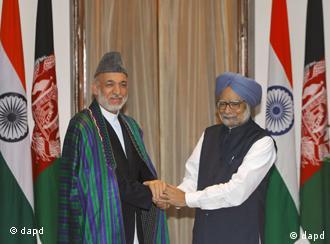 Afghan President Karzai has formally requested New Delhi to provide military equipment to his war-torn country as NATO troops prepare to leave and Kabul's ties with Islamabad deteriorate.
Afghanistan and India are trying to further strengthen their relations before international troops withdraw. The two regional allies hope that the radical Taliban won't come back to power in Afghanistan once the NATO soldiers leave the country in 2014.
"We have a wish list that we have put before the Indian government. It is now up to India how they want to respond to our request," President Karzai told the media in New Delhi at the end of his three-day official tour. "There was no discussion on the deployment of Indian troops in Afghanistan, and there is no need of doing that," he added.
So far, there has been no official comment on Karzai's request from the Indian government.Afghanistan's request for lethal military equipment comes at a time when Kabul's relations with Islamabad are at their worst. Pakistani border guards and Afghan security forces have had several clashes along the Pakistani-Afghan border in recent months.
Karzai has repeatedly accused Islamabad of backing Taliban militants to create unrest in Afghanistan and of using the Islamists as a bargaining chip to demand more influence in the his country. Pakistan refutes these allegations.
Development aid
So far, Indian involvement in Afghanistan has been mostly limited to the training of Afghan security forces. India has provided little military equipment to Afghanistan in the past. India has invested more than two billion US dollars in Afghanistan - the largest amount of external aid given by India to any country. Most of this investment has been done in Afghanistan's infrastructure, including construction of highways and hospitals, and electricity projects for rural areas.
Enhanced military cooperation between India and Afghanistan, as demanded by Karzai, would entail the supply of sophisticated weapons, fighter planes, armored vehicles, heavy artillery, and a range of other equipment.
"We will have to assess the situation carefully before committing to any combative military aid. There is a whole range of issues which must be looked at. At the moment, we can send transport helicopters and trucks to Afghanistan," a senior Indian security official told DW on condition of anonymity.
Regional dynamics
Defense and security analysts say that India's military involvement in Afghanistan would be viewed with distrust by India's regional rival and Afghanistan's neighbor Pakistan, even though Afghan officials have long been insisting that they are short of military equipment.
Indian Air Vice Marshal Kapil Kak, however, says the possibility of exporting "military equipment" to Afghanistan in the future cannot be completely ruled out.
"For sure, it is not going to happen for now. Also, there are important stakeholders in Afghanistan and this will not go down well with them. It could exacerbate the situation. First, we have to see how the incoming government in Pakistan is going to tackle the Afghanistan issue," Kak told DW.
But international diplomacy expert Amitabh Mattoo sees no problem in giving military equipment to the Afghan National Security Forces. "Karzai has, after all, been a dependable Indian ally for over a decade now," Mattoo told DW.
Security expert Hartosh Singh Bal is of the opinion that India will have to wait and see how the situation in Afghanistan unfolds after the withdrawal of NATO troops.
"India and Afghanistan signed a strategic partnership agreement in 2011 that allows India to provide only non-lethal military aid to Afghanistan," Bal said in an interview with DW.
New Delhi, however, is clear about what it wants in Afghanistan. Experts say that India is keen to see peace and political stability in Afghanistan, which it hopes will increase its influence in the country and will also defeat Islamist militancy in the region.
Afghan President Karzai has formally requested New Delhi to provide military equipment to his war-torn country as NATO troops prepare to leave and Kabul's ties with Islamabad deteriorate.
Afghanistan and India are trying to further strengthen their relations before international troops withdraw. The two regional allies hope that the radical Taliban won't come back to power in Afghanistan once the NATO soldiers leave the country in 2014.
"We have a wish list that we have put before the Indian government. It is now up to India how they want to respond to our request," President Karzai told the media in New Delhi at the end of his three-day official tour. "There was no discussion on the deployment of Indian troops in Afghanistan, and there is no need of doing that," he added.
So far, there has been no official comment on Karzai's request from the Indian government.Afghanistan's request for lethal military equipment comes at a time when Kabul's relations with Islamabad are at their worst. Pakistani border guards and Afghan security forces have had several clashes along the Pakistani-Afghan border in recent months.
Karzai has repeatedly accused Islamabad of backing Taliban militants to create unrest in Afghanistan and of using the Islamists as a bargaining chip to demand more influence in the his country. Pakistan refutes these allegations.
Development aid
So far, Indian involvement in Afghanistan has been mostly limited to the training of Afghan security forces. India has provided little military equipment to Afghanistan in the past. India has invested more than two billion US dollars in Afghanistan - the largest amount of external aid given by India to any country. Most of this investment has been done in Afghanistan's infrastructure, including construction of highways and hospitals, and electricity projects for rural areas.
Enhanced military cooperation between India and Afghanistan, as demanded by Karzai, would entail the supply of sophisticated weapons, fighter planes, armored vehicles, heavy artillery, and a range of other equipment.
"We will have to assess the situation carefully before committing to any combative military aid. There is a whole range of issues which must be looked at. At the moment, we can send transport helicopters and trucks to Afghanistan," a senior Indian security official told DW on condition of anonymity.
Regional dynamics
Defense and security analysts say that India's military involvement in Afghanistan would be viewed with distrust by India's regional rival and Afghanistan's neighbor Pakistan, even though Afghan officials have long been insisting that they are short of military equipment.
Indian Air Vice Marshal Kapil Kak, however, says the possibility of exporting "military equipment" to Afghanistan in the future cannot be completely ruled out.
"For sure, it is not going to happen for now. Also, there are important stakeholders in Afghanistan and this will not go down well with them. It could exacerbate the situation. First, we have to see how the incoming government in Pakistan is going to tackle the Afghanistan issue," Kak told DW.
But international diplomacy expert Amitabh Mattoo sees no problem in giving military equipment to the Afghan National Security Forces. "Karzai has, after all, been a dependable Indian ally for over a decade now," Mattoo told DW.
Security expert Hartosh Singh Bal is of the opinion that India will have to wait and see how the situation in Afghanistan unfolds after the withdrawal of NATO troops.
"India and Afghanistan signed a strategic partnership agreement in 2011 that allows India to provide only non-lethal military aid to Afghanistan," Bal said in an interview with DW.
New Delhi, however, is clear about what it wants in Afghanistan. Experts say that India is keen to see peace and political stability in Afghanistan, which it hopes will increase its influence in the country and will also defeat Islamist militancy in the region.
President Zardari first ever president to address the parliament for fifth time

Friday, May 24, 2013
Bahraini protesters clash with police
 Thousands of anti-government protesters have rallied in Bahrain to demonstrate against a raid last week on a top cleric's home.
Shia protesters in the village of Diraz, west of the capital Manama, threw stones at hundreds of riot police who responded with tear gas and water cannons, a witness said on Friday.
The violence continued for more than an hour before the demonstrators dispersed.
The raid by security forces on the home of Ayatollah Sheikh Issa Qassim on May 17 infuriated the Shia opposition and drew condemnation from neighbouring Shia power Iran.
The Gulf Island nation, home to the US Navy's Fifth Fleet, has been at the centre of a series of pro-democracy protests over the past two years and has become a hot spot in a region-wide tussle for influence between Iran and Sunni Arab states such as Saudi Arabia.
The mass protests were crushed but smaller demonstrations continue, led by Bahrain's Shia majority, who want the Gulf Arab state's Sunni rulers to call elections and create a constitutional monarchy.
The raid on the ayatollah's house prompted main opposition group Al-Wefaq to announce on Wednesday that it would withdraw from reconciliation talks with the government for two weeks.
Thousands gathered in the cleric's village on Friday for a peaceful sit-in against their Sunni-led government.
Protesters at the sit-in, called by Al-Wefaq and authorised by the government, waved Bahraini flags and held up images of Sheikh Issa.
Police say the raid on the cleric's home was not targeted but occurred during a security operation in the same neighbourhood.
Thousands of anti-government protesters have rallied in Bahrain to demonstrate against a raid last week on a top cleric's home.
Shia protesters in the village of Diraz, west of the capital Manama, threw stones at hundreds of riot police who responded with tear gas and water cannons, a witness said on Friday.
The violence continued for more than an hour before the demonstrators dispersed.
The raid by security forces on the home of Ayatollah Sheikh Issa Qassim on May 17 infuriated the Shia opposition and drew condemnation from neighbouring Shia power Iran.
The Gulf Island nation, home to the US Navy's Fifth Fleet, has been at the centre of a series of pro-democracy protests over the past two years and has become a hot spot in a region-wide tussle for influence between Iran and Sunni Arab states such as Saudi Arabia.
The mass protests were crushed but smaller demonstrations continue, led by Bahrain's Shia majority, who want the Gulf Arab state's Sunni rulers to call elections and create a constitutional monarchy.
The raid on the ayatollah's house prompted main opposition group Al-Wefaq to announce on Wednesday that it would withdraw from reconciliation talks with the government for two weeks.
Thousands gathered in the cleric's village on Friday for a peaceful sit-in against their Sunni-led government.
Protesters at the sit-in, called by Al-Wefaq and authorised by the government, waved Bahraini flags and held up images of Sheikh Issa.
Police say the raid on the cleric's home was not targeted but occurred during a security operation in the same neighbourhood.
Michelle Obama Gives High School Students Life Advice
The first lady tells graduates that there is more to life than getting good grades.
VIDEO: President Obama Speaks on the U.S. Counterterrorism Strategy
West Wing Week: 05/24/13 or “Justice for Everybody”
PPP’s soul-searching: A hard talk with the party leadership
 Pakistan People’s Party’s first meeting after its defeat in the general elections was an eventful session.
The decision made in the meeting which was held in Lahore appeared to suggest the level of concern within the party over its poor performance.
Senator Aitzaz Ahsan was tasked to head a fact-finding committee to look into the reasons for the party poor performance in Punjab where the PPP won only two seats.
Mr Ahsan, in consultation with the committee members, who are yet to be nominated, will come up with recommendations to reorganise the party.
However, it was the discussion that preceded this decision that was newsworthy.
A heated debate and a frank exchange of ideas took place as the party’s losing candidates from Punjab gave their opinion about the party’s poor performance in the province. While the PPP has retained 29 National Assembly seats in Sindh, it could only manage two from Punjab. In the 2008 elections, PPP candidates from 49 constituencies of Punjab had reached the National Assembly.
Co-chaired by President Asif Ali Zardari and former Prime Minister Yousuf Raza Gilani at the fortified Bilawal House in Lahore, the participants of the meeting spoke frankly.
A former MNA of the party from central Punjab told Dawn that participants criticised former prime ministers Mr Gilani and Raja Pervez Ashraf. They argued that the two former prime ministers only looked after their own constituencies ignoring the rest of the province, and that these two leaders were also responsible for bringing a bad name to the party because of their alleged involvement in corruption cases.
One party loyalist even went so far as to say that “a few in the party filled their pockets through corruption at the cost of the entire party.”
Another factor which was blamed equally for the party’s defeat was the failure on the part of party’s former cabinet members to effectively defend President Zardari in the media, said the former MNA.
The inadequate portrayal of the PPP in the media was also seen as a reason for the party’s thrashing in the Punjab.
However, this does not mean that only the ministers were criticized. Some went further and even questioned the president.
A party loyalist from district Layyah waxed lyrical about the political secretary to the late Benazir Bhutto and praised her for maintaining an effective communication between the party leadership and the workers. He then added that the present lot of aides to the party leaders did the opposite.
He said, “One Nahid Khan kept the party leadership abreast of the on-the- ground developments and let party workers speak to BB every now and then. Now there are a half a dozen women who are supposed to do the same job but there is zero communication between the president and the party workers.”
Nahid Khan and her husband former Senator Safdar Abbasi were sidelined from the party after Ms Bhutto’s assassination in December 2007.
After this ‘hard talk’, President Zardari agreed to the suggestion that Bilawal Bhutto and his two daughters should spend considerable time in Pakistan and reach out to the party workers.
Earlier during the meeting a former lawmaker had pointed out that the complete absence of the Bhuttos from the election campaign.
“If we want to bounce back, we need Bilawal, Bakhtawar and Asifa among us. Video messages are not enough,” said the lawmaker in his concluding remarks. During the election campaign, PPP chairman Bilawal Bhutto addressed election rallies through recorded video messages.
Apart from personalities and their acts, policies were also discussed.
There was a general consensus that the electoral defeat was closely linked to the party’s failure to address the energy crisis in the past five years. Everyone agreed that the PPP could have performed better in the elections in Punjab if the loadhsedding had been contained.
In his remarks, a former federal minister said the party needed to do some soul-searching to understand that voters could no longer be mobilised by slogans alone.
“Yes, there were incidences of rigging; however, the party has to accept the reality that the voters were unhappy with our performance and they expressed their resentment by rejecting us in the polls,” said the former minister.
Indeed, most participants of the meeting agreed that the party now had to improve its image and be seen as a party that could deliver.
This is why most people endorsed the suggestion put forwarded by a young participant who said that the PPP had one last chance to recapture its old glory by delivering in Sindh where it had the numbers to form the government.
He pointed out that with the PTI in Khyber Pakhtunkhwa, the PML-N in Punjab and the PPP in Sindh, the 2018 elections will be contested on the basis of the performance.
If the party was able to govern well in Sindh, it would be in a better position to campaign in 2018.
“The only slogan that will work in 2018 will be good governance and the party which will serve its people well will win elections,” said the young participant.
There was also a suggestion that stalwarts such as Mian Raza Rabbani should be given a say in the reorganisation of the party. A party source told Dawn that it was Raza Rabbani’s idea to hold the meeting in Lahore and listen to the grievances of the party candidates.
Though President Zardari is said to have listened to all the comments and suggestions, it remains to be seen if he will heed them. The choice the party makes in Sindh in the coming days will reveal how much he really heard.
Pakistan People’s Party’s first meeting after its defeat in the general elections was an eventful session.
The decision made in the meeting which was held in Lahore appeared to suggest the level of concern within the party over its poor performance.
Senator Aitzaz Ahsan was tasked to head a fact-finding committee to look into the reasons for the party poor performance in Punjab where the PPP won only two seats.
Mr Ahsan, in consultation with the committee members, who are yet to be nominated, will come up with recommendations to reorganise the party.
However, it was the discussion that preceded this decision that was newsworthy.
A heated debate and a frank exchange of ideas took place as the party’s losing candidates from Punjab gave their opinion about the party’s poor performance in the province. While the PPP has retained 29 National Assembly seats in Sindh, it could only manage two from Punjab. In the 2008 elections, PPP candidates from 49 constituencies of Punjab had reached the National Assembly.
Co-chaired by President Asif Ali Zardari and former Prime Minister Yousuf Raza Gilani at the fortified Bilawal House in Lahore, the participants of the meeting spoke frankly.
A former MNA of the party from central Punjab told Dawn that participants criticised former prime ministers Mr Gilani and Raja Pervez Ashraf. They argued that the two former prime ministers only looked after their own constituencies ignoring the rest of the province, and that these two leaders were also responsible for bringing a bad name to the party because of their alleged involvement in corruption cases.
One party loyalist even went so far as to say that “a few in the party filled their pockets through corruption at the cost of the entire party.”
Another factor which was blamed equally for the party’s defeat was the failure on the part of party’s former cabinet members to effectively defend President Zardari in the media, said the former MNA.
The inadequate portrayal of the PPP in the media was also seen as a reason for the party’s thrashing in the Punjab.
However, this does not mean that only the ministers were criticized. Some went further and even questioned the president.
A party loyalist from district Layyah waxed lyrical about the political secretary to the late Benazir Bhutto and praised her for maintaining an effective communication between the party leadership and the workers. He then added that the present lot of aides to the party leaders did the opposite.
He said, “One Nahid Khan kept the party leadership abreast of the on-the- ground developments and let party workers speak to BB every now and then. Now there are a half a dozen women who are supposed to do the same job but there is zero communication between the president and the party workers.”
Nahid Khan and her husband former Senator Safdar Abbasi were sidelined from the party after Ms Bhutto’s assassination in December 2007.
After this ‘hard talk’, President Zardari agreed to the suggestion that Bilawal Bhutto and his two daughters should spend considerable time in Pakistan and reach out to the party workers.
Earlier during the meeting a former lawmaker had pointed out that the complete absence of the Bhuttos from the election campaign.
“If we want to bounce back, we need Bilawal, Bakhtawar and Asifa among us. Video messages are not enough,” said the lawmaker in his concluding remarks. During the election campaign, PPP chairman Bilawal Bhutto addressed election rallies through recorded video messages.
Apart from personalities and their acts, policies were also discussed.
There was a general consensus that the electoral defeat was closely linked to the party’s failure to address the energy crisis in the past five years. Everyone agreed that the PPP could have performed better in the elections in Punjab if the loadhsedding had been contained.
In his remarks, a former federal minister said the party needed to do some soul-searching to understand that voters could no longer be mobilised by slogans alone.
“Yes, there were incidences of rigging; however, the party has to accept the reality that the voters were unhappy with our performance and they expressed their resentment by rejecting us in the polls,” said the former minister.
Indeed, most participants of the meeting agreed that the party now had to improve its image and be seen as a party that could deliver.
This is why most people endorsed the suggestion put forwarded by a young participant who said that the PPP had one last chance to recapture its old glory by delivering in Sindh where it had the numbers to form the government.
He pointed out that with the PTI in Khyber Pakhtunkhwa, the PML-N in Punjab and the PPP in Sindh, the 2018 elections will be contested on the basis of the performance.
If the party was able to govern well in Sindh, it would be in a better position to campaign in 2018.
“The only slogan that will work in 2018 will be good governance and the party which will serve its people well will win elections,” said the young participant.
There was also a suggestion that stalwarts such as Mian Raza Rabbani should be given a say in the reorganisation of the party. A party source told Dawn that it was Raza Rabbani’s idea to hold the meeting in Lahore and listen to the grievances of the party candidates.
Though President Zardari is said to have listened to all the comments and suggestions, it remains to be seen if he will heed them. The choice the party makes in Sindh in the coming days will reveal how much he really heard.
Sino-Pak ties in realm of trust
After his visit to India, Chinese Premier Li Keqiang on Thursday praised the existing Pak-China relationship terming the friendship between the two 'unmatchable' and that had always withstood the tests of time.
He went on to say that 'our hearts beat together and if there is anything time-tested in this world, it is Pakistan-China friendship.' During his stay in Pakistan, the Chinese leader held a number of meetings with the top leadership of the country that also includes a one-on-one meeting with the prime minister in-waiting Mian Muhammad Nawaz Sharif. The two leaders held in depth discussion on matters of mutual interests. Nawaz sought Chinese cooperation in Civil Nuclear Technology to overcome the acute energy crisis that Pakistan is facing today. China has built two nuclear power plants in this country and is contracted for two more reactors. Thus Pakistan cannot find better helping hand than China especially when the country is facing a bloody fight with armed groups, sluggish economic growth, high inflation, a crumbling currency, the threat of balance of payments crisis and crippling electricity outages. Notwithstanding the worst law and order situation in Pakistan, bilateral trade between the two countries has hit a 12-month figure of $12 billion for the first time last year which recorded an increase of 18 per cent as compared to the previous year, and the two sides are committed to raise this to $15 billion in the next two to three years. Apart from that nearly 10,000 Chinese individuals and more than 120 companies are already working in Pakistan, braving the brunt of local violence. Bilateral economic relations have firmly taken roots. Despite several testing times that the relationship between the two countries remained firm. The strategic importance that China attaches to Pakistan can be gauged from the Chinese leadership thought visit to this country necessary even when it is under interim setup.. No doubt, it is welcome move on the part of China, and Pakistan must grab the opportunity with both hands to cash in on by removing the apprehensions that China had in the past. First, Pakistan should ensure provision of safe trade rout to China-of course, the Gwadar Port already contracted to Chinese is a prime interest that Beijing harbors. Through thick and thin, Pakistan must honour its commitment to this effect with an unshakable resolve, and should also uphold the ideology of China, standing guard against religious invasion. In Pakistan too the Chinese premier's visit to India has created some uneasiness amongst diplomatic circles. China and India are two big economies in the region, having bilateral trade worth billions of dollars; their contacts should not be viewed with suspicions rather Pakistan should support China's vision of maintaining harmonious ties with its neighbours. Apart from meetings with President of Pakistan Asif Ali Zardari and Prime Minister Mir Hazar Khoso, the Chinese Prime Minister Keqiang held talks with Army Chief General Ashfaq Pervez Kayani. The Chinese resolve to deepen strategic ties between China and Pakistan irrespective of the international situation especially emerging from the American pull-out from Afghanistan next year is yet another important step forward in reinforcing the strategic partnership between the two countries. Pakistan is badly exposed to terrorism which is believed to be sponsored by some foreign forces. To a certain extent, the situation emerging from the war on terror has pushed Pakistan to a diplomatic isolation; the strategic collaboration with China at this point in time will help Pakistan fight against militancy with greater success as the two states will have same stance on different international issues. On economic front, the people of Pakistan emulate the success story of China and hope for the same in the country which is only possible if Pakistan develops rock-solid relationship with economic giant like China sitting next door. Pakistan and China have unbreakable ties that should be translated into a joint partnership beneficial for the peoples of the two countries. This visit of Chinese Prime Minister will be crucial in drawing up the economic roadmap for the incoming government in Pakistan. The hallmark is that the visit has rooted the Sino-Pak ties in realm of trust.
Pakistan: Worst power outages as shortfall crosses 7,000MW
The Frontier Post
China, Pakistan issue joint statement, vow to deepen cooperation
 China and Pakistan have agreed to cement their strategic partnership and deepen comprehensive strategic cooperation in various areas, according to a joint statement issued Thursday during Chinese Premier Li Keqiang's visit to the South Asian nation.
The statement said both sides are satisfied with their relationship, which contributed to peace and stability in the region and acquired growing strategic significance under the current complex and volatile regional and international situation.
To cement their partnership, the two countries decided to deepen practical cooperation in all sectors and strengthen coordination and cooperation on international and regional issues.
China reaffirmed that its relationship with Pakistan is always a priority in its foreign policy and appreciates Pakistan's long-term staunch support on issues concerning China's core interests.
Pakistan said it will continue to pursue this time-tested and all-weather friendship with China.
The two sides regard the terrorist East Turkestan Islamic Movement (ETIM) group as a common threat, and stand united in upholding China's sovereignty and territorial integrity, the statement said.
On economic front, the two nations agreed to link China's strategy to develop its western region with Pakistan's domestic economic development, with a view to translate their political partnership into results of pragmatic economic cooperation.
The two sides have also agreed to carry forward free trade negotiations, deepen energy cooperation, and continue the implementation of currency-swap agreement, among others.
To tap the potential of trade, logistics and flow of personnel between the two sides, China and Pakistan have agreed to enhance interconnectivity and jointly develop a long-term plan for China-Pakistan economic corridor.To strengthen maritime cooperation, China and Pakistan agreed to build and develop a joint marine research center to tackle the growing non-traditional threats to maritime security and safeguard international sea routes.
On aviation and aerospace, the two sides welcomed the signing of an agreement on cooperation on the Beidou Satellite Navigation System in Pakistan and vowed to make continuous progress in the remote-sensing satellite system project.
To build strong public support for China-Pakistan ties, the two sides agreed on a series of measures to step up people-to-people exchanges, including expanding Chinese language training in Pakistan, opening more Confucius Institutes in the country, and designating 2015 as China-Pakistan Year of Friendly Exchanges.
On defense and security ties, the two sides agreed to further cooperate on defense technology and production, and continue cooperation to jointly combat the "three evil forces" of extremism, terrorism and separatism. China also expressed its appreciation and continued willingness to help Pakistan build up counter-terrorism capacity.
On international and regional affairs, China and Pakistan agreed that all countries in the Asia-Pacific region should make united efforts to tackle global and regional issues, maintain peace and stability, resolve disputes peacefully and promote regional development.
The two sides called for the establishment of an open, transparent, equal and inclusive security and cooperation framework in the Asia-Pacific region, based on the fundamental principles of international law.
The two nations also said they are committed to strengthening the solidarity and cooperation between developing countries and safeguarding their common interests.
As both sides are concerned about the situation in Afghanistan, they agreed that political reconciliation is a key step toward peace and stability in that country, and affirmed their support for the "Afghan-owned, Afghan-led" peace and reconciliation process.
Li arrived here Wednesday for an official visit to Pakistan, the second leg of his first overseas trip as Chinese premier. He has visited India and will travel to Switzerland and Germany.
China and Pakistan have agreed to cement their strategic partnership and deepen comprehensive strategic cooperation in various areas, according to a joint statement issued Thursday during Chinese Premier Li Keqiang's visit to the South Asian nation.
The statement said both sides are satisfied with their relationship, which contributed to peace and stability in the region and acquired growing strategic significance under the current complex and volatile regional and international situation.
To cement their partnership, the two countries decided to deepen practical cooperation in all sectors and strengthen coordination and cooperation on international and regional issues.
China reaffirmed that its relationship with Pakistan is always a priority in its foreign policy and appreciates Pakistan's long-term staunch support on issues concerning China's core interests.
Pakistan said it will continue to pursue this time-tested and all-weather friendship with China.
The two sides regard the terrorist East Turkestan Islamic Movement (ETIM) group as a common threat, and stand united in upholding China's sovereignty and territorial integrity, the statement said.
On economic front, the two nations agreed to link China's strategy to develop its western region with Pakistan's domestic economic development, with a view to translate their political partnership into results of pragmatic economic cooperation.
The two sides have also agreed to carry forward free trade negotiations, deepen energy cooperation, and continue the implementation of currency-swap agreement, among others.
To tap the potential of trade, logistics and flow of personnel between the two sides, China and Pakistan have agreed to enhance interconnectivity and jointly develop a long-term plan for China-Pakistan economic corridor.To strengthen maritime cooperation, China and Pakistan agreed to build and develop a joint marine research center to tackle the growing non-traditional threats to maritime security and safeguard international sea routes.
On aviation and aerospace, the two sides welcomed the signing of an agreement on cooperation on the Beidou Satellite Navigation System in Pakistan and vowed to make continuous progress in the remote-sensing satellite system project.
To build strong public support for China-Pakistan ties, the two sides agreed on a series of measures to step up people-to-people exchanges, including expanding Chinese language training in Pakistan, opening more Confucius Institutes in the country, and designating 2015 as China-Pakistan Year of Friendly Exchanges.
On defense and security ties, the two sides agreed to further cooperate on defense technology and production, and continue cooperation to jointly combat the "three evil forces" of extremism, terrorism and separatism. China also expressed its appreciation and continued willingness to help Pakistan build up counter-terrorism capacity.
On international and regional affairs, China and Pakistan agreed that all countries in the Asia-Pacific region should make united efforts to tackle global and regional issues, maintain peace and stability, resolve disputes peacefully and promote regional development.
The two sides called for the establishment of an open, transparent, equal and inclusive security and cooperation framework in the Asia-Pacific region, based on the fundamental principles of international law.
The two nations also said they are committed to strengthening the solidarity and cooperation between developing countries and safeguarding their common interests.
As both sides are concerned about the situation in Afghanistan, they agreed that political reconciliation is a key step toward peace and stability in that country, and affirmed their support for the "Afghan-owned, Afghan-led" peace and reconciliation process.
Li arrived here Wednesday for an official visit to Pakistan, the second leg of his first overseas trip as Chinese premier. He has visited India and will travel to Switzerland and Germany.
Pak-China: ‘Unswerving support’ for Pakistan: Li
 Chinese Premier Li Keqiang met with Pakistani military leaders on Thursday as Beijing and Islamabad seek to expand their defense and anti-terror cooperation. Li reaffirmed Beijing's unswerving support for Pakistan to realize stability and improve its development.
Li spoke during a meeting with top Pakistani military leaders, saying "the military is not only an important force in maintaining security and stability in Pakistan, but also a firm supporter of the China-Pakistan friendship".
He urged the international community to help Pakistan overcome its difficulties while respecting its independence, sovereignty and territorial integrity.
Defense and anti-terror cooperation has been one of the areas that underpin China-Pakistan strategic friendship, Wang Dehua, head of Southern and Central Asian Studies Institute of the Shanghai Institute for International Strategic Studies told the Global Times.
The cooperation has gone beyond promoting peace and stability in the region and border areas of the two countries.
"China and Pakistan are also seeking closer links in maritime security, especially that of the Indian Ocean, and other international affairs at the UN," Wang said.
Li also expressed hope that the Pakistani military would continue to do its utmost to safeguard the security of Chinese agencies and staff in Pakistan.
Pakistani President Asif Ali Zardari said earlier at a joint press conference with Li that the two countries believed that "terrorism, separatism and extremism pose serious threats to regional peace, stability and security."
The two sides had reiterated their resolve to continue cooperation in "combating these evil forces", he added.
In a highlight of Li's visit to Pakistan, the two sides on Wednesday signed a series of agreements and memoranda of understanding (MoU).
Chinese Foreign Minister Wang Yi and Pakistan's Foreign Secretary Jalil Abbas Jilani signed the Agreement on Boundary Management System between Xinjiang and Gilgit-Baltistan, a MoU on maritime cooperation and an agreement on border ports and their management system. Representatives and officials from two countries also signed a MoU on building a long-term economic corridor.
Fu Xiaoqiang, a professor on South Asian affairs at the China Institutes of Contemporary International Relations, said the deal means the building of an economic corridor between China and Pakistan would gain momentum.
"There are already very good foundations for such a corridor in the border areas laid by both sides, especially infrastructure, while Pakistani regions bordering China also enjoy relatively good security," he said.
"The creation of the corridor would benefit both sides. This would improve Pakistani economy and boost its trade with China. And China would also diversify its trade links with other countries," Fu noted.
China is Pakistan's second largest trade partner. Bilateral trade last year rose to above $12 billion for the first time and both sides are aiming to reach $15 billion in the next two or three years.
A deal was also inked between China and Pakistan on the use and cooperation of the Beidou navigation system.
China's Beidou, or Compass Navigation System, already started providing public services to Asia-Pacific countries in December last year and is expected to provide global coverage by 2020. China is expected to build a network of stations in Pakistan to improve the location accuracy of the system. The network, which has military applications, currently consists of 16 operational satellites, with 30 more about to join the system and Thailand, Laos and Brunei already use the system.
Wang said the close friendship between Beijing and Islamabad will also help the development of China's relations with the Islamic world.
Pakistan has the second largest Muslim population after Indonesia.
In an address at the Pakistan's Parliament's Upper House Thursday, Li said Pakistan is significant at both regional and international levels, hailing what the role it plays in the Organization of Islamic Cooperation.
Chinese Premier Li Keqiang met with Pakistani military leaders on Thursday as Beijing and Islamabad seek to expand their defense and anti-terror cooperation. Li reaffirmed Beijing's unswerving support for Pakistan to realize stability and improve its development.
Li spoke during a meeting with top Pakistani military leaders, saying "the military is not only an important force in maintaining security and stability in Pakistan, but also a firm supporter of the China-Pakistan friendship".
He urged the international community to help Pakistan overcome its difficulties while respecting its independence, sovereignty and territorial integrity.
Defense and anti-terror cooperation has been one of the areas that underpin China-Pakistan strategic friendship, Wang Dehua, head of Southern and Central Asian Studies Institute of the Shanghai Institute for International Strategic Studies told the Global Times.
The cooperation has gone beyond promoting peace and stability in the region and border areas of the two countries.
"China and Pakistan are also seeking closer links in maritime security, especially that of the Indian Ocean, and other international affairs at the UN," Wang said.
Li also expressed hope that the Pakistani military would continue to do its utmost to safeguard the security of Chinese agencies and staff in Pakistan.
Pakistani President Asif Ali Zardari said earlier at a joint press conference with Li that the two countries believed that "terrorism, separatism and extremism pose serious threats to regional peace, stability and security."
The two sides had reiterated their resolve to continue cooperation in "combating these evil forces", he added.
In a highlight of Li's visit to Pakistan, the two sides on Wednesday signed a series of agreements and memoranda of understanding (MoU).
Chinese Foreign Minister Wang Yi and Pakistan's Foreign Secretary Jalil Abbas Jilani signed the Agreement on Boundary Management System between Xinjiang and Gilgit-Baltistan, a MoU on maritime cooperation and an agreement on border ports and their management system. Representatives and officials from two countries also signed a MoU on building a long-term economic corridor.
Fu Xiaoqiang, a professor on South Asian affairs at the China Institutes of Contemporary International Relations, said the deal means the building of an economic corridor between China and Pakistan would gain momentum.
"There are already very good foundations for such a corridor in the border areas laid by both sides, especially infrastructure, while Pakistani regions bordering China also enjoy relatively good security," he said.
"The creation of the corridor would benefit both sides. This would improve Pakistani economy and boost its trade with China. And China would also diversify its trade links with other countries," Fu noted.
China is Pakistan's second largest trade partner. Bilateral trade last year rose to above $12 billion for the first time and both sides are aiming to reach $15 billion in the next two or three years.
A deal was also inked between China and Pakistan on the use and cooperation of the Beidou navigation system.
China's Beidou, or Compass Navigation System, already started providing public services to Asia-Pacific countries in December last year and is expected to provide global coverage by 2020. China is expected to build a network of stations in Pakistan to improve the location accuracy of the system. The network, which has military applications, currently consists of 16 operational satellites, with 30 more about to join the system and Thailand, Laos and Brunei already use the system.
Wang said the close friendship between Beijing and Islamabad will also help the development of China's relations with the Islamic world.
Pakistan has the second largest Muslim population after Indonesia.
In an address at the Pakistan's Parliament's Upper House Thursday, Li said Pakistan is significant at both regional and international levels, hailing what the role it plays in the Organization of Islamic Cooperation.
Pakistan: Chronic malnutrition: Educate people, respect constitution to overcome malaise
Pakistan’s chronic malnutrition crisis has not improved over the past 40 years, costing the economy an estimated three per cent of GDP per year, making it a graver issue than the energy crisis, whose corresponding figure is two per cent. These views were expressed by World Bank Senior Nutrition Specialist Luc Laviolette at an orientation session on “Nutrition and Human Rights” at a local hotel on Thursday. The session, which was organised by the bank in collaboration with the Development Partners for Nutrition, was aimed at increasing civil society organisations’ understanding and knowledge of nutrition, thereby promoting its awareness as a basic human right. Laviolette said that currently half of Pakistan’s women and children were malnourished, terming the situation worse than in sub-Saharan Africa. He gave a presentation on ‘Malnutrition in Pakistan — A Silent Emergency’ during which some alarming statistics were shared. Comparing the findings of the National Nutrition Survey for 2001-02 and 2011, Laviolette said there had been a significant increase in various indicators. During this period, children’s wasting rate had increased from 12 to 15 per cent, the stunting rate from 31 per cent to 44 per cent, anemia from 51 per cent to 63 per cent and vitamin A deficiency from 13 per cent to 54 per cent. He said over 1.5 million children in Pakistan were currently suffering from acute malnutrition, which made them vulnerable to fatal diseases. All citizens should have access to adequate quantity and quality of food, he added. “Malnutrition makes children prone to acquiring communicable diseases like measles and reduces the effectiveness of certain vaccinations, said Laviolette. If this issue was not overcome, Pakistan risked suffering from a “demographic nightmare” — or an unskilled, economically unproductive population — rather than the “demographic dividend” which has powered its neighbour’s growing prosperity, he said. Save the Children Pakistan Advocacy and Campaigns Senior Manager Arshad Mahmood said that the Constitution under Article 38 recognised the right of access to food, mandating that “the state shall provide the basic necessities of life, namely food, clothing, housing, education and medical relief.” The mandate was not being followed by the authorities, which was a clear violation of human rights, said Mahmood. “More than 350,000 children die before their fifth birthday every year; 35 per cent of these deaths are due to malnutrition,” he added. Mahmood stressed on the need to engage parliamentarians at both the federal and provincial levels to tackle the issue. He called for sustained advocacy to implement the Protection of Breastfeeding law at both levels, and urged all media outlets to increase their coverage of nutrition. He said educating citizens on the differences between a healthy and unhealthy diet was another measure that could be taken to safeguard the country’s future generation from the malaise. Micronutrient Initiative Director Dr Tausif Akhtar Janjua lamented that nutrition was always considered as an extension of the broader category of health, and as a result was never prioritised as an issue.The Express Tribune
Thursday, May 23, 2013
President Obama outlines future of counterterrorism efforts
 By Scott Wilson and Greg Miller
 President Obama outlined the future of his counterterrorism polices Thursday in a wide-ranging speech that sought to more clearly define the American enemy, make lethal government actions more accountable to Congress, and signal that the nation’s long war against al-Qaeda will one day end.
In a lengthy speech at the National Defense University in Washington, Obama called again for Congress to help close the prison camp at Guantanamo Bay, Cuba, an early promise he has yet to fulfill. He announced that he would lift the moratorium on transferring Guantanamo’s Yemeni detainees to their home country, among other steps to help thin out the prison’s population of 166 people, many of them now on a hunger strike.
Obama also outlined for the first time the legal guidelines surrounding the use of armed drones in defined war zones and outside of them. The program, which Obama has expanded significantly since taking office, remains classified, but the president has said that he would be open to working with Congress on establishing an independent court to review future drone targets.
Obama said the country is at a crossroads in its counterterrorism fight: “We must define the nature and scope of this struggle, or else it will define us. We have to be mindful of James Madison’s warning that ‘No nation could preserve its freedom in the midst of continual warfare.’ Neither I, nor any president, can promise the total defeat of terror. We will never erase the evil that lies in the hearts of some human beings, nor stamp out every danger to our open society. What we can do — what we must do — is dismantle networks that pose a direct danger, and make it less likely for new groups to gain a foothold, all while maintaining the freedoms and ideals that we defend.”
As part of his plans, Obama signed a presidential directive that sets guidelines for when a drone strike can be used, including higher standards for setting targets and in protecting against civilian deaths.
The directive states that targets must pose a “continuing and imminent threat” to the United States and that the government must assure Obama that there is a “near certainty” that no civilians will be killed in the strike. Senior administration officials, briefing journalists before the speech, said both standards are higher than those previously used.
The change is likely to slow the already-diminished pace of the drone campaign and reduce, but not eliminate, the CIA’s role.
Obama’s guidance includes a “preference” that the Department of Defense play the lead role in lethal operations overseas. That language suggests a significant change in course for the CIA, which has carried out hundreds of drone strikes in Pakistan and Yemen, killing an estimated 3,000 militants and civilians.
But Obama stopped well short of ending the CIA’s drone program, leaving ample latitude for continued strikes in Pakistan as room for the agency to operate in other countries that allow their territory to be patrolled by U.S. military drones.
A senior administration official said the new policy reflects recognition that the Pentagon is “the appropriate agency to use force outside active war zones,” but alluding to agency operations, said, “That’s not to say the U.S. doesn’t pursue a range of counterterrorism options around the world.”
Officials also alluded to a carve-out that would enable the CIA to continue hitting targets in Pakistan that are not part of al-Qaeda but pose a threat to U.S. troops in Afghanistan, at least until the end of 2014, when most American forces will be gone.
The senior administration official placed the war in Afghanistan in a “different context” from the broader counterterrorism campaign, saying there will still be a “dual need for action against core al-Qaeda and force protection” until the drawdown is complete.
The CIA has had sole responsibility for the drone campaign in Pakistan, mainly because of terms set by the Pakistani government, which has never acknowledged that it allows the strikes.
Obama’s speech Thursday came almost exactly four years after he initially pledged to bring national security policy in the post-Sept. 11, 2001, era closer to what he described as American traditions of human rights, public transparency and the rule of law.
In that National Archives address, Obama declared that the country “went off course” during the George W. Bush administration, resorting to interrogation tactics he has called torture, the indefinite detention of terrorist suspects and the secret surveillance of private citizens.
But his efforts to set the country back on what he believes is a sounder legal course, as he ended the war in Iraq and winds down the one in Afghanistan, have met obstacles.
Obama sought Thursday to review his record and to describe how his counterterrorism policy, and several proposals to change it, responds to a far different security challenge than has faced the country during a dozen years of war.
While the threat of a large-scale attack within the United States has diminished, Obama said, small organizations affiliated with al-Qaeda are flourishing in some of the lawless parts of the Arab world, including in countries undergoing political transitions.
Weakening those groups require different policies, including a reliance more on drones and intelligence rather than a large U.S. military presence.
On Thursday, he called on Congress to help refine the Authorization for Use of Military Force, passed three days after the Sept. 11 attacks, to accommodate the U.S. focus from two large battlefields to many smaller ones.
Obama also spoke about the threat of so-called homegrown terrorism, the most recent incident being the Boston Marathon bombing last month. He pledged to work closely with local law enforcement officials and Muslim communities to reduce the threat.
Although Obama ended the practice of harsh interrogation, he has met significant resistance from Congress in trying to close Guantanamo Bay while expanding where drones can be used and against what targets.
On Wednesday, the Obama administration acknowledged that it has killed four Americans in overseas counterterrorism operations since 2009. It was the first time the administration has publicly taken responsibility for the deaths.
Although the acknowledgment, contained in a letter from Attorney General Eric H. Holder Jr. to Congress, does not say how the four were killed, three are known to have died in CIA drone strikes in Yemen in 2011.
They are Anwar al-Awlaki, an Islamic cleric affiliated with al-Qaeda in the Arabian Peninsula; his 16-year-old son; and Samir Khan. The fourth — Jude Kennan Mohammad, a Florida native indicted in North Carolina in 2009 — was killed in Pakistan, where the CIA has operated a drone campaign against terrorism suspects for nearly a decade.
President Obama outlined the future of his counterterrorism polices Thursday in a wide-ranging speech that sought to more clearly define the American enemy, make lethal government actions more accountable to Congress, and signal that the nation’s long war against al-Qaeda will one day end.
In a lengthy speech at the National Defense University in Washington, Obama called again for Congress to help close the prison camp at Guantanamo Bay, Cuba, an early promise he has yet to fulfill. He announced that he would lift the moratorium on transferring Guantanamo’s Yemeni detainees to their home country, among other steps to help thin out the prison’s population of 166 people, many of them now on a hunger strike.
Obama also outlined for the first time the legal guidelines surrounding the use of armed drones in defined war zones and outside of them. The program, which Obama has expanded significantly since taking office, remains classified, but the president has said that he would be open to working with Congress on establishing an independent court to review future drone targets.
Obama said the country is at a crossroads in its counterterrorism fight: “We must define the nature and scope of this struggle, or else it will define us. We have to be mindful of James Madison’s warning that ‘No nation could preserve its freedom in the midst of continual warfare.’ Neither I, nor any president, can promise the total defeat of terror. We will never erase the evil that lies in the hearts of some human beings, nor stamp out every danger to our open society. What we can do — what we must do — is dismantle networks that pose a direct danger, and make it less likely for new groups to gain a foothold, all while maintaining the freedoms and ideals that we defend.”
As part of his plans, Obama signed a presidential directive that sets guidelines for when a drone strike can be used, including higher standards for setting targets and in protecting against civilian deaths.
The directive states that targets must pose a “continuing and imminent threat” to the United States and that the government must assure Obama that there is a “near certainty” that no civilians will be killed in the strike. Senior administration officials, briefing journalists before the speech, said both standards are higher than those previously used.
The change is likely to slow the already-diminished pace of the drone campaign and reduce, but not eliminate, the CIA’s role.
Obama’s guidance includes a “preference” that the Department of Defense play the lead role in lethal operations overseas. That language suggests a significant change in course for the CIA, which has carried out hundreds of drone strikes in Pakistan and Yemen, killing an estimated 3,000 militants and civilians.
But Obama stopped well short of ending the CIA’s drone program, leaving ample latitude for continued strikes in Pakistan as room for the agency to operate in other countries that allow their territory to be patrolled by U.S. military drones.
A senior administration official said the new policy reflects recognition that the Pentagon is “the appropriate agency to use force outside active war zones,” but alluding to agency operations, said, “That’s not to say the U.S. doesn’t pursue a range of counterterrorism options around the world.”
Officials also alluded to a carve-out that would enable the CIA to continue hitting targets in Pakistan that are not part of al-Qaeda but pose a threat to U.S. troops in Afghanistan, at least until the end of 2014, when most American forces will be gone.
The senior administration official placed the war in Afghanistan in a “different context” from the broader counterterrorism campaign, saying there will still be a “dual need for action against core al-Qaeda and force protection” until the drawdown is complete.
The CIA has had sole responsibility for the drone campaign in Pakistan, mainly because of terms set by the Pakistani government, which has never acknowledged that it allows the strikes.
Obama’s speech Thursday came almost exactly four years after he initially pledged to bring national security policy in the post-Sept. 11, 2001, era closer to what he described as American traditions of human rights, public transparency and the rule of law.
In that National Archives address, Obama declared that the country “went off course” during the George W. Bush administration, resorting to interrogation tactics he has called torture, the indefinite detention of terrorist suspects and the secret surveillance of private citizens.
But his efforts to set the country back on what he believes is a sounder legal course, as he ended the war in Iraq and winds down the one in Afghanistan, have met obstacles.
Obama sought Thursday to review his record and to describe how his counterterrorism policy, and several proposals to change it, responds to a far different security challenge than has faced the country during a dozen years of war.
While the threat of a large-scale attack within the United States has diminished, Obama said, small organizations affiliated with al-Qaeda are flourishing in some of the lawless parts of the Arab world, including in countries undergoing political transitions.
Weakening those groups require different policies, including a reliance more on drones and intelligence rather than a large U.S. military presence.
On Thursday, he called on Congress to help refine the Authorization for Use of Military Force, passed three days after the Sept. 11 attacks, to accommodate the U.S. focus from two large battlefields to many smaller ones.
Obama also spoke about the threat of so-called homegrown terrorism, the most recent incident being the Boston Marathon bombing last month. He pledged to work closely with local law enforcement officials and Muslim communities to reduce the threat.
Although Obama ended the practice of harsh interrogation, he has met significant resistance from Congress in trying to close Guantanamo Bay while expanding where drones can be used and against what targets.
On Wednesday, the Obama administration acknowledged that it has killed four Americans in overseas counterterrorism operations since 2009. It was the first time the administration has publicly taken responsibility for the deaths.
Although the acknowledgment, contained in a letter from Attorney General Eric H. Holder Jr. to Congress, does not say how the four were killed, three are known to have died in CIA drone strikes in Yemen in 2011.
They are Anwar al-Awlaki, an Islamic cleric affiliated with al-Qaeda in the Arabian Peninsula; his 16-year-old son; and Samir Khan. The fourth — Jude Kennan Mohammad, a Florida native indicted in North Carolina in 2009 — was killed in Pakistan, where the CIA has operated a drone campaign against terrorism suspects for nearly a decade.
Prostitutes gunned down in Pakistan's violence-plagued Balochistan province
 Gunmen shot dead five people, including four prostitutes, in Pakistan's troubled Balochistan province Thursday morning, police said.
Elsewhere in the province, a car bomb blast killed 12 people, including six police officers.
Awais Ahmed, the district police officer for the town of Sibi, said four gunmen on two motorcycles opened fire at a brothel in the town.He said four prostitutes and a taxi driver were killed in the attack. Two other women were seriously wounded.
The second incident - the car bomb blast -- took place in the provincial capital of Quetta.
Deputy Inspector General Syed Ahmed Mobeen said the attackers used a remote-controlled device to trigger the bomb when a police vehicle was passing by.
The strength of the blast damaged nearby shops and houses. In addition to the deaths. the explosion wounded 21 others, Mobeen said.
No group immediately claimed responsibility for either incident. But suspicion immediately fell on Baloch insurgents operating in the area.
Militants in Balochistan, a province rich in natural gas, have been fighting Pakistani military forces for self-rule. For years, they have complained that the government has paid little attention to them and their economic needs.
Gunmen shot dead five people, including four prostitutes, in Pakistan's troubled Balochistan province Thursday morning, police said.
Elsewhere in the province, a car bomb blast killed 12 people, including six police officers.
Awais Ahmed, the district police officer for the town of Sibi, said four gunmen on two motorcycles opened fire at a brothel in the town.He said four prostitutes and a taxi driver were killed in the attack. Two other women were seriously wounded.
The second incident - the car bomb blast -- took place in the provincial capital of Quetta.
Deputy Inspector General Syed Ahmed Mobeen said the attackers used a remote-controlled device to trigger the bomb when a police vehicle was passing by.
The strength of the blast damaged nearby shops and houses. In addition to the deaths. the explosion wounded 21 others, Mobeen said.
No group immediately claimed responsibility for either incident. But suspicion immediately fell on Baloch insurgents operating in the area.
Militants in Balochistan, a province rich in natural gas, have been fighting Pakistani military forces for self-rule. For years, they have complained that the government has paid little attention to them and their economic needs.
Aziz Abro of PML-N joins PPP
 Senior PML-N office bearer from Sindh Aziz Abro announced his decision to join rival Pakistan Peoples’ Party (PPP).
He made the announcement at a press conference along with senior PPP leader Agha Siraj Durrani.
Speaking on this occasion, Durrani said that a new local body system would be introduced in Sindh with the support of MQM. “We can hold elections under the current local body system in six months.
But for this, we will have to re-promulgate local body ordinance.” He said that talks were underway with MQM.
To a question, he said that PPP did not sell any Sindh islands. “Zufliqarabad is for the betterment of people of Sindh,” he maintained.
Senior PML-N office bearer from Sindh Aziz Abro announced his decision to join rival Pakistan Peoples’ Party (PPP).
He made the announcement at a press conference along with senior PPP leader Agha Siraj Durrani.
Speaking on this occasion, Durrani said that a new local body system would be introduced in Sindh with the support of MQM. “We can hold elections under the current local body system in six months.
But for this, we will have to re-promulgate local body ordinance.” He said that talks were underway with MQM.
To a question, he said that PPP did not sell any Sindh islands. “Zufliqarabad is for the betterment of people of Sindh,” he maintained.
Who’s Afraid of Twitter? The Absolute Monarch of Saudi Arabia, That’s Who

By Diana SayedThe head of Saudi Arabia’s religious police has said anyone who uses Twitter “has lost this world and his afterlife.” Previously, the government-appointed imam of the Grand Mosque in Mecca denounced Twitter as a “threat to national unity.” You might think that social media are no match for police and petrodollars, but King Abdullah—who’s seen the Internet facilitate democratic uprisings in nearby countries—views Twitter and other platforms as a threat to his power, and with good reason. Saudi Arabia has more Twitter users per capita than any other country in the world. Between 2011 and 2012, the number of Twitter users in the Kingdom grew by 3,000 percent, with users posting an average of 50 million messages monthly, most of them in Arabic. And not coincidentally, the rise of social media has corresponded with an uptick in pro-human rights activism. Protests are largely organized through Twitter, Facebook and WhatsApp, and dissidents use Skype to communicate with foreign human rights organizations and media networks. It’s no wonder that spokesmen for the Saudi Interior Ministry have said that social media is a tool used by militants to stir social unrest. But the government’s assault on internet users is more than rhetorical. Authorities have detained and intimidated hundreds of online activists and commentators, blocked and filtered sensitive political, religious or pornographic content , and recruited online supporters to campaign against calls for protests, according to a Freedom House Report. In March, two leading activists were sentenced to 10 years in prison for a variety of offenses including “internet crimes” because they had used Twitter and other sites to criticize the government. Last year, poet and journalist Hamza Kashgari posted tweets in which he envisioned conversations with Mohammed. Thousands of Saudis, including prominent clerics, called for his death, and after a failed attempt to flee, he was imprisoned for blasphemy. His was the rare case of persecution in Saudi Arabia that attracted international attention, but the spotlight has turned away and he remains behind bars. Once government officials know who is posting what, they are unrelenting in targeting dissidents. On April 10, prominent women’s activist Iman Al-Qahtan, posted on her Twitter feed that she was closing down her account, writing “Oh dear mother I’ll stop just for you, goodbye!” Although her Twitter handle and account remain active, it is reported that Al-Qahtani has been subject to continuous harassment by members of the security forces. They have threatened her to put her jail and to target her family members if she did not stop her activism. Last month the government-sponsored Arab News daily published a cover story condemning what it deemed “abusive” tweets. The article reported that Saudi authorities are discussing a plan to link Twitter accounts with their users’ identification numbers. Analysts say such a move may decrease the number of Twitter accounts by up to 60%. On March 31, the Saudi Communications and Information Technology Commission (CITC) instructed Skype, WhatsApp and Viber to comply with local regulations or risk being shut down. This is just one example of the government violating anti-censorship laws under the guise of monitoring online activity. Last September, CITC announced that, for “national security” reasons, all pre-paid SIM card users must enter a personal identification number when recharging their accounts. Until recently, Saudi authorities have largely resisted sweeping restrictions on internet freedom for fear of igniting a political backlash, but some of their recent moves—particularly the threat to link Twitter accounts to ID numbers—may be doing just that. A few weeks ago one of Saudi Arabia’s most prominent clerics, Salman al-Awdah, who has 2.4 million followers, Tweeted against this policy, saying it might create a “spark of violence.” Prince Alwaleed bin Talal, who owns $300 million worth of Twitter shares, has said that any attempt to block social media platforms is a “losing war.” It’s widely believed that the Saudi monarchy’s grasp on power is unshakable. This would seem to be the view of the U.S. government, which gives this brutal, authoritarian regime unconditional support. But the increase in Twitter-fueled activism is clearly making the rulers nervous.
Subscribe to:
Posts (Atom)