http://timesofindia.indiatimes.comTerming it as "politically motivated", the Interpol has rejected Pakistan's request to issue a Red Corner Notice against former military ruler Pervez Musharraf in connection with Benazir Bhutto's assassination case, days ahead of his homcoming from self-exile. Musharraf has cleared the final hurdle to his plans to return to Pakistan as he no longer faces the possibility of arrest at the hands of Interpol, The Express Tribune quoted its sources as saying. The 69-year-old ex-president, who went into self-exile in early 2009, has said he intends to return to Pakistan on March 24 to lead his party All Pakistan Muslim League in upcoming polls. He has been shuttling between London and Dubai after he went out of Pakistan in exile. Islamabad's request to issue a Red Corner Notice for Musharraf was rejected by the Interpol headquarters in a reply sent to Pakistani authorities, who had sought an arrest warrant for him as a suspect in Bhutto's assassination. The agency said the case filed against Musharraf in Pakistan through Interpol channels constitutes a matter of a predominantly "political character". This is the second time a request from the Federal Investigation Agency has been rejected by Interpol. Last year, Interpol rejected the request due to insufficient proof by Pakistani authorities.
Thursday, March 21, 2013
Interpol rejects Pakistan call to arrest Musharraf
Jalozai Camp blast: Another social worker falls to terrorism
The Express TribuneNamesakes Perween Rahman and Humaira Parveen shared a similar purpose and unfortunately, the same fate. While Orangi Pilot Project Director Perween Rahman was shot dead in a targeted attack in Karachi last week, Humaira Parveen, a social worker from Peshawar, died in a car-bomb explosion in Jalozai Camp, which claimed at least 17 lives and injured another 28 on Thursday. Humaira, a health worker, would educate people on hygiene matters. Both women, determined to change society, eventually died while doing what they believed in. Colleagues said in her death the local aid organisation BEST NGO has lost a guide. “We considered her a sister to all staff members because she was older than all of us,” said an employee, requesting anonymity. “We consulted her when any of us had a problem in the office or in the field. She was our guide when we needed her most and would tell us we need to use our education and skills to bring betterment in society.” Humaira, 32, belonged to Tehkal village and had joined the NGO, around six months ago, as a hygiene promoter. Her job was to encourage internally displaced persons (IDPs) in Jalozai Camp to adopt habits that would keep them safe from waterborne diseases. Five women of the organisation were injured in the blast. While Humaira died at the Lady Reading Hospital, the others are said to be in stable condition. “We will always miss her leadership skills and commitment to bring change,” said BEST NGO Managing Director Hamesh Khan. “It will be a long time before someone can take her place.” Speaking about whether the NGO will continue its work, Khan said it depends on the directives of the Provincial Disaster Management Authority whether social work will be suspended. He added Huamira was paid a monthly salary for the project and the organisation cannot provide financial aid for her children. The provincial government should announce monetary compensation for her family, stated Khan. In a statement issued by the Khyber-Pakhtunkhwa Civil Society Network, Coordinator Idrees Kamal said: “We strongly condemn the bomb blast in Jalozai Camp and demand security provisions for aid workers. We pay tribute to NGO workers who, despite threats, have continued their struggle to help the needy.”
Malala : Back to school
EDITORIAL : Daily TimesFor child activist Malala Yousafzai, Wednesday was a big day. After fighting a long, hard battle of recovery, the 15-year-old has attended school for the first time since the tragic shooting that left her critically wounded last year. Joining a school in Birmingham, UK, little Malala is back on her feet and a sure symbol for other girl children the world over that if a cause is worth being threatened and hurt for, then it is a cause worth pursuing. What bigger cause than to promote education in Pakistan, a country rife with war — a war that is being waged on the nation’s daughters who want nothing more than to go to school so that they make better lives for themselves? It is here that Malala Yousafzai was shot in the head by militants in Swat for the crime of going to school and speaking out for girls’ education in the country. Her shooting jolted the nation out of its stupor and brought to light the real barbarity of the Taliban; anyone who can hurt a child is no less than a monster. Malala was flown to the UK for her recovery and, after months spent on a hospital bed, she has recuperated and has once again stepped foot in a school — her dream is coming true. However, Pakistan is full of Malalas: brave young girls defying the Taliban to receive an education. They have been issued threats and their schools have been blown to smithereens in the northern areas. How will they go to school? Where is their shot at a better life? The Taliban have left them with hardly any option other than to stay at home or study underground. Now that we will be seeing the arrival of an interim government until May, one wonders how the temporary set-up will look at this unaddressed issue. Chances are it will not, and the issue of female education will remain in the air for a while even with the post-elections government. However, there will be continuity in the security establishment and it is hoped that the security forces will be able to deal with this issue by preventing more schools from being blown up and more school girls from being shot. Any hiatus given to the Taliban to regroup and strengthen themselves will only allow them to expand their havoc and cause further mayhem. Malala did not take a bullet for that.
Interview:Abduction Of Two Czech Women In Pakistan
Pakistan:Energy crisis: solutions
 The five years of the PPP-led coalition government are marked by severe criticism due to its failure to resolve the energy crisis during its tenure.
There is a general agreement that the crisis was inherited by the elected government with the Musharraf-appointed caretakers engaged in three disastrous policies: (i) extending crippling subsidies to ensure that the rise in the international oil price was not passed on to the consumers with its consequent negative impact on the budget deficit and the country's financial resources; (ii) supporting inefficiently-run distribution companies by paying hundreds of billions of rupees to eliminate the inter-tariff differential though analysts are agreed that a political government cannot afford to provide electricity at different rates at different locations; and (iii) not implementing identified reforms inclusive of eliminating the inter-circular debt, reducing transmission losses as well as bringing the tariff to the level of full cost recovery.
The five years of PPP rule indicate a focus on increasing tariffs as the main means to deal with the crisis while the other reforms remained unimplemented in spite of the government's commitment to the International Monetary Fund (IMF) to implement them within a two-year period. In effect, the Water and Power Ministry increased tariffs by 100 percent in five years and the duration of loadshedding doubled - from four hours in urban and 8 hours in rural in 2008 to 8 hours in urban areas and 16 hours in rural areas. Thus data suggests that the government efforts towards demand as well as supply management remained ineffective. In this context, it is also relevant to note that the federal government actively promoted a policy of expanding the energy network with a major energy shortfall resulting in compounding the demand-supply gap.
In addition, due to failure to implement tax reforms that would have rendered the tax structure equitable and less anomalous; the government also relied on taxing the fuel and energy sector to generate funding for its ever increasing expenditure given that this was a relatively easier way to collect revenue. Thus the fuel and power sector were not only inefficiently run with large-scale leakages from the system but also were a key source of revenue for the government that simply raised tariffs without any focus on increasing the performance of the sector. This disastrous policy led to the government's failure to meet the energy demand of the economy's largest export earner - the textile sector. In short, the government, by relying on the energy sector as a major source of revenue, was unable to generate revenue from higher economic activity which is the major revenue source in other countries.
President Asif Ali Zardari has stated that the onus for the electricity crisis rests with the provinces given that Article 157 (2) (c and d) of 18th Constitutional Amendment empowers a province to "construct power houses and grid stations and lay transmission lines for use within the provinces and determine the tariff for distribution of electricity within the province". The provincial response has been that it lacks resources to engage in constructing large dams but this explanation does not absolve them from their own failing to use indigenous resources like Thar coal to generate electricity. Punjab has consistently maintained that any attempt to establish power houses have been stonewalled by the federal law ministry and refers to Nandipur and Chichon ki Malian with a combined capacity of 900 MW as examples. The question, however, is if the provinces can determine their own distribution tariffs then why does the federal government feel the need to release over 400 billion rupees per annum for inter-disco tariff differential? In short, there are many issues that need to be worked out in terms of federal and provincial roles in the energy sector notwithstanding the 18th Amendment.
The power sector as it stands today is inefficiently run with no effort being made to ensure that the obsolete plants are being run at operational capacity. Rehabilitation projects are under way and the USAID has brought a few plants to their full operational capacity but a lot more needs to be done. A short-term policy focus therefore must be on eliminating inter-circular debt which would necessitate disconnection of electricity to all those who fail to clear their bills, and cutting the unpaid dues of government entities at source to ensure bill payment, and finally to repair transmission lines and obsolete plants to ensure that the system is at operational capacity.
However, there is also a need to begin implementing new energy projects. Pakistan today has a gas deficit of around 3 mmcf and neither the Iran-Pakistan gas pipeline which is expected to generate around 0.75 mmcf nor Turkmenistan-Afghanistan-Pakistan-India pipeline with 1.5 mmcf can hope to meet our energy requirements. Pakistan needs to develop Thar coal fields as well as explore for new gas fields and begin construction of run of the water dams and large dams. Finances to undertake these mega projects remain a challenge; however, we must reprioritise expenditure, implement reforms and last but not least, support inter-provincial as well as federal harmony to resolve the crisis once and for all.
Pakistani Refugee Camp Hit by Deadly Car Bomb
Pakistan: ''Political hiccups notwithstanding''
The Frontier PostFinally, President Asif Ali Zardari has on Wednesday announced that the general elections to the National Assembly will be held on May 11. The President signed the summary sent by the Prime Minister to this effect immediately it was received in the Presidency, putting an end to political uncertainty prevailing upon the federal capital. Amidst the eye-souring violence and lingering threats of heart-breaking terrorist strikes especially in Karachi, Quetta and KPK, the announcement of the election date and subsequent announcement of the election schedule will induce new impetus to the electioneering in the country. According to the ECP spokesman, the submission of nomination papers will begin on March 25 which will be completed on 30th. Scrutiny of papers shall start from 31st and will continue for 7 days. Candidates may withdraw their nomination papers by April 18 while the final list of the contesting candidates will be published the following day. Earlier on Tuesday, the Election Commission allotted 'lion' as the election symbol to the PML-N, however, allotment of election symbol to the PPP of the President Asif Ali Zardari was deferred owing to a controversy that surfaced when an estranged party leader Naheed Khan, who served as political secretary to slain PPP leader Benazir Bhutto until her assassination in 2007, claimed that she should be allotted the symbol as she is real leader of the PPP. The decision is pending with the ECP. Otherwise, it was smooth sailing; the Jamiat Ulema-e-Islam was allotted the symbol of 'book' while Awami National Party was given 'lantern', MQM got the symbol of 'kite' and the fast emerging popular party of cricketer-turned politician, Imran Khan had been allotted 'bat'. On the other hand, on the first day the meeting of the eight-member parliamentary committee formed to break political impasse on the appointment of caretaker prime minister was too adjourned without any success-giving rise to the Opposition's accusation that the rulers are bent on give-and-take rather than paving way for impartial caretaker setup. Blame for the delay does not lie squarely on the rulers; the Opposition as well cannot be absolved of the responsibility. The Opposition too seems to take the issue to the Election Commission of Pakistan for its own 'reasons.' Whatever! The Constitutional mechanism on this matter is going to take its course-- it is just a matter of time; the deadlock over the appointment of the caretaker PM is notwithstanding. Another good omen is; the dissolution of the Punjab Assembly has completed the first phase of the political process, withering another hiccup in holding fresh elections on the same date. Indeed, the stage is all set for the elections which will be monitored by a large number of international and local observers who had already approached the Election Commission of Pakistan which issued a Code of Conduct for the observers, prohibiting any interference in the election process. The history, witnessed never before, is in the making; notwithstanding the political hiccups or differences erupting amongst the political forces out there in the election field. The nation too must grab the opportunity with both hands to elect their true representatives.
President Zardari stresses need for strengthening regional security
Radio PakistanPresident Asif Ali Zardari has stressed the need for strengthening security and counter-terrorism cooperation in the region. Addressing 4th Nowruz conference in Ashgabat on Thursday‚ he said all regional countries will have to unite and make collective efforts to bring peace to the region. The president said Pakistan firmly believes that peace and stability are vital for economic progress and development of the region. Pakistan is working to further improve its relations and expand cooperation with the regional countries. He said the region has vast natural resources and Pakistan can provide a corridor as transit for their export to the other countries. The main objective of the ECO to which Pakistan and Central Asian Republics are members‚ is to build infrastructure and connectivity projects in the region. He said Pakistan is willing to facilitate transportation of LNG from Central Asia to South East Asia and other world markets. The latest and modern seaport of Pakistan at Gwadar is the shortest route for Central Asian States to the Arabian Sea. It also offers excellent port facilities for export of LNG and other products. President Zardari said Pakistan is also ready to provide safe transit of piped gas to other neighboring countries. We are keen to implement the projects of energy connectivity like Turkmenistan-Afghanistan-Pakistan-India and Iran-Pakistan gas pipelines. President Asif Ali Zardari and his Iranian counterpart Dr Mahmood Ahmadinejad had a meeting at Ashgabat. They exchanged views on strengthening of bilateral relations especially in economic field.
Wednesday, March 20, 2013
Afghanistan, NATO agree on troops leaving key province
 Afghanistan and NATO-led forces have reached a deal on foreign troops leaving a key strategic district near Kabul, coalition forces said, but a controversial expulsion order against U.S. special forces from the entire province remained unclear.
An Afghan defense ministry spokesman told reporters in Kabul that the elite American force would quit the whole province of Wardak within a few days, despite U.S. concerns that their departure would leave a security vacuum.
The NATO-led International Security Assistance Force (ISAF), however, said that Afghan forces would only take over from foreign troops in the small restive district of Nerkh, and that "the remainder of the province will transition in time".
Afghan officials have expressed fears that insurgents might use Wardak, just a 40-minute drive from Kabul, as a launch pad for attacks on the capital.
Afghan President Hamid Karzai expelled the elite American force from Wardak and Logar provinces last month, after villagers accused them of torturing and killing civilians, an allegation the U.S. special forces denied.
Despite the deadline for their departure expiring over a week ago, U.S. special forces tasked with fighting the Taliban are still operating there, U.S. and Afghan officials say.
Their continued deployment has angered Karzai, who has become increasingly critical of his Western allies operating in the country ahead of the departure of most foreign combat troops by the end of next year.
Karzai and NATO commander Joseph Dunford reached an agreement on Wardak on Wednesday, the two sides said, although the extent of the foreign troop withdrawal and the timeframe was vague.
ISAF said in a statement that under the agreement, Afghan forces would soon take over security from foreign forces in Nerkh, a known hiding place for Taliban and Hezb-i-Islami militants. The district comprises about 10 percent of Wardak, and borders Kabul and Logar provinces.
The statement made no mention of U.S. special forces.
"I am pleased to announce that following a very constructive series of talks with the president ... we have come to agreement on a plan for Wardak that continues the transition of this critical province and meets the security needs of the people and the requirements of our mission," Dunford said.
"This solution is what success looks like as we continue the transition to overall Afghan security lead."
ISAF said the Afghan government would determine the timeline for the takeover.
The Wardak issue, along a series of inflammatory remarks by Karzai deriding the United States and other foreign forces, has strained already fraught ties between the president and Western allies.
Opposition politicians say Karzai's order to expel the U.S. special forces was a political move intended to bolster his party's support base ahead of a presidential election next year. Karzai is not allowed to stand again.
Some in Wardak however are furious U.S. special forces are still operating in the province, and about 1,000 residents converged on the capital on Saturday demanding they leave.
U.S. special forces are expected to play a major role in Afghanistan after most NATO combat troops withdraw by the end of next year, and Karzai's decision to expel them was seen as complicating talks between the United States and Afghanistan over the scope of U.S. operations after the pull-out.
Imran accuses Sharif brothers of hurdles in Pindi
Accusing Sharif brothers of misusing Punjab Police to shut Pakistan Tehreek-i-Insaaf’s (PTI) polling stations in Rawalpindi, PTI Chairman Imran Khan said that the Pakistan Muslim League – Nawaz (PML-N) was threatened by his party as it was promoting true democracy.
He made these remarks while addressing the media in Islamabad on Tuesday.
He added that the Punjab Police could not be blamed alone for the closure as they were just following orders.
Pakistan’s Blasphemy Laws Continue to be Toxic
 Last week, a Pakistani Christian, Sawan Masih, was accused of blaspheming the Prophet Muhammad. The following days,a Muslim crowd of several thousand, gathered in mobs and attacked a Christian neighborhood in Lahore, setting fire to over 150 houses, 18 shops, and two churches. This case of blasphemy is, tragically, representativeand follows a clear and well-established pattern.
As is often the case, allegations of blasphemy cause outbreaks of violence; it has become commonplace for mobs to take the law into their own hands. Following blasphemy allegations, angry crowds descend on towns and burn places of worship and homes, injuring residents.
Secondly, blasphemy laws in Pakistan are known to be used as a weapon to settle private disputes. Accusations of blasphemy are often the by-product of disputes between neighbors, colleagues, political opponents, religious and academic leaders, and business associates whose dealings have become adversarial. In this case, the police believe the blasphemy allegations stemmed from a private dispute between Masih and another man, Shahid Imran. Given the severity of the punishment provided under Pakistan’s penal code, the ease with which one may initiate a proceeding raises serious concerns of due process and the right to a fair trial.
Finally, this case underscores how the Christian minority in Pakistan is frequently targeted. As soon as a member of the Christian community is accused of blasphemy, it has become the norm for the whole community to flee the neighborhood out of fear of a backlash. That’s because the laws perpetuate prejudice and promote religious intolerance.
And yet, despite the pattern, something this time was different.
During this round of violence, the Pakistanis have been more vocal than usual. Authorities sent signals to Pakistanis that they cannot resort to violence and riot against a religious minority, in the name of the blasphemy law. Pakistan’s President Asif Ali Zardari and Prime Minister Raja Pervez Ashraf ordered an immediate inquiry into the attack and an investigation into the violence. The police arrested about 150 people accused of burning dozens of homes of Christians. The provincial law minister Rana Sanullah said that the government would not spare those involved in the attack.
Most importantly, it is promising that Christian groups are starting to speak out, in refusal to be intimidated by the mobs. Members of the Christian community publicly protested and called on the government to help rebuild destroyed houses. It’s courageous to rally this way when their lives are threatened.
Their demands must be addressed if the government wants to act beyond its condemnations.
Pakistan: Religious Intolerance Mounts with Christian Home Burnings
http://blog.heritage.orgMore than 3,000 Muslims stormed a Christian enclave in the city of Lahore, Pakistan, and proceeded to burn down an estimated 100 to 160 homes, marking a peak in violence toward religious groups. The Muslim group was looking for a 28-year-old Christian man who is accused of blaspheming the Islamic prophet Mohammed, a criminal offense under Pakistani blasphemy laws. This latest bout of violence may not lead Pakistan to reconsider its blasphemy laws, but it will certainly draw the international community’s attention to religious persecution in the region. In Pakistan, blasphemy can result in the death penalty or several years in prison. Blasphemous acts include desecrating a place of worship, burning pages of the Quran, and defaming the Islamic prophet Mohammed. Pakistan’s blasphemy law is leveled only at those blaspheming Islam, and does not provide protection for any other religious group. An estimated 1,274 people have been accused of violating the blasphemy laws. At present, there are an estimated 16 Pakistanis on death row and another 20 individuals serving life imprisonment for blasphemy against Islam. Thirteen percent of the accused were Christian, 50 percent were Muslim, and the remaining comprise other minority religious groups. The alleged precise statements of the Christian man in this latest incident are largely unknown. Some observers say that a Muslim man made the accusations of blasphemy against the Christian man in order to seek revenge the morning after the two men had been involved in a drunken brawl. After the police arrested the accused, many Christians fled the region fearing persecution for his alleged statements. The minority Christian community had reason to fear backlash. Vigilantism is not uncommon in Pakistan, where rioters often take matters into their own hands to settle personal disputes. And just last year, a 14-year-old mentally challenged Christian Pakistani girl was put on trial for burning pages of the Quran. While the charges were ultimately dropped, the trial was representative of Pakistan’s repressive political culture on matters of religion. Pakistani President Asif Ali Zardari and other senior officials have ordered an investigation into this latest string of events. The Pakistani government has pledged the equivalent of $2,000 in assistance for each family affected. While a few of the Muslim rioters are now in custody, charges are unlikely to be levied. The fate of the Christian man in custody is still unknown. Two years ago, Pakistan’s Punjab Governor Salman Taseer and Minority Affairs Minister Shahbaz Bhatti were assassinated by religious extremists because of their efforts to roll back the controversial blasphemy laws. The current Pakistani Ambassador to the U.S., Sherry Rehman, has also been under threat from extremists due to her support for re-examining the legislation and removing the death penalty as punishment. In January the Supreme Court of Pakistan approved admission of a blasphemy case against Ambassador Rehman for remarks she made on a television program in November 2010. The latest rampage against the Christian community in Pakistan is significant, says Heritage’s Lisa Curtis:
This is yet another example of the growing influence of extremist ideologies that are endangering minority communities and jeopardizing democracy, and will ultimately, if left unchallenged, turn Pakistan into a failed state. Pakistan’s founding father, Muhammed Ali Jinnah, supported the idea of Islam serving as a unifying force in Pakistan and envisioned the country functioning as a multiethnic, multi-religious democracy. Unless and until Pakistan’s leaders recommit to these ideals that helped form Pakistan as a nation state, the country will become engulfed in escalating lawlessness and sectarianism. It is time for Pakistan to draw the line on extremism and protect its minority populations by amending the blasphemy legislation.
Will Balochistan Vote in Pakistan's Next Elections?
 In a televised address to the nation on Sunday, Pakistan's outgoing Prime Minister Raja Pervez Ashraf congratulated his fellow citizens for the "historic" completion of five years of uninterrupted democracy. While the Pakistanis know that they will be voting in mid-May to elect a new government, they were still undecided who would head the caretaker administration for the next 90 days at the time of the prime minister's speech.
According to Pakistan's constitution, which was written in 1973 and amended 20 times since then, leaders from the government and the opposition should reach a consensus to form an acceptable neutral interim government ahead of the next elections. The failure of the government and the opposition to agree upon one caretaker prime minister reflects the broader problems of Pakistan's fledgling democracy.
While the outgoing members of the parliament posed for a historic group photograph in Islamabad, authorities in the country's largest province of Balochistan continued to debate among themselves whether or not they would even be able to hold peaceful elections. On March 12, 2013, armed activists of the Baloch Liberation Army (BLA), a sub-nationalist separatist group, gunned down Muhammad Ziaullah Qasimi, the District Commissioner of the Election Commission of Pakistan (ECP) in Quetta, Balochistan's capital. The BLA was not apologetic and unambiguous about the assault.
"We will not let Pakistan hold elections in Balochistan," warned the BLA's spokesperson.
The Express Tribune reported on February 9, 2013 that two more armed Baloch groups, the Baloch Liberation Front (BLF) and the Baloch Republican Army (BRA) had also threatened to disrupt the elections.
Sardar Akhtar Mengal, president of the Balochistan National Party (BNP), told BBC Urdu that discontent among the Baloch was caused by unabated illegal arrest, torture and murder of the political leaders for which Pakistan's security forces are blamed. If these extra-judicial killings do not stop, he warned, elections would be too difficult to hold.
Pakistan currently faces extraordinary challenges of law and order. The chilling wave of violence employed by the Taliban, sectarian groups, ethnic nationalists, armed wings of political parties and death squads believed to be linked with the Pakistani secret services are coercing various political parties to limit their election campaigns to avoid deadly assaults.
The March 12 assassination of the prominent election officer, for instance, has compelled politicians to reconsider their campaign strategies. Political parties fear deadly attacks on their election rallies, candidates and voters. This year's security threats are alarming across Pakistan, particularly in volatile Balochistan, which remains the focus of political observers' interest.
Balochistan, Pakistan's poorest of four provinces, has remained the center of an ethnic nationalist insurgency against the central government for nearly one decade. Balochistan's ethnic majority, the Balochs, who constitute only 5 percent of the country's total population, complain against discrimination by the federal government dominated by the ethnic Punjabis.
According to Asma Jhangir, a former president of Pakistan's Supreme Court Bar Association, the Baloch people believe the 2008 elections meant nothing for them because the Pakistani military and intelligence agencies, not the civilian government, control their province. The Balochs do not benefit from their own mineral wealth, such as gas, gold and copper, nor are they provided any representation in the country's civil, armed and foreign services. Groups like the BLA, insist that Pakistan engineers what they describe as "shame elections" in order to divert attention from the actual Baloch demand for statehood.
In 2008, major political parties in Balochistan boycotted the general elections because they opposed General Pervez Musharraf, a military dictator, as Pakistan's president. Hence, the boycotted elections brought into power one such underrepresented, unpopular and corrupt government in Balochistan that even the ruling Pakistan People's Party (PPP) in the center was forced to dismiss it on January 14, 2013 although the PPP also headed the Balochistan government.
Sections of the Pakistani ruling establishment are believed to be covertly communicating with enraged but moderate Baloch nationalist parties in order to persuade them to end their isolation and participate in the next general elections. Moderate nationalists are those who seek maximum internal autonomy for Balochistan while remaining a part of Pakistan.
If the Baloch nationalist parties participate in the elections, they can at least assist Islamabad with a process of reconciliation with some sections of the Baloch nationalists. However, the likelihood of peaceful elections is in jeopardy considering the prevalence of widespread violence across Balochistan.
The central government in Islamabad has done too little to build the Baloch confidence. Secret services, which have been blamed for colluding with extremist Sunni groups to kill Shias Muslims and sponsoring underground death squads to eliminate Baloch political activists, have not abandoned their counterproductive tactics which have significantly undermined democracy in Pakistan.
Pakistan should recover all the disappeared political activists and punish civil and military officers responsible for widespread human rights abuses in Balochistan in order to encourage the nationalists to participate in the elections. In addition, the government has to establish peace to the extent that all political parties and their voters feel safe enough to participate in the elections. If the elections fail again to improve the relations between Pakistan and its largest province, Islamabad should prepare for more internal instability and chaos in the future.
Pakistan to hold nationwide elections May 11
Associated PressPakistan will hold nationwide parliamentary elections on May 11, said a presidential spokesman on Wednesday. The vote is expected to produce the country's first transition from one civilian government to another. The president approved a proposal finalizing the May date for the upcoming election, said Farhatullah Babar. The Pakistani parliament completed its term Saturday, making it the first democratically chosen body to finish a full five-year term in a country that has seen three military coups and persistent political turmoil since its 1947 independence from Britain. The ruling Pakistan People's Party has been dogged by rumors that it would be deposed or forced to call early elections ever since it assumed office in March 2008. Its five-year term in office has been marked by near-constant political crises and a rocky relationship with the country's powerful military. But President Asif Ali Zardari has shown a remarkable ability to hold together a warring coalition government whose members threaten to quit every few months or so. Zardari is the widow of Benazir Bhutto, the iconic PPP leader who returned from exile in 2007 only to be killed later that year during a campaign rally. Zardari has managed a balance between the need for U.S. assistance amid a deteriorating relationship between the two countries and rising anti-American sentiment. Washington needs Pakistan's help fighting al-Qaida and stabilizing neighboring Afghanistan, but a series of recent scandals have severely damaged ties. CIA contractor Raymond Davis shot and killed two Pakistani men in Lahore in early 2011, the U.S. unilaterally killed Osama bin Laden in the city of Abbottabad later that year and American forces accidentally killed 24 Pakistani troops along the Afghan border in 2012. The Zardari-led coalition government has had some success fighting Islamist militants along several fronts in Pakistan's northwest but it has been under tremendous pressure domestically due to rising inflation, a faltering economy and an acute energy crises. Now that the parliament and government are dissolved, a caretaker government will run the country and oversee elections. But so far the ruling PPP and the main opposition party headed by Nawaz Sharif, who served as prime minister twice, have failed to come up with a consensus candidate for prime minister. An eight-member committee consisting of equal members from both parties is meeting Wednesday to come up with a candidate they each agree on. If the committee fails, the responsibility will then fall to the Pakistan Election Commission. The caretaker government is designed to ensure impartiality in the upcoming vote.
Obama heads to Jerusalem after warm speech at airport ceremony
Obama has been welcomed to Israel on his first visit as president. Netanyahu thanked him in the name of all Israelis for his steadfast support of the Jewish homeland. The president tried some Hebrew, and had some advice from Michelle for Yair Lapid. Now he’s heading to the capital.
Tuesday, March 19, 2013
Military intervention and Egypt’s future

Dr H.A. HellyerThe military may be coming – and it seems like everyone knows and is waiting for it, except the Muslim Brotherhood. The irony is: they are the ones who have the most to lose. A new intervention into governance by the Egyptian armed forces is something that many in the political, social and economic elite are clamouring for. They’re not all on the same page in that regard, and people ought to be honest about that. Some people just have it in for the MB, and always would have had – regardless of whether or not the MB had been successful in taking Egypt forward along the transition towards a second republic. There are others who (and let us also be equally frank in this regard) prefer a military intervention, because it removes the MB from the political playing field, thus giving them a political advantage they might not already have. Politics is hard work – and many are tempted to do away with that hard work in favour of a military intervention that would remove their adversaries. There are, however, those who are not necessarily calling for such an intervention – but are nonetheless expecting it to happen. They see the pound fall in value against the dollar; they see the supply of wheat becoming more problematic; the supply of petrol and diesel diminishing; food prices potentially rising; and looming power cuts as the summer draws closer, putting pressure on the country’s electrical infrastructure. In other words: a state akin to a slow moving train-wreck. With security becoming more and more of an issue, the propensity for that train to suddenly speed into overdrive is not beyond the realm of possibility. If the economic troubles of Egypt then turn into real threats to public order, with riots and the like, the state’s security services are not likely to be able to keep a lid on it – and at that point, the military may feel obliged to intervene. People ought not to be so idealistic about what this scenario could look like. The military’s conduct over the eighteen months it directly governed Egypt is a model for how not to conduct a transitional process. Indeed, much, if not most, of the problems that currently face Egypt are down to the military’s mismanagement of that period. While General Al-Sisi is, by all accounts, an extremely smart individual, it remains to be seen whether or not he would be able to conduct an intervention that would leave the country better off than before. Nor, it should be stated, does the military want to intervene. It doesn’t. The military’s standing in the country at the end of the governing period was extraordinarily good (all things considered) – but it was still markedly less than in the months after the downfall of Hosni Mubarak. The military does not want to be in that position again. Indeed, who would want to be responsible for such a mammoth task? However, if public disorder does go beyond a certain point, it is hard to see the military simply staying on the side-lines. It would then have to deal with certain challenges. The first is the threat to the democratic and pluralistic quotient of Egyptian politics. No matter how you slice it, an independent move by the Egyptian military means that the military continues to be above civilian control – and an intervention would almost definitely be against the elected government’s wishes. Ethically and morally, that is not a particularly good way to begin a transition. Having said that, very few people are likely to care. The military’s position in the country, and in public opinion, is the envy of any political force anywhere. If it was to construct a decent enough cover story, the intervention could be packaged as ‘supporting democracy’ – and enough people outside and inside of Egypt would be more than willing to go along with it. The second challenge would be how to reintroduce economic stability – a task that would require the military to deal directly with ‘consensus politics’. They would need to build a consensus on economic issues with the prime political forces in the country, which command the loyalty of the expertise of the country. Would those forces work with them? Potentially, probably – there would be some whose principles would keep them back from engaging with a military junta, but that might actually encourage the military to create a proper road map that ensured reform and restructuring during the interim, and an exit strategy within a certain time period. That would bring the military to the third challenge: a political road map that actually works. In an ideal situation, that would bring together the main presidential candidates that would be partial to such an arrangement – excluding Ahmad Shafiq. That would necessitate the involvement of Amr Moussa, to bring on board forces allied to the former regime without actually getting a hardcore ‘felool’ candidate. Mohamed ElBaradei, who has little if any grassroots support, would be important for international recognition, and international recognition of a civilian body would be necessary for macroeconomic assistance. Hamdeen Sabahi and Abdel Moneim Aboul Fotouh, if they consented to being involved, would be critical to ensuring the political road map had a civilian face that was genuinely bought into on the ground. Ideally, that would also mean the involvement of Mohammed Morsi – but it is difficult to consider how that would be possible if the military jumped in, as they would in this scenario. This brings us all to that final piece of the puzzle. If public order diminishes to the point that the military feels obliged to step in, it is hard to see how they could do so while remaining acquiescent to President Morsi. On the contrary, it might be easier for the military to simply place him, and other members of the MB leadership, under house arrest. In such a scenario, can anyone really envisage that the MB would simply say ‘OK’? What would their response be? Would it turn violent? No-one knows for sure – but everyone does know that Egypt is now a country that is armed on a far more widespread level than it was in the past. The irony is – everyone sees this scenario as quite plausible, if not a certainty, except for the MB. The MB leadership is convinced it can move forward and continue in the way it has done thus far. It does not seem to realise that it is indeed in the cross-hairs. Escaping from this slow train-wreck is possible – but that all depends on President Morsi.
Afghan government says Nato war 'aimless, unwise'
http://www.stasiareport.comAfghanistan's presidential spokesman on Tuesday described the North Atlantic Treaty Organisation (Nato)-led military operation in the war-torn nation as "aimless and unwise", in the latest broadside by Kabul against the international coalition. Mr Aimal Faizi, spokesman for President Hamid Karzai, hit out after Nato chief Anders Fogh Rasmussen rejected Karzai's recent allegations of United States (US) collusion with the Taleban. "The people of Afghanistan ask Nato to define the purpose and aim of the so-called war on terror.... (They) consider this war as aimless and unwise to continue," Mr Faizi said in a statement. The verbal onslaught is likely to worsen relations between Afghanistan and the international coalition that has been fighting for 11 years against Islamist militants who are trying to overthrow Karzai's government.
Migration part of global development
 In September 2000, the United Nations Millennium Development Goals rallied the international community behind a shared vision. The MDGs, which expire in 2015, signaled a new era of global cooperation. They triggered real progress in terms of lifting millions of people out of extreme poverty, improving health and access to education, and empowering women.
The eight original MDGs, which include reducing child mortality and achieving universal primary education, are lauded for their simplicity and measurability. They took an abstract, outsize challenge and distilled it into achievable ends. But as Albert Einstein loved to say, "Not everything that counts can be counted, and not everything that can be counted counts."
Today, it is important that we do not become trapped by what worked in the past. To succeed, the post-2015 agenda must break the original mold. It must be grounded in a fuller narrative about how development occurs - a narrative that must account for complex issues such as migration - otherwise the global development agenda could lose its relevance and thus its grip on stakeholders.
It is perhaps understandable that the original MDGs did not mention either internal or international migration. These are politically sensitive topics that could have polarized, rather than united, the international community. Moreover, our empirical understanding of how migration interacts with development was limited at the time; there was little data with which to shape measurable goals.
Yet migration is the original strategy for people seeking to escape poverty, mitigate risk and build a better life. It has been with us since the dawn of mankind, and its economic impact today is massive. Migrant remittances exceed the value of all overseas development aid combined, to say nothing of the taxes that migrants pay, the investments they make and the trade they stimulate.
As we consider the next-generation development agenda, it is also critical to understand that migration was a vital force in achieving the original MDGs. There are an estimated 215 million international migrants today - a number expected to grow to 400 million by 2040 - and another 740 million internal migrants who have moved from rural to urban areas within countries. Each typically supports many family members back home, which also helps to lift entire communities.
In Bangladesh, for example, just 13 percent of households that receive remittances from abroad are below the poverty line, compared to 34 percent of non-remittance-receiving households. Evidence from Latin America, Africa, South Asia and elsewhere shows that remittances reduce the depth and severity of poverty, and that the additional income is disproportionately spent on education and health. In rural Pakistan, remittances are associated with higher school enrollment, especially for girls. The list goes on.
Beyond the data, there is no greater symbol of the world's growing interdependence than the movement of people. If we can make meaningful economic progress in the coming generations, one of the pivotal reasons will be that people are allowed to move more freely. Advanced countries, with their adverse demographic trends, need migrants, as do developing countries - not only for migrants' economic contributions, but also for the social and cultural diversity that they bring.
This is not to deny that migration has its downsides. But migration is here to stay, and it is growing. There can be no return to a mono-ethnic past, so successful societies will need to adapt to diversity.
Typically, development experts regard migration as a sign of failure: If development policies work, people should not want to move. Accordingly, migration has been viewed as a problem to be solved - not as a solution to a problem.
But migration should not be considered good or bad; it is simply natural to the human condition. People migrate from poor countries, from middle-income countries and from rich countries. They go from north to south, south to north, south to south and north to north.
The likeliest outcome of the debate on the post-2015 global development agenda will be something between the MDG-style approach - concrete, measurable targets for reducing extreme poverty - and the emerging sustainable development narrative, which emphasizes the complex forces of interdependence, such as migration and climate change. In the imperfect world of politics, this middle ground would be a positive outcome.
Fortunately, the type of measurable outcomes that the MDGs have thus far demanded are being developed for migration. The overarching goal is to design a roadmap that can take us from today's poorly managed, exploitative system of human mobility to one that is well managed, protects migrant rights and plans for the consequences and opportunities of migration.
An ideal result would focus attention on the need to reduce the barriers to all kinds of human mobility - both internal and across national borders - by lowering its economic and social costs. Such an agenda includes simple measures, such as reducing fees for visas, and more complex reforms, such as allowing migrants to switch employers without penalty and increasing the proportion of migrants who enjoy legal protections and labor rights.
The bottom line is that making migration part of the world's development strategy will have a meaningful impact on the lives of migrants, affording them greater access to rights and to the fruits of their labor. Perhaps even more important, it could change public perceptions of migrants so that they are viewed as a blessing rather than a scourge.
Pakistani voters must reject those parties and candidates that have ties with ASWJ-LeJ terrorists

Editor’s note: Voting is a very important decision. LUBP(Let Us Build Pakistan) urges its readers to encourage moderate Muslims, Christians, Hindus, Sikhs and all other communities to collectively vote against those parties and candidates that have any ties with or support of Takfiri Deobandis militants of Sipah-e-Sahaba (operating as ASWJ, TTP, LeJ etc). These are enemies of Pakistan who enjoy support of Saudi Arabia and certain rogue elements in Pakistan army. The undermining of the pro-Taliban pro-ASWJ Takfiri establishment should be the biggest issue in the next election. Sipah-e-Sahaba Taliban terrorists are contesting elections on the platform of Mutahidda Deeni Mahaz (MDM, United Religious Front), an alliance of Takfiri Deobandi militant groups under the leadership of Mullah Samiul Haq Deobandi, Ahmed Ludhianvi Deobandi, Malik Ishaq Deobandi and Hakeem Ibrahim Qasmi Deobandi. Their election sign is ‘ladder’. Make sure to bring their ladder down, along with all those parties and candidates who are forging political alliance with these enemies of Pakistan. LUBP calls on all Pakistan media to join us in this call to vote smart, vote to save your own life and the lives of the oppressed people of Pakistan.Votes of religious minorities can play a key role in the coming elections in about 96 constituencies of national and provincial assemblies. Analysts believe minorities can change the electoral scene in many of these constituencies if they choose to collectively vote for specific political parties or candidates. According to official statistics available with Dawn, there are 2.77 million non-Muslim voters in the country, and 13 districts in Sindh and two in Punjab have significant presence of these voters. Umerkot and Tharparkar districts in Sindh have as high as 49 per cent and 46pc non-Muslim voters, respectively. In Umerkot, there are a total of 386,924 voters of which 189,501 belong to religious minorities. In Tharparkar, out of a total of 473,189 voters, 219,342 are non-Muslim. In Mirpurkhas, the total number of voters is 590,035 and among them 192,357 (33pc) are non-Muslim. In Tando Allahyar, 74,954 non-Muslims constitute 26pc of the total 288,460 voters. In Badin and Sanghar, the proportion of non-Muslim voters is 19pc. Total number of voters in the two districts is 642,243 and 797,976, with 123,845 and 150,234 non-Muslim, respectively. In Tando Mohammad Khan, 39,847 non-Muslims account for 17pc of total 231,522 voters. In Matiari, 81,589 non-Muslims constitute 13pc of total 302,265 voters. In Karachi (south), total number of voters is 1,070,321 and among them 81,589 (8pc) are non-Muslim. In Ghotki and Hyderabad, 41,031 and 62,243 non-Muslims account for 7pc of the total 571,636 and 928,236 voters, respectively. In Chiniot and Lahore districts of Punjab — 35,335 and 247,827 non-Muslims constitute 6pc of the total 604,991 and 4,424,314 voters, respectively. In Jamshoro and Kashmore districts of Sindh, 18,912 and 17,495 non-Muslims are 5pc of the total 373,097 and 355,904 voters, respectively. Among 2.77m non-Muslim voters, 1.40m are Hindus, 1.23m Christians, 115,966 Ahmadis, 5,934 Sikhs, 3,650 Parsis, 1,452 Buddhists and 809 Jews. Jews and Parsis are two minorities in which number of women is higher than that of men. There are 1,915 Parsi female voters against 1,735 male voters. The number of Jewish women voters is 427 against 382 men in the community. Talking to Dawn, National Database and Registration Authority (Nadra) chairman Tariq Malik asked members of the minority communities to check their names in voter lists through Nadra’s SMS service by sending the number of their computerised national identity card to the code 8300 in a text message.
Turkish media in betrayal of democracy

By: SERKAN DEMİRTAŞI admit that the title of this column is an assertive one. But, unfortunately, it describes the current state of the Turkish media in the most suitable way. A good majority of journalists are part of this betrayal, some on purpose and some not, but, at the end of the day, that counts for the whole media sector. It’s a well-established fact that freedom of expression has been deteriorating significantly under the Justice and Development Party (AKP) government, especially since 2008. The first and most important hit was the world-record three-billion-dollar tax levy issued against the country’s largest media group in the late 2000s for its coverage of corruption allegedly linked with ruling party officials. That followed the detention and arrest of dozens of journalists as part of ongoing prosecutions on alleged coup attempts and other cases. Led by Prime Minister Recep Tayyip Erdoğan and followed by top government officials, a very strongly worded media-bashing campaign found its place as an important element of ruling party policies, in the meantime. This campaign, fueled by growing intolerance against AKP opponents, also included veiled threats against the media bosses that had to fire some government-critical columnists or TV producers. With the recent victim of this tradition, veteran journalist Hasan Cemal, the number of sidelined or silenced colleagues has reached more than two dozen so far. Turkey is passing through a landmark transformation with very important processes aiming to solve the Kurdish question, rewrite the Constitution and accelerate the EU process. The role of the media in this process is very, very important in terms of providing sound and correct information to the public. The very essence of the existence of the media is its ability to meet the people’s right to demand accurate information. A media so under threat that it is exercising self-censorship or underreporting on all of these sensitive issues would not naturally serve for the good sake of democracy. Media, as the fourth power in modern democracies, is the most influential element in building public opinion either for or against the government but always in the service of the public interest. Those in the media who believe that they are doing the right thing by not questioning government policies are in fact denying the role of free journalism. It is also a fact that the problem is rather structural because of problematic ownership in the media sector. Those in the government who complained about it a decade ago are now benefiting from it as they successfully manage to create their own media. An institutional democracy requires institutionalized media. An institutionalized media requires individually and structurally independent journalists both economically and consciously. The contrary could only bring an embedded media with fully dependent journalists on those who have the power. And that is not compatible with contemporary democracy but with old-fashioned authoritarian reigns.
Pakistan: ''Corruption is us''

By Mohammad A QadeerIn almost every Pakistani home on a typical evening, there is a passionate recounting of the day's stories of officials' bribery, merchants' cheating, WAPDA's overbilling, bureaucrats' nepotism and politicians' loot. It is always the others who are corrupt, not us. There is a national consensus that corruption is the number one problem of Pakistan. Yet it has spread in all areas of life, partially because it is woven into our social organization and embedded in the moral order.
 Corruption is viewed as the malfeasance and immorality of individuals. It is regarded as a phenomenon of rotten apples in a barrel. Only if these individuals could be caught and given exemplary punishments, corruption will cease to be a problem. This is the model on which we work. Imran Khan, AltafHussain, or Nawaz Sharif, all political leaders promise us deliverance from corruption if they have the power to hound out the corrupt. From the Supreme Court to the village police, scores of agencies are engaged in catching the corrupt. Yet the malady continues to spread as the medicine is administered. We have to ask why all these anti-corruption measures have not had any effect.
Why are the pious, bearded guardians of morality corrupt as often as the liberals, moderns and clean-shaven? Aren't our society, culture and moral order fostering corruption? Undoubtedly corruption is a systemic problem embedded deeply in our organizations, social norms and personal behaviors. The individuals enact the expectations that the culture and society honor. An exquisitely detailed account of the system of corruption emerges from the book, Government of Paper by Matthew S Hull (University of California Press,2012).It is a deeply analytical and penetratingly observant description of the functioning of the Capital Development Authority (CDA) and the Islamabad Capital Territory Administration (ICTA) by an American anthropologist in pursuit of his doctoral dissertation. The book is a testimony to the revealing powers of a competently done anthropology.
A Pakistani reader can readily identify with the observations of this book, because they are the stuff of his/her everyday experience. A reader will be nodding his/her head in agreement on almost every description of the experiences of the process of getting approval for house plans, elaboration of the system of filing, noting and decision-making in public agencies, observations of the play of Parchis and visiting cards as instruments of nepotism, and examples of land grabbing in Islamabad. The book leaves readers with a feeling of familiarity and identification with the narrative, which is the illuminating power of this book. Yet only an objective outsider, and that too a well-trained social scientist, would have uncovered the organizational culture and informal moral order of Pakistan's administrative system.
I must add that corruption per se is not the focus of this book. It has a theoretical focus on demonstrating the role of paper instruments (files, reports, maps, and office manuals) in "mediating relations among people, things, places and purposes", hence the title of the book. The paper trail is an active agent in defining relations among officials, clients, citizens and the state. Official paper organizes social relations formally as well as informally: who courts whom for what purpose. The operations of CDA and ICTA have served as the testing ground for this thesis, but Hull's illuminating observations of decision-making in these two organizations has yielded a rich harvest of insights into the corruption and inefficiency of Pakistan's public administration.
When a former chairman of CDA confesses to the author that "there is no one who can tell you what CDA owns", it should not be surprising that Islamabad's lands have become a hot commodity for encroachment and unauthorized transfers. The CDA does not have a unitary set of maps. In almost 50 years of the CDA's existence, the revenue land records and city planners' land maps have not been reconciled. Maps and regulatory documents "function as tools for building coalitions among government functionaries, property owners, businessmen, builders and land dealers". Land mafias are nurtured by such coalitions.
The approval of building plans turns into a process of "sale of official approvals". CDA's planners and architects run a trade in blueprints, forming partnerships with private designers, selling approvals and removing the files from the records to allow violations of the building rules. The disappearance of files from the record room is a well-organized activity in which, officials, consultants, house builders and common citizens participate as partners with little hesitation. On observing the scale of this process, Hull calls it the "marketization of government".
Adhocism in policy-making and rule enforcement is the story of the CDA and ICTA administrations. Policies are arbitrarily changed to accommodate political and social pressures and rules are applied selectively on the basis of how influential a client is. Hull exposes the official practice of noting and drafting on files for decision-making. The whole process is jigged to "avoid responsibilities (of decision-making) and sometimes raise money". He rightly calls it the "political economy of files".
Only an outsider can note the cultural underpinning of the visitors entertained by officials in their offices, the rituals of serving tea and responding to the requests for intervention. The effect of "office as a club" is highlighted by the example of an ICTA senior director who gets to review the files of the day after 3:45pm, sparing a cursory attention for less than half an hour every day after a whole day of entertaining visitors and petitioners.
Common people are victims of this corruption and poor organization, but they are also participants in perpetuating these ills. There is little evidence that given the opportunity, a citizen or a group is inhibited by any legal or moral considerations in pursuing their illegitimate goals. Hull, in Chapter 4, provides a detailed account of how the CDA has been almost permanently blocked in the acquisition of land for sector G-12 by villagers in BadiaQadirBaksh after they had pocketed millions of rupees as compensation for 263 acres of the land. Dummy houses were built overnight to claim payment for structures, land ownership records were forged, files of individual claimants are spirited out of the CDA office and the lists of claimants keep on expanding. He thinks that Islamabad is unlikely to expand any further in the West, after being stymied in G-12 for almost 40 years. The low initial awards for land values contributed to the CDA's troubles, but they have been long overlaid with the defrauding enterprises forged by alliances of claimants and officials. Social and cultural roots of the corruption come vividly out of this description.
Religiosity and pious purposes do not make the behaviors of the proponents any more principled. This has been the story of the development of mosques in Islamabad as chronicled in Chapter 5. Although the city's master plan provides sites for mosques in all neighborhoods, the building of unauthorized mosques on public lands overtook the mosque development policy of the CDA, particularly after the Islamization initiated by Gen Zia. Sectarian claims, Barelvi versus Doebandidenominational struggles for the control of mosques, and the moral justification of appropriating public lands in the name of the superior religious edicts have undermined the CDA's policies and public laws. There are now scores of unauthorized mosques in Islamabad. The CDA's attempts to remove "illegally constructed mosques" have resulted in agitations and violence. So different are social outlooks on this matter that the English media often describes the CDA's actions as "demolition of illegal mosques", while the Urdu media characterize such events as "martyring of mosques".
I was left depressed after reading this book, because it shows that the corruption is cooked in a stew of officials' incompetence, organizational incoherence, procedural mindlessness, ill-conceived policies, no-holds-barred pursuit of personal benefit and dysfunctional moral order. It does not leave much hope of change without major administrative re-organization, making decision-making transparent and national movements for moral and social reforms. Pursuing corrupt individuals is necessary but it is only a band-aid for our cancerous institutions.
Mohammad Qadeer is a professor emeritus at Queen's University, Canada and the author of the book 'Pakistan - Social and Cultural Transformations in a Muslim Nation'
Turkey Miscalculates Syria

By: Semih IdizTwo years have elapsed in the Syrian conflict, and no apparent end to the bloodshed is in sight, as the warring sides are locked in what looks increasingly like a war of attrition. Ankara's calculations concerning Syria seem to have amounted to nothing over the past few years. But even more than that, Syria has turned out to be the crisis on which Turkey’s ambitious Middle East policies foundered in ways expected by neither Prime Minister Recep Tayyip Erdogan or Foreign Minister Ahmet Davutoglu — the architect of the now-defunct “zero problems with neighbors” policy. Just over two years ago, Syrian President Bashar al-Assad and Erdogan met in a friendly atmosphere for the groundbreaking ceremony for the so-called “Friendship Dam,” to be built on the Orontes River which separates the two countries. Erdogan couldn't have predicted that this friendship would turn sour just a few months down the road. Turkey and Syria had not only lifted visa restrictions in order to enable the two nations to mingle and increase their economic interaction, but had also held joint cabinet meetings to demonstrate just how close the two countries had become. There was also a tone of defiance in Ankara’s Syrian policy at the time — sending a message to a West increasingly wary of these ties that Turkey, and not others, would decide who Ankara would establish ties with. In the meantime, Ankara demonstrated its potential as a regional “soft power” when it mediated indirect negotiations between Syria and Israel. Although that effort ended abruptly after Israel unleashed its brutal “Operation Cast Lead” against Gaza at the end of 2008, it nevertheless showed that Turkey could act for the benefit of the region. Another development along these lines was the 2010 deal spelled out in the “Tehran Declaration,” worked out by Turkey with Brazil for Iran’s enriched uranium stocks. That deal was eventually rejected by Washington, but nevertheless proved Turkey’s ability to mediate regional disputes. But all that is a distant echo today: Assad has turned into Erdogan’s archenemy, and Turkey retains scant leverage over Iran due to the radically different positions of the two countries on Syria. What went so wrong for Turkey that it finds itself in this situation? There was nothing wrong in Ankara’s opening up to the Arab world, with Syria as the main litmus test in this regard. Erdogan and Davutoglu’s intentions on Syria were ultimately good. Their mistake was adopting overly ambitious policies that misjudged the Middle East and miscalculated Turkey’s capacity to influence the course of events in the region. Those were the days when Davutoglu claimed that Turkey knew the Middle East better than most because of its past there, and uttered remarks to the effect that not even a leaf could budge in the region without Ankara’s consent. According to Davutoglu, Turkey was “the region’s game setter.” Armed with that kind of self-assurance, he went to Damascus in August 2011 with the hopes of convincing Assad to reform his country and avoid the fate of Tunisia’s Zine El Abidine Ben Ali or Egypt’s Hosni Mubarak. But six hours of talks with Assad bore no fruit, and ties between Ankara and Damascus took a nosedive after that failure. Davutoglu had simply overestimated his capacity to convince Assad. But Davutoglu's misjudgments of Syria didn't end there. He also failed to consider Syria's complicated demographic makeup with its ethnic, sectarian and regional fault lines, and he overlooked the bad blood that went back to the Hama massacres of 1982. Erdogan and Davutoglu preferred to see the situation in Syria simplistically, as a case of a brutal dictator attacking and killing his own people. Ankara failed to consider the fact that Assad still retained support from minority Alawites and from Christians who feared Sunnis were out to avenge the past. In the end, Turkey’s support for the “oppressed Syrian people” came to be seen by Syria's Alawites and Christians as support for the Syria's Sunni majority. As a result, many in the region now think Ankara is pursuing a divisive policy in Syria based on its own sectarian preferences. Another major misjudgment by Ankara concerned Syria’s historic links with Russia, a permanent member of the Security Council, and Iran, as well as radical groups like the Lebanese Hezbollah, for whom Assad’s survival is vitally important. Turkey has had no success in diplomatic efforts aimed at convincing Moscow and Tehran to desert Assad for the opposition — a clear indication that Davutoglu didn't understand the nature of the strategic relationship these countries seek to protect with Syria. The irony is that Volkan Bozkir, a deputy from Erdogan’s own party who is a former senior diplomat, and currently heads the Foreign Relations Committee in the Turkish parliament, has said on numerous occasions that there can be no settlement to the Syrian crisis which does not factor in Russian interests. One could add Iran's interests to this equation. This realistic piece of advice from a seasoned diplomat was not taken seriously by Erdogan or Davutoglu, who instead put all of Turkey’s eggs into single basket and developed a one-dimensional policy of dispatching Assad by any means possible. Turkey today continues to bet on a military victory by the opposition, even as that seems increasingly impossible. Ankara also underestimated the “Kurdish dimension” of the Syrian uprising, and Turkey was caught unexpectedly when Syrian Kurds started gaining ground along the border with Turkey. Kurdish reports claim that Ankara went on to pursue a proxy war by supporting jihadist elements such as Jabhat al-Nusra fighting the Syrian Kurds. As a result of these miscalculations, Ankara today faces a multidimensional crisis in Syria, with refugees continuing to stream into Turkish territory and new threats posed to Turkey’s security. Ankara is no longer a key player, let alone a “game setter,” in the search for a resolution to the crisis, having lost its impartiality in regional disputes. No mater what policy it pursued, the Erdogan government would have been faced with a serious crisis on its borders as a result of the uprising in Syria. But had it positioned itself better with a deeper understanding of the region, instead of operating on the basis of subjective assumptions, it could have left some useful channels of communication open with the Assad regime. Instead, it preferred to burn bridges instead and turn Assad — who was no less of a brutal dictator when Ankara enjoyed good ties with him — into an arch-enemy. It chose to pursue policies that have left Turkey facing Shiite and Alawite accusations of destabilizing the region with sectarian policies, which in turn have deepened the divisions in Syria.
'Assad Must Go' Is the Wrong Solution

 The West insists that for any negotiations on an end to the Syrian civil war to happen, President Bashar Assad must first step down. The demand is fatal and only prolongs the bloodletting, allowing Syria to slip into anarchy while radical Islamists slowly hijack the revolution.
But that is only half the truth.
World powers are also fighting over who is to have influence in the region. It's the West and its allies against the old allies of the regime. No one is openly getting involved in the conflict, and no one is sending soldiers to Damascus -- the West appears to have had enough of an all-out policy of invasion. Still, the United States, Europe, Turkey, Saudi Arabia and Qatar have interests in Syria.
What do the West and its partners want? They want to decrease the influence of Syria's allies Iran and Hezbollah for their own security, but above all for the sake of protecting Israel. Meanwhile, the Turks and the Saudis are interested in strengthening the regional influence of Sunnis, who also make up a majority of their own populations. What France accomplished with their NATO bombing campaign in Libya -- the downfall of the dictator -- is to be achieved this time with the aid of money for weapons and guidance alone.
Sunni Gulf States Supporting Islamists
The roles are clearly divided. America says it's about defending democracy and human rights. US diplomats are negotiating abroad with opposition leaders, while others are providing resources to the rebels. The Qataris are giving money, while the Saudi secret service is coordinating the resistance to the Assad regime on Syrian soil.
Saudis have provided military advice, and to a large extent also bundles of cash for weapons. And when doing so, the Gulf states don't show preference to beginners as their partners in the struggle, but rather experienced jihadists. They are fearless, militarily effective and ideologically close. The fact that extremists are prone to act with particularly brutal violence, as in the case of the Yarmouk brigades, which execute unarmed government soldiers and has even taken UN peacekeeping troops hostage, appears to be mostly irrelevant.
 Turkey, too, serves as a hub for weapons and fighters, and routinely welcomes rebels to its field hospitals for medical treatment, regardless of whether they belong to the more moderate Free Syrian Army or if they wear the banners of Salafist organizations like the al-Nusra Front, the Ansar Brigade or the Abdullah Azzam Shaheed Brigade on their foreheads. A revolution for freedom and democracy fought side-by-side with allies of al-Qaida is disconcerting to say the least.
Officially, the United States has excluded the Al-Nusra Front from the groups it recognizes as potential government representatives for a post-Assad Syria, and the influence of Islamist fighters is still limited. But it's not just the brutality that is growing every day the civil war drags on. The roles of sectarianism and Islamism are growing as well.
Preconditions Prevent an End to War
 Analysts in Ankara and Washington are underestimating the tenacity of the Syrian government. They're also overlooking the fact that many of the Assad loyalists and the nearly 3 million Alawites, of which President Bashar Assad is one, have no choice but to fight to the last round. If they're defeated, they'll have to face the worst. "If the rebels come to this city, they'll eat us alive," said one wealthy businessman in Damascus. Thousands of others share his fear. The opposition is already kidnapping Alawites, Christians, secular Sunnis and simply the affluent, in addition to staging targeted killings of representatives of the government.
Through the one-sided demonization of the Assad government and the precondition set by the US that nothing can proceed until the despot steps down, the West has essentially blocked any solution through negotiations. It has also destroyed hope for an armistice, a possible orderly division of the country or the establishment of safe zones for refugees.
The war just goes on, also because Iran cannot allow the Syrian government to be replaced by Sunnis with close ties to Riyadh and Washington. And Russia is also not about to give up its influence in the region without a fight. All this translates to the destruction of an entire country, the home to 21 million people and a unique cultural heritage. Syria could soon fall into anarchy, fractured into war zones and Islamist enclaves.
The country has a way to go before the atrocities of its civil war reach their peak. That's true not just for Assad, but also for the various revolutionary groups, of which not a small number have already been radicalized or overtaken by radical Islamists. And the West has so far mostly sympathized with them without criticism.
European Union poverty 'eating into the heart of society'
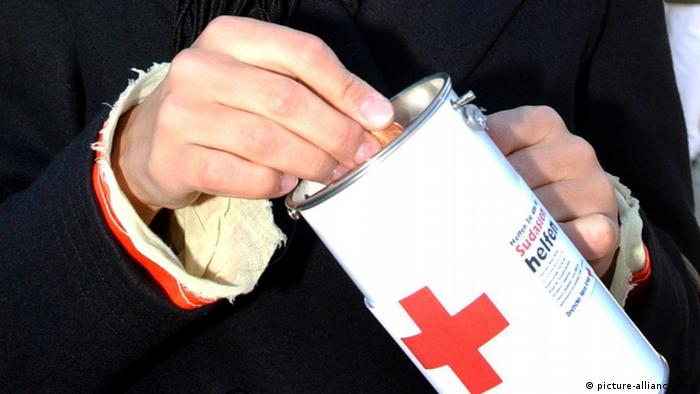 The amount of food aid distributed to people in Europe by the Red Cross has reached levels not seen since World War II. The economic crisis is putting millions at risk of poverty. Bulgaria and Spain are most affected.
Today, the International Red Cross distributes food aid in almost 20 EU member states as result of rising poverty levels.
In Spain alone, some three million people now depend on help to survive. The Red Cross does not just distribute food aid, but also supports the needy with financial aid to pay rent, water and electricity bills."Even people from the middle class who have lost one or two jobs in their households now need our help," said the spokesperson of the Red Cross, Jose Javier Sanchez Espinosa.
 A report by the European Commission suggests that young people, migrants and single parents are most at risk of permanent poverty.
"The division of society has to be fought on all levels," said Christoph Butterwegge, a political scientist and poverty researcher, in an interview with DW. "And it starts with introducing a law that guarantees a minimum wage that people can live off."
In Spain, the minimum wage is approximately 750 euros per month. In Bulgaria it drops to 150.
The social gap is widening
Since the beginning of the economic crisis in 2008, the poverty risk has increased in almost half of EU member states, according to the EU. Bulgaria has seen the most drastic developments. In 2011, around half the population was threatened by poverty or social exclusion.
Between European countries there are also severe regional differences. While Germany is relatively unaffected, in Greece, for example, many citizens can no longer afford to pay health insurance, according to Medico International, an aid and human rights organization."Aid organizations step in and help people in need whenever countries are particularly impoverished and lack the resources," said Fredrik Barkenhammar, spokesperson of the German Red Cross, in an interview with DW. "That's a new development in Europe."
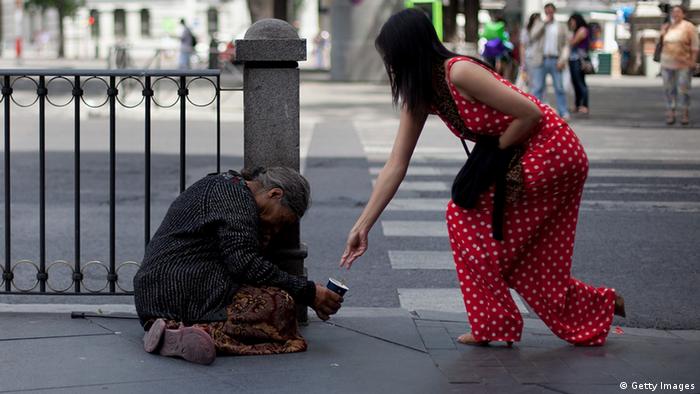 For Christoph Butterwege, governments are to blame. "Poverty is eating its way into the very heart of society," he said. "That's because political decisions are made that ease the burden for the higher incomes - the tax burden, for example."
Countries in eastern Europe are generally more affected, he added, because the level of private savings there is lower, and because social security systems there don't have the same capacities as in central and western Europe.
Spainloses out
In some EU countries, the Red Cross has been active for quite some time, launching food aid programs funded by donations.
Last year, rather than solicit money for operations in developing countries, the Red Cross in Spain solicited donations for Spain, itself. To that end, a campaign was launched that asked Spaniards to support their fellow citizens, particularly those most affected by unemployment. Unemployment has been hovering at 26 percent.
Under the slogan "Now more than ever" the campaign aims to collect some 30 million euros for around 300,000 people in need over the next two years. Collection points have been set up all over Spain.
"It's a drop in the ocean," said Christoph Butterwegge. "All it does is ease the burden for some individuals. But it's not a solution to the problem. In order to solve the problem properly, we would need to see a true change in economic, fiscal and social policies."
The European Commission is concerned about the effects that the current economic crisis has on society.
Commission President Jose Manuel Barroso wants to put the consequences of the crisis on the agenda at the EU's upcoming spring summit.
Poor British pupils deprived of meal at school

 More than one million of British children living in extreme poverty, especially in Horsham and South Downs, do not receive the free meal at school. Among them, 700 000 don’t even have this right. The Children’s Society has called the Government to extend the opportunity to low-wage families. According to a survey, 44% of teachers have declared that children often complained that they were hungry. Even worse, the study has found that 72% of teachers surveyed have seen children coming into school with no lunch and without means to buy something to eat. Finally, 66% of them have paid the children meals every time they were in obvious difficulty. 98% of school staff have called the State to nourish its children. Not just those with unemployed parents but also those whose parents work, but who have very low incomes.
Italy and India diplomatic row escalates
 Italy has accused India of violating laws on diplomatic immunity by preventing its ambassador from leaving the country,
in an escalating dispute over two marines who skipped bail while on trial for murder in New Delhi.
Chief Justice Altamas Kabir, India's top judge, said on Monday that Italy's ambassador Daniele Mancini had forfeited his diplomatic immunity over his role in securing the release of the pair who were accused of killing two Indian fishermen.
 However, the foreign ministry in Rome said India was breaking diplomatic conventions by ordering the envoy to stay in the country until the next hearing of the case on April 2.
"The Supreme Court's decision to prevent our ambassador from leaving the country without the court's permission is a clear violation of the Vienna convention on diplomatic relations," it said in a statement released on Monday.
"Italy continues to believe that the case of its two marines should be resolved according to international law," it said, adding that it "wants to keep friendly relations" with India.
Kabir said Mancini, who had negotiated the Italians' release last month so they could vote in an election, had waived his immunity by giving an undertaking to a court that the pair would return.
The marines, Massimiliano Latorre and Salvatore Girone, are accused of shooting dead two fishermen off India's southwest coast in February last year, when a fishing boat sailed close to the Italian oil tanker they were guarding.
They say they mistook the fishermen for pirates.
'Consequences'
The pair had been given permission to fly to Italy to cast their votes in the election on the understanding that they would return, but the Italian government announced last week it would revoke its decision to send the men back.New Delhi has warned of "consequences" and is reviewing its ties with Italy, while the case is being watched carefully by India's allies because it could set precedents over the treatment of foreign diplomats.
India has put its airports on alert to prevent Mancini from leaving the country.
The Supreme Court issued instructions that "appropriate steps" should be taken to restrain him.
Without legal protection he could be prosecuted for contempt of court.
A lawyer for the Italian government argued at Monday's hearing that Mancini still enjoyed diplomatic immunity and freedom of movement under international rules contained in the 1961 Vienna Convention on Diplomatic Relations.
However Kabir, who was heading a three-judge bench, said: "We have lost all trust in the ambassador."
'Amicable solution'
Katherine Reece-Thomas, an international law expert at City University in London, agreed that India risked being in breach of its Vienna Convention commitments.
"The only sanction available to the host state [India] is to declare the diplomat to be persona non grata and demand that he leave," Reece-Thomas wrote in an email sent to the AFP news agency.
"India cannot stop the ambassador leaving against his will and any suggestion that he somehow waived his rights under the Convention is unfounded."
In Brussels, the EU's foreign service earlier on Monday reacted cautiously to Kabir's decision.
India and Italy should "pursue all avenues for an amicable solution", said the spokesman for EU High Representative Catherine Ashton.
Italy insists the marines should be prosecuted in their home country because the shootings involved an Italian-flagged vessel in international waters, but India says the killings took place in waters under its jurisdiction.
Relations between the two countries have also been soured by corruption allegations surrounding a $748m deal for the purchase of 12 helicopters which the Indian government is now threatening to scrap.
Israeli president: No doubt Obama has Israel's back
 Israel's president conceded Tuesday his country may disagree with the White House at times over Iran's nuclear progress, but said he is "free of doubts" that U.S. President Barack Obama would use military force if necessary to stop Tehran from developing a nuclear bomb.
Iran is the top issue as Obama heads here for meetings with Israeli officials, including President Shimon Peres and, more importantly, Prime Minister Benjamin Netanyahu.The prime minister has at times voiced concerns Washington has a less urgent view than Israel's of Iran's progress toward developing a nuclear warhead. But he has welcomed the administration's more muscular language of late that "all options" are on the table and that its policy is to prevent -- not contain -- a nuclear Iran.Israeli officials took it as no coincidence that as he prepared for this trip, Obama told an Israeli TV station he believed there was still a year or so before Iran reached the final development stage -- suggesting he believes there is more time for diplomacy than the Israeli prime minister would like.The Israeli presidency is a ceremonial position, but Peres is a father figure in politics here, and it was clear from his tone in the interview his overriding goal of the next few days is to project an image of close co-operation between the two allies.
"I do believe that the United States is following carefully the time and the progress," Peres said of the most recent Obama assessment of Iran.
"So a year is an estimation," Peres told CNN in an interview at his residence. "If something were to happen earlier, I am sure we will pay attention to the change.
"The main question you asked me, and the real answer I am giving you -- I trust what the president says. I am free of doubts. I think he is a man of values. He is a man that I respect his words. And he is a man that thinks before he speaks."The clear threat of military action is designed to pressure Iran to negotiate a diplomatic settlement, but some Obama critics have voiced doubt Tehran takes seriously the threat of American military action.
Asked if he believed Tehran viewed the White House "all options" approach as serious, Peres said: "That I am not sure. I am not sure whether the relations between Iran and the truth are so intimate. I think they are capable of bluffing others and bluffing themselves."
He played down disagreements between U.S. and Israeli intelligence assessments of Iran's progress toward a bomb.
"There may be some differences in timing, but basically we support the policy of the president of the United States," Peres said.
Subscribe to:
Posts (Atom)