 New Czech President Milos Zeman on Monday appealed to his Pakistani counterpart for help in locating two Czech women abducted last week in the restive southwestern province of Balochistan.
Sworn into office last week, Zeman on Monday “wrote a personal letter to Pakistani President Asif Ali Zardari,” presidential spokeswoman Hana Burianova told reporters.
Pakistani security forces have so far been unable to locate the two women who were taken at gunpoint last Wednesday, around 550 kilometres (350 miles) west of Quetta, the main town of Balochistan, which borders Afghanistan and Iran. So far no one has demanded a ransom.
Identified as Hana Humpalova and Antonie Chrastecka, both psychology students, the women had apparently crossed into Pakistan from Iran on holiday.
A Pakistani policeman who was escorting the women was reportedly also kidnapped with them, but later released.
“The Pakistani side has been very active. Their interior ministry has created a crisis unit,” Czech foreign ministry spokeswoman Johana Grohova said Monday.
Kidnappings plague parts of Balochistan and northwest Pakistan, where criminals looking for ransoms snatch foreigners and locals, sometimes passing their hostages on to Taliban and al Qaeda-linked groups.
A Swiss couple, also apparently on holiday, were held captive by the Pakistani Taliban for more than eight months after being abducted in 2011 in Balochistan. They were found safely in March 2012 in circumstances that remain unclear.
The following month, British Red Cross worker Khalil Dale, 60, was found dead nearly four months after he was abducted on the outskirts of Quetta.
Balochistan is in the grip of a nine-year separatist uprising by nationalists demanding political autonomy and a greater share of profits from the province’s wealth of natural oil, gas and mineral resources.
Tuesday, March 19, 2013
Czech president seeks Zardari’s help on missing women
New Czech President Milos Zeman on Monday appealed to his Pakistani counterpart for help in locating two Czech women abducted last week in the restive southwestern province of Balochistan.
Sworn into office last week, Zeman on Monday “wrote a personal letter to Pakistani President Asif Ali Zardari,” presidential spokeswoman Hana Burianova told reporters.
Pakistani security forces have so far been unable to locate the two women who were taken at gunpoint last Wednesday, around 550 kilometres (350 miles) west of Quetta, the main town of Balochistan, which borders Afghanistan and Iran. So far no one has demanded a ransom.
Identified as Hana Humpalova and Antonie Chrastecka, both psychology students, the women had apparently crossed into Pakistan from Iran on holiday.
A Pakistani policeman who was escorting the women was reportedly also kidnapped with them, but later released.
“The Pakistani side has been very active. Their interior ministry has created a crisis unit,” Czech foreign ministry spokeswoman Johana Grohova said Monday.
Kidnappings plague parts of Balochistan and northwest Pakistan, where criminals looking for ransoms snatch foreigners and locals, sometimes passing their hostages on to Taliban and al Qaeda-linked groups.
A Swiss couple, also apparently on holiday, were held captive by the Pakistani Taliban for more than eight months after being abducted in 2011 in Balochistan. They were found safely in March 2012 in circumstances that remain unclear.
The following month, British Red Cross worker Khalil Dale, 60, was found dead nearly four months after he was abducted on the outskirts of Quetta.
Balochistan is in the grip of a nine-year separatist uprising by nationalists demanding political autonomy and a greater share of profits from the province’s wealth of natural oil, gas and mineral resources.
Two Cheers for Pakistani Democracy: A Sobering Milestone
 Five years ago, few would have predicted the achievement. In that period, Pakistan experienced political crises, Taliban insurgencies, a wave of terrorism, military offensives, dangerous standoffs with India, epic national floods and a breakdown of relations with the U.S., especially after the discovery of Osama bin Laden in Abbottabad. There were many moments when it seemed the shaky and unpopular ruling coalition would suffer the fate of its predecessors and either collapse before serving out its term or be deposed by the country’s military.
“There’s a lot of despair regarding the deteriorating security situation in Pakistan, continuing high levels of corruption and political kowtowing to extremist elements, which makes the significance of this moment easy to overlook,” says Huma Yusuf, a policy analyst. “But it’s a true milestone that signals an emerging consensus that democracy is the right governing system for Pakistan. There’s a long way yet to go.”
 By completing a full term, many are hopeful that Pakistan has turned its back on military rule and other interruptions to democracy. “The question of who remains at the helm of power does not remain a question mark but has become an answered question,” Hina Rabbani Khar, Pakistan’s outgoing Foreign Minister, told TIME. “It should be nothing for a country to be proud of that in 66 years, there’s a peaceful democratic transition from one civilian government to another,” she added, “but because it’s the first time, it shows how much there is to be proud of.”But not everyone’s impressed. Even in his televised address on Saturday night, while trumpeting the occasion, Prime Minister Raja Pervez Ashraf quietly conceded that his government has also been a source of disappointment. The outgoing ruling Pakistan People’s Party (PPP) could merely pledge to do “better next time” at its election manifesto launch.
Public resentment has been fed by an endless litany of problems: enduring power shortages (up to 18 hours a day at the peak of summer); the failure to curb terrorist attacks, protect religious minorities and formulate a coherent antiterrorism strategy; a slow and weak response to the floods; sluggish economic growth, a bloated public sector, cresting inflation; and tales of legendary corruption, carving out private fortunes from a treasury to which they scandalously pay little in tax. Many Pakistanis, particularly among the urban middle classes, are looking to the next elections with relief. This will be their first opportunity to try to vote out a civilian government and decide who replaces it.
At the same time, the government leaves with undeniable achievements. With only a plurality of the seats in Parliament, the PPP managed to hold together an unruly coalition with junior partners constantly breaking away and demanding greater concessions to stop it from collapsing. President Asif Ali Zardari, a much reviled figure in Pakistan, proved a shrewd dealmaker, stitching together unlikely alliances with erstwhile enemies. In a break with the past, members of the political opposition and the media were, with some exceptions, allowed to voice dissent freely. And rural voters benefited through support programs for poor families and small farmers.
In a display of political maturity, the government and the opposition were able to collaborate closely and pass three historic constitutional amendments. In the past, Pakistan’s politicians rarely let slip a chance to bring their opponents down, even if it meant opening the way for a return of military rule. A number of times, former Prime Minister Nawaz Sharif won praise for resisting a destructive confrontation that could have triggered the collapse of the government. Whatever strong disputes he had with Zardari’s administration, Sharif insisted they should be resolved within the fold of democracy.
Some of that maturity has faded in recent days, as the politicians squabbled over who will oversee the elections. Pakistan’s constitution says a neutral caretaker government should be in place for the months of campaigning. On Monday, the main parties were still locked in negotiations.There were many moments when it seemed the government wouldn’t make it. Last June, former Prime Minister Yousuf Raza Gilani was sacked by the Supreme Court for refusing to write a letter to Swiss authorities, urging them to reopen old corruption cases against his boss, Zardari. Ashraf, his successor, fearing the same fate, dutifully wrote the letter. He narrowly evaded arrest in January, after the court issued a warrant for his allegedly taking kickbacks in a power-project scam. In the end, the court relented and allowed Ashraf to stay in office.
Pressure also came from Pakistan’s powerful generals. When the government attempted to bring the Inter-Services Intelligence agency under civilian control, the move backfired within 24 hours. In 2009, a U.S. bill to triple nonmilitary aid was denounced by the top generals as intrusive. When, over a year ago, Gilani spoke of the hazards of having a “state within a state,” the generals publicly chastised him, warning of “potentially grievous consequences for the country.”
But under army chief General Ashfaq Parvez Kayani, the generals were in no mood to snatch back direct control. From behind a thin veil, they continued to control much of foreign, defense and national-security policy, leaving the messy, day-to-day running of the country to the politicians. Kayani will be stepping down this year. If his successors let the next government also complete a full, five-year term, the door to military dictatorships may close forever — although the army will continue to jealously guard its power.
The coming elections will prove exciting and dangerous in equal measure. They will have a broader cast of characters than normal. Former cricketer Imran Khan is leading a strident campaign against corruption and U.S. drone strikes and is attracting a new generation of youth. The religious right, chastened at the last elections, is making some gains. Former military ruler Pervez Musharraf is vowing to return this month. Tahir-ul-Qadri, the rabble-rousing Sufi cleric who led protests of tens of thousands earlier this year, isn’t taking part in the elections but is taking to the streets again to denounce them.
And the terrorists have warned they will be paying close attention too. They have already threatened to target secular politicians. With this year looking like one of Pakistan’s deadliest, the fear is that the forthcoming elections could be as bloody as the last one, when former Prime Minister Benazir Bhutto was slain.
Terror Against Hazara Muslim Minority in Iran, Pakistan, and Afghanistan
 Stephen Schwartz
Who are the Hazaras and why are they marked for annihilation in Pakistan? Two frightful terror bombings, taking 185 lives and wounding hundreds more, were reported from the city of Quetta, near the border with Afghanistan, and the capital of Pakistan’s Baluchistan province, in the first two months of 2013. They were followed by a similar massacre in Karachi, Pakistan’s main port, in March. Prominent Hazara individuals have been assassinated in Karachi and Lahore. And the ordeal of the Hazaras is hardly new.
The Hazaras stand out among Muslims that are oppressed by other Muslims. Counting 4.5 to 7.5 million spread across Iran, Afghanistan, and Pakistan, they are mostly Shia believers. They have been targeted for extermination in Afghanistan, by the Taliban, and in Pakistan, by Taliban-allied Sunni fanatics. Like spiritual Sufis, they also suffer official discrimination by the Iranian Shia regime.
In 1998, Iranian forces killed more than 630 refugees, mainly Hazaras, in the Safed Sang detention center in northeast Iran. The 2009 Afghan film Neighbor, portraying that crime, was blocked from general distribution in Afghanistan because of Iranian pressure. Nevertheless, the propaganda networks of the Tehran clerical dictatorship exploit the dreadful condition of the Hazaras in Pakistan to promote an ostensible agenda of international Shia unity.
Highland peasants and livestock herders, Hazaras speak Persian although they are of northern Central Asian origin, and their Mongolian features make them an easy object of aggression. Local Hazaras in Iran, along with Hazara refugees from the Taliban, are hated as a reminder of the Mongol subjugation of the region in the 13th century.
On January 10, terrorists killed more than 90 people in a majority-Hazara neighborhood of Quetta. An additional 170 were injured. Late in the evening, a billiard parlor frequented by Hazaras was hit by two suicide bombers. The second blast at the billiard parlor was aimed at police, rescue personnel, and journalists, killing some of them. That day of horror involved three attacks in Quetta. Earlier that day, an explosion directed at a government vehicle by Baluch separatists killed 12.
Mourning the January bloodbath, the Hazaras refused to bury their dead—eventually totalling 96—within the period, usually no longer than 24 hours, required when possible in Islam. They left the corpses in their funeral caskets, on the streets, for three days. The Hazaras described this action as a challenge to Pakistani army chief Gen. Ashfaq Kayani, demanding security for all citizens.
The victims were interred after Islamabad agreed to suspend the civilian administration in Baluchistan. The province’s chief minister, Nawab Aslam Raisani, was out of power only two months, with his coalition restored to authority on March 14, anticipating elections when the current term of the Baluchistan Assembly is scheduled to expire on April 5.
During Raisani’s hiatus, a second spectacular terror operation struck Quetta’s Hazara Town market on February 16, killing 89 people and injuring 200. Once more, the Hazaras delayed burial of their murdered compatriots. Led by women—Hazaras emphasize female involvement in public affairs—about 4,000 Hazaras blocked traffic, repeating their appeal for protection by the government. That demonstration continued for four days, after which the dead were laid to rest in a mass funeral. In the second instance of burial boycott, the Hazaras demanded that Pakistan effect a “targeted operation” against the Sunni Muslim extremists that have slaughtered them.
In the two outbursts of anti-Shia bloodshed in Quetta, responsibility was claimed by Lashkar-e-Jhangvi (LeJ), a movement of anti-Shia zealots aligned with al Qaeda, the Taliban, and jihadist elements in the Pakistani army and ISI intelligence agency. Islamabad negotiated an end to the Hazara protests. The government, however, did not send the army to protect them.
According to the Pakistani newspaper Dawn, “few believe that dozens of [LeJ] men rounded up after the bomb attacks will ever be brought to justice.” LeJ is blamed for a third episode of mass murder on March 3 in Abbas Town, a neighborhood of Karachi with a large Shia contingent. On that occasion, 48 people were killed and 135 injured.
Quetta, with a district population of about a million, includes about 70,000 Hazaras, concentrated in Hazara Town. Quetta is best known to the world as the site of the “Quetta Shura” or headquarters of the Afghan Taliban. Many Hazaras living in Quetta are refugees from Taliban persecution. But like their oppressors, they moved to Quetta to be close to Afghanistan.
Thousands of Hazaras were driven by the Taliban from the Afghan region of Bamiyan—where the Taliban and al Qaeda in 2001 blew up the ancient Buddha statues. The ultra-dogmatic Sunni ideology of the Taliban imbued them with unrestrained hatred of Shia Muslims, whom the Taliban consider apostates from Islam. But the Hazaras had also inflicted a severe defeat on the radicals in May 1997, nine months following the Taliban invasion of Afghanistan. The Taliban skirmished with Hazaras in the far northwest of the country but were trounced by the Hazaras, who had fought against the Russian and Afghan Communists and had retained their weapons.
Fifteen months later, in August 1998, as described by Thomas Barfield in his 2010 volume Afghanistan: A Cultural and Political History, the Taliban drove through north Afghanistan and killed all the Hazaras they could find, forcing Hazaras to flee to Pakistan and Iran.
For the Hazaras, however, Pakistan, as a failing state under jihadist influence, has proven as dangerous a place as Taliban-ruled Afghanistan and “friendly” Iran. LeJ claims to have exterminated 1,000 Hazaras in the past five years. It committed more than 50 homicidal raids against Shia Muslims in Karachi in 2012.
On February 20, 2013, reflecting the public outrage of the Hazaras, Islamabad announced it would arrest the entire leadership of LeJ. On February 22, LeJ head Malik Muhammad Ishaq was detained at his home in the Punjab town of Rahim Yar Khan, east of Baluchistan—for a month. Pakistani interior minister Rehman Malik accused the Punjab state government bluntly of protecting LeJ. On March 4, Malik demanded, “I ask the Punjab government if it is not supporting and patronizing Lashkar-e-Jhangvi, why these terrorists are not carrying out terrorist activities in the Punjab despite having their headquarters there. Had the Punjab government initiated action against the LeJ, over 90 percent of terrorist acts could have been prevented. . . . The Punjab government is reluctant to take action against them.”
Notwithstanding Iranian manipulation of their plight, the Hazaras do not have the militant reputation visible among Shias in Iran, Syria, and Lebanon. They have been peaceful except when faced with direct aggression. In modern times, their affliction began with the 19th-century conquest of their part of Afghanistan, the Hazarajat, by the then-ruler of Afghanistan, Abdul Rehman Khan, a theocratically-inclined Pashtun Sunni (like the Taliban). Their torment continued into the present day at the hands of the Russian and Afghan Communists and the Taliban. Enmity toward the Hazaras is often political as well as religious. The Hazaras are despised by the Afghan Taliban both because they resisted Abdul Rehman Khan more than 100 years ago and because of their Shiism.
The Hazaras fought the Communists and have threatened to form a militia to defend themselves against LeJ in Pakistan. But their chances in organized combat now appear small. Urban Pakistan, where the refugee Hazaras are found typically, is not mountainous Afghanistan. On February 28, Syed Zaman, head of the Hazara Scouts—affiliated, perhaps incongruously, with the worldwide Scouting movement— stated that in Baluchistan, “We have around 200 young men who perform security duties on specific occasions.”
Fiaz Ahmed Sunbal, head of the local police in Quetta, rejected “private policing” but said officers would “were planning to close entrances to Hazara Town, and would recruit 200 young Hazaras to patrol their own areas.” Hazara Scouts president Ghulam Haider condemned the closing of roads, as it would isolate the Hazaras—protecting them, we might say, by interning them. Hazaras are already excluded from certain areas of Quetta.
It is doubtful that even without support for LeJ inside the Pakistani political, military, and intelligence establishment, the ferocious anti-Shia campaign of LeJ and other groups like it can be quelled by Hazara scout patrols.
Lashkar-e-Jhangvi means “Jhangvi’s Army” and is named for an infamous radical agitator, Haq Nawaz Jhangvi, who also founded another bloodthirsty anti-Shia terror group, Sipah-e-Sahaba (the so-called “Knights of the Prophet’s Companions”). Both factions are aligned with the Taliban in Afghanistan and Pakistan, and all are inspired by the fundamentalist Deobandi sect of Islam. LeJ was officially designated an international terrorist group by the U.S. government in 2003, and is allegedly prohibited in Pakistan, yet it pursues its lethal agenda in Pakistan and Afghanistan with obvious impunity.
Finally, the Hazaras have no real friends, and can expect no substantial help from anybody. Australia has admitted them liberally as refugees, and some have gone to Mongolia to study. Otherwise, outside their own community, they are mostly unmourned victims of virulent Islamist sectarianism.
Monday, March 18, 2013
Obama Nowruz message: Iran must 'reduce nuclear tension'
 U.S. President Barack Obama has offered Iran a "practical solution" if it truly seeks peaceful nuclear capabilities rather than weapons.
In a video to the Iranian people, Mr Obama urged Iran to take "immediate and meaningful steps" to reduce tension with the international community.
He said Iranians had paid a "high and unnecessary price" for Tehran's "unwillingness" to satisfy concerns.
Mr Obama's message marked the Persian new year, Nowruz.
International powers suspect Iran of seeking to develop nuclear weapons - a charge Iran strongly denies.
Iran insists its purposes are purely civilian, asserting it needs enriched uranium to make medical isotopes.
"Iran's leaders say that their nuclear program is for medical research and electricity," Mr Obama said.
"To date, however, they have been unable to convince the international community that their nuclear activities are solely for peaceful purposes.
"Now is the time for the Iranian government to take immediate and meaningful steps to reduce tensions and work toward an enduring, long-term settlement of the nuclear issue."
He said increased trade and better ties with other nations would benefit the Iranian people, but warned proceeding on the current path would result in deeper isolation.
The president's annual Nowruz message comes ahead of a visit to the Middle East on Wednesday.
In Mr Obama's upcoming visit to Israel and Jordan - his first trip there as president - Iran is expected to be high on the agenda.
His closely-watched visit could set the tone of foreign policy in the region for his second term, analysts say.
Last month, the US tightened its sanctions on Iran, restricting the country's access to its own oil revenues and imposing financial restrictions against Iran's state-run media.
Bahrain: 30 days in jail for one tweet
http://www.globalpost.com/Human rights activist Sayed Yousif al-Muhafdha had no idea who followed him on Twitter. That is, until he was arrested one afternoon. As the acting head of the Bahrain Center for Human Rights, Yousif — as he’s known to friends — regularly witnesses demonstrations in Bahrain and documents actions by protesters and police. Demonstrations are illegal here. The government has arrested Shia Muslim leaders. Thirteen have been sentenced to long jail terms for advocating democratic reform. Others had their citizenship revoked, making it almost impossible to find work. Opposition TV and radio don’t exist. That leaves Twitter, the social network of choice for young Bahrainis. In November last year, Yousif had just tweeted a photo of an injured demonstrator when five men in plain clothes surrounded him. They refused to identify themselves and put him in an unmarked car. But Yousif said he knew he was under arrest. After one minute, the officer told me, ‘You just tweeted. Give me your telephone.’ He took my iPhone. Luckily, I also have a Samsung.” Yousif was later charged with “disseminating false news” under a law aimed at stifling dissent. Yousif ended up spending 30 days in jail. “I’m very fast,” he said. “I tweeted, ‘I’m arrested.’”“They kept me in jail for one month for a tweet, while police who have killed protestors go free,” he said. Through a month in detention, assigned an immigrant roommate who spoke neither English nor Arabic, Yousif was left with plenty of time to think about how complicated Sunni-Shia relations have become since the start of his country’s Arab Spring uprising in February 2011. About 70 percent of Bahraini citizens are Shia. They face discrimination in jobs, housing and education. “They are the poor people,” he said. “For sure they are the majority protesting in the streets.” But many Sunnis also opposed the government and joined the early demonstrations, he noted.“Although the government tried to divide Sunni and Shia, the majority of all Bahrainis still have problems with the government. We all want democracy. For the past 42 years, we’ve had the same, unelected prime minister.” Demanding an end to the monarchy has landed dissidents in jail for years. So far the government has dealt less harshly with Yousif. He was allowed weekly family visits. That’s how he learned that international media and human rights groups were protesting his detention. “My family printed out all the articles and statements about my case by international organizations,” he said. “I knew I was not alone.” Sarah Leah Whitson, Middle East director at Human Rights Watch, speaking about Yousif’s case, said Bahraini police have supposedly undergone human rights training. “If Bahraini officials believe that an activist is inciting violence by tweeting a picture of an injured demonstrator, then it’s clear that all the human rights training sessions they’ve attended have been wasted,” Whitson said at a recent press conference in Manama. Yousif said his detention was political, aimed at warning him and others to stay away from demonstrations. “They want me off the streets,” he said. “They want to commit crimes without any witnesses.” A few days after his release from detention, Yousif was back on the streets documenting Bahraini police actions. On March 11 he was acquitted of all charges.
Israelis welcome President Obama
http://www.timesofisrael.com
1,618 people submit slogans to US embassy’s Facebook page, 20 best will get tickets to president’s Jerusalem speechMore than 1,600 Israelis submitted slogans to a US embassy contest for tickets to President Obama’s speech in Jerusalem. According to the embassy’s Facebook page, 1,618 people answered a post promising tickets for 20 of the most “original and creative” comments and posted them by March 14.Winners will attend Obama’s address next week at the International Convention Center Jerusalem during his first presidential visit to Israel, Army Radio reported. One of the contenders, Nathan Bachrach, wrote: “As a grandfather of three girls in Houston, Texas, I hope one of them will one day replace you and become the first woman president in the US.” Another contender, Eitan Friedman, was one of several dozen who said they wanted to attend the speech to ask Obama to free Jonathan Pollard, an American Jew who in 1987 received a life sentence for spying for Israel.
Europe and the Arab Spring

BY: Ziad AklIn January 2011, those who were protesting in Tahrir Square kept a careful eye on world leaders, hoping to hear a message of support for the revolution or a message of pressure to the Mubarak regime. The United States and Western Europe found themselves in a very difficult position. On one hand, their long-time ally Hosni Mubarak has been more than useful and has safely guarded Western interests in the region. On the other hand, the young voices that chanted from the square represented all the principles that the West tries to promote. The call was indeed difficult and Western countries had to make it one case at a time. There were three main types of Western response: open support of the revolution, open support of the regime, and a third model that conservatively waited till things were clear before declaring its support. That’s why the Western response was so different from one place to the other. In Libya it was open support of the revolution from day one. In Bahrain, it was open support for the regime refusing the idea of change in the Gulf. And finally in Egypt, the West waited till it was clear that Mubarak is stepping out of the picture. The West did not respond to the Arab Spring based on the principles the West believes in or the pursuit of democracy and equality; the case of Bahrain proves that the West responded on the basis of its interests and the best way to protect them. And on this basis the response to the Egyptian revolution was made and the West supported the revolution after 18 days of skepticism towards the extent of change the youth in Tahrir were capable of. Europe was a lot faster than America in showing their support to Egypt. European interests in Egypt remain the same and have not changed. Europe is interested in a stable regional order in the Middle East that respects the status quo, which Egypt has worked hard to maintain. Europe is also interested in fighting radical Islam, which has threatened the security of Europe more than once since 9/11. It is indeed in the European interest to ensure that Muslim radicals are kept far from decision-making positions. Finally, Europe has a clear interest in combating illegal immigration. European parliaments discussed their immigration laws over and over again. In fact, the position on immigration has been one of the issues that influenced election results in Europe. Europeans believe that due to the terrible living conditions in North Africa, a lot of Arabs and Africans decide to immigrate to Europe. Egypt and Libya were the main ports for illegal immigration in the Arab World. Therefore, Europe has decided to aid in democratising the Arab World to try and reduce the yearly waves of immigrants that pour into Europe from North Africa. Americans, on the other hand, have a completely different set of interests in Egypt and in the region. The U.S sees Egypt as a necessary element of Israel’s security; therefore, whatever regime is ruling Egypt, Americans would always ensure that the regime does not jeopardise Israel’s security. In addition to Israel, the U.S has an interest in fighting radical Islam that breeds terrorism. But unlike the Europeans, Americans would rather have the Islamists normalised instead of kept away from decision-making processes. The U.S rationale is that Islamists turn violent because they cannot find an opening in the system to allow them to exist in a non-violent way. Hence, Islamists need to be empowered to avoid radicalisation. Therefore, Europe has an interest in implementing democracy in the Arab World while the U.S simply wants to ensure the status quo and prevent Islamists from turning into terrorists. The extent of democratisation does not matter to the U.S as long as American interests are kept safe. Since February 2011, I have participated in many workshops and conferences in different European countries. Wherever I go I am asked the same question: what can Europe do to support Egypt? Financial grants and direct investment are definitely of great help, but mere financial support is not enough. European interests in a democratic Egypt need to be demonstrated through supporting new political institutions. Empowering political parties and movements is necessary. At the same time, financing think tanks and research centres is very important. The chances for democracy are enhanced with more production of knowledge. Finally, all this aid must be linked to the actual process of change on the ground. There is absolutely no reason to support and finance a country with an authoritarian dictatorship-like regime. The more steps Egypt takes towards democratisation, the more aid it will receive from Europe. However, with President Morsi’s performance and the Muslim Brotherhood’s power monopoly, there is little hope that democratisation will actually take place. Europe will eventually turn its back on Egypt, and it will be the responsibility of the Muslim Brotherhood to obtain the same resources Europe used to contribute through the United States or Qatar. The Brotherhood does not turn down money, but what it can offer in return is not democratic change, but a promise to maintain the status quo.
British military commanders acted like 'myopic dinosaurs' during Iraq war
http://www.telegraph.co.ukBritish military commanders acted like "myopic dinosaurs" during the Iraq war with no plan and little understanding of the situation, Colonel Tim Collins, who delivered a key eve-of-battle speech in 2003, has said. The former army officer said his award-winning speech, in which he told troops "We go to liberate not to conquer", before the start of the conflict did not reflect an official plan and was simply his own interpretation of how the Iraq war would play out. "It was down to me to tell my men what I believed was the justification for what was to happen because, with hindsight, it is clear that there was simply no plan," he wrote today in The Daily Mirror on the eve of the 10th anniversary of the conflict. In the March 2003 speech in Kuwait, he told troops the Iraqi people would be grateful for the British intervention and that the Iraqis were their allies. He also warned against UK soldiers flying "our flags in their country". Col Collins later received an OBE for his "inspiring" delivery and a copy of his address was hung in the Oval office by then US President George W Bush. Col Collins, who was born in Belfast and served in Bosnia and Kosovo, claimed that military chiefs acted with "arrogance" over the invasion, leaving the previously "religiously and ethnically rich" country economically ravaged in a matter of months."It was just the fact that we were there and those in command wanted it done their way, even if they had no plan. We were in the way and, like a myopic dinosaur, it was all they could see," he said. British MPs were also unable to foresee the consequences of their actions with nativity "worthy of a small child", he added, calling the system "incompetent and spiteful". Col Collins, who stood as a Conservative candidate for Police and Crime Commissioner in Kent in 2011, was accused of war crimes during the battle but was later acquitted. The war in Iraq claimed more than 116,000 civilian lives in the space of eight years and cost the US about £530 billion, according to the Lancet. The conflict cost the lives of 179 British service personnel.
Pakistan:Textbook biases show when Muslim students ask non-Muslim high achievers to convert
The Express Tribune
 Intellectuals from a number of fields came together to point out the horrifying prejudices found in text books in Pakistan at a talk on ‘Biases in Textbooks and Education Policy’ organised by the National Commission for Justice and Peace (NCJP) on Monday.
“I have heard of cases where Muslim students ask non-Muslim high achievers: Why don’t you convert to our religion,” recalled Karamat Ali, the executive director of the Pakistan Institute of Labour Education and Research. “And it is not just Muslims and Hindus, but also Shias who are given this treatment. This is because of the horrifying myths about people of other faiths that we fill our children with.”
Ali criticised political parties for having a narrow vision. “Every party says that they’ll bring ‘roti, kapra and makaan’. What about the freedom to practice your religion?”
Dr Bernadette Dean, the principal of St Joseph’s College for Women, spoke about the religious and gender biases found in text books in Pakistan. “In the curriculum, Islamiat was included in the ‘general knowledge’ taught to children and was made compulsory for students in classes one, two and three,” she pointed out.
“This goes against Article 22 of the Constitution, which states that no person will be forced to attain religious education.”
Dean found religious biases in textbooks written for English, Urdu, Pakistan studies and social studies. “Teachers have to teach these textbooks because students are tested on them in the examinations. They don’t have the choice of breaking out of the system,” she said, adding that the cherry on top is the system of rote learning.
“Imagine thousands of students all over Pakistan rote learning biases against people of other religions by heart and then regurgitating them.”
Quoting acclaimed works, such as K. K. Aziz’s ‘Murder of History of Pakistan’ and Nayyar and Salim’s ‘A Subtle Subversion’, she went on to explain how Pakistan’s history is subverted by “omissions and additions”. “Our students aren’t taught that the first chief justice of Pakistan was a Christian,” she said. “Neither are they told that there were more Hindus than Muslims in Karachi at the time of partition.”The partition is a tricky topic. “When I asked my students to write about the problems faced by Pakistan during partition, they said: Hindus are bad because they didn’t want to give us the Rs200 million promised to us at partition,” she said.
She then spoke about how textbooks fail to represent gender in a fair manner. “Our text books are full of great men,” she explained.
“You hardly ever come across any great women and when they do turn up, you find them in stereotypical roles, as mothers and housewives.” Dean stressed that textbooks need to be rewritten to reflect the changing times.
The executive director of NCJP, Peter Jacob, also wondered that if the study of religion is so important as to be included at every stage in the curriculum, then why does it only focus on Islam. “Why not include other religions as well.”
Sharing her views with The Express Tribune, Dr Nuzhat, the former principal of Government College, Karachi, felt the discussion was particularly saddening if the history of education in Pakistan, and Sindh in particular, was kept in mind.
“Why do we forget that all great schools in Karachi, including Karachi Grammar School and Mama Parsi, were built by non-Muslims? Muslim parents have been dying to get their children admitted into these schools ever since they were built around 100 years ago.”
Could a Nobel Prize for Malala Yousafzai Inspire Pakistan to Stand Up to Extremism?
 Malala Yousafzai, the Pakistani schoolgirl-turned-icon of resistance to the Taliban, has been nominated for this year's Nobel Peace Prize and could possibly become the youngest recipient of the storied honor. Yousafzai was thrust into the global spotlight last October, after she was brutally attacked by a Taliban gunman while traveling home from school in Pakistan's Swat valley. The gunman boarded the van and asked for her by name before firing three shots at her — singling her out for writing a blog that criticized the Taliban for preventing girls from getting an education.
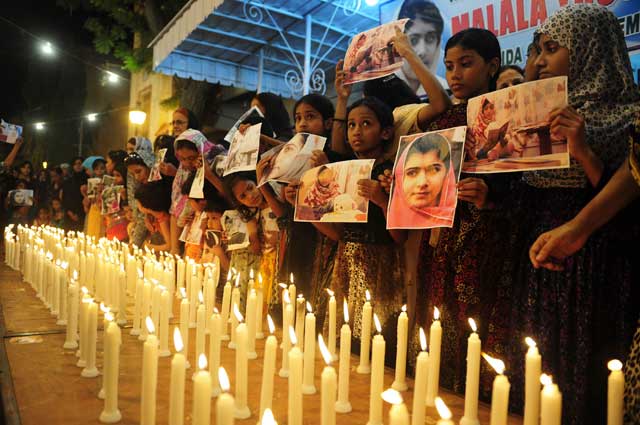 The shooting shocked the world and sparked rare public outrage against Islamist militants in Pakistan. According to Shahzeb Jillani, the BBC World Service South Asia Editor, the wave of revulsion seemed like a "turning point" for a country whose state institutions appeared ambivalent towards rising extremism.
On the face of it, the brazen attack on Malala attracted widespread condemnation by the international community as well as Pakistani leaders. However, as the days passed, Pakistani public opinion began to fracture along historically divisive ideological and political lines. The religious right accused Malala's supporters of "hijacking" the assassination attempt to further the objectives of Pakistan’s security establishment and their Western backers — declaring it a ploy to justify a possible army offensive in the Taliban-controlled tribal region of North Waziristan.
On the political front, opposition parliamentarians said they would resist any government move to launch a fresh military operation in Pakistan's tribal areas — as this could be used as an excuse to postpone the upcoming parliamentary elections. With that, Pakistan's so-called "Malala moment" faded away as quickly as it had seemingly emerged, drowned out amid the day-to-day bickering of Pakistani politicians.
Six months down the road, everything could potentially change if Yousafzai wins a Nobel Peace Prize, resurrecting another "Malala moment” by galvanizing Pakistani public opinion against the rising tide of extremism. Interestingly, many Pakistanis appear to be confident about Yousafzai's chances of winning. "If Obama can win the Nobel Peace Prize," quipped Anam Baig, a university student in Karachi, “I don’t see why Malala can't win."
This confidence doesn't necessarily translate into a consensus about what happens in Pakistan if Yousafzai actually wins the Prize. "Nothing will change," argues Moiz Muhammed, a 21-year-old student in Karachi. "People will see (the Nobel Prize) as a conspiracy against Islam… these are the same people who had called Malala a Jewish agent (earlier)."
A more nuanced view comes from Shozab Naqvi, a Pakistani banker and blogger, who argues that "a Nobel Prize will boost the morale of Malala's supporters and rally some support against extremism. However, the religious right will continue to see this Prize as a proof of their conspiracy-driven narrative and the Nobel will end up polarizing both sides even further."
Unfortunately for Pakistan, it appears that even a Nobel Peace Prize for Yousafzai is unlikely serve as a catalyst that could inspire the country to take a united stand against violent extremism.
Top US commander in Afghanistan says he’s working on issues that anger Karzai
 The top U.S. military commander in Afghanistan says he’s working quickly to resolve issues that have infuriated Afghan President Hamid Karzai, including the delayed handover of a U.S.-run detention center and the withdrawal of U.S. special operations forces from a province outside Kabul.
In his first interview since taking command, Gen. Joseph Dunford told The Associated Press on Monday that there is no new deadline for handing over the detention center despite an Afghan official statement saying the U.S. had promised a resolution by the end of the week.
Dunford also says he is working with Afghan officials to hand over security in Wardak province where Karzai says there have been complaints that the U.S. forces or Afghans working with them have mistreated citizens. The U.S. has denied any wrongdoing.
Copyright 2013 The Associated Press. All rights reserved. This material may not be published, broadcast, rewritten or redistributed.
Afghanistan's Forests A Casualty Of Timber Smuggling
 Despite Afghanistan's fierce winter, it's rare to find a house with insulation or a modern heating system. So Afghans rely on bukharis, stoves that look like an oil drum with a big rusty pipe growing out of the top that bends off into a hole in the wall.
That fact keeps the hundreds of wood vendors around Kabul quite happy. This winter, NPR staff fed several tons of firewood into their bukhari — and that's just one house in a city of about 5 million people.
The United Nations Environmental Program estimates that over the past three decades, Afghanistan's forest cover has decreased by about 50 percent.
Wali Modaqiq, deputy director of Afghanistan's environmental protection agency, says that today forests cover only about 2 percent of Afghanistan. He says years of war and drought have felled more trees than wood stoves, which generally burn scrap wood. The big killer of trees, though, is economics.
"There is a huge demand for Afghan timber in the international market," Modaqiq says.
Commercial timber harvesting is illegal in Afghanistan — which leaves a massive smuggling industry to satisfy international demand. The remaining forest is in places like Kunar province bordering Pakistan, which is the main outlet for Afghan timber now.
A Limited Economy
There is no business in Kunar but the timber business, says Haji Hamidullah, a businessman there.
"It's called Kunar, which means the homeland of mountains," he says. "Once upon a time when there was anarchy in here, people started cutting down the forest to make money."
That was during the 1980s war with the Soviets and the subsequent civil war. Now there is law — but law in Afghanistan often doesn't translate from paper to practice, and that applies to the timber business.
"There's a big business running [timber] during the night," Hamidullah says. "All top officials, including the governor, police chief and head of the provincial council, are involved and are paid their share."
Hamidullah knows, because he used to be in the business.
"When I was caught, all of my timber was put on sale by the government despite the fact that I paid a lot of money in bribes to many officials," he says.
A Well-Developed System
Ashaqullah, who goes by one name, is from Asadabad, the capital of Kunar. He is the head of the Youth Provincial Council, but even he acknowledges that he smuggles on the side. He says there is a clear system.
"A specific amount of tax is levied on each truckload of timber. The deal is made during the day between the officials and the smugglers," he says. "The cutting and transportation goes on at night."
He says dozens of trucks carry hundreds of thousands of dollars worth of timber to Pakistan each night.
Not surprisingly, Fazelullah Wahidi, the governor of Kunar, says this is all bunk.
"Smuggling is not possible now," he says.
"This is a very old story because this was happening in war time," he explains. "But now we have a strong military, we have strong border police, and we have strong national police."
But according to smugglers and residents of Kunar, those policemen are on the take. The governor was about the only person in Kunar who denied that timber is being illegally harvested and smuggled.
Modaqiq, with the national environmental protection agency, points out a Catch-22 that makes it difficult to stop the smuggling.
"Official policy is to involve the local communities to manage the natural resources, especially the forest," he says.
But the local people of Kunar have few ways to earn money other than working for smugglers.
"They are providing job opportunities for those people," Modaqiq says.
So the very people empowered to protect the forests have a strong economic incentive to cut them down. And with law enforcement officials complicit in the business, the remaining forest covering 2 percent of the country may not be standing for long.
.
Afghanistan opposition parties in talks with Taliban, claim leaders
 Afghan political parties united against the president, Hamid Karzai, are in talks with the Taliban and Islamist groups, hoping to broker peace before next year's exit of international combat troops and a presidential race that will determine Karzai's successor, leaders of the factions have said.
This is the first confirmation that the opposition has opened its own, new channel of discussions to try to find a political resolution to the war, now in its 12th year. And the Taliban too seem to want to move things forward, even contemplating replacing their top negotiator, two senior Taliban officials told the Associated Press.
Reaching an understanding with both the Taliban and the militant group, Hezb-e-Islami – headed by the US-declared terrorist Gulbuddin Hekmatyar – would give the opposition, which expects to field a consensus candidate in next year's election, a better chance at cobbling together a post-Karzai government.
The alternative to a multiparty government after the 2014 elections, many fear, could signal a return to the internecine fighting of the early 1990s that devastated Kabul.
But with ongoing back-channel discussions and private meetings being held with Taliban interlocutors around the world, it is difficult to know exactly who is talking to whom.
Early last year, Karzai, who demands that any talks be led by his government, said that his administration, the US and the Taliban had held three-way talks aimed at moving towards a political settlement of the war. The US and the Taliban, however, both deny that such talks took place.
Hekmatyar's group has held talks with both the Karzai government and Washington officials, and a senior US official said the Taliban were talking to representatives of more than 30 countries, and indirectly with the US.
The Taliban broke off formal discussions with the US last year and have steadfastly rejected negotiations with the Karzai government, which they view as a puppet of foreign powers.
News about the opposition group's new avenue of talks comes amid Karzai's latest round of verbal attacks on the US, which have infuriated some of his allies in Washington and confused some of his senior advisers.
In recent weeks, Karzai has accused the US of colluding with the Taliban to keep foreign troops in Afghanistan and has attacked the Taliban for talking to foreigners while killing Afghan civilians in their homeland. The Afghan president also has stepped up his rhetoric against his political opponents, trying to paint them as American pawns in a grand scheme to install a government of its liking when coalition troops leave by the end of 2014. The troop withdrawal and presidential elections are two major events observers fear could bring instability to Afghanistan.
Trying to put its stamp on the future, the opposition – united under a single banner called the Council of Co-operation of Political Parties – says it has reached out to both the Taliban and Hekmatyar, a one-time US ally who is now listed as a terrorist by Washington. In addition to getting the blessing of the Taliban chief Mullah Mohammad Omar, any peace deal would have to be supported by Hekmatyar, who has thousands of fighters and followers, primarily in the north and east.
Omar and Hekmatyar are bitter rivals, but both launch attacks on the Afghan government and foreign forces and both have suspended direct talks with the US, saying they were going nowhere. "We want a solution for Afghanistan … but every step should be a soft one," said Hamid Gailani, a founding member of the united opposition. "We have to start somewhere." The opposition group is full of political heavyweights.
There are former presidential candidates, Abdullah Abdullah and Ali Ahmed Jalali – both of whom were said to be Washington's preferred candidates in the last presidential election in 2009.
There is also Rashid Dostum, who leads the minority Uzbek ethnic group, and Mohammed Mohaqiq, the leader of another minority ethnic group, the Hazaras. Also in the group is Ahmed Zia Massoud, a former Afghan vice-president and the brother of the anti-Taliban fighter Ahmed Shah Massoud, the charismatic leader of the ethnic minority Tajiks and the Northern Alliance, who died in an al-Qaida suicide attack two days before 9/11, which provoked the invasion of Afghanistan in late 2001.
Joseph Colony: Blasphemy complainant, arson accused still missing
The Express TribunePolice have so far been unable to find Shahid Imran, the complainant in the blasphemy case against a Christian resident of Joseph Colony and an accused in the subsequent arson in the neighbourhood, though they arrested a friend of his on Sunday. Shafiq alias Chiku is alleged to have set fire to a snooker table owned by the blasphemy accused, Sawan Masih, and incited others to sack and burn the homes and properties of Christian residents.
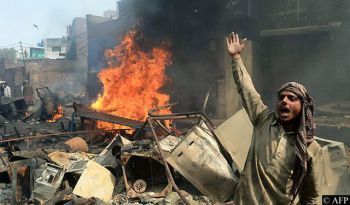 Shafiq, son of Jhuggian Sheikhabad resident Muhammad Rafique, told the police that he had not personally heard Sawan making blasphemous remarks, but had been angered by Imran’s account of Sawan’s alleged utterances, sources in Badami Bagh police station told The Express Tribune.
SP (Investigation) Amin Bokhari said that police had no clue as to the whereabouts of Imran, but were looking for all the accused nominated in the FIR.
Market elections postponed
Meanwhile, the election of the body that manages the Misri Shah iron market, located near Joseph Colony, have been postponed from the due date of March 20. Some of those rendered homeless in Joseph Colony have suggested that the expansion of the market was the motive for the March 10 attack.
“There is no point in holding elections when more than half the candidates of one of the traders’ groups are on the run after being nominated in the FIR,” said Chaudhry Shahid Hussain, the election commissioner.
He said that 18 of the 32 candidates of the Aman Group had been nominated in the FIR of the Joseph Colony attack, while not a single candidate of the rival Ittefaq Group had been nominated. He suggested that this was the result of a “political vendetta”.
“It is clear that the FIR was registered to victimise one group to get a political advantage,” Hussain said, adding that the new election date would be decided in consultation with both groups.
A member of the Aman Group, speaking on the condition of anonymity, said that 20 traders had been nominated among the 83 accused in the FIR, including 18 affiliated with his group. They included presidential candidate Tariq Gujjar, his son Shabbir Gujjar, and vice presidential candidates Usman Butt, Chaudhry Shabbir Asim Shafi and Mian Saleem. “Our opponents have the backing of political bigwigs. They have implicated our candidates to get them out of the elections,” he said.
Mian Kabeer Ahmed, a candidate of the Ittehad Group of Traders, said that some of his colleagues had been nominated. Asked to name them, he responded after a while that they were Chaudhry Bashir and Inam Butt. But the FIR, a copy of which is available with The Express Tribune, does not include any man called Bashir or Inam.
The Badami Bagh investigation officer said that the accused included candidates of both groups, but he could not name any. He said that the accused had been identified through video footage. The complainant in the case was the recently-suspended Badami Bagh SHO.
Punjab govt failed to conduct transparent inquiry
 The Supreme Court declared that the Punjab Police had “failed to conduct an honest and through investigation” into the Badami Bagh incident in which over 100 houses were ransacked and set alight by a charged mob over an alleged blasphemy incident.
A three member bench of the apex court, headed by Chief Justice Iftikhar Muhammad Chaudhry, heard the case over the arson attack in a Christian neighbourhood in Lahore.
The court adjourned the hearing to March 25 on assurance by new CCPO Lahore Muhammad Amlish who vowed before the bench that he would uncover the truth.
Earlier today, the court had rejected Punjab government’s report on the incident.
Expressing deep frustration and anguish, the chief justice expressed the intention to take over the investigation.
Shocked and dismayed over the contents of the First Information Report (FIR) read out by the SSP investigation, Chief
Justice Iftikhar remarked: “It seems that now the courts will have to take charge of investigations also.”
He said although no lives were lost in the incident, the police had failed to protect the “property and dignity” of the residents of Joshep Colony.
“This incident has caused an element of trauma that will keep on lingering in the minds of minority Christians living across Pakistan,” Justice Gulzar Ahmed said.
Gunmen kill Shia student in Pakistan
 Unknown gunmen have killed a Shia Muslim college student in Pakistan’s southern province of Sindh, Press TV reports.
Pakistani officials said armed men opened fire on the student identified as Sibte Jaffar in Liaquatabad area of the port city of Karachi on Monday.
The Monday assault was the latest in a series of attacks on the Shia community in Pakistan over the past few weeks.
On March 3, over 45 people were killed and 150 others wounded in a car bomb attack carried out in Karachi. Women and children were among those killed and injured.
On February 16, a bomb attack targeting Shia Muslims in the main bazaar of the southwestern city of Quetta killed at least 90 people, including women and children, and injured more than 200 others.
Also on January 10, a twin bomb attack at a crowded billiard hall in Quetta, which is the capital of Balochistan Province, killed more than 90 people, mostly Shia Muslims.
Reports say the anti-Shia terrorist group of Lashkar-e-Jhangvi (LeJ) was behind most of the attacks on Shia Muslims in Pakistan.
Human Rights Watch says more than 400 Shias were killed in Pakistan in 2012, which was the deadliest year on record for the Pakistani Shia Muslim community.
Shia Muslims in Pakistan say the government must take decisive action against the forces involved in the targeted killings. They also accuse Islamabad of failing to provide security for the Muslim community.
Pakistani militants attack court complex; 3 dead
Associated PressA pair of suicide bombers attacked a court complex in the northwestern Pakistani city of Peshawar on Monday, killing at least three people and wounding over two dozen, police said. The militants attacked the back of the compound and were confronted by three police guards, said police officer Masood Afridi. The militants shot and wounded the policemen, but not before one of the guards was able to gun down one of the suicide bombers, said Afridi. The other bomber managed to enter the courtroom of a female judge and detonated his explosives, said Afridi. Three people were killed and 30 wounded in the attack, he said. The female judge was among the wounded, said another police officer, Mohammad Arshad Khan. The attackers may have been trying to free militant colleagues jailed on the premises of the compound, said Mian Iftikhar Hussain, the information minister for surrounding Khyber Pakhtunkhwa province. Hussain initially suggested that the attackers may have taken some hostages, but later said the situation was under control, without providing details. Local TV footage showed people running for safety, including wounded people being assisted by others. They included a pair of policemen, a lawyer and other civilians, including one man whose clothes had been torn to shreds. Police commandos and army soldiers rushed toward the complex, as the wounded were shifted to stretchers and taken to the hospital. Peshawar is located on the border of Pakistan's semiautonomous tribal region, the main sanctuary for Taliban militants who have been waging a bloody insurgency against the government. The militants and their allies have carried out scores of bombings in Peshawar. No group has yet claimed responsibility for the latest attack. In the southern port city of Karachi, paramilitary forces arrested a militant leader who was involved in the kidnapping and murder of Wall Street Journal reporter Daniel Pearl in 2002, said two paramilitary officials, speaking on condition of anonymity because they were not authorized to talk to the media. Qari Abdul Hayee, a former leader of the Lashkar-e-Jhangvi militant group in southern Sindh province, was arrested on Sunday in Karachi, said the paramilitary officials. He also went by the name Asadullah and was involved in other attacks in Karachi as well, they said. Lashkar-e-Jhangvi is a radical Sunni Muslim militant group that has carried out many attacks in Pakistan, especially against minority Shiite Muslims. Also in Karachi, gunmen riding on a motorcycle shot to death a Shiite professor, Sibt-e-Jafar, on Monday, said police officer Amir Farooqi. No group has claimed responsibility for the attack.
Pakistan: Pre-poll pangs
 Many things are happening for the first time in Pakistan and the inexperience of handling new situations is leading to certain pre-poll problems. The Pakistan People’s Party-led coalition government completed its five-year tenure for the second time since 1977 but the National Assembly completed its term for the first time. Now that the electorate is preparing to vote for their 14th National Assembly, the question of the caretaker set-up is developing into a deadlock because both the government and the opposition are not giving room to each other.The same is the case with the wish for the dissolution of provincial assemblies on the same day as the government and the opposition are stuck to their stance of rejecting each other’s nominees. The situation regarding holding the elections to the national and provincial legislatures on the same date because the opposition is not agreeing to this federal government’s proposal.
After the dissolution of the National Assembly on Saturday night, Prime Minister Raja Pervez Ashraf and the Leader of the Opposition, Chaudhry Nisar Ali Khan, have another three days to reach an agreement on the caretaker prime minister.
The two talked to each other by telephone on Friday but there was no formal contact between them or their representatives on Saturday. The prime minister also held a meeting with the four chief ministers on Saturday afternoon to convince them for holding the NA and PA polls on the same day. The objective of the meeting was to make a last-ditch effort to reach consensus on the issues of appointment of the caretaker set-ups and holding of general elections all over the country on the same day. There seems to be differences on these issues; although. the prime minister’s house said that the chief ministers had “agreed in principle that the elections of national and provincial assemblies will be held in the country on the same day for logistical, administrative and financial reasons, which would also promote political harmony in the country”. The official statement, however, did not mention the date on which all the provincial assemblies would be dissolved, indicating that the participants had failed to reach an understanding on simultaneous dissolution of the assemblies. The effort was also made by Prime Minister Ashraf to reach a consensus when he later had a one-to-one meeting with Punjab Chief Minister Shahbaz Sharif but this did not work either.
The PML-N took the position that although it desired that the elections for the national and provincial assemblies should be held on the same day, Shahbaz Sharif had given no commitment to the prime minister that the Punjab Assembly would be dissolved simultaneously with other three provincial assemblies. When Balochistan Chief Minister Aslam Raisani was quoted by electronic media as stating that all the provincial assemblies would be dissolved on March 19, Mr Sharif immediately responded denying such a decision having taken place. Chaudhry Nisar was even more categorical in elaborating that the Punjab Assembly “will not be dissolved on March 16 if the government continues to play tricks in Sindh and Balochistan”. The Punjab Assembly would be dissolved on March 16 only if a consensus on the caretaker set-ups (in all provinces) was reached before time, otherwise, it would complete its constitutional term ending in April, Nisar added.
The establishment of a caretaker set-up at the federal level proved even trickier than other issues because both the government and the opposition were poles apart from accepting each other’s nominees. The government’s nominees for the caretaker prime minister were former finance minister Abdul Hafeez Shaikh, former State Bank governor Dr Ishrat Husain and Justice (retd) Mir Hazar Khan Khoso. The opposition put forward the names of Justice (retd) Nasir Aslam Zahid and Sindhi nationalist leader Rasul Bakhsh Palijo for the office while the name of Justice (retd) Shakirullah Jan was withdrawn and Nisar informed the PM about his party’s decision by telephone. The PPP is said to have turned down the names of Justice Zahid and Palijo because it believes they would be unfair to the party. More or less the same is the standpoint of the PML-N.
If the stalemate continues, and there are chances that it would, they will have to find the solution within the constitution itself. Article 224A of the constitution spells out the procedure for the appointment of the caretaker prime minister and chief ministers in case the government and the opposition parties fail to reach consensus, the issue will have to be taken to an eight-member bi-partisan parliamentary committee - four each from the prime minister and the leader of opposition - which will choose one name from the four nominees within three days. And if this attempt also fails, the Election Commission of Pakistan will select the caretaker prime minister within two days.
The good thing, however, is that the constitution provides a deadline and method to get out of the deadlock in spite of the inability of our politicians.
CM Punjab buys youth by providing them laptops
Chairman Pakistan Tehreek-e-Insaf Imran Khan said they will take a big decision at their public meeting on 23rd of this month in Lahore.
Addressing students convention in Islamabad this afternoon‚ he criticized the policies of the Federal and Punjab Government.
He alleged that Punjab Chief Minister is buying the youth by providing them laptops.
Imran Khan said the Punjab government has spent 70 billion rupees development funds of Punjab at the Metro Bus Service in Lahore.
Man having links with banned outfit may get PML-N ticket
 As the `sufferings’ of old guards at the hands of new entrants to Pakistan Muslim League (Nawaz) continue in Gujrat, the fresh `casualty’ is party’s district president and ex-MNA Malik Hanif Awan.
According to well-placed sources in the PML-N, the party leadership has asked Awan to run for the Punjab Assembly seat PP-114 (Sara-i-Alamgir) instead of NA-107, the seat he won in the December 2012 by-election by bagging over 100,000 votes.
Sources say the party wants to accommodate Abid Raza of Kotla group who joined the PML-N after the 2008 general elections. The move is highly surprising for all and sundry in the Gujrat PML-N.
Talking to Dawn, a couple of local PML-N leaders regretted that the party hierarchy had neither counted the sacrifices of Mr Awan he rendered for the party in Gujrat since the Oct 12, 1999 coup by Pervez Musharraf nor the fact of bagging of record votes by him a few months ago. When this correspondent approached Awan, he confirmed that the leadership had asked him to contest for the Punjab Assembly seat.
Sources quoted Mian Nawaz Sharif as telling Hanif Awan that Hamza Shahbaz Sharif had reportedly made a commitment to awarding PML-N ticket to Chaudhry Abid Raza of Kotla group during the by-elections held in December to appease the Kotlas who had also been demanding a ticket for the by-election.
It is learnt that a banned religious outfit that is known for its affiliation with the PML-N in Punjab has also sought the N ticket for Abid Raza due to his strong association with it (the outfit).
Chaudhry Abid Raza was convicted in the murder case of six people during an assassination bid on former Gujrat Tehsil Nazim and ex-MPA Ghulam Sarwar Bhooch (late) back in 1998. Mr Bhooch had then survived the bid. Abid Raza was awarded a death sentence under section 7 of Anti Terrorism Act and he remained in the Gujranwala prison where his contacts had reportedly been developed with a key figure of a banned outfit who was also facing jail in the murder case of senior police officer Ashraf Marth.
Both the Kotla and Bhooch groups later reconciled after more than three decades of enmity as Sarwar Bhooch had also been awarded death sentence in 2002 in connection with the murder case of Haji Abdul Khaliq, the elder brother of Abid Raza.
After the reconciliation between the rival groups, Raza was set free in 2003. A law enforcement agency had also taken Mr Raza into custody in connection with attacks on former president Pervez Musharraf due to Raza’s alleged links with militant groups and he remained in captivity for more than a year but released later on due to the intervention of the PML-Q leadership.
The Kotla group had been the part of PPP and its nominee Aamir Usman Raza had won the Punjab Assembly seat PP-115 on PPP ticket in 2002 general elections but soon after the polls, the group had joined the PML-Q whereas in the 2008 elections, the group had to face split as Abid Raza and three of his brothers joined the PML-N and their nominee Irfanuddin contested as an independent candidate and won the PP-115 seat whereas two of Abid Raza’s brothers are still in the PML-Q. Mr Raza used to move in a heavily guarded convoy.
AWAN: Ex-MNA Hanif Awan was first elected MPA on the PML-N ticket in 1997 general elections from Sara-i-Alamgir but could not contest the 2002 elections due to the graduation bar. However, he pitched his nephew Dr Ajmal Siddiq Awan on two seats — NA-107 and PP-114– on the PML-N ticket who remained runner-up.
In 2008 elections Awan fielded his another nephew Malik Jamil Awan who won on PML-N ticket but later on was disqualified by the Supreme Court in September 2012 for having dual nationality. Awan then contested the December 2012 by-poll and won NA-107 with a huge margin.
Sources said when the party leadership asked Hanif Awan to contest from PP-114, he reportedly sought PP-115 as well for another diehard party worker Chaudhry Farrukh Majeed, a senior vice president of PML-N in Gujrat. Awan reportedly sought the party ticket for Mr Majeed as a prerequisite for his (Awan’s) withdrawal from NA-107.
It is learnt that Mian Nawaz Sharif accepted his demand but the Kotla group claims that it has gained the party nod for both NA-107 and PP-115.
Sources in the party say that the Kotla group will never withdraw from PP-115 even after getting NA-107. In that case, Hanif Awan may also go to contest NA-107 independently besides putting his own independent panel on both the Punjab assembly seats falling under the NA seat, a situation the PML-N can never afford.
RAZA: Abid Raza who has launched his campaign as N candidate for NA-107, belongs to the Deobandi sect. The rival Barelvi sect that dominates the population of NA-107 will play a decisive role in the local politics like the last by-elections as a large number of local clerics influenced by Pir Aminul Hasnat Shah of Bhera Sharif, the chief of PML-N religious wing, have unanimously decided at a meeting held here the other day not to support Abid Raza due to his strong affiliation with the other sect.
Sunday, March 17, 2013
ولسمشر کرزی ښودل غواړي د امریکا ګوډاګی نه دی
http://www.mashaalradio.org
د فرانسې خبري اژانس په خپله یوه مقاله کې لیکي، چې ولسمشر حامد کرزى په ۲۰۱۴م کال له انتخاباتو وروسته له واکه پر لرې کېدو غور کوي، او په دا ورستیو کې د سختو خبرو په کولو سره خپل ولس ته باور ورکول غواړي چې دی د امریکا لاسپوڅی نه دی.ولسمشر کرزی امريکا تورنوي چې له وسله والو طالبانو سره يې لاس يو کړى چې په افغانستان کې د خپلو يولکو بهرنيو عسکرو شتوالي ته قانوني جواز برابر کړي. د فرانسې خبري اژانس په حواله، ولسمشر کرزى د ژر غوسه کېدو سابقه لري او مخالفان يې وايي دا خپله يو ثبوت دى چې ولسمشر کرزى بې ثباته دى او باوري کس نه دى، او د هغه داسې څرګندونې تر ګټې تاوان ډېر لري. خو نور بیا وايي، ولسمشر کرزي خپلې خبرې په پام سره سنجولې دي او په مستقيم ډول د افغانستان بېسوادو يا هم کم تعليمه ځوانانو ته مخاطب دى. بريتانوي تاريخ ليکونکي ويليم دالریمپل چې تېره اوونۍ يې په کابل کې له ولسمشر سره د نوي(۹۰) دقيقو لپاره کتلي وايي، ولسمشر کرزي د نورو مسايلو تر څنګ د بريتانيا د لاسپوڅي شاه شجاع پر برخليک هم ورسره خبرې وکړې، چې د بريتانيا استعمار ګرو په ١٨٣٩م کال کې له واک څخه ليرې کړ او وروسته ووژل شو. دالريمپل وايي: د ولسمشر کرزي نظر دا و چې امريکا له ده سره هغه چلند کوي، چې بريتانيا له شاه شجاع سره کړى وو، له هغه سره یې د يوه لاسپوڅي په توګه چلند کېده او دوى د خپلو ګټو لپاره وکاراوه. ٥٥ کلن کرزى چې د لوېديځ ملاتړ ورسره و، وروسته تر هغه چې د امريکا په مشرۍ بهرنيو ځواکونو پر افغانستان بريد او طالبان يې له سياسي صحنې ليرې کړل، د افغانستان ولسمشر شو. د فرانسې خبري اژانس ليکي، د امريکا او افغانستان اړيکې له هغه وروسته کړکېچنې شوې چې وسلوالو طالبانو سولې ته مخه کړه، د امريکايي پوځيانو تلفات کم او افغان حکومت په اداري فساد تورن شو. په وروستيو کې ولسمشر کرزي د امريکا خاصو ځواکونو ته امر وکړ، چې له ميدان وردګ ولايت څخه ووځي، د ځورونې تر ناثابته شويو ادعاوو وروسته يې د افغانستان له يوه پوهنتون څخه نړيوال پوځيان منع کړل دغه راز يې له افغان ځواکونو وغوښتل چې له امريکا څخه دې د هوايي ځواک د ملاتړ غوښتنه نه کوي. د سياسي چارو يوه کارپوه وحيد مژده د فرانسې خبري اژانس ته ويلي، دا د ولسمشر کرزي له خوا نااميدانه هڅې دي، چې کوښښ کوي د تاريخ په وړاندې ځان سپين ثابت کړي. اژانس ليکي، پر واشنګټن د کرزي لفظي بريدونه د ائتلافي ځواکونو په عملياتو کې د ولسي مرګ ژوبلې له کبله د ولسي خلکو ولاړه شوې غوسه نوره هم زياتوي. د امريکا سياسي او پوځي چارواکي د کرزي د وروستيو تورونو له کبله چې ويلي يې دي، امريکا او طالبانو لاسونه يو کړي حيران شوي، په امريکا کې د کانګرس غړو ويلي، کرزى به ډېر تاوان وکړي.
Spotlight on petition to lift driving ban on Saudi women
http://gulfnews.comThe Saudi Committee for Human Rights and Petition has pressed the Shura (Consultative) Council to launch a debate on the right of Saudi women to drive. The move by the committee is based on a study supported by 3,000 Saudi men and women from various parts of the country and calling for an open debate that should allow women to sit behind the steering wheel “in accordance with religious and social norms.” Under the bylaws, the Shura Council has to respond to all questions, queries and petition. “Debating the issue of allowing women to drive gives the Council greater credibility and promotes trust among the people who will view them as their representatives who are ready to engage in the debates they suggest,” Sulaiman Al Zayadi, the former head of the rights and petition committee that submitted the petition and requested a date to debate it, said in remarks published by Saudi news site Sabq on Saturday. The petition was handed before the end of the last session to the committee that approved it and suggested its debate by the Shura Council members.The new Shura Council, formed in January and which includes 30 women for the first time in its history has not yet looked into the petition. The study argued that local social and economic developments in Saudi Arabia and the international covenants endorsed by the Saudi kingdom require that Riyadh allow women to drive cars. An advisory and executive committee should be set up by Saudi Arabia to draw the religious, social and security regulations to allow women to drive as a prelude for social changes that will make the society more recipient to the idea of women driving, the study said. The committee should be made up of moderate religious scholars and representatives from the foreign, interior, culture and information ministries, human rights watchdogs, the Shura Council human rights committee and other members to be appointed by the king, it said.
Pakistan: ‘State’s inability to act emboldens extremists’
 Religious minorities, including Hazaras, remain the target of powerful religious militant groups, which have increasingly been emboldened because of the state’s inability to punish them, speakers told a recently organized general debate by the United Nations Human Rights Council (UNHRC).
If these militants are not controlled now, the country would face a civil war on ethnic and sectarian lines, they warned.
Those who spoke on the occasion included South Asia Democratic Forum’s Director Paulo Casaca, political analyst and commentator Tarek Fatah and Baloch nationalist leader Mehran Baloch.
Baloch alleged that the religious militants remain an ally of the state institutions in Balochistan. Taking his conspiracy theory further, he accused China and Iran for interfering in Pakistan for their own strategic interests.
Sectarian killers use seminaries as their centers and persecute religious and ethnic minorities, he alleged.
He alleged that secular Baloch elements are being side-lined from the political process as a strategy to allow extremist right-wing parties to suppress their “nationalist movement.”
Paulo Casaca urged the European Union and the United States to promote “real democracy” in Pakistan which means a state of law, freedom of religion, and respect of cultural identities.
Tarek Fatah said that Pakistan’s future remains linked with secularism. Only the separation of religion and politics will help resolve Pakistan’s horrendous crises, he said.
“The current chaos is linked with the ideological confusion where the dominant narrative wants to end every opposing or alternative voice. Its damaging Pakistan and a new direction is needed.”
Pakistan: Blasphemy insanity
EDITORIAL :DAILY TIMESThe issue of the blasphemy law has reached ridiculous proportions. The latest victim of the misuse of this law is the vulnerable Christian community. The heinous crime perpetrated by a fanatical mob of burning down 200 Christian homes in Badami Bagh recently has raised many important questions of just where we have reached not just as a society but as a nation of ‘believers’. A raving mob of some 3,000 ‘faithful’ premeditated roughhousing a so-called blasphemy accused and ended up burning down the lives and assets of hundreds of Christian families caught up in the frenzy of a mob mentality. The Christians who came out onto the streets to protest this crime have been met with threats by clerics and police officials. These are not the actions of a civilised, harmonious religion and its people. In 2009, the Gojra riots, where eight Christians were burned alive and 60 Christian homes were burnt to ashes by a mob, indicated the sick direction in which this country was heading. Not a single culprit was apprehended for the Gojra massacre and, so far, the same can be seen for the Joseph Colony incident. When the extremists see that fanatics get away with murder, what is there to stop anyone else from repeating the crime? What is more, most of these ‘blasphemy’ cases are lodged against minorities and that too for reasons that do not stand up to scrutiny. It has been reported that the Joseph Colony incident occurred after a drunken row between two men, one of them the accused, who is a Christian. The accuser has fled whilst the accused languishes in police custody. Blasphemy charges are used as a disguise for vested interests, often to do with land grabbing. This is what our faith has been reduced to by the ‘pious’ — a cover for hidden agendas. The Rimsha Masih case was a proven case of land grabbing by a greedy neighbourhood cleric. When such incidents take place, it is the job of the people, the media and the government to take stock and demand accountability. It is also the job of this country’s legal system to haul up those who actually blasphemise by dragging God’s name in the mud. In another example of how moronic our psyche has become, reports from Shibli Town, Lahore tell of how an imam of a local mosque has accused a young Christian boy of committing blasphemy by allegedly urinating in the ablution area of the mosque, resulting in the Christians of the area feeling threatened. Is this serious? Does it not make one want to shake their head and cry for the state of this nation? It is time to do something about the blasphemy laws so that minorities are, at least, offered some protection by making sure that these foolish accusations cannot be flung about so conveniently. If this is not done, it is only a matter of time before everyone becomes fair game.
Cairo police use tear gas to disperse protesters outside Muslim Brotherhood HQ
 It comes just one day after an RT cameraman and other journalists were attacked outside the headquarters by Brotherhood supporters.
Hundreds of protesters took to the streets of the capital Sunday afternoon, chanting slogans against President Mohamed Morsi and the Islamist group from which he hails.
Some of the then were holding banners which read, "Down with Brotherhood rule."
The demonstration turned violent after a group of protesters tried to break through security forces which were guarding the group's headquarters. Officers used teargas to disperse the crowds, while protesters set tires on fire in the street.
The newly elected head of the Journalists' Syndicate, Diaa Rashwan, condemned the attacks and called on Brotherhood Supreme Guide Mohamed Badie to apologize. He also urged Egyptian President Mohamed Morsi to condemn the assaults.
Rashwan did not rule out that the violence against journalists had been carried out under orders from the Muslim Brotherhood's leaders; the reporters were covering a meeting between Brotherhood Supreme Guide Mohamed Badie and Hamas leader Khaled Meshaal.
At the same time, Brotherhood spokesperson Yasser Mehrez, has denied that his members intentionally attacked the journalists.
"Clashes erupted because some people tried to break into the Brotherhood’s headquarters. The young members of the Brotherhood did not intend to assault journalists or anyone else,” Ahram Online quoted Mehrez as saying. “Everybody has freedom of expression and the right to protest, but insults and sabotage are unacceptable."
The Muslim Brotherhood insisted that guards outside the headquarters were provoked and insulted by the activists and journalists. Reporters said the assault took place after activists sprayed anti-Brotherhood graffiti on the ground outside the headquarters; Brotherhood guards retaliated with sticks and chains.
RT’s Mohammad Moukhtar, cameraman for the Arabic department, was among the crowd of journalists filming the activists drawing graffiti. He sustained a head injury while he was trying to protect his camera as a gang of men armed with sticks and knives attacked a group of activists and journalists. Despite Mohammad’s efforts, RT’s camera was broken and stolen.
The latest violence against journalists comes amid unceasing unrest in Egypt, with anti-government protests being staged in the capital Cairo and across the entire country.
Sunday’s protests at the Journalists' Syndicate in downtown Cairo was the first of three demonstrations the journalists plan to hold. They will gather at the prosecutor-general's office on Tuesday, and outside of the Brotherhood's headquarters on Wednesday.
Syrian Students in Poland Protest against Terrorist Groups in Syria
 The National Union of Syrian Students in Poland and Polish citizens organized a sit-in outside the UN headquarters in Poland's capital, Warsaw, in protest against the acts of terrorism perpetrated by the armed groups in Syria.
The participants stressed support to Syria against the conspiracy targeting it, holding banners expressing condemnation of the killings and vandalism acts of the armed terrorist groups.
A number of participants handed a letter addressed to the UN Secretary-General Ban Ki-moon to his representative in Poland, demanding exerting pressure on the countries funding terrorism in Syria and expressing support to launching a political dialogue among the Syrians.

U.S: How to Force Ethics on the Food Industry
 By MICHAEL MUDD
Pakistan: PML N in the dock

By Najam Sethi

 Political Islam and national security policies are ravaging Pakistan. But neither the generals, who spawned this symbiotic process in the 1980s and nurtured it in the 1990s, nor the politicians, who exploited or condoned it for legitimizing themselves, have the will to turn back the tide. In consequence, the country is besieged by dozens of armed non-state ethnic, sectarian, jehadi, criminal, separatist and terrorist groups in one garb or another that have overrun law and order and plunged various communities into a blood bath. The minorities, in particular, are being targeted with a genocidal vengeance.
 The targeted killing of Shias, in particular the Hazara community in Balochistan, has captured headlines in the last two years for three reasons. First, the scale of the killings is alarming - nearly 1000 have been killed in the last eighteen months, mainly in Balochistan, Karachi and the Northern Areas. Second, the assassins - Sipah e Sahaba, Lashkar e Jhangvi and various related offshoots - have been audacious enough to claim responsibility. Third, the civil-military establishment has admitted its unwillingness or inability to tackle this menace for reasons that are flimsy and self-serving.
 The Ahmedis and Christians have been laid low by the blasphemy laws that enable mischief mongers and vested interests to target them with impunity. Chapels, charities, schools and homes have been attacked. Graves have been desecrated. In the Gojra riots in Punjab, 2009, a Christian community was forced to flee, its homes were looted and burnt down. In 2011, Shahbaz Bhatti, a notable Christian leader, was assassinated in broad daylight. The same year, a mob attacked a Christian community in Gujranwala. And last week, another frenzied mob burnt down 200 Christian homes in a Lahore suburb. In every case, the PMLN administration has either avoided pre-emptive action or stood by while the Muslims mobs have rampaged. Indeed, in every case, the provincial or local government in question has screamed its party-political innocence by scapegoating the police department, swept the inquiry report under the rug and refused to learn any lessons for the future.

 The Gojra incident illustrates this well. A Tribunal of Inquiry headed by Justice Iqbal Hameedur Rehman, who is now a Supreme Court judge, delivered a 258-page indictment of the provincial government. The report was never made public precisely for this reason. But its main conclusions saw the light of day. First, it warned that "the unfortunate incident of Gojra must be taken seriously and the needful be done on a war-footing without further loss of time." But the PMLN government did exactly the opposite by consigning it to the rubbish bin. Second, the Tribunal advised appropriate amendments to the blasphemy laws - in particular PPC Sections 295, 295-A, 295-B, 295-C, 296, 297, 298, 298-A, 298-B, 298-C, and relevant provisions of CrPC 196 and 196-B and Police Order 2002 - to strip them of their mischief-making potential. But no government has had the courage to do this. Third, it focused "on the inability of the police to assess the gravity and sensitivity of the situation", it noted the "inadequate precautionary and preventive measure by the police", and the "failure of the intelligence agencies in providing prompt and correct information". Much the same charge is now being laid at the door of the various law and order departments of government. Fourth, it criticized the "irresponsible behaviour of the administration" for willfully ignoring the developing situation. This happens time and again.
The recent incident in Lahore demonstrates the opportunist political approach of the PMLN. The police - and therefore the government - knew the full facts of the matter before the alleged Christian blasphemer was even arrested. They knew the charge was patently fabricated; that a section of local traders had a vested interest in seizing the Christians' property; that local PMLN "influentials" were egging on the vested interests. But the police did nothing for 36 hours after the arrest to thwart any Muslim mob attack on the community. If anything, the lack of any preventive show of force by the administration or warning to potential trouble-makers that they would be dealt with an iron hand, probably encouraged the mob-drivers to attack the Christian community. Indeed, when a contingent of the police arrived on the scene during the mob's looting and arson, it preferred to stand aside and watch rather than wading in to disperse the arsonists. Police officials openly admit that when they sought orders from their political masters, the orders were either ambiguous or delayed or contradictory. In other words, the government only moved to redress the situation with offers of compensation after the media flogged it for its antipathy.
 The PMLN's attitude towards the Christians and Ahmedis is distinctly blameworthy. Worse, its soft, hands-off approach to militant anti-Shia organisations like the SSP and LeJ is condemnable. A bit of fear and some sneaking sympathy for the cause of such groups is all too evident. For a party that plans to rule Pakistan for the third time, this is unforgiveable.
Pakistan: The economics of corruption

Written by Lal KhanThe political debate in the ruling elite is shrouded with the issue of corruption. It is dubbed as the most serious threat to the system and eradication of this menace is being portrayed as the recipe for the social and economic salvation of this country. The most vociferous leaders on this issue are integral part of the military, civilian and the bureaucratic elite and are openly notorious for their corrupt practises and demeanours. However very little is said about its social economic and political aetiology and root causes. The most crude and obtuse explanation is the personalisation of the issue limiting it to the conduct and role of individuals. Firstly corruption is not the cause of the crisis of the prevalent socio economic system but it is a symptom of the diseased capitalism that needs and breeds this curse. It is the inevitable by product of the misery, dearth and the deprivation excruciating society. And corruption is not just a Pakistani phenomenon but where ever capitalism exists, corruption, prostitution and crime are its essential components. Corruption has rapidly soared in China ever since the process of the restoration of capitalism began under Deng Xiao Ping in the late 1970’s. According to an official report Indian capitalists have stashed away 1.4 trillion dollars in Swiss and other off shore financial heavens. This huge amount is from tax evasion and other corrupt practises of India’s national bourgeoisie. The Economist in its recent issue says, “the world has 50-60 active tax havens, with over t$21 trillion invested virtually tax-free and over 30% of global foreign direct investment is booked through these tax havens and it does not stop here as domestic investment is routed offshore to qualify for tax breaks reserved for foreign investors. Some suspect this accounts for a sizeable portion of ‘foreign’ investment in India and China. This is also the case in America, whose companies face one of the rich world’s highest corporate-taxes, also has some of the most energetic tax avoiders.” There is not a single capitalist country on this planet that can claim to be corruption free. The multinational corporations set aside huge sums of money in their budgets for the kick backs to the military and the civilian political elites with whom deals are done. Biggest culprits are rulers of the neo colonial states and prominent companies mainly the military industrial complex and the oil industry. These corporations also bribe the parliamentarians, political parties and leaders and the bureaucrats that are the policy makers in ‘defence’, infrastructural projects and other massive economic undertakings. The financial sharks and corporate businesses invest heavily in elections campaigns to get their backed politicians elected and then use them to get state bailouts, contracts and other economic privileges. The 2012 presidential race was the most expensive in US history with overall cost of $6 billion. But with the worsening of the economy the role of corruption and black economy becomes more and more intensive. Economists at Paris School of Economics and Global Financial Integrity have highlighted in recent studies that the elites of 139 low-middle-income countries have parked up to $9.3 trillion of unrecorded wealth offshore and this turns some of them from big debtors into creditors. “Developing countries as a whole don’t face a debt problem, but a huge offshore tax-evasion and money-laundering problem,” With the weak and debilitated economic base of the decayed Pakistani capitalism this parallel or the black economy has been expanding robustly. From about five percent in the mid seventies it has soared to about seventy percent of the total economy now. At the present stage the formal or the official economy is growing at the rate of less than three percent while the growth rate of the black economy is estimated to be nine percent. It is like a tumour that has over taken in size of the body in which it was rooted. This black economy is based on several sectors of the economy comprising of drug trade, human trafficking, extortion, kidnapping and ransom, counterfeiting, smuggling, illegal logging, software and music piracy and several other criminal activities. But the massive share of this black economy comes from the corruption in state and society. This black economy has had severe ramifications in politics, state and society with spiralling terrorism, crime and devastation. The covert fragmentations within the structures of the state are also due to the conflicts between the different warring factions representing the various segments of this parallel economy. Paradoxically this corruption and the black economy have been a buffer and a support for the economic cycle that is running this country. Due to the burgeoning crisis of the formal economy Pakistan has been relying more and more on this corruption. With ever increasing military expenditure and repayment of debt and its interest, there is hardly anything left to spend on the social and infrastructural sectors. Austerity, price hikes and blatant exploitation has pulverised the already impoverished masses. Due to the collapse of the living standards along with the decline in the buying power of the society there has been a severe contraction of the market. It is this black market consumption which keeps the economic cycle moving. This sector apart from being a cushion for the formal economy is responsible for 73.8 percent of the total employment in the country. Characteristically its investments are in short term sectors like the real estate, transport, health, education and other services sectors. It is shielded by the religious fundamentalist groups, several political parties, sectarian and nationalist chauvinist setups, sections of the state bought off by these lords of the black economy and outright criminal mafias. Those politicians parroting the rhetoric of ending corruption are either too naive or unashamedly deceiving the people. If corruption, the main source of the black market is eradicated then it will bring down the whole economic edifice of Pakistan as it is so large and actually the formal economy is enmeshed in this black economy. The stark reality is that Pakistan’s capitalism is in its terminal decay. Just like a junkie who is dependent on his fix, this decaying system is totally dependent on this informal economy. It is simply not possible to revive or recreate a healthy capitalist economy in this country. With little or no chance of the recovery of world capitalism in the near future Pakistan’s exports, foreign investment and industrial growth are almost ruled out. The debt burden continues to pile up. In the last five years the incumbent coalition democratic regime has acquired more foreign and domestic loans that the ones acquired in the previous sixty years. Any party in power in this system would not and could not have done much else. With the falling rupee the debt burden keeps on mounting. With about 2 percent of the population paying taxes, declining exports and record deficits the economy cannot run on the foreign remittances alone. Pakistan’s economic future is bleak to say the least. Within the present system no miracle can pull it out of the abyss into which it is unravelling. It is not a question of interpreting or predicting the system; the point is to change it.
Subscribe to:
Posts (Atom)