Saturday, July 21, 2012

Karachi: Six killed in the very start of Ramazan

Bloodshed could not be halted in Ramazan as five more were killed in different mishaps of violence. Following killing of three people, police started targeted operation in Sohrab Goth against miscreants. On the other hand, angry people commenced firing on police and SP office. In Patail Parha, a DSP and his gunman were injured by miscreants who hit the police van. On the other hand, police have arrested four extortionists during an operation. As per details, two people including Shah Faisal, Mirza and Abdur Rasool were killed by firing of unidentified men while two of them sustained injuries. According to police, the mishap occurred after clash between two rival groups who targeted each other with sophisticated weapons. Following the incident, police started targeted operation in the area, conducted raids on different houses and arrested two accused allegedly involved in different kinds of criminal activities. During operation, angry people started firing and piled stones on police. The irritate mob also targeted the SP office while showing their anger. During operation, panic gripped the area and people enclosed themselves in their houses. On the other hand, heirs to the victims put the bodies on road and held a protest demonstration, blocking the flow of traffic for some time. In the same way, a woman named Arbia was killed by firing of unidentified people. Apart from this, a disfigured body has been found out of Baldia Town Sector 17. Moreover, a man was gunned down in Gulistan e Johar in Karachi. In another incident, DSP Israr Awan and his gunman got hurt when their car was targeted by miscreants when he was leaving his residence. DSP received two bullets in his body but his condition is reportedly out of any danger; however, his gunman is suffering from critical situation. On the other hand, police conducted raid on a Truck Stand at Mari Pur and arrested four extortionists belonging to Lyari gang war. They include Qasim, Asif, Abdur Rehman and Rasheed. Heavy amount of arms and ammunition also has been recovered out of them.

People defeated unholy alliance of PML-N, PTI

Newly elected Member of the National Assembly Abdul Qadir Gilani said on Saturday that in spite of negative propagandas and baseless allegations by different political parties, the people of Multan had proved that they were always with the PPP. Talking to the state’s Television, he said his opposite contester was not independent but he had favour from PML-N, PTI and other political parties. He said thirty thousand names of PPP voters were not in the electoral list and added that the PML-N leader Ishaq Bacha quit the contest in favour of him, and his name was also not in the voters’ list. He vowed that his father had started the Seraiki province movement and he would take it to its end.

Hillary Clinton breaks travel record

THE ASSOCIATED PRESS
If diplomatic achievements were measured by the number of countries visited, Hillary Rodham Clinton
would be the most accomplished secretary of state in history. While historians will debate and eventually rate her tenure as America's top diplomat, Clinton is already assured of a place in the State Department record book. When her plane touched down Tuesday morning at Andrews Air Force Base outside Washington, the former first lady completed an epic 13-day journey of 27,000 miles — about 2,000 miles more than the circumference of the Earth — through Europe to Asia and then doubling back to the Middle East. One well-traveled Clinton staffer described the France-Afghanistan-Japan-Mongolia-Vietnam-Laos-Cambodia-Egypt-Israel itinerary as "especially absurd, even for us." Despite the mind- and body-numbing time zone hopping, Clinton joked she was ready for more. "I appreciate being here, I am only sorry that I have to leave," she told reporters on her last stop — Monday, in Israel. "My traveling team is anxious to get home. I'd like to be hanging out in Jerusalem, but, you know, I have to do my duty," she said with a sigh. Since becoming secretary of state in 2009, Clinton has logged 351 days on the road, traveled to 102 countries and flown a whopping 843,839 miles, according to the State Department. While some previous secretaries may have flown more miles — mainly due to shuttling back and forth to the Mideast on peace missions — none has visited more nations. Clinton broke that record last month, eclipsing Madeleine Albright's 98, when she traveled to Finland for number 99 and then hit the 100 mark in Latvia. Not content, she tacked on another two countries — Mongolia and Laos, where she was the first secretary of state to visit in 57 years — on her latest trip. And she has another six months to go before she reaches her self-imposed deadline to step down and take a breather. Even with a bed on the plane and her uncanny ability to sleep midflight, the grueling schedule can take its toll. Clinton suffered a rare coughing fit as she finished a speech before the U.S. Chamber of Commerce in Hanoi. And while she insisted that she would have preferred to stay all day as birds sang in Kabul's presidential place, she rushed away when Afghan President Hamid Karzai suggested taking additional questions. Arriving in Egypt this weekend after a flight from Cambodia, Clinton and her staff literally didn't know what time it was. BlackBerrys automatically reset their times to what should have been Cairo time, except it wasn't, so the staff set their clocks to Sarajevo time. Several hours later, the reason for the discrepancy was discovered: Egypt opted out of daylight saving time this year. Clinton says she won't stay on if President Barack Obama wins a second term — not surprising, given only one secretary of state has served more than four years since the 1970s. And after a bruising fight with Obama for the 2008 Democratic presidential nomination, she likes to say she won't be returning to the political stage. But with her popularity at an all-time high and the Democrats in likely need of a 2016 candidate regardless of whether Obama is reelected, there is widespread speculation that she would find a second stab at becoming first female president irresistible. First, though, she'll need a nap.

UN Alarmed Over Sharp Rise in Grain Prices

http://www.voanews.com
20-percent spike in maize and wheat
prices in just the past three weeks is raising concerns with the United Nations Food and Agriculture Organization (FAO). FAO economist Shukri Ahmed said the increase in price was sharp and sudden. He said that until May, experts were hoping for a huge increase in worldwide maize production. The FAO Global Information and Early Warning System issued a bulletin Friday saying that drought in the United States is helping push up prices, while hot, dry weather in the Black Sea region is affecting wheat. Ahmed says the price increase will put pressure on national budgets in countries that depend on imports for their domestic food needs. "Northern African countries, Middle Eastern countries, some countries even in Asia and Africa, who actually depend for more than 30 to 70 percent of their consumption needs on imports," said Ahmed. Add the threat of rising food prices to the list of troubles in Syria. "Near Eastern countries, whether it is Iraq or Syria or others, actually import from the international market. So, if these prices persist as they are, it will have implications on the countries that import much," said Ahmed. Ahmed said that price increases will strain national budgets in countries that depend on imported grain, forcing them to make difficult choices.

President Obama addresses Colorado shooting

President Barack Obama addresses the Colorado shooting during a campaign visit Friday to the Harborside Event Center in Fort Myers. Video by Kinfay Moroti/news-press.com

What might be hiding in Romney's tax returns?

Mitt Romney tried again on Thursday to shift the campaign conversation away from his refusal to disclose more of his tax returns, raising questions about what may be in them. While Romney accused President Barack Obama of demonizing business success by hounding the Republican challenger over the issue, tax experts were speculating about what might be in Romney's undisclosed returns. So far he has released only his 2010 return and a draft of his 2011 return. He has pledged to release the full 2011 return when it is ready. He has also made disclosures to election officials that shed some light on his personal finances. Formerly governor of Massachusetts, Romney co-founded private-equity firm Bain Capital, a highly successful investment house, and is one of the wealthiest individuals ever to run for the White House. Presidential candidates are not required to disclose their tax returns, but it has become common practice. Romney's father released 12 years of returns when he ran for president in 1968. Obama, whom Romney presumably will challenge in November, has released returns back to 2000. DID HE PAY LOW TAXES IN 2009? Could it be that Romney paid very little in taxes in 2009 or earlier? Romney's tax return information released in January showed he paid a 13.9-percent effective tax rate in 2010 and expected to pay a 15.4-percent effective rate on his 2011 income. Those rates are far below the 35-percent top tax rate for wages, chiefly because Romney gets most of his income from investment gains, which are taxed at a rate of 15 percent. The 2008 financial crisis hammered many wealthy investors. Some tax experts speculate the crisis may have generated large capital losses for Romney that, carried forward into 2009, might have sharply reduced his tax bill for that year. Romney campaign spokeswoman Andrea Saul said on Thursday that there has been no year in which Romney paid zero taxes. Romney might have had other types of income in 2009 and earlier that could not be offset by capital losses, other experts said. "The number everyone is focused on is, of course, the effective tax rate," said University of Notre Dame accounting professor Brad Badertscher. Obama reported paying effective tax rates of about 26 percent in 2010 and about 20.5 percent in 2011. WHAT ABOUT THAT MASSIVE IRA? Romney's individual retirement account, or IRA, holds as much as $101 million, despite an annual contribution limit of about $6,000. How could it have gotten so large? Some tax experts suggest its value has been bloated by stock acquired by Bain at rock-bottom prices. The IRA holds some of Romney's most lucrative investments, according to a financial disclosure form filed with election officials last August. Pre-2010 tax returns might reveal little about the IRA, however, since personal returns only show contributions and withdrawals in a given year, and would not show, for example, the values of partnership interests. WIFE'S SWISS BANK ACCOUNT Ann Romney, the candidate's wife, held a trust with a $3 million bank account at UBS AG, the Swiss banking giant that in 2009 agreed to settle U.S. charges that it helped Americans evade taxes. The account was closed in 2010, the Romney campaign said. University of Southern California Professor Edward Kleinbard wondered if the Swiss account generated income for the Romneys in ways they would rather not disclose, perhaps for instance by investing in foreign currencies against the U.S. dollar. "Most presidential candidates don't think it appropriate to bet that the U.S. dollar will lose value by speculating in Swiss francs, which is basically the rationale offered by the trustee of Romney's 'blind' trust for opening this account," Kleinbard wrote in a Los Angeles Times opinion piece on Wednesday. The trustee in charge of the Swiss account said it was an attempt to diversify investments. CARRIED INTEREST Romney earned about $13 million in income over the past two years from "carried interest," a form of earnings available to private-equity firm partners and taxed at the 15 percent investment tax rate, rather than the higher rate on ordinary income, according to the campaign. The carried interest provision of the U.S. tax code has repeatedly been targeted for elimination by Democrats who call it unfair, but the private-equity industry has fought repeal. WHAT ABOUT OFFSHORE INVESTMENTS? In 2010, Romney and his family had substantial income from private equity, venture capital and other funds, according to disclosures in August to the Federal Election Commission. Much of this income came from funds organized by Bain Capital. Some of the funds and affiliates are in tax havens such as the Cayman Islands, Bermuda and the U.S. state of Delaware. "The so-called offshore account in the Cayman Islands, for instance, is an account established by a U.S. firm to allow foreign investors to invest in U.S. enterprises and not be subject to taxes outside of their own jurisdiction," Romney said in a recent interview in National Review magazine. The tax returns released thus far also show investments in places such as Luxembourg and Switzerland. No one is claiming these investments were illegal, but the use of offshore tax havens could hurt Romney in the campaign.

Afghanistan’s Economic Challenges

As American and coalition forces prepare to withdraw from Afghanistan by the end of 2014, the Afghan government faces a challenge as daunting as the need to take over the fight against the Taliban: assuming responsibility for an economy that has been almost exclusively dependent on outside assistance for more than a decade. The numbers are staggering. According to the World Bank, an estimated 97 percent of Afghanistan’s roughly $15.7 billion gross domestic product comes from international military and development aid and spending in the country by foreign troops. The economy is already contracting as troops leave, and future growth will be slower, especially in urban areas and areas of conflict. To increase the odds for a more gradual and manageable transition, the United States and other major donors pledged $16 billion in development aid through 2015 at a conference in Tokyo last week. It was an important and necessary commitment. Now they have to deliver. The United States and other nations have promised that they will not abandon Afghanistan, which happened in 1989 after the Soviet Union was pushed out. The World Bank has warned that an abrupt aid cutoff could provoke a collapse of political authority, civil war and a greater reliance on opium profits. The major donors, however, are mired in financial crisis, and they are tired of war and with the corruption and ineptness of President Hamid Karzai’s government, which has failed to build a stable and viable country despite the loss of thousands of lives and billions of dollars of assistance. Not all the money has been wasted. Since 2001, many more Afghans have access to health care, schooling and even cellphones. But the country is still one of the world’s poorest and lacks reliable basic services like electricity. The government has been unable to generate enough revenue to cover more than a fraction of its budget. Billions of dollars have been transferred to Dubai and elsewhere as Afghans with huge caches of cash bet against their country’s future and sabotage its ability to grow. Transparency International, a watchdog group, says Afghanistan is among the world’s most corrupt countries and getting worse. The group says at least $1 billion donated over the past eight years has been siphoned off. The Tokyo conference tried to address this issue by requiring, for the first time, the Afghan government to reduce corruption before receiving all of the newly promised aid. Mr. Karzai gave all the right assurances, but he has done that before. If he is serious now, he is fast running out of time. Just days after the conference, seven top members resigned from the government agency that promotes investment in Afghanistan over what they said was rampant corruption and mismanagement. If Mr. Karzai fails to enact serious reforms and prosecute lawbreakers, the United States and other donors will lose all credibility if they don’t withhold at least some aid. Now is also the time for Afghans and the international community to work to guarantee free and fair elections so a new president can be chosen as called for, in the constitution, in 2014. Eventually, Afghanistan has to wean itself from its donors. Indigenous businesses are growing, and there is even greater potential. The country has significant mineral deposits. Exxon Mobil has hinted at interest in exploring for oil. A recent conference organized by India drew investors from more than 40 countries. These opportunities will have much better prospects with a transparent, honest, competent and law-based government.

Bahraini forces break up demo, one protester injured

PressTV
Saudi-backed Bahraini forces have clashed with anti-regime demonstrators in the north of the country and injured at least one protester, Press TV reports. The clashes broke out on Friday after Bahraini security forces fired tear gas and birdshot to disperse protesters who were holding a demonstration against the government’s plan to ban all political marches. Demonstrations were held in the villages of Diraz, Bilad al-Qadeem, and Musalla. In Diraz, the protesters called for the ouster of the Al Khalifa royal family. At least one protester was injured by birdshot fired by regime forces in Musalla. Since mid-February 2011, thousands of anti-government protesters have been staging regular demonstrations in the streets of Bahrain, calling for the Al Khalifa royal family to relinquish power. On March 14, 2011, troops from Saudi Arabia and the United Arab Emirates invaded the country to assist the Bahraini government in its crackdown on the peaceful protesters. According to local sources, scores of people have been killed and hundreds arrested in the crackdown. Physicians for Human Rights says doctors and nurses have been detained, tortured, or disappeared because they have "evidence of atrocities committed by the authorities, security forces, and riot police" in the crackdown on anti-government protesters.

Any Syria measure outside UNSC inefficient: Russia

Russia has strongly warned against any unilateral action on Syria that fails to get the authorization of the UN Security Council. “In the Russian president’s opinion, any attempt to act without the [UN] Security Council’s approval will be inefficient and will undermine the authority of this international organization,” President Vladimir Putin’s spokesman Dmitry Peskov said on Friday. Russia and China on Thursday vetoed a Western-backed UN Security Council draft resolution against Syria, which called for new sanctions against the government of Syrian President Bashar al-Assad under Chapter VII of the UN Charter. It is the third time that the two world powers block an anti-Damascus resolution since the beginning of unrest in Syria last year. Following the veto, US Ambassador to the UN Susan Rice threatened that Washington and its partners would look to partnerships and actions outside the auspices of the UN council. Syria has been the scene of deadly unrest since mid-March, 2011 and many people, including large numbers of army and security personnel, have been killed in the violence. Four Syrian military and security officials were killed in a terrorist bombing at the headquarters of the Syrian National Security in the capital on Wednesday. The West and the Syrian opposition accuse the government of killing protesters. But Damascus blames ''outlaws, saboteurs and armed terrorist groups'' for the unrest, insisting that it is being orchestrated from abroad.

A tale of two Kabul schools

Walking towards the house in Karteh Sakhi that serves as a school and training centre for at-risk youth, Mustafa Sahibzada is greeted enthusiastically by a group of schoolboys. The 250 children currently enrolled at the three-year-old Support Children and Afghan Women in Need Organisation (SCAWNO), once spent their days on the streets of the Afghan capital. "They used to wash cars, work as shop assistants, collect trash. Anything to make money and pass the time," says Sahibzada, the organisation's deputy director. For the children at SCAWNO, their time as some of the 60,000-70,000 Afghan youths on Kabul's streets has meant they have fallen behind in theireducation. "We find the kids who douse cars with incense or wash tyres all day and ask their parents to enroll them in our programmes so they can one day return to school, rather than begging all day," says Ahmmad Shikib Masoudi, SCAWNO director. "One month we have the money and the next we don't. Many times a lack of funds has made us consider closing the doors, but then we look at the children's faces," says Sahibzada, a doctor by trade. Many of the central Asian nation's 6,000 public schools are based in rented property. The $600 per month lease on its building near Kabul University is SCAWNO's "greatest single financial difficulty", says Sahibzada. So difficult was this burden, that Arif Sultani, the former director of SCAWNO, who recently lost his battle to cancer, would use his medication money to pay the rent. SCAWNO receives little by way of foreign aid, but the organisation's struggle to meet its monthly budget needs of $4,400 resonates with warnings issued by major donors and aid organisations ahead of this month's conference in Tokyo. Prior to the meeting in the Japanese capital, where donors pledged an additional $16b in civilian aid through 2015, donors and aid organisations said the advances made in education and health in the past ten years were at great risk without coninued financial commitments. Parnian Nazary, programme officer for the Afghanistan Regional Project (ARP) at the Centre on International Co-operation (CIC) at New York University, says a commitment to organisations such as SCAWNO and the Afghan Institute of Lear ing - beyond the projected 2014 international troop withdrawal - are important because "investing in education is one of the key factors in brining peace and stability to Afghanistan in the long run". Like many other local NGOs, however, SCAWNO officials say they have seen little of the nearly $1.9bn earmarked for education in the past decade. "We are creating a future for these children so they don't become thieves or addicts, yet our greatest concern remains money", says Masoudi. Sakena Yacoobi, executive director of the Afghan Institute of Learning, another non-state education programme, says civil society organisations, "didn't get the billions" that were promised. End.

Kabul to decide troops’ withdrawal: US envoy

The United States’ outgoing ambassador to Afghanistan, Ryan Clark Crocker, has made it clear that no decision has yet been made for total withdrawal of troops from Afghanistan by end 2014. He added the decision in this connection would be taken by the Afghan administration with a new president in place then and in consultations with the international partner countries currently providing assistance to Afghanistan, but the verdict of the Afghan government would prevail. Ryan Clark said that the security of entire Afghanistan would be handed over to the Afghan national forces by end of 2014. “The process of withdrawal is already underway, and no deadline has been set for its completion,” the US envoy said here in an exclusive chat with The News the other day in a banquet Afghan President Hamid Karzai hosted in the honour of visiting Prime Minister of Pakistan Raja Pervaiz Ashraf. The ISAF’s American commander, General Allen, was also present. The feast was also attended by the Inter-Services Intelligence (ISI) chief, Lt General Zaheerul Islam, and a number of other dignitaries. Meanwhile, General Zaheerul Islam is leaving for Washington, and he will be meeting his US counterpart General David Petraeus in August. It is believed that his meeting with the US CIA chief General Petraeus could prove as a make or break event since the thorny issue of sharing intelligence on terror with regard to use of drones would prominently figure in the meeting besides a number of other ticklish issues. General Zaheer is undertaking the visit on the invitation of General Petraeus. Ryan C Crocker, who has opted to proceed on retirement, would be engaged in his new business in Texas.To a question, Ryan Crocker said that the presidential elections in Afghanistan next year would be very interesting when the incumbent wouldn’t be contesting, but “it wouldn’t provide an opportunity to Mullah Omer or Taliban reign as they will have to renounce terrorism, detach with al-Qaida, accept the Afghan constitution and secure the support of the masses.” He added: “I don’t think the people in Afghanistan would like the return of the Taliban since they have resorted to tyranny and killed scores of innocent people. The democratic government of Afghanistan has embraced the country with unimaginable economic growth that is surpassing the figure of 11 percent. The facilities in education, health, infrastructure and all spheres of life have been indicating a remarkable improvement. I am leaving a much transformed Afghanistan.” To a question, the US ambassador claimed that his country had no blue-eyed for the next presidential polls in Afghanistan. He was of the view that Taliban activities were confined to a very limited area, and the people of Afghanistan would never let them close to the authority again. “The elimination of extremism across the globe is the agenda of every sane person who is keen to see peace and prosperity of human-beings.” He said that Pakistan’s decision on the restoration of ground lines of communication (G-LOC) for the Nato forces from its soil should be appreciated. Talking about the visit of Prime Minister Raja Pervaiz Ashraf, he said it was a good move as both the countries must enhance their mutual cooperation for the sake of their people and peace.

9 people killed in suicide blast in Kurram Agency

Nine people were killed while 16 others were injured in a suicide blast in Kurram Agency. A suicide bomber attacked militant commander s compound in Spintal area of Kurram Agency, killing at least nine people and injuring sixteen other people. The suicide attacker crashed the explosive-laden vehicle into the compound. Five children are also among the nine people killed in the blast. According to the details, the compound was of militant commander Maulana Nabi Hanfi, located in the town of Spin Tal near the Afghan border.

Next elections: Zardari tells opposition to wait ‘eight more months’

The Express Tribune
While speculation on early elections is rife, President Asif Ali Zardari
has asked leaders of opposition political parties to wait eight more months. The president claimed that the government was under no threat and would complete its tenure, which ends in March 2013. “I will request my impassioned friends to wait eight more months,” sources quoted President Zardari as saying in his address to Pakistan Peoples Party (PPP) ministers and senior party leaders at Bilawal House on Friday. During the meeting, the concerns of the coalition partners and Lyari were discussed. The president is also said to have resolved that the incumbent government would set a new precedent by holding free and fair elections in the country, adding that the PPP had always avoided politics of confrontation. Sources privy to proceedings of the meeting told The Express Tribune that the president, while referring to the complaints of coalition partners MQM and PML-F, told party leaders that “[PPP] have to jointly contest the elections and make a coalition government in the upcoming set. You have to resolve their issues.” MNA Abdul Qadir Patel, who is also president of PPP Karachi division, briefed President Zardari about the growing resentment among the people of Lyari as well as a huge public gathering organised by Awami Tehreek along with leaders of the defunct Peoples Amn Committee (PAC). The president is said to have asked party leaders to woo the enraged people of the area. “An operation is not the solution; you have to negotiate with the enraged people. The issue of Lyari is political and it cannot be resolved administratively,” President Zardari was quoted as saying. Informed that the people of Lyari wanted cases against PAC leaders, including Uzair Baloch, withdrawn, the president asked Patel to initiate negotiations in this regard. Party leaders were also instructed to organise a public gathering in Lyari soon after Eidul Fitr. “Lyari is PPP’s fort and we cannot lose it at any cost,” President Zardari told the meeting. He is also said to have asked PPP leaders to expedite the process to establish a local government system. A meeting regarding development work on the shrine of Sufi saint Lal Shahbaz Qalandar, was also held. The president expressed his reservation over the slow pace of work and directed the concerned officials to compete the work within three months. “Every time I come here and get a briefing on it and listen to you people saying the work will be completed soon,” he added.

WARNING ON BALOCHISTAN SITUATION

The Prime Minister of Pakistan addressed the National Defence University Seminar on Balochistan in which prominent personalities of the province also participated. In his key note speech, the Prime Minister talked tough warning to deal with Balochistan situation firmly otherwise such problems will arise in other parts of Pakistan. He thought that insurgency is localized and confined to a small area of Balochistan. He said the Government is ready to address the grievances of the people and invited the Baloch militants to come to negotiation table and all their legitimate grievances will be addressed accordingly. Almost all the Government leaders are addressing the militant leaders, rightly or wrongly, ignoring the rest of the people on the political and democratic fronts. The Government is encouraging the law enforcing agencies to take action against the people from the political and democratic front as most of the missing persons were not militants and they never fought against the State, to say it precisely. Like others, they had their own political opinion on constitutional, political and economic issues. The entire action had been directed against the peaceful political activists since 2004 when General Pervez Musharraf took the decision to punish all the Baloch people, particularly their leaders, for their non conformist views. Thus the views of the Government are generally directed from the biased opinion of state functionaries in the establishment asking for mass killing of Baloch people to resolve the Baloch problem, once for all. Former President General Pervez Musharraf recently addressed a select gathering of former army officers in Sindh Club and proposed a full fledged military operation be launched to wipe out all forms of resistance in Balochistan. ‘Stop appeasing the Balochs,’ he ordered the Government from exile. The hawkish views are still dominating in the important sections of the Pakistani State. The military mindset is visibly prevailing on the minds of political leaders of Pakistan at the top and they are saying the same as the hawks used to say during the regime of General Pervez Musharraf. The issue of Balochistan is political in nature and it should be handled politically. There were high hopes when Mr. Asif Zardari was elected as President of Pakistan. He knew the people, the political activists and leaders and got the capacity and capability to convince all those involved in militancy to a peaceful political process. He was pushed on the sideline by the hawks in the administration forced the Government to continue the policies of General Pervez Musharraf in a more harsh manner. Now the Prime Minister is proposing harsher action against the people in Balochistan. This is a wrong policy and a misjudgement on the prevailing political situation in Balochistan. Such actions will definitely lead to a complete disaster as Pakistan can ill afford when it is isolated in the whole world and not a single brotherly country is coming to its aid at this difficult juncture. We are again proposing that the Government should create proper and suitable environment before luring the militants to come to the negotiation table finding an amicable solution of Balochistan within the framework of one Pakistan. For this, there should be an end to fighting at once, all combat forces, both troops and Para-military forces, should go back to barrack or to peace time position as suggested by the Supreme Court Bar Association in its recent conference, release all the prisoners, including missing persons in official custody and stop misleading the public opinion by telling lies on all forum. Balochs are Pakistanis and citizens of this country and enjoy equal rights and they should be treated equally as citizens of Pakistan. Any ill treatment to the Balochs, mainly the non combatants and men from the political and democratic front, will bring a bad name for our country. The Government should take all those steps suggested by the SCBA seminar in Islamabad for creating a congenial environment for holding talks with all the sections of Baloch society. Without such measures, the entire process is doomed and it will lack support of the Baloch people who are master of their own destiny. Overwhelming majority of the Baloch people, including leaders of the political and democratic front, will support such a move from the Government that could lead to meaningful talks on all relevant issues.

POLIO IN PAKISTAN: Travel ban likely...

The Express Tribune
A ban may be imposed on Pakistanis travelling abroad if polio is not eradicated by 2013, Senate’s standing committee on inter-provincial coordination revealed on Friday. During a meeting of the committee chaired by Senator Farah Aqil, Senator Dr Kareem Khwaja said that, “Keeping in view the perils of polio and the impediments faced by Pakistan to eradicate the disease, the international community is seriously thinking of imposing a lifelong ban on Pakistani travellers if polio was not eliminated by 2013.” Khwaja further revealed that the World Health Organisation (WHO) has also indicated that if polio inflictions were not curbed by 2013, a travel ban could be placed on Pakistanis. Commuting citizens may have to sport a ‘No Objection Certificate’ along with a polio vaccination certificate to transcend Pakistani borders. When contacted by The Express Tribune to comment on this development, a WHO spokesperson revealed that there was a proposal in the pipeline to make a polio vaccination certificate issued by the WHO necessary for Pakistanis. However, the spokesperson added that as of yet the proposal had not been processed. Devolution The standing committee made a detailed review of the devolution process, particularly regarding issues of the health department. Awami National Party (ANP)’s Zahid Khan said that the devolution of powers to the provinces, which was initiated under the 18th Amendment stands the risk of being derailed. Khan, joined by other ANP and MQM members of the committee, said that issues pertaining to health and medicines were getting complicated. He cited an example of the Drug Regulatory Agency, which was initially approved by the special parliamentary committee but was later modified by then health secretary Nargis Sethi without bringing the modification to the committee’s information. Another issue which was taken up at the meeting was the launch of some vertical programmes including nationwide ones on malaria, tuberculosis, AIDs and hepatitis. The authorities concerned explained that this step was taken after a request by donor and international partners to place a federal mechanism that ensured the continuity of presently approved grant funds in the future.

Pakistan's Ghost schools

If Pakistan had as many schools in reality as it does on paper there would be no crisis in the education sector, and we might be able to fulfill our constitutional commitment to free education for all. From the point of the 1947 Partition education has never been prioritised and it still is not, with education budgets actually shrinking rather than expanding to match the growth in population. And now we see the return of ‘ghost schools’ in the context of a federal government education project – the Basic Education Community Schools (BECS). Ghost schools exist on paper and never operate, but they have ‘staff’ and sometimes buildings. The fictitious ‘staff’ are paper creatures and only live on a balance sheet, their wages disappearing into an assortment of corrupt pockets. Some ‘staff’ have fake CNIC numbers. Vehicles have been misused and large sums of money illegally taken from bank accounts associated with the programme. The Planning Commission and the National Education Foundation (NEF) have alleged that there are more than 8,000 ghost schools in the BECS project and they are spread right across the country, including in the federal capital. The project is large, over 8 billion rupees, but funding has now been stopped in the current fiscal year as the irregularities and corruption has come to light. There is some dispute about the actual number of ghosts in our midst, but no dispute that the BECS programme has serious problems. There are 13,094 schools under the BECS umbrella and more than half may be bogus. The NEF has to outsource administrative checking of schools under BECS to local NGOs, who are themselves a part of the problem rather than part of the solution, as they generated their own administrative costs and were as prone to corruption as any government agency. The thinking behind the BECS scheme was good – small community schools that are home-based serving a minimum of thirty students and with teachers who were matriculate, intermediate or graduate. Some schools have been successful and have students up to class 3, and in general terms the model is satisfactory. But the devil is in the detail, and for the scheme to have achieved its full potential rigorous monitoring was necessary from the outset. It appears that the capacity to monitor adequately was either missing or below par, and the BECS schools are yet another good idea that foundered on the reefs of corruption and ineptitude. Yet again many of the allegations of corruption centre on a political appointee, and the reticence of the National Accountability Bureau (NAB) to pursue the case may well be because of its ‘sensitivity’ in that powerful members of the ruling PPP would come under scrutiny. There is a genuine and continuing emergency in our education system. Some opine that it is ‘too broke to fix’ and there is no disagreement that education at every level is in need of a major overhaul. Getting the BECS project back on track would be a significant step in the right direction.

Pakistan’s role in Afghan peace

EDITORIAL:Daily Times
A trilateral meeting of the leaders of Afghanistan, Pakistan and the UK in Kabul has reiterated the need for an Afghan-led solution to the conflict, with Pakistan playing a crucial role in bringing the Taliban to the negotiating table. Prime Minister Raja Pervez Ashraf extended his cooperation to iron out the differences amongst warring factions for ultimate peace in Afghanistan, something that the US has been working on with little success so far. Underscoring the need to combat militant forces working to destroy both Afghanistan and Pakistan, British Prime Minister David Cameron has said that Pakistan and Afghanistan face a common enemy, which calls for a united front between all stakeholders opposed to terrorism. Lately, Pakistan has been experiencing cross-border attacks from Afghan territory that have killed a number of its soldiers. The responsibility for these attacks has been claimed by the Tehrik-e-Taliban Pakistan, which has been largely driven out of Pakistan in the 2009 military operation and has since gathered strength and support by aligning with its mentors, the Afghan Haqqani network. There are fears that once the US and NATO withdraw from the region, the Afghan Taliban, including the Haqqani network, may make a bid to regain power in Kabul. Though the US and NATO have attempted to allay these fears by ruling out a return of the Afghan Taliban to power, given the discordant history of Afghanistan, ruling out this scenario or a protracted civil war is not possible. After four decades of continuous warfare, and with neither side in a position to win a complete victory, the only way forward is a negotiated political solution. Pakistan too has lost thousands of its soldiers and civilians in a war that spilled over and has by now the whole country in its grip, an unintended consequence of our interventions in Afghanistan stretching back over four decades. Coming back to the conciliatory tone adopted by Prime Minister Raja Pervez Ashraf, can the Pakistani leadership, civilian and military, measure up to the expectations of our allies across the border? Does the political leadership have the will and clout to persuade the military establishment for a shift from a proxy war strategy to a negotiated peaceful solution to Afghanistan? Or will the prime minister, like his predecessor, be found wanting despite his sweet words in Kabul? Pakistan has been long held responsible for not wanting peace in Afghanistan and supporting a reimposition of Taliban rule in Kabul by force. Time and again there have been allegations of Pakistan’s involvement in shoring up the Haqqani network to carry out high profile attacks in Afghanistan. Even the cessation of intelligence sharing with Pakistan on drone attacks can be traced back to the alleged tipping off of targets before the drones arrived. This proxy war strategy is bound to produce even greater blowback for Pakistan than the recent series of attacks on Pakistan’s security forces and key installations from across the border. This is the common enemy that Cameron referred to, signifying an understanding of the internal nexus between the so-called ‘good’ and ‘bad’ Taliban. In this background, a political solution implies the Afghan Taliban being persuaded to trade the language of weapons for the weapon of language, a development that may lead to the reconciled Afghan Taliban being able to lean on their Pakistani counterparts to desist from their violent ways. Needless to say, unless Afghanistan settles down and Pakistan benefits from such a peace dividend, both countries and the whole region will suffer in terms of development and progress.

Where’s the law in Punjab?

The Supreme Court on Friday severely criticised Punjab chief minister and inspector general of police for their indifference to the stoning of a married woman in Khanewal district. A three-member bench of Supreme Court headed by Chief Justice Iftikhar Muhammad Chaudhry conducted suo motu hearing in the case of killing of a woman in the Kachcha Khu area of Khanewal. The chief justice asked what Punjab Police IG was up to for the last three days. He inquired whether the IGP was capable of being appointed anywhere else in the country. The CJ warned that if the remaining accused were not arrested, the court would recommend the IGP’s suspension, adding that how could the IGP have no knowledge of the murder of a mother of five. He also questioned why the Punjab chief minister was unaware of the incident. The Punjab advocate general told the court that the conflict aroused when the stoned woman, Maryam, cut grass from an area. He said the punchayat or local council had called her to resolve the controversy, not to kill her. The AG said the husband of the deceased woman disappeared from the scene, but had now been recovered, while three people involved in the killing had also been arrested. The chief justice said the woman’s husband had only been recovered after the court raised the issue. The AG told the court that the Punjab chief minister had taken notice of the matter and had ordered the arrest of the accused within 48 hours. Justice Jawad S Khwaja remarked that if the poor people’s grievances could not be taken up, they better be eliminated once for all. “No one hears the plight of the poor sitting in air-conditioned rooms”, he maintained. The chief justice said witness of the stoning incident, Sarfaraz, was also kidnapped to cover the crime. He said Punjab was a big province but its law and order was pitiable. The court also directed the authorities to present a detailed report about the crime-rate in Punjab.

Friday, July 20, 2012

Afghanistan Becomes First Country To Have Minerals Mapped

http://www.rferl.org
Afghanistan has become the first country in the world to have its surface minerals mapped from the air. The U.S. Geographical Survey (USGS) mapped some 70 percent of the country using an advanced technique known as “hyperspectral imaging,” which involves using a camera to capture sunlight reflected from the ground. Specific colors on the mineral map reflect different natural minerals as well as man-made minerals, vegetation, and snow. USGS spokesman Alex Demas maintains that the map will make it easier to identify and estimate mineral deposits for international mining companies looking to invest in Afghanistan, which is known to have vast reserves of oil, gas, copper, cobalt, gold, and lithium. “This imagery allows us to identify with very good accuracy where certain types of materials are," he says. "And this is very useful, especially for the mining industry. In fact, the USGS and the Afghan Geological Survey have already identified, using this information, 24 areas of high-profile mining interests.” Demas adds the survey did not include regions inside Afghanistan that bordered its neighbors—Iran, Pakistan, China, Tajikistan, Turkmenistan, and Uzbekistan-- in order to avoid any concerns over airspace. International mining companies have made huge investments in Afghan mining in recent years. In 2008, the China Metallurgical Group Corporation made a successful bid of $3 billion for mineral rights to the Mes Aynak site, which geologists believe has the second-largest copper reserves in the world. That was followed by a bid from a group of Indian companies in 2011, when a deal was signed to begin mining Hajigak, the country’s largest iron ore deposit, located in the central Bamiyan Province. The numbers being used to describe Afghanistan's potential wealth are staggering. In 2010, the Afghan Ministry of Mines estimated that the country’s reserves could amount to some one trillion dollars. According to Demas, from the data the USGS has received, the minerals that have been discovered by the mineral map seem to be the real deal. “We do believe these to be world-class mineral deposits," he says. "We don’t know for certain what the tonnage of mineral ore will be. We won’t know for sure, though, until a company actually goers there and develops it.” The USGS gathered the data over the space of 43 days from aircrafts travelling at a height of 15,000 meters. The project was funded by the U.S. Department of Defense’s Task Force for Business and Stability Operations as well as by the Afghan government.

Outcome of Multan by-elections and establishment’s next move

Let Us Build Pakistan
by Shaheryar Ali
According to news reports, Pakistan Peoples Party’s (PPP) Abdul Qadir Gilani has won the NA-151 Multan by-elections with 64,628 votes (19 July 2012). Independent candidate Shaukat Hayat Bosan, who was supported by all right wing parties including PML-N, PTI, Jamaat-e-Islami, Sipah-e-Sahaba etc lost the elections with 60,532 votes, according to unofficial results. This is a big set back, not only to Nawaz Sharif-led PML-N and Imran Khan-led PTI but to the almighty military establishment in the grand scheme of things. Despite every effort of Shahbaz Sharif and Punjab Police, Abdul Qadir Gilani defeated the candidate supported by every political paty of right wing, media, army and judiciary. That’s the power of PPP. It can take on all thugs together and defeat them! The judges should “pity the nation” and resign if there is any thing called “morality” left in them. Wounded by the loss of bye-election in Multan (NA-151), it won’t be wrong to assumed that Pakistan’s military establishment is now looking forward to reincarnate the anti-PPP alliance PNA of 1977 or IJI of 1990s! I am sure we will soon see the revolutionary PTI joining hands with PML-N. There is no otherway they (Pakistan army) will let the election take place. Five years of constant, uninterrupted, unilateral media trial of PPP plus its governance failures fail to shake its mass support to the extent that candidate enjoying support of Punjab government, all right wing, militant sectarian organizations, and also Election Commission of Pakistan, which by banning cadidate sponsered transport tried to inflict the fatal blow to PPP whose base lies in rural areas and in poor people, failed to win. This makes the establishment very uncomfortable. They will now try to repeat the 1977 scenerio. Pan right alliance and then a movement against alleged election rigging (under evil Zardari), today Rana Sanaullah of PMLN-ASWJ already started laying the ground work by saying “huge responsibility lies on Justice Fakhruddin G. Ibhahim, only “words” are not enough for “fair” elections”, no one should think that “we will accept “any results” given to us”. It is interesting to note that Justice Ibrahim is PML-N’s nomination not PPP’s.

Demo against PML-N MNA

A violent protest demonstration was held by Joint Christian Action Committee (JCAC) on Thursday outside the Rescue-15 office at Benazir Bhutto Road (BBR) against PML-N MNA Malik Abrar Ahmed for allegedly occupying with the connivance of high-ups of City District Government Rawalpindi (CDGR) and officers of Land Revenue Department, on the land reserved for the construction of Church and Saint Joseph Free Hospital at IJ Principal Road. Holding banners and placards against the MNA the angry protestors, including women and old aged men, blocked BBR for more than three hours for traffic posing hardships for commuters in sizzling heat. The protestors also raised slogans against PML-N President Nawaz Sharif, Chief Minister Punjab Shehbaz Sharif, District Coordination Officer (DCO) Saqib Zafar, MNA Malik Abrar Ahmed, Tehsildar Rawalpindi and other big wigs of Punjab government. Some protestors stripped off their shirts and laid in the middle of the road to vent their anger against the ruling party in the province. Addressing the protestors, JCAC Rawalpindi/Islamabad Akram Waqar Gill said that the land mafia has made their lives a hell as they were illegally occupying their worship places and hospitals with out any fear. He alleged that PML-N MNA Malik Abrar Ahmed grabbed a piece of land at the IJP Road, which was allocated for the construction of a Church and free hospital. He also alleged that in this crime, MNA enjoying the support of DCO, City Police Officer (CPO), Tehsildar Rawalpindi and some influential of the Land Revenue Department. When contacted Malik Abrar Ahmed by this scribe, he denied all the allegations levelled against him saying, “All the office bearers of JCAC are fraudsters and falsely implicating him in the land grabbing case”. He said that a person Zaman Cheema and JCAC President Akram Gill had purchased land documents of 5-kanal land from some party in Misrial and later approached him for helping them to occupy on the land. He said that the aforementioned persons had only papers while the land existed nowhere. “I have not favoured them, that is why they are on roads and leveling baseless allegations against me. I have nothing to do with the land grabbing case” MNA said categorically,” he asserted. Abrar claimed that Zaman Chema is notorious land grabber as he had also grabbed over the land of Church in Government Gordon College and later used his (MNA) name. “Now again Gill and Cheema are on the road for damaging my credibility. By doing so, JCAC wanted to grab the land, which neither exist anywhere nor in their name. I will file a defamation suit against JCAC soon,” Malik Abrar added.

Violence against women:Lahore the most violent city for women

The Express Tribune
The year 2011 remained unfortunate for women in Pakistan as violence against them increased by 6.74 per cent compared to the year 2010, a report released by Aurat Foundation on Friday revealed. The report titled ‘Violence Against Women in Pakistan: A qualitative Review of Statistics 2011’ states that 8,539 cases of violence were reported against women in 2011 as compared to 8,000 cases in 2010. According to the statistics presented in the report, abduction was the most prevalent in 2011 with 2089 cases reported across the country. The incident of murders was the second most prevalent form of violence against women. As many as 1575 women were murdered during 2011. However, this does not include women killed on the pretext of family ‘honour. The report segregated murders and cases of honour killings under which it classified 705 cases throughout the country. Categories of crime Out of 8,539 case of violence against women in Pakistan, 2089 cases of kidnapping, 1575 or murder, 610 of domestic violence, 758 of suicide, 705 of honour killing, 827 of rape and gang rape, 110 of sexual assault, 44 of acid throwing, 29 of burning and 1792 under miscellaneous. The category miscellaneous includes cases of child marriages, trafficking, attempted rapes and other forms of violence. Territorial distribution of violence Along with a breakdown of the form of violence recorded, the report attempted to map the violence as well. According to the report, most cases of violence against women in all categories were reported from Punjab with 6188 cases. Sindh accounted for 1316 cases of violence, while Khyber-Pakhtunkhawa reported 694 cases, 193 cases in Balochistan and 148 cases in the Islamabad territory. The report attempted to explain the number of cases reported from Punjab show that reporting mechanism is better than that in other provinces and the fact that Punjab makes up more than 54 per cent of the entire population of the country. The report raised alarm that Sindh accounted for a disproportionately high number in honour Killings, with Karo Kari in Sindh. The report said that 37.73 per cent of all cases (266 out of 705) of honuor killing tabulated were from Sindh. On the other hand, a disproportionately high rate of murder of women, 21.65per cent (341 of 897)of the total were reported from KP. Lahore the most violent city for women The report states that the highest number of overall violence against women cases were reported from Lahore with 754 cases. Faisalabad came in second with 667, Rawalpindi 459, Sargodha 381 and Multan 365. Districts in the list with the most reports include Chakwal, Okara, Vehari, Peshawar, Khanewal, Sheikhupura, Muzaffargarh, Sahiwal, Lodhran and Rahim Yar Khan. Additional Secretary Law and Parliamentary Affairs Syed Mohsin Raza said legal system needed to be made remedial in Pakistan to lower these numbers. He said that even if those who did indulge in violence on women were punished, there wasn’t any way to get remedy for the victim. “Often women are beaten up by the husbands or family members and have to live in the same house with them. This is linked with financial independence. If women are empowered financially then violence against them will automatically drop. This is what Punjab government is working on and also given Women Empowerment Package 2012,” he added.

French female minister wolf-whistled in parliament

http://www.telegraph.co.uk
Cecile Duflot, the country’s 37-year-old housing minister, was subjected to the barrage of abuse while wearing a flowery summer dress in the National Assembly in Paris. ‘Ladies and gentlemen,’ said Ms Duflot, adding: ‘Obviously, more gentlemen than ladies’. Leering and shouting accompanied her every word, along with ‘phwoooaarr…’ noises. Ms Duflot infamously wore jeans at a cabinet meeting earlier this year, but her dress was a conservative one. She said after her ordeal: ‘I have worked in the building trade and I have never seen something like that. This tells you something about some MPs. I think of their wives.’embers of the Union for Popular Movement, the party whose president Nicolas Sarkozy ran France until May, were widely blamed for Tuesday’s abuse. Now a video of the incident has caused further outrage across France, with many saying the incident highlights the misogyny of the country’s political class. Anger increased when Patrick Balkany, a UMP politician and close personal friend of Mr Sarkozy, said he was only ‘admiring’ Duflot, who had probably ‘put on that dress so that we wouldn’t listen to what she was saying.’ And Jacques Myard, another UMP veteran, meanwhile said the wolf whistles were ‘in tribute to the beauty of this woman’. Najat Vallaud-Belkacem, the Women’s Rights Minister, said: ‘I realise more and more that sexism has no frontiers. We politicians should set a better example.’ Francois Hollande, the new Socialist president, has introduced gender parity into his cabinet, ensuring 17 women and 17 men ministers. Despite this, many of the new women in government have been referred to as ‘Hollande’s Hunnies’ and featured in glossy magazine spreads. Only 27 per cent of the National Assembly are women, and ‘a kind of paternalism and infantilisation of women reigns’, said Paris MP Sandrine Mazetier.

Spanish Police clash with anti-austerity protesters

Spanish police fired rubber bullets and charged protestors in central Madrid early Friday at the end of a huge demonstration against economic crisis measures. The protest was one of over 80 demonstrations called by unions across the county against civil servant pay cuts and tax hikes which drew tens of thousands of people, including police and firefighters wearing their helmets. "Hands up, this is a robbery!" protesters bellowed as they marched through the streets of the Spanish capital. At the end of the peaceful protest dozens of protestors lingered at the Puerta del Sol, a large square in the heart of Madrid where the demonstration wound up late on Thursday. Some threw bottles at police and set up barriers made up of plastic bins and cardboard boxes in the middle of side streets leading to the square and set them on fire, sending plumes of thick smoke into the air. Riot police then charged some of the protestors, striking them with batons when they tried to reach the heavily-guarded parliament building. The approach of the riot police sent protestors running through the streets of the Spanish capital as tourists sitting on outdoor patios looked on. A police official told AFP that officers arrested seven people while six people were injured. The protests held Thursday were the latest and biggest in an almost daily series of demonstrations that erupted last week when Prime Minister Mariano Rajoy announced measures to save 65 billion euros ($80 billion) and slash the public deficit. Among the steps is a cut to the Christmas bonus paid to civil servants, equivalent to a seven-percent reduction in annual pay. This came on top of a pay cut in 2010, which was followed by a salary freeze. "There's nothing we can do but take to the street. We have lost between 10 and 15 percent of our pay in the past four years," said Sara Alvera, 51, a worker in the justice sector, demonstrating in Madrid. "These measures won't help end the crisis." Spain is struggling with its second recession in four years and an unemployment rate of more than 24 percent. Under pressure from the European Union to stabilise Spain's public finances, the conservative government also cut unemployment benefits and increased sales tax, with the upper limit rising from 18 to 21 percent. As Rajoy's conservative Popular Party passed the measures with its majority in parliament Thursday, Budget Minister Cristobal Montoro defended them, insisting they were needed to lower Spain's borrowing costs. "There is no money in the coffers to pay for public services. We are making reforms that will allow us to better finance ourselves," he said. Protestors angrily rejected this claim. "There isn't a shortage of money -- there are too many thieves," read one sign hoisted in the Madrid crowd. Critics say the government's new austerity measures will worsen economic conditions for ordinary people. Cristina Blesa, a 55-year-old teacher, said she and her husband would struggle to pay their son's university tuition fees because of the cuts and tax hikes. "We're earning less and less and at the same time the price of everything is going up," she said at the Madrid protest. "Now with the rise in VAT everything is going to be even more expensive. It's more and more difficult at the end of the month." Spain is due this month to become the fourth eurozone country, after Greece, Ireland and Portugal, to get bailout funds in the current crisis, when it receives the first loan from a 100-billion-euro credit line for its banks. Eurozone leaders were expected to finalise the deal in a telephone conference on Friday. Spain had to offer investors sharply higher interest rates in a bond sale on Thursday, suggesting investors remain worried over the country's ability to repay its debts. Protestors complained that they were being made to pay for the financial crisis while banks and the rich were let off. "We have to all come out into the street, firefighters, street-sweepers, nurses, to say: enough," said Manuel Amaro, a 38-year-old fireman in Madrid holding his black helmet by his side.

U.S. : Democrats Gain the Upper Hand

It’s only been a year since Congressional Republicans, bent on cutting spending, manufactured a financial crisis by threatening not to raise the debt ceiling. Now, apparently thinking the public has forgotten that debacle, they’re furious that Democrats have figured out a way to turn the tables. Senator Patty Murray of Washington, a member of the Democratic leadership, said Monday that her party was prepared to let all the Bush-era tax cuts expire on Jan. 1 if Republicans refuse to raise taxes on the wealthy. The same holds true, she said, for the $1.2 trillion in automatic spending cuts that begin at the same time, which Republicans demanded in the debt crisis but now oppose after realizing that the cuts affect more than social welfare programs. Republican leaders quickly voiced horror at these tactics. “Has it come to this?” said Speaker John Boehner, accusing Democrats of holding the economy hostage for the sake of high-end tax increases. Senator Mitch McConnell, the minority leader, called it “an entirely avoidable high-stakes game of chicken with the single-minded goal of taking more money from those who earn it.” Taking hostages has unfortunately become the default method of exercising power in Washington, after Republicans decided that conventional compromise with Democrats was unpalatable. But the Democrats’ proposal would have nowhere near the same outcome as the Republicans’ debt ceiling threat last year. Had Republicans forced the government into an unprecedented default last August, the worldwide impact on credit markets and economic growth would have been “catastrophic,” in the words of Ben Bernanke, the Fed chairman. By contrast, the combined impact of the tax-cut expiration and the spending cuts — the so-called fiscal cliff — would only push the economy into a shallow recession next year, he told a Senate panel Tuesday morning. That would be a painful outcome for millions of people, but it is not comparable to a default, and would not happen instantly, instead building slowly over time. It could also be prevented from happening altogether, as early as January, and Senator Murray has the right plan to do so. By letting all the tax cuts expire on schedule, Republicans can then join Democrats in restoring the cuts only for income up to $250,000. No vote need be taken on raising taxes for the rich, and thus Republicans won’t have to remove their no-tax-increase straitjacket. She is right in refusing Republican demands to end the half of the sequester that cuts $500 billion from defense over a decade, the only leverage Democrats have in preventing much bigger and more painful domestic cuts. If Republicans want to limit the recessionary impact of the sequester they initiated and supported, they will have to reduce it in a balanced way, now that Democrats have learned a painful lesson from Republican power games.

Obama ready to fight back against Romney’s ‘You didn’t build that’ attack

Eager not to cede ground in the debate over the economy, President Obama will offer his first direct response Friday to rival Mitt Romney’s escalating assault on his commitment to business and free enterprise, a senior campaign official said. Obama will use speeches in Fort Myers and Orlando to fight back against the presumptive Republican nominee, who for several days has lambasted the president for using the phrase “you didn’t build that” during a campaign event last week, while talking about business owners. “Somebody helped to create this unbelievable American system that we have that allowed you to thrive,” Obama said during a rally in Virginia on Friday. “If you’ve got a business, you didn’t build that.” Republicans have seized on the phrase to make the case that Obama prefers big government to free-market capitalism and entrepreneurship. Romney’s campaign released a Web video mocking the president, and the presumptive GOP nominee chided Obama again Thursday during an appearance in Roxbury, Mass. But the fuller context of the remarks make it appear that the president was arguing that the government helps the private sector by building the roads, bridges and education system that businesses rely on. Until now, the president has been content to let his aides rebut the Republican criticism, but aides said he is ready to fight back, perhaps an indication that the GOP attacks are starting to worry the Obama campaign. “Expect President Obama to counterpunch Mitt Romney’s out-of-context attack on businesses tomorrow,” said the campaign official, who spoke on the condition of anonymity to discuss internal strategy. The official added that Obama also will highlight ways in which Romney’s economic agenda, which the president has equated to trickle-down economics, would be “devastating for small businesses.” Obama will “talk about his longtime belief in the drive and ingenuity of the American worker and his ongoing commitment to ensuring entrepreneurs and small businesses have the tools they need to succeed,” the official said.

Russia slams western criticism over Syria veto

Russia has condemned as “unacceptable” Western criticisms of its decision to veto the draft resolution against the Syrian government at the United Nations Security Council.
"It is absolutely unacceptable that some Western countries are trying to lay the blame for the escalating Syrian violence on Russia’s refusal to support a resolution threatening sanctions against the authorities," Foreign Ministry spokesman Alexander Lukashevich said on Friday. "Instead of being involved in crude insinuations about the policies of Russia, which never stopped searching for a political solution, our Western partners should do at least something to make the militant opposition enter negotiations,” he also said. On Thursday, Russia and China vetoed the third anti-Syria resolution, sparkling anger among Western countries that had demanded further sanctions against the Arab country. The United States considered the decision as "highly regrettable," with the country’s UN envoy Susan Rice claiming that the resolution was not aimed at military intervention in Syria but to provide support for diplomatic efforts. "We will increase our work outside Security Council," she added. Britain’s UN envoy Mark Lyall Grant also said that the UK was “appalled” at the China and Russia veto. Lukashevich, however, reiterated Moscow’s opposition against foreign intervention in Syria, saying that the settlement of the unrest in the Arab nation could not be “reached through an escalation of violence and terrorist attacks." Meanwhile, Deputy Foreign Minister Gennady Gatilov also said on Friday that Moscow would support a draft resolution by Pakistan on the extension of the UN observer mission in Syria for 45 days. "We will support it since we were involved in drawing up (the draft resolution) together with our Pakistani colleagues," Gatilov said.

Attempts at Syrian regime change

EDITORIAL:Daily Times
Yesterday’s attack on the meeting at the National Security Headquarters in Damascus dealt a severe blow to the Ba’athist regime’s morale. The attack killed important people like the Defence Minister Daoud Rajha, Bashar al Assad’’s brother-in-law Assef Shaukat, and the head of the regime’s crisis cell, General Hassan Trukmani. These three were believed to be the power hub that has been directing the crackdown in Syria. The killing of Assef Shaukat, who was considered the key man behind the suppression of the opposition, was the most celebrated event for the rebels. The attacker, who some say was wearing an explosives jacket, could not be anyone but an insider. The opposition Free Syrian Army and Brigade of Islam both have both claimed responsibility for the attack. Whosoever be the source of the attack, it has brought joy to the opposing forces. The killing of the trio is believed in the opposition’s western backers to be the end of Assad’s tenacity and hold on power, and therefore the moment to deliver the coup de grace. The west, led by the US, hopes that the opposition forces that have entered Damascus four days ago would compel Assad to give in. That may be why, in a rush of anticipation, the western countries decided to move their long delayed UN Security Council resolution imposing sanctions on Syria. Predictably, it was vetoed by Russia and China, wary of a repeat of the regime change wrought by western support to rebels fighting against Moammar Gaddafi in Libya under the ‘right to protect’ doctrine. This leaves Kofi Annan’s peace plan that he had put forward in April calling for a political solution rather than overthrowing the regime. However, the emerging pattern in the Libyan and Syrian case suggests something sinister. It seems western-backed pressure is being applied from different sides. The invasion of Damascus, the attack on the military crisis cell’s meeting, the visit of United Nations Secretary General Ban Ki Moon to China to persuade Beijing to soften its opposition to the west-sponsored regime change project, all appear part of a concerted effort to overthrow the Assad-led Ba’athist regime in Syria. That the rebels are equipped with the latest weaponry has already raised questions about the covert involvement of the west in the Syrian civil war. This seems to confirm the western ploy of ending those Arab regimes that have so for not fallen in line under western control, hence removing barriers to the realisation of a greater Israel.

First word from Syria's Assad emerges after attack

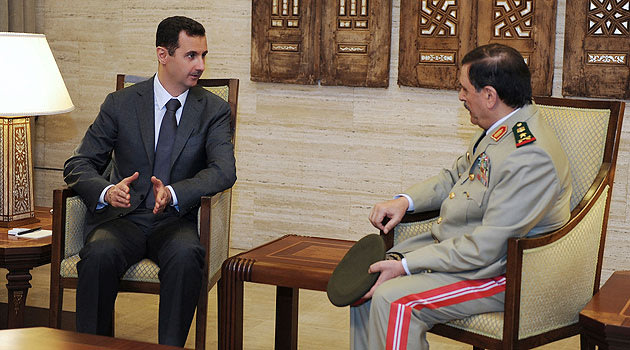
Bashar Assad attended the swearing-in of his new defense minister Thursday, according to footage shown on Syrian state TV, the first sign of the president since an audacious rebel attack the day before struck at the heart of his regime and killed three senior officials.
Government forces struck back against rebels with attack helicopters and shelling in a fifth straight day of clashes in Damascus. The inability of the military to control the clashes in the capital against lightly armed rebel forces and the deadly bombing of a high-level security meeting a day earlier made Assad's hold on power look increasingly tenuous. The whereabouts of Assad, his wife and their three young children have been a mystery since the attack that killed his brother-in-law and his defense minister. Assad does not appear in public frequently, and his absence was notable following such a serious blow his inner circle. The state TV announcement appeared aimed at sending the message that Assad is alive and well. It said Assad, dressed in a blue suit and tie, wished the new defense minister good luck but it did not say where the swearing-in took place. Thousands of Syrians streamed across the Syrian border into Lebanon, fleeing as fighting in the capital entered its fifth straight day, witnesses said. Residents near the Masnaa crossing point — about 25 miles (40 kilometers) from Damascus — said hundreds of private cars as well as taxis and buses were ferrying people across. Wednesday's rebel bomb attack struck the harshest blow yet to Assad's regime. The White House said it showed Assad was "losing control" of Syria. Syrian TV confirmed the deaths of Defense Minister Dawoud Rajha, 65, a former army general and the most senior government official to be killed in the rebels' battle to oust Assad; Gen. Assef Shawkat, 62, the deputy defense minister who is married to Assad's elder sister, Bushra, and is one of the most feared figures in the inner circle; and Hassan Turkmani, 77, a former defense minister who died of his wounds in the hospital. Also wounded were Interior Minister Mohammed Shaar and Maj. Gen. Hisham Ikhtiar, who heads the National Security Department. State TV said both were in stable condition. Rebels claimed responsibility, saying they targeted the room where the top government security officials in charge of crushing the revolt were meeting. Maj. Gen. Robert Mood, the Norwegian head of nearly 300 unarmed U.N. observers in Syria, condemned the violence and encouraged a diplomatic solution, which appears increasingly out of reach. "It pains me to say, but we are not on the track for peace in Syria," Mood said in Damascus. Hours later, China and Russia vetoed a new U.N. Security Council resolution on Syria's crisis — reflecting divisions between them and the West on who is responsible for Syria's crisis and how to stop it. The resolution would have imposed non-military sanctions against Assad's government if it didn't withdraw troops and heavy weapons from populated areas within 10 days. It was tied to Chapter 7 of the U.N. Charter, which could eventually allow the use of force to end the conflict. Russia and China have long opposed any moves that put the blame exclusively on Damascus or could pave the way for foreign military intervention in Syria. The 11-2 vote, with two abstentions, leaves in limbo the future of the 300-person U.N. monitoring team in Syria, whose mandate expires Friday. The latest fighting in Damascus, government forces fired heavy machine guns and mortars in battles with rebels in a number of neighborhoods in the capital, the Britain-based activist group Syrian Observatory for Human Rights said. Adding to the confusion, Syria's state-run TV warned citizens that gunmen were disguising themselves in military uniforms to carry out attacks. "Gunmen are wearing Republican Guard uniforms in the neighborhoods of Tadamon, Midan, Qaa and Nahr Aisha, proving that they are planning attacks and crimes," SANA said. Many residents were fleeing Damascus' Mezzeh neighborhood after troops surrounded it and posted snipers on rooftops while exchanging gunfire with opposition forces. The Observatory, which relies on a network of activists inside Syria, said rebels damaged one helicopter and disabled three military vehicles. Rebels fired rocket-propelled grenades at a police station in the Jdeidet Artouz area, killing at least five officers, the group said. Activist claims could not be independently verified. The Syrian government bars most media from working independently in the country. The unarmed observers were authorized for 90 days to monitor a cease-fire and implementation of Kofi Annan's six-point peace plan, but the truce never took hold and the monitors have found themselves largely locked down because of the persistent violence. Mood said the observers "will become relevant when the political process takes off." Syria's 16-month crisis began with protests inspired by the Arab Spring wave of revolutions, but it has evolved into a civil war, with rebels fighting to topple Assad. Activists say more than 17,000 people have been killed since the uprising began in March 2011, most of them civilians. The Syrian government says more than 4,000 security officers have been killed. It does not given numbers of civilian dead. ___

Political solution in Syria hard to achieve amid escalating violence

The long-lasting violence in Syria is gaining momentum recently as severe military showdown is now taking place in several areas in the heart of the capital Damascus, a snub to all political solutions as each party of the conflict is determined to demolish the other by force. The showdown started Sunday afternoon between regular troops and armed rebels in several neighborhoods of Damascus, which has relatively kept a distance from the violence elsewhere. The military confrontation came as the armed rebels announced the commencement of the "great battle of Damascus" in a bid to bring down the government's stronghold. The intensity of the clashes ramped up Wednesday after the rebels managed to blast a meeting room grouping top Syrian officials and cronies to the Syrian President Bashar al-Assad. The killed officials are defense minister, his deputy and assistant vice-president. The meeting was also attended by many other figures, some of whom were injured, including the interior minister. The defense ministry pledged to hit back hard and cut the hands of those who dare to undermine the security of the country, as the armed rebels Free Syrian Army claimed responsibility for the blast and vowed to stage more assaults. Moreover, the rebels said they will not back down, buoyed by their success in hitting many officials in one hit.Media reports said dozens have been killed over the five-day deadly conflict in and around the capital. While the military confrontation is on the rise, calls for dialogue sound like a sweet but far fetched dream given the gravity and the volatility of the situation, which has been complex from the very beginning of the national upheaval. Moreover, the West-backed Syrian opposition in exile refused to accept the concept of dialogue, damping all efforts in that regard. The broad-based opposition contended that a dialogue with a “criminal regime" is of no avail, saying the dialogue would be plausible if it only discussed the way of handing the power over to the revolutionaries. The anti-government movement has gained momentum after the United States and its Western allies lined up behind the opposition, promising them support and emboldening them to refuse dialogue with the current leadership. The United States has slapped Syria with many rounds of sanctions and called repeatedly on Assad to renounce power, while at the same time rendering support to the opposition, a tactic which has met discontent by Russia, which called on the West to practice pressure on the opposition to hold talks with the Assad administration to iron out differences and craft a political solution to end the crisis.On Thursday, Russia and China vetoed a West-backed resolution in the UN Security Council, which called on the Syria government to pull out troops from populated areas within 10 days or face non- military sanctions. However, the draft resolution were to be adopted under chapter 7 of the UN Charter, which would open doors for a military response if the Syrian government failed to implement the resolution. Thursday's meeting of the UN Security Council left the future of the UN Supervision Mission in Syria (UNSMIS) unclear as the mission's mandate ends on July 20. The head of the mission, Maj. Gen. Robert Mood, left Syria on Thursday and headed back to Geneva. Before his departure, Mood stressed that the situation in Syria is not on track for peace given the escalation of violence over the past few days. "It pains me to say, but we are not on the track for peace in Syria and the escalation of violence we have witnessed in Damascus over the past few days is a testimony to that," Mood said. Mood lambasted the military confrontation as it would only increase the suffering of the Syrian people and would not be conducive in ending the conflict. "I, as a soldier, know more than many that the decision in favor of peace is harder than that of war," Mood said, adding that "it is the fabric of a society that will be deeply damaged by war, and greatly enhanced by the prevalence of peace." Mood said the government and opposition must make concessions, otherwise the there will be days of suffering for the Syrians, an appeal that seems difficult to take place in the near future.

Western efforts to force Syria resolution through UNSC is doomed and dangerous

The UN Security Council failed, for the third time, to adopt a Western resolution on Syria on Thursday after a double veto from Russia and China, further exposing the profound divisions among key council members on how to end the escalating violence in the Middle East country. China's stance on the Syria issue is consistent and clear. The country has long called for an immediate end to all kinds of violence and worked hard with other countries to pave the way for a political solution to the 16-month long crisis. The latest draft, backed by Britain, the United States and some other countries, threatens to impose sanctions against the Syrian government without exerting enough pressure on the increasingly violent opposition groups. Given to the unbalanced nature of the draft and the Western envoys' intransigence in the negotiations, no one has really expected the document to get anywhere. It is doomed from the very beginning. Unfortunately, some Western countries hastily pushed for a vote on the immature draft, which, if adopted, will only lead to more violence in Syria. Western diplomats rushed to point fingers at Russia and China after the resolution was defeated, but they have only themselves to blame for trying to force such an ill-considered draft through the Council. Besides, the Western diplomats displayed arrogance and inflexibility when responding to other Council members' concerns during the negotiations, ultimately leading to the failure of their efforts. It is safe to say the resolution is dead, but the damage has been done. The West, by pushing for sanctions against the Syrian government, sent a clear signal to the armed opposition groups that politicians in London and Washington are only interested in tieing the hands of Damascus, while the violent operations of the anti-government forces would be tolerated and even encouraged. For the UN Security Council, its credibility has been further damaged as major powers are locked in fierce internal bickering. The Western attempt to force the draft resolution through the Council has also poisoned the atmosphere among key council members. Instead of taking up a confrontational approach, major Western powers should work with Russia and China to support the peace-making efforts of UN-Arab League joint special envoy Kofi Annan. The mandate of the U.N Supervision Mission in Syria, which expires on Friday, should be renewed as soon as possible to give peace efforts another chance. Council members should also enhance coordination and display flexibility so as to convey an unified message to all concerned parties in Syria. Only through this way can the Council find an effective resolution to the crisis and secure its own credibility. The future of Syria should only be decided by the Syrian people. Any outside intervention, if driven by geopolitical ambitions, will only further complicate the situation and lead to more bloodshed in the conflicts-torn country.

World remains divided on Syria as UNSC fails to pass resolution again

• Russia and China on Thursday, for the third time, vetoed a Western-proposed draft resolution. • Susan Rice, U.S. ambassador to the UN, told the UNSC that it "utterly failed" on Syria. • Ban Ki-moon said that he is disappointed at the UNSC's failure to adopt the resolution.
The world seems to be still clogged up in their divide on how to solve the chronic and tumult crisis in Syria as a UN draft resolution was killed again on Thursday. Russia and China on Thursday, for the third time, vetoed a Western-proposed draft resolution, which threatens non-military sanctions by quoting Chapter VII of the UN Charter if the Syrian government fails to pull out troops and heavy weapons from populated areas.
The two countries explained after the vote that the resolution was "biased" and "seriously problematic," and went against the consensus that was reached by the Action Group members at a meeting in Geneva late last month. China's permanent representative to the UN Li Baodong said on Thursday the resolution "would not help resolve the Syrian issue, but instead would only derail the issue from the track of political settlement...undermine regional peace and stability, and ultimately impair the interests of the people in Syria and the region at large." He said UN-Arab League joint envoy Kofi Annan's mediation work is "an important and realistic way" to achieve for the political solution to the Syrian issue, yet the vetoed text has seriously disrupted Annan's efforts. Li slammed the draft's sponsoring countries for being too rigid and arrogant to listen to other nations' reasonable concerns, and revise the document. China has all along been trying to play a "positive and constructive" part on the Syrian crisis in terms of supporting a smooth extension of the mandate of UNSMIS (the UN Supervision Mission in Syria), and Annan's mediation efforts. Russian UN envoy Vitaly Churkin also believed that resolution has targeted "exclusively at the Syrian government, counter the spirit of Geneva's document and does not reflect the reality in the country today." Churkin noted Moscow has also drafted a resolution to bring the UNSC members together, back Annan's work and to extend the mandate of UNSMIS. "We believe that the continued confrontation in the Security Council to be useless and counterproductive," said Churkin, adding that for this reason Russia would not submit its own draft for a vote. Churkin also suggested the Council adopt a brief, depoliticized resolution on a technical extension of UNSMIS' mandate for a specific period of time with a view to "preserving the useful potential" of the mission. Susan Rice, U.S. ambassador to the UN, told the UNSC that it "utterly failed" on Syria. "We will intensify our work with a diverse range of partners outside the Security Council to bring pressure to bear on Assad regime and to deliver assistance to those in need," she said. British foreign secretary William Hague on Thursday warned of increasing violence in Syria after the draft resolution was vetoed, saying the situation on the ground is "desperately serious" and "getting worse by the day." "What is happening in Syria is a tragedy for its entire people and a threat to international peace and security," Hague said. Also on Thursday, UN Secretary-General Ban Ki-moon said in a statement that he is disappointed at the UNSC's failure to adopt the resolution. It said that the vote was disappointing as it comes at a time when more resolve and pressure were needed to achieve the goals endorsed by the Council, of a full cessation of violence to protect civilians and of facilitating a Syrian-led political transition leading to a democratic political system. "The hour is grave. The international community has a collective responsibility to the Syrian people," said the statement. The statement also noted that the secretary-general, together with the the international envoy Kofi Annan and the UN as a whole, will spare no efforts in the search to end the violence and human rights violations, and to bring about a peaceful and democratic transition headed by the Syrians. "The secretary-general reiterates his urgent call upon all sides to cease violence in all its forms, and move toward a peaceful, Syrian-led political transition," it added. Annan on Thursday also expressed his disappointment over the Security Council's failure to reach a new agreement on Syria. His spokesperson Ahmad Fawzi said the the envoy is disappointed that at this critical stage the UNSC could not unite and take the strong and concerted action he had urged and hoped for. "He believes that the voice of the Council is much more powerful when its members act as one," Fawzi said.