The Express TribuneA top government functionary dropped the clearest hint yet on Sunday that Pakistan may reopen Nato supply routes for US-led foreign forces stationed in Afghanistan. “We cannot oppose Nato nor can we live a secluded life in this world,” Khyber-Pakhtunkhwa Governor Barrister Masood Kausar told reporters in Peshawar. The governor was speaking to the media during a visit to the Hayatabad Medical Complex to enquire after the health of Saturday’s Landi Kotal blast victims. He added that the government would have to take a decision over the Nato supply lines. Governor Kausar’s statement came against the backdrop of reports that the United States is getting increasingly impatient over the delay in the resumption of supply lines. A diplomatic source disclosed that the United States is pushing the embattled government to reopen the land routes at the earliest, as it fears that uncertainty hanging over the rule of Prime Minister Yousaf Raza Gilani might delay the process for months. “This is certainly an issue of concern for us,” said a source referring to the ongoing legal battle over the fate of Premier Gilani. The apex court is currently examining multiple petitions that challenge the ruling of National Assembly Speaker Dr Fehmida Mirza, who refused to disqualify the prime minister after he was found guilty of contempt of court. Legal experts believe that this week is crucial, as the three-member bench, headed by Chief Justice Iftikhar Muhammad Chaudhry, asked the premier’s lawyer Aitzaz Ahsan to complete his arguments soon. In what appears to be anticipation of a possibly adverse decision, Premier Gilani has called off his trip to Brazil for an international environmental conference. Foreign Minister Hina Rabbani Khar will represent Pakistan at the conference instead. Gilani’s move to opt out of the conference is attributed to ongoing cases in the apex court. The US urgency stems from the fact that Nato supplies may remain blocked for months if the prime minister is disqualified by the Supreme Court. A Pakistani official familiar with the development has confirmed that there had been intense efforts in recent weeks by Islamabad and Washington to break the deadlock in ties. The official, speaking on condition of anonymity, told The Express Tribune that Washington wanted to see the government take a decision before any judgment by the Supreme Court. He said the agreement on technical details related to taxes and transit fees Pakistan intends to impose on Nato trucks passing through the country had already been reached. “The matter rests with the political leadership of the two countries,” said the official. However, an American official pointed out that it was up to the Pakistani government to take the decision. “We have conveyed what we wanted to,” the official added. A crucial meeting of the Defense Committee of the Cabinet (DCC) is expected to review the situation this week to take a final decision. But officials from the two sides, though hopeful of a breakthrough, are not sure if the decision on the resumption of Nato supplies is imminent.
Monday, June 18, 2012
NATO supply routes: K-P governor warns of isolation
Zardari to visit Russia to attend Int’l Economic Forum
 President Asif Ali Zardari will pay a three-day official visit to Russia from June 20-22 to participate in the Saint Petersburg International Economic Forum (SPIEF).
President Zardari will join other world leaders in the Russian historic city of St. Petersburg at the annual gathering of leading decision-makers from across the globe to identify key economic challenges and engage in finding solutions.
With this year’s theme ‘Effective Leadership’, the President will highlight the issues affecting the global economy and the increasing role of emerging economic powers in shaping regional and global agendas.
Sources said President Zardari will also take part in the panel discussion titled ‘Leadership that works’ and will stress to minimize the global financial crisis and find ways to strengthen energy security, regulate financial markets, and introducing large-scale reforms.
He will also present Pakistan’s point of view on the global economic model for the twenty-first century that can withstand geopolitical challenges and meet the interests of all countries.
The President during his stay will hold talks with his Russian counterpart Vladimir Putin besides meeting several other world leaders and dignitaries on the sidelines of the Forum.
He will also interact with the presidents and CEOs of the leading international business companies to seek investment in Pakistan, particularly in energy sector.
The SPIEF will debate important topics including global energy outlook, the Eurasian economic integration, international global energy award, banking in the 21st century and investment in human capital.
Sunday, June 17, 2012
KHYBER-PAKHTUNKHWA:34 dead in two KP bomb attacks

 Thirty-four people were killed and more than 70 sustained injuries in two separate bombings in Landi Kotal and Kohat on Saturday.
In the first incident, 27 people became victims of terror strike at a market in the Landi Kotal town of Khyber Agency.
Assistant Political Agent Khalid Mumtaz Kundi said unidentified persons had parked an explosives-laden pickup truck at Ranghar Bazaar located on the Charbagh Road, which exploded at 10:55 am.
Soon after the incident, security forces rushed to the scene and cordoned off the area.
Two schoolgoing children were also among the victims, while 65 people, including a local journalist Ashrafuddin Pirzada, were injured in the bombing. The wounded were rushed to the Agency Headquarters Hospital Landikotal, from where five seriously wounded were referred to a hospital in Peshawar.
No organisation or individual has so far claimed responsibility for the deadly attack; however, it is stated that the vehicle terminal owned by the anti-militant Zekha Khel tribe was the main target, as it openly opposes the Mangal Bagh-led banned outfit Lashkar-e-Islam.
According to the local administration, 25 shops, three vehicles and other nearby buildings were damaged in the terror strike. Moving scenes were witnessed in the hospital as people were searching their beloved ones.
Later, a remote-controlled bomb attack on a police mobile killed seven people including four policemen, as they were patrolling Dhoda Road. At least 10 policemen were injured in the attack. An additional SHO was also among the dead. Three more injured are reported to be in critical condition
Bahrain police shoot 5-year-old in chest, eye
http://bikyamasr.comBahrain police have shot a five-year-old boy in the left eye and chest, reports said. The shooting occurred last Wednesday evening in the Dair village, a suburb of Muharraq, during a police crackdown on protesters. The boy was hit by birdshot, activists said. The young boy was then transferred to the Salmaniya Hospital for treatment, and doctors are still waiting to see whether the boy will lose his eyesight in the eye. The ABNA news agency reported the father said his son was conscious, but could not see out of his injured eye. Activists who were with the child in the hospital said that they were banned from speaking to the child’s father about the incident after the instructions of officer Yousef Mulla Bkheit “who is renowned for his torturing of the prisoners and assaulting them sexually,” the report said. The activists said that the family wanted to take the child to a private hospital, however, officer Bkheit refused. They said that the father’s body was full of bird shots pellets as well. They reported that police told him to move otherwise they would fire at him, when he turned to carry his child they fired on both of them. The man who was still in shock said: “It didn’t occur to me they would fire at an old man and his little child, we were only selling fish.” He confirmed that they fired on them on purpose. They fired twice at them. The activists said that the father’s and child’s blood covered their fish box where they were selling fish at the side of the road. The activists said the boy Ahmed Nahham was the youngest citizen whose eyes were fired at. Wefaq society, a leading opposition group, called on human rights organizations and groups to save Ahmed Nahham five-year old boy who was targeted by Bahrain police by bird gunshots along with his injured father who was with him during the incident. Wefaq statement explained that Ahmed was from Dair village that suffered the savage barbaric attack waged by the police. It added that police carried Ahmed away with them, nobody knew about his injury.
The plight of Manal al Sharif: a Saudi woman trying to drive to work
http://www.albawaba.comOne year ago today around 40 women in Saudi Arabia drove their cars, daring to claim their right and breaking the ban. Today, the Right to Dignity Campaign, known as “Women2Drive”, will present a petition to the King to change this draconian prohibition. It is signed by at least 760 people. While there is no law against it, many have been arrested since last year only to be freed when they signed a statement saying they would never drive again, Shaima Jastania was sentenced to 10 lashes for it only to be overturned by King Abdullah Bin Abdul Aziz, and the interior minister formally banned driving right after that day. Two women have even sued the government because they refuse to grant them driving licences. It was Manal Al Sharif, the Saudi woman who started the Women2Drive Campaign
 . As an employee of Aramco, the world’s biggest oil company owned by the kingdom, at the information protection management division, she was only one of only two women.
Part of her job benefits, included living in an Aramco employee town, in which, Saudi citizens enjoy a small amount of freedom. There are golf courses, cinemas, and, surprisingly, women drivers. Yes, women are permitted to drive inside the compound.
One day, trying to come home from a doctor’s appointment in a neighbouring town, Manal could not find a cab and her brother’s phone was turned off. She started walking. Men drove by with the windows down, hurling insults and lewd comments at her. One car even slowed down and doubled back to intercept her. On that day Manal feared for her life.
After hearing from coworkers the next day that there was no law against women driving, she asked herself, as reported by Women’s ENews, “I have a car and a driver’s licence. Why can’t I drive outside of Aramco?”
As Manal began to speak out and gain recognition for her activism, she was invited to various rights conferences outside of the country. Aramco time and time again denied her time off to attend the events. When she asked for permission to travel to Oslo last month to participate in the Oslo Freedom Forum, she was refused, and in consequence, she resigned. Manal closed her Oslo speech with the following line: “the rain starts with a single drop.”
On May 10 the Oslo Freedom Forum published Manal’s speech on YouTube. Since then, the video has been viewed more than 315,000 times, mostly from viewers inside the Arab peninsula.
Some YouTube users have downloaded the original video from the Oslo Freedom Forum’s YouTube channel and re-posted copies with misleading subtitles and commentary, portraying Manal as a traitor to Saudi Arabia and an enemy of Islam. As a result, Manal has been the target of thousands of attacks — on YouTube, Twitter, blogs, online news sites, and even print media in Saudi Arabia.
Saudi cleric Shaikh Abdul Aziz Al Tarifi recently issued a fatwa declaring Manal a “hypocrite” — thereby questioning her status as a Muslim and placing her under further risk.
Manal lost her job, the mortgage on her house, her job prospects for the future, and, if she chooses to leave Saudi Arabia to find work, she may also lose custody of her six -year-old son.
In Saudi Arabia there is no public transportation. On average, Saudi women pay upwards of one-third of their salaries to drivers. There are more than one million private drivers.
Saudi Arabian women risk arrest as they defy ban on driving
http://www.todayonline.comWomen in Saudi Arabia have been arrested and jailed for defying a ban on driving. Now they want men to join them in the passenger seat as they get behind the wheel. In the past year, they have lost jobs, friends, social standing, reputations and they have been imprisoned, shunned and - in a few cases - even received death threats. But women in Saudi Arabia were this weekend preparing once again to risk arrest and even flogging to drive cars in defiance of the country's ban. It was on June 17 last year that about 100 women took part in the first demonstration organised by underground civil disobedience campaigns Women2Drive and I Will Drive My Own Car. Many were arrested and jailed. One woman's sentence of 10 lashes was revoked only after the king intervened. It was the largest mass action since November 1990, when 47 Saudi women were arrested after demonstrating in cars. On Wednesday, two founders of the movement, Ms Manal al-Sharif, 33, and Ms Najla Hariri, 45, posted an open letter with 600 signatories to King Abdullah, appealing once more for an end to the ban on women driving. The letter said: "Our initiative is not aimed at violating laws." Today, women with international driving licences are being urged to flout the ban, but to make sure they do it respectfully, wearing the legally required full Islamic dress and displaying a picture of the king. Campaigners want men to show their support by travelling in the passenger seat with their wives, mothers, and sisters. They are also asking women to flood the traffic department with driving licence applications. "We only want to enjoy the right to drive like all women over the world," Ms Hariri told the Observer. "It is really hard for women to take such a stand for the right of driving," she said. It was in May last year that Ms Hariri, fed up with having to find a male relative to ferry her and her children around, began to drive herself. After hearing about Ms Hariri driving on Facebook, Ms al-Sharif, a divorced mother, followed suit a few days later, posting a video of herself on YouTube. Ms Al-Sharif was imprisoned by the religious police for more than a week. This month, Ms Al-Sharif was unable to join four other Arab women in Washington to receive a Vital Voices Leadership Award from an organisation founded by Hillary Clinton. "The main reason for not being at the awards was (concern) for my family's safety after receiving death threats from insane people," Ms al-Sharif tweeted. A year after she won recognition for defying the ban, Ms al-Sharif has been forced to resign from her job at Saudi's government-owned Aramco oil company and has lost her housing. Family members have left the country out of fears for their safety. \Meanwhile, a campaign called My Guardian Knows What is Best for Me - which opposes calls for a more liberal approach to women's rights, including women driving - has been started by a group of Saudi women. That means the high personal price that is being paid by Ms Hariri, Ms al-Sharif and other women could be for nothing if apathy stops women driving in Saudi. "I am very happy with the attention that we draw to our right to drive and I thank God that so many men are supporting us," said Ms Hariri. "I can't say women are afraid, but of course they are worried - worried equally about the police and about their families. "I hope that June 17 this year will bring us some good news regarding driving, because society's awareness is so much better now and there is wider understanding that there is an alternative here," she said. "All of us have the dream that our country can and will become a supportive community for women, where men and women are treated equally."
Bahraini regime forces attack anti-regime protesters
Anti-regime protesters in Bahrain have been attacked once again by the country’s Saudi-backed forces as the demonstrators continue to insist on their demands.
In the capital city of Manama, forces fired tear gas and rubber bullets at the protesters, who called for an end to the long-time rule of the Al Khalifa regime.
The Sheikhdom has been the scene of anti-regime demonstrations since February 2011. The Manama regime forces have been cracking down on the protests ever since.
The rallies continue across the kingdom despite a ban on public gatherings and the regime crackdown.
Scores of people have been killed and many others have been arrested during the revolution.
Bahrainis hold King Hamad bin Isa Al Khalifa responsible for the death and arrest of protesters.
Taliban ban anti-polio drive in Pakistan tribal area
 Pakistani militants in a Taliban and Al-Qaeda infested tribal region Saturday banned anti-polio vaccination
 teams, to protest US drone strikes saying the attacks were killing civilians.
"Anti-polio vaccination teams will not be allowed to administer polio drops among children in North Waziristan," local warlord Gul Bahadur said in a statement.
Bahadur, who is allied with Afghan Taliban fighting US-led troops across the border, said the ban will remain effective until the US stops drone attacks in the tribal region.
"On the one hand they are killing innocent women, children and old people in drone attacks and on the other they are spending millions on vaccination campaign," the statement distributed in the region's main town Miranshah said.
It said "the day and night US drone flights in Waziristan are causing mental illness in the local population which is more dangerous than polio."
Residents said people would respond to the call as Bahadur commands influence in the region.
Pakistan's northwestern tribal region, known as a hotbed of Taliban and Al-Qaeda militants, is witnessing increasing drone strikes amid a stalemate in US-Pakistan talks to end a blockade on NATO supplies crossing into Afghanistan.
Pakistan shut NATO supply lines in anger over US air strikes on a border post on November 26 that killed 24 Pakistani soldiers.
The statement, citing the case of Pakistani doctor Shakeel Afridi jailed for helping the CIA find Osama bin Laden, also slammed the immunisation campaign saying that it may be used for espionage purposes.
Afridi was arrested after US troops killed bin Laden in May 2011 in the northwestern town of Abbottabad where he set up a fake vaccination programme in the hope of obtaining DNA samples to identify the Al-Qaeda leader.
He was sentenced to 33 years in jail on May 23.
Pakistani authorities whipped up anti-American sentiment after the bin Laden raid calling the drone strikes a violation of national sovereignty.
But US officials consider the attacks a vital weapon in the war against Islamist extremists, despite concerns from rights activists over civilian casualties.
UN High Commissioner for Human Rights Navi Pillay recently called for a UN investigation into US drone strikes in Pakistan, questioning their legality and saying they kill innocent civilians.
Saturday, June 16, 2012
China launches spaceship with first female astronaut
xinhuanet.com
 China launched Saturday Shenzhou-9 spacecraft with the country's first female
 astronaut aboard.
Shenzhou-9, atop an upgraded Long March-2F carrier rocket, blast off from the Jiuquan Satellite Launch Center in northwestern China at 6:37 p.m. Saturday.
A see-off ceremony was held at the center hours before the launch. Wu Bangguo, the country's top legislator, attended the ceremony and extended wishes to the three astronauts.
 "The country and the people are looking forward to your successful return," he said.
The first Chinese woman in space Liu Yang, 33, is joined by commanding officer Jing Haipeng and Liu Wang, who has been selected as an astronaut trainee since January 1998.
Main tasks of the Shenzhou-9 mission include the manual docking procedure conducted between the Shenzhou-9 and the orbiting space lab module Tiangong-1.
China succeeded in the automated rendezvous and docking between unmanned Shenzhou-8 spacecraft and Tiangong-1 last year.
A successful manual docking will demonstrate a grasp of essential space rendezvous and docking know-how, a big step in the country's manned space program to build a space station around 2020.
Liu, a People's Liberation Army (PLA) major, was a PLA Air Force pilot with 1,680 hours of flying experience and deputy head of a military flight unit before being recruited as an astronaut candidate in May 2010.
After two years of training, which shored up her astronautic skills and adaptability to space environment, Liu excelled in testing and was selected in March this year as a candidate for the Shenzhou-9 manned space mission.
"Female astronauts generally have better durability, psychological stability and ability to deal with loneliness," Wu Ping, spokeswoman for China's manned space program, said.
More than 50 female astronauts from seven countries have gone into space to date. The longest space flight by female astronauts lasted 188 days.
BALOCHISTAN BUDGET—AN ATTEMPT TO STREAMLINE ECONOMY
 The Provincial Government has presented it last budget of its five-year tenure pending general elections sometime next year. The budget is generally welcomed as a good budget for the province with some reservation about the leakages of funds and misuse of official powers by some sections of the ruling coalition. Again it is record development budget with the commitment from the Minister in-charge to monopolize the development spending and not to disclose to the media about the details or reviews of the past development spending. It is good news that the Provincial Government had proposed massive spending on solar power meeting the growing energy needs of Balochistan. Some Rs 888 millions had been allocated for solar homes and Rs 3.5 billion allocated for this sector. The Chief Minister Secretariat and the Governor’s House will be switched over to solar system ensuring round the clock power supply to import centres of power in Balochistan. It is far better to provide solar system to the entire provincial secretariat, the real centre of administrative power in this province. Special funds should allocate for providing solar system for the Civil Secretary ensuring round-the-clock power supply to the Secretariat. We had earlier suggested in these columns that the entire village electrification programme of the Government should be converted and solar system be used as it is more feasible for this vast province of Pakistan. The Grind system is a failure and every village should have small power house based on solar energy instead of taking costly and lengthy transmission line to all corners of Balochistan. For this simple reason, the village electrification system has failed and now a day there is no electricity thus Government is resorting to massive load shedding of 22 hours a day in major parts of Balochistan.
The second import decision is to allocate fund for making Reko Dik Project operational at the earliest since there is no chance that the consortium of two international firms are unable to make it function following a dispute with the provincial Government. Reko Dik is the most prestigious project and it remain corruption and scandal free in the interest of poor people of Balochistan. All corrupt, vested interests and dishonest people should be kept far away from the project so that it is implemented at the earliest. Reko Dik will guarantee a sizeable income to Balochistan taking it out from the perennial financial and economic crisis, once its start production. The project had been delayed for more than two decades as vested interests were involved and corrupt and dishonest people in the Government did not implement it on priority basis. Now time has come that the Government should not delay it further. Help from brotherly Iran can be sought in establishing a refinery for separation of copper from gold disallowing the import of blister copper to outside world.
Finally, the subsidy on agriculture tube wells is totally misplaced keeping in view the depleting water table in areas from owners are given subsidy for indiscriminate withdrawal of sub soil water. There is no justification for subsidy to a small area of Balochistan and denying to the rest of Balochistan. It is discriminatory and uncalled for. In total, the Government is providing a subsidy of Rs seven billion while the entire product of fruits, including apple value less than Rs One billion, to say the least. The Government should stop this subsidy as it was stopped to wheat subsidy for the last couple of year. Let the growers make their own economics viable with subsidy and plan their agriculture land on this basis. No public money should be provided for a man made disaster for drying up the subsoil water making whole of Balochistan a huge desert sooner or later. We hope that the Government will end the shortsighted policy of subsidy to agriculture tube wells merely because the owners had a political clout in the present Government.
Pakistan: The menace in media
Editorial:Daily TimesThe events of the last week that have come to be known as ‘FamilyGate’ and ‘BahriaGate’ have given rise to a new gate yesterday: MediaGate. In a document printed on a Bahria Town letterhead, 19 journalists and media personnel have allegedly received kickbacks and bribes from Malik Riaz. On the heels of that startling but so far unsubstantiated document, the latest storm on social, print and electronic media unleashed after behind the scenes footage of a private TV channel found its way to YouTube. All hell broke loose as the ‘friendly’, personal talk/arguments between the interviewee and the interviewers were caught on tape and leaked on the internet. As the drama takes a public shape, the ‘tarnished’ channel in order to clear its name as two of its most prominent anchors face public and media condemnation, the response as expected is allegations of the unsavoury manipulation by a rival TV channel. There are a few things to be said about this. These allegations are a slap in the face of journalism in Pakistan and an insult to the 65-year struggle it took for good people to establish a free media in Pakistan. It wasn’t always like this: personal. As the latest media scandal upset the public’s sensibilities who hold certain individuals as a beacon of hope for Pakistan’s media as perpetrators of truth, it has also tarnished the country’s image abroad, making a spectacle of itself. The phenomenon of a ‘planted’ interview as it hollows out the credibility of the media, coupled with the allegation that certain prominent journalists are on the payroll of a certain businessman is a very serious development. It is now the duty of these 19 journalists to come clean on these allegations. For the most part, the media has never been subjected to accountability — whether it comes to incorrect facts or journalistic ethics. The owners and PEMRA turn a blind eye. Owners are driven by profits, swept up in a rat race of ratings. Most anchors and journalists have received no formal training and have a non- professional attitude. Their shooting to fame overnight empowers them, thus becoming a double-edged sword when they use it for ‘illicit’ acts, based on greed and an ugly rush to make professional advances. Started by TV anchors hurling allegations at each other on air, is this what airtime is meant to be used for? The CJP’s son’s alleged corruption charges are revealed by some anchors from a major media house; then it escalates and engulfs many, snowballing into the revelation of the list of 19 journalists, including the ones who presented the scoop. Why is this happening? Generally speaking, society has thrown all codes of ethics and morality out of the window. The clamour about alleged corruption in the media is the latest reflection of this virtually universal affliction in society. Journalists do not descend from the heavens, they are products of this very society, hence exhibiting a reckless behaviour that has become so commonplace it is considered a norm. Professionalism was to be the bedrock of the free media, but unfortunately not so anymore apparently if the example of the black sheep in the field is anything to go by . A multitude of inexperienced or unscrupulous journalists, after overnight excessive importance, have made a mess of a hitherto respectable profession. In the age of social media, whose power is an unfiltered double-edged sword, unsavoury results are sometimes produced as a result of an unlimited capacity to express yourself without fear or favour. It is some kind of accountability in itself, going into areas that old media could not venture into as easily. The latest development should serve as an example: it is time to look inwards. Breaking news is a tricky business; the ratings’ race is unchartered territory, which could lead to conscious and tacit victimisation of individuals and organisations. It is time journalists accepted responsibility for the huge task resting on their shoulders vis-à-vis the authenticity and veracity of what they present. A culture of corrections, explanations, and apologies must be incorporated. The ability to accept an error has been thrown out of the window in today’s rat race of ratings. A system of concrete reprimands and censure must be implemented. In that regard, the suo motu notice taken by the Supreme Court could apply a corrective, emhasising the importance of a proper system of veracity checks and balances.
No one could save Sharif brothers from money laundering case
www.sananews.netAfter the suspension of his Senate membership and subsequent reassignment as Adviser to the Prime Minister on Interior, Rehman Malik on Monday criticised the Sharif brothers in strong words and asked Shahbaz Sharif to keep up practice of jumping, adding that he will come in Lahore and will decide who will dance. He said that if I am IG of liars then the Shahabaz Sharif is the Super Daku, adding I advise Shahbaz to improve good governance instead of indulging in blame game. Speaking to media representatives at Karachi’s Jinnah International Airport, Malik referred to the duo as backstabbers. Malik also referred to the Pakistan Muslim League – Nawaz’s election symbol and said that “the lion roars, it does not jump from one place to another”. He summarised Nawaz Sharif’s political history dating from the time of his allegiance with General Ziaul Haq to the time when he separated from Chaudhrys. He said that the Sharifs jumped to Junejo League after leaving General Zia and later on they stabbed in the back of Maulana Samiul Haq in IJI and later formed PML-N and stabbed the Chaudhry Shujahat. He accused the Sharif brothers of causing a political upheaval and of staging a rebellion against the federation. Rehman also accused them of financial corruption. He said that the proofs of corruption of Shahbaz Sharif are with international agencies and he could save himself at any cost, adding that still he not disclosing any new corruption scandal against Sharifs, adding that the Sharifs will have to face the case of 32 million dollars money laundering case. He said that instead of approaching anyone the Sharifs could not save themselves from this case. He said that I had not said anything about the Nawaz Sharif but he himself thought that I have said anything against him. When asked about Karachi’s law and order situation, Malik hailed the performance of the provincial government and said that how PML-N leaders hatched conspiracies against democracy while sitting in Dubai I will expose this, adding that the Punjab government did not produced a single unit of electricity during past four years, adding that billions of rupees were wasted in Rasti Roti scheme and lap top schemes. He said that Shahbaz Sharif should focus on improving the good governance in the province instead of setting up camp at the Minar-e-Pakistan. He said that why Shahbaz Sharif has not taken any notice against the MS of Services Hospital Lahore over the fire eruption incident and death of 10 children, adding that if Shahbaz would have been performing his duties rightly this incident would have not been happened, adding that due to presence of Shahbaz at Minar-e-Pakistan the administration of Punjab is not working properly, adding if Shahbaz will not take not of Services Hospital tragedy then I will exercise powers of interior advisor and would form judicial commission for the investigations of the incident. He said that he was the first man who took the notice of the rape incident of five women in Dera Ghazi Khan. Replying the question on the new spree of target killings in Karachi, Rehman Malik said that Karachi was a big city and was therefore harder to manage. He also said that in the case of Karachi, one political group was trying to suppress another which was resulting in the chaos. He said that there was good governance in Sindh, adding that the petty issues of Karachi would be solved soon. He said that according to the 18th amendment to control the law and order situation is the responsibility of the provincial government, adding that the interior ministry will provide every possible support to the provincial government.
‘Life threats to Asma curb on freedom’
The Joint Action Committee for People’s Rights has raised deep concerns over threats to noted human rights worker Asma Jahangir.
“Life threats to Asma Jahangir are curbs on all those voices that are being raised for the rule of law, constitution, justice, peace and democracy in Pakistan, which is a cowardice way to oppress the truth, but such tactics could not be allowed and will be dealt boldly,” said the speaker of the moot held at Aiwan-e-Iqbal on Friday.
People from different sectors of civil society, including IA Rehman, Imtiaz Alam, Khaled Ahmad, Roubeena Sahgal and Farooq Tariq, spoke on the occasion.
The speakers condemned the threats to the human rights activist and former president of Supreme Court Bar Association, Asma Jahangir. On the occasion, they said such malpractices must be stopped and all the institutions must function within their limits.
They questioned whether it was a crime if Asma raised her voice for people’s sufferings or talked about democracy, peace and justice.
Demanding probe into the very threats and publicising the findings of the factors involved, the speakers also highlighted the various aspects of the struggle and activism of Asma Jahangir for the past four decades. A protest rally was also organised at the end of the meeting.
It is pertinent to mention here that Asma Jahangir has been receiving life threats recently over some of her views in favour of democracy and real freedom of judiciary.
Khyber Agency: 14 killed in Khyber Agency explosion
DunyaNewsAt least 14 people have been killed in blast in Landi Kotal area of Khyber Agency.A bomb ripped through a market area in a northwest tribal town near the Afghan border on Saturday, killing at least 14 people and wounding more than 30, officials said. The blast took place in the main bazaar of Landi Kotal town in Khyber tribal district, local administration official Arshad Khan said. The bodies and the injured people have been taken to the nearby hospital.The law enforcement agencies have cordoned off the area and an initial investigation into the blast has also been initiated.So far, the nature of the blast is not known.
Friday, June 15, 2012
Saudi women urged to flout driving ban
 Activists on Friday urged women to get behind the wheel for Sunday's first anniversary of the Women2Drive campaign, which resulted in the arrest of people defying Saudi Arabia's ban on women drivers.
"The key to ending the ban imposed on women driving in Saudi Arabia starts with women themselves," said a statement from the Women2Drive initiative, received by AFP.
It urged "women who hold driving licences (from abroad) to drive on the anniversary day, June 17, and document their acts."
It also urged men to get in the passenger seat and support their wives, mothers, or sisters who decide to flout the ban in the act of protest.
The statement called on women to flood the traffic department with applications for driving licences, knowing that women will not get such permits, and then to write to the head of the department to complain.
Nearly 600 people petitioned King Abdullah on Wednesday to allow women to drive in the only country in the world they are banned from doing so.
The petition urged the monarch of the ultra-conservative kingdom to "encourage women who have obtained driving licences from neighbouring countries to begin driving whenever necessary."
They also called on the king to "establish driving schools for women and (begin) issuing licences."
The petition thanked the king, a cautious reformer, for giving women the right to vote in municipal elections set to take place in 2015, saying "our initiative is not aimed at violating laws."
"We only want to enjoy the right to drive like all women over the world," said the petition signed by Manal al-Sherif, the icon of an Internet campaign launched last year urging Saudi women to defy the ban.
Many women have driven since the campaign was launched last year and many have been arrested and forced to sign a pledge that they will never drive again, activists say.
One group of defiant women drove cars last June in response to calls for nationwide action to break the ban.
The campaign, which spread through Facebook and Twitter, was the largest mass action since November 1990, when 47 Saudi women were arrested and punished after demonstrating in cars.
No law specifically forbids women in Saudi Arabia from driving, but the interior minister formally banned women from doing so after that protest.
Women with the financial means hire drivers, but others depend on the goodwill of male relatives to get around.
Pakistan:Strict action ordered against Pakistani chief justice's son, realtor
 Pakistan's Supreme Court has ordered strict action in a bribery case involving Chief Justice Iftikhar Muhammad Chaudhry's son and a real estate tycoon.
Wrapping up the case, a two-member bench ordered Attorney General Irfan Qadir to take strict action against the chief justice's son Arsalan Iftikhar, real estate tycoon Malik Riaz and the latter's son-in-law Salman Ali Khan, Dawn reported.
Justice Jawad S. Khawaja read out the short order after Thursday's proceedings.
"It is our expectation that he (the Attorney General) will set the machinery of the case in motion so that all those who may have committed any illegal acts, including Malik Riaz Hussain, Dr. Arsalan, Salman Ali Khan etc are pursued and brought to book with the full force and rigor of the law," the 14-page order read.
Not only was the Pakistan Supreme Court's credibility questioned, the bench said, but allegations were also levelled against the chief justice and the judiciary.
It added that bribery is a sin, and both givers and takers of bribes were sinners.
On Tuesday, Riaz had detailed before the court the alleged payments he made to Arsalan Iftikhar over the past three years, including for his foreign visits, stay at high-end hotels in London and Monte Carlo, and picking up his gambling losses.
About the reasons for taking the suo motu notice of the case, the Bench stated that such a notice was necessary to counter the erroneous perception about the Supreme Court being created due to media reports.
The court ruled that Riaz attempted to "buy justice" through bribery, and that he had grown into a habit of buying everything with money. He fuelled kcepticism and raised doubts on the apex court's credibility.
White House to halt deportation of young illegal immigrants
YAHOO NEWS
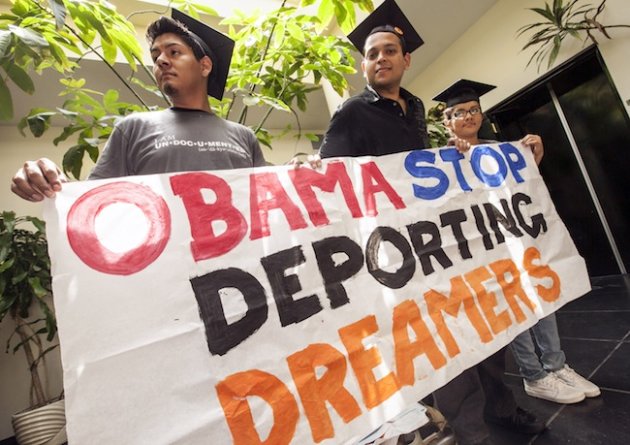 The White House will halt the deportation of as many as 800,000 young illegal immigrants and in some cases give them work permits, in a sweeping new initiative announced by the Department of Homeland Security.
People under 30 who entered the country illegally or overstayed their visas when they were under the age of 16 will be immune from deportation if they have not committed a significant misdemeanor or felony and have graduated from a U.S. high school or joined the military. They can apply for a renewable two-year work permit that won't provide a path to citizenship but will allow them to work legally in the country. Applicants will have to prove they've lived in the country for five consecutive years.
Homeland Security Secretary Janet Napolitano told reporters on Friday that she believed the move "is the right thing to do," and will help the agency focus on deporting criminals. "It is not immunity, it is not amnesty," she said. "It is an exercise of discretion so that these young people are not in the removal system."
Young people will have to proactively apply and pay for the temporary legal status at a local United State Citizenship and Immigration Services office. If the deferred status is granted, they can apply for a work permit.
"I wouldn't say we are encouraging people to step forward," an Obama administration official told reporters. "We are making a process available and people can make their own decision."
President Obama will address the change in a speech at 1:15 pm.
Young people who were brought into the country illegally or overstayed their visas as children are commonly referred to as "Dreamers," referencing the title of a decade-old bill that would have given them legal status if they joined the military or attended college. The Dream Act passed the House nearly two years ago, but was blocked by Republicans in the Senate. Opponents of the bill have argued that it would encourage more people to enter the country illegally, while supporters say it helps people who were brought up as Americans and whose lack of status is not their own fault become full members of society.
President Obama has faced criticism from the crucial Hispanic electorate for ramping up deportations under his tenure and for failing to deliver on his campaign promise to pass comprehensive immigration reform within his first year in office. Several times in the past year, Obama has told Hispanic audiences who asked him why he did not issue an executive order halting deportations of some classes of immigrants that such a move would be legally impossible. "There are enough laws on the books by Congress that are very clear in terms of how we have to enforce our immigration system that for me to simply, through executive order, ignore those congressional mandates would not conform with my appropriate role as President," Obama told one Dreamer who asked him why he couldn't halt young people's deportations in July. It's unclear what made him change his mind.
"We've been hearing all sorts of things from the White House, that it's not legally possible, that it's not politically possible," said Erika Andiola, a 25-year-old Arizona-based Dreamer and advocate who has met with administration officials on the subject. "I can't even believe it. We've been working for this for so long."
The move may generate enthusiasm among many Latinos: 85 percent of registered Latino voters said in a Latino Decisions poll that they support the Dream Act. The president enjoys a strong lead among Hispanic voters over Mitt Romney, but a lack of enthusiasm among these voters could mean they stay home on Election Day in swing states like Nevada, Colorado and Florida. During the primary, Mitt Romney said he would veto the Dream Act, but in recent weeks he has seen open to a proposal by Sen. Marco Rubio to grant Dreamers a worker permit but not a path to citizenship.
Republicans have rushed to criticize the move as an executive overreach. "This decision avoids dealing with Congress and the American people instead of fixing a broken immigration system once and for all," wrote Sen. Lindsay Graham, one of the few Congressional Republicans who supports immigration reform.
Dunya News workers vow to counter conspiracies
 An orchestrated campaign was launched against Dunya TV by nefarious elements.
Talking to Dunya News, senior politicians and journalists revealed that certain insignificant media groups in league with nefarious elements launched a well-thought out conspiracy against Dunya News and its workers to thwart media-group’s swift progress.
Dunya newspaper is in the offing and its popularity has threatened the vested interests.
Thousands of Dunya News workers have vowed to valiantly defeat this conspiracy.
Rana Azeem - the president of Punjab Union of Journalists - said that those involved in such anti-media propaganda would not succeed in their cause.
"Dunya News achieved exemplary success in short span of time" he added.
PPP s deputy parliamentary leader in the Punjab Assembly Shukar Basra said Dunya News raised its voice against the dictators and always kept public interest in view.
PML-Q leader Chaudhry Zaheeruddin vowed to support Dunya News and asked its administration to continue serving the masses through unbiased reporting.
He also said that the matter should be taken to the court and those involved in the conspiracy should be brought to justice.
PML-N leader Ayaz Amir said leaked off-air footage of the program is being used by various media groups as a tool to fuel anti-Dunya News sentiments.
Inamullah Niazi, member of PTI said that leakage of the footage was a violation of privacy law.
Gondal warns Shahbaz against misuse of funds
Pakistan Peoples Party Parliamentary leader in the Punjab Assembly Zulfiqar Gondal has urged the Punjab chief minister to refrain from misusing the development funds allocated in the provincial budget 2012-13 for various sectors on the PML-N’s election campaign.
Speaking at the chamber of opposition leaders on Thursday, he said, the Punjab budget was a mere eyewash in which no relief was given to the poor, alleging that Shahbaz Sharif kept billions of rupees with him to run his party’s election campaign.
Last year, he said, he had allocated Rs 9 million for the use of his helicopter while in this budget Rs 39 million were earmarked which he said consolidated their doubts that he would recklessly use the helicopter for his election campaign.
He said the PML-N leadership’s blaming the federal government for load shedding was abstruse as his own government could not add a single megawatt of electricity to the national grid during the last four and a half years.
Answering a question, Gondal said the Sharif brothers will not hold local body elections because they know the results will not be in their favour.
He demanded the government to present a complete report regarding the Services Hospital fire in the House.
Mehdi Hassan laid to rest in Karachi

 Funeral prayers of Ghazal maestro Mehdi Hassan was held on Friday amidst thousand of mourners.
His Funeral prayers were held in an open ground near Noorani Mosque at the area of Ancholi in Karachi.
Speaker National Assembly Nasir Ahmad Khoro, MQM, Pakistan People Party leaders and many singers, actors and stage drama actors, admirers and friends also attended the funeral prayer.
After funeral prayers he was buried in Shah Muhammad Shah graveyard.
Thursday, June 14, 2012
China open to political proposals on Syrian conflict
 China is open to proposals on convening an international conference on Syria or establishing a contact group on Syria, a Chinese Foreign Ministry spokesman said here Thursday.
Spokesman Liu Weimin made the remarks at a regular press conference when asked to comment on proposals raised by Russian Foreign Minister Sergei Lavrov and Kofi Annan, the joint UN and Arab League special envoy for Syria.
As killings have been reported almost every day in Syria, Lavrov proposed an international conference on Syria last Saturday.
He said the international conference on Syria should become the "only framework" toward resolving the crisis in Syria and the only platform to implement the UN Security Council resolutions on Syria.
Also last week, Annan proposed an international contact group to bring together key world countries to bring an early end to the Syrian conflict.
"China advocates the international community adhering to the general direction of seeking a political resolution to the Syrian conflict," said Liu.
He called on the international community to provide full support for Annan's mediation efforts and promote the implementation of relevant UN Security Council resolutions as well as Annan's six-point plan.
"China is willing to maintain contact with all relevant parties on the above proposals," he said.
China has repeatedly said that it has no intention of siding with any Syrian party, and the Syrian people have the right to decide Syria's development path and political system, Liu said.
As long as consensus is made among different parties in Syria through political dialogue and can be accepted by all Syrian parties and the international community, China will be open to it, he noted.
On one hand, China hopes Annan's mediation efforts will make more progress as soon as possible. On the other hand, China calls for patience and international solidarity, given the complicated situation in Syria, said the spokesman.
He reiterated that international actions on Syria should be conducive to easing tensions in the country, promoting a political resolution to the issue and maintaining peace and stability in the Middle East region.
He again urged all Syrian parties to cooperate with the UN Supervision Mission in Syria (UNSMIS), put an end to all forms of violence and protect civilians, so as to defuse tensions at an early date.
"China disapproves of one-sided sanctions or pressure in the settlement of the Syrian conflict," he added.
MEHDI HASSAN:Mujhey tum kabhi bhi bhula na sako ge
Legendary classical singer Mehdi Hassan, who captivated millions of fans across the world, passed away on Wednesday after a long illness.
Mehdi, also known as Shahenshah-e-Ghazal (King of Ghazal Singing), died in a private hospital. He had been suffering from multiple lung, chest and urinary tract conditions.
Mehdi Hassan had been under treatment at hospitals for a while and there had also been reports of shifting him to India. He was admitted at the Aga Khan Hospital for the past couple of weeks after he had developed a chest infection and other related problems. He passed away after he was shifted to the Intensive Care Unit (ICU).
Mehdi Hassan was born in a well-known family of musicians at Luna village, India, in 1927. His family migrated to Pakistan after 1947.
He had been awarded Tamgha-e-Imtiaz, Pride of Performance and Hilal-e-Imtiaz by the Pakistani government.
Talking to the media outside the Aga Khan Hospital, Asif Mehdi, a son of Mehdi Hassan, said his father had a number of complications and had been admitted for treatment for a month.
He said keeping in mind the age factor, his father was getting weak and suffering from a number of health problems, including with lungs and chest. Stating the arrangements for the funeral were to be finalised soon, Asif said his brothers would reach Karachi shortly.
President Asif Ali Zardari and Prime Minister Yousuf Raza Gilani paid glowing tribute to the legendary singer. The president said Mehdi Hassan was an institution in himself and would always remain a beacon for the young artistes to learn from his mastery of singing.
Prime Minister Gilani said, “Mehdi Hassan is an icon, who mesmerised the music lovers not only in Pakistan but also in the Subcontinent for many decades.” Sindh Governor Dr Ishratul Ebad Khan and Chief Minister Syed Qaim Ali Shah have also offered condolences to the bereaved family.
MQM chief Altaf Hussain Altaf Hussain said the void created by his departure would never be filled and the nation had lost a great asset. He said Mehdi Hassan was the most towering personality in the field of ghazal singing in the world and he strengthened brotherly relations between the people of Pakistan and India with his unmatched singing.
PTI Chairman Imran Khan, Khyber Pk Chief Minister Amir Haider Khan Hoti, ANP Sindh President Senator Shahi Syed, Sindh Minister for Social Welfare Begum Nargis ND Khan, Advisor to Chief Minister Haleem Adil Shaikh and people belonging to different walks of life expressed grief over the death of Mehdi Hassan and offered condolences to the bereaved family.
Expressing his sorrow, film star Nadeem Baig said Mehdi Hassan’s demise was a big loss, adding that a voice like his might never be heard again. “I had been humming one of Hassan’s songs in the morning today and it was later that I had heard about his demise,” the renowned actor said.
He added that he was blessed to have had the opportunity to perform on his songs in films.
Nadeem also recalled that the maestro had encouraged him to sing and promised to teach him.
Ghazal singer Tina Sani said Mehdi was a legend even during his lifetime.
“I have no words except for God bless him,” said Sani.
She said the Shahenshah-e-Ghazal had given the world a legacy and he was a ‘passport’ for the people like her when they went abroad to perform.
Shahenshah-e-Ghazal Mehdi Hasan, also known as Khan Sahib, was quite possibly the most prolific ghazal singer the country and the sub-continent ever had. The maestro’s voice was as legendary as it was magical.
He was the recipient of the Tamgha-e-Imtiaz by General Ayub Khan, Pride of Performance by General Ziaul Haq in 1985 and the Hilal-e-Imtiaz by General Pervez Musharraf. In 1979, he was awarded the Saigal Award in India and the Ghorka Dakshan Bahu Award by Nepal in 1983. He had collected innumerable accolades and awards over the course of his career, which also includes nine Nigar awards, six of which were won in a row and also the Lifetime Achievement Award from the PTV Karachi in 2001.
Khan Sahib was especially known for his clarity of pronunciation and his absolute command over Urdu lyrics and the finesse, with which he delivered them, was unlike any other. His smooth and rich vocals had cast a very strong and very important influence on the popularity and development of ghazal in the subcontinent.
Mehdi Hasan was equally popular in Pakistan, India and Nepal. The former Indian prime minister AtaI Bihari Vajpayee was among his ardent admirers and had especially invited him over to sing at his residence in 1978.
Once during the course of a performance in the court of Nepalese King, Khan Sahib forgot the lyrics, but the King Shah Birendra Bir Bikram Shah Dev paid him tribute by prompting the lyrics for him.
Born in Luna, India, in 1927, his family ancestry consisted of proficient classical musicians since fifteen generations hailing from Kalawant. His father Ustad Azeem Khan tutored him on his initial music lessons based on the style intricacies of dhrupad, khayal, thumri and dadra. His father and uncle, Ustad Ismail Khan, were accomplished classical singers and his uncle had also had a profound impact on his musical training.
Mehdi Hassan’s talent wasn’t unnoticed for he had given his first solo performance at the age of five at Mahraja Barodi’s palace and had also been appreciated by the Maharaja of Jaipur.
Mehdi Hasan and his family have seen their fair share of struggles. When 20, Mehdi and his family migrated to Pakistan. The family was hard-pressed financially and Mehdi Hasan took up job as a mechanic in Khushab for livelihood.
It was in 1952, after the family had moved to Karachi, that Mehdi got his first break on Radio Pakistan with debut ghazal was “Gulon mein rang bharay baad e nau bahar chalay”, composed by his elder brother Ghulam Qadir. He had initially sung thumris on radio, which inevitably got the attention of music personalities. Rafiq Anwar and ZA Bukhari played a great role in kick-starting his career by providing him with opportunities to sing on the radio.
“Mujhey tum kabhi bhi bhula na sako ge”, “Ranjish hi sahi”, “Hum chaley iss jahan sey”, “Ko baku phel gaye baat shanasai ki” and others are among his famous songs and ghazals.
Parallel to his thumri renditions, Mehdi Hasan tried his hand at ghazals spurred by his passion for Urdu poetry. During this time, names such as Begum Akhtar, Ustad Barkat Au Khan and Mukhtar Begum were well established in the ghazal arena.
Over the years, the Pakistani film industry had benefitted from innumerable hits during his career as a playback singing through 1960s to late 1980s. Mehdi Hasan was a truly gifted artist. The late Parvez Mehdi and Talat Aziz were his famous students who learnt from the great maestro. Over the time, Mehdi Hasan had made the poetry of Ghalib, Faiz Ahmed Faiz, Qateel Shifai, Ahmed Faraz, Daagh, Parveen Shakir, Mir Taqi Mir, Saleem Kauser, Bahadur Shah Zafar and others come alive with his unique vocals.
Khan Sahib performed all across the globe. But in 1980s, he began to wane his playback singing and performances due to ailing health. General Pervez Musharraf had declared that all the expenses for his treatment would be incurred by the government. He had even been invited to India by Atal Bihar Vajpayee for treatment. The Ministry of Information and Broadcasting was also willing to pay all medical expenses for the treatment of Ghazal maestro, but in 2004 his sons Asif and Arif claimed that they received no grants save for the amount given by Pervez Musharraf that was stolen soon after. They also said that they were not the beneficiary of the concerts held in their father’s honour to raise funds for his treatment.
The sad demise of Mehdi Hasan brings to close a golden chapter in the music history of the subcontinent.
Karzai urges more international support for Afghanistan
Afghan President Hamid Karzai called Thursday for greater international cooperation to stabilise his war-torn country and defeat Islamist militants, during the latest round of talks on the future of Afghanistan.
Representatives from 29 countries gathered in Kabul for the day-long conference, just weeks after NATO agreed at a summit in Chicago to stick to plans to withdraw the bulk of 130,000 foreign combat troops from Afghanistan by the end of 2014.
The conflict in Syria is also expected to feature prominently in meetings between foreign ministers on Thursday -- including those from Britain and Russia.
The Taliban militia leading a 10-year insurgency against Karzai's government have begun this year's annual fighting season with a series of attacks which saw US Defense Secretary Leon Panetta admit last week that violence was rising.
Karzai said the help of neighbouring countries and international powers was vital to economic growth and peace in his impoverished country.
He also called on Pakistan, one of the historic sponsors of the Taliban, directly to support nascent efforts to end the 10-year war in Afghanistan.
"Support from these global powers and our neighbours is very important to Afghanistan and to the continued progress of Afghanistan towards stability and economic development," Karzai told delegates.
"Cooperation of all of us countries in the region, the neighbours, and our allies and NATO that will bring stability not only to Afghanistan but the much-needed relief from terrorism and radicalism and violence."
He also sought to reassure neighbours, Iran in particular, that strategic partnership deals signed by Kabul with several Western powers, particularly the United States, to govern relations beyond 2014, would not damage ties.
But Iran, a sworn enemy of the United States that welcomes NATO's departure from its eastern border, alluded to the Kabul-Washington pact by saying it adds to security concerns among Afghanistan's neighbouring countries.
Foreign Minister Ali Akbar Salehi said the deal and efforts to establish foreign military bases in Afghanistan ran counter to peace efforts and "could turn this country once again into scene of security rivalries".
Karzai is keen to broker a peace deal with the Taliban, but the militants publicly refuse to talk to his government. Earlier this year, it also announced that it had pulled the plug on nascent contacts with the Americans in Qatar.
The president said the head of the Afghan High Peace Council would soon visit Saudi Arabia and Pakistan, but gave no dates, and urged Islamabad to support peace efforts.
Afghanistan's relations with Pakistan have been clouded by mutual blame for Islamist violence plaguing both countries.
Karzai has consistently called on Pakistan to demolish terror sanctuaries in its semi-autonomous tribal belt.
Last week, Panetta also warned that the United States was running out of patience with Pakistan for not eliminating safe-havens of the Pakistan-based Haqqani network and other militants who attack US troops.
Islamabad denies any support for Haqqani activities and says it is doing everything possible to fight terrorism, saying no country has suffered more.
British Foreign Minister William Hague said he would use talks with his Russian counterpart Sergei Lavrov on the sidelines of the conference to press Moscow to use its influence to rein in the Syrian regime.
Monitors say more than 14,100 people have been killed in the 15-month uprising against the government of Syrian President Bashar al-Assad, and Moscow, long an ally of Damascus, has refused to halt weapons sales.
A row blew up Wednesday between Washington and Moscow over arming the rivals in the Syrian conflict after US Secretary of State Hillary Clinton said she had information that Russia was sending attack helicopters to Assad's regime.
Lavrov insisted Russia was supplying "anti-air defence systems" to Damascus and accused the United States of supplying arms to the Syrian opposition.
The next talks on Afghanistan will be in Tokyo next month and will focus on ways to ensure social progress -- governance, economic prospects, health and education.
Malik Riaz’s tirade
EDITORIAL:DAILY TIMESA virtual storm has overtaken the country as a result of the tirade launched by property tycoon Malik Riaz in his press conference following his appearance before the Supreme Court (SC) in the Arsalan Iftikhar case. Although Malik Riaz’s written statement submitted before the SC had levelled serious charges of being blackmailed by Arsalan Iftikhar out of millions of rupees in cash and other benefits, his demeanour before the court gave no hint of what was to follow. In his press conference, Malik Riaz shifted his line of attack from the son to the father, from Arsalan to the Chief Justice of Pakistan (CJP) Iftikhar Mohammad Chaudhry. Malik Riaz posed three questions directly to the CJP. First, he asked the CJP to tell the nation how many times he had met him in the darkness of the night? Second, was Arsalan not present in these meetings? Third, how many times had the CJP met Prime Minister Yousaf Raza Gilani at Malik Riaz’s partner Ahmed Khalil’s residence, where the sitting registrar of the SC was also present? According to Malik Riaz, a sitting judge of the SC also used to participate in these meetings. Why did the CJP not take suo motu notice then, and only after the media broke the news, asked Malik Riaz. When did the CJP come to know of Arsalan’s wrongdoings, he asked? (Aitzaz Ahsan has stated that he had informed the CJP of the rumours swirling about Arsalan’s business dealings six months ago.) Malik Riaz says a mutual friend of his and the CJP told the latter about the blackmailing of his son but the CJP refuted this and labelled Malik Riaz himself a blackmailer. These statements are startling enough, but Malik Riaz then descended to some wild and incredible assertions. He said the CJP should not have taken up cases against him, implying that since he was being blackmailed by his son, justice would be compromised. He claims the FIA was ordered to implicate him in a murder case, without clarifying who might be interested in such a step. The FIA is controlled by the federal government, the top leaders of the ruling party, President Asif Ali Zardari and Prime Minister Yousaf Raza Gilani being Malik Riaz’s friends, according to his own admission. Who then could have so ordered the FIA? In the next breath Malik Riaz exonerates by implication both the PPP-led federal government and the military from any responsibility for this ‘tsunami’ by declaring there is no ‘third party’ behind the controversy. Though he claims he did not bribe anyone, but was blackmailed, in the next breath he admits his son-in-law did pay bribes! Last but not least, and possibly the piece de resistance, he asserts that the judiciary is not free but being run by a ‘don’, i.e. Arsalan Iftikhar! He ends by promising more startling revelations “in due time”. In response to the diatribe of Malik Riaz, the CJP has taken suo motu notice of the press conference, set up a three-member bench to charge Riaz with contempt, and called a full court meeting of the SC on June 15. No one is in a position presently to ascertain the truth or otherwise of Malik Riaz’s charges, but the fact remains that a distinction needs to be made between what appear prima facie to be serious allegations against the CJP and his son, and wild statements that do not stand up to logic or scrutiny. Both serious allegations and wild statements however have dragged the judiciary into the mud. Whatever the CJP and the SC do in their defence and in defence of the respect and dignity of the judiciary, the taint of accusation will be difficult to jettison or wash clean. It would be in the interests of justice, the respect and dignity of the judiciary, and the country if the CJP were to contemplate stepping aside or at the very least going on leave until the whole matter is cleared up. The charges are too serious and the personage being attacked, the CJP, too important to allow the affair to be expediently dealt with. The truth must be brought out without fear or favour, and all those involved receive their just desserts according to their guilt or innocence as determined by a thorough investigation and final pronouncement by the apex court to salvage something of its battered image. *
Lahore: Girl allegedly gang raped by police
dunyaTv
A court bailiff raided the Factory Area police station and recovered the girl. As per details, the girl along with her brother was going to Walton in a rickshaw when they were stopped by police personnel at a check post on the pretext of checking. Police reportedly misbehaved with them. Later, the officials took them to police station and asked them to deposit Rs 50,000 bribe. Over refusal to pay, the girl was allegedly raped by four police personnel identified as Maqsood, Shehzad, Amin and Munawar. A court bailiff – upon complaint filed by victim s brother - raided Fatory Area police station and recovered the girl. A case has been registered against the policemen, however, no arrest has been made.
Wednesday, June 13, 2012
India advances, but many women still trapped in dark ages
 The birth of a girl, so goes a popular Hindu saying, is akin to the arrival of Lakshmi – the four-armed goddess of wealth, often depicted holding lotus flowers and an overflowing pot of gold.
That should assure pride of place for women in Indian society, especially now the country is growing both in global influence and affluence.
In reality, India’s women are discriminated against, abused and even killed on a scale unparalleled in the top 19 economies of the world, according to a new poll by the Thomson Reuters Foundation.
The survey, polling 370 gender specialists, found Canada to be the best place to be a woman amongst G20 nations, excluding the European Union economic grouping. Saudi Arabia was the second worst, after India.It’s a miracle a woman survives in India. Even before she is born, she is at risk of being aborted due to our obsession for sons,” said Shemeer Padinzjharedil, who runs Maps4aid.com, a website which maps and documents crimes against women.
“As a child, she faces abuse, rape and early marriage and even when she marries, she is killed for dowry. If she survives all of this, as a widow she is discriminated against and given no rights over inheritance or property.”
Many of the crimes against women are in India’s heavily populated northern plains, where, in parts, there is a deep-rooted mindset that women are inferior and must be restricted to being homemakers and childbearers.
In addition, age-old customs such as payment of hefty dowries at the time of marriage and beliefs linking a female’s sexual behavior to family honor have made girls seem a burden.
The poll results – based on parameters such as quality of health services, threat of physical and sexual violence, level of political voice, and access to property and land rights – jars with the modern-day image of India.
India had a female prime minister, or head of government, as long ago as 1966. Well-dressed women in Western attire driving scooters or cars to work is now an everyday sight in cities. Women doctors, lawyers, police officers and bureaucrats are common.
Millions Aborted
But scratch under the surface and the threats in India are manifold – from female foeticide, child marriage, dowry and honor killings to discrimination in health and education and crimes such as rape, domestic violence and human trafficking.
Indeed, a girl’s fight for survival begins in the womb due to an overwhelming desire for sons and fear of dowry, which has resulted in 12 million girls being aborted over the last three decades, according to a 2011 study by The Lancet.
This has led to a decline in the number of women in proportion to men in many areas, resulting in a rise in rapes, human trafficking and, in certain cases, practices such as “wife-sharing” amongst brothers.
In fact, the curse of dowry continues even after marriage.
One bride was murdered every hour over dowry demands in 2010, says the National Crime Records Bureau. Some are “stove burnings” where in-laws pour kerosene, the commonly-used cooking fuel of poorer homes; over women and set them alight, making it appear accidental.
“The courts are flooded with cases of gender-related crimes,” said retired Supreme Court judge Markandey Katju. He said honor and dowry murders should be punished with death.
“These are not normal crimes. These are social crimes because they disrupt the entire social fabric of the community. When you commit crimes against women, it has a lasting impact.”
Experts say child marriage remains among the biggest hurdles to women’s development in India and has a domino effect. Almost 45 percent of Indian girls are married before they turn 18, says the International Center for Research on Women.
A child bride will drop out of school and is more likely to have complications during child birth. One in five Indian women, many child mothers, die during pregnancy or child birth, the United Nations says.
Their babies, if they survive, are more likely to be underweight and suffer stunting due to poor nourishment. Many will be lucky to survive beyond the age of five.
In the narrow, crowded alleyways of Sapara slum on the outskirts of Delhi, 15-year-old newly married Aarti has never been to school and says she was married off because her father has tuberculosis and couldn’t work or afford to look after her.
“I said no, but my mother said my father was sick, so I had no choice,” Aarti said, wearing the traditional bright red bangles of new Hindu brides.
“I spent my time doing domestic chores. I like to play with dolls … but my grandmother has taken them away now. She says I don’t need them anymore.”
TWO INDIAS
Indian authorities have also struggled to combat rising crimes against women, including domestic violence, molestation, trafficking and rape.
Reports of women being snatched from the streets and gang-raped in moving cars are frequent in Delhi and its neighborhood. Newspaper reports are full of stories of trafficking and sexual exploitation.
In many cases, violence against women has a level of social acceptability. A government survey found 51 percent of Indian men and 54 percent of women justified wife beating.
India has robust gender laws, but they are hardly enforced, partly because a feudal mindset is as prevalent among bureaucrats, magistrates and the police as it is elsewhere. Politicians are also unwilling to crack down on customary biases against women for fear of losing conservative votes.
“The inheritance law was reformed in 2005, bringing women’s legal equality in agricultural land. In reality, however, less than 10 percent women own some kind of land,” said Govind Kelkar from land rights group, Landesa India.
“This is starker as 84 percent of rural women are engaged in agricultural production. There is policy silence on the implementation of laws for women’s rights.”
Some gains are being made, primarily by instituting gender-sensitive laws and social schemes as well as boosting the number of girls in primary schools, the workforce and village politics, experts say.
More than two decades of economic liberalization has also helped empower women, and as India has opened up, Western ideas of equality have permeated towns and cities.
The country’s top political positions are held by women, including the head of the main ruling party, Sonia Gandhi, and the country’s outgoing president, Pratibha Patil.
“There are two Indias: one where we can see more equality and prosperity for women, but another where the vast majority of women are living with no choice, voice or rights,” said Sushma Kapoor, South Asia deputy director for U.N. Women.
Gender experts say the challenges are immense, given India’s vast population of 1.2 billion, its diversity, and geographical spread. But they add they are not insurmountable.
Tiny pockets show positive change by giving women opportunities such as access to higher education, vocational training and finance – tools that should transform the perception of women as burdens to assets.
A new Oprah Winfrey-style television talk show called “Satyamev Jayate” (Truth alone prevails), hosted by popular Bollywood actor Aamir Khan, has in recent weeks focused on issues such as foeticide, and dowry and honor killings.
The shows have won wide acclaim and stirred debate in the media, but experts say the efforts to increase awareness in Indian society as a whole need to be sustained.
“Laws alone can only play 20 percent of the role in empowering women in this country,” said judge Katju.
“Eighty percent of the role will be played by education, by changing the mindset, the mentality of men who are still to a large extent feudal-minded which means they regard women as inferior.”
Russia defends weapons sales to Syria, says U.S. arming rebels
 Russia's foreign minister on Wednesday defended his country's sale of arms to Syria and accused the United States of supplying rebels with weapons to fight against the government.
U.S. Secretary of State Hillary Clinton said on Tuesday Washington was worried Russia may be sending attack helicopters to Syria and described as "patently untrue" Moscow's argument that its arms transfers to Syria are unrelated to the conflict there.
"We are not violating any international law in performing these contracts," said Sergei Lavrov, in response to a question about Clinton's comments at a news conference during a visit to Iran.
"They are providing arms and weapons to the Syrian opposition that can be used in fighting against the Damascus government," he said on Iranian state television, speaking through an interpreter.
Russia is one of Syria's principal defenders on the diplomatic front and, as a permanent member of the U.N. Security Council with the power to veto resolutions, has stymied efforts by Western powers to pressure President Bashar al-Assad into stepping down.
Lavrov said Russia's position was based on concern for the Syrian people and the country's integrity, rather than personal preference for Assad.
"I have announced time and again that our stance is not based on support for Bashar al-Assad or anyone else ... We don't want to see Syria disintegrate."
Russia is resisting Western and Gulf Arab pressure to take a harder line against Assad, rejecting calls for sanctions and proposing a conference bringing together global and regional powers including Iran.
Iranian Foreign Minister Ali Akbar Salehi said the Syrian crisis could not be resolved by external powers.
"The Islamic Republic of Iran has announced many times: the issue of Syria needs to be dealt with in Syria by Syrians, not through the interference of others"
The United States says it does not believe Iran, Assad's closest regional ally, is ready to play a constructive role in Syria, where the United Nations says government forces have killed more than 10,000 people since March 2011.
U.S. troops return to Afghanistan's "lost province"
 U.S. troops returned to the area in Afghanistan they call the "dark side of the moon" this week, a remote Hindu Kush region that controls several access routes to Kabul and where the coalition suffered one of its biggest reverses in the decade-long war.
This part of Nuristan province, in the mountainous far east of Afghanistan, could be the target of a planned Taliban offensive, coalition commanders say.
Carrying "speedballs" - black body bags packed with mortars, ammunition and heavy machine guns - a company of U.S. soldiers landed by helicopter on a narrow ridge and trudged up to a tiny Afghan army post overlooking icy peaks and plunging river valleys, as hostile as breathtaking.
With U.S. intelligence pointing to a possible attack by as many as 1,800 Taliban, the soldiers set up weapons over a backyard-sized square, while Afghan army soldiers in camouflage and plastic sandals pointed out fires and torchlight in the distance in the chill night air.
"We'll get some eyes overhead to check it out. If it's Taliban, we'll get a plane up in the morning and drop a bomb on it," said U.S. Major Jared Bordwell as some of his men from the 1-12 Infantry Regiment dropped down in the dust and tried to get some sleep.
American soldiers withdrew from Nuristan, or the "land of light", after around 300 insurgents overran an isolated combat outpost near Kamdesh village - below where Bordwell's men were huddled - on October 3, 2009, killing eight soldiers and wounding 22.
The former U.S. and NATO commander in Afghanistan, General Stanley McChrystal, decided in 2010 to give up remote combat outposts and shift American troops to protect larger population centers.
But it was through here that the Taliban shifted men and weapons for a suicide assault on Kabul's diplomatic and government quarter in April, circling beyond the reach of U.S. and Afghan army positions to the south in neighboring Kunar province, coalition commanders say.
With Nuristan now a Taliban staging post and haven, the province is a vital pocket for U.S. forces based in Kunar, with only a few hundred Afghan soldiers and police over an area of 5,800 square km.
"Nuristan remains for me a challenge, a black hole. My line in the sand stops at the Kunar and Nuristan borders," said Lt-Colonel Scott Green, a wiry former Ranger who oversees Nuristan.
But he will not be in the region for long - NATO troops are due to be withdrawn from north Kunar by October. Green and his men, who are based in Kunar and in Nuristan temporarily, will be among those withdrawn.
So his reduced-strength 1st battalion has to counter insurgents while simultaneously building Afghan capability and "retrograding" - closing up U.S. bases - all within months.
It is one of the most hostile areas in war-torn Afghanistan in a landscape that is equally hostile. Taliban and al Qaeda fighters pass through easily, from either Pakistan or from bases located out of easy NATO reach inside a 4 km-wide border buffer zone.
As many as 2,500 Taliban are thought to be in the province, controlling most districts, and around 300 are foreign, mostly Pakistanis or Chechens, Afghan commanders say.
The insurgents control what few roads there are and have three ways to move deeper into Afghanistan, through either the Kunar, Waygal or Parun valleys, which then wind down into provinces nearer to Kabul.
UP AT DAWN
The next day, Bordwell's soldiers were up in their body armor and crouched over guns at 4 a.m. to repel a dawn attack that did not happen. Then, they started to coach Afghan soldiers in everything from weapons care to their own health.
The sand-bagged positions became insufferably hot as the sun rose, while the translucent mountain stone underfoot flaked and crumbled to a glittering dust that glued itself to weapons and bodies, as unstable as the province's security.
"Tell them to drink water. They will get dehydrated in body armor," said one U.S. officer to a nodding Afghan interpreter.
Bordwell's soldiers have come back to Kamdesh under a shift this year in NATO's strategic focus from the Taliban's southern heartlands to target supply routes and havens in the east, and also to back a former enemy turned warlord ally.
The fighting season began early this year in what has been called Afghanistan's "lost" province after the Taliban turned against former Hezb-e Islami insurgent and local strongman, Mawlawi Sadeq, who has aligned his militia with the government.
Sadeq, still listed on U.S. government 'capture or kill' lists, turned up with seven other local elders to attend a 'shura' meeting with Bordwell and the accompanying U.S. mentor to Afghan forces, Lt-Colonel Rocky Burrell.
"We are happy with you guys coming here and listening to our problems. Our government is not doing anything," said the aging warlord.
"If you are able to support us with heavy weapons it will be very good. I don't think there would be any bad guys anymore."
AIRSTRIKES AND GEMS
Burrell, a veteran of years of U.S. special forces operations in Guatemala, Panama, El Salvador and Colombia, says securing Nuristan would probably take thousands of Afghan soldiers that the government does not have, even though it is one of the country's most mineral-rich provinces.
An Afghan militia member, Mohammad Ghazi, arrived at the post to have a bullet wound on the back of his head treated by U.S. medics and warned local people were deeply worried about the American pullout from Kunar and the entire country in 2014.
"There are a lot of Taliban around. If the (U.S.) supports the Afghan government it will be very good in future. If not, it will be worse," Ghazi said.
As the hours passed, Bordwell called air strikes on Taliban fighting positions, with Apache helicopter gunships firing incendiary white phosphorous rockets into caves on a mountainside thought to hide an insurgent gun position.
As forest fires continued to burn from the strikes, a U.S. warplane dropped two bombs on a ridge across the valley, while soldiers hurled mortar shells onto river rapids where Afghan troops believe the Taliban like to gather.
TALIBAN CONTROL
Green acknowledged the Taliban controlled most of the districts within his nominal Nuristan command, which he sees from his north Kunar battalion command at Forward Operating Base Bostick as a line of snow-covered peaks on the horizon.
"I would not disagree with that. The hard part is that while you can say they are Taliban-controlled, that's only because there is such a limited (U.S. security) presence up there," he said.
Outside, the thump of outgoing 120mm mortar fire shook his headquarters, a low collection of white-washed huts beside a river flanked by vaulting, folded hills known as "rocket ridge".
The terrain was proving as difficult for the Taliban as for the NATO-led coalition, Green said. The infamous Nuristan rebel commander Dos Mohammad - who led the attack on Combat Outpost Keating in the 2009 Battle of Kamdesh - had now reportedly moved south into Kunar, he said.
"There's good and bad there for us. The good is he's out of Nuristan. The bad is he's a guy who made a name at COP Keating for rallying insurgents and overrunning U.S. bases," Green said.
There were signs, though, in northern Kunar - another long-time insurgent supply route and stronghold - that were cause for hope ahead of the American pullback, Green said.
Insurgents have been mostly pushed away from the flashpoint Saw Valley in the south, a traditional Taliban supply inroad, and divisions between different militant groups in other areas that led to an insurgent crossfire.
Green was confident security by Afghan forces would be possible in parts of his command within the two years before NATO's combat exit, but said securing all of Nuristan would remain difficult.
"I think we can transition in Kunar," he said. "But if we were to try and expand without increased combat power there, then yes, I do think that we would be spread so thin that it would start to break."
Pakistan: Fort Monroe rape case
 The case of rape of five girls by personnel of Border Military Police during their visit to Fort Monroe, Dera Ghazi. Khan, is a shocking example of prevalence of criminality and indiscipline among those whose duty it is to provide security to the people. It is reflective also of double standards followed by tribal elders and rural jirgas, who are ever so willing to sanction so-called honour killings in the name of tradition and protect rapists.
The girls, it may be recalled, had gone from Lahore and Bahawalpur to the resort town last week accompanied by a male relative, who is a DG Khan resident. They were stopped at the resort entrance by border military police (BMP) personnel on the pretext of terrorism related suspicion and taken to a BMP station where three members of the force and two others sexually assaulted the young women.
Apparently, the BMP men had expected the victims to disappear quietly next morning for fear of inviting social stigma. But the victims and their male companion insisted on seeking justice. Once again, the BMP personnel misused their authority to force the girls and their relative to sign a statement of reconciliation. Creditably for the victim party, however, they still wouldn't let the heinous crime pass without holding the culprits to account. They lodged a complaint with the BMP Commandant in DG Khan, who after preliminary investigation got the case registered against the five accused. Instead of surrendering, the men fled taking refuge with some tribal elders. In so doing they lent credence to the victims' story. Those men had no reason to flee if the crime hadn't taken place. The BMP men gave in after the Commandant's hectic negotiations with the tribal leaders harbouring them. Two other suspects remained absconding until at least four days after the incident.
Since the case was splashed on TV screens and newspapers pages all across the country, the government machinery also spurred into action. Chief Minister's advisor on women affairs Begum Zakia Shah Nawaz met the girls and assured them that they would get justice. Meanwhile, the Home Secretary appointed the BMP Commandant as inquiry officer. The DCO though is quoted as saying that the administration faced difficulties in determining the girls' identity because they did not possess computerised national identity cards. He asked the media for help with identification. Identifying the rape victims so openly is not a good idea. In fact, the administration's concern ought to be protecting their identity. The focus should be on what happened rather than who the victims might be. The perpetrators of this heinous crime deserve and must be given exemplary punishment.
Pakistan chief justice’s son ran judiciary like a don
Let Us Build Pakistan
 Business tycoon Malik Raiz asked three questions from Chief Justice Iftikar Muhammad during a news conference. Riaz holding the Quran in his right hand asked:
1. Chief Justice of Pakistan Iftikhar Muhammad Chaudhry should reveal how many times I (Malik Riaz) have met you in the middle of the night? Was Arsalan Iftikhar not a part of these meetings, does he not know me? The sitting Registrar was also present during several of these meetings.
2. How many meetings were held at the residence of Ahmed Khalil between the Chief Justice and Prime Minister and was there not an acting judge of the Supreme Court present during one of the meetings?
3. How long did the Chief Justice know about this case and why did he wait till media reports to take suo moto notice.
Malik Riaz said that he was blackmailed and did not pay any bribes. He described Arsalan Iftikhar as ‘Don’ adding that he was the one running the judiciary. SANA
Real estate tycoon and the developer of Bahria Town, Malik Riaz, on Tuesday levelled horrendous allegations against Chief Justice Iftikhar Muhammad Chaudhry, in his row with the son of the chief justice, Dr Arsalan Iftikhar.
Addressing a crowded news conference with reference to the Dr Arsalan Iftikhar suo moto case, Malik Riaz, while holding a pocket-sized Holy Quran in his right hand, asked three questions from the chief justice.
“I have come with Holy Quran just like the chief justice did while taking suo moto notice,” he said, adding he would share more evidence with media in the due course of time.
He asked the chief justice to tell the nation on Holy Quran as to how many times they had met during the night and if his son Dr Arsalan Iftikhar did not know about it? Was he and the sitting registrar of the Supreme Court were not present in these meetings?
He further asked the chief justice to disclose how many times he and the prime minister met at the residence of his partner Ahmed Khalil.
“Place this Holy Quran in front of you and tell the people, for how long have you not known about this? Why did you not take a suo moto then? Why did you take a suo moto only after the media broke the news?”
When asked of repercussions that may arise following such a news conference, Malik Riaz replied that he did not care if he was charged with contempt or sent to prison. He said a person putting everything at stake was never afraid of jail or death. “Call me in contempt of court or send me to jail. I’m ready to die. I’m not afraid of the jails,” he added.
Terming Dr Arsalan a ‘don’, Malik Riaz said he was running the judiciary, adding he did not go to the Supreme Court to purchase justice but to get justice. “Our cases were not heard in the Supreme Court properly,” he alleged.
He said the chief justice knew about the business dealings and should have taken suo moto action before the media broke this news.
Answering a question, he maintained that he had been blackmailed as a businessman and said, “I did not bribe anyone but was blackmailed. Blackmailers were assigned to follow me and I did not bribe anyone, my son-in-law did.
Answering another question, Malik Riaz said he would not demand judicial reference against the chief justice, adding that he had not accused the chief justice of anything and respected him.
He also denied that he had backing of President Asif Ali Zardari and Prime Minister Yousuf Raza Gilani. “President Zardari had refrained me from doing so,” he added.
He said in 2007, he worked for restoration of the judiciary and wrote columns in support of the chief justice during the Musharraf era. He said he even offered a bulletproof car to the chief justice for the safety of his life but he refused.
He said he faced investigation of NAB, FIA, MI and other institutions for sixteen years.
Malik Riaz had to leave in the middle of press conference amid a hue and cry that he should also disclose names of journalists on Holy Quran who had benefited from him.
“I do not need to answer all the questions,” he remarked after keeping mum for minutes and requested his legal counsel to answer questions of the journalists but he also declined. Najam Sethi’s name is being rumoured as one of those journalists who were bribed by Malik Riaz.
Business tycoon Malik Raiz asked three questions from Chief Justice Iftikar Muhammad during a news conference. Riaz holding the Quran in his right hand asked:
1. Chief Justice of Pakistan Iftikhar Muhammad Chaudhry should reveal how many times I (Malik Riaz) have met you in the middle of the night? Was Arsalan Iftikhar not a part of these meetings, does he not know me? The sitting Registrar was also present during several of these meetings.
2. How many meetings were held at the residence of Ahmed Khalil between the Chief Justice and Prime Minister and was there not an acting judge of the Supreme Court present during one of the meetings?
3. How long did the Chief Justice know about this case and why did he wait till media reports to take suo moto notice.
Malik Riaz said that he was blackmailed and did not pay any bribes. He described Arsalan Iftikhar as ‘Don’ adding that he was the one running the judiciary. SANA
Real estate tycoon and the developer of Bahria Town, Malik Riaz, on Tuesday levelled horrendous allegations against Chief Justice Iftikhar Muhammad Chaudhry, in his row with the son of the chief justice, Dr Arsalan Iftikhar.
Addressing a crowded news conference with reference to the Dr Arsalan Iftikhar suo moto case, Malik Riaz, while holding a pocket-sized Holy Quran in his right hand, asked three questions from the chief justice.
“I have come with Holy Quran just like the chief justice did while taking suo moto notice,” he said, adding he would share more evidence with media in the due course of time.
He asked the chief justice to tell the nation on Holy Quran as to how many times they had met during the night and if his son Dr Arsalan Iftikhar did not know about it? Was he and the sitting registrar of the Supreme Court were not present in these meetings?
He further asked the chief justice to disclose how many times he and the prime minister met at the residence of his partner Ahmed Khalil.
“Place this Holy Quran in front of you and tell the people, for how long have you not known about this? Why did you not take a suo moto then? Why did you take a suo moto only after the media broke the news?”
When asked of repercussions that may arise following such a news conference, Malik Riaz replied that he did not care if he was charged with contempt or sent to prison. He said a person putting everything at stake was never afraid of jail or death. “Call me in contempt of court or send me to jail. I’m ready to die. I’m not afraid of the jails,” he added.
Terming Dr Arsalan a ‘don’, Malik Riaz said he was running the judiciary, adding he did not go to the Supreme Court to purchase justice but to get justice. “Our cases were not heard in the Supreme Court properly,” he alleged.
He said the chief justice knew about the business dealings and should have taken suo moto action before the media broke this news.
Answering a question, he maintained that he had been blackmailed as a businessman and said, “I did not bribe anyone but was blackmailed. Blackmailers were assigned to follow me and I did not bribe anyone, my son-in-law did.
Answering another question, Malik Riaz said he would not demand judicial reference against the chief justice, adding that he had not accused the chief justice of anything and respected him.
He also denied that he had backing of President Asif Ali Zardari and Prime Minister Yousuf Raza Gilani. “President Zardari had refrained me from doing so,” he added.
He said in 2007, he worked for restoration of the judiciary and wrote columns in support of the chief justice during the Musharraf era. He said he even offered a bulletproof car to the chief justice for the safety of his life but he refused.
He said he faced investigation of NAB, FIA, MI and other institutions for sixteen years.
Malik Riaz had to leave in the middle of press conference amid a hue and cry that he should also disclose names of journalists on Holy Quran who had benefited from him.
“I do not need to answer all the questions,” he remarked after keeping mum for minutes and requested his legal counsel to answer questions of the journalists but he also declined. Najam Sethi’s name is being rumoured as one of those journalists who were bribed by Malik Riaz.
Subscribe to:
Posts (Atom)