M WAQAR..... "A man's ethical behavior should be based effectually on sympathy, education, and social ties; no religious basis is necessary.Man would indeed be in a poor way if he had to be restrained by fear of punishment and hope of reward after death." --Albert Einstein !!! NEWS,ARTICLES,EDITORIALS,MUSIC... Ze chi pe mayeen yum da agha pukhtunistan de.....(Liberal,Progressive,Secular World.)''Secularism is not against religion; it is the message of humanity.'' تل ده وی پثتونستآن
Monday, January 9, 2012
Middle East protests, state repression set to continue in 2012:
Repression and state violence is likely to continue to plague the Middle East and North Africa in 2012 unless governments in the region and international powers wake up to the scale of the changes being demanded of them, Amnesty International warned on Monday in a new report into the dramatic events of last year.
In the 80-page report released under the title ‘Year of Rebellion: State of Human Rights in the Middle East and North Africa’, the organization describes how governments across the region were willing in 2011 to deploy extreme violence in an attempt to resist unprecedented calls for fundamental reform.
Mass uprisings sparked by the self-immolation of a Tunisian vegetable vendor that swept the Arab world last year led to the downfall of presidents Zine ElAbidine Ben Ali in Tunisia and Hosni Mubarak in Egypt and Libya’s Muammar Qaddafi.
They continue to rock the regime of Syrian President Bashar al-Assad and paved the way for the removal of Yemeni President Ali Abdullah Saleh.
But Amnesty International said that the region’s protest movements appeared to show few signs of abandoning their ambitious goals or accepting piecemeal reforms.
“With few exceptions, governments have failed to recognize that everything has changed,” said Philip Luther, Amnesty International’s interim Middle East and North Africa Director. “The protest movements across the region, led in many cases by young people and with women playing central roles, have proved astonishingly resilient in the face of sometimes staggering repression.”
“They have shown that they will not be fooled by reforms that make little difference to the way they are treated by the police and security forces. They want concrete changes to the way they are governed and for those responsible for past crimes to be held to account.”
“But persistent attempts by states to offer cosmetic changes, to push back against gains made by protesters or to simply brutalize their populations into submission betray the fact that for many governments, regime survival remains their aim.”
Despite great optimism in North Africa at the toppling of long-standing rulers in Tunisia, Egypt and Libya, Amnesty International said that these gains had not yet been cemented by key institutional reforms to guarantee that the same kinds of abuses would not be repeated.
Egypt’s military rulers, the Supreme Council of the Armed Forces (SCAF), pledged repeatedly to deliver on the demands of the “January 25 revolution” but Amnesty International found that they had in fact been responsible for a catalogue of abuses that was in some aspects worse than under Hosni Mubarak.
The army and security forces have violently suppressed protests, resulting in at least 84 deaths between October and December 2011. Torture in detention has continued while more civilians have been tried before military courts in one year than under 30 years of Mubarak’s rule. Women appear to have been targeted for humiliating treatment to try to deter them from protesting. In December the offices of a number of Egyptian and international NGOs were raided by security forces in an apparent attempt to silence critics of the authorities.
Amnesty International said it feared that 2012 could see further attempts by the military council to restrict the ability of Egyptians to protest and freely express their views.
The uprising in Tunisia brought significant improvements in human rights, but one year on many consider that the pace of change has been too slow, with families of the victims of the uprising still awaiting justice.
Following elections in October a new coalition government was formed. Moncef Marzouki, a human rights activist and former Amnesty International prisoner of conscience, is the country’s interim president.
Amnesty International said that in 2012 it was critical that Tunisians seized the opportunity of drafting a new constitution to ensure that it guaranteed protection of human rights and equality under the law.
In Libya, there were significant questions about the ability of the new authorities to control the armed brigades that had helped oust the pro-Gaddafi forces and prevent them from replicating the patterns of abuse learnt under the old system.
Despite the National Transitional Council calling on its supporters to avoid revenge attacks, serious abuses by anti-Qaddafi forces have rarely been condemned. In November the U.N. stated that an estimated 7,000 detainees were being held in makeshift centers under the control of revolutionary brigades, with no prospect of a proper judicial process.
Elsewhere, Amnesty International said that governments remained grimly determined to cling onto power, in some cases at almost any cost in human lives and dignity.
The Syrian armed forces and intelligence services have been responsible for a pattern of killings and torture amounting to crimes against humanity, in a vain attempt to terrify protesters and opponents into silence and submission. By the end of the year there were over 200 cases of reported deaths in custody, over 40 times the recent average annual figure for Syria.
In Yemen the standoff over the Presidency caused further suffering for ordinary Yemenis. More than 200 people were killed in connection with protests while hundreds more died in armed clashes. Tens of thousands were displaced by the violence, causing a humanitarian crisis.
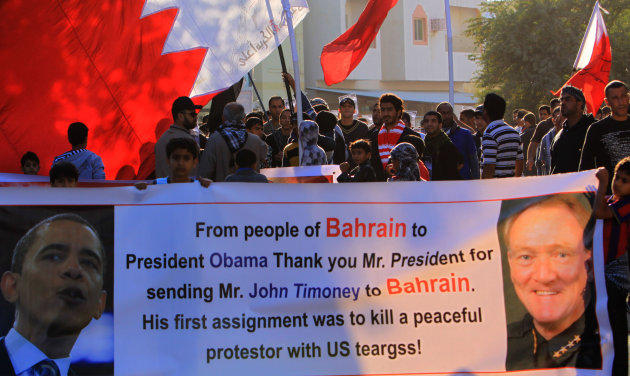
There were hopes in Bahrain that the November publication of an independent report by international experts on protest-related abuses might mark a fresh start for the country. At the end of the year the strength of the government’s commitment to implementing the commission’s wide-ranging recommendations remained to be seen.
In Iran, whose domestic policies remained largely out of the spotlight during 2011, the government continued to stifle dissent, tightening restrictions on freedom of information and specifically targeting journalists, bloggers, independent trade unionists and political activists.
Amnesty International said the response of international powers and regional bodies such as the African Union, Arab League and EU to developments in 2011 had been inconsistent, and had failed to grasp the depth of the challenge to entrenched repressive rule in the region.
Human rights were espoused as a reason in favor of a military intervention in Libya, but the Security Council, stymied by Russia and China in particular, had by the end of the year only issued a weak statement condemning the violence in Syria.
And while the Arab League acted quickly to suspend Libya from membership in February and later suspended Syria and sent a team of observers, it remained quiet when Saudi Arabian troops, acting under a Gulf Cooperation Council banner, backed the Bahraini government’s efforts to crush protests.
“Support from world powers for ordinary people in the region has been typically patchy,” said Philip Luther.
“But what has been striking about the last year has been that – with some exceptions – change has largely been achieved through the efforts of local people coming onto the streets, not the influence and involvement of foreign powers.”
“The refusal of ordinary people across the region to be deterred from their struggle for dignity and justice is what gives us hope for 2012.”
End support to Taliban for peace
Afghanistan on Monday asked Pakistan to end its "unequivocally abundant support" to Taliban to check terrorist activities in the region that are hurting both countries.
A top advisor to Afghan President Hamid Karzai said while bold and open discussions have been held between Kabul and Islamabad on the issue of tackling terrorism, Pakistan now needs to "walk the talk".
"Both countries are suffering from losses due to increasing terrorist activities," Mohammad Masoom Stanekzai, an advisor on the Home Security to the President, said on the sidelines of a workshop to discuss the Afghan transition.
End support to Taliban for peace: Afghans to Pak
He said while notable progress has been made in strengthening the security sector in Afghanistan, it was only in 2011 when the government's comprehensive, population- centric counter-insurgency operations started bearing results and the trend started reversing.
"This is, however, a delicate progress and can reverse, if not managed well. With the unequivocally abundant support funnelled to them from outside the Afghan borders, insurgents are increasingly shifting tactics focusing on high profile targets thus rejecting any notion that they are losing the war," he told over 100 delegates, including high ranking diplomats and representatives from the Pakistan and Indian High Commissions.
Other Afghan delegates too insisted that Pakistan was a source of insurgency in their country, and any fencing of the 2,400 km of border would not help contain terrorists.
Stanekzai, who is also the chief executive officer of the Afghanistan Peace and Reintegration Programme, said there was trust-deficit between the two countries which remained a major hurdle in taking clearer action on the ground.
"Stabilising Afghanistan following NATO's departure 2014 will not be possible unless the international community establishes a realistic strategy for the government to respect the rule of the law," stressed Fawzia Koofi, the Afghanistan member of parliament and one of the 10-member Afghan delegates at the workshop, the first of its kind to be hosted in Southeast Asia and Singapore.
"The Taliban must stop getting military supplies from other side of the border, namely, Pakistan," said Koofi, expressing concern over the possibility of Taliban's return that, she said, would hit women the most.
Replies to SC by Kayani, Pasha illegal, says Yousaf Raza Gilani
Pakistan Today
In yet another twist in the memo scandal, Prime Minister Yousaf Raza Gilani today suggested that the replies submitted to the Supreme Court by the chiefs of the army and ISI were "unconstitutional and illegal" as they were sent without obtaining the government's approval.
The responses given by the army chief Gen Ashfaq Parvez Kayani and the Director General of the Inter-Services Intelligence (ISI), Lt Gen Ahmed Shuja Pasha to the Supreme Court in connection with the alleged memo did not have the approval of the competent authority as required under the rules of business, Gilani said.
No summary or formal proposal seeking the approval of the competent authority for these two replies was initiated by the Defence Ministry, Gilani said during an interview to a Chinese newspaper.
Any official action by a government functionary without the prior approval of the government is "unconstitutional and illegal", he said.
Gilani pointed out that the Supreme Court Chief Justice had observed that any act of a government functionary without the government's nod is unconstitutional and therefore illegal.
The prime minister said in both the memo controversy and the recent NATO air strike on Pakistani military border posts, the civil and military leadership of Pakistan had held detailed meetings and taken immediate decisions.
He said both issues were referred to the Parliamentary Committee on National Security and the government had accepted the resignation of Husain Haqqani, Pakistan's former envoy to the US.
After the memo issue was referred to the parliamentary committee, the Supreme Court took suo moto action, he said.
Gilani described the memo as a "letter written by one American national to another American".
This is not the first time that Gilani has criticised the army and ISI for their handling of the memo issue.
Gilani was recently angered by an affidavit submitted to the apex court by Defence Secretary Khalid Naeem Lodhi, a retired general considered to be close to the army chief.
Lodhi's affidavit had contended that the civilian government had no control over the operational matters of the army and the powerful ISI.
Gilani responded by saying it was unacceptable for the army to act like a "state within a state".
The civilian government and the military adopted divergent stands when the apex court took up the memo issue.
The government challenged the court's jurisdiction to hear the matter, saying it was already being investigated by the Parliamentary Committee on National Security.
The chiefs of the army and ISI urged the court to conduct an independent probe.
The alleged memo, made public by Pakistani-American businessman Mansoor Ijaz, sought US help to stave off a feared military coup in Pakistan after the killing of Osama bin Laden in May last year.
U.S.A. : Ending a cruel immigration twist
The Washington Post
AMERICA’S HALF-BAKED immigration system is riddled with unfair, arbitrary and inhumane provisions, but few are so senseless and cruel as those covering the undocumented immigrant spouses and children of U.S. citizens. Now the Obama administration is proposing a prudent rule change that would prevent thousands of pointless family separations and prompt untold numbers of illegal immigrants to seek legal status through lawful channels.
Currently, undocumented spouses and children of American citizens are eligible for green cards if they return to their native countries to apply for U.S. visas. But when they do, they are automatically barred from reentering the United States for up to 10 years — the penalty for having been unlawfully present here.
The way around those harsh measures is to prove that family separation would cause a U.S. citizen “extreme hardship” — for instance, by depriving him of the family income or help with child care that the immigrant spouse provided. The catch is that while U.S. immigration authorities grant thousands of such waivers annually, the process takes six months on average, and sometimes much longer, stranding spouses and children far from their families. Given the long delays and possibility of rejection — and prolonged family separations — many never bother to apply.
In practice, most of those who apply for waivers are Mexicans, and the vast majority of them are successful. Of some 17,000 waiver applications filed with the U.S. Consulate in Ciudad Juarez, which handles the paperwork in Mexico, about 90 percent were approved.
The rule change, proposed by the U.S. Bureau of Citizenship and Immigration Services, would allow such spouses and children to remain in this country while they seek provisional waivers. Nothing else would change: Once a waiver is granted, the immigrant would still be required to return to his home country to apply for a visa. But the shift would streamline the process and cut family separations to the days or weeks it takes to issue a visa, rather than the months required for a waiver application.
It’s possible that opponents of illegal immigration will cry “amnesty” — they rarely miss an opportunity — but the proposal is little more than a tweak. After all, it would favor people who are already members of American families and are overwhelmingly eligible to receive green cards anyway. Why tear them from their jobs, homes, spouses and parents for months on end? Nor is it likely to encourage phony marriages, since immigration and visa authorities would apply the same scrutiny to such arrangements as they do now.
Officials hope that the proposal — a change in administrative law that does not require congressional approval — will go into effect after a comment period by the end of this year. If it does, it could help tens or hundreds of thousands of immigrants and their American families to lead normal lives, free of the burdens imposed by a dysfunctional immigration system.
Karzai’s Ultimatum Complicates U.S. Exit Strategy
President Hamid Karzai’s
denunciation last week of abuses at the main American prison in Afghanistan — and his abrupt demand that Americans cede control of the site within a month — surprised many here. The prison, at Bagram Air Base, is one of the few in the country where Afghan and Western rights advocates say that conditions are relatively humane.
American officials, caught off guard by the president’s order, scrambled to figure out the source of the allegations. Now they have at least part of an answer: the Afghan commission that documented the abuses appears to have focused mainly on the side of the prison run by Afghan authorities, not the American-run part, according to interviews with American and Afghan officials.
Mr. Karzai was, in essence, demanding that the Americans cede control of a prison to Afghan authorities to stop abuses being committed by Afghan authorities.
But the American snickering subsided quickly as it became apparent that the Afghans were not backing off their demand, the officials said, and instead appeared intent on turning it into a test of their national sovereignty.
“We have the right to rule on our own soil,” said Gul Rahman Qazi, the chief of the Afghan commission that investigated the prison, at a weekend news conference in which his panel listed accusations of abuses.
The matter is exposing the deep vein of mutual mistrust and suspicion that runs beneath the American and Afghan talk of partnership, and officials characterize the prison dispute as a critical complication for the United States’ intent to withdraw from the Afghan war on its own terms.
The prison plays a key role in the war effort, housing almost all the detainees that forces from the American-led coalition deem “high value,” including Taliban operatives. Transferring the prison to Afghan control is a central issue in the on-again, off-again negotiations between Washington and Kabul over the shape of the relationship between the two countries after NATO ends combat operations in 2014.
“It doesn’t make it easy to keep talking when you’re getting ultimatums,” said an American official who did not want to be identified for fear of straining already delicate relations. “This isn’t a side issue or something that we can just let go and see what happens.”
It is the latest — and one of the most serious — case of how increasingly frequent and unilateral outbursts by Mr. Karzai and his allies indicate growing resentment of the Americans, even as he is trying to negotiate some sort of American military support past the 2014 deadline.
Afghan and Western officials close to the matter describe Mr. Karzai as increasingly suspicious about being cut out and worked around by the Americans, and anti-Western advisers have been gaining in influence in his circle, for the moment at least, the officials said. They spoke on the condition of anonymity because they did not want to harm relations with the president and one another.
That has become apparent in the past two months, as the positive talk heard at an international conference on Afghanistan’s future in Bonn, Germany, has given way to a markedly more hostile tone. Mr. Karzai is again demanding an immediate end to the night commando raids that the United States consider vital to getting at insurgent field commanders. Another presidential commission late last month publicly condemned NATO forces for killing civilians without mentioning that the Taliban killed far more innocents, according to United Nations assessments of Afghan casualties.
Mr. Karzai came close last month to disrupting the latest American move to jump-start talks with the Taliban when he abruptly rejected a plan for the Persian Gulf state of Qatar to host an insurgent negotiating office. He has since acquiesced, but his aides say the overtures to the Taliban are another example of the Americans’ trying to sidestep Mr. Karzai’s administration. Statements from the presidential palace about the talks have pointedly made reference to foreigners as the source of Afghanistan’s troubles.
Then, on Thursday came the sudden demand for control over the American prison, known as the Parwan Detention Facility. The Americans were given no warning the order was going to be issued. Asked about the timing, Aimal Faizi, a spokesman for Mr. Karzai, said: “It was decided, and then we issued it. I don’t think it is not clear.”
American officials planned to meet with the Afghans to discuss the matter on Saturday after a scheduled news conference, waiting to see whether Afghan officials changed their tone. They did not. Mr. Qazi, the chief of the Afghan commission, told reporters that Afghan officials considered transfer of the prison a critical matter of national sovereignty.
The commissioners said prisoners had complained of torture, humiliating strip searches, being held in freezing cells and a lack of due process. The commission’s legal adviser, Ahmad Hanif Hanifi, stood and recited a list of suspected abuses during the news conference. But when pressed for details, especially about under whose watch the abuses might have happened, the Afghan officials began backing away.
Mr. Qazi acknowledged that “we do not have a lot of information on the details” of what had taken place in the American side of the prison, which the commission visited briefly only on Dec. 27. During an earlier visit, in May, the commission was not given access to the American side of the prison, a statement American officials did not dispute.
Despite the lack of details, Mr. Qazi said, “what has happened there will become clear” in time.
Afterward, the commission’s deputy chief, Abdul Qader Adalatkhah, said in a brief interview that most of the abuses documented so far were from the Afghan side of the prison. No matter, he said, there are “problems in the international side,” as well. He would not elaborate.
Despite the tenor of the news conference, a Western official said the meeting later Saturday between Afghan and American officials about the prison had been “productive.” The official would not provide details.
Built as part of the Obama administration’s revamping of American detention facilities and policies, the $60 million prison abuts Bagram Air Base, one of the main coalition bases in the country. It replaced an older prison that was housed in a Soviet-era machinery hangar inside Bagram and was the site of well-documented abuse cases.
Conditions at the new prison are markedly better, according to independent Afghan and Western assessments, although arbitrary detentions and a lack of due process remain serious problems.
It is unclear how the Afghan officials will proceed in pressing their authority to take control of the prison. Whether they have the capacity is another question. The Americans have been slowly training Afghan guards and administrators, but the efforts are said to be behind schedule.
Mr. Faizi, the presidential spokesman, brushed aside concerns about Afghan readiness. He said the government was only sticking to an agreed upon plan to hand over the prison by the end of 2011.
Yet, even that is in dispute. American officials said there was never a hard deadline. An internal Afghan government document about the prison in 2010, obtained by The New York Times, appears to back up their point. “The transition will be based on demonstration of capacity rather than a specific time table,” the document reads. It is signed by a number of government officials, including the minister of defense, Abdul Rahim Wardak.
American officials said they believed the prison’s fate would ultimately be decided in the talks on the so-called strategic partnership document, which is intended to spell out the relationship between Afghanistan and the United States after 2014. The next round of talks has not yet been scheduled.
China slams US defense strategy with Asian slant
China has slammed as "groundless and untrustworthy" the United States' new defense strategy that says China's strategic intentions are unclear.
The strategy unveiled Thursday intends to assert America's position in the Asia-Pacific region.
The document says the growth of China's military power must be accompanied by greater clarity of its strategic intentions to avoid causing friction in the region.
Foreign Ministry spokesman Liu Weimin said Monday: "China's strategic intent is clear, open and transparent."
He says China is committed to peaceful development and a "defensive" policy.
Liu says China's defense modernization plays an active role in maintaining regional peace and security and "will not pose any threat to any country."
Bill Gates contacts Arfa's father for treatment
Chairman of Microsoft, billionaire Bill Gates has made contact with the parents of the world's youngest Microsoft Certified Professional
Arfa Karim for her treatment, Geo News reported.
According Arfa's father, Amjab Karim Randhawa, Bill Gates telephoned him and expressed his wish about Arfa's treatment in the US.
Gates has also directed his doctors to adopt every kind of measure for the treatment of the young genius Microsoft professional.
Gates' doctors contacted Arfa's Pakistani doctors and received details about the illness through the internet.
Meanwhile, Pakistani doctors are of the view that Arfa is on ventilator, therefore, it will be hard to shift her to any other hospital.
Any official action by govt functionary, without approval is unconstitutional
Prime Minister Yousuf Raza Gilani Monday said that any official action by a government functionary without the prior approval of the government is unconstitutional and illegal.
While giving an interview to People's Daily Online he referred to the observation of the Honourable Chief Justice of Pakistan that any act of a government functionary without the government's nod is unconstitutional and therefore illegal.
The Prime Minister stated that in two simultaneous issues, one relating to the NATO attack on Pakistan's borders and the other relating to a letter written by one American national to another American, the civil and military leadership of Pakistan held detailed meetings and took immediate decisions.
In case of the attack by the NATO, the Prime Minister said it was decided to refer the matter to the Parliamentary Committee on National Security.
In the second case it was also decided to refer the matter to the Parliamentary Committee on National Security, besides accepting the resignation of Mr Hussain Haqqani.
The Prime Minister stated that after having referred both the matters to Parliamentary Committee on National Security, the Supreme Court took suo motto action on the alleged Memo Case.
He further pointed out that the responses given by the Army Chief and the DG (ISI) to the Supreme Court in connection with the alleged Memo controversy do not contain the approval of the Competent Authority as required under the Rules of Business.
No summary seeking approval of the Competent Authority was initiated by the Ministry of Defence.
Nor any approval was obtained from the Defence Minister in this regard.
Early elections clamour
EDITORIAL:DAILY TIMES
Of late, a chorus of voices is clamouring for early general elections. The ruling PPP had not seen fit to respond to this clamour until recently, except to endlessly repeat its mantra that the government would complete its tenure, i.e. that the elections would be held in February 2013. However, responding to the rising crescendo of demands for early elections, and perhaps seeing that the post-March 2012 Senate elections scenario would give it political advantage, the PPP has recently discussed the issue in its core committee and indicated through hints and suggestions that it was contemplating elections in October 2012. That would be only a few months before its scheduled end of tenure and could be informed by the perception that incumbency in the face of continuing serious problems afflicting the country may not be conducive to its interests beyond that.
Given this change of view, it is surprising to note that Nawaz Sharif in Quetta the other day came out with one more of his ‘either/or’ ultimatums. This one makes even less sense than some of the other choice ones the PML-N chief has delivered in the past. Nawaz says he cannot wait till October and wants the elections ‘now’. He goes on to assert that October 2012 would be too late, but fails to explain too late for what? Further, if he is taken at his word that he cannot wait till October, what does he intend to do between now and then if the PPP sticks to its view? Statements by prominent political leaders and prime-ministers-in-waiting should be better considered and weighed than this. As to the rumoured attempt by Chief Minister Balochistan Nawab Aslam Raisani to arrange a meeting between Nawaz Sharif and President Asif Zardari, the PML-N chief says he knows nothing about it. So much for that. To add fuel to the fire, his younger sibling, Punjab Chief Minister Shahbaz Sharif delivered himself of the wisdom on his return from Turkey that he was ruling out any talks with Mr Zardari. In a democratic system, doors are never shut on discussion, even with political rivals. The younger Sharif should therefore stop spewing such vitriol, which can only exacerbate tension in the polity at a time when cooler approaches are required.
In contrast to the Punjab chief minister’s ‘can’t play, won’t play’ attitude, the PPP has initiated discussions with all political parties to forge a consensus around the elections date. Although this is not required by any constitutional or even democratic political norms, it speaks well of the PPP’s continuing efforts to take the polity along on such fundamental decisions. The PPP would obviously like a consensus around holding the elections after the Senate elections, preferably in October 2012. The PML-N and Jamaat-i-Islami are pressing for an earlier date, if not immediate polls. The PTI of Imran Khan seems inclined towards September/October 2012, but only after updating the electoral rolls and eliminating the 35 million invalid votes identified, along with the registration of new entrants, amongst whom it counts on the youth. PTI is also tilting against elections under President Zardari, although this does not sit squarely with its demand for a credible, independent Election Commission (EC). If this demand gets fulfilled, what does it matter who is the president, who then will have little say in the electoral process? ANP and the PML-Q still adhere to the original position that the government should complete its tenure. The PPP’s view is that the MQM will go with the tide, its only core interest being maintaining its hold on Karachi. Maulana Fazlur Rehman of the JUI sets three conditions for early elections: an independent EC, agreement on the caretaker setup to conduct the elections, and updating and correcting the electoral rolls.
A mere iteration of these respective positions of the biggest players in the field indicates the need and wisdom in conducting consultations amongst all stakeholders to agree a mutually acceptable date. Nothing stops the incumbent government from taking this decision unilaterally, but its approach is clearly intended to avoid ruction over the decision. All parties should therefore welcome any such initiative and come to the table to sort out the elections date.
PML-N won’t get seat outside Punjab in Senate polls
PML-Q President Shujaat Hussain has said the PML-N will not manage to get any seats outside the Punjab in the Senate polls whereas the PML-Q will successfully manage to bag representation in every province.
“I had advised Nawaz Sharif during his tenure as prime minister to avoid being proud and not to pay any heed to liars and sycophants, but he turned a deaf ear which eventually led to his fall,” said Shujaat while talking to the media on Sunday at a reception hosted by former PPP MPA Shabina Riaz Sheikh and her husband, a close confidant of President Asif Zardari, Ahmed Riaz Sheikh, over the acquittal of Moonis Elahi from court.
It was the first interaction of the central cadre of both parties — previously rivals — with the media in Lahore after coming up in coalition. Pervaiz Elahi, the former chief minister, Senator Jehangir Badr, the PPP Secretary General, Governor Sardar Latif Khosa, PML-Q leaders including Basharat Raja, Ch Zaheeruddin, federal minister Manzoor Wattoo, Evacuee Trust Property Board Chairman Syed Asif Hashmi, Ch Shafaat Hussain, Naveed Chaudhry, Qasim Zia, PM’s son Abdul Qadir Gilani, Aurangzeb Burki, Khurram Latif Khosa and a large number of members from both sides attended the reception.
To a query about the recent interview of President Zardari, Shujaat stated that the positive thing was the use of word ‘we’ by the president instead of ‘I’. He said Nawaz Sharif and even Musharraf were advised by him to avoid arrogance.
To another question about the unification of the Muslim League and his chance of meeting with PML-N President Nawaz Sharif, he said that like other leaders, he would also meet Nawaz at the moot.
“Does anyone trust Nawaz Sharif?” replied Shujaat when asked to comment over the statement of the PML-N leadership that the party didn’t trust Zardari anymore. He said he had discussed the Senate elections with the president and dates for the polls would be announced soon. Regarding the memo issue, he said the PML-N would continue to live in a dream world without realising that dreams were dreams, not reality.
To a query about the revelation made by President Zardari during his interview that in 1989, Benazir Bhutto had a dialogue with the Chaudhrys while she was the prime minister, Shujaat confirmed it but stated that the process later got postponed.
Shujaat went on to say that the ‘champions of justice’ should also cite the example of the court that had acquitted Moonis Elahi. He said when Moonis was under detention, there were suggestions from lawyers to get bail but Moonis insisted on fighting the case and was finally acquitted of all charges.
Governor Sardar Latif Khosa, in his address, congratulated the PML-Q leadership on the acquittal of Moonis Elahi and called for legislation over the registration of fake cases against a person. He said Asif Zardari was kept in prison for 11 years but nothing was proved against him and similarly, Moonis Elahi, who was proven innocent, remained in captivity for nearly a year.
He said in the case of Moonis, an investigation officer was appointed again and again while Moonis’ constant media trial was carried out as if he was the biggest culprit in the country. PPP Secretary General Jehangir Badr said that democracy was the only purpose of the PPP and it would continue to make efforts to strengthen it. He said in the past, PML-N President Nawaz Sharif had left no stone unturned to target the PPP leadership but for the sake of democracy, it forgot bitterness and signed the ‘Charter of Democracy’. He also said that Musharraf had offered PPP Co-chairman Zardari to form governments in all the provinces and Centre and let him continue to hold the office of president but he not only managed to form provincial governments but also forced Musharraf to quit the presidency in a democratic way.
Federal Minister Manzoor Wattoo said it was the fruit of democracy that there wasn’t a single political prisoner in the country contrary to the past, when victimisation of politicians was quite common. Criticising the PML-N leadership, he said politicians full of vanity were isolated whereas all democratic forces had joined hands to save the country.
INP adds: Chaudhry Shujaat said self-centred politics had damaged Pervez Musharraf and Nawaz Sharif, while President Asif Ali Zardari was the only politician who used the word ‘we’ instead of ‘me,’ as used by Nawaz and Musharraf.
“When Nawaz Sharif was elected as a prime minister, a number of flatterers gathered around him at a function. I came out of the function and later told Nawaz Sharif to avoid flatterers, hypocrisy and habitual use of the word ‘me’ if he wants to become a successful prime minister, but he never paid any heed and was shown the door,” Shujaat added.
Similarly, the PML-Q chief said, he also conveyed to Musharraf through General Ihsan to avoid repeated use of word ‘me’ but he too never paid any heed.
About the possibility of early polls, Chaudhry Shujaat said there was no ban on Nawaz Sharif having such dreams. “If Musharraf wants to come back to Pakistan, he is most welcome,” he added.
To another question, Chaudhry Shujaat said there had been contacts with the PPP in 1989, but no progress was made. “Moonis Elahi was released after facing the courts and going through the due process of law,” he added.
NNI adds: PML-Q chief Chaudhry Shujaat Hussain on Sunday telephoned President Asif Ali Zardari to discuss the current political situation, especially the upcoming Senate polls.
According to sources, the current political situation of the country and Senate elections came under discussion during the telephonic conversation between Ch Shujaat and President Zardari. Both leaders also discussed cases being heard by the courts and the demand by other political parties for early elections, sources added.
‘Haqqani to escape punishment even if link with memo proved’
DAWN.COM
Zahid Hussain Bukhari, the counsel for Husain Haqqani, has said that even if any link between his client and the controversial memo is established the former ambassador to the US will not be punished.
In an interview with DawnNews, Mr Bukhari however denied any link between Mr Haqqani and the memo, adding that the controversy had been created by Mansoor Ijaz, described as the main character in the episode.
“But I say even if the link is proved — there is still no crime in it,” Mr Bukhari said. “We will then have to ask Mr Shahbaz Sharif and Mr Nawaz Sharif as to what did they say when Gen Musharraf was toppling the PML-N government.”
Talking to Matiullah Jan of DawnNews TV, Mr Bukhari remarked: “We will ask whom did he ask for help at that time and it has to be noted who has not asked for help from the US in our history.”
Sources said that Nawaz Sharif was expected to appear on Monday before the judicial commission investigating the case.
Mr Bukhari has replaced Asma Jehangir, who has quit the case for not having confidence in the commission set up by Supreme Court to investigate the matter.
Mr Bukhari, who is a former judge of the Lahore High Court and former president of the People’s Lawyers Forum, expressed the confidence that Mr Haqqani would not be punished under the law.
Answering a question, Mr Bukhari said he would fully cooperate with the commission.
“I will cooperate as long as the commission remains within the ambit of the law and the rights granted to my client Husain Haqqani under the law are honoured,” he added.
He said the commission was not authorised to punish or even accuse anybody — its responsibility is only to investigate the matter and forward findings to the Supreme Court. “The case will be decided by the Supreme Court.”
Mr Bukhari said the Supreme Court had only agreed to the existence of the memo. “They have not made any remarks on the status of the memo.
“And it’s a fact we all agree on, that there is a memo,” he said and added: “But we say that this memo is the brainchild of Mansoor Ijaz and Mr Haqqani has nothing to do with it in any way.”
Mr Bukhari said the apex court should treat Husain Haqqani and Mansoor Ijaz on equal terms.
“When Mansoor Ijaz has spelt out his conditions to the court, all these apply to Mr Haqqani too,” the counsel said.
“The court has restricted Mr Haqqani from leaving the country. Mansoor Ijaz should also be barred from leaving Pakistan till the case is decided.”
Khyber Pakhtunkhwa Governor pays rich tributes to Naseerullah Babar
Khyber Pakhtun-khwa Governor Masood Kausar on Sunday said that the Pakistan People’s Party under the leadership of President Asif Ali Zardari would carry forward the mission of the deceased party leaders.
Talking to reporters at an event marking the first death anniversary of the former minister for interior Maj Gen Naseerullah Babar, he said the PPP leaders had sacrificed their lives for democracy in the country.
Lauding the services of Naseerullah Babar, the governor said the late PPP leader had resolved the bus hijacking issue, restored peace in Karachi and established lasting relations with Afghanistan.
He said Maj Gen Babar was the first governor who initiated development activities in the tribal areas and increased the funds for Fata.
He added that his services as an army general, governor, minister and party worker would be remembered for years. Maj Gen Babar had twice received Sitara-e-Jurrat during his military service for his bravery and professionalism, he said. He said his death was the third great tragedy for the PPP after the deaths of its founder Zulfikar Ali Bhutto and former Prime Minister Benazir Bhutto.
Hundreds of party activists, Maj Gen Babar’s family members, MNA Tariq Khattak, Federal Ombudsman Shoaib Suddle and president of the ex-serviceman association Brig Muhammad Mehmood, Malik Attaullah of the Mohmand tribal jirga and Provincial Minister Liaqat Shabab attended the fateha Khwani.
There are many cases against Nawaz
www.pakistantoday.com
Issuing a direct threat to Pakistan Muslim League-Nawaz (PML-N) chief Nawaz Sharif, Interior Minister Rahman Malik on Sunday said he has many cases against Nawaz in his brief case that could be opened. He lashed out at PML-N chief for his role in ‘memo conspiracy’ and asked him to disclose his links with Mansoor Ijaz; the protagonist of the memo case. Malik termed memogate ‘Fasaadgate’ and said that it had hurt Pakistanis. He said Mansoor Ijaz was not a Pakistani citizen and Malik suspected Ijaz had hatched the memo conspiracy to sell his article. Talking to media after a meeting with former federal minister for Water and Power Raja Pervez Ashraf, Malik said the assassins of Benazir Bhutto had been exposed. Malik said he and Raja Pervez Ashraf were against the last rally addressed by Benazir Bhutto at Liaqat Bagh. Malik further said that President Zardari’s recent interview to a private TV channel helped removing misunderstandings on different issues. Speaking on the occasion, Raja Pervez Ashraf said President Zardari presented his point of view in simple words before the people.
Sunday, January 8, 2012
Democrats See Hopes Rise in Battle to Control Congress
While most of the political world’s attention has been focused on the presidential primaries, Democrats who took a beating in the midterm elections say they have slowly but steadily gotten back in the game when it comes to the battle for control of Congress.
A year of fiscal fights that left the country careening from threatened government shutdown to federal default back to shutdown has hurt every member of Congress, but polls show it has hurt Republicans a bit more. Just before Christmas, House Republicans were forced to make humiliating concessions to Democrats over the extension of a payroll tax holiday and unemployment benefits, dinging the party’s tax-cutting brand.
And improving economic signs captured in jobs gains reported on Friday also have Democrats feeling more optimistic.
“This morning’s announcement that our economy added 200,000 jobs in December, bringing our unemployment rate down to 8.5 percent, is a sign of progress and provides further evidence that our economy is recovering,” Representative Steny H. Hoyer of Maryland, the No. 2 Democrat in the House, said Friday.
At the same time, President Obama, while still embattled, has seen his poll numbers improve slightly in the wake of the chaos on the Hill. Further, the Republican narrative that so dominated 2010 — deficit spending as the nation’s greatest ill — has been matched in recent months by the Democratic pounding of the table on income inequality.
Occupy Wall Street protests eclipsed Tea Parties around the nation this fall in defining at least some of the national mood. In a New York Times/CBS News poll conducted in October, 66 percent of respondents who were asked if they felt that “the money and wealth in this country should be more evenly distributed among more people” said it should be more evenly distributed, while 26 percent said the system was fair.
All of this has left Democrats feeling more hopeful that they can recapture many of the 25 House seats needed for a majority, fend off a formidable challenge by Republicans over control of the Senate and perhaps keep Mr. Obama in Washington.
“A year ago today we were depressed, we were doubtful and we were in debt,” said Representative Steve Israel of New York, who oversees the committee that works to get Democrats elected to the House.”
“Since then, because of Republican mishaps and our own aggressiveness,” he said, the party has regrouped in its fund-raising and persuaded more Democrats to run. “I am not predicting we are going to take the House back,” Mr. Israel said. “But I am willing to sign an affidavit that it will be razor close.”
Color Republicans unimpressed.
There are far fewer Republicans in Democratic districts now than there were Democrats in Republican districts in 2010, and many of the current batch of Republicans have been shored up through redistricting. More Democrats are also retiring from both chambers than Republicans; in the Senate, seven Democrats have decided to leave, the most recent being Ben Nelson of Nebraska, whose announcement last week further hurt his party’s chances of holding onto control there.
What is more, Republicans often cite the respected political expert Charlie Cook, who points out that only once since World War II has the party holding the White House gained more than 15 House seats in a presidential election year. And Mr. Obama remains an impediment in many crucial districts.
“House Democrats’ public chest-thumping is recurring entertainment,” said Representative Pete Sessions of Texas, who is Mr. Israel’s counterpart at the National Republican Congressional Committee. “But it falls far from political reality. Even Democrats know that the Republican majority is strengthening as more Democrats throw in the towel in order to avoid facing a referendum election on their job-destroying policies.”
Republicans and others also argue that the president’s new strategy of running against Congress carries risks for Democrats who could be tarred along with Republicans.
But Democrats hope that by narrowing their majority in the House, even if Republicans win control of the Senate, they can push back against the policy agenda that Republicans have pressed, often with great success, over the last year.
In any event, the political complexion of the 113th Congress will almost certainly complicate the agenda of whoever is in the White House come January 2013.
“What will most likely happen is you will either have a narrow majority in either chamber or a still-divided Congress,” said Julian E. Zelizer, a professor of history and public affairs at Princeton University. “You are looking at a president who is going to face the same governing environment that President Obama faces and Bush before him faced, and in some ways the problems might be worse.”
There are two ways to look at current polling, and Democrats choose the glass-is-half-full approach.
In a December poll conducted by NBC News and The Wall Street Journal , 45 percent wanted the Democrats to win control of Congress in November while 43 percent supported the Republicans.
That is a slight uptick for Democrats since the summer, when the news organizations found 47 percent of voters surveyed said they preferred a Republican-controlled Congress, and 41 percent said they would rather see the Democrats win a majority this year.
However, while 72 percent of the public disapproves of how Republicans in Congress are doing their jobs according to a recent ABC News/Washington Post poll, nearly as many, 66 percent, disapprove of the job performance of Congressional Democrats.
“Democrats did a good job in the recent tax fight of drawing Republicans into the spotlight,” said Nathan L. Gonzales, an editor at The Rothenberg Political Report, a nonpartisan newsletter. “But they don’t want to go into 2012 having it simply be referendum on whether people feel good about the country, because Democrats are viewed as more responsible for state of the economy. I am not convinced that Democrats have won the message battle for the 2012 election.”
But Democrats believe that they have momentum on their side, just as Republicans did at this time in 2010. Democrats cite money, polls and candidate recruitment as the central beacons of light.
Last January, “I couldn’t even get people I wanted to run to return my calls,” Mr. Israel said. These days, he is persuading some of them — including nearly a dozen who lost their seats in 2010 — to take another shot.
Dan Maffei, a Democrat who lost his New York seat by roughly 600 votes to Ann Marie Buerkle in 2010, said that after licking his wounds for several months, he decided over the summer to try and regain his seat.
“It was very challenging to lose,” he said. “After my wife and I saw how challenging it was, we just sort of wanted to walk away. But as my successor’s record emerged, we kind of came to the conclusion, if I don’t get back in, who will?”
While the party left him to his own devices last time, not anticipating a loss, Mr. Maffei said he has been assured help in this campaign. “It is a lot easier to run if you have full support of D.C.C.C.,” he said.
Congressional Democrats have raised more money lately than Republicans. But many campaign finance experts say that is less important than in past years because of the increasing influence of outside groups.
“If the D.C.C.C. outraises the N.R.C.C.,” Mr. Gonzales said, “big deal.” Conservative groups like American Crossroads and other outsider organizations “are going to have money and spend it in key races,” he said. “So analyzing fund-raising is more complicated than it has ever been.”
But Democrats are clinging to a series of new polls that they say show a momentum that can be harnessed to their advantage, particularly around fiscal policy issues. For instance, a recent poll by Gallup found that voters felt more confidence toward Mr. Obama and the Democrats in Congress (41 percent to 34 percent) concerning the extension of payroll tax cuts and unemployment benefits.
Democrats in competitive districts wasted no time conducting automated calls on the issue to voters, even before the final outcome of the payroll tax fight.
Both parties note the length of time until November, when anything can happen to shift the political ground. Republicans have a history of disciplined messaging, and Democrats have been known to allow infighting between its most liberal members and those who seek the center to unravel their unity. But the party continues to hope.
“The economy, jobs and income equality are the biggest issues,” said Senator Charles E. Schumer of New York, the chamber’s no. 3 Democrat. “Taken together, Republicans are having trouble getting their arms around the issue. The ballgame is changing.”
Argentine Leader Is Told Thyroid Was Cancer-Free
President Cristina Fernández de Kirchner of Argentina never had thyroid cancer despite a diagnosis of the disease last month, her spokesman said on Saturday. The government announced in late December that Mrs. Kirchner had cancer, but the spokesman, Alfredo Scoccimarro, said an examination of her thyroid gland, which was removed Wednesday, had found no cancerous cells.
“The original diagnosis has been modified,” he said at a news conference. “The presence of cancer cells was discarded.”
Eduardo Faure, a thyroid cancer expert in Buenos Aires who is not on the president’s medical team, said a small number of such cases turned out to be “false positives.” “The cells may originally appear to be cancer, but in 2 percent of cases, after the operation, when a more thorough examination can be performed, it turns out they are not,” he said.
several hundred supporters of Mrs. Kirchner, 58, who won re-election in October with 54 percent of the vote, had camped out near the hospital where she was treated, carrying banners that said, “Strength, Cristina.” A cheer went up when Mr. Scoccimarro made the announcement.
The original diagnosis of papillary carcinoma alarmed many of Mrs. Kirchner’s supporters, especially after the death of her husband, Néstor, a former president who had remained an unrivaled political force, in 2010 from a heart attack.
Lull in Strikes by U.S. Drones Aids Militants in Pakistan
A nearly two-month lull in American drone strikes in Pakistan has helped embolden Al Qaeda and several Pakistani militant factions to regroup, increase attacks against Pakistani security forces and threaten intensified strikes against allied forces in Afghanistan, American and Pakistani officials say.
The insurgents are increasingly taking advantage of tensions raised by an American airstrike in November that killed two dozen Pakistani soldiers in two border outposts, plunging relations between the countries to new depths. The Central Intelligence Agency, hoping to avoid making matters worse while Pakistan completes a wide-ranging review of its security relationship with the United States, has not conducted a drone strike since mid-November.
Diplomats and intelligence analysts say the pause in C.I.A. missile strikes — the longest in Pakistan in more than three years — is offering for now greater freedom of movement to an insurgency that had been splintered by in-fighting and battered by American drone attacks in recent months. Several feuding factions said last week that they were patching up their differences, at least temporarily, to improve their image after a series of kidnappings and, by some accounts, to focus on fighting Americans in Afghanistan.
Other militant groups continue attacking Pakistani forces. Just last week, Taliban insurgents killed 15 security soldiers who had been kidnapped in retaliation for the death of a militant commander.
The spike in violence in the tribal areas — up nearly 10 percent in 2011 from the previous year, according to a new independent report — comes amid reports of negotiations between Pakistan’s government and some local Taliban factions, although the military denies that such talks are taking place.
A logistics operative with the Haqqani terrorist group, which uses sanctuaries in Pakistan to carry out attacks on allied troops in Afghanistan, said militants could still hear drones flying surveillance missions, day and night. “There are still drones, but there is no fear anymore,” he said in a telephone interview. The logistics operative said fighters now felt safer to roam more freely.
Over all, drone strikes in Pakistan dropped to 64 last year, compared with 117 strikes in 2010, according to The Long War Journal, a Web site that monitors the attacks. Analysts attribute the decrease to a dwindling number of senior Qaeda leaders and a pause in strikes last year after the arrest in January of Raymond Davis, a C.I.A. security contractor who killed two Pakistanis; the Navy Seal raid in May that killed Osama bin Laden; and the American airstrike on Nov. 26.
Pakistan ordered drone operations at its Shamsi air base closed after that airstrike, but C.I.A. drones flying from bases in Afghanistan continue to fly surveillance missions over the tribal areas. The drones would be cleared to fire on a senior militant leader if there was credible intelligence and minimal risk to civilians, American officials said. But for now, the Predator and Reaper drones are holding their fire, the longest pause in Pakistan since July 2008.
“It makes sense that a lull in U.S. operations, coupled with ineffective Pakistani efforts, might lead the terrorists to become complacent and try to regroup,” one American official said. “We know that Al Qaeda’s leaders were constantly taking the U.S. counterterrorism operations into account, spending considerable time planning their movements and protecting their communications to try to stay alive.”
C. Christine Fair, an assistant professor of political science at Georgetown University who just returned from a month in Pakistan, put it more bluntly: “They’re taking advantage of the respite. It allows them to operate more freely.”
Several administration officials said Saturday that any lull in drone strikes did not signal a weakening of the country’s counterterrorism efforts, suggesting that strikes could resume soon. “Without commenting on specific counterterrorism operations, Al Qaeda is severely weakened, having suffered major losses in recent years,” said George Little, a Defense Department spokesman. “But even a diminished group of terrorists can pose danger, and thus our resolve to defeat them is as strong as ever.”
Analysts say the hiatus coincides with and probably has accelerated a flurry of insurgent activity and new strategies.
In the past week, leaflets distributed in North Waziristan announced that the Afghan Taliban and Al Qaeda had urged several Pakistani militant groups to set aside their differences and some commanders have reportedly asked their fighters to focus on striking American-led allied forces in Afghanistan.
The Pakistani groups include the Pakistani Taliban, an umbrella group led by Hakimullah Mehsud that has mounted attacks against the Pakistani state since the group was formed in 2007. The new council also includes the Haqqani network and factions led by Maulvi Nazir of South Waziristan and Hafiz Gul Bahadur of North Waziristan, which already target NATO soldiers and have tacit peace agreements with the Pakistani military.
In telephone interviews, some Pakistani militants said the purpose of the agreement was to settle internal differences among rival factions and improve the image of the Taliban, which has been tarnished because of the increasing use of kidnapping and the rise in civilian killings.
Other analysts say that the Afghan Taliban are also feeling the pinch of American-led night raids and other operations across the border. They said the Taliban needed the militants in Pakistan’s tribal region to focus more on helping to launch a final offensive in Afghanistan, in hopes of gaining leverage before any peace talks and the ultimate withdrawal of most American forces from Afghanistan by 2014.
One of the main drivers of the accord was Sirajuddin Haqqani, the leader of the Haqqani network, prompting some Pakistani analysts to reason that the Pakistani Army had also prodded the creation of the council, or shura, to maintain its leverage in any peace negotiations. Last summer Adm. Mike Mullen, who was then chairman of the Joint Chiefs of Staff, called the Haqqanis “a veritable arm” of Pakistan’s main military spy agency.
“No agreement is ever permanent in frontier politics, and it’s all very complicated,” said one American government official with decades of experience in Pakistan and its tribal areas.
Stuck in a stalemate in the lawless borderlands with this array of militants are 150,000 Pakistani troops. A recent report by an Islamabad-based research organization, the Pak Institute for Peace Studies, said that militant-based violence had declined by 24 percent in the last two years. But it also concluded that terrorist attacks in the Federally Administered Tribal Areas, or FATA, and Khyber-Pakhtunkhwa Province increased 8 percent in 2011 from the year before.
“The security situation remained volatile as militants dislodged from their strongholds constantly managed to relocate to other parts of the FATA,” the report said.
In a sign of the shifting insurgent tactics, the number of suicide bombings in the country declined to 39 through November, compared with a high of 81 in all of 2009, according to the Pakistani military.
The number of attacks from homemade bombs, however, increased to 1,036 through November, compared with 877 for all of 2009. More than 3,500 Pakistani soldiers and police officers have been killed since 2002.
One senior Pakistani Army officer with experience in the tribal areas said that insurgents had devised increasingly diabolical triggers and fuses for bombs.
Unlike Americans, Pakistani soldiers still drive in pickups or carriers with little protection. “The effects are devastating,” said the officer, who spoke on the condition of anonymity. “Vehicles are basically vaporized.”
“The Pakistani Army is overstretched, and that’s clearly had an impact on morale,” said Maleeha Lodhi, a former Pakistani ambassador to the United States. “But we have to maintain the pressure on the militants.”
Exclusive Interview of President Zardari
sOURCE:GEO/DAILY TIMES
Part 1
Part 2
Part 3
After a long time, President Zardari has given an interview to a local TV channel. Interior Minister Rehman Malik said that the president’s interview has helped in clearing misunderstandings on different issues. Mr Zardari spoke on a number of issues of national and international importance ranging from relations between state institutions and ties with India, China and the US. Denying rumours about his resignation, the president said, “No one has asked for my resignation till now. I do not think anyone in Pakistan is so innocent that he will ask for my resignation. What will they do with my resignation? I have given my powers to parliament.” After the 18th Amendment, the president has been divested of all his powers and is now just a constitutional head of state, as he/she should be under a parliamentary system. He also ruled out the government writing a letter to the Swiss authorities in the NRO case because it would amount to a “trial of the dead; it will be like a trial of BB’s grave”. As far as the issue of the NATO supply route, boycotting the Bonn Conference and getting the Shamsi Airbase vacated were concerned, the president gave the credit to parliament. What was significant in the interview was Mr Zardari hinting at ‘someone’, without naming that person, who insisted that the Rawalpindi rally be held even though many others, including the president, Ms Bhutto’s children and Rehman Malik “opposed holding the rally”. He also said the Memogate issue has been given undue importance in the media. He dispelled the notion that there were any differences between the government and the military and/or the judiciary. “We are not at war with the court and we are not at war with the military. You think it is a clash, but I say it is part of an evolutionary process. This clash will evolve and then simmer down,” said Mr Zardari. Some analysts are of the view that the interview was a whitewash and the president did not say anything of importance; others view it as a good thing given that the president has not been giving many interviews to the local media.
Part 2
Part 3
After a long time, President Zardari has given an interview to a local TV channel. Interior Minister Rehman Malik said that the president’s interview has helped in clearing misunderstandings on different issues. Mr Zardari spoke on a number of issues of national and international importance ranging from relations between state institutions and ties with India, China and the US. Denying rumours about his resignation, the president said, “No one has asked for my resignation till now. I do not think anyone in Pakistan is so innocent that he will ask for my resignation. What will they do with my resignation? I have given my powers to parliament.” After the 18th Amendment, the president has been divested of all his powers and is now just a constitutional head of state, as he/she should be under a parliamentary system. He also ruled out the government writing a letter to the Swiss authorities in the NRO case because it would amount to a “trial of the dead; it will be like a trial of BB’s grave”. As far as the issue of the NATO supply route, boycotting the Bonn Conference and getting the Shamsi Airbase vacated were concerned, the president gave the credit to parliament. What was significant in the interview was Mr Zardari hinting at ‘someone’, without naming that person, who insisted that the Rawalpindi rally be held even though many others, including the president, Ms Bhutto’s children and Rehman Malik “opposed holding the rally”. He also said the Memogate issue has been given undue importance in the media. He dispelled the notion that there were any differences between the government and the military and/or the judiciary. “We are not at war with the court and we are not at war with the military. You think it is a clash, but I say it is part of an evolutionary process. This clash will evolve and then simmer down,” said Mr Zardari. Some analysts are of the view that the interview was a whitewash and the president did not say anything of importance; others view it as a good thing given that the president has not been giving many interviews to the local media.
Tortured Afghan girl suffering in hospital, aid worker says
A 15-year-old girl allegedly tortured by her in-laws in Afghanistan after she refused to be forced into prostitution is not doing well in hospital, aid workers say.
Sahar Gul was rescued by police last month in the country's northern Baghlan province after she was locked in the basement of her in-laws' house, starved and her nails pulled out.
She is safe, but signs of the abuse she's suffered remain all too clear, said Wazhma Frogh of the Afghan Women's Network.
Sahar is too weak to move her body, which has black bruise marks all over from being beaten, and the nurses gave her diapers because she can't get to the toilet, Frogh said.
The girl's eyes are bruised and she can't speak. Her hair was also cut short by her in-laws as a punishment after she refused to sleep with other men.A photograph provided by the Afghan Women's Network shows her asleep in a hospital bed, the bruising on her face obvious and her head bandaged.
The mental trauma she suffered is also affecting her, and is under medication to help her deal with it, Frogh said.
"We've also provided her with a trauma counselor because she is very traumatized and even when I wanted to take her hand, she resisted," despite being unconscious, Frogh said.
Because the teenager was beaten and assaulted, she added, "now she doesn't want anyone to even touch her."
Last month, authorities in Baghlan said they rescued the girl after hearing reports that she was tortured after she refused to be forced into prostitution. But, they said, they were waiting for her to fully recover to talk to her and learn more.
Sahar was married off to a 30-year-old man about seven months ago. After her parents reported not seeing her for months, police launched their investigation, Baghlan police official Jawid Basharat said at the time.
Meanwhile, Sahar's father-in-law, mother-in-law and sister-in-law have been arrested but her husband -- who Frogh said is thought to be a soldier serving in Helmand province -- has not been caught.
The Women's Network is determined to do its best to ensure she gets the care she needs -- but Frogh warned that her recovery won't be easy.
"She needs proper food, proper care that our government's hospitals don't have, therefore we have been collecting donations to provide to the hospital to buy her good food, clothing and other basic needs," she said.
"We also have to think of her shelter once she is back into normal life, which is going to take some months."
At the same time, the Women's Network has found a lawyer for Sahar and has persuaded the Afghan authorities to move the investigation to Kabul, where there will be less influence from the local community, Frogh said.
It has also contacted the attorney general to appeal for a faster investigation before the girl's in-laws are released from custody.
Afghan President Hamid Karzai has called for the abuse to be "seriously investigated," his office said in a statement Sunday.
Nawaz’s foolhardiness
Editorial:THE FRONTIER POST
Why is Mian Nawaz Sharif so hell-bent on sprinkling bags of salt on the open wounds of the deprived, denied and wronged Baloch people with his perfidious talk and poking fun at their nagging woes by playing brazenly dirty opportunistic politics on their colossal grief? He has been posing foxily as if he had had no part in the injustices inflicted on the Baloch people in spates whereas he too has been very much part of the centre-sardar nexus that has kept the Baloch commoners so callously caged in penury and backwardness, keeping them from coming into their own and stifling their very spirit and grit to be the masters of their will and vote. He was part of the problem in the past; he is part of the problem even now. No part of the solution has he ever been. He speaks for sardars, who are part of the problem; not of commoners, who actually are part of the solution.
He befriends sardars; and means them, not the commoners, when he speaks of the Balochs’ tragic predicaments. No wonder, his self-serving talk warms up the rapacious sardars’ hearts; it nauseates the suppressed and oppressed commoners they hold in their tight strangleholds. Yet not any hesitant has he been in ditching even sardars if so warranted by his political interests. He says after the 1997 election, Baloch nationalists had supported his government at the centre. Yes, they did; a clutch of sardars donning the nationalists’ garb were on his side. But how did he return the compliment to them? Of it he speaks not, the fact being too damning. He pulled down Sardar Akhtar Mengal’s provincial ministry. So much of his pious sentiments for Balochistan’s people.
But veritably Balochistan never ever figured up any prominently or imperatively on his radar screen all through his power stints. He consumed huge precious sum in building an unarguably unneeded motorway in Punjab; but he too shelled not essentially required one billion rupees from the federal treasury to put into operation the Saindak copper-gold mine, lying idle since its development in September 1995 by a Chinese company, for want of working capital. He now speaks enthusiastically of the Gwadar port, calling it a potential entrepot of regional dimension and proposing making of it a free port. But he conveniently glosses over the huge fuss he dished up when an Omani royal got actively interested in building this port during Benazir Bhutto’s second government.
He cried foul, flimsily. The Omani royal, he alleged, had gifted a costly necklace to her and a prized-breed horse to her mother to clinch the port deal. A disgusted royal walked away and Benazir got scared off for fear of accumulating slur; and the port project fell flat. But, woefully, this jewel of a port that he now considers Gwadar to be, enthused him not a wee bit when he succeeded Benazir in the prime minister’s chair. It was his bete noire Pervez Musharraf who built it, not he. Not even the pathetic condition of fishermen community inhabiting Gwadar’s coastal region drew Nawaz’s interest a notch. While he launched a patently politically-motivated vote-bank-building yellow cab scheme to expand his support base in urban Pakistan, he gave not even a fleeting thought to help the Gwadar fishermen, still plying their trade on outmoded boats, to modernise their fishing vessels.
And as he flung into parcelling out kaacha lands in Sindh to landless haris, albeit selectively, he thought of no such scheme for the similarly-placed Balochistan’s peasantry. Indeed, Balochistan was never his favourite all through his power stints. At best, it was sardars and chieftains, not least the commoners, who engaged his attention, if at all. He built no schools, technical institutes, universities or professional colleges to help the Balochistan youths to fructify the enormous potential, promise and talent they are brimming with. Not even he cared to promote the province’s rich horticulture, leave alone bigger things like building dams, canals and rural roads to bring to full fruition its virgin agriculture’s potential. Given this, expecting from him to have given some attention to the province’s huge mineral wealth’s exploitation for its people’s benefits is like expecting milk from a ram.
He indeed would be quite content if, say, gas royalties land in a sardari pocket to buy deadly weapons, even anti-aircraft guns, to keep their tribal folks in dread, fight blood-soaked tribal feuds, and, if need be, to battle with state security forces. The people can go to hell, he would care less. It is the sardar’s grief that torments him; not the commoner’s. But he must know a new awakening is taking place among the Balochistan youth that would in time throw aside his sardari pals as mere redundancies and irrelevancies. This is inevitable. And he must know Balochistan is not just Baloch. It is also very much Pakhtun and Hazara, and no lesser Punjabi settlers and Urdu-speaking migrants. They cannot be wished off, so integral part of the Balochistan polity are they now. Will he call them, too, to his proposed all-party conference on Balochistan? Let’s see.
Why is Mian Nawaz Sharif so hell-bent on sprinkling bags of salt on the open wounds of the deprived, denied and wronged Baloch people with his perfidious talk and poking fun at their nagging woes by playing brazenly dirty opportunistic politics on their colossal grief? He has been posing foxily as if he had had no part in the injustices inflicted on the Baloch people in spates whereas he too has been very much part of the centre-sardar nexus that has kept the Baloch commoners so callously caged in penury and backwardness, keeping them from coming into their own and stifling their very spirit and grit to be the masters of their will and vote. He was part of the problem in the past; he is part of the problem even now. No part of the solution has he ever been. He speaks for sardars, who are part of the problem; not of commoners, who actually are part of the solution.
He befriends sardars; and means them, not the commoners, when he speaks of the Balochs’ tragic predicaments. No wonder, his self-serving talk warms up the rapacious sardars’ hearts; it nauseates the suppressed and oppressed commoners they hold in their tight strangleholds. Yet not any hesitant has he been in ditching even sardars if so warranted by his political interests. He says after the 1997 election, Baloch nationalists had supported his government at the centre. Yes, they did; a clutch of sardars donning the nationalists’ garb were on his side. But how did he return the compliment to them? Of it he speaks not, the fact being too damning. He pulled down Sardar Akhtar Mengal’s provincial ministry. So much of his pious sentiments for Balochistan’s people.
But veritably Balochistan never ever figured up any prominently or imperatively on his radar screen all through his power stints. He consumed huge precious sum in building an unarguably unneeded motorway in Punjab; but he too shelled not essentially required one billion rupees from the federal treasury to put into operation the Saindak copper-gold mine, lying idle since its development in September 1995 by a Chinese company, for want of working capital. He now speaks enthusiastically of the Gwadar port, calling it a potential entrepot of regional dimension and proposing making of it a free port. But he conveniently glosses over the huge fuss he dished up when an Omani royal got actively interested in building this port during Benazir Bhutto’s second government.
He cried foul, flimsily. The Omani royal, he alleged, had gifted a costly necklace to her and a prized-breed horse to her mother to clinch the port deal. A disgusted royal walked away and Benazir got scared off for fear of accumulating slur; and the port project fell flat. But, woefully, this jewel of a port that he now considers Gwadar to be, enthused him not a wee bit when he succeeded Benazir in the prime minister’s chair. It was his bete noire Pervez Musharraf who built it, not he. Not even the pathetic condition of fishermen community inhabiting Gwadar’s coastal region drew Nawaz’s interest a notch. While he launched a patently politically-motivated vote-bank-building yellow cab scheme to expand his support base in urban Pakistan, he gave not even a fleeting thought to help the Gwadar fishermen, still plying their trade on outmoded boats, to modernise their fishing vessels.
And as he flung into parcelling out kaacha lands in Sindh to landless haris, albeit selectively, he thought of no such scheme for the similarly-placed Balochistan’s peasantry. Indeed, Balochistan was never his favourite all through his power stints. At best, it was sardars and chieftains, not least the commoners, who engaged his attention, if at all. He built no schools, technical institutes, universities or professional colleges to help the Balochistan youths to fructify the enormous potential, promise and talent they are brimming with. Not even he cared to promote the province’s rich horticulture, leave alone bigger things like building dams, canals and rural roads to bring to full fruition its virgin agriculture’s potential. Given this, expecting from him to have given some attention to the province’s huge mineral wealth’s exploitation for its people’s benefits is like expecting milk from a ram.
He indeed would be quite content if, say, gas royalties land in a sardari pocket to buy deadly weapons, even anti-aircraft guns, to keep their tribal folks in dread, fight blood-soaked tribal feuds, and, if need be, to battle with state security forces. The people can go to hell, he would care less. It is the sardar’s grief that torments him; not the commoner’s. But he must know a new awakening is taking place among the Balochistan youth that would in time throw aside his sardari pals as mere redundancies and irrelevancies. This is inevitable. And he must know Balochistan is not just Baloch. It is also very much Pakhtun and Hazara, and no lesser Punjabi settlers and Urdu-speaking migrants. They cannot be wished off, so integral part of the Balochistan polity are they now. Will he call them, too, to his proposed all-party conference on Balochistan? Let’s see.
Khyber Pakhtunkhwa will provide Rs 50 million to launch Abasin TV Channel
Khyber-Pakhtunkhwa Minister for Information Mian Iftikhar Hussain on Friday informed that the provincial government will provide Rs 50 million to launch Abasin TV Channel in the province on initial phase, saying that a formal agreement would be signed very soon in this regard.
Talking to reporters after attending meeting of Senate Standing Committee on Information and Broadcasting, he said that the Abasin Channel will run through existing administrative and technical staff, because of which no additional budget is needed to allocate for the purpose.
He extended the special gratitude to the Chairman Senate Standing Committee on Information and Broadcasting PTV and members for giving importance to war-affected province of Khyber-Pakhtunkhwa.
He added the province is in dire need of starting the Channel.
Mian Iftikhar said that the proposal of launching the Abasin Channel has been pending for the last two years.
Of course, he said that provincial government is liable to provide funds for launching the Channel and hence it will provide Rs 50 million on the request of Governor of the province.
He maintained that the provincial government was unable to disburse the amount of Rs 50 million because of delay in the meeting of relevant standing committee.
He, however, said that the meeting unanimously decided that the total expenditure on Abasin TV is Rs 450 million while Rs 200 million needed for its initial stage.
He further said that the meeting asked the Centre to sanction Rs 200 million as a special case for early commencing of Abasin TV.
Initially, he informed that the provincial government would provide Rs 50 million for recurring expenditure of Abasin TV each year, adding the amount would be generated through advertisements on the Channel.
Hashmi chides PML-N for distributing sweets on news of his ailment
The Express Tribune
Pakistan Muslim League (Nawaz) leadership and workers had distributed sweets upon hearing news of his ailment, former PML-N stalwart Javed Hashmi, said while addressing a ceremony in Multan.
He said that I as he fought with death, some party members distributed sweets on hearing that I had suffered a brain haemorrhage attack on me.
Hashmi, who has on numerous occasions blamed the government of Punjab for neglecting his constituency, said that despite funds allocated to Multan, close to Rs1.2 billion had been reallocated from Multan for development projects in Lahore and upper Punjab.
Hashmi was of the view that this move had not only increased the grievances PML (N) workers but had further strengthened the perceived notion of discrimination by Punjab government against the people of south Punjab. “Me and my MPA can hold the seats and can easily earn Rs5 million annually, but I immediately rejected this facility in a second.”
He said that the PML (N) leadership had made four promises of development of Multan including, the construction of agricultural college, engineering university, women and medical university. However, the government had failed to keep its promises.
“I had personally informed Prime Minister Yousaf Raza Gillani and Punjab chief minister Shehbaz Sharif about reservations of the people of the south Punjab but the focus for both is more towards consolidating their governments than addressing the reservations of the people,” Hashmi complained.
Pakistan Muslim League (Nawaz) leadership and workers had distributed sweets upon hearing news of his ailment, former PML-N stalwart Javed Hashmi, said while addressing a ceremony in Multan.
He said that I as he fought with death, some party members distributed sweets on hearing that I had suffered a brain haemorrhage attack on me.
Hashmi, who has on numerous occasions blamed the government of Punjab for neglecting his constituency, said that despite funds allocated to Multan, close to Rs1.2 billion had been reallocated from Multan for development projects in Lahore and upper Punjab.
Hashmi was of the view that this move had not only increased the grievances PML (N) workers but had further strengthened the perceived notion of discrimination by Punjab government against the people of south Punjab. “Me and my MPA can hold the seats and can easily earn Rs5 million annually, but I immediately rejected this facility in a second.”
He said that the PML (N) leadership had made four promises of development of Multan including, the construction of agricultural college, engineering university, women and medical university. However, the government had failed to keep its promises.
“I had personally informed Prime Minister Yousaf Raza Gillani and Punjab chief minister Shehbaz Sharif about reservations of the people of the south Punjab but the focus for both is more towards consolidating their governments than addressing the reservations of the people,” Hashmi complained.
Z.A.Bhutto was an asset of Pakistan
Sindh Assembly on Saturday continued discussion on the resolution to pay tribute to the founder of Pakistan People’s Party (PPP) late Zulfikar Ali Bhutto (ZAB)
.
Sindh Information Minister Shazia Marri said that Shaheed Bhutto was not only leader of PPP but was also an asset of Pakistan and the Islamic Ummah.
She said that conspiracies were even today against democracy. PPP is not a party of one person, it is an ideology and a movement.
Dr Sikandar Mendhro, Rafique Engineer, Abdul Qadir Rajpar, Rashida Panhwar and Najma Saeed Chawla also addressed the house on the subject.
Parliamentary leader and Senior Minister Pir Mazhar-ul-Haq while talking on the floor said that though Shaheed Bhutto was born in Sindh, he emerged as a world leader. “He converted the dead nation into a living entity and gave voice to those who were nearly dead. He united the Islamic Ummah and made Pakistan a nuclear power”, Haq said.
The minister, however, felt that that great leader was not treated with justice. In a false case, he was given a capital punishment on the evidence of an approver, he noted.
Haq said that the approver Masood Mehmud gave a false statement after a confinement of five months.
Provincial Minister Muzaffar Ali Shujra said that some elements were bent upon to eliminate PPP, but they could not do it because that party belonged to late Zulfikar Ali Bhutto and poor people.
MPA Shama Mithani said that Shaheed Bhutto was a great leader and statesman who gave political awareness to the people. Today, we are all Bhutto.
.
Sindh Information Minister Shazia Marri said that Shaheed Bhutto was not only leader of PPP but was also an asset of Pakistan and the Islamic Ummah.
She said that conspiracies were even today against democracy. PPP is not a party of one person, it is an ideology and a movement.
Dr Sikandar Mendhro, Rafique Engineer, Abdul Qadir Rajpar, Rashida Panhwar and Najma Saeed Chawla also addressed the house on the subject.
Parliamentary leader and Senior Minister Pir Mazhar-ul-Haq while talking on the floor said that though Shaheed Bhutto was born in Sindh, he emerged as a world leader. “He converted the dead nation into a living entity and gave voice to those who were nearly dead. He united the Islamic Ummah and made Pakistan a nuclear power”, Haq said.
The minister, however, felt that that great leader was not treated with justice. In a false case, he was given a capital punishment on the evidence of an approver, he noted.
Haq said that the approver Masood Mehmud gave a false statement after a confinement of five months.
Provincial Minister Muzaffar Ali Shujra said that some elements were bent upon to eliminate PPP, but they could not do it because that party belonged to late Zulfikar Ali Bhutto and poor people.
MPA Shama Mithani said that Shaheed Bhutto was a great leader and statesman who gave political awareness to the people. Today, we are all Bhutto.
Lessons for Pakistan
EDITORIAL:Daily Times
By arresting the former military chief General Ilker Basbug, Turkey’s elected government has put the military in its place by making even the highest-ranking officer accountable to the law. The ex-General has been arrested over his alleged involvement in a conspiracy to overthrow Prime Minister Recep Tayyip Erdogan’s government and suspected of forming, directing and funding a terrorist network by the name of ‘Ergenekon’ through websites. Turkey’s powerful secularist army has played a major role in the country’s politics until Erdogan’s Islamist-based Justice and Development Party (AKP) came to power through the ballot in 2003. Initially there was apprehension that being an Islamist party, the AKP would erode the secular character of the country much to the dismay of the secularists, including the military. However, nothing of the sort happened. Moreover, the performance of Erdogan’s government was excellent and his party’s economic and foreign policies brought prosperity to the country. The fact that it won a majority of seats in parliament for a third consecutive term is proof that the AKP, under his premiership, has and continues to enjoy enormous public support. In fact, it is due to this popularity that Erdogan’s government has been able to roll back the influence of the military and made it accountable to the civilian government — no small feat. Through good governance, Erdogan has challenged the civil-military imbalance — something that was bound to incur the displeasure of the army, which has often been suspected of attempting to repeat the past by weakening the grip of the incumbent democratic government.
With as many as four military coups and the execution of a prime minister, the history of Turkey — with regards to its power-hungry military — bears a striking resemblance to that of Pakistan, where the military is still seen as the most powerful institution in the country. Therefore, Pakistan must learn from the example set by Erdogan’s democratic government in order to rewrite the military-dominated chapters of its dark history. The civilian government must strive to come up to the expectations of the people and serve the very purposes for which they were elected. Secondly, the military — individually and/or collectively — must be held accountable for all its actions. It is only through these means that democracy in Pakistan can be protected, supremacy of the law and parliament in the country ensured, and the military made to function within the parameters of the law and constitution and under the authority of the federation.
By arresting the former military chief General Ilker Basbug, Turkey’s elected government has put the military in its place by making even the highest-ranking officer accountable to the law. The ex-General has been arrested over his alleged involvement in a conspiracy to overthrow Prime Minister Recep Tayyip Erdogan’s government and suspected of forming, directing and funding a terrorist network by the name of ‘Ergenekon’ through websites. Turkey’s powerful secularist army has played a major role in the country’s politics until Erdogan’s Islamist-based Justice and Development Party (AKP) came to power through the ballot in 2003. Initially there was apprehension that being an Islamist party, the AKP would erode the secular character of the country much to the dismay of the secularists, including the military. However, nothing of the sort happened. Moreover, the performance of Erdogan’s government was excellent and his party’s economic and foreign policies brought prosperity to the country. The fact that it won a majority of seats in parliament for a third consecutive term is proof that the AKP, under his premiership, has and continues to enjoy enormous public support. In fact, it is due to this popularity that Erdogan’s government has been able to roll back the influence of the military and made it accountable to the civilian government — no small feat. Through good governance, Erdogan has challenged the civil-military imbalance — something that was bound to incur the displeasure of the army, which has often been suspected of attempting to repeat the past by weakening the grip of the incumbent democratic government.
With as many as four military coups and the execution of a prime minister, the history of Turkey — with regards to its power-hungry military — bears a striking resemblance to that of Pakistan, where the military is still seen as the most powerful institution in the country. Therefore, Pakistan must learn from the example set by Erdogan’s democratic government in order to rewrite the military-dominated chapters of its dark history. The civilian government must strive to come up to the expectations of the people and serve the very purposes for which they were elected. Secondly, the military — individually and/or collectively — must be held accountable for all its actions. It is only through these means that democracy in Pakistan can be protected, supremacy of the law and parliament in the country ensured, and the military made to function within the parameters of the law and constitution and under the authority of the federation.
Rickshaw tsunami washes Peshawar roads
www.thenews.com
No one would ever believe that Peshawar was once
called the "City of Flowers" and heritage because rickshaws
in the city have exceeded the number of those flowers and instead of aroma of the lost flowers people were intensively inhaling the poisonous carbon monoxide gas of tri-wheelers.
A study conducted in the city revealed that the level of carbon monoxide and nitrogen oxides in several places of Peshawar was very much higher than the international standards determined by the World Health Organization.
The increasing traffic chaos and emission of hazardous gases have been also causing various health problems for city dwellers. The atmosphere has been badly polluted with fumes and noise pollution had crossed all limits. The noise level in certain parts of the city ranges between 90 and 100 decibel, while the limit set by WHO is 85 decibel.
Rated as the most polluted city of the country, the average air pollution in Peshawar is 17 particles per million (PPM) and it goes up to 38 PPM at certain spots. Experts say that noise above 9 PPM is dangerous to human health.
Local physicians believe that these tri-wheelers are also key factors in the incidence of disorders like hearing impairment, hypertension and heart problems among the local populace.
Dr Muhammad Nawaz, a local ENT specialist, confirmed that vehicular noise not only affects hearing, but also triggers psychological and physiological ailments such as blood pressure, hypertension, increased heart rate and shortness of breath, stomach problems, stress, and disturbed sleep patterns. Explaining hearing impairments, he said that if an eardrum is damaged, it couldn’t regenerate again. Nawaz claimed that his 30% patients complain of hearing problems, largely due to the high vehicular noise levels.
If believed the official estimation it said that more than 50,000 rickshaws were plying on the city roads among which only 13,000 have permits and the rest were unregistered. It is a clear fact that 50,000 rickshaws cannot be accommodated on congested city roads and other road users have to suffer at the hands of the rickshaw drivers.
The road users of provincial metropolis had taken a sigh of relief and the city was also presenting a tranquil look in the past week when the drivers of the three-wheelers were on strike against a new traffic plan unfolded by the SP Traffic for them.
The traffic plan for rickshaws, which was agreed upon in a meeting with Senior Minister Bashir Ahmed Bilour in the chair, had suggested that rickshaws should be divided in two colors and one would be allowed to ply in the morning till afternoon and the other from the afternoon to late night.
The Minister had also directed the traffic police to first regulate rickshaws and then prepare plan for regulating other vehicles, including buses and taxi cars. But will it be possible to regulate the evergrowing numbers of rickshaws especially when they don't want to be regulated.
While some officials in Traffic Department consider the matter as out of control mostly believe that a proper mechanism should be devised and laws aimed at curbing this menace should be implemented in letter and spirit. They said no matter how much the situations aggravates it could effectively be controlled by implementing strict laws and stern checking.
No one would ever believe that Peshawar was once
called the "City of Flowers" and heritage because rickshaws
in the city have exceeded the number of those flowers and instead of aroma of the lost flowers people were intensively inhaling the poisonous carbon monoxide gas of tri-wheelers.
A study conducted in the city revealed that the level of carbon monoxide and nitrogen oxides in several places of Peshawar was very much higher than the international standards determined by the World Health Organization.
The increasing traffic chaos and emission of hazardous gases have been also causing various health problems for city dwellers. The atmosphere has been badly polluted with fumes and noise pollution had crossed all limits. The noise level in certain parts of the city ranges between 90 and 100 decibel, while the limit set by WHO is 85 decibel.
Rated as the most polluted city of the country, the average air pollution in Peshawar is 17 particles per million (PPM) and it goes up to 38 PPM at certain spots. Experts say that noise above 9 PPM is dangerous to human health.
Local physicians believe that these tri-wheelers are also key factors in the incidence of disorders like hearing impairment, hypertension and heart problems among the local populace.
Dr Muhammad Nawaz, a local ENT specialist, confirmed that vehicular noise not only affects hearing, but also triggers psychological and physiological ailments such as blood pressure, hypertension, increased heart rate and shortness of breath, stomach problems, stress, and disturbed sleep patterns. Explaining hearing impairments, he said that if an eardrum is damaged, it couldn’t regenerate again. Nawaz claimed that his 30% patients complain of hearing problems, largely due to the high vehicular noise levels.
If believed the official estimation it said that more than 50,000 rickshaws were plying on the city roads among which only 13,000 have permits and the rest were unregistered. It is a clear fact that 50,000 rickshaws cannot be accommodated on congested city roads and other road users have to suffer at the hands of the rickshaw drivers.
The road users of provincial metropolis had taken a sigh of relief and the city was also presenting a tranquil look in the past week when the drivers of the three-wheelers were on strike against a new traffic plan unfolded by the SP Traffic for them.
The traffic plan for rickshaws, which was agreed upon in a meeting with Senior Minister Bashir Ahmed Bilour in the chair, had suggested that rickshaws should be divided in two colors and one would be allowed to ply in the morning till afternoon and the other from the afternoon to late night.
The Minister had also directed the traffic police to first regulate rickshaws and then prepare plan for regulating other vehicles, including buses and taxi cars. But will it be possible to regulate the evergrowing numbers of rickshaws especially when they don't want to be regulated.
While some officials in Traffic Department consider the matter as out of control mostly believe that a proper mechanism should be devised and laws aimed at curbing this menace should be implemented in letter and spirit. They said no matter how much the situations aggravates it could effectively be controlled by implementing strict laws and stern checking.
How did Musharraf become a billionaire?
In a successful but dubious journey from rags to riches, the former dictator and now the self pro claimed messiah of the people of Pakistan, General (retd) Pervez Musharraf, has become a billionaire.
There is no indication as to who funds him and how he became fabulously rich but the retired general has accumulated billions in offshore accounts besides the property that he has already purchased in foreign lands or inside Pakistan.
Musharraf, who intends to return to Pakistan by the end of this month after seeking the required guarantees from Washington and Riyadh, has a lot of money to spend for his political campaign and his launching as “the best option for Pakistan”.
A source, having a close association with the former dictator, confided to The News that Musharraf has at least seven to ten offshore accounts in Dubai and London containing huge cash in dollars, sterling pounds and dirhams.
In his memoirs - In the Line of Fire - Musharraf admitted that he had come from a really humble background where they did not have enough money but now he pays at least half a million rupees as monthly salary to his personal staff residing inside Pakistan.
According to the source, besides having foreign bank accounts, Musharraf has also made huge saving investments abroad to earn large profits. The source said that in just one Dubai based online trading service — MMA — Musharraf had US$ 1,600,000 (Rs 145 million) last year. Musharraf’s account number, according to the source in this company, is AV77777.
In the Union National Bank, which is an investment bank in Abu Dhabi, Musharraf and his spouse Sehba Musharraf, have a joint account No 4002000304, in which the amount mid last year was almost UAE Dirhams 17,000,000 ( Rs 391 million).
In the same bank- the Union National Bank- the same duo, Mr and Mrs Musharaf have another joint account No 400200315, which is a dollar account. This particular account last year contained US$ 535,325 (Rs 48 million).
In yet another UAE Dirham account in the same financial institution — the Union National Bank — Sehba and Musharraf had almost UAE Dirhams 7,600,000 (Rs 174 million) last year. The account No is 4003006700.
In the fourth account, No 4003006711, in the Union National Bank, the duo had UAE Dirhams 8,000,000 (Rs 184 million).
In the fifth account, No 4003006722 in the same bank — the Union National Bank — Musharraf and his wife had US$ 8,000,000 (Rs 728 million).
In the sixth account, No 4003006733, Mrs Sehba Musharraf and Mr Pervez Musharraf had UAE Dirhams 8,000,000 (Rs 184 million) last year.
In the seventh account, No 4003006744, in the same Union National Bank, the duo holds UAE Dirhams 8,000,000 (Rs 184 million).
In their eighth account in the same bank — the Union National Bank Abu Dhabi — the duo had US$ 1,300,000 (Rs 118 million).
During the initial few months of his taking over as a military dictator following his coup against the Nawaz Sharif government, General Musharraf did make his wealth public, which hardly contained any cash but only some plots in different parts of the country. Musharraf claimed to be the Mr Clean of Pakistan.
How did he become a billionare is a million dollar question. The same question when asked to Musharraf’s spokesperson and his party’s information secretary Fawad Chaudhry Advocate told The News that all the accounts of Pervez Musharraf, whether abroad or in Pakistan, are declared accounts.
“There is not a single hidden bank account like Nawaz Sharif and Asif Ali Zardari”, he added.
Fawad Chaudhry said that when an Army Chief retires, he gets pensionary benefits worth Rs 400 to 500 million.
Moreover, he added that Bill Clinton and Pervez Musharraf are the highest paid speakers in the world, therefore he earns a handsome amount through lectures.
He clarified that Musharraf’s bank accounts do not have billions of rupees in them.
Pak, Afghanistan to revive high-level joint commission meetings for Taliban peace talks
Pakistan and Afghanistan have decided to revive high-level joint commission meetings to devise strategies for holding direct negotiations with the Afghan Taliban.
The move comes after the Taliban announced its intention to open a 'political' office in Qatar to conduct peace talks with the United States. he joint commission headed by Pakistan Prime Minister Yousaf Raza Gilani and Afghan President Hamid Karzai, and comprising military and intelligence chiefs from both sides was established in 2011 to facilitate the reconciliation process in Afghanistan, and had held its inaugural session in June 2011.
But the process was stalled in September following the assassination of former Afghan president Burhanuddin Rabbani, who took the initiative to reach out to the Taliban.
A senior Pakistani official, speaking on the condition of anonymity, told The Express Tribune that both countries have overcome their differences, which aided the revival of a joint commission.
The meeting is expected to take place by the end of January or early next month.
Pakistan's foreign ministry spokesperson Abdul Basit confirmed that both countries are finalizing venue and dates for the meeting.
He also confirmed that the meeting of the joint economic commission would be held in Islamabad in the third week of January.
Pakistani President Says No Plans to Resign
Pakistan's president said he has no intention of stepping down in the face of allegations his government sought U.S. help in reining in Pakistan's powerful military.
Asif Ali Zardari, speaking in an interview aired Saturday night on Pakistan's Geo News TV, was responding to a question about whether army leaders might seek his resignation.
"No one has asked me yet," Zardari said. "I don't think there is such an innocent in Pakistan who will demand my resignation."In Saturday's interview, Zardari was asked if leaving again was an option for him, to avoid humiliation or even an arrest by the army.
"Why should it be?" he responded.
Saturday, January 7, 2012
Opposition supporters rally in Bahrain despite ban
Anti-government protesters converged on the headquarters of Bahrain's main opposition party Saturday, defying a government ban on the gathering and pressing ahead with their campaign for greater political and civil rights for the nation's Shiite Muslims.
The protest in front of Al Wefaq's offices in the capital of Manama was a show of defiance by the party that has been the main backer of the Shiite majority's 10-month-old protest movement, which is aimed at breaking the Sunni dynasty's monopoly on power in the strategically important Arab kingdom in the Persian Gulf.
The government rejected the party's permit request for the demonstration, but thousands of protesters came anyway. They waved Bahraini flags and chanted anti-government slogans despite a massive security presence across the capital.
Opposition supporters poured into Manama from the predominantly Shiite villages that ring the capital. The villages have been the site of almost daily clashes between demonstrators and security forces since the government intensified a punishing crackdown on dissent in March.
Shiites represent about 70 percent of Bahrain's population but are denied top political and security jobs.
In the past decade, Al Wefaq has led a campaign for greater rights for the Shiite majority, but with inspiration from the Arab Spring uprisings, Shiite protesters took to the streets in February in numbers never seen before in the island nation.
A month later, the party's 18 lawmakers resigned from parliament to protest the crackdown.
The party also walked out of government-designed reconciliation talks in July, claiming authorities had no intention of compromising with the opposition. The party also boycotted September elections for the vacated seats because of the detention of several of its officials.
Al Wefaq has been staging weekly public gatherings in the past months, but it has usually refrained from doing so without a permit from authorities. In return, Al Wefaq's applications are usually granted, but the request for Saturday's gathering was rejected.
Bahrain's Interior Ministry said Al Wefaq's request to stage a gathering on one of Manama's vital roads was not approved for security reasons.
"If the event were to be held on such a vital road ... it could hinder traffic, disturb security and affect the interests of the public," the ministry said in a statement that was posted on its website late Friday.
Riot police encircled the party's headquarters and prevented protesters from marching to the highway, just east of the building. But the protest ended peacefully.
At least 40 people have died since the unrest began in February.
Bahrain is a critical U.S. ally and is home to the U.S. Navy's 5th Fleet. Washington has taken a cautious line with authorities, urging Bahrain's leaders to open more dialogue with the opposition, but avoiding too much public pressure.
Subscribe to:
Posts (Atom)