Wednesday, November 11, 2020

Report From China: Pompeo’s last-ditch efforts to bash China: Global Times editorial

 In a speech Tuesday at the Ronald Reagan Institute's Center for Freedom and Democracy, US Secretary of State Mike Pompeo said the Trump administration is "not finished yet" when it comes to getting tough on China. He used his most vicious rhetoric to date, accusing the Communist Party of China as a "Marxist-Leninist Monster" whose political system is "authoritarian, brutish." It seems this ideological maniac who is going to lose his job as secretary of state will use his last-ditch effort to discredit China and shape anti-China agenda as the most prominent mark of his tenure. 


Pompeo admitted in his Tuesday speech that his attitude toward China was formed when he was the director of the Central Intelligence Agency (CIA). This is consistent with people's judgment that he still behaves like a CIA director. In most countries, intelligence organs converge upon bottom-line thinking. By contrast, diplomatic departments represent more of a country's openness and inclusiveness. Pompeo has upended that balance by turning the State Department into a more combative and confrontational front foe - even more so than the CIA.

Pompeo has offended and humiliated diplomats with his bad example. He can be called the "No.1 Wolf Warrior" in global diplomacy. When he is forced to retreat from his position, the louder and more rampant his screams are, and the more they sound like wailing. 

Pompeo is obsessed with making China an enemy. He has added a lot of his own fantasies in the China-US confrontation he created. According to his description of China, the two countries should have cut off any exchanges, and even the militaries of both countries should have prepared for a war. But the structure of China-US relations is complicated. While keeping vigilant against each other, the two countries have maintained the largest bilateral trade of the world. Many entangled interests cannot be cut off. 

Pompeo will ultimately be a loser. He is that kind of US governing elite who has the most hatred against China, which determines his false depiction of China and extreme policies that could not be widely followed and pushed by others. Much of his anti-China swagger is a bravado balloon and when he leaves, the balloon is bound to burst, as the unrealistic things he promoted will be revealed.

For example, his said that nearly 50 countries and 170 telecommunications companies have joined the US-led Clean Network program that he has largely engineered, but all of those countries and companies are half-hearted in excluding China's telecommunications elements, in which there are enough variables to make a nightmare for Pompeo. 

Pompeo's claim that China's political system must end sounds like a political will. However, we want to tell him that socialist China puts the interests of the people at the center, so it will last as long as the people desire a better life. China has outlived many of its political opponents who have fled to the US, and Pompeo would have the same ending if he lives for this goal.

We would like to remind the US white right-wing elites that it is their own country that is most likely to "change color." White supremacy is coming to an end, and the connotation and direction of "democracy" are bound to change. But this will have nothing to do with China. Rather, demographic changes in the US will continue to evolve, leading to an upending of the existing value system and interests in the US.

If Pompeo lives longer than average life expectancy, he will see the critical point in the next two decades when the US will no longer be predominantly white, and all kinds of restructuring that this change will bring. That is the real political challenge in the US. He should just mind the US' own business and deal with the political balance in the great change of the country. Confronting China will not help the US in transition.

https://www.globaltimes.cn/content/1206543.shtml

‘Relationship reassessed’: Joe Biden and Saudi Arabia relations

By Abubakr Al-Shamahi
@abubakrabdullah
Analysts suggest Biden administration could end the near-unconditional support that Riyadh has enjoyed over the years.
US President-elect Joe Biden has made his position on Saudi Arabia and its war in Yemen clear.
In the past two years, Biden has said Saudi Arabia’s government has “very little social redeeming value”, that Riyadh had murdered “children … and innocent people” in Yemen, and it was a “pariah” state.
“Under a Biden-Harris administration, we will reassess our relationship with the Kingdom [of Saudi Arabia], end US support for Saudi Arabia’s war in Yemen, and make sure America does not check its values at the door to sell arms or buy oil,” Biden said in October. That forceful language is echoed by the wider Democratic Party. Just in the past week, US Representative Ro Khanna tweeted the Democrats would “stop funding the Saudi war in Yemen”.
The reason for this push to punish Saudi Arabia on the Democratic side is clear – the war in Yemen’s continuing humanitarian cost, the murder of Saudi dissident Jamal Khashoggi in the Saudi consulate in Istanbul in October 2018, and the Trump administration’s overt support for Saudi Arabia throughout these affairs.
Aside from shared antipathy for Iran, Saudi Arabia was President Donald Trump’s first overseas visit, and the outgoing US leader bragged that he protected Crown Prince Mohammed bin Salman (MBS) after Khashoggi’s killing. Many Democrats, on the other hand, called for MBS to be held accountable.
However, there is often a difference between promises made on the campaign trail and the reality of life as the leader of the most powerful nation on Earth – one that has historically always sought to remain friendly with Saudi Arabia.
Analysts say it is, therefore, more likely Biden will adopt a balanced approach that, while different to Trump’s, is not quite the repudiation of Saudi Arabia that some in the Democrat base might want. “The Biden administration will end the perception that the Saudi leadership enjoys near-unconditional support in the White House … with a view to reframing it around goals that serve both the US and Saudi interests,” Kristian Ulrichsen, a fellow for the Middle East at Rice University, told Al Jazeera.
“These would include a way of disengaging Saudi Arabia from Yemen.”
Ulrichsen said this new policy towards Saudi Arabia would extend to arms sales, as Washington seeks to attempt to not lose Saudi business while pivoting to arms sales of a different nature.
“Given that advisers around Biden have maintained a commitment to helping defend Saudi Arabia against regional adversaries, I’d imagine there would be more of a focus on ensuring that any weapons sales would be defensive rather than offensive in nature,” Ulrichsen said.
A quarter of US weapons sales in the five years between 2014 and 2019 went to Saudi Arabia, up from 7.4 percent in 2010-2014, according to the Stockholm International Peace Research Institute. Saudi Arabia began its military involvement in the war in Yemen in March 2015.
Ending Yemen’s war
In addition to billions of dollars in arms sales, the US provides logistical and intelligence support to the Saudi war effort in Yemen, and previously refuelled Saudi planes in-flight.
In April 2019, a bipartisan resolution to end American involvement in the war was passed by both houses of Congress, only to be vetoed by Trump. At the time, the president defended his actions by saying peace in Yemen could only come through “a negotiated settlement”. The question now is whether Biden will have more luck in bringing about such a solution. “I think the Biden administration can have a very positive impact on ending the war in Yemen,” said Gregory Johnsen, a former member of the UN Security Council Panel of Experts on Yemen. “Indeed, the US may be the only country, which – if it so chooses – can put enough diplomatic pressure on Saudi Arabia to end the war in Yemen.”
However, ending Saudi involvement in Yemen does not necessarily mean the wider conflict in the country will be over.
“Ending the Saudi-led war in Yemen is step one, but the next and much more difficult step is ending Yemen’s civil war and putting the country back together again,” Johnsen said.
Aside from Saudi Arabia and the United Arab Emirates, the war in Yemen involves a myriad number of warring parties, including the internationally-recognised government, the Iran-allied Houthi rebels, and the separatist Southern Transitional Council. Fighting in the country has intensified over the past few months with the Houthis advancing into Marib, the Yemeni government’s power-base in the north of the country, and home to a large population of internally displaced people.
If the Biden administration is successful in a push for peace talks, it may come as the Houthis hold the upper hand on the battlefield. And that does not necessarily mean the outcome of any negotiated agreement will lead to an end to the war on the ground. “We should not overestimate what the Biden administration can do in relation to Yemen’s war,” Nadwa Dawsari, a non-resident scholar at the Middle East Institute, told Al Jazeera. “A political settlement under the current circumstances would further complicate Yemen’s war and play into the hands of the Houthis and, by default, Iran.”
“Trump gave the Saudis and the Emiratis a free hand in Yemen,” Dawsari added. “I hope Biden won’t do the opposite and give Iran a free hand in Yemen.” https://www.aljazeera.com/news/2020/11/11/relationship-reassessed-joe-biden-and-saudi-arabia

Video Report - America and the world: Foreign policy challenges for Biden-Harris

Video Report - #SaudiArabia Saudi Arabia: 4 wounded in bomb blast at WWI memorial in Jeddah

Video Report - Biden plans sweeping reversal of Trump immigration agenda

#USAElections2020 - Opinion: What Is Trump Playing At?


By Thomas B. Edsall
The president’s refusal to concede that he lost the election is taking us into dangerous territory.
As newspapers and media across the country and around the world reported Joe Biden’s victory and Donald Trump’s defeat in last week’s election, Trump himself — along with his Republican allies in Congress, including the entire Senate majority leadership and the Republican House minority leadership — remained defiant. I queried a number of American historians and constitutional scholars to see how they explain what should be an inexplicable response to an election conducted in a modern democracy — an election in which Republican victories up and down the ballot are accepted unquestioningly, while votes for president-elect Biden on the same ballots are not.
Many of those I questioned see this discrepancy as stemming from Trump’s individual personality and characterological deficiencies — what they call his narcissism and his sociopathy. Others offer a more starkly political interpretation: that the refusal to accept Biden’s victory stems from the frustration of a Republican Party struggling to remain competitive in the face of an increasingly multicultural electorate. In the end, it appears to be a mixture of both.
Many observers believe that the current situation presents a particularly dangerous mix, one that poses a potentially grave danger to American democracy.
Jonathan Gienapp, a professor of history at Stanford and the author of “The Second Creation: Fixing the American Constitution in the Founding Era,” noted by email that there have been close, contested elections in the past,
But none of these earlier examples featured what we see now: a completely manufactured controversy based on no evidence whatsoever, purely to maintain power, and to overturn a legitimate election.
In this context,Trump’s refusal to concede and his congressional allies’ refusal to object to what he is doing is indeed most dangerous. If it continues to be given oxygen, it’s hard not to think that there could be lasting damage to the republic.
This, Gienapp concluded, “is what rot looks like.”
James T. Kloppenberg, a professor of American history at Harvard, responded to my inquiry with a broad overview, worth quoting at length:
Trump’s refusal to acknowledge defeat is unprecedented. Yet it is consistent with everything he’s done throughout his life, so it should not surprise us. While political scientists often focus on institutions and political practices, democracy, where it exists, rests on deeper cultural predispositions that are harder to see. Unless a culture has internalized the norms of deliberation, pluralism, and above all reciprocity, there is no reason to concede to your worst enemy when he wins an election, nor is there any reason to acknowledge the legitimacy of opponents.
It is just these underpinnings of democracy that Trump threatens, especially now:
Norm-busting has been Trump’s modus operandi from a very early age, so to expect him now to conform to democratic norms is unrealistic. Conceding defeat is a tradition consistent with the ethic of reciprocity: you admit defeat, move on, work with those you disagree with, and try to win the next election. Establishing those norms is the work of centuries, not decades. The colonies that became the United States had been at it since the 1630s. By 1787 those cultural pillars were already in place.
Trump’s behavior, Kloppenberg argues, is the culmination of long-term developments within Republican ranks:
Many conservatives considered the New Deal a repudiation of the laissez-faire dogmas they claimed were written into American life. They were wrong about that, as a generation of progressives had shown for decades before FDR’s election. But from Goldwater and Reagan through Gingrich to the present, many Republicans have viewed deviations from what they consider the gospel of free-market capitalism as heresy. Of course there has never been anything remotely resembling a free market in the United States. State, local, and federal governments were involved in daily life from the nation’s first days. But the fantasy of unrestrained capitalism has endured, as has the strategy of condemning as ‘un-American’ anyone who dares suggest otherwise. Given Trump’s four years of hate-mongering and his stubborn refusal to acknowledge reality, his behavior since the election is to be expected — and criticized as the direct challenge to democracy that it is.
Sean Wilentz, a professor of history at Princeton, was outspoken:
It would be not simply a major departure but a deeply dangerous one were Trump to deny the legitimacy of Biden’s election. It would be a brutal renunciation of American democracy. It would create not simply a fissure but a chasm in the nation’s politics and government, telling his tens of millions of supporters as well as his congressional backers to reject Biden’s presidency. It would be an act of disloyalty unsurpassed in American history except by the southern secession in 1860-61, the ultimate example of Americans refusing to respect the outcome of a presidential election.
In fact, Wilentz warned:
Trump would be trying to establish a center of power distinct from and antagonistic to the legitimately elected national government — not formally a separate government like the Confederacy but a virtual one, operating not just out in the country but inside the government, above all in Congress. Wilentz envisaged a counter-government, administered by tweets, propped up by Fox News or whatever alternative outlet Trump might construct for himself — a kind of Trumpian government in exile, run from Mar a Lago or maybe from wherever else Trump selects to reside in, in order to avoid prosecution by the State of New York.
Wilentz and others argue that Trump is gearing up to violate a principle of peaceful transition established shortly after the founding of the nation.
“You have to go back to the very odd and dangerous election of 1800 for anything remotely similar,” Ned Foley, a constitutional scholar and professor of law at Ohio State, told me via email:
The Federalist Party considered various scenarios for depriving Thomas Jefferson of the presidency, including the possibility of a Federalist acting president if the House remained deadlocked over the tie. John Adams “was not in on any of those Federalist machinations,” Foley continued, but “it’s worth focusing on just how dangerous it was that the Federalists were thinking of depriving Jefferson of his victory.”
Both Virginia and Pennsylvania, Foley wrote, called out their militia to make sure that Jefferson would get installed, and the Federalists would not “steal” the election from Jefferson. There was a genuine risk of a civil war.
Nonetheless, Jefferson was inaugurated and in his March 4, 1801 address, declared not only that “We are all Republicans, we are all Federalists,” but told Americans of all political stripes to bear in mind this sacred principle, that though the will of the majority is in all cases to prevail, that will to be rightful must be reasonable; that the minority possess their equal rights, which equal law must protect, and to violate would be oppression. Let us, then, fellow-citizens, unite with one heart and one mind.
“From my perspective,” Foley wrote,the lesson of 1800 is that we are never supposed to go through anything like that again. It’s what started the tradition of the peaceful transition of presidential power from one party to another. It might have been a bit of a rocky start to that tradition, but it was successful.
Wilentz noted that after his defeat in the 1800 election, Adams wrote bitterly that “we have no Americans in America,” and that “a group of foreign liars, encouraged by a few ambitious native gentlemen, have discomfited the education, the talents, the virtues, and the property of the country.” Adams was so disgusted that he refused to attend the inauguration of his successor, Thomas Jefferson.
Despite this bitterness, Wilentz explained, Adams — in contrast to Trump — “owned the reality that, as he wrote, ‘we federalists’ had been ‘completely and totally routed and defeated.’”
Manisha Sinha, a professor of history at the University of Connecticut and the author of “The Counterrevolution of Slavery,” pointed out in an email that there was one time when there was a substantial rejection of the outcome of a presidential contest:
Indeed it happened in 1860 when most Deep South states refused to accept the election of Abraham Lincoln to the presidency on an antislavery platform and seceded from the Union.
While many of the scholars I questioned described Trump’s actions as predictable, they were gravely concerned by the support Republican office holders have displayed for Trump — or at the silence they have kept. So far, only five out of 53 Republican Senators have publicly suggested that Trump take steps to open the transition process to Biden; none are in the leadership.
As my Times colleagues Nicholas Fandos and Emily Cochrane put it earlier this week:
Leading Republicans rallied on Monday around President Trump’s refusal to concede the election, declining to challenge the false narrative that it was stolen from him or to recognize President-elect Joseph R. Biden Jr.’s victory.
Frank Wilkinson, a writer at Bloomberg and a friend of mine, provided the best explanation for Republican complicity in a July 15 column. His headline says it all: “Trump’s Party Cannot Survive in a Multiracial Democracy.”
In other words, Trump’s refusal to concede, and the support he is getting from his fellow Republicans, is part and parcel of the sustained drive by the right, especially since Barack Obama won a majority in 2008, to constrain and limit political participation by minorities by every available means: gerrymandering, voter suppression, restricting the time and place of balloting, setting new rules for voter identification and so forth. On this theory, allowing the Nov. 3 vote to stand would, in the face of rising minority participation, endanger the ability of the Republican Party to compete in future national elections.
Richard Johnson, a lecturer in U.S. Politics & Policy at Queen Mary University of London, wrote me in an email that the current situation in the United States has key parallels to the end of the Reconstruction period in the late nineteenth century.
That period, Johnson wrote,provides many unfortunate examples of election losers refusing to accept defeat, as well as examples of constitutional chicanery and political violence to overturn U.S. election results.
In his book “The End of the Second Reconstruction,” Johnson described the refusal of Democrats in Louisiana and North Carolina to accept local elections which saw Black Republicans in municipal offices. In these disputes — in Colfax, Louisiana and Wilmington, North Carolina — the election winners and their supporters were murdered and the local party infrastructure (e.g., printing houses of supportive newspapers, local party headquarters) were burnt to the ground.
On Nov. 9, Senator Lindsey Graham of South Carolina, who had just survived a challenge by a Black Democrat, declared on Fox:
If Republicans — if we don’t challenge and change the U.S. election system, there’ll never be another Republican president elected again. President Trump should not concede. Eric Foner, a professor of history at Columbia, was cautious in his assessment of the threat posed by Trump, but he voiced concern: How dangerous this situation may be will become clearer soon. Legally speaking Biden is not officially the victor until mid-December when the electors cast their votes and the states certify them. If Trump plans to fight until then, however, it will certainly poison the political atmosphere for quite a while.
Foner pointed out that there have not been very many defeated incumbent presidents. John Adams, John Quincy Adams, Martin Van Buren, Grover Cleveland, Benjamin Harrison, William Howard Taft, Herbert Hoover, Gerald Ford, Jimmy Carter, George H.W. Bush. I don’t believe any of them challenged the legitimacy of the result.
Over the short term. Greg Grandin, a professor of history at Yale, sees the Trump challenge petering out, but he argues that the challenge represents a long-term threat to American governance: I think it is dangerous, less for what is going to happen in this moment — I imagine Trump will give up, in some form, and we will have a series of “bent not broken op-eds.”
Over time, however,
we see a pattern. First, in terms of ever more extremist right wing presidencies, there is an evolution: Nixon, Reagan, Bush, and now Trump. Each would have been unthinkable were it not for the precedent and policies of their predecessor. Second, I think Trump and Trumpism signal a weakening, or a collapse, of the two-party system’s ability to absorb tensions and conflicts.
A few decades from now, Grandin wrote in his email, “Trump will be seen as significant, but really just a minor blip compared to the crisis that lay ahead.”
Samuel Moyn, a Yale historian, discounted fears of a Trump-led insurgency for a different reason: that Trump is not up to playing the role of strongman.
“I think we will come to understand him as the weakest recent president,” Moyn wrote by email, “and this ‘unprecedented’ situation in which he refuses to acknowledge election results is just more proof.”
Moyn rejected the notion that “we are in a dangerous situation,” because instead of a serious threat, “we have something more like a parody of a coup, one which moreover is something like a conclusive demonstration of the limits of Donald Trump’s power all along.”
James T. Campbell, a historian at Stanford, emailed:
No sitting president — no presidential candidate, with the partial exception of Jackson in 1824 — has refused to accept the results of an election. I’m not surprised that Trump is threatening to do so, but refusing to accept the results of an election may be a bridge too far.
Still, Campbell has been surprised before.
The thing that most astonished me in the 2016 campaign was Trump saying, repeatedly and quite casually, that he would refuse to agree to accept the results of the election unless he won it and then doubling down by saying that his first act on taking office would be to jail Hillary Clinton.
The authoritarianism expressed in those statements was so naked that I simply couldn’t believe that they weren’t immediately and universally denounced by Democrats and Republicans alike. Turns out he wasn’t kidding.
Campbell noted that one of the most penetrating comments on Trump’s character in 2016 came from none other than Ted Cruz, who described him as a sociopath, who wholeheartedly believed whatever he happened to be saying at the time.
It’s quite likely, Campbell continued,that Trump is not deliberately “lying” in his recent statements, that he genuinely believes that evil forces are conspiring to steal an election that he actually won.
On that note, Ted Cruz’s remarks about Trump in May 2016, which appear in sharp contrast to his sycophancy now, capture the essence of our president — and why the combination of this man and this historic moment, is so worrying: This man is a pathological liar. He doesn’t know the difference between truth and lies. He lies practically every word that comes out of his mouth. And in a pattern that I think is straight out of a psychology textbook, his response is to accuse everybody else of lying. He accuses everybody on that debate stage of lying. And it’s simply a mindless yell. Whatever he does, he accuses everyone else of doing. The man cannot tell the truth, but he combines it with being a narcissist. A narcissist at a level I don’t think this country has ever seen.
Everything in Donald’s world is about Donald. And he combines being a pathological liar, and I say pathological because I actually think Donald, if you hooked him up to a lie-detector test, he could say one thing in the morning, one thing at noon and one thing in the evening, all contradictory and he’ll pass the lie detector test each time. Whatever lie he’s telling, at that minute he believes it.
Cruz added:
Bullies don’t come from strength, bullies come from weakness. Bullies come from a deep, yawning cavern of insecurity. The fact that Trump does not care about the scope of the mayhem he creates — that he revels in anarchic conflagration — creates exceptional danger. Philip Bobbitt, a professor of law at the University of Texas and at Columbia, is an expert in national security. He raised the question of what is called “continuity of government.”
If Trump succeeds in preventing acceptance of Biden as president all the way to Jan. 20, 2021, Bobbitt notes in an email, what is known as “continuity of government” becomes a problem.
Continuity of Government is an artifact of the nuclear age: what happens to the National Command Authority vested in the president — and to nuclear deterrence — if a surprise attack decapitates the US leadership? The problem resurfaced after 9/11 when it became known that the fourth plane seized by Al Qaeda was headed to the Capitol and would have struck during morning business in the House. The result could have rendered Congress helpless until new elections replaced enough House members to reconstitute a quorum; in the interim martial law would have prevailed.
These problems could be lethal in the chaos Trump is seeding.
A number of scenarios, Bobbitt noted,by no means fanciful, could result in the constitutional drop-dead date of Jan. 20, leaving the country and many elements of government deeply divided as to who the rightful occupant of the presidency is.
In that event, Bobbitt asked, “What happens to the national command authority vested in the president?”
“There is a second, related problem,” Bobbitt continued:
The continuity of government vulnerability spawned a number of emergency powers granted to the president, some highly classified. We could well face the use of these powers by the president based on his professed belief that the election was irredeemably flawed and that a “coup” against him is underway.
While the focus now is on the period until Dec. 14 because “Dec. 8 is the deadline for resolving election disputes and completing any state recounts and contests, and Dec. 14 is the day the electors meet in each state to vote and execute their ballots,” Bobbitt warns that the subsequent period from the 14th to Jan. 20 may be even more fraught and the worst outcome would be confusion on the 20th. What, for example, would be the response of the United States government if North Korea or Russia took some aggressive action in their respective theaters on the 20th?
The unpredictable danger Trump and his henchmen are putting the nation in has no antecedent. Trump’s irrationalism has become a contagion. As he presides over the destruction of reason, he exploits and electrifies his public. No one knows where this will lead. Delusion can become tragedy. It’s happened before.
https://www.nytimes.com/2020/11/11/opinion/trump-concession-transition.html?action=click&module=Opinion&pgtype=Homepage

#USAElections2020 Opinion: The Republican Party Is Attacking Democracy

    By Jesse Wegman


Our survival as a nation depends, above all, on the loser accepting the results of an election.
It turns out there was a coordinated attack on the 2020 election after all. It began several years ago and accelerated in the last several months. Now that Election Day has passed, it has launched into overdrive.
Its weapons are baseless insinuation and evidence-free charges, deployed solely to sow chaos and undermine the results of a free and fair election — one that produced a clear winner and an even clearer loser.
But the most dangerous attackers of American democracy aren’t the Russians or the Chinese. They are the leaders of the Republican Party.
In the face of a commanding national triumph by President-elect Joe Biden — not just an Electoral College victory but a popular-vote margin that is approaching five million — President Trump and top Republicans are behaving like spoiled children refusing to let go of their toys.
“President Trump is 100 percent within his rights to look into allegations of irregularities and weigh his legal options,” said Mitch McConnell, the Senate majority leader, even as he celebrated Republican pickups in the House of Representatives. Apparently, the same ballots that may be fraudulent at the presidential level are fine a few lines farther down, where Republicans are winning more of them.
Attorney General Bill Barr, who has repeated the president’s lies that absentee ballots were a source of widespread voter fraud, authorized the Justice Department to look into “substantial allegations” of voting irregularities. In response, the department official who oversees voter-fraud investigations stepped down.
The rot pervades the administration. The Trump-appointed head of the General Services Administration, Emily W. Murphy, has yet to recognize Mr. Biden as the winner of the election and the president-elect, preventing him from accessing millions of dollars in funds, national-security tools and other essential resources to begin the long and complex task of presidential transition.
On Monday, Mr. McConnell snidely remarked, “Let’s not have any lectures about how the president should immediately, cheerfully accept preliminary election results from the same characters who just spent four years refusing to accept the validity of the last election.”
Oh, please. Hillary Clinton conceded the 2016 election less than 24 hours after polls closed, even though Mr. Trump had barely eked out wins in three decisive swing states and was trailing badly in the popular vote. So did other top Democrats, including, crucially, President Barack Obama, who called Mr. Trump before sunrise to congratulate him and to “invite him to come to the White House tomorrow to talk about making sure that there is a successful transition between our presidencies.”
This is what you do when you lose an election. Republicans still howled in outrage because Mrs. Clinton had dared to hold off conceding on election night itself.
It is now one full week after Election Day 2020. Joe Biden has prevailed in the Electoral College by a margin that, if current leads hold, will be identical to Donald Trump’s in 2016. When the counting is complete, his popular-vote margin could be twice as big as Hillary Clinton’s.
And yet with painfully few exceptions, Republicans are silent. No congratulations to Mr. Biden and his running mate, Vice President-elect Kamala Harris. No concessions. No acknowledgment that any world exists beyond their fantasy one in which only Republicans may rule. Instead we hear endless droning about “voting irregularities” or “fraud” or whatever euphemism Republicans have agreed on this year to describe Black and brown people voting in large numbers.
By the way, for a party that professes to care so much about election integrity, Republicans have an odd way of showing it. Democrats have tried to pass multiple measures enhancing election security in recent years, some with bipartisan support. Mitch McConnell keeps blocking them, or being stingy with funding.
Of course any election irregularities should be brought to light, if they exist. But what Republicans have brought forth instead is a slurry of unverified allegations and flat-out bogus claims racing around social media, and filing lawsuits that would be sanctionable under normal circumstances. Senator Lindsey Graham of South Carolina said, “Philadelphia elections are as crooked as a snake,” without offering any evidence. The new generation of Republican leaders preach and preen about how only “legal” votes should be counted, as though they have discovered some long-lost secret rather than a mundane fact about all elections.
The truth is that Republicans have conditioned themselves to refuse to accept that they could lose despite, or precisely because of, all the built-in structural advantages they currently enjoy, like the Senate and the Electoral College.
Speaking of those advantages, do you hear any Democrats saying that the Senate was “stolen,” even though their minority has consistently represented many millions more Americans than the Republicans’ majority? Instead, after a disappointing election night, they regrouped and said, we have to get out the vote and win those two runoffs in Georgia. That’s what you do in a democracy.
Sure, Democrats are mad at Mr. Trump and opposed to his presidency — not only because he lost the popular vote by so much, but because he was and remains so manifestly unfit to hold the office, as many top Republicans used to say themselves.
One of the countless measures of Mr. Trump’s unfitness is his willingness to accept or even solicit foreign interference to win. That is why, if there was any cheating in the 2020 election, it was committed by the president himself, when he tried to extort a foreign nation to gin up dirt on Mr. Biden and his son Hunter. For this high crime he was impeached by the House of Representatives. To be clear, that impeachment was not the result of Democrats’ refusal to accept his legitimacy to govern; it was a result of his decision to squander that legitimacy yet again by behaving like a strongman.
But the bigger picture here is the decades-long descent of the Republican Party which now prefers conspiracy theories over facts, magical thinking over science and delegitimizing its political opponents over substantive and responsible governance. Just a few recent examples: The racist birther slurs that Mr. Trump spearheaded against Mr. Obama; the reflexive opposition to everything Mr. Obama tried to do, even before he took office; the blanket denial of his appointment of federal judges, culminating in the theft of a Supreme Court vacancy that arose nearly a year before he left office; and finally, the seating of Mr. Trump’s Supreme Court nominee only days before an election that he lost fair and square.
Republicans have been working tirelessly to make voting harder for many years, and especially this year, for precisely this reason. They knew that Mr. Trump was unpopular and that Mr. Biden would probably win if more people voted. When voter suppression failed, they had only two options: accept their fate like serious and responsible people do, or claim that any loss they suffered was by definition the result of fraud.
Once again, they picked door number two. This is the problem with getting comfortable with the perks of minority rule, as Republicans have over the past several decades. It’s not just that you can ignore what most Americans want. It’s that you genuinely believe that there’s no way your opponent can win — much less by an absolute majority — without cheating.
That attitude is fatal to a democracy, the survival of which depends, above all, on the loser accepting the results. The Democrats, along with most of the rest of the world, understand this. One party alone is responsible for dragging the nation to this perilous place.
https://www.nytimes.com/2020/11/10/opinion/trump-election-concede.html?action=click&module=Opinion&pgtype=Homepage

صالح: کابل کې څو سینماوې د معتادینو په دیرو بدلې شوي

Video - Chairman PPP Bilawal Bhutto Zardari addresses to rally in Sharote, Gilgit

#Pakistan’s #Lahore sees peak pollution as #coronavirus surges

By BABAR DOGAR and MUNIR AHMED
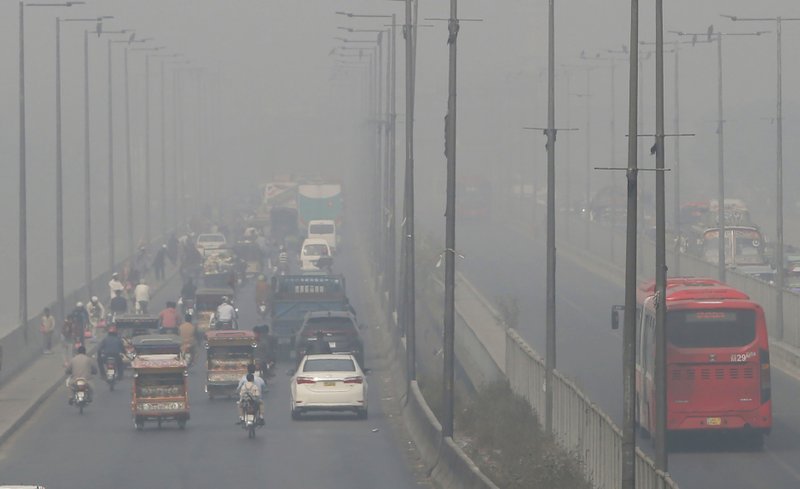
A thick blanket of smog enveloped Pakistan’s cultural capital of Lahore on Wednesday, prompting officials to warn that tens of thousands of the city’s residents risk respiratory disease and eye-related problems while doctors urged people to stay at home.
The air quality in Lahore deteriorated to hazardous levels, putting an additional burden on the fragile healthcare system amid a surge in coronavirus deaths and new infections. The Air Quality Index at one point rose to 750 in the city’s poorer areas — about 12 times the recommended level.
Earlier in the day, Switzerland-based air quality information platform IQair declared Lahore the second most polluted city, after New Delhi, India’s capital. Pollution indexes peak dramatically in Pakistan in winter, when farmers burn off stubble in the fields. Winds worsen the pollution by further spreading smog across the region.
“The air quality level was hazardous today,” said Sajid Bashir, a spokesman for Environmental Protection Department.
By mid-day the situation had improved, he said, as authorities took steps to keep smoke emitting vehicles off the roads and shut brick kilns across the province of Punjab, where Lahore is the provincial capital.
Lahore, once dubbed as the city of gardens, remained pollution-free for months after March, when the government imposed a lockdown to contain the spread of coronavirus. But the restriction was lifted in May, allowing a return to industrial activities and normal businesses. With cars back on the roads, the air quality gradually deteriorated, falling again to unhealthy levels. Pollution is no stranger to Pakistan, a country of 220 million — or Lahore, with some 12 million people. Cars are the top pollutants in Lahore but the city also has other sources of pollution, including the stubble burning, steel manufacturing furnaces and the city’s famous brick kilns.
“Coughing, throat infection and irritation in the eyes are common,” said Anza Farid, an environmental expert, warning that the situation could worsen in the coming weeks as more people burn garbage in the cities and farmers burn off the stubble in their fields.
Dr. Talha Ayub urged people to wear face masks for protection, both from pollution and the coronavirus. “People should try to stay at home if they can,” he appealed.
Pakistan on Wednesday said it registered 21 new COVID-19 deaths and 1,708 new infections over the past 24 hours — despite a government-imposed partial lockdowns in 4,136 residential areas across the country. The government is turning to sealing off hotspots in a bid to contain rising fatalities and infections from coronavirus. Authorities also banned large gathering, shut shrines, cinemas and theaters to contain the spread of the virus, which has infected more than 348,000 people in Pakistan and killed 7,021 since February.
https://apnews.com/article/virus-outbreak-pakistan-health-air-quality-lahore-c58d15948b4d50cef7c1ec88beb16d5e

Sudden spurt in #coronavirus cases in #Pakistan

The total number of active cases on November 10 was 20,045 as against 5,831 on September 14.
Pakistan is contemplating new measures to combat the coronavirus after at least 1,708 new COVID-19 cases were detected in the last 24 hours, taking the national tally to 348,184 on Wednesday.
Around 21 patients died in this period as the COVID-19 death toll reached 7,021, reported the Ministry of National Health Services.
The ministry data showed that some 320,065 people have fully recovered while 1,109 were in critical condition.
The National Command and Operation Centre (NCOC) in its meeting chaired by Federal Minister for Planning Asad Umar discussed the option to limit the public gatherings and enhance restrictions on high-risk areas.
The forum was informed that the number of cases have nearly tripled since the NCOC's earlier recommendation, on October 12 and then on November 3, to the National Coordination Committee (NCC) to ban large public gatherings and outdoor activities. However, no consensus has yet been reached by the stakeholders.
The meeting was informed that the positivity rate was increasing in educational institutions and there was a need to check the trend. It was decided that the federal education minister would chair a meeting of provincial education ministers on November 16 to review its situation.
"Other recommendations put forth by the body are to limit public gatherings – political, religious, cultural, entertainment and civil society in nature – to a maximum of 500 people,” according to a statement.It was also recommended in the meeting to limit restaurants and eateries to outdoor dining till 10pm and takeaways. Other suggestions included the closure of shrines in the country and early closure of markets with designated 'safe-days'. It was suggested to increase restrictions for high-risk sectors.The NCOC appreciated adherence to SOPs in mosques for the last many months. However, it noted a decline in compliance at present and urged the stakeholders to keep following the procedures in place.
Later Minister Umar tweeted that daily cases had nearly tripled since mid-October, when the National Coordination Committee (NCC) chaired by the Prime Minister first considered the NCOC recommendation to ban large public gatherings. "NCOC has once again recommended to ban all large public gatherings. Rapid increase in positivity requires urgent steps to save lives & livelihoods,” he tweeted.
The NCOC -- the nerve centre to synergise and articulate unified national effort against COVID-19 -- was briefed on Tuesday about the threat of rising positivity as the rate of coronavirus cases once again surpassed five per cent after a gap of over three months, the Dawn News reported. The highest increase of 16.71 per cent was observed in Pakistan-occupied Kashmir (PoK), followed by Balochistan (8.71 per cent), Sindh (5.39 per cent), Punjab (4.46 per cent) and Gilgit-Baltistan (3.24 per cent); while in Islamabad and Khyber Pakhtunkhwa, cases were decreased by 4.92 per cent and 4.61 per cent , respectively.
In Pakistan, the maximum positivity rate had reached 23% in June. It was brought down to 1.7% in September, the report said.
Positivity rate is the percentage of positive results out of the total number of tests sampled.
The positivity rate was 11.79 per cent on March 30, 19.95 per cent on May 25 and 22.24 per cent on June 1. Later, it started dropping and reached 16 per cent on July 6, 3 per cent on August 10 and 1.7 per cent on September 21. An upward trend in the positivity rate was spotted the following month as it reached 2.49 per cent on October 19, 4.26 per cent on November 2 and 5.13 per cent on November 10.
Similarly, the trend of new admissions due to COVID-19 has also started rising as 131 patients were admitted in hospitals, across the country, as compared to 46 on October 5, the report said.
The NCOC was informed that among healthcare workers, 8,573 cases were confirmed which was 3 per cent of overall COVID-19 cases.
According to the latest data released by NCOC, the number of active COVID-19 in Pakistan has increased by more than 14,000 cases in the last eight weeks.
The total number of active cases on November 10 was 20,045 as against 5,831 on September 14.
https://www.tribuneindia.com/news/world/sudden-spurt-in-coronavirus-cases-in-pakistan-169319

#Pakistan: #Christian mother and her son brutally lynched to death by an Islamist mob over #blasphemy

According to activist Rahat Austin, Yasmin was shot dead by Mohammad Hassan. His son, severely injured, died minutes later as he desperately clung to his wife’s hands while his two daughters saw their father dying.
A Christian woman named Yasmin and her son Usman Masih were brutally killed by a Muslim mob led by Muhammad Hassan and others in Kathor Kalan village in Gujranwala, Pakistan. The activist further mentions that the crowd gathered at the spot watched the specter of violence unleashed against the Christian family, with none of them coming forward to help them. Pakistan PM Imran Khan’s remarks rationalising Samuel Paty’s killing emboldens fundamentalists
The incident which has its roots in blasphemy occurred days after Pakistani Prime Minister issued a clarion call to the Islamic world to unite against ‘growing Islamophobia’ in the aftermath of the merciless beheading of a French teacher, Samuel Paty. He was killed and decapitated for showing the caricatures of Prophet Muhammad published by French satirical magazine Charlie Hebdo in his classroom.

Paty’s decapitation had triggered sharp disapproval from French President Emmanuel Macron, who raised concern over the ominous spread of Islamism and emphasised the need to foster an “Islam of enlightenment”. Macron’s sharp rebuke was also accompanied by sweeping measures ordered by the French government to suppress extremism.

Macron’s statement and action instituted by France in the aftermath of the Samuel Paty killing served as fodder for the leaders of the Islamic world, who made a beeline to rationalise the blasphemous murder of the French teacher and lay the blame on the Western world for hurting the religious sensitivities of the Muslims.

Turkish President Recep Erdogan, Pakistani Prime Minister Imran Khan, former Malaysian Prime Minister Mahathir Mohamad and several others issued incendiary statements, with a view to gin up anti-western sentiments and justify violence in the name of blasphemy. Many believe such rationalising remarks from Islamic leaders have served to embolden the fundamentalists in their respective countries to take a more hardened approach to deal with the criticism of Islam.

Plight of minorities in Pakistan and rising cases of violence over blasphemy

As such Pakistan has a poor record of safeguarding its minorities population and blasphemy is used as an instrument to target the minorities. Christian and Hindu minorities in Pakistan live under a constant threat of being persecuted by the Muslim extremists in the country. Girls belonging to the minority communities are routinely abducted, forcibly married and converted into Islam by the Muslim fundamentalists. Non-compliance or resistance have often led to their murder.

Just a few days back, another killing over blasphemy had come to the fore in Pakistan. A bank manager was shot dead by the security guard over a purported blasphemy allegation. Videos of the crowd cheering the security guard for killing the Bank Manager had gone viral on the internet.

In one such viral video shared by Pakistani activist Rahat Austin, Ahmad Nawaz, the security guard who shot a manager of the National Bank of Pakistan branch in Quaidabad tehsil of Khushab, accusing him of blasphemy, is seen leading a fanatic crowd of supporters which greets him and raises slogans in his favour as they walk together on the street. Amidst loud cheers and slogans, one person appears from the crowd and kisses the guard.

Even the Pakistani legal system appears to side with the fundamentalists as far as blasphemy is concerned. In September 2020, a Pakistani court in Lahore convicted a Christian man to death under the controversial ‘blasphemy’ law. The Lahore Session Court sentenced 37-year-old Asif Pervaiz Masih for insulting Islam and sending ‘blasphemous’ texts to a former supervisor at work. Masih was arrested in 2013 for alleged blasphemy.

Recently, in a brutal incident, an elderly man belonging to the minority Islamic sect of Ahmadiyyas, who was facing a trial for ‘blasphemy’, was shot dead in front of the judge in a local court situated in a high-security zone in Pakistan’s Peshawar city.

Tahir Ahmad Naseem, who was arrested on the charges of blasphemy two years ago, died on the spot in the court of Additional Session Judge Shaukatullah Khan after being shot at. The man on trial was facing charges for ‘insulting’ the Muslim Prophet Muhammad.

After the incident, shockingly, the Islamists in Pakistan had turned Khalid Khan—the man who shot dead Tahir Ahmed Naseem into a ‘hero’ as people took to social media to hail him as the ‘Lion of Islam’ for killing the ‘blasphemer’.

In a similar case, Aasia Bibi, a 48-year-old mother of four was convicted in 2010 for insulting Islam. She maintained her innocence but spent eight years in solitary confinement. Later she was acquitted by the Pakistan Supreme Court and had to escape to Canada. Salman Taseer, who was the former Punjab governor was also killed by his own guard in 2011 after he sought mercy for Asia Bibi. 

https://www.opindia.com/2020/11/pakistan-blasphemy-christian-islamists-yasmin-usman-masih/

Music Video - Aya Hai Bilawal NewSong 2020 |Twins Kids Performance in Gulmit (Gojal) Hunza Gilgit-Baltistan | #PPP

Video - Corner meeting of Pakistan Peoples Party at Nomal, Gilgit

Video - Chairman PPP Bilawal Bhutto Zardari addresses to rally in Baseen , Gilgit

Video - #BilawalBhutto #JalsaSpeech #BOLNews Bilawal Bhutto Speech in PPP Jalsa | 11th November 2020

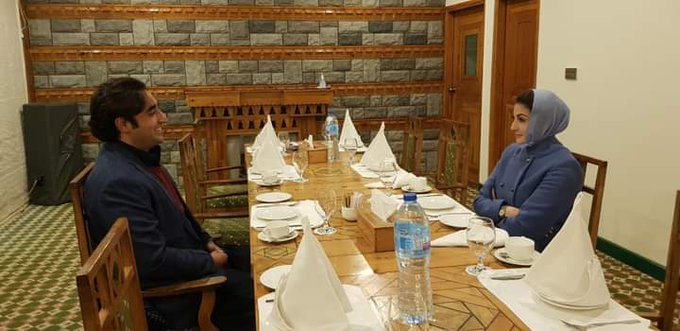
Chairman PPP Bilawal Bhutto Zardari and Maryam Nawaz held one on one meeting


Chairman Pakistan Peoples Party, Bilawal Bhutto Zardari and vice President Pakistan Muslim League-Nawaz, Maryam Nawaz held an one on one meeting in the hotel where both the leaders are staying in Gilgit in connection with their parties election campaigns. They discussed political situation in the country.

Both the leaders also held meeting with their delegations. The PPP delegation included Senator Sherry Rehman, Senator Mustafa Nawaz Khokhar and President PPP GB Advocate Amjad Hussain whereas the PML-N delegation was consist of Shahid Khaqan Abbasi, Ahsan Iqbal, Pervez Rasheed, Maryam Aurangzeb and Hafiz Hafeezur Rehman.

Tuesday, November 10, 2020

Ghazal - Sharab Cheez He Aisi Hai - Pankaj Udhas -

فوجی ترجمان کی پریس ریلیز :آئی ایس آئی/رینجرز ہاتھوں آئی جی سندھ کے اغوا کا اعتراف۔ #reportrejected

Video Report - #KhabarSayAagay #NayaDaur #PMLN Nawaz Sharif 'Rejected' IG Sindh Abduction Inquiry Report, PPP Welcomes

In Pakistan, feminist revenge drama ‘Witches’ sparks outrage following online debut

.Filmed in Karachi but released by an India-based streaming service, the show centres on four women who open a detective agency to catch cheating husbands. .The storylines cover often untouched topics such as gay relationships, sexual exploitation, male dominance and Pakistan’s obsession with fair skin A fiery online series about a group of women who unleash revenge on men has sparked a backlash in conservative Pakistan, where tough censorship rules prevent such shows from appearing on television. .Filmed in Karachi but released by an India-based streaming service, Churails, or “Witches” in English, centres on four women who open an underground detective agency under the guise of a clothing store to catch cheating husbands.
The storylines cover often untouched topics such as gay relationships, sexual exploitation, male dominance and Pakistan’s obsession with fair skin.
It caused a buzz among much of its audience online – often limited to affluent Pakistanis who can afford the platform’s subscription fee – but infuriated conservatives when clips began to circulate on social media.“When all of us read the script for the first time we thought to ourselves, ‘Are we even allowed to do this?’,” said actress Mehar Bano.She plays Zubaida, a young woman from a poor and traditional family who loves boxing but is forbidden from practising the sport.“We knew what we were getting into, we knew that something like this would garner a lot of hate,” she said.It is a rare women-centred script for strait-laced Pakistan, where shows are often limited to the stormy relationships between stay-at-home wives and their demanding mothers-in-law.“Before this, I had not heard or seen these women on television or on digital platforms or cinema, even though I knew they existed,” said British-Pakistani filmmaker Asim Abbasi, who wrote the 10-episode series. He faced relentless accusations of “making immorality glamorous” once the show began streaming, especially after a clip from the series went viral on social media.
It portrayed a successful businesswoman character who discussed having to perform sexual services for her boss in order to be promoted. Zee5 later temporarily pulled the series while it “addressed” a complaint from the Pakistan Television Authority. How do we fix something when it’s not being talked about? Mehar Bano, Pakistani actress “How do we fix something when it’s not being talked about? It keeps the status quo in place,” said Bano of complaints by the “moral police”. The actress, whose character is rescued from a forced wedding while her parents are held at gunpoint, said the familiar portrayal of women as respectful and subservient was keeping Pakistani women at a disadvantage. Abbasi said he would never have been able to produce the show for Pakistani television, which faces heavy censorship from authorities particularly related to sexuality.
International subscription streaming platforms do not face the same constraints, but tech companies do risk outright prohibition – Pakistan briefly banned Chinese short video app TikTok earlier this year because of “immoral” content. Series star Sarwat Gillani said her country was “living in denial”, with the lives of Pakistanis “sugarcoated” for television. “We weren’t telling a lie,” she says of Churails, in which she plays a rich trophy wife who founds the detective agency after discovering her husband has been texting dozens of women. “We weren’t telling a story of another country. We were telling a story about our people,” she adds.
Pakistan’s censorship crusade against supposedly indecent media has been gathering pace under Prime Minister Imran Khan, a former cricket star with a playboy past, who has sought to placate powerful conservative and religious constituencies. “The problem is that you cannot define indecency. It has a totally different definition for different segments of the population,” complained science minister Fawad Chaudhry, who opposes the government bans and says they are harming the country’s tech industry. In the past few months, foreign-made dating apps such as Tinder and Grindr have been blocked and YouTube has been threatened. There has been an “erosion of the kind of things we can talk about”, said filmmaker Hasan Zaidi, a former head of the Karachi Film Festival. “The avenues and space available for creativity have really shrunk in Pakistan,” he said. Series star Bano added that she understood it was “uncomfortable” for Pakistanis to see the flaws in their own society but said entertaining narratives gave audiences a chance to reflect.
https://www.scmp.com/news/asia/south-asia/article/3109231/pakistan-feminist-revenge-drama-witches-sparks-outrage
“Because of this banning culture, there are a lot of problems that are being swept under the rug,” she said.

The Return of Militancy in Pakistan


By 

After a few years of relative peace, militant groups are on the rise again – and at a dangerous time for Pakistan.

Pakistan has enjoyed comparative peace over the past few years, other than sporadic incidents. Following a devastating attack on a school in Peshawar in 2014, the state cracked down on religious and other banned militant outfits under the National Action Plan (NAP), the country’s 20-point counterterrorism strategy. This offensive pushed such groups back into hiding, temporarily disrupting their networks. As a result, the country’s major cities have been largely immune to militancy.

An October 27 IED blast at a religious school in Peshawar, in which eight young people died and more than 110 were injured, has disrupted that peace.

It is believed that Sheikh Rahimuddin Haqqani, a Afghan cleric originally from Jalalabad, in Afghanistan, was the target. He was taking a class in the religious school where the explosion took place. He was the target of suspected elements of the Islamic State in a gun attack in 2016. He escaped safely back then, as he did this time, protected by his young security guards from the religious school.

Close to the Afghan border in Pakistan’s Khyber Pakhtunkhwa province, Peshawar has witnessed some of the worst violence of the last two decades,  since the United States invaded Afghanistan in 2001. The most horrific and horrendous attack was the 2014 incident in which Taliban gunmen stormed a military school. By the end, 150 were dead, most of them children. The attack shook the conscience of the world, and provoked Pakistan’s security forces to take a sterner approach under NAP, which was formulated in the aftermath of the tragedy. The NAP called for the military to go after banned outfits of all sorts, including religious and nationalist groups often believed to be implicitly backed by Pakistani authorities. The strategy provided a brief calm, but now once again Peshawar has been hit, allegedly by religious militants.

Unfortunately, the Peshawar blast was followed a motorcycle blast in Quetta, the provincial capital of Balochistan in the southwest of Pakistan. As a result of the blast, three people reportedly were killed and over a dozen injured. Worryingly, the blast occurred in the outskirts of Quetta as opposition leaders of the country’s major political parties were present in the city, addressing tens of thousands people in a bid to mount pressure on the government.

Over the past few months, Pakistan’s security landscape has changed fast. The spate of attacks clearly suggests that the militant groups are regrouping, prompting a resurgence of violence. That does not augur well for the cash-strapped Pakistani government, already reeling under International Monetary Fund (IMF) loans.

In Pakistan, the former Federally Administered Tribal Areas (FATA) – now merged with Khyber Pakhtunkhwa province – have long been the major source of militancy, which eventually evolved into a threat to the state itself. Over the past five years, the security forces have carried out major operations against Taliban-linked groups, flushing them out of the tribal areas. Since then, other than sporadic attacks, these groups have been biding their time, but are now gathering momentum once again – this time with the addition of the Islamic State (IS) to the list of groups carrying out attacks. Reports suggest the militant groups have managed to regroup, despite being weakened by the intelligence-based operations.

The current wave of attacks is taking place at a crucial time, when the major opposition political parties are in the streets protesting against the government led by Prime Minister Imran Khan. Other than political uncertainty, Pakistan is increasingly faced with financial woes, which have only gotten worse in recent years. In Pakistan, China has become the dominant investor under the China-Pakistan Economic Corridor (CPEC). But since Khan came to office in 2018, Chinese investors have been discouraged by the government’s inexperience, especially in economic management. Recently, the Chinese have returned, reviving the multibillion-dollar CPEC projects after some delays.

In order to attract investments and economic development, Pakistan’s government has to ensure the safety and stability of the country. In that regard, some analysts have pointed out a curious coincidence: The resurgence of religious-cum-sectarian attacks has been taking place exactly as the CPEC has been revived in the country after quite some time on the backburner. Baloch militant groups have been opposed to CPEC from day one, and have been carrying out attacks in Gwadar – the heart of the CPEC – and elsewhere in the country in order to show their opposition.

The Chinese, despite their heavy investments, are concerned about the security situation. Militant groups, including banned religious outfits, have carried out attacks against Chinese workers and installations in the past. Now they have to worry that the revival of CPEC projects has gone hand-in-hand with the recent upsurge of militancy in various parts of the country. Already, Baloch separatists have carried out major attacks against Chinese workers and installations in Balochistan province, as well as in Karachi, the provincial capital of Sindh.

Pakistan’s security-centered approach has failed to stop such attacks, which are detrimental to Chinese investments. So the government has shifted course with the announcement of the South Balochistan Package, meant to generate jobs and other economic opportunities in the area. Officials believe that, through this effort, Baloch youth can be dissuaded from joining the rank and file of the separatists in Balochistan. But realities on the ground suggest otherwise. A political question cannot be resolved through economic policy alone.

Meanwhile, along with terrorism, sectarianism between Shia and Sunni groups is also rearing its head in various parts of the country. As seen in the past, sloganeering can trigger sectarian violence, which has already claimed thousands of lives in Pakistan. Keeping in view the recent sectarian developments in the country, Pakistan could slip into sectarian chaos anytime. Since policymakers have not learnt any lessons from the past, it keeps on repeating, with dire consequences for the state and its people. Among other problems, major political parties are not giving serious attention to recent sectarian tensions: either they are complicit or they are too afraid to speak out about it.

Militancy has returned to Pakistan after a brief hiatus. If it is not dealt with, it could initiate a new cycle of violence, engulfing the peace and prosperity of the country and the region as a whole.

https://thediplomat.com/2020/11/the-return-of-militancy-in-pakistan/

Several localities in #Lahore, #Pindi, #Multan go under lockdown amid #Covid-19 spike


Several localities in Lahore, Rawalpindi and Multan have been declared as coronavirus hotspots and put under lockdown with immediate effect, according to notifications from the Punjab Primary and Secondary Healthcare Department released late Monday, after 400 new cases were reported province wide for the first time since July 18.

The notifications said there had been a "constant increase in positivity percentage and prevalence of Covid-19 in the province of Punjab during the last two weeks which poses a serious and imminent threat to public health", adding that all possible measures needed to be taken to control the spread of the virus.

According to the notifications, following areas in the three cities were put under lockdown "with immediate effect" until November 19:


Lahore:

  • New Muslim Town
  • Raza, Sikandar and Umar blocks of Iqbal Town
  • Certain blocks in Garden Town
  • Cavalary Ground
  • DHA Phase 1 (AA Block)
  • DHA Phase 6 (L Sector, A Sector)
  • Askari 11
  • Anarkali
  • Mozang
  • Shadman
  • Certain parts of Gulshan-i-Ravi

Rawalpindi:

  • Fauji Foundation University, New Lalazar
  • Government Girls Highschool, Kahuta
  • Satellite Town
  • Abbasi Abad

Multan:

  • Naqshband Colony
  • Gulgasht Colony/ Khairabad
  • Mepco Colony
  • Khwajabad/ Multan Kacheri
  • Sadat Colony

The notifications said all markets, shopping malls, restaurants and offices would remain closed in these areas while movement would be restricted and all public gatherings would be banned.

Grocery stores, fruit and vegetable shops, tandoors and petrol pumps would be allowed to remain open between 9am and 7pm on all days of the week. Milk shops, fish and meat shops, and bakeries would be allowed to open from 7am to 7pm. All medical services, including hospitals, clinics and pharmacies would remain open 24 hours a day, the notification said.

The measures come as Punjab reported more than 400 daily cases on Tuesday for the first time since July. The government's coronavirus portal showed the province recorded 407 new infections in the last 24 hours, taking its total to 107,329. The province last reported more than 400 cases on July 18, when it confirmed 442 infections.

According to the official figures, from July 21 to Oct 23, Lahore had been reporting less than 100 daily cases. Since Oct 24, however, the city has been reporting over a 100 cases and on Monday, accounted for 174 out of the total 345 new cases in Punjab.

Of the total new cases in the province yesterday, 50 tested positive for the virus in Multan and 41 in Rawalpindi.

Others were reported from DG Khan, Narowal, Sialkot, Gujrat, Sargodha, Mianwali, Kasur, Bahawalnagar, Muzaffargarh, Faisalabad, Lodhran, Gujranwala, Bahawalpur, Okara, Toba Tek Singh, Mandi Bahauddin, Sahiwal, Khanewal, Vehari, Khushab, Jhang and Chiniot.

Meanwhile, the National Command and Operation Centre (NCOC) on Monday observed that the Covid-19 positivity ratio is rapidly increasing in major cities, with the rate exceeding 15 per cent in at least three cities across the country.

Multan had the second highest positivity rate across the country at 15.97 per cent, behind only Hyderabad at 16.59pc. Lahore (5.37pc) and Rawalpindi (4.63pc) were also declared among the top 15 cities with the highest positivity ratios.

Separately, a special meeting of the Cabinet Committee for Anti-Corona held at Chief Minister’s Office took notice of the violation of standard operating procedures (SOPs) in markets and businesses and decided to shut down all such places.

Speaking on the occasion, Health Minister Dr Yasmeen Rashid said there is an ample stock of essential medicines and PPEs.

"The health department will buy more PCR kits for tests," she claimed.

Industries Minister Mian Aslam Iqbal said every necessary measure would be taken to control the second wave of coronavirus in the province, according to a report by Radio Pakistan.

The meeting also decided to declare the Rawalpindi Institute of Urology as a dedicated hospital for treating coronavirus patients.

https://www.dawn.com/news/1589639/several-localities-in-lahore-pindi-multan-go-under-lockdown-amid-covid-spike