Monday, September 16, 2019

Hindus fear for their lives after Pakistan blasphemy riots

Communal riots have erupted in Ghotki, a southern Pakistani town, after a charged mob attacked a school due to blasphemy accusations against its Hindu principal. Blasphemy is a sensitive issue in the Islamic country.

Violent protesters attacked a school on Sunday after a blasphemy case was filed against Nautan Lal, principal of the Sindh Public School.
Abdul Aziz Rajput, a student's father, complained to the police that Lal had insulted Islam.
Blasphemy, which is punishable by death in Pakistan, is a sensitive topic in the country, where 97% of its 180 million inhabitants are Muslim.
Rights activists have demanded reforms of controversial blasphemy laws, which were introduced by the Islamic military dictator General Zia-ul-Haq in the 1980s. Activists say the laws have little to do with blasphemy and are often used to settle petty disputes and personal vendettas.
According to rights groups, around 1,549 blasphemy cases have been registered in Pakistan between 1987 and 2017. More than 75 people have been killed extra-judicially on blasphemy allegations. Some of them were even targeted after being acquitted in blasphemy cases by courts.
Pakistan's Christians and other religious minorities have often complained of legal and social discrimination in their country. In the past few years, many Christians and Hindus have been brutally murdered over unproven blasphemy allegations.
Hindus locked inside their homes
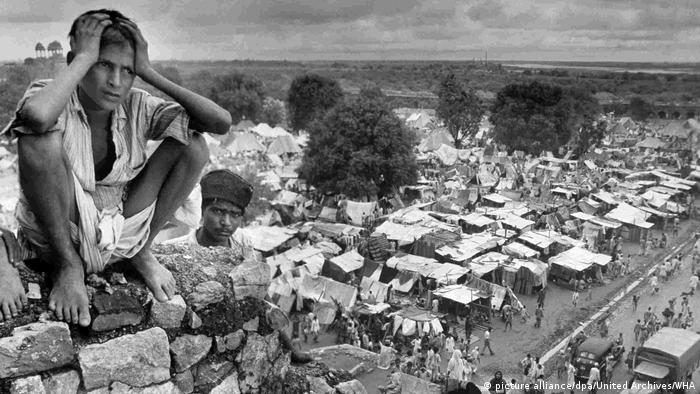
Ghotki, a small town in southern Sindh province, has a considerable population of Hindus, who have been living there before the partition of British-ruled India in 1947.
 
Watch video03:02

Christians in Pakistan fear increasing intolerance

Sindh province is known for its mystical ethos, where Hindus, Sikhs and Christians have coexisted with Muslims for centuries. But in the past few years, extremism has gripped the region, with hardline Muslim groups attacking temples and forcing Hindus to convert to Islam.
The riots in Ghotki have forced the Hindu community to remain indoors, as authorities have deployed police forces in the city.
Jaipal Chhabria, the president of the Pakistan Hindu Forum, told DW that the Hindu community in Ghotki feels more insecure after the riots.
"Nautan Lal only scolded a Muslim boy for not completing his homework. The boy accused him of blasphemy and that triggered violent protests in the city. The Hindus in the area are frightened and have locked themselves in their houses," Chhabria said.
Chhabria claimed that a local religious leader and his supporters were involved in the Sunday school attack.
The school principal and his family have reportedly gone into hiding, fearing mob attacks.
"How can they live in Ghotki anymore?" said Rajesh Kumar, a Ghotki resident. "Once a person is accused of blasphemy, they cannot live in that area. In the past, mobs have killed many people on blasphemy allegations."
Some reports say the police have taken the principal into custody and moved him to an undisclosed location due to security concerns.
Inadequate state help
Rights activists have demanded the provincial government protect the Hindu community in Ghotki.
Hari Lal Bhagia, the secretary-general of the Upper Sindh Hindu Panchayiat, told DW that the authorities are trying to restore peace in the area. "But these extremist groups are quite powerful, and even the government looks helpless. That is why the Hindu community in the area feels even more vulnerable to attacks," Bhagia said.
 
Watch video01:16

'Holi' in Pakistan: celebrating to honor spring and harmony

But Sajjad Ali Soomro, a local rights activist, said that the indifference of state authorities has emboldened extremist groups in a province that used to be a beacon of religious harmony in the country.
"On Sunday, hundreds of people gathered outside the police station and later started attacking Hindu houses, businesses and temples. The authorities did not intervene," Soomro said.
Senator Taj Haider, whose Pakistan People's Party — headed by Bilawal Bhutto — governs Sindh province, admitted that the police should have stopped the mob from attacking Hindu properties.
Haider, however, insists that the provincial government is not to be blamed for religious disharmony in the area.
"We handed over a list of 300 religious seminaries that have been propagating hatred and extremist ideas to the federal government, but it did not take any action against these elements," he told DW.
Police have booked several people for damaging public property and inciting violence in Ghotki.
Religious minorities feel 'unsafe' in Pakistan
Hindus make up around 2.5% of Pakistan's population. The majority of them, over 90%, live in Sindh.
There have been reports that the number of Hindus migrating to neighboring India has increased in recent years.
Pakistan's Christians, and other religious minorities, have often complained of legal and social discrimination in their country.
Asia Bibi, a Christian woman who spent years on death row in Pakistan on a blasphemy charge, left for Canada to join her family in May. Bibi and her family had to stay in hiding even after she was acquitted by the country's Supreme Court in October 2018.
Recently, Baldev Kumar, a former legislator from Prime Minister Imran Khan's Pakistan Tehreek-e-Insaf (PTI) party, sought asylum in India for himself and his family. The 43-year-old politician alleged that Pakistan is an "unsafe country" and that the Imran Khan-led government mistreats minorities there.
In the past few years, many Christians and Hindus have been brutally murdered over unproven blasphemy allegations.
In one case, a young Christian girl with Down Syndrome was accused in August 2012 of burning pages upon which verses of the Koran were inscribed. Rimsha Masih was taken into police custody and only released months later, when charges were dropped. The case caused an uproar in her hometown and beyond and sparked riots and violence against Christians in the region. In 2013, she and her family relocated to Canada.
In 2014, a Christian couple was beaten to death for allegedly desecrating a copy of the Koran. Their bodies were subsequently burned in a brick kiln.
In September last year, a Christian man in Pakistan was sentenced to death for sharing "blasphemous" material on WhatsApp.

Pakistani police detain Hindu school principal over 'blasphemy'

By


Pakistani police have detained a Hindu school principal in the southern town of Ghotki, after he was accused of committing blasphemy by a student, prompting riots by far-right protesters, police officials and Hindu community leaders say.
Notan Lal, the owner and principal of a private school in Ghotki, located about 425km north of Karachi, Pakistan's largest city, was taken into "protective custody" on Sunday, senior police official Farrukh Lanjar told Al Jazeera.
"He is in protective custody and we are inquiring about what his role is [in the incident]," said Lanjar. "The student has also been questioned. The inquiry is under process."
Blasphemy is a sensitive subject in Pakistan, where at least 75 people have been killed since 1990 in connection with allegations of the crime, according to an Al Jazeera tally.
The crime, which includes insulting the Quran (Islam's holy book), attacking religious sites or insulting Prophet Muhammad, can carry a mandatory death penalty.
At least 40 people are serving life sentences or are on death row for blasphemy in Pakistan, according to the United States Commission for International Religious Freedom (USCIRF).
On Sunday, an angry mob ransacked the school where the incident allegedly took place and attacked a Hindu temple, badly damaging its interior, members of the Hindu community told Al Jazeera.
"In the temple, they broke the windows, and the things inside, including our idols, were also damaged," said Mukhi Kika Ram, the leader of the local Hindu community.
Ram said several shops and homes were also damaged by rioters.

'Tempers high'

Police said they intervened on Sunday with a heavy deployment of personnel to bring the town back in order, and registered a blasphemy case for the attack on the temple.
"We ensured that minorities be protected and their places of worship and homes be protected," said Lanjar. "We have deployed additional personnel there."
Later on Sunday, government officials held talks with the religious leaders leading the protests to end the violence, said provincial Information Minister Saeed Ghani.
"We are investigating and going through every person possibly involved, but tempers are high and people are charged and we want to make sure the situation is calm before we proceed ahead and verify details," said Jamil Ahmad, a senior police official, adding that Lal's statement had been recorded.
On Sunday night, Ahmad said Muslim religious leaders spent the night with Hindu representatives of the area at the temple that was attacked as a show of solidarity.
"The community around the school and temple has shown great maturity. Clerics of every sect showed up in solidarity at the temple. And the Muslim community and clerics provided security to Hindu families."

Blasphemy case

The accusation against Lal centres on comments he allegedly made while sitting in on an Urdu lesson, said Abdul Aziz Khan, the complainant in the case.
Khan's son, 15-year-old Muhammad Ibtisam, alleges that Lal insulted the prophet during a lesson on his life and travel between two holy cities.
Khan alleged that Lal had later sent school staff to their residence to pressure Ibtisam to recant his statement, resulting in a violent altercation between Khan's family and the staff.
"We had a confrontation there, where we argued with them over this," he said, adding that following the violence he registered the blasphemy case at the local police station.
On Sunday, local religious parties, including the Sunni Tehreek and the Jamiat Ulema Islam, led protests in Ghotki, forcing businesses to shut and resulting in the attacks on the temple and school, residents told Al Jazeera. Videos from the protests showed Muslim leaders called for "blasphemers" to be put to death.
Khan, himself under police protective custody, condemned the violence, saying Lal should only face any punishment under the law.
"Whoever has done this, it is completely wrong," he said. "Our religion does not give permission for this. Our Prophet Muhammad, on whose name we are pursuing this case, says for no one to ever be harmed, even if they are non-Muslim.
"If one heretic has committed heresy, then the police must arrest him, the court must hear him and then he will face his punishment."

Hindus fear for their safety

Pakistan human rights body called the mob violence against the minority community "barbaric" while Amnesty International said the perpetrators of the attack must be held "accountable".
"The authorities must take prompt action to quell the violence and ensure the safety of the school principal being targeted," said the independent Human Rights Commission of Pakistan in a Twitter post following the violence.
"The video circulated earlier is chilling: mob violence against a member of a religious minority is barbaric, unacceptable."
Hindu community leaders, however, said they continued to fear for their safety in Ghotki.
"We are very hurt by the idea that if one person commits a mistake, then the whole Hindu community is punished for it," said Jewat Ram Manglani, a community leader. "We respect both our temples and also mosques, and people should also respect us."
Pakistan is home to roughly 3.3 million Hindus, a small minority in a country of 207 million people. The majority of the country's Hindus live in the southern province of Sindh, where Ghotki is located.

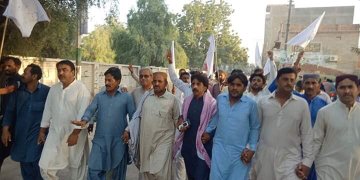
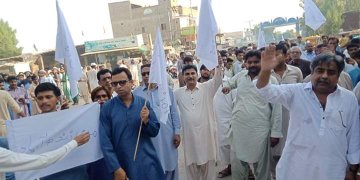
#Pakistan #PPP - Federal govt ‘conspiring’ to divide Sindh: Bilawal


Pakistan People’s Party (PPP) Chairman Bilawal Bhutto Saturday said the federal government wants to ‘occupy’ Karachi as part of a larger conspiracy to divide the Sindh province.
The PPP chief said his party enjoys complete support of the masses as it won the last year’s general elections with a heavy majority. He said the federal government is not releasing the due share of funds for Sindh which is a sheer injustice with the province. “Those who want to eliminate PPP will be themselves eliminated,” he added.
Bilawal announced that he will initiate agitation against the ‘puppet’ government from a public gathering to be held at Garhi Khuda Bux. To a question regarding forward block in the PPP, he termed the reports mere speculation.
Sitting and former lawmakers including Mir Abid Bhayo, Eijaz Dhamrah, Anwar Ali Sial, Nisar Ahmed Khuhro, Khurshid Junejo, Azhar Kamario, Abdul Fatah Bhutto also accompanied the PPP chief.

Video Report - Mob attacks Hindu teacher, vandalises temple in Pakistan

Video Report - #SaudiOil #HouthiRebels Saudi oil attacks: Iran denies links to drone strikes

Video Report - Drone attack on Saudi oil: How safe are global supplies? | DW News

Video Report - Bolton's record that got him fired from Trump's Administration

Video - Footage Surfaces from Bernie Sanders’s 1980s Public Access Show | The Daily Show with Trevor Noah

#Pakistan #PPP - Bilawal Bhutto Address In Garhi Khuda Bakhsh Workers Convention| 15 Sep 2019

#Pakistan - The regime

Cyril Almeida

BY now, it’s apparent to all — or at least to anyone willing to look — what this is. Gone are the fig leaves and legal nuances and faux optimism. It is what it is, it isn’t very pretty and it’s probably going to get a whole lot uglier.
Welcome to the hybrid regime.
A lot has already gone wrong and the stuff that has gone wrong is obvious for two reasons. Economic hurt is impossible to hide, especially at the consumer end and when jobs start to disappear. Folk can easily intuit what’s going on every time they buy something or wander around in search of jobs.
Imran helped. His message was simple — I’ll fix everything at the same time in record time, just trust me — while the base he cultivated is simpler still: young-ish, previously apolitical and with not much understanding of much.
Outsized expectations were always going to collide with reality, but that reality has turned out to be so dismal and the collision come at such speed is down to something else.
Imran has landed himself in an awkward and potentially perilous situation.
The periodic shopping around for a useful idiot to nominally run the show was more straightforward in times past: pick a technocrat or select a traditional politician. Technocrats get a bit of work done because that’s what professional sorts do: they try and do stuff.
Never mind that they screw up matters and leave a mess behind; while they’re on the job, technocrats always look like they’re busy doing stuff. They have to.The traditional politician has much the same imperative to be seen to be doing things, but his focus is mostly on greasing the system because no grease means no support and no support means no utility to the ones hunting about for the next useful idiot.
But things aren’t so simple in a hybrid regime.
The headhunters don’t just have to find someone who can get things done, they need someone to bring a veneer of legitimacy to the whole enterprise. In these tricky times, a memorable Mohammed Hanif phrase must suffice by way of elaboration:
“Khan has politicised a whole generation, only to deliver it into servitude to Pakistan’s old establishment.”
If the headhunters needed someone Imran-esque, give the man his due: Imran made it impossible for the headhunters to look past him. A hybrid regime fronted by a technocrat or traditional politician was a non-starter in the presence of Imran.
With the idea being to put Nawaz and Zardari to the sword politically and then if you look past Imran too, there isn’t much left in the wagon wheel of public opinion from which to secure legitimacy for a hybrid regime.
One of the more curious elements of the experiment we’ve all been made to live through this past year is why this doesn’t seem to have occurred to Imran — that much as he needs them, they need him, or did anyway.
Perhaps Imran really has no interest in anything beyond becoming PM as a final chapter in a life well spent. Or perhaps in finding their latest useful collaborator the competence deficit is more than what had been hoped for.
Either way, in eviscerating great chunks of his political capital in little over a year, Imran has landed himself in an awkward and potentially perilous situation: on balance, it’s not quite clear if the veneer of legitimacy Imran brings to the hybrid regime is really worth the headaches he’s created for the regime.
But if what’s gone wrong is obvious and how we’ve got to this miserable point in double-quick time is fairly clear, there’s a more fundamental problem with the hybrid regime: it can’t work, no matter who is trotted out to front it.
Slice it anyway you like. Regimes almost by definition are a centralising force, but delivery is almost always decentralised.
Perhaps because the margins at the centre were razor-thin or perhaps because the impetus behind this project is itself a centralised force, too much time and attention was wasted on fashioning a workable arrangement at the centre.Imran is now effectively a lame duck at the centre, the IMF straitjacket and the snatching away of key ministries from his control ensuring that. But Imran still has real sway in Punjab and KP and, with the right assistance, a fair bit of potential to meddle in Sindh.That Imran has proved rubbish at managing the provinces, and thereby undercut the rationale of the hybrid regime, has obscured the point that the provinces can’t be managed from the centre. But then no regime can tolerate multiple power centres across the provinces. It’s a riddle with no solution.
Or flip it around.
Just because Imran is flailing around doesn’t automatically have to mean that a better frontman can never be unearthed. It could just be a question of more skilfully looking in the right place at the right time.
A regime frontman with the skills of a technocrat, the savvy of a traditional politician and the sleight of hand of a populist. See the problem there? In Pakistan? You may as well be looking for a unicorn snuggling up to leprechaun at the end of a rainbow. The internal contradictions of a hybrid regime are too many and too varied to be adequately and sustainably overcome.
By now, it’s apparent to all what this is: it isn’t very pretty and it’s probably going to get a whole lot uglier. And that we still have Imran is both the good news and the bad.
Pakistan, eh?
May God bless this land and good luck to all of us here.
https://www.dawn.com/news/1505305/the-regime

#Pakistan - Why Imran Khan's 'Kashmir Hour' Fell Flat

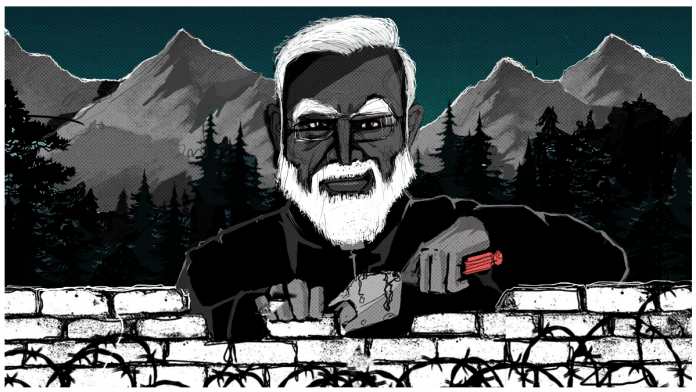
Modi has finished Pakistan’s ‘unfinished business’ of Partition


Article 370 is gone, now it’s time to fight the good fight — for rights of Kashmiris as fellow Indians and restoration of commerce & political activity in J&K.


Here is a somewhat different way of looking at Jammu and Kashmir today.
One side in the conflict had used one description for the Kashmir issue for 70 years, as if it was cast in a Pir Panjal rock: It is the unfinished business of Partition.
That side was Pakistan.
India never agreed. Not even by way of emphasising its claim on Pakistan-occupied Kashmir (PoK). India’s view was, Partition ended in 1947. We have moved on, so should you. It wasn’t stated, but unambiguously implied.
Pakistan disagreed. In the decade of the 1950s, it waited to strengthen its armed forces by joining US-led military pacts. That achieved, in the 1960s, it launched a full-fledged military campaign to take Kashmir by force to settle that “unfinished business”, but failed.
It spent the 1970s recuperating from defeat and the dismemberment of 1971. Zulfikar Ali Bhutto turned its attention westwards, towards Islamic countries, especially the Arabs, and sought solace in the Ummah. The “unfinished business” wasn’t forgotten. The Pakistani establishment was biding its time.
The time came in the late 1980s. By 1989-90, Pakistan believed it now had a proven strategy. It was the one used to defeat the Soviets in Afghanistan. It also had the nuclear umbrella. The asymmetric war launched in Kashmir at that time is now in its 30th year.
In the 1990s, it waned (after P.V. Narasimha Rao crushed the insurgency). It rose again with pan-Islamisation of the insurgency as foreign mujahideen surfaced. The intrusion in Kargil was the next gambit. That failed because of India’s resolute response and Pakistan’s non-existent international leverage.
After Musharraf’s coup in 1999, the insurgency was fully revived, now manned entirely by Pakistani jihadis. As it peaked, the Vajpayee government accepted a Pakistani overture for a summit. But the imperious manner in which Musharraf conducted himself at Agra shocked even an incorrigible peacenik like former prime minister I.K. Gujral. He said Musharraf was behaving as if he was visiting a “defeated country”.
The Agra summit failed. Pakistan’s global leverage also returned soon with 9/11. From being an expendable old ally-turned-nuisance, Pakistan emerged as a “stalwart ally” (Bush’s description) yet again. Bloodshed in Kashmir peaked. You want to know how strong Pakistan’s hold on the Americans was in this year? When Kashmir’s first suicide bomber blew up its state assembly, then Secretary of State Colin Powell infamously described it as an attack on an Indian government “facility”.
The attack on Parliament, a near-war following it, and then the long peace process with Musharraf during the tenures of Vajpayee and Manmohan Singh are relatively recent history. Regrettably, the Pakistani establishment was again only buying time.
Keeping pace with all the peacemaking efforts was pro-active asymmetric warfare. India was hit with something big the moment the ISI calculated India had had “too long” a period of respite. There were many train bombings, attacks here and there in mainland India (besides routinely in Kashmir) and then the Mumbai massacres of 2008.
The pattern continued in the following decade. Every thaw was followed by a kick in India’s shin. Gurdaspur, Pathankot, Pulwama, keep counting.
India responded in a variety of ways: From counter-insurgency in Kashmir, a localised fight back (Kargil), coercive diplomacy (after the Parliament attack) and strategic restraint (26/11).
The initiative was always with Pakistan. For 70 years, Pakistan had brainwashed itself into believing that if it kept bleeding India, India would one day give in.
Pakistan had given up hope of winning Kashmir after its 1965 misadventure. But there was always the hope for something, at least a face-saver, something to write home about.
From a four-district Valley land grab deal in the pre-1965 Bhutto-Swaran Singh negotiations under big-power (mostly British) pressure, to open borders and treaty-bound Kashmiri autonomy in the Musharraf-Vajpayee/Manmohan Singh era, Pakistan had moderated its expectations.
But it was confident of getting “something” in the end. Something to claim that it had concluded that unfinished business of Partition.
Instead, on 5 August this year, the Modi government finished that “business”. Every Indian prime minister had moved the clock in the same direction. Article 370 and Kashmiri special status and autonomy had been whittled down over these decades, as if serendipitously.
Narendra Modi has sealed that. Of course, it brings him great benefit in domestic politics. But he never claimed he wasn’t a politician.
This business finished, where do we go next?
For the first time since 1947, Pakistan has to strategise when it doesn’t have the initiative. India has shut the door on negotiations on the status of Kashmir, or at least the part of Jammu and Kashmir with India.
Pakistan can, of course, try to take it by force again. A full-fledged war will have its own consequences. Resumption of terrorism will be countered under the definition of a new normal.
Here’s the oldest reality on Kashmir: It was never an international or even bilateral issue. The only thing bilateral was our mutual hypocrisy.
For Pakistan, it was the fraudulent pretence of “Azad Kashmir”, as if “azadi” or any third option was available besides India or Pakistan.
For India, it was the insincere subterfuge of a moral, political and constitutional commitment to Kashmiri autonomy and special status. None of our 13 prime ministers believed this. Not even Jawaharlal Nehru.
All this is now buried.
The new reality is, therefore, essentially the old one: There will be no territorial exchange at all between the two countries, even if they fight a thousand-year war as Bhutto had threatened (only 72 have gone yet). Not even if they drop all their nukes on each other. Kashmir’s territorial status was never going to change. Now even cosmetic, optical face-savers to Pakistan are out.
There is a nuttier (but self-destructively powerful) section among the Pakistani establishment which still has scriptural belief of ‘Ghazva-e-Hind’, whereby Islamic forces led by them will “break up and subjugate India”. That is exactly the fantasy echoed by the idiotic few (and we don’t yet know who) who shouted “Bharat tere tukde honge…” the other day. India isn’t about to break up, and Kashmir will stay where it is.
Pakistan is out of the equation now. Where do we go next?
First, accept that whether or not you like Narendra Modi and Amit Shah, there is zero popular support for or prospect of what happened on 5 August being reversed. Zero. On the status of Kashmir, there is the widest political and popular unanimity in India.
This accepted, junk all guilt and self-flagellation. Since you swear by your Constitution, read it from Article 1 on, not 370. Article 1 lists the states and territories of India and has Jammu & Kashmir firmly at no. 15. You can’t swear by your Constitution, but only by a solitary temporary Article 370 and fight with its Article 1.
What follows is less cluttered. Speak, campaign, fight for the restoration of all civil and human rights, restoration of communication, commerce, movement, assembly, peaceful protests, political activity in Jammu and Kashmir. It’s a good fight.
Fight for the Kashmiris’ constitutional rights now as equal, fellow Indian citizens. There is no reason why they should not have the same rights as Indians in Tamil Nadu, Uttar Pradesh, West Bengal or Gujarat. It should have always been the case, except for those lingering uncertainties about the “dispute” with Pakistan, the unfinished business of Partition.
After the loss of more than 42,000 lives in 30 years, a new history has begun in Kashmir. We can make it much better than the past.

بھارت سے تجارتی پابندیوں کے بعد نصابی کتب کا بحران سر پہ موجود


مونا خان

چونکہ پاکستان میں پرنٹنگ کا کاروبار نہ ہونے کے برابر ہے اس لیے یہاں صرف لوکل شاعری یا ادب کی کتابیں پرنٹ ہو جاتی ہیں لیکن یونیورسٹی پریس گروپ یا ہارورڈ پبلشر کی کتابیں بھارت میں ہی پرنٹ ہوتی ہیں۔

پانچ اگست کو بھارت کی جانب سے جموں و کشمیر کی ریاستی حیثیت ختم کرنے کے ردعمل میں پاکستان نے نو اگست کو بھارت کے ساتھ تجارت  پر پابندیاں عائد کر دیں۔ پابندی لگنے کے تین ہفتے بعد ہی احکامات میں ترمیم کرتے ہوئے بھارت سے ادویات اور طبی آلات منگوانے کی اجازت دے دی گئی۔
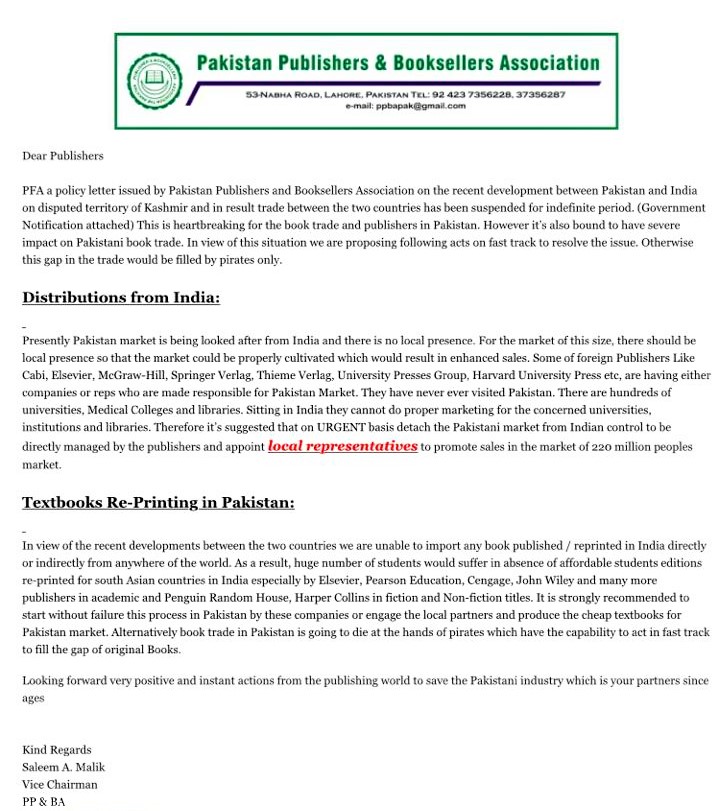
یہ پابندیاں بھارت سے منگوائی گئی نصابی کتب پر کس طرح اثر انداز ہوتی ہیں، یہ جاننے کے لیے انڈپینڈنٹ اردو نے پاکستان پبلشر اینڈ بُک سیلر ایسوسی ایشن کے نائب صدر سلیم ملک سے بات کی تو انہوں نے بتایا کہ ’ٹیکسٹ بُکس جو بھارت سے پاکستان منگوائی جاتی تھیں وہ  آئندہ تعلیمی سال اس پابندی کی وجہ سے میسر نہیں ہوں گی جس سے طلبا کا بہت نقصان ہو گا۔‘
انہوں نے مزید وضاحت کی ’بہت سی امریکی اور غیر ملکی پبلشر کمپنیوں نے جنوبی ایشا میں کتابوں کی مناسب قیمت رکھنے کے لیے بھارت میں اپنے پبلشر ہاؤسز بنائے۔  وہاں او لیول، اے لیول، میڈیسن، انجنئیرنگ اور کمپیوٹر سے متعلقہ کتابیں چھاپی جاتی ہیں اور جنوبی ایشا کے دیگر ممالک میں ان کی ترسیل کی جاتی ہے۔‘ انہوں نے کہا کہ نو اگست کے تجارتی بندش نوٹیفیکیشن کے بعد پاکستان اب بھارت سے وہ کتب بھی درآمد نہیں کر سکتا۔
جب اُن سے سوال کیا گیا کہ کیا پاکستان میں ان بین الاقوامی ٹیکسٹ بُکس کا سٹاک موجود نہیں تو سلیم ملک نے کہا کہ موجودہ تعلیمی سال کے لیے کتابیں تو طلبا نے خرید لی ہیں لیکن آنے والے دسمبر جنوری میں شروع ہونے والے سمسٹر اور تعلیمی سال کے لیے کتابوں کا ذخیرہ موجود نہیں اور اس کے لیے حکومت کو اقدام اٹھانے ہوں گے۔
کیا وہ کتابیں پاکستان میں پرنٹ نہیں ہو سکتیں؟ اس سوال کے جواب میں انہوں نے کہا کہ ’پاکستان کے پاس پرنٹ کرنے کے قانونی حقوق نہیں ہوں گے تو ہم پرنٹ نہیں کریں گے۔ اور بغیر اجازت اگر کتابیں پرنٹ کی جائیں گی تو وہ قانونی خلاف ورزی میں شمار ہو گا۔‘
سلیم ملک نے کہا کہ ’ہم نے بین الاقوامی پبلشر سے درخواست کی ہے کہ اگر 2000 سے زائد کتابوں کی سالانہ ضرورت ہے تو پاکستان کو وہ کتابیں پرنٹ کرنے کے قانونی حقوق دیے جائیں۔‘
انہوں نے کہا ’چونکہ پاکستان میں پرنٹنگ کا کاروبار نہ ہونے کے برابر ہے اس لیے یہاں صرف لوکل شاعری یا ادب کی کتابیں پرنٹ ہو جاتی ہیں لیکن یونیورسٹی پریس گروپ یا ہارورڈ پبلشر کی کتابیں بھارت میں ہی پرنٹ ہوتی ہیں۔ وہاں سے پاکستانی پبلشر وہ کتابیں منگوا کر بڑے کتاب گھروں میں تقسیم کر دیتے ہیں جہاں سے طلبا کتابیں خرید لیتے ہیں۔ لیکن جب مارکیٹ میں کتابیں میسر ہی نہیں ہوں گی تو طلبا کتابیں کہاں سے خریدیں گے؟ ‘
انہوں نے مزید کہا کہ ’اگر پاکستان کو پرنٹنگ کے حقوق مل جائیں تو اس سے پاکستان میں پبلشنگ بزنس بھی بڑھے گا اور روز روز کے پاکستان بھارت تناؤ سے درسی کتابوں کی تجارت میں بندش بھی نہیں آئے گی۔‘
اگر ادویات کی درآمد کی اجازت دے دی گئی ہے تو کتابوں کی درآمد کی بھی اجازت حکومت کو دینی چاہئیے۔ اس معاملے کی وضاحت کرتے ہوئے سلیم ملک نے کہا کہ 'ہم پبلشرز کے ساتھ رابطے میں ہیں اور ہماری پہلی کوشش یہی ہے کہ اس مسئلے کا مستقل حل نکال لیں اور پاکستان میں پرنٹنگ کے حقوق حاصل کر لیں۔ انہوں نے کہا کہ حکومت نے 70 برس سے اس بارے میں کچھ نہیں کیا۔ اتنی اہم کتابیں پاکستان میں پرنٹ ہونا شروع ہو جاتیں تو دہلی سے درآمد کرانی ہی نہ پڑتیں۔ لیکن افسوس کہ تعلیم کو کبھی اتنی توجہ دی ہی نہیں گئی۔
انہوں نے کہا کہ ’حکومت سے یہی اپیل ہے کہ اس مسئلے کا مستقل حل نکالے اور پاکستان میں بین الاقوامی کتابوں کے پرنٹنگ حقوق لینے میں پبلشرز کی مدد کرے تاکہ ہم اہم تعلیمی کتابوں میں خودکفیل ہو سکیں۔‘
وزیر تعلیم شفقت محمود سے انڈپینڈنٹ اردو نے رابطہ کیا تو انہوں نے کہا کہ 'معاملہ وزارت تجارت دیکھ رہی ہے لیکن وہ خود بھی اس معاملے کو دیکھیں گے کہ درسی کتابوں کے معاملے پہ حکومت کیا کر سکتی ہے۔‘
درسی کتابوں کا مسئلہ کیسے حل ہو؟ یہ جاننے کے لیے انڈپینڈنٹ اردو نے وزارت تجارت کے ترجمان محمد اشرف سے رابطہ کیا تو انہوں نے بتایا کہ ’ابھی تک حکومت کے علم میں یہ معاملہ تھا ہی نہیں اور نہ ہی کسی بھی پبلشر ایسوسی ایشن کے رکن نے وزارت تجارت سے رابطہ کیا ہے۔‘
وزارت تجارت کے ترجمان نے کہا کہ ’پبلشرز اگر حکومت کے پاس باضابطہ پروپوزل لے کر نہیں آئیں گے تو مسئلہ کیسے حل ہو گا؟ جب بھی دو ملکوں کے درمیان تجارتی پابندیاں لگتی ہیں تو دونوں ممالک میں بزنس کمیونٹی کو برداشت کرنا پڑتا ہے۔ لیکن یہاں اہم بات یہ ہے کہ وزارت تجارت کو تو خوشی ہو گی اگر پاکستان کو بین الاقوامی پبلشرز سے حقوق ملیں اور یہاں ری پرنٹنگ کی سہولت مل جائے۔ اس سے پرنٹنگ انڈسٹری بھی ترقی کرے گی لیکن اس کے لیے متعلقہ پاکستانی پبلشرز کو معاملہ وزارت تجارت کے سامنے رکھنا ہو گا۔ صرف بیان میں یہ کہہ دینا کہ حکومت کچھ نہیں کر رہی، اس سے مسائل کا حل نہیں ہوتا۔‘