Sunday, August 18, 2019

To understand Modi’s new #Kashmir reality, these 5 liberal myths need to be broken


Kashmir has a new status quo & Pakistan can risk breaking it. A solution can be found only after accepting that the existing borders are permanent.

Before searching for a solution to the Kashmir problem, we should understand it better. There are deadly perils in jumping in with solutions without first understanding the facts and realities. Only quacks — or maybe faith-healers — prescribe medication for chronic ailments without arriving at a reasoned diagnosis.
There are three sets of solutions today from three categories of these “faith-healers”. First, in India, the establishment view, which finds wide popular support, is that the only problem in Kashmir is Pakistan, and the radical Islam it exports there along with rifles, rocket-launchers and RDX. Get the Pakistanis off our backs, and you shoot a sequel to Kashmir Ki Kali in Dal Lake.
The Pakistani establishment fantasy, again with wide public support, is the exact opposite: Get the Indians out by pushing, pinching, bleeding them. We defeated Soviets and Americans in Afghanistan. What is India? Then, you can integrate all of Kashmir as the fifth province of Pakistan.
The third category in our analysis today is the small but articulate and doughty group of Indian liberals. They accept that Kashmir’s accession to India isn’t final, that the will of the Kashmiris is paramount and it hasn’t yet been sought. To that extent, their basic demands for plebiscite, autonomy, even independence, are legitimate. You can’t keep them with India by using state and military power.


Philosophically, it is difficult to argue with this: India is a voluntary federation of states, so how can you force people to stay with you if they don’t want it? No surprise that this view also finds sympathy among a lot of fundamentally liberal and young elites. I understand the perils in picking an argument with them because this very position gives them the higher moral ground. But we live dangerously.
 L
et’s break it down to five fundamental pillars on which this current liberal position rests:
1. India made a commitment to a plebiscite in the United Nations Security Council Resolutions of 1947-48. Why did it violate these?
The fact is, both India and Pakistan made this commitment. Both broke it as well. If you read the text of the resolution (47), however, you will see a three-step ladder. The first was Pakistan withdrawing all its forces from Kashmir and then making “best endeavours” to ensure all others (we will call them jihadis today) leave as well. It never happened.
The next two steps were India thinning its troops to the minimum needed, setting up an all-party government, and then for a plebiscite to be held under a UN-appointed governor. Pakistan didn’t take the first step. India wasn’t jumping to take the next two.
2. Most Kashmiris want neither India nor Pakistan. They want freedom, or azaadi. How can you deny it to them? Think referendum, think Quebec, Scotland, or Brexit.
Once again, read the resolutions. It will take you three minutes. They do not provide independence or azaadi as an option. The choice is India or Pakistan.
Pakistan’s supposed support for Kashmiri “azaadi” is fraudulent, but it has also had some Goebbelsian success with this great deception that Pakistanis back freedom for Kashmiris. Pakistan has built this masterfully over 70 years, calling the part of Kashmir occupied by it ‘Azad Kashmir’.
Since Pakistanis claim all of Kashmir, shouldn’t they be calling it their state of Jammu and Kashmir as well? No. Because that will expose their hypocrisy in using azaadi as a cover for territorial capture. Google if there are any statements from any Pakistani leaders of consequence offering azaadi as an option. I find none. If you buy into that azaadi fantasy, please do. You can’t sell it to the rest of India.
3. Can you hold for ever a territory and people by military power?
The answer is a counter-question: Can you take away a territory and people from another country through military power? Pakistan tried this. Twice, in 1947-48 and 1965 through direct military invasion, and 1989 onwards with proxy war. There was also the little madness of Kargil 1999. These are facts. You need to understand Nehru’s shift on the UN resolutions from mid-1953 onwards. The Cold War was then ratcheting up, and Kashmir’s geography trapped it into a unique pincer where the Great Game hadn’t ended. Foreseeing trouble, he moved to integrate Kashmir in 1953 with Sheikh Abdullah’s arrest. In the next two years, Pakistan had joined the US-led Baghdad Pact, SEATO etc. It began tilting the military balance in its favour over the next decade. Ultimately it was Nehru’s pre-emptive action that saved Kashmir from military (not plebiscite-led) capture.
The Pakistanis waited until they felt they had built sufficient military advantage, caught India in a period of weakness — military recovering from the 1962 debacle, Nehru’s death, food shortages — and used its full US-armed and trained military might (read up on Op Gibraltar and Op Grand Slam) to take Kashmir, but failed.
This was the last time Pakistan could have taken Kashmir by direct military force. And it hadn’t sent its troops and tanks to win Kashmiris azaadi.
These three pretty much account for the twists and turns in the Kashmir story in its first UN-to-Simla epoch (1947-72), though at a kind of digital pace in fast-forward. That brings us to the fourth:
4. Why is the Modi government not settling Kashmir according to the Simla Agreement as even Imran Khan is now saying?
The answer again: Do read the short Simla Agreement. The literal sense is all India-Pakistan problems are now bilateral. Which means, no UN resolutions. The spirit was, both realise that none can take any territory by force. So, rename the Cease Fire Line (CFL) as the Line of Control (LoC) and work on persuading your people to accept it as the border. Why this wasn’t stated more explicitly is a brilliant subject for some genuine scholar, for a book called “The Guilty Indians (not just men) of Simla”.
But the spirit was betrayed as soon as the prisoners of war returned. Zulfikar Ali Bhutto began Islamising his country (yes, he did, not Zia), hosted the Organisation of Islamic Conference summit in Lahore, even named its cricket stadium after Muammar Gaddafi as he launched a fund-raiser for his “Islamic Bomb”.
The cool breeze of Simla lasted only until the bomb was ready. By 1989, Pakistan was back in “action”, trying to take Kashmir with force again, avoiding direct confrontation which it knew it would lose.
The Simla Agreement was indeed violated. Only by Pakistan.
5. But the Kashmiris don’t want to be with you, what can you do?
Again, a counter-question: Who are the Kashmiris? The Right-Nationalists are missing nuance when they say just 10 districts of the Valley can’t speak for all of the state. Because these represent the state’s majority. The liberal argument is more flawed. If the majority view of Valley Muslims then subsumes the sizeable minorities of the state, what do we do for the view of the rest, about 99.5 per cent of India? Can you have the democratic logic of majority work in one place and not in the other?
Whether you like Narendra Modi or not, he has now broken the post-Simla status quo. Pakistan’s space for sub-military manoeuvre is gone. No political party of consequence is questioning the abrogation of Article 370, only the method.
There is a new status quo now. Pakistan can risk breaking it. There is a problem in Kashmir, with anger, alienation, violence, human rights abuses, and it needs addressing. It must begin with accepting that the borders today are the permanent borders of India and Pakistan. We shouldn’t need Bill Clinton to come here and tell us that maps of the region can no longer be redrawn with blood. Once you accept this reality, you can argue about the future.


United Arab Emirates backs India on Article 370, says Kashmir its internal matter

Dr Al Banna commented that from his understanding the reorganisation of states is not a unique incident in the history of independent India and that it was mainly aimed at reducing regional disparity and improving efficiency.

United Arab Emirates (UAE) Ambassador to India Dr Ahmad Al Banna reacted to Article 370 Jammu and Kashmir decision on Tuesday.
United Arab Emirates Ambassador to India Dr Ahmad Al Banna expressed hope that Article 370 Jammu and Kashmir decision would help improve the social and economic conditions in Jammu and Kashmir.
The UAE has taken note of the Indian government's decision of non-operationalisation of some sections of Article 370 of the Indian Constitution related to the state of Jammu and Kashmir, Dr Ahmad Al Banna, the UAE ambassador to India, said.
Dr Al Banna sauid, "We also took note of the introduction of Jammu and Kashmir Reorganisation Bill in the Indian Parliament aimed at replacing Article 370 with the creation of Ladakh region and the state of Jammu and Kashmir as India's two new Union Territories."
Dr Al Banna commented that from his understanding the reorganisation of states is not a unique incident in the history of independent India and that it was mainly aimed at reducing regional disparity and improving efficiency.
Dr Al Banna viewed this latest decision related to the state of Jammu and Kashmir as an internal matter as stipulated by the Indian Constitution.

After Kashmir backing, PM Modi to visit UAE, Bahrain from August 23

Days after the UAE openly backed India over its Kashmir move, PM Modi is set to pay a two-day state visit to Abu Dhabi from August 23.

Days after the UAE openly backed India over its Kashmir move, Prime Minister Narendra Modi is set to pay a two-day state visit to Abu Dhabi from August 23, and also to Bahrain, where the administration cracked down on Pakistanis holding an anti-India demonstration last week.
The UAE, which shares close bonds with India, had on August 6 said that the Indian government's decision to abrogate Article 370 that gave special status to Jammu and Kashmir was an internal matter of India aimed at improving efficiency.
During his visit, Modi would meet the Crown Prince of Abu Dhabi, Sheikh Mohammed bin Zayed Al Nahyan, to discuss bilateral, regional and international matters of mutual interest.
The Prime Minister would receive the Order of Zayed, the highest civil decoration of the UAE, which was conferred earlier in April 2019 in recognition of the distinguished leadership of Modi for giving a big boost to bilateral relations between the two countries, an MEA statement said.
The award in the name of Sheikh Zayed bin Sultan Al Nahyan, the founding father of the UAE, acquires special significance as it was awarded to Modi in the year of the birth centenary of Sheikh Zayed.
India-UAE ties were elevated in 2015 to a Comprehensive Strategic Partnership. In February 2018, Modi visited the UAE as Chief Guest at the World Government Summit. The Crown Prince of Abu Dhabi was the Chief Guest at the Republic Day celebrations in 2017.
India-UAE bilateral trade stands at $60 billion, and the UAE is India's third-largest trade partner. The UAE is also the fourth-largest exporter of crude oil for India and is home to a 3.3 million-strong Indian community.
The Prime Minister would pay a state visit to the Kingdom of Bahrain from August 24-25 in the first ever Prime Ministerial visit from India to Bahrain.
Last week, the Bahrain government had cracked down on a protest carried out by Pakistanis and some Bangladeshis over the Indian government's decision to revoke Jammu and Kashmir's special status.
The rally was conducted after Eid prayers in Bahrain. Tweeting about the action taken, Bahrain's interior ministry had said that the local police had initiated legal proceedings against the protestors.
Last week, Pakistan Prime Minister Imran Khan was given a cold shoulder when he called up Bahraini King Hamad bin Isa Al Khalifa to complain about India's moves on Kashmir. King Hamad had told Imran that Bahrain was closely analysing the situation in Kashmir and that all issues should be resolved through negotiations.
During his visit, Modi would meet and hold talks with Prince Shaikh Khalifa bin Salman Al Khalifa, Prime Minister of Bahrain, to discuss the entire spectrum of bilateral relations and also regional and international issues of mutual interest. The Bahraini King would host a banquet dinner in honour of Modi.
Modi would also launch the renovation of Shreenathji (Shree Krishna) temple in Manama.
India enjoys close and friendly relations with Bahrain, rooted in ancient trade and cultural links and people-to-people contacts and underpinned by regular exchange of high-level visits.
India-Bahrain bilateral trade has been on the rise for the last few years, reaching about $1.3 billion in 2018-19.
About 3,50,000 Indian nationals, the largest expatriate community in Bahrain, has been contributing to the development of Bahrain. The presence of over 3,000 Indian-owned/joint ventures in Bahrain indicates the intense economic engagement between the two countries.
The visit will provide an opportunity to further cement the mutually beneficial bilateral ties with Bahrain, an MEA statement said.

#Pakistan - #PTI failed to deliver in first year of office

Sindh Minister for Information & Archives Saeed Ghani has said that the one year rule of Pakistan Tehreek-e-Insaaf (PTI) had so far been full of blunders and despair. He said that incompetence, inexperience, ineptitude, incapability, and self-righteousness are the hallmark of the PTI government.
In a statement issued here on Sunday, Saeed Ghani said that the promise of good governance seemed far from being fulfilled. Instead, bedlam, dysfunctioning of administration, chaos, and mayhem remained the buzzword during the last one year, he added.
He said that leaders of the PTI should not have made overstatements before coming to power. Ghani said that the people of the country went through the most difficult times of their lives during the first year of the PTI regime.
The provincial minister said that Prime Minister Imran Khan was doing everything that he had censured the previous governments for. He said that the prime minister failed to deliver on every promise he made before coming to power and the performance of his cabinet during last year was quite reprehensible. Every scheme that had been once labeled by Imran Khan as ‘legalized corruption’ had now been adopted by him, he added.
He said that people had been only given a pack of lies during last year. He said that for Imran Khan taking U-turns was the quality of good leadership. He said that economic turmoil was another feature of the PTI government during its first year. His so-called austerity drive was also just nominal as the order of 70 luxury vehicles for his Punjab cabinet ministers was no more a secret, he maintained.
Saeed Ghani further stated that the cost of these vehicles was much higher than the money fetched by selling the luxury vehicles of the Prime Minister House. The performance of the PTI for the last one year was neither striking nor impressive but it was full of lies and U-turns, he added.
He said that instead of creating 10 million jobs and building five million homes the PTI regime’s policies had resulted in unemployment and homelessness. People today were unable to acquire and maintain regular, safe, secure and adequate housing due to unsteady income which was a result of the unplanned economic policies of Niazi’s regime, he stated.
He said that owing to constant partial accountability and use of National Accountability Bureau (NAB) for personal vendetta the bureaucracy was not willing to take responsibility for any decision. Even after the premature change of financial authorities, the tax reforms of the present regime had also failed miserably, he added.

Saturday, August 17, 2019

The failure of Imran Khan comes as no surprise

By Sushant Saree

From administrative and governance issues to a collapsing economy, Pakistan under Khan is in shambles.
More than nine months after Imran Khan, the great hope of the well-heeled “Khanistas” (the Pakistani version of Bhakts), was manoeuvred into the office by the “khakis”, the dream is starting to unravel. Except for his most die-hard supporters, no one had really expected Imran Khan to work miracles and turn Pakistan around. But hardly anyone except his most inveterate critics and perhaps the perpetual cynics had expected the sort of feckless governance and complete drift in the affairs of state that is on display. Forget about starting to fix things, the Imran Khan-led regime has not even been able to set a clear-cut direction, much less a course of action to pull the country out of the morass in which it finds itself.
During his time in the Opposition, Imran Khan had built a cult following with his rabble rousing. He had managed to convince his hard-core supporters that he was the messiah who would deliver Pakistan from the venal and vile politicians. It was not just the youth (mostly middle and upper middle class) but also most of the uniformed services which identified with him and believed that he would transform Pakistan. In fact, the Pakistani armed forces rooted for him to a point where they actually paved the way for his ascent to power by fixing the match and tilting the field in his favour.
While Imran Khan remains Teflon-coated for the Khanistas, it is now clear to most other people that Imran Khan was mostly hot air—a real “feku”. He still says all the right things but has no idea on how to implement the tall promises he had made and continues to make. It is almost as though he is living in an alternate reality, or perhaps is in stupor, that makes him take flights of fancy. At a time when the economy is broke, development expenditure has been cut drastically, growth is falling alarmingly, debt servicing and defence alone have surpassed the entire revenue of the federal government, Imran Khan like a potentate of yore goes about announcing fancy packages: a PKR 100 billion here, another PKR 150 billion there, a poverty alleviation scheme of PKR 80 billion (even 10 times the amount wouldn’t be enough) which will bring prosperity, a hare-brained housing programme to construct five million houses, and so on and so forth.
None of this is surprising to anyone who has watched Imran Khan when he was in Opposition. He was a one trick pony then—raved and ranted about corruption—and remains a one trick pony now. Except that even that one trick is only a trick because half his Cabinet is stacked with people who are steeped in the corrupt and venal ways of Purana Pakistan. The thing is that Imran Khan was and is a man of limited intelligence with no administrative experience or knowledge (unless of course you consider leading an 11-man cricket team as being enough to run a country of 210 million people).
The only thing Imran Khan had was his clipped and correct upper-crust English accent. In a country where the ISPR spokesman and the top most spin doctor tweets of the “bondage” between the people and the military, someone like Imran stands out as a genius because he speaks good English. Other than his accent, Imran Khan was the sort of guy who regurgitates the last thing that he reads in the papers, or sees on TV, or even what someone whispers in his ear.  He doesn’t have the intellectual bandwidth to apply his mind or even consider the ridiculousness of what he so nonchalantly says in public. Simply put, Imran Khan is a prime example of a disastrous cocktail of arrogance and ignorance, which makes him both abusive and abrasive.
As if his administrative and governance failures were not glaring enough—despite his complete control over his party and his claims of enjoying total support of the army—Imran Khan is so insecure that he has appointed two complete non-entities and utterly incompetent men as chief minister in two crucial provinces of Khyber Pakhtunkhwa and Punjab and is trying to run the administration in both these provinces by remote control. His inability to even forge an understanding, much less a consensus, on issues critical to those who “selected” him as Prime Minister are now fraying the strings that control him. He has bad-mouthed and needlessly hounded all his opponents to a point where getting the opposition on board for legislation on the military courts, finance commission and even the anti-terrorism stand is now looking impossible.
The economy is collapsing. Growth is likely to fall from around 5.2 per cent to anything between 3-3.5 per cent which given a population growth of 2.4 per cent means virtually no increase in incomes. Interest rates have gone through the roof and are likely to rise further. This has made doing business unviable because already businesses are borrowing money only to stay afloat. The massive depreciation of the currency—it is feared that the PKR might fall to as much as 180 to a dollar in the coming months—has made imports expensive leading to rise in inflation (highest in five years and still rising) with utility and energy prices breaking the back of the people.
The greatest achievement of Imran Khan being touted by his camp followers is his successful foreign policy which is nothing more than his managing to get loans from Saudi Arabia, UAE and China, which in turn have increased the debt burden and with it debt servicing. The confrontation with India has proved to be extremely expensive and forced a big rise in the defence budget at a time when the fiscal deficit is out of control. People are losing jobs by the day and economic distress is rising. After some grandstanding Pakistan is finally all set to approach the IMF which is likely to force a stiff structural adjustment programme on Pakistan—which in turn will worsen the economic crisis.
Suddenly, many of the members of the media corps (journalists who work as adjuncts of the military and take their line and their awards from the military spokesman’s office) who had been rooting for Imran Khan have started asking tough questions to retain a modicum of credibility. He has let loose his storm troopers in the social media space to troll his critics. The old media is meanwhile being pressured into compliance using the bait and threats of advertisements to keep them in line. Ironically, instead of helping the Imran Khan regime in painting a rosy picture, the muzzling of the media is leading to pressure building up in the system because it is finding no outlet.
The situation is ideal for the opposition parties. But they are in no position to exploit the situation partly because the main leaders of these parties are trying to save themselves from jail, and partly because they are trying to win an approval from the military before they take to the streets. In what is a classic game theory framework, the opposition parties are trying to maximise their individual welfare instead of cooperating to maximise their collective welfare. Meanwhile, the army is scratching its head on what to do to handle the situation. Having invested so much in Imran Khan and pushed the other parties against the wall, the military is for now left with no option but to stick with the man they selected. But for how long?
Even if the main opposition parties don’t take to the streets, the rising economic distress is going to create pressure from below. If that happens, the opposition parties will probably be left with no choice but to ride that wave. With the Khanate going kaput, it is going to be only a matter of time before the “khakis” will be left with no option but to intervene. It is of course another matter that the military’s “khakicracy” is really a kakistocracy.

After failed UNSC move, Imran Khan says 'ensuring resolution to Kashmir issue responsibility of this world body'

US President Donald Trump has already asked Pakistan PM Imran Khan to resolve the issue through bilateral dialogue.


A day after China-Pakistan initiative to rake up Kashmir at United Nations found no support at the United Nations Security Council Consultative (UNSCC) meet on Friday, a rattled Pakistan Prime Minister Imran Khan on Saturday said he welcome UNSC discussions on Jammu & Kashmir.
"I welcome the UNSC meeting to discuss the serious situation in Jammu & Kashmir. It is for the first time in over 50 years that the world’s highest diplomatic forum has taken up this issue. There are 11 UNSC resolutions reiterating the Kashmiris right to self-determination."
However, even after US President Donald Trump asked Pakistan to resolve the issue through bilateral dialogue, Imran Khan once again tried to play his Kashmir propaganda saying, "And the UNSC meeting was a reaffirmation of these resolutions. Therefore addressing the suffering of the Kashmiri people and ensuring resolution of the dispute is the responsibility of this world body."
Apart from US, other nations including Russia, France have called that Kashmir issue should be resolved bilaterally.  
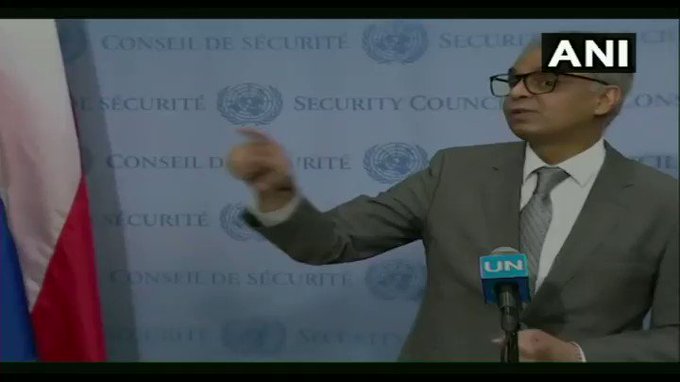
Meanwhile, addressing a presser at the UNSC, India's permanent envoy to United Nations, Syed Akbaruddin on Friday had already conveyed, "Article 370 is internal matter... these have no external ramifications."
Addressing a Pakistani reporter's query on when talks with Islamabad will take place, Akbaruddin said, "Using terror to push goals is not the way normal states should behave. Stop terror to begin talks."
Akbaruddin spoke to the media after the representatives of China and Pakistan had spoken and took questions unlike his counterparts. He took first three questions from Pakistani journalists and even went to them to shake hands in a gesture reflecting India's willingness to engage in a dialogue provided there was no push to terror.
Akbaruddin said that matters related to Article 370 of Indian Constitution "were entirely an internal matter of India".
Asked about India refusing dialogue with Pakistan, Akbaruddin said there are normal diplomatic ways of dealing with countries. "But using terror to try and push your goal is not the way that normal states behave. No democracy will acknowledge or accept talks when terror thrives. Stop terror, start talks," he said.
Russia, France and the US backed India at the consultations.
First Deputy Permanent Representative of Russia, Dmitry Polyanskiy said, "We will open-heartedly continue to engage with Islamabad and New Delhi in order to help both of them to come to terms and have good neighbourly ties on Kashmir on the basis of Simla Agreement of 1972 and Lahore declaration of 1999."

Kashmir off the table, Modi govt now wants revised ‘talking points’ with Pakistan


Cross-border terrorism is set to become single-point agenda between India and Pakistan as Modi govt looks to revise the terms of engagement.

With Kashmir now pulled off the negotiation table, the Narendra Modi government is planning to revise the “talking points” with Pakistan that may render the composite dialogue process redundant. The issue of cross-border terrorism is likely to become the single-point agenda between New Delhi and Islamabad.
The composite dialogue process was established between India and Pakistan by former prime ministers, I.K. Gujral and Nawaz Sharif, respectively, on the sidelines of the 1997 SAARC summit in Maldives.
It was the first time that the two sides agreed to discuss “all outstanding issues including Jammu and Kashmir” as part of the structured dialogue.
However, a senior government official told ThePrint that the “Kashmir chapter is now over”.
“The talking points will now have to be revised. Although there is no room for a dialogue at this end, India has to be seen as a statesman,” said the official on condition of anonymity.
India now plans to increasingly portray an image of a statesman in front of the world, as far as the South Asian region is concerned, that is keen on having a normal and stable relationship with its neighbour, the official added.

How Modi govt sees the composite dialogue

The composite dialogue process has been suspended several times in the past, but it underwent a complete transformation under the Modi government’s first tenure when both sides agreed to discuss terror and violence and delink the issue with talks.
The process was regularly reviewed between both sides until it was suspended in the aftermath of the 2008 Mumbai terror attack. It had been suspended on a couple of instances prior to that too, especially during the 1999 Kargil War, but the credibility of the process came under severe scrutiny after the Mumbai attack. In 2010, the process was resumed under a different nomenclature and it included new talking points such as counter terrorism.
Under the Modi government the composite dialogue transformed into what came to be known as ‘Comprehensive Bilateral Dialogue’. This was announced by former external affairs minister Sushma Swaraj at the Fifth Ministerial Conference of the Heart of Asia-Istanbul Process in Islamabad on 8-9 December, 2015.
However, in the wake of the September 2016 Uri attack, the Modi government said “terror and talks won’t go together”.
“The problem in India-Pakistan relations is not the absence of good talking points or dialogue mechanisms… Notwithstanding what new items are listed for dialogue by diplomats, the test of the relationship will remain the irreversible end of terrorism and walking away from viewing each other as enemies who must be outwitted and defeated at all costs,” said Husain Haqqani, former ambassador of Pakistan to the US.

Terror and talks

According to former foreign secretary Kanwal Sibal, the main talking point that India needs to sort out with Islamabad is terrorism, with particular reference to cross-border terrorism.
“At this time, talks are out of question. But at a later stage, India has to discuss terrorism with Pakistan, which remains the biggest unfinished agenda. Besides, agreement on nuclear sites also remains a crucial part of the composite dialogue,” said Sibal.
Unlike the previous dialogue process that had eight subjects, the comprehensive bilateral dialogue included over ten: Peace and security, confidence building measures, Jammu and Kashmir, Siachen, Sir Creek, Wullar Barrage/Tulbul Navigation Project, economic and commercial cooperation, counter-terrorism, narcotics control, humanitarian issues, people to people exchanges and religious tourism.
T.C.A. Raghavan, former Indian high commissioner to Pakistan, said while it is too early for both the nuclear-armed neighbours to have a dialogue, the issue of counter-terrorism will now rule the roost.
“As neighbours there are a number of issues that both the countries have to discuss. The issue of Kashmir is not over yet. The question of Pakistan-occupied Kashmir (PoK) has to be settled.
“But Pakistan is clearly overreacting at the moment. We want a stable relationship with Pakistan,” Raghavan, director general of Indian Council of World Affairs (ICWA).
The real issue between both countries right now is whether they can overcome “mistrust”, said Haqqani, who is also director (South & Central Asia), Hudson Institute and author of Pakistan: Between Mosque and Military and Magnificent Delusions: Pakistan, the United States, and an Epic History of Misunderstanding.
“Terrorism has muddied the water since the 1980s but even before that, the 1965 war came right after the 1963 ministerial level talks on Kashmir and the 1971 war was not long after the Tashkent Declaration of 1966.
“The Simla Accord of 1972 lays the foundation for dealing with all issues, including Kashmir, bilaterally. It also calls upon India and Pakistan to end the propaganda that breeds hostility,” added Haqqani.
Before the Kashmir issue sprang up earlier this month, the Imran Khan government had urged India for a dialogue on many occasions, even after the Balakot air strikes. However, with the scrapping of Jammu and Kashmir’s special status, Islamabad has refused to engage with for a dialogue.
On Friday, post the UN Security Council closed-door meeting on the Kashmir issue, Pakistan Foreign Minister Shah Mahmood Qureshi said “there is no question of a dialogue with India” after its Kashmir move.

US Cuts $440 Million Financial Aid To Pakistan: Report

The US apprised Pakistan Prime Minister Imran Khan about its decision to cut aid three weeks before his planned visit to Washington.
 The United States slashed the aid to Pakistan by nearly $440 million, bringing down its commitment to just $4.1 billion.
The aid was disbursed under Pakistan Enhanced Partnership Agreement (PEPA) 2010, reported Express Tribune.
The US apprised Pakistan Prime Minister Imran Khan about its decision to cut aid three weeks before his planned visit to Washington.
Notably, the PEPA was signed in September 2010 to make operational the Kerry Lugar Berman (KLB) Act that was passed by the US Congress in October 2009 to disburse $7.5 billion to Pakistan over a period of 5 years.
Earlier the aid under the KLB stood at nearly $4.5 billion. Following the cut, the aid will come down to $4.1 billion.
Last year in September, the United States'' military cancelled the financial aid worth $300 million to Pakistan due to the growing concerns regarding Islamabad's failure to tackle terrorism.
In January that year, Pentagon had cut $1 billion worth financial aid to Pakistan, with Defense Secretary James Mattis and other officials citing Islamabad's failure to crack down on the Haqqani terror outfit as the reason behind it, Fox News reported.
During his meeting with Pakistan Prime Minister Imran Khan, last month, US President Donald Trump strongly criticised Islamabad for its behaviour which led to the cancellation of US aid amounting to $1.3 billion to the country.
"We were paying $1.3 billion to Pakistan as aid, for many years. The problem was...Pakistan was not doing anything for us. They were really subversive. They were going against us. I ended that about a year and a half ago, the $1.3 billion (aid)," Donald Trump said during his meeting with Imran Khan.

#Video - Bilawal Bhutto condemns Kuchlak blast

Pakistan Peoples Party (PPP) Chairman Bilawal Bhutto Zardari on Friday strongly condemned the Quetta blast and expressed grief over the loss of precious lives, ARY News reported. 

The PPP leader, in a statement, sympathized with bereaved families and prayed for the departed souls and early recovery of the injured.
“Implementation on National Action Plan (NAP) is necessary in order to eliminate the mindset of extremism,” said PPP chairman in a statement.
Earlier in the day, Prime Minister Imran Khan strongly condemned the terrorist attack in Quetta’s mosque during Friday prayers that left at least five people martyred and 15 others injured.
At least five people were martyred and 15 injured in a bomb blast during Friday prayers in the provincial capital of Balochistan.
Rescue sources said the explosion took place in a Madrasa of Kuchlak town of Quetta during Zuhr prayers. Five people were reported to be dead and around 15 sustained injuries in the blast.
The injured are being shifted to Mufti Mehmood hospital.
As per sources, the explosive was placed beneath the carpet of Madrasa which was set off during Friday prayers.
Rescue teams and security forces have reached the site of the incident.

Friday, August 16, 2019

Video Report - Kids speak their minds about race

Video Report - Michelle Obama Goes Viral With Takedown Trump 'It’s Our America'

Video Report - First test of Russia’s new heavyweight combat drone ‘Hunter’

Video Report - Elizabeth Warren releases policy plans to aid Native Americans

Video Report - Rep. Rashida Tlaib tweets she won't visit Israel

#Pakistan - #PTI govt’s first year is a series of miserable failures

Pakistan Muslim League-Nawaz (PML-N) Information Secretary Marriyum Aurangzeb on Friday said that Pakistan Tehreek-e-Insaf (PTI) government’s first year was a series of miserable failures when it comes to governance and policy-making.
In a statement, the former information minister said that Prime Minister Imran Khan has successfully turned every national success into terminal failure. “The country has gone from one of the most affordable countries in the region to one of the most difficult countries to survive in,” she said.
She said that PM Imran will break his own “world record of compulsive lying” on August 18 when his government would have completed its first year in power. “Over 4.5 million people have been pushed below the poverty line whereas 1.5 million have become jobless. Despite borrowing huge sums from other countries and the International Monetary Fund (IMF), the government has not completed a single developmental project,” she said.
She said that inflation has spiked from 3 per cent to 13 per cent, growth rate of 5.8 per cent has fallen to under 2 per cent and interest rate has shot up from 5.75 per cent to 14 per cent, which is nothing but catastrophic for the national economy.
She asked how many “paradigm-changing chickens and cattle” were distributed by the government. “The government had promised five million homes and 10 million jobs but it has not delivered on a single promise,” she added.

#Pakistan - #PTI government’s first year in power - The promise versus performance


The PTI will be completing the first year of its tenure tomorrow. It is time to take account of its perceived achievements and failures.
Two million jobs and 200,000 houses per year were required to fulfil the promise of 10 million jobs and one million homes in five years. While tens of thousands of people have lost jobs, not a single new residential unit has been built so far. The party considers a handful of ‘Panah Gahs’ a major achievement. Other steps paraded as landmarks include E-visa extension and visa on arrival, which have no bearing on the life of the people of this country. That no financial scandal involving government high ups has been reported is also presented as a remarkable feat.
Within eight months of coming to power a clueless PTI government fired its own financial wizards, handing over the country’s economic management to the IMF’s team which is least bothered about the impact of its policies on the life of the common man. The people are consequently suffering under the impact of rising prices and inflated gas and electricity bills. The government’s economic policies have pushed tens of thousands below the poverty line.
The PTI government took political polarisation to an unprecedented height in the very first year of its rule. It goaded NAB to arrest opponents even when no offense had been proved against them in a court of law. The arrest of former PM Shahid Khaqan Abbasi, former Finance Minister Miftah Ismail and PML-N Vice President Maryam Nawaz are some of the cases that prove that malice was the motive behind the arrests.
Free speech has been suppressed, TV channels pulled off-air without due process, newspapers pressurised to ban columnists and baseless treason cases filed to silence the media.
The government has squandered the opportunity provided to it by the Trump Administration’s urgency to quit Afghanistan. The government has played its cards badly. Instead of supporting Pakistan’s Kashmir stand, US Secretary of State Mike Pompeo’s message on August 14 underlines the need to build on the important commitments made during recent visit by Prime Minister Imran Khan and the senior leadership of the Government of Pakistan. Back to do more, Pakistan.