Friday, August 16, 2019

Opinion: Imran Khan — one year of stumbling ineptitude

BY Harris Khalique 
Pakistani Prime Minister Imran Khan promised to provide relief to citizens when he came to power last year, but his government has only added to their misery, says Harris Khalique of Pakistan's human rights commission.
When Imran Khan was elected as Pakistan's prime minister on August 17, 2018, some Pakistanis saw him as the the best option, but others saw Khan as a messiah, and followed him like blinkered members of a populist cult.
Khan's victory was the triumph of Pakistan's self-righteous and self-serving affluent urban middle class. They were aided internationally by a well-meaning but naive diaspora, and domestically by the leadership of the politically dominating and psychologically impatient judiciary and military.
Khan's supporters agreed on his prescription for treating the ills of Pakistan's economy and polity: i.e. moral answers to material questions and administrative solutions to structural problems.
Both have failed to work. Rather than providing relief to common citizens as promised, the past year has added to their misery.
In 2018, the narrative that was sold to the public for a "new idea of Pakistan" could be summarized as a corruption-free economy and a justly governed country. This narrative was realized through Khan's rise to power, along the rise of his political outfit, Pakistan Tehreek-e-Insaf (PTI), in national and provincial general elections.
The July 2018 general elections were marred by  accusations of pre-poll manipulation and vote-rigging. But those who understood that a nascent democracy constrained by a colonial structure would stumble before finding its feet were willing to give Pakistan's new democratic dispensation a serious chance. Even the main opposition parties were cautious and feared that their non-cooperation could have brought an end to the democratic order altogether.
Therefore, Khan's government began with even better support than two of his predecessors — Zulfikar Ali Bhutto in 1972, and Nawaz Sharif in 1990. All powerful institutions of the state were on his side, opposition was reluctant to agitate and a large part of the affluent middle class — having sway over both market and media at that time — saw him as a savior.
Economic mismanagement
One year into this government, not only do we find all the promises made for improving the economy and governance unfulfilled, the path forward seems to have been lost as well.
Capitalism works in a certain way in a developing country, and the PTI claims it can fix the system without knowing how it works.
The PTI's rhetoric about curbing corruption and ending financial debt was turned upside down sooner than imagined. The cluelessness, and therefore poor performance of PTI's economic managers appointed at the outset, brought their unceremonious ouster within months.
A late agreement with the International Monetary Fund (IMF) not only put more pressure on Khan's government, it also meant the IMF could exercise more control over Pakistan's financial decision-making.
In the name of bringing macroeconomic stability, growth has been stifled, the currency is majorly devalued and markets have lost their trust. Hyper-inflation and unprecedented power and energy price hikes coupled with sharp decline in incomes of middle, lower middle and working class have brought extraordinary hardships on common people. Poverty indicators soar and under- and unemployment rise as a consequence of this economic slowdown. 
On top of this, there have been major cuts introduced in spending on health and education directly hitting the disadvantaged. As far as public debt is concerned, a recent report in The Express Tribunenewspaper revealed that more than two-thirds of what the previous Pakistan Muslim League Nawaz (PML-N) government had borrowed in five years has already been acquired by Khan's government in less than one year.
Foreign relations and domestic policies
In terms of foreign relations, Khan's government is finding it hard to create a balance between the US and China for its own benefit. The pace of investments and development under the China-Pakistan Economic Corridor (CPEC) is caught up in uncertainty, while the US seems to be reluctant in offering any substantial support unless Pakistan fulfills the role Washington envisages for it in the ongoing Afghan peace process.
Bending over backwards to woo Saudi Arabia and the UAE over the past year has brought limited dividends to Khan in every quarter, including support to Pakistan's economic stability.
The Arab countries' response was cold when Pakistan expected them to denounce India's recent annexation of the State of Jammu and Kashmir, where constitutional safeguards were withdrawn, compounded with stark military aggression against civilians.
What Khan's government and its backers in the establishment have successfully done over the past year is to systematically curb political dissent and constrain freedom of the mainstream media.
But those who can recall Pakistan's political history —however chequered it may have been — know full well that muffling of voices eventually leads to unmanageable dissonance in the body politic that in turn erodes the very base of the government.
Need for introspection
At the end of its first year in power, what Khan's government needs is a critical introspection in order to fundamentally alter its economic policies to realize the economic rights of Pakistani citizens. This includes alleviating poverty and increasing productivity.
The government also needs to better manage the country's foreign relations with a long-term vision that helps strike a balance between global powers to Pakistan's advantage.
Finally, the government needs to appreciate the importance of civil and political rights and respect for the freedom of expression, which are prerequisites to creating a healthy society and sustainable polity.

China Blames India for Kashmir Tension as UN Action Blocked - U.S. and France blocking a Chinese attempt

China’s ambassador to the United Nations blamed India for stoking tensions with Pakistan and called on both sides to exercise restraint after a rare closed-door Security Council meeting on the situation in Kashmir that failed to produce concrete action.
The Security Council met on Friday to discuss Indian Prime Minister Narendra Modi’s decision to scrap autonomy for Kashmir, though the body was divided on how to proceed, with the U.S. and France blocking a Chinese attempt to get the 15-member body to publicly urge parties to refrain from actions that exacerbate tensions along the line of control, diplomats said.
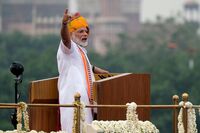
India Prime Minister Narendra Modi At Red Fort For Independence Day Celebrations
Narendra Modi delivers a speech in New Delhi.
Photographer: T. Narayan/Bloomberg
“It’s obvious that the constitutional amendment by India has changed the status quo in Kashmir, causing tensions in the region,” Chinese Ambassador Zhang Jun told reporters after the closed-door meeting. “China is deeply concerned about the current situation and opposes any unilateral action that complicates the situation and we call upon the relevant parties to exercise restraint.”
China is a historic ally of Pakistan. Underscoring rising tensions between nuclear powers India and Pakistan over Kashmir, it was the first full Security Council meeting to discuss the disputed region since 1965.
One Western diplomat, who asked not to be identified discussing the closed meeting, said even though no decision was reached, holding the meeting helped calm tensions because it showed Pakistan that the international community is engaged on the issue.
India has called the Kashmir decision an internal matter with no bearings on its international borders with Pakistan and China. Yet Beijing issued a strongly worded statement last week questioning the impact on the mainly Buddhist region of Ladakh -- an area of strategic importance nestled between Tibet and Pakistan.
Friday’s discussion came after Pakistan’s Foreign Minister Shah Mahmood Qureshi urged the Council earlier this week to hold an urgent meeting, arguing that India’s moves pose “a threat to international peace and security, willfully undermine the internationally recognized disputed status of Jammu & Kashmir,” and violate the human rights of the Kashmiri people.
India says its decision to convert Jammu and Kashmir into two federally administered regions would usher in prosperity for the region where as many as 42,000 people, including civilians, army, police and militants have died in violence in the last three decades.
“The recent decisions taken by the government of India are intended to ensure that good governance is promoted and social economic development is enhanced,” Syed Akbaruddin, India’s ambassador the the UN, said. “We are saddened that terrorism is being fueled while language and incendiary talk of Jihad are being mentioned by people who should know better.”

Pakistan’s doctors are getting fired in Arab countries. Blame its unreliable medical degrees


Many Pakistanis working in the field of clinical research would say that the unfortunate episode was waiting to happen.

Research is a word reviled in Pakistan, and the lack of it has come back to haunt Pakistani doctors working in the Gulf.
Saudi Arabia, Qatar, Bahrain and the United Arab Emirates recently showed the mirror to Pakistan’s medical community by sacking hundreds of Pakistani doctors who had secured jobs on account of their MD/MS degrees. These doctors have now been issued deportation orders. Most of them had been working in the Arab countries since 2016.
Pakistani doctors working in clinics (patient treatment and care) are excellent, but that’s not the case with those working in clinical research. And, it is the second group that has brought ignominy to Pakistan.
In the past, Saudi Arabia was more concerned about the clinical aspect of medicine, but it has recently invested heavily in clinical research, especially in the area that focuses on cause of a disease and application of drugs in patients.
In response to this, some medical universities in Pakistan developed certain MS and MD programmes to ensure the skilled force gets opportunities in Saudi Arabia and other Gulf countries, but the strategy seems to have backfired.
First Saudi Arabia and now others have alleged that Pakistan’s postgraduate degrees in medicine are lacking in structured training programmes.
There are four main reasons for such criticism.

No concept of research

First, Pakistan’s medical universities are alien to the concept of research. Professors themselves violate research rules with impunity and the same malpractice trickles down to the student researchers. Garbage in, garbage out.
For instance, a former vice-chancellor of government-run University of Health Sciences in Lahore, after assuming the position, had circulated his CV wherein he claimed that he had 120 research articles published in the field of reproductive endocrinology and high-altitude physiology in a career spanning 35 years.
Going by the sheer number of articles, an entire book on medical research would have been published. Similarly, with such vast experience in medical research, one would assume there were several discoveries (patent rights) against his name. Unfortunately, there was none. No standard book on medical research included his name as a contributor to appreciate his scientific work.

Stealing ideas

Second, medical researchers in Pakistan are not careful about the validity of their research. They overlook the fact that the steps taken to conduct research are more important than the conclusion drawn. Every step has to be recorded in a logbook. There is a tendency among Pakistani researchers to steal the objectives and conclusion of a research performed in some other part of the world and replicate the same in the context of Pakistan to claim a scientific credit. This explains why the conclusion drawn often doesn’t flow from the research conducted.
For instance, in 1991, P. Laurberg et al published the result of their study conducted at Aalborg University Hospital (Denmark) on high incidence of multinodular toxic goiter in the elderly population in a low iodine intake area in East Jutland, Denmark. In 2013, a team of Pakistani researchers in Rawalpindi replicated the same study in northern region of Pakistan among the elderly population. Without following the requisite steps of research, they arrived at the same conclusion to earn a scientific credit. Steps for conducting research were not followed because the team of researchers already knew the conclusion they would arrive at.
Similarly, in 2005, at the Osaka University in Japan, A. Fukukara et al conducted a study on humans to examine the effect of a secreted protein (Visfatin) on the testosterone levels in insulin-resistant diabetic males. Interestingly, in 2013, a team of Pakistani clinical researchers based in Rawalpindi reinforced the same findings by conducting a study on male rats to earn a scientific credit.
Across the world, experiments are conducted first on animals and based on their success, clinical trials are conducted on humans. In Pakistan, the reverse pattern is followed just to earn a scientific credit, making a mockery of research. News of such virtuosity has reached foreign countries that now view the achievement of Pakistani researchers with doubt.

No reliability of research

Third, medical researchers in Pakistan are incautious about the significance of the reliability of research. Any research whose results are not replicable is unreliable research. There are several examples where unreliable data have been produced to only serve the purpose of the researcher.
For instance, a head of the department at the government-run medical university in Lahore declared a couple of years ago that he had discovered a ‘Pakistani type-II diabetes’. To publicise his findings, the professor published four research articles (in 2013, March 2014, September 2014 and 2015) in four different research journals of Pakistan. The articles indicated that each time he got the approval of the ethical committee of the university to collect the samples.
Interestingly, the blood samples of 212 patients were reportedly collected from November 2009 to January 2012 during his PhD studies. It is still not known how he cryopreserved the samples or if he used the same samples for more than three years since the date of the sample collection. It also not known how and why the ethical committee of the university would allow him to declare in each article that the samples used were fresh.
No independent or third-party researcher has been able to successfully repeat the experiments to confirm the authenticity of the findings.

A culture of condoning

Fourth, Pakistani researchers practice a culture of condoning – you overlook my faults and I will overlook yours. They do not challenge each other because they mutually conduct research malpractices.
There are other silent participants in this malicious activity of research quackery. Every medical university in Pakistan has hired the services of media managers who secure hefty salaries from the university and penetrate the media to forestall the publication of any news, which is against the interests of the university. These media managers also offer the reporters covering the medical beat a direct access to medical facilities of the attached hospitals as a sop to stay tightlipped.
Above all, medical universities, especially those run by the government, are supervised by the chancellor who happens to be governor of the province. Governors, mostly from non-science background, do not wish to interfere in the universities’ research issues.
There are, for instance, several complaints against research malpractices pending with the office of the Governor of Punjab. Registrars of medical universities are also known to propitiate the governors with different favours to keep the issues suppressed.

Thorough probe needed

The news of expulsion of Pakistani doctors from the Gulf countries might have taken many Pakistani by surprise, but to many Pakistanis working in the field of clinical research, the unfortunate episode was waiting to happen. When teachers (or trainers) are involved, students (or trainees) cannot escape research malpractices.
A thorough inquiry into the matter is required to root out the malpractices of research quackery and research misconduct, which are rampant in Pakistan’s medical universities and hospitals. These malpractices are spoiling the future of young clinical researchers in Pakistan and bringing disgrace to the country.

Thursday, August 15, 2019

Taylor Swift - Welcome To New York

Video Report - US spy chief Dan Coats leaves post after feud with Trump

Video Report - Don Lemon: Statue of Liberty would hang her head in shame

Video Report - Why passing gun control legislation is so hard

Video - Comedian Stephen Colbert doesn't want Trump back on his show 'for safety's sake'

Pashto Music - Khyal Muhammad - janana pa zargi me

How Islamic State Infiltrated Kabul University

Naya Kashmir: It’s not a new idea | Opinion

Srinath Raghavan
Like Modi, Indira Gandhi, too, wanted to alter the status quo in the state almost 50 years ago.
After his government voided Article 370, Prime Minister Narendra Modi said that “a new age has begun in Jammu-Kashmir and Ladakh”. In fact, the quest for a new beginning is not all that novel in the history of Jammu and Kashmir (J&K).
Indira Gandhi, too, wanted to alter the status quo in Kashmir.
In explaining its decision to abolish the special status of Jammu and Kashmir, the Modi government has emphasised the developmental and political benefits that are expected to flow from these arrangements. These moves have indeed wrought a radical change in the constitutional relationship between the Indian Union and the erstwhile state of J&K. As we ponder how these arrangements will work out, it may be useful to look back to Indira Gandhi’s attempt at a new beginning.
“We will build a new Kashmir, quickly if you help, slowly if you don’t, but build it we will!” Prime Minister Indira Gandhi had said while addressing a public rally in Srinagar in June 1970. Indeed, important changes were already underway.
Then J&K chief minister, GM Sadiq, had been in office since 1964. A year into his tenure, he had merged his splinter group, the Democratic National Conference, with the Congress. What’s more, Sadiq had enabled the erosion of the state’s special status by accepting more provisions of the Indian Constitution (including Article 356, which caters for President’s rule) and amending the state’s constitution to convert the elected Sadr-e-Riyasat into a governor appointed by the central government. Following assembly elections in 1967, Sadiq returned with a comfortable majority. New Delhi was poised to tighten its grip over the state.
Yet the government struggled to create jobs or promote investments in Kashmir. Sadiq noted that the educated young people of the state were increasingly drawn to the secessionist groups. Indira Gandhi deputed her confidante, IK Gujral, to mobilise investments in the state. But Gujral reported that industries were not prepared to invest in a conflict zone and the best he could do was to get two public sector units to open factories in the state.
The central challenge, however, was posed by the stalwart leader of Kashmiris: Sheikh Abdullah. Although Abdullah had been in and out of prison since his dismissal and arrest in 1953, his standing in the Kashmir Valley was unrivalled. Indira Gandhi understood the importance of co-opting Abdullah to ensure that New Delhi’s hold over Kashmir remained 
Among the inputs that shaped her thinking was advice from an unlikely quarter. Jayaprakash Narayan had been an advocate of self-determination for Kashmir, but had changed his mind after Pakistan’s aggression in 1965. The following year he wrote to Indira Gandhi arguing that Kashmiris could be enthused about autonomy within India if Abdullah advocated it. The Sheikh might have flirted with independence in the past, but now “he is realist enough to realise” that India would not part with any portion of Kashmir. To secure Kashmir, it was imperative to forge a new concord with Abdullah, who remained under arrest.
In October 1967, Gandhi tasked foreign secretary, TN Kaul, with reaching out to Abdullah in his “private” capacity. Kaul had known Abdullah for nearly four decades. In a series of meetings with the Sheikh, he probed the latter’s mind. Abdullah said that the “gradual whittling of Article 370 … was unfortunate”, but agreed that India’s interests should “not be harmed in any way”. At the same time, he noted that it was difficult to make the case for autonomy: “no fruitful dialogue was possible unless a free and congenial atmosphere was created in Kashmir …[Kashmiris] were not prepared to accept this master-slave relationship.”
When Kaul pointed out that New Delhi would not parley with anyone demanding self-determination, Abdullah retorted, “It was very strange … that while Government of India had no hesitation in talking to Nagas who were in open armed revolt against her they should refuse to meet the real representatives of the Kashmiri people.” In the event, Abdullah was open to meeting the prime minister when he was out of prison.
Abdullah was released in March 1968, but Indira Gandhi chose not to meet him. She evidently hoped that the Sheikh would reconcile himself to the new realities in Kashmir. She was not off the mark. In 1971, she returned to power with a massive majority and the next year, following the military defeat of Pakistan, the Congress won 57 out of the 74 seats in the J&K assembly elections. With Sadiq’s passing in December 1971, Syed Mir Qasim took over as chief minister. These dramatic developments left Abdullah with few cards to play.
Meanwhile, PN Haksar, the prime minister’s principal secretary, advised her that “it is imperative to make a fresh start and lead him [Abdullah] by hand on the difficult and tortuous road whose ultimate destination is reconciliation”.
Haksar also advocated a quiet dialogue between New Delhi and Abdullah to work out a model of autonomy acceptable to both sides. The ensuing negotiations between G Parthasarathi and MA Beg led to an agreement in November 1974. The accord paved the way for Abdullah’s return to power, but at the cost of further hollowing out the autonomy of J&K.
In February 1975, Abdullah took over as chief minister with the support of the Congress. To Abdullah’s surprise and consternation, these developments drew widespread criticism in the Valley. Thereafter, he sought to maintain a prudent distance from the Congress. When the latter suggested that the National Conference should merge with the Congress, Abdullah demurred. He also refused to take any suggestions from the Congress on the composition of his cabinet beyond agreeing to give them four berths. Lastly, Abdullah dug in his heels on seat sharing with the Congress in local body elections. By October 1976, an irate Indira Gandhi was telling Gujral that Abdullah had become “a pain in the neck”. Indeed, she was seriously contemplating removing him from office.
It was Indira Gandhi who was ousted from power in March 1977. The Congress withdrew its support to Abdullah’s government in J&K. Released from these ties, the Sheikh won a handsome victory in the assembly elections. When Indira Gandhi returned to power in 1980, she had to make yet another new start in Kashmir — this time with more deleterious consequences.
The attempts during the Indira Gandhi years to create a new normal suggest that there are limits to the plasticity of politics in Kashmir. The challenge of fostering new leaders who cleave to New Delhi’s vision may be greater today. To be sure, the context now is very different. Yet we would do well to recall JP’s advice in his missive to Indira Gandhi:
“To think that we will eventually wear down the people and force them to accept at least passively the Union is to delude ourselves. That might conceivably have happened had Kashmir not been geographically located where it is. In its present location and with seething discontent among the people, it would never be left in peace by Pakistan … With the issue settled to the satisfaction of the great majority of the people, the external mischief-makers would not find a favourable soil for sowing their mischief.”

International community should take notice of Indian violations across LoC: Bilawal Bhutto

Pakistan Peoples Party (PPP) Chairman Bilawal Bhutto Zardari on Thursday urged the international community to take notice of unprovoked firing across Line of Control (LoC) by the Indian troops, ARY News reported.

The PPP leader in a statement has condemned the unprovoked Indian firing along the Line of Control (LoC) and prayed for higher ranks in Jannah for the soldiers who embraced martyrdom due to Indian firing.
“The martyred soldiers are real heroes of Pakistan,” he added.
Prime Minister Imran Khan also condemned the unprovoked Indian firing along the Line of Control (LoC).
Earlier in the day, three Pakistani soldiers embraced martyrdom as Indian forces resorted to unprovoked firing across the Line of Control (LoC).

'Silenced': Pakistan's journalists decry new era of censorship

By Asad Hashim
Journalists tell Al Jazeera coverage of opposition leaders and civil society dissenters 'banned' by government and army.
Former Pakistani President Asif Ali Zardari grins like a Cheshire cat - looking a little worse for wear three weeks after he was arrested on corruption charges - as he begins an hour-long interview with journalist Hamid Mir.
A few minutes in, Mir, the country's most-watched television news show host, asked Zardari about his belief that charges against him are politically motivated but transmission was interrupted by a commercial break, a bowl of frozen chicken meatballs exploding onto the screen.
The rest of the interview never aired.
Days later, three television news channels - Abbtak News, 24 News and Capital TV - saw their transmissions abruptly suspended, shortly after covering a press conference by opposition politician Maryam Nawaz.
Maryam, daughter of former three-time Prime Minister Nawaz Sharif who was controversially removed from power in 2017 and is serving a jail sentence for corruption, alleged in the press conference that she had evidence the judge who jailed her father had done so under pressure.
Less than a week later, a live interview with Maryam Nawaz on Hum News was "stopped forcefully" a few minutes into transmission, according to Nadeem Malik, the journalist who conducted it.

A sustained campaign

These were the latest incidents in what journalists in Pakistan described to Al Jazeera as a sustained campaign of censorship that has targeted news organisations across the board, banning coverage of opposition politicians - and dissent more generally - under the aegis of Prime Minister Imran Khan's government and the country's powerful military.
"Not [the media regulator], not the information ministry, not the information minister, no one has to date told us why the Asif Zardari interview was taken off the air," said Mir, who was informed days later that he would no longer be allowed to conduct his show live.
Transmission of Geo News, his employer, remains disrupted across the country.
Pakistan censorship
An anchor delivers the news at Geo News television, whose distribution was disrupted across the country [Asad Hashim/Al Jazeera]
Pakistan has had a chequered history with press censorship, military rulers and politicians alike imposing strict rules on what could be reported, often citing national security.
Pakistan's information ministry denied any involvement in press censorship to Al Jazeera.
 "We do not have any instrument, law or anything else by way of which we could apply pressure to anyone," said ministry spokesperson Tahir Khushnood.
In response to Al Jazeera's questions, Pakistan's military spokesperson said the "[media regulator] undertakes such regulatory measures as per law".
"ISPR [the military's press wing] interacts with news media as official mouthpiece of military to share military's perspective on various security issues," said Major General Asif Ghafoor.
The media regulator, Pakistan Electronic Media Regulatory Authority (PEMRA), offered no comment to Al Jazeera.
Journalists say this time the censorship is worse than in the past because it is not imposed through formalised regulations.
"Earlier, we knew who was angry with us, who was pressuring us, and who was imposing censorship on us," said Mir. "Now, they are so brave that we can't tell who is doing it, no one is owning it and everything is happening."

'We need to shut this down'

Speaking at the Washington-based United States Institute of Peace in late July, PM Khan, also the chief of Pakistan Tehreek-e-Insaf (PTI) party which swept into power in a controversial 2018 general election, denied accusations of curbing press freedom.
"The Pakistani media, in my opinion, is even freer than the British media," he said, advocating for greater internal media regulation. "The media in Pakistan is not just free, but sometimes out of control."
Days later, media rights group Reporters Without Borders (RSF) termed that claim "an obscenity" in an open letter to Khan, documenting a series of attacks on press freedom perpetrated during Khan's tenure, including legal cases against journalists, suspension of news channels and fatal attacks on reporters. 
"These brazen cases of censorship, which seriously threaten journalistic independence and pluralism, are characteristic of non-democratic regimes," said RSF secretary-general Christophe Deloire in the letter.
RSF's press freedom index for 2019 ranked Pakistan at 142, down from 139 last year.
Now they don't threaten your life, they threaten the organisation's life.
PAKISTANI JOURNALIST
Pakistani journalists told Al Jazeera the red lines on what they can and cannot report are now clear.
"The unspoken rule that certain people, personalities or parties are not to get any coverage is sacrosanct," said a senior journalist working for a television news channel, speaking on condition of anonymity for fear of reprisals.
He narrated how, last month, he was ordered to stop coverage of Maryam Nawaz addressing a political rally in the western city of Quetta.
"[They] said we need to shut this down, delete it and remove it [off the website and social media]."
The journalist documented further cases where he was either ordered to cease coverage or remove reports deemed critical of the state or the military from digital platforms.
"You can't tweet something critical and survive. You can't speak the truth about what's happening or what happened - if you speak the truth, trust me, I think you're going to vanish [off-air]."
Amber Shamsi, a television news show host, echoed that sentiment, saying that where censorship used to affect only certain kinds of dissent, its scope is now much broader.
"It has spread to mainstream politics, it's not just people on the fringe. It's mainstream politicians, obviously opposition," she told Al Jazeera. "There is no consequence for it, so it has become worse."
Shamsi said that since the interrupted interviews in early July, there was an unannounced ban on any media channels interviewing prominent opposition politicians such as Maryam Nawaz and Zardari and that it was "completely off-limits" to cover such politicians live on television.
"With Maryam Nawaz, you can no longer run clips on your shows, interviews are out of the question."
Information ministry spokesperson Khushnood denied there was a ban on covering opposition politicians, despite a federal cabinet order in early July asking the media regulator to stop coverage of leaders accused of corruption.
The media in Pakistan is not just free, but sometimes out of control.
PRIME MINISTER IMRAN KHAN
Managers at news organisations said the punishment for non-compliance with the unwritten rules can be immediate and dire.
"If there is a programme that the establishment or the PTI government don't like, they won't call the journalist, they will call the managers, or they'll just shut down the channel," said one Karachi-based senior television journalist, speaking on condition of anonymity for fear of reprisals.
"The mechanism used [for censorship] is to shut down the channel or stop the newspaper's distribution. Then when we go to them to find out what is happening, that is when demands are made."
Several journalists told Al Jazeera censorship requests were communicated to groups of editors, managers and media owners by the military's press wing through WhatsApp messages.
"They have a one-window operation, usually a WhatsApp group," said one Karachi-based senior television producer. "A tweet or a screenshot will be shared on that group [by a military officer]. And a question mark."
Other journalists confirmed the existence of such WhatsApp groups.
"In [the 1990s], there were post-it notes, now there are WhatsApp requests," said a journalist. "Please play this, this or this, or please push this, this or this, requested by ISPR [the military press wing]."
Asked what the penalties for non-compliance were, the journalist laughed. "Besides going off-air, magically? Besides that?"

Chilling effects of censorship

The crackdown on dissent by the government and military includes arrests and intimidation that go beyond the media, rights groups and political leaders say, with the media unable to cover those events critically.
Muhammad Ismail, a retired professor and development consultant, sits in his modest two-storey home in the suburbs of the Pakistani capital Islamabad, wondering when armed men would raid his house next.
Ismail's daughter, Gulalai Ismail, 33, is a prominent feminist and activist in the Pashtun Tahaffuz Movement (PTM), an ethnic Pashtun rights group that has been campaigning since 2018 for the military to be held accountable for alleged rights violations committed in its war against the Taliban in the country's northwest.
In late May, after several unsuccessful raids on her home to arrest her on sedition charges, Gulalai went into hiding. Days later, unidentified men once again raided the house, her father said, this time taking away their driver, Nadeem-ur-Rehman, and allegedly torturing him with drugs and electric shocks for information on her whereabouts.
"The whole world, as well as Pakistan, says she is an icon for women's rights and peace," he said. "But now when she points out things … that they disapprove of, and suddenly she is a traitor, her parents are traitors."
When Gulalai fled home, Ismail said he argued with her, warning her to stop her activism because he could not protect her against the military.
"She gave me a very stern answer: 'If I don't […] raise my voice, and I just take money from NGOs, then that means it is another kind of prostitution. This is not human rights activism, it is prostitution. And I cannot bargain on women's rights'," he recalls her saying as she left.
Ghafoor, the military spokesperson, denied any raids were carried out, saying Gulalai Ismail was "at large, presumably to evade trial by the court of law".
Asked if the news media could cover Gulalai Ismail's case, the answer from journalists was clear.
"No, we cannot cover Gulalai's case," said Shamsi, the television journalist. "The few times I have mentioned [jailed PTM leaders] Mohsin Dawar and Ali Wazir on air, I found myself stuttering."

Whither journalism?

For many journalists, with the stakes so high, much of the censorship has now been internalised, not requiring intervention from the authorities.
"[Journalists] know no new instructions are coming in from the editor, they know the news editor is not stopping them … from writing certain things, but the overall atmosphere that has been created through intimidation and other methods, it is having a psychological impact and it is affecting our journalism," said Zaffar Abbas, editor-in-chief at Dawn, the country's leading English language newspaper.
Abbas said that because the censorship is unofficial and undocumented, it is more insidious.
"To deprive the reader of that information and to give an impression that everything that is being printed is the whole truth is far more dishonest than living in an era where there is complete censorship, and you can [openly] say 'I'm sorry but I am unable to publish this.'"
Right now, it is just about survival. We will see about journalism later.
MEDIA EXECUTIVE
One journalist said the existential threat to television news organisations posed by shutting down transmission was paralysing.
"The problem is initially, as journalists, you take risks, thinking that there is a threat to your own life," he said. "Now, they don't threaten your life, they threaten the organisation's life. So on your head are all 3,000 employees and everything."
"We currently don't plan for years ahead, we're planning for weeks ahead," said a senior media executive, who spoke on condition of anonymity fearing reprisals against his news organisation.
Others warned that, in the current era, it was becoming impossible to conduct real journalism.
"I don't know what journalism is any more," said Shamsi.
"It used to be very easy. This is a story, this is how you treat it, and you're done. Now we're worried about who we're upsetting and what that means for us and the people we work for and the people who work with us."
The media executive put it simply: "Right now, it is just about survival. We will see about journalism later."