Saturday, June 29, 2019

Afghan President Ghani is praising Pakistan & releasing Taliban leaders. Something’s fishy


Ashraf Ghani’s government must not repeat the disastrous mistake of offering yet another ‘olive branch’ to Pakistan.

After more than three years, Afghanistan President Ashraf Ghani is on his third visit to Islamabad for a new episode of rapprochement with Pakistan. He reportedly had a one-on-one meeting with Prime Minister Imran Khan Thursday and praised Pakistan’s “efforts” towards the Afghan peace process.
Since almost a month, Ghani’s administration has been propagating the false notion that Pakistan is moving in a positive direction in its Afghan policy and there has been a ‘change’ in Islamabad’s thinking vis-à-vis Afghanistan and the region.
This may come as a miracle, especially if, as an Afghan, you have always been told and have witnessed just the opposite all your life. Is there, all of a sudden, a genuine warmness in the ties between Kabul and Islamabad? Or, is it empty rhetoric and an effort to appease Pakistan afresh?
Kabul should certainly engage Pakistan and leave all doors open for talks and diplomacy to improve bilateral relations. However, Ghani’s government must not repeat the disastrous mistake of offering yet another ‘olive branch’ to Pakistan to secure its support in the presidential election. While it is unlikely that Islamabad will mend its policies on Afghanistan in the near future, any Afghan government or group that places its narrow interests before its people and strikes a secret deal with Pakistan for personal gains is evil.

Break with the past?

After months of bitter accusations against Pakistan, Afghan National Security Adviser (NSA) Hamdullah Mohib travelled to Islamabad last month to prepare the ground for Ghani’s visit. On his return to Kabul, in an interview with Tolo News, Mohib repeatedly said that Pakistan is “moving in a positive direction”.
According to Afghan government’s observation of Pakistan over the last “ten months”, Mohib said: “We see that they [Pakistani officials] are moving towards a policy shift [regarding Afghanistan]. Whether [their] policy changes or not, it might become clear as a result of our talks [with Pakistan on June 27]. But their thinking is positive.” “Pakistan now sees its interest in Afghanistan’s security,” he added.
The Afghan NSA’s recent statement contradicts what he said about Pakistan just three months ago.
In March 2019, speaking at an event organised by Asia Society in New York, he had said: “We are not going to buy any more words from Pakistan”. He said while Pakistan speaks about “brotherhood”, “all we see is terrorists coming our way and no brotherhood”.

The ground reality

On the ground, terrorism is on the rise and Afghan people continue to be at its receiving end. A new report says that Afghanistan is “the least peaceful country” and “the deadliest spot in the world for terrorism”.
Afghan government estimates that “at least 50 people” die every day fighting terrorism. Suicide bombers continue to strike our major cities, including Kabul. The US and Afghan forces have stepped up air and ground operations against the Taliban, the Haqqani Network and other Pakistani terror groups.
According to official estimates provided by Afghanistan’s Ministry of Defence and the National Directorate of Security (NDS), Afghan forces since June have launched hundreds of air and ground combat operations in more than 15 of the country’s 34 provinces. The Ministry of Defence’s data shows that Afghan Special Forces carry out 70-80 operations every 24 hours “in different parts of the country”. It is simultaneously carrying out a dozen airstrikes regularly.
If these official numbers are not just a part of Ghani administration’s propaganda, then we are certainly caught in a bloody foreign war, where the more we fight, the more entangled our forces and people become. This proves that the US security and defence pact with Afghanistandid not translate into peace and stability for the country. President Ghani’s military strategy of ‘Afghanising’ the US war and intensifying military operations across the country have terribly failed.

Eye on 2019 election

Ghani is desperate to win another presidential term. Therefore, he is eager to get Pakistan’s support not only for dealing with the Taliban but, most importantly, to win the 2019 presidential contest.
Ghani, according to former senior Afghan national security and intelligence officials, allegedly struck a dirty deal with the Pakistani establishment in 2013.
In August 2013, at the end of then-President Hamid Karzai’s formal visit to Pakistan, Ashraf Ghani, then a senior adviser to the President, “remained” in Pakistan and parted ways with the Afghan delegation “against the protocol”, according to former Afghan NSA Rangin Dadfar Spanta. In his memoir, Spanta writes that Ghani’s overstay in Islamabad helped him get Pakistan’s support for his candidacy in 2014 presidential elections. “The Taliban, at the behest of Pakistan, supported Dr Ghani in the presidential election and in those parts of the country where it was possible for him to receive more votes, the Taliban openly ceased all their operations and threats [attacks],” Spanta says in his book.
Former Afghan spy chief and a presidential candidate in the 2019 election, Rahmatullah Nabil, also believes that Pakistan’s interference, which he calls ‘Pakistan’s sympathy for Ghani’, in 2014 election favoured then-presidential candidate Ashraf Ghani.
On Ghani’s ongoing visit to Islamabad, Nabil tweeted that the Afghan president is “desperate to remain in power” and is “making secret deals with the Pakistani establishment”. He believes “similar” deals were made in the past too, “prior to the election”.

Fighting Taliban, freeing Taliban?

Ghani decision to release nearly 900 inmates from prisons across the country has attracted sharp criticism. Local media reports suggest that most of these prisoners are members of the Taliban. Afghanistan government has, so far, released 490 Taliban fighters who, according to President Ghani, are the “ambassadors of peace” now and “will not return to war”.
Coinciding with this, a key former Taliban shadow governor of Faryab province, Qari Salahuddin, has escaped from the National Directorate of Security (NDS) detention facility.
After his mysterious jailbreak, Salahuddin is reportedly back on the battlefield and the Taliban celebrated his return in Qaisar at a big public gathering. While the government is not providing any clarification or details regarding the incident, the local media has raised questions over his escape.
Current and former government officials and presidential candidates are questioning Ghani’s intention behind releasing the Taliban prisoners. Speaking at the Council of Ministers meeting last week, Chief Executive of Afghanistan, Abdullah Abdullah said that the release of the Taliban prisoners “will lose its actual impact if it takes the form of a [election] campaign”.
The same can be said about Ghani’s new stance on Pakistan. Afghans continue to believe that the origins of the terrorists’ threats are still in Pakistan. Afghan military officials recently claimed that the security forces fought and killed Lashkar-e-Taiba (LeT) terrorists in Kunar province.
In sharp contrast to the recent statements of Afghan NSA, the continued presence of LeT terrorists and the increasing violence clearly demonstrate that there is no “change” in Pakistani military’s strategic thinking vis-à-vis Afghanistan.
While the US military presence and war are certainly Afghanistan’s problem, the enablers here are Pakistan’s military rulers. The US military has no intention of chasing pro-Pakistan terrorists on the Afghan soil.
Washington has enough leverage to influence Pakistan’s destructive policies in Afghanistan, but that would hardly serve the goals of the US military in the region. Pakistan remains the US’ strategic ‘launching ground’ and, under President Donald Trump, the recent deterioration in Washington-Tehran relations only increase US’ dependence on Pakistan.

Friday, June 28, 2019

Lokan do do yaar banaye afshan zebi

Pakistan and the Politics of Polio

Why Pakistan's economy is sinking

By

Pakistan's new budget will not fix the country's economic woes. Here is why.
The Pakistani government unveiled its first annual budget for the fiscal year 2019-2020 on June 11 and was only able to pass it on June 28. The considerable delay was due to strong resistance from the opposition in parliament which threatened with protests over perceived economic mismanagement by the government.
The economic situation in Pakistan today is indeed worrying. This year's Pakistan Economic Survey, a government-issued report that precedes the annual budget presentation, has painted a dismal picture of the domestic economy.
Almost all financial indicators have seen a downward trend. The growth rate fell by almost 50 percent from 6.2 percent to 3.3 percent. It is expected to go down even further to 2.4 percent next year, which will be the country's lowest in the past 10 years. The Pakistani rupee has lost a fifth of its value against the dollar since the beginning of this fiscal year. Inflation is expected to hover around 13 percent over the next 12 months, reaching a 10-year-high as well.
Then there is the issue of the ever-increasing debt, which eats up some 30 percent of the budget every year. Pakistan continues to take out loans to be able to cover repayments of past borrowing. It recently signed yet another deal with the International Monetary Fund (IMF) for a bailout package worth $6bn.
In a televised address after his budget presentation, Prime Minister Imran Khan announced the creation of a special commission to investigate why the country has so much debt.
But Khan does not need to look any further than the budget unveiled by his own government to see where the problem lies: The country has low sources of revenues and high non-development expenditures, which is a recipe for a financial disaster.
For decades, the Pakistani authorities have been unable to establish effective tax collection practices. Currently, only one percent of Pakistanis pay their taxes and the country has one of the lowest tax-to-GDP ratios in the world.
Successive governments have avoided imposing stricter controls because they have been staffed by members of the same elites that are actively evading taxes. They are able to do so not only because of government inaction but also because of widespread corruption. In fact, it is cheaper for them to bribe than to pay their dues.
Thus, the tax burden in Pakistan falls overwhelmingly on the poor who pay in various indirect ways and who already struggle to make ends meet. Currently, a third of the nation is living below the poverty line.
Khan promised to crack down on tax evasion and corruption before coming to power but little has been done so far. He has not introduced any measures to address corruption in the ranks of his own party, for example. Recently it emerged that a minister in Khan's cabinet had evaded paying taxes for years by transferring his luxury properties to one of his employees, but no action has been taken against him so far.
Given this selective justice, it is hardly surprising that a recent tax amnesty scheme implemented by the government in which tax debt is forgiven in exchange for a fee failedto kick off.
While Khan's government is failing to raise revenue flows it is also failing to cut non-developmental expenditures.
The biggest source of such spending after debt-servicing is the military which officially receives around 18 and 23 percent of the budget every year.
The funds the military receives from the state budget is in addition to the revenue it gets from its large business operations, which include over 50 commercial entities generating some $1.5bn annually. It just recently moved into the mining and oil and gas exploration sector, some of which was facilitated by Khan's government.
So despite being rich itself, the army continues to be a burden on the Pakistani economy and to get preferential treatment. At this point, there are no signs that this would change under the current government.
Earlier this month, Khan announced the formation of a new committee called the National Development Council to oversee Pakistan's economic growth strategy. Apart from a number of ministers with relevant portfolios and key government officials, the army chief is also a member of the council, which indicates that the military will continue to be part of any decision-making on the economy in the future.
A few days before the annual budget was submitted to parliament, Khan also announcedthat the military was going to take a voluntary budget cut, attributing it specifically to the economic turmoil. However, when the details of the budget were made public, it turned out that the allocation to the army saw an increase of 17.6 percent from last year. As a result, some have speculated that the earlier announcement was just a PR exercise, aimed to fool Pakistan's international creditors, like the IMF, who have urged the government to cut down its non-development expenditures.
Despite this persistent pressure from outside entities, defence spending continues to be prioritised. The official justification for this policy is always the perceived threat from neighbouring countries, which in some ways the military itself perpetuates.
Both Afghanistan and India are regularly identified as sources of threat to the national security in local mainstream media, yet the fact that militant groups targeting these two countries are allowed to organise on Pakistani territory is often overlooked.
Their presence maintains low-intensity conflicts with neighbouring countries, which conveniently justifies increased military spending to protect Pakistan from "foreign enemies".
Thus Pakistan appears to be stuck in a vicious cycle of accommodating the interests of the army and the powerful economic elites which cripple its economy and force it to continue borrowing from international creditors, sinking further into debt and inching closer to full economic collapse.
At this point, those in power and those who enjoy economic privileges must realise that this status quo is unsustainable. The only way out is to implement a just tax system along with a cut or at least a freeze on the ever-increasing military budget.
If Pakistan is to avoid the looming economic disaster, it must revise current spending and prioritise expenditures that will actually generate social and economic development and uplift the poor, not just the civilian and military elites.

Video - #PTI Policy Fails To Control Dollar Hike | Najam Sethi Show | 27 June 2019

#PTIMF budget, AwamDushman buget, MulkDushman budget Na Manzoor. Selected Government ka Selected Budget REJECTED.

Thursday, June 27, 2019

PTI Policy Fails To Control Dollar Hike | Najam Sethi Show | 27 June 2019

Bangladesh's mainstream pupils more radical than Islamic school graduates

  • Author Zobaer Ahmed
A police study has revealed that more than half of the country's radicalized students complete their education in general schools. Experts say the government needs to shift focus while targeting potential militants.
The Anti-terrorism Unit of Bangladesh's police published the report, called Preventing Terrorism and Extremism through Community Engagement, last week. The study used data collected from 3,000 suspects who were arrested between 2015 and 2017.
 "The common idea is that only Madrassas produce militants, which is absolutely wrong. It is evident that only the Madrassa or Islamic education system cannot be blamed for militancy," Additional Deputy Inspector General (Intelligence) Mohammed Moniruzzaman told DW.
Education to blame?
Schooling in Bangladesh is divided into three chief systems. The general, or mainstream education system treats all religions equally and the curriculum is controlled by the government. Madrassas focus on Islamic education for their students and English-medium schools offer all subjects in the English language. There are around 100,000 primary schools in Bangladesh that follow the general system.
Data from the police study revealed that 56% of Islamic radicals had been educated in the general system, while 22% each came from English-medium and Madrassa schools, although the English system has only 200 schools compared to 20,000 madrassas.
Speaking to DW, Shantanu Majumder, professor at the University of Dhaka said that the education system alone was not to blame for the influencing students negatively.
"One can be exposed to such [radical] ideas sitting in any type of school, whereas I still believe that the government should not take its hands off of monitoring the books or syllabus that are studied in some religion-based schools," he told DW.
More internet, more radicals?
The survey also revealed that 80% of those arrested were radicalized through the Internet while 20% were swayed by their peers. Police officer Moniruzzaman said that students of Bengali and English-medium schools used the internet more often compared to Madrassa students.
He said it was possible that frequent access resulted in more radicalization, but other surveys have proved the contrary. For example, a survey by Move Foundation, a nonprofit organization based in Bangladesh, revealed that 75% of Madrassa students had access to the internet through their mobile phones and tablets. Their survey included 36 Madrassas across 12 districts of Bangladesh.
"On an average, students of Madrassas spend one and half hours on the internet every day," Saiful Haq, the head of the NGO told DW, adding, "Girls spend more time than the boys." However, school administrators could not prevent students from using the internet when they were at home.
"Many of them use mobile phones and computers at home. They can use the internet there," Mawlana Mahfuzul Haq, principal of the Jamia Rahmania Arabia Madrassa in the capital of Dhaka told DW. He also said that his institution regularly held teachings to dissuade students from joining radical groups. "With references from the holy Quran and Hadith we tell them that there is no relation between religion and terrorism," he said.
Shift in Focus
In the last few years, several terror attacks in Bangladesh, including at the Holey artisan bakery in Dhaka, the murders of bloggers and liberal thinkers have led the government of Bangladesh to adopt a "zero-tolerance approach" towards Islamic radicalization. Among other initiatives to prevent the youth from joining extremists, the police are increasingly monitoring educational institutions other than Madrassas.
"Especially after the Holey Artisan attack where students from private universities were involved, the common attitude of blaming Madrassas for spreading radicalization has changed drastically among people," the University of Dhaka's Shantanu Majumder told DW.
He thinks that government agencies have successfully countered terror acts, but there is a complex process through which radicalization occurs, and this has increased. On the other hand, cultural activities like theater, which create open attitudes and promote free thinking, have reduced.
Majumder feels that focusing on cultural movements could fight radicalization. "For that, we need to promote more cultural activities in schools, hostels and other places."

#Pakistani Opposition Unites Against Military’s Political Role

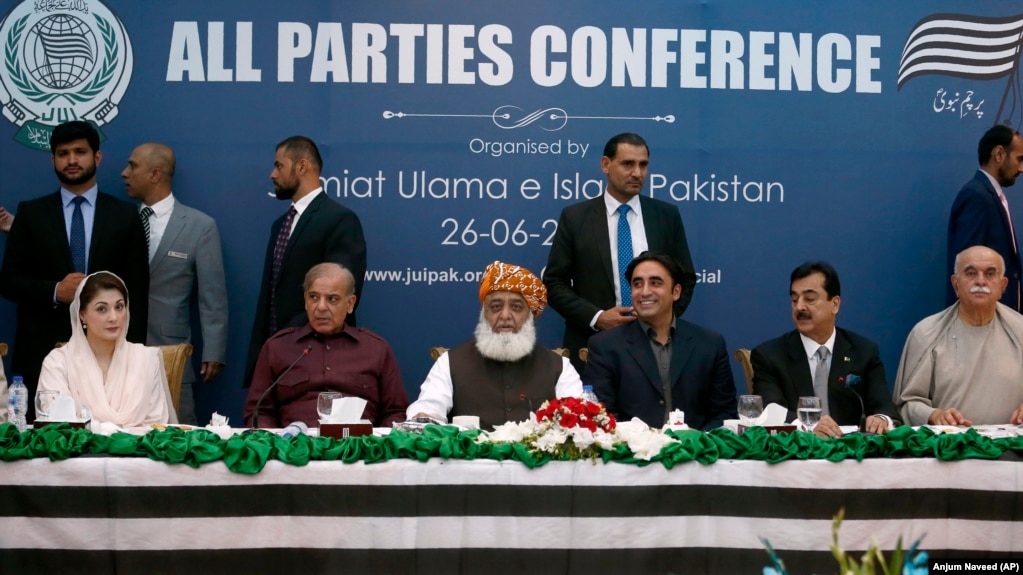
Most opposition political parties in Pakistan appear to be uniting in opposing the growing role of the country’s powerful military in shaping the country’s politics, governance, and economy.
A major meeting of leaders of the country’s main liberal, conservative, ethno-nationalist, and Islamist political parties this week agreed on a charter of demands, an agitation date, and a way forward that extensively targets the military’s involvement in Pakistan’s politics and its role in shaping major policies.
Jamiat Ulma-e Islam (JUI), an Islamist political party, hosted the June 26 meeting that included the top leaders of the conservative Pakistan Muslim League Nawaz (PML-N), the liberal Pakistan Peoples Party (PPP), and nearly half a dozen other parties. Together they present a formidable opposition to the ruling Pakistan Tehreek-e Insaf (PTI), whose coalition government holds a thin parliamentary majority.
“This meeting has emphasized parliamentary, constitutional, and civilian rule in the country,” JUI leader Maulana Fazlur Rehman told journalists late on June 26. “We will oppose every move aimed at weakening the parliamentary democracy in our country.”
Rehman said the opposition will unite in moving a no-confidence motion against Sadiq Sanjrani, the current chairman of the Senate or upper house of the Pakistani Parliament. He vowed to mark July 25 as a “black day” to protest what the opposition claims were rigged elections on the same day last year.
Former lawmaker Afrasiab Khattak says the opposition meeting is significant because it shows their resolve to reverse what they see as “political engineering” by the military.
He told the RFE/RL Gandhara website that most opposition leaders are convinced the PTI’s rise since 2011 and its victory in last year’s parliamentary election was orchestrated by the military, which now holds a commanding influence over the administration. The PTI denies being supported by the military, and a spokesman for the military has repeatedly denied meddling in politics.
Khattak says the election of Sanjrani, a political novice, to lead the Senate in March 2018 was part of a larger scheme to dominate the current political system by orchestrating the PTI’s victory. “Removing the chairman of the senate will be a logical first step toward the subsequent removal of the puppet government,” he said of the opposition’s strategy.
Beyond the country’s treacherous power politics, some of the opposition’s most pressing demands also directly address the military.
“We demand that laws should be framed to deal with the issue of forced disappearances,” Rehman said. “People being held by the security forces must be presented before courts of law. We need to also legislate against torture.”
For more than a decade now, Pakistani political parties and human rights organization have accused the security forces of being involved in forced disappearances, extrajudicial killings, and other grave abuses in conflict regions such as southwestern Balochistan Province and parts of northwestern Khyber Pakhtunkhwa Province.
While the Pakistani military denies any involvement, these issues have prompted large-scale protests under the banner of the Pashtun Tahafuz Movement (PTM), a civil rights movement that emerged in February 2018.
The Pakistani military has accused the movement of colluding with the intelligence services of neighboring India and Afghanistan. But PTM leaders reject such accusations and say they are demanding rights and security for Pakistan’s largest ethnic minority, an estimated 35 million Pashtuns, through peaceful protests.
Months of tensions between the military and the PTM boiled over last month. On May 26, the military killed 13 PTM protesters at a check post in North Waziristan tribal district, according the movement’s members and witnesses. The military, however, said it only responded after protesters led by lawmakers Mohsin Dawar and Ali Wazir first opened fire.
The two PTM lawmakers are still in prison. Asad Qaisar, a PTI leader and speaker of the National Assembly or lower house of the Pakistani Parliament, has refrained from allowing them to participate in the ongoing budget session. Opposition leaders demanded that the two lawmakers must be allowed to participate in the parliament’s deliberations and called for the formation of a parliamentary committee to probe the May incident in Waziristan.
Rehman said that all leaders are united in opposing the military’s role in first-ever provincial elections in Waziristan and five other districts of the former Federally Administered Tribal Areas (FATA), which were merged into Khyber Pakhtunkhwa last year. “We reject the election commission’s recommendation of deploying army soldiers inside the polling stations during the upcoming elections in the erstwhile FATA,” he told journalists.
The opposition rejected the PTI’s proposed budget and ruled out new government initiatives to investigate alleged past corruption and grant the military a formal role in economic decision-making. It called for the freedom of press, which international watchdogs say is reeling from censorship imposed by the military.
Senior leaders of the ruling PTI, however, are not deterred by the opposition’s posturing.
“It is the job of the opposition to criticize and target us, while ours is to stop them,” Firdous Ashiq Awan, a special assistant to Prime Minister Imran Khan, told reporters. “There is not a single word in the [opposition] parties’ declaration against corruption,” she said, alluding to her party’s longstanding campaign that most Pakistan’s current problems stem from corruption by leaders of the PPP, PML-N, and other parties.
But opposition politicians are banking on rising resentment among Pakistan’s 207 million people amid rapid economic decline. The rupee, the Pakistani currency, dropped to another record low against the U.S. dollar this week. Since December 2017, the rupee has lost more than half its value. Runaway inflation, new taxes, and increasing utility prices are stoking widespread anger.
“We aim to relieve the masses of the crippling inflation created by the incompetent government that assumed power after a rigged election,” Rehman said.

'selected prime minister' - In Imran Khan’s Pakistan it’s not the economy, stupid. It is a dreaded word keeping PM awake


What was more or less an inside joke about Imran Khan being a 'selected prime minister' has now become a joke beyond borders.

Of all the things that Pakistan has banned in the past – from YouTube to Facebook – the latest is the most bizarre. This time, a word has become public enemy. And the word is ‘selected’.
Actually, it all began last August when Imran Khan came to power with his Naya Pakistan slogan.
Pakistan Peoples Party (PPP) chairman Bilawal Bhutto Zardari in the opening session of parliament cheekily called Imran Khan “prime minister select” while congratulating him for Pakistan Tehreek-e-Insaf’s (PTI) win. Bhutto was hinting at the possibility of the establishment helping Imran Khan win. Ironically, Khan had even thumped the desk then.
On Monday, almost a year later, a rather emotional deputy speaker Qasim Khan Suri banned using the phrase ‘selected prime minister’ for Imran Khan during the budget session. He said it was an insult to the entire parliament.
One would think that cricketer-turned-politician Khan sahib would want to wear that word on his sleeve, but his colleagues can now no longer utter it. So much for sportsmanship and some harmless sledging.

Joke to disaster

Opposition parties questioned the legitimacy of the ruling and termed it undemocratic, frivolous and a step towards censoring parliament.
Bilawal Bhutto said that it was because of Prime Minister Imran Khan’s “ego” that the word was banned.
Pakistanis – both in parliament and outside – have already found ways to bypass the ban.
Pakistan Muslim League-Nawaz’s (PML-N)information secretary Marriyum Aurangzeb chose the word “handpicked” instead for the prime minister.
What was more or less an inside joke about Imran Khan being a “selected prime minister” has now become a joke beyond borders. The ban has reopened the debate of how he came to power rather than preserve Imran Khan’s image.
Or, is this a classic case of a guilty conscience?
The general elections of 2018 were widely criticised by the PPP and the PML-N. They accused the military of intimidating their political workers and engineering the election in Khan’s favour. Censorship of mainstream media didn’t give parties a level playing field either.

The umpire’s finger

‘Selected’ is not the only word Khan should get banned. His naysayers have often described his relationship with the military by calling him a “ladla” (favourite child), “ghost employee” or “nikkay da abba” (father of the young child). Back in the day, Khan himself had referred to the establishment as “umpire” and pre-empted how the umpire’s finger would go up against Nawaz Sharif.
To refer to the political manoeuvring by the military without getting into trouble, a creative set of terms was invented: “Farishtay” (angels), “khalai makhlooq” (aliens), “Selectors” or “mehkma-e-zarat” (Department of Agriculture).
To refer to the powerful men in uniform, terms such as “boys”, “boots” or “namaloom afrad” (unidentified people or known unknowns) are often used.
The etymology of mekhma-e-zarat is one of the most hilarious.
Rana Iqbal Siraj, a PML-N candidate from Punjab assembly in 2018, in a viral video, had alleged that he was tortured by the personnel of a secret agency over his refusal to return his ticket. Subsequently, a raid was conducted on his fertiliser godown. He later backtracked, apologising that he actually was not threatened by agencies, it was the mehkma-e-zarat (department of agriculture) that raided his facility. Since then the department of agriculture has become synonymous with security personnel.

What is keeping Imran Khan up?

Historically, many political terminologies have been used for opponents in Pakistan’s parliament. “Mr 10 per cent” for Asif Ali Zardari, “Maulana Diesel” for Fazalur Rehman, “Sheeda Talli” for Sheikh Rashid’s over the top demeanour or “Lotta” to define turncoats. Those at the receiving end have always taken these terms with a pinch of salt and never asked for bans. After all, puns and metaphors are all that keeps ‘engineered’ assemblies alive.
Marred with economic crisis, incompetent governance, lack of vision and inability to deliver on the promises made to his constituents, the first year of the Imran Khan-led government has not gone well and the pressure seems to be getting the better of the PM.
Otherwise, why would Khan bother with who calls him what, knowing how he in his opposition days had called prime ministers and presidents dacoits, liars, cheaters and even cursed the same parliament that he is now the leader of.

Selected is elected

So, is Imran Khan a selected prime minister? Absolutely.
According to the dictionary, an election is “the act of choosing or selecting one or more from a greater number of persons, things, courses, or rights.”
Lahore High Court’s 2003 ruling on the subject follows the same theory. A selected prime minister is one who has been elected by parliament. Clearly, neither the speaker, the ruling PTI, nor the PM knows that.
Selected is elected. And Mr Prime Minister we all know what you think we didn’t know!


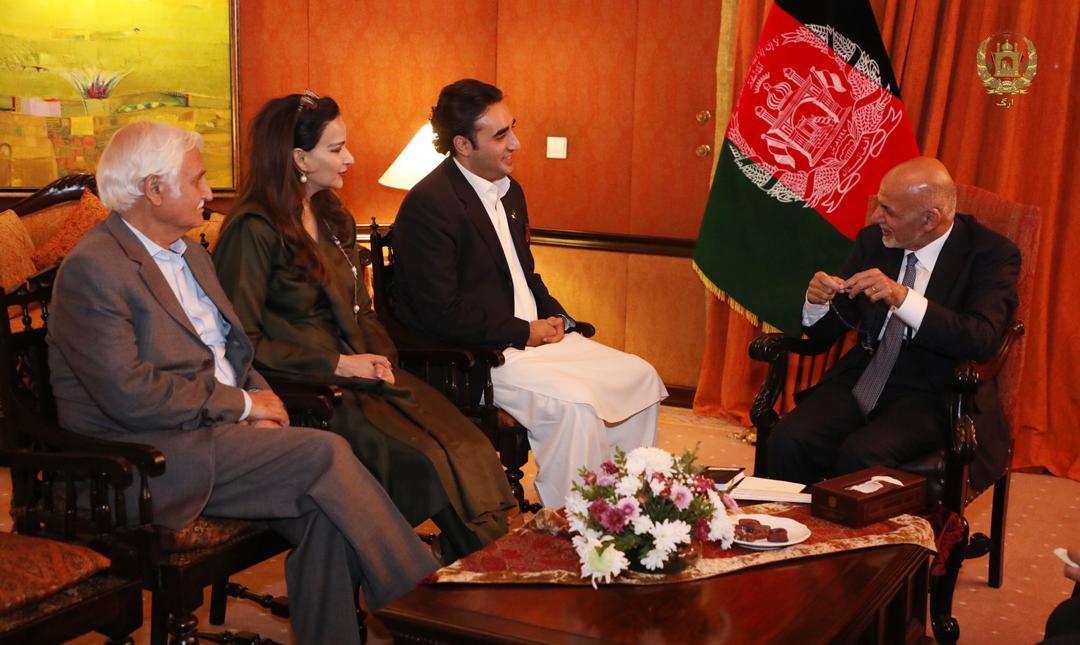
Bilawal meets President Ghani, shows well wishes for Afghan peace process


Pakistan People’s Party (PPP) chairman Bilawal Bhutto-Zardari on Thursday met Afghan President Ashraf Ghani who is on his two-day official visit to Pakistan, ARY News reported.
The PPP chairman welcomed President Ghani over his arrival in Pakistan.
Bilawal, Ghani discussed matters of mutual interests during the meeting. Bilawal expressed his well wishes for ongoing Afghan peace process.
The meeting was also attended by PPP’s senior leader Farhatullah Babar and Sherry Rehman.