Wednesday, May 15, 2019

Walking A Tightrope: Pakistan Struggles To Juggle Multiple Balls – Analysis

By 

Pakistan risks falling off the tightrope it walks as it attempts to balance its relations with rivals Saudi Arabia and Iran.
Developments in recent days, including this weekend’s Baloch nationalist attack on a luxury hotel in the strategic port city of Gwadar and a legal dispute over completion of a gas pipeline against the backdrop of Saudi-Iranian-Qatari competition for the Pakistani gas market, suggest that Pakistan is caught between a rock and a hard place.
The South Asian nation’s seemingly unsustainable tightrope walk is likely to have consequences for the security of China’s massive US$45 billion investment in the China Pakistan Economic Corridor (CPEC), a crown jewel of Beijing’s Belt and Road initiative; an approximately US$10 billion planned Saudi investment in a refinery and a copper mine in the troubled Pakistani province of Balochistan; and Pakistani hopes of getting a grip on  political violence in a bid to attract further badly needed foreign investment and avoid sanctioning for inadequate counterterrorism measures.
The assault on the highly secured hilltop Zaver Pearl Continental Hotel Gwadar, part of Pakistan’s largest luxury hotel chain, in which four people, including three gunmen were killed, was the second incident since Pakistani prime minister Imran Khan and Iranian president Hassan Rouhani last month agreed to step up security cooperation along their 959-kilometre long border.
Many Baloch, members of an ethnic minority on both sides of the border, feel economically disadvantaged and marginalized with a minority harbouring nationalist aspirations. Security-led repressive policies by both Iran and Pakistan have fuelled militancy and offer ample opportunity for manipulation by regional powers.
In an emailed statement claiming responsibility for the hotel attack, Baloch Liberation Army (BL) spokesman Jihand Baloch said this weekend’s attack targeted “Chinese and other investors who were staying at the PC hotel.” The hotel was believed to have few guests because of Ramadan.
In an earlier statement issued last week after an attack on a coal mine in which five people were killed, Mr. Baloch asserted that “Balochistan is a war-torn region and we will not allow any investments until the independence of Balochistan.”
BLA operatives have in the past seven months hit various Chinese targets beyond the boundaries of Balochistan, including a convoy transporting Chinese engineers in Karachi and the People’s Republic’s consulate in the city.
Baloch nationalist militancy is not the only problem confronting Pakistani security forces in the strategic southwest of the country. The Islamic State claimed responsibility for an attack last month on a market in the Baloch capital of Quetta frequented by Hazaras, a beleaguered Shiite minority, in which 19 people were killed and dozens injured.
Iran blamed allegedly Saudi and US-backed Balochistan-based Sunni Muslim militants for an assault in February on the Iranian side of the border that killed 27 Revolutionary Guards.
In an apparent bid to build confidence, Mr. Khan admitted during his visit to Tehran that militants operating from Pakistan had attacked targets in Iran but vowed to put an end to that.
Complicating Mr. Khan’s efforts to walk a fine line between Saudi Arabia and Iran and safeguard crucial Chinese and future Saudi investment is the fact that the Trump administration’s stepped up maximum pressure campaign against the Islamic republic is restricting the South Asian nation’s ability to live up to prior commitments to Iran and fuelling Iranian concern that Saudi Arabia is able to influence Pakistani policy.
Jeddah-based Arab News quoted Mobin Saulat, the managing director of Pakistan’s state-owned Inter State Gas Systems, as advising his Iranian counterparts that US sanctions were preventing it from completing the Pakistani leg of an agreed gas pipeline despite statements by Messrs. Khan and Rouhani that they were seeking to enhance connectivity between their two countries.
Iranian suspicion of Saudi covert activity in Balochistan as well as the kingdom’s ability to influence Pakistani policy stems from multiple factors that Tehran sees as indicators.
These include massive Saudi financial assistance to help Pakistan avert a financial crisis, question marks among international oil executives of the economic rationale for the kingdom’s  plan to build a refinery in Gwadar, a plan published by a Riyadh think tank calling for the fostering of an insurgency among Iran’s Baloch minority, reports by Pakistani militants of Saudi funding for anti-Shiite and anti-Iranian Sunni Muslim militants in Balochistan, and evidence of broader segments of the Pakistani population buying into Saudi-inspired ultraconservative interpretations of Islam as a result of the kingdom’s decades-long support of religious and cultural institutions as well as media.
Iran’s province of Sistan and Balochistan hosts the Indian-backed port of Chabahar, a mere 70 kilometres up the Arabian Sea coast from Gwadar. A shadowy militant Sunni Muslim group claimed responsibility for a rare suicide bombing in Chabahar in December.
Pakistan scholar Madiha Afzal noted in a just released Brookings report that “Saudi Arabia has succeeded in changing the character of Pakistan’s religiosity in a bid to expand its influence in the Muslim world, and in its mission to counter Iran.”
While US sanctions may have, at least for now, given the death knell to the Iran-Pakistan pipeline, Saudi influence appears to have failed in stopping Pakistan from entertaining a gas deal with Qatar, another of the kingdom’s nemeses, despite an almost two-year old Saudi-United Arab Emirates-led diplomatic and economic boycott of the Gulf state.
Qatar recently lowered the price in a bid for a major Pakistani liquified natural gas (LNG) contract in an effort to outcompete Saudi Arabia, that last month sent a delegation to Islamabad to discuss the South Asian nation’s gas needs.
The competition is about more than commercial advantage. While Qatar sees its gas exports as part of its soft power strategy, Saudi Arabia views the Pakistani contract as part of an effort to establish the kingdom as a major trader and marketeer as it strives to position itself as a significant gas exporter over the next decade.
Pakistan’s ability to maintain its tightrope walk could be further endangered if it fails to convince the Financial Action Task Force (FATF), an international anti-money laundering and terrorism finance watch dog, that it is doing sufficient to meet the group’s standards.
Pakistan was last year grey listed by the group and risks being blacklisted if it fails to convince FATF in talks later this month that it has substantially improved its controls. Blacklisting listing would significantly curtail its access to international finance at a time that it is seeking a bailout by the International Monetary Fund. (IMF).
Juggling multiple balls is proving to be an increasingly difficult act in which Pakistan may be the country out on a limb but many of its partners have a stake in ensuring that it maintains its tightrope walk.

Pakistan: Stifled Media – Analysis

By Sanchita Bhattacharya
On April 30, 2019, unidentified assailants shot dead journalist Malik Amanullah Khan near Landa Sharif Adda on the Multan-Dera Road in Paroa Tehsil (revenue unit) of Dera Ismail Khan in Khyber Pakhtunkhwa. Amanullah Khan was a local reporter who wrote for Urdu daily Meezan-e-Adl and was Chairman of Paroa Press Club.
Earlier, on December 3, 2018, Nurul Hasan, a Nowshera-based reporter of a private television channel, was shot dead by unknown motorcyclists in Peshawar, the provincial capital of Khyber Pakhtunkhwa.
According to South Asia Terrorism Portal (SATP) database, available since March 2000, the first incident of killing of journalists was recorded on February 7, 2005, when two journalists were shot dead by armed assailants in Wana, the headquarters of the then South Waziristan Agency of the Federally Administered Tribal Areas (FATA).
Since then, according to partial data collated by SATP, at least 38 journalists have been killed in Pakistan. A high of six journalists were killed in the year 2013 followed by five in 2010; four each in 2009, 2011 and 2012; three each in 2014 and 2015; two each in 2005 and 2017; and one each in 2006, 2007, 2008, 2018 and 2019. No such fatality was recorded in years 2000 to 2004. These numbers are likely underestimates. 
Also, according to the Committee to Protect Journalists (CPJ), at least 61 journalists have been killed in Pakistan between 1992 and 2018. A maximum of eight journalists were killed in 2010 followed by seven each in 2011 and 2012; five each in 2007, 2008 and 2013; four in 2009, three in 2014; two each in 1994, 2002, 2005, 2006 and 2016; one each in 1997, 2000, 2003, 2004, 2015, 2017 and 2018. No fatality was recorded in years 1992, 1993, 1995, 1996, 1998, 1999 and 2001.
Journalists in Pakistan have been subjected to abduction; murder by beheading, target killing, throat-slitting, hurling of bombs and beating to death; physical torture and suicide attack. And it is not just terrorists, insurgents, separatists, gangsters and drug traffickers whom journalists have to fear: state sponsored actors, including intelligence agencies, also pose a threat.
In one prominent case, on May 29, 2011, Saleem Shahzad, Pakistan Bureau Chief of Asia Times Online, was abducted after he exposed links between al Qaeda, a group of Naval personnel and the Inter-Services Intelligence (ISI) in the attack at the Pakistan Naval Station (PNS) Mehran within Faisal Naval Airbase in Karachi. 10 Security Force (SF) personnel were killed in the terrorist attack. Later on, June 1, 2011, his body was found with signs of torture, in the Mandi Bahauddin District of Punjab Province. In July 2011, The New York Times reported that US officials had reliable intelligence that showed that the ISI was responsible for Shahzad’s murder. Predictably, in January, 2012, Pakistan’s official commission of inquiry concluded that the perpetrators were unknown, a finding that was widely criticized as lacking credibility.
Though the available data clearly indicates that fewer journalists have been killed over past few years, reports show that the media is more stifled than it was earlier. The CPJ Annual Report 2018 thus observes,
…Despite a decline in fatal violence against journalists the media environment is worse today than it has been in recent years… Intimidation and threats of assault have led journalists and editors to avoid reporting stories on topics that would lead them into trouble. These topics include a wide range of touchy issues: religion, Chinese investment, relations with India, militant groups, and criticism of the military.
Another CPJ report, Acts of Intimidation: In Pakistan, journalists’ fear and censorship grow even as fatal violence declines, based on interviews with journalists across Pakistan, released on September 12, 2018, highlighting the plight of journalists in the country, noted that “the deterioration in the climate for press freedom in Pakistan accompanied a reduction in murders and attacks against the media” and “the two trends are linked, with measures the military took to stomp out terrorism directly resulting in pressure on the media”. The report adds, further, “conditions for the free press are as bad as when the country was under military dictatorship, and journalists were flogged and newspapers forced to close”.
More importantly, the September report, underlined the role of military in suppressing Press freedom,
The military garnered widespread praise for its crackdown on militancy after the school attack, which resulted in a sharp decline of terrorist incidents — and in turn, violence against journalists. Yet the stepped-up activity put the military in position to exert even greater control. The military has quietly, but effectively, set restrictions on reporting: from barring access to regions including Balochistan where there is armed separatism and religious extremism, to encouraging self-censorship through direct and indirect methods of intimidation, including calling editors to complain about coverage and even allegedly instigating violence against reporters. The military, intelligence, or military-linked and political groups were the suspected source of fire that resulted in half of the 22 journalist murders in the past decade. Hence it is easy to see how the military’s widening reach is viewed as a source of intimidation. The military has clashed with Pakistan’s elected government, which tried and ultimately failed to assert civilian control. Journalists find themselves in the middle of this battle, struggling to report while staying out of trouble.
Significantly, during the months before the 2018 General Elections of Pakistan, several journalists were beaten, abducted and otherwise intimidated, with just one thread tying them together – their criticism of the military.The witch-hunt against the media began after journalist Matiullah Jan wrote highly critical articles against Pakistan’s military and judiciary. On June 4, 2018, military spokesperson Major General Asif Ghafoor held a press conference where he claimed that a handful of journalists and bloggers were “anti-State and anti-military”. Unsurprisingly just a day later, on June 5, 2018, columnist and political commentator, Gul Bukhari was abducted in an Army-controlled area of Lahore by unknown attackers, including men in military uniform. She was, however, freed a few hours later.
On the same night, BOL TV broadcast journalist Asad Kharal’s car was intercepted by masked men near Lahore airport, and he was taken out of the car and beaten. He received severe injuries and was taken to Lahore Services Hospital for medical treatment.
Earlier, on January 10, 2018, prominent Pakistani journalist Taha Siddiqui was beaten and threatened by armed men, during an attempt to kidnap him in broad daylight, as he took a taxi to the airport in the capital, Islamabad. A few weeks after the incident, he relocated to Paris (France). According to a July 2018 report, Siddiqui claimed,
The army and intelligence agencies were threatening me and I suspect the people who tried to kidnap me were from the army. They do not like investigative reporting that uncovers the wrongdoings of those institutions.
According to an October 2018 report, several journalists and editors were of the opinion that the ongoing hostility towards media, was more dangerous than it had been under previous Governments. They saw it as coming from all pillars of the state, with Imran Khan’s government considered closely in sync with the courts and the military. The military is accused of pressuring the courts to block any opposition or even criticism of Pakistan’s Army.
Indeed, impunity and a lack of prosecution has characterised many of the attacks on journalists in Pakistan. The impunity enjoyed by killers of journalists in Pakistan is among the highest in the world. According to a report shared by International Center for the Protection of Media Freedom and Defending the Rights of Journalists (ICPFJ) on October 31, 2018, murdered journalists and their families had received justice in only one of 26 cases over the preceding five years. Iqbal Khattak, the Executive Director of Freedom Network, which prepared the report, observed, “Journalists continue to get target killed and threats against them continue to grow and the State’s legal system (police failure) and justice system (courts failure) have failed to provide them justice.”
Significantly, amidst this enveloping environment of intimidation, fear and state failure, Cyril Almeida, the Assistant Editor of Dawn, was awarded the 2019 World Press Freedom Hero award by the International Press Institute for his ‘critical’ and ‘tenacious coverage’ of the Pakistani military-security complex. Significantly, Almeida is under trial for treason – an offence that carries a potential death penalty – for an interview with former Prime Minister Nawaz Sharif, in which the latter accused the Pakistan Army of aiding the terrorists who carried out the 2008 Mumbai attacks, which killed 175 people, including 144 civilians, 22 Security Force personnel and all nine attackers. Afzal But, President of the Pakistan Federal Union of Journalists, notes, “This is the darkest period for journalism in the country’s history, no doubt about it.”
Assessing the overall situation of media, CPJ Asia Program Coordinator, Steven Butler, stated,
While the decline in the killing of journalists is encouraging, the government needs to counteract pressures that have resulted in rampant self-censorship and threats to the media. Pakistan must address the disturbing trend of impunity and attacks on journalists to shore up this faltering pillar of democracy.
Against this backdrop, Pakistan saw its first-ever two-day (May 2 and May 3, 2019) Sahafi (Journalist) Summit held in Karachi, the provincial capital of Sindh, to discuss at length the fast-emerging challenges to journalism in the country, including threats to independent news media from digital disinformation and financial cuts. The summit reportedly generated robust and inclusive discussions on the current challenges faced by the news industry in Pakistan, focusing, inter alia, on the coordinated and malicious spread of disinformation, the crisis of media literacy, regulations and the broadcast media’s struggling business model for revenue generation. The challenges faced by Pakistani women reporters were also discussed along with Pakistan’s media economy, including the issue of mass layoffs, investment in digital news and services and the role of news media owners.
In a society fixated on ‘righteous’ conduct overwhelmingly defined by religious extremism and militarized hypernationlism, journalists have come to dread violence for doing their job. With repeated physical attacks, fear has taken over the media, resulting in unprecedented self-imposed censorship. 

#Pakistan - #MyHealthMinisterIsTerrorist - #Peshawar doctors boycott OPDs after brawl with health minister

Doctors boycotted the outpatient departments at all government hospitals across Khyber Pakhtunkhwa Wednesday after an associate professor was beaten allegedly by Health Minister Hisham Inamullah Khan.
According to the KP Doctors Council, their primary demand was that an FIR be registered against the beating of Dr Ziauddin and a judicial inquiry be opened against Inamullah Khan. Dr Ziauddin works at Khyber Teaching Hospital.
The minister and his guard beat the assistant professor during a meeting of the hospital board of governors.
Dr Ziauddin and the minister shouted at each other during the meeting.
The minister claimed, however, that Nausherwan Burki, a cousin of Prime Minister Imran Khan, was egged by young doctors.
Inamullah Khan has said that when he reached the hospital to inquire further, he too was attacked. He claimed that Dr Ziauddin had attacked him but he was saved by his bodyguards.
A case has been later registered against Dr Ziauddin on the minister’s request. The police have arrested four young doctors after identifying them from CCTV footage of egging Burki.
Chief Minister Mahmood Khan summoned a report after ordering an immediate inquiry.

#Pakistan #PPP - Bilawal Bhutto writes letter to #NAB

Pakistan People’s Party (PPP) chairman Bilawal Bhutto Zardari has responded to the letter of National Accountability Bureau (NAB), Chief Minister’s Advisor on Information Barrister Murtaza Wahab has confirmed.
In the letter, Bilawal writes he could not appear before the anti-graft body on May 17 owing to some crucial engagements.
Bilawal Bhutto Zardari urged the NAB to set any date in the next week so that he could appear before it.The advisor said “PPP chairman he received letter from NAB on May 13. The letter was written on May 08.”

Tuesday, May 14, 2019

Video - Mai Baghi Hoon (Jeyay Bhutto)

Video Report - PTI Gives New Tax Amnesty Scheme To Pakistan | Najam Sethi Show | 14 May 2019

Video Report - Pakistani girls sold in China's 'bride market'

Video Report - Why Pakistani Girls Are Getting Married With Chinese Men?

Pakistan signed deal with IMF : Will it bring new taxes and Inflation?

We all know who’s behind ‘NABgardi’: Bilawal Bhutto

Pakistan Peoples Party Chairperson Bilawal Bhutto Zardari remarked on Tuesday that everyone knows who is behind the latest spade of ‘NABgardi’. 

“Our three generations have been battling them,” he wrote in a tweet on social media. “We will not stop now.”
The tweet comes the same day the National Accountability Bureau summoned him in the Park Lane cane on May 17, Friday. This is the second time he will appear before NAB in the case.


Pakistan: The Chant Of ‘Da Sanga Azadi Da’ – OpEd

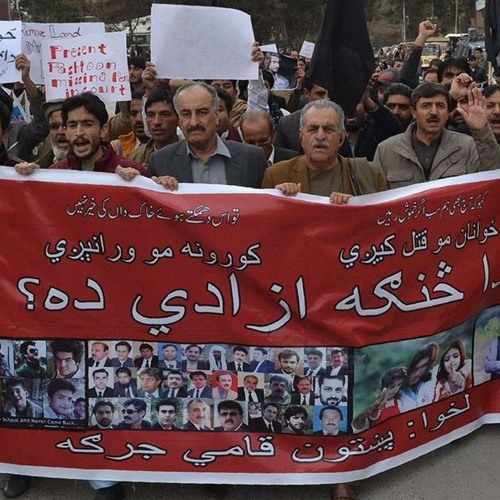
Nearly 15% of population of Pakistan (around 200 million) belongs to Pashtun ethnicity. Time and again our Pashtun brothers and sisters have proved their loyalty and love for Pakistan and sacrificed the most be it in terms of Pakistan movement or later whenever any rough time and situation arises in the border region or when the military operation was conducted in the North West region and they had to become IDPs. However, the slogan “Da Sanga Azadi Da” (what kind of freedom is this?) is voice of many Pashtuns these days and its echo can now be heard in whole country and raising many questions in minds of all Pakistanis. PTM – Pashtun Tahaffuz Movement; is the recent conflict the state and people are facing these days.
Looking back, the journey of PTM is not very long, being established by 8 university students in May 2014 with very basic demand of removing the landmines from tribal areas which had claimed more than 40 lives. The case of NaqeebUllah Mehsud and controversy of Rao Anwar, unfortunate incident of Tahir Dawar and all those missing persons cases brought the PTM in spotlight since 2018. This was the time PTM started gaining support from masses and people joined and rendered their support for them as the demands seemed genuinely worth considering. At the same time, the controversies and scandals started surfacing regarding PTM’s chairman and leadership– the Khaisor event and allegations of Matorkey brothers, and among them there are now voices of foreign hand involved behind PTM activities. Between this scramble of truths and politics and controversies and messed up situation, the major concern is its impact on a common young mind particularly Pashtun youth and those from the tribal belt – now part of KPK.
This goes without saying that the love for our forces and homeland runs in our blood and there is sheer intolerance for all anti state sentiments in our hearts. Amongst all the recent developments including the stance of government, the voice of Pashtuns, the statements of Pakistan Army, the media talk and analysis and all the other voices of political parties and human rights organizations makes a young mind inquisitive and curiosity of finding the facts and truth with the debate of patriotism and treachery reaches its peak. Being a young student, I have my own set of questions.
The PTM’s influential circle is mostly youth and young adults. University students and other educated/ well aware young adults who have paid a hefty price throughout their lives owing to a tiresome battle for peace they are fighting and now torn between militants and military. The sacrifices these people have made by leaving their houses and land and going through the struggles of rehabilitation and are still being scrutinized for what the militants and terrorist groups have done to them and their areas. The required support from government and other institutions is lacking for them. The basic demands of PTM is therefore voice of their hearts and these grievances have now become deep rooted and serves as a fertile land for all the anti state powers; be it the foreign agencies and militant groups from across border, regional politics and all others who have evil plans for our dear homeland and exploitation for them becomes very easy. Foreign funding, media access (as local media is not giving them coverage), international and national support at various forums etcetera are the baits being used.
Considering the severity of situation, the state cannot just sit idle and has to take actions which are bound to be disliked by the targeted community. The culprits or black sheep will get their due share but the sufferers are only going to be those young minds and people who once again put their trust in the wrong hands maybe, or whose sentiments and emotions have been exploited once again by people of some other motives who got off track by the period of time and nobody will claim responsibility of all this messed up situation from both ends – the PTM or the state.
Every new day is bringing new things and new dimensions to this conflict but need of time is to secure the future of our precious Pashtuns who love Pakistan no less than others and who are being held hostage time and again previously by the militants who are now again trying to reclaim them directly or indirectly and now by some other nationalists who are accusing the armed forces openly for all their issues (Ye jo dehshatgardi hai; iske peeche wardi hai). The correct answer to this puzzle lies only in genuine and considerate resolution of their mainstream problems. To share and make them understand the limitations (if there are any) so that they themselves can fight the elements who try to take advantage from plight of others. Hoping things to turn out the best way possible for resolution of this conflict and may our Pashtun brothers and sisters experience Azaadi the way they want!

Fresh #IMF deal a 'political blow' to #Pakistan PM Imran Khan


By  Haroon Janjua

After months of difficult negotiations, Islamabad and the International Monetary Fund (IMF) declared on Sunday that they had reached an agreement on a fresh bailout package for Pakistan. If the deal is approved by the IMF's management, the South Asian nation will receive $6 billion (€5.34 billion) in financial assistance over a period of three years to stave off a balance-of-payments crisis.
Abdul Hafeez Shaikh, Pakistan's de facto finance minister, told the state-run Pakistan Television that he hoped it would be his country's last bailout package from the IMF.
Under the deal, Pakistan would give up central bank control of the currency to adopt a market-based exchange rate and take measures to improve the functioning of loss-making state-owned firms as well as curtail subsidies, among other things. The World Bank and the Asian Development Bank would provide up to $3 billion in additional assistance in pursuance of the IMF deal, Hafeez Shaikh said.
The economy of the majority-Muslim nation with a population of over 200 million has slid deeper into crisis since Imran Khan took over as prime minister last year. Burgeoning fiscal and current account deficits and a dip in revenues from tax collection are at the heart of the crisis. "Pakistan is facing a challenging economic environment, with lackluster growth, elevated inflation, high indebtedness, and a weak external position," Ernesto Ramirez Rigo, who led the IMF mission to Pakistan, said in a statement on Sunday. "The authorities recognize the need to address these challenges, as well as to tackle the large informality in the economy, the low spending in human capital, and poverty."
A challenging environment
"Through the IMF bailout package, Pakistan will resolve its balance-of-payments crisis. There is currently a financing gap of $12 billion and the bailout will help bridge the gap this year as well as in the coming three years," Minister of State for Revenue Hammad Azhar told DW.Pakistan has gone to the IMF numerous times since 1980 seeking bailouts. The country has had a tense relationship with the lender as the conditions attached to the assistance are always unpopular.PM Imran Khan initially appeared reluctant to approach the IMF for aid, fearing that it would impose tough conditions on government policy. Instead, Khan's administration sought billions of dollars in help from "friendly countries," including Saudi Arabia, China and the United Arab Emirates, to fix the nation's finances.But with inflation climbing to over 8%, the rupee losing a third of its value over the past year, and foreign exchange reserves barely enough to cover two months of imports, it was forced to turn to the IMF.
Growing discontent
Analysts have warned that any IMF deal would likely come with strict conditions that could restrict PM Khan's ability to fulfil his grand promises to build an "Islamic welfare state," as the country is forced to tighten its purse strings.
"The IMF deal, with the austerity measures it will entail, will be a political blow to a Pakistani government that had promised to build out a new welfare state," Michael Kugelman, a South Asia expert at the Washington-based Woodrow Wilson Center for Scholars, told DW. "The IMF package will make it quite tough for Khan to achieve his economic promises and therefore undercut the populist image that he has sought to showcase to the electorate," he added.
This view is shared by Kaiser Bengali, a renowned economist in Pakistan. "The IMF has an agenda to privatize the assets of the country, which will lead to massive unemployment," said the expert.
The bailout announcement comes as discontent is already growing over measures Khan's government has taken to fend off the crisis, including devaluing the rupee by some 30% since January 2018, sending inflation to five-year highs.Khan came to power after winning a simple majority in last year's parliamentary elections on promises to improve the country's economy and provide jobs to people. But his critics say his government has so far not been able to honor his commitment to the masses. A government report published on Friday also noted that Pakistan's growth rate is set to hit an eight-year low, with the country's GDP rate likely to sink to 3.3%t against a projected target of 6.2%.
But some observers say the IMF package will be beneficial to end the growing uncertainty and build investor confidence. "The deal will put an end to uncertainty and improve Pakistan's financial situation," Abid Sulehri, an economist, told DW. "Even though it might have some negative effects, in the form of a rise in inflation, it will produce positive results in the long run."
US support?
When asked why China didn't come to Pakistan's rescue, Minister Azhar said: "China has already been providing funding for Pakistan's trade and infrastructure development, and we opted for the IMF funding so as to introduce structural reforms in the economy."The United States, which has tremendous influence over the IMF, warned last year that any potential international bailout for Pakistan should not provide funds to pay off Chinese lenders."Make no mistake. We will be watching what the IMF does," US Secretary of State Mike Pompeo said. "There's no rationale for IMF tax dollars, and associated with that American dollars that are part of the IMF funding, for those to go to bail out Chinese bondholders or China itself," Pompeo added. It's not yet clear if the bailout agreement reached on Sunday enjoys Washington's backing.Pakistan's crisis also comes as the country is facing possible sanctions from the Financial Action Task Force — an anti money-laundering monitor based in Paris — for failing to rein in terror financing.
The organization will soon decide whether to add Pakistan to a blacklist that would trigger automatic sanctions, further weakening its already faltering economy.

Pakistan is worried about conditions behind IMF’s $6 billion bailout, stock market crashes


 and 
National security imperatives of the waters are rising as surely as the sea levels around the world because of climate change.
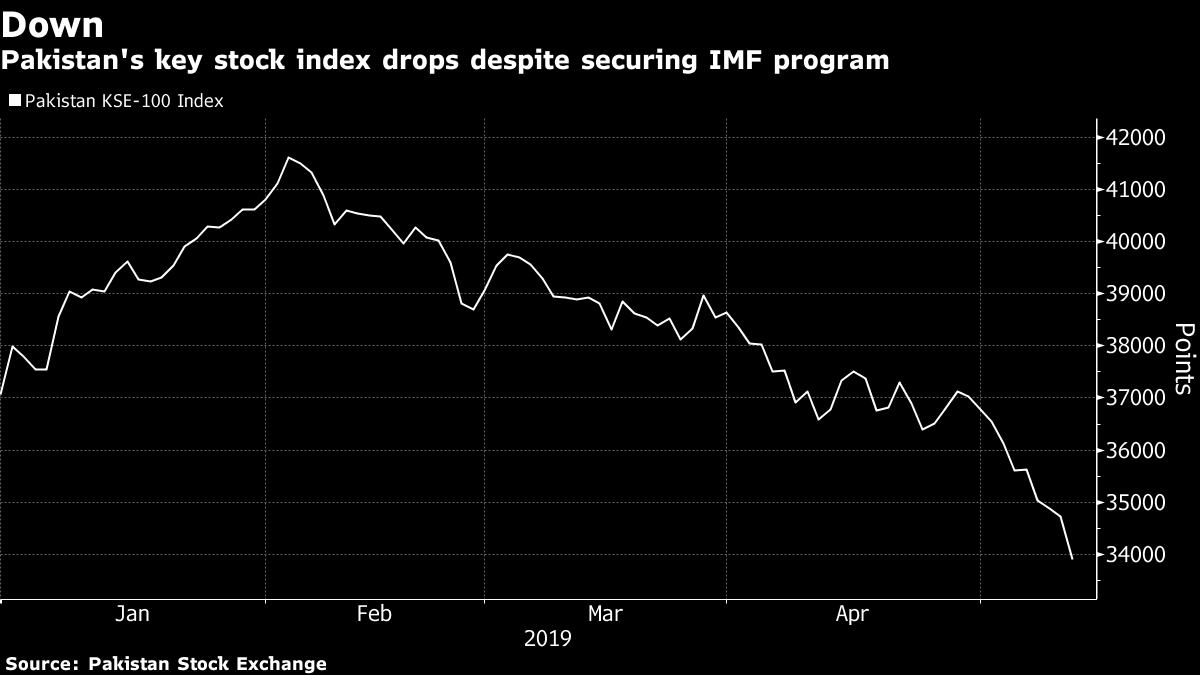
Pakistan’s stock market fell the most this year amid concern about the steps needed to seal a $6 billion loan agreed on with the International Monetary Fund.
The lender’s executive board will meet to approve the agreement for the 39 month loan, “subject to the timely implementation of prior actions and confirmation of international partners’ financial commitments,” IMF’s mission chief Ernesto Ramirez Rigo said in a statement.
A lack of clarity around these actions prompted speculation about further currency devaluations and interest rates increases, which rattled markets, according to NBP Fullerton Asset Management Ltd. and FIM Partners.
The loan would represent the 13th bailout since the late 1980s from the IMF to Pakistan, which is facing a balance-of-payments crisis triggered by high fiscal and current-account deficits and dwindling foreign exchange reserves. The pact was reached after Prime Minister Imran Khan overhauled his economic team, including the installation as central bank governor of Reza Baqir, who previously served in senior positions at the IMF, including in Egypt.
“The IMF statement is understandably vague at this stage and that is leading to more speculation,” said Mohammed Ali Hussain, Dubai-based head of research at FIM Partners, which handles $2.1 billion in assets. “Granular details about the program as well as the timing of conditions will play a role in market sentiment.”
An Egypt-style program, where most changes are required at the start, would be bad for sentiment though a gradual one “may play a bit better,” he added.
The nation’s benchmark KSE-100 Index of stocks fell 2.35% at close, the most in more than five months, erasing earlier gains of 1.5%. The rupee was little changed.

Graph: Bloomberg

More Needed

IMF’s Rigo noted efforts to stabilize the nation’s economy but said more needs to be done.
“Decisive policies and reforms, together with significant external financing are necessary to reduce vulnerabilities faster, increase confidence, and put the economy back on a sustainable growth path,” he said.
Abdul Hafeez Shaikh, an economic adviser to the prime minister, told state-run Pakistan Television that there had been some overspending by the government, so to “recover costs we will have to increase prices in certain areas of the economy.” The IMF facility “should be taken as a program of structural changes” and its success depends upon how successfully the country implements it, he said.
Pakistan agreed on a bailout after almost a six-month delay that prompted rating companies to downgrade the nation’s credit score earlier this year. The central bank has already devalued the currency by about 20% in the past year, making it the worst performer in Asia, according to a basket of 13 currencies compiled by Bloomberg.
“Any currency adjustment should be made as soon as possible,” said Amjad Waheed, chief executive officer at NBP Fullerton Asset Management Ltd., the nation’s largest mutual fund. “This will give confidence to foreign investors to enter the market. It will also encourage local investors to move towards equities.”
Prime Minister Khan has faced criticism from economists and opposition parties for delaying the loan and mishandling the economy. Khan had said the program was delayed as he set about securing more than $7 billion of loans from Saudi Arabia, the United Arab Emirates and China. While the IMF loan also doesn’t solve the financing gap, it opens up the possibility of Pakistan accessing debt markets, according to Hasnain Malik, head of equity strategy at Dubai-based Tellimer.
“This bailout package should be a positive in the medium to long run, provided the reform agenda is religiously pursued,” said Khurram Schehzad, chief executive officer of financial advisory firm Alpha Beta Core.
Pakistan’s opposition parties have asked for a parliamentary briefing on the details of the IMF loan agreement.
“We don’t accept it like this,’’ said Senator Sherry Rehman of Pakistan People’s Party, the nation’s second-biggest opposition party. “It seems that the agreement will bring a tsunami of price hikes.”

Deadly bomb attack targets policemen in Pakistan's Quetta


By Asad Hashim
Several wounded as bomb targets police vehicles outside a mosque in the third attack in Balochistan in three days. At least four policemen have been killed and several others wounded after a bomb attack targeted their vehicles while they stood guard outside a mosque in Pakistan's southwestern Balochistan province.
The attack on Monday night, third in the region in three days, targeted two police vehicles parked in the Satellite Town area of Quetta, the provincial capital of Balochistan, said city police chief Abdul Razzaq Cheema.
"Police vehicles provide security in various parts of the city for Taraweeh prayers [special prayers during Muslims' holy month of Ramadan]," Cheema told reporters. "As two of these vehicles stopped outside the al-Huda mosque, an explosion took place."
Twelve people were admitted to the city's main government hospital following the attack, the hospital spokesperson told Al Jazeera before adding that two of them were suffering from serious head wounds.
Images from the blast site showed blood and glass strewn across the wrecked police vehicles.
The attack comes two days after at least three gunmen stormed a five-star hotel in the southern Balochistan port city of Gwadar, about 700km south of Quetta, killing at least five people and engaging in a gun battle with the military that lasted several hours.The Baloch Liberation Army (BLA), an armed ethnic Baloch separatist group, claimed responsibility for that attack.On Saturday, two paramilitary soldiers were injured in an improvised explosive device (IED) blast in the province's Pishin district, about 70km north of Quetta, local media reported.The Pakistan Taliban, an armed group that has been fighting since 2007 to impose a strict interpretation of Islamic law in the country, claimed responsibility for the Pishin attack as well as the Monday's explosion in Quetta.
Targeted killings
Balochistan is Pakistan's largest and least-populated province. It has seen regular violence in recent years, with attacks claimed by Baloch separatists, Pakistan Taliban and local affiliates of the Islamic State of Iraq and Syria (ISIL or ISIS).
It has also seen a series of killings and bombings targeting Quetta's minority Shia Muslim population, killing more than 509 people, according to government data.
The province, rich in mineral and natural gas reserves, is also the focal point of much of the $60bn China Pakistan Economic Corridor (CPEC) project's trade component, with a new port constructed at Gwadar and a network of roads under construction.
The CPEC trade corridor will link southwestern China with the Arabian Sea through Pakistan, culminating in the port at Gwadar.
The Pakistan Taliban has frequently targeted Pakistani security forces and civilians in Balochistan, with attacks increasing in frequency as the group has been displaced from its erstwhile headquarters in Pakistan's northwestern tribal districts by sustained military operations.
The group is now believed to be based mainly in eastern Afghanistan, carrying out sporadic large-casualty attacks against civilians and government.

Video Report - Pakistan and IMF Sign Bailout Package With Severe Economic Cost | Najam Sethi Show | 13 May 2019