Tuesday, May 14, 2019

Fresh #IMF deal a 'political blow' to #Pakistan PM Imran Khan


By  Haroon Janjua

After months of difficult negotiations, Islamabad and the International Monetary Fund (IMF) declared on Sunday that they had reached an agreement on a fresh bailout package for Pakistan. If the deal is approved by the IMF's management, the South Asian nation will receive $6 billion (€5.34 billion) in financial assistance over a period of three years to stave off a balance-of-payments crisis.
Abdul Hafeez Shaikh, Pakistan's de facto finance minister, told the state-run Pakistan Television that he hoped it would be his country's last bailout package from the IMF.
Under the deal, Pakistan would give up central bank control of the currency to adopt a market-based exchange rate and take measures to improve the functioning of loss-making state-owned firms as well as curtail subsidies, among other things. The World Bank and the Asian Development Bank would provide up to $3 billion in additional assistance in pursuance of the IMF deal, Hafeez Shaikh said.
The economy of the majority-Muslim nation with a population of over 200 million has slid deeper into crisis since Imran Khan took over as prime minister last year. Burgeoning fiscal and current account deficits and a dip in revenues from tax collection are at the heart of the crisis. "Pakistan is facing a challenging economic environment, with lackluster growth, elevated inflation, high indebtedness, and a weak external position," Ernesto Ramirez Rigo, who led the IMF mission to Pakistan, said in a statement on Sunday. "The authorities recognize the need to address these challenges, as well as to tackle the large informality in the economy, the low spending in human capital, and poverty."
A challenging environment
"Through the IMF bailout package, Pakistan will resolve its balance-of-payments crisis. There is currently a financing gap of $12 billion and the bailout will help bridge the gap this year as well as in the coming three years," Minister of State for Revenue Hammad Azhar told DW.Pakistan has gone to the IMF numerous times since 1980 seeking bailouts. The country has had a tense relationship with the lender as the conditions attached to the assistance are always unpopular.PM Imran Khan initially appeared reluctant to approach the IMF for aid, fearing that it would impose tough conditions on government policy. Instead, Khan's administration sought billions of dollars in help from "friendly countries," including Saudi Arabia, China and the United Arab Emirates, to fix the nation's finances.But with inflation climbing to over 8%, the rupee losing a third of its value over the past year, and foreign exchange reserves barely enough to cover two months of imports, it was forced to turn to the IMF.
Growing discontent
Analysts have warned that any IMF deal would likely come with strict conditions that could restrict PM Khan's ability to fulfil his grand promises to build an "Islamic welfare state," as the country is forced to tighten its purse strings.
"The IMF deal, with the austerity measures it will entail, will be a political blow to a Pakistani government that had promised to build out a new welfare state," Michael Kugelman, a South Asia expert at the Washington-based Woodrow Wilson Center for Scholars, told DW. "The IMF package will make it quite tough for Khan to achieve his economic promises and therefore undercut the populist image that he has sought to showcase to the electorate," he added.
This view is shared by Kaiser Bengali, a renowned economist in Pakistan. "The IMF has an agenda to privatize the assets of the country, which will lead to massive unemployment," said the expert.
The bailout announcement comes as discontent is already growing over measures Khan's government has taken to fend off the crisis, including devaluing the rupee by some 30% since January 2018, sending inflation to five-year highs.Khan came to power after winning a simple majority in last year's parliamentary elections on promises to improve the country's economy and provide jobs to people. But his critics say his government has so far not been able to honor his commitment to the masses. A government report published on Friday also noted that Pakistan's growth rate is set to hit an eight-year low, with the country's GDP rate likely to sink to 3.3%t against a projected target of 6.2%.
But some observers say the IMF package will be beneficial to end the growing uncertainty and build investor confidence. "The deal will put an end to uncertainty and improve Pakistan's financial situation," Abid Sulehri, an economist, told DW. "Even though it might have some negative effects, in the form of a rise in inflation, it will produce positive results in the long run."
US support?
When asked why China didn't come to Pakistan's rescue, Minister Azhar said: "China has already been providing funding for Pakistan's trade and infrastructure development, and we opted for the IMF funding so as to introduce structural reforms in the economy."The United States, which has tremendous influence over the IMF, warned last year that any potential international bailout for Pakistan should not provide funds to pay off Chinese lenders."Make no mistake. We will be watching what the IMF does," US Secretary of State Mike Pompeo said. "There's no rationale for IMF tax dollars, and associated with that American dollars that are part of the IMF funding, for those to go to bail out Chinese bondholders or China itself," Pompeo added. It's not yet clear if the bailout agreement reached on Sunday enjoys Washington's backing.Pakistan's crisis also comes as the country is facing possible sanctions from the Financial Action Task Force — an anti money-laundering monitor based in Paris — for failing to rein in terror financing.
The organization will soon decide whether to add Pakistan to a blacklist that would trigger automatic sanctions, further weakening its already faltering economy.

Pakistan is worried about conditions behind IMF’s $6 billion bailout, stock market crashes


 and 
National security imperatives of the waters are rising as surely as the sea levels around the world because of climate change.
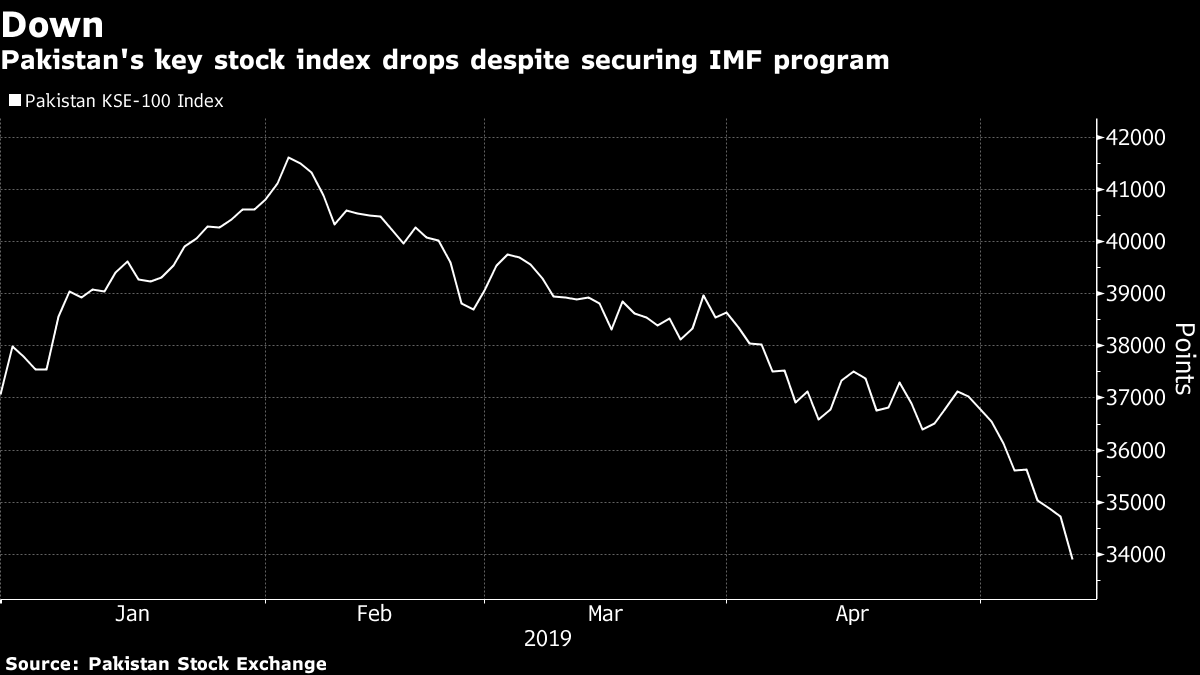
Pakistan’s stock market fell the most this year amid concern about the steps needed to seal a $6 billion loan agreed on with the International Monetary Fund.
The lender’s executive board will meet to approve the agreement for the 39 month loan, “subject to the timely implementation of prior actions and confirmation of international partners’ financial commitments,” IMF’s mission chief Ernesto Ramirez Rigo said in a statement.
A lack of clarity around these actions prompted speculation about further currency devaluations and interest rates increases, which rattled markets, according to NBP Fullerton Asset Management Ltd. and FIM Partners.
The loan would represent the 13th bailout since the late 1980s from the IMF to Pakistan, which is facing a balance-of-payments crisis triggered by high fiscal and current-account deficits and dwindling foreign exchange reserves. The pact was reached after Prime Minister Imran Khan overhauled his economic team, including the installation as central bank governor of Reza Baqir, who previously served in senior positions at the IMF, including in Egypt.
“The IMF statement is understandably vague at this stage and that is leading to more speculation,” said Mohammed Ali Hussain, Dubai-based head of research at FIM Partners, which handles $2.1 billion in assets. “Granular details about the program as well as the timing of conditions will play a role in market sentiment.”
An Egypt-style program, where most changes are required at the start, would be bad for sentiment though a gradual one “may play a bit better,” he added.
The nation’s benchmark KSE-100 Index of stocks fell 2.35% at close, the most in more than five months, erasing earlier gains of 1.5%. The rupee was little changed.

Graph: Bloomberg

More Needed

IMF’s Rigo noted efforts to stabilize the nation’s economy but said more needs to be done.
“Decisive policies and reforms, together with significant external financing are necessary to reduce vulnerabilities faster, increase confidence, and put the economy back on a sustainable growth path,” he said.
Abdul Hafeez Shaikh, an economic adviser to the prime minister, told state-run Pakistan Television that there had been some overspending by the government, so to “recover costs we will have to increase prices in certain areas of the economy.” The IMF facility “should be taken as a program of structural changes” and its success depends upon how successfully the country implements it, he said.
Pakistan agreed on a bailout after almost a six-month delay that prompted rating companies to downgrade the nation’s credit score earlier this year. The central bank has already devalued the currency by about 20% in the past year, making it the worst performer in Asia, according to a basket of 13 currencies compiled by Bloomberg.
“Any currency adjustment should be made as soon as possible,” said Amjad Waheed, chief executive officer at NBP Fullerton Asset Management Ltd., the nation’s largest mutual fund. “This will give confidence to foreign investors to enter the market. It will also encourage local investors to move towards equities.”
Prime Minister Khan has faced criticism from economists and opposition parties for delaying the loan and mishandling the economy. Khan had said the program was delayed as he set about securing more than $7 billion of loans from Saudi Arabia, the United Arab Emirates and China. While the IMF loan also doesn’t solve the financing gap, it opens up the possibility of Pakistan accessing debt markets, according to Hasnain Malik, head of equity strategy at Dubai-based Tellimer.
“This bailout package should be a positive in the medium to long run, provided the reform agenda is religiously pursued,” said Khurram Schehzad, chief executive officer of financial advisory firm Alpha Beta Core.
Pakistan’s opposition parties have asked for a parliamentary briefing on the details of the IMF loan agreement.
“We don’t accept it like this,’’ said Senator Sherry Rehman of Pakistan People’s Party, the nation’s second-biggest opposition party. “It seems that the agreement will bring a tsunami of price hikes.”

Deadly bomb attack targets policemen in Pakistan's Quetta


By Asad Hashim
Several wounded as bomb targets police vehicles outside a mosque in the third attack in Balochistan in three days. At least four policemen have been killed and several others wounded after a bomb attack targeted their vehicles while they stood guard outside a mosque in Pakistan's southwestern Balochistan province.
The attack on Monday night, third in the region in three days, targeted two police vehicles parked in the Satellite Town area of Quetta, the provincial capital of Balochistan, said city police chief Abdul Razzaq Cheema.
"Police vehicles provide security in various parts of the city for Taraweeh prayers [special prayers during Muslims' holy month of Ramadan]," Cheema told reporters. "As two of these vehicles stopped outside the al-Huda mosque, an explosion took place."
Twelve people were admitted to the city's main government hospital following the attack, the hospital spokesperson told Al Jazeera before adding that two of them were suffering from serious head wounds.
Images from the blast site showed blood and glass strewn across the wrecked police vehicles.
The attack comes two days after at least three gunmen stormed a five-star hotel in the southern Balochistan port city of Gwadar, about 700km south of Quetta, killing at least five people and engaging in a gun battle with the military that lasted several hours.The Baloch Liberation Army (BLA), an armed ethnic Baloch separatist group, claimed responsibility for that attack.On Saturday, two paramilitary soldiers were injured in an improvised explosive device (IED) blast in the province's Pishin district, about 70km north of Quetta, local media reported.The Pakistan Taliban, an armed group that has been fighting since 2007 to impose a strict interpretation of Islamic law in the country, claimed responsibility for the Pishin attack as well as the Monday's explosion in Quetta.
Targeted killings
Balochistan is Pakistan's largest and least-populated province. It has seen regular violence in recent years, with attacks claimed by Baloch separatists, Pakistan Taliban and local affiliates of the Islamic State of Iraq and Syria (ISIL or ISIS).
It has also seen a series of killings and bombings targeting Quetta's minority Shia Muslim population, killing more than 509 people, according to government data.
The province, rich in mineral and natural gas reserves, is also the focal point of much of the $60bn China Pakistan Economic Corridor (CPEC) project's trade component, with a new port constructed at Gwadar and a network of roads under construction.
The CPEC trade corridor will link southwestern China with the Arabian Sea through Pakistan, culminating in the port at Gwadar.
The Pakistan Taliban has frequently targeted Pakistani security forces and civilians in Balochistan, with attacks increasing in frequency as the group has been displaced from its erstwhile headquarters in Pakistan's northwestern tribal districts by sustained military operations.
The group is now believed to be based mainly in eastern Afghanistan, carrying out sporadic large-casualty attacks against civilians and government.

Video Report - Pakistan and IMF Sign Bailout Package With Severe Economic Cost | Najam Sethi Show | 13 May 2019

Monday, May 13, 2019

#Pakistan - Opposition rejects govt’s $6bn bailout deal with #IMF - #PTIMF


The two main opposition parties in the National Assembly, the Pakistan People’s Party (PPP) and the Pakistan Muslim League-Nawaz (PML-N), on Monday rejected the government’s bailout deal with the International Monetary Fund (IMF).
PPP leader Nafisa Shah said that those claiming to bring about change had only given inflation to the people. She said that the Pakistan Tehreek-e-Insaf (PTI) government had reached a deal with the IMF without taking anyone into confidence.
Meanwhile, PML-N leader Ahsan Iqbal said that the opposition would jointly react to the government policies on the occasion of budget announcement in the National Assembly (NA). PML-N spokesperson Marriyum Aurangzeb said that Prime Minister (PM) Imran Khan had shown his ineligibility by handing over the country to the IMF for only $6 billion. The conditions for bailout package would bring poverty, inflation and unemployment, she added.
Earlier on Sunday, Pakistan had reached an accord with the IMF for a three-year, $6 billion bailout package aimed at shoring up fragile public finances and strengthening a slowing economy. The deal, which still needs approval by the IMF board in Washington, would be the 13th such bailout since late 1980s. “Pakistan is facing a challenging economic environment, with lacklustre growth, elevated inflation, high indebtedness and a weak external position,” the IMF said in a statement, outlining the framework deal. The IMF forecasts Pakistan’s economic growth slowing to 2.9% this fiscal year from 5.2% in 2018, while the central bank has cut its estimate to between 3.5% and 4%.

#Pakistan - #PTIMF - He doesn’t know


By Najam Sethi


Acheeky reporter asked Imran Khan the other day whether it was easier to lead the opposition than to run government. Pat came the reply: “Government”. The Prime Minister couldn’t be more wrong. As he stumbles from one stupid decision to another, he would be advised to heed the wise old man with a leaky umbrella: If you know that you don’t know, you can learn and become a wise man; but if you don’t know that you don’t know, you’re a fool who will court disaster.
It has taken Imran Khan over nine months of U-Turns to finally decide that Pakistan cannot do without an IMF bailout plan. In the process, he has thrown Asad Umar overboard, his avowed right hand finance minister, and sacked Tariq Bajwa, Governor of the State Bank of Pakistan, whose three-year constitutional term still had a year to run. The irony is that both home spun gentlemen were striving to conclude a realistic adjustment programme with the IMF so that the expected hardship could be spread over the populace less inequitably and more gradually. On the other hand, the two gentlemen he has imported to replace them, Hafeez Sheikh and Raza Baqir, are blue-blooded by the standards of international donor finance institutions, including the IMF, and are likely to sign on the dotted line as and when required. The irony is that the IMF has long advocated the necessity of the SBP being independent, or at least autonomous, of the Finance Ministry. Now it is rubbing its hands in glee at the effective merger of the SBP with the Ministry of Finance under two IMF-chosen “experts”.
The PM’s decision to appoint Shabbar Zaidi as Chairman FBR, even as the incumbent, Jehanzeb Khan, is still working overtime to prepare budgetary plans, is another lesson in arrogant recklessness. The Establishment Secretary’s note for approval of the cabinet says that there may be a conflict of interest in Mr Zaidi’s case and contempt of court if proper procedures and concerns for selecting someone to such a post aren’t followed. The PM didn’t like this summary and ordered it replaced with a one point note seeking approval of the appointment on a pro-bono basis. It may be recalled that in at least four judgments between them, the Supreme Court, the Islamabad High Court and the Lahore High Court have struck down earlier Prime Ministerial appointments of Chairman Oil and Gas Regulatory Authority, Tariq Sadek; Chairman FBR, Ali Arshad Hakeem; Chairman Securities and Exchange Commission, Mohammad Ali; and Chairman PEMRA Absar Alam, for failing to follow strict guidelines of selection, competition and transparency. Indeed, even Presidential appointments without due process are open to challenge in the courts, as evidenced in the case of Salman Farooqui some years ago. Bilawal Bhutto says he may challenge Baqir’s appointment. Meanwhile, the appointment of Hafeez Sheikh has already been challenged in the Peshawar High Court and there is resistance from the FBR Officers Association to Mr Zaidi’s proposed nomination. The likelihood is that either Mr Zaidi will extricate himself from this mess by withdrawing his candidature or Imran Khan will ride roughshod over all objections and appoint him, only to face legal challenges in due course.
The recent cabinet changes also confirm the fact that Imran Khan is clueless about how to pick and choose a successful team. Why Usman Buzdar continues to be Punjab CM remains a mystery that has stricken half of Pakistan. Why Fawad Chaudhry, who was an effective pain in the opposition’s neck, was shunted to the Ministry of Science (“Hubble telescope was put into orbit by Suparco” will remain a priceless gem for a long time) and replaced by Firdaus Awan of no particular virtue, will rankle for months to come. Why, after having kicked out Asad Umar ignominiously, the PM is now desperate to bring him back into his fold, is equally baffling. And so on.
In a meeting of the PTI parliamentary Party last Wednesday, the PM was confronted with awkward questions. Why was Asad Umar sacked? Why are blue-eyed IMF boys being imported to run the economy when everyone knows the IMF programme is going to alienate the populace and make it bitterly angry at the PTI? Why are parliamentarian legislators being shunted from ministerial positions as enjoined by the constitution and replaced with non-accountable advisors and special assistants? Does the PM have any idea of how the graph of the PTI is falling outside the PM House and why his MNAs and MPAs are unable to show their faces in their respective constituencies?
Imran Khan’s response was not surprising. I am the PM. I am answerable to the people and not you. I will take whatever decisions I think are in the people’s interest. In effect, shape up or ship out.
It didn’t occur to the “selected” PM that this applies more than ever to him rather than anyone else. He doesn’t know that he doesn’t know.

Catch 22 - The #IMF has agreed to break #Pakistan’s fall. Again

Pakistan has already borrowed from the multilateral lender as often as Argentina.
FAMILIARITY, THEY say, breeds contempt. Few countries are as familiar with the IMF as Pakistan. The over-indebted country of 200m people has obtained 21 loans from the fund, as many as Argentina. On May 12th this familiarity deepened further. The country’s government, led by Imran Khan, a former cricket star who heads the Pakistan Tehreek-e-Insaf party, said it had reached a deal with the IMF’s staff to borrow another $6bn over three years. The agreement now awaits formal approval from the fund’s bosses in Washington, and the support of other international lenders, including the World Bank and the Asian Development Bank.
The loan will relieve Pakistan’s dollar shortage but do little to improve the IMF’s standing in the country. In return for its money, the fund expects the government to raise tax revenues and utility prices—and to let the currency fall, if need be. That will help narrow Pakistan’s wide trade and budget deficits. But it will also curb growth and increase inflation in the short term.
The full agreement has not yet been published. But some details have been released and others leaked to the local press. Pakistan must cut its budget deficit (before debt service) to 0.6% of GDP next fiscal year (which starts in July) from the deficit of over 1.7% that the IMF expects for this year. To meet this goal, the government has reportedly promised to remove tax breaks worth about 350bn rupees ($2.5bn or 1% of GDP) next year and to raise the price of gas and electricity. It has pledged to give the central bank, the State Bank of Pakistan, more autonomy in its fight against inflation (which has increased sharply to over 8%). It will also let market forces dictate the rupee’s exchange rate, which has been devalued by over 18% against the dollar in the past year.
To ease the public’s pain, the IMF will allow the government to spend more on welfare schemes, such as a cash-transfer scheme named after Benazir Bhutto, a former prime minister who was assassinated in 2007. But her son, Bilawal Bhutto Zardari, who now leads her party in opposition, seems unimpressed. After the government this month appointed a former IMF official to head the country’s central bank, Mr Bhutto Zardari accused it of surrendering Pakistan’s autonomy. “How can IMF negotiate with IMF?” he asked. A cartoon in the Friday Times, a local news weekly, showed Christine Lagarde, head of the fund, sitting across the negotiating table from herself.
In truth, Mr Khan’s government tried hard—perhaps too hard—to keep its distance from the fund. Instead of agreeing a deal as soon as it came to power in August 2018, it turned for help to friendly powers instead, including Saudi Arabia (which gave $3bn and deferred a similar amount of oil payments), the United Arab Emirates ($3bn) and China, which added another $2.2bn. China is investing heavily in Pakistan’s roads, ports and power plants, building what has been called the China-Pakistan Economic Corridor (CPEC). Some view this lending with suspicion, seeing Pakistan as a victim of China’s “debt-trap diplomacy”.
Such an assessment seems premature. CPEC spending may have contributed to the increase in Pakistan’s imports (the country’s current-account deficit exceeded 6% of GDP in the year to June 2018). But because this outflow of import spending was presumably matched by an inflow of Chinese capital, it cannot have been responsible for the dangerous dwindling of Pakistan’s foreign-currency reserves over the past year.
That was instead the result of Pakistan’s own macroeconomic muddle. The previous government pursued both an over-valued exchange rate, which was too strong for Pakistan’s beleaguered exporters, and imprudent fiscal spending, which was too strong for Pakistan’s feeble revenue-raising powers. The dollars provided by Pakistan’s allies in China and the Gulf have temporarily alleviated this problem of falling reserves. But solving it was always going to require policy reforms, which are difficult for bilateral allies to demand or monitor. Better to leave those tasks to the IMF.
Not that the IMF will find it easy. Pakistan is a regular taker of the fund’s loans but not a diligent follower of its advice. Many of the reforms it has promised in the latest agreement have been pledged repeatedly before, including widening the tax net, rationalising utility prices and respecting the central bank’s autonomy. When push comes to shove, Pakistan’s governments have been reluctant to follow through, afraid of losing the support of powerful, but lightly taxed, domestic constituencies.
For their part, the IMF’s staff have been reluctant to cut Pakistan off, for fear of the upheaval that would ensue. “Governments have tried to ‘game’ the IMF, and achieved partial success each time,” write Ehtisham Ahmad and Azizali Mohammed, two former IMF advisers, in their history of the pair’s relationship. Pakistan’s public might dislike the IMF less, if they knew how frequently their leaders disregard it.

Sunday, May 12, 2019

Pashto Music - ساقي | اجمل خټک | سردارعلي ټکر

Pashto Music Video - Sardar Ali Takkar - Ta Sa Khabar Ye Da De Maze Na

Pashto Music Video - Sardar Ali Takkar, Ghani Khan - Makh de tabaana sta

Music Video - سردار علی ٹکر - ’گلہ مے زکہ اوکڑا‘

سردار علی ٹکر - ایک پاکستانی گلوکار جس کی دھنوں پر افغان طالبان بھی رقص کرتے تھے


عسکریت پسندوں کے حملے میں بچنے کے بعد امریکہ منقتل ہونے والے پشتو گلوکار سردار علی ٹکر کی سریلی آواز ایک مرتبہ پھر پاکستان میں گونجی ہے۔

1980 کی دہائی میں جنرل ضیاالحق کے دورہِ آمریت میں فنکاروں خصوصا گلوکاروں کے خلاف بدترین کریک ڈاؤن کے دوران بھی ایک پشتو گلوکار کی پشاور میں جمنے والی نجی محفلیں سامعین سے کھچا کھچ بھری رہتی تھیں۔
یہ گلوکار سردارعلی ٹکر تھے، جو رواں سال پشتو موسیقی کے لیے خدمات کے صلے میں حکومت کا سب سے اعلیٰ سول ایوارڈ ’تمغہ امتیاز‘ وصول کرنے طویل عرصہ بعد پاکستان آئے۔
تقریبا ایک دہائی قبل ٹکر اور ان کا خاندان عسکریت پسندوں کے ایک حملے کے بعد کینیڈا اور پھر امریکہ ہجرت کر گئے تھے۔ 2009 میں اسلام آباد میں ہونے والے اِس حملے میں ان کی ایک بیٹی زخمی ہوئی تھی۔
اس حوالے سے عرب نیوز کو دیے گئے ایک انٹرویو میں سردار علی ٹکر کا کہنا تھا کہ اُن نامساعد حالات میں ہجرت کر جانا ہی درست فیصلہ تھا۔
’جب میں خود سے پوچھتا ہوں کہ اگر میرے خاندان کے کسی ایک فرد کے ساتھ  کچھ برا ہو جاتا تو وہ مجھ سے سوال کرنے میں حق بجانب ہوتے کہ میں نے ان کو دہشت گردوں کے رحم و کرم پر کیوں چھوڑ دیا تھا۔‘
پاکستان کے ایک معتبر انگریزی اخبار ’دی نیوز‘ میں چھپنے والی رپورٹ کے مطابق 2008 سے 2017 کے دوران مقامی طالبان عسکریت پسندوں نے کم از کم 13 نمایاں فنکاروں کو، جن میں اکثریت پشتون خواتین گلوکاروں کی تھی، بے دردی سے قتل کیا۔
ان فنکاروں میں سے بیشتر کو پشاور یا اس کے قریبی علاقوں میں ہلاک کیا گیا تھا۔ یہ وہ دور تھا جب پاکستان بدترین شورش کا شکار تھا۔
2016 میں عسکریت پسندوں نے معروف قوال امجد صابری کو کراچی میں ٹارگٹ کلنگ کا نشانہ بنایا، سردارعلی ٹکر بھی صابری کی طرح صوفیئزم کا پرچار کرتے ہیں جو اسلام کا ایک معتدل چہرہ ہے لیکن طالبان اس کے سخت مخالف ہیں۔
انہی حالات سے دلبرداشتہ ہو کر سردارعلی اپنی بیوی اور تین بچوں کے ساتھ 2010 میں کینیڈا چلے گئے ۔
جلد ہی اس معروف پشتو گلوکار کی امریکی درالحکومت واشنگٹن میں آمد کی خبریں پھیل گئیں، جہاں امریکی نشریاتی ادارے ’وائس آف امریکہ‘ کے دیوا ریڈیو نے ان کو ملازمت کی پیشکش کی اور اب ٹکر ایک ریڈیو پروگرام کی میزبانی کرتے ہوئے  پشتو موسیقی، برداشت اور صوفیئزم کی ترویج کرتے ہیں۔
ان کے اکثر مداحوں کا تعلق پاک ۔افغان سرحد کے دونوں جانب آباد پشتون علاقوں سے ہے، جہاں وہ انٹرنیٹ پر سردار علی کا پروگرام شوق سے سنتے ہیں۔
مردان کے روایتی حجرے میں دیے گئے انٹرویو میں 62 سالہ ٹکر نے امام غزالی کے مشہور قول کا حوالہ دیتے ہوئے کہا ’موسیقی دلوں کی سختی دور کرتی ہے‘۔
انہوں نے مسکراتے ہوئے بتایا کہ افغانستان کے اندر طالبان دور میں موسیقی کو غیر قانونی سمجھا جاتا تھا لیکن پھر بھی طالبان ان کی مرتب کردہ دھنوں پر روائتی اٹن رقص کرتے تھے۔
دلچسپ بات یہ ہے کہ سردار علی مکینیکل انجینیئر ہیں۔ انہوں نے موسیقی کو بطور مشغلہ شروع کیا تھا اور ان کی موسیقی کی تخلیقات جنرل ضیا الحق کے دور میں ہی منظرعام پر آئیں جن میں ان کی مشہور غزل ’گلہ مے زکہ اوکڑا‘ اپنے وقت کے بہترین شاہکاروں میں سے ایک تھی۔
سردار علی نے زیادہ تر 20ویں صدی کے معروف پشتو فلسفی شاعر خان عبدالغنی خان کا کلام گایا ہے جنہوں نے شاعری کے ذریعے مذہب میں شدت پسندی کی مخالفت کی۔
سردار علی ٹکر نے امریکہ واپسی تک مردان کے جس حجرے میں قیام کیا، وہاں سینکڑوں نوجوانوں کا رش لگا رہتا تھا جو ان کے گانوں اور ریڈیو پروگرام کے پرستار تھے۔
ٹکر نے فخریہ کہا: ’دیکھو مجھ سے ملنے والے کون ہیں، یہ وہ نوجوان ہیں جن کی عمریں 30 سال سے بھی کم ہیں‘۔
سردار علی نے اپنے مہمانوں سے جذباتی خطاب میں کہا کہ وہ ماضی کو دفن کر کے فن اور ثقافت کو ایک اور موقع دیں۔ پھر انہوں نے اپنی مشہورغزل گائی اور ان کی آواز اس دھرتی پر ایک بار پھر گونجی جیسے 
انہوں نے دس برس قبل چھوڑ دیا تھا۔

Video Report - چینی لڑکے ’لمبو‘سے شادی کرنے والی پاکستانی لڑکی مہک پرویز کے ہولناک انکشافات

#Pakistan - New wave of terrorism


Rahimullah Yusufzai
 A complex conglomeration of factors has resulted in the recent rise in small and large scale terrorist attacks across the country.
A new wave of terrorism has hit Pakistan as attacks have recently taken place in three provinces including Punjab, Khyber Pakhtunkhwa and Balochistan.
Punjab’s capital, Lahore, suffered the latest terrorist strike on May 8. The suicide bombing took place outside the Data Darbar, the popular shrine of 11th century Sufi saint Syed Ali bin Osman Ali Hajvairy, where a vehicle of the Elite Police was the apparent target. Ten people including four policemen and a security guard were martyred and 25 others were injured.
The police said the suicide bomber was a teenager aged 15 to 17. Wearing shalwar-kameez and a coat, he walked out of a fruit shop, crossed the road and headed for the police vehicle parked at the entrance of Data Darbar’s Gate Number 2 meant for women visitors. As is visible from the video footage obtained from CCTV cameras, a ball of fire could be seen immediately after the bomber detonated seven kilos of explosives he was carrying.
This was the second terrorist attack at the Data Darbar. On July 1, 2010, a suicide bombing had caused the death of more than 50 persons and injured around 200. This was one of the most devastating attacks against any shrine in Pakistan even though several have been targetted over the years.
Hizbul Ahrar, a splinter faction of the Jamaatul Ahrar, which in turn broke away from the mainstream Tehreek-i-Taliban Pakistan (TTP) in August 2014, claimed responsibility for the recent attack at the Data Darbar. Its spokesman, Aziz Yousafzai, insisted the attacker ensured that civilians weren’t harmed as his target was the police. He was wrong as civilians including a child were among the dead.
On November 11, 2017, Mukarram Khan aka Omar Khorasani had announced that he and his men were forming their own group, Hizbul Ahrar, after breaking away from the Jamaatul Ahrar, which was being led by Abdul Wali aka Omar Khalid Khorasani. Ironically, Omar Khorasani argued that the un-Islamic actions by the Omar Khalid Khorasani-led Jamaatul Ahrar such as attacks against the minority Christian community, as well as extortions and kidnappings for ransom had prompted them to break away and launch their own group which focused on attacking only the army and the police.
Lahore seems to be the favourite target of both these terrorist outfits. Apart from several terrorist strikes in Lahore claimed by Jamaatul Ahrar before the split, the attack at Wagah during the ceremonial daily closing of the border with India on November 2, 2014 that took the lives of 61 persons and caused injuries to another 200, was also claimed by them.
The government officials are hoping that the introduction of police and judicial system in the merged tribal districts now underway would also help improve the security situation. The militants are aware of all this and this is the reason they have been warning the police to leave the tribal districts or face the consequences.
Both the militant factions are based in Afghanistan’s eastern Nangarhar province after being evicted from Mohmand tribal district as a result of a major military operation by Pakistan’s security forces in late 2009. The splintering of the TTP primarily due to personality clashes began after the assassination of its head Hakimullah Mehsud in a US drone strike in North Waziristan on November 1, 2013 and the disputed selection of Maulana Fazlullah as his successor. The Hizbul Ahrar appears to be the stronger of the two factions as it has claimed most of the attacks since the split. The Jamaatul Ahrar has become weak after losing some of its known members, including former spokesmen Ehsanullah Ehsan and Asad Mansoor, who surrendered to Pakistan’s security forces in April 2017 and January 2018, respectively. The whereabouts and fate of its head Omar Khalid Khorasani has also remained a matter of conjecture in recent years.
The other major recent terrorist attacks include the one in Quetta on April 13 in which members of the Hazara community were targetted once again. Nine Hazaras were among the 20 who were martyred, the others including a Frontier Corps soldier and civilians. Both the Lashkar-e-Jhangvi and the Islamic State, or Daesh, claimed responsibility for the attack, making it clear their target was the Hazara Shia community members.
Balochistan also suffered other terrorist strikes, including the one claimed by Baloch separatists on the Makran Coastal Highway in which 14 passengers belonging to the Pakistan Navy, Pakistan Air Force and Pakistan Coast Guards were offloaded from buses and shot dead on April 18. Other attacks took place in Loralai, Chaman and Quetta.
In Peshawar, a 17-hour long operation on April 16 finally led to the killing of five alleged terrorists and capture of one more when the police and army soldiers raided a house in the upscale Hayatabad locality where they were holed up. A soldier and policeman were martyred in the action.
Incidents of target killings also happened in recent months in Dera Ismail Khan, Swat and other parts of Khyber Pakhtunkhwa.
A major cause of concern was the deteriorating security situation in North Waziristan, which like other six tribal agencies became a district when Fata was merged with Khyber Pakhtunkhwa in May 2018. The militants used improvised explosive devices (IEDs) to target military convoys and target-killed pro-government tribal elders and commoners. The soldiers and civilians fencing the Durand Line border in North Waziristan, as well as in Bajaur, also encountered frequent attacks by Pakistani militants based in neighbouring Afghanistan.
North Waziristan and certain other tribal districts serve as a gateway to Khyber Pakhtunkhwa and rest of Pakistan and provide a conduit to militants planning terrorist strikes not only in Peshawar, but also in Lahore and beyond.
Security officials believe the recent rise in terrorist attacks is the backlash against the military operation being carried out to clear the Alwara Mandi site on the border with Afghanistan. Alwara Mandi was the only area not cleared by the military during the massive Zarb-e-Azb military operation launched in June 2014. However, security officials used to claim that their troops were occupying the mountain peaks overlooking Alwara Mandi and were capable of blocking the militants’ movement. Still Alwara Mandi provided an opening to the militants to cross the border to carry out terrorist attacks in Dattakhel, Mir Ali and even Miranshah. The decision to clear Alwara Mandi was taken to primarily seal the border and resettle the internally displaced persons lodged at the relief camp in Bakkakhel near Bannu.
Military officials claimed major losses have been inflicted in Alwara Mandi on the North Waziristan militant group led by Hafiz Gul Bahadur and this would lead to improvement in the security situation. However, they are concerned that the reduction of roadside checkpoints has facilitated the militants as they now enjoy unchecked movement. They pointed out that the Pashtun Tahafuz Movement (PTM) factor has provided more freedom of action to militants in the wake of the PTM’s accusations against the security forces, particularly in the aftermath of the Khaisoor incident in which the soldiers were accused of violating the sanctity of chaddar and chardiwari.
The government officials are hoping that the introduction of police and judicial system in the merged tribal districts now underway would also help improve the security situation. The militants are aware of all this and this is the reason they have been warning the police to leave the tribal districts or face the consequences.

Video - "د ګوادر پر هوټل بريد کې پنځه کسان وژل شوي" #GwadarAttack

Afghan Women Activists Fear Return Of Taliban-Era Repressions


Afghan President Ashraf Ghani has refused to put a bill to a parliamentary vote that would prohibit violence against women -- despite years of domestic and international focus on the legislation.
Khalida Khorsand, a 35-year-old rights activist from the western Afghan city of Herat, is skeptical about Taliban claims that it has dispensed with its strict rules against girls' education and women working.
The militant Islamic group made the declaration in the midst of recent peace talks with U.S. envoy Zalmay Khalilzad aimed at bringing an end to the long U.S. military presence in Afghanistan.
But Khorsand still remembers the notorious repressions under Taliban rule as a teenager in the western city of Herat when she risked the death penalty to study literature in a class disguised as a women's sewing group.
"After nearly 18 years without the Taliban in power, we now see that the Taliban are coming back in Afghanistan and there haven't been big changes for women's lives -- especially in rural areas," says Khorsand, who has dedicated much of her life since 2001 to advancing women's rights in western Afghanistan.
Even without the Taliban in power in Herat, Khorsand says, many hard-fought gains for women since the collapse of the Taliban regime already are under threat.She attributes that situation to what she calls "a Taliban way of thinking" by many Afghans and a proliferation of unregistered religious schools in Herat teaching "radical Islam" to as many as 50,000 young people.If the Taliban gets a role in the Afghan government as part of a peace deal, as Khorsand expects, she fears a floodgate will be opened for resurgent "radical Islamists" in Herat."I don't know why this has been allowed to happen under the current government of Afghanistan since 2014," Khorsand laments. "They are not paying attention to the rise of fundamentalists and radical groups in Herat.
"Now the city has become a safe haven for the radical groups that support the ideology of the Taliban," Khorsand says. "The fundamentalist groups in Herat are very organized and have a lot of money. They take the young people into madrasahs and teach to them the principles of the Taliban, and they are having an enormous impact on the young generation."
Those groups already have gained backing from municipal authorities for an unofficial ban on live musical performances in Herat and for a ban on celebrating Valentine's Day -- with both practices being declared "unIslamic."
In rural areas of Herat Province, where Khorsand worked for years to help women who are victims of domestic violence, Khorsand says she has seen disturbing signs of support for the punishments doled out by the Taliban under its strict enforcement of Islamic Shari'a law -- amputating the hands of thieves, publicly flogging people for drinking alcohol, and stoning to death those who engage in adultery.
Students at Herat's madrasahs deny being radical Islamists. But they also support a return to the prohibitions and punishments of the Taliban era."Allah says cut off the hands of a male thief and a female thief," says Jan Agha Jami, a 21-year-old at the Fakhr al-Madares madrasah in Herat. "When men and women commit adultery, whip them if they are single. If they are married, they should be stoned, and the Koran's rulings should be implemented in public."Music concerts are absurd because they are forbidden," Jami tells RFE/RL. "Music is bad for the mind, memory, and even human psyche. When a girl performs in front of strangers, the whole society is corrupted."Reflecting on the growing popularity of such beliefs in Herat, Khorsand says "it makes no difference for women in Afghanistan if the Taliban exists or doesn't exist.""The Taliban's way of thinking about women is the way many people are thinking in Afghanistan," she says. "A lot of Afghans have traditional ways of thinking and they believe the talk of the Taliban. Unfortunately, much of their way of thinking is against the rights of women."
Move Forward, Step Back
To be sure, Khorsand says there have been important advances for Afghan women since 2001 -- including language in the Afghan Constitution that enshrines the right to education and to work.
Women are members of parliament and can be seen on television, competing in sports, and performing in concerts in Kabul.
But the Afghan government since the collapse of the Taliban regime has included many conservative Islamists and former warlords whose attitudes about women are similar to the Taliban.
Sima Simar, the head of Afghanistan's Independent Human Rights Commission, says the gains for women since 2001 can easily be overturned and have rarely been implemented in rural areas where most Afghans live.The 2018 Women, Peace, and Security Index by Georgetown University and the Peace Research Institute of Oslo ranks Afghanistan as the second-worst place in the world to be a woman. Only Syria was ranked worse.That study notes that only 16 percent of Afghanistan's workforce is female and that half of all Afghan women have four years or less of education.UNICEF, the United Nations children's agency, says only half of school-aged Afghan girls now go to school, and that only one out of five girls under 15 are literate.
Nearly two out of three Afghan girls are married when they are teenagers or younger. On average, they are sent by their parents into arranged marriages between the ages of 15 and 16.
Most imprisoned Afghan women have been jailed for so-called "morality crimes," such as leaving an abusive husband or demanding to marry a man of their own choosing.
A study issued in January by UN Women and the nongovernmental gender equality group Promundo found that 80 percent of Afghan women have experienced domestic physical violence.
That study found that only 15 percent of Afghan men think women should be allowed to work outside of their home after marriage, and that two-thirds of Afghan men think women already have too many rights in Afghanistan.
It is in this environment that Afghan President Ashraf Ghani has refused to put a bill to a parliamentary vote that would prohibit violence against women -- despite years of domestic and international focus on the legislation.
Ghani has appointed only five women to a 37-member council tasked with trying to pave the way for direct peace talks between his government and the Taliban at a time when the Taliban refuses to talk directly with the Kabul government.Only 10 women were invited to be part of a 240-strong delegation for so-called "all-Afghan talks" with the Taliban, and even then, the first round of those talks was canceled over reported complaints by the Taliban over the composition of the delegation.
No Happy Ending
Khorsand was one of about 20 women who, under Taliban rule in Herat, regularly attended covert literature classes for girls and women at a place known as the Golden Needle sewing school.

The experiences of those young women were documented in a 2002 book by Sunday Times correspondent Christina Lamb called The Sewing Circles Of Herat.

Lamb tells RFE/RL that although women have fought bravely for their rights since the collapse of the Taliban regime in late 2001, many are now concerned that those gains will be lost as U.S. President Donald Trump's administration seeks a peace deal with the Taliban.

"Women are very unhappy because it seems as though in the rush to get out of Afghanistan, the Trump administration has prioritized only two things: that the Taliban renounce terrorism and that they stop attacking Americans and other NATO soldiers, and not that they respect the constitution and minorities and equal rights," Lamb says.

"This has left women very exposed -- which considering that women's rights had been very much part of the initial reason for removing the Taliban, it's very disappointing," Lamb says.

"I'm sure that the Taliban will insist on having some share in power as part of negotiations," Lamb says. "They are saying at the moment in these negotiations that things have changed, that they will allow girls to go to school and for women to work. But who knows what the reality will be were they to actually have power again.

"We certainly have seen in some areas [under Taliban control recently] women being lashed by Taliban because they're not regarded as being properly covered," Lamb says. "It's very risky and I can see why women are extremely concerned."
As for the women Lamb wrote about in The Sewing Circles Of Herat, she says most have not seen a happy ending to their story after 18 years.

"Sadly, those particular women who bravely met under the guise of the sewing circles and who were writing stories and poems secretly, most of them have left the country or have stopped writing because they are not happy with the situation," Lamb tells RFE/RL.

"One of them, a poet called Nadia Anjuman, was actually killed by her husband because he wasn't happy about the fact that she was speaking publicly and writing about women's rights," Lamb says.

In 2016, Khorsand left Afghanistan for Ottawa, Canada, where she lives with her husband and twin 14-year-old daughters and remains in regular contact with rights activists in Herat.

Khorsand tells RFE/RL she went to Canada for her daughters' sake because it is her "primary duty as a mother" to ensure that they get the best education she can provide them.

Once her daughters finish school, Khorsand vows to enroll in a university human rights program in Canada -- and then return to Herat "to continue the fight" for the rights of Afghan women.

Mena Mangal: journalist and political adviser shot dead in Kabul

A prominent Afghan journalist and political adviser has been gunned down in Kabul, just days after she warned on social media that she feared for her life.Mena Mangal was shot dead on Saturday morning in south-east Kabul. The attack, in broad daylight in a public place, prompted an outpouring of grief and anger from women’s rights activists, directed at authorities who had left her unprotected in the face of threats. “This woman had already shared that her life was in danger; why did nothing happen? We need answers,” said Wazhma Frogh, an Afghan human rights lawyer and women’s rights campaigner. “Why is it so easy in this society [for men] to keep killing women they disagree with?”
Mangal had shared her fears in a defiant post on Face­book on 3 May. She said she was being sent threatening messages but declared that a strong woman wasn’t afraid of death, and that she loved her country. Interior ministry spokesman Nas­rat Rahimi said unknown attackers had shot Mangal, and a special police unit was now investigating. In a tearful video posted to Twitter, Mangal’s mother named a group of men as suspected killers, claiming they had previously kidnapped her daughter. The group were arrested for that abduction, she said, but later bribed their way out of detention. Mangal made her name as a presenter on the Pashto-language channel Tolo TV, the country’s largest private broadcaster, and later worked for one of its key competitors, Shamshad TV.
Off-screen she was a passionate advocate of women’s rights to education and work, and had recently become a cultural adviser to the lower chamber of Afghanistan’s national parliament.
“Can’t stop my tears at the loss of this beautiful soul. She had a loud voice, and actively raised [that] voice for her people,” Frogh said.


Such a public killing was an “absolute dishonour” on the police, intelligence services and national security council, said the political analyst Mariam Wardak.
Over the past two decades of war in Afghanistan there have been many attacks on and assassinations of women in public positions, including policewomen and politicians, educators, students and journalists. Some have been targeted by insurgents who object to women having a role in public life, while others have been attacked by conservative relatives or members of their own community.
But there is a sense that the latest murder comes at a time when women are particularly vulnerable. Afghan women’s rights activists have warned that they have been almost entirely excluded from a US drive to broker peace with the Taliban, putting hard-won freedoms in jeopardy. When the Taliban ruled Afghan­i­stan, before the US-led campaign to topple them in 2001, they barred women from education and most work, forcing them to wear the burqa.
The fight for women’s rights was often presented as a major driver of western military intervention, but appears to have been largely sidelined as the US tries to wrap up its longest ever war. Although the Taliban has paid lip service to women’s rights at international meetings, in the parts of the country it controls there are harsh restrictions including a de-facto ban on secondary education for girls.
And just days before Mangal’s murder, the Taliban attacked the headquarters of an international aid group in Kabul, citing its work on women’s rights as one reason it was targeted.
The Taliban spokesman Zabihul­lah Mujahid said Counterpart Inter­national had carried out “harmful western activities” in Afghanistan, and was “promoting open inter-mixing between men and women”.