Sunday, October 21, 2018

#AfghanistanElection2018 - There’s No Path to Victory in Afghanistan. There never was.

BY FRED KAPLAN 


 This month, for the first time, the U.S. armed forces are
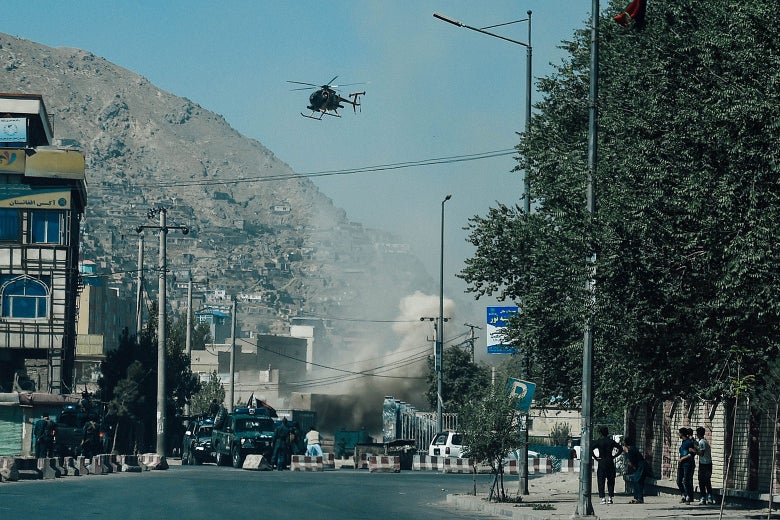
recruiting young men and women who weren’t yet born when the invasion of Afghanistan took place.
The war has been going on for 17 years now (17-year-olds can enlist with parental consent), making it the longest war in American history. Yet we are no closer than we have ever been to accomplishing our objectives, in part because those objectives have been so sketchily, inconsistently, and unrealistically defined.
In fact, the Taliban is gaining strength; other jihadist groups, including ISIS and a revivified al-Qaida, are joining the fight (against the Afghan government, Western forces, and the Taliban); the Afghan Army is suffering casualties at an alarming rate; the chaos is spiraling to unsustainable levels.
Just Thursday, a gunman wearing an Afghan Army uniform opened fire at a security meeting in a government compound, killing two top provincial governors, wounding three U.S. officers, and just missing the U.S. commander in Afghanistan, Gen. Austin “Scott” Miller, who was the apparent target of the attack.
There is no road to victory in sight. And there probably never was one.
It is worth recalling how we got to this point. One month after the terrorist attacks of Sept. 11, 2001, a combination of CIA commandos, U.S. special forces, and Afghan guerrillas—backed by brand-new smart bombs—overthrew the Taliban government, which had given sanctuary to Osama Bin Laden and his al-Qaida terrorist group. That December, at a conference in Bonn, Germany, Western leaders installed Hamid Karzai, an Afghan who had spent years in exile, as the interim leader of a Western-style centralized government in Kabul.That may have been the original sin in our policy. Afghanistan—a mountainous, sparsely populated, largely illiterate country, where power has long resided with local or regional tribesmen or warlords—seems inherently ill-suited for that form of government.The second, and ultimately larger sin occurred shortly after the Taliban’s ouster, when President George W. Bush and Secretary of Defense Donald Rumsfeld declared that the war was won and done—and refocused their attention, and resources, on the impending invasion of Iraq.
As it turned out, Taliban and al-Qaida forces hadn’t quite left the premises. Meanwhile, the Karzai government had a predictably hard time securing its hold and providing basic services. The loyalty of the people was up for grabs, as were large chunks of territory, and the Islamist militias contested them.
In 2006, the U.S. turned over its ever-dwindling military operation to NATO—whose leaders were looking to take on a new kind of mission in the post–Cold War era and thought Afghanistan might be a testing ground. These allies thought they were signing up as “peacekeepers.” Yet when they sent their troops out on patrol, the Taliban came out to fight. Suddenly, each country in the coalition insisted on “waivers,” dozens of them, all told. One country would send air support but not ground troops, another would fight on the defense but not the offense—resulting in a fragmented, feckless command structure. A small contingent of U.S. forces, fighting al-Qaida militias on the eastern border with Pakistan, stayed independent of NATO and killed lots of terrorists, but this had little effect on the shape and security of Afghanistan.During the 2008 presidential campaign, Barack Obama depicted Iraq as the bad war and Afghanistan as the lamentably ignored good war, and pledged to pull out of the former while doing more in the latter. In his first months in office, he held 10 meetings with his National Security Council to decide on an Afghan war policy. Critics accused him of indecisiveness, but a bigger factor was bureaucratic incoherence. At one meeting, an official suggested that the U.S. support effective provincial governors rather than the central apparatus in Kabul. Obama asked which provinces could best use the support. No one knew, so he scheduled another meeting and told the officials to find out the answer by then.
The big debate in those meetings was between those who argued that we should merely supply and train the Afghan Army, using U.S. forces only to fight al-Qaida terrorists on the Pakistan border, and those who argued that we should wage an intense counterinsurgency campaign. COIN (as the term was abbreviated) would require a larger U.S. military presence and a huge aid-and-advisory effort to help Karzai run an effective government. The idea was to win the hearts and minds of the Afghan people by providing them with security and services. Then, support for the Taliban would melt away.
All of Obama’s military advisers recommended a COIN strategy, which they estimated would require an additional 40,000 U.S. troops. Vice President Joe Biden and Secretary of Defense Robert Gates were the main advocates of the limited approach, which would take only 10,000 more troops. Then Gates changed his mind, persuaded by the COIN side’s arguments, and the debate was over.
However, in a final meeting in December 2009, just with Gates and the top officers, Obama asked whether they were confident that, with the COIN strategy and the extra troops, they could help the Afghan Army control more than half the provinces within 18 months. If you’re not confident, he said, I’ll go with Biden’s approach. If you are confident, keep in mind, this is all you’re going to get. If the experiment doesn’t work after 18 months, I’ll stop the strategy and withdraw the surge troops. Everyone present said they were confident—though, in fact, most of them were not. Historically, COIN campaigns take years to achieve their goals, if they work at all, but the advisers figured that they’d at least make enough progress after 18 months to convince Obama to give them a few more brigades.
Exactly 18 months later, Obama announced that he was ending COIN and pulling out the surge troops. Publicly he said that he was doing so because they’d succeeded, citing the killing of Bin Laden in Pakistan (an operation that had no relation whatsoever to the COIN campaign in Afghanistan). But his advisers knew—and were shocked—that he was merely making good on his promise: He wasn’t giving them the few more brigades that they’d requested.
Obama reverted basically to the Biden plan. Shortly before leaving office, he decided to keep 8,000 troops in Afghanistan, as a counterterrorism force for the region, without any illusions that it would help build Afghanistan itself into a more stable or prosperous country.Critics say Obama made a strategic error by publicly announcing when he planned to withdraw the surge troops; this put the Taliban on notice that they could simply wait out the United States, then step up the fight after we’d gone. Theoretically, the critics had a point. But in fact, the Taliban put up a very fierce fight during those 18 months; they showed no sign of hanging back.By contrast, President Donald Trump announced in August 2017 that he was sending a few thousand more troops to Afghanistan and imposed no timetable for their withdrawal; they might stay there forever. This has had no effect on the Taliban’s behavior either.It is likely that no U.S. military campaign—whether based on COIN, counterterrorism, or some other principle—would have much chance of success, and this has been clear for nearly a decade. Early on in the Obama phase of the war, Adm. Mike Mullen, chairman of the Joint Chiefs of Staff, told the Senate Armed Services Committee that the main obstacle was “clearly the lack of legitimacy of the government.” Sen. Lindsey Graham asked, “We could send a million troops and that wouldn’t restore legitimacy in the government?” Mullen answered, “That is correct.”
Corruption has long been endemic in Afghanistan. The centralized government, with presidentially appointed governors relying on bribery and patronage, intensified the problem. The flood of money swooshing around the country in the form of U.S. aid—billions of dollars, worth more than Afghanistan’s GDP—only exacerbated the problem. In some cases, ineffectual governors paid the Taliban not to attack their provinces—meaning U.S. aid was subsidizing the Taliban.
Mullen and Gen. David Petraeus, when he was a commander of U.S. forces in Afghanistan, frequently said that the war could not be won by military force alone, that there would have to be a political settlement. They also argued that the U.S., NATO, and Afghan forces needed to rack up a series of tactical successes, in order to negotiate from a “position of strength.” The problem was that these big successes were never achieved, nor were any preparations made for peace talks, in the event of some moment of dominance.
The main problem was that the U.S. officers and officials running Afghan policy didn’t know much about Afghanistan. On at least one occasion, they opened tentative peace talks with somebody claiming to be a Taliban leader who wasn’t one at all. They launched drone strikes on native Afghan Taliban militias, who were fighting for myriad motives, making no distinction between them and foreign jihadists—much less exploring ways to drive a wedge between the factions.During the height of the COIN period, they tried to help the Afghan government provide basic services to the population. But David Kilcullen, a former infantry soldier and COIN scholar who advised U.S. commanders in Afghanistan, says they would have done better helping provide justice. In areas where they are in control, the Taliban has set up its own courts, highway checkpoints, and recruitment centers—all of which, Kilcullen says, are viewed by local people as fairer and less corrupt than those operated by the Afghan government.When Trump came into office, he was inclined to pull the remaining 8,000 U.S. troops out of Afghanistan. He wound up adding another 5,000 (though without announcing the precise number). His national security adviser, H.R. McMaster, helped clinch the deal by showing him a photo from the 1970s of some women in Kabul wearing miniskirts—as if that proved Afghanistan could once again be a normal country. Secretary of Defense James Mattis also briefed him on what he depicted as a “new strategy”—pounding the enemy, relaxing the rules of engagement, and integrating diplomatic, economic, and military power to achieve victory—when, in fact, this was nothing new and certain key terms, for instance victory, were left undefined. More than a year after his escalation, nothing in Afghanistan has changed, except that the Afghan Army is shredding and the deaths are on the rise. Bob Woodward’s book, Fear, quotes Trump telling aides that he should have stuck to his instincts—though he hasn’t since acted on his regrets either.So, what to do? Most analysts, on all sides of the issue, agree that simply pulling out would spark disaster—anarchy, civil war, the return of a terrorist regime, the strengthening of ISIS—in a region of nuclear powers and great instability already.
A negotiated settlement is the only way out. The Taliban seem disinclined to negotiate at the moment, since they’re winning on the battlefield. But they might be lured to peace talks if the reward were sufficiently enticing, and the only reward that might bring them is the prospect of a U.S. withdrawal—though not an unconditional withdrawal. Afghanistan is a nexus of international interests and intrigue. China, Russia, Iran, and Pakistan all have geopolitical and economic interests in its future. America’s relations with all four countries are dismal at the moment; yet, we depend on at least one of them at any given time for basing and overflight rights to supply our troops there—which means it isn’t entirely out of the question to work with at least two or three to contrive a peace.
China, which has investments in Afghan copper mines, has offered to help train troops to fight off jihadists, if just to protect its mercantilist interests. So has, to a lesser extent, Russia. Washington has resisted on both counts, not wanting to share the territory. This is shortsighted. China, Russia, Iran, and Pakistan all have their reasons to oppose a jihadist-controlled Afghanistan, and—whatever our other issues—we should form an international conference, perhaps mediated by a U.N. agency or some other neutral power, on Afghanistan’s final status. This would have to be done with Pashtun, Tajik, and other ethnic factions, as well as with elements of the Taliban—which, unlike al-Qaida and ISIS, is made up of local Afghans. (If we were to look at Afghanistan with fresh eyes, as if the past 17 years hadn’t taken place, we might well view the Taliban—preferably a Taliban embedded in a multiethnic Afghan political order—as an ally of convenience in the fight against ISIS.)
Timetables would have to be set, with benchmarks and step-by-step measures of Western military withdrawal and internal political settlement. If we get closed out of mineral rights, if the process ends up strengthening the bonds among Russia, China, and Iran, well, so be it. Afghanistan isn’t likely to settle into a land of harmony for many years. Let someone else take up the burden.

U.S. general wounded in attack in Afghanistan


By Dan Lamothe

A U.S. general was wounded in an attack last week in Afghanistan’s Kandahar province that killed two senior Afghan provincial officials and targeted a group that included the senior U.S. commander in the country, four people with knowledge of the assault said.
Army Brig. Gen. Jeffrey Smiley is recovering after suffering at least one gunshot wound inside the Kandahar governor’s compound, three of the people said. They spoke on the condition of anonymity because of the sensitivity of the issue. U.S. military officials in Afghanistan and at the Pentagon have declined to comment on the attack or identify the wounded, describing them only as an American service member, an American civilian and a contractor who is part of the military coalition.
“We’re not going to talk about the wounded,” said Army Col. David Butler, the top military spokesman in Afghanistan.
After this story was initially published by The Washington Post, Butler confirmed on Twitter that Smiley was wounded.
The attack caught the U.S. military by surprise. General officers are rarely in situations where they face attack, and even more rarely wounded.
Among those present during the attack was Army Gen. Austin “Scott” Miller, the top U.S. officer in Afghanistan. Butler has said that the U.S. officials present were caught in the crossfire after a gunman started shooting. The Taliban asserted responsibility for the attack and said Miller was among the main targets.
Smiley has served in the Army for just over 30 years and became a general in May 2017, according to an official biography. He deployed in Afghanistan this summer, taking command of a unit with headquarters in Kandahar known as Train, Advise, Assist and Command-South. The headquarters is largely composed of members of the 40th Infantry Division, a unit of the California Army National Guard. Smiley has commanded Guard units in California for years.
The Afghan officials killed include Kandahar’s top police general, Abdul Raziq, a powerful but controversial security official who had survived numerous assassination attempts. He had risen to power while clearing the Taliban from Kandahar but was accused of extrajudicial killings, torture and other human rights abuses. He denied the allegations.
Also killed was Kandahar’s intelligence chief, Abdul Momin. The governor, Zalmai Wessa, was shot but survived.
The attack prompted the Afghan government to postpone voting in Kandahar for parliamentary elections by a week. The elections were held Saturday across most of the country, with some Afghans waiting hours to vote.
“Today we proved together that we uphold democracy,” Afghan President Ashraf Ghani tweeted Saturday. “With casting our ballots without fear we honor the sacrifices of the fallen.”

Watchdogs Press Pakistan on Terror Financing


By Madeeha Anwar

A delegation from the Financial Action Task Force (FATF), a global financial watchdog monitoring terror financing and money laundering, has reportedly expressed dissatisfaction with what it called inadequate measures Pakistan has taken to curb terror financing and fix anti-money-laundering laws.
The nine-member delegation of the Asia Pacific Group (APG), an FATF entity that overlooks Asian countries, concluded its 12-day visit to Pakistan on Friday after meeting officials from the country’s ministries of finance and foreign affairs as well as the central bank to assess Pakistan’s progress and compliance with the FATF’s recommendations.
In its report presented to Pakistani authorities Friday, APG reportedly pointed to problems in the country’s legal system and urged Pakistan to address inadequacies in the supervision of nonprofit and charitable organizations.
The APG’s recent findings will also be submitted to the FATF’s main headquarters, which will evaluate Pakistan’s progress and decide whether the country should remain on the FATF’s gray list or be removed next year following measures taken by Pakistan to address the global watchdog’s concerns.
Pakistan was placed on the FATF’s gray list in June over its alleged failure to comply with the global watchdog’s guidelines to crack down on terror financing.
Islamabad was placed on the gray list before, in 2012, where it remained until 2015.
Effects on economy
Some economists in Pakistan fear that the country’s continued failure to satisfy the FATF’s demands could mean the country runs the risk of being moved from the gray list to the black list. They also fear such an action would undermine Pakistan’s fragile economy, which is facing a debt crisis.
“Pakistan’s economy right now is no doubt in a fragile state. Pakistan is seeking help from IMF and fighting to get out of the gray list. If Pakistan remains unsuccessful in satisfying the APG body, there could be consequences, and there are chances the country could be placed on the black list,” Muhammad Zubair Habib, a Karachi-based economist, told VOA.
Earlier this month, Pakistan sought financial assistance from the International Monetary Fund (IMF) to help address some of its economic challenges.
Banking system
Ayub Mehar, another Pakistani economist, told VOA he believes the real problem lies in Pakistan’s banking sector and its existing infrastructure, which has known loopholes that allow militant groups to launder money.
“The team specifically mentioned the flaws in our organized banking system, financial markets, investment in the stock market and the corporate sector. They have pointed towards the lack of enforcement mechanism against the money-laundering and terror-financing channels,” Mehar said.
“Pakistan’s banking system has improved immensely, and one cannot open an account without biometrics and certain verifications,” he said. “But it’s the old bank accounts of individuals and organizations that need to get verified, too, as they were opened before this new system.”
Existing laws
Some analysts, such as Waqar Masood, who once served as Pakistan’s secretary of finance, believe the problem is not a lack of new laws but rather enforcement of existing laws.
“The main problem is not the laws, but the forceful implementation of these existing laws. If Pakistan is serious to get out of the gray list, the country will have to ensure to forcefully implement the laws,” Masood told VOA.
Over the past year, Pakistan has passed new legislation to combat money laundering and terror financing in an effort to show that Islamabad is taking the FATF’s concerns seriously.
In June, the Securities and Exchange Commission of Pakistan (SECP), the country’s national financial body, introduced the Anti-Money Laundering and Countering Financing of Terrorism Regulations.
SECP also banned individuals and groups placed on terror watch lists by Pakistan and the U.N. Security Council from collecting funds.
The legislation allowed Pakistan to halt the operations of the U.N.- and U.S.-designated terror groups Jamaat-ud-Dawa (JuD) and Falah-e-Insaniat Foundation (FIF), both linked to Hafiz Saeed, who is a U.S.-designated global terrorist accused of orchestrating the 2008 Mumbai terror attacks that killed more than 160 people, including six Americans.
But many analysts accuse Pakistan of being selective in its attention to militants and their financial networks, alleging that Islamabad cracks down on militants that pose a threat to Pakistan while overlooking other groups that operate outside the country. Pakistan has denied such allegations.
Informal channels
Terror financing remains a big challenge in Pakistan. The terror groups allegedly continue to collect large sums of money in the name of religion and welfare for the poor.
The militant outfits also use foreign funding, drug trafficking, extortion from businesses and kidnapping for ransom as ways to generate wealth.
The terror groups also depend on the Hawala system, a parallel banking system, to launder their money, which according to some analysts is not adequately scrutinized by authorities.
“There is no doubt Pakistan has introduced substantial reforms in its banking sector over the past few years. The problem is not the banking system, but the other informal money channels the terror groups continue to use easily,” Pakistani economist Mehar said.

#Pakistan - #FATF - Need to respond to international concerns


  • Terrorists have to be deprived of financial support
No Pakistani administration likes the country to be put on the grey list of the Financial Action Task Force (FATF). But each one has stopped short of taking appropriate measures to stem money laundering and terror financing. Early this year a Pakistani delegation had apprised the FATF of steps Islamabad had taken in the desired direction. These were considered unsatisfactory and the country put on the list in June.
In July the National Security Committee (NSC) made a high-level political commitment to combating terrorism financing and approved the new action plan submitted by the government to FATF. In August, soon after being appointed finance minister, Asad Umar told the Senate that FATF had given Pakistan 15 months to comply with its requirements. The minister said the inter-governmental organisation had identified 27 deficiencies in Pakistan’s financial system, including currency smuggling, hawala and terror financing of proscribed organisations. He promised in the house that the government would be addressing all the objections raised not only to satisfy the international community but also because it was in Pakistan’s own interest to get rid of terrorism financing.
On Friday the delegation of the Asia-Pacific Group (APG), an arm of the FATF, made damaging observations about Pakistan’s performance vis-a-vis blocking the terrorist funding. It presented a long list of deficiencies .The APG concluded that with this pace Pakistan was unlikely to get out of the grey list.
During the last few years confidence has grown among certain quarters that they can turn a blind eye to the activities of certain “banned groups” as they receive donations and continue violent activities under different names. Some of these groups are even being mainstreamed to provide them political legitimacy. The false sense of immunity should have been shattered after close allies China and Saudi Arabia sided with FATF members who voted to grey list Pakistan. Keeping the eyes closed to ground realities will further isolate the country and might even bring international sanctions. This will be against the interests of the common people who want peace and stability in Pakistan and friendly relations with the countries in the region.

#ByElection2018 - #Pakistan - #PK71 - #PTI loses #Peshawar seat to #ANP

The ruling Pakistan Tehreek-e-Insaf (PTI) has lost the PK-71 seat to Awami National Party (ANP) in Peshawar.
ANP’s Salahuddin won the by-election, securing 11,257 votes with his rival candidate from PTI, Zulfiqar Khan managing to bag 9,854 votes. Independent candidate Dildar Khan came third with 5,409 votes, according to unofficial results.
The Election Commission of Pakistan (ECP) had announced by-elections on the Peshawar seat after The Pakistan Tehreek-e-Insaf’s (PTI) Shah Farman assumed charge as Khyber-Pakhtunkhwa governor.
PK-71 (Peshawar VI)
A total of five candidates were contesting for the slot, however a close contest is expected between Awami National Party’s (ANP) Salahuddin Mohmand and PTI’s Zulfiqar Ali – the brother of Shah Farman.
The ANP candidate was being supported by an alliance of different political parties, including Pakistan Muslim League – Nawaz (PML-N), PPP and Mutahhida Majlis-e-Amal (MMA).
A total of 86 polling stations have been established across the constituency, where 133,451 voters – 79,836 men and 53,615 women – will cast their votes.
https://tribune.com.pk/story/1830608/1-elections-polling-underway-karachi-peshawar/

#ByElection2018 - #Pakistan by-election results: The writing is on the wall for Imran Khan


PTI's lead is eclipsed by losing crucial seats and more importantly the Punjab assembly to its arch rival, PML-N.

Pakistan’s ruling party Pakistan Tehrik-e-Insaaf (PTI) is not taking the by-election results from October 14 well, despite the bravado witnessed over maintaining a lead over the opposition. Yet, this very lead of the PTI is eclipsed by losing crucial seats in the National assembly and more importantly the Punjab assembly to its arch rival, the Pakistan Muslim League Nawaz (PML-N). Analysing the results Let’s talk numbers before delving into the implications of this crucial poll – that for the first time had overseas Pakistanis casting their ballot online. There were 11 national assembly (NA) seats and 24 provincial assembly seats – of which 11 were Punjab’s – that had been vacated. PTI lost seats in the NA while the PML-N, in fact, made gains both at the centre and in the Punjab provincial assembly.
The current political standing of PML-N is thus; the president of PML- N and former chief minister Shahbaz Sharif is in jail while his brother and former Prime Minister Nawaz Sharif faces an uncertain future.
Out on bail, he awaits judicial enquiry and trial over his alleged unexplained wealth divulged by the Panama leak. However, the party’s lowest point had been not so much the trials of the party bigwigs being charged for corruption and misuse of power, but of losing Punjab to PTI. Despite numbers, it failed to cobble together a government in the province, its seat of power following the general election in July this year. For the PML-N this might have sounded a death knell.

"Get Punjab, get control"

There is a saying in Pakistan, familiar to those who are well versed with the murky politics here, that – get Punjab and you get control. Strange as it might sound, history has proven that an opposition government in Punjab is any premier’s nightmare.

Hence, for any political party it is crucial to have one’s government in Punjab for its survival at the centre, or less dramatically, for it to function smoothly."

Flashback to the late Benazir Bhutto’s tenure as prime minister and the constant headache and political manoeuvring engineered by the Sharifs in Punjab. Punjab was their fiefdom and remained so for the past many decades, with the exception of losing ground in Musharraf’s tenure.

If we look at the July 2018 scenario, we find the Sharifs traumatised and shaken by the corruption allegations, breakaway dissidents, lack of leadership or direction and the alleged power tussles within the party preceding the elections.
Not to forget the widespread allegations of electoral rigging in July not just by the PML-N but the PPP and other parties. Consequently, the PML-N lost ground to PTI. Losing Punjab despite having adequate numbers in the Punjab assembly because of aggressive PTI hustling and cobbling together a coalition, an effort Machiavelli would have been proud of, served a bigger humiliation for the Sharifs’. Punjab, it seemed was done and dusted with.

PML-N looking for a lifeline

Thus, any victory, however small in the by-election would be a lifeline at this point. Especially, if there is any chance of regaining Punjab. This is a real possibility as PML-N gains numbers in the assembly and, if, the party displays acumen and political dexterity in fanning dissent, in the form of disgruntled members already sniffing around to unseat Punjab Chief Minister Usman Buzdar. PML-N could succeed in clawing its way up again.
Even if such a possibility does not materialise, it could recoup and form a formidable opposition to Buzdar’s government in the province. Shahbaz’s untimely arrest before the by-election also induced sympathy for the PML-N in Punjab and went in its favour in the by-polls.
The Information Minister Fawad Chaudhry’s justification behind PTI’s loss to PML-N in the by-election because of premier Imran Khan’s inability to canvass should serve a reminder to PTI for its political future. For, Chaudhry spells out what many believe, that the PTI is a personality-led Khan show. Many would argue the same for PML-N and PPP – that has never been able to muster the strength and national vote bank after the loss of Benazir Bhutto.
In Pakistan, personality driven politics and dynastic rule still rules the roost despite the changes evident in the political system brought about by social media driven campaigns, growing awareness among the lower income groups, and defeat of many political heirs in the last election.  The political system cannot be simply relegated to neat compartmentalisation. The very same commanding personalities are fallible and their success subjective to several intermeshed dynamics. Pakistan’s powerful military for one.
It is also hard to ignore the alleged rigging of July blamed on the army despite the rejoinders issued by the Inter Services Public Relations Pakistan [ISPR].  The by-election is being hailed as vindication of the alleged rigging charges by the opposition that has now re-emerged in strength. However, if PTI numbers were boosted by help from other ‘sources’ in the general election why was it not thus helped in the by-polls?
It could be that those ‘sources’ believed that a clean sweep was necessary to break the PML-N and ensure a majority PTI government in July but once the PTI was in place it would be able to secure the few seats being contested in the by-polls. The other objective of the July polls might have been to ‘help’ a compliant Khan desperate for power after a long arduous struggle and to once and for all cripple the old guard. This does not mean that PTI lacked any strength or that the public were not desirous of a change of political leadership among the people. But the way the electoral process was conducted in July was dubious to say the least.
And, as Chaudhry also noted in the case of Khan, personality led politics is a strong factor. The same goes for PML-N and PPP now being steadily reinvigorated after years by Bilawal Bhutto.

Power play in Pakistan is all about balance

Any political savvy knows how crucial it is to maintain good ties with the military, the most powerful institution in the country. Despite the outward adherence to democratic norms, the balance of power between the executive, the judiciary and the military has been fragile and tricky. All three need to be on board for formation of foreign policy, defence, governance and law and order. A head of state that knows how to balance this would be ideal, the problem is that power injects wilfulness and defiance. And thus, the circus begins.
Khan’s egoism and zero tolerance for advice leave alone diktat is legendary. Instead of baring fangs at opponents, PTI should focus on the economy and governance. Blaming past government policies while crying hoarse about its magic economy revival plan this past year has not helped either.
For now, the PTI should draw a lesson from its own victory and consequent defeat for its constituency is derived on idealism and promises of deliverance. 
https://gulfnews.com/news/asia/pakistan/pakistan-by-election-results-the-writing-is-on-the-wall-for-imran-khan-1.2290292

Video - Former President of Pakistan and President PPPP Asif Ali Zardari addresses a Press Conference

#Pakistan - Govt has no economic policy besides raising prices, says Bilawal

Pakistan Peoples Party Chairman Bilawal Bhutto on Saturday said that the government has no real economic policy other than hiking prices.

In a statement, Bilawal said the government seems to have no particular direction to which to take the economy and criticised them taking the biggest loan from IMF despite making tall claims against it.
He added that PPP also saw serious economic issues in its tenure but never burdened the poor with increased prices.
“It is clear that those who brought prime minister-select [to the office] brought him without any preparation,” Bilawal said.
Imran Khan’s Naya Pakistan has become a nightmare for the poor, the PPP chairman added.
Finance Minister Asad Umar early today spoke about Pakistan approaching the International Monetary Fund (IMF) and said this would be the last time the country seeks a bailout from the lender.
http://www.thesindhtimes.com/pak/govt-no-economic-policy-besides-raising-prices-says-bilawal/

India-Pakistan Relationship Held Hostage By Many Structural Impediments – OpEd


By Samir Saran
It will take a very prolonged series of successful trust building before more sensitive issues like Kashmir are even discussed with any credibility.
ndia and Pakistan made some significant overtures since the formation of new government in Islamabad, which rekindled hopes of peaceniks in both the countries. But the parleys proved short-lived. The battle lines are drawn again as accusations and counter-accusations fly thick and fast. This week, the foreign ministers of the two countries took their war of words to the UN General Assembly.
The following is an interview of Samir Saran with the Tehran Times.

The formation of a new government in Islamabad had rekindled hopes of peace and reconciliation between India and Pakistan, after the two sides made a series of overtures and looked interested in opening a new chapter in their bilateral ties. But, now it has again been put on the backburner. What makes this relationship so fragile?
The relationship remains fragile for structural reasons. Issues of identity and a shared sense of historical animosity have hardcoded themselves into both countries’ politics. And in today’s polarised media environment, opinions on these issues are sharper and more amplified than ever before. These factors make any true reconciliation very difficult.
Imran Khan in his victory speech said he will take two steps if India took one. And Narendra Modi had called to congratulate him on his thumping victory in Pakistan general elections. Do you think the two leaders were really sincere in improving bilateral ties?
No, it is unlikely that they were. This welcoming rhetoric is often visible when new administrations take office, but rarely lasts very long for the reasons outlined in my first response.
Everything seemed to be going as per the script until India called off foreign minister level talks on the side lines of UNGA, citing killing of policemen in Kashmir and release of stamps in Pakistan commemorating a Kashmiri militant commander. Do you think there are shadowy forces working overtime to sabotage peace process?
The Pakistani Army remains a key interlocutor in Pakistan-India relations. Their overwhelming control over most aspects of Pakistan’s political and social life is built on a hardline Islamic identity and hostility towards India. Prospects of peace with India always threaten these realities — and the Army has often attempted to sabotage any attempts at constructive outreach.
Some experts opine that PM Modi decided to call off talks since he doesn’t wish to antagonise his loyal Hindu vote bank in India ahead of next year’s general election. What is your take on it?
Talks with Pakistan are always politically sensitive in India — irrespective of which party is in power. Having said that, no administration has ever hesitated to take this risk if real and constructive outcomes were on the horizon. At this time, it is evident that there was no such possibility — and any administration in India would have rather called off talks.
Pakistan’s foreign minister Shah Mehmood Qureshi speaking at the UN accused India of “financing, facilitating and orchestrating terrorism in Pakistan,” citing the case of Kulbushan Yadav, who he called “Indian state-sponsored terrorist.” How would you react to that?
This is not new rhetoric in Pakistan, nor will it be the last time it is used. It is merely a very weak attempt to delegitimise India’s credible complaints over the extent to which terrorism has been mainstreamed in Pakistan.
The crossborder shelling and ceasefire violations continue unabated. In recent years, the violations of the ceasefire accord the two countries signed in 2003 have assumed alarming proportions. What according to you is the most important trigger for it?
Unlike 2003, the global order today is far more strained and uncertain. With Pakistan now being bankrolled by the Chinese and India preparing to take on a global leadership role, both countries are likely more confident in their strategic capability to gain the upper hand against the other.
The civil society and think tanks in both the countries, including yours, are very strong and they have been relentlessly campaigning for peace and dialogue between the two countries. Do you think the strong political will is missing to resolve outstanding issues including Kashmir?
Political will is certainly important. As I have said earlier, however, the India-Pakistan relationship is held hostage by many structural impediments. It will take a very prolonged series of successful trust building before more sensitive issues like Kashmir are even discussed with any credibility.
Russian President Vladmir Putin visited India this week for 19th India-Russia summit. How do you view prospects of India-Russia defense cooperation taking into account US sanctions?
Russia is, and will remain in the foreseeable future, India’s primary defense partner. And American sanctions are unlikely to change India’s choices. In fact, India is likely to make a strong case for exceptions from Washington’s sanctions even as it continues security cooperation with Moscow.
India is yet to take the final decision on oil trade with Iran, although reports suggest that New Delhi will seek waivers from US to continue importing oil from Tehran. Why is there so much suspense and delay?
India will continue to expand its energy and development cooperation with Tehran. Unfortunately, however, Indian firms and businesses are quite dependent on the American financial system. Therefore, while the political rhetoric makes clear that India will pursue its independent strategic interests, commercial realities are often difficult to overcome.

Praying for Pakistan - Extremism and Corruption in a Troubled State


By Mohammed Hanif
Around a dozen years ago, during a visit to my ancestral village in Pakistan, I joined my brother for Friday prayers at the local mosque. At the time, the country’s military dictator, President Pervez Musharraf, was busy explaining to Pakistanis that they were in the middle of a do-or-die battle against militants—although it seemed that, for ordinary people, this mostly involved dying. People all over the country were wary of prayer leaders preaching about jihad or creating pretexts for others to wage it.
My brother, who runs a business in a fruit and vegetable market, served on a committee of mosque leaders that had recently hired a new imam. Before offering him the job, the committee had checked him out to make sure he was not a radical. “The new imam is not a troublemaker,” my brother assured me. “Times are bad, and what goes on in the mosque affects people’s minds, so we wanted to be sure.”
That day, the imam’s sermon was suitably vague: health and wealth for everyone, sweet words about the ummah (the global community of Muslims), and no calls to arms or support for holy wars. The imam did take a jab or two at those who preached “enlightened moderation”—a meaningless label that Musharraf had apparently picked up during his numerous visits to think tanks in the United States and that he had begun using to describe the ideological direction of his dictatorship. Musharraf was at the height of his double game: allowing the United States to use Pakistani military bases to bomb the Afghan Taliban while signing peace deals with the Pakistani Taliban. The new imam might have been a moderate by my brother’s standards, but he had no appetite for Musharraf’s brand of enlightenment. I wondered if this imam could help stem the tide of radicalism or whether he was part of it.
I found my answer around midnight, when a loudspeaker attached to the mosque’s exterior came alive with the sound of the imam performing a long recitation from the Koran and exhorting people to perform their midnight prayer. The speaker was remarkably loud; the house where I was staying was a few hundred meters from the mosque, but the imam seemed to be shouting directly into my ears. It is not traditional for an imam to call people to the midnight prayer. Performing it is completely voluntary; one is not even supposed to go to the mosque for it. In Pakistan, most people seem to not even know that such a prayer exists. The imam, it seemed, was a moderate by day but a zealot at night.
“Why make such a big deal of your personal piety?” my brother’s wife, a homemaker, groused in the morning. “What kind of imam have you hired? He doesn’t let us sleep at night.” My brother mumbled that he would bring it up at the next committee meeting. It was clear that he wasn’t quite sure how to stop a man of faith from reminding the faithful of their duty to Allah—even if it was the middle of the night, and even if they had no such duty.
My brother is one of many Pakistani Muslims who believe that a revolution akin to the one that transformed Iran in 1979 is the only solution to the country’s problems. (Although they hope for a revolution like Iran’s, which was led by Shiite clerics, they also suspect that Shiites are not good enough Muslims—and they don’t really see any contradiction there.) By Western standards, he acts like a radical; by a radical’s standards, he acts like a moderate. In this, he is like many other Pakistanis, who go about making a living and raising families, only to find themselves accused of being not good enough Muslims whenever they pause to pray in the company of more pious people. Most Muslims are encouraged to think of themselves as sinners; when confronted about the quality of their faith, they promise to strive to be better Muslims. This is the original meaning of “jihad”—a struggle to better oneself, to get over the baser urges, to become a better Muslim. Of course, according to extremists, no one is a better Muslim than the one who lays down his life for Allah.
This tension between the urge to be a better Muslim in this world and the wish to take a short cut to paradise has riven Pakistani society for decades, and it’s what makes the country a subject of such fascination for scholars and social scientists. Books about Pakistan by Western and Pakistani experts alike tend to focus on religion and radicalism. They are often suffused with a sense of alarm and danger, as many of their titles or subtitles demonstrate: Can Pakistan Survive? Pakistan: A Hard Country. The Scorpion’s Tail. Deep Inside the World’s Most Frightening State. Courting the Abyss. Eye of the Storm.
With its title, Madiha Afzal’s Pakistan Under Siege follows in this tradition. But compared with what is found in other recent books on the country, her analysis is mild, even matter of fact. Afzal’s multi-layered approach to explaining Pakistan makes it sound like a normal country—almost. The book details the rise of religious extremism and explains how the state has been both complicit in extremist violence and victimized by it. Afzal, a young Pakistani economist, examines the evolution of legal and educational institutions in the country and relates how they have fostered a hatred for ethnic and religious minorities and a general antipathy toward the West. The book delves into the Pakistani army’s efforts to create a “good Taliban” to counter the “bad Taliban” and emphasizes the ways in which civilian officials have been kept out of the decision-making process behind such policies. “There is doubt that the civilians are up to the task of handling security policy,” she writes. “But it is also clear that the military is not ready to let it go.”
In August, the former cricket star Imran Khan led the political party he founded to victory in national elections and became prime minister. Throughout the campaign, Khan seemed to enjoy the tacit backing of the military establishment. Many analysts believe that with the army and the civilian political leadership finally on the same page, Khan has a historic opportunity to slowly wrest away the military’s control of foreign policy and national security. Those analysts may be expecting too much from Khan—and, moreover, they have things backward. In fact, it is the military that has a historic opportunity: to finally learn to live with the aspirations of its civilian partners and acknowledge that the army cannot be the sole arbiter of the country’s fate. The army, however, seems unlikely to do so. Afzal’s book offers a useful survey of the many pressures—cultural, religious, economic—that add to social and political instability in Pakistan. One of the ironies that emerges is that although commentators have long focused on the intersection of extremism and poverty in the country, the combination of extremism and growing prosperity may prove even more dangerous.
ZIA'S LEGACY
Pakistanis’ attitude toward extremism changes frequently and depends to a great degree on context. When Pakistan itself is not under attack, Pakistanis take a fairly benign view of militants. But if the same militants start blowing themselves up near Pakistan’s mosques or shops, many Pakistanis’ first reaction is to think, “These can’t really be my brothers in faith.”
The question of foreign intervention in the country scrambles things even further. Afzal shares the results of a survey conducted in 2009 by the Program on International Policy Attitudes in Pakistan, in which 90 percent of respondents expressed opposition to the presence of al Qaeda in Pakistan and neighboring Afghanistan. On the other hand, she reports, a different survey conducted around the same time found that 63 percent of Pakistanis opposed the 2011 U.S. raid in Abbottabad that killed Osama bin Laden. Pakistanis don’t want violent jihadists in their backyards, but they also do not want American assassins stealing into their country in the middle of the night.
Afzal rightly assigns much of the blame for Pakistan’s confusing relationship with extremism to Muhammad Zia-ul-Haq, the military dictator who ruled the country from 1978 until his death in 1988. Zia sought to “Islamize” society by establishing and enforcing his version of sharia, bolstering religious education, and preventing Pakistanis from accessing Western cultural products. To accomplish this goal, he made a mockery of Pakistani democracy. In 1984, he held a referendum in which Pakistani voters were asked whether they supported the imposition of an Islamic system and another five-year term in office for Zia himself. The only acceptable answers were yes and no. Since it would have been almost unthinkable for anyone to vote “against Islam,” it was practically impossible for anyone to vote against Zia. Many voters abstained altogether; some cities looked like ghost towns on polling day. On top of that, Zia’s cronies stuffed ballot boxes, awarding him and his initiative more than 98 percent of the votes.
Zia’s successors curtailed some aspects of his Islamization program, but much of it remains in place, as Afzal reveals. Authorities frequently invoke discriminatory laws against minorities. Charges of blasphemy have led to the imprisonment of hundreds, and sometimes lynch mobs have killed the accused. Members of the Ahmadiyya sect were declared non-Muslims by Pakistan’s parliament in 1974, and they remain one of the most persecuted minority groups. (To apply for a passport or a national identity card, Pakistani Muslims must sign the following statement: “I consider Mirza Ghulam Ahmad”—the founder of the sect—“to be an imposter prophet [and] also consider his followers . . . to be non-Muslims.”)
One can also still see Zia’s legacy in Pakistan’s educational system, which teaches children a number of astounding lies about their country’s history and place in the world. According to Afzal, history textbooks borrow language and concepts about the relationship between Islam and politics from Jamaat-e-Islami, the oldest Islamist political party in Pakistan. In examining Pakistan’s schools, Afzal usefully debunks the common myth that madrasahs are central to jihadist movements. In reality, it is the country’s mainstream educational system that fosters militancy.
MOSQUES AND MONEY
Afzal also sheds light on how economic change has fueled religiosity and extremism in Pakistan. In recent decades, Pakistan’s middle class has grown substantially. According to the Pakistani economist S. Akbar Zaidi, Pakistan’s upper- and middle-class population now stands at 84 million—larger than the entire population of Germany. Most political scientists or economists would expect newly prosperous Pakistanis to become more secular in their outlook and behavior. But middle-class Pakistanis often spend their newfound wealth not on material comforts but on things they believe will ensure their safe passage to paradise after they leave this world. They go on luxury pilgrimages to Mecca, donate to Islamic charities, and fund the construction of new mosques. (They really love building mosques: throughout Pakistan, one can find freshly minted houses of worship with marble floors and minarets decorated with elaborate mirror work, even in places that lack sewage systems and paved roads.)
A few years ago, a man who was a classmate of mine in high school opened a gas station in central Punjab. He proudly showed me a tastefully designed mosque that he’d built on the premises, to offer his customers a place to pray. A few years later, he built another gas station—and another mosque—on the same piece of property. When I visited, I noticed that the first mosque was mostly empty. “Why another mosque in the same spot?” I asked him. “Because if God has given me two businesses instead of one, why shouldn’t I pay him back?” he replied.
Afzal also focuses on Pakistan’s military, which she correctly identifies as the most powerful institution in the country, even when civilians are in control of the government. The military has a strong hold on Pakistanis; it is widely feared but also widely respected. The generals have suffered losses and humiliations but have always managed to get back on their feet quickly. In 2010, the entire world was looking for bin Laden. When he was found living a stone’s throw away from a major Pakistani military academy, the generals more or less shrugged it off.
Whenever I interact with midranking army officials, they don’t want to discuss religion, regional security, or any of the other issues that Afzal analyzes. All they want to talk about is real estate prices. Thanks to the military’s vast holdings and deep participation in the Pakistani economy, military officials enjoy privileges unavailable to their counterparts in most other countries. The armed forces have recently added processing and selling meat to the already large portfolio of businesses in which they dabble, which also includes cereals, cement, banking, sugar, telecommunications, transport, and many other sectors.
In some countries, such profiteering might generate a popular backlash against the military. To prevent such an outcome in Pakistan, military officers have taken a cue from the civilian nouveaux riches, funneling some of their profits to religious charities and mosque-building projects. The idea that money can buy one a ticket to paradise is so well entrenched that most Pakistanis don’t even question the obvious corruption that has enriched the military elite. By publicly performing their piety and thus allowing judgments about religiosity to shape public debate, middle-class Pakistanis and the military have aided the cause of the extremist militants. By publicly performing their piety and thus allowing judgments about religiosity to shape public debate, middle-class Pakistanis and the military have aided the cause of the extremist militants who loathe them. Seven years ago, the governor of Punjab Province, Salman Taseer, was assassinated by his own bodyguard. Taseer was a liberal who lived a secular lifestyle and who had raised questions about Pakistan’s harsh law against blasphemy, which calls for the death penalty for offenders. Among many middle-class and educated Pakistanis, discussions of his assassination often began with the observation that murder can never be justified but then quickly shifted to cata-loging the many things that a “good Muslim” shouldn’t do in order to avoid Taseer’s fate: never speak up for minorities, for example, and never say anything that might offend a religious scholar. In May, as Pakistan prepared for national elections, a gunman attempted to kill the country’s interior minister, Ahsan Iqbal; he was shot in the arm but survived. As with the attack on Taseer, it appeared that Iqbal’s assailant was motivated by extremist views relating to the laws prohibiting blasphemy. But unlike Taseer, Iqbal is a highly observant Muslim; he comes from a conservative family known for its affiliation with Islamist movements. He is, by all prevailing standards, a pious man. For the man who tried to kill him, however, Iqbal wasn’t a good enough Muslim.
Pakistanis try hard to become better Muslims—and the country’s courts, media, and educational system work to ensure that they do. But every so often, someone comes along wielding a gun, telling them that they have been doing it all wrong. And unfortunately, they seem willing to listen.
EXPECTATIONS GAME
Recently, I returned to my family’s village and attended Friday prayers. The mosque was full of worshipers; others were lined up outside on the pavement. Since my last visit, the mosque had let go the imam who had called them to the midnight prayer and chosen a more moderate one. My brother found the new imam’s Friday sermons a bit dull and was contemplating inviting someone more lively to deliver an occasional sermon.
I mentioned to him that many more people turned up for prayer these days than when we were children. He agreed. Then he sighed and pointed out that, at the same time, there were now more petty crimes in the village and that people were stealing water and electricity from their neighbors and dragging one another to court over minor land disputes. “What I don’t understand is that when fewer people came to the mosque, there were hardly any crimes in the village,” he said. “People didn’t think they could commit fraud and get away with it in such a small place. But today, everyone’s lying, everyone’s cheating, everyone’s stealing, and they think by coming to the mosque, they have booked themselves a plot in paradise and they don’t need to fulfill their obligations in this world.”
When people come into a bit of money, their expectations rise. They also start craving respect and demanding that the state provide them with basic services. But the Pakistani state is still stuck in its old ways, relying on colonial-era laws and riddled with corrupt patronage networks. When the state inevitably fails to meet people’s raised expectations, they turn to religious parties and look for messiahs who can fix their broken world, as well as promise a shiny bridge to paradise in the afterlife.
I called my brother on election day and asked him if he had voted yet. He said that it was quite hot and that he was waiting for the weather to cool down a bit. “And who are you going to vote for?” I asked. He chuckled and said, “I am going to go out and find a good mullah on the ballot.”

Saturday, October 20, 2018

Video Report - 'I don't even know what the UN does': Nikki Naley admits lack or experience in leaked comments

Video Report - Jamal Elshayyal: Response to Khashoggi’s Death Will Determine Future of Saudi Arabia & Middle East

#Saudi Explanation of Jamal #Khashoggi’s Killing Fails to Squelch Skepticism


By David D. Kirkpatrick and Ben Hubbard


Saudi Arabia’s explanation on Saturday only added to the international uproar over the killing of dissident Jamal Khashoggi in Istanbul. President Trump appeared to step back from an earlier expression of confidence in this new description of events that Mr. Khashoggi was strangled after a fistfight — skeptics focused on apparent gaps in the narrative and Turkey threatened to undermine the already shaky Saudi account with its own rival investigation.
Doubters questioned why it took 18 days since Mr. Khashoggi disappeared in the Saudi Consulate in Istanbul for the royal court to admit knowledge of his fate — after insisting for two weeks that he had left the consulate freely after a brief visit. Nor did the Saudis explain why Mr. Khashoggi, a 60-year-old writer, sought to resist in a fight against multiple Saudi security agents.
Although the Saudis say that the mission in Turkey was carried out without the specific authorization or awareness of Crown Prince Mohammed bin Salman, 33, the emerging account failed to explain the apparent connections of at least four suspects to the prince’s security detail. The Saudis also offered no explanation for why a doctor specializing in autopsies was sent on the mission, rather than one who treats live patients or manages forensic evidence. But the most decisive blow to the credibility of the Saudi account could come from Turkey. Turkish officials say they have audio recordings and other evidence that could severely discredit the Saudi narrative and the crown prince by showing that the team executed a deliberate plan to assassinate and dismember Mr. Khashoggi inside the consulate.if the Turks do possess such evidence, disclosing it to the public or sharing it with Western intelligence services could do incalculable damage to the crown prince.The Saudis have said that the mission initially sought only to persuade Mr. Khashoggi to return to the kingdom. But Turkish officials, speaking on condition of anonymity, have called the participation of Dr. Salah al-Tubaigy, the autopsy specialist, evidence that the mission’s intent was always deadly.Citing audio recordings from inside the consulate, a Turkish official familiar with the investigation has said that Dr. Tubaigy dismembered the body with a bone saw — a standard instrument used in autopsies — that he had brought for that purpose. The Saudi official familiar with the investigation denied that the doctor had brought a bone saw, and he insisted that he was dispatched only to help erase evidence if necessary, not to help dispose of Mr. Khashoggi.
The Saudi consul’s residence in Istanbul. Saudi Arabia acknowledged Saturday that the journalist Jamal Khashoggi was killed inside its consulate. The doctor “was added to the team as a forensic expert,” the Saudi official said. “In case the team’s presence was revealed and the operation was compromised,” the official said, Dr. Tubaigy was expected to remove incriminating details like fingerprints. The Saudi official, however, offered no explanation for why the doctor was a specialist in autopsies rather than, say, in fingerprints or other evidence.The Saudis appear to be making a risky bet that they can persuade world leaders to accept their new narrative. The silencing of Mr. Khashoggi — a Washington Post columnist who had left the kingdom last year for voluntary exile in Virginia — has spurred an extraordinary international backlash against the kingdom and the crown prince, including from American lawmakers of both political parties.
The credibility of the new account could determine the continued willingness of Western leaders and business executives to work closely with Prince Mohammed, the de facto ruler under his aging father, King Salman. The prince has seized power in the kingdom more tightly than any king in at least half a century, and the Trump administration has embraced him as the central pillar of its Middle East strategy — from containing Iranian influence to reaching a peace deal between Israel and the Palestinians. King Salman only reinforced his support for the crown prince, his favorite son, on Saturday. Instead of checking his authority in the wake of the scandal, the king put Prince Mohammed in change of an overhaul of Saudi intelligence services, implicitly assigning him to correct whatever errors led to the killing. President Trump on Saturday said he expected to speak soon with the Crown Prince and appeared to reconsider his previous expression of trust in the Saudi explanation.
“It’s possible” that Prince Mohammed was unaware of the operation, he said, but he added, “I’m not satisfied until we find the answer” to the question of Mr. Khashoggi’s fate. Meiko Mass, German foreign minister, said in a television interview that his government should no longer sell weapons to Saudi Arabia until the matter was resolved. “So long as investigations are underway, so long as we don’t know what happened there, there is no reason to take positive decisions on arms exports to Saudi Arabia,” he said.
Turkish President Recep Tayyip Erdogan, a personal friend of Mr. Khashoggi’s, has so far declined to publicly accuse the Saudis of killing him or to lay out any evidence to support that assertion. He has only allowed officials speaking anonymously to dole out selected leaks incriminating Saudi Arabia and pointing to responsibility at a senior level of the royal court. Saudi Arabia and Turkey are both regional powers, publicly allies but privately rivals. Skeptics have speculated that Mr. Erdogan may be seeking to avoid a full diplomatic rupture by reaching some accommodation with Saudi Arabia, or alternatively that he may merely be seeking to prolong the public uproar against the Saudi prince.
On Saturday, spokesmen for Mr. Erdogan signaled that he had rejected the Saudi account and that Turkey would continue to conduct its own investigation.
“We will not allow things to remain covered,” Omer Celik, a spokesman for Mr. Erdogan’s governing Justice and Development Party, said in a report by the semiofficial Anadolu news agency. “We will use all the opportunities that we have to reveal what happened, and this is the intention of our president.”
Numan Kurtulmuş, the party’s acting chairman and a member of Parliament, promised that “once the evidence is finalized, Turkey will not hesitate to share this with the rest of the world” and “we will not stop chasing after this gruesome, scary, horrible incident. We will not allow this to be covered up.”“I don’t think it will be possible for Saudi Arabia to wriggle out of this incident — if the crime becomes certain — by claiming that a certain person had committed the crime,” he added in remarks broadcast over Turkish media.The director of the Turkish Arab Media Association, who is close to Mr. Erdogan and had been a friend of Mr. Khashoggi’s, described the Saudi account as “far from reality” and urged the removal of the Saudi crown prince from power.
“This is not over. It’s just starting,” said the director, Turan Kislakci. “We want Jamal’s murderers to be punished,” he added, including “the authority that gave the orders.” “Give Jamal back to us,” Mr. Kislakci said, referring to the remains of Mr. Khashoggi. “Give him back so we can raise his funeral.”
In Washington, lawmakers of both parties complained that Saudi Arabia’s new narrative of the killing appeared inconsistent with the conclusions of American intelligence agencies, and some stepped up their calls for sanctions against the kingdom.
“#SaudiArabia’s changing stories on #KhashoggiMurder is getting old,” Senator Marco Rubio, a Florida Republican, wrote on Twitter.
Amid the skepticism, the Saudi government has sought to convey the impression of business as usual.
The Foreign Ministry tweeted a large photo of Prince Mohammed as the head of the high-level committee formed by the king to restructure the Saudi intelligence agency in the aftermath of Mr. Khashoggi’s killing. The kingdom’s allies around the region — including Egypt and most of the Persian Gulf monarchs — expressed strong support for Saudi Arabia’s self-investigation.
Saudi officials, meanwhile, sought to distance Prince Mohammed from any responsibility for the killing even as they singled out one of his closest advisers as the culprit, Gen. Ahmed al-Assiri, the deputy chief of intelligence.The Saudi official with knowledge of the royal court’s investigation said on Saturday that the kingdom’s intelligence agency had issued only a general order to retrieve dissidents in exile like Mr. Khashoggi, but had not specified the means of doing so. The Saudis’ internal investigation, the official said, had concluded that General Assiri, on his own, had put together a plan to bring back Mr. Khashoggi.Although the crown prince had not explicitly ordered an abduction or assassination, the official asserted, “as the order went down the chain of command, the vagueness and aggressiveness increased.” General Assiri and the team might have interpreted “return him to the kingdom” as instructions to kidnap Mr. Khashoggi, the official said.The team arrived in Istanbul on two private charter jets from a company close to the crown prince and the Interior Ministry, and the Saudi official offered no immediate explanation of how the planners of the mission obtained the use of planes.
But the official acknowledged that 15 Saudis arrived in Istanbul on Oct. 2 — the day Mr. Khashoggi disappeared inside the consulate — as the Turks have said. The official said that the team had initially sought to persuade Mr. Khashoggi to return home. “He didn’t want to have the discussion, so more or less he tried to leave the room,” the official said. The agents tried to stop him. An altercation ensued. Mr. Khashoggi started screaming, and one of the agents put him in a chokehold.
“That is how he died,” the official said. “It didn’t last that long.”
The official offered no explanation for why Mr. Khashoggi would try to resist when he was overpowered. The official also said that the Saudi authorities do not yet know what the agents did with the body. “They say they gave it to one of their local collaborators to dispose of,” the official said, though he declined to disclose whether that “collaborator” was Saudi, Turkish or of another nationality.
Turkish officials have said that Dr. Tubaigy, the autopsy specialist, moved quickly and matter-of-factly to cut up the body. He even put on headphones and suggested to the agents working with him that they listen to music as he did while they carried out the gruesome work, the officials say.The Saudi official said that the leaks from Turkish authorities had misidentified some of the 15 agents because of the spellings of their names or other details, but he did not disclose how many people were supposedly misidentified.One member of the team, Gen. Maher Mutreb, was selected for the mission specifically because he knew Mr. Khashoggi. General Mutreb, an intelligence officer, had worked with Mr. Khashoggi when both were stationed in the Saudi Embassy in London years ago, this person said.The participation of General Mutreb, however, may also undercut Saudi assertions that Prince Mohammed was unaware of the plan. An investigation by The New York Times revealed that General Mutreb has frequently traveled with the crown prince in his entourage. At least three other Saudis named as suspects by the Turks appear to have links to the crown prince as well.The Saudi official said the 15 agents had been divided into three teams: one for logistical support and transportation; one for counter-surveillance and operational security; and another for the execution of the operation. Another general in addition to General Mutreb was part of the team.The Saudis have announced 18 arrests in connection with the investigation, and the official said those arrests included the 15-member team, two consular workers and a driver. General Assiri was not among those arrested, raising questions about what consequences he might face.The official said the team had sought to hide Mr. Khashoggi’s killing from the crown prince. The crown prince began asking questions after details appeared in the Turkish media, the official said. But he offered no explanation for why it took two weeks before answers emerged.