Thursday, September 13, 2018

#AtifMian - What the removal of economist Atif Mian says of Imran Khan’s ‘Naya Pakistan’


Zarrar Khuhro


This is a government that caved and sacrificed not only its credibility but the good of Pakistan, with no payoff.

There are times when you don’t know whether to laugh or cry, times when you ride the crazy train and hope it doesn’t go completely off the rails.
With the appointment of an Economic Advisory Council comprising some highly skilled and world-renowned economists, it seemed as if the governance train had left the station at an impressive clip.
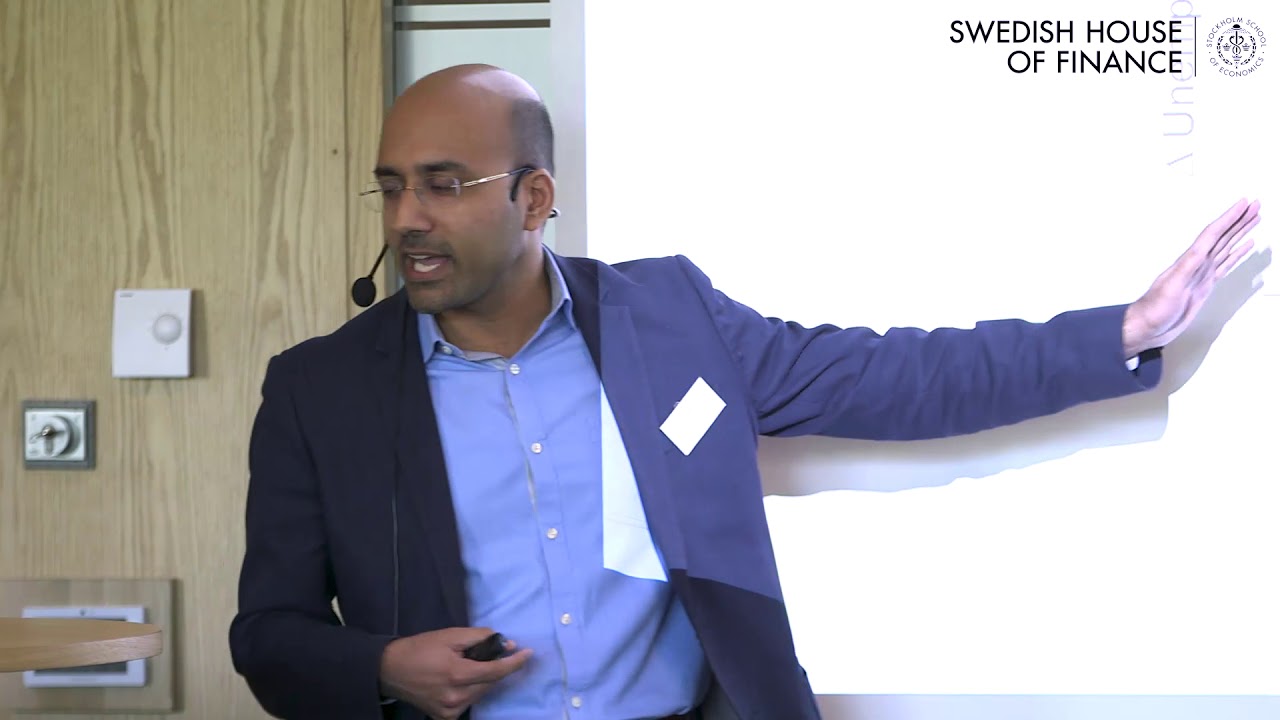
But the ride got bumpy. One of the economists happened to be Atif Mian. His impressive CV was the reason for being on this council, but alas, in a completely predictable development, it was his faith that became an issue.
There was a tweet – quickly deleted and disowned – from the Pakistan People’s Party’s Shehla Raza. Then a notice in the Senate and National Assembly, presented by Jamiat Ulema-i-Islam-F and signed off by the Pakistan Muslim League-Nawaz, Jamaat-i-Islami, Awami National Party, Pakhtunkhwa Milli Awami Party and the National Party.
Surprisingly, Information Minister Fawad Chaudhry came out swinging on the front foot, throwing down the gauntlet and taking a very strong stance defending the appointment, not just once but several times.
But that was a false dawn. Just a few days later came capitulation. Atif Mian was removed from his post. The Pakistan Tehreek-i-Insaf said he had been removed and hours later, he claimed he himself had stepped down.
Even here, simple messaging and damage control failed rather miserably. No face saving was to be had.
In protest, Asim Ijaz Khwaja and Imran Rasul also quit the council, citing their inability to continue in this advisory capacity after seeing the treatment meted out to Atif Mian.
Economists across the world are aghast at this decision – the same economists who at times advise their own governments about how to interact with countries like Pakistan. But what could the government do in the face of such reckless hate? Should they have allowed the country to burn as a result of a single appointment?
Surely not.
Surely the real blame lies with those who outed Atif Mian as Ahmadi.
Yes, that must be it, and this would be a fair argument if not for the (again) inconvenient fact that the government – the one that knows no fear – knew this all along, and knew what the consequences would be.
In the distant past
Rewind a whole four years to 2014, when a grand sit-in was being held and the nation was held spellbound by the daily speeches of the Dharna Days.
In one of those speeches, where Imran Khan was waxing lyrical about one of his favourite topics – appointments on merit – he mentioned a man called Atif Mian (sounds familiar, I know) whom he extolled as a renowned and globally acclaimed economist he would appoint as finance minister.
Who else would he appoint, thundered Khan to the approving roars of his followers, his samdhi?
But just a few days later, a delegation of well-meaning persons went up to Khan as he rested in his makeshift office to inform him that the man he had named was (shock and horror!) of the wrong faith; surely Khan had not been aware of this and would reconsider.
And he did.
I realise that we have the memories of goldfish and the incredible ability to not just rewrite history, but reality itself, but this wasn’t that long ago. It’s a Google search away, and can be looked up in less time than it takes to tweet “you khooni liberal patwari r da cause of all Pakistan problems u illuminati yahoodi traitors”.
Trust me, I timed it.
So not only was the reaction expected, the government went a step further and put Fawad Chaudhry in the firing line, only to effectively throw him to the wolves a few days later. Forget about principles of merit and tolerance – who cares about such nonsense anyway? But do consider what this says about the government’s decision-making ability.
Is it really Jinnah’s Pakistan?
For a government that loves to talk about Jinnah ka Pakistan and the more devoted followers of which never fail to compare Khan to the founder of the country, this was a failure on a very elementary level that flies in the face of Jinnah’s oft-repeated quote: “Think 100 times before you take a decision. But once that decision is taken, stand by it as one.”
But we didn’t need Jinnah to tell us this. This is a fundamental principle of management and frankly, something we pick up as children without even needing it to be taught.
Clearly, no one in this government got that memo.
And here’s when it gets truly incomprehensible: this is a government that does not have the judiciary on its back, which has the visible and clearly signalled support of the military and has a popular mandate with no political opposition worth the name. And yet it cannot stick to a simple decision that had not even been effectively challenged yet.
This is a government that had built up some religio-political capital by taking a stance on the despicable Geert Wilders’ caricature project and then taken credit for its cancellation. This is a government that – unlike the wounded Pakistan Muslim League-Nawaz at Faizabad – could have sustained the pressure and called the bluff.
And this is where it gets scary: sharks can smell blood in the water from miles away – or so I’m told by the good people at National Geographic – and are already circling around. That’s the thing with sharks – they are beasts of limitless appetite and aren’t usually amenable to compromise. To wit, you can’t ask them to bite off your hand and then expect them to leave the rest of you intact. And here you were literally in a shark cage with no need to make a blood sacrifice.
To some, this is karma.
After all, the Pakistan Tehreek-i-Insaf relentlessly weaponised religion against the former government (Captain Safdar and his theatrics notwithstanding), and continued to use it even after Ahsan Iqbal had nearly been murdered and so – some say – it is kosher to use the same tactics against them.
While one cannot agree with that, it is again clear that even the most benighted mind could and should have seen this coming.
After all, when you use the language of the extreme right, it is the extreme right that gains. In no time at all, blame will be shifted to the Opposition, to internal party factions, to random Twitter accounts and international conspiracies.
And more than blame, people within the government will even take credit.
In no time at all, we will move on, distracted like a child is by a set of shiny keys being rattled.
The first clinking of this was heard on the day Atif Mian was removed. That evening, Prime Minister Imran Khan took to the airwaves not to explain this turnaround, but to appeal for funds to build a dam.
After all, we are a resilient nation – as resilient as a battered wife who always hopes that the next time around the beating will end in only a bloody nose and not broken bones.
What is this you say? That’s not how resilience is defined?
Well that’s your fault for not updating to the “naya” dictionary where up is down and black is white. Meanwhile, the rest of us can huddle on the banks of the great river of denial.
Now, if we could only build a dam on that mighty waterway we could, maybe, stop drowning in idiocy.
#Pakistan: 14 Coal Miners die as new Parliament takes oath


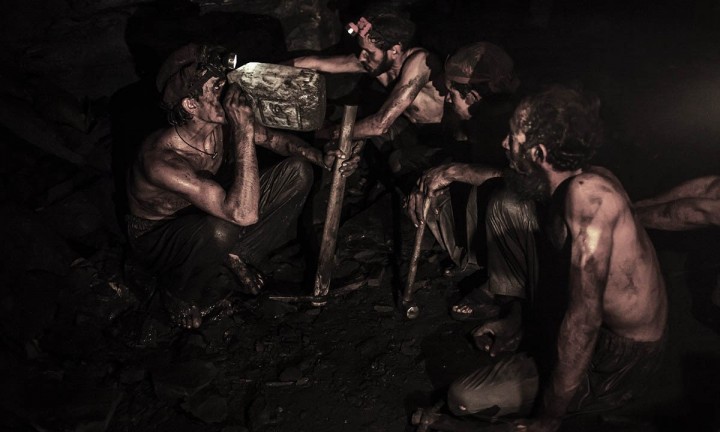
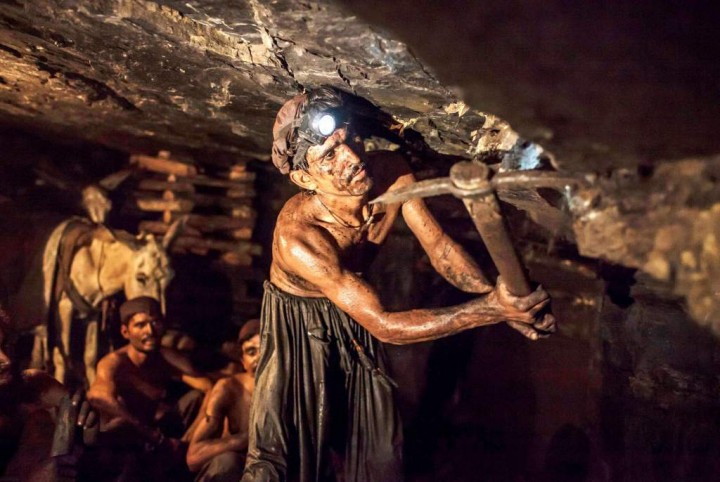
On Monday 13 August, just as Pakistan’s new parliament were taking oath after the recent elections, fourteen workers died in a coal mine near Quetta. The miners were trapped by a gas explosion inside the mine on Sunday.

The Newspaper Dawn reported that:
“Bodies of 10 of the 14 labourers trapped in a coal mine in Quetta's Sanjadi area have been recovered so far following a gas explosion last night – rescue teams told DawnNewsTV on Monday.
“In addition to this, five rescue workers who had gone to recover the trapped miners also went missing earlier in the day, two of whom have been found dead, Quetta Commissioner Hashim Ghilzai told DawnNewsTV.
“Rescue teams are trying to recover four other coal miners and three rescue workers who are still believed to be trapped in the mine, Ghilzai said. The excavation operation has been underway since yesterday.
“Following the blast, the Balochistan Provincial Disaster Management Authority had said that the rescue teams were trying to retrieve the trapped miners, but had remained coy about the chances of their survival.
“The miners belong to Shangla, Swat and Dir areas of Khyber Pakhtunkhwa.
“Poor working conditions inside coal mines in Balochistan claim the lives of miners on an almost daily basis in Harnai, Sowrange, Dukki, Mach and other parts of the province, but often go unreported.
“Coal mining is considered much more hazardous than hard rock mining due to flat-lying rock strata, generally incompetent rock, leakage or explosion of poisonous gases and coal dust, collapsing of mine stopes or general mechanical errors from improper use and malfunctioning of mining equipment.
“According to the Pakistan Central Mines Labour Federation, between 100 and 200 labourers die on average in coal mine accidents every year.”

Just a few months ago in May, twenty-three coal miners died and thirteen were injured in the same area when two mines collapsed. Twenty-one of those who died belonged to the same family of Shangla, near Swat in Pukhtoonkhwa.
In Balochistan, around one hundred thousand coal miners work in four hundred mines in inhuman conditions. Starting work at five in the morning, the working day lasts between sixteen and eighteen hours and the average wage is $10 per week. Workers tend to be between thirteen and thirty years old. They stop work after the age of thirty, not due to retirement or the fact that they have received a pension, but because they contract fatal diseases preventing them from continuing. Indeed, many workers die before even reaching the age of thirty from various illnesses caused by their work, with tuberculosis being the most common. Others die soon after quitting their jobs.
Whilst there are laws for health and safety standards for coal miners, no one pays any attention to them. Workers are never provided with safety gear and not allowed to form unions – there is not a single union for these workers in the whole region. In fact, forming a union has become an unofficial crime in all sectors of Pakistan and any activity in this direction is crushed by the industrialists with the help of the police, judiciary and labour department.
Many mines are operating illegally and are not even registered. Only twelve-thousand miners are registered in the Mines Department in Balochistan while all others are unregistered. These miners are forced to work in precarious conditions to earn their living. It is usually young teenagers who are sent to work in the difficult, narrow parts of the mines because those who are older than twenty often contract lung diseases making them unfit to work there. The miners’ families have been working here for generations; when a father dies, his son will take his place. High unemployment and falling living standards have meant that these people are forced to continue to sacrifice their lives at the altar of the blood-thirsty mine owners and the government employees bribed to allow it all to continue.
The most common accidents are methane explosions or the collapse of mines. Moreover, since no rescue teams or medical facilities are available to cope with these accidents, fellow miners usually attempt to rescue their colleagues themselves, which only results in more deaths and injuries. These accidents could easily be avoided if technology was properly used and safety standards were followed, but the mine owners choose to use primitive methods because, for them, the life of a coal miner is the cheapest commodity on the market.
There are laws supposedly requiring owners to pay compensation to the families of workers killed whilst working, but this compensation is rarely paid. Owners often blame the workers themselves. They claim that, if workers die, it is their own fault.
These coal miners are not alone. Workers in other sectors in Pakistan face similar conditions and are brutally exploited by the capitalists and the ruling elite. Governments and various departments are merely tools in the hands of these brutal exploiters who spill the blood of workers like water. No political party has condemned this brutality, and no MP in the new Assembly has spoken against this horrible exploitation. In fact, the new government has planned to privatise two hundred more public-sector departments in its first one-hundred days. This will only mean even more attacks on working-class people already living in monstrous conditions
The only way forward for the working class is to fight against these attacks. Red Workers Front has condemned this brutality and has announced its complete support for the coal miners of Balochistan. They have appealed to other trade unions to come forward against this brutality and organise protests for the rights of coal miners. A protest was held in May in Quetta on the call of the Pakistan Worker’s Confederation to protest against the killings of coal miners, but it is important to widen these protests and agitate on a much bigger scale. Only the unity of working class can stop this barbarism and rescue the workers from this bloodthirsty capitalism.
Long live the working class!
Workers of the world, unite!

Imran Khan, once a critic of ISI, now claims it’s the best intelligence agency of all


Imran visits ISI HQ and heaps praise on it, gets called out for doublespeak
Prime Minister Imran Khan paid a visit to the headquarters of Pakistan’s premier intelligence agency, Inter-Services Intelligence (ISI) Wednesday and was received by army chief Qamar Javed Bajwa and Lieutenant-General Naveed Mukhtar, director general of the ISI.
ISI stands out as word’s best intelligence agency: PM Imran Khan.

Wait, what? pic.twitter.com/k3EgDdNS0A
— Naila Inayat (@nailainayat) September 12, 2018
During the meeting, Khan said: “ISI is our first line of defence and stands out as the best intelligence agency of the world.”
Imran Khan was given an eight-hour long briefing on matters of strategic intelligence and national security. He reportedly also laid a floral wreath at Yadgar-e-Shuhada, the agency’s martyr monument, and offered Fateha (reading of verses from Quran).
The prime minister also lauded ISI’s contributions towards securing the country’s security, especially in reference to anti-terrorism efforts. He added that the armed forces and the intelligence agencies had the backing of the government as well as the people of Pakistan.
Soon after his comments, an old video surfaced, which shows Imran attacking the role of ‘agencies’ in running the country. He can be heard accusing agencies of bringing only those to the top who can be controlled, and also levelling charges against these agencies of manipulating elections.

Zardari, Bilawal to meet to Nawaz to extend condolences: sources

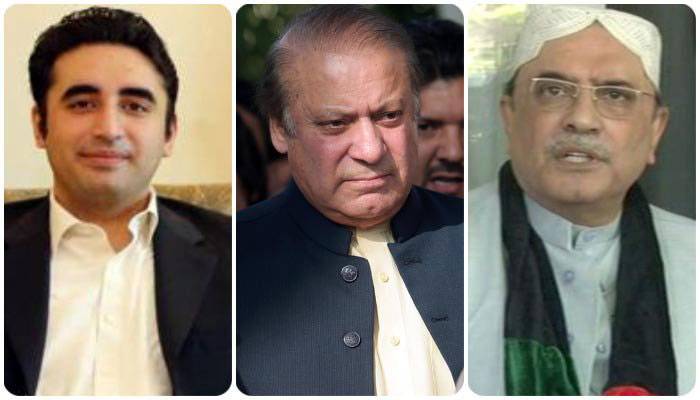
Pakistan Peoples Party (PPP) chairman Bilawal Bhutto Zardari and former president Asif Ali Zardari will meet ex-premier  Nawaz Sharif to extend condolences on Begum Kulsoom's demise, sources informed Geo News.
According to sources, the top leadership of the PPP met a day earlier and discussed attending Begum Kulsoom’s funeral.
It was decided that former PM Yousaf Raza Gillani, Raja Pervaiz Ashraf, Khursheed Shah, Naveed Qamar and Qamar Zaman Kaira will attend the former first lady’s funeral, the sources added.
Meanwhile, Zardari and Bilawal will meet Nawaz after Begum Kulsoom's burial.
Begum Kulsoom passed away on September 11 in the Harley Street Clinic in London, where she was being treated for lymphoma. 
Following her death, Nawaz, Maryam, and her husband Captain (retd) Safdar Awan were released from Adiala Jail on parole till Sunday.
Begum Kulsoom's body will be flown to Lahore tonight, with the funeral prayers being offered on Friday at Sharif Medical City in Jati Umra at 5pm.
https://www.geo.tv/latest/211046-zardari-bilawal-to-meet-to-nawaz-to-extend-condolences-sources

Wednesday, September 12, 2018

Music Video - Cutting Crew - (I Just) Died In Your Arms

Video Report - Don Lemon: Puerto Rico response not successful by any measure

News Report - Rise of extremist parties sends tremors across Europe

Video Report - CrossTalk on Syria: Into The Abyss?

#SaudiStruggle - The 9/11 lawsuit looming over Saudi Arabia's ambitions


By Ali Harb

Saudis would be mistaken to think Donald Trump can help them with lawsuit alleging role in 9/11 attacks, lawyer says.

A lawsuit alleging Saudi involvement in the 9/11 attack is overshadowing Crown Prince Mohammed bin Salman's economic and political plans.
Saudi Arabia is rebranding itself, attempting to move its economy away from dependence on oil, to deconstruct its image as an ultraconservative society and portray its autocratic rulers as reformists.
In 2016, the US Senate overruled then-President Barack Obama to pass Justice Against Sponsors of Terrorism Act (JASTA), a law allowing civil lawsuits by victims of "international terrorism" to proceed in US courts against sovereign states.
The bill opened the door for the families of the 9/11 victims to go after Saudi Arabia over its alleged role in the attacks.
While Riyadh maintains that it has nothing to do with the al-Qaeda militants, who have launched attacks in Saudi Arabia often targeting security forces, US District Judge George Daniels in New York gave a green light in March for a lawsuit against the Saudi government to proceed.
The 9/11 Commission back in 2003 and 2004 either didn't pursue, didn't want to pursue, covered up for the Saudis or just never got around to finishing the investigation
- Andrew Maloney, lawyer
Beyond damaging the kingdom's image, the court case threatens Saudi economic interests, namely the plans to sell a 5 percent stake in Saudi Aramco, the state's oil company.
Lawyers had warned the kingdom against listing Aramco's initial public offering on the New York Stock Exchange, the Financial Times reported last year.
Saudi Arabia has denied that it is suspending the sale, which aims to raise $100bn in cash to boost other sectors of the economy. But the IPO's delay is apparent.
"This dampens the Saudi wish to invest in the United States, considering that investments in the United States is one of the pillars of the Saudi economic diversification plan," Imad Harb, director of research and analysis at Arab Center Washington DC, told Middle East Eye.
"Economic relations do spill over to political relations. This is why Saudi Arabia is very concerned about it."
He added that the lawsuit also harms the US public's perception of the kingdom, not only relating to its alleged involvement in the attacks, but also because it opens the door for discussing the current state of affairs in Saudi Arabia, including human rights abuses.

Discovery

Andrew Maloney, a lawyer for the 9/11 victims' families, said the legal proceedings are in the stage of discovery - gathering documents from the Saudis and other parties.
If the Saudis refuse to cooperate with the court, Maloney explained, they would be considered in default, much like Iran.
Judge Daniels himself issued in 2011 a default judgement against Iran in a civil lawsuit that claimed links between Tehran and the 9/11 attackers. Tehran did not respond to the court case although it denies ties to al-Qaeda militants who consider Iran's Shia rulers apostates.
The 9/11 Commission report, which details the extensive government investigation of the attacks, did not corroborate the lawsuit's allegations that Iran trained the hijackers.
Still, in May, Daniels ordered Iran to pay $6bn to the victims' families.
While Iran has no business in the US and is already under Treasury Department sanctions relating to its nuclear programme, Saudi assets in the US are abundant and would be up for grabs if the plaintiffs win.
"If the Saudis were to simply say: 'We're not going to cooperate; see you later,' we can do the same thing that has happened to Iran," Maloney told MEE in a phone interview last month. "I think it would be a very bad move to the Saudis to go down that route."
Saudi rulers have cozied up to Donald Trump, and Prince bin Salman has particularly received praise from the US president.
But politics cannot influence the lawsuit because of independence of the judiciary in the US, Maloney said.
"Even if the president didn't want us to do it, he really couldn't stop us… The Saudis are mistaken if they're relying on the president to protect them here; it's not possible," he added.
The 9/11 Commission report appears to clear the Saudi government of direct involvement in the attacks.
"Saudi Arabia has long been considered the primary source of al-Qaeda funding, but we have found no evidence that the Saudi government as an institution or senior Saudi officials individually funded the organisation," the report reads.
Maloney said the report leaves open a large portion of the Saudi government that could be held liable, including Saudis who may not be considered high-level officials.
If a faction of mid-level Saudi officials had been conspiring with the hijackers, it would make the entire government liable, Maloney said.
The lawyer suggested that the report does not tell the entire story.
"The [Saudi] Ministry of Islamic Affairs in the United States and other parts of the world had government officials who conspired with al-Qaeda to support them and to support the 9/11 hijackers," Maloney said.
"The 9/11 Commission back in 2003 and 2004 either didn't pursue, didn't want to pursue, covered up for the Saudis or just never got around to finishing the investigation. That's where we picked it up, and we've collected a lot more information and evidence since then."
He added that the FBI may have sealed information on Saudi involvement that the plaintiffs are seeking.

The allegations

The most damning allegations in the lawsuit are around contacts by Saudi officials with hijackers Khalid al-Mihdhar and Nawaf al-Hazmi, who arrived to the US and settled in southern California in January 2000.
According to the 9/11 Commission report, the two militants were "ill-prepared" for a mission in the United States: they were not fluent in English and had not spent any "substantial time" in the West. The investigation found that it was "unlikely" that Mihdhar and Hazmi came to the United States without arranging in advance to receive assistance from individuals in the US.
The plaintiffs say those individuals were allegedly two Saudi officials in Los Angeles and San Diego: Fahad al-Thumairy and Omar al-Bayoumi.
Thumairy was the head of a Saudi-funded mosque in Los Angeles and he had been appointed to the position by the head of Saudi Islamic Affairs in Washington, according to court documents. He was also an "accredited diplomat" at the Saudi consulate there. The lawsuit accuses him of "orchestrating the US-based support network" for Mihdhar and Hazmi.
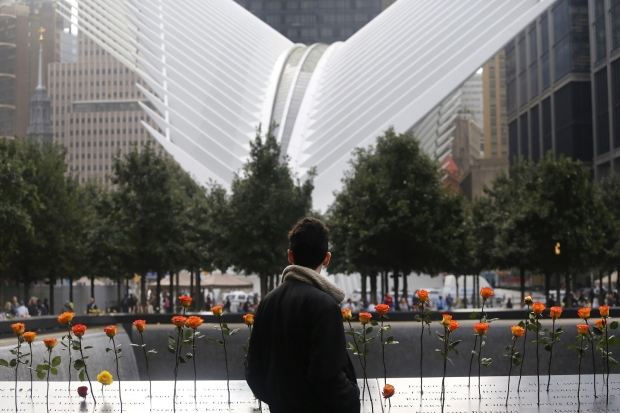
9/11 anniversary ceremony in New York, 11 September (AP)
The plaintiffs allege that Thumairy connected the pair with Bayoumi, a Saudi citizen who had been employed by the Saudi government since the 1970s and lived in San Diego after moving there in 1994 to study English on a government scholarship.
The lawsuit says Bayoumi, in turn, allegedly helped Mihdhar and Hazmi settle in San Diego, where he co-signed a lease for their apartment and put them in touch with Anwar al-Awlaki, a preacher who later came out in support of al-Qaeda and was subsequently killed by a US drone strike in Yemen in 2011.
The 9/11 Commission report says, "We do not know" how the hijackers met al-Awlaki.
Bayoumi allegedly also connected the hijacker to an individual from Awlaki's congregation who provided further assistance.
"Based on these alleged facts, plaintiffs claim that Thumairy and Bayoumi were directed by someone within the Saudi embassy in Washington, DC, to help Hazmi and Midhar acclimate and settle in the United States to begin preparations for the 9/11 Attacks,"  Judge Daniels wrote in March.
The lawsuit says Bayoumi's phone records show that he made calls to Saudi consulates in the US 74 times between January and March 2000, coinciding with the hijackers arrival in the country. 34 of those calls were made to the consulate in Los Angeles where Thumairy worked.
"These allegations, unrebutted by any contrary evidence from Saudi Arabia, are sufficient to create a reasonable basis for this court to exercise jurisdiction over the claims plaintiffs assert against Saudi Arabia to justify jurisdictional discovery to proceed as to Thumairy and Bayoumi," Daniels wrote in his decision to reject Saudi Arabia's motion to dismiss the lawsuit. 
Both Thumairy and Bayoumi deny that they knew anything about the hijackers' plans.

In an interview with Saudi-owned newspaper Asharq al-Awsat in 2002, Bayoumi said Hazmi and Midhar had sought help from established expats in San Diego like any Saudi newcomers, adding that they only stayed in the initial apartment complex for two weeks. He did not know where they went next, he said.
Bayoumi had left the US to continue his studies in the UK in October 2000, about a year before the attacks. He told the Saudi newspaper in 2002 that British police had thoroughly searched his house and interviewed him for a week before he decided to return to his home country seven months later.
For his part, Bayoumi was denied re-entry to the US in 2003 after his visa was cancelled without explanation. He told Asharq al-Awsat then that he cannot recall any violation that he may have committed in the US.
Asked if there is evidence linking Saudi officials to the 9/11 attacks beyond the two hijackers who landed in California in 2000, Maloney's answer was a "definitive yes," but he refused to share the details.
"Eventually, it will come out; you will see, but I can't go beyond that," the lawyer said.


Video report - 73rd Birthday of famous film actress Zeba

کوټه کې د پښتون ژغورنې غورځنګ پلویانو لاریون

Pakistan: Church Abhors ‘Blasphemous’ Facebook Post


By Kamran Chaudhry
Church officials in Pakistan have filed a complaint with the Federal Investigation Agency against four Muslims for sharing a Facebook post deemed offensive to the Christian minority.
The controversial photo showed Pakistan army chief Gen. Qamar Javed Bajwa standing beside Prime Minister Imran Khan and his wife Bushra Maneka.

The First Lady is seen clad in her signature white burqa, an all-covering traditional garment, with the caption “The Father, the Son and the Holy Ghost.”
Imran Titus Bhatti, national coordinator of the Church of Pakistan, filed an application on Sept. 10 to launch a case over the post with the cybercrime wing of the investigation agency in the city of Lahore, capital of Punjab province.
“The trinity is among the foundational doctrines of the Christian faith,” he said. “The titles in this blasphemous post insult my faith. It has caused religious hatred. The further sharing of this post is hurting our feelings.”
The Church of Pakistan requested authorities to block the Facebook post and take strong action against what it branded “religious terrorism.”By Kamran Chaudhry
Church officials in Pakistan have filed a complaint with the Federal Investigation Agency against four Muslims for sharing a Facebook post deemed offensive to the Christian minority.
The controversial photo showed Pakistan army chief Gen. Qamar Javed Bajwa standing beside Prime Minister Imran Khan and his wife Bushra Maneka.
The First Lady is seen clad in her signature white burqa, an all-covering traditional garment, with the caption “The Father, the Son and the Holy Ghost.”
Imran Titus Bhatti, national coordinator of the Church of Pakistan, filed an application on Sept. 10 to launch a case over the post with the cybercrime wing of the investigation agency in the city of Lahore, capital of Punjab province.
“The trinity is among the foundational doctrines of the Christian faith,” he said. “The titles in this blasphemous post insult my faith. It has caused religious hatred. The further sharing of this post is hurting our feelings.”
The Church of Pakistan requested authorities to block the Facebook post and take strong action against what it branded “religious terrorism.”
Blasphemy is a highly sensitive issue in the Islamic-majority nation and Pakistan’s Penal Code stipulates imprisonment of up to 10 years, a fine or both for outraging the religious feelings of any group.
However, religious minorities accuse authorities of generally ignoring insulting remarks about religions other than Islam.
In 2016, a disfigured picture of Leonardo da Vinci’s classic 15th century mural of The Last Supper circulated on social media. It depicted the faces of Jesus and his disciples swapped with the faces of former prime minister Nawaz Sharif and his ministers against a backdrop of Pakistan’s parliament.
The Christian community has taken to social media to condemn the recent Facebook photo and to post Biblical verses against such mockery.
In a video message issued Sept. 11 on social media, Rev. Amjad Niamat, convener of the Pakistan Christian Action Committee, urged Christians to peacefully record their objections to what was lamentable behaviour.
He demanded that both the government and military act against what he described as miscreant elements.
Catholic activist Khalid Shahzad urged Muslims to give equal respect to the Christian faith.
“A Christian believes in the trinity just like you believe in the finality of Prophethood,” he said. “The Muslim community has imprisoned many illiterate Christians in Punjab jails for blasphemy.”
Affected families and lawyers attending court hearings had also been threatened.

#Pakistan - #PTI Government - A faulty beginning


By Zahid Hussain

MAYBE it is too early to judge the performance of the PTI government but the bumbling start has not shown much promise. Almost a month after taking the reins, the new dispensation has yet to find its moorings. A disjointed team of novices and the lack of clear policy direction do not evoke much confidence.
Numerous taskforces have been formed to chart out the plan of action in various fields; but until they start functioning there will be chaos. Additionally, events over the past week have revealed an amateurish approach to handling critical issues related to governance. Populist rhetoric seems to have substituted policy. It is voodoo economics and politics in action — dams will be built through public donations and ‘unutilised state land’ can be used to reduce our debt burden. Just wait for the 100-day miracle, we are told.
There is no doubting Imran Khan’s commitment to bring change. His focus on human development and environmental issues is commendable. But it’s the economy that needs to be fixed first. It’s surely ‘change vs more of the same’. But what kind of change has not been clearly defined.
Without a clear vision it will be more of the same or worse. It is certainly a good idea to seek the services of technocrats to develop a framework for change but there is a question about the willingness of the elected leadership to heed their advice and recommendations. It was a wise decision to form a permanent Economic Advisory Council inducting the best talent from both inside and outside Pakistan. This showed seriousness on the part of the PTI government to deal with the grave economic challenges that confront the country. But all those promises came crashing down, when days after the formation of the EAC, the government asked Prof Atif Mian to step down from the council because of his faith.
Recent events have revealed an amateurish approach to handling critical governance issues.
Nothing could be more humiliating for a globally recognised economist and a professor at one of America’s top universities, who had volunteered to work for the country. It was a shameful surrender to zealots.
A democratically elected popular leader could not take a stand on his own decision because he appeared to be afraid of religious extremists within and outside his party. One can ask, what kind of ‘naya Pakistan’ does the prime minister intend to build? Surely not one that is more regressive than what we have witnessed in the past?
Not surprisingly, two other members, both internationally acclaimed economists, quit the council too in protest. In his tweet, Dr Imran Rasul, who teaches at University College London, said: “Basing decisions on religious affiliation goes against my principles, or the values I am trying to teach my children.”
Other members may not have resigned but they have reservations. The episode has dealt a blow to the image of the new government and could discourage any self-respecting Pakistani expatriate from returning to help the country.
Most worrisome is the observation that the pressure to remove Atif Mian was stronger within the PTI, bringing to the surface the paradox of a party that claims to represent the educated middle classes and youth. No action was taken by the party leadership against the Punjab information minister who went to the grave of Mumtaz Qadri to pay homage to the convicted murderer. It does not matter if the religious parties were routed in the elections; the zealots continue to hold sway.
Meanwhile, the conduct of diplomacy too has been amateurish. Despite being an experienced hand, the over-exuberant foreign minister has been at the centre of controversy. His fondness for holding frequent press talks generates more confusion. His misreading of a letter from Narendra Modi to Imran Khan that New Delhi was willing to resume bilateral talks caused embarrassment, especially as the Indian authorities denied there was any such offer.
Similarly, the hype regarding the outcome of talks with visiting US Secretary of State Mike Pompeo was also misplaced. It did not make much sense for the foreign minister to hold a long press conference after the meeting when the Americans did not choose to have a joint presser. In addition, there was the report of the prime minister refusing to take a prearranged call from the French president while he was busy talking to a group of journalists — if correct, it was an undiplomatic approach. There was no denial by the Prime Minister’s Office of the media report.
True, such matters may be dismissed as initial glitches, but can also cause serious diplomatic embarrassment. A faux pas by the adviser on commerce and trade has caused some problems with Beijing. In an interview with the Financial Times, he suggested that work on CPEC could be stopped for a year or more because the Pakistani government wanted to renegotiate the terms and conditions with the Chinese companies on some projects.
While there is certainly no harm in reviewing the contracts, there was no need to make statements to the media that were bound to create misgivings.
The government has time to fix things. But some mistakes could be hard to remedy. For instance, the government compromises on its authority and credibility when it gives in to the pressure of a small minority using religion as a weapon. The PTI and the government must decide what kind of future they want to chart for the country. The Atif Mian case has dealt a blow to the government’s credibility, and has further emboldened the bigots and extremists who present the biggest threat to the political and economic stability of the country. Now is the time for the government to get down to the business of governance before it is too late.

Licence to Kill - #PAKISTAN SC licenses Jamat-ud-Dawa to continue welfare activities


The Supreme Court of Pakistan (SCP) has rejected the appeal of federal government to restrain Jamaat-ud-Dawa (JUD) chief Hafiz Saeed from his social welfare activites.
The two-member bench rejected the appeal of federal government against the verdict of Lahore High Court (LHC) on JUD’s welfare and charity work and licensed Jamaat-ud-Dawa and Falahi Insaniyat Foundation (FIF) to continue assistance (welfare) and charity work in the country.
The two-member bench includes Juctice Manzoor Ahmed Mulk and Justice Sardar Tariq Masood.
According to the reports JuD’s includes 300 seminaries, schools, hospitals, a publishing house and ambulance services. The JuD and FIF alone have about 50,000 volunteers and hundreds of other paid workers, according to two counter-terrorism officials.
JuD claimed that 369 ambulances of the FIF helped 72,000 people to reach the charity hospitals and that 600,000 patients were provided treatment last year alone. Moreover, the JuD had dug out 2,000 drinking water wells in Tharparkar, Balochistan and Baltistan.

How extreme poverty is forcing #Pakistanis to sell kidneys


Sattar Khan 


Impoverished daily wage laborers in Pakistan are forced to sell their body organs to make both ends meet. DW meets a brick kiln worker near Lahore, who narrates his horrifying tale of kidney selling to an illegal racket.
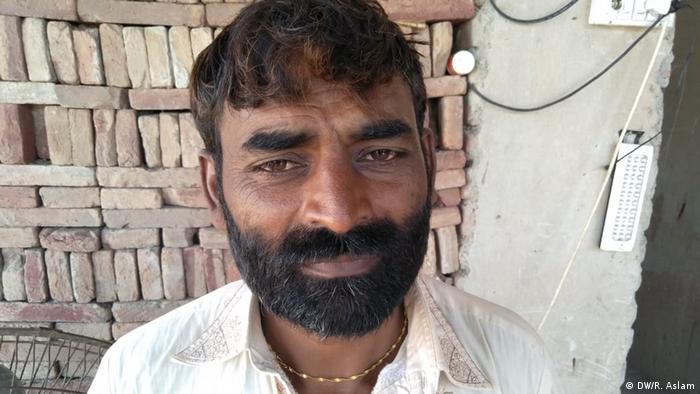
Muhammad Iqbal (pictured above) is a 44-year-old laborer hailing from eastern Pakistan. He wants to play kabaddi, a wrestling-like traditional sport in South Asia, but his deteriorating health does not allow him to indulge in any activity that is physically straining. A former brick kiln worker, Iqbal is now unable to lift heavy stuff.
He was not always so enervated. A wrong decision in 2012 changed his life for the worse. Iqbal regrets making that decision.
"In 2012, I was heavily indebted," Iqbal, a father of eight children, told DW.
"I was living in a village near Lahore and working at a brick kiln factory. I had borrowed 135,000 Pakistani rupees (€1,603, $1,856) from the kiln owner. I was working round the clock to pay back the loan, but with my meagre salary, I could hardly make both ends meet, let alone repay the loan," Iqbal said.
"I was so desperate that I was ready to do anything to get some money," a teary Iqbal told DW. "At the time, my cousin Ashraf came up with an idea — he asked me to sell my kidney and repay the loan."
"It sent a shiver down my spine, but knowing that I had no other way to repay the loan, I told my cousin that I would give the idea a second thought.
"Ashraf rolled up his shirt, showing me the operation marks after the removal of his kidney," Iqbal continued.
"He told me I could easily live with one kidney and the operation is not very complicated," Iqbal said, adding that he was scared that he could lose his life during the surgery.
Muhammad Iqbal, kidney donor (DW/R. Aslam)
Iqbal regrets selling his kidney, as he can no longer work as brick kiln laborer
A journey to Rawalpindi
Once Iqbal gave his cousin a green light, Ashraf arranged his meeting with Faqir Hussain, a Lahore resident involved in kidney sale.
Several media reports point to a growing racket of kidney sellers across the country, especially in Punjab province. In the past few years, police have arrested several people who are involved in running this illegal business.
"Hussain offered me 130,000 rupees (€1,544). When I demanded more money, he raised it to 160,000 rupees," Iqbal said.
"First, I was taken to a place in Lahore where they conducted my blood tests and took my X-rays. I was told that it was necessary to make sure that I did not have any major disease," Iqbal added.
Iqbal was later asked to travel to Rawalpindi, a city near the capital Islamabad.
"I don't remember the date but I'm sure it was the winter of 2012. We were 19 or more people. We boarded a bus in Lahore and reached Rawalpindi in the wee hours. There we were picked up by drivers who had been in touch with us on the phone. We were taken to a clinic near the Grand Trunk road. The clinic was owned by Faqir Hussain."
Iqbal said Hussain treated him gently. "We were told to take shower and have food but asked not to eat again for several hours so that more medical tests could be conducted," Iqbal narrated.
"We stayed there for 15 days. They turned away a few people as their tests showed their kidneys could not be removed."
Muhammad Iqbal, kidney donor (DW/R. Aslam)
Iqbal can no longer lift heavy stuff
In Pakistan, the illegal business of organ "donation" is done secretively. Iqbal said the place where his kidney was removed was actually an eye hospital.
"But they had set up a modern facility for kidney surgeries in the basement of the eye hospital," Iqbal said.
Iqbal told DW that people involved in the business make sure the organ donors don't sue them later so they make them sign an affidavit.
"The operation began at 10 am. I was anesthetized. I woke up the next morning. After the surgery, they gave me money and I was allowed to leave the hospital and go home."
Where is the government?
Iqbal said the kidney donation did not solve all of his financial problems.
"Out of 160,000 rupees, I had to spend around 30,000 rupees on my post-surgery medicines. So I had to sell my rickshaw and combined it with the kidney money to repay my loan," Iqbal said.
"But the loans started piling up again. Due to my health situation, I had to give up on the brick kiln work. Now I am an irregular laborer because I cannot work the entire month. Two of my daughters, aged 13 and 12, started working in Lahore as full-time maids. They earn around 13,000 rupees per month."
Iqbal said he regrets selling his kidney.
"I appeal to the government that it nabs these rackets and also takes measures to help brick kiln laborers, who are so poor that they find no other way than selling their body organs in order to survive," Iqbal underlined.
"The authorities must help us, write off our loans and force the factory owners to increase our wages so that brick kiln workers do not fall prey to kidney selling gangs."

Bilawal Bhutto pays glowing tributes to the martyrs of Movement for Restoration of Democracy on their 35th martyrdom anniversary

Chairman Pakistan Peoples Party Bilawal Bhutto Zardari has paid glowing tributes to the martyrs of Movement for Restoration of Democracy (MRD) on their 35th martyrdom anniversary observed today.

It may be recalled that 12 PPP workers were martyred through brutal force during a protest against dictatorship of Zia in Khairpur Nathan Shah town in Dadu district in 1983 today.
In his message, the PPP Chairman said that sacrifices of PPP leadership and workers against the ruthless dictatorship were a proud chapter in the history of not only the nation but in the whole world.

Bilawal Bhutto Zardari said that entire nation was indebted to these martyrs and their sacrifices won’t go in vain. He said that every aspect of MRD movement fought under the leadership of Shaheed Mohtarma Benazir Bhutto was equal syllabus for the next generations and stressed upon the teachers of history and political science to play their role in apprising the new generations about the ideological and philosophical characteristics of this movement.

Those who were martyred by the Zia dictator’s regime on September 12, 1983 in Khairpur Nathan Shah of Dadu district include martyrs Abdul Ghani Abro, Abdul Aziz Lakhair, Nizamuddin Naich, Abdul Nabu Khoso, Allahwarrayo Langah, Shahnawaz Khoso, Habibullah Leghari, Deedar Ali Khokhar, Zameer Hussain Jagirani, Aijaz Hussain Khoonharo and Manzoor Ahmed Chandio.


https://mediacellppp.wordpress.com/2018/09/12/bilawal-bhutto-zardari-pays-glowing-tributes-to-the-martyrs-of-movement-for-restoration-of-democracy-on-their-35th-martyrdom-anniversary/