Wednesday, June 20, 2018

#Pakistan: Choking Free Voices – Analysis

By Tushar Ranjan Mohanty
The Media in Pakistan has long faced the brunt of the all-powerful military establishment. Of late, with elections around the corner, there has been an intensification of the crackdown against journalists and news establishments.
On June 6, 2018, The New York Times thus wrote, “Just a month and a half away from national elections, Pakistan’s powerful military establishment has mounted a fearsome campaign against its critics in the news media, on social networks, and in mainstream political movements. It is all adding up: journalists abducted or threatened, major news outlets blocked, sympathetic views toward the civilian governing party, the Pakistan Muslim League-Nawaz, censored or punished. Interviews with journalists and political analysts in recent days have been dominated by concerns that a military campaign of intimidation and crackdown on dissent is intensifying ahead of the vote – and nearly unanimously, none dared discuss it on the record.”
General Elections are scheduled to be held on July 25, 2018.
A prominent British-Pakistani journalist and activist, Gul Bukhari, known for his criticism of the military establishment, was abducted by ‘unidentified persons’ at around 11 pm [PST] on June 5, 2018, from Sherpao Bridge in the Cantonment area of Lahore, the provincial capital of Punjab. Gul Bukhari was reportedly whisked away by gunmen when she was on her way to the Waqt TV studio for a show.
The driver of the Waqt TV cab told the Police that two persons came out of a vehicle and asked Bukhari to get into their vehicle. “When she refused they bundled her up in the vehicle and sped away,” he said, adding that her abductors did not say anything to him. As the news of Bukhari’s abduction broke out, several people took to the social media blaming the intelligence agencies for her forced disappearance because of her views about the Pakistani military. Some three hours later, Bukhari’s family confirmed that she had returned home. She has refused to talk about her abductors.
Elsewhere in the city, on the same day, senior journalist and television anchor Asad Kharal was reportedly attacked by ‘masked men’ near Allama Iqbal International Airport. Kharal, who was on his way home from the airport when his vehicle was intercepted, was taken out from the car and assaulted.
On May 15, 2018, the Government of Pakistan ‘blocked’ the distribution of Dawn, one of the country’s leading English dailies. A report by Reporters Sans Frontiers (RSF) stated that the distribution of Dawn had been blocked in most of Balochistan Province, in many cities in Sindh Province and in all military cantonments. The RSF observed,
The unwarranted blocking of the distribution of one of the main independent newspapers has yet again shown that the military are determined to maintain their grip on access to news and information in Pakistan. It is clear that the military high command does not want to allow a democratic debate in the months preceding a general election. We call on the authorities to stop interfering in the dissemination of independent media and to restore distribution of Dawn throughout Pakistan.
The action followed publication by Dawn of an interview with former Prime Minister Nawaz Sharif on May 12, 2018. Sharif had acknowledged that the terror attacks launched on Mumbai between November 26 and November 29, 2008, were carried out by Pakistan-born terrorists. According to the RSF report, the ‘blockade’ came into effect as the Pakistani Army brass was reportedly unhappy with the newspaper’s publishing of the interview.
On April 1, 2018, Geo TV, part of Pakistan’s largest commercial media group, Jang, was taken off the air in many parts of the country. The ban only ended a month later after talks between the military and the network’s chiefs, who reportedly pledged to make sure the network’s coverage does not cross the military’s line. Significantly, in April 2014, Geo TV’s most prominent anchor and journalist, Hamid Mir, was shot by ‘unidentified gunmen’. Mir survived his injuries and was on record blaming military intelligence agency Inter Services Intelligence (ISI) for the attack.
On March 1, 2018, Anjum Muneer Raja (40), a sub-editor at Urdu newspaper Qaumi Pukaar, was shot dead in a high-security zone in the Pakistan Army General Headquarters area in Rawalpindi in Punjab. He was on his way home from work when the incident occurred. While speaking to Dawn, Raja’s uncle Tariq Mehmood asserted that his nephew did not have a personal enmity with anyone and expressed shock that Raja was murdered in such a ‘highly secured’ area.
On January 10, 2018, prominent journalist, Taha Siddiqui, who reports for France 24 and is the Pakistan Bureau Chief of the Indian television channel World Is One News (WION), escaped a kidnapping attempt on his way to the airport in Islamabad. “The Army and intelligence agencies were threatening me and I suspect the people who tried to kidnap me were from the Army,” Siddiqui said, speaking to Radio Free Europe / Radio Liberty (RFE/RL) from Paris, where he has relocated, “They do not like investigative reporting that uncovers the wrongdoings of those institutions.”
Press Freedom Barometer 2018 (monitored from May 1, 2017 to April 1, 2018), released by Freedom Network (FN) on May 2, 2018, observed that Islamabad was the most dangerous place to be a journalist in Pakistan, accounting for 35 per cent of the 157 violations recorded by the Report. Other areas found dangerous for journalists were Punjab, the second worst, with 17 per cent of the violations (26 cases); followed closely by Sindh with 16 per cent (25 cases); Balochistan with 14 per cent (22 cases); and Khyber Pakhtunkhwa with 10 per cent (16 cases). The Federally Administered Tribal Areas (FATA) documented the lowest number of overall violations at eight per cent of the total with 13 cases. According to a press release issued by FN, the group has recorded over 157 cases of attacks and violations against media and its practitioners, including journalists, in Pakistan in the preceding year, “signifying a worryingly escalating climate of intimidation and harassment that is adversely affecting the freedom of expression and access to information environment”. The report points to the state and its agencies and functionaries, as the most serious ‘threat actors’ targeting media in 39 per cent of the incidents, as compared to other actors, such as militant groups, political parties, religious groups and criminals.
An April 25, 2018 report by RSF revealed that Pakistani journalists were increasingly resorting to self-censorship due to pressures from intelligence agencies and extremist groups. RSF placed Pakistan at the 139th position out of 180 countries that restrained press freedom.
Pakistan’s media community is effectively under siege. The Gul Bukhari abduction came only hours after the military warned that it was monitoring those criticising Pakistan. At a press conference on June 4, 2018, Director General (DG) of Inter-Services Public Relations (ISPR) Major General Asif Ghafoor derided the rise of social media troll accounts which, he said, spread propaganda against the Army and State, and warned that ISI was monitoring such accounts and those that engage with them, including journalists. During his presentation, Major General Ghafoor showed a graphic featuring an alleged troll account’s Twitter activity and the journalists and other individuals allegedly connected to the account. Ghafoor claimed that these journalists redistributed anti-state and anti-Army propaganda from the troll’s account.
Reacting to Ghafoor’s warning, the Committee to Protect Journalists (CPJ)’s Asia Program coordinator in Washington, D.C., Steven Butler stated,
Displaying photos of journalists alleged to help push anti-state propaganda in Pakistan is tantamount to putting a giant target on their backs. General Ghafoor should apologize for his comments and explain how security forces might help promote journalist safety in Pakistan, where reporters and editors are routinely threatened, attacked, and killed for their work.
The practice of bulldozing media, however, is an old phenomenon. As noted, top Pakistani journalist Hamid Mir was seriously wounded in a targeted shooting in Karachi, the provincial capital of Sindh, on April 19, 2014. Mir’s car was ambushed as soon as it left Karachi’s Jinnah International Airport and was on the way to his Jang group-owned Geo TV’s office. Mir had earlier told his family, friends, colleagues, Army and Government officials in writing that he would hold ISI chief Lt. General Zaheerul Islam responsible if he was attacked. Hamid Mir had been relentlessly highlighting the issue of missing persons in Balochistan. The incident also demonstrated the ruthless attempts by the military establishment to silence an increasingly critical media, with the civilian Government expectedly toeing the Army’s line.
In 2011, the Inter-Services Intelligence (ISI) was accused of abducting, torturing and killing Saleem Shahzad, a journalist working as the Pakistan Bureau Chief of Asia Times Online (Hong Kong) and Italian news agency Adnkronos (AKI). Shahzad disappeared in the evening of May 29, 2011, from Islamabad and his mutilated body was recovered from a canal in Mandi Bahauddin District of Punjab on May 31. His body bore marks of severe torture. Human Rights Watch researcher, Ali Dayan Hasan, claimed he had “credible information” that Shahzad was in the custody of ISI. Indeed, Shahzad’s friends and colleagues revealed that the ISI had warned Shahzad at least three times prior to his death. In October 2010, Shahzad was summoned to ISI headquarters the day after publishing a sensitive article on Afghan Taliban leader Abdul Ghani Baradar’s capture.
Attack on Media: 2000-2018
Years
Killed
Assault/ Injured
Arrested/ abducted
Intimidated
Banned/ Barred / Censored
Damage to Property
2000
5
14
10
24
6
6
2001
2
2
5
3
4
2
2002
1
37
10
13
8
2
2003
2
7
4
17
2
1
2004
2
2
8
17
3
2
2005
3
7
13
18
28
3
2006
5
31
12
22
15
9
2007
11
215
325
79
43
16
2008
13
74
40
118
20
4
2009
10
70
10
28
35
10
2010
9
19
1
1
0
4
2011
8
10
1
3
0
0
2012
9
4
0
1
0
0
2013
8
8
1
2
1
2
2014
3
4
0
1
2
2
2015
6
7
1
0
1
1
2016
4
2
1
0
2
1
2017
3
3
6
2
0
2
2018
1
2
2
1
3
0
Total*
105
518
450
350
173
67
Source: 2000-2009: Intermedia; 2010-2018: South Asia Terrorism Portal (SATP) *Data till June 10, 2018
At least 105 media personnel have been killed in Pakistan since 2000. Another 518 have either faced assault or have been injured in attacks. At least 450 media persons have been abducted/ arrested, while another 350 have faced direct intimidation. According to the partial data compiled by SATP, 2018 has already recorded the killing of one journalist, thus far.
The punishing pressure now being applied to Dawn and other news outlets is more insidious than the outright censorship of times past, Dawn’s editor Zaffar Abbas noted. “They want to control the narrative,” Abbas claimed, without elaborating who “they” were, “And to a large extent, they are succeeding.”

Feminism - ‘Real’ Pakistani women


Rafia Zakaria
OVER the Eid weekend, as most Pakistanis, male and female, gorged on goodies, eating the biryanis and sheer kormas that are traditional to the festive season, the country’s politicians remained preoccupied with the upcoming elections. Even Eid, it seemed, was not a holiday for them; no break was to be had from the pandering, the promising and the speechifying.
Among these politicians was PTI chairman Imran Khan. While being interviewed, Khan stated that he disagreed with the Western feminist movement, which has, in his opinion, degraded the role of motherhood. Mothers, he went on to say, wield the most influence over their children’s lives, thus implying that feminism’s focus on giving women power outside the home has shifted attention away from the truly important stuff ie taking care of their (assumedly) large broods of children.
While the words produced some outcry on social media, the tone and the denigration of women and feminism in general, duly pointed out by feminists, analysts and others, is deserving of further discussion. Khan is hardly unique in raising the spectre of the abandonment of motherhood as the consequence of female empowerment; men in Pakistan (bosses, husbands, fathers, brothers) do it routinely as they bar women from doing this or that, working or studying or leaving abusive marriages.
For many men, an ideal woman is one who has no sense of self, no basis to ever challenge the man’s decisions, who is ‘reasonable’ where the term means complicit in her own subjugation.
The idea that any woman who wants more than what men are comfortable with — women who want to prove that they can be mothers and doctors (or lawyers or accountants or government workers, etc, etc) — are in fact not ‘real’ Pakistani women and are tainted by ‘Western feminism’ is a very popular one in Pakistan. There is no use explaining what ‘Western feminism’ may or may not mean; for the purposes of men like Khan and millions of others like him, it stands simply and completely for anything that they don’t agree with.
The consequence is the construction of the authentic, the true, and the perfect Pakistani woman as someone who is formed exactly according to the wishes of the men who are standing in judgement over her. For such men, this would be the selfless and self-sacrificing mother, a one-dimensional creature that exists only to watch over her brood and teaches them all the things that men have approved are appropriate for teaching.
For some other men, somewhat different angles may matter more: they might see the perfect woman as a fantastic cook who keeps an immaculate house, pleases and serves their mothers (and let us not forget that women propagate these strictures too) and on and on. The similarity in all of this, of course, is that the woman is expected to have no sense of self and no basis to ever challenge the man’s decisions, besides being ‘reasonable’ where the term means complicit in her own subjugation.
Obviously and unsurprisingly, millions of Pakistani women fall for this trap. In a country where all things Western are sometimes quite deservedly reviled, no one wants to be tainted, everyone wants to be authentic — the good and perfect Pakistani woman. This desire is manipulated by a large segment of Pakistani men, politicians or otherwise with a mastery that is absolutely awe-inspiring. Mere disagreement, for instance, saying something like, ‘No, I don’t want to have a fourth baby in five years’, comes close to that tainted Western feminism, that instrument of maternal degradation.
In truth, this ‘Western feminism’ has little to do with the reality or the ideological premises of what is actual feminism; it is a completely local creation, its monstrosity constructed entirely in response to Pakistani fears: feminist Pakistani women, if they are permitted to exist, will ditch their husbands and marriages entirely, abandon their children in the pursuit of whimsical careers, demand that those who make messes actually clean them up, and so on. It is not that such fantasies do not ever cross the minds of Pakistani women. In Sultana’s Dream, a novella written in English by the Bengali Muslim writer Rokeya Sakhawat Hussain in 1905, a fantasy world devoid of men is conjured up. It sounds like a lovely place, familiar but devoid of the pressure of being the perfect, real, true Pakistani woman.
So stringent are the guidelines of selfless devotion to Pakistani men (and hence perfect Pakistani femaleness) that even the example of some of the earliest Muslim heroines may not help them reconsider their approach. Take, for instance, the courageous Nusaybah bint Ka’ab, one of the earliest converts to Islam. After accepting Islam, she began preaching, always believing that women and men had equal duties in defending the faith. To practise what she preached, the fearless Nusaybah took part in the Battle of Uhud as a warrior. A number of men who believe that mothers should stay at home would be shocked to discover that Nusaybah was married and the mother of two sons. Would such a woman have measured up to the contemporary idealised standard of motherhood touted here? There is no one politician or preacher or public figure who is to blame for the construction of ‘Western feminism’ as the ultimate bogeyman to duly silence and frighten Pakistani women into shutting up. Those who defend it, as many did on Twitter following this latest incident, brand themselves as the most tainted, falling into a trap in which they defend the indefensible and hence disqualified from even daring to call themselves Pakistani. The ‘Western feminism’ created by Pakistani men is a misogynistic marvel, a strategic move of diabolical foresight, a tool to keep women in their place — wherever Pakistani men decide that place may be.

OP-ED : Thank you for democracy Benazir Bhutto !


It must be of big consolation to Bibi that overcoming insurmountable hurdles, the Pakistani people have proved their resilience by ousting a well-entrenched military dictator by force, a dictator who is now too frightened to return to Pakistan.


Benazir Bhutto — had she been alive today — would have been 65. There is a good chance that she would have been in power, and bracing for the upcoming elections in July 2018. It would have been yet another big leap forward towards the consolidation of democracy on the principles laid down in the Charter of Democracy. We would have been moving towards the strengthening of parliament, free press, independent judiciary and a culture of tolerance with guaranteed freedom to all religions. All Pakistanis would have had something to hope for, irrespective of caste, creed, colour or gender. Promised dreams might have become a reality.
Sadly, fate had different plans. Like two other prime ministers, Liaquat Ali Khan and Zulfikar Ali Bhutto, she was killed in the garrison town of Rawalpindi. Yet, the Pakistan People’s Party (PPP) victory in the 2008 elections was still a triumph for her long drawn struggle against dictatorship. Though she was not there to lead, her party sustained democracy against all odds for five years, and managed to introduce fundamental constitutional amendments and transferred power to another government on completion of its term.
One had hoped that lessons would be learnt. At least the army that had reached the apogee of unpopularity under General Pervez Musharraf read the writing on the wall. It got the message loud and clear that options for a military takeover were minimal. For want of space one would not like to go into details of extra-constitutional machination from 2008 to 2013. It was because of the resilience of the people that the PPP was able to defy them all. Despite orchestrated propaganda by the wired media, the masses remained convinced that an elected government would be the best. The peoples’ memory is not too short to remember the consequences of previous dictatorships.
No doubt, the overall picture is quite dismal today, yet Bibi must be happy about the decade of democracy and the minimal chances of extra-constitutional intervention. No doubt, despite assurances from Army Chief General Qamar Javed Bajwa that elections will be held on schedule, one dreads to think about the proverbial many a slip ‘twixt the cup and the lip’ especially when there are already whispers that “the democratic decade is over, and a ‘soft’ military coup has already taken place.”
Though she was not there to lead, her party sustained democracy against all odds for five years, and managed to introduce fundamental constitutional amendments and transferred power to another government on completion of its term
I feel this impression has come about because of the deplorable performance of the Pakistan Muslim League-Nawaz government and the government sponsored free-for-all in mega corruption, inclusive of the former Prime Minister (PM) who could not defend himself forthrightly. Moreover, Mian Nawaz Sharif and his army of crony ministers let down the Parliament, undermined its sovereignty and gave space to other institutions. By welcoming a Supreme Court (SC) intervention through Joint Investigation Team comprising of several security agencies, Mian Sahib dug his own grave and chose to place his fate in the hands of other institutions, not Parliament.
Pakistan has many bad memories related to elections. The violent deaths of three populist prime ministers, and many other leaders were directly related to the polls. Liaquat Ali Khan was shot in a public meeting when he was to announce the date for Pakistan’s first general elections. Prime Minister Zulfikar Ali Bhutto was undone because he called for the 1977 elections earlier than scheduled. He provided an excuse to his ambitious Jihadist army chief — General Zia — to engineer a quasi-religious movement to oust and hang him on trumped up murder charges. Third was his daughter Benazir Bhutto. She was assassinated when she triumphantly returned home to contest elections. I don’t have to mention here how one particular organisation had earlier conspired to stop her landslide victories twice (1988-1990) by funding Nawaz Sharif and other opposition leaders. In its historic judgment, the SC has laid bare the role intelligence agencies have played in the subversion of democracy.  In the 2013 elections, the secular PPP and ANP were made to bear the brunt of the wrath of Tehreek-e-Taliban Pakistan and other religious parties, while the powers that be did nothing.
It must be of big consolation to Bibi that overcoming insurmountable hurdles, the Pakistani people have proved their resilience by ousting a well-entrenched military dictator by force, a dictator who is now too frightened to return to Pakistan. Bibi’s blood has nourished the democratic will of the people and given it defiant strength to stand on its own feet to take on the extra-constitutional forces.
I would agree with the popular view that in 2008, Pakistani democracy was reborn — alas without the leader who lived and died for it. It was the confidence generated by Bibi’s determination that enabled civilians to assert their right to an elected Parliament, paving the ground for the blossoming of democracy.
This was supposed to be a memorial article to pay tribute to martyred Bibi on her 65th birthday anniversary (June 21st). Indeed, we have done her proud by sustaining democracy. I remember her calling upon all those who cared for her and Pakistan to save the country. I can recall her words, “did Shaheed Bhutto and thousands of others sacrifice their lives, walked to gallows, faced long and torturous incarcerations at the hands of dictators usurping democratic rights of the people to be pushed back into dark ages?” It is time for the nation to wake up from its deep slumber and save Pakistan from being swept up by a deluge. The challenges are enormous, and both our internal and external enemies are increasingly formidable. We have to revert Pakistan to the liberal, secular and democratic vision of the Quaid and martyred Zulfikar Ali Bhutto to protect pristine Islam — a religion of peace-from the horde of suicidal terrorists”.

On 65th birthday of Shaheed Mohtarma Benazir Bhutto, PPP Chairman Bilawal Bhutto Zardari pledges to pursue her dream for an egalitarian, democratic, strong Pakistan

Chairman Pakistan Peoples Party Bilawal Bhutto Zardari has said that his prime task was to achieve the unfinished mission left behind by his mother and former Prime Minister Shaheed Mohtarma Benazir Bhutto for a Pakistan, which shines on the globe as an egalitarian, democratic, strong and prosperous Muslim nation.

In his message on the 65th birthday of Shaheed Mohtarma Benazir Bhutto being celebrated on Thursday, the PPP Chairman said as a mother she always considered Pakistani children as her own and laid down her life fighting for their future. He said that her valiant struggle and brave resistance to the dictatorial forces and their henchmen has become a permanent source of inspiration and pride for the generations to come.


Paying rich tributes to Shaheed Mohtarma Benazir Bhutto, he said that she had initiated eradication of polio from Pakistan in 1994 and currently the deadly disease was very close to extinction in the country. She also started major steps for empowerment of women and established First Women Bank, separate police stations for women and created a mechanism for economic empowerment of women and their protection.


Bilawal Bhutto Zardari also pointed out that Prime Minister Shaheed Mohtarma Benazir Bhutto launched ballistic missile programme to strengthen the defence system of the country besides carrying out several giant efforts for increasing the revenue generation at both federal and provincial levels.


He said that PPP has achieved the dream of Shaheed Mohtarma Benazir Bhutto by restoring the 1973 Constitution in its original shape in 2010 through consensus to ensure provincial autonomy and devolution of powers.


Bilawal Bhutto Zardari pledged that PPP will continue its struggle for achieving the mission of Shaheed Mohtarma Benazir Bhutto and was confident that people of Pakistan would vote his Party in 2018 general elections and enable it to pursue her dream.


https://mediacellppp.wordpress.com/2018/06/20/on-65th-birthday-of-shaheed-mohtarma-benazir-bhutto-ppp-chairman-bilawal-bhutto-zardari-pledges-to-pursue-her-dream-for-an-egalitarian-democratic-strong-pakistan/

Tuesday, June 19, 2018

Video Music - Alf Leila Wa Leila - Amal Maher الف ليله وليله - حفلة - امال ماهر

Video Report - China: North Korean leader Kim Jong-Un is in Beijing for talks with Xi Jinping

Video Report - Game of Chicken: US vs China on Tariffs

Video Report - Lemon on immigration: Is this who we are?

Opinion: The Trump Apologists and the Crying Children


By Michelle Goldberg
Apparently there are some people close to Donald Trump with the capacity for shame. Not decency or courage, of course, but at least furtive recognition that they’re complicit in something vile.
Over the last few days, stories of bureaucratic sadism have poured forth from America’s southern border. The Associated Press described a Texas warehouse where “hundreds of children wait in a series of cages” with up to 20 people inside. The New York Times reported on a mother deported to Guatemala without her 8-year-old son. In The Washington Post, the president of the American Academy of Pediatrics described a shelter for toddlers where staffers aren’t allowed to hug or hold the bereft children. ProPublica obtained a recording of small children wailing for their parents in a U.S. Customs and Border Protection facility, while a Border Patrol agent joked, “We’ve got an orchestra here.”
As outrage has built nationally, several people associated with the White House stepped forward to dissemble. Kirstjen Nielsen, head of the Department of Homeland Security, sent out a series of tweets denying that the administration’s policy was in fact the administration’s policy. “We do not have a policy of separating families at the border. Period,” she lied.
Melania Trump’s spokeswoman put out a slippery statement distancing the first lady from the president’s actions and sowing confusion about their cause. “Mrs. Trump hates to see children separated from their families and hopes both sides of the aisle can finally come together to achieve successful immigration reform,” the statement said, as if her husband were not responsible for the separations.
On “Meet the Press” on Sunday, Kellyanne Conway, counselor to the president, claimed that “nobody” in the administration likes the policy. “You saw the president on camera, that he wants this to end,” she said.
It’s hard to tell if these women are engaged in deliberate gaslighting or frantic reputation maintenance. Perhaps Nielsen is worried about her post-White House prospects now that she’s best known for the systematic traumatization of children. Maybe Melania Trump realizes that being the trophy wife of a child-torturer is bad for her brand. (#BeBest!) Conway, whose husband has already staked out a position as a Trump critic, may think she has a road back into decent society when this Grand Guignol regime finally ends.
But no one should be able to squirm out of admitting that the evil practice of family separation is Donald Trump’s doing, abetted by everyone who abets him. Indeed, part of the madness of this moment is that while some Trump apologists — as well as Trump himself — deny their role in tearing families apart, others in the administration boldly own it. “It was a simple decision by the administration to have a zero-tolerance policy for illegal entry, period,” Trump’s senior policy adviser Stephen Miller told The Times.
Some of the president’s defenders insist he’s bound by a legal settlement mandating that children be held in the least restrictive setting possible. The only alternative to the current policy, they say, is what they call “catch and release,” a dehumanizing term borrowed from fishing to suggest that migrant families are simply being let go.
Senator Ben Sasse, a Nebraska Republican, dispatched this argument in a Facebook post on Monday. “The administration’s decision to separate families is a new, discretionary choice. Anyone saying that their hands are tied or that the only conceivable way to fix the problem of catch-and-release is to rip families apart is flat wrong,” he wrote. Some in the administration, he added, “have decided that this cruel policy increases their legislative leverage.”
The administration’s justifications and denials are meant to obscure that fact. Consider Nielsen’s suggestion, during a speech on Monday, that the administration is worried about child smuggling: “We do not have the luxury of pretending that all individuals coming to this country as a family unit are, in fact, a family.”
The government has made this argument before, in one of the first family separation cases to go to court. Last November, a Congolese woman known in court filings as Ms. L and her then 6-year-old daughter arrived at a port of entry near San Diego, presented themselves to border agents and asked for asylum. Officers separated them — according to a lawsuit, Ms. L could hear her daughter in the next room, screaming — and the girl was sent to Chicago while her mother was held in California. When the A.C.L.U. sued on Ms. L’s behalf, officials claimed they’d taken the girl because Ms. L couldn’t prove she was her parent. The judge in the case ordered a DNA test, which quickly demonstrated Ms. L’s relationship to her daughter. (In March, they were finally reunited.)
“The truth is they’ve been doing this all along for deterrence purposes, as sometimes they boldly said in the press,” Lee Gelernt, an A.C.L.U. lawyer who argued the case, told me. “But when confronted in a federal lawsuit, they tried to retroactively justify it by saying they couldn’t figure out whether it was the mother.” It’s hard to know who’s worse — the sociopaths like Miller who glory in the administration’s cruelty, or those who are abashed enough to lie about the filthy thing they’re part of, but not to do anything else.

Video Report - Trump Gets Blasted for Breaking Up Migrant Families | The Daily Show

Video Report - Wolf Blitzer grills ICE director over family separations at border

Video Report - Elijah Cummings Rips Republicans For Allowing Trump's Child Internment Camps

Video Report - 🇺🇸 Will the US reform immigration laws? | Inside Story

Video Report - Why are families being separated at the southern #US border?

PAKISTAN could be water scarce by 2025 - Water scarcity


PAKISTAN could be water scarce by 2025. In recent days, this prediction has generated headlines and galvanised social media users across the country. It’s not the first time we’ve heard this estimate. The UN, Pakistan’s Met department and the Pakistan Council of Research in Water Resources have all delivered it in recent years.
The fact that the projection didn’t attract much attention previously is unsurprising. For years, Pakistan’s water researchers have shouted from the rooftops about water insecurity. And most people couldn’t be bothered to look up to see what the shouting was about. But today, perhaps because of the debate on the Kishanganga dispute, Pakistan’s water woes are getting attention. That’s a good thing, given the seriousness of the situation. Pakistan won’t become water scarce in 2025 because, for all intents and purposes, it’s already water scarce.
Per capita availability hovers around 1,000 cubic metres, the scarcity threshold. In some areas, the Indus has been reduced to a puddle, bringing misery to farmers and an agricultural sector that dominates the economy. Drought conditions are endemic in Balochistan. According to officials in Karachi, residents receive fewer than 500 million gallons of water per day, well below 50 per cent of daily needs.
Meanwhile, groundwater tables are plummeting. According to the World Wide Fund for Nature in Pakistan, the water table has fallen to below 130 feet (39.6 metres) in central Lahore. The Indus basin aquifer, as revealed by Nasa satellite data, is the second most stressed in the world.
Building new dams won’t make damaging policies go away.
Groundwater is water security’s safety net. And in Pakistan, this safety net is fraying rapidly. It is also increasingly contaminated.
Let’s be clear: Pakistan is rapidly running out of water, and much of what’s left is unfit for consumption. The over 53,000 children that die every year from waterborne disease, according to Unicef, learn this in the most tragic way. More than two-thirds of Pakistan’s households drink contaminated water, according to Unicef. Research in Science Advances journal finds that, based on about 1,200 groundwater samples, up to 60 million people, more than a quarter of the population, are at risk of consuming arsenic. A whopping 91pc of Karachi’s water, according to a Pakistani judicial commission report, contains sewage and industrial waste.
Water pollution isn’t just a public health hazard, it’s also detrimental to the economy. According to the World Bank, it costs Pakistan nearly 4pc of GDP.
With scarcity having arrived, there’s only so much that can be done. Indeed, the what-should-be-done question has become the can-anything-be-done question.
Fortunately, the answer is yes. The first step is to craft a national consensus, with buy-in from the entire political class, for addressing a long-neglected crisis. A new national water policy, approved last month, is a good start. It needs a strong implementing framework and should be informed by inputs from Pakistan’s water experts.
Tough decisions will need to be made about changing the public policies that have exacerbated water woes: a preference for wasteful flood irrigation and water-guzzling crops, a lackadaisical approach to maintaining and repairing ageing, leaky water infrastructure; a paucity of wastewater treatment facilities, and a distorted water-pricing regime that gives consumers little incentive to conserve. Let’s also not forget that CPEC, with its large-scale projects in Pakistan’s most parched regions, is an accelerant of water stress.
Building new dams — or getting a favourable decision on the Kishanganga dispute — won’t make these damaging policies go away. Admittedly, an American urging Pakistan to develop political consensus to tackle a critical policy dilemma may be a case of the pot calling the kettle black. In America, partisan gridlock has long stymied efforts to address poor healthcare and gun violence.
Yes, it’s hard to develop political consensus and national strategies. But it’s essential. For Pakistan, the alternative is stark: a dry dystopia where some, equipped with electric tube wells, desperately search for the last drops of groundwater, while others find themselves at the mercy of rapacious water mafias. Energy resources are exhausted. Public health crises explode. Water scarcity takes a devastating toll, killing crops, livelihoods, economic growth, and, slowly, the nation on the whole.
Back in 2007, South Asia scholar Anatol Lieven had warned that water shortages pose “the greatest threat to the viability of Pakistan as a state and a society”. At the time, his warning may have seemed hyperbolic.

Today, with the existential threat posed by water stress coming into sharp focus, Lieven’s warning is sounding remarkably prophetic.

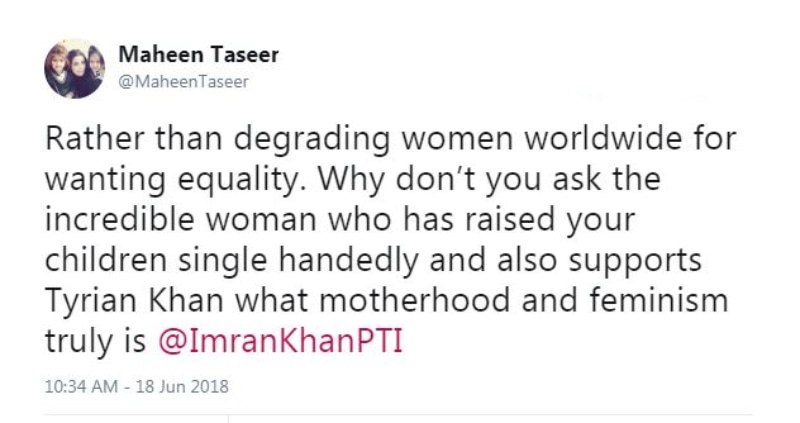
#Pakistan - Imran Khan knows nothing about motherhood and feminism, so we wrote him a cheat sheet


Here are 4 lessons Imran Khan badly needs to learn about this whole feminism motherhood situation.
"A mother has the biggest influence on children... I disagree with this western concept, this feminist movement, it has degraded the role of a mother. My mother had the greatest impact on my life."
These comments made by PTI chief Imran Khan during a televised interview have drawn ire on social media, with commentators saying he has misinterpreted feminism's take on motherhood.


Has he? Yep.
Since Imran Khan proved he knows nothing about feminism and motherhood, we decided to write him a cheat sheet with a few handy hints.
Here's what he needs to learn:

1) The most feminist country in the world also has the best laws protecting working mothers

Yep, we're talking about Iceland. We suspect Imran Khan, like many Pakistanis, equates 'the west' with the United States and Britain, and in doing so ignores more progressive countries that top global rankings for gender equality.
Like Iceland, which for many years has been number one on the World Economic Forum's Global Gender Gap Index.
One of the ways Iceland has achieved this is by passing legislation that protects working mothers and grants new parents parental leave for up to 9 months. The government in Iceland covers parental leave for birth, adoption and foster care for all employees in Iceland, and each parent receives 80% of their salary while on leave.
Parents have the option to split the time of parental leave or however they see fit. This means that the burden of childcare is not placed solely on the mother; this leads to a healthier and more supportive child-rearing experience for both parents and children.
We wonder... if Imran Khan really wants to support mothers, is he ready to take a cue from one of the world's most feminist countries and pass federal legislation extending paid maternity leave?
Hmmm.

2) Feminists have been at the forefront of the fight to have childcare recognised and respected as unpaid labour

Imran Khan has one thing right: being a mother is an incredibly important job.
It is also an incredibly challenging job, one where your boss (baby) expects you to always be on call, pull all-nighters, wake up early and sacrifice your sleep and social life to keep them happy. Expect for one tiny little factor: as a mother you're not expected to ask for compensation for this most difficult of responsibilities.
Modern feminists have been at the forefront of conversations that demand that women's labour at home ought to be taken as seriously as a man's day at the office. When feminists fight for better rights for mothers, they fight for better maternity leave policies in order to ensure that a new mother's labour is financially compensated, better government sponsored daycare, better psychological support for new mothers and more.
Since Imran Khan believes that motherhood is so important, we hope he will also recognise that most women in Pakistan perform this all-important task with little or no material or financial support from the government or from their workplaces. We hope he is ready to provide that support.

3) Feminists don't say motherhood is the wrong choice. They say it isn't the ONLY choice.

Oftentimes people who hold the views that Imran Khan holds also believe that feminism is a motherhood-hating monster that would rejoice if all women became barren.
This is not so.
Feminists are not at war with motherhood; however, they are at war with patriarchy's notion that motherhood is the ONLY viable life path for women.
When you put motherhood on a lofty pedestal and insist it is the highest honour a woman can achieve, you're participating in the devaluation of women who cannot have children or who simply choose not to have children -- and that is wrong.
Plenty of women who don't have children have lived great, memorable lives and achieved truly inspiring goals. We're thinking of Oprah, Helen Mirren, Angela Merkel, Simone de Beauvoir, Gloria Steinem and more.
Also, plenty of men choose to not be fathers. In history and popular culture men who are childless are celebrated as 'rebels' or 'free spirits' or 'creative geniuses' whereas women who are childless are viewed as 'sad' or 'unlucky' or 'incomplete.' What gives?
And on that note...

4) Feminism asks that we not view mothers as the 'only' caretakers of children.

Take a closer look at Imran Khan's glorification of motherhood and you'll see that something appears to missing. What is it?
Fathers.
Glorifying motherhood is the most manipulative tool in patriarchy's arsenal; it justifies male disinterest in parenthood by lumping every responsibility on women and calling it an honour.
Most often invoked by men who have little daily interaction with their children or families, this glorification of motherhood is just another way of saying "I don't think caring for my children is the best use of my time."
If feminism is against anything, it is against the double standards that exist in child-rearing. Feminism doesn't degrade the role of mothers, it insists that fathers take responsibility for the life they helped create.

#Pakistan - Western Feminism - Imran’s latest gaffe


Imran Khan is a man who sees the premiership firmly within reach. It is therefore most unfortunate that no one sent him the memo. The one cautioning men in positions of power to keep schtum when it comes to discussing feminism and motherhood.
The latest gaffe has seen the PTI chairman conclude that “western feminism has degraded the role of mothers”. What he means by this still remains rather unclear. Though there was mention of how children learn from their mothers; especially when it comes to the mother tongue.
Which may or may not be another way of saying that Kaptaan subscribes to the notion that a woman’s place is in the home; at least when children are in the need of primary caregivers. To say that this is an outdated notion is an understatement. Particularly as it appears to take as its premise the idea of a nuclear family whereby both parents are present and fully attendant. Yet here in Pakistan, as anywhere else, there is no one-size-fits-all.
Moreover, children can best learn from their mothers or any adult women in their lives what it means to respect women; be they homemakers or as they climb their way up the career ladder. For here in the 21st century, women are not restricted to either one or the other. The world has moved on due to the struggle of generations and generations of women who came before.
Equally regrettable, however, is the false demarcation between western feminism and ‘the other’. For this unnecessarily pits one group of women against another — when the endgame ought to be the same: equal rights. Or, rather, equality of opportunity between the sexes. But what Imran has unwittingly or otherwise reduced this to, is a conflicting narrative between women of the First World and those of the Global South.
And this has inevitably played out in the legitimate social media backlash against him. Meaning that what we have seen from certain quarters is the message that women in Europe, say, do not share the same struggle as Pakistani women given that the latter are fighting for fundamental rights. This is, of course true, for the majority. But such one-dimensional discourse conveniently circumvents the issue of class. Both here in Pakistan, where some feminists all too often speak for the rural poor. And in Europe, where working-class women increasingly find it difficult to feed themselves and their families.
The issue at hand is not, therefore, what kind of feminism different women believe in but, instead, a recognition that the patriarchy still needs to be smashed. And urgently so. For this global system of gendered injustice will continue to triumph for as long as women are held responsible for suffering at the hands of those who would first oppress them and then castigate them for trying to redress the balance.
All of which is an unwelcome distraction from the issue at hand. Namely, what will a Naya Pakistan look like for the women of this country? We sincerely hope it will be one where women are encouraged to fulfil their individual potential in whichever way they choose.  *

#Pakistan's notorious militant Mullah Fazlullah Gone -- خس کم جہاں پاک


This Eid ul Fitr was special for the entire nation. At last, the notorious militant Mullah Fazlullah –who was head of Tehreek Taliban Pakistan (TTP) – was killed in a drone strike. The news came as a sigh of relief for many whose lives became miserable as these militants not only wrecked the peace of the country but also killed thousands of civilians including children. The scars of attack on Army Public School Peshawar are still fresh in the collective memory of the people.

The death of the TTP leader will also pave the way for better bilateral relations between Islamabad and Kabul. The drone strike that killed the notorious Taliban leader was a joint effort thus strengthening Islamabad’s stance “that a cooperative and coordinated approach is the best response to the menace of terrorism.” The reports that the TTP has confirmed its leader death as well means that their leader is gone for sure unlike the previous false claims about his death.
Meanwhile, when the organisation is in tatters and trying hard to find a haven, it is crucial for America, Afghanistan and Pakistan to work jointly to eradicate terrorism from the region. Instead of securing narrow national interests, a better approach towards the elimination of terrorism and militancy will be if the governments work together to strengthen cooperation and coordination.
The confirmation of Fazlullah’s death will no doubt remove the environment of mistrust between the two neighbours. His demise is also a considerable loss to the TTP. The killing of TTP’s chief is a sigh of relief for Pakistan since he never appreciated dialogue or rapprochement with Islamabad. However, what is essential for all the concerned governments is to keep the fact in mind that his death will not bring Taliban to stop from their attacks on Pakistan. His death is only a temporary setback to the movement. While individuals may be necessary, their end does not mean the elimination of a cause. The uneasy partners in this war on terror need to come up with a strategy that can dismantle the movement.

PPP has always indulged in politics of principles: Asif Ali Zardari


Former president and Pakistan Peoples Party (PPP) co-chairman Asif Ali Zardari said on Sunday that former prime minister Nawaz Sharif has brought Pakistan to a place where the world is making fun of the country.
Talking to the media after a visit to PPP leader Abdul Haq Bhurt’s house here, Zardari said that the PPP has always indulged in politics of principles.
The PPP co-chairman claimed further that the party’s candidates will emerge victorious in the upcoming general election on July 25 and the party will form a government.
Zardari added that the incoming PPP government will right the wrongs committedby the Nawaz-led government which was dissolved on May 31 this year.