Monday, April 16, 2018

#PashtunTahafuzMovement - I am Pashteen – Gul Bukhari’s article which wasn’t published in The Nation today


Editor’s note: The following article by Gul Bukhari could not published by The Nation today for discussing Pashtun Tahafuz Movement. However, we at Naya Daur believe that the article does not criticise any state institution but is an attempt to address the misconceptions about PTM and therefore must reach the audience.

General Bajwa’s comments on PTM

It is astonishing that the country’s military leadership has alluded to the Pashtun Tahafuz Movement as ‘engineered’, with foreign connections. On Thursday the army chief said that ‘engineered protests’ will not be allowed to reverse the gains of counter-terrorism operations and cautioned the nation against forgetting sacrifices of the ‘real heros’, regretting that ‘no sooner had peace returned to FATA than a movement was started’. For the second time in a week on Saturday, the army chief again alluded to the movement as a ‘hybrid war’ being waged on Pakistan to internally weaken the country, but also noted that ‘the enemies were failing to divide the country on the basis of ethnicity and other identities.’ Both times he neither named the PTM nor its leaders.

What is PTM actually demanding?

Setting aside the noise and obfuscation surrounding the movement, first one need only look at the demands of the movement, asking for the restoration of the same fundamental rights that most citizens of other provinces enjoy. Manzoor, and the other leaders, ask to produce in courts of law persons made forcibly missing; they ask for a life of dignity – to not be humiliated for hours at military check-posts while commuting; they ask for their area to be cleared of landmines that are still killing and maiming them; they ask not to be collectively punished for crimes by unknown persons; and they ask for the killer of Naqeebullah Mehsood to be brought to justice. To bring to life the nature of their demands, the leaders of the movement are telling stories of human tragedy in every other household of FATA, stories that earlier remained hidden from view because of a lack of access to the media in FATA.

Support from Afghanistan?

How such demands can be engineered by foreign forces is beyond comprehension. Turned on its head, such statements would imply that the enemies of Pakistan want its citizens to have a life of peace and dignity, but the state does not. It makes no sense whatsoever.
Do we Pakistanis not sympathise with and support the Kashmiris in India? Does that make the uprising in Indian held Kashmir engineered by Pakistan? No it does not.
However, if the statement is in reaction to the sympathy the movement has found among Afghan Pashtuns and in others around the world, then the reaction should itself be analysed with common sense. Firstly, the people of FATA have tribes and families living across the Durand Line and would find natural sympathy and empathy by a people who have lived with similar horrors of war for decades. The support and sympathy are natural, not born out of enmity for the Pakistani state. I would urge the establishment to also consider this: do we Pakistanis not sympathise with and support the Kashmiris in India? Does that make the uprising in Indian held Kashmir engineered by Pakistan? No it does not. Do we not lend moral support to the Palestinians, or to the Rohingya in Burma? Are those not natural and human reactions of horror and sympathy? They make not the intefadahs engineered by Pakistan!

We love our country as much as you do

Expressions of support for the PTM have come from across Pakistan. To name but a few, is Imran Khan, a Pashtun, also playing in foreign hands in asking for justice for the people of FATA? Is Bilawal Bhutto Zardari, a Sindhi son of the soil, also an enemy of the sate of Pakistan? Am I, a Punjabi, a part of the ‘hybrid war’ being waged on Pakistan? Or are Babar Sattar and Raza Rumi, also Punjabis, all ‘anti-state’ elements? Are senators Afrasiab Khattak, Syed Ali Raza Abidi, Mushahid Husain Saiyid waging war on the country? No, Sir, we all love our country and our people. We want peace, education, dignity, and security for all our countrymen and women. If wanting this for Pakistanis is treason, then we are traitors.
At one level or another, every ethnicity and most Pakistanis have felt the blow of violation of their fundamental rights.
I would also urge the establishment to consider how members of the Tehreek Labbiak Ya Rasool Allah are ‘our people’ to be engaged with, and at the cost of paralyzing the government of Pakistan, while PTM’s peaceful protestors merely asking for fundamental rights are foreign agents not be allowed to protest?

PTM not dividing but uniting Pakistan

To address the concern that the PTM is dividing the country on ethnic lines, I would assert that to the contrary, the movement is uniting ethnicities because of human empathy which rises above differences of ethnicity, cast or creed. The voices of support belong not just to the Pashtun, but also to the Punjabi, Mohajir, Sindhi and Baloch. Another reason the sympathy and support cuts across ethnicities is that the demand for fundamental rights also resonates with the rest. At one level or another, every ethnicity and most Pakistanis have felt the blow of violation of their fundamental rights.

Dismal state of freedom of speech in the country

Take the right of free speech. Almost everyone who has dissented has seen their right being violated either by being muted, blacked out, by threat or by death. Journalists are beaten and killed in this country for doing their duty, no matter their ethnicity. Take the right to information. As we speak the largest news group is blacked out in most parts of the country, without explanation or cause. Take the right to security. Punjabi bloggers were forcibly disappeared and tortured before being released mysteriously. Take the right to education. Universities are made to cancel events meant for their students to listen, to think and to debate.
Then take it as good news Manzur Pashteen and his movement is uniting the people of Pakistan like never before. And the reasons are both sympathy and empathy.

The criticism on army

If what rankles is slogans of ‘ye jo dehshat gardi hai, iss ke peechay wardi hai’, then what is needed is wisdom and courage to not only understand what is meant by it, but also to acknowledge the people’s anger at the tragedies they have suffered at the hands of state policies. It should not be hard to do so, given that Pakistan army’s own generals, generals Musharraf and Hameed Gul to name two, have stated that the military amassed religious militants in FATA as a tool of foreign policy.
Who does not know this? For decades the people of FATA have paid with their lives for the militants and then the subsequent war imposed on them. People across the rest of Pakistan have also paid with their lives, but not in as great numbers.

Those soldiers were ours too

The ‘real heroes’ are indeed heroes. Not a single man or woman of any ethnicity can forget their sacrifices. We are all deeply grateful to them. But the heroes and victims are not either, or. The fact that our military soldiers and officers lost their lives in fighting the same militants the institution once planted on our soil, does not negate the suffering of the people. Both are true and real, both need to be acknowledged for healing to take place. We weep as much for our fallen soldiers and officers as we do for the civilian casualties of self-harming policies of the state.
In fighting the militancy, human rights abuses were also committed. Those too need to be acknowledged and ceased for healing to take place. The demand for ceasing of those violations is all there is to the PTM, which many of us now see not just as the Pashtun Tahafuz Movement, but as the Pakistan Tahafuz Movement. The state should engage with the movement, instead of accusing it without evidence. By and large, the citizenry is now cynical of such accusations because of the jaded use of such tactics for seventy years.

Pakistan Watchdog Says Country Failing on Human Rights


BY KATHY GANNON
An independent Pakistani watchdog criticized the country's human rights record over the past year in a new report released Monday, saying the nation has failed to make progress on a myriad of issues, ranging from forced disappearances, to women's rights and protection of religious minorities.
The damning report card issued by the Human Rights Commission of Pakistan says people continue to disappear in Pakistan, sometimes because they criticize the country's powerful military or because they advocate better relations with neighboring India. The controversial blasphemy law continues to be misused, especially against dissidents, with cases in which mere accusations that someone committed blasphemy lead to deadly mob violence, it said.
While deaths directly linked to acts of terrorism declined in 2017, the report says attacks against the country's minorities were on the rise.
The 296-page report was dedicated to one of the commission's founders, Asma Jahangir, whose death in February generated worldwide outpouring of grief and accolades for the 66-year-old activist who was fierce in her commitment to human rights. "We have lost a human rights giant," U.N. Secretary General Antonio Guterres said following Jahangir's death. "She was a tireless advocate for inalienable rights of all people and for equality - whether in her capacity as a Pakistani lawyer in the domestic justice system, as a global civil society activist, or as a Special Rapporteur ... Asma will not be forgotten."
Monday's report also took aim at religious bigotry in Pakistan and the government's refusal to push back against religious zealots, fearing a backlash.
"Freedom of expression and freedom of association is under attack, except for those who carry the religious banner," commission spokesman I.A. Rehman said at the release of the report, which accused Pakistani authorities of ignoring "intolerance and extremism." Religious conservative organizations continue to resist laws aimed at curbing violence against women, laws giving greater rights to women and removing legal restrictions on social exchanges between sexes, which remain segregated in many parts of Pakistani society, it said.
Still, there was legal progress in other areas, it noted, describing as a "landmark development" a new law in the country's largest province, Punjab, which accepts marriage licenses within the Sikh community at the local level, giving the unions protection under the law.
But religious minorities in Pakistan continued to be a target of extremists, it said, citing attacks on Shiites, Christians falsely accuse of blasphemy and also on Ahmedis, a sect reviled by mainstream Muslims as heretics. Ahmedis are not allowed under Pakistan's constitution to call themselves Muslims.
"In a year when freedom of thought, conscience and religion continued to be stifled, incitement to hatred and bigotry increased, and tolerance receded even further," said the report. On Sunday in Quetta, the capital of southwestern Baluchistan province, gunmen attacked Christian worshippers as they left Sunday services, killing two. Five other worshippers were wounded, two seriously.
Last year was a troubling year for activists, journalists and bloggers who challenged Pakistan's military. Several were detained, including five bloggers who subsequently fled the country after their release. From exile, some of them said their captors were agents of Pakistan's intelligence agency, ISI. The agency routinely refuses to comment on accusations it is behind the disappearances. The bloggers were also threatened with charges of blasphemy. In December, Raza Mehmood Khan, an activist who worked with schoolchildren on both sides of the border to foster better relations was picked up by several men believed to be from the ISI after leaving a meeting that criticized religious extremism.
In recent weeks, Pakistan's Geo Television has been forced off the air in much of the country. Many activists have blamed this on the military, which took umbrage when the outlet criticized the country's security institutions.
Last year, a government-mandated commission on enforced disappearances received 868 new cases, more than in two previous years, the report said. The commission located 555 of the disappeared but the remaining 313 are still missing. "Journalists and bloggers continue to sustain threats, attacks and abductions and blasphemy law serves to coerce people into silence," the report said.
https://www.usnews.com/news/world/articles/2018-04-16/pakistan-watchdog-says-country-failing-on-human-rights

Bilawal Bhutto Zardari strongly condemns terrorist attack near Church area in Quetta

Chairman Pakistan Peoples Party Bilawal Bhutto Zardari has strongly condemned terrorist attack near Church area in Quetta in which innocent persons were killed on Sunday.
In a statement, the PPP Chairman said that terrorists unleashed serial attacks on Christian community in Quetta to tarnish the image of the country and its harmonious society and demanded for stern action against terrorists involved in these attacks.
Bilawal Bhutto Zardari expressed sympathy with those who fell victims to the Quetta terrorist attacks and demanded best possible medical treatment to those injured in the attack.

https://mediacellppp.wordpress.com/2018/04/15/bilawal-bhutto-zardari-strongly-condemns-terrorist-attack-near-church-area-in-quetta/

Sunday, April 15, 2018

Video Report - Protests against #Syria air strikes take place outside White House

Video Report - What 5G Means for Your Phone

Video Report - 🇦🇺 Australia's New Stolen Generation?

Video Report - CrossTalk on Syria: Path to War

'Double standards: US, UK, France stand by Saudis in Yemen but pose as moral crusaders in Syria'


Syria attack reveals the hypocrisy of the West – which fuels the Saudi-led bombing campaign in Yemen despite documented abuses – but relies on unverified claims to punish Syria, journalist and broadcaster Neil Clark told RT.
As Riyadh's campaign in Yemen enters its fourth year, it has been repeatedly accused by rights groups of civilian casualties during the bombardment. However, in Syria's case, reports of a chemical weapon attack in Douma that are yet to be independently corroborated became the trigger for a coordinated military action, Clark pointed out.
"On the one hand, they are rolling out the red carpet for Saudi leaders and they are supporting, either directly or indirectly, the Saudi bombing of Yemen, which is causing a great humanitarian catastrophe – and how many children has that conflict killed?
"On the other hand, they pose as moral paragons, as moral crusaders when they claim children have died in Syria's chemical weapons attack without evidence," he said.
Clark argued that by continuing its weapons sales to Riyadh, the West "has been feeding and supporting that conflict."
Between March 2015 (the start of the Saudi-led campaign) and February 2018, almost 6,000 civilians were killed and 9,500 wounded, according to the UN Office of the High Commissioner for Human Rights. In its report in March, Amnesty International said it has documented at least 36 coalition airstrikes that appeared to be carried out in violation of international humanitarian law, many of which may constitute a war crime. At least 513 civilians perished in their raids, including 157 children, it said.
"So, on one hand we have got documented evidence of children dying in huge numbers in Yemen through cholera and through bombing. That's true, that's evidence, actually. And the same powers responsible for that are bombing Syria in response to unverified claims of attacks on children in Syria," Clark said. "The double standards are totally, totally off-the-scale."
Just last month, UK Prime Minister Theresa May, US President Donald Trump, and French President Emmanuel Macron welcomed Saudi Crown Prince Mohammed bin Salman, the Gulf country's defense minister and de-facto ruler who is on a charm offensive in Europe and the US.
As a result, the UK, which has provided a steady supply of arms to the ultraconservative kingdom, signed a huge arms deal with Riyadh that will see it purchasing 48 Typhoon jets from British firm BAE Systems. 
In his own meeting with bin Salman in Washington, President Trump boasted about $12.5 billion in finalized sales of American weapons to Saudi Arabia. In May 2017, he chose Saudi Arabia for his first foreign trip as president and signed a record $350-billion arms deal. 
France, which according to data from the Stockholm International Peace Research Institute (SIPRI) was Saudi Arabia's third biggest weapons supplier between 2013 and 2017, might soon also conclude a new series of deals with the kingdom.
Last week, a French defense minister official told Reuters that France had agreed on a new arms export strategy with Saudi Arabia. According to reports in French media, Paris can soon start selling navy patrol boats and Caesar artillery canons to Saudi Arabia, manufactured by CMN and Nexter respectively. 

Music Video - Madonna - Justify My Love

#DeleteFacebook #DeleteYourFacebookAccount - Mark Zuckerberg Tries to Explain Facebook to Congress

Video Report - President Trump and James Comey battle over new book

Video Report - Bharara: Trump doesn't fully understand attorney-client privilege

Video report - 'You Have No Credibility' Stephanopoulos PUTS Sarah Sanders In Her PLACE When She Won't Stop Lying

Pashto Music - Sardar Ali Takkar - ''PORE''

Music Video - Musarrat Nazir - Main kamli da dhola

Urdu Music Video - Pyar Bhare Do Sharmeele Nain -1974 Chahat

Urdu Music Video - Rafta Rafta Woh - Zeenat

Urdu Music Video - Zoe Viccaji - Phir Mili Tanhai

Urdu Music Video - Zoe Viccaji- Ho Jao Aazad

#Pakistan - Targeted attack: Two #Christians killed, three hurt in #Quetta shooting


At least two members of the Christian community were killed and three more were injured, two of them girls, after gunmen opened indiscriminate firing in Isa Nagri, a Christian neighbourhood near the Brewery Road on Sunday evening.

According to Police, four armed men riding two motorbikes entered Isa Nagri and started shooting people sitting outside their homes.
“As a result of intense firing, five members of Quetta’s Christians community were injured and rushed to Bolan Medical Complex Hospital (BMC) for treatment,” Brewery Road SHO Javed Buzdar said. According to him, the attackers managed to escape after the shooting.
Two of the injured – Rashid Khalid and Azhar Iqbal – died on way to the hospital.
Family members of the deceased also accused hospital staff of gross negligence. They said that their relatives were not provided immediate medical care. “At that time, there was no senior doctor in the hospital. The patients were handled by trainees who did not even know how to treat a bullet wound,” said Parvez Masih, a relative of one of the deceased.
The injured were identified as Mehvish, Sunena and Samuel, a prominent figure in Isa Nagri.
Four members of a Christian family among nine killed in Quetta attacks.
BMC Surgeon Dr Mola Buksh said that all of the injured had multiple bullet injuries.
He said that the injured girl, Mehvish, had been shifted to the Civil Hospital’s Trauma Centre for better medical care.
Sunday’s attack was the third attack on Christian Community in the provincial capital in the last four months. At least 15 Christians have been killed in a suicide attack and multiple targeted attacks since last December.
Da’ish claimed responsibilities for a suicide bombing at a church last year and also for the Shahzman road targeted killings earlier this month.
Balochistan Home Minister Mir Sarfaraz Bugti condemned the Isa Nagri attack and promised a swift response.
A heavy contingent of law-enforcement personnel, including police and Frontier Corps (FC), Balochistan, rushed to the spot and cordoned off the area.
The Christian community staged a protest demonstration against the provincial government and called for the immediate arrest of the attackers. They also urged the government to provide protection to all members of the Christian community in Quetta.
“Why are we coming under attack? Terrorists are freely attacking us but security forces and the provincial government are playing the role of silent spectator,” said Amjad Faryad, an uncle of slain Rashid Khalid.
Protesters blocked Brewery and Sabzal roads and set tyres on fire.

OP-ED The state should engage with PTM. Dubbing it ‘engineered’ will not work


By Raza Rumi

One cannot endorse language that undermines national institutions and derails the fundamental issues but PTM has a larger story that needs to be heard.
The Pashtun Tahafuz Movement has gained immense momentum in recent weeks. The well-attended rally in Peshawar (held on April 8) indicated that PTM and its cause resonate with a large number people within the Federally Administered Tribal Areas (FATA) and Khyber Pakhtunkhwa province. More surprising was the solidarity expressed by other parts of Pakistan. Since the PTM has been blacked-out by mainstream media, the conversations have shifted to social media or else the one-sided attempts by some TV channels to discredit the movement.
The opposition to PTM comes from the military itself and the Army chief confirmed the ‘official’ view when he termed the protests as ‘engineered’. Prior to this clear denunciation, the COAS also visited the home of Naqeebullah Mehsud, the young man who was killed by an infamous police officer in Karachi and what in fact became the immediate catalyst for political mobilisation.
The Army as an institution is angry about the PTM narrative for a number of reasons. First, the sloganeering at the rallies has been critical. Yeh jo dehshatgardi hay/ Iske peechay vardi hay (literally: terrorism is backed by uniform). Second, PTM’s main leader Manzur Pashteen referred to the intelligence outfits by name in his Peshawar rally. There are other reasons why the movement has been dubbed ‘anti-Army’ but the key reason is more complex. The young men and women of FATA and KP are challenging the strategic worldview of the military led security policy that has on different occasions patronised and on others, targeted the militants. That some of these militants are Pashtun themselves makes this even more complicated. Hence the refrain that militants found sanctuaries in FATA and were ‘abetted’ by the protestors.
One cannot endorse language that undermines national institutions and derails the fundamental issues here. The Pakistani Taliban and their affiliates have attacked thousands of military personnel; and many of those who lost their lives were officers. In fact the younger officers corps and soldiers have a reason to be alarmed when their ‘sacrifices’ are not recognised by political conversations. The fact that ethnic identity is galvanising the Pashtun Tahafuz Movement does not mean that this is a separatist movement. It is time for the strategic minds to move beyond dated rhetoric The misgivings about PTM have resulted in the standard formula response. The latter is being projected as a foreign-sponsored movement. The support expressed by high officials in Afghanistan is seen as evidence of engineering. But Pashtuns live on both sides of the Durand Line. A point we consider kosher when we want to support the Afghan Taliban but one that suddenly becomes treasonous when an anti-war movement finds traction on the other side of the border. Another trope employed, especially on social media, is that of the Pashtunistan bogey. The quest for a greater land for the Pashtuns is over. Since the 1980s, this group has been economically as well politically integrated into the mainstream. Far more than the Baloch for instance. But that’s a separate story. None of the speeches or demands made by PTM has mentioned this point. The fact that ethnic identity is playing a major role in mobilisation does not imply that this is a separatist movement. It is time for the strategic minds to move beyond dated rhetoric.
Time and again, Pashteen and his followers have said that their movement is within the ambit of the Pakistani constitution. In fact the mobilisation that asks for due process, recovery of missing persons, ending extra-judicial killings and abolishing apartheid in FATA are all essentially constitutional demands. A movement that asks for the enforcement of fundamental rights cannot be anti-state unless the state thinks that it can dispense with the Constitution as and when required. Given how this has been trampled on and abused by both civvies and khakis — the PTM narrative strengthens the hope for a pluralist, democratic Pakistan.
Manzur Pashteen was an 8-year-old child when 9/11 took place. He is being asked about the past as if he were in charge of FATA affairs. In fact, questions are always posed by those who wield power and in our case it is the military that has been directly in control of the tribal areas, which have been a war zone and remain so. Pashteen represents the displaced and war-torn people of FATA who deserve compassion, understanding and due process like other citizens of Pakistan. Calling him and other PTM leaders traitors is a huge disservice to the course correction and rehabilitation that must follow after the area has been cleared of militants.
There has been endless social media commentary on how the ‘treasonous’ (or khooni liberals, to use an Imranism) supported bloodshed by asking the Army to clear FATA of insurgents; and now under the ‘orders’ of Pakistan’s foreign enemies they are backing the PTM. Trolls have also attacked me relentlessly. It is certainly pointless to engage with biased and paid vehicles of disinformation, though it would worthwhile to set the record straight. Many of us supported (and still do) the Army’s clean up against the Pakistani Taliban and their affiliates. However, we also caution that human rights must not be violated; displacements of the population should not be arbitrary and if they take place must be corrected through appropriate state interventions. More importantly, we have also asked for clarity in how the state views militants — assets, rogue assets or enemies of Pakistan’s future. While things have improved since Gen Raheel Sharif, there is still much ambiguity and reluctance to completely dismantle the militant infrastructure. Are the ‘good’ ones still central to our Afghanistan and India policies?
Pashteen challenges that and perhaps this is why he is more of a threat than the handful khooni liberals who write for the English press and get an occasional few minutes on electronic media. Political parties, by and large — given the treatment meted out to Nawaz Sharif — acquiesced when it comes to dissenting on Afghan and India policies.
The rise of PTM as a growing social movement is a testament of dynamic factors that define contemporary Pakistan: assertion of youth voice, urbanisation and new media, among others. It is an opportunity for the state to show that it cares and is willing to engage with a segment of population that feels neglected, angry and mistreated. A few slogans cannot be used to overlook the ruptured state-citizen relationship across the country.

Bilawal Bhutto strongly condemns firing on the residence of Supreme Court judge Justice Ijazul Ahsan in Lahore

Chairman Pakistan Peoples Party Bilawal Bhutto Zardari has strongly condemned firing on the residence of Supreme Court judge Justice Ijazul Ahsan in Lahore and demanded an independent inquiry into the incident.
In a statement, the PPP Chairman said that intimidation of judges was an unpardonable act and those involved directly and indirectly in the firing incidents on the residence of Justice Ijazul Ahsan should not go scot-free and deserved exemplary punishment.
Bilawal Bhutto Zardari said that PPP stands for protection and respect of judges despite the fact that it has been a victim as its founder Shaheed Zulfikar Ali Bhutto was made target of judicial murder but not a single stone was thrown against anyone from judiciary.

https://mediacellppp.wordpress.com/2018/04/15/bilawal-bhutto-zardari-strongly-condemns-firing-on-the-residence-of-supreme-court-judge-justice-ijazul-ahsan-in-lahore/

#Pakistan - Shots fired at Supreme Court Justice Ijazul Ahsan's Lahore residence

Two separate firing incidents were reported at the residence of Supreme Court Justice Ijazul Ahsan on Sunday. 
A statement by the apex court revealed that the judge's Model Town residence was struck by bullets first late last night and then again early morning today.
The judge's house is located very close to the residence of the Punjab chief minister and his son MNA Hamza Shehbaz, where there is visible police presence throughout the day.
Chief Justice of Pakistan Justice Saqib Nisar arrived at the residence of his fellow judge after the incident and is overseeing the situation, the statement by the apex court added.
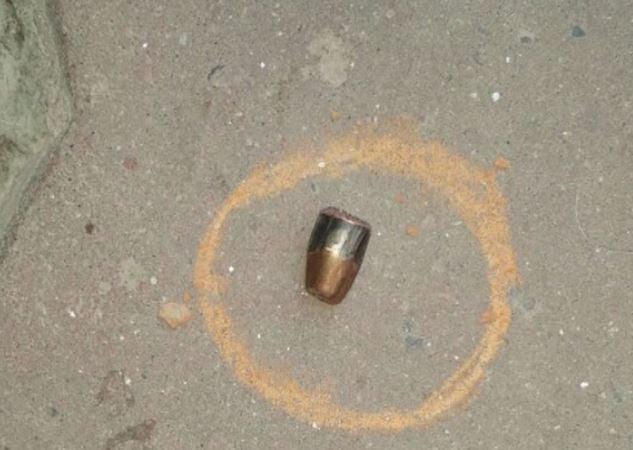
The bullet recovered from the house - Geo News
Chief Justice Nisar, after reaching the residence, summoned the Punjab police chief and ordered an investigation. 
Similarly, Punjab Chief Minister Shehbaz Sharif has taken notice of the incident and directed the Punjab inspector general to bring the culprits to book. 
Rangers personnel also reached the site after the incident as did Special Branch officials while a police investigation is under way. 
According to police officials, the judge's private security guard, Din Mohammad, discovered a 9mm bullet casing inside the residence at 6am today after which the police were called in. 
Police officials said the shell has been sent for forensic analysis, adding that they are also reviewing footage of CCTV cameras in the area. 
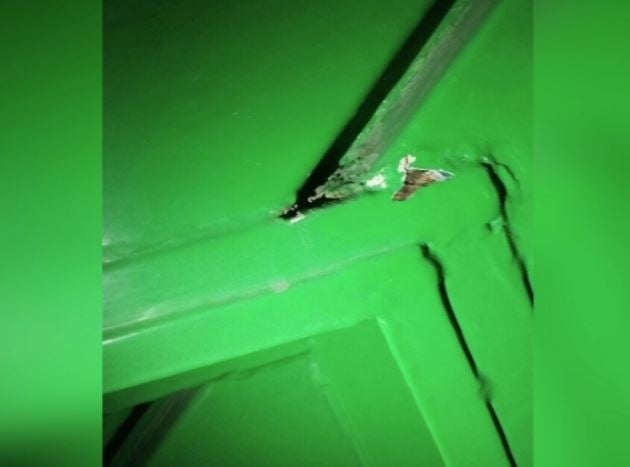
Another bullet was recovered from the garage of the house. 
A bullet hole at the residence. Photo: Geo News
Neighbours of the judge informed Geo News that they do not recall hearing gunshots in the night. 
Police believe the shots were fired from roofs of surrounding houses and not the street in front of the house. 
Later in the day, a Supreme Court spokesperson said that the chief minister's personal staff officer was not allowed to meet Justice Ahsan when he arrived at his residence.  
'Sicilian mafia tactics' 
Following the incident, reports of condemnations poured in with the legal community announcing to wear black armbands in protest tomorrow.
Moreover, Pakistan Tehreek-e-Insaf Chairman Imran Khan said on Twitter that these "Sicilian-mafia-like tactics to pressurise senior judiciary are unacceptable in any democracy". 
He added that the PTI stands firmly behind the judiciary and rule of law.
Similarly, former president and Pakistan Peoples Party leader Asif Zardari called for a high-level judicial probe into the incident. 
Later on, Prime Minister Shahid Khaqan Abbasi released a condemnation message and directed for the early arrest of those responsible.  
In her condemnation, State Information Minister Marriyum Aurangzeb said such anacrhists should be unveiled as soon as possible. 
High-profile judge 
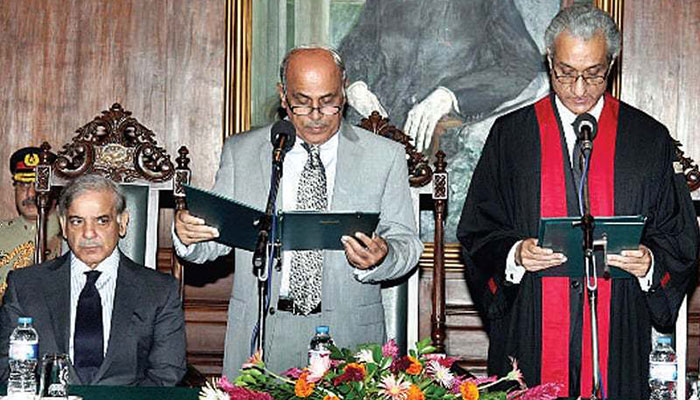
Justice Ahsan taking oath as the LHC CJ in Nov 2015. Photo: File 
Justice Ahsan often spends the weekend in Lahore, his hometown, where he, along with the chief justice, presides over several cases related to public welfare issues and other matters at the Lahore registry.
Justice Ahsan is also the monitoring judge of the ongoing corruption cases against former prime minister Nawaz Sharif. He was part of the bench which disqualified Nawaz in the Panama Papers case last year. 
He has also remained as the chief justice of the Lahore High Court. 

Saturday, April 14, 2018

Music Video - Arabic Music - Haifa Wehbe - Ana Haifa VERY HQ!!

From #China _ #US, allies risk #Russian retaliation in #Syrianattack

US President Donald Trump announced on Friday he ordered strikes on the Syrian regime in response to a chemical attack last weekend. He said the strikes were in coordination with France and the United Kingdom. Syrian President Bashar al-Assad said his country is being "invaded" by the three countries. The Russian Embassy in the USA said in a statement that "insulting the President of Russia is unacceptable and inadmissible."

In a sensational statement, Trump asserted the Bashar Assad government used chemical weapons on civilians. He said "The evil and the despicable attack left mothers and fathers, infants and children thrashing in pain and gasping for air. These are not the actions of a man. They are crimes of a monster instead."Trump also warned "Russia must decide if it will continue down this dark path or if it will join with civilized nations as a force for stability and peace."

The facts cannot be distorted. This military strike was not authorized by the UN, and the strikes targeted a legal government of a UN member state. The US and its European allies launched strikes to punish President Bashar al-Assad for a suspected chemical attack in Duma last weekend. However, it has not been confirmed if the chemical weapons attack happened or if it did, whether government forces or opposition forces launched it. International organizations have not carried out any authoritative investigation.

The Syrian government has repeatedly stressed that there is no need for it to use chemical weapons to capture the opposition-controlled Duma city and the use of chemical weapons has provided an excuse for Western intervention. The Syrian government's argument or Trump's accusations against the "evil" Assad regime, which one is in line with basic logic? The answer is quite obvious.

The US has a record of launching wars on deceptive grounds. The Bush government asserted the Saddam regime held chemical weapons before the US-British coalition troops invaded Iraq in 2003. However, the coalition forces didn't find what they called weapons of mass destruction after overthrowing the Saddam regime. Both Washington and London admitted later that their intelligence was false. 

Washington's attack on Syria where Russian troops are stationed constitute serious contempt for Russia's military capabilities and political dignity. Trump, like scolding a pupil, called on Moscow, one of the world's leading nuclear powers, to abandon its "dark path." Disturbingly, Washington seems to have become addicted to mocking Russia in this way. Russia is capable of launching a destructive retaliatory attack on the West. Russia's weak economy is plagued by Western sanctions and squeezing of its strategic space. That the West provokes Russia in such a manner is irresponsible for world peace. 

The situation is still fomenting. The Trump administration said it will sustain the strikes. But how long will the military action continue and whether Russia will fight back as it claimed previously remain uncertain. Western countries continue bullying Russia but are seemingly not afraid of its possible counterattack. Their arrogance breeds risk and danger.

Video Report - #Russian Foreign Minister comments on #Syria strikes and #Skripal case

Video Report - #Syria air strikes: The mood in #Damascus - BBC News

Video Report - #Syria, Morning After "Horrible American Strikes" - Syrians Are Partying On Damascus Streets

Video Report - #Syria and its allies respond to strikes

Video Report - USA vs Russia Total War! Detailed Military Comparison 2018

Video Report - The challenge for US with Russia in Syria

Video Report - 🇸🇾 What will US attacks against Assad achieve? - UpFront

#syriaattack #Syriawar - The West’s Moral Hypocrisy on Yemen


By Jonathan Marshall
Global Research, February 22, 2017
The West’s “humanitarian interventionists” howl over bloody conflicts when an adversary can be blamed but go silent when an ally is doing the killing, such as Saudi Arabia in Yemen, reports Jonathan Marshall.
Only a few months ago, interventionists were demanding a militant response by Washington to what George Soros branded “a humanitarian catastrophe of historic proportions” — the killing of “hundreds of people” by Russian and Syrian government bombing of rebel-held neighborhoods in the city of Aleppo.
Leon Wieseltier, a senior fellow at the Brookings Institution and former New Republic editor, was denouncing the Obama administration as “a bystander to the greatest atrocity of our time,” asserting that its failure to “act against evil in Aleppo” was like tolerating “the evil in Auschwitz.”
How strange, then, that so many of the same “humanitarian” voices have been so quiet of late about the continued killing of many more innocent people in Yemen, where tens of thousands of civilians have died and 12 million people face famine. More than a thousand children die each week from preventable diseases related to malnutrition and systematic attacks on the country’s food infrastructure by a Saudi-led military coalition, which aims to impose a regime friendly to Riyadh over the whole country. “The U.S. silence has been deafening,” said Philippe Bolopion, deputy director for global advocacy at Human Rights Watch, last summer. “This blatant double standard deeply undermines U.S. efforts to address human rights violations whether in Syria or elsewhere in the world.”
Official acquiescence — or worse — from Washington and other major capitals is encouraging the relentless killing of Yemen’s civilians by warplanes from Saudi Arabia and its allies. Last week, their bombs struck a funeral gathering north of Sanaa, Yemen’s capital, killing nine women and a child and injuring several dozen more people.
A day earlier, officials reported a deadly “double-tap” airstrike, first targeting women at a funeral in Sanaa, then aimed at medical responders who rushed in to save the wounded. A United Nations panel of experts condemned a similar double-tap attack by Saudi coalition forces in October, which killed or wounded hundreds of civilians, as a violation of international law.
The Tragedy of Mokha
On Feb. 12, an air strike on the Red Sea port city of Mokha killed all six members of a family headed by the director of a maternal and childhood center. Coalition ground forces had launched an attack on Mokha two weeks earlier.
Xinhua news agency reported, “the battles have since intensified and trapped thousands of civilian residents in the city, as well as hampered the humanitarian operation to import vital food and fuel supplies . . . The Geneva-based UN human rights office said that it received extremely worrying reports suggesting civilians and civilian objects have been targeted over the past two weeks in the southwestern port city . . . Reports received by UN also show that more than 200 houses have been either partially damaged or completely destroyed by air strikes in the past two weeks.”
The U.N.’s humanitarian coordinator further reported that “scores of civilians” had been killed or wounded by the bombing and shelling of Mokha, and that residents were stranded without water or other basic life-supporting services.
That could be Aleppo, minus only the tear-jerking photos of dead and wounded children on American television. However, unlike Syria, Yemen’s rebels don’t have well-financed public relations offices in Western capitals. They pay no lip service to the United States, democracy, or international human rights. Their foe Saudi Arabia is a friend of Washington, not a long-time adversary. In consequence, few American pundits summon any moral outrage at the Saudi-led coalition, despite findings by a United National Panel of Experts that many of its airstrikes violate international law and, in some cases, represent “war crimes.”
Aiding and Abetting
The United States hasn’t simply turned a blind eye to such crimes; it has aided them by selling Saudi Arabia the warplanes it flies and the munitions it drops on Yemeni civilians. It has also siphoned 54 million pounds of jet fuel from U.S. tanker planes to refuel coalition aircraft on bombing runs. The pace of U.S. refueling operations has reportedly increased sharply in the last year.

The Obama administration initially supported the Saudi coalition in order to buy Riyadh’s reluctant support for the Iran nuclear deal. Over time, Saudi Arabia joined with anti-Iran hawks to portray Yemen’s rebels as pawns of Tehran to justify continued support for the war. Most experts — including U.S. intelligence officials — insist to the contrary that the rebels are a genuinely indigenous force that enjoys limited Iranian support at best.
As I have documented previously, all of the fighting in Yemen has damaged U.S. interests by creating anarchy conducive to the growth of Al Qaeda extremists. They have planned or inspired major acts of terrorism against the West, including an attempt to blow up a U.S. passenger plane in 2009 and a deadly attack on the Parisian newspaper Charlie Hebdo in January 2015. The Saudis tolerate them as Sunni allies against the rebels, in the name of curbing Iran.
Though the Obama administration is gone, the Trump administration is flush with ideologues who are eager to take a stand against Tehran through Yemen and look tough on “terrorism.” Within days of taking office, President Trump approved a commando raid targeting an alleged Al Qaeda compound in central Yemen that went awry, killing an estimated 10 women and children. The administration has also diverted a U.S. destroyer to patrol Yemen’s coast.
Secretary of State Rex Tillerson, to his credit, has cited “the urgent need for the unfettered delivery of humanitarian assistance throughout Yemen,” according to a department spokesman. But no amount of humanitarian aid will save Yemen’s tormented people from the bombs made in America and dropped from U.S.-made warplanes, with little protest from Washington’s so-called “humanitarian interventionists.”

Pashto Songs - Pekhawar Kho Pekhawar De Kana - By Irfan Khan

#Pakistan - #PashtunTahafuzMovement - #Peshawar rally and beyond


By Afrasiab Khattak

By Ajmal Khattak

8th of April was yet another watershed moment for the hardly three months old Pashtun Tahafuz Movement ( PTM). In fact it was a milestone on the path of redefining Pashtun political discourse in Pakistan. But it is also pertinent to note that this development has significant implications for political discourse all over Pakistan. After squandering the last few years in the creeping coup, the scripted sit-ins, weaponizing religion and judicialization of power games, the country can ignore deep alienation and simmering unrest in FATA, Balochistan and Gilgit-Baltistan at its own peril. By holding a huge gathering of tens of thousands of enthusiastic Pashtuns in Peshawar, the administrative capital of Pakhtunkhwa and political capital of 45 million plus Pashtuns in Pakistan, the newly born PTM has made its mark in popular politics. Earlier the young leaders of this new movement demonstrated their popularity by marching in the southern belt of Pashtuns and by addressing a series of huge gatherings in Zhob, Qilla Saifullah and Quetta. PTM has originated in Waziristan which is located in the south of Khyber Pakhtunkhwa. But even a cursory glance at the map reveals that it is in middle of Pashtun lands on the eastern side of the Durand Line. By linking up to historical centers of Quetta in the south and to Peshawar in the north through mass mobilisation, PTM has already become a political force to be reckoned with.
The impressive aspect of this successful mass mobilisation is that Manzoor Pashteen and his young team could achieve it without any formal organisational structure and despite being totally blacked out by most of the so called mainstream media. It is for the first time that a nascent sociopolitical movement has successfully beaten back the monopoly of state controlled and corporate electronic and print media on access to information by the effective use of social media for spreading its message. This achievement is remarkable for the youth of a marginalised people living in an ‘ excluded area’ under the yet to be reformed colonial structures. But it is also important to remember that a strong wave of solidarity across the ethnic and regional boundaries attracted by the movement made this achievement possible.
As we know the deep pain, agonies and humiliation of war and displacement generate narratives and stories which aren’t reflected in the official press releases about the situation and become mere statistics. But PTM has provided a platform where these narratives and personal stories can be shared and recorded. This is the first step towards getting out of the trauma of war and displacement. The massive turn up of the families of the victims of enforced disappearances is yet another characteristic of this nascent movement. Manzoor Pashteen has made it clear that he is not demanding the release of persons accused of committing crimes. He only wants their production in courts for due process. But enforced disappearance of thousands of people is a very grave challenge on human rights front and cannot be ignored.
The Pashto songs sung by thousands in chorus express the deep desire of Pashtuns to reclaim their land, their culture and their dignity destroyed by terrorism and state oppression. The growing participation of women in the rallies gives strength to the movement. Interestingly far from being passive spectators women activists can be seen delivering passionate speeches, raising slogans and singing revolutionary songs. Hearing the speeches of PTM leaders it isn’t difficult to understand that they belong to a generation which has come to know the Pakistani state through its military. Manzoor Pashteen is 26 years old now. In 2002 when military was inducted in FATA on a large scale he was 8 years old. In the last eighteen years he has seen a decade when FATA was left at the mercy of terrorists. They killed the local people with impunity as the state did not act against terrorism with an eye on Taliban’s war in Afghanistan. Ali Wazir, the second most prominent leader of PTM, has lost more than a dozen members of his immediate and extended family to terrorism. Then there were military operations in which common people suffered more because of the double games played by the state. Prolonged curfews were particularly disturbing for a population that had lived without proper state control for centuries. Displacement brought new kinds of suffering and humiliation on the one hand but on the other hand exposed them to urban experiences and influences generating a higher level of sociopolitical consciousness. On their return the IDPs could not put up with the total disempowerment that waited for them back home. The lava accumulated through all these troubles and tribulations was waiting for eruption.
The insinuations coming from the GHQ about the “engineered” nature of PTM are simply shocking. Those who have raised no objection over Afghan Taliban Amir accepting oath of allegiance of Pakistani Taliban are perturbed over popularity of Pashteen cap across the Durand Line as an act of solidarity for peace in both countries ! PTM has repeatedly stated that it stands for the rights of oppressed people within the limits of Pakistani Constitution but the intelligence agencies are orchestrating artificial and so called demonstrations against PTM to give the impression as if the the youth movement is a threat for the country. It is particularly weird in a country where 139 UN designated terrorist entities don’t face the type of hounding and maligning that is faced by a grass roots non violent human rights movement.
Last but not the least is the question of relationship of PTM with established political parties in general and nationalist political parties in particular. Political parties have been generally cautious in responding to a new grass roots movement but they have also shown restraint in view of the popular support demonstrated by PTM. It is my considered opinion that nationalist parties shouldn’t be worried because of two factors. One, it is after all the seeding of Pashtun nationalist movement which has sprouted in the form of the new movement. The leaders of PTM commit themselves to the political legacy of Bacha Khan and Khan Shaheed, the founding fathers of the nationalist movement in 20th century. Two the epicentre of the new movement is FATA Pashtuns where the old parties didn’t have sufficient presence. If handled deftly the new movement is complimentary and not contrarian to broad Pashtun national movement. In fact PTM is warming up to the idea of broader democratic movement by addressing the concerns of oppressed people all over Pakistan.

#PashtunTahaffuzMovement - #Pakistan - OP-ED When Pekhawar roared


By Talimand Khan


The PTM movement is not only shredding the stereotypical, engineered image of the Pakhtun seem by seem, but also washing away the arbitrary division among them.

The Peshawar rally organised by the Pashtun Tahafuz Movement (PTM) on April 8, was unique in many ways.  The most remarkable was the surprisingly huge response they received from the city. Apparently, it was far beyond the expectations of the organisers. By 3 o’clock the earmarked portion for the rally swelled beyond capacity, forcing the removal of partitions to accommodate the expanding bulge.
Even when it began to rain during Ali Wazir’s speech, the crowd remain unperturbed, and stayed for Manzoor Pakhtun’s 32 minute long speech. Furthermore, if the participation of women in a rally in Peshawar was not noteworthy enough, victims of enforced disappearances were also finally given the opportunity to share their heart wrenching ordeals. But the most salient feature was the attendance of Pakhtuns holding a myriad of different opinions and political points of view.
It was amazing seeing Pakhtun intelligentsia, writers, poets, professionals, teachers, professors, social activists and political workers congregating in one place under the PTM banner. Their faces were visibly beaming with new hope, exhibiting a sort of relief from the long mental agony they had suffered. There was finally some optimism that a new beginning could be around the corner, and that Pakistan’s long suffering Pakhtun community could finally find a way out of the existing political suffocation and decay.
For most of the participants; this was the first time they had seen such a spectacle. A rally that had convergence of views and determination for a cause. The majority of them defied their pre-held political affiliation and loyalties, notwithstanding the forewarnings of their respective parties. As we surveyed the crowd, one of our friends pointed out that the rally could be termed a gathering of opinion makers rather than a mere show of reluctant and passive participants.
Right now, it’s just the beginning. Nobody can predict the political future of this movement at the moment with much precision
Coming back to the role played by women; they were not only active in the rally but had a leading role in mobilisation, organisation and management. This is not just unique in Khyber Pakhtunkhwa (KP), but all of Pakistan.
At least in my knowledge there is no precedent in KP for a woman, particularly a young woman like Sana Ijaz, as a steward performing as stage secretary of a huge public rally attracting crowds from FATA and other areas with a predominantly Pakhtun population.
The PTM movement is not only shredding the stereotypical, engineered image of the Pakhtun seem by seem, but also washing away the arbitrary division among them. If the Zhob, Qaila Saifullah and Quetta rallies destroyed the artificial geographical division between Pakhtuns, the Peshawar rally further substantiated that, but also unified the various strains of political opinion found among them. These rallies have further reinforced the Pakhtuns’ confidence. It convinced them that despite being an oppressed community, they can stand up to unaccountable powers through force of character and moral courage.
The Peshawar rally also sifted grain from the chaff. Those, although through meek voices were raising the issues earlier or at least preferred to be silent during the storm rather than acquiesce or become abettors, proved to be natural allies of the movement.
However, the rally proved to be a nightmare for those who had shed Pakhtun blood. When these people distanced themselves from the movement, they exposed themselves, and landed right on the dock of the people’s court. The PTM has proved that these political elements do not represent the Pakhtuns’ voices or sentiments. The Peshawar rally showed that today, the masses are ready to face injustice, but not those who are supposed to be their leaders.
Their narrative regarding the ‘War on Terror’ is not much different than its Western architects, as both present the people’s suffering and miseries as sacrifices to gain leverage for their own agenda. Both shed their own people’s blood as sacrifice to cover public scrutiny, create a smokescreen and claim eligibility for power.
The electronic media’s blackout of the rally, like the previous rallies, substantiates that the powers to be are afraid of the truth which the movement exposes in its rallies in the form of eye witness accounts and undeniable proof. However, such blackouts prove that the media is neither free nor reliable. It also substantiates that the narratives woven through this media are fabricated and misleading.
This has made clear that for most Pakhtuns, particularly those from rural areas, the first priority is to subscribe and relay through social media or refer to the international media. To my surprise, last night after the rally, my brother was watching the VOA Pakhto on TV. When I inquired as to why he was watching that channel, he replied that no Pakistani channel telecast the Peshawar rally, but VOA was covering it.
26 year old Manzoor Pakhtun, who hails from a modest background, led the PTM youth, and succeeded in galvanising and pulling massive crowds against all odds and in the most oppressive environment. A remarkable feat. Manzoor epitomises the common cause shared and owned by everyone. This is not his only achievement, as the PTM’s success has united the Pakhtun diaspora, particularly in the Western world. Rallies were organised in the US, England, Germany, Australia and Ukraine.
Right now, it’s just the beginning. Nobody can predict the political future of this movement at the moment with much precision. But what it did in terms of political mobilisation and awareness regarding human, constitutional rights and challenging the powerful and unaccountable usurpers in a span of about two and half months is unprecedented. The political environment and discourse in the Pakhtun region is not the same as it was two and a half months ago.
Perhaps, the Peshawar rally can trigger the process of Ibn-Khaldun’s theory of Asabiyya, explaining how (political) dynasties come into being, and fall if the successors fail to read the writing on the wall.

Sindh is Pakistan’s fastest growing province, Khyber Pakhtunkhwa third growing province: Dr Pasha


By Khurshid Ahmed
 Sindh is the fastest growing province of Pakistan followed by Punjab and Khyber Pakhtunkhwa, said renowned economist and former assistant secretary general of and director of of Regional Bureau of United Nations for Asia & Pacific Dr Hafiz A Pasha.Addressing a ceremony, which was held to launch his book Growth & Inequality in Pakistan on Thursday, Dr Hafiz A Pasha said that the Human Development Index which was compiled with the data collected from 120 districts of Pakistan put Sindh ahead of Punjab in terms of economic growth.
He lamented that the deprivation and alienation of Balochistan continues and for the last 15 years, provincial growth remained below 3 percent.
Karachi economically progressed during former president Pervez Musharaff’s era to 6 percent but due to law and order, the growth declined to 2 percent until 2013-14 but now has again picked up to 4 percent, he noted adding that estimates show Karachi attracts 20 percent investment. He claimed that the population census was faulty because migration factor from other provinces of Pakistan was not considered. “The population of Sindh is 2.5 to 3 million less shown in the census,” Dr Pasha claimed.
He said that in the war on terror, Pakistan’s actual cost was around $250 billion but Pakistan could not present its case in a proper manner by adopting the wrong methodology. “Overall, the total cumulative of the war on terror up to 2016-17 is $135 billion. This includes direct cost of $74 billion and indirect cost of $61 billion. This is more than four times the security and economic assitances provided by the US of $33 billion,” he added.
He called for investing in water, electricity and China Pakistan Economic Corridor on priority bases and termed these sectors the lifeline of Pakistan’s future. “Pakistan must invest up to 60-70 percent of resources for the development of these sectors,” he suggested. Saying the official unemployment rate based on manipulation, he said that in fact the unployment rate stands at 9-10 percent. “A large number of people are tired of searching for jobs and now they are unemployed. The actual number of such youth is around 8-9 million which remains unaccounted,” he claimed.
Pakistan’s 45 percent of youth between the ages of 15 and 24 are jobless or idle including 1.2 million youths in the Sindh. “The dangerous situation may arise if these young people are directed somewhere else,” he noted.

Fate of politicians should be decided by people of Pakistan: Bilawal Bhutto

Pakistan People’s Party (PPP) Chairman Bilawal Bhutto Zardari on Friday said the fate of politicians should be decided by the people of Pakistan.

“I am of the belief that it’s the people of Pakistan who should make such decisions about the fate of politicians,” Bilawal tweeted after a historic Supreme Court verdict ruled that lawmakers disqualified under Article 62(1)(f) of the Constitution would be unable to contest elections for the rest of their life.

Stating that the Pakistan Muslim League-Nawaz (PML-N) and Pakistan Tehreek-e-Insaf (PTI) “forced the judicialisation of our politics”, Bilawal added, “Naehal (disqualified) Nawaz and Tareen must now face the consequences of their actions.”


http://paktribune.com/news/Fate-of-politicians-should-be-decided-by-people-of-Pakistan-Bilawal-Bhutto-280574.html