Monday, March 19, 2018

Pakistan ISI: Doctors protest against spy agency over beating


By M Ilyas Khan

Authorities in Pakistan's Bajaur tribal region have promised action against military personnel who detained and beat a doctor, sparking protests.
Medics went on strike and the military was criticised after Dr Abdul Hameed was held for several hours on Saturday.
Protesters accused the army and its Inter-Services Intelligence (ISI) spy agency of "state hooliganism".
Campaigners say tens of thousands of tribal residents have been killed or disappeared during years of conflict.

'Are you murderers?'

Doctors in Bajaur called off their strike on Monday after the military made concessions. Protesters had threatened to extend it to other parts of the country.
The concessions include exempting doctors from being stopped at military checkpoints in tribal areas. The army authorities also promised to curb the number of soldiers allowed to seek medical treatment at civilian hospitals, a constant source of complaint from locals.
Pressure on the military had been building since Saturday's incident.
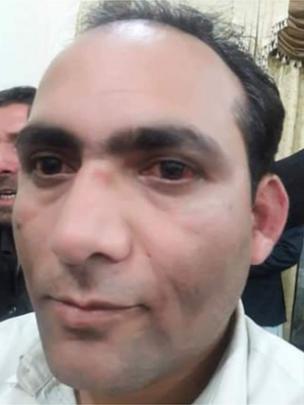
Doctor HameedImage copyrightFAMILY
Image captionDoctor Hameed sustained bruising to his eye during Saturday's assault
Presentational white space
Dr Hameed, who works at the Agency Headquarters Hospital in Bajaur's main town Khar, was roughed up while he was attending a female patient in his room.
"Two men in civvies walked into the room and wanted him to see a patient they had brought," his brother, Hamid Khan, who is also a doctor, told the BBC.
"The staff helping the doctor asked them to wait outside, but instead they stepped up to the doctor and one of them shook hands with him. The doctor got a bit impatient and refused to shake the second man's hand, asking them to step outside and wait till he was finished with his patient."
The two men then pounced on his brother, Dr Khan said. They called in some other colleagues and roughed up the doctor and other staff.
"Then they dragged my brother by the hair, shoved him into a truck and drove away."
Dr Hameed was released only after the doctors and other hospital staff shut down all services and medical stores in the main markets of Khar also pulled down their shutters.
The incident was widely discussed on social media, with activists criticising the military and the ISI of treating the Federally-Administered Tribal Areas (Fata) as their fiefdom.
In a video shared on Facebook, a tearful Dr Khan told protesters that people would "not allow the ISI to kill their children".
"Are you a protector of the people, or are you a murderer?" he said, addressing the ISI. "Why do you want to turn the children of this nation into your enemies?"

Growing protests

Fata is a semi-autonomous strip of land along Pakistan's north-western border. It was used as a base for anti-Soviet Islamist militants during the Afghan war of the 1980s and became a Taliban and al-Qaeda sanctuary post-9/11.
Thousands of Fata people are believed to have been killed during this period.
A military operation to clear out anti-Pakistan militants in 2014 displaced nearly a million people.
Residents have faced layers of security checks on all entry-exit routes to the area. Non-locals, including the mainstream media, are barred from travelling to Fata.
The area is also outside the sphere of Pakistan's regular system of justice, and is ruled under a colonial-era law that prescribes collective punishments to tribes for violations committed by individuals.
But since January, protests have erupted in several parts of Fata and Pakistan's north-west, mostly over "extrajudicial killings" and procedures at security checkpoints.
A movement which started after one such death - the alleged extrajudicial killing of a tribal youth in Karachi - was the first to criticise the military's actions in tribal areas.
The Pashtun Protection Movement appears to have opened the floodgates for public criticism of the military, something which had been unthinkable until a few months ago.
Its leaders claim that more than 30,000 locals have been forcibly disappeared by the military's intelligence network. Many more have had their houses demolished by the military, campaigners say.

#Pakistan: Resolve hundreds of cases of enforced disappearances


Human Rights Council adopts Universal Periodic Review outcome on Pakistan.
Few punishments are as cruel and deliberate as enforced disappearances. People are wrenched away from their loved ones by state officials or others acting on their behalf. They deny the person is in their custody or refuse to say where they are. Families are plunged into a state of anguish, trying to keep the flame of hope alive while fearing the worst. They may be in this limbo for years.
The disappeared are at risk of torture and even death. If they are released, the physical and psychological scars endure. If they are killed, the family never recovers from their loss. Disappearances are a tool of terror that strikes not just individuals or families, but entire societies. This is why they are a crime under international law, and if committed as part of a widespread or systematic attack, they constitute a crime against humanity.
No one has ever been held accountable for an enforced disappearance in Pakistan
Amnesty International
The UN Working Group on Enforced or Involuntary Disappearances has more than 700 pending cases from Pakistan, and Pakistan’s State Commission of Inquiry on Enforced Disappearances has received reports of hundreds more, from across the country. Victims include bloggers, journalists, students, peace activists and other human rights defenders whose work promotes the same values as this Council and is crucial to a free and just society.
No one has ever been held accountable for an enforced disappearance in Pakistan.
These crimes take place against the backdrop of a broader assault on civil society. Freedom of expression is criminalized online. Human rights defenders are smeared and threatened and journalists are attacked. Civil society organizations are subject to greater restrictions, and international NGOs have been expelled.
Amnesty International welcomes Pakistan’s acceptance of recommendations to make enforced disappearance a criminal offence, 1 but is disappointed by Pakistan’s failure to accept several recommendations – including from states with their own traumatic history of disappearances – to ratify the International Convention for the Protection of All Persons from Enforced Disappearance.
Amnesty International is pleased to note that Pakistan has accepted recommendations to protect journalists and freedom of expression,2 however, is concerned that the government did not accept recommendations to bring the perpetrators of such threats, attacks and abductions to justice.3
As an elected member of this Council, Pakistan must uphold the highest human rights standards – to not just acknowledge violations, but take concrete steps to end impunity for them.
Background
1 A/HRC/37/13, recommendation 152.131 (Switzerland). 2 A/HRC/37/13, recommendations 152.170 (Cyprus), 152.173-176 (Sweden, Czechia, Norway, Greece). 3 A/HRC/37/13, recommendations 152.177-178 (Canada, Austria).
The UN Human Rights Council adopted the outcome of the Universal Periodic Review of Pakistan on 19 March 2018 during its 3 th session. Prior to the adoption of the report of the review Amnesty International delivered this oral statement. Amnesty International also contributed to the information basis of the review through its submission on country:
https://www.amnesty.org/en/documents/asa33/6513/2017/en/

- #KotliSattianBhuttoKa - Nawaz Sharif is “Chabi Wala Khilona”, says Bilawal Bhotto

Pakistan Peoples Party (PPP) Chairman Bilawal BhuttoZardari is addressing party supporters in Kotli Sattian.
Senior party leaders, including former prime minister Raja Pervaiz Ashraf, former Senate chairman Nayyar Hussain Bukhary and former MNA Mehreen Raja, are also on stage.
The senior party leaders addressed workers before Bilawal took the podium.
The PPP chairman recalled the relationship of the tehsil with the party.
“Nawaz thinks democracy linked to him only,” he said, terming the former prime minister Gen (retd) Ziaul Haq’s “opening batsmen” and Nawaz Sharif is still “Chabi Wala Khilona”, but the key is broken. The day key starts working, Nawaz Sharif will again start dancing on the tunes. In an apparent jibe at Nawaz’s daughter Maryam, Bilawal said: “look now, we have stopped you”.
http://www.thesindhtimes.com/blog/2018/03/18/nawaz-sharif-chabi-wala-khilona-says-bilawal-bhotto/

Sunday, March 18, 2018

Video - Britney Spears - I'm A Slave 4 U -

Three Years of Saudi Heinous Crimes in Yemen


By Sondoss Al Asaad
Yemen a miserable isolated Arab country has been devastated by an ongoing Saudi bloody war. Since March 2015, Saudi Arabia and its gulf allies (GCC) have launched a vicious military campaign against Yemen to reinstall its former government. Recently, the Saudi Crown Prince Mohammed bin Salman’s visit to the UK has refocused attention on this silent conflict.

The collation has imposed a blockade on the port of Hodeida city, the main entry point for food and medicines and has been repeatedly accused of unlawful airstrikes on civilian targets which amount to war crimes. Obviously, the U.K., U.S. and other Western governments back, supply weapons and provides training to the GCC soldiers.
Amid the global silent and the mainstream media hypocrisy, the criminal collation systematically targets residential areas, claiming it would control arms transfer to the Houthi rebels. Saudi Arabia regards the Houthis as Iranian proxies and intervened to check their advance. These heinous massacres have prompted accusations by some Western opposition MPs and human rights groups of significant responsibility for civilian casualties. Thousands of Yemenis have been killed and the infrastructure has been thoroughly pulverized.
The GCC collation has imposed a blockade on Yemen’s air, sea and land borders in November 2017 in response to Huthis firing missiles towards Riyadh airport, closing an aid lifeline to tens of thousands of starving Yemenis. The U.K. government denies that its forces are advising the Saudis on specific targets, though they admit that, after a raid, British officers can give advice on future targeting policy.
A UN panel of experts that reviewed 10 Saudi airstrikes found Saudi denials of involvement in these specific airstrikes were implausible, and individuals responsible for planning, authorising or executing the strikes would meet the standard for the imposition of UN sanctions. The panel reported early in January, “even if the Saudi Arabia-led coalition had targeted legitimate military objectives … it is highly unlikely that the principles of international humanitarian law of proportionality and precautions in attack were respected.”
At the end of February, Russia vetoed a UK draft resolution that included a condemnation of Iran for violating the UN arms embargo in Yemen over claims that it supplied the missiles used by the Houthis that were fired towards Riyadh.The ongoing war has witnessed heinous atrocities, which emphasizes the urgent need of taking all necessary and possible steps to stop the war, bring the perpetrators to justice and ensure impunity. Since the beginning of the military campaign, the coalition has targeted numerous facilities including schools, hospitals, airports, ports, universities, water and electric utilities, roads, bridges. Although international conventions grant full protection for civilian installations, the Saudi warplanes have systematically targeted civil facilities using several internationally forbidden weapons, during the systemic raids over densely populated areas.
Medics have voiced alarm over the raging spread of the cholera epidemic in the impoverished country, saying that one child is infected every minute. Malnourished children, who number more than two million in Yemen, are greatly susceptible. Yemeni Health Ministry says that the Saudi aerial embargo has prevented patients from travelling abroad for treatment, and the entry of medicine into the country has been blocked. Over the following three years, the war has engulfed the entire country causing unbearable suffering for civilians. Due to the relentless bombardment, many civilians have been killed or injured, and a humanitarian crisis has spiraled, while the world ignores this raging war and hears little about its devastating consequences.
Various hospitals were shut because of the bombarding, and the insufficient medical teams. Further, vaccinations of major infectious diseases have been banned, amid the growth of the indicators of child malnutrition, and the spread of epidemics. In addition, more than 95% of doctors, nurses and consultants have been killed or fled the country. The lack of medicines has caused the deaths of many with Thalassemia and Anemia who need a monthly blood transfusion. Dialysis centres have made an SOS to save the lives of more than 6 thousand patients with Renal failure by providing them with necessary medical supplies, pointing out that the number of deaths of patients with renal failure exceeded 17 deaths in every 8 months.
The blockade imposed by the coalition has left more than 12,000 people killed, 49,000 injured and around 20 million people in need of humanitarian assistance. It has also created the world’s largest food security emergency. Human Rights Watch has accused the Saudi-led coalition of committing war crimes, saying its air raids killed 39 civilians, including 26 children, in two months. Additionally, The International Committee of the Red Cross has said that the number of suspected cholera cases in war-torn Yemen has hit one million. More than eight million Yemenis are on the verge of starvation, making Yemen the scene of, what the United Nations calls, the world’s worst humanitarian crisis.The Saudi regime has launched his war to eliminate the Houthis movement and to reinstall a Riyadh-friendly regime in Yemen.
However, the collation has failed to achieve its geopolitical and ideological objectives regardless of spending billions of dollars and enlisting the cooperation of its vassal states as well as some Western countries. The world’s largest humanitarian crisis caused by Saudi prolonged military onslaught has pushed millions of Yemenis to the brink of starvation. Unfortunately, the UN has not yet taken any effective measures to halt the humanitarian tragedy for the sake of the ultimate objective that Saudi Arabia is pursuing in the country, which is eliminating the threat of the Houthis. Obviously, the Saudis have not achieved their basic goals; hence, they are seeking revenge on the innocent Yemenis through their aimless bombardment.

Theresa May misled parliament over Yemen UN resolution: Corbyn


Accusation comes as UK and Saudi Arabia sign preliminary deal for sale of 48 Typhoon fighter jets.


 Labour leader Jeremy Corbyn has accused Theresa May of misleading parliament over the legal basis for Saudi Arabia's war in Yemen, threatening to reignite a bitter political row over UK support for the conflict.
The row comes after the prime minister said the war in Yemen had United Nations backing, and threatens to overshadow the last day of the visit to the UK by the Saudi crown prince, Mohammed bin Salman. 
It also came as the UK signed a preliminary deal with Saudi Arabia on Friday for the sale of 48 Typhoon fighter jets, to the dismay of rights campaigners.
In a full-throated defence of the UK's relationship with Riyadh on Wednesday, which came hours before she met the powerful crown prince in Downing Street, May told parliament that Saudi-led intervention was "backed" by the UN Security Council, and "as such" was supported by the UK.
Corbyn responded that UK forces were effectively "colluding" in war crimes by supporting Saudi forces.
It cannot be right, as I told the prime minister on Wednesday, that her government is colluding in what the UN and others say is evidence of war crimes. Germany has suspended arms supplies to Saudi Arabia, and so must the British government. This outrage must end
- Jeremy Corbyn, opposition leader
Now, Corbyn has gone further and attacked May's comments in parliament, saying that she got her facts wrong, amid claims that the UN has not explicitly authorised the use of military force by the Saudi-led coalition under Chapter VII of the UN Charter, the document which regulates when states are authorised to use "all military means" to enforce UN resolutions.
Foreign Office officials told MEE on Friday that the prime minister was referring to UN Security Council Resolution 2216, which was passed in 2015 and recognised the Hadi government, while calling for all Yemeni parties to the conflict to "end the use of violence".
However, critics of the Saudi-led bombing campaign say the resolution did not authorise the use of force by the Saudi-led coalition. It merely noted a letter from the president of Yemen, Abd Rabbuh Hadi, calling for military intervention.
A cholera epidemic is also sweeping Yemen (AFP)
This remains the Saudi-led coalition's legal justification for the war, but has been questioned by legal experts because Hadi had overstayed his term, resigned once and fled the country, placing the Saudi military action in a "murky legal" position.
Speaking at the Scottish Labour Party conference in Dundee on Friday, Corbyn said: "It cannot be right, as I told the prime minister on Wednesday, that her government is colluding in what the UN and others say is evidence of war crimes. Germany has suspended arms supplies to Saudi Arabia, and so must the British government. This outrage must end.
"Nor is it true, as the prime minister claimed, that the Saudi-led war in Yemen has been authorised by the United Nations Security Council.
"What's needed now is both a ceasefire and a concerted international effort to achieve a negotiated political settlement."
'Stop cuddling up to bin Salman'
Corbyn's intervention came after his shadow minister for peace told MEE earlier on Friday that the prime minister had got her facts wrong over the legal status of the Saudi-led bombing campaign in Yemen.
Fabian Hamilton MP said: "Theresa May has got it all wrong here. The fact is that UN Resolution 2216 called for an end to the violence in Yemen and certainly did not support Saudi military intervention in the country."
The Labour shadow minister, added: "Instead of cuddling up to the crown prince, it is now time for the prime minister to show some leadership and suspend all British arms sales to Saudi Arabia, as their use against civilians in Yemen is a source of shame for Britain."
The Saudi justification for its intervention in Yemen, where at least 5,000 civilians have been killed, rests on the claim that Riyadh is supporting a neighbour in need, which is legal under international law, but some experts say Houthi aggression may not be enough to justify intervention without a specific UN resolution.
Theresa May has got it all wrong here. The fact is that UN Resolution 2216 called for an end to the violence in Yemen, and certainly did not support Saudi military intervention in the country
- Fabian Hamilton, shadow minister for peace
The legal case is far from clear, but Saudi Arabia's justification rests on Hadi invoking Article 51 of the UN Charter, which provides the right to self-defence if a UN member state is attacked.
Some some experts say this is only relevant if Yemen was responding to an external armed attack. Riyadh regards the Houthis, who are based in the north of the country, as Iranian proxies and intervened to check their advance. 
The British prime minister also faced calls on Friday from within her own party over the UN's role in ending the conflict.
Former International Development Minister Andrew Mitchell told MEE: "We need an end to all violence, the lifting of the blockade, inclusive peace talks and full support for the new UN special representative Martin Griffiths. We also need the UN resolution urgently updated to reflect this."
A protest against MBS' visit to London on Wednesday (AFP)
He added: "I hope close engagement with the Saudi crown prince is allowing Britain to make these important points and that we are using our influence to do so."
Support for the UK and UK-backed position at the UN is reportedly weakening, and last month Russia vetoed a UK draft resolution that included a condemnation of Iran for violating the UN arms embargo on the country. This comes amid claims, supported by UN experts, that missiles used by Houthis to fire towards Riyadh came from Iran.
The UN called for a peaceful solution, it did not call for a three year bombardment which has killed thousands of people and destroyed vital infrastructure all across the country
- Andrew Smith, Campaign Against Arms Trade
However, the UN eventually passed a more limited resolution, making no mention of sanctions on Iran for supplying the missiles, amid speculation that Riyadh is likely to reject the UN route to solve the crisis.
The political row in London over the UN's role in Yemen came as bin Salman's visit to London turned to defence and security on Friday with a meeting with British Defence Minister Gavin Williamson in the afternoon. 
The meeting was expected to touch on the most contentious element of his trip: arms sales. 
"The UN called for a peaceful solution, it did not call for a three-year bombardment which has killed thousands of people and destroyed vital infrastructure all across the country," Andrew Smith, spokesperson for Campaign Against Arms Trade told MEE.
He added: "The people of Yemen have had one of the worst humanitarian crises in the world inflicted on them, and Theresa May and her colleagues have been totally complicit in it."

More Typhoon jets on order?

Britain and Saudi Arabian officials set themselves a $90bn trade and investment target for the next decade earlier this week. It came as London looks for new post-Brexit opportunities for its service sector and the crown prince seeks to convince sceptical investors that his country is a modernising place to do business.
Nevertheless, arms remain the main component of UK-Saudi trade and the UK government has approved the export of $6.4bn in weapons since the start of the war in Yemen, despite allegations that Saudi-led forces have committed war crimes.
The meeting between bin Salman and Williamson on Friday is focused on discussions on the sale of up to 48 Typhoon fighter jets made by British firm BAE Systems - a multi-billion dollar deal which has been under discussion for some time.
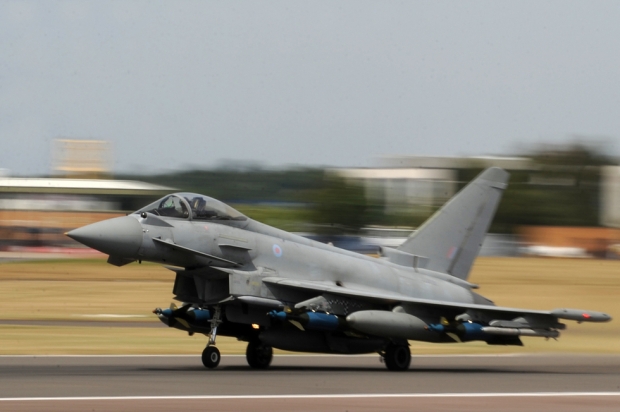
BAE's Typhoon fighter jet, which Saudi Arabia has signed a new memorandum of intent to purchase (AFP)
It resulted in a memorandum of intent for Saudi Arabia to purchase the jets, a move just short of a confirmed order but a step towards finalising the lucrative transaction. 
The deal, which could be worth as much as $10bn, will be welcomed by BAE Systems, which manufactures the aircraft, as it struggles to keep the aircraft's production line in Lancashire viable.
According to a press release the firm, the memorandum aims "to finalise discussions for the purchase of 48 Typhoon aircraft".
The Typhoon deal was also thought to have been on the agenda when the crown prince travelled to Chequers, the prime minister's country residence, on Thursday night.
"This is a positive step towards agreeing a contract for our valued partner," BAE Systems, said in a statement. "We are committed to supporting the kingdom as it modernises the Saudi Armed Forces and develops key industrial capabilities."
Saudi Arabia already operates more than 70 Typhoon jets. They have been used extensively in the Yemen war, and the deal is likely to spark outrage among rights groups and campaigners.
Kate Allen, Amnesty International UK's director, said: "Selling more fighter planes to a country leading a military coalition that's already laying waste to homes, hospitals and schools in Yemen, is just adding fuel to a humanitarian fire.
"It's shocking, and shows that the Government hasn't been listening to widespread concern from the British public on this issue during the Crown Prince's controversial visit."
May's office said that during the crown prince's visit she presented bin Salman a family tree showing the Al Saud dynasty. Downing Street said the framed document was originally created by Queen Victoria's consul general in Jeddah in 1880.
That meeting came as the UK and Saudi Arabia signed more than 18 economic deals, thought to worth around $2bn, covering education, banking and pharmaceuticals.

The Brexit dimension

The deals came as a Saudi minister said the UK should look to Saudi Arabia for new trade and investment opportunities after Brexit and not a backward-looking Commonwealth.
"I would like to think that Saudis can be the pivotal link to a new partnership sphere for the UK that is perhaps not positioned in the past, as is the Commonwealth, but forward-looking, looking at the demographics of the Middle East, Africa, and Islamic world to which Saudi Arabia is central," Saudi energy minister, Khalid Al-Falih, told a business conference in London on Thursday.
He added that the UK should regard the kingdom as the dominant force in the Gulf and "your gateway to Africa, one of the next frontiers".
Backed by a PR advertising blitz, the crown prince also met with the chancellor of the exchequer, Phillip Hammond, and a select group of MPs from the Conservative Middle East Council on Thursday.
He also went to Lambeth Palace to meet the Archbishop of Canterbury, Justin Welby.
The Foreign Office declined to comment further on the prime minister's comments when contacted on Friday.

Video Report - #SHOCKING - Sex, Drugs & Refugees. Syrian teenagers in Athens resort to prostitution to survive

Video Report - President Assad greets troops in eastern #Ghouta

Video Report - MARUV & BOOSIN - Drunk Groove

Vladimir Putin decisively re-elected as Russian president – preliminary results


Incumbent Russian leader Vladimir Putin is set to secure a resounding victory in the Russian presidential election, according to partial results made public by the electoral commission.
Vladimir Putin is now leading with over 76 percent of the vote, well above the simple majority needed to avoid a run-off.
First-time Communist Party candidate Pavel Grudinin is running second with little over 12 percent, while veteran nationalist politician Vladimir Zhirinovsky, who first ran against Boris Yeltsin in 1991, rounds out the top three with about six percent.
None of the other five candidates is on track to receive more than two percent of the vote.
The early results are in line with exit-polls conducted by Russian polling agencies FOM, which predicted Putin would take 77 percent of the vote, and VCIOM, which forecast a final share of 73.9 percent for the current president.
Ella Pamfilova, head of the Russian Central Election Commission, has said that there were no major violations during the vote, and that only “minor and local complaints” were received.
Shortly after the first results were announced, Vladimir Putin addressed his supporters at a massive anniversary rally in Moscow’s Red Square, marking Crimea's reunification with Russia, and talked to reporters in his election campaign HQ. He thanked his backers and answered questions on the hottest political issues.
Putin was first elected to the Kremlin in 2000, and again four years later. Constitutionally barred from serving more than two consecutive terms, he did not run in 2008, the same year presidential terms were extended from four years to six years. Putin won 63.6 percent of the vote in 2012, and, if the early results are confirmed, he will now stay in his post until 2024, the year he turns 72.

Video Report - Putin Speaks From The Red Square After Presidential Election Results Announced

Video Report - Putin addresses Russians on the night of the 2018 elections

Video Report - Putin wins 6 more years in power, exit polls show

Music Video - Mujh Se Pehli Si Mohabat - Noor Jahan - Faiz Ahmad Faiz

DO PAKISTANIS AGREE WITH THE U.N.’S ASSESSMENT OF THEIR OVERALL HAPPINESS?

ASIF HASSAN

WE DON’T KNOW HOW THE UNITED NATIONS’ 6TH ANNUAL WORLD HAPPINESS REPORT CALCULATED THAT PAKISTAN IS AHEAD OF INDIA, CHINA, IRAN, AND AFGHANISTAN IN ITS RANKINGS. BUT ASK ANYONE ON THE PAKISTANI STREET AND YOU WILL BE HIT WITH MORE UNHAPPINESS THAN ANYWHERE ELSE IN SOUTH ASIA. IF YOU WATCH THE TV CHANNELS IN THE REGION, THE LACK OF JOY IN PAKISTAN WILL OVERWHELM YOU. AND “UNHAPPY INDIA,” KILLING INNOCENT PAKISTANIS ACROSS THE LINE OF CONTROL AND HARASSING PAKISTANI DIPLOMATS IN NEW DELHI THROUGH ITS SECRET AGENTS, ADDS TO THIS SUFFERING. THE WORLD IS ACTUALLY ENJOYING ALL THIS, SECRETLY.

After the recent Senate elections, Pakistani media—call it “merdia” the way it indulges in fanning the fires of discord—has succumbed to depravity as Pakistani politicians go for each other’s throat and the establishment herds them around at will as the “rejoicing third party.” This unnamed party is pulling the political rug from under the feet of the dysfunctional state and is all set to booby-trap the coming June general elections. Nothing like this happens in the rest of South Asia. Pakistani self-hatred is expressed on the street where people now address each other insultingly like Imran Khan and Nawaz Sharif exchanging defamations on TV.
India can get away with anything because it is not internally troubled and no terrorism radiates from it to the outside world while Pakistan faces sanctions for harboring terrorists. No matter what India does to punish Pakistan it is with the tacit approval of a world sick of Pakistan’s lack of internal sovereignty, with 60 percent of its territory without the writ of the state. The political parties are morbidly entangled in their vendettas, siding with the “third party” to bring each other’s government down. In the coming elections, the tertium gaudens (rejoicing third party) will lay down the new political chessboard of lack of joy. Wait for what comes next after unhappiness.

http://newsweekpakistan.com/unhappiest-in-south-asia/

Attack on #polio vaccination team in #Pakistan kills 3

By Riaz Khan 
Militants have ambushed a polio vaccination team in a remote tribal region in Pakistan, killing two of the medical workers and seriously wounding another two, officials said Sunday.
The gunmen also attacked tribal police and the paramilitary Frontier Corps when they responded to the attack late Saturday, killing one paramilitary and wounding another.
Polio workers have come under attack on several occasions since it was revealed that the CIA used a polio vaccination campaign as a ruse to get information on Osama bin Laden, who was killed by U.S. commandos in Pakistan in 2011.Those revelations fed into claims by Islamic extremists that the vaccinations are part of a Western plot against Muslims.
 
Pakistan is one of the only countries in the world where polio is still endemic, along with Afghanistan and Nigeria.
An official in Pakistan’s restive Mohmand Agency, Younus Khan, said two workers from the seven-member polio vaccination team went missing after the attack but later returned unharmed. He says security forces are still searching for the attackers.
Jamaatul Ahrar, a faction of the Pakistani Taliban, claimed the attack.
Khan said the bodies of the anti-polio workers were handed over to relatives and their funeral will take place later in the day.

Bilawal Bhutto Zardari strongly condemns missile attack on the residence of PPP leader Akhunzada Chattan in Bajaur Agency

Chairman Pakistan People’s Party Bilawal Bhutto Zardari has strongly condemned missile attack on the residence of PPP leader Akhunzada Chattan in Bajaur Agency last night.

In a statement, the PPP Chairman said that lashes, bullets and bombs have failed to frighten Jiyalas in the past adding that missiles too can’t scare them.

Bilawal Bhutto Zardari said that Akhunzada Chattan is a brave Jiyala and he would continue struggle for the people of FATA and their rights vigorously.


https://mediacellppp.wordpress.com/2018/03/18/bilawal-bhutto-zardari-strongly-condemns-missile-attack-on-the-residence-of-ppp-leader-akhunzada-chattan-in-bajaur-agency/

Video - #KotliSattianBhuttoKa - Chairman #PPP Bilawal Bhutto addresses to the Party workers in Kotli Sattian

Saturday, March 17, 2018

Video Report - Sergey Lavrov: "We will not stand for any use of force against Damascus based on fake pretences"

Video Report - 'Situation in E. Ghouta is catastrophic' – Red Cross spokesperson

Video - Crime Minister' - Protesters demand Netanyahu’s resignation

Video Report - Newly elected Chinese president takes oath of allegiance to Constitution

Video Report - 🇨🇳 Xi Jinping elected for second term after a unanimous vote | Al Jazeera English

Pakistan court ruling against Ahmadiyya Muslim minority draws criticism

Zohra Yusuf

Rights activists in Pakistan are expressing concern over a court ruling that would require people to declare their religion on all official documents, saying it could lead to the persecution of minorities, particularly adherents of the Ahmadi faith.

The Islamabad High Court ruling on Friday also requires that citizens take a religious oath upon joining the civil service, armed forces or judiciary.

Zohra Yusuf, a board member at the Human Rights Commission of Pakistan, on Sunday called the ruling "very dangerous." She said her group would issue a statement in the coming days.

The ruling appeared to be aimed at Ahmadis, who revere the 19th century founder of their faith as a prophet. Pakistan declared Ahmadis non-Muslims in 1974. They already face widespread discrimination and are often targeted by extremists.

#Pakistan - Ambushing democracy


Afrasiab Khattak

The brazen manipulations, corruption and intervention by intelligence agencies in the recent Senate elections has exposed the hollowed and farcical nature of the current “ republic “ which doesn’t qualify anymore to be called even a mere facade of democracy. On the one hand the creeping coup going on for the last few years has now culminated into a blatant and direct control of the upper echelon of military and civil bureaucracy over not only the internal and external state policies but also over the electoral processes to an extent where the system has turned into a mere selection process. On the other hand the real rulers have also been able to successfully exploit political feuds among major political players for pitting them against each other by using carrot and stick. The de fact seems to have defeated the de jure. From overthrowing of provincial government in Balochistan through a parliamentary coup orchestrated by the prime Intelligence agency of the country in January for paving ground for election of a group of “independent “ senators, to using pressure and dirty deals for getting a little known and totally inexperienced senator elected as chairman Senate, everything smacked of mala fide. There is nothing secret about it as some political parties publicly accused a senior intelligence operative by name for his involvement in the rigging of recent Senate election but nothing happened as the bosses of the concerned institutions decided to ignore such demands and the civilian government is too weak to make the concerned guy accountable.
As if all that wasn’t enough COAC General Qamar Javed Bajwa had a detailed interaction with a large group of journalists, tv anchors and analysts. Among other things he advised the Parliament to revisit laws such as the Police Act ( passed in 1861 by Colonal rule) and the 18th Constitutional Amendment that was passed by consensus in 2010. Reforming the Police Act of colonial period is something that everyone agrees upon but call for rolling back the 18th Amendment is like calling for the rolling back of federal system in the country. It has raised eyebrows for many reasons. First this statement has given special meaning to the recent manipulation in the senate election. The purpose seems to be not only controlling Senate for blocking legislation in future by any “ undesirable “ elected government but also to create conducive atmosphere for rolling back of 18th Amendment. Senate being the custodian of the federation plays very important role in protecting the federal system. Second, such a demand by a sitting army chief is direct intervention in the country’s politics, something which is not permitted by law. A government servant , even after his/her retirement has to wait for two years before joining political activities. Three, provincial autonomy is a very sensitive subject. The population wise smaller provinces have struggled/sacrificed a lot and have achieved the present quantum of provincial autonomy after a prolonged struggle. Some of the nationalists from these provinces are even not satisfied with it. But rolling it back would certainly open a flood gate for centrifugal movements. Four, such statements also raises questions about army as a national institution. How can it take a position that is a challenge to the interests of the the three federating units? Insistence on such a position will give the impression as if the army represents only the population wise biggest province.
Be that as it may, but the question is what is the problem with the 18th Amendment and why is it opposed by the generals? The basic thrust of the 18th Amendment was to restore the original federal, democratic and parliamentary 1973 Constitution by cleaning it of distortions and deformations imposed on it by General Zia’s Martial Law and General Pervez Musharraf’s military rule. Although some of the “land mines” ( like Gen Zia’s Article 62 and 63) could not be taken out because of the lack of political consensus but substantial reforms were implemented. Presidential power to dissolve assemblies were taken away and given back to elected Parliament. Concurrent list of legislative powers was abolished and powers were devolved to the federating units as envisaged by framers of the 1973 Constitution. Eighteenth Amendment was supported by fourteen political parties and groups, practically by every political party present in Parliament at that time. But this Amendment is a thorn in the side of authoritarian circles for many reasons. Like it has done away with the authoritarian instruments inserted in the Constitution by military dictators for subverting the democratic process ( dissolution of assemblies by the President) that were used time and again by putschists in the past. The emergence of stronger provinces makes the undemocratic intervention more difficult. Although the prolonged existence of the Apex Committees has some what diluted it but even than greater access to financial resources has given edge to the federating units.
But the most important aspect in this whole thing is a competition for share the national financial cake. The National Finance Commission ( NFC) Award decides the formula for distribution of resources between the federation and the federating units. Under the NFC Award of 2009 declared by elected government the share of provinces was raised to 57 per cent ( unlike 45 per cent under General Musharraf in 2006 Award) and Constitutional protection was given to the provincial share in the 18th Amendment. This formula was agreed upon in 2009 and the 18th Amendment was passed in 2010 ( it was implemented in 2011). In the CCI meeting in June 2011 it was agreed that the federation would provide financial resources to the provinces for health and education as provisional arrangement till the next NFC Award which was to be declared in 2014. It’s pretty clear that provinces will demand further rise in their share on the basis of the logic of 18th Amendment. This will further reduce the quantum of federal resources putting constraints on allocation to all federal ministries including defense. That’s why the present government hasn’t declared a new NFC Award in the last four years. This is the actual reason of the attack on 18th Amendment.
But this isn’t a zero sum game. There can be debates about national priorities, about requirements of national security and human security. But using “ political engineering “ for rolling back the 18th Amendment by constitutionally and legally questionable means would send a very wrong message to the population wise smaller provinces. Undermining the sanctity of the Senate which is the house of federation doesn’t augur well for the future of the country.

#Pakistan - Official of interior ministry transferred amid debate over placing Sharifs on ECL


The PML-N led federal government has transferred an official of interior ministry, who has been serving as additional secretary, to Economic Affairs Division amid growing debate over placing names of Sharif family members on Exit Control List (ECL), a private television channel reported on Saturday.
Sher Afgan Niazi, an additional secretary at the interior ministry, has been transferred to Ministry of Finance, Revenue and Economic Affairs. A notification of his transfer has also been issued. According to sources, there was dissension within the interior ministry over inclusion of Sharif family members’ names on no-fly list.
The sources further said the officer had dissented from other officials and recommended implementation of request made by the National Accountability Bureau (NAB).
On February 14, the anti-graft body had written a letter to the interior ministry to place former prime minister Nawaz Sharif, his daughter Maryam Nawaz and son-in-law Captain (retd) Muhammad Safdar.
Moreover, a 21-grade officer at Federal Education and Professional Training Division, Imran Ahmed, now will replace Niazi as additional secretary at Interior Ministry.
On Friday, the matter about inclusion of former Prime Minister Nawaz Sharif and his family members’ names on the ECL was raised at parliament. Responding to a question, former Interior Minister Chaudhry Nisar Ali Khan said the Interior Ministry’s committee was answerable for decisions on recommendations for including names on the no-fly list.
Speaking at the floor of National Assembly, the estranged PML-N leader said, “If a decision to not include the names of Sharif family members on the list has been finalised, it must have been made somewhere else.” He was responding to PPP lawmaker Syed Naveed Qamar’s question about delay on the NAB recommendations about placing Sharifs on the ECL. Nisar went on saying that he had changed the policy of placing names on the ECL and minimized the role of ministry during his tenure as Interior Minister.
“A committee under the ministry was assigned with the task to deal with requests to place the names on the ECL during my tenure,” he said.
He further said the committee was free to take decisions on merit during his tenure, besides the NAB recommendations were always taken seriously.
On the occasion, Nisar wondered about the double standard of placing names on no-fly list.

Bilawal Bhutto strongly condemns killings and kidnapping of polio workers in Mohmand Agency

Chairman Pakistan Peoples Party Bilawal Bhutto Zardari has strongly condemned killings and kidnapping of polio workers in Mohmand Agency and urged the concerned authorities to arrest the culprits and recover the kidnapped polio workers without any further delay.
In a press statement, the PPP Chairman said that those attacking, killing and kidnapping the polio workers were enemies of a healthy Pakistani nation pledging that no elements would be allowed to challenge and stop brave efforts to protect the nation’s future generations from the crippling disease of polio virus.
Bilawal Bhutto Zardari expressed sympathies with the martyred polio workers and stated that nation won’t forget and forgive the terrorist elements who are challenging and blocking the efforts to raise a healthy nation free from any physical disabilities through preemptive vaccination and medical treatment.

https://mediacellppp.wordpress.com/2018/03/17/bilawal-bhutto-strongly-condemns-killings-and-kidnapping-of-polio-workers-in-mohmand-agency/

Video Report - Exclusive interview of PPP Chairman Bilawal Bhutto Zardari with Waseem Badami on ARY News

Friday, March 16, 2018

Video Report - Panelists erupt over Trump-Stormy Daniels saga

Video Report - Lavrov accuses UK of violating law, Moscow opens case into the poisoning of Skripal's daughter

Video Report - UK's standoff with Russia, Trump fires Tillerson, Stephen Hawking's legacy

West hopes to hurt, intimidate Russia

Britain on Thursday published a joint declaration with the US, France and Germany over the poisoning of a former Russian spy and his daughter, calling it the "first offensive use of a nerve agent" in Europe since World War II. It said Britain has informed its allies that Russia is likely responsible for the attack, and they share the view that "there is no plausible alternative explanation" for the attack. 

In the meantime, the US announced new sanctions on five Russian entities and 19 individuals for what was believed their interference with US presidential elections and cyber attacks.

This new round of "bullying" of Russia by the US and its European allies is quite abrupt and acute. London ignored usual diplomatic procedures to issue an ultimatum to Moscow and began sanctions. It feels like racing against time.

It makes people think of the upcoming Russian presidential election on March 18. The West wrestling with Russia at this particular moment has become a major factor for Russia's elections. It is hard to distinguish how much of the antagonism reflect its true severity and how much is designed to target Russia's elections.

The past couple of years has witnessed the most strenuous period of Russia's relations with the West. The improvement in their relations since the end of the Cold War has almost run out. However, today's Russia, without satellite states, is incomparable with the strength of the former Soviet Union when dealing with the strategic pressure from the West.

Russia still has three cards in its hand. First, it's a major nuclear power, which prevents the West from engaging in direct military conflict; second, Russia's rich resources make it highly self-sufficient to counter sanctions; third, Russia's strong national spirit has united Russian society in support of Vladimir Putin. Eliminating the third card and pressuring Russian society toward dismay and instability will weaken the political foundation of Putin's rule.

Analysts believe Putin will win the election without a doubt, and that the West's sanctions will likely provide new momentum for Putin's supporters. But maybe some Western elite think the other way and wish to drain Putin's votes or undermine his authority via a new round of sanctions that may pressure the Russian public.

Western countries have been quite freewheeling in imposing sanctions on Russia, as they don't see much cost in doing so.

The harsh attitude of Western countries toward Russia resembles their unity in the face of major geopolitical and value challenges despite problems in their own camp. Any non-Western competitor could become their shared target, which is part of the current world order.
