Friday, March 16, 2018

#Pakistan - It is time we pay attention to the Pashtun Tahaffuz Movement's demands - The Pakhtun spring


Khurram Husain


AN incredible series of events is unfolding in the aftermath of the murder of Naqeebullah Mehsud. A group of young Pakhtun men and women, have found their voice, and in growing numbers, are stepping forward to tell their tale.

Their stories are finding so much traction in the wider society, that the beginning of a grass-roots movement appears to be in the making. What is particularly interesting about this movement is that it is spontaneous, and has an amorphous leadership drawn from a younger generation with no links to organised politics. What is dismaying to see is how their efforts have been ignored by the big mainstream political parties, as well as the mainstream media.

Going by the name of the Pashtun Long March, or the Pashtun Tahaffuz Movement (PTM), their demands are simple. They want the rights that the Constitution guarantees them: the right to be secure from arbitrary detention, the right to peaceably assemble, to speak their minds. The roots of the movement go back in time to the discontentment that was brewing in the camps set up to house IDPs from the military operations in the tribal agencies, as well as Swat, in the 10-year campaign against the Tehreek-i-Taliban Pakistan. The discontentment grew out of a sense of humiliating treatment by state authorities, whether at any of the myriad checkpoints or at Nadra centres when applying for a national identity card. In addition, they have lent their support to the recommendations of the Fata reforms committee, finalised in late 2016 (and yet to be implemented).

Listen to the voices at the sit-in they held in Islamabad. Listen again to the voices that spoke at their events in Zhob and Qila Saifullah last week, or in Quetta this Sunday. Listen also to the voice of Raza Wazir, writing in the New York Times, describing what it is like to grow up a Pakhtun amid the ‘war on terror’. Fortunately for us, social media recorded these events even as mainstream media chose to focus its attention on the Senate elections.

Listen to their voices, and you will not believe that they are describing the same Pakistan that you and I live in.

Listen to these voices, they are not hard to find, and your ears will not believe that they are describing the same Pakistan that you and I live in. The stories they tell sound more like those one hears coming out of active war zones like Iraq and Sudan, and one is hard-pressed to believe that an entire generation has grown up with the horrors of such an enormity as a basic fact of their lives.

Consider this: anybody below the age of 30, who is from any of the tribal areas, Swat, or even Peshawar or Quetta, came of age during the war that began in 2001, a little more than a decade and half ago. A 10-year-old in 2001 would be 28 years today. If lucky, this child would have completed schooling, and college by now, and reached the stage in life when one is full of optimism as one goes about the task of building a life, family, career, job, business. But for a young man or woman who has reached this age, and succeeded in not getting sucked into the war as a combatant or as a victim, the experience of this age is very different.

What is even more terrible in seeing this unfold is the memory of the enormous sacrifices made by the people of Peshawar, and Khyber Pakhtunkhwa more broadly, as well as Quetta during the ‘war on terror’. We have forgotten the early years of the terrible conflict with the TTP that got going following the Lal Masjid operation, when bombings in Peshawar had become an almost daily occurrence, including, in one case, targeting a market frequented by women and children specifically.

“An enormous strength of character is shining through,” went an editorial in The News at the time, hailing the stoic strength with which the people of Peshawar and the rest of KP braved the terrible rain of calamities coming down upon them with ferocity. Thousands died in that rain of bombings that stretched for years after Lal Masjid, but not once did we see the people or the leadership of this great province plead for mercy.

This is not the first time we are hearing these tales. Only a few years earlier, a marvellous rebel emerged from Quetta city, telling a story very similar to the ones being told by the young men and women of the PTM. He had lost a son apparently in a counter-insurgency operation and resolved to walk from Quetta all the way to Islamabad, stopping in towns along the way to meet small groups of people and tell them what was happening in his province. His name is Mama Qadeer, and his long march was one of the earliest of these grass-roots voices to emerge from the depths of a conflict that the rest of us know little about.

Along the way there have been others, farmers in Okara, families asking after loved ones gone missing, each asking for nothing more than justice, for their rights, for inclusion as equal citizens in the social contract that ties us all together.

What is sad to see is how the play of democratic politics has missed these voices almost entirely. The self-correction of democracy, one of the most powerful social forces in the world, relies on harvesting these grievances and channelling them into the mainstream political life of the system. But when democratic politics is disfigured by the constant play of unelected forces, it responds less to the demands coming from below, and more to the pressures coming from above. The recent Senate election, which happened at the same time as the PTM march, was only the latest instance where this disfigurement of our democratic polity was plainly in view.

#Pakistan - Bravo, Sherry Rehman!


The PPP’s Sherry Rehman is a woman who can. And presently, she is all set to assume the position of Leader of the Opposition in the Senate; having secured the support of some 33 Upper House lawmakers. Twenty-seven endorsements in an opposition bench of 54 are needed for a clear run.
This is good news all round; but particularly for Pakistan’s media. For the former career journalist has always stood firm for press freedom. In 2008, she challenged the two constitutional ordinances that were introduced under the brief period of martial law the previous year; and which related to a ban on live news broadcasts involving suicide bombers and extremists as well as custodial sentences for journalists found ‘guilty’ of defaming or mocking the president.
And none of this was hot air. For back in 2009 Rehman famously resigned as the minister for Information and Broadcasting after then president, Asif Ali Zardari, took Geo TV off the air for its ‘critical’ coverage of his regime. The channel had given extensive airtime to the four-day Long March to Islamabad in which lawyers and civil society activists protested the government’s failure to reinstate the judges dismissed by the previous set-up; something that it had promised to do within 30 days after sweeping the general elections the year before.
That Bilawal Bhutto Zardari nominated Rehman for this latest position demonstrates maturity on the part of the PPP co-Chairman. Not to mention more than a touch of pragmatism. For Rehman embodies core party principles. Seen as a liberal, the PPP vice president has fought long and hard for women’s rights. Indeed, she submitted the following before the National Assembly: the Women Empowerment Bill, Anti-Honor Killings Bill, Domestic Violence Prevention Bill, Affirmative Action Bill and Hudood Repeal Bill.
Rehman is also a friend of Pakistan’s most vulnerable. She and the late Minister for Minorities Shahbaz Bhatti had co-authored a bill to amend the country’s draconian blasphemy laws following the incarceration of a Christian woman, Asia Bibi. Never being one afraid to speak out, Rehman went as far as accusing her own party of appeasement when it failed to introduce this legislation to the floor.
Of course, she is not without detractors. As is typically the case here in Pakistan when dealing with a public figure who dares talk truth to power there are always conspiracy theories and baseless rumours. But to be clear: Sherry Rehman has demonstrated her steel-nerve persona when dealing with such critics. Nothing has stopped her from advocating legislative reform, democratic consolidation and a sensible foreign policy. Jinnah Institute, the think tank she founded, is an influential space for policy advocacy. All of this explains why Senators across the political divide supported her, including those from FATA and Balochistan.
Considering all the allegations of horse-trading in the Senate elections that were held earlier this month — it is heartening to see someone finally winning on merit. For Sherry Rehman is the right woman for the job. *

Bilawal to contest upcoming general elections from NA-200 Larkana


Pakistan People’s Party (PPP) Chairman Bilawal Bhutto Zardari will be contesting the upcoming general elections from NA-200 Larkana constituency, confirmed party’s Sindh president, Nisar Ahmed Khuhro here Friday.

The constituency NA-200 comprises Larkana city, Ratodera Taluka and areas within the radius of Panu Aqil.
While announcing this, Khuhro also challenged all opposition parties to field their candidates against Bilawal.
Before the recent delimitation of constituencies, the NA-200 was better known as NA-207, the seat which was formerly used by Bilawal’s mother late Benzair Bhutto to contest the polls.
It was won by PPP co-chairman Asif Ali Zardari’s sister Faryal Talpur, against Ghinwa Bhutto, in the last general elections.
“Bilawal will win with record votes from Larkana. The 2018 elections will be the first for Bilawal and the last for all his opponents,” stated Khuhro.
In a rebuke towards PML-N, he stated that PPP will come out victorious in Punjab as well as “the Senate elections have shown that Nawaz Sharif is going to fail.”
He further added that they will work tirelessly for Bilawal Bhutto and would like to see him as the head of state.

Christians come under threat in Pakistan: ‘No one accused of blasphemy is ever safe’


By Pamela Constable

It was a quiet February morning when the mob of men in green turbans came surging through the alleys of a run-down Christian neighborhood in this town outside Lahore. Some carried cans of fuel. They were hunting for a young man named Patras Massih, and they were in a state of frenzy.
“They were shouting and breaking things. They said to hand him over, or we will burn the whole community down,” recounted Sana, 28, a neighbor whose front door was kicked in and whose TV and washing machine were smashed. 
By then, most other residents had fled, warned by police to evacuate the area that day. They were coming to arrest the illiterate janitor, 20, on charges of blasphemy, accompanied by a group of Islamist activists. He was away at work, so the police detained several of his relatives as insurance and departed, along with the vigilantes.
Today, Massih is awaiting trial in prison for having allegedly shared an image on Facebook Messenger of an unidentified man standing triumphantly atop the prophet Muhammad’s tomb. His family is in hiding, along with his cousin Sajid, 26, who jumped from a fourth-story window while being questioned at a police building and nearly died from his injuries.
The case illustrates the growing reach and aggressiveness of Pakistan’s once-obscure anti-blasphemy movement, which has gained wide popular support since staging a three-week protest outside the capital, Islamabad, in November. The group filed the original complaint against Massih and was treated deferentially by the police. Now leaders of the area’s minority Christians are beginning to fear they are no longer safe. 
“Our life is over,” said Massih’s father Inderias, sitting despondently in a legal rights office in Lahore on Sunday. Even if he is found innocent and released, his father said, “we will always be afraid someone will attack us. No one accused of blasphemy is ever safe.”
‘This was never our war’
The Movement in Service to the Sanctity of the Prophet, formed several years ago, has caught fire across Pakistan, its emerald banners rippling from rooftops and taxis. Rather than advocating extreme ideology or terrorist tactics, it calls on ordinary Muslims to “defend” deeply held principles, especially reverence for the prophet Muhammad.
Government officials, almost all Muslim, have struggled to curb religious rabble-rousing without being seen as insufficiently devout. Many privately sympathize with the anti-blasphemy cause; some who try to mend fences have been humiliated. On Sunday, former prime minister Nawaz Sharif spoke at a Sunni seminary in Lahore, but two people from the audience threw shoes at him. One shouted exultantly, “We are here, oh prophet!” 
Lahore, the capital of Pakistan’s most populous and wealthy province, is also the home of Sharif’s ruling party and half a dozen Islamist groups. In October, the anti-blasphemy group and a second religious party ran test candidates in a legislative race there, and observers say it could become a key battleground in their bid to influence the national elections later this year.
The region is also home to the country’s largest concentration of Christians, who constitute about 10 percent of the populace. Until now the anti-blasphemy forces have focused on condemning Ahmedis, another minority religious group, but Christians have come under attack before, and activists said the number of blasphemy accusations against them is growing.
“This was never our war. We have much in common with Muslims, and when problems arose we have always tried to settle things informally,” said Mary Gill, a Christian member of the Punjab provincial legislature. “We are not against the blasphemy law. We just want to prevent its misuse.”
Leaders of the anti-blasphemy group in Lahore did not respond to requests for comment, but several members said they bore no ill will toward Christians. “All should be free to pray, to live,” said one. “Our goal is to see sharia fully implemented, but respect for Christians is obligatory.”
But activists cited several cases of false blasphemy accusations and mob violence against Christians, provoked by rumors or disputes. An elderly villager was accused and attacked after he refused to sell his house in a Muslim area. A couple was burned alive in a brick factory oven after word spread that they had burned pages of the Koran. 
In the Massih case, the anti-blasphemy group filed formal charges that he had shared the image mocking the prophet’s tomb with friends in a Facebook Messenger group. Police told Pakistani media that Massih had confessed under questioning and apologized.
But the family and their lawyer told a different story. They described a complex conspiracy that involved Muslim youths who fought with Massih at a cricket match, a mobile-phone shop owner who belonged to the anti-blasphemy group and a local landowner who wanted to drive out low-income Christian squatters.
“There are conspiracies through the whole story,” said the lawyer, Aneeqa Anthony. “This is a very emotional issue, and people in mobs don’t pay attention to facts; they just know they have been told that blasphemy has occurred, and they want someone to be hanged for it.”
Anthony said officers of the Federal Investigative Agency falsely accused Massih of sharing the offensive image on Jan. 16, a date when his cellphone was at the repair shop. She also said he could not read or write but put his thumbprint on a written confession after being beaten in custody.
The abusive treatment of Sajid Massih, she said, was far worse. Her office has filed charges accusing investigators of beating him, then ordering him to perform oral sex on Patras Massih before he leaped out the window. The agency insists that Sajid jumped out of panic that they would find deleted blasphemous photos on his cellphone, but it is also conducting an internal investigation.
Sajid’s account, on a video recorded at his hospital bedside, is barely audible. His face is swollen and bruised, but his words are clear enough. “They told me to curse Patras,” he says in the recording. “They told me to take off his pants and do sex with him. I asked forgiveness and said he is my brother. They told me to take off my pants. I saw the window was open, and I jumped.”
An uneasy coexistence
In Shahdara, a crowded working-class district where Dhair is located, pockets of Christians have coexisted with Muslims for decades. At the end of one alley, a tall steel gate with a guard tower stands outside St. Luke’s Catholic Church.
On Sunday, the pews were crammed for communion and hymns in Urdu, accompanied on a handheld harmonium. Older congregants said they had worshiped there for years without incident, but Rafael Mehnga, the priest, said tensions had been growing since the protests in November.
“The issue of blasphemy has become highlighted and more sensitive now,” he said. “If it is misused, if neighbors start to doubt, it can be a danger to every citizen. There is no threat to their religion. But in the name of it, they are creating a threat.”
In the twisting alleys of Dhair, Christian residents said they had no animosity toward Muslims and respected Islam. No one rose to Massih’s defense. A Muslim horsecart driver, chatting with a Christian teacher, said somewhat heatedly that Massih should be punished if found guilty, and his family, too.
The teacher nodded, then spoke quietly: “Yes, but not all Christians.”

U.S. seeks 'real action' from Pakistan on militant groups


Roberta Rampton
The United States has not yet seen Pakistan take significant steps to clamp down on the Afghan Taliban and the Haqqani network militant groups, a senior U.S. administration official said on Friday.
The administration suspended about $2 billion in security assistance to Pakistan in January but Islamabad has failed to take “the kind of decisive and irreversible action” Washington has asked for to help with the war in Afghanistan, the official told reporters.
The administration has been frustrated by what it sees as Pakistan’s reluctance to act against the Afghan Taliban and the affiliated Haqqani network. Washington believes the groups use Pakistan as a safe haven for launching attacks on neighboring Afghanistan. Pakistan denies helping the militants. The United States has been at war in Afghanistan since 2001, making it America’s longest military conflict. President Donald Trump agreed in August to a stepped-up military campaign against the Taliban, and has since increased pressure on Pakistan to help.
U.S. Defense Secretary Jim Mattis on Tuesday said he has seen some positive signs from Islamabad, including Pakistani military operations along the border - and the senior administration official agreed.
“I think the Pakistanis have wanted to appear responsive to our requests,” the senior administration official said, speaking on condition of anonymity. “What I would say is, they have done the bare minimum to appear responsive to our requests,” the official said, saying more proactive steps were needed.
U.S. officials have told their Pakistani counterparts what types of actions are needed to lift the suspension of aid, the official said, declining to elaborate on the specifics.
“We are prepared to take steps that we think are necessary to safeguard U.S. personnel and interests in the region,” the official said, declining comment on what those steps would be, and on deadlines for action.
“We are continuing to look for real action, not just words, from Pakistan on the Taliban and Haqqani sanctuaries,” the official said.

Who is Krishna Kohli?, the first-ever Thari Hindu woman to be elected to Pakistan’s Senate


Hamid Sheikh

In a historic move, Krishna Kumari Kohli has become the first-ever Thari Hindu woman to be elected to Pakistan’s Senate.
The Pakistan Peoples Party (PPP) leader from a village in Tharparkar is the first-ever senator from a scheduled caste. The 39-year-old is mentioned at No 23 in the Pakistani Schedule Castes Ordinance, 1957.
Krishna's rise to the Senate was not an easy one.
Born in 1979, Krishna hails from Nagarparkar, a village in Tharparkar where women are to date deprived of basic facilities. She battled hunger and poverty early in her life, and was also a victim of bonded labour.
Her family was tied to bonded labour and she had work on the lands of village landlords.
Despite her hardships, driven by her passion for knowledge, Krishna continued her education at a 'run-down' school in her neighbourhood.
“We didn’t have electricity so I used to study under the light of an oil lantern,” she told Geo News.
In what may have been a hindrance to her education, Krishna was married when she was in ninth grade. “Fortunately my husband and in-laws were extremely supportive and encouraged me to continue my education,” she said.
In 2013, Krishna received her master’s degree in sociology from University of Sindh. All the while, she actively worked against bonded labour, sexual harassment at workplaces, and for the rights of women and the people of her village.
Speaking about her goals after being elected to the Senate, Krishna said, “I will not only represent women of Thar but act as a representative for women across the country and speak for their rights.”
She added, “Many laws have been drafted for the rights of women but none of them have been implemented – something I wish to change.” Highlighting the major issues faced by the people of Tharparkar, she said, “Child marriages and forced conversions are some of the pressing issues which need to be addressed urgently.”
Thanking the PPP leadership for nominating her in the Senate, Krishna clarified she has won on the women’s seat and not the minority’s seat.
Dalit, which means oppressed or broken people, has become an alternate collective identification for the 40 non-Muslim castes declared in the Schedule Castes Ordinance 60 years ago.
PPP also nominated the first-ever non-Muslim senator by electing a Dalit Dr Khatumal Jeewan as Senator in 2009 on a general seat. Engineer Gianchand was the second Dalit to be elected as Senator in 2015 by the PPP, also on a general seat.

#Pakistan - Classes begin at Malala-funded school in Shangla

A school established by Nobel Laureate Malala Yousufzai in her hometown of Shangla, Khyber Pakhtunkhwa, has begun operations.
The youngest Nobel Peace Prize winner took to Twitter to congratulate students of the school on their first day on Thursday. 
“Congratulations to students at KKF Model School in Shangla on your first day! I was proud to give my @NobelPrize money to help build this school for girls in my home community. Thank you @MalalaFund, @Aman_Foundation, @TheBigHeartUAE & @susanmccaw,” she wrote.

Malala established the school through the Malala Fund to enable all girls of the district to get a quality education.
In 2014, Malala vowed to construct a school and college in her home district. Speaking through a video-link at the ‘Malala Education Seminar’ in November 2014, she had said most of the children in her native district were deprived of education due to financial constraints. Malala had said her birthplace required more schools for girls.
“The Shangla district is without schools and if some areas have educational institutions these are without basic facilities,” she maintained.
“Twenty-five underprivileged children are being funded through this programme to get education at standard schools,” she had said and vowed that these children would be supported till completion of their education.
Malala was born in 1997 in the Shangla district where she spent her childhood till her parents migrated to the adjacent district of Swat.
The Nobel laureate set up the Malala Fund after the Taliban tried to assassinate her in October 2012 for asserting her right to go to school.
The Malala Fund supports the education and empowerment of girls in Pakistan and around the world and provides grants to civil society organisations and individuals focused on education.
The fund is run by a board of trustees, including Malala and her family.

Thursday, March 15, 2018

Video Report - 🇸🇾 #Syrian army makes big gains in Eastern #Ghouta

Video Report - Almost 11,000 civilians evacuated from E. Ghouta during ceasefire – Russian military

Video Report - UK & US accused Russia of poisoning Sergei Skripal at emergency UNSC meeting

Why Mohammed bin Salman's visit to London was a fiasco


Nabil Ennasri


The Saudi crown prince's eagerly awaited visit to London did not go off as well as was hoped. The visit was supposed to lend credibility to the international stature of a crown prince aspiring to one day rule the world's leading oil power.
It turned out instead to be a fierce attack on Saudi Arabia's brutal and amateurish foreign policy in the Gulf state region. The three-day state visit to the UK, which began on 6 March, was organised to both bolster the image of Mohammed bin Salman (MBS), as head of state, and to reinforce the strategic UK-Saudi partnership.

Strategic partners

A long-standing ally, London is seen as one of the Wahhabi kingdom's key strategic partners, second only to the United States and far ahead of France.
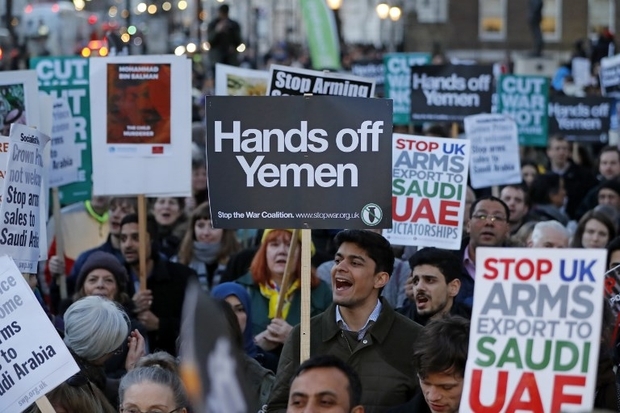
The Saudi ruler's visit was quickly derailed, however, as he came under fierce attack for his role in the Saudi-led intervention in Yemen, which began in March 2015 and has since killed thousands of civilians.
Indeed, three years after the launching of Operation Decisive Storm, the situation is no less than catastrophic. Not only has the Saudi army failed to subdue the Houthi rebels, perceived by the Saudis as the armed extension of Iran in the Arabian Peninsula, but the rebels have put up an incredible fight.
A long-standing ally, London is seen as one of the Wahhabi kingdom's key strategic partners, second only to the United States and far ahead of France
On several occasions they successfully launched missile attacks on the outskirts of Riyadh, and they continue to inflict heavy losses on an increasingly discredited and dispirited Saudi army. And for Riyadh, the war has turned into a financial quagmire as well.
Every month, hundreds of millions of dollars – or even billions according to the most alarming estimates – are squandered, while domestic spending remains in the red. In a country plagued by endemic youth unemployment, social unrest is growing.
A Typhoon jet manufactured by BAE Systems and operated by the Saudi air force (Creative Commons)
But the greatest losses are unquestionably humanitarian. The conflict has killed more than 10,000 people, and the wounded and refugees now number in the millions.
Furthermore, Yemen's catastrophic food supply situation and dilapidated public services have triggered epidemics like cholera. The combination of devastating disease with famine and water shortages has alarmed humanitarian partners and led UN officials to call the Yemen humanitarian crisis the "worst in the world".

The visit of a 'war criminal'

MBS's problems in London were largely due to the fiasco of the Saudi-led intervention in Yemen. Numerous human rights organisations have called for protest marches, forums and other symbolic gatherings to denounce the visit of a "war criminal".
Activists have also rallied near Westminster, the home of the UK parliament.
Seventeen MPs published an op-ed piece criticising Saudi Arabia for its record on human rights and demanding a moratorium on UK arms sales to the Gulf state monarchy. Labour leader Jeremy Corbyn sharply condemned Theresa May's misguided support for the crown prince's policies.
According to the opposition leader, the values of the nation should not be sacrificed to the prime minister's desire to offset the spiralling consequences of Brexit by developing a privileged relationship with the Saudi oil power.
Demonstrators protest the visit of Mohammed bin Salman, Wednesday, 7 March (AFP)
Because this is indeed one of the unavowed reasons for the crown prince's UK visit: Britain hopes to capture a share of the juicy investments the Saudi authorities are getting ready to move forward on.
But discreet discussions on the forthcoming public listing of the all-powerful state oil firm, Saudi Aramco, were a particularly important part of the trip. Aside from this, it was about selling arms.

Vision 2030

The European consortium that manufactures Typhoon fighter jets, of which the British group BAE Systems is a partner company, has welcomed a memorandum of intent signed with Riyadh for the purchase of 48 fighter aircraft.
The announcement came at the end of the Saudi prince's visit to the UK and could lead to an order worth over $10bn.
MBS and his advisors are also seeking foreign investment as part of Vision 2030, an ambitious plan to liberalise the kingdom's economy through the privatisation of state-held concerns.
Scheduled for later this year or early 2019, the public listing of the Saudi oil giant is expected to value it at $2000bn with 5 percent of the company's stock, worth $100bn, floated. Among the few details that remain to be settled - the stock exchange where Aramco will be listed.
One thing we do know is that the British government was hoping to convince the Saudi royal to choose London over New York, a city he will soon be visiting as part of an extensive tour of the United States.
Given the less than warm welcome he received in the UK, it is highly unlikely the Saudi crown prince will have many fond memories of the heavy weather in London.

End the US Enabling of Saudi War Crimes in Yemen

Daniel Larison

Zaid Jilani reports that the U.S. military has no idea what missions are carried out in Yemen by the coalition planes that they refuel:
In a surprising admission on Tuesday, the head of U.S. Central Command – which oversees U.S. forces in the Middle East and Central Asia – admitted that the Pentagon doesn’t know a whole lot about the Saudi airstrikes in Yemen that the United States is supporting through intelligence, munitions, and refueling.

U.S. CENTCOM Cmdr. Gen. Joseph Votel made the admission in response to questions from Sen. Elizabeth Warren, D-Mass., during a hearing of the Senate Armed Services Committee.
“General Votel, does CENTCOM track the purpose of the missions it is refueling? In other words, where a U.S.-refueled aircraft is going, what targets it strikes, and the result of the mission?” Warren asked.
“Senator, we do not,” Votel replied.

If the U.S. military doesn’t track what the coalition planes do after they are refueled, it can’t honestly claim that it isn’t aiding and abetting coalition violations of international law. They don’t know what the coalition planes they refuel do later on, and perhaps they don’t want to know. If the U.S. isn’t tracking how our assistance is used, it isn’t credible to say that our government is using that assistance to change the coalition’s conduct of the war for the better. The U.S. is blindly enabling indiscriminate coalition bombing without making any effort to understand the effects of our support.

Gen. Votel also stated that the U.S. is not a party to the conflict. This is the lie that U.S. officials have been hiding behind for the last three years. When our military refuels planes that go on to bomb targets in another country, our military has joined that war on the side of the governments it is aiding. That should be an uncontroversial statement of fact, but supporters of U.S. involvement in the war are desperate to deny it. If the U.S. weren’t a party to the conflict, there would be no need to debate the extensive assistance that the U.S. provides to the governments wrecking and starving Yemen for the last three years.

U.S. support has been essential to the Saudi-led war, and it would be much harder for the Saudis and their allies to continue waging that war without our military assistance. That is why those in favor of continuing the war don’t want to cut off that support. They wish to keep the war going, but they want to dodge the responsibility our government has for aiding and abetting the coalition’s crimes. Americans that want to end U.S. involvement and help bring an end to the war on Yemen should urge their senators to vote for S.J.Res. 54.

Music Video - Who Let The Dogs Out

Video Report - Lemon: Voters sent message to Trump, is he listening?

Video Report - WaPo: Trump says he made up facts in Trudeau meeting

Video Report - #Florida pedestrian bridge collapses

Comedy Video - #StudentWalkout - Students Walk Out To Protest Gun Violence | The Daily Show

Pashto Music Video - Ghezaal Enayat "Mazigar Raza Raza - غزال عنایت - آهنک پشتو

Persian Music - Leila Forouhar - Jooni Joonom | لیلا فروهر - جونی جونم

Persian Music Video - Alireza Ghaderi - Golpari joon

Music Video - Lokan do do yaar banaye - Afshan Zebi

#Pakistan - Punjab dance ban


THE project of dismantling arts and culture by a 1,000 cuts continues this week in the form of a ban on dance announced by the Punjab School Education Department.
When a similar attempt was floated in Sindh in 2016, Chief Minister Murad Ali Shah reacted swiftly to quash it. The provincial government, he said, believed in preserving and promoting culture. “It will not be dictated [to] by isolated extremist elements and will not allow its progressive agenda to be hijacked at any cost. Dance and music are integral parts of a liberal society.”
Over the decades, similar attempts to narrowly redefine our identity have been made. None have fully succeeded because, inevitably, we show our true stripes: diverse, tolerant and defiantly joyous. This is reflected in our shared kinetic energy, whether through the boisterous bhangra, the elegant Kathak or the transcendental Sufi raqs. Yet, each time, the habitually out-of-step fringe concocts a new straw man, such as the selective fear of ‘alien culture’, to exploit society’s existential anxieties.
While not explicitly stated, it seems that the proscription du jour is a cynical, misguided appropriation of a pressing issue, recently foregrounded by the rape-murder of little Zainab and all the abuse allegations that have since followed: how do we keep our children safe?
As is regrettably the case with systemic violence, a particularly unproductive response emerges. Sexual abuse, it is argued, is something that can be rationalised and avoided provided a potential victim behaves appropriately — dress and act just right, and you won’t be a target, the logic goes — stopping just short of suggesting that victims, even children, are morally responsible for being abused.
Such thinking should be resisted at all costs. Surrounded by poverty and violence, Pakistani children are already forced to grow up too soon. They won’t be better off, or safer, for being forced to forgo simple, earnest displays of expression. We should be holding perpetrators accountable, not abetting in the broader crime of stealing childhoods.

The Talibanization of #Punjab - School dance, anyone? Pakistan lawmakers in Punjab seek ban


By Zaheer Babar and Munir Ahmed


Pakistani lawmakers in a provincial assembly voted in favor of a recommendation to ban dance parties at schools and other educational institutions, saying they promote Western culture, officials said Thursday. The move drew criticism from students and activists, who vowed to oppose the decision.

Proposed by Shaikh Ijaz, a lawmaker from the ruling Pakistan Muslim League party in Punjab, the non-binding resolution was quickly adopted.
“This resolution was passed to stop vulgarity and the promotion of Western culture among youths,” he said.
Ijaz said the resolution passed the Punjab Assembly on Wednesday with no opposition from secular, moderate or Islamic parties.
The resolutionis considered a recommendation to the government, which is being asked to “stop the vulgarity” in the province. Ijaz said the motion followed parents’ complaints that some schools organized mix-gender gatherings, which are prohibited in Islam.
Angered over the motion, students said they would resist it.
Aman Batool, 22, a university student said they had the right to dance and sing at campuses.
Mahwash Ajaz, a Dubai-based Pakistani psychologist, opposed the motion, saying it was not only ridiculous but also a violation of civil liberties of individuals.
“It is up to parents to decide what their underage children can and cannot do in schools. It is not the business of politicians or state to interfere in such matters,” she told The Associated Press from Dubai.
“Don’t we have more pressing concerns to consider such as physical abuse of children, sexual abuse and quality of education rather than kids having some function or dancing once or twice a year,” she asked.
Sahir Ali Bagga, a Pakistani singer, said the best response to violence at campuses was to promote performing art.
It was not the first time that a provincial legislature recommended a ban on school dance.
A similar attempt was made in the southern Sindh province in 2016, but it was rejected by majority of the lawmakers.
Pakistan’s English-language newspaper The Dawn opposed the ban, saying it should be resisted.
In an editorial, the paper said “over the decades, similar attempts to narrowly redefine our identity have been made. None have fully succeeded because, inevitably, we show our true stripes: diverse, tolerant and defiantly joyous. This is reflected in our shared kinetic energy, whether through the boisterous bhangra, the elegant Kathak or the transcendental Sufi raqs.”

Women In Pakistan Dared To March — And Didn't Care What Men Thought


We were hundreds of women, marching on the streets of Karachi, Pakistan.
We shouted slogans. '"Aurat aiee, aurat aiee, tharki teri shaamath aiee!" (Women are here, harassers must fear!)
We raised our fists in the air, smiling, laughing.
We wore what we wanted to wear: burqas, jeans and designer shades, brightly embroidered skirts, the traditional tunic and baggy trousers called shalwar kameez.
Men gaped, shook their heads, filmed us from passing cars as we walked by, disrupting traffic.
We did not care what the men thought of us.
We were free to stand, walk, dance, with nobody to tell us to sit down, be quiet, be good.
It was the first time in my life that I saw women gathering in public, in strength, in numbers. This was the Aurat (Urdu for "women") March, the first of its kind in the conservative Muslim country of Pakistan. There were actually three marches — in Karachi, Lahore and Islamabad – all held on March 8, International Women's Day.
Word spread through Facebook and Twitter posts among the various networks of women involved in grassroots work — in education, health, microfinance, women's shelters, workers' rights. Objectives were ambitious: a demand for the recognition of women's rights and gender equality, and an end to the hideous scourge of gender violence, among other aims.
But the overriding intent was to raise the morale of Pakistani women. The constant drip of misogyny can turn life into a misery, where you are considered a lucky woman if you have a husband who doesn't beat you. The Aurat March wanted to remind women that the bar doesn't need to be set that low.
Before the march began, activists took to the stage and spoke of their struggles and triumphs. Veeru Kohli, a member of the Dalit community in the Thar Desert (low-caste Hindus known by the epithet of "untouchables") related how she escaped a life of slave labor to become a political activist. Kainat Soomro, a victim of gang rape at 13 who is trying to take her rapists to court, described her as yet unsuccessful 11-year fight for justice. An activist from the Christian community excoriated the government for ignoring the scourge of forced conversions, where Muslim men kidnap minority women, force them to convert to Islam and marry them against their consent. The March brought together women across class, ethnic, and religious lines. University students cheered on older feminist icons. Placards in English and Urdu read "Patriarchy is Fitna (sedition)", "Kebab Rolls not Gender Roles", "Woman is King" and "Stop Killing Women." Children waved orange and yellow flags with the Aurat March logo, and 97-year-old folk singer Mai Dhai sang and banged enthusiastically on a dhol, the traditional Pakistani drum played at weddings, stirring women and men to dance together in a spirit of festivity and celebration.
For the first time, I felt as though the invisible ties that held me back, those hundreds of written and unwritten rules about Pakistani women's behavior in public, had been cut through with a blowtorch.
A small group of trans women watched from the edges, nervous and scared, but they soon joined in, along with the procession of nuns bearing giant crosses and the Dalit women from the desert. We marched behind women in red, members of the working women's union, bussed in from Hyderabad. We marched, hair bare or covered, to the beat of the drums and the pounding of our hearts. We were accompanied by women on motorcycles, girls on pink bikes. Tens of men and boys joined us. We walked next to women wearing masks portraying the face of Qandeel Baloch, the social media star who was murdered by her brother two years ago because he could not stand her bold, risqué public persona. They bore a symbolic coffin containing a body shrouded in white, calling it "patriarchy's funeral."
It's been three decades since members of the Women's Action Forum were beaten on the streets for protesting the Islamization laws of dictator General Zia in the early 1980s. Pakistani women in 2018 still find themselves trampled under decades of discrimination and oppression. But the Aurat March has motivated them to demand equality and justice. The Aurat March has uncovered an undeniable truth: The revolution has arrived in Pakistan — and it is a women's revolution.

http://kcur.org/post/women-pakistan-dared-march-and-didnt-care-what-men-thought#stream/0