Thursday, March 15, 2018

Why Mohammed bin Salman's visit to London was a fiasco


Nabil Ennasri


The Saudi crown prince's eagerly awaited visit to London did not go off as well as was hoped. The visit was supposed to lend credibility to the international stature of a crown prince aspiring to one day rule the world's leading oil power.
It turned out instead to be a fierce attack on Saudi Arabia's brutal and amateurish foreign policy in the Gulf state region. The three-day state visit to the UK, which began on 6 March, was organised to both bolster the image of Mohammed bin Salman (MBS), as head of state, and to reinforce the strategic UK-Saudi partnership.

Strategic partners

A long-standing ally, London is seen as one of the Wahhabi kingdom's key strategic partners, second only to the United States and far ahead of France.
The Saudi ruler's visit was quickly derailed, however, as he came under fierce attack for his role in the Saudi-led intervention in Yemen, which began in March 2015 and has since killed thousands of civilians.
Indeed, three years after the launching of Operation Decisive Storm, the situation is no less than catastrophic. Not only has the Saudi army failed to subdue the Houthi rebels, perceived by the Saudis as the armed extension of Iran in the Arabian Peninsula, but the rebels have put up an incredible fight.
A long-standing ally, London is seen as one of the Wahhabi kingdom's key strategic partners, second only to the United States and far ahead of France
On several occasions they successfully launched missile attacks on the outskirts of Riyadh, and they continue to inflict heavy losses on an increasingly discredited and dispirited Saudi army. And for Riyadh, the war has turned into a financial quagmire as well.
Every month, hundreds of millions of dollars – or even billions according to the most alarming estimates – are squandered, while domestic spending remains in the red. In a country plagued by endemic youth unemployment, social unrest is growing.
A Typhoon jet manufactured by BAE Systems and operated by the Saudi air force (Creative Commons)
But the greatest losses are unquestionably humanitarian. The conflict has killed more than 10,000 people, and the wounded and refugees now number in the millions.
Furthermore, Yemen's catastrophic food supply situation and dilapidated public services have triggered epidemics like cholera. The combination of devastating disease with famine and water shortages has alarmed humanitarian partners and led UN officials to call the Yemen humanitarian crisis the "worst in the world".

The visit of a 'war criminal'

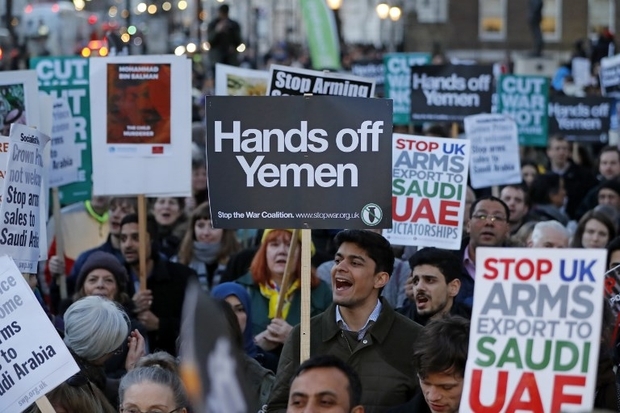
MBS's problems in London were largely due to the fiasco of the Saudi-led intervention in Yemen. Numerous human rights organisations have called for protest marches, forums and other symbolic gatherings to denounce the visit of a "war criminal".
Activists have also rallied near Westminster, the home of the UK parliament.
Seventeen MPs published an op-ed piece criticising Saudi Arabia for its record on human rights and demanding a moratorium on UK arms sales to the Gulf state monarchy. Labour leader Jeremy Corbyn sharply condemned Theresa May's misguided support for the crown prince's policies.
According to the opposition leader, the values of the nation should not be sacrificed to the prime minister's desire to offset the spiralling consequences of Brexit by developing a privileged relationship with the Saudi oil power.
Demonstrators protest the visit of Mohammed bin Salman, Wednesday, 7 March (AFP)
Because this is indeed one of the unavowed reasons for the crown prince's UK visit: Britain hopes to capture a share of the juicy investments the Saudi authorities are getting ready to move forward on.
But discreet discussions on the forthcoming public listing of the all-powerful state oil firm, Saudi Aramco, were a particularly important part of the trip. Aside from this, it was about selling arms.

Vision 2030

The European consortium that manufactures Typhoon fighter jets, of which the British group BAE Systems is a partner company, has welcomed a memorandum of intent signed with Riyadh for the purchase of 48 fighter aircraft.
The announcement came at the end of the Saudi prince's visit to the UK and could lead to an order worth over $10bn.
MBS and his advisors are also seeking foreign investment as part of Vision 2030, an ambitious plan to liberalise the kingdom's economy through the privatisation of state-held concerns.
Scheduled for later this year or early 2019, the public listing of the Saudi oil giant is expected to value it at $2000bn with 5 percent of the company's stock, worth $100bn, floated. Among the few details that remain to be settled - the stock exchange where Aramco will be listed.
One thing we do know is that the British government was hoping to convince the Saudi royal to choose London over New York, a city he will soon be visiting as part of an extensive tour of the United States.
Given the less than warm welcome he received in the UK, it is highly unlikely the Saudi crown prince will have many fond memories of the heavy weather in London.

End the US Enabling of Saudi War Crimes in Yemen

Daniel Larison

Zaid Jilani reports that the U.S. military has no idea what missions are carried out in Yemen by the coalition planes that they refuel:
In a surprising admission on Tuesday, the head of U.S. Central Command – which oversees U.S. forces in the Middle East and Central Asia – admitted that the Pentagon doesn’t know a whole lot about the Saudi airstrikes in Yemen that the United States is supporting through intelligence, munitions, and refueling.

U.S. CENTCOM Cmdr. Gen. Joseph Votel made the admission in response to questions from Sen. Elizabeth Warren, D-Mass., during a hearing of the Senate Armed Services Committee.
“General Votel, does CENTCOM track the purpose of the missions it is refueling? In other words, where a U.S.-refueled aircraft is going, what targets it strikes, and the result of the mission?” Warren asked.
“Senator, we do not,” Votel replied.

If the U.S. military doesn’t track what the coalition planes do after they are refueled, it can’t honestly claim that it isn’t aiding and abetting coalition violations of international law. They don’t know what the coalition planes they refuel do later on, and perhaps they don’t want to know. If the U.S. isn’t tracking how our assistance is used, it isn’t credible to say that our government is using that assistance to change the coalition’s conduct of the war for the better. The U.S. is blindly enabling indiscriminate coalition bombing without making any effort to understand the effects of our support.

Gen. Votel also stated that the U.S. is not a party to the conflict. This is the lie that U.S. officials have been hiding behind for the last three years. When our military refuels planes that go on to bomb targets in another country, our military has joined that war on the side of the governments it is aiding. That should be an uncontroversial statement of fact, but supporters of U.S. involvement in the war are desperate to deny it. If the U.S. weren’t a party to the conflict, there would be no need to debate the extensive assistance that the U.S. provides to the governments wrecking and starving Yemen for the last three years.

U.S. support has been essential to the Saudi-led war, and it would be much harder for the Saudis and their allies to continue waging that war without our military assistance. That is why those in favor of continuing the war don’t want to cut off that support. They wish to keep the war going, but they want to dodge the responsibility our government has for aiding and abetting the coalition’s crimes. Americans that want to end U.S. involvement and help bring an end to the war on Yemen should urge their senators to vote for S.J.Res. 54.

Music Video - Who Let The Dogs Out

Video Report - Lemon: Voters sent message to Trump, is he listening?

Video Report - WaPo: Trump says he made up facts in Trudeau meeting

Video Report - #Florida pedestrian bridge collapses

Comedy Video - #StudentWalkout - Students Walk Out To Protest Gun Violence | The Daily Show

Pashto Music Video - Ghezaal Enayat "Mazigar Raza Raza - غزال عنایت - آهنک پشتو

Persian Music - Leila Forouhar - Jooni Joonom | لیلا فروهر - جونی جونم

Persian Music Video - Alireza Ghaderi - Golpari joon

Music Video - Lokan do do yaar banaye - Afshan Zebi

#Pakistan - Punjab dance ban


THE project of dismantling arts and culture by a 1,000 cuts continues this week in the form of a ban on dance announced by the Punjab School Education Department.
When a similar attempt was floated in Sindh in 2016, Chief Minister Murad Ali Shah reacted swiftly to quash it. The provincial government, he said, believed in preserving and promoting culture. “It will not be dictated [to] by isolated extremist elements and will not allow its progressive agenda to be hijacked at any cost. Dance and music are integral parts of a liberal society.”
Over the decades, similar attempts to narrowly redefine our identity have been made. None have fully succeeded because, inevitably, we show our true stripes: diverse, tolerant and defiantly joyous. This is reflected in our shared kinetic energy, whether through the boisterous bhangra, the elegant Kathak or the transcendental Sufi raqs. Yet, each time, the habitually out-of-step fringe concocts a new straw man, such as the selective fear of ‘alien culture’, to exploit society’s existential anxieties.
While not explicitly stated, it seems that the proscription du jour is a cynical, misguided appropriation of a pressing issue, recently foregrounded by the rape-murder of little Zainab and all the abuse allegations that have since followed: how do we keep our children safe?
As is regrettably the case with systemic violence, a particularly unproductive response emerges. Sexual abuse, it is argued, is something that can be rationalised and avoided provided a potential victim behaves appropriately — dress and act just right, and you won’t be a target, the logic goes — stopping just short of suggesting that victims, even children, are morally responsible for being abused.
Such thinking should be resisted at all costs. Surrounded by poverty and violence, Pakistani children are already forced to grow up too soon. They won’t be better off, or safer, for being forced to forgo simple, earnest displays of expression. We should be holding perpetrators accountable, not abetting in the broader crime of stealing childhoods.

The Talibanization of #Punjab - School dance, anyone? Pakistan lawmakers in Punjab seek ban


By Zaheer Babar and Munir Ahmed


Pakistani lawmakers in a provincial assembly voted in favor of a recommendation to ban dance parties at schools and other educational institutions, saying they promote Western culture, officials said Thursday. The move drew criticism from students and activists, who vowed to oppose the decision.

Proposed by Shaikh Ijaz, a lawmaker from the ruling Pakistan Muslim League party in Punjab, the non-binding resolution was quickly adopted.
“This resolution was passed to stop vulgarity and the promotion of Western culture among youths,” he said.
Ijaz said the resolution passed the Punjab Assembly on Wednesday with no opposition from secular, moderate or Islamic parties.
The resolutionis considered a recommendation to the government, which is being asked to “stop the vulgarity” in the province. Ijaz said the motion followed parents’ complaints that some schools organized mix-gender gatherings, which are prohibited in Islam.
Angered over the motion, students said they would resist it.
Aman Batool, 22, a university student said they had the right to dance and sing at campuses.
Mahwash Ajaz, a Dubai-based Pakistani psychologist, opposed the motion, saying it was not only ridiculous but also a violation of civil liberties of individuals.
“It is up to parents to decide what their underage children can and cannot do in schools. It is not the business of politicians or state to interfere in such matters,” she told The Associated Press from Dubai.
“Don’t we have more pressing concerns to consider such as physical abuse of children, sexual abuse and quality of education rather than kids having some function or dancing once or twice a year,” she asked.
Sahir Ali Bagga, a Pakistani singer, said the best response to violence at campuses was to promote performing art.
It was not the first time that a provincial legislature recommended a ban on school dance.
A similar attempt was made in the southern Sindh province in 2016, but it was rejected by majority of the lawmakers.
Pakistan’s English-language newspaper The Dawn opposed the ban, saying it should be resisted.
In an editorial, the paper said “over the decades, similar attempts to narrowly redefine our identity have been made. None have fully succeeded because, inevitably, we show our true stripes: diverse, tolerant and defiantly joyous. This is reflected in our shared kinetic energy, whether through the boisterous bhangra, the elegant Kathak or the transcendental Sufi raqs.”

Women In Pakistan Dared To March — And Didn't Care What Men Thought


We were hundreds of women, marching on the streets of Karachi, Pakistan.
We shouted slogans. '"Aurat aiee, aurat aiee, tharki teri shaamath aiee!" (Women are here, harassers must fear!)
We raised our fists in the air, smiling, laughing.
We wore what we wanted to wear: burqas, jeans and designer shades, brightly embroidered skirts, the traditional tunic and baggy trousers called shalwar kameez.
Men gaped, shook their heads, filmed us from passing cars as we walked by, disrupting traffic.
We did not care what the men thought of us.
We were free to stand, walk, dance, with nobody to tell us to sit down, be quiet, be good.
It was the first time in my life that I saw women gathering in public, in strength, in numbers. This was the Aurat (Urdu for "women") March, the first of its kind in the conservative Muslim country of Pakistan. There were actually three marches — in Karachi, Lahore and Islamabad – all held on March 8, International Women's Day.
Word spread through Facebook and Twitter posts among the various networks of women involved in grassroots work — in education, health, microfinance, women's shelters, workers' rights. Objectives were ambitious: a demand for the recognition of women's rights and gender equality, and an end to the hideous scourge of gender violence, among other aims.
But the overriding intent was to raise the morale of Pakistani women. The constant drip of misogyny can turn life into a misery, where you are considered a lucky woman if you have a husband who doesn't beat you. The Aurat March wanted to remind women that the bar doesn't need to be set that low.
Before the march began, activists took to the stage and spoke of their struggles and triumphs. Veeru Kohli, a member of the Dalit community in the Thar Desert (low-caste Hindus known by the epithet of "untouchables") related how she escaped a life of slave labor to become a political activist. Kainat Soomro, a victim of gang rape at 13 who is trying to take her rapists to court, described her as yet unsuccessful 11-year fight for justice. An activist from the Christian community excoriated the government for ignoring the scourge of forced conversions, where Muslim men kidnap minority women, force them to convert to Islam and marry them against their consent. The March brought together women across class, ethnic, and religious lines. University students cheered on older feminist icons. Placards in English and Urdu read "Patriarchy is Fitna (sedition)", "Kebab Rolls not Gender Roles", "Woman is King" and "Stop Killing Women." Children waved orange and yellow flags with the Aurat March logo, and 97-year-old folk singer Mai Dhai sang and banged enthusiastically on a dhol, the traditional Pakistani drum played at weddings, stirring women and men to dance together in a spirit of festivity and celebration.
For the first time, I felt as though the invisible ties that held me back, those hundreds of written and unwritten rules about Pakistani women's behavior in public, had been cut through with a blowtorch.
A small group of trans women watched from the edges, nervous and scared, but they soon joined in, along with the procession of nuns bearing giant crosses and the Dalit women from the desert. We marched behind women in red, members of the working women's union, bussed in from Hyderabad. We marched, hair bare or covered, to the beat of the drums and the pounding of our hearts. We were accompanied by women on motorcycles, girls on pink bikes. Tens of men and boys joined us. We walked next to women wearing masks portraying the face of Qandeel Baloch, the social media star who was murdered by her brother two years ago because he could not stand her bold, risqué public persona. They bore a symbolic coffin containing a body shrouded in white, calling it "patriarchy's funeral."
It's been three decades since members of the Women's Action Forum were beaten on the streets for protesting the Islamization laws of dictator General Zia in the early 1980s. Pakistani women in 2018 still find themselves trampled under decades of discrimination and oppression. But the Aurat March has motivated them to demand equality and justice. The Aurat March has uncovered an undeniable truth: The revolution has arrived in Pakistan — and it is a women's revolution.

http://kcur.org/post/women-pakistan-dared-march-and-didnt-care-what-men-thought#stream/0

#PashtunTahafuzMovement - A portrait of Manzoor Ahmed Pashteen, a missing voice


Last year, in March, I was in Dera Ismail Khan, a southern city in Khyber Pakhtunkhwa, to attend a friend’s wedding. Later that night, as the festivities ended a few of us – mostly reporters - headed to a local hotel for tea. There I met him for the first time. The young man walked over to our table and introduced himself as the head of the Mehsud Tahafuz Movement — I’ll be honest, I had no idea what it was.
We listened, politely, and then returned to our conversations. But the 23-year-old Manzoor Ahmed Pashteen was relentless. Journalists need to do more, he pleaded. They need to give more coverage to the everyday ordeals that Pashtun men and women face in Pakistan. Mehsuds, a Pashtun tribe, “are still struggling to be heard,” he continued breathlessly. “Men from the Wazir and Dawar tribes have used social media platforms to their advantage. Why haven’t we done the same?” Pashteen was convinced if the Mehsuds can come together and present their demands audibly and indistinguishably in one voice, only then will they be taken seriously by the state. “You journalists are lucky,” he said, “You have access to Facebook and Twitter, we don’t.”
He was not wrong. South Waziristan, one of the seven tribal agencies of the Federally Administered Tribal Areas in Pakistan, where a large number of Mehsuds live, has remained deprived of the internet. Even after the Pakistan Army launched Operation Rah-e-Nijat in 2009, a ground and air offensive to rid the area of militants, the coverage of broadband and mobile 3G is still patchy. Tribesmen have to walk great distances to catch signals from towers installed in neighbouring areas. If they had open access, insisted Pashteen, the Mehsud tribes would be able to communicate seamlessly and a movement for their rights could be initiated.
Yet, internet or no internet, there was no stopping this ambitious man. When he spoke, it was difficult not to hang on to his each and every word. Pashteen was determined. He was passionate. He was the voice that had long been missing in Pakistan.
The eldest of seven siblings, the boy grew up in the Sarokai district of South Waziristan.
His father was a teacher at a local school. Even from a young age, it seems, Pashteen always had a flair for activism. In 2014, he joined the Tribal Students Society and was made its president for two years. Then two years ago, he began raising awareness about landmines and unexploded ordinances littering their mountainous hometown. Occasionally, he would compile the list of those hurt in landmine explosions and Whatsapp them to all reporters, including me. Some of these reports would make it on-air, many wouldn’t. He would also share pictures of children killed and disabled by landmines on social media. When local news networks did not pay attention, a frustrated Pashteen then turned to the international media for help.
Young men like him would gather at the Haq Nawaz Park in Dera Ismail Khan or in Tank to draw attention to their demands. In the process, many would be arrested. Pashteen has also spent two days behind bars.
In the meantime, anger amongst the Mehsuds kept simmering and boiled over into a 10-day protest outside the National Press Club in Islamabad in February. The protest was also propelled after the killing of an aspiring model from South Waziristan, Naqeebullah Mehsud, who was allegedly killed extra-judicially by a notorious cop in Karachi.
After the murder, there was palpable fear in South Waziristan. Some Mehsud elders were of the view that the man be quietly buried, like so many other Pashtun men who have been killed in fake police encounters. But others wanted justice and accountability. Enough was enough, it was decided that the Mehsuds will take their nonviolent protest to the country's capital. The word spread quickly through Facebook. Within hours, dozens of young men reached the morgue to claim Naqeeb’s remains. Then dozens turned into hundreds in the Sohrab Goth area of Karachi.
Pashteen and his friends took the 27-year-old’s body to his ancestral village, under the protection of the paramilitary Levies and police. Once he was laid to rest, Pashteen took Naqeeb’s father back to Karachi, where they decided on a date for the 'long march'.
Finally, on January 26, Pashteen and many Pashtun men and women made history. They set off, undeterred, from Dera Ismail Khan to Islamabad, collecting people from all parts of FATA and Khyber Pakhtunkhwa. The demands were simple:
· Bring Naqeeb’s murderers to trial
· Clear landmines in the tribal areas
· Reduce the curfews that people of FATA are subjected to after every bombing in Pakistan
· Produce the missing people in court
· Form a judicial commission to investigate staged encounters
With these demands, the Mehsud Tahafuz Movement turned into the All Pashtoon National Jirga and Pashteen became a household name.

PPP is ready to make history; Sherry to be the first woman to lead the opposition in the senate: Bilawal Bhutto

PPP chairman Bilawal Bhutto Zardari has said that PPP is ready to make history again by nominating Senator Sherry Rehman for the position of Leader of Opposition in Senate. In his twitter message today he further said that InshAllah she would be the first woman to lead the opposition in the senate.


http://www.thesindhtimes.com/blog/2018/03/14/ppp-ready-make-history-sherry-first-woman-lead-opposition-senate-bilawal-bhutto/

PPP always leading with our women in front: Bakhtawar Bhutto

Bakhtawar Bhutto Zardari, the daughter of Mohtarma Benazir Bhutto has said that PPP always leading with our women in front. Commenting over the nomination of Senator Sherry Rehman as leader of opposition in Senate she in her twitter message said,” Senator @sherryrehman nominated as leader of opposition! #PPP always leading with our women in front – from first female Prime Minister, to Speaker of National Assembly to Foreign Minister & more #PPP 😍🙌🏻💪 #Pakistan”


http://www.thesindhtimes.com/blog/2018/03/15/ppp-always-leading-women-front-bakhtawar-bhutto/

Wednesday, March 14, 2018

Music Video - Taylor Swift - Delicate

Video - EXCLUSIVE FULL UNEDITED Interview of Putin with NBC's Megan Kelly

Video Report - Russia reacts to U.K. nerve-agent attack allegations

Video Report - Trump fires Tillerson: What next for US diplomacy?

Video Report - 🇺🇸 🌎 Rex Wayne Tillerson - What now for Washington's relations with the world? - Inside Story -

Video - Comedy Show - Rex Tillerson Got Fired Via Twitter

Video - Trump Cans Rex Tillerson Over Twitter | The Daily Show

Video Report - #NationalStudentWalkout - Students Take Fight For Gun Reform Into Their Own Hands: ‘Adults Have Failed Us’

📡 Chuck Schumer Speaks to THOUSANDS of Kids Outside the Capitol in Washington DC.

📡 Nancy Pelosi Speaks to THOUSANDS of Kids Outside the Capitol in Washington DC. - #NationalStudentWalkout

Video Report - #NationalStudentWalkout - Bernie Sanders' ROCKSTAR Like Appearance At D.C. Student Gun Control Rally

Video Report - Students Protest Gun Violence With Walkout | NBC News

Video Report - #NationalStudentWalkout - Students protest gun violence in mass walkout across U.S. (FULL march)

Video Report - #NationalStudentWalkout - National School Walkout finds students gathering for tighter gun control laws

Conor Lamb Wins Pennsylvania House Seat, Giving Democrats a Map for Trump Country

By ALEXANDER BURNS and JONATHAN MARTIN

Conor Lamb, a Democrat and former Marine, scored a razor-thin but extraordinary upset in a special House election in southwestern Pennsylvania after a few thousand absentee ballots delivered Democrats a win in the heart of President Trump’s Rust Belt base.
The victory still may be contested, but Mr. Lamb’s 627-vote lead Wednesday afternoon appeared insurmountable, given that the four counties in Pennsylvania’s 18th district have about 500 provisional, military and other absentee ballots left to count, county election officials said. That slim margin, out of almost 230,000 ballots cast, nonetheless upended the political landscape ahead of November’s midterm elections and emboldened fellow Democrats to run maverick campaigns even in deep-red areas where Republicans remain bedeviled by Mr. Trump’s unpopularity.
Republican officials in Washington said they were likely to demand a recount through litigation, and the National Republican Congressional Committee put out a call for voters to report any irregularities in the balloting. Matt Gorman, a spokesman for the committee, said the party was “not conceding anything.”
But absent significant adjustments in the tally, Mr. Lamb, a 33-year-old former prosecutor from a local Democratic dynasty, pulled off a staggering upset over Rick Saccone, a Republican state legislator, in a district that Mr. Trump carried by nearly 20 percentage points in 2016.
The hairbreadth outcome in the race belied its sweeping consequences. The battle for a district in suburban and rural areas around Pittsburgh underscored the degree to which his appeal has receded across the country. And it exposed the ways in which both parties are weighed down by divisive leaders: Democrats by Nancy Pelosi, the House minority leader; Republicans by Mr. Trump and Paul D. Ryan, the speaker of the House.
Just as vividly, the race showed that only one party appears willing to grapple with the implications of campaigning under a radioactive figurehead.
In Pennsylvania, Mr. Lamb presented himself as independent-minded and neighborly, vowing early he would not support Ms. Pelosi to lead House Democrats and playing down his connections to his national party. He echoed traditional Democratic themes about union rights and economic fairness, but took a more conservative position on the hot-button issue of guns.
Throughout the race, Mr. Lamb said he welcomed support from people who voted for Mr. Trump, and he saved his most blunt criticism for Mr. Ryan, highlighting the speaker’s ambitions to overhaul Social Security and Medicare. Mr. Lamb’s approach could become a template for a cluster of more moderate Democrats contesting conservative-leaning seats, in states like Arkansas, Kansas and Utah. Democrats in Washington have focused chiefly on Republican-held seats in the upscale suburbs where Mr. Trump is most intensely disliked.
But they are hungry for gains across the political map, and in red areas they have encouraged candidates to put local imperatives above fealty to the national party, even tolerating outright disavowals of Ms. Pelosi.
Representative Cheri Bustos of Illinois, a Democrat who represents a farm and manufacturing district Mr. Trump narrowly carried, said the party’s recruits should feel free to oppose Ms. Pelosi if they choose. She noted that she was helping one such anti-Pelosi candidate, Paul Davis of Kansas, who was in Washington this week raising money.
“If they want somebody else to be a leader, then they ought to express that,” Ms. Bustos said. “I don’t have a problem with that.”
Representative Mike Doyle of Pennsylvania, a veteran Democrat from a neighboring district, said Mr. Lamb had benefited from “buyer’s remorse” among Trump supporters and had wisely tailored his message to the conservative-leaning area.
“This guy has made a lot of promises that aren’t being kept,” Mr. Doyle said of the president.
On the Republican side, Mr. Saccone, 60, campaigned chiefly as a stand-in for Mr. Trump, endorsing the president’s agenda from top to bottom. He campaigned extensively with Mr. Trump and members of his administration and relied heavily on campaign spending from outside Republican groups that attempted to make Ms. Pelosi a central voting issue. Conservative outside groups also sought to promote the tax cuts recently enacted by the party, but found that message had little effect.
Yet the Republicans’ all-hands rescue mission was not enough to salvage Mr. Saccone’s candidacy. Mr. Saccone has not conceded and Republicans have indicated they may challenge the results through litigation, a long-shot strategy.
In a meeting with House Republicans on Wednesday morning, Representative Steve Stivers of Ohio, who leads the party’s campaign committee, described the race as “too close to call,” according to a person who heard his presentation. But Mr. Ryan and Mr. Stivers also called the election a “wake-up call” for Republican lawmakers, telling them that they could not afford to fall behind on fund-raising, as Mr. Saccone did. Mr. Lamb raised $3.9 million and spent $3 million, compared with Mr. Saccone’s $900,000 raised and $600,000 spent as of Feb. 21. But Republican outside groups swamped the district. Between conservative “super PACs” and the National Republican Congressional Committee, Mr. Saccone had more than $14 million spent on his behalf.
Mr. Lamb got just over $2 million.
As Republican lawmakers spilled out of their morning conference meeting, few seemed willing to come to grips with how much Mr. Trump is energizing Democrats and turning off independent voters. Some of them even argued that Mr. Saccone only made the race close thanks to the president’s rally in the district on Saturday.
“The president came in and helped close this race and got it to where it is right now,” said Mr. Ryan.
Others in the conference, however, talked more openly about the political difficulties of breaking with Mr. Trump. “There is no benefit from running away from the president,” said Representative Patrick McHenry of North Carolina, a member of his party’s leadership, noting that Republican candidates need core conservative voters to show up and this constituency still backs the president. “It doesn’t get them the same thing as Lamb opposing Pelosi,” said Mr. McHenry.
Even Mr. Stivers, who is tasked with re-electing a contingent of lawmakers from districts that backed Hillary Clinton, declined to say Republicans should feel free to break from Mr. Trump.
“I am not going to tell anybody to be against the president,” he said. But Mr. Lamb’s margin and the turnout levels in the district’s suburban precincts proved crucial, and a handful of Republican House veterans conceded this broader vulnerability. “We know that’s probably where the president’s appeal is the weakest,” said Representative Tom Cole of Oklahoma, a longtime party strategist, adding: “It’s a pattern we’ve seen throughout.” But he argued that Mr. Trump’s unpopularity in high-income areas would not as adversely impact incumbents who have their own identity and are steeled for difficult races. Yet even as most of the Republicans pinned the blame on Mr. Saccone’s fund-raising weakness or held up Mr. Lamb’s willingness to oppose Ms. Pelosi, refusing to fault Mr. Trump, one retiring lawmaker was more blunt. “Denial isn’t just a river in Egypt,” said Representative Charlie Dent of Pennsylvania, a frequent critic of the president. “I’ve been through wave elections before.”
Democrats were buoyant at Mr. Lamb’s victory, viewing his upset as both a harbinger of a November wave and perhaps a sign that the party had overcome some of the most stinging Republican attack lines of the Obama years. Polling in both parties found Ms. Pelosi widely disliked among voters in the district, but the Republican ads featuring her failed to disqualify Mr. Lamb. Pittsburgh Mayor Bill Peduto, a Democrat, said Mr. Lamb’s campaign showed that the Republicans’ anti-Pelosi playbook had real limitations. The race, he said, should embolden Democrats to contest difficult districts in the Midwest with an economic message that appeals to elements of Mr. Trump’s base.
“Conor Lamb was talking about redevelopment and economic growth, and the Republicans were talking about Nancy Pelosi,” Mr. Peduto said. “It’s like they couldn’t help themselves.” Mr. Peduto urged the Democratic Congressional Campaign Committee, the electioneering vehicle for House Democrats, to expand its target list in the Trump-aligned Midwest. “Look through the Rust Belt, in areas that used to be blue,” Mr. Peduto said. “If you’re in a congressional district that’s 8, 10 or 12 points carried by Trump, I would hope that the D.C.C.C. is now putting that in the target.”
To the extent that Democrats attempt further incursions into Trump country, it may test their party’s willingness to tolerate Lamb-like deviation on matters like gun control, and perhaps more widespread rejection of Ms. Pelosi.
Democrats in Washington have already faced criticism from liberal activists for intervening in primary elections, in states like Texas and California, to promote candidates that they view as more electable. Putting forward a slate of moderates in Republican areas could prove more controversial than boosting just one in a special election. Up to this point, however, Democratic leaders and their campaign tacticians have taken a just-win approach, encouraging candidates to attack Mr. Ryan but taking a far more permissive view of party loyalty than their Republican counterparts.
Clarke Tucker, a Democratic state legislator in Arkansas who is challenging Representative French Hill, a Republican, said on Wednesday that he took Mr. Lamb’s victory as a validation of a throw-the-bums-out message he planned to deliver in his own race. Campaigning in a seat that comprises Little Rock and its suburbs, Mr. Tucker said he seldom spoke about Mr. Trump and announced up front that he would not back Ms. Pelosi.
Mr. Tucker, who was aggressively recruited by the D.C.C.C., said he had told Democrats in Washington that he was “very frustrated with the leadership of the House in both parties” and no one attempted to dissuade him from delivering that message. “That district is a lot like the one I’m running in,” Mr. Tucker said of Mr. Lamb’s seat. “I think voters are interested in changing the leadership in Washington.”

Music Video - Runa Laila live @ Ptv in her Teens @ Urdu Song

#Pakistan - Bilawal rejects conspiracy theories about fate of 18th amendment


Pakistan People's Party (PPP) chairman Bilawal Bhutto Zardari on Tuesday said his party will not compromise on the integrity of country's constitution.
Rejecting what he said conspiracy theories  about the fate of the 18th amendment, the PPP chairman said in a tweet that the fundamentals of the 18th amendment and 1973 constitution are non negotiable.
"Come hell or high water we will not compromise on our constitution’s integrity," said he.


There seems to be a lot of conspiracy theories about the fate of the 18th amendment. Let me make position clear; the fundamentals of the 18th amendment & 1973 constitution are non negotiable. Come hell or high water we will not compromise on our constitution’s integrity.

The 18th amendment was passed during the PPP tenure by the National Assembly in 2010, removing the power of the President of Pakistan to dissolve the Parliament unilaterally .

#PashtunTahafuzMovement - Cases filed against #Pakistani activist for 'criticizing military'

By Asad Hashim
An FIR has been registered against Manzoor Pashteen, who organised rallies highlighting profiling of Pashtuns.


Pakistani police have registered cases against a young ethnic Pashtun rights activist for criticising the country's powerful military during the latest in a series of rallies his organisation has held across the South Asian country.
Police registered cases in the western districts of Zhob and Qila Saifullah on Tuesday, accusing Manzoor Pashteen of "wantonly giving provocation with intent to cause [a] riot".
If convicted Pashteen, 26, faces a maximum of five years in prison.
Pashteen is one of a group of young men leading the Pashtun Tahaffuz Movement (PTM), which has organised rallies in solidarity with a Pashtun youth who was killed by the police.
The rights group gained prominence while leading a sit-in demanding justice for the extrajudicial killing of Naqeebullah Mehsud in the southern port city of Karachi in January.
Mehsud had been accused by police of being a Pakistan Taliban fighter, but an inquiry after his killing in a police 'encounter' found him innocent of any links to the group. 
Rao Anwar, the senior police official held responsible for the youth's killing, went into hiding shortly after the inquiry, and remains wanted in the case.
"The registering of this case is extremely saddening, and we cannot condemn it strongly enough," said Alam Zeb Mehsud, a PTM leader.
"We have stood up for our rights. We have only spoken of what has happened to us - we have not lied, and we have never said anything unconstitutional."
Pashteen and Mehsud are among a number of young activists from the northwestern district of South Waziristan who have led a movement calling for the rights of ethnic Pashtuns to be respected.
They hold the state and military responsible for what they call the ethnic profiling of Pashtuns as "terrorists", and widespread rights violations in South Waziristan and elsewhere, including the collective punishment of civilians for attacks on security forces.
The Pakistani military denies any wrongdoing. In a statement to Al Jazeera issued in January, responding to the PTM's allegations, the military said while it investigated the possibility of locals facilitating attacks, it did so "strictly as per [tribal] traditions".
PTM leaders say they have been receiving threats from unidentified callers for years, since they first started organising their grassroots movement to protest alleged rights violations by the military.
"As time passed, we lost our fear. Now we are at a stage where if we get a call from the intelligence agencies, we don't care anymore. Because we have gotten used to it. They bother us on an almost daily basis," said Muhammad Idrees, 25, a founding member of the group.

Taking on the military

Direct criticism of the military, which has ruled the country for roughly half of its 70 years since independence, is rare in Pakistan.
Since May last year, the government has led a campaign targeting dissent against the military expressed on social media and on other online platforms.
"The PTM is not an engineered movement, it has been created by the situation," said Mehsud. "It has been created by a context of killings ... we have been the victims of terrorism, and then we are accused of being terrorists to boot. We have been facing this injustice for years."
PTM rallies held across the country since the Islamabad sit-in have attracted thousands of participants, although they have seen scant coverage in the country’s press.
At a recent rally, a local religious leader attempted to direct the young participants' anger towards the United States, signaling that armed groups such as the Pakistan Taliban were a US creation.
He was met by strident criticism, and forced to step off the stage, after the crowd loudly chanted an oft heard Pakistani leftist Urdu slogan: "This terrorism, it is backed by the military!"
PTM leader Mehsud denies his group is demanding "any kind of rebellion or anything against the State".
"We just want the protection of our life, our property and our honour.
"These three things, nothing else."

#Pakistan - At least nine, including five policemen martyred in Raiwind blast


At least five police personnel and four citizens were martyred Wednesday evening in a suspected suicide attack in the Raiwind area on the outskirts of Lahore, officials said. 
Rescue 1122 and hospital officials confirmed the toll, saying the explosion injured at least 25 others, including 13 police personnel, who were being treated at different hospitals. 
Senior police official, Deputy Inspector General Operations Dr. Haider Ashraf, said police personnel appeared to be the target of the attack as the explosion took place close to a police check-post and near the vehicle of a deputy superintendent.
DIG Ashraf said the bomb exploded when police were changing guards at the checkpoint.
It appears to be a suicide attack, he said, adding that body parts had been recovered from the site of the blast. Police officials added that a motorcycle near the blast site had also been completely destroyed.
Thousands of people from Punjab province and across the country participate gather in Raiwind every year to take part in the Raiwind Ijtema (congregation), one of the largest gatherings of religious devotees in Pakistan. The attack targeted the police vehicle close to the venue of the annual religious congregation.
This was the first explosion targeting the provincial capital since the start of 2018. Lahore underwent a series of terrorist attacks last year in which more than 60 people were killed. 

Our struggle will continue for the women’s rights in #Pakistan: sherry Rehman


Our struggle will continue for the women’s rights in Pakistan. It was stated by Senator Sherry Rehman during a rally in connection with Karwan-e-Benazir here on Thursday.


http://www.thesindhtimes.com/blog/2018/03/08/struggle-will-continue-womens-rights-pakistan-sherry-rehman/