Friday, October 13, 2017

#CheGuevara– Viva! Hasta la Victoria Siempre! “Che


By Peter Koenig


Among the Greatest Revolutionaries of the 20th Century”.


Che! – You are one of the greatest revolutionaries of the 20th Century. You inspired tens of millions of people throughout the world to fight for justice, for their freedom and civil rights. You have left a vision of hope, of never giving up – a legacy of solidarity and of Venceremos! – we shall overcome. You have been murdered by the most criminal organization of the most evil empire, the CIA of the United States of America – but your spirit lives on in Latin America, Africa, Asia and even in vassal Europe, inspiring generation after generation for class struggle, that there is universal justice that must be fought for and will be won. Che – you are a true Hero – an icon for the poor and powerless!
Ernesto “Che” Guevara was born in Rosario, Argentina, on 14 June 1928 and was assassinated in Higuera, Bolivia, by CIA-led Bolivian forces on 9 October 1967. It was a summary execution – no trial, no questions asked – 50 years ago. What has changed in 5 decades? – At the surface, one might say – not much. The world is still divided between the capitalist, neocolonialist west and the much more visionary and peaceful east.
However, moral consciousness is rising everywhere. There is slow progression; the vessel is slowly veering towards a more peaceful multi-polar world. Not just the ascent of Russia and China are bringing a new wind of consciousness to millions of people, but the sensation of change is noticeable everywhere – from South to North and from East to West. It is still brittle and weak – but it is growing and gaining strength. And Che – his unquestioned determination to fight for a better world – was instrumental in this awakening.
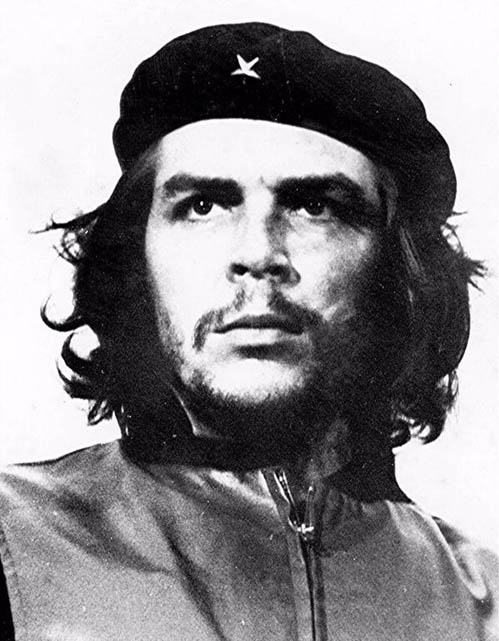
Che left Argentina in the early 1950s as a medical student, accompanied by his pal, Alberto Granado, a young doctor, on a single-cylinder sputtering 1939 Norton motor cycle – they called it “La Poderosa” (“the Mighty”), exploring the Latin American Subcontinent which they knew only from books. Granado was probably the first one to give Ernesto the famous nickname “Che” – an Argentinian equivalent to ‘buddy’ or ‘pal’. They travelled through South America and discovered misery, poverty and disease. Combining Che’s “The Motor Cycle Diaries” and Granado’s “With Che Through Latin America”, Robert Redford turned the diaries in 2004 into an epic movie that has since become as symbolic for young revolutionary rebellion as has Alberto Korda’s famous photography of Che’s.
The film portrays the two friends exposed to utmost destitution throughout South America, turning Che gradually into the revolutionary, who eventually was instrumental in freeing Cuba, at the side of Fidel and Raul Castro, from the deadly oppression of US-supported dictator, Fulgencio Batista.
During their trip, the two friends served as doctors in San Pablo, an isolated leprosy colony near Iquitos, in Peru’s Amazon region. They went their separate ways at the end of their trip in 1953 in Venezuela. Granado stayed on in Venezuela, where he felt his raison d’être was to be a medical doctor, working as a leprosy specialist in a Venezuelan hospital. It took 8 years until they met again in Havana, when Che, who by then was second-in-command to Fidel, invited Alberto Granado to Cuba, where he was to teach biology at Havana University and in 1962 created the Faculty of Medicine at the University of Santiago in Cuba.
As a medical doctor, Che saw often hopelessness and misery. When he treated once a woman dying from tuberculosis, he was horrified by the public health system: 
“How long this present order, based on the absurd idea of caste, will last is not within my means to answer, but it’s time that those who govern spent less time publicizing their own virtues and more money, much more money, funding socially useful works.”
And he continued,
“It is at times like this, when a doctor is conscious of his complete powerlessness, that he longs for change: a change to prevent the injustice of a system in which only a month ago this poor woman was still earning her living as a waitress, wheezing and panting but facing life with dignity. In circumstances like this, individuals in poor families who can’t pay their way become surrounded by an atmosphere of barely disguised acrimony; they stop being father, mother, sister or brother and become a purely negative factor in the struggle for life and, consequently, a source of bitterness for the healthy members of the community who resent their illness as if it were a personal insult to those who have to support them.”
Ernesto Che Guevara moved on from Venezuela on a cargo boat to Miami and from there through Central America to Mexico. He later learned about Guatemala’s President Arbenz’s assassination by a CIA-led coup d’état in 1954 on behalf of United Fruit – which Arbenz wanted to nationalize. Che became increasingly a revolutionary, whose goal it was to fight for justice and equality, for a better world and to free oppressed people throughout the globe from nefarious capitalism – starting with Latin America.
In Mexico, Che met with Fidel and Raul Castro. Together with a small revolutionary armada, they sailed on the now famed yacht Granma, participating in the historic 26th of July 1953 Movement (M-26-7) against the Moncada army Barracks in Santiago de Cuba. The assault failed. Che was injured, Castro was captured and sentenced to 15 years in prison but freed after two years in an armistice. They then returned to Mexico, where they organized and planned another, better prepared attack on the Batista regime.
In 1955, together with others by now renowned Cuban revolutionaries, like Camilo Cienfuegos and Juan Almeida Bosque, Fidel, Raul and Che formed a disciplined 82 men-strong guerilla force, aiming at overthrowing Batista. They left Veracruz, Mexico in late November 1956 and targeted the small town of Niquero, Oriente Province of Cuba. However, they were discovered by Cuban air force helicopters and had to land on 2 December 1956 on a beach called Los Colorados, about 25 km south of the designated spot where Celia Sánchez, a comrade revolutionary in Cuba, waited for them with jeeps, petrol, weapons and food. Due to the emergency landing, they could not benefit from this essential guerilla war materiel.
They fought hard against Batista’s troops and lost 70 of the 82 men that sailed aboard Granma. But they did not give up. They regrouped in the Sierra Maestra mountains, where they attracted hundreds of young Cuban volunteers. They won many battles against Batista’s army. These battles became the Cuban Revolution and eventually ended on New Year’s Eve of 1958, when they marched victoriously into Havana. In January 1959 Batista fled to the Dominican Republic.
Following the triumphant Cuban Revolution, Che Guevara gained prominence and was soon promoted to second-in-charge to Fidel. He occupied several key roles in the new government, like instituting the agrarian land reform, leading a successful countrywide literacy campaign; he was Minister of Industry, Director of Cuba’s Central Bank, instructed Cuba’s armed forces. As such, he also trained the militia forces who repelled the Bay of Pigs Invasion and was instrumental in bringing the Soviet nuclear missiles to Cuba which prompted the 1962 Cuban Missile Crisis. Che also toured the world as Cuba’s chief diplomat, representing Cuba’s socialism at the United Nations in both New York and Geneva, as well as everywhere he traveled.
In 1965, Che decided to leave Cuba. His major contribution to the Cuban Revolution, though ongoing to this day – was done. He was heavily influenced by Marxism-Leninism and saw the so-called Third World’s underdevelopment – poverty, destitution, disease – as a dependence on the abusive exploitation by the west – that which, in turn, is the inherent result of imperialism and monopoly capitalism. The only remedy to fight it was socialist internationalism, a world revolution.
Che left Cuba for Congo-Kinshasa, now Zaïre, where he was unsuccessful in fomenting a revolution against Joseph Mobutu, one of the most corrupt and murderous dictators Africa has known until this day. Che Guevara was particularly inspired to help the people of then Congo (a former Belgian colony, today neocolony), because his comrade Patrice Lumumba, the first democratically elected President of the Congo in 1960, was overturned in a coup d’état by Colonel Mobutu, helped by Belgian forces. Mobutu ordered Lumumba’s murder by firing squad in January 1961.
After a second coup, the brutal authoritarian Mobutu assumed power in 1965. With the help of the neocolonial US and the UK, he stayed in power more than three decades, until 1997, putting the extraordinary riches of minerals and petrol basically at western disposal (against a hefty fee, of course, for his own (Swiss) bank accounts, not for his country), to the detriment of the Congolese people. Che Guevara was powerless against these boundless and ruthless military forces – forces that continue to protect also the Kabila dynasty that followed Mobutu in 1997, first by Laurent Kabila, and after his assassination in 2001, by his son Joseph – who to this day is ruling mineral-rich Zaïre, while sustaining bloody civil war-like conditions that has killed millions of people, including women and children, all for the benefit of western – mostly US – mineral giants feeding mainly the US military industrial complex.
Back to Che. After his unfortunate experience at revolution in Africa, he went back to his roots – Latin America, a culture which he was familiar with and where he believed a true and lasting revolution was possible – to bring dignity and sovereignty back to the peoples who were miserably oppressed by Washington backed military regimes for decades. On November 4, 1966, Che crossed the border into Bolivia under false identity. He thought Bolivia, the center of South America, was ideal to start and spread a revolution throughout Latin America.
Che formed a small army of 47 fighters from Bolivia, Cuba, Peru and Argentina, the ‘Ejército de Liberación Nacional de Bolivia’ – ELN (The Bolivian National Liberation Army). Che and his people fought on several occasions the army of the cruel military dictator, René Barrientos, (1964-1969), who came to power in 1964 by a coup helped – by whom else – Washington. Che and his troops had also a non-fighting network that kept them informed and supplied them with food and water as their hardship and information inaccessibility made them vulnerable in the jungle of Bolivia.
Two members of Che’s support team, Regis Debray (French) and Ciro Bustos (Argentinian), were captured and tortured. It is said, but has been often contested, that they revealed Che’s whereabouts, which allowed Barrientos’ army to intensify its battle and eventually by the end of September 1967 have a clear advantage over Che’s guerilla army. Che and his men fought their last battle on 8 October in the Churro gorge, when they were captured and taken to an area called La Higuera, in the Department of Santa Cruz in Bolivia. Che was executed on 9 October and his body hidden by the military, though his diary made the way into Fidel’s hands. Fidel eventually published it.
In 1995, Fidel Castro initiated with the President Gonzalo Sánchez de Lozado, also called Goni the “Gringo”, a search for Che’s remains. They were found in Vallegrande near La Higuera and sent to Cuba, where they were laid to rest in Santa Clara in a Mausoleum especially built for Che.
On 17 October 1997 CNN reports “Cuba paid tribute to revolutionary hero Ernest “Che” Guevara … with a pomp-filled state burial and a ringing tribute from Fidel Castro, the man he helped propel to power nearly four decades ago. He said:
 “His inerasable mark is now in history, and his luminous gaze of a prophet has become a symbol for all the poor of this world.””
Fidel’s words still keep ringing through the ether of the universe. Undoubtedly, Che, Fidel and Hugo Chavez were among the most influential revolutionaries of the Western Hemisphere in the 20th Century. Their legacy keeps emitting signals of peace and justice throughout the world.

Video - 'More US troops at our borders' - Russian Defense Ministry

Video - What should be done about children of ISIS foreign fighters in Iraq? (DEBATE)

Video - West Bank: 10,000 Israeli and Palestinian women rally for peace

#EU on #Iran Deal decision: "We cannot afford to dismantle an agreement that is working"

Video - Hillary Clinton on Weinstein, Trump's threat to world peace and losing

Pakistan's Human Rights Commission slams Capt Safdar’s hate speech against Ahmadi Muslims


This is an extremely disappointing trend in a country where one does not have to look far for methods of intimidation and discriminatory behavior against religious minority groups.


The Human Rights Commission of Pakistan (HRCP) has expressed outrage at the statement made by a parliamentarian from the ruling party in the National Assembly, targeting and calling for discriminatory actions to be taken against a religious minority group.

A statement issued by the Commission on Thursday said, “HRCP condemns in the strongest possible terms the targeting of any Pakistani religious minority group and any call for discriminatory behavior against any such group at a public forum. The parliamentarian’s tirade in the National Assembly on 10th October 2017 targeted Ahmadis. The Ahmadiyya community is already the most persecuted religious minority group in Pakistan. Furthermore, the use of the National Assembly floor to advocate discrimination, hatred and exclusion for citizens in this manner is deplorable.

MNA Captain (R) Safdar accused the faith group of acting against Pakistan’s interests and labeling them a threat to the country, its Constitution and ideology.

He made demands, among others, that there should be a prohibition on the recruitment of Ahmadis into the armed forces and national institutions such as the Atomic Energy Commission of Pakistan.

He also said that they would not stand for the Physics department at the Quaid-e-Azam Universityt o be named after Nobel Laureate Dr Abdus Salam, because he was an Ahmadi.

This is an extremely disappointing trend in a country where one does not have to look far for methods of intimidation and discriminatory behavior against religious minority groups.

It is also a bad omen for Pakistan’s beleaguered democracy if members of political parties are able to express such intolerant and politically incorrect views at a public forum with such impunity. It is regrettable that no political party or attending parliamentarian condemned this parliamentarian as he made his speech.

Pakistan’s national and international human rights obligations do not support such vehement and uncalled for disregard of the human rights of any of its citizens, irrespective of their religion, caste or creed.

The government must ensure that such hate speech does not go uninvestigated and uncondemned at the highest level. This is vital in order to send a clear message that it will not allow such things to go unpunished.”


http://timesofahmad.blogspot.com/2017/10/pakistans-human-rights-commission-slams.html

Pakistan's #PMLN Captain MOHD Safdar Awan - Moron’s defense against the charges of corruption

On Oct. 10, Pakistan played witness to a curious theater of the absurd. Former military captain Muhammad Safdar Awan of the ruling PMLN attacked Pakistan’s persecuted Ahmadi community in Parliament, ostensibly to further the debate over a Khatm-e-Nabuwwat reference in the Election Bill 2017. The son-in-law of ousted premier Nawaz Sharif, who has faced the wrath of the clergy for his pro-minority statements, Safdar’s rhetoric stunned the House, with observers interpreting the outburst as a sign of a growing rift within the Sharif clan. Interior Minister Ahsan Iqbal’s condemnation—two days later—on Twitter appeared to bolster this view.
Safdar’s charges were extravagant, some appearing to directly target his father-in-law and leader of the PMLN. During his tirade, he slammed a decision to rename the Quaid-e-Azam University’s Physics Center after “Ahmadi” Nobel Prizewinner Dr. Abdus Salam—despite his father-in-law approving it last year against the Council of Islamic Ideology’s objections. He also railed against the presumed appointment of Ahmadis in civil and military jobs, accusing the entire community of being disloyal Pakistanis. Not satisfied with merely attacking the marginalized, Safdar exited Parliament shouting slogans in favor of Mumtaz Qadri, the police commando who was hanged in 2016 for assassinating then-Punjab governor Salmaan Taseer.
Was it a moron’s defense against the charges of corruption he faces before NAB? Or was it a dumb attempt to separate himself from a “criminal” family he believes will soon be behind bars? Perhaps even he doesn’t know.
Safdar has long been a liability for the PMLN due to his—increasingly apparent—low IQ and tendency to deviate from party policy and fly off the handle. His party membership was even briefly suspended in 2012 after he caused rifts in the party’s Khyber-Pakhtunkhwa leadership.
How will Nawaz Sharif react to his latest outburst? And how will Safdar’s wife, Maryam Nawaz, accept this act of stabbing her father in the back if she doesn’t already despise her husband for being such an ass? For troubled Maryam, it might finally be time to make one of the most important decisions of her life.

http://newsweekpakistan.com/perfidy-of-the-son-in-law/

Afghanistan - International Day Of The Girl: 121 Districts Have No Intermediate Pass Girl


Attaullah Wesa, an office bearer of Pen Path Civil Society (PPCS) has said at least 121 districts in the country have zero intermediate pass girl which is a national tragedy, needs war-footed efforts.
According to him, in the past 16 years, the government with the close support and collaboration of international community has been gained a number of achievements in educational sector which are not enough to meet the public demands.


He said educational is the fundamental right of every male and female and it is the key to peace and development in Afghanistan. He added many districts and villages have been deprived of education where no government schools are available for male and female children.

“80 districts have no female teacher and the government must overcome this human tragedy.”
He urged the National Unity Government to appoint female staff in all girls’ schools in the country, as male teachers for girls are contradicting to the norms and traditions which creates hurdles for educating them. He slammed the role of education ministry for not chasing its goals to provide educational facilities to our sisters in remote areas.


On the occasion of international day of girls, he called on the government, international community and donor organizations to help Afghanistan in education sector to provide it to all male and female children in the country.


He said establishing proper schools buildings and caring local customs and norms are the foundations to reach our goal.


“Less care for education and cold-shouldered response to public demands questions the legitimacy of the government, he furthered.

Video - #PPP President Asif Ali Zardari is addressing a press conference in #Peshawar.

#Pakistan - Zardari demands financial emergency in country

Pakistan People’s Party (PPP) co-chairman Asif Ali Zardari on Thursday called for an ‘economic emergency’ in the country, saying that the Pakistan Muslim League (PML-N) government had brought the country to the brink of bankruptcy.
“Whenever the PML-N comes to power, it destroys the economy. The PPP strengthens the economy,” he said, while addressing a press conference in Peshawar.
“Who is behind the current economic crisis? An economic emergency should immediately be declared in the country,” he said.
Zardari said that the debts incurred by the PML-N would eventually have to be repaid.
“The PPP always encouraged economic activities and avoided taking foreign loans,” he said.
He also criticized former prime minister Nawaz Sharif. “He is still unsure why he has been disqualified. Pakistan Tehreek-e-Insaf (PTI) chairman Imran Khan is living in a world of his own,” he said.
Zardari also visited the ancestral village of Khyber Pakhtunkhwa Chief Minister Pervez Khattak. “I have seen no change here, but damaged roads and garbage,” he said.
He said that the upcoming NA-4 by-election in Peshawar would give a new direction to the people. “The PPP is making all efforts to participate in the by-polls,” he said.
He also said the PPP had given a new identity to the Pakthuns, fought to drive off militants from Swat, and would continue for the work for the rights of the people.
He also vowed to merge FATA with KP and declare it a single province. “We will restore the writ of the state and will eliminate the strife in the area. We will announce a package with assistance of the world to provide employment and development to the region,” he said.
“Today is the time to merge Fata,” he said, adding that the PPP would move forward despite objections from Jamiat Ulema-e-Islam (JUI-F) chief Maulana Fazlur Rehman.
When asked about the current clash between the government and other state institutions, Zardari said it was the responsibility of the parliament to resolve the crisis.
He said that the judiciary had also dismissed former prime minister Yusuf Raza Gillani. “However, we did not take to the streets or issued threats against anyone,” he said.
http://www.thesindhtimes.com/pak/zardari-demands-financial-emergency-country/

Thursday, October 12, 2017

Chupke Chupke Raat Din Aansoo Bahana Yaad Hai - Ghazal By Ghulam Ali

#Pakistan - Social rights’ groups stage protest in #Peshawar against non-provision of potable water


Social rights’ groups on Thursday staged a demonstration in front of the Peshawar Press Club in a bid to force the government to provide potable water to the residents of the city.

The protestors assembled in front of the Peshawar Press Club and chanted slogans in favour of their demands.

District Naib Nazim Aftab Baluch and Pakistan People’s Party’s (PPP) President Hidayat Ullah Khan among others addressed the protestors.

The speakers said that from last three months they have been facing acute shortage of water, especially drinking water in Tank City and its surrounding areas. Majority dwellers of Tank city and its surrounding areas are poor and they cannot afford heavy expenditures on water. Even some of the transporters are getting benefits of the situation now by selling water. A large number of people who are engaged in livestock business are now shifting to other areas, added the speakers.

The speakers further informed that prolonged drought has badly affected the agriculture sector all over Tank and its adjoining Frontier Regions of Jandola. In this respect, from the last three months, they are holding frequent meetings with the concerned civil authorities as well as Public Health Engineering Department but all of them have yet to realise their responsibilities, they lamented.

District Tank Naib Nazim Mr Aftab Baluch told media that previous government in 2000 last approved 19 tube wells for Tank district. The Public Health Engineering Department issued tenders for digging and operation of these tube wells in August 2017 but the concerned Superintendent Engineer was reluctant to open the tenders and issue work orders. They alleged that the concerned SE is a close relative of Chief Minister and is reluctant to open the tenders for reasons known best to him. They demanded an early transfer to the concerned SE Public Health Engineering Department.

Aftab Baluch said that unless their problems are resolved, they will continue the protest. Earlier, they had arranged similar protest demonstrations and rallies in front of the deputy commissioner, SE public health engineering and district nazim offices in Tank.

Tank with a population of 393,000 is situated around 330 kilometres away from Peshawar.

The protesters said that after getting disheartened by the local administration, district nazim, MNA and MPA, they were forced to stage a protest in Peshawar.

#Afghanistan - Karzai warns of growing US-Russia rivalry in Afghanistan, slams Taliban for destructions

The former Afghan President Hamid Karzai warned regarding the growing rivalries between the United States and Russia in Afghanistan as he once again reiterated his opposition towards the new US strategy for Afghanistan and South Asia.
Speaking to reporters during a press conference in Kabul, Karzai the United States and Russia were engaged in rivalries against each other during the Jihad times against the Soviet forces.
However, he said the rivalries still exist and continue to grow in the country with the Afghan people suffering from the continued war and violence.
He also slammed the Taliban group for their so-called holy war and said he has sent a letter to them to stop violence.
According to Karzai, the Taliban-led insurgency continues to harm and destroy the Afghan people only.
In other parts of his speech, Karzai said a Loya Jirga (Grand Council Meeting of the elders) should be convened to discuss the new US strategy.
The United States announced its new policy for Afghanistan and South Asia late in August and vowed to continue suppressing the militant and terrorist groups, a move which was widely welcomed by the Afghan officials.
However, Karzai says the new US strategy of the United States does not accompany a message for peace and stability.

http://www.khaama.com/karzai-warns-of-growing-us-russia-rivalry-in-afghanistan-slams-taliban-for-destructions-03631

#Pakistan - For some in Quetta, the battle with thalassaemia is a constant nightmare


Muhammad Akbar Notezai
Situationer: Living 'a constant nightmare'
Around half a dozen customers sit patiently waiting to be served lunch at the Pakistan Chaat Point, on Faiz Mohammad Road in Quetta, when a boy with a dusky complexion hobbles up to the tables holding up a jug of water and steel glasses. One of the customers, a doctor by profession, pipes up: “You suffer from thalassaemia, don’t you?”
The boy smiles. “My father takes me to the Thalassaemia Care City Centre once every two weeks, where doctors give me regular shots and blood transfusions.”
The Thalassaemia centre here opened a few years ago and it looks clean and well-equipped. Around two dozen children wait for their turn to get a transfusion, while nurses and doctors mill around, attending to patients. Many of the young patients here belong to various districts outside Quetta — Mastung, Pishin, Kalat, etc — and their parents complain about how there isn’t a single centre for thalassaemia patients in their area.
There are reports of children living in remote villages and towns of Balochistan, who die without receiving treatment for thalassaemia because they have never been diagnosed with it. Razzaque Siapad, who hails from a village in Kharan district, did not know that his children had died from the disease. “We thought that they were killed by djinns, and we recently found out that they were suffering from a disease — thalassaemia.”
But Siapad, a small-scale farmer, asks the pertinent question: “For how long will I be able to bring him to Quetta regularly... I barely make a living for my family.”
Other parents share similar heartbreaking stories. Mohammad Waris Langove, 50, hails from Kirdagap, Mastung. A patient of hepatitis C, Langove has been bringing his son Furqan, 10, to the centre in Quetta for blood transfusions since he was three months old. “I do not know what to do to myself. I am suffering from jaundice, but my son, on the other hand, is suffering from thalassaemia. Because of his disease, I cannot take out time to get treatment for myself,” he says.
For some in Quetta, the battle with thalassaemia is no less than a constant nightmare.
Habibullah, a Pashtun who works as a mechanic, lives on Sabzal Road. He has lost three of his brothers to the disease and his father, a cleric of the local mosque, is suffering from cancer.
He shares that after two of his brothers had died of thalassaemia, his father lost hope and refused to treat the third brother. “My father said he would not treat the third brother, so he let him die... [My brother’s] spleen soon enlarged, which resulted in swelling of his whole belly. He died tragically after seven months of the scourge. My father did not even consult a doctor!”
Following the death of the third son, the father decided to take Habibullah, now 27, and Khuda Nazar, 13, to the Thalassaemia centre. Their brother Najeebullah says, “I earn Rs14,000 every month and use my meagre salary to pay for household expenditures, for my father’s cancer treatment and for the treatment of my two brothers suffering from thalassaemia.”
The scant facilities available to thalassaemia patients in the province do not perturb most health officials. In fact, Health Minister Rehmat Saleh Baloch insists: “Our support [to thalassaemia patients] continues at the provincial and district levels. There are cases of thalassaemia patients in Gwadar district, which is why we built a thalassaemia centre there.”
He adds, “We will increase the capacity of hospitals situated in remote parts of Balochistan to treat thalassaemia patients.”
Professor Dr Nadeem Samad Sheikh, who heads the Thalassaemia Care City Centre, explains: “This genetic disorder is mostly caused by marriages within families. For instance, when two cousins suffering from thalassaemia minor marry each other, the condition — thalassaemia major — is passed on to their children. Thalassaemia minor is also a disease which one does not generally come to know about because its symptom is mild anaemia, but in children who have thalassaemia major, there is a lack of blood-forming potentials. There are around 30 mutations of thalassaemia major in this region.”
The 30 kinds of mutations require 30 different treatments. Sometimes, it is the parents’ negligence that condemns children to aggravated symptoms. Many children at the Thalassaemia centre had enlarged spleens, livers, and even hearts. Dr Samad says many of the children’s lives are at risk because of their own parents because, “they stop giving them their medicines without asking us”.
At present, there are 1,735 cases of thalassaemia major registered in Quetta. There are two thalassaemia centres in the district — at Quetta’s Civil Hospital and at the Bolan Medical Complex. “Around 60 children are given blood at the two centres daily,” he says.
According to Dr Samad, there is 8.1 per cent prevalence of thalassaemia among the Baloch population, and is 5.6pc among the Pashtun. He adds that the prevalence of thalassaemia is generally very high in Southeast Asia.
Urooj Ali was diagnosed with thalassaemia when she was nine months old, but she never gave up, and neither did her parents. “My father is a senior professor at a college and he stood by me and educated me. Now I am doing an MPhil,” she says. “I give lectures at my varsity and attend seminars on thalassaemia in order to raise awareness among students about thalassaemia, so that everyone gets tested before marriage.''

#Pakistan - Supporting the girl child


For us here in Pakistan, it is a moment of tremendous pride that Malala Yousafzai has embarked upon her undergraduate studies at Britain’s prestigious Oxford University. That her first term kicked off in the same week that the world celebrated the UN International Day of the Girl only underscores her achievements.
This year the IDG aims, over the next year, to spur global attention and action to the immense challenges facing the girl child before, during and after crises. Malala knows what it is to confront a militant patriarchal mindset that seeks to keep girls disempowered by way of robbing them of the right to education. Such efforts could not be timelier.
Yet these threats to the girl child are not restricted to non-state actors. Today wars waged and societies decimated by the US and the NATO war machines from Afghanistan to Iraq to Libya to Syria to Somalia to Yemen have turned the girl child into a refugee. Or as the West prefers to call her: an economic migrant. Those who do not manage to flee face the bombs and bullets of what the western media still insist on calling ‘civil wars’. Yet for the girl child, all she knows is that whether a refugee or an Internally Displaced Person — she has been denied the right to education, medical assistance, food. In short, the right to childhood. Nowhere is this more so than in Yemen, one of the world’s poorest nations. The ICRC has warned that the cholera epidemic could hit the one million mark by the year’s end. It has labelled the crisis there as the worst humanitarian crisis in the world, with some 80 percent of children in desperate need of aid. This is what nearly three years of Saudi-led military intervention looks like. Elsewhere there is also US sabre rattling about the possibility of sanctions being imposed upon Pakistan and Iran. Such measures always hit the most vulnerable first and the hardest.
Thus while we support the UN endeavours when it comes to having people around the world rally behind the girl child before, during and after crises — what we don’t support is the western narrative that suggests the latter befall her by their own accord, as if by magic. Rather, we would like to say that it’s nothing less than a stain on the so-called civilised world that nearly 60 years after de-colonisation the plundering of natural resources from the world’s poorest nations by the richest is still going on. Unashamedly. The war next door in Afghanistan is one that has been waged according to different narratives of the day. One of which purported that it had been driven to liberate Afghan women and so that girls could go to school. Yet after 16 long years — the US is said to be eyeing mineral mining projects which may or may not amount to some $3 trillion — conveniently more than covering the cost of war.
Tell us if this doesn’t undermine the future of the Afghan girl child?

Pakistan - Senators wake up, pass resolution against new law


By Ijaz Kakakhel
An opposition resolution against a disqualified person heading a political party was passed by the Senate of Pakistan on Wednesday.
The resolution, presented by opposition leader Chaudhry Aitzaz Ahsan, stated that a person who was declared ineligible for becoming a member of parliament or had been disqualified could not lead any political party.
Last month, the Senate defeated an amendment by the opposition to the Election Bill 2017 with a single vote margin, paving way for Nawaz Sharif to return as the president of PML-N after he was disqualified by the Supreme Court from becoming a member of parliament.
Aitzaz Ahsan also demanded that a committee should be formed to investigate the alleged Intelligence Bureau (IB) list of lawmakers with links to terrorist organisations. “I do not accept that the letter is fake,” he said, adding that the issue required investigation since two senators had also been named in the list.
The IB and the government have repeatedly denied the existence of any such list, with Prime Minister Shahid Khaqan Abbasi clarifying on the floor of the National Assembly that the list was “fake”.
In the Senate, 52 people voted in favour of the resolution while 28 opposed it. While expressing reservation, Minister for Law Zahid Hamid said nothing usual was happening in the country. He added that the resolution was passed with mala fide intentions; hence should not be deliberated upon.
He said that the resolution must not be passed by the Senate as opposition was only trying for point-score on a law that had already been passed by both the Houses of parliament.
Leader of the House Raja Zafarul Haq said that both the Houses of parliament had already passed a law to the effect and the resolution would not make any difference. Senator Saud Majeed urged the House to avoid making a law, which it had passed, controversial. No resolution against settled issues should be passed, he added.
Meanwhile, Minister for Law Zahid Hamid told the House that the list containing the names of 37 parliamentarians having alleged links with banned outfits, which was telecast by a news channel, was fake and fabricated. The minister said his name was also included in the list. The Intelligence Bureau had already issued its denial. The alleged letter of Prime Minister’s House directing to make the list was also fake and incorrect, he added. He said the government was not victimising the anchorperson who had aired the list. The prime minister had already clarified the issue in the National Assembly and lawmakers were satisfied with his statement.
Earlier, Chaudhry Aitzaz Ahsan raised the issue saying that the anchorperson was allegedly being victimised on making public the alleged lB list. The Pakistan Electronic Media Regulatory Authority (PEMRA) was also threatening the anchorperson, he alleged.
The senators belonging to the PPP made hue and cry when PML-N Senator Mushahidullah in his speech claimed that Uzair Baloch told the court that he collected extortion for former president Asif Ali Zardari. He asked the PPP to stop political point-scoring by presenting a motion that a disqualified person could not lead a political party.

PPP had given identity to Pakhtuns: Zardari


Pakistan People’s Party (PPP) Co-chairman Asif Ali Zardari on Wednesday said that Khyber Pakhtunkhwa (KP) Chief Minister Pervez Khattak could not improve the conditions of his own village while his party chairman was making claims of changing Pakistan.
He was speaking at a public meeting in Pervez Khattak’s village Manki Sharif where the Pir of Manki Sharif Pirzada Nabi Amin announced joining the PPP.
Zardari said the state of affairs at Manki Sharif showed the performance of Pakistan Tehreek-e-Insaf (PTI) in the KP during the last four and a half years. He said every fraud was carried out in the province; even they didn’t spare the Bank of Khyber, which indicated the level of corruption in the KP.
He said that Khyber Pakhtunkhwa was facing the worst loadshedding while unemployment was rising. He claimed the people were losing jobs in the province. The PPP co-chairperson maintained that his party while in power provided jobs to educated youth in the KP but they were sacked by the next government. “We reinstated the sacked employees after forming the government again,” he added. “They sent former provincial minister Liaqat Shabab of our party behind bars due to politically motivated cases,” he alleged.
“I told Pervez Khattak that Liaqat Shabab would bear the difficulties of prison but you and your leader would regret your mistakes after falling into a similar situation,” he recalled. Zardari said that Imran Khan had never faced the hardships that political workers face. “Imran always used the backdoor for getting favourable decisions,” he remarked. He maintained that Pakistan Muslim League-Nawaz and PTI had no interest in resolving the problems of the masses.
He said that the PPP had given identity to Pakhtuns. “Who will resolve the problems, the Pakhtuns would face 25 years from now?” he questioned. “The rulers must not think about their personal gains and should consider alleviating the sufferings of the masses,” he stressed.
The PPP leader said that the country’s youth was aware of the plight of Muslims in India and other countries. He urged them to work for strengthening Pakistan’s security. Paying tributes to the Pir of Manki Sharif, he said that Quaid-i-Azam Muhammad Ali Jinnah had sought the support of Pir of Manki Sharif during the struggle for independence. He said that then Pir of Manki Sharif had defeated the Congress and today’s Pir would defeat the ruling ‘BJP’ in Khyber Pakhtunkhwa.
The former President of Pakistan said that Peshawar was once the hub of economic activity and hoped that the Pir of Manki would utilise the energies of the youth for restoring the past glory of the Peshawar valley.
He alleged that the PTI had given the mineral extraction contracts to its blue-eyed persons and promised that his party’s government would introduce merit in the award of contracts and development schemes. He added that locals would be given preference in the award of contracts.

Shifting towards the Right - The systematic persecution of the Ahmadis in Pakistan

Pakistan has no dearth of bigots but if bigotry had a name, it would have been Captain (retd) Muhammad Safdar Awan. He is not just an ordinary member of the Pakistan Muslim League-Nawaz; he is also the son-in-law of the former prime minister, Nawaz Sharif. On Tuesday, Captain Safdar turned the National Assembly of Pakistan into a hate speech centre. His vitriol against the Ahmadiyya community was disgusting and dangerous at the same time.
Less than a year ago, Nawaz Sharif, the then premier, had renamed the Quaid-i-Azam University's physics centre after Professor Abdus Salam, Pakistan's first Nobel laureate and an Ahmadi. Captain Safdar had the gall to demand that this be undone. "These people [Ahmadis] are a threat to this country, its Constitution and ideology," said Safdar. He further went on to say that he wants to table a resolution in the Assembly asking for a ban on the recruitment of Ahmadis in the armed forces. Maybe he has forgotten the names of several brave Ahmadi soldiers who have served Pakistan valiantly. But, then again, maybe Safdar knows this all too well since he had also once served in the army. But he has wilfully chosen to ignore their services and wants to play to the religious galleries.
It is not the first time that he has made a bigoted statement. In the past, Safdar had praised Mumtaz Qadri, the self-confessed murderer of Punjab's governor, Salmaan Taseer. Even on Tuesday, he chanted slogans in favour of Mumtaz Qadri while he was still on the premises of the National Assembly. Just last week, Pakistan's interior minister, Ahsan Iqbal, had said something quite opposite of what his party leader's son-in-law is propagating. Iqbal said: "Another thing people do is give out fatwas [religious decrees] about who can be murdered - that is not for individuals to decide, only the State can decide such matters. No individual has the right to do that." It is time Iqbal puts his money where his mouth is and takes action against Captain Safdar for raising slogans in favour of a convicted murderer, Qadri, who was hanged by the State itself. If a member of parliament justifies, nay glorifies, a man who assassinated a sitting governor because of wrong and unlawful fatwas against him, he/she does not deserve to be part of our Parliament. Safdar is guilty of glorifying a terrorist, a murderer, and, on top of that, he crossed all limits of decency and virtually called out for the ostracization and disenfranchisement of the Ahmadiyya community.
The Ahmadiyya community already faces persecution at the hands of the State as well as our society. Ahmadis were declared non-Muslims in 1974 by the State of Pakistan. When General Zia-ul-Haq came to power a few years later, he further amended Pakistani laws by introducing Ordinance XX, which specifically targeted the Ahmadis. It is for this reason that Safdar's diatribe against the Ahmadis makes it all the more alarming as religious zealots are already out there in full force against this community. There have been countless attacks on Ahmadis all over the country, be it in educational institutions, Ahmadi mosques, their homes and/or on the street. Safdar and his ilk are the ones who legitimize violence against the Ahmadis and other minorities by questioning their patriotism. Shame on Captain Safdar and shame on all those who silently stand by and not condemn such hateful acts.
On the one hand, we have parliamentarians like Captain Safdar who wear their faux-religiosity on their sleeves and on the other our State has decided to mainstream jihadis/militants. Both paths spell doom and danger.
For many, the recent by-elections in Lahore's NA-120 were an eye-opener. While the main contestants were Nawaz Sharif's spouse, Begum Kulsoom Nawaz, and Pakistan Tehreek-e-Insaf's Yasmin Rashid, the surprise factor was how well candidates from the religious (or in this case militant) parties did. The candidate from the Milli Muslim League, which is the newly launched political party of Lashkar-e-Toiba, got fourth position while the candidate of Tehreek-e-Labbaik Ya Rasool Allah, a party that supports Mumtaz Qadri, came third. Astonishingly, both these parties were far ahead of the Pakistan People's Party which shows that Punjab's shift towards the Right, be it Centre-Right or extreme Right, is now complete and it is very difficult to undo this damage. Some believe it is not just Punjab but Pakistan as a whole that is shifting towards the Right.
The military establishment may think it is alright if militants are mainstreamed and become part of our political process but for any sane person, this policy should raise alarm bells. Who are these militants that are going to be part of our political process? The likes of LeT and Qadri supporters? If so, they have certainly not renounced violence or given up arms - the preconditions for any mainstreaming process. No good will come out of this policy until and unless these proscribed organizations give up militancy completely. Such half-baked and flawed policies in the past have led Pakistan to a juncture where it is hard to move forward because of religious extremism, violence and intolerance. Just a day before Captain Safdar's anti-Ahmadi spiel, three Hazara Shias were gunned down in Quetta. Sectarian militant outfits were once nurtured by our State for proxy wars and jihad. Whether they have outlasted their use still remains to be seen but on the surface our State has started taking action against some sectarian terrorists, but most of them are still operating with impunity.
Pakistan's foreign minister, Khawaja Asif, said many a good thing during his recent visit to the United States of America as far as militant organizations are concerned and on changing the narrative but we need to walk the talk. Making progressive and liberal statements in front of international audiences will not do us any good. Our rulers need to understand that this country has already borne the brunt of the Afghan jihad, the Kashmir jihad, and various other wars that have no relevance whatsoever when it comes to Pakistan's own vested interests. We are leaving a bleak future for our next generation, which will grow up watching terrorist attacks on their television screens, on their schools, on the streets. We need to leave behind a country where no one will hand out certificates of patriotism, where no one will ask which faith/sect you belong to, where your religion is not the State's business, where you can have a peaceful debate on religion without worrying for your safety, where you can walk without the fear of a terrorist attack and where people - even powerful parliamentarians - are taken to task for hate speech. If our ruling elite is actually interested in a progressive and peaceful Pakistan, they need to challenge the narrative of the far-Right.

#IStandWithAhmadis - Why is Pakistan against its Ahmadi (MUSLIM) community?


Former PM Nawaz Sharif's son-in-law has caused uproar among Pakistan's liberal sections by demanding a ban on military jobs for the minority Ahmadi community. DW examines why Pakistan has a problem with Ahmadis.
Captain (retired) Muhammad Safdar, who is ousted premier Nawaz Sharif's son-in-law and a member of the ruling Muslim League party, lashed out this week at the minority Ahmadi community in the country's lower house of parliament.
He accused the religious group of conspiring against Pakistan and called for an action against them.
"These people [Ahmadis] are a threat to this country, its constitution and ideology," Safdar said.
Safdar also asserted that he wanted to bring a resolution in the National Assembly (lower house of parliament) to put a ban on recruitment of Ahmadis in the armed forces.
"Because theirs is a false religion, in which there is no concept of jihad for Allah," said Safdar.
His comments about the minority group have angered the country's liberals, who say that Safdar is trying to divert attention from a corruption case against him by appeasing the powerful right-wing elements in the security establishment.
Some say the rise of the Milli Muslim League (MML) party, which allegedly has links to banned militant groups, is the reason behind Safdar's diatribe against Ahmadis. The South Asian country's election commission banned the MML Wednesday on the government's request, but some political observers say that by raising extremist slogans, Safdar is trying to win back those right-wing voters in the Punjab province who had drifted to the MML in last month's by-election in Lahore.
Whatever the reason may be, Sharif's son-in-law's anti-Ahmadi comments have dented the image of the former PM Sharif and his party, who gained tremendous support from Pakistan's liberal sections following his ouster on corruption allegations in July.
Liberals condemn 'hate speech'
"Around the world, nobody can speak about their minority populations in such a manner," Asma Jahangir, a renowned human rights activist, told a local news channel. "If we do not raise our voice against this incident [Safdar's speech] today, people like this [who make such remarks against minorities], will be in a majority," she added.
Jahangir said that Sharif must take notice of his son-in-law's remarks about Ahmadis.
It is probably due to the pressure from civil society that Sharif's aide and interior minister, Ahsan Iqbal, tried to distance the ruling party from Safdar's comments.
"It is tragic to see hate speech against minorities in National Assembly. We believe in [an] inclusive Pakistan. Pakistan respects all minorities," Iqbal, who is on an official visit to the US, tweeted Wednesday.
Who are Ahmadis?
Ahmadis, who believe the Messiah Ghulam Ahmad lived after Islam's prophet Muhammad, insist they are Muslim and demand as much right to practice their faith in Pakistan as other people. Declared non-Muslims in 1974 by former PM Zulfiqar Ali Bhutto, Ahmadis face both legal and social discrimination in the Islamic country, and the attacks on their properties have increased manifold in the past decade.
In December last year, thousands of religious fanatics attacked a mosque belonging to the minority Ahmadi sect as Pakistanis marked the birthday of Prophet Muhammad. In a well-coordinated attack, the hardliners besieged the Ahmadi place of worship in Chakwal, set the mosque furniture on fire, and wounded several people inside the building. According to Mahmood Javed Bhatti, a local police official, armed men also opened fire on Ahmadis and clashed with security forces.
The Islamization of Pakistan, which political analysts say started during former Prime Minister Zulfiqar Ali Bhutto's government in the 1970s, culminated in the 1980s under the former military dictator General Zia ul-Haq's Islamist regime. It was during Haq's oppressive rule that Ahmadis (also known as Qadianis in Pakistan) were banned from calling themselves Muslim and building their mosques in the Islamic Republic. Their places of worship were shut down or desecrated by hard-line Islamists with the support of the state.
However, Amin Mughal, a scholar based in London, believes the issue is more political than religious.
"Ahmadis were once a relatively strong group within the Pakistani establishment. The dominant Sunni groups felt threatened by them and axed them out of the state affairs," Mughal told DW in a 2016 interview.
'Appeasement of right-wing'
Pakistan has witnessed an unprecedented surge in Islamic extremism and religious fanaticism in the past decade. Islamist groups, including the Taliban, have repeatedly targeted religious minorities in the country to impose their strict Shariah, or Islamic law, on people.
Baseer Naveed, a human rights activist, says that Ahmadis continue to be persecuted and attacked in Pakistan with the full backing of the state.
"The government wants to appease Muslim fundamentalists and right-wing parties. We see that the Pakistani state continues with its policy of hatred towards religious minorities, which embolden fundamentalists," Naveed told DW.
Safdar also suggested the government should rename the Islamabad-based Quaid-i-Azam University's Dr. Abdus Salam Physics Department.
Internationally, Dr. Salam is known for his outstanding contribution to physics and his groundbreaking work that led to the discovery of the so-called "God Particle," but in Pakistan, where the late Nobel laureate was born, Dr. Salam is a heretic, whose name has been removed from all text books. Salam's crime was that despite being a genius in the field of science, he was an Ahmadi.
The university's physics department has rejected Safdar's demand to remove Salam's name.
Plight beyond South Asia
Pakistan is not the only Muslim-majority country where Ahmadis face systematic persecution. In South Asia, Bangladeshi Ahmadis are also discriminated against, whereas the situation is direr in Southeast Asian Muslim nations, particularly in Indonesia.
Most of Indonesia's over 200 million Muslims are Sunnis. There are an estimated 100,000 Shiites and 400,000 Ahmadis who were declared "deviant" by Indonesia's top Islamic body in 2008.
According to various polls, over 40 percent of those surveyed in Indonesia would not want Shiites or members of the Ahmadi community living in their neighborhood in comparison to 15.1 percent who said they did not want Christians or Hindus as their neighbors.
Ahmadi leaders in Indonesia complain that members of the community have been intimidated and terrorized since 2005 and that their prayers and activities have been banned in many districts.
An especially shocking incident happened in February 2011 when 20 Ahmadis were attacked on the Java peninsula by about 1,500 radicals. Three members died and five were severely injured.
Moreover, people who are discriminated against on religious grounds do not seem to be able to turn to the courts for help.

Pakistan - 'Horrible ordeal' over for Canadian man, family rescued after years in captivity


A Canadian man who was held hostage by the Taliban for years along with his American wife and three children has been freed.
Patrick Boyle confirmed with The Globe on Thursday morning the release of his son, Joshua Boyle, 34, his American wife Caitlan Coleman, 31, and their children. The couple disappeared almost exactly five years ago, around Oct. 10, 2012, in Wardak, an Afghan province about 100 kilometres west of the Pakistani border.
"I can confirm Josh and family have been freed and are all okay," Mr. Boyle said in an email to the Globe.
In a statement Thursday morning, Pakistan's High Commission in Ottawa said the country's army and Inter-Services Intelligence had recovered five Western hostages, including one Canadian, his American wife and their three children from terrorist custody. It did not name the hostages.
The statement said the hostages' whereabouts were being tracked by American intelligence agencies, who alerted Pakistan when they crossed from Afghanistan into Pakistan on Wednesday, through the Kurram tribal area border. The hostages were recovered "safe and sound" and are being repatriated to their country of origin, the statement said.
Speaking to the Globe and Mail Thursday, High Commission spokesperson Nadeem Haider Kiani said there was no prisoner exchange or ransom paid for the hostages' release.
Pakistan's High Commissioner to Canada Tariq Azim Khan congratulated Mr. Boyle on the release of his son and his family.
"I would like to congratulate you and your family on the good news. Your patience has finally paid off. I am glad is all over," Mr. Khan said in an email to Mr. Boyle, which was shared with the Globe and Mail.
Foreign Affairs Minister Chrystia Freeland said the Canadian government is "greatly relieved" that Mr. Boyle, Ms. Coleman and their young children have been safely released. "Canada has been actively engaged with the governments of the United States, Afghanistan and Pakistan and we thank them for their efforts, which have resulted in the release of Joshua, Caitlan and their children," Ms. Freeland said in a statement Thursday.
"Joshua, Caitlan, their children and the Boyle and Coleman families have endured a horrible ordeal over the past five years. We stand ready to support them as they begin their healing journey."
Ms. Coleman was pregnant when she was captured, and the couple had three children while in captivity. The family's current location is unclear; officials declined to say when the family planned to return to North America.
U.S. President Donald Trump on Thursday praised the rescue effort by the Pakistani military, calling the effort "a positive moment" for U.S.-Pakistan relations.
The U.S. and Pakistani governments "secured the release of the Boyle-Coleman family from captivity in Pakistan. Today they are free," Trump said in a statement released by the White House. "The Pakistani government's cooperation is a sign that it is honouring America's wishes for it to do more to provide security in the region."
Mr. Boyle and Ms. Coleman had been the object of previous attempts to negotiate their release. In 2013, a Pentagon group headed by a former special forces officer, Jason Amerine, was assigned to develop options to free a captive American soldier, Sgt. Bowe Bergdahl. Mr. Amerine, who is now retired, tried to include other hostages in his efforts, including Mr. Boyle, Ms. Coleman and another Canadian, Colin Rutherford, in a "one-for-seven" deal that would have swapped seven Westerners for one Taliban drug trafficker and warlord. "It looked like it was a viable course of option," Mr. Amerine said in an interview last year. However, he said, other branches of the U.S. government favoured other scenarios and eventually Sgt. Bergdahl was the only person released, in 2014, exchange for five Taliban detainees.
The other Canadian, Mr. Rutherford, was released in 2016. At the time, the Canadian government thanked the government of Qatar for intervening for his release.
This spring, Andrew Ellis, a former Canadian intelligence official who now works for a travel-security firm, wrote an essay in The Globe and Mail, urging the Canadian government to do more for captives.
In the piece, he told the story of how the couple were caught, and said government officials should not close the door on the possibility of a ransom being paid.

Wednesday, October 11, 2017

Perspective: Captain Safdar's tirade exposes Pakistan's true nature

By Munir Khan

A friend of The Times of Ahmad, Munir Khan, posted a list of questions and comments on micro-blogging website Twitter in the wake of the Pakistani politician Cap. Safdar Awan, son-in-law of the ousted Pakistani prime minister Nawaz Sharif, berating Ahmadis in the National Assembly at Islamabad.

Munir Khan asks the following questions:
Following Captain Safdar's tirade against Ahmadis from floor of the National Assembly did a single lawmaker from any party challenge him?
Did the leader of any Pakistani political party condemn Capt Safdar's hate speech against Ahmadis today in parliament?
Did the Major General Asif Ghafoor of ISPR issue a press release condemning Captain Safdar's remarks?
Of course none of them did because Pakistan is cursed with a cowardly political elite who loot Pakistan and have sold their souls to the devil.
Ahmadis will continue to be persecuted and martyred by a corrupt elite political class but will still defend, serve and contribute to their Pakistan.

Ahmadis will offer more Sir Zafrullahs, Dr Salams, Gen. Janjuas, Gen. Alis, Gen. Akhtar Maliks, Air Marshal Zafar Chaudhrys to defend and serve Pakistan.


The aforementioned names listed by Munir Khan are of some of the prominent Ahmadis who served Pakistan in various fields and they are well recognized for their selfless service to their nation.

Safdar in his speech called for 'action' against the community and said he would bring a resolution in the National Assembly for a “ban on recruitment of Qadianis [Ahmadis] in the armed forces".

"These people [Ahmadis] are a threat to this country, its Constitution and ideology. This situation is heading towards a dangerous point," claimed Safdar in his highly dramatic censure of the persecuted community.

Why Safdar was so angry is open to several interpretations, foremost of which is that he was attempting to balance the public opinion that was severely critical of Sharif group after his government's Election Commission Bill debacle.

http://timesofahmad.blogspot.com/2017/10/perspective-captain-safdars-tirade.html