Thursday, August 3, 2017

Saudi Arabia is blocking fuel for UN humanitarian planes in Yemen, say officials

By Bethan McKernan 


    ‘Bleak’ situation in war-torn country is being exacerbated by lack of aid access caused by Riyadh-led coalition, UNDP country director says .
    Saudi Arabia and its allies fighting in Yemen are obstructing deliveries of fuel for UN planes which are bringing some of the only aid into the starving country, a  UN Development Programme (UNDP) official has said.
    Jet fuel deliveries to the rebel-held capital of Sanaa had been blocked by Riyadh, Auke Lootsma, UNDP’s country director, told reporters via a video link from the city on Tuesday. 
    There are supposed to be two UN humanitarian flights a day into Sanaa, but planes currently in the city are stranded thanks to a lack of fuel for making the return trips to Jordan and Djibouti. 

    The fuel comes from the port city of Aden, which is under the control of the internationally recognised Saudi-backed Yemeni government. 
    “We have difficulties obtaining permission from the coalition and from the government of Yemen to transport this jet fuel to Sanaa to facilitate these flights,” Mr Lootsma said.
    Asked why the jet fuel deliveries were blocked, Mr Lootsma said: “It's a good question. I don't have an answer.”
    The UN’s aid efforts were also being hampered by bureaucratic delays and visa refusals on the rebel side, he added. 
    After more than two years of a war which has killed at least 10,000 people, Yemen is struggling to cope with both famine and the worst cholera outbreak in modern history.
    Saudi bombing and a blockade on Yemeni ports and airspace have been widely criticised for creating the humanitarian crisis, and adding to the misery by holding up desperately needed food, medicine and other supplies from entering the country. 
    The situation is “bleak” with “no end in sight”, Mr Lootsma said, adding that several cases of meningitis have now been registered, adding to civilians’ woes. 
    Around 70 per cent of the 27-million strong population is now reliant on some form of humanitarian aid. A total of 14.5 million people don’t have regular access to clean water and 7.3 million live on the brink of famine.
    Less than half of the country’s medical centres are still functional.
    The situation is like a bus “racing towards the edge of a cliff,” the UNDP country director added. 
    Instead of hitting the brakes and turning around, “the one controlling the direction of the bus keeps going and pushes the accelerator, all but certain to crash”.
    The UN estimates $2.1bn (£1.6bn) is needed to stop Yemen turning into a completely failed state, but donor governments only pledged half that amount at an aid conference in Geneva in April.
    Western governments have also faced criticism for their role in the conflict: arms sold to Saudi Arabia are destined for use in the Yemeni war, rights groups say.

    SAUDI REGIME FORCES KILL CIVILIAN IN AWAMIYAH AS CLASHES CONTINUE

    Saudi police forces have killed a civilian during their latest raid on the besieged Shia-majority town of Awamiyah.
    The man died on Wednesday as the Saudis opened fire on a bus transporting people who were trying to flee the town located in the restive Eastern Province.
    Flared-up clashes between the kingdom’s forces and activists over the past few days have forced many of the town’s inhabitants to seek refuge in the neighboring towns of Damman and Qatif.
    Awamiyah has witnessed renewed deadly clashes between the military and residents since May, when Saudi forces began razing the town’s old quarter, known as al-Mosawara.
    Saudi authorities claim that Mosawara’s narrow streets have become a hideout for militants suspected of being behind attacks on security forces in Eastern Province.
    The UN, however, said Saudi Arabia was erasing cultural heritage and violating human rights through Mosawara’s demolition.
    Since February 2011, Saudi Arabia has stepped up security measures in the Shia-dominated Eastern Province, which has been rocked by anti-regime demonstrations, with protesters demanding free speech, the release of political prisoners, and an end to economic and religious discrimination.
    The protests have been met with a heavy-handed crackdown by the Saudi regime. Over the past years, Riyadh has also redefined its anti-terrorism law so as to repress pro-democracy movements.

    http://www.shiitenews.org/index.php/saudi-arab/item/29866-saudi-regime-forces-kill-civilian-in-awamiyah-as-clashes-continue

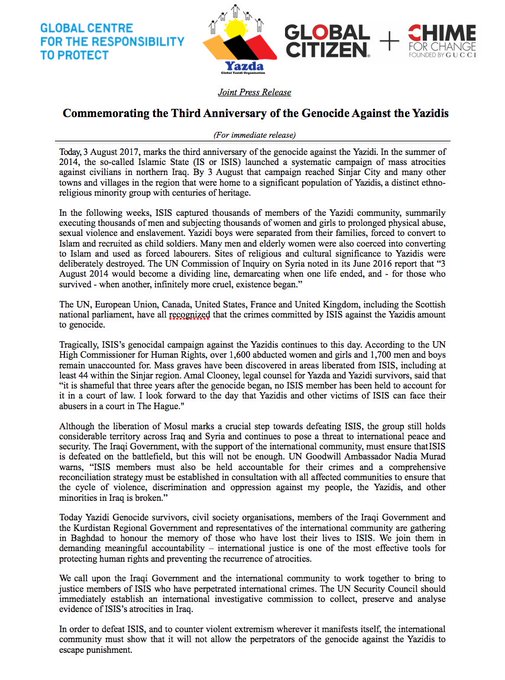
    Yazidi genocide by ISIS ‘on-going’, captives in danger in Raqqa – UN

    On the third anniversary of the start of Islamic State attacks against the Yazidis in Iraq, the UN commission on Syria has warned that captive Yazidi women are in particular danger as the noose around Raqqa tightens and has urged the coalition to rescue them.
    “The genocide is ongoing and remains largely unaddressed,” said a statement from the Independent International Commission of Inquiry on the Syrian Arab Republic, the body established six years ago to investigate human rights abuses in the conflict which has claimed over 300,000 lives.
    “Thousands of Yazidi men and boys remain missing and the terrorist group continues to subject some 3,000 women and girls in Syria to horrific violence including brutal daily rapes and beatings. Some women and girls are being held in Raqqa city. As the Syrian Democratic Forces and international coalition offensive on Raqqa intensifies, reports have emerged of ISIL fighters trying to sell enslaved Yazidi women and girls before attempting to flee Syria,” the statement says further.
    On August 3, Islamic State (IS, formerly ISIS/ISIL) took control of the city of Sinjar in northern Iraq, a major population center for the Yazidis who number fewer than one million. After slaughtering thousands of predominantly fighting-age men, the Islamists – who view the Yazidis, who follow their own religion as “devil-worshippers” – enslaved between 4,000-10,000 mostly women and children.
    “Yazidi boys were separated from their families, forced to convert to Islam and recruited as child soldiers. Many men and elderly women were also coerced into converting to Islam and used as forced labourers. Sites of religious and cultural significance to Yazidis were deliberately destroyed,”read a statement from four leading human rights groups dedicated to the Yazidis. It was released to commemorate the anniversary.
    While the plight of the Kurdish-speaking minority received media coverage, little was done to specifically help the Yazidis. Over the last three years, some have escaped, others have died, with many found in mass graves. However, no specific rescue plan has been formulated to aid the Yazidis who had suffered severe discrimination even before the latest brutalities.
    “The Commission recommends to all parties fighting ISIL to consider plans aimed at rescuing Yazidi captives and use all means available to ensure they are set free during on-going military operations,” stated the UN.
    With Islamic State territory shrinking and a battle raging for their proclaimed capital of Raqqa, focus is shifting to punishing the perpetrators of the systematic atrocities.
    “The international community must also recognize ISIL is committing the crime of genocide against the Yazidis and undertake steps to refer the situation to justice, including to the International Criminal Court or an ad hoc tribunal,” said the UN commission.
    “The UN Security Council should immediately establish an international investigative commission to collect, preserve and analyse evidence of ISIS' atrocities in Iraq,” said the human rights groups.

    Video Report - Zakaria says Trump has made The U.S a laughing stock and Irrelevant

    Video Report - Reuters tries to discredit anti-ISIS operation in Syria – Russian MoD

    Video - Turmoil in the Trump Administration: The Daily Show

    Video - Chaos in the White House: Scaramucci and Priebus Are Out - The Daily Show

    Pashto Music - گل پانڑہ..زما نادان ملنگہ

    Pashto Music --- دگل پانه سندره

    د ګل پاڼې غزل خوښېږي

    د بنو پولیس سرتېرو په اسلام اباد کې احتجاج

    Suicide bomber kills NATO soldier in Afghanistan, 6 personnel wounded: official

    A Taliban suicide bomber attacked a convoy of foreign forces in Afghanistan late Thursday, killing one NATO soldier and wounding six other personnel, the coalition said. 

    "The patrol was conducting a partnered mission with the Afghan National Army when a personnel-borne IED (improvised explosive device) detonated," in Qarabagh district in Kabul province," NATO said in a statement. 

    The Taliban quickly claimed the attack on social media. 


    http://www.brecorder.com/2017/08/04/363103/suicide-bomber-kills-nato-soldier-in-afghanistan-6-personnel-wounded-official/

    #PPP Song - AYA AYA BILAWAL...

    Pakistan - Insecurity among women daub on politics: Bilawal

    Pakistan People’s Party (PPP) chief Bilawal Bhutto Zardari on Tuesday said that insecurity of respect and honour among women in certain political parties was a daub on politics.
    Expressing serious concerns over the allegations levelled by Pakistan Tehreek-e-Insaf (PTI) lawmaker Ayesha Gulalai Wazir, Bilawal pledged that the PPP would not allow any harm to the rights and respect of womenfolk.
    In a statement, the PPP chief said that the party of Benazir Bhutto would continue to raise voice for the protection of women. He said that the accusations of Ayesha Gulalai Wazir against her former leadership should be investigated in-depth.
    Meanwhile, on Tuesday, PPP senator Dr Karim Khawaja in a statement said Imran Khan had no political training and he did not respect his party workers.
    “It is very unfortunate that after two former wives now his party legislator is also questioning his integrity and calling him a characterless person. PPP respects its workers especially women workers because this party had a leader like Benazir Bhutto,” he said.
    Earlier on Tuesday, opposition leader in National Assembly Syed Khurshid Ahmed Shah and Syed Naveed Qamar called on Bilawal here and discussed the political situation.
    Faryal Talpur, Chief Minister Sindh Syed Murad Ali Shah, Munawwar Ali Talpur Raja Pervez Ashraf, Senator Aitezaz Ahsan, Qamar Zaman Kaira and Mustafa Nawaz Khokhar attended the meeting. Syed Murad Ali Shah also briefed Bilawal about the development projects in Sindh, said a PPP statement.

     http://nation.com.pk/national/02-Aug-2017/insecurity-among-women-daub-on-politics-bilawal

    Pakistan - Bilawal Bhutto Zardari decides to intensify political activities

    Pakistan - Bilawal demands inquiry into Gulalai’s disclosures about PTI chief

    Voicing concerns over former PTI leader Aaisha Gulalai’s disclosures about the PTI chief, PPP Chairman Bilawal Bhutto Zardari on Tuesday urged investigation into her revelations.

    In a statement, the PPP chief termed insecurity of women’s honour as a stigma on politics.

    He assured that the PPP would not compromise on respect of women.

    Bilawal said that his party would raise voice for the protection of women’s respect and honour.

    Earlier, prominent female lawmaker of Pakistan Tehreek-e-Insaf, Aaisha Gulalai quit Imran Khan’s party, saying there's 'no respect for women' in the PTI.

    Elected MNA on reserved seat for women, Gulalai has been one of the most active female members of PTI.

    She is the second noted figure to have quit the party after Karachi-based Naz Baloch parted ways, saying that it has become the ‘male chauvinist’ party.

    Giving the reasons she said, “PTI is no more the party they claim to be and workers are not given importance.”

    https://www.thenews.com.pk/latest/220552-Bilawal-demands-inquiry-into-Gulalais-disclosures-about-PTI-chief

    UN calls for Pakistan to repeal or amend blasphemy laws


    United Nations (UN) has taken note of human rights violations and controversial blasphemy laws after a think tank registered with Irish government had lodged a plea with the international body.

    The United Nations has made the following observations:

    The State party should:

    (a) Repeal all blasphemy laws or amend them in compliance with the strict requirements of the Covenant, including as set forth in general comment No. 34, para. 48;

    (b) Ensure that all those who incite or engage in violence against others based on allegations of blasphemy as well as those who falsely accuse others of blasphemy are brought to justice and duly punished;

    (c) Take all measures necessary to ensure adequate protection of all judges, prosecutors, lawyers and witnesses involved in blasphemy cases;

    (d) Ensure that all cases of hate speech and hate crimes are thoroughly and promptly investigated and perpetrators are prosecuted and, if convicted, punished;

    (e) Review school textbooks and curricula with a view to removing all religiously biased content and incorporate human rights education therein, and continue to regulate madrassas;

    (f) Fully implement the judgement of the Supreme Court on 19 June 2014.

    United Nations stated that it is concerned at the blasphemy laws, including Sections 295 and 298 of the Criminal Code of Pakistan.

    UN on PEMRA

    “It is also concerned at reports of the way in which that Pakistan Electronic Media Regulatory Authority (PEMRA) exercises its powers over the content of media outlets, including suspending over 20 programs in the past four years; and the lack of clarity on procedural safeguards and oversight mechanisms to ensure that PEMRA exercises its powers consistent with the principle of freedom of expression.”

    The international body further stated: “The State party should decriminalize defamation, and ensure that imprisonment is never a punishment for defamation and that criminal laws are not improperly enforced journalists and dissenting voices.”

    UN concerned over military courts

    According to the observations, UN committee is concerned that the criteria for the cases over which cases are forwarded to military courts is not clear.

    “It is also concerned that about 90 percent of convictions are based on confessions; that the criteria used for the selection of cases to be tried by these courts are not clear; that defendants are not given the right to appoint legal counsel of their own choosing in practice or an effective right to appeal in the civilian courts,” the report states.

    The committee has called for conformity of proceedings of military courts with Article 14 and Article 15 of the Covenant to ensure a fair trial.

    "The state party should review the legislation relating to the military courts with a view to abrogating their jurisdiction over civilians as well as their authority to impose the death penalty," the body writes.

    UN on terrorism

    According to the committee, Pakistan needs to align definition of terrorism in Article 6 of the anti-terror act in light of the international standards.

    The UN is concerned with the broad definition of terrorism in Pakistani laws.

    ‘The Committee remains concerned at the very broad definition of terrorism provided for in the Anti-Terrorism Act.”

    The ‘missing persons’

    “The State party should criminalize enforced disappearance and put an end to the practice of enforced disappearance and secret detention.

    It should also review the Actions (in aid of Civil Powers) Regulations 2011 with a view to repealing them or bringing them in conformity with international standards,” the UN committee noted.

    The committee calls for measures and steps by the state for safety of the witnesses and families of the victims and ensure fair trials.
    “It should further strengthen the authority and the capacity, financial and personnel, of the Commission of Inquiry on Enforced Disappearance to function effectively.
    "http://timesofahmad.blogspot.com/2017/08/un-calls-for-pakistan-to-repeal-or.html

    Pakistan - Descent into chaos


    Zahid Hussain
    The gloves are off and it is a free for all. Politics is a dirty game in this country, but it has seldom been so ugly. In this no-holds-barred war of glib talk, the entire endeavour is to prove the rival more corrupt. While parliament is rendered dysfunctional, the apex court has become the battleground. The court, too, is subjected to criticism if the ruling is not in one party’s favour.
    It may appear that the fate of many political leaders now hinges on court rulings in the petitions filed against them by opponents. Meanwhile, the democratic process is descending into chaos. The order sending an elected prime minister home for a misdemeanour is not the cause of a political order devoid of any moral bearing, rather it is reflective of one.
    While the opposition celebrates Sharif’s inglorious exit, the ruling party is playing the ‘victim of an inexplicable conspiracy’ card. Sharif’s supporters are also waiting to see the fall from grace of Imran Khan and other senior members of the PTI implicated in cases of financial wrongdoing. Every side is trying to rock the boat that they themselves are in.
    All rationality is lost in the haze of the politics of revenge.
    All rationality is lost in the haze of the politics of revenge. There is much talk about democracy, public mandate and accountability, but one doubts that anyone is being taken seriously. The banality of these platitudes has been starkly exposed in the political soap opera that is being currently played out.
    Indeed, the application of Article 62 of the Constitution and the Representation of the People Act, 1976, by the Supreme Court to remove the former prime minister has led to questions of how many public office holders and members of the National Assembly and provincial assemblies can come up to the standards enunciated in Articles 62 and 63 if strictly applied. Surely, there will be very few.
    So, the opposition political leaders who are rejoicing in Sharif’s unceremonious ouster must see whether their own accounts are in order before they too come under the axe. The cases against Imran Khan and Jehangir Tareen are already pending in the Supreme Court and the verdict is likely to come out soon. That may also open the floodgates of petitions that could overwhelm the top court. Given the extremely volatile situation stemming from the daily theatrics outside the court it could put the judiciary under pressure.
    It was amusing to see lawmakers rushing to file their tax returns in the wake of the Panama case against the Sharif family. According to some reports, there has been a massive hike in taxes paid by lawmakers, from a 15 to 3,852 per cent rise in individual cases during this period. Indeed, it is a positive development. But the majority of the legislators still do not seem too bothered about what they believe is a temporary phase. They may be right given the lacklustre approach of the Election Commission of Pakistan (ECP) and other state institutions responsible for law enforcement.
    The annual tax directories for parliamentarians shed some light on the level of tax compliance by the lawmakers. Surely, the lifestyle of most of them is in stark contrast to what their tax declarations indicate.
    Few lawmakers are in the high tax bracket, notwithstanding their superior living standards. The money paid by most of them is peanuts despite the fact that many are believed to be among the richest people in the country. According to reports, some senators pay an income tax in the range of Rs17,000 to Rs50,000.
    Such low tax compliance raises questions about the commitment of our political leaders to enforcing the tax laws they are supposed to oversee. Pakistan has a chronically low rate of income tax collection as tax evasion has become the norm and is hardly looked upon as a crime.
    Thus it is not surprising that it is estimated that less than 1pc of the population files its taxes. Income tax evasion is particularly high among the wealthiest, leaving the country with one of the lowest tax-to-GDP ratios in South Asia. One certainly cannot blame the people for that when our rulers and lawmakers themselves do not set an example to follow. Indeed, the problem is not limited to lawmakers but extends to the entire ruling elite. Senior civil and military officials too are seen as part of it. A major reason is that law enforcement is much weaker when it comes to the rich and powerful.
    Surely, it is not just about low tax compliance, but also about politicians living beyond their known means. That applies to both the government and the opposition leaders.
    There are many who conceal their wealth in a clear violation of ECP rules. Yet they, unlike the prime minister, might escape being penalised under ROPA and Article 62. Certainly, there must be stricter accountability rules applied to the holder of the top public office. But it must not be seen as a selective exercise. The process of accountability must not be perceived as a one-time action targeting a particular person or a party. It should be viewed as a normal process of law enforcement across the board and not just limited to politicians.
    Corruption is deeply rooted in our society and one cannot blame only the politicians for it. The security establishment that has ruled the country for so much of its existence is responsible for most of its ills. Eyebrows are rightly raised if the generals remain untouched.
    It is, indeed, an extremely depressing state of affairs when the apex court is seen as a venue for settling political scores. What is needed is the reform of the entire law-enforcement system to make it more autonomous and ensure that it remains outside the influence of the government. This is one lesson we must learn from the Panama scandal. The Supreme Court must not be approached for settling every issue. The main responsibility lies with the political leadership. Democracy cannot be sustained without the rule of law and without making parliament more effective as an institution.

    Will provide proof of allegations if summoned by court, parliament: Ayesha Gulalai


    Former Pakistan Tehreek-e-Insaf (PTI) leader Ayesha Gulalai said on Thursday she will provide proof of her allegations if summoned by a court of law or a parliamentary committee. 
    Gulalai was speaking on Geo News Aaj Shahzeb Khanzada Ke Sath. 
    "I am not here speaking without evidence. I will not pursue it personally, however, if they go to some forum, I will cooperate," clarified Gulalai.
    Gulalai showed the alleged messages briefly to senior journalist Hamid Mir.
    "The messages showed to me add weightage to Ayesha Gulalai's claims, but they should be investigated," said Mir. 
    She lamented that the PTI had targetted her sister and added that her sister is non-political and should not have been dragged into the issue. 
    "Imran tried to portray himself as innocent during his interview today," said Gulalai. 
    Gulalai, in a new revelation, also said PTI spokesperson Naeem-ul-Haque had also sent her a text message.
    "Naeem-ul-Haque also sent a text after sometime stating, 'I am alone and want to marry'," claimed Gulalai. 
    She further said the purpose of her press conference was to caution women and to quit the party.
    Referring to the legal notice sent to her by PTI, she said that PTI initially tried to make a deal with her.
    "They have sent me a Rs30 million legal notice, I don't even have Rs300,000 in my account. They tried to make a deal."
    She also claimed that she was called and asked by PTI's Awn Chaudry to not address the press conference and a delegation would have visited her to discuss the matter. 
    The former PTI leader further said that her grievances were not only personal, but they were also related to public issues and corruption in the province.
    "Whatever I said was meant for the betterment of the women."
    Earlier, the PTI served a legal notice to Gulalai demanding that she reply to the letter within 10 days or pay compensation to the tune of Rs 30 million.
    Gulalai has alleged that Imran Khan sent her inappropriate text messages, but has not revealed any other details to support her allegations.

    #PTI - Ms Mazari, do you remember what you said?


    By Ovais Jafar
    From the moment the allegations came out, everything escalated really fast. First it was ignorance about Gulalai's issues, then flanked by PTI's women leaders, Shireen Mazari defended Imran Khan and labelled her former party-colleague and legislator Ayesha Gulalai an opportunist for levelling allegations of corruption and sexism in the party.
    Using her tribal background against her, PTI has now warned Gulalai that a tribal jirga will be used against her if she fails to retract her allegations.
    Addressing the media on Tuesday, Mazari said Gulalai wanted a party ticket for NA-1, even though the decision regarding tickets had not been finalised. "Imran gave respect to us... Gulalai doesn't realise how much respect she was given," she said.
    It was most interesting to see Mazari, vehemently deny claims of any mistreatment of female workers in PTI; in stark contrast to her own words from 2012.
    On September 26, 2012, Mazari's daughter Iman Mazari uploaded her mother's resignation letter to her blog. The 1400-word resignation letter from 2012 points out the reasons her own daughter left PTI, she wrote: "filthy abuses against my daughter which compelled her to leave the party," and added that she refrained from reducing herself to personal attacks but made it clear that she hoped "abuse and name calling" would not happen again because, "there are limits to everyone's patience."
    Mazari, in her letter to Imran Khan also identified many issues that Gulalai echoed in her 'allegations' against PTI.
    Mazari wrote, "PTI has been effectively taken over by traditional politicians reflecting big money and/or feudal sardars".
    Gulalai said pretty much the same thing. Mazari said the competent workers in PTI are being ignored, Gulalai said the same thing.
    To avoid sounding like a broken record, I will stop with the list here; readers may click the link above to read Mazari's own words and find similarities themselves. Mazari may have changed her stance about the party, her chairman and whatever else that needed a new lens to see past her own observations, but it seems Gulalai has not.
    Sadly, the commitment to change that PTI promised, the multiple incidents of harassment of PTI's women at their rallies - stopped only after the women's enclosure started resembling a cage to keep the wolves out - gives credence to Gulalai's words.. that all PTI ever stood for "is withering away fast in all but name."
    Forgive me, that last quote was Mazari's not Gulalai's.

    While you were paying attention to North Korea, another Asian nuclear power was destabilizing

    Nyshka Chandran
    The same laws used to dismiss Pakistan's former Prime Minister Nawaz Sharif could effectively be applied to other lawmakers, spelling potential political upheaval and a stronger military — unsavory scenarios for the nuclear power's fragile democracy.
    Last Friday, the Supreme Court dismissed the 67 year-old on a failure to announce income in disclosure papers for 2013's general election. According to the Supreme Court statement, the former prime minister demonstrated dishonesty by not declaring monthly salary of roughly $2,700 from Dubai-based Capital FZE — a company owned by his son — during 2006 to 2014. The judicial body based its decision on Article 62 of the Constitution and Section 99 of the Representation of the People Act — little-used legislation that require truthfulness and honesty from elected officials.
    Political infighting expected
    While Friday's decision was hailed as a rare example of accountability in a graft-stricken nation, the fact that such vague laws were used to remove Sharif could trigger infighting between political parties, strategists warned.
    "Having used these clauses to oust the prime minister, the court may have opened Pandora's box," Moeed Yusuf, associate vice president, Asia Center, United States Institute of Peace, said in a recent note. "Sharif's allies have already started bringing charges against their political opponents under the same article; other such cases are sure to follow." "Having used these clauses to oust the prime minister, the court may have opened Pandora's box." -Moeed Yusuf, Associate Vice President, Asia Center, United States Institute of Peace Dirty politics, nepotism, and cronyism is rampant in the South Asian economy, ranked 116th in Transparency International's list of 176 corrupt nations, which means numerous lawmakers could be removed under Article 62.
    The court itself has previously referred to the law as a "nightmare" given the difficulty in objectively defining the terms, Yusuf said.
    "The fact that Sharif was disqualified on the grounds of Article 62 is potentially very problematic because more than half the current parliament and members of the provincial assemblies could be disqualified on the same grounds," echoed Rafiullah Kakar, an assistant research officer at the Commonwealth Young Professionals Programme, in a note published by the London School of Economics. That could spark the purging of an entire political class, which could create a vacuum that would likely be filled by non-democratic forces, he added.
    Military to benefit
    During the 1990s, friction between Sharif's Pakistan Muslim League and the opposition Pakistan People's Party eventually paved the way for 1999's military coup — many now fear a repeat of history. The army, experts said, is a clear winner from Friday's ruling.
    "The army gains by discrediting the civilian government. A weakened and humiliated civilian government ensures that public support for the armed forces will remain high as it emerges, once again, as the more competent institution," said Shailesh Kumar, senior Asia analyst at consultancy Eurasia Group.
    But despite its advantageous position and history of coups, the military isn't expected to take power anytime soon.
    "In decades past, if a civilian leader was abruptly removed, the expectation would be that the army would swoop in to restore order — yet today, no serious observer of Pakistan expects the military to seize power," Michael Kugelman, South Asia deputy director and senior associate at the Wilson Center, said in a Tuesday note. "Of course, given the deep clout that the military already enjoys behind the scenes, it has no need to take power directly and likely no desire either, given the arguably unprecedented non-security policy challenges, such as severe water shortages and a serious energy crisis, that afflict present-day Pakistan." Eurasia Group also said it expects the powerful army to stay on the sidelines amid the current government turmoil.
    Friday's ruling followed a months-long investigation into the Sharif family's offshore wealth, which was sparked by allegations of money laundering in 2016's Panama Papers. The Supreme Court has also ordered a criminal probe into the family based on the Panama Papers' claims.
    https://www.cnbc.com/2017/08/02/pakistan-democracy-at-risk-after-removal-of-nawaz-sharif.html

    Is There Any Way to Help Pakistan Improve Governance?

    By Alyssa Ayres
    Last Friday, under a narrow and never-before-utilized clause of the Pakistani constitution, one focused on moral probity, Pakistan’s Supreme Court deemed Prime Minister Nawaz Sharif ineligible to be “an honest member of parliament,” and thereby ineligible to hold office as prime minister. He resigned.
    The decision emerged from processes unleashed by the Panama Papers, in which undisclosed assets held by Sharif’s family members came to light. The Supreme Court decision strangely cited the nondisclosure of income from a company his son owns in Dubai as the reason for the moral probity finding. (Sharif’s lawyers said he did not receive such income). On the surface any effort to rein in corruption in a land that suffers badly and widely from it should be a positive step; Transparency International gives Pakistan a 32 out of 100 (0 is “highly corrupt” and 100 is “very clean”) on their Corruption Perceptions Index, giving it a rank of 116 out of 176 countries. But this convoluted dismissal instead raises questions of why such a process took place at all, and what it means for the country’s still-weak democratic institutions. As former Ambassador of Pakistan to the United States Husain Haqqani tweeted, the decision kept the country “faithful to its 70-yr tradition: No PM ever removed by voters; only by judges, generals, bureaucrats or assassins.” It also raises questions about the selective pursuit of Sharif under this constitutional clause. And it further raises questions, given the relatively quick pace of this probe, about why the trials of the accused perpetrators of the Mumbai attacks remain in a state of constant prolongation for nearly nine years. Is justice never served for terrorists in Pakistan?
    As analysts within and outside of Pakistan sought to unpack what this unprecedented decision holds for the country, and indeed for U.S. relations with Pakistan, we ought to reflect on the larger picture here. The decision will not improve U.S.-Pakistan ties, so we are left with either a continued status quo of a very difficult, complex relationship, or a further deterioration. Against this backdrop, what should the United States do, if anything can be done, to help Pakistan strengthen its democratic institutions? As is well known, the United States and Pakistan have long had close bilateral ties, even if the relationship has been a roller coaster, including with periods of outright antagonism. Pakistan has been a U.S. ally and presently holds the status of a major non-NATO ally. The U.S. Agency for International Development has been active with Pakistan since the country’s founding, and has provided nearly $8 billion in development assistance alone in the past decade. (That figure does not include security assistance, a separate topic.) I have written previously about the counterintuitive finding that Pakistan now fares worse on most major development indicators than Bangladesh, a country that seceded from Pakistan in 1971. Bangladesh remains poorer and with significant political turbulence, but still has managed to prioritize improving the lives of its citizens. It’s hard to say that Pakistan has placed the improving the lives of its citizens at the top of its agenda, compared with its overemphasis on the military. And despite decades of U.S. government funding to nudge it in a direction of development outcomes, it turns out that the outcomes aren’t that great in the governance and rule of law indicators. The data tool available on ForeignAssistance.gov allows an aggregation of these indicators over time, so there’s a real comparison to be made. To look at the question of corruption and rule of law, I selected three important indicators from the dataset for Pakistan: rule of law, control of corruption, and government effectiveness. I pulled the results from 1996 through 2014, the most recently available year. Here’s what I found:
    These indicators, drawn from World Bank data, represent a “scaled” score ranging from -2.5 to 2.5, with 2.5 as the “best.” On rule of law, Pakistan fares slightly worse in 2014 than it did in 1996, slipping from -0.67 to -0.78. On control of corruption, it has improved, with its score increasing from -1.15 to -0.81. On government effectiveness, things have grown worse, falling from -0.59 in 1996 to -0.75 in 2014. So over a nearly twenty-year period, Pakistan has fared better fighting corruption—although it still remains below the zero “even” point—and it has gotten worse on overall rule of law and governance issues. It’s harder to download the foreign assistance funding data for the same period, but we can explore on an annual basis the breakdown of foreign assistance funding from FY 2006 through FY 2017. The table below draws from the annual funding (planned) allocations to illustrate the dollar amounts and percentage of U.S. aid that has gone toward strengthening democracy, human rights, rule of law, and governance in Pakistan.
    For most of these fiscal years, the peace and security category constitutes around half of all U.S. aid to Pakistan. As the table above illustrates, over the last decade, support for democracy and governance at best constituted 10 percent of U.S. funding, but most years it hovers around 6 to 7 percent. It raises the question: how best should the United States allocate its assistance dollars to shape better outcomes in Pakistan? Would a greater degree of support for democracy, human rights, and governance—rather than the heavily peace-and-security-sector focused patterns of the past—help nudge Pakistan toward more improvements where it needs to strengthen its governance and rule of law? There isn’t enough information here to suggest any causation between how Washington allocates assistance dollars and indicator outcomes in Pakistan, but the discussion is worth opening.
    I would argue that it is high time for Washington to dial up its attention toward these pressing governance problems in Pakistan, since there is plenty of room to dial down the heavily security-centric relationship that has dominated U.S.-Pakistan ties. I base this recommendation on the fact that what we have tried over the years has not succeeded on the security front, nor obviously on the governance front, so ought to be revisited. The Donald J. Trump administration’s initial FY 2018 budget proposed to hold steady the foreign assistance levels for Pakistan. With that in mind, the United States should have a more active debate on the allocation of that foreign assistance funding and the prioritization of programs on which it is spent.
    https://www.forbes.com/sites/alyssaayres/2017/08/02/is-there-any-way-to-help-pakistan-govern-better/#7c27538566e7