Tuesday, April 18, 2017

#MashalKhan Dear killers of #Mashal, why are you hiding? Head to the police station and embrace your ‘love’


By Sulman Ali 

So where are all those ‘Ashiqan-e-Rasool’? Why are you guys hiding from police? Why don’t you just go present yourselves in front of the authorities? My question is simple: why ‘Ashiqan-e-Rasool' like you, who lynched Mashal Khan are in hiding or have to be arrested by police.
I thought you guys are ‘true lovers’ of Prophet (PBUH), the ‘true devotees’, the ‘true followers’. That is why you did it, right? Why else?
There were hundreds of ‘Ashiqan’, but currently around 15 are under custody of police. Why did you leave your fellow 'Ashiqan’ alone in this hard time? Go and be with them and accept the glory, or the arrested might steal your thunder.
I, and many others, 'lesser Ashiqan’ saw your devotion and extreme ‘love’ for Hurmat-e-Rasool when you guys were jumping on the dead body of Mashal, dragging it like a trophy of your ‘love’ as you showed the ishq in your hearts, or may I say in your hands, legs, feet, tongues, and the rest of the body.
I am kind of sad for you guys that you did not get chance to kill Allama Iqbal for his blasphemous Shikwa. Yes, I know he wrote Jawab-e-Shikwa but he wrote it after four years. There was a time gap and you could have easily lynched him, like you torched Mashal. I can feel your pain that Iqbal got time for his Jawab-e-Shikwa and even became a national poet. My condolences, guys.
I am also sorry that, you guys were not there, when an old lady used to throw garbage on our Prophet (PBUH), because you guys would have wanted to show your ‘love’ for the Prophet (PBUH), although he himself forgave her and even took care of her. But your ‘love’ was way purer, I guess.
My sympathies, because you were not there, when Prophet (PBUH) forgave Hazrat Hinda (RA), who got Prophet (PBUH)’s dearest uncle Hazrat Hamza (RA) killed and ate his liver, because, you guys would have killed her, or may be would have lynched her, way before the forgiveness. Sorry for your loss, guys.
I will once again urge you guys, to come out, show and express your ‘love’ once again.
Go to authorities; or even better, go to parents of Mashal Khan, and tell them, what a pious job you guys have done – because they clearly don’t understand it. They are still saying that they had sent Mashal to study, and that their son was a good Muslim. But you guys should tell them, no, he was not, he was blasphemer, and that you guys killed him out of true ‘love’ without any verification, proof, evidence. Although Mashal had been complaining about a fake account on Facebook, but let us just forget all these things, small things, convince the parents, they will understand.
So, come on guys, don’t hide, and show some ‘love’, because you guys are ‘Ashqaan’ and world should know that.

PPPP President Asif Ali Zardari condoles on the death of Iftikhar Jhagrra


سابق صدرپاکستان اور پاکستان پیپلزپارٹی پارلیمنٹیرینز کے صدر آصف علی زرداری نے پاکستان پیپلزپارٹی کے رہنما اور کے پی اسمبلی کے سابق رکن افتخار جھگڑا کے انتقال پر گہرے رنج و غم اور صدمے کا اظہار کیا ہے۔ ایک تعزیتی پیغام میں آصف علی زردار نے مرحوم افتخار جھگڑا کی پارٹی کے لئے خدمات اور خیبرپختونخوا کے عوام کے لئے خدمات پر انہیں خراج تحسین پیش کرتے ہوئے کہا ہے کہ ایسے کارکن پارٹی کے لئے سرمائے کی حیثیت رکھتے ہیں۔ پاکستان پیپلزپارٹی اور خیبرپختونخوا کے عوام افتخار جھگڑا کو کبھی بھی نہیں بھول پائیں گے۔ سابق صدر نے کہا کہ پاکستان پیپلزپارٹی افتخار جھگڑا کے خاندان کے غم میں برابر کے شریک ہیں۔ انہوں نے کہا کہ اللہ تعالیٰ افتخار جھگڑا مرحوم کو اپنے جوار رحمت میں جگہ عطا فرمائے اور ان کے خاندان کو یہ صدمہ برداشت کرنے کی توفیق عطا فرمائے۔


https://mediacellppp.wordpress.com

#MashalKhan #ANP for public hanging of people involved in lynching of student

Awami National Party (ANP) chief Asfandyar Wali Khan on Monday warned the party leaders and workers against providing any kind of assistance to the arrested party workers in the murder of a student ofAbdul Wali Khan University Mardan and demanded capital punishment for those involved in lynching of Mashal Khan.
"My own son should be hanged if his role was established in the lynching incident. If any ANP leader or worker tried to provide any assistance to the accused involved in the student's murder, he would be expelled from the party. There is no place for such people in the ANP," he added.
Speaking at a workers convention here, he said the nation lacked tolerance and the Mardan incident was its example where mobsters took the law into their own hands and lynched a university student. "The people take the law into hands in the name of religion and kill one another without waiting for an investigation into the allegations. Which kind of Islam is this?" he questioned.
The nationalist leader feared the practice would continue in the country if the accused involved in the murder of Mashal were not awarded appropriate punishment. He thanked Chief Justice of Pakistan Justice Saqib Nisar for taking suo moto notice of the incident and demanded the accused involved in the incident to be hanged in public.
Asfandyar Wali Khan also lauded the ANP parliamentarians for staging a hunger strike in front of the National Assembly, saying the federal government had accepted the party's demand of unblocking the blocked computerised national identity cards of Pakhtuns.
He demanded immediate merger of the Federally Administered Tribal Areas, special financial package and 35 seats in the Khyber Pakhtunkhwa Assembly for the tribal belt. Asfandyar Wali criticised the Pakistan Tehreek-e-Insaf (PTI)-led Khyber Pakhtunkhwa government, saying the provincial treasury was empty while allegations of involvement of PTI leaders and lawmakers in corruption were emerging.
He said PTI chief Imran Khan was asking Prime Minister Nawaz Sharif to resign over corruption allegations, adding that he should also take resignation from Khyber Pakhtunkhwa Assembly Speaker Asad Qaiser.
Asfandyar said that his ancestors had warned against the Afghan war and its implications. "Now Pakistan has launched operation Raddul Fasaad to get rid of it," he added. He said that peace in Afghanistan was a must for peace in Pakistan. ANP general secretary Mian Iftikhar Hussain and others also spoke on the occasion.       
https://www.thenews.com.pk/print/199315-ANP-chief-warns-against-support-to-arrested-party-workers

Pakistan - Dear #Mashal, we’re all guilty of your murder


Alishba Akram


My editor asked me to write about Mashal Khan, 200-250- words, everybody was writing about him so he thought I should too. I wanted to too, I wanted to say things, things that I felt and things that were spilling out of me in mute chaos. In the way I’d cry hysterically at night, in the way I’d scold my sister for no reason, in the way I’d leave my chae to get cold, in the way I’d avoid messages on my phone and in the restlessness that took over me post Mashal’s murder. I wanted to write about him but I do not have 250 words to write, I do not even have one or even a thousand words.
So I put it off, writing about him, but I could not stop thinking about him. I’d go back to his profile and stalk him like he was still alive, I’d read every article about him reminding me that he wasn’t. His father’s interview, his mother’s eyes, his sister’s fearlessness when remembering her brother on TV, it feels like everything that could be said or written about him has already been written about him and there still isn’t closure. There’s still anger, there’s still disappointment and there is still fear.
I don’t know what I am angriest at, the fact that Mashal was killed in the manner that he was by educated young men; the fact that these educated young men had joy on their faces while beating him to death, or the slogans of Takbeer chanted while murdering a boy, or the broken fingers his mother had to kiss, or the fact that upon hearing about the incident everybody’s first question was whether he did it?, or the #NotAllMuslims, #ThisIsNotIslam, “the Prophet (PBUH) teaches forgiveness and these men were not Muslims”, arguments all over the internet.
I don’t know what I am most fearful of, that a large number of people exist who can murder someone by beating them, or that an even larger number of people exist who think that this was right.
I do not know who I’m more disappointed in, the religiously charged boys who killed Mashal, the people who glorified the killers, those who asked for proof of blasphemy as if that would justify the murder, any murder, the police trying to recover Mashal’s ‘real’ Facebook profile before arresting the ‘real’ murderers, those who condemn it silently or those who condemn it for the wrong reasons?
I also do not know if mine is the place to be feeling all of this, I was, after all, not related to Mashal, by blood at least. I cannot share in his father’s loss, his mother’s helplessness, his sister’s pain but I can share in this country’s reality. I can share in the insecurity every citizen of this country with a voice has. I can share in the fear that Mashal wasn’t the first neither the last, next could be me or a friend, or a brother, I can share in the belief that the state will not protect us nor will give justice, because the state is handcuffed behind its back against the ground, I can share in the horror that mine or my brother’s fingers could be the broken ones my mother has to kiss one day. I can share in this reality of the country I call home.
So here I am ending on 500 words, a little more than my editor expected, a lot less than what Mashal deserves. Still at a loss of words, still unable to find closure.

#MashalKhan - Beyond The Lynch Mob


So far the authorities have shown the right diligence and attitude towards the horrific lynching in Mardan; politicians have made the right statements, institutions like the Supreme Court are taking the right initiatives and the police seem to be pursuing multiple leads in the case. While it remains to be seen how motivated the authorities are to take these steps to their logical end, for the moment we must support the positive actions they take. On Sunday, law enforcement agencies opened a hate speech investigation involving the two clerics who tried to disrupt the funeral rites of Mashal Khan in his hometown of Swabi.
According to a senior Swabi police official, “the mosque loudspeaker for hate speech against the slain student and his family and .
created hurdles for the people and another cleric to participate in the funeral.
” Hate speech and anti-terrorism legislation clearly outlaws the use of loudspeakers to incite hate and violence, and there exist strong precedence for clerics being indicted and punished for committing this crime. In this case, there is ample evidence of the incident, multiple eyewitnesses and the political backing to try the perpetrators – this should be an open-shut case and nothing short of a successful conviction suffices in the circumstances.
The stakes in this case also make this a must-win case for law enforcement and prosecution teams. While the actual murderers and their abettors surely need to be put behind bars, also on trial is a culture that encourages violent vigilantism on mere suspicion of blasphemy, supports targeting family members of the victims and intimidates all opposition. While the shrine of Mumtaz Qadri, the “Lubaik Ya Rasool” movement, and other individuals – some in the government itself – seem beyond what the authorities are willing to tackle at the moment, these low level clerics who blindly propagate that toxic narrative need to be tried for their crimes and made an example off.
This is the least the government can do.
It is time that the authorities start looking at the bigger picture – instead of going after the individuals that commit these vigilante murders, the government needs to start targeting the organisations that propagate this narrative, who fund it, and who glorify murderers. We are reminded by the incident in Mardan that unless the organisations who openly challenge the writ of the state and encourage people to take the law into their own hand are taken down, the lynch mobs will keep rising up.
Mardan is a test case for the government; it must show that it is capable of delivering justice.

Pakistan - Police reporting #Mashal’s innocence to SC today


Khyber-Pakhtunkhwa Police chief Salahuddin Khan Mehsud Monday said no evidence of blasphemy was found against lynched university student.

A mob murdered journalism student Mashal Khan at Abdul Wali Khan University in the conservative northwestern town of Mardan last week.
The deceased was stripped, beaten and shot before being thrown from the second floor of his hostel for allegedly committing blasphemy.
The Supreme Court has taken suo moto notice of this brutal act while high-ups, including Prime Minister Nawaz Sharif and KP-ruling PTI chief Imran Khan, vowed to bring the culprits to justice.
"There are no evidence with police against Mashal, his friends Abdullah and Zubair to implicate them in any blasphemous act,” the IGP told the media.
The IGP said Zubair, a friend of Mashal, had recorded his statement and he categorically rejected these allegations.
The top cop said the police would submit the detailed report to the Supreme Court today (Tuesday).
He said the Federal Investigation Agency (FIA) has also been requested to identify the fake account in the name of Mashal Khan.
 “Police have arrested 22 persons, including six staff members of the university,” he said, adding that before the brutal killing, news was circulated in the university against Mashal to provoke the mob.
He added 16 persons were arrested after their nomination in the first information report (FIR) while six other persons were arrested through various videos.
He said police person who is visible in the video was a DSP who took the Mashal’s body out of the university.  He promised stern action would be taken against culprits.
The IGP said the Maltoon Town DSP recovered Abdullah from an admin room he was locked in to save him from the mob.
He said when the administration and police were searching Mashal to save him from the mob, a gunfire was heard in the hostel 1, some 800 yards away from the administration block.
He informed the media that after the incident, police reached the site and dispersed the mobsters through baton-charge and arrested 59 persons on the spot.
He said there was nothing substantial against Mashal, Adbullah and Zubair.
Survivor records statement
Abdullah said in his statement before a Mardan magistrate that he belonged to a religious family and strongly believed in the religion of Islam and Prophet Muhammad (PBUH).  He said he had no affiliation with any political party.
“Mashal Khan was a talented and brilliant student having a kind heart. On April 13, at around 11am, one of my friends, namely Muhammad Abbas, called me on my cellular phone and told me to come to the journalism department. Abbas was a conspirator,” the statement read.
It adds: “Upon his call, I proceeded to the journalism department and saw Mudassir Bashir (the class representative), the actual perpetrator, along with other students who there and then, charged me and Mashal Khan with blasphemy and all of them alleged that we have deviated from the right path along with Zubair.”
He said that in response to that, he had bluntly refused and narrated Kalma Taiba. He said he was later forced to say against Mashal and falsely implicate him in blasphemy allegations but he refused to do so.
He was locked in a bathroom by “teacher Idress, Farooq and Zia Hamdard to save him from the mob”.
He said some students broke the window and tortured him but police rescued him and shifted him to hospital.
He said he heard about the brutal murder of Mashal in hospital. He alleged that university administration was against Mashal for his interview in which he had criticised the administration for mismanagement and loopholes in the system.
Suspect’S statement
Dawn reported on its website that a student arrested in the Mashal Khan lynching case claimed that the university administration asked him to testify against him.
The accused, Wajahat, claimed in the statement given to the police that Mashal Khan had “anti-Islamic views since the start, whereas, Abdullah and Zubair followed him".
"I used to snub Mashal Khan for his discourteous attitude towards Islam and advised him to abstain from such nefarious and devilish designs but he always lent deaf ears to," Wajahat stated.
He admitted that he was part of the mob which lynched the 23-year-old Mardan university student.
Wajahat claimed in his statement that on April 13 he was called to the chairman’s office by class representative Mudassir Bashir, who asked him to testify against Mashal before the university administration.
"Some 15 to 20 people, including university officials were present at the chairman's office.
"The administration had convened the meeting to decide the case of Mashal Khan and Bashir had called me to be a witness regarding the blasphemous ideas of Mashal Khan," said the accused.
He also alleged that the security in-charge of the university, Bilal Baksh, said those that step forward to protect Mashal and his supporters would be dealt with "an iron hand".
Baksh, according to Wajahat, further said that he would kill Mashal.
"Hearing this, the congress turned into a violent mob and rushed towards the hostel," said Wajahat.
In the statement, Wajahat has said that if he had known what the administration was conspiring against Mashal, he would have never come to the university on that day.

https://www.bankofamerica.com/sitemap/hub/signin.go

Facebook memorialises Mashal Khan's profile


The Facebook account of Mashal Khan, who was brutally killed by a charged mob by his university fellows, has been memorialised by the social media site.
Facebook allows friends and family of a deceased person to memorialise their accounts, which “are a place for friends and family to gather and share memories after a person has passed away. Memorialising an account also helps keep it secure by preventing anyone from logging into it.”
Soon after the horrendous lynching video of the Abdul Wali Khan student surfaced, condemnation poured in from all quarters of the society. On social media, people started sharing Mashal’s Facebook and Twitter to show his soft, humane side.
More than 20 people have been arrested by the police in connection with incident and are being probed.

#MashalKhan - Arrests highlight Pakistan's struggle with extremism


By ASIF SHAHZAD


Pakistani authorities said Monday they have arrested 22 people involved in the lynching of a university student who was accused of blasphemy and detained a teenage woman who had been recruited by the Islamic State group for a foiled attack on a church.
Word of the arrests came as U.S. President Donald Trump's national security adviser arrived for talks on combatting militants in South Asia, highlighting Pakistan's struggle with Islamic extremism.
The 16 students and six university employees are believed to have incited or taken part in the mob that killed 23-year-old Mohammad Mashal Khan, provincial police chief Salahuddin Mehsud said. The student was beaten and shot to death at a university in the northwestern city of Mardan on Thursday.
Mehsud said no evidence has been found to indicate Khan committed blasphemy against Islam, which is punishable by death in Pakistan. The mere suspicion of blasphemy is enough to incite deadly riots in the deeply conservative country.
Pakistan had recently vowed to combat the sharing of blasphemous material on social media, and has tried to enlist Facebook and Twitter in the campaign.
A military spokesman meanwhile said authorities detained a teenage woman earlier this month who had been recruited by the Islamic State group to carry out a suicide attack against a church on Easter.
Noreen Leghari, 19, was detained after a previously reported shootout on April 14, the day before Easter, in which another militant was killed, said Maj. Gen. Asif Ghafoor.
The new details on the raid were released as H.R. McMaster, the U.S. national security adviser, arrived on his first visit since the United States dropped its largest non-nuclear bomb on an Islamic State tunnel complex in neighboring Afghanistan.
McMaster arrived in Islamabad after holding talks in Afghanistan on efforts to combat the Taliban and the IS group's Afghan affiliate. The U.S. dropped the Massive Ordnance Air Blast bomb, or MOAB, on an Islamic State tunnel complex carved into a mountain in eastern Afghanistan on Thursday, reportedly killing 95 militants.
McMaster met with Prime Minister Nawaz Sharif and other senior officials. Pakistan's foreign affairs adviser Sartaj Aziz said Islamabad remained committed to working for peace and reconciliation in neighboring Afghanistan, and that officials meeting with McMaster had discussed efforts to secure the border.
The U.S. Embassy said McMaster "expressed appreciation for Pakistan's democratic and economic development, and stressed the need to confront terrorism in all its forms."
Pakistan has long sought to downplay the growing presence of Islamic State militants, who have claimed a number of attacks in recent months. Monday's announcement marked the first time Pakistani officials have acknowledged that the extremist group based in Syria and Iraq is recruiting within the South Asian country.
Pakistan has been struggling to combat the much larger and more well-established Pakistani Taliban, which emerged after the 2001 U.S.-led invasion of Afghanistan and have carried out attacks that have killed tens of thousands of people.
The Islamic State group is believed to have recruited disgruntled Taliban fighters in both Pakistan and Afghanistan with its promise of building a worldwide Islamic caliphate.
Leghari was recruited via Facebook, and went missing in February, later marrying an Islamic State fighter who was killed in the April 14 raid, a Pakistani security official said on condition of anonymity because he was not authorized to brief reporters. He said the woman had fought alongside her husband during the raid and shot at security forces.
Ghafoor suggested she had fallen prey to the group's online propaganda. He portrayed her detention as a rescue and said "we will rehabilitate her."

Monday, April 17, 2017

Video - Turkey: Ergenekon case exposes deep divisions

Pakistan and Turkey: A comparative study in Islamism and authoritarianism


Shamil Shams
By granting Erdogan unlimited powers, Turkey has chosen the same disastrous path that Pakistan took in the 1980s. DW looks at some uncanny similarities between Erdogan's Turkey and Islamist Zia ul-Haq's Pakistan.
In December 1984, former Pakistani military dictator Zia ul-Haq held a referendum on his controversial and divisive Islamization policies. The Islamist ruler won a landslide victory albeit independent observers noted widespread irregularities in the vote. The referendum extended Haq's presidential term by five years and gave him unlimited powers. Haq had enormous powers even before the referendum, but from 1985 to his death in a plane crash in 1988, the general acted like a "caliph." Pakistan's liberal sections say their country never really recovered after the 1984 referendum.
There can't be accurate comparisons between Turkish politics under President Recep Tayyip Erdogan and the Pakistan of the 1980s, but the victory for the "yes" camp in Turkey's April 16 referendum reminded many South Asians of Pakistan's disastrous experience with authoritarianism and Islamism. 
"RIP, Turkey. By the way Turkey, we beat you at this game by 33 years. We did the same under Zia ul-Haq in 1984," Nahyan Mirza, an Islamabad-based development professional, wrote on Facebook.
Other social media users in Pakistan also pointed to the similarities.

 @RT_Erdogan claims victory, opposition demands recount: "Yes" 51.36% and "No" 48.64% 
@nadeemmalik @RT_Erdogan What a farce ! If you want presidential system I am president till 2029. Reminds of Zia ul Haq 's referendum
Pakistanis can definitely share a thing or two with the Turkish people about how mixing politics and religion can be fatal for a nation. Apart from the uncanny similarities between Haq and Erdogan, a protracted war in the neighboring country, the role of the West in defeating a "common enemy," and the training of numerous militias to topple a foreign government are only some other parallels between Pakistan and Turkey, which otherwise have very different historical and geopolitical outlooks.
The rise of Islamic extremism in Turkey as a result of the Syrian conflict, and the way President Erdogan is using the war to silence dissent against his authoritarian rule and crush Kurdish separatists are some of the factors that are likely to shape Turkey's future.
Pakistan underwent a similar transformation in the 1980s and is still struggling to come out of it.
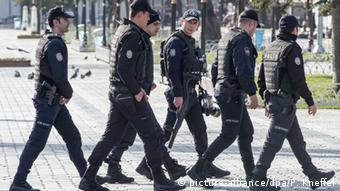
Turkish police officers walk near the site of a suicide bombing in the Sultanahmet district of central Istanbul, Turkey, January 13, 2016 (Photo: Peter Kneffel/dpa)
Turkey is facing a surge in violent extremism
The Afghan war of the 1980s changed the political landscape of Pakistan forever. Like Ankara, Islamabad decided to become a party to the war at the behest of the West to achieve its own strategic goals - to expand its area of operation in Afghanistan to counter the Indian influence.
Also, like Erdogan, former Pakistani dictator Zia ul-Haq promoted a hard-line Islamic ideology in his country and cracked down on liberal political groups and activists. He expected the West to turn a blind eye to grave human rights violations in Pakistan, as he believed he was doing a favor to the US by fighting its proxy war in Afghanistan.
In an article published by news site Al-Monitor, prominent Turkish journalist Fehim Tastekin warned his countrymen against a possible "Pakistanization" of Turkey. He argued that "the armed uprising in Syria, with the goal of changing the regime, has given birth to organizations that are threatening the entire population of the region, but Turkey is continuing on its way in total disregard for the perils of 'Pakistanization.'"
Tastekin quotes Mushahid Hussein, the chairman of the Pakistani Senate's Defense Committee, as warning former Turkish Prime Minister Ahmet Davutoglu - when the ex-premier visited Islamabad - against the "Pakistanization" of his country.
"You are repeating in Syria the mistakes we made in Afghanistan. Organizations you support now will turn against you. Pakistan was wrong in becoming party to the war in Afghanistan and was wrong in supporting the Taliban. We are now paying the costs of these mistakes," Hussein was quoted as saying in the article.
Training of militants
Michael Kugelman, a South Asia expert at the Woodrow Wilson Center for Scholars, believes it is risky to compare Turkey and Pakistan as they are different in many ways, but there are some striking convergences as well: "The main one is the overall volatile dynamic - a strongman-type government presiding over an environment of growing instability and terrorist threats. There is also a level of deepening Islamization in Turkey today that bears uncanny resemblances to what happened in Pakistan in the 80s."
The renowned expert says that Ankara is treading a very dangerous path by training and arming the rebels in Syria and Iraq.
"Whenever a state actor develops a relationship with armed non-state actors, you risk major blowback. That is the case no matter what the context - Pakistan, Turkey, and even, quite frankly, the US in Afghanistan and Iraq. You never know what these non-state actors will do to you - they may want state support today, but that doesn't mean they won't turn on you tomorrow," Kugelman told DW.
Rise of Islamism
According to Arif Jamal, a US-based expert on Islamic extremism, the Islamist resurgence in Turkey is not a new phenomenon; it started two decades ago.
Many experts associate the rise of Islamism in Pakistan with the 1980s war in Afghanistan but Jamal is one of the analysts who trace back its origins in the early 1950s.
"But that is where the parallels and similarities end. Turkey has been a geographical entity for centuries and does not feel psychologically insecure. Pakistan, on the other hand, has no history. It was created in the name of Islam and it has struggled to survive by trying not to be what India is," Jamal told DW. Meanwhile, the Turkish state and society still remain largely secular, he added.
Kugelman, however, believes that might change in Turkey: "If Saudi-sourced sects of Islam are starting to compete with Sufi Islam in Turkey, then we could be seeing history repeating itself - a cause of a Saudi-imported version of Islam eclipsing a more moderate form of Islam, just like it happened in Pakistan. The question is how much influence and reach Saudi-sourced schools of Islam could enjoy in Turkey. We don't yet know how this will all play out in Turkey."
But Turkish journalist Fehim Tastekin has no doubts that his country is "now seeing the beginnings of a tragic Deobendi-esque transition from Sufism to radicalism," and that he is "not surprised to hear of hundreds of Turkish citizens joining IS and Jabhat al-Nusra" jihadist groups.
A tight grip on power
Critics accuse President Erdogan of authoritarianism and say he is tightening his grip on power, more so after the April 16 referendum. The government is cracking down on dissidents, secular and Kurdish activists and journalists, and has introduced controversial terror laws that the rights groups deem as draconian. Despite domestic opposition to his policies, the president continues on the path using the Syrian war as a bargaining chip.
"Erdogan has used wars in Iraq and Syria to not only crush political dissent against his government and the Kurdish nationalists but also to further his Islamist agenda," analyst Arif Jamal said.
Tastekin believes the ambitions of Zia ul-Haq and Erdogan are similar - the former "dreamed of expanding Pakistan's sphere of influence first to Afghanistan and then to Asia, and Turkey's President Erdogan wanted to pray in Damascus' Emeviye Mosque and become caliph there," he underlined.

#MashalKhan - Very cautious optimism?


The aftermath of the brutal murder of Mashal Khan at the hands of fellow students on a Mardan campus has been one of mixed responses, as is usually the case. There are, however, some heartening aspects to the response, as soon from various quarters.
The first point to be noted is that despite the clouds of doubt around the role of the university administration, the Khyber-Pakhtunkhwa Chief Minister Pervez Khattak, for his part, came out explicitly stating that there has been no evidence of the young man having committed blasphemy. This should help counter the speculation and propaganda by malicious elements who seek to justify the brutal murder. While there are those who justifiably find it tragic that the views and actions of a young man are called into scrutiny after his murder at the hands of a crazed lynch mob, the ground realities in Pakistan must be borne in mind. Past experience teaches us that such murders usually generate a furious storm of anger from the religious right-wing against anyone who questions the flimsy and spurious accusations against the victim. This time, however, it would appear that things are a bit different. Some have broken silence, and others have gone against established habits.
In Karachi, prominent madrassah cleric Mufti Naeem came out openly to say that the slain Mashal is shaheed (martyr) — thus clearly condemning the murderers. Certain TV anchors, who have in the past done their utmost to whip up lynch-mobs and defend their actions, have this time taken a similar stance to Mufti Naeem. This is not to commend such TV anchors as having turned over a new leaf, but to point out that even the usual trouble-makers appear somewhat hesitant to stoke the madness.
One could argue, with the most cautious optimism that there is some realization in both state and society that such horrific madness cannot be condoned or encouraged.
The larger problem, of course, still remains. There are the procedural and legal problems in the Blasphemy Laws. And above all, there is the highly toxic discourse around alleged ‘blasphemy’, which is peddled by religious elements looking to do politics on the cheap. And then there is the attitude of the state, which has ranged from abject helplessness to criminal support for such dark forces — up to the very recent past, as seen in the case of the missing bloggers.
But perhaps most heartening is the response of the people in Mashal’s village, who took to open and well-attended protests, in defence of their unjustly slain son. They did so, even defying the village mullah who had chosen the usual slander and maligning of the victim.
“Mashal is innocent, Mashal is a martyr!” they chanted earlier in the streets where the young man came from. May their clarity and courage represent a turning-point in Pakistan’s struggle against its own dark, obscurantist, extremist under-belly.

Pakistan - Who is responsible for #Mardan?


Sarmad Iqbal


Not them. The snarling, swirling, berserk mob did kill Mashal - sticks wielded by their arms cracked his skull, and their blood-soaked feet stamped out the last vestiges of life. But responsibility extends beyond the confines of factual action and reaction. When the mob charged the university hostel, it was little more than a feral animal, overwhelmed by primal instinct, individuals fused into one throbbing, screaming entity. Its virility questioned, its honour threatened, and its very existence in jeopardy. Rallied by visions of a glorious duty to which there is no second. What reason is left in that maelstrom of guttural frenzy? Very little. Conscience? None.
Like the froth that forms on a stagnant pool stirred up with a stick, the mob is the residue of a decaying body – a symptom, not the cause. While our justice towards them will be swift, perhaps it is time we looked at the person who wielded the stirring stick, and more importantly, who allowed the pool to stagnate in the first place.
The instigators are not hard to find, for they are not trying to hide at all. Their murderous diktats, delivered in sonorous slogans, are printed boldly on walls and banners. They build mausoleums for the terrorist Mumtaz Qadri and raise his pre-teenage son to the status of a saint. They are not hard to find at all, if we are really looking. A state that has weaponised religion is harder to spot – behind a clean shave and a crisp uniform fundamentalism becomes patriotism, and objections become treasons.
Over the next few days and weeks these instigators will be denounced - directly by some and in veiled innuendos by most. Condemnation will rain down and strict actions proposed – and rightly so. Theirs is the provocative whisper in the ear of the ‘believer’, the threat of vigilante violence, and the promise of heavenly debauchery.
But responsibility, as we have noticed, extends beyond the confines of factual action and reaction. The real responsibility for Mardan, dear reader, lies with you. Your cowardice and timidity has given space to a narrative that will consume us all.
Don’t take offence, don’t raise your voice in indignation – I know you are humane, a voice of sanity. Your heart quickened with disgust at the horrific images in Mardan just like the rest, and your denunciation was as scathing as they came. But what use is your denunciation that echoes in empty chambers you have built for yourself? A war rages in the streets, and you are content at wrinkling your noses from your ivory towers.
Ideas are nurtured by blood and sweat, revolutions built on sacrifice. In the tussle over the religious extremism one side is out in droves going toe to toe with law enforcement and staring down any official who dares oppose it. The other laments in plush living rooms with like-minded individuals, leaves Facebook statuses to be read by carefully curated audiences and hides behind the veil of anonymity. Is this the extent of moderate Pakistan’s outrage, a social media condemnation and token tributes to Mashal?
There is yet strength in your numbers that you do not know. Stand on an intersection, block the parliament road, call your local representative, anything. Put your bodies on the line, and make your presence be felt. Politicians are creatures of pragmatism; like a fungus, they grow towards the path of least resistance. A backlash from the right-wing keeps them from acting as they should to tackle this problem; a backlash from the moderates and the left-wing is needed to push them into action. 50 madrassah students, 25 motorbikes, and a tree whittled down to sticks is all that is needed to block a street and get the government’s attention – and religious seminaries have done so since time immemorial to great effect. Tolerant, rational Pakistanis number in millions, yet outside of a few trembling candle vigils threatened by a stray gust of wind when was the last time moderate Pakistan protested this brutality, when have they marched on government or come out in numbers? When have you?
“This doesn’t affect me” you’ll say, “I have my own safety to think about” you’ll add. And that is undoubtedly true – nothing about this endeavor is safe. But if safety was the prime concern the great advancements of liberal and tolerant thought – from upheavals like the French Revolution to campaigns like the Civil Rights Movement – would never have happened. At some point personal safety needs to be put aside for your ideals. Change – real, hard, implausible change, doesn’t come easy.
Let’s look at the other objection – that this doesn’t affect you. Well, it was true when they burned a poverty-stricken Christian couple over a brick kiln in Kot Radha Krishan; you weren’t poor nor Christian. It was true when they killed Ahmedis in their mosques in Gujaranwala; you weren’t an Ahmedi cleric, you are a middle-class Sunni. What about now? When a young, educated, bright student, just like you is so many ways, was butchered by his fellow students in a university – is it still too far away, is it still not your concern?
I understand. I know you are scared, so am I. But think of this; “Mashal” means torch in Urdu – the burning standard that lights a darkened path and leads the way for the rest to follow. Think of that, and put some steel in your will. This is your responsibility.