Saturday, March 11, 2017

Pakistan - Uproar in National Assembly – again!


Expletives and a brawl befoul the House
The cowed and stressed common man, already bowed down under the weight of myriad problems of everyday existence, witnessed another worrying rowdy exhibition of fisticuffs by the honourable members he has sent to the august House to make his wretched life a little more cheerful. In fact, these macho displays of outraged manhood and misconceived respectability, abuse, sloganeering, yelling and ripping up copies of agenda, are now spiralling, both inside and outside the Assembly. It is a scene that depresses and demoralises, apart from disrupting the rare occasions when quorum is complete, as such raucous scenes are invariably followed by a sulking walkout by the offended members, as has happened now. Sadly, the only issue which attracts a full House without fail and a touching unanimity is when the members are voting on raising their salaries and perks.
The ugly events of Thursday were the second round in the PML-N and PTI series of bouts after the hullaballoo of January 26 inside the Assembly, involving the Minister of Petroleum and a PTI member, which quickly drew in loyalists of both sides. The latest disturbing incident occurred outside the Assembly chamber in the lobby, but its roots lay in the earlier proceedings of the House and in the questionable role of the presiding Deputy Speaker, as well as in the running feud between the ruling family, wobbling under Panama leaks, and Imran Khan, who scents Sharif blood, and is baying for it. There are no national issues or matters of principle behind these sordid squabbles.
PML-N Javed Latif’s personal remarks about Imran Khan were excessive and could have been expunged to lower tensions, the Deputy Speaker behaved in an unfair, even biased manner towards the opposition, Murad Saeed’s behaviour outside the Assembly was condemnable, but the later Press comments of Javed Latif are indefensible as they diminish the decorum of Parliament. A committee has been formed to investigate and apportion blame. It is unfortunate that the Sharif-Imran jockeying for power has spilled into the House from the streets.

Pakistan - Shameful Parliamentarians


The grotesque incident involving two parliamentarians — Javed Lateef of Pakistan Muslim League-Nawaz (PMLN) and Murad Saeed of Pakistan Tehreek I Insaf (PTI) – within the precincts of the Parliament is a grim reflection of the deteriorating ethical standards and political discourse. Mr. Lateef, a senior parliamentarian with three terms of parliament on his record, was heard using expletives moments before Mr. Saeed pounced at him to give a tight slap. This is not the first time that a hot-tempered Mr. Saeed, who is a young first time member from PTI, has exchanged heated words and misbehaved with seniors in parliament andTV studios.
After this regrettable incident, Mr. Saeed insisted for hours that he ‘had to’ assault Mr. Lateef because the latter was abusing ‘my leader’ i.e. Imran Khan. Mr. Lateef denied using expletives butin the video footage of the scuffle these can be clearly heard. This regrettable episode took another ugly turn whenMr. Lateef attacked Mr. Saeed’s sisters while speaking to the media at the entrance to the parliament house after the broil. This is simply unacceptable.
Male politicians routinely target women in their skirmishes. This is a trend embedded in our sexist culture. Both PTI and PMLN have been attacking women in their desperate attempt to settle scores. Recently, PTI supporters have been running a campaign targeting a female journalist who leaked the video of Imran Khan’s controversial chat in which he used unfortunate words, bordering on racism, for the foreign players who came to Pakistan for PSL. Before that, PMLN’s Khawaja Asif used derogatory words for PTI parliamentarian ShirinMazari.
While Mr. Lateef’s obnoxious attack on women members of Mr. Saeed’s family is condemnable in absolute terms, it cannot justify violent physical attacks. If such provocation were to be accepted, there would be no end to the physical scuffles inside or the outside parliament. It would be extremely worrying if a major political party were inclined to use provocation as justification of their legislator’s misbehavior. Deeming it as a legitimate defence implies that party leaders are prone to losing their self-control while hearing pungent remarks from their opponent. Should such persons of questionable self-control be part of such an important decision-making forum, remains another important question that party leaders must ponder upon.
Other than the misogynistic trend of targeting women, the practice of peeri-mureedi within political parties viz a viz their leaders needs to be shunned.Political parties are responsible to instilland nurture democratic culture within a polity. If legislators resort to abusive and violent behavior then it raises a big question mark about their democratic credentials. Both PMLN and PTI, at the very least should take stern action against their MNAs to set a much-needed precedent.

'93% of Pakistani women experience sexual violence'


By Mudaser Kazi
Pakistan is among those countries where 70% women and girls experience physical or sexual violence in their lifetime by their intimate partners and 93% women experience some form of sexual violence in public places in their lifetime.
This was stated by founder of Madadgaar National Helpline 1098 and national commissioner for children, Zia Ahmed Awan, while quoting the statistics of international organisations during a press conference at their office on Tuesday.
Awan lauded, in tribute to the International Women Day which is celebrated on March 8 every year, the courage of the 8,897 women and children from across Pakistan who came forward in 2016 and fought for their rights and protection by calling, visiting or contacting Madadgaar’s helpline.
“The data recorded by our organisation is just the tip of the iceberg. Our helpline would [if there was awareness] have been flooded with calls from victims and survivors,” he stated, adding that only 10% cases of violence are being reported in Sindh and Punjab in media with even less reporting from Balochistan and Khyber-Pakhtunkhwa.
According to him, in order to prevent violence against women and children, the government should act boldly and announce an emergency in the country.
“For us, every day must be women’s day,” he emphasised, saying that an inefficient social justice system is the reason for different forms of violence in Pakistan.
According to the World Economic Forum, it will take another 169 years to bridge the gender gap at our current pace, he shared. “Out of the total cases reported on the helpline, the highest percentage of victims was that of women at 56%,” explained Madadgaar’s general manager Muhammad Ali Bilgrami who added that cases reported by boys were 16%, 15% by girls and 13% by men.
According to Bilgirami, 7,561 cases were reported from Sindh and the least number of cases, 306, were reported from Balochistan. Unrest, targeted killing of the legal fraternity, weak law enforcement, absence of rule of law and overall social, cultural and religious barriers stop people in Pakistan, especially women and girls, to come forward and report violence perpetrated against them, said Bilgrami.
While sharing the nature of cases reported in 2016 to Madadgaar National Helpline, Bilgrami briefed that 118 cases of child marriage, 162 of cybercrime, 14 of child abuse, 2,092 of domestic violence, 14 of forced marriage, 562 of harassment, 12 of karo-kari, 2,251 of missing children, 213 of missing women, 792 of mental torture, 5 of rape, 6 of sodomy, 10 of sexual harassment, 7 of sexual abuse and 5 cases of trafficking. Most of the violent crimes committed against women are strictly prohibited by laws in Pakistan such as child marriage, sexual violence, domestic violence, karo-kari, kidnapping and harassment, said Awan, saying that laws are however, not being implemented and there is a lack of awareness on addressing the complaints through a proper channel.
Awan also highlighted that gender-based cyber violence is on the rise in Pakistan. Children and youth are particularly at risk, he said, demanding that special courts in lower judiciary and special cells at police stations must be established to provide relief to women victims in a male chauvinist society.

PakAf - Closing the border


Afrasiab Khattak
After its closure in February, the Pak-Afghan border was reopened for two days this week to let thousands of stranded children, women and men on both sides of the border go to their homes. Many trucks and containers loaded with all sorts of goods, some of them perishable, could also proceed to their destinations. The sudden and unilateral closure of the border by Pakistani side last month had created a humanitarian crisis that was deepening with every passing day. So opening the border and providing respite to thousands of stranded people is a positive step. But its closure once again for an indefinite period doesn’t augur well for normalisation of relations between the two close neighbours. This isn’t for the first time that the border has been unilaterally closed by the Pakistani side in total violation of the Afghanistan-Pakistan Transit Trade Agreement of 2010. This has become a routine strategy for Pakistan for putting pressure on Afghanistan. According to the said agreement, Afghan trucks are to enter Pakistan through Torkham (Khyber Agency), Ghulam Khan (North Waziristan) and Speen Boldak (Balochistan). There are five other lesser known crossing points that are manned and formally controlled by both sides. They are Arundu (Chitral), Gursal (Baujore), Nawa Pass (Momand Agency), Kharlachi (Kurram Agency) and Angoor Adda (South Waziristan). There are hundreds of other crossing points on the 2650 kilometres long Durand Line between Pakistan and Afghanistan (according to one estimate at least 262). So the argument of “blocking the movement of terrorists” across the border in favour of its closure doesn’t hold ground. Why would the terrorists use the crossing points where there are security forces deployed on both sides for controlling the border in the first place. This possibility weakens further when one considers the fact that there are hundreds of uncontrolled and unfrequented routes available for terrorists to use for their cross border movement. The so called border management can be at best a long term project implementable only through bilateral cooperation. Unilateral border blockade actually hurts the prospects of the mutual cooperation on the border management project.
The present confrontation on the borders is further aggravated by heavy Pakistani artillery shelling into Afghan territory and terrorist attacks on some Pakistani border posts causing loss of precious human life on both sides. So what can be the real purpose of closing border indefinitely when the claims of “border management” and “blocking terrorists” do not hold ground? Those who have been carefully following the Pakistani security establishment’s Afghan policy can tell you that we have been here before. In early 1989, the Pakistani supported Afghan Mujahideen had tried to economically strangulate the government of President Dr Najibullah by making an effort for imposing an economic blockade on the routes in eastern and southern Afghanistan. Food supplies were the particular target of that blockade. Unlike the Afghan Mujahideen of that time, the Taliban aren’t able to do it by themselves. They don’t have the capacity. In fact mentors of Taliban on the east of Durand Line are quite disappointed in them although they wouldn’t publicly accept it for obvious reasons. Taliban haven’t been able to capture and hold even a single province in the almost three years despite the vast supplies and support received by them. So the conventional wisdom is that an economic blockade will weaken the Afghan Republic, making it vulnerable to the fresh Taliban spring or summer offensive.
It is interesting to note that the obsession of Pakistani security establishment with the Talibanisation of Afghanistan has seriously undermined the economic interests of Pakistan. Since 1991, there has been a lot of talk about accessing Central Asian markets which could have been a game changer for Pakistani economy even better than CPEC in the sense that it wouldn’t have required heavy burden of foreign debts. But the main hurdle on this path has been putting Taliban first to regional trade. Under Taliban controlled Afghanistan, Pak-Afghan annual trade was around 250 million dollars. In the post Taliban era, trade had reached to 2.5 billion dollars and in 2014 both sides had agreed to raise it to 5 billion dollars. Bilateral formal trade between the two countries has drastically decreased and is heading towards zero level due to growing insecurity, tension and border closures. The contradiction between Pakistani policy of regional economic cooperation and her Afghan policy was demonstrated quite dramatically by the fact that the latest border closure came at a time when Pakistan was hosting ECO Summit for promoting region connectivity and economic cooperation. It goes without saying that projects like TAPI and CASA will have no chance of implementation in presence of Taliban militancy.
Growing Indian influence in Pakistan’s western neighbouring country is used as justification for Pakistani support for Taliban. But Pakistani makers of the country’s Afghan policy have never pondered over the fact that their crude pressure over and coercion towards Afghanistan has greatly helped India in gaining further foothold in that country. India has consistently focused on projecting its soft power in Afghanistan by building dams, roads, schools, hospitals and monuments of democracy such as parliament and court buildings. Since Pakistan supported Taliban target all these facilities of public good, it is only natural that Pakistan and her policies receive a negative perception in the minds of common Afghans. Indian policy towards Afghanistan is quite sophisticated when it comes to promoting a soft image. PM Narendra Modi makes it a point to say some Pashto and Dari words in his public speeches in Afghanistan apart from appreciating rich culture of the host country. Even Indian technocrats are so conscious about their soft policy that they call India as economic partner of Afghanistan rather than a donor. In the light of these facts is it surprising to see the expansion of Indian influence in Afghanistan?
Another socio political fallout of a prolonged border closure with Afghanistan is its intended or unintended negative impact on the economic situation of the Pashtuns living in Pakistan. Thousands of Pashtun families including businessmen, transporters and daily wagers depend on transit trade and border trade with Afghanistan. Border closure seriously punishes them. Economic deprivation coupled with recent racial profiling of Pashtun IDPs in Punjab and Sindh can deepen political alienation among them. Pakistan’s bankrupt Afghan policy which brought drugs, klashnikov culture, extremism, sectarian and terrorism in Pakistan in the past can bring ethnic polarisation as well. Can Pakistan remove the albatross of a bankrupt Afghan policy from its neck for becoming a stable and prosperous country is a question crucial for her future.

Pakistan: Killing For Honour


101 East investigates the fate of four young girls in Pakistan, where honour killings are endemic.


When a video showing four girls clapping while three brothers dance emerges in a remote Pakistani village, it quickly goes viral.
Rumours spread that tribal elders have ordered they be killed for bringing shame upon their families.
In this deeply conservative society, where 500 women are killed each year in so-called honour killings, this can be enough to drive some relatives to murder.
The intrigue deepens as a court orders the girls to be brought before a judge. But are they still alive?
101 East searches for the truth in a case that exposes the clash between old beliefs and modernity in Pakistan.

Friday, March 10, 2017

Pakistan's God's Will - Blind Faith & Ignorance.


IRFAN HUSAIN


  • Blind Faith


I HAVE often wondered why the people of Pakistan put up with all the awful stuff they endure on a daily basis.
Why don’t they rise up in protest against the incompetence and corruption rampant in the country? The state provides virtually nothing in the way of basic education and health; 84pc of Pakistanis have no access to clean drinking water; and the populace is at constant risk from terrorists and criminals.
So why aren’t people out on the streets to demand decent governance? I suspect our bovine acceptance of whatever our leaders dish out is due largely to the fatalism that has long held the subcontinent in its iron grip.
When a child dies in a hospital due to a botched procedure or sloppy nursing, its parents console themselves by looking towards heaven, saying, “Allah ki marzi” or “It was God’s will”. Thus, rotten medical care remains the norm as doctors and nurses know their blunders will go unremarked on and unpunished.
By contrast, they would have been sued for similar professional malpractice in other countries.
This fatalistic attitude permeates society, allowing policymakers, politicians, bureaucrats, cops and professionals an easy way out whenever they fail in their duties, something they do with depressing frequency. And when there’s no price to pay for incompetence, there is little incentive for reform and improvement.
Our acceptance of whatever our leaders dish out is due to fatalism.
After all, if we ascribe all our misfortunes to the Maker, how can any human agency be blamed? How much easier to pass the buck to the very top than to accept personal responsibility for having goofed up. When a beggar asks for money to feed his six children, and you ask him why he has such a large family, the reply invariably is: “It was God’s will”.
When politicians visit those maimed in a terrorist attack in a hospital, they invariably invoke the Maker as consolation. This no-cost formula lets them off the hook as they pose for TV cameras. And, of course, nothing changes in the aftermath of successive deadly attacks as the public also puts the murder of loved ones down to Divine will, thereby absolving the government and its security agencies of any blame.
While stoicism helps us to bear pain and sorrow, fatalism reduces the sense of outrage that should accompany needless suffering. Thus, instead of calling a lawyer or launching a street protest after yet another disaster caused by personal or public incompetence, we seek solace by saying to ourselves that it was God’s will.
At the Battle of Lepanto in 1571, the Ottoman fleet was defeated by the Holy League. This was a key naval engagement, and the outcome signalled the end of the Ottoman push into the Mediterranean. The contemporary Ottoman chronicle of this hinge moment in history explained the defeat thus: “… the Imperial Fleet encountered the fleet of the wretched infidels and the will of God turned another way…”
So instead of analysing the reasons for this defeat when the Ottoman fleet outnumbered the opposing side, God’s will was cited as the cause. As a result, when replacement ships were being built, they incorporated the same weaknesses as the galleons that had been captured or sunk by the Holy Alliance.
When an oil tanker blew up in Gadani last November, killing and maiming scores of workers, the cause was clear: the owner of this vessel brought ashore to have its steel stripped off had allegedly smuggled in a certain amount of oil in the holds. The workers wielding oxy-acetylene cutting torches were unaware of this hazard, and set off the devastating blast.
Many officials and politicians turned up at the site of the disaster. The media criticised the administration for its failure to inspect the tanker, but at the end of the day, all concerned shook their heads and muttered: “Allah ki marzi.” The same thing happens with regularity in mines and factories across the country but, after each accident, nothing changes and it is business as usual.
This fatalism retards progress and lets the guilty off the hook. If only Divine action guides us, then clearly, mere humans cannot be held accountable for their errors of omission and commission.
By forgetting the maxim ‘God helps those who help themselves’, we have fallen into the trap set by ignorant clerics. In their worldview, everything is preordained, so we don’t control what happens to us and around us. The true purpose of life on earth is to prepare for the afterlife. If you are born poor and powerless, you will be compensated in the next life.
Until we take responsibility for our own actions, we will continue to languish at the bottom of the pile.

Pakistan: More On Indus Water Treaty – OpEd


 By Dr. S. Chandrasekharan


Media reports indicate that India has agreed to attend the next session of Indus Water Commission on March 20-21 2017 to be held at Lahore. This will be the 113th session of the Commission and the meeting is being held in Pakistan this time as mandated in the Treaty.
The Indian media has started reading too much into the meeting and the change of mind of India. This change is presumed to be the result of the softening of stand in Pakistan and of all things invitation to Indian Artists to the two art and cultural festivals at Karachi and Lahore is being cited as one of the reasons. Nothing could be farther from truth than this. Worse, the media has even speculated that this will pave the way for the two Prime Ministers to meet on the sidelines during the Shanghai Cooperation meeting in June this year!
Following the September Terror strike at Uri last year, India had decided to suspend the talks and also declared that it would review the Indus Water Treaty. Article VIII of the Indus Water Treaty states that the Indus Water Commission must meet once a year alternatively in India and Pakistan.
The Indian announcement was only about suspension of the talks and not the abrogation of the treaty as such. Yet while a review of the treaty internally was welcome and justified, the suspension of talks was wrong and against the rules laid down in the treaty. To say now that “India is always open to settling issues relating to the pact with Pakistan bilaterally” makes no sense as the pact is purely bilateral and the World Bank was only a facilitator and not a guarantor.
In a way it was good that the Indus Water Treaty came into focus once again after the terror strikes in Uri. Pakistan appears to have been rattled by the Indian decision after the review that India would fully utilise the rivers flowing through Jammu and Kashmir and exercise India’s full rights under the pact. This statement was long over due and instead of making empty threats, what is needed is to go ahead in building the infra structure necessary to implement the pact to the full. The pact is not flawless as it totally ignores the needs of Jammu and Kashmir. Yet this was the only way that the Indus Waters could have been shared and what was lacking was India’s failure to fully utilise what is legitimately her’s.
Pakistan cannot export terror on one hand and expect India to reciprocate by being generous. It is time to sensitize both the Indian public and the strategic analysts of the importance of the treaty.
One is not surprised by the vehemence of protests from Pakistan both at official and unofficial levels. It may be recalled that Pakistan had arranged in the past protests by the Pak. sponsored Jihadists at the time of the visits of Indian delegation during the meetings of the Indus Water Commission that India was “stealing the waters” that should legitimately go to Pakistan!
Pakistan has been systematically and some times frivolously raising series of technical objections on every project that is being planned on the Indian side. Besides the two projects Kishenganga and Ratle (refer our paper 6226), objections have also been raised on three other projects- Pakal Dul (1000MW), Miyar (120 MW) and Lower Kalnai (48 MW) all on Chenab river. In the disputes already settled by the neutral experts on the Baglihar and Kishenganga, it has been established that India is entitled to exploit the “western rivers” flowing into Pakistan for generation of hydro power.
It is suspected that Pakistan’s regular objections to the Indian build schemes under the pact is more to hide and divert their people’s attention from the mismanagement of the dwindling water resources and more seriously the unequal sharing of waters among the provinces. The lower riparian Sind Province is said to be not getting its legitimate quota of water while Punjab the upper riparian takes the major share!
It is in this connection that one should welcome the book “Indus Divided” by Prof. Daniel Haines of Bristol University who appears to have done considerable research on the Indus Water Treaty. Prof. Haines focusses on modern environmental history.
The author maintains that the Indus Water Treaty was a boldly unique solution and this could not be replicated anywhere else, although for a while the US toyed with the idea of applying the same principle of dividing the rivers than the waters in the dispute of sharing Ganga waters with the then East Pakistan.
One should recall that David Lilenthal of Tennesse Valley Authority who was instrumental in getting Indus Treaty hoped that solving Indus Water Sharing “was a necessary first step on the way to a Kashmiri settlement.” It was too simplistic a view and was not perhaps aware of many deep-rooted layers of conflicts between the two countries. Prof. Haines has also disabused the theory that Kashmir dispute is all about Pakistan trying to get control of the head waters of the rivers flowing into Pakistan.
One of the comments from the Pakistan on the book was that the book “highlights the fundamental place that Indus Waters have had in Pakistan and Indian politics since 1947″.
I wish it had been so but it was not. At least now, it should be-So that Pakistan is made to realise as PM Modi had said that Blood and Water do not go together.

EVERY 13TH PAKISTANI INFECTED AND NO CHECK ON BLOOD SCREENING KITS, SHERRY REHMAN

Vice President PPPP, Senator Sherry Rehman led the opposition on a walkout over the shameful negligence shown by the government in the Senate. The Ministry of National Health Services Regulation and Coordination was unable to give a proper answer to Rehman’s concern regarding the health crisis caused by the wide prevalence of substandard blood testing kits in public hospitals.on a walkout over the shameful negligence shown by the government in the Senate. The Ministry of National Health Services Regulation and Coordination was unable to give a proper answer to Rehman’s concern regarding the health crisis caused by the wide prevalence of substandard blood testing kits in public hospitals.
“With its typical arrogance and negligence, the government is refusing to focus attention in parliament, let alone on the ground of such a critical humanitarian challenge. They are literally trifling with the blood of innocent civilians,” Rehman said in her address before the Senate.
Dismayed over the Ministry’s response, Rehman said, “It is shocking that the government was unable to give a satisfactory answer on such a vital issue of public importance in the Senate. It seems as if they were neither prepared nor bothered when I called their attention to the scandalous prevalence of substandard blood testing kits even in Islamabad Capital Territory”.
The Ministry’s casual response prompted uproar in the joint opposition which then chose to walk out.
Citing the case of the young siblings who were believed to have contracted HIV through contaminated blood used for their transfusion, she said, “It’s a national tragedy that the lives of innocent civilians are jeopardized because of the government’s negligence,” reiterated Rehman.the young siblings who were believed to have contracted HIV through contaminated blood used for their transfusion, she said, “It’s a national tragedy that the lives of innocent civilians are jeopardized because of the government’s negligence,” reiterated Rehman.
Rehman further stated, “The fact that 15 million or every 13th Pakistani is infected with Hepatitis B and C is of no worry to them. The government is showing its criminal negligence by ignoring the crisis even in parliament when the question is raised”.
It is believed that 60-70% of approximately 3.5 million blood donations in Pakistan are screened through substandard blood testing kits.
On the importance of regulating the quality of kits used by health facilities across the country, Rehman said, “The substandard Rs.6-7 garage-made blood screening kits are putting millions of Pakistanis in danger. WHO approved kits should be used. It is unfortunate that such basic form of regulation is missed by the concerned authorities”.
“I cannot further emphasize the importance of having comprehensive health policies to ensure the safety of civilians. The opposition’s bill on posing penal liabilities to those responsible for causing death or injury caused by unsafe transfusion is still pending, causing shocking loss of lives as a result,” argued Rehman.

https://ppppunjab.wordpress.com/2017/03/10/every-13th-pakistani-infected-and-no-check-on-blood-screening-kits-sherry-rehman/

Pakistan activist Waqass Goraya: The state tortured me


A liberal Pakistani activist who went missing earlier this year has said a "government institution" with links to the military held him and tortured him.
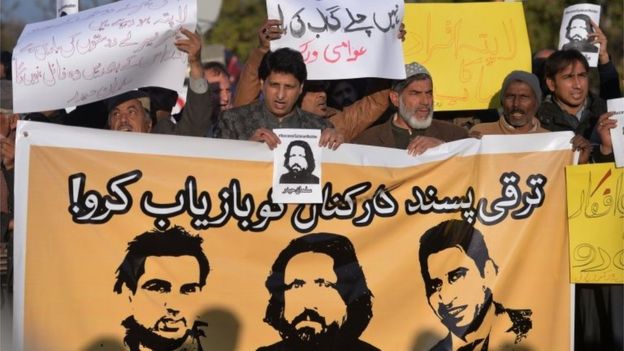
Waqass Goraya, one of five activists who disappeared in early January, told the BBC he was tortured "for pleasure".
The activists were freed after several weeks - but until now none of them has said who was behind their mistreatment.
Pakistan's army has previously denied any involvement in the case. There were vocal protests seeking their release.
Pakistan is one of the the world's most dangerous countries for reporters and human rights activists, and critics of the powerful military have been detained, beaten or killed.
Waqass Goraya - who now lives in the Netherlands - told the BBC he had been tortured "beyond limits".
He described being punched, slapped and forced into stress positions during the three weeks he was held. He worried he would never be released.
"We knew it was over… We will die under torture," he told the BBC.
He also spoke at a side event at the United Nations Human Rights Council in Geneva about his experiences.
Mr Goraya believes he was detained because he ran a satirical Facebook page critical of the influence of the Pakistani military in the country's political system.
The page has also criticised military policy in Pakistan's restive Balochistan province. Mr Goraya strongly denies breaking any laws.
"I hadn't done anything criminal - otherwise I would've been in a court not in illegal detention," he told the BBC.
Pakistani human rights activists hold images of bloggers who have gone missing during a protest in Islamabad on January 10, 2017.Image copyrightAFP
At a press conference in January, a spokesman for Pakistan's powerful military said it had had nothing to do with the disappearance of the bloggers.
Pakistan's interior minister had previously said the government did not tolerate "enforced disappearances".
After Waqass Goraya and the other activists disappeared, a campaign demanding their release sprang up around the hashtag #recoverallactivists. But a counter-campaign both online - and backed by a number of TV anchors - accusing them of blasphemy also began.
Blasphemy is an emotive issue in Pakistan - and can legally be punishable by death.
Mr Goraya says the allegations of blasphemy are false, and that alleged blasphemous postings have been fabricated.
Following a court petition by an Islamist leader, on 8 March legal proceedings were begun calling for the prosecution of those behind a number of social media pages allegedly run by the missing activists.
All of them are now believed to be outside Pakistan. Pakistan's Interior Minister Chaudhry Nisar Ali Khan has previously raised concern about the blasphemy allegations against the activists - but following the court ruling threatened to block "all social media websites" that had blasphemous content.
Mr Goraya believes the blasphemy allegations are an attempt "to shut us down - to threaten our families - to build pressure on us".
A protest was held in Islamabad on 8 March by religious groups calling for action against the activists and criticising the government for letting them leave the country.
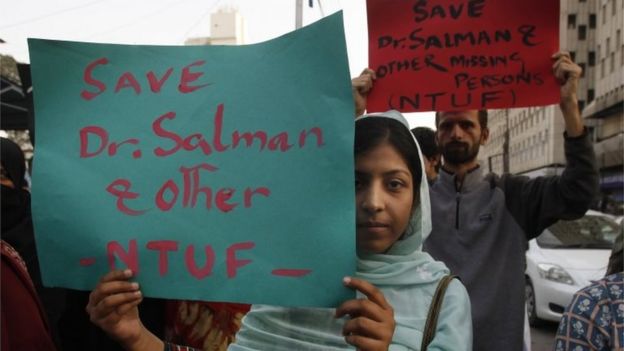
Activists of Pakistan civil society rally to condemn the missing human rights activist Salman Haider, in Karachi, Pakistan, Monday, Jan. 9, 2017.Image copyrightAP
Image captionActivists saw the disappearance of the bloggers as a worrying sign
Mr Goraya says he believes that by speaking to the UN, he can help build pressure in Pakistan to pass a bill currently before parliament that would force the security services to provide information on a "missing person" in their detention within three days of a request.
He also wants accountability for what happened to him.
"The government should investigate it. We have evidence - strong evidence - it will directly lead to the persons responsible."
Mr Goraya still has nerve damage in his hands and feet, as well as problems with his hearing - but says he is determined to continue activist work.
"They are still picking people, more and more people are being harmed - our friends, our colleagues - so how can we stop? Someone has to stand up."

Pakistan's War on Atheism


On Tuesday a High Court Judge in Pakistan’s capital Islamabad reiterated in a hearing that “blasphemers are terrorists,” as a petitioner sought a ban on social media pages allegedly uploading derogatory posts against Islam and Prophet Muhammad.
Justice Shaukat Aziz Siddiqui, who has broken down in tears in every single one of the three hearings on the case this week, on Wednesday asked the government to put “blasphemers” on the Exit Control List (ECL).
On Thursday, Siddiqui, who has represented Islamic State-sympathizing Lal Masjid cleric Abdul Aziz in the past, said he would summon the prime minister if no action is taken against social media pages that post “blasphemous” content.
Enjoying this article? Click here to subscribe for full access. Just $5 a month.
The Islamabad police have since registered a case against the owners of these pages. The Senate has approved a resolution demanding strict action against “blasphemous content” online. Meanwhile, the Federal Investigation Agency has published ads in national dailies asking citizens to “help identify blasphemers on Facebook.”
During the hearing this week, the Islamabad High Court (IHC) judge, implied that murder would be inevitable if the pages aren’t blocked. He went on to add that “liberal secular extremism” is a bigger threat than Islamic extremism.
Pakistan’s interior secretary assured Justice Siddiqui that the “entire government machinery would be set in motion” to address the issue. This was followed by the interior minister vowing to block social media completely if the issue isn’t resolved.
Meanwhile, the Pakistan Telecommunication Authority (PTA) Chairman, in his defense, said that similar social media pages have recently been blocked and that it takes time to convince the Facebook administration to take action.
These blocked pages include Bhensa, Mochi, and Roshni, which have either been blocked or taken over by the Elite Cyber Force of Pakistan.
In January, secular bloggers and activists, many of whom were accused of being affiliated with these pages, were abducted from various parts of the country, with the well-coordinated maneuver accused of being a state-backed operation by many quarters.
While many were subsequently recovered, some fled the country immediately. One of these activists revealed on Thursday how the state had tortured him “beyond limits.”
Almost parallel to the activists’ release, the Jamaat-ud-Dawa (JuD) Chief Hafiz Saeed, accused of masterminding the Mumbai Attacks, was put under house arrest. Many believe the state’s long overdue action against Kashmir-bound jihadists is being pushed by China, as it seeks security for the much touted economic corridor.
With the current ruling party forging political alliances with many of these jihadist groups, and the Army using them as “strategic assets” for proxy wars in Kashmir and Afghanistan, only external pressure can lead to decisive counterterror action.
But what this has meant is that both the civilian and military leaders now have to appease their heretofore Islamist allies to avoid collective backlash, as action against jihadist groups becomes inevitable. Pakistan’s overt war against freethinkers might just give the state the respite that it needs.
Last year, Pakistan also passed its cybercrime law, which upholds identical punishments for Penal Code violations in the cyber-sphere. This means that “blasphemy” would be punishable by death,  even if committed online.
The immediate impact of January’s abductions was a mass exodus of anonymous secular bloggers from the web. Satirical publication Khabaristan Times was also banned by the PTA, while a shift in editorial policies has been visible in many online and mainstream liberal publications.
This is why Justice Siddiqui’s juxtaposition of “liberal secular extremists” and radical Islamists is critical. All state institutions echoing apologia for Islamists, and slamming secularists, is menacing for an already endangered species: the Pakistani atheist.
Delineating the ideological divide, which would result in any liberal ideals being thrown to the wolves, could’ve instigated Bangladesh-like violence had Pakistani freethinkers been a quasi-significant demographic. As it is, a few abductions, and banned web pages, were enough to silence many of us.
Ironically, it is the state’s appeasement of radical Islam that has caused an upsurge in the number of atheists in Pakistan. This is why an official discourse on atheism has been going on in Pakistan, resulting in many expressing non-belief online, most doing so anonymously.
While one still can’t officially register as an atheist, or opt for “No Religion” as identity for the national database, the number of atheists is believed to have increased following the advent of Internet and social media allowing isolated nonbelievers to connect.
Muslims abandoning Islam – even if not their Muslim identity – is a global phenomenon, and the apostasy wave is upsetting the Islamist cart in Pakistan as well.
In 2015, the hashtag #ایک_کروڑ_پاکستانی_ملحد  or “Aik crore Pakistani mulhid” (10 million Pakistani atheists) trended around Darwin Day, with thousands of Twitter users tweeting both for and against atheism. It trended around February 12 last year again. But we didn’t see a repeat last month.
While 10 million might be significant exaggeration, a Gallup poll of 50,000 people found that 2 percent of Pakistanis self-identified atheists in 2012, which had doubled from the 1 percent in 2005.
Pakistani atheists – a broad term encompassing agonistics, the irreligious, deists, and humanists alike – have been lazily painted by the Islamists as “liberals and seculars,” despite the fact that many believing and practicing Muslims identify as such as well.
Muslims openly identifying as atheist in Pakistan would be an open invitation to violence, considering the state’s blasphemy laws are interpreted to outlaw apostasy, coupled with the National Database and Registration Authority’s (NADRA) refusal to let citizens officially change Islam as their religion. Hence, the aforementioned “secular liberal” label also provides refuge to the atheists.
Even so, in websites and social media pages that are critical of Islamic theology, the Islamists at the helm of state institutions have found the filter to sift atheists. Justice Siddiqui himself was quick to clarify that non-Muslims shouldn’t be considered in the ongoing case against blasphemers, clearly underscoring apostates as the intended target.
And while these atheists of Muslim heritage aren’t an organized political entity – as is the case in Bangladesh – the IHC’s verdict, and the capital police registering a case weeks after action against secular activists had already been taken, smacks of a thirst for blood.
Whether the episode is being staged to mollify Islamists amidst the crackdown on jihadists, or if there’s a genuine clampdown against free-thought, remains to be seen. But the state seems more than willing to sacrifice its nonbelievers at the altar of its security failures.

Thursday, March 9, 2017

ZAYN, Taylor Swift - I Don’t Wanna Live Forever

Video - Seven injured in Dusseldorf axe attack

Video Report - 'Humanitarian crisis looming in Mosul' - fmr UN spokesperson for Iraq

BREAKING NEWS 3-9-17 ~ FBI Cheıf Briefs Lawmakers With Top Security

The Daily Show - The #GOP Still Hasn't Figured Out Health Care

#HerVoiceIsMyVoice : Malala Nobel Peace Prize Speech

Islamabad-Kabul relations


Border tensions between Pakistan and Afghanistan are heading towards a dangerous level with recent incidents. In wake of the attack on Sehwan Sharif, Pakistan closed the border with Afghanistan for security reasons and conducted cross border raids against Jamaatul Ahrar (JuA) for neutralising its training camps. However, the closure of the border also led to a brewing deadlock with Afghan officials over the last couple of weeks due to non-cooperation from either side over various issues (with the bulk of the onus lying on Kabul). Moreover, a militant attack originating from Afghan territory martyred five soldiers, indicating Kabul’s weakness in controlling the use of its own territory, unlike Pakistan.
Defence Minister Khawaja Asif’s recent remarks on Kabul, though controversial, present some hard facts that one cannot shy away from. On the floor of the parliament, he pointed out towards Kabul and said, ‘If you have no control over the territories, stop calling them part of Afghanistan.’ Moreover, he emphasised that Pakistan has its sovereign right to close the border for its own security and cannot allow the border to be used as a thoroughfare, pointing towards India’s alleged support to terror groups and its nexus with Afghan intelligence. He also lashed out at the Afghans for resisting proper border management mechanisms recommended by Pakistan.
The situation is indeed spiralling out of control with no end in sight. Although Pakistan has agreed to open the border for just two days this week, it may need to reopen the border permanently in the long-run for another humanitarian crisis cannot be afforded at any cost along the Durand Line. The state has already hosted millions Afghan refugees since the Soviet-Afghan War in the 1980s, leading to many of them acquiring Pakistani citizenship (albeit illegally in some respects).
Afghanistan, largely known as the graveyard of empires, has hardly witnessed peace in its long history and with former Afghan President Hamid Karzai’s refusal to recognise the Durand Line, diplomatic relations are indeed murkier than ever between Islamabad and Kabul. In addition, a senior Pakistan Army official, in an interview with London-based paper The Daily Telegraph, commented that the USA had failed to achieve stability in the region, and asked that it ‘do more’ or else the possibility of Moscow’s intervention was there. These remarks clearly signal the complexity of changing regional power dynamics.
On the other hand, our establishment is worried about India’s role in Afghan territory, its defence and economic investments and provision of alleged support to proxy groups through Afghan intelligence. Our Foreign Office needs to think creatively and present out of box solution to the civil and military leadership. Track II efforts need to be strengthened to bring Kabul and Islamabad together without any set conditions.
The Pakistani government should also convince Kabul to share HUMINT and SIGINT for effective collaboration against the common threat of terrorism. The mistrust between the two sides has been used by India as an opportunity to extend its influence in Afghanistan.
Despite Pakistan’s questionable role in the past pertaining to the Afghan Taliban, it has indeed come a long way in fostering regional connectivity which would benefit Afghanistan’s future. Talks with the Taliban are must for the Afghan Peace Process to end smoothly, and this must be the objective of all involved powers.

#PPP denies agreeing to two-year extension in military courts' tenure


The Pakistan Peoples Party (PPP) rubbished on Thursday reports that it had agreed to a federal government proposal to reestablish military courts for two years.
“PPP has not agreed to the draft legislative proposals prepared by the government for the revival of military courts,” a statement said. Reports in a section of the media about the PPP having agreed are not correct and are contradicted, it added.
“PPP totally and roundly rejects any statement purportedly issued by any official agency creating a false and erroneous impression of the party having agreed to the draft proposals of the government.”
Earlier on Thursday, Finance Minister Ishaq Dar termed a two-year extension in military courts’ tenure imperative to address the issue of terrorism in the country. He hoped that the PPP would accept the government’s decision regarding the duration of military courts.
“It is a national issue which will be resolved with the consensus of all political parties including the PPP,” he said, adding the whole nation wanted to see the country’s leadership united against terrorism. The remarks came following a fresh round between the parliamentary forces in connection with the courts.
Further, Tehreek-e-Insaf (PTI) Vice Chairman Shah Mehmood Qureshi claimed today that the PPP had withdrawn some of its recommendations, saying a consensus was developed in this regard.
On Monday, PPP co-Chairman Asif Ali Zardari said they were not against military courts, but have advised extension in their tenure for a year. “We are carrying out consultations on the issue,” he added.
The military courts were established through the 21st Constitutional Amendment after the December 2014 attack on Army Public School in Peshawar which left 150 people, mostly children, dead.

Hindu woman axed to death in Pakistan

Jalo Ram, Kumari’s brother said his sister was killed for no reason by “influential people” of the area. He appealed to the police to take action against the killers and provide security to his family.

A Hindu woman has been axed to death by a group of unidentified persons in Pakistan’s restive southwestern Balochistan province, a media report said.
Zania Kumari, was attacked on Wednesday by the group in Baba Kot area of Nasirabad district and escaped after the murder, police was quoted as saying by the Dawn.
The cause of the attack remains unclear and police have registered a case against the killers, the report said.
Jalo Ram, Kumari’s brother said his sister was killed for no reason by “influential people” of the area. He appealed to the police to take action against the killers and provide security to his family.
http://www.thehindu.com/news/international/hindu-woman-axed-to-death-in-pakistan/article17433273.ece

Video Report - CHAIRMAN PPP BILAWAL BHUTTO MEETS HAZARA DELEGATES