Tuesday, January 17, 2017

Pakistan's ten year old Tayyaba - Labour without love


Andleeb Abbas


At an age where the child is full of energy and mischief, this child has been made mindless by the cruelty of the society and by the insensitivity of each one of us.
Child labour has savaged into child torture. The story of ten year old Tayyaba is shockingly shameful but alas not uncommon. What is uncommon is the media attention followed by Supreme Court suo moto despite the manipulated patch up between the child’s parents and the accused. Children working as housemaids is almost a norm. Children working in Brick kilns is almost a given. Children begging on streets is almost a job. Child labour is almost accepted with the justification of huge family sizes, appalling poverty, growing illiteracy and non-existing employment opportunities. We have accepted all these with a comfortably numb approach as part and parcel of a ground reality most underdeveloped countries go through.
According to The Global Slavery Index 2013, Pakistan comes third, after Mauritania and Haiti, in the prevalence of child labour while the International Labou rOrganisation (ILO) says that the overall number of child labourers has declined from 200 million in 2000 to 168 million in 2014. In a country where we are not bothered to conduct National Census, Statistics on Child Labour are as outdated as 1996 when the last National Child Labour survey was held. Thus we have to rely on international statistics. The ILO estimated in a 2012 survey that 12.5 million children in Pakistan are involved in child labour. Besides, 264,000 Pakistani children are involved in domestic child labour, according to the ILO’s report. There are 8.52 million home-based workers in the country, according to the official National Policy on Home-Based Workers.
Some, glances, looks, expressions, are unforgettable. Sharbat Gul’s sorrowful eyes after the earthquake are still etched in the mind. But Tayyaba’s look is heart wrenching. It is expressionless. It is as if the pain has reached a level where only deadening your feelings can make it bearable. It is as if a zombie is going through the motions. It is as if nothing registers and nothing matters. For a ten year old this state is incredible. At an age where the child is full of energy and mischief, this child has been made mindless by the cruelty of the society and by the insensitivity of each one of us. For after all it was a suo moto notice by the Chief Justice that has made us notice it more rather than treating it as business as usual.
The story of Tayyaba is more profound and telling than just another case of exploitation. It is not the case of an MNA or MPA throwing his arrogance at the helpless, rather one of the most educated and respected professionals in the society throwing off his mask of hypocrisy. This is the case of an Additional District and Session Judge (ADSJ) Raja Khurram Ali Khan and his wife facing the inquiry for his alleged involvement in keeping a juvenile housemaid in a wrongful confinement, burning her hand over a missing broom, beating her with a ladle, detaining her in a storeroom and threatening her with dire consequences. This is a case of police aiding and abetting the disappearance of the child to hide the heinous crime of the Me lord. This the case of the deceitful lawyer lying and forging documents to make the child’s parents sign a forgiveness bond. And this is the case of the greedy grabbers who became family members to take advantage of Tayyaba’s media value.
In most poor households with no education children are a matter of routine. The house maid industry is a sorry tale of dysfunctional families. The norm of these families is to make their women and children work while the men do not work, are on drugs, and either just abuse their wives or produce more children.
There are no specific laws on domestic workers below the age of 18 in Pakistan. To make matters more complicated, the laws addressing adult domestic workers are not specific enough to be effective. Domestic labour is mentioned in two legislations: one is The Provincial Employees Social Security Ordinance, 1965; Section 55-A of the ordinance stipulates that “Every employer of a domestic servant shall be liable to provide at his own cost to the domestic servant medical care to the extent mentioned in section 45”. The other is the Minimum Wages Ordinance, 1961 that includes ‘domestic work’ in its definition of ‘worker’ but the government has not yet notified the minimum wages applicable to domestic workers.
However, the law that allows the criminals to go scot-free is the law of forgiveness. This law is the plea bargain of violence. This law exploits ignorance and indifference. This law makes a mockery of the judicial system. This law makes the rule of law lawless. It is the government’s responsibility according to Article 25A of the constitution to provide basic education to all children. Thus if 2.5 million children are out of school who should be penalized for it. If a ten year old instead of being in playgrounds is being locked up in storerooms, those who do not provide opportunity are equally responsible and should be issued a suo moto too.
The Additional Judge has been made an OSD as a penalty. But is this enough? Being an Officer on Special Duty is not firing him from the job and he still gets paid. What is his punishment for harassing her, for assaulting her, for burning her? The Tayyaba case is a case of judge Vs judge where an Additional judge has brutally, cruelly and heartlessly indulged in violence against a minor. The judge who committed and the judge who allowed forgiveness on written statement without face to face investigation of the parents are complicit in this crime. For true justice to prevail these judges should be brought to trial and meted out a punishment that becomes an example for those who believe that to win a case do not solicit a lawyer, just solicit a judge.

From 'abduction' to blasphemy allegation - What's in store for Pakistan's missing activists?


Shamil Shams
While the Pakistani civil society is campaigning for the recovery of secular activists, a blasphemy complaint has been put forward against the "disappeared" persons. Experts say this increases the risks to their lives.
Pakistan Demo vermisste Blogger (picture-alliance/Zumapress.com)
The families of the missing secular activists await the return of their loved ones. In the past few days, the civil society has held several demonstrations against the "forced disappearance" of the activists, demanding the government to recover at least four bloggers, writers, social media activists and human rights workers.
It is unclear who "abducted" these people. Some rights groups blame the security agencies whereas some accuse the militant groups for the disappearances. The government denies the military's role in it, and there has not been any statement from any Islamist organization in this regard either. Authorities have ordered an investigation into possible kidnappings, but have not yet located the missing persons.
Renowned rights activist and university professor Salman Haider disappeared from the capital Islamabad on January 6, according to his relatives and human rights organizations. At least three other secular activists - Waqas Goraya, Asim Saeed and Ahmed Raza - are also missing. While all these people work in different fields, they all have one thing in common: their consistent and sharp criticism of Pakistan's security establishment and conservative groups.
The blasphemy issue
On Monday, January 16, the missing persons' case took a new turn when a resident of the capital Islamabad filed a complaint with the police accusing the missing activists of committing blasphemy.
Blasphemy is a sensitive topic in the Islamic Republic of Pakistan, where around 97 percent of its 180 million inhabitants are Muslim. Rights advocates have long been demanding reform of the controversial blasphemy laws, which were introduced by the Islamic military dictator General Zia-ul-Haq in the 1980s. Activists have said the laws have little to do with blasphemy and are often used to settle petty disputes and personal vendettas.
"I have filed a complaint against these bloggers, requesting the authorities to book them under the blasphemy law," Mohammad Tahir, the complainant, told Sattar Khan, DW's Islamabad correspondent.
Tahir's lawyer Asad Tariq told DW the reason behind registering a blasphemy complaint against the missing activists was to "inform the public and the bloggers' supporters about what kind of anti-Islam material these activists were posting on social media."
For the past few days, Pakistan's conservative sections have been sharing images and quotes from a number of secular Facebook pages that they claim were administered by the missing activists like Haider and Goraya. Although there is no proof that these people were running those pages, the South Asian country's anti-liberal TV commentators are criticizing them for engaging in "anti-national" and "anti-religious" activities.
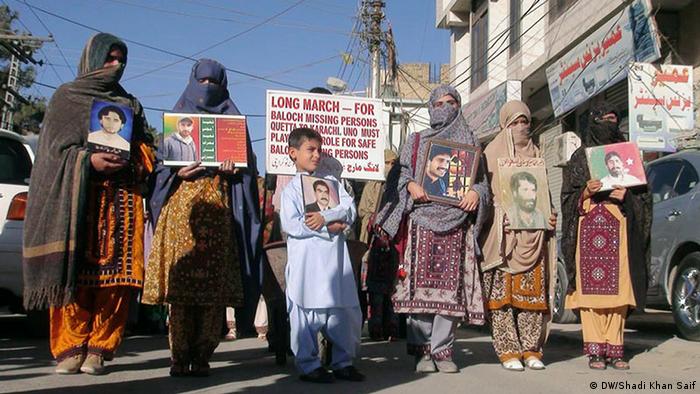
Pakistan Demonstration für vermisste Angehörige in Queeta (DW/Shadi Khan Saif)
Baloch men and women have repeatedly taken to the streets to protest against apparent kidnappings
A 'new trend'
"There has been a propaganda campaign against these bloggers on certain social media websites. Those who spoke in favor of the missing writers were also criticized. I have informed the Supreme Court about this organized campaign," Jibran Nasir, a social activist, told DW.
Some experts say that even if the missing activists were recovered now, their lives would be in huge danger following the blasphemy accusations.
Asad Butt, the vice chairman of the independent Human Rights Commission of Pakistan (HRCP), says the blasphemy complaint has been filed by those who support the Islamization of the country. "It is their way of threatening the people. That is why we have been demanding that the government amends the blasphemy law," Butt told DW.
The "missing persons" phenomenon is not new in Pakistan. Thousands of people have disappeared over the past few years, but most of them are connected with an ongoing separatist movement in the western Baluchistan province or the Islamist insurgency in the northwestern tribal areas bordering Afghanistan. In both places, the army claims it is operating against "miscreants" and "terrorists" that are working against the state. Rights groups also accuse the paramilitary forces of illegally picking up political activists from the southern city of Karachi.
Local rights groups have the details of at least 8,000 people they say have disappeared over the past 12 years without a trace.
But the disappearance of secular writers and activists is a relatively new "trend" in the majority Muslim South Asian nation. Rights groups have been alarmed by it, saying it is a big threat to free speech in the country.
"Forced disappearances are not a new phenomenon in Pakistan. In the past, it was mostly restricted to the kidnappings of people from Baluchistan and the southern Sindh province, but now we see a nationwide situation," Farzana Bari, a prominent social activist in Islamabad, told DW.
Liberalism versus orthodoxy
Rights groups find the "trend" alarming for freedom of expression in the country.
"The civil society needs more unity now to protect the freedom of speech in the country. In the age of social media, independent thinkers have a platform to voice their concerns against certain actions of the government, and it is their right," Nahyan Mirza, an Islamabad-based development professional, told DW.
"Pakistani society, unfortunately, is being controlled to a large extent by the rightwing. These groups will never tolerate social, cultural and intellectual change that poses a challenge to their power. But I am hopeful the change will come soon," Mirza added.
The activists' disappearance is not only condemned in Pakistan but across the world, especially among the Pakistani diaspora.
Asim Ali Shah, a leftist member of the London-based Faiz Cultural Foundation, doesn't directly accuse the government for the kidnappings, but rather views the issue as a failure of the state to protect the country's intellectuals.
"The government's National Action Plan to eradicate terrorism has been a total failure. We see the extremist literature that promotes hatred, sectarianism and intolerance is in circulation all across the country. Yet the state only cracks down on progressive bloggers, peaceful writers and political activists," Shah told DW.
But there are also people in Pakistan who say the liberal sections only protest when one of their "comrades" disappears, and that they never raise their voices against the military operations in the tribal areas that, according to them, have killed thousands of innocent people. They argue that many people with no links to the Taliban or any other militant group have disappeared in those areas, yet the civil society is silent about them.
"The missing persons belonging to the Islamist camp have never been an issue for the Pakistani liberals. They were happy when former military dictator Pervez Musharraf acted unlawfully against Islamic clerics and activists," Naufil Shahrukh, an analyst at the Islamabad-based Institute of Policy Studies (IPS), told DW.
"The US drone killings in the northwestern tribal region, and the kidnappings and extrajudicial killings of anti-Musharraf people never bothered the secular groups. The case of Pakistani neuroscientist Aafia Siddiqui, who is imprisoned in the US, is just one example of this hypocrisy," Shahrukh underlined.

Pakistan's violent cyberspace: No place for dissent


By Rabia Mehmood


The online war against the abducted four bloggers and an activist in Pakistan continues.
During the last few days, notifications of people in my phone contact list joining the encrypted mobile chat app, Signal, have kept popping up every few hours. These are journalists, rights activists, minority community members of different faiths, and some are politicians and even a police officer or two. It has also been over a week since the story of the disappearance of first of the four bloggers surfaced on Pakistani social media platforms and then the press and stirred fear among many.
Between January 4 and 7, four bloggers and a Karachi-based activist have gone missing from Islamabad and Punjab. Hence, 2017 started on a claustrophobic note in Pakistan, where unknown hands have gone for the throat of free expression.
The battlefront of this fight for reclaiming shrinking space for the freedom to speak up is on social media. While the recent online aggression of the religious nationalists against the kidnapped bloggers is unprecedented in scale, this is not the first time the hate-filled internet jihadis are unleashed against progressives, seculars and the left.
Online attacks on dissidents Dissent or critique of state policy is not only not tolerated but snubbed in a way that an example is set for others. It has been happening to outspoken voices against religious conservatism, state's appeasement of clergy or the military establishment for years.
Since the increase of internet consumption in the last 10 years, the space allowed to the religious supremacists in the offline world has been handed to them in cyberspace, too. A pattern exists of hate-filled online activity against activists and journalists whose lives either ended or changed after violent attacks. In the missing bloggers' case, the online harassment is the continuation of the oppression of their forced disappearances.
Since the disappearances, Twitter accounts and Facebook pages with satirical commentary on religion and political issues, allegedly affiliated with the missing bloggers, were deactivated. The most controversial of the deactivated pages was taken over by the self-proclaimed "Elite cyber force of Pakistan", which claimed it had removed all "blasphemous" material from it.
A pro-Pakistani military page with over seven million followers called "Pakistan Defence" framed the critical writing of the disappeared bloggers as blasphemy by an "atheist secular group". This is not the first time this page has incited violence against people supposedly harming national security.
Pakistan Cyber Force, a Facebook page with over 400,000 likes, in addition to posting against the bloggers, has accused them of taking funds from the Indian intelligence agency. It is an established propaganda move to blame dissent on Indian funding.
A stream of tweets, Facebook posts and YouTube videos are asking for blasphemy cases to be filed against the missing bloggers. Queries of the key hashtags and terms used by the pro-state and conservative religious users show thousands of tweets calling for physical attacks on the disappeared. Twitter accounts that are leading the hashtag wars have one thing in common: They are critical of different political parties, but love the Pakistani military and religious conservatism. Facebook pages continuously posting against the missing bloggers and their supporters have a different set of hashtags in Urdu which equate being secular with atheism.
On Twitter, there is a surge in tweets in Urdu with terms like Gustakh-e-Rasool, (person who commits blasphemy towards the Prophet), liberal (referred to anyone who is a moderate) and secular. Tweets with hashtags created against the bloggers are also over a thousand in number.
As of now, three Barelvi and Deobandi religious groups with sectarian agendas have tweeted and put up Facebook posts against the missing bloggers, calling for their blasphemy trials and executions.
Smearing dissent
The demonisation of secular voices goes beyond attacks on the bloggers. For example, accounts and pages that are tweeting against bloggers in the name of religion also posted against leading journalist Cyril Almeida when he was put on the Exit Control List for reporting a story critical of the military in 2016 and broadcast journalist Hamid Mir in 2014, when he survived an assassination attempt and accused Pakistan's primary intelligence agency of responsibility.
Attacks have been levied by ultra-conservative voices on traditional media, too. One-anti secular TV talk show host, in particular, waged his war against secular bloggers and online journalists for months. He has drawn comparisons between Pakistani and Bangladeshi bloggers, has labelled a very small group of secular online writers, including the missing activists, and other progressives blasphemous and implied their views are a threat to national interest.
It is assumed by some in the ultra-conservative part of society that there is an atheist, secular social media movement against Islam and Pakistan, just because tough questions are asked.
The abduction of the bloggers has spread an overwhelming sense of fear and paranoia among digital media users from different professions. And the cluelessness of the government's response to the disappearance of the bloggers does not help the deterioration of free speech.

Pakistan's Missing Human Rights Activists


By 
Salman Haider — a Pakistani poet, human rights activist, and academic — wrote an Urdu poem in July last year highlighting the disappearances of activists and his friends in Pakistan’s Balochistan province. Ironically, he also predicted in his poem that he could soon face a similar fate. A translated excerpt from his poem reads:
Now friends of my friends are going missing,
Then it will be my friends, and then, 
It will be my file [of me missing] that my father will take to the courts.
Unfortunately for Haider, his prediction came true when he was recently abducted in the outskirts of the country’s capital Islamabad. Soon after his abduction, which occurred around 10 p.m. on January 7, friends, family, and social media users started the hashtag #recoversalmanhaider on Twitter and Facebook. The hashtag soon gained attention, with the issue selectively taken up by the national media.
Pakistan’s implicit censorship code restrains TV news channels from directly blaming the security forces for such incidents, and thus Haider’s disappearance couldn’t get the coverage it deserved. Print and social media outlets, on the other hand, are still doing their best to keep the issue alive and maintain pressure on the security agencies for Haider’s recovery. Also, large groups of people have organized protests in various cities demanding Haider’s safe return.
Haider was known for raising an active voice against human rights violations and abductions in Pakistan’s Balochistan province. He was also serving on the board of editors for Tanqeed, a bilingual online Pakistani magazine. Tanqeed is one of the few alternate media sources in the country that highlights state and policy failures related to security and citizen’s rights. The magazine has also regularly criticized military operations and the situation in Balochistan and Pakistan’s tribal areas in the north.
Haider wasn’t the only one to have disappeared this month in Pakistan. Four other activists, namely Ahmed Raza Naseer, Samar Abbas, Asim Saeed, and Ahmed Waqas Goraya, were either abducted or went missing in the past week. All were also critical of the state’s policies and advocated for civil rights. Both Saeed and Goraya were known for managing Mochi, a famous anti-military Facebook page. These abductions (and disappearances) have startled a number of social media users and pages critical of the military, with many having deactivated their accounts.
This is not the first time left-leaning activists have either been targeted or abducted. Renowned journalist, author, and liberal activist Raza Rumi was attacked by a militant organization in March 2014 for being critical of the state’s policy of nurturing and protecting militants. Even though his driver died in the attack, Rumi managed to survive, and afterwards immigrated to the United States, fearing for his life. Rumi believes that the state, having already controlled the television news medium, is now going after the digital spaces and trying its best to suppress any dissent.
The attack on Rumi was followed by the death of Sabeen Mahmud, a 40-year-old female Pakistani activist, who was attacked in April 2014. On the day of her death, Mahmud was hosting a discussion on Balochistan’s missing persons and had invited Mama Qadeer, a famous Baloch activist, to take part in the panel. Qadeer, 70, was initially invited by the Lahore University of Management Sciences (LUMS) to speak at an event, titled ‘Un-silencing Balochistan’, on the alleged abduction and killing of the Baloch people. The event was ultimately cancelled by LUMS after stern pressure from the government. Soon after her own event, Mahmud, on her way home in her car, was surrounded by unknown armed assailants on motorbikes, who shot her three times, in the chest and neck.
Incidents involving attacks on liberal activists in Pakistan were rare in the 20th century, but are slowly becoming a norm in the 21st. Where Pakistan was supposed to move ahead, and consolidate its slow transition toward democracy and democratic norms, it’s instead going backwards by suffocating the space for limited voices of reason in the country.
Now, with a targeted campaign against outspoken activists, questions are being raised as to whether the state, along with the security agencies, is targeting the right people in its campaign against militancy. If people advocating for human rights and the recovery of missing persons are going missing themselves, it would seem that something is seriously wrong with the state and its policies.
Farooq Yousaf is a PhD Politics Candidate from Peshawar, Pakistan, currently pursuing studies in Australia. His research focuses on the role of indigenous conflict resolution methods in countering Insurgency in the tribal areas of Pakistan. Prior to his PhD studies, Yousaf completed his Masters in Public Policy, with concentration in Conflict Studies, from the Willy Brandt School of Public Policy, University of Erfurt, Germany.

Pakistan's activists - Conditional Freedom


There is a growing sense of insecurity and alarm among the civil society as the enforced disappearance of activists enters another week.
This climate of uncertainty is starting to affect the public now, which has come out to protest, it is calling civil societies into action, galvanising political parties and drawing attention from all international observers and players.
Soon this uncertainty will harden into resolve and resentment, and the state will have itself to blame.
The powers-that-be seem to be trying too hard to maintain their positive image, or perhaps they are actively try to inculcate a severe and frightening one from time to time. Threats to free speech, and a lack of answers never result in anything positive for state institution, except fear and loathing from people and eventual revolt.
In the last eight years, it has taken the establishment painstaking effort and a series of well thought out decisions to win back the public’s unwavering support.
It is easy to see how it did that.
It targeted the religious militancy head on and without giving any quarter, it refrained from inserting itself in civilian matters, even where the opportunity presented itself, and allowed the media to act freely without censor. The praise from home and abroad was unequivocal, and General Raheel Sharif became one of the most popular men in the country as a result.
But popularity isn’t unconditional, and the abduction of these activists has bought back the spectres of a totalitarian past. Overnight the mood has changed, and a country that was beginning to get used to a hard-won democratic space where free speech and open discussion could guide issues is now pegged back – not by religious fanatics or dictatorships, but by state institutions themselves – whether through their complicity or silence.
While it is true that officially no one knows who abducted these men, the silence of the government has forced the public to connect the dots. Common perception is that these activists criticised the military and raised a voice against the enforced disappearances in Balochistan. Online forums that usually present the military’s viewpoint have suddenly sprung into action against these men.
The fact is that whatever these men were writing, or protesting, it was peaceful and none of them had yet committed a crime. We can disagree with their perspectives but we cannot deny their right to hold them. Anyone who argues that these men deserve to disappear for criticising the army or the state is giving currency to a very cruel idea that people should be kidnapped or killed if they hold “unacceptable” views.
We also cannot deny that the state has failed these men, their families, and anyone who may ever voice dissent in Pakistan. A target has been painted on all of our foreheads, lest we ever offend the powerful.

Monday, January 16, 2017

Music Video - Fergie - M.I.L.F. $

Video - Michelle Obama, Fallon write thank you notes

Merkel on Trump: The EU can take care of itself


Speaking at a press conference with the prime minister of New Zealand, the German chancellor dismissed Trump's criticism of her refugee policy. Germany's top diplomat accused Trump of contradicting his own cabinet.
German Chancellor Angela Merkel dismissed US president-elect Donald Trump's criticism of the European Union and her refugee policy on Monday. The EU, she insisted, can take care of itself.
"We Europeans have our fate in our own hands," she told reporters. In an interview with the German mass-circulation newspaper "Bild" on Sunday, Trump had called Merkel's open-door policy for Syrian refugees a "catastrophic mistake."
He added the strange caveat that he had "great respect" for the chancellor, saying he would go into his presidency with an open mind about this "fantastic leader," only to then suggest that his trust might not last long.
Merkel accused Trump of conflating accepting refugees fleeing a war zone with being soft on terrorism.
"I would clearly separate (terrorism) from the existence of refugees in relation to the Syrian civil war…the majority of Syrians left their country because of the civil war, because of the fight against [Syrian President Bashar al-] Assad or the oppression by Assad."
She said however that she would approach the Trump administration with an open mind: "When he is in office, and at the moment that's not the case, we will work with the new American government and see what kind of agreements we can reach."
Steinmeier calls out Trump hypocrisy
German Foreign Minister Frank-Walter Steinmeier also reacted to Trump's interview on Monday, particularly the president-elect's statement that NATO was "obsolete, because it was designed many, many years ago."
Doing a similar about-face as with his Merkel comments, Trump then added that the treaty organization was "very important to me," but that some countries were not paying their dues, and he saw this as highly problematic.
Steinmeier slammed Trump's statements, saying from the EU capital Brussels that they "have caused some surprise and consternation here, and surely not just here…his statements contradict things his designated Defense Secretary (James) Mattis just said before Congress."
Merkel mum on 'hard Brexit'
During her press conference, Merkel was also asked to comment on reports that British Prime Minister Theresa May is set to announce her plan for a "hard Brexit" on Tuesday. This could mean that the UK will likely pull out of the European single market - much to the dismay of many of May's Conservative Party colleagues.
In characteristic fashion, Merkel refused to speculate on plans that had not been officially announced, telling the press that Germany would wait for Britain to file its application to leave the European Union.
Merkel's statements came after a meeting with New Zealand Prime Minister Bill English, who is in the midst of a European tour that also included Brussels and London. Despite his praise for Theresa May's handling of the Brexit preparations, made on the heels of his own free trade negotiations with Britain, Merkel and English were all smiles at the joint press conference. The chancellor said that Germany would push for a speedy EU trade deal with New Zealand.

Video - #Yemen's forgotten war


Yemen's civil war has plunged the country into a humanitarian crisis. According to UNICEF, a total of 10 million children have been affected. Of those, three million are malnourished. Several different groups are vying for power.

#Yemen death toll has reached 10,000, UN says


Kareem Shaheen


At least 10,000 people have been killed in the war in Yemen, according to the United Nations, which is urging both sides to come together to end nearly two years of conflict.
The UN’s humanitarian affairs office said the figure, which is a low estimate, was reached using data from health facilities that have kept track of the victims of the war, which has largely been ignored by the international community.
The figure does not include those recorded by hospitals and health centres as having died, which is likely to be most of the combatants on both sides of the conflict.
“This once more underscores the need to resolve the situation in Yemen without any further delay,” Farhan Haq, deputy spokesman for the UN general secretary, said in New York. “There’s been a huge humanitarian cost.”
The war has devastated Yemen, which was already the Arab world’s poorest country. UN officials estimate that nearly 19 million people – 80% of the population – are in need of humanitarian aid, and more than 3 million have been displaced.
Saudi Arabia launched the war in Yemen in March 2015 after the Houthis, rebels backed by Iran, took control of the Yemeni capital, Sana’a, and overthrew President Abd-Rabbu Mansour Hadi in a coup. The Saudi-backed president fled to the southern city of Aden and then to Riyadh. The Saudi campaign is backed by the US and the UK.
But the Saudis have not achieved their objectives and the war has dragged on, leading to a humanitarian catastrophe. Large numbers of child soldiers have been recruited, there have been outbreaks of cholera and many attacks on schools, hospitals and civilian areas.
The Saudi-led coalition has been blamed for most of the civilian casualties. The devastation has also drawn attention to the role of western powers who have continued to provide Riyadh with weapons, logistical support and intelligence. The Houthis have also been accused of human rights violations.
Yet the destruction of Yemen has garnered little international attention compared with other regional conflicts such as that in Syria, or the battle against Isis in Iraq.
The war has dragged on despite efforts by a UN mediator to broker a peace deal. While the Saudis are apparently eager to reach a settlement that would end an expensive war that has damaged its image worldwide, Hadi and his Houthi rivals have yet to agree to a deal.
Hadi is demanding that the Houthis give up their arms and control of Sana’a, while the Houthis wish to see a national unity government formed in which they are included.

Music Video - a-ha - Take On Me

Video - President Obama - Participating in a Service Project for Martin Luther King Jr. Day

Video - President Obama - The 2016 World Series Champion Chicago Cubs

Ban Ki-moon fails to understand THAAD’s damaging effect


By Ai Jun 


Ban Ki-moon, who has recently stepped down as UN secretary-general, is throwing his weight behind the deployment of the Terminal High Altitude Area Defense (THAAD) anti-missile system on South Korean soil. Given that the peninsula is "in a quasi-state of war," the THAAD installation is "appropriate," Ban said Sunday. As for the issue of relations with neighboring countries, Ban showed his confidence as former UN chief while noting that problems can be solved "through diplomacy."

However, because of his previous role as UN secretary-general, he is expected to have more understanding over why Beijing and Moscow cannot tolerate any move to break the balance of the region. 

From the perspective of the Korean Peninsula situation itself, Ban seems to have failed to learn from the lessons of the past decades - whoever carries out provocative actions will only find countermeasures from the other side. In the end, crises have never been resolved while the two sides keep escalating their contradictions by safeguarding their own security interests and jeopardizing other's safety at the same time. The THAAD deployment is not an effective and correct answer to threats made from Pyongyang, but simply another provocative move in the name of defense.

Ban should also be well aware that the UN can only play its function when major powers are in balance. Nevertheless, once THAAD is set up, the current strategic balance among China, the US and Russia will be wrecked and the three sides will sharply confront one another. In that case, the Korean Peninsula will only turn into a zone filled with direct clashes of interests. 

South Koreans probably think that once Seoul actually sets the system up, China will find that nothing more can be done. Such thinking is too naïve. The THAAD installation in South Korea will pose a hazardous challenge to China's security and core interests. Beijing's stance on the issue can't be bargained over.  

Is the Sino-South Korean relationship less important than the US THAAD system? Even if the Blue House's decision was made for defense, has Seoul ever pondered the consequence of turning Beijing hostile?

Soon after Ban retired from the UN, he asserted that he would give his all for his country. However, he needs to think again about how to genuinely live up to that. As he mentioned, the peninsula is "in a quasi-state of war," so the last thing he should do now is stir up more tensions in the peninsula. 

One of Ban's achievements as UN secretary-general was the Iran nuclear deal, which was reached after a 12-year standoff between Tehran and other nations. Due to the complexity on the Korean Peninsula, Ban should show even more patience and wisdom than how he dealt with Iran, instead of intensifying contradictions the minute he goes back to his country.

Starting a New Phase in Sino-US Relations


By Max Baucus
I often say this, and I mean it from the heart: serving as the United States Ambassador toChina is the best job I've ever had. It has been the greatest pleasure to work with Chinese and Americans to advance the world's most important bilateral relationship.
But, as they say, all good things must come to an end. The United States just had an election and, with our country's transition to a new administration, the time has come to bid you farewell as the United States Ambassador. When you say "goodbye" in Chinese it means "see you again," and that's how I like to think of this farewell - I'll be seeing you again!
Before my wife Mel and I depart from Beijing for a new chapter in our lives, I would like to share some parting thoughts with you as we start a new phase in our countries' relationship, at a time fraught with global challenges - from economic uncertainty to climate change to terrorism. Over my 35 years in the United States Senate and especially my time as the United StatesAmbassador, I've witnessed first-hand China's remarkable transformation and re-emergence on the global stage. Since Deng Xiaoping launched China's opening up and reform three decades ago, China has lifted hundreds of millions out of poverty, becoming the world's second-largest economy. Our economies, in turn, have grown increasingly interconnected, with more than $650 billion in annual bilateral trade.
I've seen China's rise play out in impressive ways. China joined the United States to help lead the world toward an ambitious agreement on climate change in Paris. It played a positive role in the global response to Ebola, working closely with the United States and other partners. China served as the host of the Six Party Talks on the denuclearization of the Korean Peninsula and can play an equally important role in seeing those talks resumed.
These examples make clear the benefits to China and the world that come from China's engagement and responsible leadership. US policy, decades old and upheld by successive administrations from both parties, has been to welcome the rise of a stable, peaceful and prosperous China. We welcome China as a global leader that assumes its responsibilities within the transparent, rules-based system underpinning the peace and prosperity that theAsia-Pacific region has enjoyed for many decades. I worked hard as a U.S. Senator to get China into the World Trade Organization because Iknew it would be good for China, good for the United States, and good for the entire world. And it was! Looking ahead, we hope China will work closely with the new US administration to continue this process of opening up to the world.
We live in a time of interconnectedness, unlike any other in history. Our countries' relationship, in fact, is a testament to and a direct benefactor of these trends.
And a key part of keeping this going in the right direction will be fostering an encouraging environment for American and foreign companies to invest and do business here - just asChinese companies can expect to do in the United States. Strengthening innovation, one of China's top priorities, is another critical factor. That's why we encourage China to continue to open up, which will help enable talent - like that ofJack Ma, Tu Youyou, or Wang Jianlin - to flourish across the globe. Similarly, we hope thatChina will welcome the constructive role of non-government organizations that help societies drive innovation, contribute to social stability and bring us together to protect the environment.
Another key element will be ensuring that China's peaceful rise is bolstered by regional engagement and creative diplomacy that manages disputes in ways that benefit all, in line with President Xi and President Obama's efforts during their numerous meetings that I've had the privilege to join.
At the end of the day, I can't stress enough the importance for us all to ask honest, constructive, good-faith questions, and to really listen to each other's point of view. As my mentor and former United States Senator from Montana Mike Mansfield once said, "Remember, the other person isn't always wrong, and you're not always right." This is the path to honest dialogue. While this is a time of transition, and some question the path ahead, I think both of our countries agree on the importance of making this relationship work. That has been true since President Nixon first came to China and met with Chairman Mao in what is called "the week that changed the world." Their work was carried on by President Carter andDeng Xiaoping, who normalized relations between our two countries in 1979. Our leaders have changed, and we've had our ups and downs, but we've never given up our shared goal to create a better future for our kids and grandchildren.
I've seen this commitment first-hand, time and time again. When I first came to China, I promised President Xi that I would visit all of China's provinces - a goal I achieved lastOctober. What I learned along the way is that it doesn't matter if you're American orChinese, we all basically want the same things in life - a good job, a good education for our children, and a clean, safe environment to live in. That's a big part of the American dream. And it's part of what I've come to learn is the Chinese dream.
With patience, persistence and the positive attitude I've seen in students, everyday people, businesspeople, or government officials throughout this country - from Qufu to Kunming, from Shanghai to Urumqi - I know there is nothing we can't accomplish when we work together. And when we succeed - whether that's working on those many issues on which agree, or being frank and wisely in managing our differences - the world stands to benefit.
(The author is US ambassador in China. The Chinese edition of this article was published on the People's Daily Thursday.)

Russia - Foreign Ministry: Washington initiating new arms race in Europe

Washington is practically initiating a new arms race in Europe, plans to deploy large-scale armed forces have destructive potentials, Russian Foreign Ministry spokeswoman Maria Zakharova said on Monday.

"Plans of large-scale deployment of armed forces in Europe implemented by the US have strongest destructive potentials for the whole architecture of European security, create a new military-political reality, introduce sizable imbalance in the balance of power on the continent and are fraught with long-term destructive consequences on the Euro-Atlantic space," a commentary said.

"Washington, in fact, is initiating a new arms race, trying to impose on us a confrontational model of relations, similar to that of the Cold War times," the commentary added.
"Over the recent time, western media and bloggers have been actively spreading the thesis that the deployment of American troops in Europe allegedly plays no special military role and comes down to redeployment of several hundred US military on a rotation basis with a small number of arms and hardware with the framework of allied solidarity," the diplomat said. "However, looking at certain planned and implemented by Americans military preparations in Europe, the figures suggest a different thing," the commentary said.
In particular, in January 2017, the US has deployed to Poland an armored brigade of about 4,000 military and 2,500 units of military hardware. A total of 300 US marines will be deployed on the Norwegian base in Vernes from January.

In February, the Pentagon plans to deploy at Norwegian arms depot outposts sizable amounts of military hardware, Zakharova noted. A US air brigade of about 1,800 military with combat and transport helicopters is to be deployed in Germany at the end of March.
The ministry spokeswoman has noted that Americans are actively investing in the development of military infrastructure and potentials of rapid deployment of major military units close to the Russian borders, including updating of the network of airfields where US large transport airplanes could land.

"An arms depot outpost of the US Army was re-commissioned in the Netherlands in December 2016, to house a brigade set of heavy armor," the commentary said.


"A similar in its size facility will be shortly created in Belgium and two more in Germany. The hardware deployed there is designed for a prompt redeployment of US military personnel from the sites of their permanent stationing ‘in case of a need," she added.
The Pentagon slyly calls all its military deployments on the territories of European states rotating, in other words non-permanent, she said. "At the same time, these so-called continuous rotations are planned so that the units on duty will not be leaving sites of temporary stationing until they are rotated," she said.

"We are talking about a long-term stationing of American military equipment and personnel in Europe that can hardly be called solely defensive," she noted.

All this comes "against the background of unilateral and unrestricted development of potentials of US missile defense systems in Europe having an increasingly destabilizing influence on European and global security, as well as upgrading of US nuclear weapons deployed on the territory of other NATO countries," she added.


More:
http://tass.com/politics/925328

Moscow Cautiously Reacts to Trump's Idea on Lifting Anti-Russian Sanctions


Moscow Cautiously Reacts to Trump's Idea on Lifting Sanctions in Exchange for Nuke Reduction

Russian officials commented on the proposal of US President-elect Donald Trump to lift sanctions against Russia in exchange for a bilateral agreement on the reduction of the nuclear arsenal, saying that Moscow is currently not considering the possibility of reducing its nuclear arsenal in exchange for a sanctions deal. In interview with newspapers Das Bild and The Times, Trump suggested that the sanctions against Russia could be lifted if both countries sign a nuclear disarmament agreement. However, the proposal caused a cautious reaction in Moscow.

Kremlin spokesman Dmitry Peskov said that the issue could be discussed only after Trump's inauguration, while representatives of the Russian Federation Council stressed that Moscow doesn't consider the withdrawal of sanctions as something it needs to make sacrifices for, especially in the field of security.

Chairman of the Council of the Federation Committee on Foreign Affairs Konstantin Kosachev, in his turn, urged not to take Trump's idea as "an official offer." He stressed that the proposal was just a consideration made during an interview. He also suggested that the new US president should carefully examine the reasons why the negotiations on disarmament have so far been unsuccessful. "If we take away the demagogic explanations (like Russia's 'aggression' and 'revanchism'), it will become clear that one of the main obstacles is the implementation of the US global missile defense plans, as well as constant US attempts to secure unilateral superiority in other areas like the development of NATO infrastructure, conventional weapons, weapons of high precision, drones and the militarization of outer space," Kosachev said.
Members of the Moscow State Duma, in turn, urged not to link the sanctions with nuclear proliferation. Head of the Committee on Defense Yevgeny Serebrennikov said that the withdrawal of sanctions is a "reciprocal process" and cannot be a subject to a bargain.

Meanwhile, Viktor Ozerov, the head of the Russian parliamentary security committee, said that Russia is ready to consider the US proposals on joint nuclear disarmament, but other nuclear powers should also join the process. "For sure, Russia will consider this proposal. I think any offer from the US President-elect is worth studying. Russia has repeatedly stated that it was ready for a dialogue… Apart from Russia and the United States there are other countries, which have official status of a nuclear powers, so the process should also involve these countries," Ozerov told RIA Novosti. However, as member of the Russian parliament's upper house Alexei Pushkov believes, the incoming US administration should not use the issue of lifting anti-Russian sanctions as means of leverage on Moscow. Meanwhile, Senator Oleg Morozov said that nuclear arms reduction talks could be held alongside discussions of sanctions. Morozov told RIA Novosti that "it has long been made clear to everyone that sanctions cannot force Russia to comply with any conditions."

Read more: https://sputniknews.com/politics/201701161049655954-moscow-cautiously-reacts-trump/

‘We’ll supply bricks,’ Russia tells Lithuania on plans to build ‘anti-aggressor’ fence at border


Russia says it’s ready to supply Lithuania with bricks after Vilnius announced the construction of a fence on its Russian border. Lithuanian officials say the barrier will protect the Baltic nation and the EU from the ‘Russian threat’. News about the proposed fence on the border with Kaliningrad, a Russian exclave located between Poland and Lithuania, emerged in Lithuanian media on Saturday.
“The fence is like a sign that [Lithuania] views the neighboring country as a potential aggressor,” Interior Minister Eimutis Misiunas said, as cited by Lietuvos zinios newspaper.

According to the minister, the fence will cost some €3.6 million and will be equipped with “a surveillance system.” It won’t be a ‘Chinese Wall’, but only a fence which will protect Lithuania from illegal smugglers, Misiunas said. The barrier will be some 135km from Vistytis neighborhoods, on the intersection of three countries – Poland, Lithuania and Russia – to the Nemunas River.
“Lithuania needs to strengthen border security, since it is an EU state. Lithuanian state border security is important not only for our country, but for the whole of the EU,” National Security and Defense Committee (NSGK) member Arvydas Anusauskas said.
Another NSGK member, Rasa Juknevičienė, said the fence is designed to counter the Russian “threat.”
“This fence will not stop tanks or other military equipment, but it will show that we are hoping for better relations with Russia, a realistic assessment of the situation. We do our best to reduce a potential threat posed by Russia,” she said.
Russian officials, however, have quite an ironic attitude to the wall project. The interim Governor of Kaliningrad Region, Anton Alikhanov, told Rossiya 24 TV channel that Kaliningrad is ready to buy all necessary construction materials for the fence.
He reminded that Russia has a “wonderful plant” for production of bricks on the border with Lithuania.
“If our Lithuanian colleagues want to erect a fence to stop illegal smugglers, then we are ready to provide them with construction material,” he said.
At present the Russia-Lithuania border is only marked with special signs and a 13-meter-long warning line. Lithuania has a 100-meter-long fence on the 600-meter border with Belarus.
The news about the fence on the border with Russia comes amid the arrival of US tanks and military equipment in Eastern Europe for NATO military drills dubbed Operation Atlantic Resolve. NATO says the buildup along Russia’s borders is a defensive measure due to Moscow’s alleged involvement in the Ukrainian crisis.
Russia has repeatedly called the bloc’s moves aggressive, while stressing that they are undermining security in Europe. In response, Moscow has been conducting large-scale military drills on its home soil and stationed its most modern weaponry and armaments on its western borders, including the exclave region of Kaliningrad, which lies between Poland and Lithuania.

Video - Oxfam: 'eight men own as much wealth as poorest half of world's population'

Video - Retweet the Revolution: What if Twitter existed 100 years ago? (Nicholas II Promo)

Happy Birthday (Tribute Martin Luther King Jr. Holiday) -- St

Video Report - Congresswoman Marcia Fudge Won’t Attend Donald Trump's Inauguration

Video - 16 House Democrats to skip inauguration

Video - Full interview: White House Chief of Staff Denis McDonough

Video - Obama to Dems: "Don't rescue" GOP on Obama...

Op-Ed - President Obama, the millennial whisperer


By Morley Winograd and Michael Hais

President Obama will be seen by historians as the first president to bring millennial values to the challenges of the Oval Office. He isn’t a millennial (in fact he has two millennial children), but his leadership style and beliefs reflect America’s largest and most diverse cohort. And while much of the rest of America is divided on how well he has performed as the nation’s 44th president, Obama has won overwhelming approval from the millennial generation, born 1982-2003.
More than three-fourths of millennials (77%) approved of Obama’s job performance in a mid-December Pew Center survey, surpassing even the previous high mark the group gave him — 73% — just after his first inauguration in 2009. For much of his administration, millennials were only marginally more positive about the president than the rest of the population, but once his departure from office drew closer and the contrast between him and either of his potential successors — Donald Trump and Hillary Clinton — became clearer, millennial approval of the president’s job performance shot up by about 15 percentage points, accounting for just about all of the increase he has enjoyed in his final year in office.
Some of the enthusiasm stems from millennials’ perception that Obama tackled the issues they care about most. Almost half of millennials (46%) credit the president with making significant progress “toward solving the major problems facing the country,” a far greater percentage than for any other generation. Only 10% of millennials, compared with 30% of older generations, think he made things worse.
Millennials will represent more than one out of three Americans by the end of this decade.
Millions of millennials have health insurance because Obamacare allowed them to remain on their parents’ plan. Theirs is the only generation in which a majority tell pollsters they support the Affordable Care Act. Millennials in particular have also benefited from Obama’s initiatives to reduce the interest rates on student loans and allow millions to convert loan repayments to a percentage of income rather than a more onerous flat amount. In addition, the president’s improved job-performance marks, especially their latest rise, reflect improvements in the economy that millennials now see in their incomes.
But more than any specific benefit, millennials appreciate the way Obama has championed their causes and created a more tolerant America. One in five millennials has an immigrant parent, and most in the generation credit the president with trying to find a comprehensive solution to the immigration issue, especially for the youngest “Dreamers” who found new hope under the president’s Deferred Action for Childhood Arrivals executive order. By carefully building a foundation of support of gay rights, Obama’s leadership also helped enshrine same-sex marriage among our constitutional protections. According to Pew surveys, close to three-quarters of millennials view immigrants and immigration positively (76%) and support gay marriage (73%); less than a majority of older age groups agree.
Finally, Obama’s daily demonstration, as our nation’s first African American president, that race should not be a barrier to achievement has reinforced millennials’ desire to include everyone in the group and to celebrate their own diversity. In fact, some of the president’s finest millennial “whisperer” moments happened when he addressed the question of race in America, including his eloquent speech on the topic as candidate Obama during the 2008 Democratic primary. In an interview with NPR, he couched his answer to a question about political correctness with a defense of tolerance that fits millennial attitudes: “Don't go around just looking for insults," he said, quoting advice he has given his daughters. "You're tough. If somebody says something you don't agree with, just engage them on their ideas.”
It’s not surprising that the same set of Americans that overwhelmingly approve of Obama would disapprove of the man who will replace him as president on Jan. 20. Already 64% of 18- to 29-year-olds disapprove of Trump’s performance as president-elect, the highest disapproval rating of any age group in Pew’s January survey.
Millennials will represent more than one out of three Americans by the end of this decade. Despite Trump’s electoral college win in November, it seems likely that millennial attitudes will dominate American political discourse and policy decisions in the coming years. It’s not clear now how much this generation’s demographic and political importance shaped Obama’s presidency and how much the cause and effect ran in the other direction. But it is clear that the optimism the president expressed in his farewell address is based in large part in his faith in his children’s peers:
“This generation coming up — unselfish, altruistic, creative, patriotic — I’ve seen you in every corner of the country. You believe in a fair, just, inclusive America; you know that constant change has been America’s hallmark, something not to fear but to embrace, and you are willing to carry this hard work of democracy forward. You’ll soon outnumber any of us, and I believe as a result that the future is in good hands.” And with that the country’s first millennial president left the stage.
Morley Winograd and Michael Hais are co-authors of “Millennial Makeover, Millennial Momentum and Millennial Majority.” They wrote this essay in association with Community Advocates, Inc. in Los Angeles.

Video - Remembering the life and sacrifice of Martin Luther King Jr.