Wednesday, January 11, 2017

Pakistan - The Saudi temptation


By ZAHID HUSSAIN
THERE has, as yet, not been any denial of Defence Minister Khawaja Asif’s mumbled comments during a TV interview last week about retired Gen Raheel Sharif being appointed the chief of a Saudi-led military alliance. Considering that clear articulation has never been his strong point, one may take the minister’s mutterings as confirmation.
But the minister has left many questions unanswered, adding to the confusion over the government’s position on the issue and whether the appointment of the former chief of army staff indicates a shift in our policy of staying away from the power tussle in the Middle East. It is apparent that the former general’s selection to head a multinational force would hardly be possible without the approval of the prime minister.
It seems that the government is maintaining deliberate ambiguity on this matter as happened when it was first reported that Pakistan had joined the so-called Islamic military coalition. Then there are valid questions too about Raheel Sharif’s own decision to accept the controversial job that may adversely impact the fine legacy that he left as the best-remembered army chief.
He is certainly not a freewheeling retired general who would accept such a politically sensitive position at his own discretion without the consent of the government. There is no precedence in Pakistan of a retired army chief seeking a job and that too outside the country.
Surely the Saudi offer was on the table long before Gen Sharif’s retirement. Is there any strategic reason behind the government’s decision to loan a recently retired army chief, or is it Saudi pressure that we could not afford to resist? Whatever the justification, such a decision can have serious foreign and domestic fallout.
There is no clarity on how the forces of different Muslim countries, with divergent interests, can work together. It has been more than a year since the young Saudi deputy crown prince, who has been responsible for the kingdom’s disastrous military adventure in Yemen, announced the formation of a military alliance of 34 Muslim-majority nations. This unilateral Saudi declaration took not only Pakistan, but also several other nations on the list, by surprise. Although the coalition was formed to jointly fight terrorism, its very composition branded it as a ‘Sunni coalition’.
There has been widespread scepticism of whether it is really meant to be a coalition against terrorism or just a Saudi pawn in the power tussle in the Middle East. The lukewarm response from many member countries makes it extremely doubtful that such a military alliance can really take off. The exclusion of some Muslim countries including Iran and Iraq makes it all the more divisive.
There are few countries that are willing to commit troops to the alliance. So what is there for the former army chief to lead? Moreover, to fight terrorism, there is a need for closer cooperation among the intelligence and security agencies of these Muslim countries rather than a joint military force.
Interestingly, the idea of a military alliance was floated after Pakistan and some other countries refused to send their troops to fight along the Saudi forces in Yemen. A joint session of parliament had rejected the Saudi request, provoking indignation in the kingdom. It was certainly not in the country’s interest to be a party in the sectarian divide and the regional power struggle between Saudi Arabia and Iran. The Saudi military adventure has only exacerbated the civil war in Yemen and blocked any move to reach a political solution to the conflict.
Over the past one year, there have been some significant changes in the Middle East’s power dynamics with the heavy losses inflicted on the militant Islamic State group in Iraq and Syria. Interestingly, many countries that are listed in the Saudi-led coalition are part of the US-sponsored anti-IS alliance including Iran. In fact, Iran has played a key role in pushing out the global terrorist group from its stronghold in Iraq.
Meanwhile, Russia is also asserting its military and diplomatic power in the Middle East forming a separate trilateral alliance that includes Iran and Turkey to counter IS in Syria. The new nexus has the tacit support of Washington and other Western countries in enforcing a ceasefire among various warring sides in Syria. Saudi Arabia, which has been supporting Sunni militant groups, now seems to be out of the equation in the Syrian crisis.
Interestingly, Egypt, that has been receiving massive Saudi financial aid, has also been supporting Bashar al-Assad’s government against the Saudi-backed opposition. So with all these divergent interests and shifting alliances, the idea of a new Saudi-led coalition does not seem to make much sense. Most observers agree that the formation of a new alliance reflects Saudi Arabia’s growing concern about its own security and internal stability as it no longer sees the US as a reliable ally.
Washington’s nuclear deal with Iran and its reluctance to commit ground troops to overthrow the Assad government in Syria has exacerbated the kingdom’s anxiety. Although the US had welcomed the proposed alliance there are serious doubts about Saudi Arabia’s seriousness in fighting violent extremism.
This widespread scepticism is largely due to the allegation that some Saudi charities continue to provide financial support to radical Sunni sectarian groups in Pakistan and other Muslim-majority countries in order to impose their own intolerant and retrogressive concept of Sharia laws. In the past year, there have not been any discussions and consultations among the member countries on what the alliance might do. There is also no clarity on how the forces of different Muslim countries, with divergent interests, can work together. In such a situation, Pakistan’s participation in the controversial alliance, with its former army chief heading the joint military force, has serious political repercussions.
The government must take into confidence parliament and the nation on the issue. It must not allow the former chief to rent himself out to a controversial alliance with a divisive agenda. It is in our national security interest that we keep out of the power struggle in the Middle East.

Pakistan - Don’t kidnap me. I'm not a liberal


Salman Haider


I was corrupted by liberal values such as free speech and basic human dignity but I have realised that my desire to not be abducted is much stronger than my desire to speak my mind. I have finally seen the light and I now realise that there is no state in Pakistan but the ‘one true state’. I have even sold all my real estate as to not anger the state.
I would like to issue a full public apology for espousing liberal values. I fully realise that these apologies only work when they are issued by political leaders but it is still worth a shot. Maybe I should grow out my beard first before issuing this apology to give my words more meaning but then again Imran Khan is still alive so maybe it is not the beard that matters.
It was a mistake to walk out of Plato’s cave – the sun is a lie and I wish to run to the dark underworld. I fully believe the shadows I see are the complete reality and there is no reality beyond the one you show us.
Forget about civil liberties, I do not even want to protect Lahore’s Liberty Roundabout anymore. Please go ahead and build your Orange Line over any heritage site you want. Build a metro bus that runs through Badshahi Mosque. Who needs culture, history and breathable air when you can sit in a metal container to go serve the capitalist system each day?
I suddenly see the value in the government’s economic plan. I do not want to talk about all the farmers you are exploiting and all the land you are grabbing to make Pakistan a better product for your international friends. The only people affected by those are Pakistanis and we are the most dispensable people on earth. Success comes at a cost and as long as I am not paying the price I will start looking the other way.
Millions sacrificed themselves for the creation of this great nation – what are a few more thousand sacrifices to make this nation even greater? You can even say our new state policy is to make Pakistan great again, and I am now fully on board with this plan. I have even bought a big load of duct tape to shut my mouth every time I have an opinion.
Opinions are overrated anyway. They are not worth being kidnapped over. I do not know when my other stupid liberal friends will realise that. It is ironic that these people speak out for the basic human rights of oppressed communities and now they are the ones being denied those fundamental human rights. There is the flaw in the liberal plan – if they go missing, nobody will speak out for them because they were the ones fighting this lost cause.
I, for one, am a winner and I know a losing cause when I see one so I am jumping ship. I am not going down with this liberal Titanic. I will no longer read Habib Jalib against the text and truly believe that “Cheen apna yaar hai, us pe jaan nisaar hai”. I will even start loving all our leaders and write my own poetry – “Noon league apna yaar hai, us may Chaudhry Nisar hai”.
If you still do not believe in my loyalties I can even make cartoons on MS Paint to show you how much I love this nation. I will go on all Indian Facebook pages and abuse them for being Indian. I will not even appreciate how good a batsman Virat Kohli is anymore. Shahid Afridi has better technique than Virat Kohli.
Equality is a lie; the world is unequal. Liberalism is a lie; human rights have all left. All you have is yourself. Welcome to this Hobbesian nightmare. In this dog-eat-dog-world, even the actual dogs are not safe. The holocaust of the dogs in Karachi’s DHA is just a rehearsal and now we are in the real Ender’s Game. You can either have an opinion or a life – at least you have the freedom to decide.
If I am to be kidnapped, remember me with these completely original uninspired words:
First they came for the dogs, and I did not speak out because I was not a dog (my ex -girlfriend disagrees)
Then they came for the minorities, and I did not speak out because I was privileged,
Then they came for the liberals, and I spoke out against liberals because I was a traitor,
Then they came for the human beings, and I got rid of my spine and became a prawn
Don’t kidnap me, I am a prawn

Pakistan - Children of a lesser state

Mohsin Raza Malik


The case of Tayyaba, a minor house-maid who was allegedly tortured by the family members of a judicial officer in Islamabad, is getting complicated and rather mysterious with the passage of time. She instantly disappeared as soon as the Chief Justice of Pakistan took suo motu notice of this case last week. Afterward, a number of individuals came forward and claimed that they were the parents of this hapless girl. Now the Islamabad police has recovered her from a suburban part of the city. At present, there is considerable confusion as to her actual name and parentage. A DNA test would probably help determine the parentage of this minor girl. However, she hardly needs any name or identity. Indeed, there is nothing in a name. By whatever name we call her, it will by no means lessen the miseries of this nameless girl. A girl who is being claimed by many, but owned by none. Moreover, we can conveniently recognise her by her numerous generic names- “Nikki”, “Chhoti”, “Guddi” etc.
The Tayyaba case has badly exposed the darkest side of both our state and society. We can just imagine the plight of this minor enslaved girl who was abandoned by her real parents, mistreated and tortured by her masters, shunned by the society, and finally disowned by the state. Her story simply shows how apathy and heartlessness have penetrated our body politic. How dexterously we have revived the institution of slavery in our society, how callously a large segment of our society has been reduced to a subhuman status. We proudly call ourselves Muslims, but have long divorced the fundamental human values essentially emphasised by the Islam. We have readily given rise to a highly-stratified, hierarchical and rather compartmentalised society. A society divided into Brahmans and pariahs.
Pakistan, as a state, has observably failed in significantly minimising the sufferings and woes of these ‘children of a lesser God’. The government looks quite disinterested in saving Tayyaba and millions of other children living under similar, or perhaps even worse circumstances.
According to the well-known Social Contract theory, a state is bound to protect its subjects, including the children, against all potential dangers. Ensuring the protection and welfare of minors are the primary obligations of a state. Therefore, every state should actively endeavour to introduce an extensive child protection regime by enacting some effective laws and establishing certain efficient agencies to enforce these laws. This is also done by the developed countries in the world where poverty and illiteracy are not really the grave issues as such. Indeed, the state cannot leave children at the mercy of society, or even their parents in some cases.
One of the most agonising aspects of the Tayyaba episode is the fact that the very moral values of the most educated and so-called civilised segment of our society have collapsed. A minor girl was illegally employed and later tortured by the family of a judicial officer in the capital city. Indeed, the judicial officers are supposed to enforce and supervise the child protection laws in the country. At the same time, her story has also shown how the complementary and supplementary components of our criminal justice system have become instrumental in exploiting the weaker and vulnerable segments of the society. They readily come forward to rescue the wrongdoers instead of the victim in distress. The police and lawyers usually join hands to save the accused, and criminal courts encourage the instant execution of Razi Nama (instrument of compromise) between the perpetrators and victims. In reality, the legal distinction between the compoundable and non-compoundable crimes in the country has disappeared. Now almost every crime is compoundable, thanks to the ‘conciliatory instincts’ of our criminal courts.
Presently a large number of minors like Tayyaba are serving as house-maids across the country. As a matter of fact, they have become an essential part of almost every household in posh urban localities. They perform multiple tasks ranging from cleaning and washing to child-rearing. Compared to adult and qualified nannies, they are much cheaper and easily available in each part of the country. These ‘young nannies’ are absolutely denied all the safeguards and benefits under the labour laws, including the minimum wages and works hours. Their status and role are no better than a slave. They can just be ‘purchased’ by advancing a little money to their parents. A large number of feminist NGO’s are operating in Pakistan. Their interests and operations unusually revolves around the issues like gender-equality, domestic violence, honour-killing etc. They never seriously took up the issue of these hapless girls.
Pakistan has been ranked third in the world for having the largest children’s workforce by the International Labour Organization (ILO). According to another report published by it in 2012, around 12.5 million children are involved in child labour. Poverty and illiteracy lie at the very root of the issue of child labour in Pakistan. Mostly, socio-economic imperatives compel children to work. Their parents can’t properly raise or educate them. So they force their children into child labour. Thus their children are a substantial means for their income instead of a liability. The more children, the more income. This tendency among the people is also an important reason behind the current population boom in the country.
The constitution of Pakistan strictly prohibits the child labour, bounded labour, slavery and similar other undesirable practices. Similarly, there are also a number of laws which address the issue of child labour in Pakistan, e.g. The Factories Act 1934, The West Pakistan Shops and Establishments Ordinance 1969, The Employment of the Children Act 1991 and The Bounded Labour Abolition Act 1992. Regrettably, the government has enacted many laws against the child labour practice but it has yet not established the appropriate agencies to monitor and enforce these laws in the country. Consequently, the situation regarding the child labour in Pakistan is deteriorating day by day.
In Punjab, the Child Protection and Welfare Bureau has been established under The Punjab Destitute and Neglected Children Act 2004. This is the right step towards ensuring the protection and welfare of children in the province. However, owing to some human and financial resources constraints, it has yet not succeeding in significantly overcoming the children specific problems in the largest province of Pakistan. This bureau is operating just like an NGO. It has no significant presence in smaller cities and rural areas, which house the larger segment of the population. Therefore, this bureau needs to be made more efficient, active and vigilant after enhancing its capacity to perform this sensitive task.
As the apex court has formally taken up the Tayyaba case, therefore now it should properly conclude this case by punishing those who are involved in persecuting and exploiting this minor girl. At the same time, the apex court should also ask the government to ensure the compliance of child protection and labour laws in the country by mobilising the relevant agencies. Similarly, the government should also proactively endeavour to introduce an effective and efficient child protection regime in Pakistan. Indeed, the state should not shy away from its basic obligation to protect neglected and persecuted children.

Pakistan - Sindh Governor Saeed uz Zaman Siddiqui passes away


Sindh Governor Justice (retd) Saeed uz Zaman Siddiqui passed away on Wednesday.
He was being treated for a heart condition at a private hospital in Karachi.
He was appointed as the 31st governor of Sindh in November 2016.
Earlier, he was admitted to the hospital for breathing difficulties and a chest infection three days after being sworn in as the governor on November 11.
According to reports, the governor was discharged because of family pressure and was accompanied by a 24-hour monitoring team including chest specialist, neurologist and physiotherapist.

http://www.pakistantoday.com.pk/2017/01/11/justice-retd-saeed-uz-zaman-siddiqui-passes-away/

CHAIRMAN BILAWAL ASKS PPP WORKERS TO FORGE UNITY


Chairman Pakistan Peoples Party Bilawal Bhutto Zardari held meetings with different delegations of party workers from Sargodha Division. He also interviewed aspirants from Sargodha, Khushab, Mianwali and Bakhar districts for different party positions of Sargodha Division.

Chairman Bilawal Bhutto Zardari addressing workers on the occasion said PPP philosophy is the philosophy of Shaheed Zulfikar Ali Bhutto. Shaheed Mohtarma Benazir Bhutto and party workers struggled hard for that philosophy and rendered exemplary sacrifices. He said that we have to make Pakistan a country where no one is victimized or maltreated for having different point of views as envisioned by PPP founder Quaid-e-Awam Shaheed Zulfikar Ali Bhutto and Shaheed-e-Jamhooriat Mohtarma Benazir Bhutto. He vowed to resist all those elements in society who have been trying to impose their distorted philosophy by force. He asked Party workers to forge unity so that they can win the elections to complete mission of Mohtarma Benazir Bhutto.

Former Prime Minister Raja Pervaiz Ashraf, PPP Secretary General Nayyar Hussain Bukhari, Secretary Information Chaudhry Manzoor Ahmed, President PPP Central Punjab Qamar Zaman Kaira, General Secretary Central Punjab Nadeem Afzal Chan, Secretary Information Central Punjab Mustafa Nawaz Khokhar, PPP Secretary Finance Haider Zaman Qureshi, former MNA Nawab Sher Waser and Tariq Bajwa were also present in the meetings.

#RECOVERALLACTIVISTS: PPP DEMANDS IN LAHORE, ISLAMABAD PROTESTS


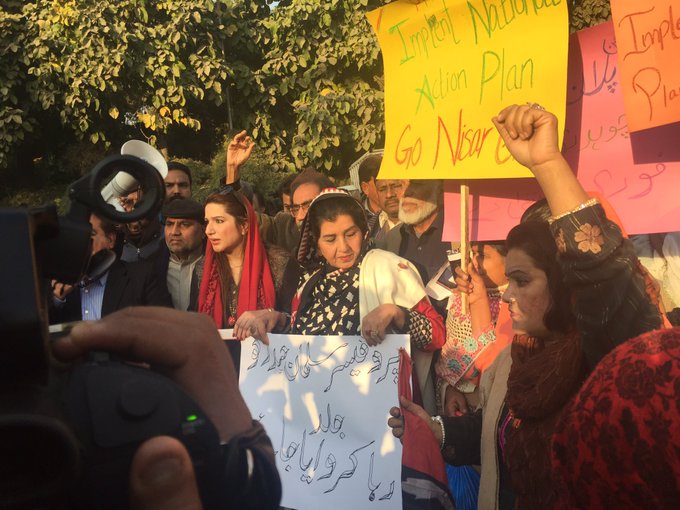
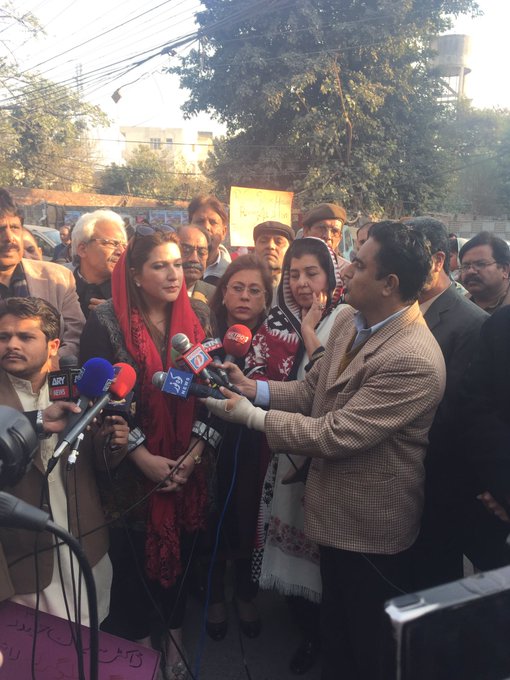
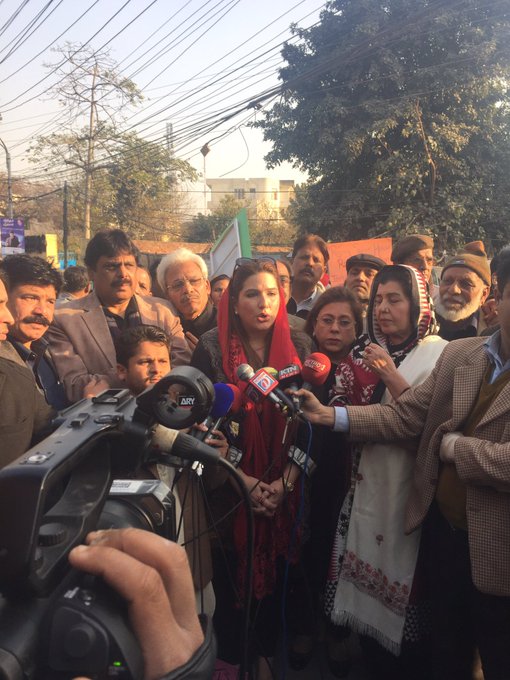
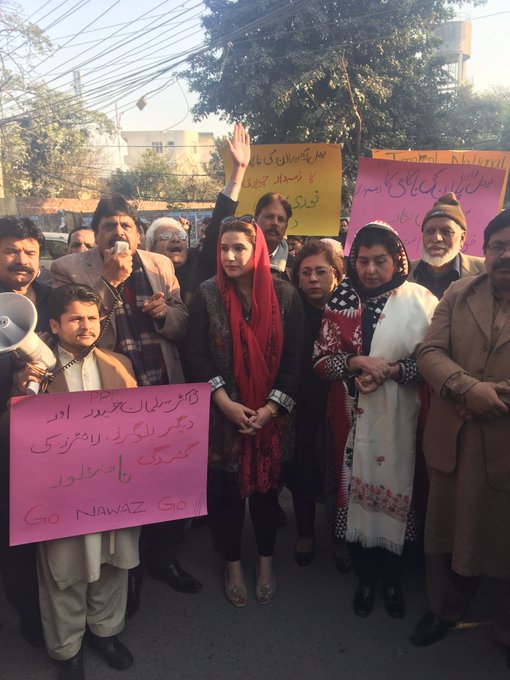
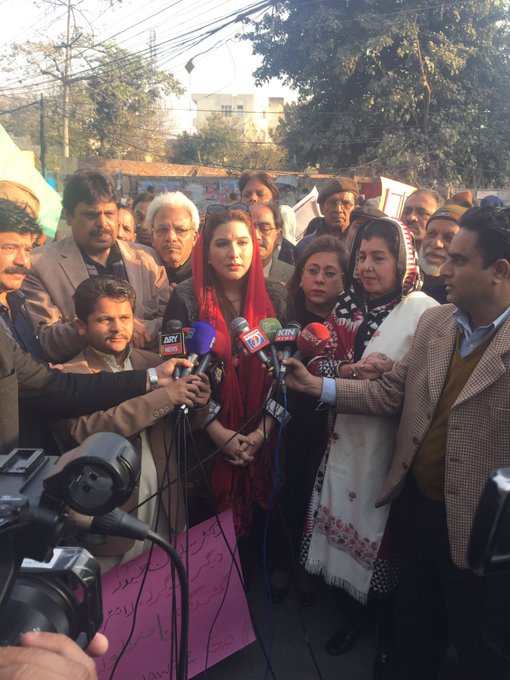
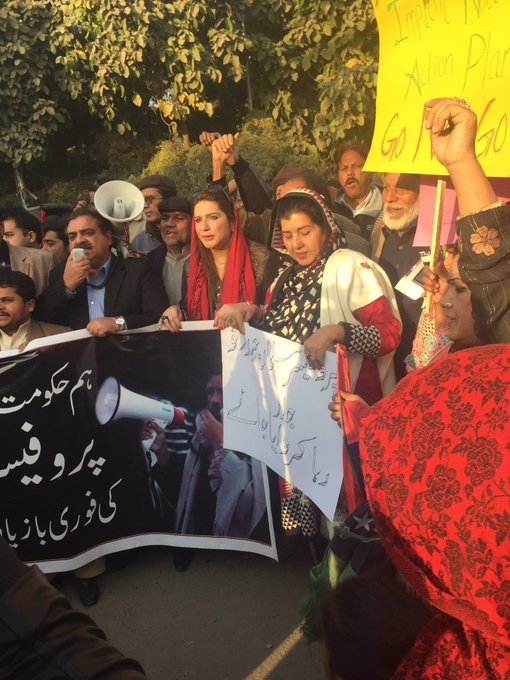
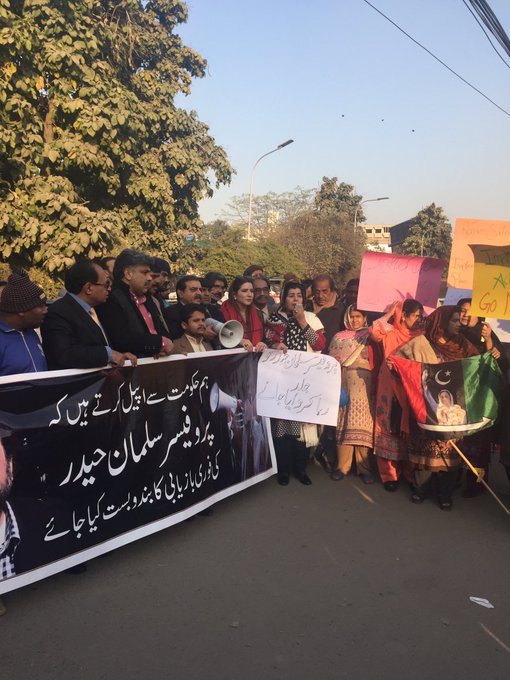
Pakistan Peoples Party held protest demonstrations in front of the Lahore Press Club and in front of the National Press Club Islamabad against the forced abduction of Professor Salman Haider and others on Monday.
In Islamabad Pakistan Peoples Party leaders Farhatullah Babar, Taj Haider, Rubina Khalid, Akhunzada Chattan, Professor Tahir Malik, while, in Lahore Jahan Ara Watoo, Barrister Amir Hasan, Faisal Mir and Shahida Jabeen address the participants.
The speakers expressed their concerns over the growing cases of ‘mysterious disappearances’ of intellectuals, critics and political activists are evident of the failure of National Action Plan and growing lawlessness prevailing across the Punjab.
The protestors demanded that the recently abducted Islamabad-based professor Salman Haider and others should immediately be recovered and those behind their kidnapping should be dealt according to the law. And if someone is allegedly involved in any criminal activities, he/she should be presented in a court, but unlawful forced disappearance unacceptable” they demanded.
The speakers criticized the government for its failure to implement the National Action Plan, and demanded the resignation of interior minister Chaudahary Nisar.
They said that banned outfits were openly holding their rallies, public gatherings and meeting with high officials in the federal capital, while peaceful citizens are ‘mysteriously disappearing’.
“The interior minister must take the responsibility of disappearance of sane voices otherwise leave the job for a competent person,” JahanAra Wattoo demanded.
View image on TwitterView image on TwitterView image on TwitterView image on Twitter
The interior minister must take the responsibility of disappearance of sane voices otherwise leave the job for competent person.
While lashes out at the PML-N government, she says “Rulers have dictatorship mindset to silence liberal voices”
View image on TwitterView image on TwitterView image on TwitterView image on Twitter
Demonstrated against PMLN 4 nt recovering d writers.They have dictatorship mindset 2 silence liberal voices 
The protestors demanded that Salman Haider and others should immediately be recovered and the perpetrators of their abduction should be held accountable.

The participants were carrying banners and placards bearing inscriptions “Stop! Enforced disappearance of political activists, bloggers, and writers.”, “Abduction, disappearance unacceptable: PPP stands with freedom of speech” and “Prof. Salman Haider aur degar social activists ko fi-alfor baziyab kerwao”. They also chanted slogans against the federal and Punjab governments.
https://ppppunjab.wordpress.com/

Pakistan - Funds depleting for heart patients at Peshawar’s Lady Reading Hospital


Several hearty patients are returning dejected from the Lady Reading Hospital (LRH) as the hospital administration has confirmed unavailability of funds.  
According to LRH sources, the provincial government had released Rs 76.7 million for the department of heart diseases in 2013-2014. However, no funds were reserved for the aforementioned department in 2015-2016 budget. The provincial government has not given any funds to the heart department in the past 12 months.
Sources added that an annual fund of nearly Rs 80 million was given to the heart department which helped in cheap and free treatment for many deserving patients.
They added that an angioplasty costs between Rs 200,000 to Rs 400,000 rupees which was out of financial reach of poor heart patients.
The unavailability of funds has left many poor patients facing severe problems in getting free treatment for their heart diseases.

Pakistan - Peshawar: Sale of Cross inscribed shoes vex Christians


Christians rant and rave after learning about shopkeepers selling shoes with symbol of “cross” inscribed on them. Reports emerged that shoes are being sold with Christian holy symbols inscribed on their soles. The news has irked local Christians who claim that the stock must be confiscated immediately by the authorities and strict action should be taken against those manufacturing and selling such products.

These shoes have two cross symbols at their soles. These shoes are being sold in shops in local markets. Ensuing the reports, local Christians are exasperated and are demanding that immediate action should be taken in this connection.

While commenting in this regard, young Pakistani Christian social activist Yasir Bhatti explains that: “Here in local bazars some shopkeepers are selling shoes which are blaspheming Christian faith as symbols of cross have been inscribed on their soles.”

Peshawar-based youth activist further said that this act must be dealt under the aegis of the blasphemy law. “I, therefore, request honorable Government of Khyber Pakhtunkhwa to take action against the perpetrators. Those who are found involved, in the production and sale of such shoes must be hooked. Provincial government must ensure justice in this regard; as this act has hurt the religious sentiments of Christians.”

Yasir Bhatti further urged Federal Minister for Human Rights Kamran Michael to look into the matter and take strict action against the perpetrators. He further invoked Chief Justice of Pakistan to take Suo Moto notice of the act and administer justice to the Christians.

“I urge the provincial as well as federal governments to take notice of the desecration of Christian symbol. I call upon the Peshawar High Court to take action in this case.”

Islamic State ramps up recruitment in Pakistan


By Aamir Saeed
Obaid Khan was planning to join Pakistan’s public school system as a teacher after finishing his undergraduate degree in May this year. Instead, he dropped out of university to join the so-called Islamic State, and he’s now fighting in Afghanistan.
Obaid’s life-plan began to change when a man identifying himself as Qari Abid contacted him via Facebook last August. As their correspondence deepened, Khan became more and more convinced that he needed to join the “jihad against infidels”, according to his elder brother, Hanifullah, whom Abid attempted to recruit as well.
“He used to get promotional Islamic State material and sermons about jihad every second day in his Facebook inbox,” said Hanifullah about his brother.
Then, at the end of October, Obaid suddenly left the family home in Bajaur Agency in the Federally Administered Tribal Areas on the frontier with Afghanistan. Last month, he called Hanifullah and told him he had finished training with IS and was now fighting in Afghanistan’s Nangarhar Province, where Afghan government and US forces have been battling the militants.
“He was a religious-minded person, but we never thought he would one day join a militant group like the IS,” said Hanifullah in a telephone interview.
Military assaults have squeezed IS out of some of the territory it took control of in Iraq and Syria, and the group has recently expanded its presence in South Asia.
In January 2015, IS declared its intention to establish “Khorasan”, in reference to a historical region that once covered much of modern day Afghanistan as well as parts of Iran and Central Asia. Nangarhar remains its main base of operations, but its tentacles extend across the border into Pakistan too.
Officially, Pakistan’s government says that IS, or Daesh as it is referred to here, is not active in the country. But a senior security official has told IRIN that the group represents a serious threat to the country as it coordinates with other militant groups, and ramps up recruitment using social media. The official and Pakistani relatives of IS fighters have shared information on how the recruitment process works.
Government denials
“There is no organised presence, I repeat, no organised presence of Daesh in Pakistan,” Mohammed Nafees Zakaria, a foreign ministry spokesman, told reporters on 15 December. “The pronouncement of one or two random individuals of having affiliation to Daesh does not form the basis for claiming organised presence for this entity in Pakistan.”
However, a senior counter-terrorism official told IRIN that 14 Pakistanis joined IS in October alone, while hundreds more are also believed to be in touch with the recruiters through social media.
“The IS recruiters contact young, educated Pakistani men and women through Facebook, telegram, and other social media platforms and convince them to join the IS in Syria and Afghanistan,” said the official, who requested his name be withheld due to the sensitive nature of the subject. He said he believed the presence of IS could pose a more dangerous threat to Pakistan than the Taliban and other militants, because “it has penetrated in urban educated youth through social media and has enough resources too to lure them to Syria and Afghanistan in the name of jihad”.
The resources include cash payments to families of new recruits, according to the official as well as the brother of another young Pakistani man who has joined IS and is now in Afghanistan for training.
The man told IRIN that his family is receiving a monthly stipend of 30,000 rupees ($286) and that leading IS figures in the region had also promised to sponsor the education of his brother’s three children. “My brother was inducted into the IS force through multiple interviews on Facebook,” said the man on condition of anonymity. “We don’t know exact identity of the recruiters.”
Khurram Mehran, a spokesman for the Pakistan Telecommunication Authority, said his organisation has no clear-cut policy to counter the presence of IS on internet and its recruitment of Pakistanis through social media.
“The government has been continuously denying the presence of IS in Pakistan,” he said. “We start monitoring activities of any militant group on the internet only after we receive instructions from relevant government departments."
Asia expansion?
As recently as 21 December, Pakistan Prime Minister Nawaz Sharif said during a visit to Bosnia that IS is not active in Pakistan, and that the country has destroyed sanctuaries and safe havens of al-Qaeda and Taliban. Despite such public statements, the militant group has carried out attacks in Pakistan, according to the counter-terrorism official, and IS itself.
The IS claimed responsibility for a May 2015 attack on a bus in Karachi that killed 47 people. It also claimed responsibility for the attack on a hospital in Quetta last August that killed 72 people, as well as an attack on the Quetta Police College in October, which killed 59 officers.
The counter-terrorism official said IS has linked up with other militant groups that have a more established presence in Pakistan and have better capabilities on the ground. “The Islamic Movement of Uzbekistan and Lashkar-e-Jhangvi carried out these attacks in Pakistan under the banner of the Islamic State,” said the official. “IS has effectively infused its ideology in these groups through its promotional material of jihad.”
He said Pakistan military operations have forced many Islamist fighters across the border into Afghanistan, particularly those with IMU and the Tehreek-e-Taliban militant group, but the porous border allows them to cross back into Pakistan to plan and carry out operations.
“The IMU fighters have also had their presence in Pakistan's Balochistan province and some tribal areas of the country as they have married local girls and developed relationship with local warlords,” the counter-terrorism official added.
For now, the IS presence in Asia is focused mainly on the frontier between Pakistan and Afghanistan, but there are signs that the groups has plans to expand throughout the region.
The group took responsibility for an attack on a café in Dhaka, Bangladesh, in July where 20 hostages were killed. Indonesian police said an IS militant believed to be in Syria ordered an attack in the capital, Jakarta, one year ago that killed two people. Militant groups in the southern Philippines island of Mindanao have also publicly pledged allegiance to IS.


http://www.irinnews.org/analysis/2017/01/11/islamic-state-ramps-recruitment-pakistan

TO CURB TERRORISM, CHINA TO SEAL BORDER WITH PAKISTAN

In a move that may expose Pakistan over its inability to stop spreading terrorism from its soil, Chinese government has recently announced that the security along the China-Pakistan border would be further tightened in order to prevent terrorists from entering or leaving the region illegally.
According to media reports, Xinjiang Communist Party leaders expressed fears of militants getting training in Pakistan and Afghanistan, and returning to the province to carry out terror attacks.
This announcement came days after five people killed in a terrorist attack in Hotan.“The government has stepped up its efforts in entry-exit system to curb illegal movement of people across the border,” Xinjiang chairman Shohrat Zakir said at the regional People’s Congress.
“Terrorists who carried out attacks in the region in recent years received training abroad and returned illegally,” Times of India report quoted Aniwar Turson, a Communist Party official, as saying.
Chinese government’s this may move hurt the ‘growing friendship’ between the two countries.
Earlier in December, China blocked India’s request to add the head of the Pakistan-based militant group Jaish-e-Mohammad to a U.N. Security Council blacklist of groups linked to al Qaeda.
India has accused Jaish-e-Mohammad and its top leader, Maulana Masood Azhar, of masterminding several attacks, including a deadly assault on an Indian air base in January.
Pakistani security officials interrogated Azhar and his associates after the attack, and said they found no evidence linking him to it.
Jaish-e-Mohammad has already been blacklisted by the 15-nation Security Council, but not Azhar, an Islamist hardliner and long-time foe of India.
http://www.inuth.com/world/to-curb-terror-china-to-seal-border-with-pakistan/

Pashto Music - Sardar Ali Takkar - د سامري محل ـ عبدالغني خان

Fears of online crackdown after Pakistan bloggers vanish


Pakistani activists and opposition lawmakers voiced fears Tuesday of a crackdown on social media, the last bastion of free speech in a country where journalism is increasingly under threat, following the apparent abductions of four leftist bloggers.
Salman Haider, a poet and academic, and bloggers Waqas Goraya, Aasim Saeed, and Ahmad Raza Naseer — who campaigned for human rights and religious freedom — went missing from various cities between January 4 and 7, sparking nationwide protests.
Human Rights Watch (HRW) said their near simultaneous disappearances raised concerns of government involvement.
Rights groups say Pakistani activists and journalists often find themselves caught between the country’s security establishment and militant groups including the Taliban.
Hundreds of people attended protests in Pakistan’s major cities yesterday calling for the bloggers’ immediate release.
Speaking at a demonstration in Islamabad, opposition senator Afrasiab Khattak told AFP: “We have seen pressures on the media, electronic media, print media.
People have been forced to indulge in self-censorship.
“But for social media this is for the first time, the first attack.
And the message is — we won’t allow freedom of expression on social media also.”
Feminist activist Farzana Bari told AFP the disappearances pointed to a widening crackdown on dissent in the country.
“If they have committed any crime or violated any cyber rules — (the government) could have registered a complaint against them.
But we should know what they committed,” she said.
The interior ministry said over the weekend it would investigate the disappearance of Haider, but made no reference to the others.
A security source told AFP that intelligence services were not involved in the disappearances.
But the main opposition Pakistan People’s Party issued a notice in parliament that said: “The pattern of these disappearances suggests it is a coordinated action, undertaken to silence voices which are critical of prevalent socio-political issues.”
Pakistan has had a history of enforced disappearances over the past decade, but they had mainly been confined to conflict zones near the country’s border with Afghanistan, or to southwestern Balochistan province where separatists are fighting the government for independence.
Dawn, Pakistan’s leading English-language daily, issued a strongly-worded editorial condemning the latest disappearances.
“The sanitised language — ‘missing persons’, ‘the disappeared’, etc — cannot hide an ugly truth: the state of Pakistan continues to be suspected of involvement in the disappearance and illegal detentions of a range of private citizens,” it said.
Pakistan is routinely ranked among the world’s most dangerous countries for journalists, and reporting critical of security policies controlled by the powerful military is considered a major red flag, with reporters at times detained, beaten and even killed.
In April 2015, prominent activist Sabeen Mahmud was killed by militants who said they carried out the attack because she promoted liberal, secular views.

http://www.gulf-times.com/story/527589/Fears-of-online-crackdown-after-Pakistan-bloggers-

Pakistan - State of fear


If we are living in a democratic country with a constitution that guarantees full rights to its citizens, then our society must not come to resemble Chile in the Pinochet era when activists went missing as a matter of routine. This country should not have become one of those places where people can be picked up, hidden away and suffer torture. The disappearance of four social media activists can hardly be a coincidence. Salman Haider, Waqas Goraya, Asim Saeed and Ahmed Raza Naseer have all gone missing in the past week and none of them is yet to be located. The government has commented on Haider, who is also an academic and poet, with Interior Minister Chaudhry Nisar saying that he is in contact with intelligence agencies and that Haider’s recovery is the government’s priority. Little, however, has been said about the others on the list. It should be obvious that the near-simultaneous disappearances are linked since all four of the activists shared the same approach, were critical of government and establishment policies and were prominent online and on social media. Who abducted the activists?
Their forthright condemnation of the regressive mindset certainly could have attracted the attention of any of a number of militant groups but those elements cannot coordinate so many kidnappings, especially when the government claims to have them on the run. The other very real – and very frightening – possibility is that they are the first people of the new year to go ‘missing’. This possibility is being widely believed. It is the state and its organs – again – that have come under question. The country’s civil society has squarely put on the responsibility on the government to release them as well as all other ‘missing people’. There have been protests against these latest disappearances and rights group have called on the government to immediately locate the activists.
The matter is not just about one individual. First, the state needs to produce all of those who have gone ‘missing’ recently and then account for every person who has been ‘abducted’. For persons to disappear into nothingness after they have been branded or understood as enemies of the state can never be justified. There is some evidence to suggest that the number of ‘missing’ people is increasing. The Commission of Inquiry on Enforced Disappearances says a total of 728 people were added to the commission’s list last year – the highest in any year since its inception. Most of them were taken away from Balochistan. In 2015 there were 649 cases. These numbers may actually be lower than the real number since many families are reluctant to appear before a government-appointed commission, especially since it is suspected that intelligence officials are also present at the hearings. Many incidents may not be brought to light or placed before any forum. Over the last two years, an alarming feature of these incidents is the almost total silence assumed by the mainstream media. Events in the province of Balochistan are now barely mentioned at all. There are of course reasons for this silence, and every reporter, every activist in Balochistan and other places know of the risks involved in highlighting disappearances of mostly young men. The silence needs to end. We must ask what has become of our collective conscience as citizens and as people. The suffering of families who do not know the fate of their loved ones is immense. The commission, as well as the judiciary, should take immediate notice and take action against whoever was/is responsible. A free and secure society is one which tolerates, and even encourages, dissent. The government and its agencies need to accept responsibility and uncover the secrets behind the vanishings.

Pakistan - Disappearance of bloggers protested


Civil society activists, students and workers of political parties demonstrated here on Tuesday to condemn the disappearance of human rights activist Salman Haider and other bloggers. The protesters were holding placards and banners inscribed with demands for early recovery of the activists.
Addressing the protesters, ANP former MNA Jamia Gilani said that Pakistan was a democratic country and its constitution ensured full implementation of the universal charter of human rights, but even then freedom of expression was being curtailed in the country.
She said that no institution or law enforcement agency had the right to pick at their will political, social and human rights activists and writers. “The constitution gives citizens the right of assembly, freedom of speech, thought and opinion,” she said, pointing out that abduction of activists for being vocal for human rights was violation of the constitution and democratic norms.
Civil society activist Ms Sana Ejaz said disappearance of workers and writers in broad daylight was intolerable in a country where a democratic government existed. “We appeal to the judiciary, elected representatives and law enforcement agencies to ensure early recovery of Salman Haider and other bloggers. She said if cases were registered against the activists, the civil society would move courts.
A youth activist and university student, Pirzada Fawad-ur-Rehman, appealed to the international human rights organisations to take notice of disappearance of political, social and human rights activists in Pakistan.

Video Report - Activists Go Missing in Pakistan, Human Rights Watch Urges Investigation