Wednesday, January 11, 2017

#RECOVERALLACTIVISTS: PPP DEMANDS IN LAHORE, ISLAMABAD PROTESTS


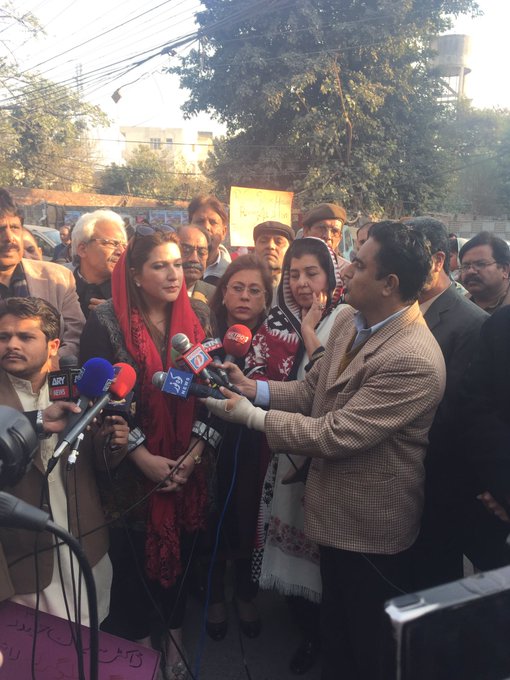
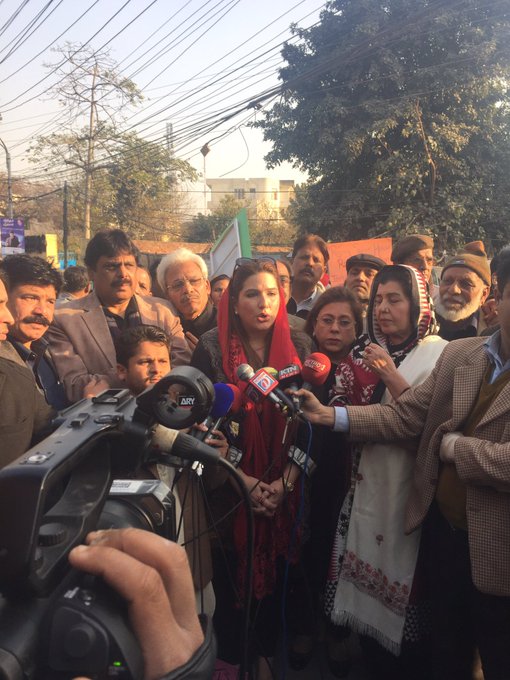
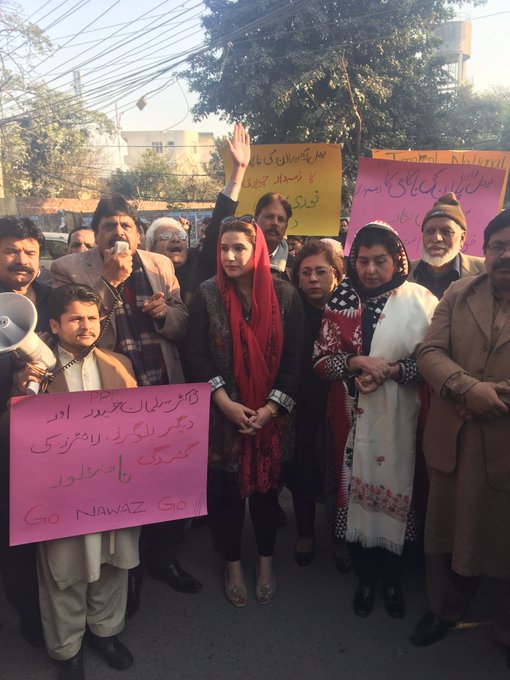
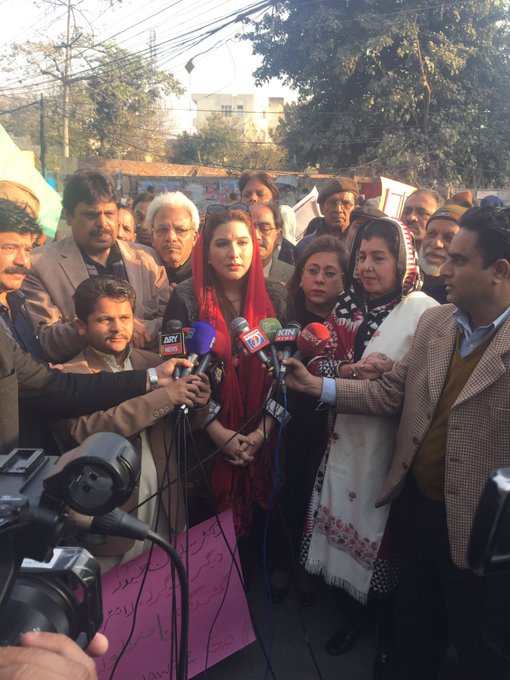
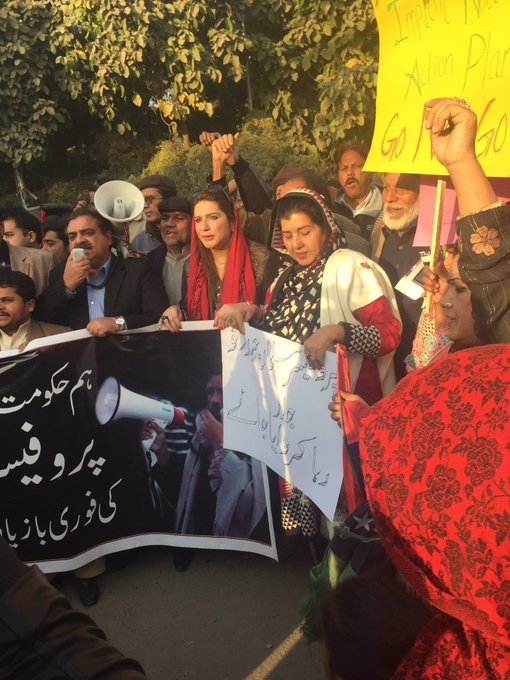
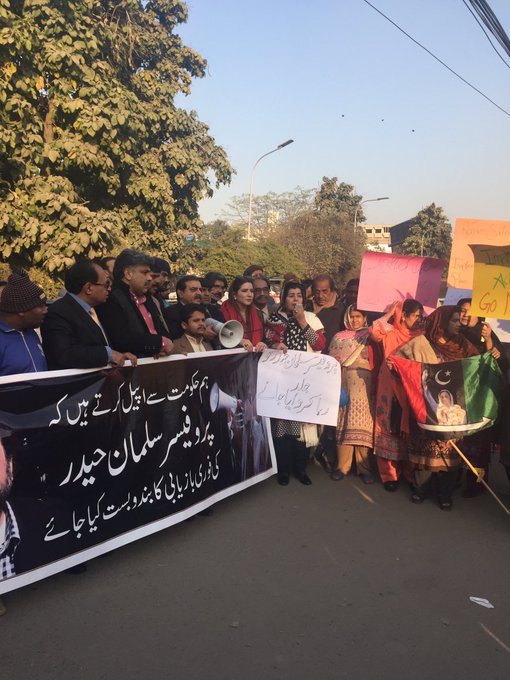
Pakistan Peoples Party held protest demonstrations in front of the Lahore Press Club and in front of the National Press Club Islamabad against the forced abduction of Professor Salman Haider and others on Monday.
In Islamabad Pakistan Peoples Party leaders Farhatullah Babar, Taj Haider, Rubina Khalid, Akhunzada Chattan, Professor Tahir Malik, while, in Lahore Jahan Ara Watoo, Barrister Amir Hasan, Faisal Mir and Shahida Jabeen address the participants.
The speakers expressed their concerns over the growing cases of ‘mysterious disappearances’ of intellectuals, critics and political activists are evident of the failure of National Action Plan and growing lawlessness prevailing across the Punjab.
The protestors demanded that the recently abducted Islamabad-based professor Salman Haider and others should immediately be recovered and those behind their kidnapping should be dealt according to the law. And if someone is allegedly involved in any criminal activities, he/she should be presented in a court, but unlawful forced disappearance unacceptable” they demanded.
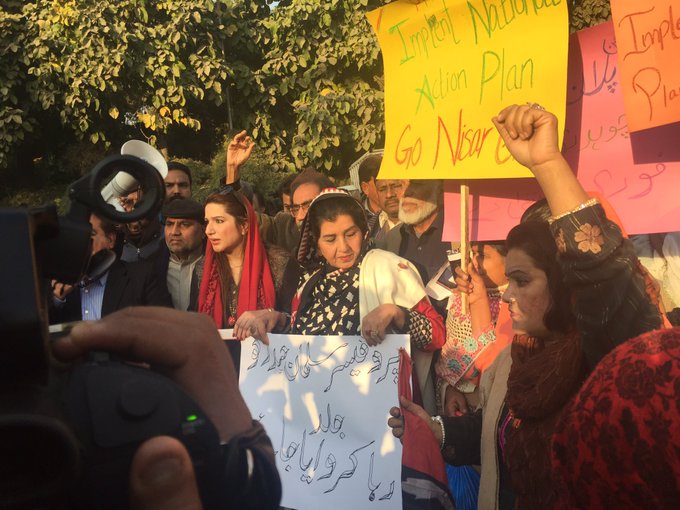
The speakers criticized the government for its failure to implement the National Action Plan, and demanded the resignation of interior minister Chaudahary Nisar.
They said that banned outfits were openly holding their rallies, public gatherings and meeting with high officials in the federal capital, while peaceful citizens are ‘mysteriously disappearing’.
“The interior minister must take the responsibility of disappearance of sane voices otherwise leave the job for a competent person,” JahanAra Wattoo demanded.
View image on TwitterView image on TwitterView image on TwitterView image on Twitter
The interior minister must take the responsibility of disappearance of sane voices otherwise leave the job for competent person.
While lashes out at the PML-N government, she says “Rulers have dictatorship mindset to silence liberal voices”
View image on TwitterView image on TwitterView image on TwitterView image on Twitter
Demonstrated against PMLN 4 nt recovering d writers.They have dictatorship mindset 2 silence liberal voices 
The protestors demanded that Salman Haider and others should immediately be recovered and the perpetrators of their abduction should be held accountable.

The participants were carrying banners and placards bearing inscriptions “Stop! Enforced disappearance of political activists, bloggers, and writers.”, “Abduction, disappearance unacceptable: PPP stands with freedom of speech” and “Prof. Salman Haider aur degar social activists ko fi-alfor baziyab kerwao”. They also chanted slogans against the federal and Punjab governments.
https://ppppunjab.wordpress.com/

Pakistan - Funds depleting for heart patients at Peshawar’s Lady Reading Hospital


Several hearty patients are returning dejected from the Lady Reading Hospital (LRH) as the hospital administration has confirmed unavailability of funds.  
According to LRH sources, the provincial government had released Rs 76.7 million for the department of heart diseases in 2013-2014. However, no funds were reserved for the aforementioned department in 2015-2016 budget. The provincial government has not given any funds to the heart department in the past 12 months.
Sources added that an annual fund of nearly Rs 80 million was given to the heart department which helped in cheap and free treatment for many deserving patients.
They added that an angioplasty costs between Rs 200,000 to Rs 400,000 rupees which was out of financial reach of poor heart patients.
The unavailability of funds has left many poor patients facing severe problems in getting free treatment for their heart diseases.

Pakistan - Peshawar: Sale of Cross inscribed shoes vex Christians


Christians rant and rave after learning about shopkeepers selling shoes with symbol of “cross” inscribed on them. Reports emerged that shoes are being sold with Christian holy symbols inscribed on their soles. The news has irked local Christians who claim that the stock must be confiscated immediately by the authorities and strict action should be taken against those manufacturing and selling such products.

These shoes have two cross symbols at their soles. These shoes are being sold in shops in local markets. Ensuing the reports, local Christians are exasperated and are demanding that immediate action should be taken in this connection.

While commenting in this regard, young Pakistani Christian social activist Yasir Bhatti explains that: “Here in local bazars some shopkeepers are selling shoes which are blaspheming Christian faith as symbols of cross have been inscribed on their soles.”

Peshawar-based youth activist further said that this act must be dealt under the aegis of the blasphemy law. “I, therefore, request honorable Government of Khyber Pakhtunkhwa to take action against the perpetrators. Those who are found involved, in the production and sale of such shoes must be hooked. Provincial government must ensure justice in this regard; as this act has hurt the religious sentiments of Christians.”

Yasir Bhatti further urged Federal Minister for Human Rights Kamran Michael to look into the matter and take strict action against the perpetrators. He further invoked Chief Justice of Pakistan to take Suo Moto notice of the act and administer justice to the Christians.

“I urge the provincial as well as federal governments to take notice of the desecration of Christian symbol. I call upon the Peshawar High Court to take action in this case.”

Islamic State ramps up recruitment in Pakistan


By Aamir Saeed
Obaid Khan was planning to join Pakistan’s public school system as a teacher after finishing his undergraduate degree in May this year. Instead, he dropped out of university to join the so-called Islamic State, and he’s now fighting in Afghanistan.
Obaid’s life-plan began to change when a man identifying himself as Qari Abid contacted him via Facebook last August. As their correspondence deepened, Khan became more and more convinced that he needed to join the “jihad against infidels”, according to his elder brother, Hanifullah, whom Abid attempted to recruit as well.
“He used to get promotional Islamic State material and sermons about jihad every second day in his Facebook inbox,” said Hanifullah about his brother.
Then, at the end of October, Obaid suddenly left the family home in Bajaur Agency in the Federally Administered Tribal Areas on the frontier with Afghanistan. Last month, he called Hanifullah and told him he had finished training with IS and was now fighting in Afghanistan’s Nangarhar Province, where Afghan government and US forces have been battling the militants.
“He was a religious-minded person, but we never thought he would one day join a militant group like the IS,” said Hanifullah in a telephone interview.
Military assaults have squeezed IS out of some of the territory it took control of in Iraq and Syria, and the group has recently expanded its presence in South Asia.
In January 2015, IS declared its intention to establish “Khorasan”, in reference to a historical region that once covered much of modern day Afghanistan as well as parts of Iran and Central Asia. Nangarhar remains its main base of operations, but its tentacles extend across the border into Pakistan too.
Officially, Pakistan’s government says that IS, or Daesh as it is referred to here, is not active in the country. But a senior security official has told IRIN that the group represents a serious threat to the country as it coordinates with other militant groups, and ramps up recruitment using social media. The official and Pakistani relatives of IS fighters have shared information on how the recruitment process works.
Government denials
“There is no organised presence, I repeat, no organised presence of Daesh in Pakistan,” Mohammed Nafees Zakaria, a foreign ministry spokesman, told reporters on 15 December. “The pronouncement of one or two random individuals of having affiliation to Daesh does not form the basis for claiming organised presence for this entity in Pakistan.”
However, a senior counter-terrorism official told IRIN that 14 Pakistanis joined IS in October alone, while hundreds more are also believed to be in touch with the recruiters through social media.
“The IS recruiters contact young, educated Pakistani men and women through Facebook, telegram, and other social media platforms and convince them to join the IS in Syria and Afghanistan,” said the official, who requested his name be withheld due to the sensitive nature of the subject. He said he believed the presence of IS could pose a more dangerous threat to Pakistan than the Taliban and other militants, because “it has penetrated in urban educated youth through social media and has enough resources too to lure them to Syria and Afghanistan in the name of jihad”.
The resources include cash payments to families of new recruits, according to the official as well as the brother of another young Pakistani man who has joined IS and is now in Afghanistan for training.
The man told IRIN that his family is receiving a monthly stipend of 30,000 rupees ($286) and that leading IS figures in the region had also promised to sponsor the education of his brother’s three children. “My brother was inducted into the IS force through multiple interviews on Facebook,” said the man on condition of anonymity. “We don’t know exact identity of the recruiters.”
Khurram Mehran, a spokesman for the Pakistan Telecommunication Authority, said his organisation has no clear-cut policy to counter the presence of IS on internet and its recruitment of Pakistanis through social media.
“The government has been continuously denying the presence of IS in Pakistan,” he said. “We start monitoring activities of any militant group on the internet only after we receive instructions from relevant government departments."
Asia expansion?
As recently as 21 December, Pakistan Prime Minister Nawaz Sharif said during a visit to Bosnia that IS is not active in Pakistan, and that the country has destroyed sanctuaries and safe havens of al-Qaeda and Taliban. Despite such public statements, the militant group has carried out attacks in Pakistan, according to the counter-terrorism official, and IS itself.
The IS claimed responsibility for a May 2015 attack on a bus in Karachi that killed 47 people. It also claimed responsibility for the attack on a hospital in Quetta last August that killed 72 people, as well as an attack on the Quetta Police College in October, which killed 59 officers.
The counter-terrorism official said IS has linked up with other militant groups that have a more established presence in Pakistan and have better capabilities on the ground. “The Islamic Movement of Uzbekistan and Lashkar-e-Jhangvi carried out these attacks in Pakistan under the banner of the Islamic State,” said the official. “IS has effectively infused its ideology in these groups through its promotional material of jihad.”
He said Pakistan military operations have forced many Islamist fighters across the border into Afghanistan, particularly those with IMU and the Tehreek-e-Taliban militant group, but the porous border allows them to cross back into Pakistan to plan and carry out operations.
“The IMU fighters have also had their presence in Pakistan's Balochistan province and some tribal areas of the country as they have married local girls and developed relationship with local warlords,” the counter-terrorism official added.
For now, the IS presence in Asia is focused mainly on the frontier between Pakistan and Afghanistan, but there are signs that the groups has plans to expand throughout the region.
The group took responsibility for an attack on a café in Dhaka, Bangladesh, in July where 20 hostages were killed. Indonesian police said an IS militant believed to be in Syria ordered an attack in the capital, Jakarta, one year ago that killed two people. Militant groups in the southern Philippines island of Mindanao have also publicly pledged allegiance to IS.


http://www.irinnews.org/analysis/2017/01/11/islamic-state-ramps-recruitment-pakistan

TO CURB TERRORISM, CHINA TO SEAL BORDER WITH PAKISTAN

In a move that may expose Pakistan over its inability to stop spreading terrorism from its soil, Chinese government has recently announced that the security along the China-Pakistan border would be further tightened in order to prevent terrorists from entering or leaving the region illegally.
According to media reports, Xinjiang Communist Party leaders expressed fears of militants getting training in Pakistan and Afghanistan, and returning to the province to carry out terror attacks.
This announcement came days after five people killed in a terrorist attack in Hotan.“The government has stepped up its efforts in entry-exit system to curb illegal movement of people across the border,” Xinjiang chairman Shohrat Zakir said at the regional People’s Congress.
“Terrorists who carried out attacks in the region in recent years received training abroad and returned illegally,” Times of India report quoted Aniwar Turson, a Communist Party official, as saying.
Chinese government’s this may move hurt the ‘growing friendship’ between the two countries.
Earlier in December, China blocked India’s request to add the head of the Pakistan-based militant group Jaish-e-Mohammad to a U.N. Security Council blacklist of groups linked to al Qaeda.
India has accused Jaish-e-Mohammad and its top leader, Maulana Masood Azhar, of masterminding several attacks, including a deadly assault on an Indian air base in January.
Pakistani security officials interrogated Azhar and his associates after the attack, and said they found no evidence linking him to it.
Jaish-e-Mohammad has already been blacklisted by the 15-nation Security Council, but not Azhar, an Islamist hardliner and long-time foe of India.
http://www.inuth.com/world/to-curb-terror-china-to-seal-border-with-pakistan/

Pashto Music - Sardar Ali Takkar - د سامري محل ـ عبدالغني خان

Fears of online crackdown after Pakistan bloggers vanish


Pakistani activists and opposition lawmakers voiced fears Tuesday of a crackdown on social media, the last bastion of free speech in a country where journalism is increasingly under threat, following the apparent abductions of four leftist bloggers.
Salman Haider, a poet and academic, and bloggers Waqas Goraya, Aasim Saeed, and Ahmad Raza Naseer — who campaigned for human rights and religious freedom — went missing from various cities between January 4 and 7, sparking nationwide protests.
Human Rights Watch (HRW) said their near simultaneous disappearances raised concerns of government involvement.
Rights groups say Pakistani activists and journalists often find themselves caught between the country’s security establishment and militant groups including the Taliban.
Hundreds of people attended protests in Pakistan’s major cities yesterday calling for the bloggers’ immediate release.
Speaking at a demonstration in Islamabad, opposition senator Afrasiab Khattak told AFP: “We have seen pressures on the media, electronic media, print media.
People have been forced to indulge in self-censorship.
“But for social media this is for the first time, the first attack.
And the message is — we won’t allow freedom of expression on social media also.”
Feminist activist Farzana Bari told AFP the disappearances pointed to a widening crackdown on dissent in the country.
“If they have committed any crime or violated any cyber rules — (the government) could have registered a complaint against them.
But we should know what they committed,” she said.
The interior ministry said over the weekend it would investigate the disappearance of Haider, but made no reference to the others.
A security source told AFP that intelligence services were not involved in the disappearances.
But the main opposition Pakistan People’s Party issued a notice in parliament that said: “The pattern of these disappearances suggests it is a coordinated action, undertaken to silence voices which are critical of prevalent socio-political issues.”
Pakistan has had a history of enforced disappearances over the past decade, but they had mainly been confined to conflict zones near the country’s border with Afghanistan, or to southwestern Balochistan province where separatists are fighting the government for independence.
Dawn, Pakistan’s leading English-language daily, issued a strongly-worded editorial condemning the latest disappearances.
“The sanitised language — ‘missing persons’, ‘the disappeared’, etc — cannot hide an ugly truth: the state of Pakistan continues to be suspected of involvement in the disappearance and illegal detentions of a range of private citizens,” it said.
Pakistan is routinely ranked among the world’s most dangerous countries for journalists, and reporting critical of security policies controlled by the powerful military is considered a major red flag, with reporters at times detained, beaten and even killed.
In April 2015, prominent activist Sabeen Mahmud was killed by militants who said they carried out the attack because she promoted liberal, secular views.

http://www.gulf-times.com/story/527589/Fears-of-online-crackdown-after-Pakistan-bloggers-

Pakistan - State of fear


If we are living in a democratic country with a constitution that guarantees full rights to its citizens, then our society must not come to resemble Chile in the Pinochet era when activists went missing as a matter of routine. This country should not have become one of those places where people can be picked up, hidden away and suffer torture. The disappearance of four social media activists can hardly be a coincidence. Salman Haider, Waqas Goraya, Asim Saeed and Ahmed Raza Naseer have all gone missing in the past week and none of them is yet to be located. The government has commented on Haider, who is also an academic and poet, with Interior Minister Chaudhry Nisar saying that he is in contact with intelligence agencies and that Haider’s recovery is the government’s priority. Little, however, has been said about the others on the list. It should be obvious that the near-simultaneous disappearances are linked since all four of the activists shared the same approach, were critical of government and establishment policies and were prominent online and on social media. Who abducted the activists?
Their forthright condemnation of the regressive mindset certainly could have attracted the attention of any of a number of militant groups but those elements cannot coordinate so many kidnappings, especially when the government claims to have them on the run. The other very real – and very frightening – possibility is that they are the first people of the new year to go ‘missing’. This possibility is being widely believed. It is the state and its organs – again – that have come under question. The country’s civil society has squarely put on the responsibility on the government to release them as well as all other ‘missing people’. There have been protests against these latest disappearances and rights group have called on the government to immediately locate the activists.
The matter is not just about one individual. First, the state needs to produce all of those who have gone ‘missing’ recently and then account for every person who has been ‘abducted’. For persons to disappear into nothingness after they have been branded or understood as enemies of the state can never be justified. There is some evidence to suggest that the number of ‘missing’ people is increasing. The Commission of Inquiry on Enforced Disappearances says a total of 728 people were added to the commission’s list last year – the highest in any year since its inception. Most of them were taken away from Balochistan. In 2015 there were 649 cases. These numbers may actually be lower than the real number since many families are reluctant to appear before a government-appointed commission, especially since it is suspected that intelligence officials are also present at the hearings. Many incidents may not be brought to light or placed before any forum. Over the last two years, an alarming feature of these incidents is the almost total silence assumed by the mainstream media. Events in the province of Balochistan are now barely mentioned at all. There are of course reasons for this silence, and every reporter, every activist in Balochistan and other places know of the risks involved in highlighting disappearances of mostly young men. The silence needs to end. We must ask what has become of our collective conscience as citizens and as people. The suffering of families who do not know the fate of their loved ones is immense. The commission, as well as the judiciary, should take immediate notice and take action against whoever was/is responsible. A free and secure society is one which tolerates, and even encourages, dissent. The government and its agencies need to accept responsibility and uncover the secrets behind the vanishings.

Pakistan - Disappearance of bloggers protested


Civil society activists, students and workers of political parties demonstrated here on Tuesday to condemn the disappearance of human rights activist Salman Haider and other bloggers. The protesters were holding placards and banners inscribed with demands for early recovery of the activists.
Addressing the protesters, ANP former MNA Jamia Gilani said that Pakistan was a democratic country and its constitution ensured full implementation of the universal charter of human rights, but even then freedom of expression was being curtailed in the country.
She said that no institution or law enforcement agency had the right to pick at their will political, social and human rights activists and writers. “The constitution gives citizens the right of assembly, freedom of speech, thought and opinion,” she said, pointing out that abduction of activists for being vocal for human rights was violation of the constitution and democratic norms.
Civil society activist Ms Sana Ejaz said disappearance of workers and writers in broad daylight was intolerable in a country where a democratic government existed. “We appeal to the judiciary, elected representatives and law enforcement agencies to ensure early recovery of Salman Haider and other bloggers. She said if cases were registered against the activists, the civil society would move courts.
A youth activist and university student, Pirzada Fawad-ur-Rehman, appealed to the international human rights organisations to take notice of disappearance of political, social and human rights activists in Pakistan.

Video Report - Activists Go Missing in Pakistan, Human Rights Watch Urges Investigation

Activist Shaan Taseer faces death threat from religious hardliners in Pakistan


Shaan Taseer's father, Salmaan, was murdered in Islamabad in 2011 by his own bodyguard. The shooter targeted the politician because he had criticized the country's blasphemy laws.
"It's not the first time [I've spoken out] and it's certainly not the last time."- Shaan Taseer, Pakistan rights advocate
Now, hardline religious groups in Pakistan have issued a similar fatwa against his son. The reason: a video the activist made echoing his father's message.
Shaan Taseer spoke to As It Happens guest host Helen Mann about the threat against his life.
Shaan Taseer at vigil
Pakistani activist Shaan Taseer with his infant son at a memorial last year for his father, Salmaan, who was assassinated in 2011. (Courtesy of Shaan Taseer)
Helen Mann: Mr. Taseer, what did you say in this video you released on Christmas Day?
Shaan Taseer: I wished everyone 'Merry Christmas' and I asked everyone to make a prayer for the victims of religious persecution in Pakistan, specifically Asia Bibi and Nabeel Masih, who have been imprisoned on charges, false charges, of blasphemy. I asked everyone to make a prayer for them and their families and for all other victims of religious persecution in Pakistan who have suffered under the blasphemy law, an inhumane law.
HM: Did you think you were making a controversial statement at the time you released this?
ST: Good question. I have criticized the religious persecution of minorities in Pakistan many times. Why the religious right chose to pick up on this particular statement, I don't know. I can't speak for them. But I can guess that it has something to do with the fact that my father's death anniversary was coming up and they were looking for an opportunity to expand their influence and expand their mind space in Pakistani society.
HM: This is not the first time you've made some kind of statement in this regard?
ST: It's not the first time and it's certainly not the last time.

HM: What exactly is the threat that has been made against you?
ST: Well, the religious right has started an incitement murder campaign against me where they are calling for my death. They have created a moral panic whereby they have said that Islam is in danger and they are calling for a white knight to come and rescue Islam and by that they specifically mean for someone to come and take my life. The precedent is there. They did exactly the same when my father criticized such laws. And they are calling for another Mumtaz Qadri to do to me what was done to my father. Mumtaz Qadri is the man who took my father's life.

HM: It's interesting that you should mention that. One of the hardline clerics in Pakistan making accusations against you said this: "I don't know why the Taseer family do this again and again. His own father was killed for this so why is he also choosing the same path?" Given that you know the price your father paid, why is so important to you to take this stand?
"I will return to Pakistan, of course, because I have a lot of work in Pakistan. I work with victims of religious persecution. Obviously, when I do so, I will be taking some precautions."- Shaan Taseer
ST: Well, what's happening in Pakistan is that the religious right is placing these red lines within society on what can be spoken about and what cannot be spoken about and they are playing judge, jury and executioner. Now, there is absolutely no constitutional basis for telling any citizen in the country whether or not they have the right to speak about the laws that govern them. So for this cleric to be wondering why I expressed an opinion, I would find that amusing. Who gave him the right to tell me what I can speak about or not?
HM: You spoke of Mumtaz Qadri the man who was convicted of killing your father and who is considered a martyr and a hero by some people in Pakistan. How worried are you that the way he is regarded may further promote someone to do some sort of violence against you?
ST: Look, that threat has always been there ... I'd say it's a little more marked now, but I don't think there's anything new about that.
HM: Your principal home is in Canada. How concerned are you about your safety here? Do you feel OK in this country?
ST: Threats made against people on social media usually transcend the geographical boundaries in which they are made, so, of course, there is a threat globally because these people have called on someone to take my life ... Something similar happened that there was a lot of hate goading in Pakistan and some misguided person took a shopkeeper's life in Glasgow. So it's not altogether unbelievable that these threats can exceed the geographical boundaries of Pakistan.
HM: What about plans to return to Pakistan. Will you travel there?
ST: I will return to Pakistan, of course, because I have a lot of work in Pakistan. I work with victims of religious persecution. Obviously, when I do so, I will be taking some precautions ... Those precautions usually involve not advertising your movements.

Tuesday, January 10, 2017

The Daily Show - Trump vs. the Truth: The Russian Hacking Report

In farewell speech, Obama warns of threats to democracy


Rick Pearson and Bill Ruthhart


Barack Obama said goodbye Tuesday night to a nation that delivered him a historic presidency and exhorted supporters to work to fulfill democracy's promise as a new era in Washington led by Republicans and President-elect Donald Trump is about to begin.
Even as Obama exits the world and national stage in little more than a week, his nationally broadcast speech to an estimated 18,000 at McCormick Place made clear to thousands of supporters in his adopted hometown of Chicago that his social and civic activism will continue — as a citizen.
Joined by First Lady Michelle Obama, daughter Malia and Vice President Joe Biden, the president credited Chicago with playing a crucial role in his path to public service.
"I first came to Chicago when I was in my early twenties and I was still trying to figure out who I was, still searching for a purpose in my life," Obama said in a speech that lasted about 50 minutes.
"And it was in a neighborhood not far from here where I began working with church groups in the shadows of closed steel mills. It was on these streets where I witnessed the power of faith and the quiet dignity of working people in the face of struggle and loss," said Obama, a South Side community organizer. "Now, this is where I learned that change only happens when ordinary people get involved, and they get engaged, and come together to demand it."
Obama's comments about Chicago came as a woman shouted at him from the audience, holding a sign saying, "Pardon us all now." That prompted supporters to try to shout down the protester by chanting, "Four more years." Police removed the protester.
The farewell speech demonstrated that while Obama is leaving the White House, the 55-year-old president is not headed to quiet retirement amid one-party Republican control of the nation, a controversial successor in the White House and a Democratic Party that finds itself in disarray and without focused leadership.
Instead, the onetime University of Chicago law lecturer delivered a lesson on what he perceives as dangers to democracy, including rising economic inequality, growing racial tensions, fear of terrorism and a fracturing of media that allows people to exist in their own political preference "bubbles," regardless of fact or science.
And while he only mentioned the incoming president once by name — discussing the peaceful transfer of power that will come on Jan. 20 — Obama's message sought to combat some of the concepts and demographic appeals that Trump embraced to win the White House. Citing the growth of automation in displacing middle-class jobs in the future, Obama called for a new social compact "to guarantee all our kids the education they need, to give workers the power to unionize for better wages, to update the social safety net to reflect the way we live now and make more reforms to the tax code" so corporations and wealthy individuals don't "avoid their obligations to the country."
"We can argue about how to best to achieve these goals. But we can't be complacent about the goals themselves. For if we don't create opportunity for all people, the disaffection and division that has stalled our progress will only sharpen in years to come," he said.
While Obama said his election as the nation's first black president inspired optimism toward a "post-racial America," he added that such a vision "was never realistic." He also warned economic divisions have intensified racial divisions, particularly at a time when the growth of the nation's Hispanic population continues. To be serious about race, Obama said laws to fight discrimination in hiring, housing, education and criminal justice must be upheld — and "hearts must change."
"For blacks and other minority groups, that means tying our own struggles for justice to the challenges that a lot of people in this country face," Obama said, including "the middle-aged white man who, from the outside, may seem like he's got all the advantages, but who's seen his world upended by economic, cultural and technological change."
For whites, Obama said, "it means acknowledging that the effects of slavery and Jim Crow didn't suddenly vanish in the '60s, that when minority groups voice discontent, they're not just engaging in reverse racism or practicing political correctness; when they wage peaceful protest, they're not demanding special treatment but the equal treatment that our founders promised."
Noting the increasing partisanship that marked his tenure as president, Obama warned another threat to democracy was the trend of people becoming "so secure in our bubbles that we start accepting only information, whether true or not, that fits our opinions instead of basing our opinions on the evidence that's out there."
"Without some common baseline of facts, without a willingness to admit new information and concede that your opponent is making a fair point and that science and reason matter, we'll keep talking past each other, making common ground and compromise impossible," he said.
In what may have been his most direct criticism of Trump, Obama spoke of the threat of terrorism, the vigilance of first responders and the military and vowed "ISIL will be destroyed."
But the president also warned that "democracy can buckle when we give in to fear." "So just as we, as citizens, must remain vigilant against external aggression, we must guard against a weakening of the values that make us who we are," Obama said. "That's why I reject discrimination against Muslim Americans," he added, drawing loud applause. "That's why we cannot withdraw from global fights — to expand democracy and human rights, women's rights, LGBT rights — no matter how imperfect our efforts, no matter how expedient ignoring such values may seem."
Obama also warned of complacency and urged all Americans, regardless of party, to "throw ourselves into the task of rebuilding our democratic institutions. The potential of democracy only works "if our politics better reflects the decency of our people" and if everyone helps to "restore the sense of common purpose that we so badly need right now."
As expected, Obama briefly touched on a list of accomplishments during his tenure, including the Affordable Care Act, which has provided health insurance to 20 million previously uninsured and that the new GOP administration and leadership in Congress has promised to dismantle. Obama took credit for rescuing the economy he inherited in 2009 as the Great Recession deepened, noting a gradual jobs recovery along with wages that have increased in recent years at a pace faster than at any time in the last four decades.
He also talked up a foreign policy that he characterized as sharply curtailing, but not totally ending, U.S. military involvement in Iraq and Afghanistan; killing Al Qaeda leader and 9/11 mastermind Osama bin Laden; restoring relations with Cuba; and featuring U.S.-led multinational efforts to curb Iran's ability to develop nuclear weapons.
"That's what we did. That's what you did. You were the change," he said in summing up his accomplishments. "You answered people's hopes. And because of you, by almost every measure, America is a better, stronger place than it was when we started."
As he began to close his speech, the president recognized first lady Michelle Obama and wiped away a tear.
"You took on a role you didn't ask for and made it your own with grace and with grit and with style and good humor," he said.
Chicago has held special meaning to Obama, where he moved after serving as the first African-American editor of the Harvard Law Review to become a community organizer, then to serve as a state and U.S. senator and ultimately for eight years as president.
The city served as the base of his presidential campaigns and was a source for his top White House aides. And it helped provide him with the ambition to seek out a career in politics, even as he suffered his only election loss here in a failed 2000 primary challenge to South Side U.S. Rep. Bobby Rush.
Obama has acknowledged had he defeated Rush, it might have changed his political trajectory to a point where he would not have even sought the presidency, let alone win the White House.
Long lines of supporters looking to see Obama's last major presidential speech gathered in the rain and wind hours before the event to undergo airport-style security screening.
The Windy City's wind-swept weather on Tuesday night forced the presidential entourage to travel by motorcade to McCormick Place, which included shutting down the in-bound Kennedy Expressway and portions of Lake Shore Drive during rush hour after Air Force One landed at O'Hare International Airport. Usually, the president uses the Marine One helicopter to travel from O'Hare to downtown.
Prior to arriving at McCormick Place, the presidential motorcade arrived at one of Obama's favorite restaurants, Valois, in Hyde Park. He did an interview with NBC Nightly News anchor Lester Holt, who previously was an anchor and reporter in Chicago. Among the dozens in the crowd outside was Jessica Simmons, 38, a marketing manager who works in the neighborhood. Simmons said she waited for two hours on a sidewalk along Harper Avenue to catch a brief glimpse of Obama's motorcade.
"He served the country and the people for eight years, and to show my gratitude I can stand out here, wave, send him off and wish him well," Simmons said. "It's absolutely a whole new meaning to 'Thanks, Obama.'"

President Obama - 2016 Wounded Warriors Ride

Video - President Obama's Farewell Address to the American People

Pakistan - Sindh governor refuses to ratify forced conversion bill


In the wake of strident protests by various groups, Sindh Governor Justice (retd) Saeeduzzaman Siddiqui has refused to ratify the Sindh Assembly’s forced conversion bill, officially known as Criminal Law (Protection of Minorities) Bill.
“Please reconsider the legislation,” said Siddiqui in his message to the Sindh Assembly Secretariat.
In his observations, the governor referred to the letters written by the Council of Islamic Ideology (CII), MQM parliamentary leader Sardar Ahmed, as well as the protest by religious parties, which either called for the bill’s withdrawal or proposed amendments to it.
PPP may revisit bill against forced conversions
“Today, we have received the bill with the governor’s message. The governor’s plea for reconsideration means he has asked for the bill’s withdrawal and for the introduction of a new law,” said Sindh Assembly Secretary GM Umer Farooq while talking to The Express Tribune. With the governor’s message appended to it, he said, the bill will be presented at the upcoming session of the Sindh Assembly. “However, it is the house’s prerogative to accept it or not,” he said.
The private bill – jointly moved by the ruling PPP and the PML-F lawmakers and unanimously passed by the assembly on November 24 –recommended that change of religion not be recognised until a person becomes 18 years old.
It also prescribed severe penalties for forced conversion of religion and said, “Any person who forcibly converts another person shall be liable to imprisonment for a minimum of five years and maximum of life imprisonment and a fine to be paid to the victim.”
Following the passage of this proposed law, the PPP leadership, civil society members and minorities had celebrated the development and called it a ‘landmark’ achievement in the history of the assembly, which became the first legislative forum to adopt such a law in the country.
However, religious parties rallied against the proposed legislation, calling it against the spirit of Islam and threatening street agitation over it. According to a source, the PPP government has apparently succumbed to the pressure and has agreed to make amendments to it.
“After Jamaat-e-Islami chief Sirajul Haq’s phoned PPP Co-chairman Asif Ali Zardari, the latter asked the Sindh Chief Minister Murad Ali Shah to withdraw the law and introduce a fresh bill,” an official source said.
Some sources even claimed that the governor objected to the bill on the advice of the Sindh CM.
However, Nand Kumar, the bill’s architect, insisted it was a genuine issue because forced conversions continue to pose a threat to the Hindu community. “Minor girls are compelled to change their religion and get married to Muslim men in Sindh,” he said, terming the government decision to withdraw the law a ‘cowardly act’
“No one objects to changing their faith out of their free-will. But it is a criminal practice to forcibly convert anybody,” he added. “I don’t know where the PPP stands after this decision. The party claims to have taken the mantle for the rights of minorities, yet it has surrendered that role,” he said.
More forced conversions going on than reported, says MP
PPP’s parliamentary leader in the Sindh Assembly, Nisar Ahmed Khuhro, justified his party and government policy. “We still own this bill, but since some parties have expressed reservations, so we have to redress the same,” he said. “The government will not withdraw the bill, but will make amendments to it,” he added.
However, sources privy to the development told The Express Tribune that the bill will again be sent to a standing committee for the point of view of religious parties to be incorporated in it. “I don’t know what will be the fate of this law, but it may hang in the balance,” a senior bureaucrat in Sindh Assembly said.
The PML-N’s MNA Ramesh Kumar Vakwani, who also heads the Pakistan Hindu Council, said: “It will be a big tragedy for non-Muslims, if the bill is withdrawn. After this decision the extremist elements will become confident and minorities will feel insecure.”

Corruption In Balochistan


JUI-F lawmaker Sardar Abdul Rehman Khetran on Saturday, addressing the Balochistan assembly alleged that the former Inspector General of Balochistan Police Mushtaq Ahmed Sukhera took 28 provincial owned vehicles with him to Punjab after he retired.
The news read like just another fact of life in Pakistan, where VIPS and VVIPS act like they have rights over what does not belong to them. In this case it points to the blatant sense of entitlement that a select few officials working in Balochistan feel. Pakistan has suffered long and Balochistan even longer due to corrupt governance, unrest and chaos.
When massive wads of money were discovered by the National Accountability Bureau (NAB) in May last year, from the residence of Balochistan Finance Secretary Mushtaq Ahmed Raisani, there was an uproar over the conditions in Balochistan and the unabashed looting from local government development funds.
The NAB recovered more than Rs730 million from the house, an amount so large, if utilised properly, had the potential to transform the backward province. The National Accountability Bureau (NAB) made two controversial plea bargain deals with Raisani, enforcing the fact, that cheaters will be allowed to prosper. The IG probably understood as much when he decided to keep the official motorcade, and if the accusation is unfounded, a clarification must be given.
If it is true, he should be investigated and prosecuted to the full extent of the law.
Former federal minister Sardar Yar Mohammad Rind had brought to attention the Raisani case in October 2014, and it took three years for the NAB to take action, only to allow a way out for the corrupt. Rind alleged that the Raisani-led government had committed massive corruption in the Reko Diq gold-cum-copper project deal and the province still awaits justice.
How long will it take to get to the bottom of this one?