Wednesday, January 11, 2017

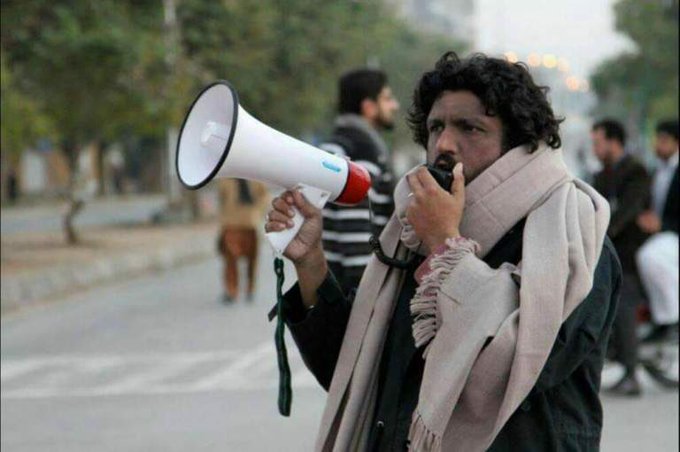
Activist Shaan Taseer faces death threat from religious hardliners in Pakistan


Shaan Taseer's father, Salmaan, was murdered in Islamabad in 2011 by his own bodyguard. The shooter targeted the politician because he had criticized the country's blasphemy laws.
"It's not the first time [I've spoken out] and it's certainly not the last time."- Shaan Taseer, Pakistan rights advocate
Now, hardline religious groups in Pakistan have issued a similar fatwa against his son. The reason: a video the activist made echoing his father's message.
Shaan Taseer spoke to As It Happens guest host Helen Mann about the threat against his life.
Shaan Taseer at vigil
Pakistani activist Shaan Taseer with his infant son at a memorial last year for his father, Salmaan, who was assassinated in 2011. (Courtesy of Shaan Taseer)
Helen Mann: Mr. Taseer, what did you say in this video you released on Christmas Day?
Shaan Taseer: I wished everyone 'Merry Christmas' and I asked everyone to make a prayer for the victims of religious persecution in Pakistan, specifically Asia Bibi and Nabeel Masih, who have been imprisoned on charges, false charges, of blasphemy. I asked everyone to make a prayer for them and their families and for all other victims of religious persecution in Pakistan who have suffered under the blasphemy law, an inhumane law.
HM: Did you think you were making a controversial statement at the time you released this?
ST: Good question. I have criticized the religious persecution of minorities in Pakistan many times. Why the religious right chose to pick up on this particular statement, I don't know. I can't speak for them. But I can guess that it has something to do with the fact that my father's death anniversary was coming up and they were looking for an opportunity to expand their influence and expand their mind space in Pakistani society.
HM: This is not the first time you've made some kind of statement in this regard?
ST: It's not the first time and it's certainly not the last time.

HM: What exactly is the threat that has been made against you?
ST: Well, the religious right has started an incitement murder campaign against me where they are calling for my death. They have created a moral panic whereby they have said that Islam is in danger and they are calling for a white knight to come and rescue Islam and by that they specifically mean for someone to come and take my life. The precedent is there. They did exactly the same when my father criticized such laws. And they are calling for another Mumtaz Qadri to do to me what was done to my father. Mumtaz Qadri is the man who took my father's life.

HM: It's interesting that you should mention that. One of the hardline clerics in Pakistan making accusations against you said this: "I don't know why the Taseer family do this again and again. His own father was killed for this so why is he also choosing the same path?" Given that you know the price your father paid, why is so important to you to take this stand?
"I will return to Pakistan, of course, because I have a lot of work in Pakistan. I work with victims of religious persecution. Obviously, when I do so, I will be taking some precautions."- Shaan Taseer
ST: Well, what's happening in Pakistan is that the religious right is placing these red lines within society on what can be spoken about and what cannot be spoken about and they are playing judge, jury and executioner. Now, there is absolutely no constitutional basis for telling any citizen in the country whether or not they have the right to speak about the laws that govern them. So for this cleric to be wondering why I expressed an opinion, I would find that amusing. Who gave him the right to tell me what I can speak about or not?
HM: You spoke of Mumtaz Qadri the man who was convicted of killing your father and who is considered a martyr and a hero by some people in Pakistan. How worried are you that the way he is regarded may further promote someone to do some sort of violence against you?
ST: Look, that threat has always been there ... I'd say it's a little more marked now, but I don't think there's anything new about that.
HM: Your principal home is in Canada. How concerned are you about your safety here? Do you feel OK in this country?
ST: Threats made against people on social media usually transcend the geographical boundaries in which they are made, so, of course, there is a threat globally because these people have called on someone to take my life ... Something similar happened that there was a lot of hate goading in Pakistan and some misguided person took a shopkeeper's life in Glasgow. So it's not altogether unbelievable that these threats can exceed the geographical boundaries of Pakistan.
HM: What about plans to return to Pakistan. Will you travel there?
ST: I will return to Pakistan, of course, because I have a lot of work in Pakistan. I work with victims of religious persecution. Obviously, when I do so, I will be taking some precautions ... Those precautions usually involve not advertising your movements.

Tuesday, January 10, 2017

The Daily Show - Trump vs. the Truth: The Russian Hacking Report

In farewell speech, Obama warns of threats to democracy


Rick Pearson and Bill Ruthhart


Barack Obama said goodbye Tuesday night to a nation that delivered him a historic presidency and exhorted supporters to work to fulfill democracy's promise as a new era in Washington led by Republicans and President-elect Donald Trump is about to begin.
Even as Obama exits the world and national stage in little more than a week, his nationally broadcast speech to an estimated 18,000 at McCormick Place made clear to thousands of supporters in his adopted hometown of Chicago that his social and civic activism will continue — as a citizen.
Joined by First Lady Michelle Obama, daughter Malia and Vice President Joe Biden, the president credited Chicago with playing a crucial role in his path to public service.
"I first came to Chicago when I was in my early twenties and I was still trying to figure out who I was, still searching for a purpose in my life," Obama said in a speech that lasted about 50 minutes.
"And it was in a neighborhood not far from here where I began working with church groups in the shadows of closed steel mills. It was on these streets where I witnessed the power of faith and the quiet dignity of working people in the face of struggle and loss," said Obama, a South Side community organizer. "Now, this is where I learned that change only happens when ordinary people get involved, and they get engaged, and come together to demand it."
Obama's comments about Chicago came as a woman shouted at him from the audience, holding a sign saying, "Pardon us all now." That prompted supporters to try to shout down the protester by chanting, "Four more years." Police removed the protester.
The farewell speech demonstrated that while Obama is leaving the White House, the 55-year-old president is not headed to quiet retirement amid one-party Republican control of the nation, a controversial successor in the White House and a Democratic Party that finds itself in disarray and without focused leadership.
Instead, the onetime University of Chicago law lecturer delivered a lesson on what he perceives as dangers to democracy, including rising economic inequality, growing racial tensions, fear of terrorism and a fracturing of media that allows people to exist in their own political preference "bubbles," regardless of fact or science.
And while he only mentioned the incoming president once by name — discussing the peaceful transfer of power that will come on Jan. 20 — Obama's message sought to combat some of the concepts and demographic appeals that Trump embraced to win the White House. Citing the growth of automation in displacing middle-class jobs in the future, Obama called for a new social compact "to guarantee all our kids the education they need, to give workers the power to unionize for better wages, to update the social safety net to reflect the way we live now and make more reforms to the tax code" so corporations and wealthy individuals don't "avoid their obligations to the country."
"We can argue about how to best to achieve these goals. But we can't be complacent about the goals themselves. For if we don't create opportunity for all people, the disaffection and division that has stalled our progress will only sharpen in years to come," he said.
While Obama said his election as the nation's first black president inspired optimism toward a "post-racial America," he added that such a vision "was never realistic." He also warned economic divisions have intensified racial divisions, particularly at a time when the growth of the nation's Hispanic population continues. To be serious about race, Obama said laws to fight discrimination in hiring, housing, education and criminal justice must be upheld — and "hearts must change."
"For blacks and other minority groups, that means tying our own struggles for justice to the challenges that a lot of people in this country face," Obama said, including "the middle-aged white man who, from the outside, may seem like he's got all the advantages, but who's seen his world upended by economic, cultural and technological change."
For whites, Obama said, "it means acknowledging that the effects of slavery and Jim Crow didn't suddenly vanish in the '60s, that when minority groups voice discontent, they're not just engaging in reverse racism or practicing political correctness; when they wage peaceful protest, they're not demanding special treatment but the equal treatment that our founders promised."
Noting the increasing partisanship that marked his tenure as president, Obama warned another threat to democracy was the trend of people becoming "so secure in our bubbles that we start accepting only information, whether true or not, that fits our opinions instead of basing our opinions on the evidence that's out there."
"Without some common baseline of facts, without a willingness to admit new information and concede that your opponent is making a fair point and that science and reason matter, we'll keep talking past each other, making common ground and compromise impossible," he said.
In what may have been his most direct criticism of Trump, Obama spoke of the threat of terrorism, the vigilance of first responders and the military and vowed "ISIL will be destroyed."
But the president also warned that "democracy can buckle when we give in to fear." "So just as we, as citizens, must remain vigilant against external aggression, we must guard against a weakening of the values that make us who we are," Obama said. "That's why I reject discrimination against Muslim Americans," he added, drawing loud applause. "That's why we cannot withdraw from global fights — to expand democracy and human rights, women's rights, LGBT rights — no matter how imperfect our efforts, no matter how expedient ignoring such values may seem."
Obama also warned of complacency and urged all Americans, regardless of party, to "throw ourselves into the task of rebuilding our democratic institutions. The potential of democracy only works "if our politics better reflects the decency of our people" and if everyone helps to "restore the sense of common purpose that we so badly need right now."
As expected, Obama briefly touched on a list of accomplishments during his tenure, including the Affordable Care Act, which has provided health insurance to 20 million previously uninsured and that the new GOP administration and leadership in Congress has promised to dismantle. Obama took credit for rescuing the economy he inherited in 2009 as the Great Recession deepened, noting a gradual jobs recovery along with wages that have increased in recent years at a pace faster than at any time in the last four decades.
He also talked up a foreign policy that he characterized as sharply curtailing, but not totally ending, U.S. military involvement in Iraq and Afghanistan; killing Al Qaeda leader and 9/11 mastermind Osama bin Laden; restoring relations with Cuba; and featuring U.S.-led multinational efforts to curb Iran's ability to develop nuclear weapons.
"That's what we did. That's what you did. You were the change," he said in summing up his accomplishments. "You answered people's hopes. And because of you, by almost every measure, America is a better, stronger place than it was when we started."
As he began to close his speech, the president recognized first lady Michelle Obama and wiped away a tear.
"You took on a role you didn't ask for and made it your own with grace and with grit and with style and good humor," he said.
Chicago has held special meaning to Obama, where he moved after serving as the first African-American editor of the Harvard Law Review to become a community organizer, then to serve as a state and U.S. senator and ultimately for eight years as president.
The city served as the base of his presidential campaigns and was a source for his top White House aides. And it helped provide him with the ambition to seek out a career in politics, even as he suffered his only election loss here in a failed 2000 primary challenge to South Side U.S. Rep. Bobby Rush.
Obama has acknowledged had he defeated Rush, it might have changed his political trajectory to a point where he would not have even sought the presidency, let alone win the White House.
Long lines of supporters looking to see Obama's last major presidential speech gathered in the rain and wind hours before the event to undergo airport-style security screening.
The Windy City's wind-swept weather on Tuesday night forced the presidential entourage to travel by motorcade to McCormick Place, which included shutting down the in-bound Kennedy Expressway and portions of Lake Shore Drive during rush hour after Air Force One landed at O'Hare International Airport. Usually, the president uses the Marine One helicopter to travel from O'Hare to downtown.
Prior to arriving at McCormick Place, the presidential motorcade arrived at one of Obama's favorite restaurants, Valois, in Hyde Park. He did an interview with NBC Nightly News anchor Lester Holt, who previously was an anchor and reporter in Chicago. Among the dozens in the crowd outside was Jessica Simmons, 38, a marketing manager who works in the neighborhood. Simmons said she waited for two hours on a sidewalk along Harper Avenue to catch a brief glimpse of Obama's motorcade.
"He served the country and the people for eight years, and to show my gratitude I can stand out here, wave, send him off and wish him well," Simmons said. "It's absolutely a whole new meaning to 'Thanks, Obama.'"

President Obama - 2016 Wounded Warriors Ride

Video - President Obama's Farewell Address to the American People

Pakistan - Sindh governor refuses to ratify forced conversion bill


In the wake of strident protests by various groups, Sindh Governor Justice (retd) Saeeduzzaman Siddiqui has refused to ratify the Sindh Assembly’s forced conversion bill, officially known as Criminal Law (Protection of Minorities) Bill.
“Please reconsider the legislation,” said Siddiqui in his message to the Sindh Assembly Secretariat.
In his observations, the governor referred to the letters written by the Council of Islamic Ideology (CII), MQM parliamentary leader Sardar Ahmed, as well as the protest by religious parties, which either called for the bill’s withdrawal or proposed amendments to it.
PPP may revisit bill against forced conversions
“Today, we have received the bill with the governor’s message. The governor’s plea for reconsideration means he has asked for the bill’s withdrawal and for the introduction of a new law,” said Sindh Assembly Secretary GM Umer Farooq while talking to The Express Tribune. With the governor’s message appended to it, he said, the bill will be presented at the upcoming session of the Sindh Assembly. “However, it is the house’s prerogative to accept it or not,” he said.
The private bill – jointly moved by the ruling PPP and the PML-F lawmakers and unanimously passed by the assembly on November 24 –recommended that change of religion not be recognised until a person becomes 18 years old.
It also prescribed severe penalties for forced conversion of religion and said, “Any person who forcibly converts another person shall be liable to imprisonment for a minimum of five years and maximum of life imprisonment and a fine to be paid to the victim.”
Following the passage of this proposed law, the PPP leadership, civil society members and minorities had celebrated the development and called it a ‘landmark’ achievement in the history of the assembly, which became the first legislative forum to adopt such a law in the country.
However, religious parties rallied against the proposed legislation, calling it against the spirit of Islam and threatening street agitation over it. According to a source, the PPP government has apparently succumbed to the pressure and has agreed to make amendments to it.
“After Jamaat-e-Islami chief Sirajul Haq’s phoned PPP Co-chairman Asif Ali Zardari, the latter asked the Sindh Chief Minister Murad Ali Shah to withdraw the law and introduce a fresh bill,” an official source said.
Some sources even claimed that the governor objected to the bill on the advice of the Sindh CM.
However, Nand Kumar, the bill’s architect, insisted it was a genuine issue because forced conversions continue to pose a threat to the Hindu community. “Minor girls are compelled to change their religion and get married to Muslim men in Sindh,” he said, terming the government decision to withdraw the law a ‘cowardly act’
“No one objects to changing their faith out of their free-will. But it is a criminal practice to forcibly convert anybody,” he added. “I don’t know where the PPP stands after this decision. The party claims to have taken the mantle for the rights of minorities, yet it has surrendered that role,” he said.
More forced conversions going on than reported, says MP
PPP’s parliamentary leader in the Sindh Assembly, Nisar Ahmed Khuhro, justified his party and government policy. “We still own this bill, but since some parties have expressed reservations, so we have to redress the same,” he said. “The government will not withdraw the bill, but will make amendments to it,” he added.
However, sources privy to the development told The Express Tribune that the bill will again be sent to a standing committee for the point of view of religious parties to be incorporated in it. “I don’t know what will be the fate of this law, but it may hang in the balance,” a senior bureaucrat in Sindh Assembly said.
The PML-N’s MNA Ramesh Kumar Vakwani, who also heads the Pakistan Hindu Council, said: “It will be a big tragedy for non-Muslims, if the bill is withdrawn. After this decision the extremist elements will become confident and minorities will feel insecure.”

Corruption In Balochistan


JUI-F lawmaker Sardar Abdul Rehman Khetran on Saturday, addressing the Balochistan assembly alleged that the former Inspector General of Balochistan Police Mushtaq Ahmed Sukhera took 28 provincial owned vehicles with him to Punjab after he retired.
The news read like just another fact of life in Pakistan, where VIPS and VVIPS act like they have rights over what does not belong to them. In this case it points to the blatant sense of entitlement that a select few officials working in Balochistan feel. Pakistan has suffered long and Balochistan even longer due to corrupt governance, unrest and chaos.
When massive wads of money were discovered by the National Accountability Bureau (NAB) in May last year, from the residence of Balochistan Finance Secretary Mushtaq Ahmed Raisani, there was an uproar over the conditions in Balochistan and the unabashed looting from local government development funds.
The NAB recovered more than Rs730 million from the house, an amount so large, if utilised properly, had the potential to transform the backward province. The National Accountability Bureau (NAB) made two controversial plea bargain deals with Raisani, enforcing the fact, that cheaters will be allowed to prosper. The IG probably understood as much when he decided to keep the official motorcade, and if the accusation is unfounded, a clarification must be given.
If it is true, he should be investigated and prosecuted to the full extent of the law.
Former federal minister Sardar Yar Mohammad Rind had brought to attention the Raisani case in October 2014, and it took three years for the NAB to take action, only to allow a way out for the corrupt. Rind alleged that the Raisani-led government had committed massive corruption in the Reko Diq gold-cum-copper project deal and the province still awaits justice.
How long will it take to get to the bottom of this one?

Rights groups urge Pakistan to probe disappearances of bloggers


He always raised voice for missing persons now he himself is missing from Islamabad 

Local and international rights groups have urged Pakistan to urgently investigate the apparent abductions of four social media commentators. The four are outspoken campaigners for human rights and religious freedoms.
Pakistan Protest - Aktivist Salman Haider verschwunden (Getty Images/AFP/A. Hassan)
Human Rights Watch said the near-simultaneous disappearance of four activists in Pakistan raised concerns of government involvement. The US-based watchdog said the four men had been critical of both militant groups like the Taliban as well as the Pakistani military establishment.
Salman Haider, a poet and academic, and bloggers Waqas Goraya, Aasim Saeed, and Ahmad Raza Naseer - who campaigned for human rights and religious freedom - went missing from various Pakistani cities between January 4 and 7.
Hundreds of people attended protests in Pakistan's major cities Tuesday (pictured above), calling for the bloggers' immediate recovery.
Government complicit?
Brad Adams, Asia director at Human Rights Watch (HRW), said that the Pakistani government had "an immediate obligation to locate the four missing human rights activists and act to ensure their safety," adding that anything short of this would make the government look complicit in their disappearance:
"The nature of these apparent abductions puts the (...) government on notice that it can either be part of the solution or it will be held responsible for its role in the problem," Adams said.
Weekend disappearances
The HRW statement said the four had disappeared on the same weekend. Haider was last seen in the capital Islamabad on Friday.
Over the weekend, Pakistan's interior ministry said it had ordered an investigation into the possible kidnapping of Haider; it is unclear whether any investigations are underway in the cases of the other three men.
Pakistan's independent Human Rights Commission has also expressed concern, demanding the men be located.
No group has claimed responsibility for abducting any of the four individuals. And, authorities have not posted any information to indicate that they might have been detained.
Liberal groups throughout the country announced they would hold protests in reaction to the disappearances, using the social media hashtag #RecoverAllActivists.
Pakistan: a scary place for journalists
Pakistan is ranked among the world's most dangerous countries in the world, not only for journalists. The Global Travel and Tourism Report published by the World Economic Forum ranks Pakistan as the fourth most dangerous place in the world.
Journalists critical of Pakistan's powerful military and the country's opaque security policies have in the past been detained, beaten and even killed. Many find themselves caught between the country's security establishment and militant groups - including the Taliban.
In April 2015, prominent activist Sabeen Mahmud was killed by militants who said they attacked her because she promoted liberal, secular views.
In April 2014, gunmen attacked Hamid Mir, one of the country's most recognized TV anchors. The presenter, who survived that attack, has also tweeted in favor of recovering missing academic Salman Haider.

Government complicit?
Hamid Mir's family and employers have accused Pakistan's powerful intelligence service, the Inter-Services Intelligence agency (ISI) of being behind the attempt on his life.
The ISI has been regarded as complicit in several such cases before; political assassinations have shaped the history of the nation.
Newspaper airs suspicion
Pakistan's leading English-language daily newspaper "Dawn" meanwhile said in a strongly-worded editorial that "the state of Pakistan continues to be suspected of involvement in the disappearance and illegal detentions of a range of private citizens."
"It is simply not enough for government and police officials to claim that the disappearances are being investigated. Mr Haider and the other recently missing activists need to be returned to their families immediately," the statement added.

Pakistan government should urgently investigate abductions of four activists: Human Rights Watch


All four men were vocal critics of militant religious groups and Pakistan’s military establishment, and used the internet to disseminate their views.
New York-based Human Rights Watch said Tuesday that the Pakistan government should urgently investigate the apparent abductions of four social activists who campaign for human rights and religious freedom. The four men, Salman Haider, a well-known poet and academic, and bloggers Waqas Goraya, Aasim Saeed, and Ahmad Raza Naseer, went missing or were taken away from different cities between January 4 and 7. All four men were vocal critics of militant religious groups and Pakistan’s military establishment, and used the internet to disseminate their views. Their near simultaneous disappearance and the government are shutting down of their websites and blogs raises grave concerns of government involvement, Human Rights Watch said.
While the Pakistani interior minister, Nisar Ali Khan, directed the police on January 7 to speed up efforts to locate Haider, whom the government says it is not holding, a broader effort is needed to uncover the whereabouts and well-being of all four men. “The Pakistani government has an immediate obligation to locate the four missing human rights activists and act to ensure their safety,” said Brad Adams, Asia director at Human Rights Watch. “The nature of these apparent abductions puts the Nawaz Sharif government on notice that it can either be part of the solution or it will be held responsible for its role in the problem,” he added. Goraya, an anthropologist who blogged on issues of religious freedom, and Saeed, a blogger and an administrator of a Facebook page hosting progressive views critical of religious extremists and Pakistan’s security policies, were reported missing from Wapda Town, Lahore, on January 4.
Haider, a poet and professor at Fatima Jinnah Women University, went missing on the evening of January 6. His wife received a text message telling her to pick Salman’s car from Koral Chowk, Islamabad. The family has not heard from Salman or the abductors since. On January 7, unidentified men took away Naseer, a blogger running a Facebook page broadcasting secular, progressive views, from his family’s shop in Sheikhupura, Punjab. The government’s failure to provide information on the fate or whereabouts of a person taken into custody amounts to an enforced disappearance, which is a serious violation of international human rights law. “Disappearances” place individuals outside the protection of the law and make them more vulnerable to torture and other abuses. After the four activists went missing, messages on social media have accused them of blasphemy and other crimes, heightening concerns for their safety.
Pakistani journalists and activists face an increasingly hostile climate due to harassment, threats, and violence from both state security forces and militant groups. In August 2016, the Pakistani government enacted a vague and overbroad cybercrimes law that threatens rights of privacy and freedom of expression. The law includes provisions that allow the government to censor online content, criminalize internet user activity, and access internet users’ data without judicial review. Pakistan’s security establishment has a long history of intimidating critics. Pakistani and international human rights groups, including Human Rights Watch, have extensively documented the intimidation, torture, enforced disappearances, and killings of activists and journalists. The Taliban and other armed groups have also threatened media outlets and targeted journalists and activists for their work. In April 2015, prominent rights activist Sabeen Mahmud was killed by militants. The principal planner of her assassination later said that he killed her because, “she was generally promoting liberal, secular values.”
In May 2014, Rashid Rehman, a human rights activist and lawyer, was assassinated by militants in an apparent reprisal for his willingness to represent people charged under Pakistan’s blasphemy law.
In April 2014, unidentified gunmen attacked Hamid Mir, one of Pakistan’s most prominent television anchors in Karachi. Mir survived the attack, and Jang/Geo – his employer and the country’s largest media conglomerate – accused the director general of the government’s powerful Inter-Service Intelligence (ISI) agency of involvement in the incident. Saleem Shahzad, a reporter for the Hong Kong-based Asia Times Online and for Adnkronos International, the Italian news agency, disappeared from central Islamabad on the evening of May 29, 2011. Shahzad’s body, bearing visible signs of torture, was discovered two days later near Mandi Bahauddin, 80 miles southeast of the capital.
“The government needs to reduce the insecurity faced by journalists and activists, which has a severe chilling effect on their work,” Adams said. “This requires the government holding responsible the militants – and its own security agencies – that threaten and attack them.”
http://indianexpress.com/article/world/pakistan-government-should-urgently-investigate-abductions-of-four-activists-human-rights-watch-4467888/

Disappearances spark fears of crackdown on leftwing dissent in Pakistan


By Jon Boone


Four prominent online campaigners with anti-military views believed abducted since Friday.
Four social media activists with outspoken, secular and anti-military views have gone missing in Pakistan in recent days, sparking fears of a crackdown on leftwing dissenters.
Pakistan’s intelligence agencies have a history of illegal detentions and of not notifying relatives about where they are or why they are being held. However, such “forced disappearances” are usually directed against those suspected of involvement in terrorism or violent separatism.
One of the four men, Asim Saeed, was abducted from his home in Lahore on Friday after he had returned from working in Singapore. Ahmad Waqas Goraya, another online activist who is usually based in Holland, was detained on the same day, his friends say.
According to a statement given by Saeed’s father to the police, four men arrived at the house in a pickup truck and “forcefully took him away”.
“I made all efforts to locate my son but I have been unable to trace him,” his statement said.
At the time of Saeed’s abduction, the IT worker was carrying his laptop and two mobile phones.
Both Saeed and Goraya help run the Mochi Facebook page critical of Pakistan’s powerful military. The page has recently criticised the army’s heavy-handed crackdown on political groups in Karachi, alleged corruption amongst senior officers and accused the military of interfering in national politics.
“We respect Armed Forces of Pakistan as much as they respect the constitution of Pakistan,” runs the text on the Facebook page’s banner.
Salman Haider, a lecturer at Fatima Jinnah Women University, failed to come home on Friday. His wife received a mysterious message from his phone saying he was abandoning his car on the Islamabad-Rawalpindi motorway. The car was later recovered by police.


On Saturday the interior minister said he had urged police to find Haider, a playwright, poet and editor of Tanqeed. The online magazinehas criticised army counter-insurgency operations in the southern state of Balochistan. Relatives of the fourth man, Ahmed Raza Naseer, say he was taken from his family’s shop in the Punjab district of Sheikhupra on Saturday.
Human Rights Watch asked authorities to investigate the apparent abductions as a matter of urgency.
“The Pakistani government has an immediate obligation to locate the four missing human rights activists and act to ensure their safety,” said Brad Adams, HRW’s Asia director.
“The nature of these apparent abductions puts the … government on notice that it can either be part of the solution or it will be held responsible for its role in the problem.”
Shahzad Ahmad, director of Bytes for All, a human rights group focused on online security, said the disappearances had spooked social media activists, and several had deactivating their Facebook and Twitter accounts.
“We are concerned over the recent roundup of social media activists, which we see as a threat to freedom of expression, association and assembly in online spaces,” he said.
The arrests were designed to “silence and smear” those who challenge the establishment and speak against human rights violations in the country, he said. Security sources have denied any involvement, while a group of MPs have called the disappearances “highly concerning”.
“The pattern of these disappearances suggests that it is a planned and coordinated action, undertaken to silence voices which are critical of prevalent socio-political issues in Pakistan,” they wrote in a parliamentary resolution.

BILAWAL BHUTTO PAYS HOMAGE TO MAJOR GENERAL (R) NASEERULLAH BABAR ON HIS 6TH DEATH ANNIVERSARY


Chairman Pakistan Peoples Party Bilawal Bhutto Zardari said that Pakistan needs an Interior Minister of Naseerullah Babar’s stature having both brain and bravery to deal terrorists with iron hand.
Major General (r) Naseerullah Babar was a PPP leader who served as Interior Minister under Prime Minister Shaheed Mohtarma Benazir Bhutto during 1993-96 and is remembered as a strongest Interior Minister. His 6th death anniversary was observed yesterday.
Paying homage to late Naseerullah Babar, the PPP Chairman said that services of the late PPP leader were remarkable and he remains the only Interior Minister who drove alone on Karachi streets while commanding clean-up operation in Karachi.


https://ppppunjab.wordpress.com/2017/01/10/bilawal-bhutto-pays-homage-to-major-general-r-naseerullah-babar-on-his-6th-death-anniversary/

Monday, January 9, 2017

Video - Sanders: We will do everything to protect undocumented

Video - The Obama years

Video - Watch Obama crack himself up

Video - "You're not alone on this." - President Obama visits Baton Rouge

The Record: President Obama on Climate and Energy

Music - Aamir Khan , Rani Mukherji.........Ai KYA BOLTI TU.....AATI KYA KHANDALA

Pakistan: At least four activists with secular, leftist views missing


At least four Pakistani activists known on social media for their secular leftist views have gone missing this week, relatives and NGO workers said on Monday, as analysts voiced rights concerns. Two of the men — Waqas Goraya and Asim Saeed — disappeared on 4 January, according to a cyber-security NGO, while Salman Haider vanished Friday and Ahmed Raza Naseer, relatives said.
Activists missing in Pakistan are cause for concern. Image Courtesy: FacebookActivists missing in Pakistan are cause for concern. Image Courtesy: Facebook
The interior ministry has said it will investigate the disappearance of Haider, a Dawn newspaper blogger known for his outspoken views on enforced disappearances in the southwestern province of Balochistan, but made no reference to the others.
All four were active on social media groups promoting leftist, secular views, often against the military or conservative state. Pakistan is routinely ranked among the world's most dangerous for journalists, and reporting critical of the military is considered a major red flag, with journalists at times detained, beaten and even killed.
"The state has controlled TV and now they're focusing on digital spaces," said Raza Rumi, a writer and analyst who left Pakistan in 2014 after he was attacked by gunmen who shot his driver dead. A security source denied intelligence services were involved in the disapperances.
Naseer, who suffers from polio, was taken from his familiy's shop in central Punjab province, his brother Tahir told AFP on Monday.
Hours after Haider was due home Friday evening, his wife received a text message from his phone saying he was leaving his car on the Islamabad expressway, his brother Faizan said. Police later found the car and registered a missing persons report.
Faizan said his brother had not received any specific threats. Waqas Goraya, who is usually a resident of the Netherlands, was picked up on 4 January, as was Aasim Saeed, said Shahzad Ahmed, head of cyber security NGO Bytes for All. "None of these activists have been brought to any court of law or levelled with any charges.
Their status disappearance is very worrying not only for the families, but also for netizens and larger social media users in the country," Ahmad said.

Pakistan - Tagore and decolonisation


By Shahid Siddiqui


Rabindranath Tagore was a poet, novelist, short story writer, playwright, painter, musician, and educationist who influenced a large number of people, generation after generation.
He was born in the post-1857 period when the Indians were pushed to the corner after the abortive attempt of a freedom war in 1857. The War of Independence was a result of the economic, social, cultural, and religious exploitation of India by the foreign rulers. Tagore, born in 1861 to an enlightened family, was aware of the effects of the colonisation of India, especially its impact on the cultural and social life of Indians. His resistance to the Raj was subtle and his tool of resistance was education. In British India, there was, on the one hand, a tradition of indigenous education which had a long history and was accessible to the masses and, on the other, English education in schools patronised by the British rulers. English education was expensive, limited to a few places and was removed from the local culture and values. A typical approach of imperialist powers is to glorify their own culture, language, and educational system and stigmatise the culture, languages, and educational systems of others. Education has always been used by the imperialist powers to influence and control the minds.
A prime objective of the discursive approach of hegemony is to make the marginalised groups believe that their culture, language, educational system, and way of life are inferior and, thus, of no worth. It was against this backdrop that Tagore thought about an innovative style of education which was different from the indigenous and English systems of education. It was based on a subtle attempt of decolonisation which embodied the spirit of freedom. It was a poet’s way of responding to the challenge of colonisation. Tagore was concerned about poor condition of the people living in villages. Their living conditions were further exacerbated by the repressive economic policies of the Raj. To empower the students – culturally, economically, and spiritually – Tagore established his school, Shantiniketan, in 1901. Tagore’s concept of education was associated with liberation and freedom. Freedom of thought, expression, and choice were the pillars of Shantiniketan. An important part of the process of decolonisation is to identify, recognise, and celebrate one’s own roots and the culture that constitute one’s identity. Shantiniketan aimed to bring students to a setting that was close to their cultural environment. Students were provided an innovative concept of education where they were given an opportunity to engage with the objects of nature and develop a sense of association with their motherland.
The focus of education was much more that just mundane literacy. It was a holistic educational approach that would encompass the educational, physical, spiritual, and aesthetic development of children. The curriculum was not fixed and combined theoretical and practical work. The emphasis was on blending interest with learning. Thus, in Shantiniketan, learning was fun. The teacher was not the only source of knowledge but students would learn by doing. As a result, experience and learning were intertwined. The students, besides the core subjects, were exposed to painting, reading stories, music, creative writing, dance and drama. They were encouraged and motivated to write, paint, and publish their works. Besides the routine teaching offered at schools, scholars and thinkers were invited to Shantiniketan where they would interact with students and share their experiences with them. Thus, the students’ horizon of thinking was broadened through regular interaction with external speakers.
Tagore was aware of the importance of language as not just a tool of communication but also as an important marker of identity. As a scholar and writer, he knew how language plays an important part in the construction of realities and how learning is enhanced if a student is taught in a language that is familiar to him. Bengali was chosen as a medium of instruction in Shantiniketan. This decision demonstrated that local languages are in no way inferior to English and Indians are proud of their culture and languages. The central theme of Shantiniketan was to develop a holistic personality of the child. Isolated ‘knowledge’ was not the objective at Shantiniketan. On the contrary, harmony with nature, sensitivity about people, and empathy with the cultural surroundings were emphasised. Tagore was conscious of the acute poverty of the villagers in Bengal. To address their needs, a rural education centre, Sriniketan, was established. This centre was important in providing basic literacy and skills to the learners. He also established a university, Visva-Bharati, which focused on bringing together the cultural diversity of different parts of India.
Tagore believed that creative writing, painting, dance, and drama played a vital role in the expression of national identity. Shantiniketan could therefore be seen as a hub of activities that revolved around celebrating the indigenous culture, local settings, cultural surroundings and local languages.
A subtle approach was employed through Shantiniketan to decolonise the minds of Indians and empower them to be proud of their own cultural heritage. Tagore’s involvement with education spanned over four decades. These efforts converged on one point: waking up the Indian nation from deep slumber by exposing the students to a brand of education that would lead to freedom and liberation. He was shocked by the massacre in Jallianwala Bagh in 1919 where hundreds of Indians were killed on the order of a British officer. The whole nation protested against this killing. Tagore, as a sign of protest, returned his title.
Tagore’s idea of life was incomplete without freedom. His vision of Shantiniketan was expressed in one of his poems where he prays to God for a school: “Where the mind is led forward/by thee into ever-widening thought and action–/into that heaven of freedom, my Father,/Let my country awake.” Tagore’s educational efforts paid off and Shantiniketan turned into a movement of alternative education and the expression of national identity.

Christian educationist demands for a safer Pakistan for minorities


Prominent Pakistani Christian educationist Professor Anjum James Paul said that Pakistan is becoming increasingly dangerous for minorities. He said that situation is worsening not only for Christians but for Hindus, Sikhs and other minorities in the country. He said that incidents of religion based persecution are becoming more frequent.
Christian educationists in Pakistan
In a statement, Professor Anjum James who heads Pakistan Minorities Teachers’ Alliance (PMTA), maintained that revocation of the Minorities Protection bill was disappointing. “We were expecting that such legislation will be adopted by other provincial assemblies followed by National Assembly of Pakistan to make it part of constitution but its sad that on pressure of Islamic parties it is withdrawn.”
Further delineating the history of Pakistan, Professor Anjum Paul said that at the time of formation of Pakistan, religious minorities made about 23% of population of Pakistan. He said that the population of minorities has shrunk to 5%. He said that in line with government gazette notifications of 2002, population of non-Muslims has fallen dramatically because of mass immigration of minorities. He said that minorities have been feeling unsafe in Pakistan, after 1973 when Pakistan was declared to be Islamic Republic.
“The Constitution does not protect their fundamental rights in any sense. There is only protection to Islam and Muslims but even then it is said that all citizens are equal and minority rights are being protected. Unfortunately Pakistani governments have all the times been in the pressure of non-state extremist actors and have failed to protect the minority rights,” he added.
He went on to urge Government of Pakistan to take measures in order to ensure dispensation of rights to non-Muslim citizens. He said that government must take steps to protect minorities, which has nee guaranteed by the constitution of Pakistan. He said that government must act in order to make the religious minorities feel secure in Islamic Republic of Pakistan.
United States Commission of International Religious Freedom (USCRIF) reported: “In 2015, the Pakistani government continued to perpetrate and tolerate systematic, ongoing, and egregious religious freedom violations. Religiously-discriminatory constitutional provisions and legislation, such as the country’s blasphemy law and anti-Ahmadiyya laws, intrinsically violate international standards of freedom of religion or belief and result in prosecutions and imprisonments.
The actions of non-state actors, including U.S.-designated Foreign Terrorist Organizations such as Tehrik-e-Taliban Pakistan (Pakistani Taliban), continue to threaten all Pakistanis and the country’s overall security.”
“While the Pakistani government has taken some steps over the last two years to address egregious religious freedom violations, it has failed to implement systemic changes. Accordingly, USCIRF again recommends in 2016 that Pakistan be designated a “country of particular concern,” or CPC, under the International Religious Freedom Act (IRFA), as it has recommended since 2002.”

Pakistan: Blasphemy or Treason?


By Faraz Talat 

Who decides?

Notable theologians agree that the further we retreat into history, the more the lines between religion and secular matters begin to blur.

The modern Muslim world often struggles to differentiate between ‘Islam’ – as a timeless collection of religious laws and ideals – from the social-cultural model of 7th century Arabia. This difficulty, according to writers like Karen Armstrong, is the inescapable result of religion and politics being inseparable in history.

‘Deen’ does not mean ‘religion’, but rather ‘way of life’. Looking beyond Islamic history, the word ‘dharma’ does not mean ‘religion’ either, but simply signifies the right way of doing thing.

So what does ‘blasphemy’ truly imply in a system where the word ‘religion’ is a placeholder for both matters of spirit and politics?

Consider the etymology of the term ‘murtadd’ for example, or ‘apostate’ in English. It is derived from the word ‘irtidad’ which means ‘turning back’. In the distant past, turning back on Muslims, Christians, or pagans was not just a religious decision, but a matter of choosing political sides.

According to a report by the Digital Rights Foundation, a total of 7 people were accused of blasphemy in the presence of older blasphemy laws between 1927 to 1986. Following the amendment of the laws under Zia’s regime, the justice system has dealt with 1,335 accusations between 1986 and 2014.

Could it be that the public has became more insolent after 1986? There are other explanations which appear more probable:

The older blasphemy laws existed strictly in the interest of maintaining public order, by penalizing the deliberate incitement of clashes between religious parties. These were religion-neutral laws that were not designed to be employed by the dominant religious party for thought-control of any dissenting minority.

In the 80s, Zia-ul-Haq’s regime ushered in a new era of Islamonationalism. Since then, religion has been diffusing unchallenged into politics – and perhaps more disturbingly – vice versa. The newer laws exist foremost to protect the religious sentiments of the Muslim majority, as evidenced by non-Muslims and close allies being affected disproportionately by these laws.

I claim no expertise on Islamic affairs and do not intend to tutor readers on religious dicta. But the one thing is brutally obvious: in the spirit in which the blasphemy laws presently exist, what Islam says or doesn’t say about the fate of blasphemers has itself become moot. As we step back, we realize that these laws exist only secondarily to protect the religious feelings of ordinary Muslims, but foremost as a political statement on which religion – hence the political organization bearing its flag – rules this country.

Liberals – secular or religious – who aspire to work towards interfaith harmony, cannot do so with blasphemy laws at the fovea of their worldview. The center of attention must be the established political imperialism of one religion over others. Note that I’m only using the term ‘imperialism’ in a strict regional context of an Islamic Republic. This is not intended to validate the paranoia of a reader in Alabama, USA who hears shariah knocking at his door.

Religious debates occur entirely outside the domain of the mosque. They place in courthouses, government offices, and on political talk-shows.

Every time a liberal Muslim counters a conservative talking point of “This is Islam” with “This is not Islam”, he reinforces public opinion that it is ultimately our view of religion that unilaterally determines the fate of non-Muslims, and even minority sects. The liberal Muslim challenges a violent, orthodox manifestation of politico-religious imperialism with his own brand of benevolent politico-religious imperialism. That, in the larger scheme of things, does nothing to address the root of the problem.

The liberal Muslim who strives for kinder Pakistan, must refuse to play the game by General Zia-ul-Haq’s rule. For these rules assert that the question is not of equality among citizens or harmonious living, but a matter of the dominant religious group maintaining its privilege of deciding what happens to the minority. The voiceless minority must simply learn to wait outside our mosque, while we figure out what to do with them.

As long as Islam and nationalism remain unified in this country as one force, no religious law purports to be exclusively about religion. When in an accuser’s mind, ‘blasphemy’ is not just a matter of hurting religious sentiments, but also a betrayal of the national interests of an Islamic Republic or the political interests of some of its parties, the liberal Muslim gets nowhere in this discourse armed with religious argument alone.

http://timesofahmad.blogspot.com/2017/01/pakistan-blasphemy-or-treason.html

#SHAME #PAKISTAN - Patient dying on floor is not strange for me


Aminah Suhail Qureshi
Why does a person with hands bruised while sharpening twines for kites demand same attention which is compulsorily required by the one wounded on neck by those very kite strings?
1996. This year marks the formal inauguration of Punjab’s second largest teaching hospital and the last tertiary care hospital of Lahore to date, that is Jinnah Hospital. With a population increase from 5.4 million in 1998 to 10.4 million in 2016, only 300 beds in two increments have been added to the initial count, making a total of 1250 beds in this hospital. With three patients resting on each bed, should a person lying on floor be a lurid and appalling sight? With only 20 beds available in each emergency ward, would it be fine to admit only 20 patients, 1 for each bed? Would this practice of doctors not be proclaimed as inhumane by flag-bearers of human rights? With three patients lying on one bed and one on the floor, would the death of a patient on bed be less deplorable than the patient who died on cold floor on January 2, 2017? Had the same patient died on a not-so-cosy and actually dirty bed in the hospital, would the chief minister have taken notice of the incident? Against whom has he taken the notice? The doctors who are themselves underpaid employees of the government who just happened to be the front men dealing with the patients? The former governments that failed to add to the system tertiary hospitals in proportion with the increasing population? Or the currently ruling government itself that has been unable to do the aforementioned despite being in power in Punjab since 2008?
Taking notices, dismissing medical superintendents, blaming doctors, blocking roads, and protesting in front of the provincial assembly have been habitually practised in routine on the occurrence of any such incident. Out of all these, damning doctors and paramedical staff is the easiest because they can be easily identified in white coats and uniforms, walking here and there with stethoscopes hung around their necks or trays held in their hands, respectively. I am not denying that several incidents have been reported where patients died or suffered grave losses owing to uncalled for negligence shown by doctors, but the fact that there exists a blind trust between a patient and his doctor is equally undeniable. Regardless of the consequence, the patient there and then does show undaunted faith in the doctor that is allotted to him or he chooses himself. This is obviously realised and acknowledged by both the patient and the doctor. So why would any doctor show any scale of heedlessness and neglect towards his patient despite knowing the dire results he might have to face, including blaming and shaming? No one, exactly no one, on this planet can challenge a doctor if he resolves to harm his patients. What keeps him from doing so is his morality which is now on the verge of being quelled due to unreasonable and unmindful allegations that they have to face every single time. Our media showed a 60-year-old woman dying on the floor, but no cameraman and reporter dared enter one of the wards to show the true picture of the only beds and facilities available in the hospital for the general public.
One general misconception that public has about doctors is factually based on widespread mistrust that exists in our society. Being a part of a nepotistic society, patients widely suspect doctors of giving undue favours to their relatives who come for treatment. They think that these relatives are sent for check-up as well as surgeries before those who come without a reference. The state of mind in which such accusations are made is totally understandable, but all what needs to be done is to roam around the emergency of the hospital and discover the realities. The unfortunate harsh verity is that there exist only two operation theatres for general surgery in the very Jinnah Hospital we are talking about. Yes, only two operation theatres for thousands of patients that daily visit this hospital in pursuit of treatment. What favouritism can possible operate under such circumstances? And why are only the doctors blamed for alleged cold-blooded behaviour? Why patients are not held liable for the height of incorporation they show towards their fellow countrymen? Not a single person willingly shares the bed with others. Why do they forget it is not their personal property but a limited facility that has been provided by the government? Why does a person with hands bruised while sharpening twines for kites demand same attention which is compulsorily required by the one wounded on neck by those very kite strings? Upon witnessing the latter being treated first due to seriousness of injury, why can the former not simply wait for his turn?
Every camera showed the female patient taking her last breaths on the cold floor, but no one dared show the state of patients lying on beds. Instead of highlighting this issue as a failure to provide adequate number of beds and medical facilities resulting from inattention of government since ever, our media portrayed it as a mistake committed by doctors owing to dereliction of duty. Before inculpating doctors one should understand that their sole responsibility is to diagnose and prescribe treatment. Both of these aspects are in turn dependent on the infrastructure and equipment provided by government. If not rendered available, doctors cannot do anything to treat and save lives. This is what we all need to realise; doctors are as much humans as we are. If this incident has moved us, it also has equally, in fact more intensely, affected the doctors. However, they are as helpless as we are. They are as much part of the system as we are. When we cannot assign fault to ourselves, we should not put it on the shoulders of doctors. They are bound to work in the system that has been provided to them. Therefore, if notice has to be taken, it is definitely not against the hospital administration.


http://dailytimes.com.pk/opinion/09-Jan-17/patient-dying-on-floor-is-not-strange-for-me