Tuesday, August 9, 2016

In Bloody Attack, Pakistan’s Lawyers Targeted for Greater Impact

Ayesha Tanzeem

The suicide bombing in Pakistan’s southwestern city of Quetta on Monday that killed 70 people may have targeted the legal community in order to multiply the impact of the attack, according to some lawyers and analysts.
“In light of available information, they are going after soft targets, and lawyers are a very important community,” said Ejaz Haider, editor for national security affairs at a television channel called Capital TV in Pakistan.
Lawyers in Pakistan are considered a well-organized, vocal community that gets plenty of media glare, especially since a lawyers movement from 2007 to 2009 partially led to the downfall of the former military leader of Pakistan, General Pervez Musharraf.
Multiplier effect
Ihsan Ghani, the man in charge of Pakistan’s National Counter Terrorism Authority, said targeting a particular community has the effect of multiplying the impact of the attack by rallying a whole community, a large group of people around the country, who all come out and raise their voices.
“When you blast a bomb in a bazaar, everyone still feels sad, but the reaction is not the same,” he said, although he thought it was too early to jump to the conclusion that they wanted to target lawyers per se.
“They wanted to target a community, and that community can be Hazaras [a Shi'ite minority group frequently targeted], Christians, Shi'ites, lawyers or students,” he said.
Jamaatul Ahrar, a splinter faction of the Pakistani Taliban, told VOA how it planned the dual attacks, by first assassinating the president of the provincial bar association near a hospital of its choosing, knowing full well that his body would then be taken to that hospital and many lawyers and senior officials would gather there. JuA spokesmen said the group already had deployed a suicide bomber at the hospital, ready to strike once the crowd became large enough.
The impact of the attack was devastating — at least 70 dead, about two dozen still in critical condition and more than 160 wounded.
The group promised more attacks would follow. Last week, the United States added this group to its list of global terrorist organizations.  
The same group had taken responsibility for an attack in March in Pakistan’s second-largest city, Lahore, in which more than 70 people were killed. That attack, it claimed, was against the Christians celebrating Easter Sunday in a busy public park.
It also claimed the assassination in Quetta last week of two men of the Hazara community, but there was no way for VOA to independently verify these claims.
“There is a pattern to these things,” according to an advocate in Pakistan’s Supreme Court, Salman Akram Raja. “Various segments of society have been put under pressure in the past, have been made to feel insecure, and it could be a continuation of that dark strategy of making the society generally fearful and less confident as people go about their daily lives,” he said.
The other objective of this attack could be symbolic, Raja and various others said.
Critical of legal system
Multiple Islamist militant groups have claimed that Pakistan’s legal system is “un-Islamic,” and have demanded it be replaced with a more Islamic version.  
Whatever the reason, Haider of Capital TV said the timing of the attack was crucial.
“The force multiplier effect is a lot, especially with celebrations planned for August 14 by Southern Command,” he said.
Pakistan celebrates August 14 as its independence day, and Southern Command is a portion of Pakistan’s military deployed in the southern part of the country and headquartered in Quetta.
http://www.voanews.com/content/bloody-attack-pakistan-lawyers-targeted-greater-impact/3456693.html
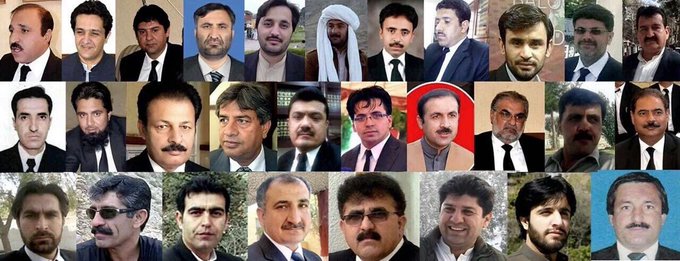
An entire generation of a city’s lawyers was killed in Pakistan


Baluchistan is a place that desperately needs lawyers.
Pakistan's largest province by area, it is the home of a decades-old separatist insurgency, fueled by real grievances over neglect and lack of political representation. It is also increasingly the target of Sunni extremists, who bomb and kill its Shiite minorities. What leaders the province has are widely considered corrupt. Dozens of local journalists have been kidnapped in the past few years. It is nearly impossible for foreign reporters to enter Baluchistan. Lawyers are almost all that give the province a semblance of justice.
About 60 of them were killed in one attack on Monday in Baluchistan's capital, Quetta. They were packed into an emergency room where the body of a slain colleague lay, riddled with gunshot wounds. A widely circulated video showed lawyers milling about the hospital before an enormous explosion. A Pakistani Taliban offshoot claimed the attack, as did the Islamic State, though analysts say the latter's claim is dubious.
A generation of lawyers has been wiped out in Quetta, and it will leave Baluchistan, in more ways than one, lawless.
On Tuesday, the Pakistani bar association called for an indefinite boycott of the courts. But so few lawyers are left in Baluchistan that it will be years, probably, until its legal community recovers.
The global response has been muted. Ban Ki-moon, Hillary Clinton and other international figures issued brief statements. Pakistan's leaders did much the same. No officials have been held responsible for the security breakdown at what should have been a highly guarded scene. The website of Dawn, a Pakistani English-language newspaper, had only a day-old story and photo gallery about the attack on its homepage on Tuesday evening.
Barkhurdar Khan, a member of the Baluchistan Bar Council, was one of the few lawyers who survived the attack. He has practiced in Quetta for nine months. After the attack, Khan offered his singular perspective in a heartrending stream of posts on social media.
"All, I repeat ALL senior practicing lawyers and barristers died today," he wrote. "The number of junior lawyers, who are the sole breadwinners of their homes and who are now unemployed runs into hundreds."
"Most of those who died were first-gen educated. The scenes of misery and loss cannot be put into words. The bent shoulders of their fathers, the broken backs of their brothers. Their kids, still oblivious to their own loss, playing and hoping," Khan continued. "Every lawyer that has ever given me a lift home is dead, except for one, Naveed Qambrani, he is critical and was airlifted to Karachi."
"Heartwrenching is an understatement."
https://www.washingtonpost.com/news/worldviews/wp/2016/08/09/an-entire-generation-of-a-citys-lawyers-was-killed-in-pakistan/

Thursday, August 4, 2016

Pakistan - Most water sources in Islamabad unsafe, says report

Around 53 per cent of water samples taken from filtration plants and other sources in Islamabad contain high bacteria.
A report submitted to the Islamabad mayor’s office by the Water Quality Control Cell (WQCC) of the civic agency shows that along with filtration plants, water from a number of tube wells and overhead tanks is also contaminated and unsafe for human consumption.
In late July, the WQCC collected a total of 55 samples from different water sources across Islamabad. “Of the 55 samples, 26 samples were found safe to drink, while the remaining 29 samples were found unsafe,” says the report, which was issued on July 29.
Incidentally, while a few areas had at least one source of clean drinking water, sectors G-6, G-7, and I-9 had zero sources of clean water between them, forcing residents who cannot afford bottled water to travel long distances to get water or risk falling sick.
“‘Unsafe’ means that the water contains excessive levels of bacteria, chloride, and fluoride,” said WQCC Deputy Director Nadir Hussain Soomro.

Soomro attributed a number of factors to the appalling test result, including irregular cleaning of supply lines and overhead tanks, and setting up tube wells which are too shallow to provide clean water.
Although the issue of inconsistent water quality at filtration plants is well-known among citizens, the extent of contamination in secondary water sources is worrying.
Only three of the eight tube wells checked provided acceptable water, while two of the ten water tanks tested were safe to take a drink from. Earlier this year, the cell tested 11 water filtration plants, seven of which were unsafe to drink from.
Soon after the report was issued, Prime Minister Nawaz Sharif directed the CDA to ensure the supply of “superior” quality water to residents of Islamabad. The report suggests the directive has been ignored. Islamabad Mayor Sheikh Ansar Aziz admitted that after inspecting some of the filtration plants and overhead tanks across Islamabad, he found their condition to be “unsatisfactory”.
He said that majority of the water filtration plants were not being run by the CDA as the civic agency has outsourced them to private contractors.
“The WQCC report has just been released but it has not arrived at my table,” Aziz said, adding that action would be taken against those responsible.
The mayor said that he was working with local government representatives to improve the situation while noting that it would take some time to make discernable progress.

http://tribune.com.pk/story/1155419/alive-water-water-sources-islamabad-unsafe-says-report/

Pakistan - Punjab’s missing children

The epidemic of child kidnappings in Punjab has reached such alarming proportions that even the Supreme Court has been forced to take notice. So far this year, 767 children have been abducted, mainly from larger cities in the province. At a hearing of the case in the Supreme Court this week, the police showed that their only policy for dealing with this horrifying trend is to bury its head in the sand. The report presented to the court by the police admitted that many of the children have not been recovered, prompting Justice Saqib Nisar to say that the responsibility for this lies foremost with the police. In the last six years, 6,793 children have been abducted in the province, according to the police report, out of which nearly 600 still have not been recovered. Just last week, the IG Police Mushtaq Ahmad Sukhera tried to play down the rash of kidnappings saying that in most cases the children have left their houses because of domestic violence or other personal reasons. If that is indeed what is happening, it shouldn’t prove too difficult for the police to track them down – and yet that has proven beyond their abilities.
The policy devised by the IG Police to deal with child abductions does not inspire much confidence either. He has announced that every SHO would be bound to immediately lodge an FIR after receiving an application by parents of their child being abducted. That this most basic duty of a police officer needs to be spelled out in a special policy only shows the lethargy of the police. The policy has also called for snooker clubs and video game arcades to be monitored and action launched against ‘professional’ beggars. Quite what harassing poor people living on the streets or watching children playing games has to do with tackling kidnapping was left unexplained. The police in Punjab should have learned what happens when they are negligent after the horrifying case in Kasur last year when hundreds of children were molested for years and the authorities turned a blind eye to complaints. Children are among the most vulnerable in our society and have been used for everything from prostitution to working as child jockeys in the Gulf. Clearly the police feel trafficking might be behind these kidnappings since ransom has usually not been demanded. This is why they have contacted the police in Sindh and Khyber Pakhtunkhwa for help. That help should be provided before we lose even more of our precious next generation.
https://www.blogger.com/blogger.g?blogID=6906155786122195046#editor/target=post;postID=7042290727806198301

Bilawal Bhutto condemns ‘inaction of govt’ over abduction of 715 kids from Punjab

Chairman Pakistan Peoples Party Bilawal Bhutto Zardari on Thursday expressed grave concern over kidnapping of 715 children in Punjab within last month, ARY News reported.
“Data about these ill-fated and innocent children brings in one’s mind horrific imaginations and criminal silence. Inaction of Prime Minister Nawaz Sharif government on this human disaster should be condemned in strongest terms,” he said in a press statement issued here.
The PPP chairman said that this was pathetic and tragic part of the report that three children were kidnapped daily from Lahore’s Badami Bagh but the Punjab government was pressurizing the parents of the abducted kids to treat them as missing children to hush up the matter.
Bilawal said, according to the reports, most of the kidnapped children belong to poor families which further aggrieves the concerns in the wake of use of innocent children in terrorist activities and brainwashing them into suicide-bombers.

He said that his party was shaken by these reports and would take up this horrendous issue at all available forums as the PPP considers children as the future of our nation and protecting them from all the dangers was the prime responsibility of the state and the society.
https://arynews.tv/en/bilawal-condemns-inaction-of-govt-over-abduction-of-715-kids-from-punjab/

Pakistan - Prime Minister’s silence

It has been over three years since the last general elections. The PML-N government came into power with promises of ending energy shortfall, boosting the economy, and ridding people of other social problems. Three years into their tenure and most of the problems persist. The only progress witnessed has been in the economic sector, but that too has come at the cost of foreign debts. Opposition parties, mainly Pakistan Tehreek-e-Insaf, were protesting on the streets and contesting the election results merely a year after the polls. Now, they are again threatening for street agitation on the Panama Papers issue. Amid all this chaos, it is the public that is suffering as government is focussed more on defending itself against allegations rather than concentrating on the issues that are crippling the country’s economy.
Prime Minister Mian Muhammad Nawaz Sharif has been lately busy in meetings to decide on the issues relating to the extension of the Chief of Army Staff General Raheel Sharif and the protest movement of Pakistan Tehreek-e-Insaf and Pakistan Awami Tehreek. Although there are many speculations in the media circles, there has not been any official word from the Prime Minister’s office.
PML-N came into power with an almost two-third majority in the National Assembly. Moreover, it has won virtually all by-elections as well as local body elections held throughout the country. Moreover, the recent triumph in the AJK elections also speaks volumes of people’s trust in the current government. Government should reciprocate people’s mandate entrusted to it, and form an independent judicial commission for investigations into the Panama Papers issue. No matter how trustworthy the panel is among the masses or the opposition, there is a protocol that needs to be followed, and investigations should be held against the alleged wrongdoings. The sooner government is able to clear its name from the issue, the better it would be for the people of Pakistan as government will be able to focus solely on the issues the people are facing.
The prerogative of the appointment of new army chief or extension of the present one solely rests upon the prime minister. It is he who will make the final decision, and he has every right to remain silent on the issue. Although there is no need to answer useless questions circulating in the media, there should be an active spokesperson of the prime minister to deal with any such concerns. Everywhere around the world, be it the White House, 10 Downing Street or any other office of the country’s premier, an official spokesperson is present to brief the media on all related questions on the premier’s activities. The Prime Minister’s office does not need a spokesperson merely for press briefings; it should maintain its presence on social media for a wider outreach to the masses. The news of prime minister’s activities should not be coming from his relatives, as has happened in recent past, but from the official spokesperson. 

http://dailytimes.com.pk/editorial/03-Aug-16/prime-ministers-silence

Pentagon not to pay Pakistan $300 million in military reimbursements

The Pentagon will not pay Pakistan $300 million in military reimbursements after U.S. Secretary of Defense Ash Carter decided not to tell Congress that Pakistan was taking adequate action against the Haqqani network, a U.S. official said.
Relations between the two countries have been frayed over the past decade, with U.S. officials frustrated by what they term Islamabad's unwillingness to act against Islamist groups such as the Afghan Taliban and the Haqqani network.
"The funds could not be released to the Government of Pakistan at this time because the Secretary has not yet certified that Pakistan has taken sufficient action against the Haqqani network," Pentagon spokesman Adam Stump said on Wednesday.
The $300 million comes under the Coalition Support Fund (CSF), a U.S. Defense Department program to reimburse allies that have incurred costs in supporting counter-terrorist and counter-insurgency operations. Pakistan is the largest recipient.
"This decision does not reduce the significance of the sacrifices that the Pakistani military has undertaken over the last two years," Stump said.
According to Pentagon data, about $14 billion has already been paid to Pakistan under the CSF since 2002.
The decision by the Pentagon is a sign that while it sees some progress by Pakistan in its military operations in North Waziristan, much work remains.
Pakistan rejects harboring militants but says there are limits to how much it can do as it is already fighting multiple Islamist groups and is wary of a "blowback" in the form of more militant attacks on its soil.
"Pakistan does not draw any distinction between any terrorists and we have taken up the fight against terrorism and the terrorist elements within Pakistan," Foreign Office spokesman Nafees Zakaria told reporters in Islamabad on Thursday.
"These reimbursements enable the United States to support Pakistan's ongoing counterterrorism efforts in a manner that serves shared interests of both the countries."
Relations between the United States and Pakistan were tested in May by a U.S. drone strike that killed Afghan Taliban chief Mullah Akhtar Mansour on Pakistani soil.
There has been growing resistance in the U.S. Congress to sending money to Pakistan. Many lawmakers have expressed concern about its nuclear program, commitment to fighting terrorist organizations and cooperation in the Afghanistan peace process.

In March, Republican Senator Bob Corker said he would use his power as the chairman of the Senate Foreign Relations Committee to bar any U.S. funding for Islamabad's purchase of $700 million of Lockheed Martin Corp (LMT.N) F-16 fighter jets.
http://www.reuters.com/article/us-usa-pakistan-military-idUSKCN10F07O

Sunday, July 31, 2016

Pashto Attan Song 2016 - Naghma

Ignorant Muslim fanatics from Afghanistan storm Kalash Valley, steal 2,500 goats, sheep

Intensifying their cross-border attacks, the Afghanistan-based militants took away about 2,500 goats and sheep from the Kalash valley Birir, locals and officials said.
The incident reportedly happened hours after the militants’ attack on Friday in Bamburet valley inhabited by the Kalash minority community.
The Nuristan-based militants had killed two Kalash shepherds in Bamburet valley on Friday and seized over 300 sheep and goats in Karakal border village of Bamburet. This had created fear in the otherwise peaceful area in Chitral.
The locals said dozens of militants from Nuristan province of Afghanistan attacked shepherds in Birir valley and herded away some 2,500 goats and sheep to the neighbouring country.
There are, however, conflicting reports about the number of sheep and goats taken away by the gunmen to Nuristan. According to some reports, the militants drove away some 400 goats and sheep while others said the number was 2,500.
The locals said  the shepherds managed to save their lives by taking refuge in a nearby village.
Meanwhile, the funeral ceremony of Noor Ahmad and Khush Wali, the shepherds who were killed in Friday’s attack, was held late last night without any special rituals.
According to the Kalasha traditions, the mourners perform rituals for the dead for three days before they are laid to rest. People from the three Kalash valleys of Rumbur, Birir and Bamburet gather to pay their last respects.
District Police Officer (DPO) Asif Iqbal Mohmand said the first incident happened early Friday morning near the Pak-Afghan border.
He said they have deployed additional 150 personnel including Elite police force to provide protection to the Kalash people.
There is suspicion that the attackers were Pakistani militants based in Nuristan province of Afghanistan. They have undertaken attacks in the Pakistani border areas in the past as well. Three years ago the militants had infiltrated into the Bamburet valley and killed a shepherd belonging to the Kalash community and taken away his 200 goats and sheep.
The attacks have caused fear among the Kalash people, whose total population is 3,000, and their community elders have asked the government to provide them protection. Though the security and law-enforcement agencies personnel are present in Chitral, including the three Kalash valleys in strength, the militants have continued to launch attacks in remote areas close to the Afghan border.

https://www.thenews.com.pk/print/138948-Afghan-militants-storm-Kalash-Valley-steal-2500-goats-sheep

Pakistan - Back to private jihad?

Afrasiab Khattak
Terminology of “old” and “new” Pakistan has acquired a particular connotation in the recent political discourse in the country. Parallel to that discussion there have also been similar claims and counter claims in debate about the emergence of a new Pakistan in terms of facing the challenge of terrorism.
Operation Zarb-e-Azb and the National Action Plan of 2014 were supposed to have started a new chapter in the country’s security policy with zero tolerance for extremism and terrorism of all brands. Pronouncements of the All Parties Conference held on December 24, 2014 made it quite clear that there is going to be no room for private militias working under any garb (including the religious one) in Pakistan. These notorious outfits working under religious camouflages were supposed to be disarmed and dismantled. The formulation of the amendments in the Military Act of 1952 clearly implied that those who take up arm in the name of religion and sect to wage war against the state will be regarded as jet black terrorists and will face the brunt of anti-terrorist laws. An important section of NAP declared a ban on the proscribed organisations from working under new names. Skeptics who expressed doubts about the seriousness of the deep state in breaking its prolonged relations with militant organisations were silenced because the army leadership was also a party to the decisions of the APC and that means business.
For a few months the optics reflected the NAP narrative. The Media was briefed by government spokespersons from time to time about “targeted operations” against sleeper cells of terrorists, hate speeches and written material inciting violence. But as the year 2015 drew to a close it became quite clear that the more Pakistan changes the more it remains the same. The focus was shifted from toxic ideologies and banned organisations to the alleged corruption in the Fisheries Department of Sindh that was supposed to have financed terrorism! Dr. Asim Hussain’s hospital in Karachi was supposed to have become the mainstay of terrorism. It became quite evident that good Taliban (Afghan Taliban, JuD, JeM and others) had nothing to fear under this new narrative. Haven’t we been here before? Remember General Musharraf’s “enlightened moderation” which was supposed to push back extremist/terrorist ideologies but subsequently the same proved to be a veneer for the regrouping of Taliban on Pakistani soil who were earlier vanquished in Afghanistan?
The middle of year 2016 saw a complete u-turn in the War on Terror. Particularly, after the death of Mulla Mansour, the leader of Afghan Taliban, the jihadi industry in Pakistan has seen a public revival. On May 30 JuD hosted a meeting of pro-Jihadi organisations in Islamabad under the auspices of Defense of Pakistan Council. Leaders of different outfits clearly hinted at an escalation of fighting in Afghanistan. They also expressed their determination to continue their support for militants fighting in the neighboring countries. On June 5 the same conglomerate of extremist organisations came out for a public show of strength in Islamabad. In the holy month of Ramazan Jihadist outfits publicly asked for financial donations in mosques in different cities of the country to support what they called jihad in different places. These activities were reported in media but the government remained totally indifferent. In June the PTI government allocated 300 million rupees in the annual budget of provincial government for the Haqqania religious seminary run by Sami-ul-Haq, the self proclaimed father of the Taliban. What is the rationale for money going from the public exchequer to institutions that refuse to be reformed and insist on spreading extremism? Last but not the least, a public rally was organised by JI, JuD and other extremist outfits last Sunday in Rawalpindi and Islamabad, ostensibly in support of the people’s uprising in Indian held Kashmir. The organisers of the rally publicly collected financial donations.
This line of action is particularly dangerous because the expansion of militancy in the region will inevitably lead to the contraction of peaceful economic cooperation in the region that includes CPEC, CASA and TAPI. Pakistan obviously can’t afford this. Public activities of UN-designated terrorist networks will definitely increase the country’s international isolation. But more dangerous is the possible rise of the so called IS in the region. The facts that have emerged from the news about military operations against militants affiliated with IS in eastern Afghanistan suggest that the bulk of commanders and fighters of this outfit are actually Pakistanis. Most of fighters in Achin, Nazian and Kot districts of Nangrahar Province hail from Oarakzai Agency, Khyber Agency and Bajour Agency and have remained part of the TTP. There has been an active supply line to these fighters in Afghanistan from Tirah Vally in Khyber Agency which is geographically adjacent to these Afghan districts. Lashar-e-Islami (LI) led by Mangal Bagh from Khyber Agency has been the main supplier. This partnership across the Durand Line also includes drug trade and other criminal activities. It is important to note that these elements have also exploited distrust and hostility between the governments of Pakistan and Afghanistan. Both the governments ignored these dangerous elements in the hope that they will harm the other side. Finally the Afghans decided to cleanse their area from this menace and a recent successful operation in Kot is convincing example of this strategy. So far there is no sign of any cooperation between Pakistan and Afghanistan to root out this scourge. The Pak-Afghan coordinated war on terror on both sides of the Durand Line envisaged in 2014 by the two governments did not materialise mainly because Pakistan failed to reconsider her relations with the Taliban.
IS has suffered serious setbacks in both Iraq and Syria in the recent past. Abubakar Albaghdadi who knows this area very well may be tempted to expand his network in Pakistan and Afghanistan where there is a lot of potential and conducive environment. That will mean a new chapter of terrorist activities in the region attracting international focus. But how will Pakistan and Afghanistan fare better than Iraq and Syria? Isn’t it time to finally close the chapter of private Jihad by the Muslim countries? For Pakistan it will mean a rethinking of her Afghan policy, among other things.
http://nation.com.pk/columns/30-Jul-2016/back-to-private-jihad

Bilawal Bhutto shocked over kidnapping of 715 children in Punjab

Chairman Pakistan People’s Party Bilawal Bhutto Zardari has expressed grave concern over kidnapping of 715 innocent children in Punjab within last month without any knowledge about the fate of such large number of children of our nation.
“Data about these ill-fated and innocent children brings in one’s mind horrific imaginations and criminal silence and inaction of Nawaz Sharif government on this human disaster should be condemned in strongest terms,” said the PPP Chairman in a press statement issued here.
He said that this was pathetic and tragic part of the report that three children are kidnapped daily from Lahore’s Badami Bagh but Punjab government was pressurizing the parents of the abducted kids to treat them as missing children to hush up the matter.
Bilawal Bhutto Zardari said, according to the reports, most of the kidnapped children belong to poor families which further aggrieves the concerns in the wake of use of innocent children in terrorist activities and brainwashing them into suicide-bombers.
PPP Chairman said that his Party was shaken by these reports and would take up this horrendous issue at all available forums as the PPP considers children as the future of our nation and protecting them from all the dangers was the prime responsibility of the state and the society.

https://www.thenews.com.pk/latest/138348-Bilawal-Bhutto-shocked-kidnapping-715-children-Punjab#

Bilawal Bhutto condemns Larkana blast

Chairman Pakistan Peoples Party, Bilawal Bhutto Zardari, has strongly condemned blast near Rangers vehicle in Larkana on Saturday.
In a statement issued by the Bilawal House Media Cell, the PPP Chairman asked Sindh government to arrest the terrorists involved in the bomb blast and provide best possible medical facilities to all those injured.
Bilawal Bhutto Zardari expressed sympathies with the family of martyred sepoy and prayed for the departed soul, the statement added.

http://pakobserver.net/2016/07/31/bilawal-bhutto-condemns-larkana-blast/

Tuesday, July 26, 2016

Is Pakistan at Risk for a Coup?

I am a Muslim doctor. I saved a Christian in Pakistan and it nearly cost me my life


Anonymous


I am a Pakistani medical doctor, currently receiving political asylum in the US for the past year and a half. I sought refuge here after having to go through much humiliation and outright hatred for trying to practice ethical medicine and for belonging to a religious minority in my own motherland.
A while back, my father retired from a reputed local bank in Pakistan and moved to the US, along with the rest of my family. I continued to live in Pakistan: I was a fresh medical graduate pursuing the dream of post-graduate education in nephrology.
Life seemed well on track until one night while working an ER shift, when I received a patient needing urgent dialysis. Unattended and disheveled as he was, there was no one with him to get him the medicine he needed. Fearing he might die, I instinctually grabbed the emergency medicine donated via zakaat, an Islamic system of alms-giving, and performed the life-saving hemodialysis.
He survived but I immediately faced the wrath of the nurse. She was mad at me because the patient was a Christian and she said Islamic alms are not meant to be used on non-Muslims. But I did not know the patient’s faith, nor did I know that such a law existed.
I promptly replaced the medicine, which cost around $20. But it didn’t end there. The representative of a conservative Islamic NGO, which was a donor to the clinic, was furious about what I had done. They attributed my lack of knowledge about the alms laws to the fact that I belong to a minority Muslim sect.
A departmental inquiry followed and I was discriminated throughout the entire process. The workplace discrimination gave way to threatening phone calls and vandalism of my car and bike. They found out my family lived in America and that I was alone. This made me an easy target. I was threatened with death at a medical conference hosted by the chair of the same NGO which had complained about me.
Fearing for our lives, my wife, who is also a doctor, and I made it to the US in 2015. We applied for political asylum based on what had happened to us. It took a lot of courage on her part to leave. She had to accept not knowing when she could next visit her family in Pakistan, owing to our asylum status.
Life here as an asylum applicant is hard, as I can’t practice medicine. I have a small, part-time job and study the rest of the time. I am working towards obtaining a license to practice medicine here. All this while, I am also deeply troubled by the discrimination of Muslims in America. I personally feel this country is abandoning the very principles its based on.
The demagogues emerging in this election campaign make me feel that I have no place to seek refuge anymore. My native country is a bedrock of religious fanaticism and presents a certain death for me. Meanwhile my country of asylum is fast enveloping in Islamophobia.
Humanity is the core of any religion. I believe no true Muslim can be an extremist. I knowingly went out of my way to help a human in need, without a thought about his religion. I faced backlash that would change my life forever. But, in the name of humanity, I deem that it was all worth it.
https://www.theguardian.com/commentisfree/2016/jul/26/muslim-doctor-christian-patient-pakistan